


Abstract
User-generated videos (UGVs) and professional-generated videos (PGVs) have become important information sources in movie marketing, yet prior research has largely examined user-generated content and professional-generated content as independent drivers of market performance. This study investigates how UGV influences movie box office revenue through PGV and identifies the boundary conditions of this process. Drawing on signaling theory and the elaboration likelihood model, we propose that UGV volume generates social attention and stimulates PGV production, while PGV serves as a more credible quality signal that affects consumers’ viewing decisions. Using panel data on 226 movies released in China from 2024 to 2025 and 245,890 videos collected from Weibo, we test the proposed framework with fixed-effects models, endogeneity tests, and robustness checks. The results show that UGV volume indirectly increases box office revenue through PGV volume. Moreover, UGV creator reputation strengthens the positive relationship between UGV volume and PGV volume, and PGV perceived usefulness strengthens the positive effect of PGV volume on box office revenue. These findings reveal a sequential pathway through which user-generated social attention is transformed into professional market persuasion, offering theoretical and managerial implications for video-based interactive marketing.
1. Introduction
From ordinary user-generated videos (UGVs) on social media to professionally generated videos (PGVs) by opinion leaders, video has become a critical information source for consumer decision-making, as its multimodal features reduce uncertainty [1]. Consequently, video profoundly influences consumers’ cognition, attitudes, and purchase behavior [2,3], yet it remains unclear how UGVs and PGVs interact in the interactive marketing process to shape market outcomes.
Prior research has separately established the effects of user-generated content (UGC) and professional-generated content (PGC) on product sales. UGC volume and sentiment predict market performance such as box office revenue [4,5], while PGC conveys quality signals that enhance consumer trust and stimulate purchase [6,7]. Moreover, prior evidence on the relative effectiveness of these two content forms is mixed: in an experimental study in which video source and technical quality were manipulated, Hautz et al. [8] find that UGV outperforms agency-generated video only under low technical quality, whereas Li and Tu [9] show that the relative advantage of UGC versus PGC depends on product type (e.g., hedonic vs. utilitarian). To our knowledge, however, no prior study has examined whether and how the two content forms interact sequentially—that is, whether UGV shapes market outcomes by stimulating PGV production, rather than operating alongside it. Extant research largely treats UGC and PGC as parallel, independent information sources [8,9,10,11,12], overlooking the dynamic, sequential interactions between them.
In movie marketing, prior studies have conflated ordinary users with professional opinion leaders and focused almost exclusively on official trailers, neglecting UGVs and PGVs on social media [4,13,14]. Thus, the distinct roles of and interaction between UGV and PGV remain underexplored, limiting our understanding of how interactive marketing unfolds across different types of video content. The movie market offers an especially suitable context for examining the interaction between UGV and PGV. First, movies are typical experience goods whose quality is difficult to evaluate before purchase [15,16]; consumers must therefore rely on external information and their own experience. In contrast, search goods can be described and displayed more directly [1,12]. Second, movies have an extremely short theatrical life cycle, with box office revenue highly concentrated in the first few weeks after release [4]; information diffusion and consumption decisions must therefore be completed within a very short time. In contrast, search goods typically remain on the market for a long time, whereas online experience goods—including travel—afford longer decision and booking windows. Third, movies feature a highly concentrated pre-release information window during which UGV and PGV emerge simultaneously and shape each other [4,5,17]. In contrast, livestream commerce relies heavily on the liveness of content; although livestream previews or influencers’ previous livestream videos may exist, their signaling effect is far weaker than that of movies, and signal uncertainty is higher. It is for these reasons that we selected the movie industry as our research context.
To address these gaps, we integrate signaling theory [18] and the elaboration likelihood model (ELM) [19] to propose a sequential mediation framework. The two theories are complementary: signaling theory identifies which observable information can function as a credible quality signal at the market level, but it does not explain how consumers process such signals; ELM, in turn, explains how consumers process these signals through central versus peripheral routes. We argue that UGV does not directly persuade consumers. Instead, it operates indirectly: UGV volume serves as a low-cost, peripheral-route signal that builds social attention and attracts professional creators. PGV creators, in turn, rely on these signals to produce in-depth, central-route content that functions as a more credible quality signal, ultimately driving box office revenue. In this process, PGV volume mediates the UGV–sales relationship. We further examine two boundary conditions: UGV creator reputation strengthens the positive effect of UGV on PGV generation, and the perceived usefulness of PGV enhances its effect on sales.
Using 226 movies released in China between 2024 and 2025, we construct a panel dataset covering the eight weeks before release, matched with over 245,890 UGV and PGV observations from Weibo. Addressing endogeneity with instrumental-variable methods, our results support the proposed model. First, UGV volume indirectly increases box office revenue by positively affecting PGV volume, uncovering a creator-to-creator influence chain that prior research has overlooked. Second, UGV creator reputation positively moderates the UGV–PGV relationship. Third, the perceived usefulness of PGV content positively moderates the PGV–box office relationship.
This study makes three contributions to interactive marketing research. First, it shifts attention from official trailers to non-official video content and, for the first time, systematically distinguishes UGV from PGV in the movie context, revealing how two types of videos interact sequentially to shape market outcomes. Second, integrating signaling theory and ELM, it reveals a peripheral-to-central pathway through which interactive marketing operates. Third, it identifies creator reputation and perceived usefulness as key boundary conditions. The findings offer practical implications for movie distributors, marketers, and social media platforms.
2. Theoretical Background
2.1. Movie Interactive Marketing
The movie industry offers an ideal context for studying interactive marketing, as consumer decisions rely heavily on information generated and shared on social media. Prior interactive marketing research in this context has examined official trailers [13,20], textual UGC, and consumer engagement behaviors. However, three limitations persist from an interactive marketing perspective.
First, most studies focus on one-way broadcast content (e.g., studio trailers) rather than the multi-directional, participatory dynamics that characterize interactive marketing. Second, existing UGC research often conflates ordinary users with professional opinion leaders, overlooking how these two types of creators interact with and influence each other—a core aspect of platform-orchestrated interactivity. Third, prior work pays insufficient attention to video as a multimodal content format [17,21], despite video’s superior ability to reduce consumer uncertainty [1].
These limitations collectively obscure the interactive dynamics between different creator tiers. To address these gaps, this study distinguishes UGV from PGV in the movie context and examines how their interaction influences movie performance, thereby offering an interactive marketing perspective on video content.
2.2. Video Marketing
Video marketing has become a core channel through which firms capture consumer attention, build brand loyalty, and drive sales [2]. From an interactive marketing perspective, video enables bidirectional communication between brands and consumers, as well as among consumers themselves, making it a uniquely powerful tool for fostering engagement and participation. Prior research has shown that video marketing reduces consumer uncertainty [1], influences brand attitudes [12], and drives purchase intentions [3,22]. In line with this trend, a rapidly growing body of recent digital-marketing research has focused on short-video platforms—TikTok [3,12,22], Douyin [1,22], Instagram Reels [12], and YouTube Shorts [12]—examining how short-video content shapes attention, engagement, and purchase intentions. Zhou et al. [12] find that user-generated short videos on TikTok outperform official marketing videos in perceived authenticity and emotional engagement, indicating that content source fundamentally determines persuasiveness; Zhang et al. [3] identify four audiovisual features (colloquial expression, cadence, colorfulness, and visual prominence) that drive engagement; Xiao et al. [22], drawing on signal theory, show that performance expectancy, entertainment, tie strength, and sales approach shape engagement behavior, with product type as a boundary condition; and Luo et al. [1] demonstrate that content marketing in the “short video + e-commerce” model enhances purchase intentions by building consumer trust. Broadly, these studies converge on the view that short videos—whether firm-generated or user-generated—have become a dominant format for interactive marketing, whose persuasive power depends on content features and the perceived authenticity of the content source.
From the perspective of the content source, the extant literature can be classified into three broad categories: user-generated video (UGV), professional-generated video (PGV), and firm-generated video (FGV). Operationally, these three constructs are distinguished by the identity and expertise of the content producer [6]: UGV is created by ordinary consumers based on personal experience without an identifiable professional role; PGV is produced by professional or semi-professional creators with domain expertise, including non-verified creators when such role-based evidence is explicitly observable; and FGV is issued by the focal firm itself for promotional purposes. Much less attention has been paid to the relationships among these video types and their combined effects on consumer behavior [8,12], with particularly limited discussion of the relationship between UGV and PGV.
Building on this literature, the present study focuses on movies as a representative experience good to empirically examine the interplay between UGV and PGV.
2.3. UGC, PGC, and Product Sales
Early research on online word of mouth did not draw a strict distinction between UGC and PGC, instead subsuming both under the broader category of electronic word of mouth. As the literature developed, scholars began to separate PGC from UGC and examine it independently. PGC is typically produced by creators with domain expertise, serving both persuasive and informative functions, whereas UGC offers a lay perspective but is relatively more subjective [6].
Notably, Hautz et al. [8] challenged the conventional view that UGC is generally more effective than PGC. They found that the relative effects depend on technical quality: under low technical quality, UGV exerts a stronger positive effect on source credibility; under high technical quality, the effect of creator source disappears. Similarly, Li and Tu [9] revealed contextual dependence, showing that UGV is more effective for hedonic products, whereas PGV is more effective for utilitarian products, with perceived credibility and usefulness mediating these effects.
Although research on UGC and PGC has expanded considerably, the extant literature has largely examined their independent effects on consumer behavior, overlooking potential transmission mechanisms between these two content forms. Hirsch’s [23] cultural industry system model offers a useful lens to theorize such a mechanism: it suggests that market success depends on a filtering system from creative communities to professional gatekeepers to consumers.
The mediating model proposed in this study is applicable not only to short-life-cycle experience goods such as movies, but also offers a useful theoretical framework for other product categories characterized by high information asymmetry, such as books, games, and dining services.
3. Study Framework
3.1. PGV as a Mediator Between UGV and Movie Performance
Based on signaling theory, the effectiveness of a signal depends on the cost and credibility with which it conveys unobservable quality [18]. Although UGV is an important form of online word-of-mouth and has been shown to influence consumer attitudes [24,25], it has inherent limitations as a quality signal. From a cost perspective, UGV originates from ordinary consumers’ authentic experiences and is often considered a relatively credible lay perspective [26,27]; however, its value lies primarily in providing diverse user experiences rather than conveying professional quality judgments. From a signal quality perspective, users generally lack professional equipment and content-planning capabilities, and even when some users devote considerable effort, their production costs and technical quality remain far below those of professional creators [8].
Consequently, rather than functioning as a strong quality signal, UGV serves more as a low-cost, high-volume social signal: its proliferation on social networks generates topic salience and an awareness effect [4], thereby attracting professional creators’ attention and providing topical momentum and rich source material for PGV production. In other words, UGV influences the market by guiding professional content creators’ attention and production decisions. When a movie generates substantial spontaneous user discussion, it itself becomes a sociocultural event worthy of professional interpretation, thereby prompting PGV creators to produce related content. From a signaling-theory perspective, PGV creators perceive the high volume of UGV as a signal of the movie’s popularity and are thereby motivated to continue producing PGV content. Accordingly, we propose:
H1.
UGV volume positively affects PGV volume.
The growth of UGV reflects consumers’ interest in the movie and their demand for preliminary interpretation. However, UGV content often remains at the level of personal experience sharing and lacks systematic analysis supported by professional knowledge [8]. This unmet demand for deeper understanding creates space for PGV in the market.
By virtue of their professional production quality and the domain authority of their creators [28], PGV can provide potential viewers with more in-depth and persuasive interpretations of product quality. According to signaling theory [18], in markets characterized by information asymmetry, the high-quality party must convey its quality through observable and costly signals to distinguish itself from lower-quality alternatives.
Building on this perspective, we argue that PGV is not merely an additional information source but rather a mechanism that transforms dispersed user-generated signals into credible quality signals. As a typical experience good, a movie’s quality is difficult for consumers to evaluate accurately before purchase [15]; accordingly, any information carrier that reveals product quality may function as a market signal. Although PGV is not marketing material directly controlled by movie producers, its creation requires professional knowledge, industry experience, and resource investment, thereby reflecting the creator’s professional competence and industry reputation [8,9].
In the movie market, PGV plays the dual role of informing and persuading [29,30]. On the one hand, through professional interpretation, it conveys information about a movie’s artistic value and technical quality, enhances consumer understanding, and provides a better viewing experience [25,31]. On the other hand, through professional endorsement, it conveys quality signals that strengthen consumer confidence [6,7].
From a signaling perspective, the effect of PGV on box office revenue operates primarily through a volume-based mechanism. Erdem and Keane [32] argue that when product quality is uncertain, products supported by a greater volume of professional content are distinguished from comparable products, because the emergence of professional content itself signals to the market that the product is worthy of attention. Liu’s [4] study similarly finds that the explanatory power of word-of-mouth for box office revenue derives primarily from the volume of information. Dhar and Chang’s [5] research in the music industry likewise confirms a positive relationship between content volume and product sales. This suggests that when a movie attracts a large volume of PGV, that volume itself conveys a signal to potential viewers that the movie has attracted broad professional attention and merits consideration. The gatekeeping role of PGV is especially important: prominent critics may function as market gatekeepers [33], and their professional interpretations can effectively reduce consumers’ perceived risk and positively influence box office revenue [16].
Accordingly, the effect of UGV on box office revenue does not operate directly. Rather, UGV generates social attention and initial discussion, which are subsequently translated into professional content production; PGV then transforms this attention into credible and persuasive signals that influence consumer decision-making. Within this process, PGV serves as a key mediating mechanism that converts user-generated social signals into market-relevant persuasion. Because PGV is a costly, credible quality signal that converts user-generated social signals into market-relevant persuasion, the UGV–box-office relationship operates through this PGV channel. On this basis, we propose the following:
H2.
PGV volume mediates the relationship between UGV volume and movie box office revenue. Specifically, UGV volume indirectly increases movie box office revenue by positively affecting PGV volume.
3.2. Moderating Effects of UGV Creator Reputation and PGV Perceived Usefulness
The ELM distinguishes two routes of information processing: the central route, which relies on systematic evaluation of message arguments, and the peripheral route, which relies on cues such as source credibility and message volume [19]. UGV creators are typically ordinary consumers lacking professional authority, and their content consists largely of subjective personal experiences rather than systematic arguments. Accordingly, UGV is inherently peripheral-route information, and UGV volume constitutes an aggregated peripheral cue that generates awareness [4]. Therefore, consumers process UGV through the peripheral route, and UGV volume constitutes an aggregated peripheral cue that generates awareness [4]. Because creator reputation is a source-related cue that pertains to the originator of the message rather than to its content, it is classified under the ELM’s peripheral route.
However, not all UGVs contribute equally to market signals. ELM suggests that under the peripheral route, source-related cues such as reputation significantly affect information credibility [19,34]. Accordingly, UGV creator reputation can be regarded as an amplifying peripheral cue that strengthens the social signal conveyed by UGV volume. Specifically, high-reputation UGV enhances the salience and interpretability of the social signal, making it more likely to be recognized by PGV creators as meaningful rather than noisy information. At the same time, high-reputation UGV implies that the discussion not only has a quantitative foundation but has also received endorsement from relatively higher-quality creators, thereby conveying a clearer signal of market demand to PGV creators and reducing topic-selection uncertainty and creative risk [5]. Therefore, the higher the reputation of UGV creators, the stronger the positive effect of UGV volume on PGV volume. On this basis, we propose:
H3.
UGV creator reputation positively moderates the relationship between UGV volume and PGV volume.
Unlike UGV, PGV possesses the argumentative depth needed to function as central-route information, owing to creators’ professional expertise and production capabilities [8]. When potential viewers seek reference information before making ticket purchase decisions, PGV is more likely to be processed through the central route due to its professional nature: viewers are motivated to reduce risk and can rely on professional interpretation to engage in more systematic information processing.
According to ELM, under the central route, the perceived usefulness of arguments is a core determinant of persuasive effectiveness [34,35]. Unlike source cues such as reputation, perceived usefulness pertains to the diagnostic quality of the message arguments themselves, and is therefore a central-route factor under ELM. Extending this logic to the market level, the effectiveness of PGV depends not only on its volume but also on the perceived usefulness of its content as an informational resource. PGV with higher perceived usefulness provides more diagnostic and insightful perspectives, effectively reducing perceived risk and strengthening viewing confidence, and thus translates more readily into box office revenue. In contrast, when perceived usefulness is low, even a large volume of PGV may offer redundant or superficial arguments, limiting its persuasive impact. Therefore, perceived usefulness determines whether PGV can effectively function as a central-route persuasion mechanism. On this basis, we propose:
H4.
The perceived usefulness of PGV content positively moderates the relationship between PGV volume and movie box office revenue.
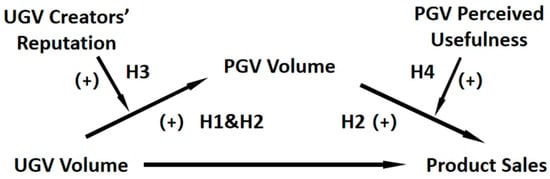
All hypotheses and their relationships are presented in Figure 1.
Figure 1.
Conceptual framework and hypothesized relationships.
4. Variables and Data Sources
To test the research hypotheses, we constructed a panel dataset by integrating multiple data sources. Movie box office revenue, screen counts, genre, sequel status, star participation, professional ratings, user ratings, release schedule, and early marketing intensity were obtained from the China Movie Data Information Network, Douban, IMDb, and Maoyan, respectively. Additional control variables used in robustness checks are defined in Table 1. The study period spans from 1 January 2024 to 31 December 2025, yielding a sample of 226 movies. Given that movie box office revenue is primarily concentrated in the first eight weeks after release [4], we constructed a weekly panel dataset covering the eight weeks prior to release for each movie, resulting in 1808 observations (226 movies × 8 weeks). Because keyword-based retrieval and pagination could capture the same video more than once, duplicates were removed by exact matching on video URL. All key variables used in the main analyses contained no missing values, so no imputation was required. Before computing the sentiment variables, the original text of each video was subjected to standard preprocessing—tokenization and the removal of URLs, mentions, and stopwords—consistent with the sentiment-lexicon procedure [21].
Table 1.
Variable description and source.
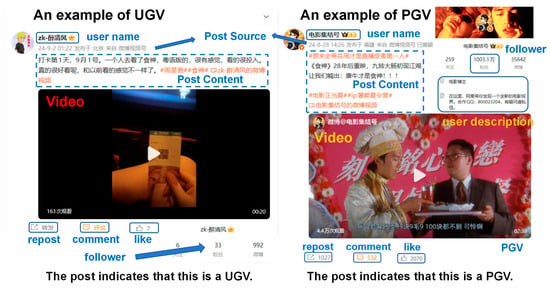
UGV and PGV data were collected from Weibo. Using movie titles as search keywords, we employed a Python web crawler (version 3.9.18) to collect relevant videos from the eight weeks prior to release. Videos were classified based on the account attributes of the publisher. Following prior research that distinguishes user-generated from professional-generated content by whether creators possess professional knowledge and qualifications in the relevant domain [6], videos posted by ordinary personal accounts without clear professional characteristics were classified as UGV. Videos posted by accounts whose nicknames, profile descriptions, or verification information contained professional cues related to media, film criticism, or entertainment (e.g., keywords such as “movie review,” “film and television,” or “media”) were classified as PGV. That is, verified professional identity—certified media or film-criticism accounts, or accounts with explicit occupational cues—served as the sufficient criterion for classifying a creator as professional, consistent with the source-based distinction between amateurs producing outside commercial routines and professionally produced content in the video-marketing literature [8] and with signaling theory’s premise that observable signals proxy for unobservable quality [18]. Content posted by official movie accounts or accounts directly affiliated with the movie was excluded from both categories, because firm-generated content represents the firm’s own promotional signal rather than independent third-party evaluation [36]. This process yielded 110,971 UGVs and 134,919 PGVs. Examples of UGVs and PGVs are shown in Figure 2. To ensure classification validity, two independent coders manually verified 1% of all accounts (n = 2459) following a written coding protocol; disagreements were resolved by discussion, reaching a Cohen’s Kappa of 0.87 (substantial agreement).
Figure 2.
Examples for UGV and PGV.
Variable definitions are reported in Table 1. Following Zimbra et al. [21], UGV and PGV valence was measured as the proportion of positive words in each post using a sentiment lexicon. Consistent with prior social media research [37,38], the average follower count of UGV creators was used as a behavioral proxy for creator reputation, capturing accumulated audience reach and social influence. The average number of PGV likes was used as a behavioral proxy for content usefulness because likes reflect users’ behavioral endorsement of the content’s value in video-based eWOM [14,34,39]. These indicators approximate rather than directly measure reputation and perceived usefulness; their construct-validity limitations are discussed in Section 8.3.
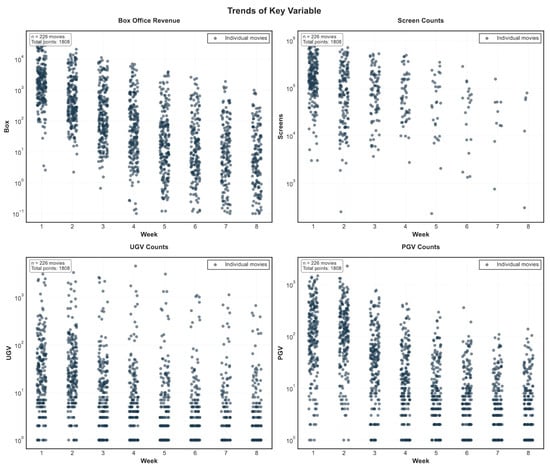
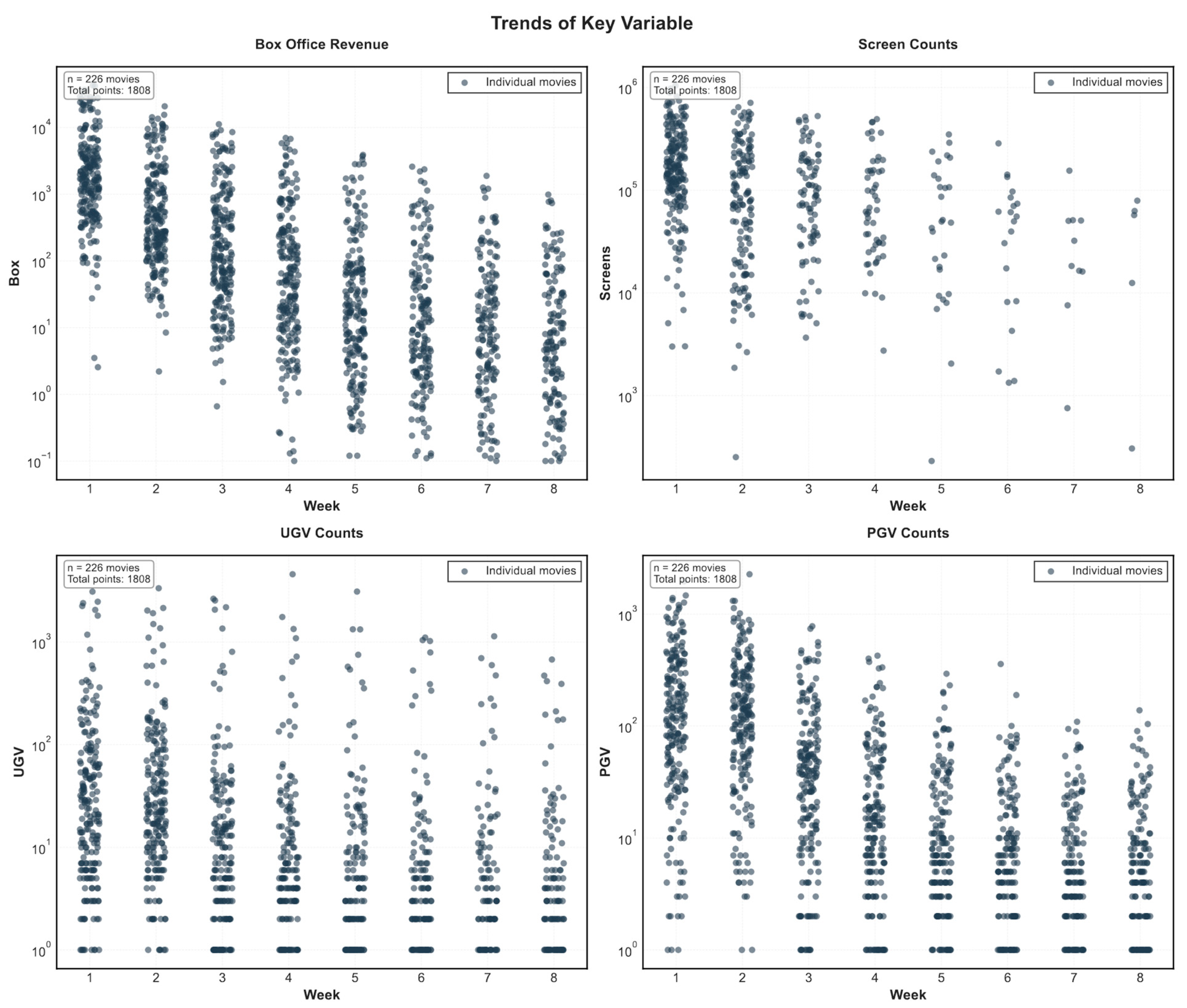
Descriptive statistics are presented in Table 2, and dynamic trends are shown in Figure 3. On average, each movie generated approximately 61 UGVs and 75 PGVs per period. PGVs received more likes than UGVs on average (2279.93 vs. 24.23), and PGV creators had more followers than UGV creators (2.1211 million vs. 1400).
Table 2.
Summary statistics of key variables.
Figure 3.
Trends of key variables over time.
The content-level controls—valence, likes, follower count, and comments—separate the effects of video volume from content sentiment, audience engagement, creator reach, and online discussion, while screen count controls for theatrical availability. The additional robustness controls account for movie-level demand heterogeneity associated with genre, star participation, holiday release, sequel status, marketing intensity, competition, and professional and user evaluations [4,21].
5. Empirical Results
We estimated a two-way fixed-effects model for weekly box office revenue, controlling for movie-specific characteristics and release weeks. Following Liu [4] and Lu et al. [40], all continuous variables were log-transformed.
The regression results for Equation (1) are reported in Table 3. Variance inflation factors for all variables are below 5, suggesting that multicollinearity is unlikely to be a serious concern.
Table 3.
Regression Results of H1 and H2.
Following Baron and Kenny [41], we test the mediating effect of professional-generated video in three steps. First, UGV volume has a significantly positive association with box office revenue (β = 0.171, p < 0.01). Second, UGV volume has a significantly positive effect on the mediator, namely PGV volume (β = 0.544, p < 0.01). Third, when both are included simultaneously, PGV volume remains significant (β = 0.148, p < 0.01), whereas UGV volume becomes insignificant (β = 0.063, p > 0.10). These results indicate that PGV volume mediates the relationship between UGV volume and box office revenue. To formally substantiate the mediating channel, a bootstrap mediation analysis (1000 resamples) confirms that the indirect effect of UGV volume on box office revenue through PGV volume is significantly positive (indirect effect = 0.062, SE = 0.017, z = 3.56, p < 0.001), with a 95% bootstrap confidence interval of [0.028, 0.096] that excludes zero (based on 1000 resamples, of which 923 yielded complete estimates). This evidence is corroborated by the Sobel test (indirect effect = 0.075, p < 0.001; proportion mediated = 54.60%). Full results are reported in Appendix A Table A4 and Table A5.
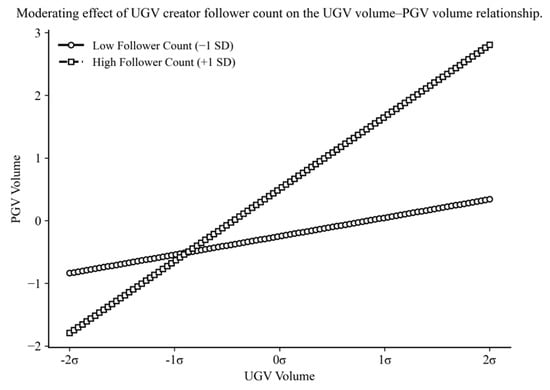
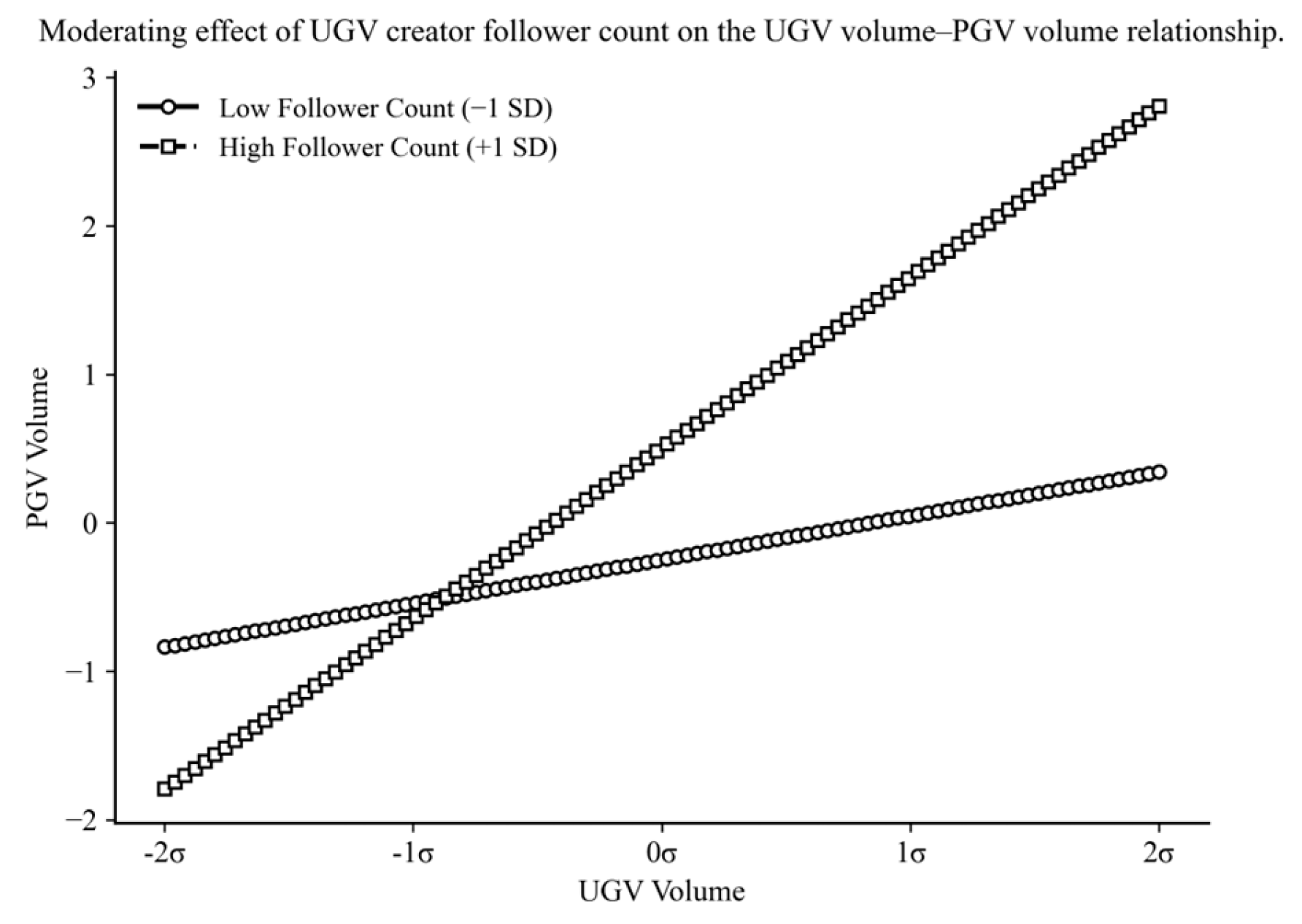
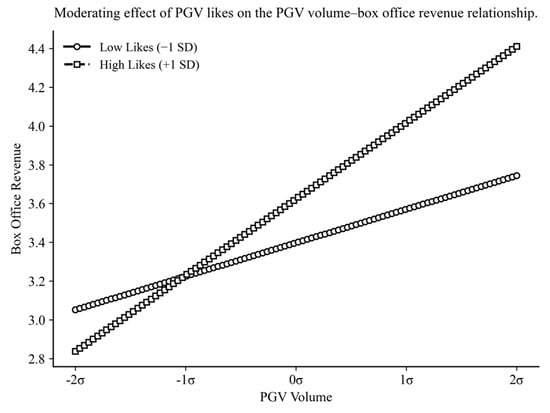
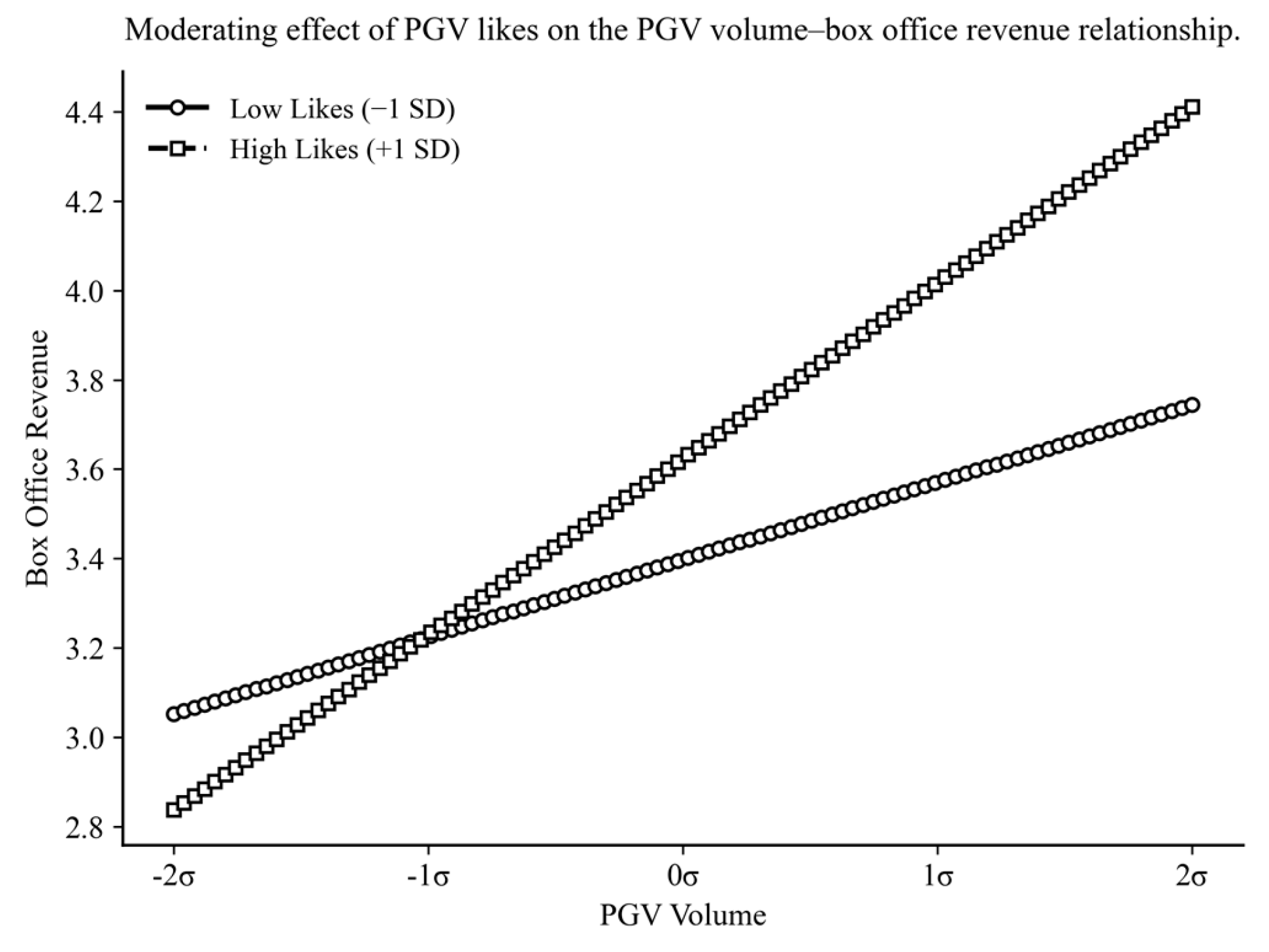
To further examine the moderating effects, we introduce interaction terms. Model 2-1 and Equation (2) include the interaction between UGV volume and average follower count of UGV creators. The coefficient of the interaction term is significantly positive (β = 0.073, p < 0.01), supporting H3. Model 2-2 and Equation (3) include the interaction between PGV volume and the average number of likes received by PGV content. The coefficient of the interaction term is significantly positive (β = 0.021, p < 0.05), supporting H4. The regression results are reported in Table 4. The moderating effects are illustrated in Figure 4 and Figure 5.
Table 4.
Regression results of H3 and H4.
Figure 4.
Moderating effect of UGV creator follower count on the UGV volume–PGV volume relationship.
Figure 5.
Moderating effect of PGV likes on the PGV volume–box office revenue relationship.
6. Endogeneity Test
6.1. Instrumental Variable Approach
To address endogeneity, we employed an IV approach using two-period lags as instruments. For the UGV → PGV path, the second-stage results confirm that UGV volume remains positive after correcting for endogeneity (β = 0.917, p < 0.01). For the full mediation model, PGV volume remains positive (β = 0.614, p < 0.05), while UGV volume becomes insignificant (β = −0.154, p > 0.10), consistent with baseline findings (Appendix A Table A1).
Because each row of our panel aligns UGV and PGV in period t − 1 with box office revenue in period t, we instrument the endogenous video variables with their one-period panel lags, corresponding to t − 2 relative to box office revenue. The lagged regressors satisfy the relevance condition: the first-stage coefficient on the t − 2 instrument is positive and highly significant (β = 0.281, p < 0.001), with a Kleibergen–Paap rk Wald F-statistic of 155.97, well above the Stock–Yogo 10% maximal IV-size critical value of 16.38; the null of underidentification is also rejected (p < 0.001).
The exclusion restriction is not directly testable and therefore remains an identifying assumption. Specifically, conditional on movie and period fixed effects, contemporaneous theatrical exposure, and lagged content characteristics, video activity at t − 2 is assumed to affect box office revenue at t only through its persistence into video activity at t − 1. Movie and period fixed effects absorb time-invariant movie characteristics and common period shocks, while the content and screen controls reduce the possibility that the instruments capture persistent differences in sentiment, engagement, creator reach, discussion, or theatrical availability. Nevertheless, because earlier video activity could have persistent effects on audience attention, the IV results are interpreted as robustness evidence rather than definitive causal identification. We also attempted to search for other instrumental variables, such as the mean volume of UGV and PGV for movies of the same genre, the mean volume of UGV and PGV in the same period, and the mean volume of UGV and PGV for movies of the same genre in the same period. However, none of these passed the first-stage test.
As an alternative-lag check, the t − 3 instrument yields qualitatively similar second-stage results. The t − 4 instrument, however, is substantially weaker (Kleibergen–Paap rk Wald F = 9.83), and its second-stage estimate is statistically insignificant. Because weak instruments can produce imprecise and unstable estimates, we do not interpret the t − 4 result as evidence for or against the proposed relationship. Rather, this comparison indicates that instrument relevance declines at longer lags, while the findings remain qualitatively similar when a sufficiently relevant alternative lag is used.
6.2. Control Function Approach
Because endogeneity may extend to interaction terms, we employed the control function approach. For the moderating effect of UGV creator reputation (H3), the original interaction term remains significantly positive (β = 0.075, p < 0.01). Although the residual-based interaction term is significant in this model, suggesting some endogeneity, the original interaction term retains its significance and direction, supporting the robustness of H3. For the moderating effect of PGV perceived usefulness (H4), both PGV volume and its interaction with the moderator remain significantly positive after controlling for endogeneity. Overall, both moderating effects are robust (Appendix A Table A2).
The control function approach is preferred over dynamic panel GMM estimation for two reasons. First, endogeneity enters our model primarily through the interaction terms: because UGV volume is endogenous—partly driven by unobserved factors such as film quality or marketing intensity—the interaction term between UGV volume and the moderator inherits that endogeneity. Consequently, the interaction remains endogenous even when the moderator itself is exogenous. Second, standard 2SLS and linear GMM frameworks are not ideally suited for this setting [41]. Their estimation strategy substitutes the predicted value of the endogenous variable into the model, which is consistent only when the endogenous variable enters linearly; for interaction terms, which are nonlinear functions of the endogenous variable, this substitution is no longer generally consistent. In addition, the moment conditions underlying standard linear GMM are designed for linear endogenous regressors and do not directly identify the endogenous component in product terms such as UGV × M. While one could construct ad hoc instruments for such terms, doing so often leads to weak-instrument problems in practice. The control function approach addresses the issue more directly [42]: it retains the endogenous variable in its original form and includes the first-stage residual, together with its interaction with the moderator, as additional controls in the second stage, thereby purging the endogenous component from the interaction term. We therefore rely on two-way fixed-effects models with the control function correction.
6.3. Placebo Test
To rule out reverse causality or anticipatory effects, we conducted placebo tests by replacing core variables with their one-period-ahead values. Neither one-period-ahead PGV, UGV, nor their interactions significantly explained current box office revenue. These findings indicate that the moderating effects are not driven by mechanical time trends, reverse causality, or unobserved contemporaneous shocks (Appendix A Table A3).
7. Robustness Checks
To test the robustness of our core conclusions, we conducted a series of checks across multiple dimensions. First, re-estimating the models with split box office revenue (Boxnet) as an alternative dependent variable yielded results consistent with the baseline. Second, under OLS without fixed effects, the main effects and the mediation path remained significant—indeed, the effect of UGV on PGV was even stronger—indicating that the conclusions do not hinge on the fixed-effects specification. Third, after winsorizing all continuous variables at the 1st/99th and 5th/95th percentiles, all key coefficients remained virtually identical to the baseline in both magnitude and significance, indicating that the results are not driven by extreme observations. Fourth, after including firm-generated content (FGV) as a control using an orthogonalization procedure to eliminate collinearity, the effects of UGV and PGV were essentially identical to the baseline, showing that the core mechanism is not confounded by official content. Fifth, under random-effects estimation, the key paths remained significant, further ruling out that the conclusions depend on the choice between fixed and random effects. Overall, all robustness checks support the same conclusion: UGV significantly stimulates the production of PGV, PGV has a significant positive effect on box office revenue, and PGV plays a full mediating role between UGV and box office revenue—the direct effect of UGV on box office revenue is insignificant across all specifications, and its effect is fully channeled through PGV. These results indicate that our findings are highly robust to alternative measures of the dependent variable, model specifications, extreme-value treatments, omitted variables, and estimation methods. All results of the robustness checks are presented in Table 5.
Table 5.
Robustness checks.
To examine whether the proposed relationships remain consistent across market conditions, we conducted exploratory subgroup analyses along five dimensions—movie genre, star participation, release period, sequel status, and competitive intensity. For each dimension, we estimated the H1 model predicting PGV volume and the H2 box office model including both UGV and PGV volume.
- (1)
- Movie Genre (drama vs. non-drama). The UGV → PGV path is significantly positive for both non-drama films (β = 0.563, SE = 0.065, p < 0.001) and drama films (β = 0.523, SE = 0.056, p < 0.001), with similar coefficient magnitudes. The PGV → Box Office path is significant for non-drama films (β = 0.205, SE = 0.060, p < 0.01) but not for drama films (β = 0.086, SE = 0.071, p > 0.10). Although this difference in subgroup significance does not establish a statistically significant between-group difference, the descriptive pattern is consistent with an information-asymmetry explanation: professional interpretation may have greater informational value for non-drama films, for which audiences have less well-formed quality expectations.
- (2)
- Star Participation (with stars vs. without stars). The UGV → PGV path is significant in both groups, with nearly identical coefficients (with stars: β = 0.547, SE = 0.052, p < 0.001; without stars: β = 0.544, SE = 0.077, p < 0.001). The PGV → Box Office path is significant for films with stars (β = 0.161, SE = 0.057, p < 0.01) but not for films without stars (β = 0.104, SE = 0.081, p > 0.10). This descriptive pattern may reflect complementarity between professional content and star-related attention: a broader initial audience may allow professional interpretation to receive greater exposure and translate more readily into viewing decisions.
- (3)
- Release Period (holiday vs. non-holiday). The UGV → PGV path is significant in both non-holiday (β = 0.648, SE = 0.054, p < 0.001) and holiday periods (β = 0.464, SE = 0.060, p < 0.001), with a numerically larger coefficient in the non-holiday subgroup. The PGV → Box Office path is significant in non-holiday periods (β = 0.171, SE = 0.067, p < 0.05) but not during holiday periods (β = 0.109, SE = 0.066, p > 0.10). This pattern may reflect differences in information reliance: holiday viewing decisions may be shaped more strongly by seasonal consumption and social needs, whereas non-holiday audiences may rely more on active information search and professional interpretation.
- (4)
- Sequel Status (sequel vs. non-sequel). The UGV → PGV path is significant in both groups (non-sequel: β = 0.569, SE = 0.044, p < 0.001; sequel: β = 0.448, SE = 0.128, p < 0.001). The PGV → Box Office path is significant for non-sequels (β = 0.144, SE = 0.054, p < 0.01) but not for sequels (β = 0.108, SE = 0.088, p > 0.10). This descriptive pattern is consistent with signaling theory: audiences may have established quality perceptions from a predecessor, reducing the marginal informational value of professional interpretation for sequels, whereas professional content may provide a more important quality signal for unfamiliar non-sequel films.
- (5)
- Competitive Intensity (high vs. low competition). The UGV → PGV path is significant under both low (β = 0.500, SE = 0.061, p < 0.001) and high competition (β = 0.589, SE = 0.060, p < 0.001). The PGV → Box Office path is also significant under both low (β = 0.136, SE = 0.053, p < 0.05) and high competition (β = 0.160, SE = 0.076, p < 0.05), with similar coefficient magnitudes. Thus, among the examined dimensions, the proposed pathway displays its most consistent descriptive pattern across levels of competitive intensity.
Overall, the UGV → PGV path remains positive and significant across all subgroups, whereas the PGV → Box Office path exhibits greater descriptive variation. Because differences in subgroup significance do not themselves establish significant coefficient differences, these results are interpreted as exploratory evidence rather than formal moderation tests.
8. Discussion
This study examines how two types of social media video content, namely UGV and PGV, jointly shape the market performance of experience goods. By integrating signaling theory and the elaboration likelihood model, it develops a moderating framework in which PGV mediates the relationship between UGV and box office revenue. The findings suggest that social media video content does not influence market outcomes through a single homogeneous mechanism; rather, UGV and PGV play distinct but complementary roles in the process through which attention is translated into consumption. The following discussion considers the theoretical contributions, managerial implications, and limitations of the study.
8.1. Theoretical Contributions
First, this study advances movie marketing research by systematically distinguishing UGV from PGV. Prior work has focused on official trailers or textual UGC while conflating ordinary users with professional opinion leaders [20]. By shifting attention to non-official video content, we reveal a distinct division of labor: UGV generates social attention through quantity, whereas PGV converts that attention into credible quality signals. This division of labor also helps reconcile findings that previously appeared contradictory: studies documenting strong direct effects of user content on sales [4,26] typically observed markets or periods in which professional content had not yet diffused, whereas studies emphasizing expert content [16,33] operated in settings where user-generated attention was already abundant. From this perspective, these are not competing truths but different stages of one influence chain, which explains why the relative effectiveness of UGV versus PGV varies across studies.
Second, this study uncovers a mediating mechanism linking UGV and PGV, integrating signaling theory and ELM into a unified framework. Unlike prior research treating UGC and PGC as parallel drivers [43], we show they are linked through a sequential process. UGV serves as a low-cost signal that attracts professional creators, reducing their topic-selection uncertainty. PGV then operates through ELM’s central route, providing systematic, credible information that persuades consumers. This integration explains why UGV and PGV have different effects: the former functions as a peripheral cue, the latter as a central argument. In extending these two theories, our findings first broaden signaling theory from its traditional focus on costly signals sent by firms to consumers, toward a peer-driven signaling chain in which even low-cost, high-volume user content transmits informative market signals that professional creators observe and act upon. For ELM, we extend the framework from individual-level attitude-change experiments to aggregate market outcomes. Our results indicate that, for the movie-going audience, the two routes can be driven by different content types within the same market: UGV volume operates as a peripheral cue processed with limited elaboration, whereas PGV provides argument-rich information that audiences scrutinize via the central route.
Third, this study identifies key boundary conditions in the influence chain. Creator reputation strengthens the UGV → PGV link by amplifying market signals, while perceived usefulness of PGV strengthens the PGV → sales link by enhancing persuasive effectiveness. These findings suggest that UGV and PGV rely on different mechanisms at different stages—peripheral-route signaling versus central-route quality evaluation.
8.2. Managerial Implications
This study offers practical implications for movie distributors, marketers, and social media platforms.
First, for movie distributors, our findings suggest a staged, signal-driven allocation of marketing resources across the pre-release window. Because UGV volume precedes professional content production and can serve as a leading indicator of audience interest, distributors can monitor UGV metrics on a weekly basis and schedule PGV collaborations (e.g., film-critic videos, professional commentary, in-depth interpretations) to go live when UGV-driven buzz reaches its peak. Investment in professional content should not be allocated evenly but scaled in proportion to the observed UGV momentum; for titles with high user-generated buzz, the release of PGV content should be accelerated before opening [4,17]. At the same time, because the persuasiveness of PGV derives from perceived usefulness rather than volume, distributors should select PGV collaborators based on content quality (argument depth, professional expertise) and brief them to address the specific questions and uncertainties visible in audiences’ comments on UGV posts.
Second, for social media platforms, our findings point to a concrete design of algorithmic and incentive mechanisms. Recommendation systems should detect UGV-driven topic momentum and push professional content about the same title to the same audiences within a short window, rather than ranking UGV and PGV separately through independent, content-type-divided feeds—this cross-content linkage is effective precisely because it amplifies the bridging social capital mechanism through which attention is converted into market outcomes [24]. On the incentive side, platforms can launch creator programs that reward PGV creators who provide professional interpretations of trending UGV topics and generate sustained engagement, while granting high-reputation UGV creators (whose signals are amplified by their audience base) greater exposure on topic-discovery pages, thereby forming a virtuous cycle between user buzz and professional interpretation.
Third, for creators, our findings provide a clear, evidence-based positioning strategy. UGV creators should emphasize authenticity and sustained interaction with their audience, such as replying to comments and maintaining a regular posting cadence, because the perceived credibility rooted in sustained engagement is what amplifies their signal [28,37]. In contrast, PGV creators should compete on argument quality rather than on speed or volume: their influence depends on perceived usefulness, and therefore investing in domain expertise, structured argumentation, and coverage of the specific questions raised by audiences is more valuable than maximizing output [9,25]. The two types of creators should not imitate each other but treat their complementarity as a deliberate strategy—UGV creators supply volume and visibility, PGV creators supply depth and persuasion—and coordinate the timing of their content (with PGV responding within days after a UGV topic goes viral), thereby fostering an efficient, self-reinforcing content ecosystem.
8.3. Research Limitations and Future Directions
This study has several limitations that point to promising directions for future research.
First, generalizability is constrained by the sample and research context. This study focuses on the Chinese movie market using Weibo as the primary data source. The specific social media ecology and cultural context may limit external validity. Future research could extend this framework to other countries or regions, examine its applicability to other experience goods, and test it across multiple platforms. Relatedly, our evidence is drawn from a single platform, and platform-specific biases—such as Weibo’s recommendation algorithms, which may amplify certain content, and potential omitted variables correlated with both content volume and box office performance—cannot be fully ruled out. Because algorithmic curation can shape which UGV and PGV gain visibility, the observed effects may partly reflect platform mechanics rather than content quality alone.
Second, the platform metrics used in this study are behavioral proxies rather than direct perceptual measures. Average follower count captures accumulated popularity, audience reach, and social influence but may not fully represent domain-specific reputation, authority, or credibility. Similarly, likes indicate behavioral engagement and endorsement but do not directly measure perceived informational usefulness. The results should therefore be interpreted as relationships involving behavioral approximations of the proposed constructs. Future research could use surveys or experiments to measure reputation and perceived usefulness directly and examine how PGV characteristics such as argument depth, emotional arousal, and audiovisual quality affect consumer persuasion.
Third, causal mechanisms warrant further validation. Although this study alleviates endogeneity concerns using instrumental variables, the control function approach, and placebo tests, the interaction between UGV and PGV and its effects on market performance merit deeper investigation. Future research could introduce external interventions, experiments, or quasi-experimental designs to further examine how UGV influences PGV creation and box office revenue, and to identify the causal effects of different video content types under specific conditions.
Fourth, our modeling choice regarding PGV merits discussion. We model PGV as a mediator through which UGV shapes box office revenue, consistent with our theoretical framework. We acknowledge, however, that alternative specifications—such as treating PGV as a sequential outcome of UGV or as a parallel mechanism alongside UGV—are theoretically plausible and cannot be definitively ruled out by our data. Our empirical results are consistent with the mediating interpretation, yet they do not constitute a formal test against these alternatives. We therefore encourage future research to compare alternative model specifications using more flexible approaches, such as structural equation modeling or panel vector autoregression, to further validate the proposed mechanism.
9. Conclusions
Situated in the Chinese movie market, this study examines how UGV and PGV jointly shape box office outcomes. Drawing on signaling theory and the elaboration likelihood model, it develops and tests a mediated moderation framework in which UGV stimulates PGV production and PGV, in turn, translates social attention into market performance. Based on panel data for 226 movies matched with over 240,000 UGV and PGV posts, the findings show that UGV does not simply function as parallel word-of-mouth alongside PGV; rather, it indirectly affects box office revenue by facilitating PGV creation. The results further indicate that this process is contingent on two important conditions: the reputation of UGV creators strengthens the positive relationship between UGV and PGV, whereas the perceived usefulness of PGV strengthens the positive relationship between PGV and box office revenue.
Overall, the study shows that different types of video content play complementary roles in the market influence process: UGV helps generate early visibility and social momentum, whereas PGV provides the more credible and persuasive interpretation needed to convert attention into consumption. Beyond the movie industry, this pattern offers a tentative extension to digital marketing theory that future research should validate: we conjecture—rather than claim—that user- and professional-generated content operate in a staged, interdependent chain in other experience goods, a question our single-platform, single-market design cannot answer. The central take-home message is that the true value of user content lies not in its direct market impact but in the demand signal it sends to professional creators: it triggers credible professional interpretation that ultimately converts attention into market outcomes—buzz is the raw material, interpretation is the converter.
Future research should examine cross-platform comparisons (e.g., Douyin, Bilibili, YouTube), the role of AI-generated content and influencer marketing in this chain, and cross-cultural validation of the UGV→PGV mechanism.
Author Contributions
Conceptualization, Y.C. and P.Z.; methodology, W.L.; software, Y.C.; validation, Y.C., W.L. and Y.L.; formal analysis, Y.C.; investigation, W.L.; resources, P.Z.; data curation, Y.C. and Y.L.; writing—original draft preparation, Y.C.; writing—review and editing, W.L. and P.Z.; visualization, Y.L.; supervision, P.Z.; project administration, P.Z.; funding acquisition, P.Z. All authors have read and agreed to the published version of the manuscript.
Funding
This research was funded by the Humanities and Social Science Fund of the Ministry of Education of China, grant number 24YJA630143.
Institutional Review Board Statement
Not applicable. This study used publicly available online data collected from Weibo and did not involve human participants, human tissues, or animals. Ethical approval was therefore not required.
Informed Consent Statement
Not applicable. This study did not involve human subjects.
Data Availability Statement
The data used in this study were collected from publicly available posts on the Sina Weibo platform. Only publicly visible pages were accessed, and no login-protected or non-public information was involved. Access frequency and data volume were reasonably controlled to avoid affecting platform operations. All collected data were anonymized and de-identified, with all personally identifiable information (e.g., usernames and user IDs) removed, retaining only textual content for analysis. As the data were obtained from a third-party public platform and have been anonymized, the raw data are not publicly available but can be requested from the corresponding author (Peng Zou, zoupeng@hit.edu.cn) for legitimate academic purposes.
Acknowledgments
The authors gratefully acknowledge the financial support from the Humanities and Social Science Fund of the Ministry of Education of China (Grant No. 24YJA630143).
Conflicts of Interest
The authors declare no conflicts of interest. The funders had no role in the design of the study; in the collection, analyses, or interpretation of data; in the writing of the manuscript; or in the decision to publish the results.
Appendix A
Table A1.
Instrumental variable estimation results.
Table A2.
Control function approach results.
Table A3.
Placebo test.
Full results of Sobel–Goodman and bootstrap mediation tests are reported in Appendix A Table A4 and Table A5.
Table A4.
Sobel-Goodman mediation test results.
Table A5.
Bootstrap mediation test results.
This Appendix A provides the Python script used to collect UGV and PGV data from Weibo. Movie titles were used as search keywords, and videos were collected from the eight weeks prior to release. The script is presented for reproducibility; the login cookie is a personal credential and is passed through the environment variable WEIBO_COOKIE.
import os
import re
import time
import requests
import pandas as pd
import yaml
from bs4 import BeautifulSoup
from datetime import datetime, timedelta
# The Cookie is a personal login credential. Please obtain it from the
# browser developer tools (F12) after logging in and pass it via the
# environment variable WEIBO_COOKIE.
COOKIE = os.environ.get("WEIBO_COOKIE", "")
HEADERS = {
"User-Agent": "Mozilla/5.0 (Windows NT 10.0; Win64; x64)",
"Accept-Language": "zh-CN,zh;q=0.9",
}
SEARCH_URL = "https://s.weibo.com/weibo"
# Advanced search page
DETAIL_URL = "https://weibo.com/ajax/statuses/show" # Post detail API
USER_URL = "https://weibo.com/ajax/side/cards/sideUser" # Author info API
RETRY, RETRY_WAIT = 3, 60 # Number of retries and interval (seconds)
def gen_dates(start_date, before=7, after=48):
"""Generate the search date list: from 7 days before to 48 days after release."""
d0 = datetime.strptime(start_date, "%Y-%m-%d")
return [(d0 + timedelta(days=o)).strftime("%Y-%m-%d")
for o in range(-before, after + 1)]
def http_get(url, params=None, referer=None):
"""Send a GET request with simple retry logic."""
headers = dict(HEADERS)
if referer:
headers["Referer"] = referer
for _ in range(RETRY):
try:
r = requests.get(url, params=params, headers=headers, cookies={"Cookie": COOKIE}, timeout=10)
if r.text:
return r
except requests.RequestException:
time.sleep(RETRY_WAIT)
raise ConnectionError(f"Request failed: {url}")
def parse_search(html):
"""Parse the search result page and return (post URLs, max page number)."""
soup = BeautifulSoup(html, "html.parser")
links = ["https:" + a["href"]
for div in soup.find_all("div", class_="from")
if (a := div.find("a")) and a.get("href")]
max_page = 1
ul = soup.find("ul", class_="s-scroll")
if ul and ul.find_all("li"):
m = re.search(r"page=(\d+)", ul.find_all("li")[-1].find("a")["href"])
if m:
max_page = int(m.group(1))
return links, max_page
def fetch_item(url):
"""Fetch the detail of a single post and its author’s profile."""
mbid = url.split("/")[-1].split("?")[0]
uid = url.split("//")[-1].split("/")[1]
post = http_get(DETAIL_URL, {"id": mbid, "locale": "zh-CN", "isGetLongText": "true"}, url).json()
user = http_get(USER_URL, {"id": mbid, "idType": "mid"}, url).json()
media = post.get("page_info", {}).get("media_info", {})
u = user.get("data", {}).get("user", {})
stc = u.get("status_total_counter", {})
return {
"url": url, "uid": uid, "mbid": mbid,
"user_name": u.get("screen_name", ""),
"followers_count": u.get("followers_count", 0),
"text": post.get("text_raw", ""),
"is_retweet": int("retweeted_status" in post),
"is_AIGC": int("ai_tag_info" in post),
"video_duration": media.get("duration", 0),
"reposts_count": post.get("reposts_count", 0),
"comments_count": post.get("comments_count", 0),
"attitudes_count": post.get("attitudes_count", 0),
"comment_cnt": stc.get("comment_cnt", 0),
"repost_cnt": stc.get("repost_cnt", 0),
"like_cnt": stc.get("like_cnt", 0),
"total_cnt": stc.get("total_cnt", 0),
}
def main(config_path, out_dir="weibo_data"):
# config.yaml: [{"film_name": "movie title", "start_date": "YYYY-MM-DD"}]
with open(config_path, encoding="utf-8") as f:
films = yaml.safe_load(f)
for film in films:
name, start = film["film_name"], film["start_date"]
os.makedirs(f"{out_dir}/{name}", exist_ok=True)
query = f"film {name} #{name}#"
for date in gen_dates(start):
out_csv = f"{out_dir}/{name}/{date}.csv"
if os.path.exists(out_csv): # Skip if already collected
continue
records = []
for hour in range(24): # Search hour by hour for complete pagination
end = (datetime.strptime(date, "%Y-%m-%d")
+ timedelta(days=1)).strftime("%Y-%m-%d") if hour == 23 else date
end_hour = "00" if hour == 23 else f"{hour + 1:02d}"
timescope = f"custom:{date}-{hour:02d}:{end}-{end_hour}"
params = {"q": query, "scope": "ori", "suball": "1",
"page": 1, "timescope": timescope}
html = http_get(SEARCH_URL, params).text
if "sorry, no results" in html: # No results found
continue
_, max_page = parse_search(html)
for page in range(1, max_page + 1):
params["page"] = page
referer = None if page == 1 else (
f"{SEARCH_URL}?q={requests.utils.quote(query)}"
f"×cope={timescope}&page={page - 1}")
html = http_get(SEARCH_URL, params, referer).text
links, _ = parse_search(html)
for u in links:
records.append(fetch_item(u))
time.sleep(1) # Rate limiting
pd.DataFrame(records).to_csv(out_csv, index=False, encoding="utf-8-sig")
print(f"Done: {name} {date} {len(records)} posts")
if __name__ == "__main__":
main("config/spider_config.yaml")
References
- Luo, C.; Hasan, N.A.M.; Ahmad, A.M.Z.; Lei, G. Influence of short video content on consumers’ purchase intentions. Sci. Rep. 2025, 15, 16605. [Google Scholar] [CrossRef] [Scilit] [PubMed]
- Wen, X.; Niu, Y.; Liao, C. U-shaped effect of color in short-form video: Combination of text, audio, image ML and generative AI. J. Bus. Res. 2025, 192, 115278. [Google Scholar] [CrossRef] [Scilit]
- Zhang, Z.; Qiu, K.; Ye, Y. Influence of audiovisual features of short video advertising on consumer engagement behaviors: Evidence from TikTok. J. Bus. Res. 2025, 201, 115662. [Google Scholar] [CrossRef] [Scilit]
- Liu, Y. Word of mouth for movies: Its dynamics and impact on box office revenue. J. Mark. 2006, 70, 74–89. [Google Scholar] [CrossRef] [Scilit]
- Dhar, V.; Chang, E.A. Does chatter matter? The impact of user-generated content on music sales. J. Interact. Mark. 2009, 23, 300–307. [Google Scholar] [CrossRef] [Scilit]
- Chen, X.; Wang, Y.; Wei, S. How does social media influence car sales: The effects of firm-, user-, and professional-generated content. Inf. Technol. Manag. 2025, 26, 305–322. [Google Scholar] [CrossRef] [Scilit]
- Thuy, D.C.; Quang, N.N.; Huong, L.T.; Phuong, N.T.M. The moderating effects of involvement on the relationships between key opinion leaders, customer’s attitude and purchase intention on social media. Cogent Bus. Manag. 2024, 11, 2400600. [Google Scholar] [CrossRef] [Scilit]
- Hautz, J.; Füller, J.; Hutter, K.; Thürridl, C. Let users generate your video ads? The impact of video source and quality on consumers’ perceptions and intended behaviors. J. Interact. Mark. 2014, 28, 1–15. [Google Scholar] [CrossRef] [Scilit]
- Li, H.; Tu, X. Who generates your video ads? The matching effect of short-form video sources and destination types on visit intention. Asia Pac. J. Mark. Logist. 2024, 36, 660–677. [Google Scholar] [CrossRef] [Scilit]
- Zhu, J.; Tse, D.K.C.; Fei, Q. Effects of online consumer reviews on firm-based and expert-based communications. J. Res. Interact. Mark. 2018, 12, 45–78. [Google Scholar] [CrossRef] [Scilit]
- Li, X.; Fan, T.; Yu, H.; Yang, P. Online controversial events: Leveraging consumer engagement with users’ positive buzz. J. Res. Interact. Mark. 2024, 19, 984–998. [Google Scholar] [CrossRef] [Scilit]
- Zhou, X.; Liu, G. From TikTok to travel: The impact of sport related user-generated short videos on destination brand attitude and purchase intention. J. Retail. Consum. Serv. 2026, 90, 104709. [Google Scholar] [CrossRef] [Scilit]
- Adigüzel, F. Consumer engagement on social media: Its dynamics and impact on box office sales. Pazarlama Pazarlama Araştırmaları Derg. 2021, 14, 643–668. [Google Scholar]
- Oh, C.; Roumani, Y.; Nwankpa, J.K.; Hu, H.-F. Beyond likes and tweets: Consumer engagement behavior and movie box office in social media. Inf. Manag. 2017, 54, 25–37. [Google Scholar] [CrossRef] [Scilit]
- Akerlof, G.A. The market for “lemons”: Quality uncertainty and the market mechanism. Q. J. Econ. 1970, 84, 488–500. [Google Scholar] [CrossRef] [Scilit]
- Reinstein, D.A.; Snyder, C.M. The influence of expert reviews on consumer demand for experience goods: A case study of movie critics. J. Ind. Econ. 2005, 53, 27–51. [Google Scholar] [CrossRef] [Scilit]
- Hennig-Thurau, T.; Wiertz, C.; Feldhaus, F. Does Twitter matter? The impact of microblogging word of mouth on consumers’ adoption of new movies. J. Acad. Mark. Sci. 2014, 43, 375–394. [Google Scholar] [CrossRef] [Scilit]
- Spence, M. Job market signaling. Q. J. Econ. 1973, 87, 355–374. [Google Scholar] [CrossRef] [Scilit]
- Petty, R.E.; Cacioppo, J.T. Communication and Persuasion: Central and Peripheral Routes to Attitude Change; Springer: New York, NY, USA, 1986. [Google Scholar]
- Archer-Brown, C.; Kampani, J.; Marder, B.; Bal, A.S.; Kietzmann, J. Conditions in prerelease movie trailers for stimulating positive word of mouth. J. Advert. Res. 2017, 57, 159–172. [Google Scholar] [CrossRef] [Scilit]
- Zimbra, D.; Sarangee, K.R.; Jindal, R.P. Movie aspects, tweet metrics, and movie revenues: The influence of iOS vs. Android. Decis. Support Syst. 2017, 102, 98–109. [Google Scholar] [CrossRef] [Scilit]
- Xiao, L.; Li, X.; Zhang, Y. Exploring the factors influencing consumer engagement behavior regarding short-form video advertising: A big data perspective. J. Retail. Consum. Serv. 2023, 70, 103170. [Google Scholar] [CrossRef] [Scilit]
- Hirsch, P.M. Processing fads and fashions: An organization-set analysis of cultural industry systems. Am. J. Sociol. 1972, 77, 639–659. [Google Scholar] [CrossRef] [Scilit] [PubMed]
- Mudambi, S.M.; Schuff, D. What makes a helpful online review? A study of customer reviews on Amazon.com. MIS Q. 2010, 34, 185–200. [Google Scholar] [CrossRef] [Scilit]
- Bi, N.C.; Zhang, R.; Ha, L. Does valence of product review matter? The mediating role of self-effect and third-person effect in sharing YouTube word-of-mouth (vWOM). J. Res. Interact. Mark. 2019, 13, 79–95. [Google Scholar]
- Tirunillai, S.; Tellis, G.J. Does chatter really matter? Dynamics of user-generated content and stock performance. Mark. Sci. 2012, 31, 198–215. [Google Scholar] [CrossRef] [Scilit]
- Zhu, F.; Zhang, X.M. Impact of online consumer reviews on sales: The moderating role of product and consumer characteristics. J. Mark. 2010, 74, 133–148. [Google Scholar] [CrossRef] [Scilit]
- Muda, M.; Hamzah, M.I. Should I suggest this YouTube clip? The impact of UGC source credibility on eWOM and purchase intention. J. Res. Interact. Mark. 2021, 15, 441–459. [Google Scholar] [CrossRef] [Scilit]
- Ackerberg, D.A. Empirically distinguishing informative and prestige effects of advertising. RAND J. Econ. 2001, 32, 316–333. [Google Scholar] [CrossRef] [Scilit] [PubMed]
- Bagwell, K. The economic analysis of advertising. In Handbook of Industrial Organization; Armstrong, M., Porter, R., Eds.; Elsevier: Amsterdam, The Netherlands, 2007; Volume 3, pp. 1701–1844. [Google Scholar]
- Mulier, L.; Slabbinck, H.; Vermeir, I. This way up: The effectiveness of mobile vertical video marketing. J. Interact. Mark. 2022, 55, 1–15. [Google Scholar] [CrossRef] [Scilit]
- Erdem, T.; Keane, M.P. Decision-making under uncertainty: Capturing dynamic brand choice processes in turbulent consumer goods markets. Mark. Sci. 1996, 15, 1–20. [Google Scholar] [CrossRef] [Scilit]
- Boatwright, P.; Basuroy, S.; Kamakura, W. Reviewing the reviewers: The impact of individual film critics on box office performance. Quant. Mark. Econ. 2007, 5, 401–425. [Google Scholar] [CrossRef] [Scilit]
- Thomas, M.-J.; Wirtz, B.W.; Weyerer, J.C. Determinants of online review credibility and its impact on consumers’ purchase intention. J. Electron. Commer. Res. 2019, 20, 1–20. [Google Scholar]
- Petty, R.E.; Cacioppo, J.T.; Schumann, D. Central and peripheral routes to advertising effectiveness: The moderating role of involvement. J. Consum. Res. 1983, 10, 135–146. [Google Scholar] [CrossRef] [Scilit] [PubMed]
- Bun, M.J.G.; Harrison, T.D. OLS and IV estimation of regression models including endogenous interaction terms. Econ. Rev. 2019, 38, 925–942. [Google Scholar] [CrossRef] [Scilit]
- Rui, H.; Liu, Y.; Whinston, A. Whose and what chatter matters? The effect of tweets on movie sales. Decis. Support Syst. 2013, 55, 863–870. [Google Scholar] [CrossRef] [Scilit]
- De Veirman, M.; Cauberghe, V.; Hudders, L. Marketing through Instagram influencers: Impact of number of followers and product divergence on brand attitude. Int. J. Advert. 2017, 36, 798–828. [Google Scholar] [CrossRef] [Scilit]
- Donath, J. Signals in social supernets. J. Comput.-Mediat. Commun. 2008, 13, 231–251. [Google Scholar] [CrossRef] [Scilit]
- Lu, S.; Dinner, I.; Grewal, R. The ripple effect of firm-generated content on new movie releases. J. Mark. Res. 2023, 60, 908–931. [Google Scholar] [CrossRef] [Scilit]
- Baron, R.M.; Kenny, D.A. The moderator-mediator variable distinction in social psychological research: Conceptual, strategic, and statistical considerations. J. Pers. Soc. Psychol. 1986, 51, 1173–1182. [Google Scholar] [CrossRef] [Scilit] [PubMed]
- Wooldridge, J.M. Control function methods in applied econometrics. J. Hum. Resour. 2015, 50, 220–245. [Google Scholar] [CrossRef] [Scilit]
- Zhu, J.; Jiang, L.; Dou, W.; Wang, V.L.; Zhou, L. Beyond the “like” button: Ideal social self-congruity’s role in shaping consumer behaviors on social media. J. Res. Interact. Mark. 2025, 19, 969–983. [Google Scholar] [CrossRef] [Scilit]

Disclaimer/Publisher’s Note: The statements, opinions and data contained in all publications are solely those of the individual author(s) and contributor(s) and not of MDPI and/or the editor(s). MDPI and/or the editor(s) disclaim responsibility for any injury to people or property resulting from any ideas, methods, instructions or products referred to in the content. |
© 2026 by the authors. Licensee MDPI, Basel, Switzerland. This article is an open access article distributed under the terms and conditions of the Creative Commons Attribution (CC BY) license.