


Abstract
The rapid integration of Artificial Intelligence (AI) into digital commerce and social structures has created a complex perceptual landscape for consumers. While AI is often associated with efficiency and progress, it simultaneously triggers concerns regarding algorithmic opacity and loss of human control. This study investigates the dual role of digital literacy as a predictor of both perceived utility and consumer scepticism, as well as their subsequent impact on the overall perception of AI as an opportunity or a risk. Using secondary data from a nationally representative German survey on artificial intelligence (GESIS, Study No. ZA8719) and employing Structural Equation Modelling (SEM), the research tests a conceptual framework based on the “Privacy Paradox” and technology acceptance theories. The results reveal that digital literacy significantly enhances the perceived utility of AI while concurrently amplifying consumer scepticism. Furthermore, the study identifies a dominant effect of perceived utility on the overall evaluation of AI, whereas the impact of scepticism remains statistically non-significant. These findings suggest a compensatory mechanism where pragmatic benefits outweigh perceived risks in the consumer’s decision-making process. The paper concludes with strategic implications for digital marketing and e-commerce platforms, emphasizing that value creation is the primary driver for overcoming consumer resistance in the digital era.
1. Introduction
The integration of Artificial Intelligence (AI) into contemporary economic and social structures represents one of the most profound technological transformations of recent decades, fundamentally redefining digital innovation ecosystems. AI-based applications have moved beyond the experimental stage and are now extensively integrated into critical fields such as e-commerce, healthcare, and information management. This rapid diffusion has created a perceptual paradox among users; although AI is the primary driver of efficiency and personalization, it simultaneously triggers complex psychological mechanisms of resistance, uncertainty, and risk perception.
In this disruptive technological landscape, digital literacy can no longer be conceptualized merely as a simple technical skill for using online tools. It must be analyzed as a multidimensional cognitive construct that shapes consumer psychology in e-commerce [1]. Current literature indicates that digital literacy acts as a critical filter; on the one hand, it enables the identification of pragmatic utility (e.g., optimizing shopping, medical benefits), and on the other hand, it fuels scepticism regarding the ethics of algorithms and the loss of human control [2].
This tension is particularly salient in digital marketing and e-commerce, where AI-driven personalisation, recommendation systems, and conversational agents are increasingly used to shape consumer decisions. While such tools can enhance perceived usefulness and engagement, they may equally trigger scepticism, privacy concerns, and a sense of alienation among consumers, effects that have been documented across personalized marketing, human-like AI interactions, and AI-based influencer strategies. Understanding how digital literacy shapes this dual response is therefore directly relevant to the broader debate on consumer resistance to AI-driven marketing tactics and technologies.
The research question addressed by this study is the lack of a clear understanding of how digital literacy simultaneously influences these opposing forces—utility and scepticism—and how they interact to shape an overall perception of AI as an opportunity or a risk. Although previous studies have focused on technology adoption, few have investigated consumer resistance through the lens of large-scale, nationally representative survey data, such as that archived within the GESIS Data Catalogue.
The original contribution of this paper is twofold. First, it extends classical technology acceptance models by introducing scepticism as an active psychological barrier. Second, using structural equation modelling (SEM), the study empirically demonstrates the dominance of perceived utility over risk, providing an explanation for the “privacy paradox” in online transactions. The results offer vital strategic implications for organizations seeking to implement AI-based marketing solutions, emphasizing that consumer education alone does not eliminate resistance; rather, it requires maximizing perceived value to counteract it. While prior work has applied TAM or UTAUT individually to AI adoption contexts, this study’s contribution lies in the joint modelling of digital literacy as a simultaneous driver of two theoretically opposed mechanisms, functional acceptance and critical resistance, within a single structural framework, rather than treating scepticism as a residual or control variable.
2. Literature Review
This section reviews the theoretical foundations underpinning the adoption of artificial intelligence, with a particular focus on the cognitive and perceptual mechanisms that shape consumer behaviour. Building on established technology acceptance frameworks, the study integrates three core constructs: perceived utility, consumer scepticism, and digital literacy. While perceived utility captures the functional value attributed to AI, scepticism reflects the perceived risks and psychological resistance associated with its use. Digital literacy is conceptualized as a key antecedent influencing both dimensions. The section is structured as follows: first, it outlines the general theoretical foundations of AI adoption, followed by an analysis of the dual role of digital literacy in shaping both perceived utility and scepticism, and finally, it examines the dominance of utility within the framework of the Privacy Paradox.
2.1. Theoretical Foundations of AI Adoption
The literature on the adoption of emerging technologies has consistently highlighted the role of user perceptions in determining whether a technology is accepted or rejected. Classical models, such as the Technology Acceptance Model (TAM) and the Unified Theory of Acceptance and Use of Technology (UTAUT), emphasize the importance of perceived usefulness as the primary determinant of usage intention [3]. In the context of artificial intelligence, this dimension takes on increased relevance, as the technology involves high levels of complexity, autonomy, and algorithmic opacity [4].
In addition to the classical TAM and UTAUT models, the recent literature has begun to incorporate additional dimensions that reflect the specificity of artificial intelligence-based technologies. Unlike traditional computer systems, AI applications are characterized by the ability to learn autonomously and by a high degree of perceived unpredictability, which leads to a recalibration of the psychological factors involved in the adoption process. Thus, concepts such as “algorithmic aversion” [5] or “trust in automation” [6] become essential for understanding user reactions. These perspectives suggest that, in the case of AI, acceptance does not depend exclusively on the assessment of functional utility, but also on the level of trust placed in autonomous systems and the user’s ability to tolerate decision-making uncertainty [7].
A second strand of research points to algorithmic transparency and explainability (Explainable AI—XAI) in facilitating adoption. The opacity of AI systems’ decision-making (“black box problem”) creates a cognitive dissonance between technological performance and human understanding, which can inhibit the intention to use the system even when it offers high utility [8]. Studies show that users are more likely to accept intelligent systems when they provide interpretable explanations or when there are mechanisms for perceived control over the generated results [9]. Therefore, the perception of utility is closely intertwined with the perception of control and transparency, which extends the traditional theoretical framework of TAM toward a more complex approach centred on human–algorithm interaction.
Last but not least, the adoption of AI must also be analyzed through the lens of theories regarding perceived risk and resistance to innovation [10] (Innovation Resistance Theory). These approaches emphasize that users are not passive actors, but rather active evaluators of the trade-off between benefits and risks. In the case of AI, the risks are not only functional but also ethical and social (e.g., algorithmic bias, job losses, digital surveillance) [11]. This conceptual expansion clarifies why traditional acceptance models must be adapted: they must simultaneously integrate cognitive (utility), affective (trust, anxiety), and normative (ethical implications) factors. As a result, AI adoption becomes a multidimensional process, in which perceived utility remains central but is mediated—and sometimes challenged—by complex perceptions of risk and control. This study draws primarily on recent empirical applications of TAM and UTAUT [3,4,5] rather than their foundational formulations, as these applications more directly address AI-specific constructs such as algorithmic opacity and autonomous risk that were not part of the original models.
Building on these perspectives, the present study adopts a multidimensional view of AI adoption, integrating both enabling (perceived utility) and inhibiting (scepticism) mechanisms, while positioning digital literacy as a key antecedent shaping both dimensions.
This study anchors its theoretical model in TAM, given its established capacity to explain functional-value-driven technology acceptance. UTAUT is integrated as a complementary lens, particularly through its emphasis on facilitating conditions and user competence as antecedents of technology-related beliefs—a role fulfilled here by digital literacy. Innovation Resistance Theory provides the theoretical justification for treating scepticism not as an absence of acceptance but as an active, competence-driven barrier that coexists with perceived usefulness. The Privacy Paradox is invoked specifically to frame the utility–scepticism trade-off tested in H3. Rather than applying these frameworks in parallel, the model integrates them sequentially: digital literacy (informed by UTAUT’s competence dimension) acts as the common antecedent of both TAM’s utility pathway and IRT’s resistance pathway, whose relative weight in shaping overall AI perception is then evaluated through the Privacy Paradox lens.
2.2. The Dual Role of Digital Literacy
Digital literacy has been identified as a critical factor that facilitates information processing and the critical evaluation of technology. Individuals with a high level of digital literacy are better able to decipher the complex functionalities of AI, which leads to a greater appreciation of its practical benefits [12].
Beyond its instrumental dimension, digital literacy must be conceptualized as a complex cognitive construct that includes not only technical skills but also critical competencies in evaluating information and understanding algorithmic logic. The literature [13,14] emphasizes that digitally literate users develop a superior ability to interpret the interfaces and results generated by intelligent systems, thereby reducing the perceived ambiguity associated with AI use. Digital literacy, in effect, functions as a mechanism for reducing uncertainty, facilitating the internalization of the functional value of technology and accelerating the process of forming the intention to use it.
Evidence from e-commerce and information systems research points in the same direction: that digital literacy acts as an “enabler” of perceived value through experiential learning processes [15]. Users with a high level of digital competence are more likely to actively experiment with AI applications (e.g., personalized recommendations, virtual assistants), which leads to a gradual strengthening of the perception of utility [12]. This mechanism is consistent with the “learning-by-using” theory, according to which operational familiarity reduces cognitive barriers and increases the perceived efficiency of the technology. Consequently, digital literacy not only facilitates the initial understanding of AI but also actively contributes to amplifying perceived value through repeated interaction [12].
Digital literacy also plays a mediating role in the relationship between technological characteristics and user perceptions. In the absence of adequate skills, the inherent complexity of AI systems can be interpreted as a barrier, diminishing their perceived usefulness [16]. In contrast, digitally literate individuals are able to turn this complexity into a competitive advantage by recognizing the benefits related to efficiency, personalization, and decision-making optimization. Thus, digital literacy becomes a key differentiating factor in the adoption process, explaining the significant variations in perceptions of AI’s utility across different user segments [17].
Empirically, this segment-level variation mirrors findings from adjacent technology adoption settings, where digital competence has repeatedly emerged as a significant predictor of perceived usefulness [4,17].
H1.
Digital literacy has a positive and significant impact on the perceived usefulness of artificial intelligence applications.
2.3. Digital Literacy and the Emergence of Scepticism
While digital literacy enhances perceived utility, emerging literature suggests that it simultaneously intensifies critical awareness, leading to increased scepticism [18].
Digital literacy, however, does not produce exclusively positive linear effects, according to recent literature. Paradoxically, an increase in information literacy leads to a keen awareness of systemic risks, including issues related to privacy, security, and algorithmic manipulation. In the case of artificial intelligence, these risks are often associated with the proliferation of “fake news” and the loss of human autonomy in decision-making processes [19].
This seemingly paradoxical relationship can be explained through the lens of theories regarding “risk awareness” and “information processing capacity.” As individuals become more digitally literate, they not only access a greater volume of information but also develop the ability to critically evaluate the sources, mechanisms, and implications of technology [20]. Thus, increased exposure to discussions about AI ethics, algorithmic bias, or the use of personal data leads to a deeper internalization of systemic risks. Rather than reducing uncertainty, this expanded knowledge may amplify the perception of vulnerability, generating a higher level of scepticism toward autonomous technologies [21].
This phenomenon has been termed the ‘algorithmic transparency paradox’ in contemporary literature, according to which a better understanding of how algorithms work does not necessarily lead to increased trust, but may instead bring to light their limitations and imperfections [22]. Digitally literate users are more sensitive to issues such as a lack of explainability, the potential for discrimination, or information manipulation, which leads to a more critical evaluation of AI applications. In this regard, scepticism should not be interpreted as an irrational barrier, but rather as a sophisticated cognitive reaction based on a deeper understanding of technological risks [23].
A further consequence is the emergence of what the literature calls a ‘reflective consumer’ capable of simultaneously weighing benefits and risks in the decision-making process. This type of user does not automatically reject technology, nor does he or she accept it uncritically. Instead, they adopt an ambivalent stance, characterized by a balance between utility and caution [24]. Read through this lens, the increase in scepticism observed in our results does not signal rejection of AI, but rather reflects a maturing of the user’s perception. Therefore, the positive relationship between digital literacy and scepticism reinforces the idea that technology adoption is a complex process, in which knowledge amplifies both acceptance and resistance [25].
This mirrors a broader pattern in the technology adoption literature: knowledge does not neutralize risk perception but rather sharpens it, as more informed users become better equipped to detect where a system’s limitations lie [26].
H2.
Higher levels of digital literacy significantly increase consumer scepticism regarding the risks of AI.
2.4. The Dominance of Utility and the “Privacy Paradox”
A central element of the contemporary debate is the concept of the “utility-risk paradox” (or Privacy Paradox), according to which users simultaneously exhibit conflicting attitudes toward technology [27]. In this context, perceived utility can offset or even outweigh risk-related fears.
The concept of the “Privacy Paradox” was originally formulated to explain the discrepancy between users’ stated privacy concerns and their actual behaviour in the digital environment [28]. In the context of artificial intelligence, this paradox takes on a broader dimension, transforming into a “utility–risk trade-off,” where users evaluate technology through the lens of an implicit cost–benefit analysis. Thus, even in the presence of perceived high risks, individuals may express a positive intention to use the technology if the pragmatic benefits are sufficiently tangible and immediate [29]. This decision-making logic is consistent with utilitarian theories of consumer behaviour, which suggest that functional value takes precedence in the evaluation of technological innovations.
From a cognitive perspective, this dominance of utility can be explained by mechanisms of “cognitive balancing” or “risk rationalization.” Users tend to minimize or reinterpret risks when they perceive a clear gain in efficiency, comfort, or performance. In the case of AI applications, benefits such as task automation, personalized experiences, or decision optimization create immediate value that is easy to internalize [30]. In contrast, risks—such as loss of control or algorithmic manipulation—are often abstract, diffuse, and projected into the future, which reduces their impact on immediate decision-making. This temporal and cognitive asymmetry helps explain why scepticism, though present, does not translate into a significant behavioural effect [31].
Furthermore, the emerging literature on the data economy and surveillance capitalism [32] suggests that users develop a form of “pragmatic acceptance,” in which awareness of risks does not lead to rejection but rather to a tacit negotiation of those risks in exchange for the value offered. Our results are best read in this light: the high coefficient of perceived utility indicates that the consumer’s decision is predominantly anchored in the logic of value, not risk. Consequently, scepticism becomes a latent but non-determinative factor in the decision-making process [33].
This dynamic validates the need to expand traditional models of technology acceptance by explicitly integrating cognitive compensation mechanisms. In the case of artificial intelligence, adoption cannot be explained solely by linear variables but must be understood as the result of an asymmetric equilibrium, in which perceived utility acts as the dominant force. Thus, Hypothesis H3 not only confirms an empirical relationship but also contributes to the development of a more nuanced theoretical framework regarding consumer behaviour in emerging digital ecosystems [34].
This asymmetry is not unique to AI: similar utility-dominant patterns have been documented across other Privacy Paradox contexts, reinforcing the idea that behavioural intention is anchored more firmly in anticipated gains than in perceived exposure [35].
H3.
Perceived utility has a greater influence than scepticism in determining the overall perception of artificial intelligence as a strategic opportunity.
Therefore, this study contributes to the literature by empirically validating an asymmetric decision-making mechanism in AI adoption, where perceived utility systematically outweighs scepticism.
3. Materials and Methods
3.1. Data Source and Sample
This study is based on secondary data from the survey ‘Aktuelle Fragen zu KI’ (Current Questions on AI), commissioned by the Press and Information Office of the German Federal Government and archived at GESIS—Leibniz Institute for the Social Sciences (Study No. ZA8719) [36]. The survey provides a nationally representative sample of the German adult population regarding perceptions of artificial intelligence. While the dataset does not offer cross-national coverage, Germany represents a highly relevant case for studying AI-related consumer attitudes, given its large digital economy and its central role in shaping EU-level digital and AI policy debates.
The analytical sample includes respondents who provided complete answers to the variables of interest, particularly those related to digital literacy, perceived utility, and consumer scepticism. Given the exploratory nature of the study and the reliance on pre-existing survey items, the analysis focuses on capturing general patterns of perception rather than individual-level causal inference.
3.2. Measurement of Key Constructs
To capture the psychological dimensions underlying technology adoption, the study operationalizes three key latent constructs grounded in prior literature: Perceived Utility (PU), Consumer Scepticism (CS), and Digital Literacy (DL).
All measurement items were drawn from the GESIS survey “Aktuelle Fragen zu KI” (ZA8719, fielded June 2023), a study-specific instrument developed by GESIS—Leibniz Institute for the Social Sciences rather than an adaptation of a previously validated psychometric scale [36]. As such, the items were not designed or pre-tested as a multi-item TAM/UTAUT scale, which we note explicitly as a limitation in Section 5.3.
Perceived Utility (PU) reflects the extent to which individuals perceive artificial intelligence as beneficial in improving daily life and contributing to societal progress. This construct is measured using items related to efficiency gains, simplification of everyday activities, and advancements in critical domains such as healthcare and labour markets.
Consumer Scepticism (CS) captures the cognitive and affective resistance toward AI technologies. It is operationalized through items reflecting concerns about misinformation (e.g., fake news), loss of human control, and broader risks associated with algorithmic decision-making.
Digital Literacy (DL) is treated as an exogenous predictor and represents the respondent’s level of awareness and understanding of artificial intelligence applications. It captures the ability to recognize, interpret, and evaluate AI-related information in a digital environment. Table 1 summarizes the measurement items used for each construct, including their original response format in the ZA8719 questionnaire. Digital Literacy is operationalized using a single self-assessment item capturing respondents’ perceived understanding of which occupational domains could concretely benefit from AI applications (Table 1). While single-item measures are common in large-scale omnibus surveys not originally designed for SEM, this operationalization captures self-perceived awareness rather than a multidimensional literacy construct; this limitation is addressed further in Section 5.3.
Table 1.
Measurement items and response format.
The original questionnaire items were administered in German. English translations reported in Table 1 were produced by the authors and subsequently checked for accuracy and semantic equivalence by a second, independent native speaker; discrepancies were resolved by consensus. No formal back-translation procedure was conducted, which we note as a limitation of the translation process.
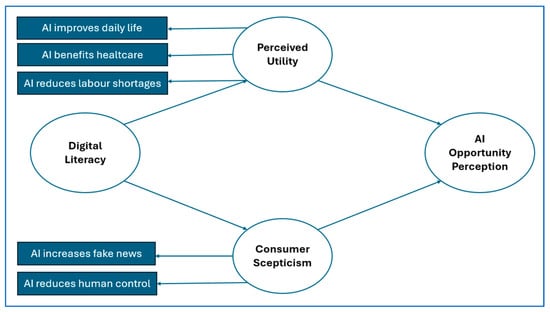
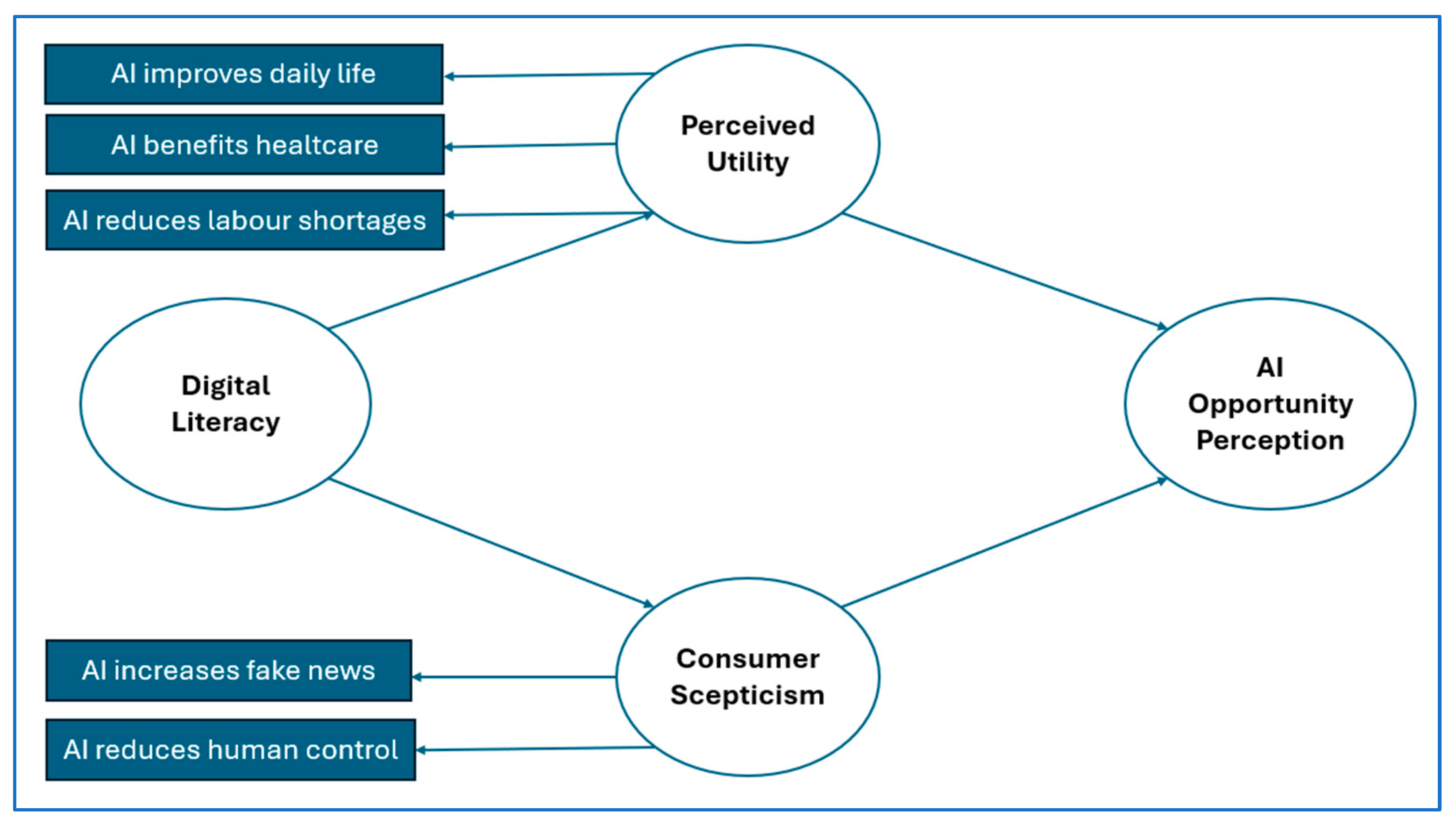
Based on these constructs, the conceptual research model is illustrated in Figure 1. The model proposes that digital literacy influences both perceived utility and consumer scepticism, which in turn shape the overall perception of artificial intelligence as an opportunity.
Figure 1.
Structural model of AI adoption: The role of digital literacy, perceived utility, and consumer scepticism.
3.3. Analytical Strategy
The empirical analysis is conducted using Structural Equation Modelling (SEM), a multivariate technique that enables the simultaneous estimation of relationships between latent constructs while accounting for measurement error. This approach is particularly suitable for testing complex theoretical models involving both direct and indirect effects.
The analysis follows a two-step procedure. First, the measurement model is evaluated to assess construct validity and internal consistency, ensuring that the selected indicators adequately reflect the underlying latent variables. Second, the structural model is estimated using the Maximum Likelihood (ML) method to test the hypothesized relationships between digital literacy, perceived utility, and consumer scepticism.
Given the exploratory nature of the study and the use of large-scale secondary data, model evaluation is based on a holistic interpretation of fit indices, including the Comparative Fit Index (CFI), Root Mean Square Error of Approximation (RMSEA), and Tucker–Lewis Index (TLI). Greater emphasis is placed on the theoretical significance and robustness of the structural relationships rather than strict adherence to conventional threshold values.
Exploratory factor analysis and reliability analyses were conducted using IBM SPSS Statistics (Version 26; IBM Corp., Armonk, NY, USA). The structural equation model was estimated using IBM SPSS Amos (Version 20.0.0; IBM Corp., Armonk, NY, USA).
4. Results
This section presents the empirical findings of the study, following the two-step approach recommended for Structural Equation Modelling (SEM). First, the measurement model is assessed to evaluate the validity and reliability of the constructs. Second, the structural model is examined in order to test the hypothesized relationships between digital literacy, perceived utility, and consumer scepticism. This sequential approach ensures the robustness of the results and provides a solid basis for hypothesis testing.
4.1. Measurement Model Analysis: Validity and Reliability
Before testing the structural hypotheses, the measurement model underwent a rigorous assessment of validity and reliability. Exploratory factor analysis confirmed a clear two-factor structure with no significant cross-loading, indicating adequate construct validity (Table 2).
Table 2.
Pattern matrix of exploratory factor analysis (EFA *).
Although the Cronbach’s Alpha coefficients (0.539 for utility and 0.493 for scepticism) fall below the conventional threshold of 0.70 recommended by Nunnally and Bernstein [37], such values are not uncommon in exploratory research using secondary survey data, where scales were not originally designed as psychometrically validated instruments and where a small number of items (two to three per construct) mechanically depresses alpha regardless of true reliability [38]. We report these values transparently as a limitation rather than as evidence of adequate internal consistency, and discuss their implications for the robustness of the findings in Section 5.3.
4.2. Structural Equation Modelling (SEM)
Hypothesis testing was conducted using Structural Equation Modelling (SEM) with the Maximum Likelihood (ML) estimation method. To assess the adequacy of the structural model, multiple goodness-of-fit indices were examined, including incremental (NFI, IFI, CFI), comparative (TLI), and absolute fit measures (RMSEA). The results are presented in Table 3.
Table 3.
Goodness-of-fit indices for the structural model.
The model fit indices indicate an acceptable overall fit of the structural model. The Comparative Fit Index (CFI = 0.869) and Incremental Fit Index (IFI = 0.870) approach the recommended threshold of 0.90, suggesting a reasonably good fit. The Normed Fit Index (NFI = 0.862) further supports the adequacy of the model.
The Tucker–Lewis Index (TLI = 0.750) and RMSEA (0.098) fall outside the thresholds conventionally recommended by Hu and Bentler [39]—TLI ≥ 0.90 and RMSEA ≤ 0.08—while incremental indices (CFI = 0.869, IFI = 0.870, NFI = 0.862) approach but do not fully reach the 0.90 benchmark. We interpret this pattern as a genuine, moderate limitation of model fit rather than as fully adequate, consistent with guidance that large samples and parsimonious models estimated on secondary survey data frequently yield elevated RMSEA and depressed TLI even when the underlying structural relationships are theoretically sound and statistically robust [39,40]. Given the exploratory nature of this study and its reliance on pre-existing survey items not originally designed for SEM, we proceed to hypothesis testing while treating the model’s overall fit, rather than its individual path estimates, as the primary limitation of the analysis, discussed further in Section 5.3.
However, given the use of large-scale secondary data and the exploratory nature of the research, these values do not undermine the validity of the model. Overall, the results support the adequacy of the structural model for subsequent hypothesis testing.
4.3. Hypothesis Testing and Path Coefficients
The structural model was estimated to test the proposed hypotheses. The standardized path coefficients, along with their statistical significance, are presented in Table 4.
Table 4.
Structural Path Coefficients.
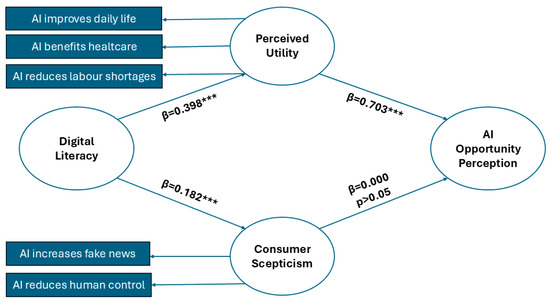
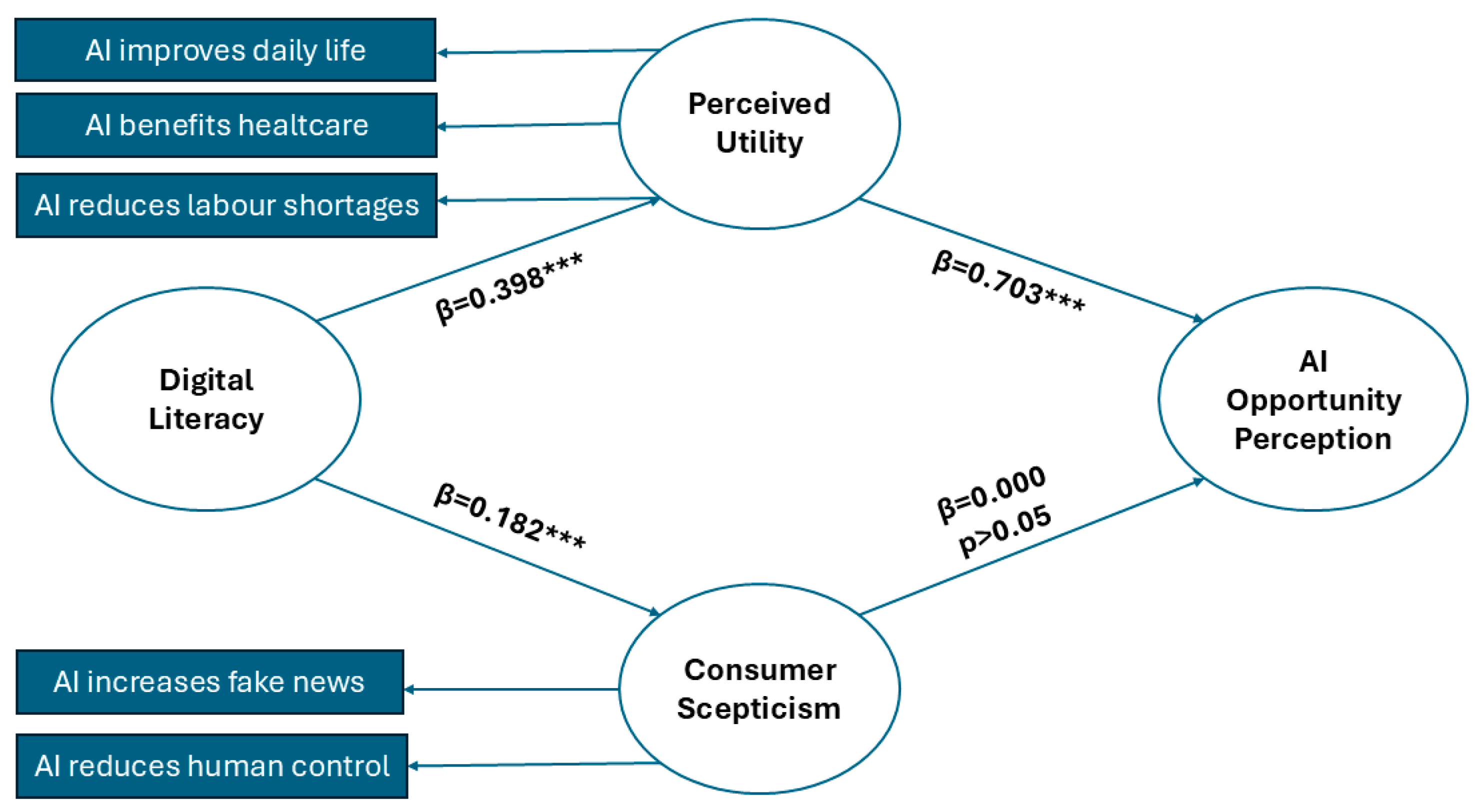
The results provide strong empirical support for the proposed hypotheses. Digital Literacy has a positive and statistically significant effect on Perceived Utility (β = 0.398, p < 0.001), supporting H1. This finding indicates that individuals with higher levels of digital competence are better able to recognize the functional benefits of AI applications.
At the same time, Digital Literacy also exerts a positive and significant effect on Consumer Scepticism (β = 0.182, p < 0.001), confirming H2. This result supports the notion of the “informed and critical consumer,” suggesting that increased knowledge enhances awareness of technological risks, such as misinformation and loss of control.
The strongest relationship identified in the model is between Perceived Utility and the overall perception of AI as an opportunity (β = 0.703, p < 0.001), providing strong support for H3. This high coefficient indicates that perceived benefits play a dominant role in shaping consumer evaluations of AI.
In contrast, the effect of Consumer Scepticism on the overall perception of AI is not statistically significant (p = 0.975). This finding suggests that, although users are aware of potential risks, these concerns do not translate into a negative overall evaluation. Instead, the results indicate the presence of a compensatory cognitive mechanism, whereby perceived utility overrides scepticism in the decision-making process.
The structural relationships and standardized path coefficients are visually summarized in Figure 2. While the magnitude difference between the two path coefficients (β = 0.703 for utility vs. β = 0.000, n.s. for scepticism) is substantial, this study does not formally test the statistical difference between them via an equality-constrained nested model comparison. The dominance of utility over scepticism is therefore supported descriptively by the contrast in coefficient size and significance, rather than confirmed through a direct statistical test of a compensatory mechanism; this distinction is addressed further in Section 5.2.
Figure 2.
Structural model with path coefficients. Note: *** p < 0.001. The path from Consumer Scepticism to AI Opportunity Perception (B = 0.000) was not statistically significant (p > 0.05).
4.4. Qualitative Drivers of AI as an Opportunity and Risk
While structural equation modelling (SEM) validated the causal relationships among the major latent constructs (Digital Literacy, Perceived Usefulness, and Scepticism), this technique does not allow for the identification of the specific arguments that shape these perceptions in the consumer’s mind. To overcome this limitation and provide greater granularity to the analysis, we conducted an evaluation of multiple response frequencies applied to the ‘Reason’ variables in the ZA8719 dataset.
To provide an overview of the distribution of responses, Table 5 presents the proportion of respondents who perceive artificial intelligence as an opportunity versus a risk.
Table 5.
Distribution of AI perception categories.
This approach allows us to “decipher” the qualitative content of users’ fears and hopes. Given that respondents were directed to different logical branches based on their initial stance (those who viewed AI as an opportunity answered only the “Opportunity” set, while those who viewed it as a risk answered only the “Risk” set), the parallel presentation of the hierarchy of reasons provides an accurate picture of the current polarization of perceptions.
Table 6 presents, in parallel, the hierarchy of the most frequently cited reasons given by German respondents. For better readability and academic relevance, the top reasons cited in each category were extracted, based on the percentage of cases (Percent of Cases).
Table 6.
Comparative analysis of AI opportunity and risk perceptions.
The results reveal a clear asymmetry in consumer perceptions of artificial intelligence. On the one hand, AI is perceived as an opportunity through a predominantly pragmatic and future-oriented lens. The most frequently cited motivations include technological progress (15.8%), improved convenience in everyday life (11.8%), and increased efficiency (10.4%), indicating that perceived utility is strongly anchored in tangible and immediate benefits.
On the other hand, risk perceptions are more concentrated and emotionally salient, being primarily associated with loss of control (21.3%) and concerns about fraud and abuse (15.4%). These findings suggest that while perceived benefits are diverse and functionally driven, perceived risks are more focused and related to fundamental issues of autonomy and trust.
This asymmetry provides additional empirical support for the results of the structural model, reinforcing the conclusion that perceived utility plays a dominant role in shaping overall evaluations of AI, while scepticism, although present, does not significantly alter the final perception.
5. Discussion
5.1. Revisiting the Dual Role of Digital Literacy
The findings of this study highlight the ambivalent nature of digital literacy, confirming its dual role as both a catalyst for perceived utility and a driver of consumer scepticism. This result extends traditional technology acceptance models (e.g., TAM, UTAUT), which typically conceptualize digital competence as a purely facilitating factor.
Consistent with prior research [33,41] the results suggest that more informed users are not necessarily less concerned. On the contrary, digital literacy enhances critical awareness, making risks such as misinformation and loss of control more salient. This supports the view that digital literacy functions as a double-effect mechanism in emerging technological ecosystems.
5.2. The Dominance of Utility and the Privacy Paradox
A central empirical finding of this study is that the path from perceived utility to overall AI perception is strong and significant (β = 0.703, p < 0.001), while the path from scepticism is not statistically significant (p = 0.975). Read descriptively, this pattern is consistent with the Privacy Paradox, according to which individuals may accept higher risks when perceived benefits are sufficiently valuable [42,43]; however, as noted in Section 4.3, our data support this interpretation as a plausible reading of the coefficient contrast rather than as a directly tested compensatory mechanism.
In the context of AI, functional benefits such as improved efficiency, everyday convenience, and medical advancements exert a significantly stronger influence than perceived risks (p = 0.975). This pattern is consistent with a predominantly utilitarian decision-making logic, in which perceived value appears more consequential than psychological resistance for this sample—though we note this as an interpretation of the relative coefficient strength rather than as a confirmed compensatory process.
The qualitative findings further reinforce this mechanism. While concerns such as loss of control (21.3%) and fake news (9.0%) are highly salient, the perceived benefits—such as technological progress (15.8%), convenience (11.8%), and efficiency (10.4%)—create a strong value proposition that compensates for these risks. Together, these results confirm the existence of a compensatory cognitive mechanism in AI adoption.
5.3. Implications, Limitations, and Future Research
From a managerial perspective, the findings provide important strategic insights for organizations operating in digital and e-commerce environments. Rather than focusing exclusively on risk mitigation, firms should prioritize the communication and delivery of clear functional value. When users perceive tangible benefits, resistance mechanisms are significantly reduced.
These findings speak directly to ongoing debates on consumer resistance to AI-driven marketing tactics. Just as personalisation can simultaneously build trust and provoke privacy-related scepticism, our results show that the same antecedent—digital literacy—can drive both appreciation and wariness of AI. This reinforces calls in the marketing literature for firms to move beyond risk mitigation toward transparent, trust-building design choices in AI-enhanced customer engagement, rather than assuming that reducing scepticism alone will secure adoption.
At the policy level, the results highlight the need for a more nuanced approach to digital literacy programmes. Since increased knowledge also amplifies scepticism, education should not be limited to technical skills but should also include ethical and critical dimensions. This supports the development of transparent and accountable data governance frameworks [44,45].
These findings are broadly consistent with prior evidence that digital competence amplifies rather than resolves ambivalence toward AI [12,17,18], reinforcing the view that literacy-based interventions alone are unlikely to eliminate resistance. For organizations implementing AI-driven services, from e-commerce recommendation engines to conversational agents, this suggests that governance and transparency measures should be paired with clear, visible communication of functional benefits, rather than treated as a substitute for it. At the policy level, digital literacy curricula and AI governance frameworks alike may benefit from explicitly addressing this trade-off, rather than assuming that improved literacy uniformly increases trust.
Despite its contributions, the study has several limitations directly tied to its reliance on secondary survey data. The moderate model fit indices (TLI = 0.750, RMSEA = 0.098) and the below-threshold internal consistency coefficients indicate that the measurement model captures the constructs of interest imperfectly; consequently, the standardized path coefficients should be interpreted as indicative of the direction and relative strength of the relationships rather than as precise point estimates, and the model’s generalizability beyond the specific items and sample used here should be treated with caution. Future research using purpose-designed, psychometrically validated scales—ideally with a larger number of items per construct—would allow for a more stringent test of the proposed relationships. Future research could also incorporate moderating variables such as institutional trust or specific AI use contexts to further refine the understanding of the utility–risk trade-off.
Additionally, Digital Literacy is measured with a single item rather than a multi-item scale, which precludes an assessment of its internal reliability and may understate the construct’s conceptual breadth; future studies should employ validated multi-item digital or AI literacy scales.
A further limitation concerns the geographic scope of the data: as the analysis relies on a German national sample rather than a cross-national EU dataset, the generalizability of the findings to other European countries with different levels of digital infrastructure, regulatory context, or cultural attitudes toward technology should be treated with caution. Future research could replicate this model using cross-national data, such as the EU-wide Special Eurobarometer on AI, to test the robustness of the observed relationships across different institutional and cultural contexts.
6. Conclusions
This study demonstrates that consumer perceptions of artificial intelligence are not linear, but rather the result of a dynamic trade-off between perceived benefits and perceived risks. Using Structural Equation Modelling (SEM), the findings show that perceived utility plays a dominant role in shaping AI adoption, effectively outweighing the impact of consumer scepticism.
A key contribution of this research is the identification of the dual role of digital literacy. The results confirm that digital literacy simultaneously increases perceived utility (H1) and consumer scepticism (H2), while perceived utility exerts a significantly stronger influence on overall AI evaluation (H3). These findings challenge traditional technology acceptance models by showing that user competence not only facilitates adoption but also enhances critical awareness.
From a practical perspective, the study suggests that the successful implementation of AI in digital commerce depends primarily on the ability of organizations to deliver and communicate clear functional value. When benefits are perceived as tangible and relevant, consumer resistance becomes secondary in the decision-making process.
This research opens several avenues for future investigation. Further studies could extend this German-based model to other national contexts, exploring the moderating role of cultural factors, institutional trust, or regulatory frameworks such as the EU AI Act in shaping the relationship between perceived utility and scepticism. Understanding these dynamics will be essential for designing digital ecosystems that balance technological innovation with ethical responsibility and consumer trust.
Author Contributions
Conceptualization, I.L.P. and G.-R.L.; methodology, I.L.P.; software, I.L.P.; validation, G.-R.L., R.A.I. and M.C.D.; formal analysis, S.M.; investigation, S.M.; resources, M.C.D.; data curation, I.L.P.; writing—original draft preparation, S.M.; writing—review and editing, M.C.D.; visualization, I.L.P.; supervision, G.-R.L.; project administration, R.A.I.; funding acquisition, G.-R.L. All authors have read and agreed to the published version of the manuscript.
Funding
This research received no external funding.
Institutional Review Board Statement
Not applicable.
Informed Consent Statement
Not applicable.
Data Availability Statement
This study uses secondary data from the survey ‘Aktuelle Fragen zu KI’ (Current Questions on AI, fieldwork June 2023), commissioned by the Press and Information Office of the German Federal Government (Presse-und Informationsamt der Bundesregierung) and archived at GESIS—Leibniz Institute for the Social Sciences (Study No. ZA8719, Version 1.0.0, DOI: https://doi.org/10.4232/1.14223). The dataset is publicly available for scientific use through the GESIS Data Catalogue https://search.gesis.org (accessed on 29 March 2026). No new data were generated for this study.
Conflicts of Interest
The authors declare no conflicts of interest.
Abbreviations
The following abbreviations are used in this manuscript:
| AI | Artificial Intelligence |
| CFI | Comparative Fit Index |
| CS | Consumer Scepticism |
| DL | Digital Literacy |
| EFA | Exploratory Factor Analysis |
| EU | European Union |
| GESIS | Leibniz Institute for the Social Sciences (Eurobarometer data provider) |
| IFI | Incremental Fit Index |
| ML | Maximum Likelihood (estimation method) |
| NFI | Normed Fit Index |
| PCLOSE | Probability of Close Fit (RMSEA-associated test, generated by AMOS) |
| PU | Perceived Utility |
| RFI | Relative Fit Index |
| RMSEA | Root Mean Square Error of Approximation |
| SEM | Structural Equation Modelling |
| TAM | Technology Acceptance Model |
| TLI | Tucker–Lewis Index |
| UTAUT | Unified Theory of Acceptance and Use of Technology |
| XAI | Explainable AI |
References
- Nguyen, T.T.; Tran, T.N.H.; My, T.H.; Dinh, T.K.L.; Nguyen, T.U.N.; Dang, T. Digital Literacy, Online Security Behaviors and E-Payment Intention. J. Open Innov. Technol. Mark. Complex. 2024, 10, 100292. [Google Scholar] [CrossRef] [Scilit]
- Saxena, R.; Pal, A.; Sharma, M.; Verma, S.; Chauhan, M.S. AI and Consumer Behavior in e Commerce Platforms Using Social Media Analytics and Economic Indicators. J. Nov. Res. Innov. Dev. 2025, 3, a156–a178. [Google Scholar] [CrossRef] [Scilit]
- Cao, X.; Zhang, H.; Zhou, B.; Wang, D.; Cui, C.; Bai, X. Factors Influencing Older Adults’ Acceptance of Voice Assistants. Front. Psychol. 2024, 15, 1376207. [Google Scholar] [CrossRef] [Scilit] [PubMed]
- Ibrahim, F.; Münscher, J.; Daseking, M.; Telle, N.-T. The Technology Acceptance Model and Adopter Type Analysis in the Context of Artificial Intelligence. Front. Artif. Intell. 2025, 7, 1496518. [Google Scholar] [CrossRef] [Scilit] [PubMed]
- Jain, R.; Garg, N.; Khera, S.N. Adoption of AI-Enabled Tools in Social Development Organizations in India: An Extension of UTAUT Model. Front. Psychol. 2022, 13, 893691. [Google Scholar] [CrossRef] [Scilit] [PubMed]
- Thiebes, S.; Lins, S.; Sunyaev, A. Trustworthy Artificial Intelligence. Electron. Mark. 2020, 31, 447–464. [Google Scholar] [CrossRef] [Scilit]
- Xu, W.; Dainoff, M.J.; Ge, L.; Gao, Z. Transitioning to Human Interaction with AI Systems: New Challenges and Opportunities for HCI Professionals to Enable Human-Centered AI. Int. J. Hum.-Comput. Interact. 2022, 39, 494–518. [Google Scholar] [CrossRef] [Scilit]
- Stahl, B.C.; Antoniou, J.; Bhalla, N.; Brooks, L.; Jansen, P.; Lindqvist, B.; Kirichenko, A.S.; Marchal, S.; Rodrigues, R.; Santiago, N.; et al. A Systematic Review of Artificial Intelligence Impact Assessments. Artif. Intell. Rev. 2023, 56, 12799–12831. [Google Scholar] [CrossRef] [Scilit] [PubMed]
- Raees, M.; Meijerink, I.; Lykourentzou, I.; Khan, V.-J.; Papagelis, K. From Explainable to Interactive AI: A Literature Review on Current Trends in Human-AI Interaction. Int. J. Hum.-Comput. Stud. 2024, 189, 103301. [Google Scholar] [CrossRef] [Scilit]
- Kovács, E.; Horváth, I. Trust, Transparency, and AI Adoption in Business. Acta Polytech. Hung. 2025, 22, 81–100. [Google Scholar] [CrossRef] [Scilit]
- Shrivastava, P. Understanding Acceptance and Resistance toward Generative AI Technologies: A Multi-Theoretical Framework Integrating Functional, Risk, and Sociolegal Factors. Front. Artif. Intell. 2025, 8, 1565927. [Google Scholar] [CrossRef] [Scilit] [PubMed]
- Pinski, M.; Benlian, A. AI Literacy for Users–A Comprehensive Review and Future Research Directions of Learning Methods, Components, and Effects. Comput. Hum. Behav. Artif. Hum. 2024, 2, 100062. [Google Scholar] [CrossRef] [Scilit]
- Tınmaz, H.; Lee, Y.-T.; Fanea-Ivanovici, M.; Baber, H. A Systematic Review on Digital Literacy. Smart Learn. Environ. 2022, 9, 21. [Google Scholar] [CrossRef] [Scilit] [PubMed]
- Gagrčin, E.; Naab, T.K.; Grub, M.F. Algorithmic Media Use and Algorithm Literacy: An Integrative Literature Review. New Media Soc. 2024, 28, 423–447. [Google Scholar] [CrossRef] [Scilit]
- Khlaisang, J.; Yoshida, M. Empowering Global Citizens with Digital Literacy: Modeling the Factor Structure. Int. J. Instr. 2022, 15, 577–594. [Google Scholar] [CrossRef] [Scilit]
- Zuo, Z.; Luo, Y.; Yan, S.; Jiang, L. From Perception to Practice: Artificial Intelligence as a Pathway to Enhancing Digital Literacy in Higher Education Teaching. Systems 2025, 13, 664. [Google Scholar] [CrossRef] [Scilit]
- Bahçekapili, E.; Boztaş, G.D. Generative AI and Digital Literacy: Unravelling User Intentions through PLS-SEM and Machine Learning. J. Inf. Sci. 2025, 51, 6. [Google Scholar] [CrossRef] [Scilit]
- Nikou, S.; De Reuver, M.; Kanafi, M.M. Workplace Literacy Skills—How Information and Digital Literacy Affect Adoption of Digital Technology. J. Doc. 2022, 78, 371–391. [Google Scholar] [CrossRef] [Scilit]
- Hossenbux, M.Y. Risk Analysis of Artificial Intelligence in HighStakes Human Decision Systems. Int. J. Innov. Sci. Res. Technol. (IJISRT) 2026, 11, 1846. [Google Scholar] [CrossRef] [Scilit]
- Buchan, M.C.; Bhawra, J.; Katapally, T.R. Navigating the Digital World: Development of an Evidence-Based Digital Literacy Program and Assessment Tool for Youth. Smart Learn. Environ. 2024, 11, 8. [Google Scholar] [CrossRef] [Scilit]
- Elliott, K.; Price, R.; Shaw, P.; Spiliotopoulos, T.; Ng, M.; Coopamootoo, K.; van Moorsel, A. Towards an Equitable Digital Society: Artificial Intelligence (AI) and Corporate Digital Responsibility (CDR). Society 2021, 58, 179–188. [Google Scholar] [CrossRef] [Scilit] [PubMed]
- Čvokić, D. The Unintended Consequences of Algorithmic Transparency on Trust: A Multi-Disciplinary Analysis. Acta Sci. Balc. 2025, 6, 21–39. [Google Scholar] [CrossRef] [Scilit]
- Koenig, P.D. Attitudes toward Artificial Intelligence: Combining Three Theoretical Perspectives on Technology Acceptance. AI Soc. 2024, 40, 1333–1345. [Google Scholar] [CrossRef] [Scilit]
- Lee, J.-M.; Rha, J.-Y. Ambivalence Toward Personalized Technology and Intention to Use Location-Based Mobile Commerce: The Moderating Role of Gender. Int. J. Electron. Commer. Stud. 2017, 8, 197–218. [Google Scholar] [CrossRef] [Scilit]
- Pelău, C.; Pop, M.-I.; Ene, I.; Lazăr, L. Clusters of Skeptical Consumers Based on Technology and AI Acceptance, Perception of Social Media Information and Celebrity Trend Setter. J. Theor. Appl. Electron. Commer. Res. 2021, 16, 1231–1247. [Google Scholar] [CrossRef] [Scilit]
- Oostveen, A.; Eimontaite, I.; Fletcher, S. Human Factors in Digital Manufacturing Technology Adoption: A Workforce Perspective. Int. J. Adv. Manuf. Technol. 2025, 140, 6575–6593. [Google Scholar] [CrossRef] [Scilit] [PubMed]
- Frank, D.; Chrysochou, P.; Mitkidis, P. The Paradox of Technology: Negativity Bias in Consumer Adoption of Innovative Technologies. Psychol. Mark. 2022, 40, 554–566. [Google Scholar] [CrossRef] [Scilit]
- Kozyreva, A.; Lorenz-Spreen, P.; Hertwig, R.; Lewandowsky, S.; Herzog, S.M. Public Attitudes towards Algorithmic Personalization and Use of Personal Data Online: Evidence from Germany, Great Britain, and the United States. Humanit. Soc. Sci. Commun. 2021, 8, 117. [Google Scholar] [CrossRef] [Scilit]
- Kuen, L.; Schürmann, F.; Westmattelmann, D.; Hartwig, S.A.; Tzafrir, S.S.; Schewe, G. Trust Transfer Effects and Associated Risks in Telemedicine Adoption. Electron. Mark. 2023, 33, 35. [Google Scholar] [CrossRef] [Scilit]
- Li, Y.; Wu, B.; Huang, Y.; Luan, S. Developing Trustworthy Artificial Intelligence: Insights from Research on Interpersonal, Human-Automation, and Human-AI Trust. Front. Psychol. 2024, 15, 1382693. [Google Scholar] [CrossRef] [Scilit] [PubMed]
- Stein, J.; Messingschlager, T.; Gnambs, T.; Hutmacher, F.; Appel, M. Attitudes towards AI: Measurement and Associations with Personality. Sci. Rep. 2024, 14, 2909. [Google Scholar] [CrossRef] [Scilit] [PubMed]
- Watters, C.; Lemański, M.K. Universal Skepticism of ChatGPT: A Review of Early Literature on Chat Generative Pre-Trained Transformer. Front. Big Data 2023, 6, 1224976. [Google Scholar] [CrossRef] [Scilit] [PubMed]
- Mills, A.J.; Robson, K. Brand Management in the Era of Fake News: Narrative Response as a Strategy to Insulate Brand Value. J. Prod. Brand Manag. 2019, 29, 159–167. [Google Scholar] [CrossRef] [Scilit]
- Wang, G.; Tan, G.W.; Yuan, Y.-P.; Ooi, K.; Dwivedi, Y.K. Revisiting TAM2 in Behavioral Targeting Advertising: A Deep Learning-Based Dual-Stage SEM-ANN Analysis. Technol. Forecast. Soc. Change 2021, 175, 121345. [Google Scholar] [CrossRef] [Scilit]
- Kushwaha, B.P.; Paul, J.C.; Köles, B. ‘To Share or Not to Share’? Informational Privacy Paradox. Int. J. Consum. Stud. 2026, 50, e70182. [Google Scholar] [CrossRef] [Scilit]
- GESIS–Leibniz Institute for the Social Sciences. ZA8719: Aktuelle Fragen zu KI (Juni 2023), Version 1.0.0; GESIS Data Archive: Cologne, Germany, 2023. [CrossRef]
- Nunnally, J.C.; Bernstein, I.H. Psychometric Theory; McGraw-Hill: Columbus, OH, USA, 1994. [Google Scholar]
- Cortina, J.M. What Is Coefficient Alpha? J. Appl. Psychol. 1993, 78, 98–104. [Google Scholar] [CrossRef] [Scilit]
- Hu, L.; Bentler, P.M. Cutoff Criteria for Fit Indexes in Covariance Structure Analysis. Struct. Equ. Model. 1999, 6, 1–55. [Google Scholar] [CrossRef] [Scilit]
- Kenny, D.A.; Kaniskan, B.; McCoach, D.B. The Performance of RMSEA in Models with Small Degrees of Freedom. Sociol. Methods Res. 2015, 44, 486–507. [Google Scholar] [CrossRef] [Scilit]
- Lin, Y.; Yu, Z. Extending Technology Acceptance Model to Higher-Education Students’ Use of Digital Academic Reading Tools on Computers. Int. J. Educ. Technol. High. Educ. 2023, 20, 34. [Google Scholar] [CrossRef] [Scilit]
- Brauner, P.; Glawe, F.; Liehner, G.L.; Vervier, L.; Ziefle, M. Mapping Public Perception of Artificial Intelligence: Expectations, Risk–Benefit Tradeoffs, and Value as Determinants for Societal Acceptance. Technol. Forecast. Soc. Change 2025, 220, 124304. [Google Scholar] [CrossRef] [Scilit]
- Willems, J.; Schmid, M.J.; Vanderelst, D.; Vogel, D.; Ebinger, F. AI-Driven Public Services and the Privacy Paradox: Do Citizens Really Care about Their Privacy? Public Manag. Rev. 2022, 25, 2116–2134. [Google Scholar] [CrossRef] [Scilit]
- Atenas, J.; Havemann, L.; Timmermann, C. Reframing Data Ethics in Research Methods Education: A Pathway to Critical Data Literacy. Int. J. Educ. Technol. High. Educ. 2023, 20, 11. [Google Scholar] [CrossRef] [Scilit] [PubMed]
- Sander, I. Critical Datafication Literacy—A Framework for Educating about Datafication. Inf. Learn. Sci. 2023, 125, 270–292. [Google Scholar] [CrossRef] [Scilit]

Disclaimer/Publisher’s Note: The statements, opinions and data contained in all publications are solely those of the individual author(s) and contributor(s) and not of MDPI and/or the editor(s). MDPI and/or the editor(s) disclaim responsibility for any injury to people or property resulting from any ideas, methods, instructions or products referred to in the content. |
© 2026 by the authors. Licensee MDPI, Basel, Switzerland. This article is an open access article distributed under the terms and conditions of the Creative Commons Attribution (CC BY) license.