


Abstract
In a highly homogeneous market environment, consumers’ cognitive inertia towards standardized products continues to strengthen, and traditional functional attributes significantly weaken the driving force of impulse buying. This study is based on the elaboration likelihood model (ELM). It constructs a dual-path theoretical framework of “cognitive inertia cue arousal”, aiming to reveal a new triggering mechanism for impulse buying behavior (IBB) in homogeneous competition. This study proposes a hybrid structural equation model (SEM) and artificial neural network (ANN) approach to evaluate the driving factors behind consumers’ maintenance of IBB in the context of homogeneous competition. Specifically, the first stage involves identifying key variables that significantly affect IBB using SEM. The second stage consists of predicting the accuracy of the outcome variables and ranking their importance using an ANN. This study confirms two pathways: product cognitive inertia (customized information and promotional discounts) and peripheral cue arousal (anchor novelty display strategy and observation learning). Research has found that observational learning has a positive impact on perceived attention. Interestingly, perceived attention does not have a significant mediating effect between promotional discounts and IBB. This discovery provides a theoretical basis and practical paradigm for cracking the involution competition.
1. Introduction
As the competitive environment intensifies, the live-streaming e-commerce market is undergoing significant homogenization, hindering the high-quality development of live-streaming e-commerce platforms [1,2]. The increasing prevalence of homogenized content stifles creativity, narrows the range of ideas and information, and produces an information cocoon effect [3,4,5,6,7]. Homogenized content dominating the market poses a threat to the consumer market, drastically weakening consumer interest and significantly reducing impulse buying. Compared with impulsive buying behavior (IBB) in conventional environments, IBB in homogenized environments is more complex and subject to more chaotic influences [8]. Therefore, breaking the homogenization deadlock of the live-streaming e-commerce platform and scientifically and rationally designing and laying out anti-homogeneous marketing plans is the only way to maintain the healthy pace and economies of scale of the live streaming market.
Past studies tend to explore with the help of models such as the theory of planned behavior (TPB) [9], stimulus–organism–response (SOR) [10], the technology acceptance model (TAM) [11], and the social cognition theory (SCT) [12]. However, these models have certain shortcomings, and it is difficult to use them to explain the individual behavioral resolution process from the perspectives of information processing and personal attitude change. It should be noted that consumers are emotional and rational in the consumption decision-making process and will choose different processing paths for different types of information [13]. However, previous research on IBB focuses more on consumers being emotional, suggesting that emotional factors, time cost, promotional offers, etc., are vital triggers [14,15]. In consumer behavior research, the application of the elaboration likelihood model (ELM) helps us to understand how consumers process information and can be used in deriving profound explanations and predictions for individual attitude changes [16]. Among other things, central pathways influence deep cognitive processing to affect attitude change, and peripheral cues are used to promote attitude change with minimal brain exertion [17]. By analyzing the information processing path of consumers in different contexts, marketing strategies and communication methods can be better designed to improve marketing effectiveness.
Past research has methodologically focused on analyzing quantitative relationships between structures using a simple structural equation model (SEM) [18]. However, the shortcoming of this research method is that it can only explore the linear relationship between structures and is insufficient to predict the nonlinear relationship between variables, thus making it challenging to predict complex decision-making processes [19]. Therefore, Wang et al. innovatively proposed to use an artificial neural network (ANN) to take advantage of its deep learning to make up for the shortcomings of SEM, which can only capture linear relationships, to improve the accuracy of nonlinear models [13]. The most crucial point is that existing studies have paid less attention to IBB in the context of homogeneity, and their influencing factors are more complex. Therefore, the research questions are as follows: In the context of live broadcast homogenization, what factors can help break the homogenization deadlock and promote IBB? What are the paths that influence IBB?
To make up for the shortcomings of the above research, based on the center–periphery path of ELM, we constructed a theoretical model of the influencing factors of IBB. Moreover, this study utilizes the learning ability of ANN to construct a hybrid SEM–ANN approach to improve the accuracy of nonlinear model prediction. The focus is on exploring the key factors and the importance of these key factors. The steps to operate the research method are as follows: the first stage identifies the key variables affecting IBB with the help of SEM and verifies the research hypotheses. The second stage adopts the nonlinear relationship between the key variables of the ANN model significance and ranks their importance to predict the accuracy of IBB [11]. This hybrid approach’s advantage is that it is a new method to test IBB and that it utilizes the advantages of one model to offset the disadvantages of the other model. Finally, the research findings provide valuable suggestions for e-commerce live streaming platforms to improve consumer purchasing power and promote the green and sustainable development of the live streaming economy.
2. Literature Review
2.1. Research on Impulsive Buying Behavior
IBB is sudden, uncontrollable, and immediately complex [20]. Impulsive buying is an irrational desire manifesting as the intention to make impulsive purchases. When consumers purchase a product, they do not consider whether they need it. On the contrary, this leads to immediate purchases to fulfill purchase obligations, resulting in IBB [21]. It is not harmful but rather pleasurable and immersive.
IBB has received great attention in multiple fields. It is considered an interesting phenomenon because it is not only influenced by the internal psychological factors of consumers but also stimulated by external factors. The triggering factors for consumer IBB mainly include three schools of thought [14]. Firstly, some scholars believe that individual attributes are the key factors driving consumers to purchase impulsively. Personal attributes include consumers’ cognitive level, economic level, personality, and self-control ability [22]. The second is motivation and resources. Previous studies have confirmed that hedonic, utilitarian, positive, and negative motivations are enough to trigger impulse buying [23]. Moreover, a considerable amount of research has confirmed that resources have varying degrees of impact on IBB, including resources such as goods, time costs, and money [24]. The third focus is on exploring marketing factors. Marketing stimuli include promotional price reductions, anchor characteristics, product prices, etc. [14]. In addition, research has confirmed that factors such as observational learning, consumer motivation, and perceived attention are also critical drivers of IBB [25,26,27].
Current research agrees that IBB is a special form of irrational behavior characterized by unplanned behavior, external stimuli, and quick decision making. It should be noted that consumers are both emotional and rational in the process of consumption decision making, and they will choose different processing paths for different types of information [14]. Moreover, existing research often utilizes classical grounded theory [14], TPB [28], SOR [29], and other theories for characterization. However, the biggest drawback of using these models to characterize IBB is their inability to clarify the processing paths of different influencing factors and the formation and transformation of individual attitudes.
2.2. Research on the Elaboration Likelihood Model
The ELM was proposed by psychologists Petty and Cacioppo, who found that individuals stimulated their motivations and ability to process information through both central and peripheral pathways, promoting the formation and transformation of individual attitudes [16]. The central path refers to individuals spending considerable time or energy using rational thinking to process information directly related to tasks or specific product attributes and features. The peripheral path refers to the individual’s processing of simple information clues when lacking experience or energy. These two paths are common in individuals’ thinking and decision-making processes, so ELM is often employed to describe the process and pathways of consumer attitude formation and change.
This social psychology theory has been applied to multiple fields, such as e-commerce, digital technology, and marketing, to explore information receivers’ depth of information source processing and their subjective accuracy needs. In the field of e-commerce, Zeng et al. constructed a research framework for consumer purchasing behavior intention based on ELM by characterizing the impact of real-time barrage on consumer purchasing behavior through central and peripheral paths [30]. In the digital field, Palla et al. examined and validated the impact of product intervention on attitude formation and intensity based on ELM and recommended that marketers and consumers visit websites regularly based on the conclusion of attitude change [31]. In the field of advertising, Jayawardena et al. designed a qualitative experiment based on ELM to examine the different effects of luxury and non-luxury brand print advertising on consumer brand attitude persuasion [11]. The results demonstrated that the model theoretically provided an understanding of the social cognitive stages of human mentality. Research conclusions were used to persuade consumers to change their attitudes.
2.3. Research on Homogenization
Originating from biological sciences, homogenization refers to the convergence process in biological composition and function between two or more biological regions within a specific period [32]. Subsequently, the concept of homogenization was applied in the marketing field, which refers to the process by which individual things with different characteristics gradually converge in their inherent essential characteristics during the development process. Homogenization fundamentally stifles diversity and increases similarity, meaning repetition is superior to creativity [20].
From the origin of homogenization, scholars have not yet reached a consensus on its essence. Polonioli argued that the application of recommender systems had resulted in a narrowing of scholars’ vision of literature reading, thus calling for academics to focus on the issue of the mechanism of user-received content homogenization, to gain insight into the nature of the generation of content homogenization, and to understand and solve the real problem at its root [33]. Some scholars agree that homogenization originated from users’ choice of homogenization [34]. Some scholars did not agree with this viewpoint, believing that a lack of technological innovation caused content homogenization [35]. Xu et al. also pointed out that intense competition with extreme homogenization was the main factor leading to the inability to achieve collaborative innovation [36].
From the consequences of homogenization, it is a hazard [37]. For consumers, it is difficult to meet their increasingly diverse consumption needs and maintain their satisfaction [38]. For platform merchants, homogenization intensifies internal market competition, reduces the core competitiveness of products, and ultimately leads to a decline in profitability. For e-commerce platforms and the entire industry, long-term homogenization can lead to a large amount of rich content data that lacks information, resulting in a data dilemma. Therefore, when examining the influencing factors of IBB, this study focuses on those factors that are conducive to breaking the deadlock of live broadcast homogeneity and conceives according to the center–periphery dual path of ELM to explore the mediating mechanism affecting IBB.
3. Research Hypothesis
3.1. The Impact of Product Cognitive Inertia and Perceived Inspiration
Customized information refers to the degree to which recommended products align with current user preferences [39]. The homogenization of information weakens consumers’ interest or preference for products, inevitably hindering the development of live-streaming e-commerce platforms. Therefore, customized Information is the key driving force for the sustainable development of live-streaming e-commerce. Uniform or diverse information will only distract consumers’ attention, making it difficult to make the right decisions. According to previous research, information receivers will choose and reject the information they receive based on their characteristics, and information related to individuals will dominate [40]. Meanwhile, according to the attention mechanism, the individual sensory system focuses limited attention on key information to quickly process the most effective information [41]. The key information referred to here is customized information, which can better attract consumers’ attention. Here, perceived attention refers to the degree of focus on one’s activities [42]. Therefore, we have reason to believe that the stronger the personalization of information, the more it can attract attention.
Andreeva et al. pointed out that inspiration is the positive outcome of upward social comparison [25]. Perceived inspiration refers to personal emotions, positive emotions, and intentions for future behavior [43]. Inspiration belongs to the concept of psychology, with its core being arousal, transcendence, and motivation. Perceived inspiration refers to consumers’ motivation to experience transcendence through internal and external stimuli, which in turn triggers and encourages consumer behavior. In this study, perceived inspiration refers to an individual presenting a good, happy, or satisfied state in a live shopping environment. From the perspective of consumer preferences, personalized information makes consumers feel valued and cared for, and can better stimulate consumer interest and encourage their purchasing desire. Some studies have also confirmed that shopping platforms that provide personalized products and services can help consumers experience positive emotions [31,44]. Thus, the following hypotheses are proposed:
H1a.
Customized information is positively associated with perceived attention.
H1b.
Customized information is positively associated with perceived inspiration.
Promotional discounts are a promotional tool which companies and businesses use to sell goods at a reduced price based on the original price of the goods within a specific market area and time of operation [45]. Tactically, discounting is a reliable strategy for promotion, and it is often used as a merchant marketing method to motivate consumers to buy, often determining the product’s attractiveness [46]. Consumers can have short attention spans, and thus often concentrate on discounts and browsing various promotions. The stronger the offer of a promotional discount, the more focused an individual’s attention will be, and the more likely they are to make a quick, impulsive purchase decision [14].
In addition, promotional discounts allow consumers to feel the joy and pleasure of the promotion, and this way of working for the benefit of consumers encourages them [47]. Past studies have also confirmed that promotional discounts are important antecedents that inspire consumers to purchase [14]. Thus, the following hypotheses are proposed:
H2a.
Promotional discounts are positively associated with perceived attention.
H2b.
Promotional discounts are positively associated with perceived inspiration.
3.2. The Influence of Peripheral Cue Arousal on Perceived Attention and Perceived Inspiration
Anchor novelty display strategy refers to the innovative way in which anchors display products [27]. It is a type of interactive strategy and is a typical interpersonal interaction. In previous studies, most scholars have focused on the impact of anchors’ professionalism, attractiveness, interactivity, and popularity on consumer purchasing behavior. However, these traits are unimportant in homogenization [25]. Compared to others, innovative display strategies by anchors can help products embed fresher elements, bring higher levels of consumer participation, and stimulating positive psychological reactions from consumers. Therefore, the anchor’s innovative display strategy can attract consumers’ attention and encourage them to process information. Previous research has also confirmed a close relationship between the anchor novelty display strategy and consumer attention [25,48].
Innovative display methods often enhance consumers’ goodwill and sense of information sources, thereby bringing positive psychological encouragement. At the same time, this approach also allows anchors to stand out among the numerous homogenized anchors, helping consumers form a good consumer experience. Previous studies have shown that innovative display strategies by hosts have a substantial impact on consumer emotions [25,48]. This innovative display strategy can greatly attract consumers’ senses and inspire them. Thus, the following hypotheses are proposed:
H3a.
Anchor novelty display strategy is positively associated with perceived attention.
H3b.
Anchor novelty display strategy is positively associated with perceived inspiration.
Observational learning refers to individuals observing the behavior of others and learning through direct or indirect social activities [49]. According to social learning theory, we know sociology departments: observational learning and reinforcement learning [50]. Observational learning can lead consumers to exhibit certain imitative behaviors, automatically ignoring their own perceived information and whether others’ choices are better. Therefore, observational learning is also known as trial-and-error learning or alternative learning. When consumers face homogenized information and find it difficult to decide, they tend to choose observation and learning. They only need to process the information they obtain through simple processing, without the need for complex logical thinking, so they will make decisions quickly. However, such rapid decision making still demands sufficient attention and focus when evaluating observed information.
When consumers obtain information by observing the behavior, experience, and results of others, if they have a positive evaluation of the observed content and believe that this information has a positive impact on their purchasing decisions, then this observational learning will stimulate perceptual encouragement [51]. Observing and learning information or behavior satisfies consumers’ inner needs, obtains a greater sense of satisfaction, and makes them more confident in their behavior. Thus, the following hypotheses are proposed:
H4a.
Observational learning is positively associated with perceived attention.
H4b.
Observational learning is positively associated with perceived inspiration.
3.3. The Influence of Perceived Attention and Perceived Inspiration on Consumer Impulsive Purchase Behavior
Yim et al. stated that individuals in an immersive state tended to be more focused and made decisions faster [52]. When watching live broadcasts, individuals’ attention is focused, and under the stimulation of the tense atmosphere in the live broadcast room, they are easily able to make impulsive purchasing decisions [53]. Zafar et al. also emphasized that consumers tend to selectively pay attention when interacting with a large amount of information, resulting in insufficient information processing ability and impulsive shopping [54]. Therefore, when consumers perceive that their attention is more focused, they are more likely to make decisions quickly and are more likely to engage in IBB.
Inspirited consumers have great psychological satisfaction and are internally motivated. This internal motivation makes it difficult for consumers to resist the temptation of products, overestimate their actual needs, and thus be more likely to generate impulsive purchasing intentions [35]. Historical research has also confirmed that perceived inspiration positively promotes individual behavioral intentions [25,44]. Therefore, there is reason to believe that there is a clear correlation between perceived inspiration and impulse buying. Thus, the following hypotheses are proposed:
H5a.
Perceived attention is positively associated with IBB.
H5b.
Perceived inspiration is positively associated with IBB.
3.4. The Mediating Role of Perceived Attention and Perceived Inspiration
In the entire process of impulse purchasing decision making, consumers are easily stimulated by various factors and generate different subjective emotions. Perceived attention can be subjective, further stimulating IBB. MacKenzie and Wolfe confirmed the mediating role of attention in individual information acquisition [7,34]. Specifically, vivid information, i.e., personalized information, is more attractive than other forms of information and can retain individuals’ concentration levels, influencing decision making [35,54]. More attractive discounts can quickly catch consumers’ attention and prompt them to make immediate purchases [10]. When consumers are attracted by the innovative display, novel content, or other attractive features of the host, they may be impulsive and immediately purchase [35,54]. In addition, there is no clear evidence that perceived attention mediates the relationship between observational learning and consumer IBB. However, we infer that consumers acquire information through observational learning and then generate interest and identification through perceived attention, which stimulates impulse buying. Thus, the following hypotheses are proposed:
H6a.
Perceived attention plays a mediating role between customized information and IBB.
H6b.
Perceived attention plays a mediating role between promotional discounts and IBB.
H6c.
Perceived attention plays a mediating role between anchor novelty display and IBB.
H6d.
Perceived attention plays a mediating role between observational learning and IBB.
Impulsive purchasing is hedonic, driven by a strong desire for emotional experiences [10,26]. Perceived inspiration is a positive emotional experience that plays a significant mediating role in behavioral decision-making processes [26,35,53]. Specifically, personalized information can better stimulate consumer interest and more easily trigger their hedonic motivation, leading to unplanned purchases [55]. When consumers perceive discount promotions, they are more likely to make impulsive purchases if they have a positive evaluation of them and experience positive emotions [10]. Unlike monotonous anchors, novel display strategies from anchors can be seen as highly attractive and unique, enhancing consumers’ sense of pleasure, meeting their emotional needs, and stimulating them to make impulsive purchases [35]. Observational learning enables consumers to obtain a large amount of information through observation, meeting their information needs and making them more interested, thereby stimulating them to make purchases [29]. Thus, the following hypotheses are proposed:
H7a.
Perceived inspiration plays a mediating role between customized information and IBB.
H7b.
Perceived inspiration plays a mediating role between promotional discounts and IBB.
H7c.
Perceived inspiration plays a mediating role between anchor novelty display and IBB.
H7d.
Perceived inspiration plays a mediating role between observational learning and IBB.
3.5. Conceptual Model
In the live-streaming e-commerce scene, when faced with homogeneous information, consumers must interpret some information deeply and make shallow judgments about other information. This process is a dual process of attitude generation and change [51], and attitude change depends on the type of information individuals receive and the cognitive energy they expend in processing this information [34]. After reviewing the relevant literature, it was found that IBB among consumers is a result of attitude formation and change, and the main reason for attitude change lies in the stimulation of different factors and individual cognition. We found that the attitude change process towards IBB is highly consistent with the individual attitude change revealed by the ELM. Therefore, the ELM is more advantageous in characterizing IBB under homogeneous information.
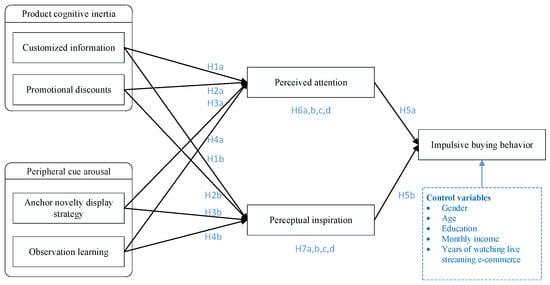
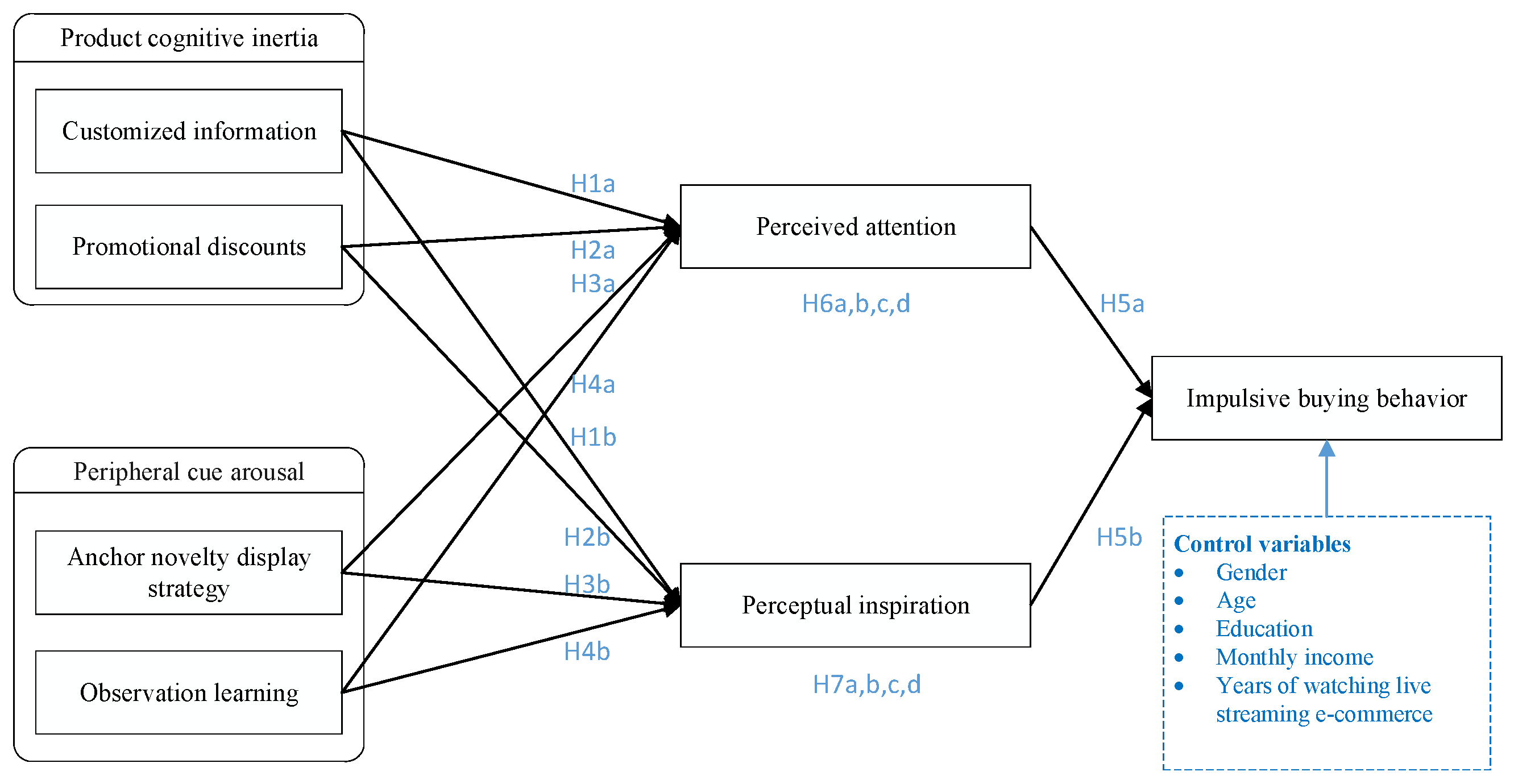
This paper proposes a consumer IBB model based on the ELM. As shown in Figure 1, the conceptual model describes transitioning consumer behavior in terms of the central and peripheral paths. In the central path, consumers mainly rely on rational thinking and pay more attention to information related to the product itself. Therefore, personalized information and promotional discounts represent the central path (product cognitive inertia). In the peripheral pathways (peripheral cue arousal), consumers rely on emotional thinking and value peripheral clues more, spending less time and energy to make judgments. Therefore, choosing the anchor novelty display strategy and observational learning as representative variables of the peripheral path. At the same time, perceived attention and perceived inspiration are introduced as mediating variables, jointly studying the impact of these variables on the formation and transformation of consumers’ internal psychological attitudes and the information decision-making process.
Figure 1.
Impulsive buying behavior model.
4. Research Methods
4.1. A Hybrid SEM–ANN Method
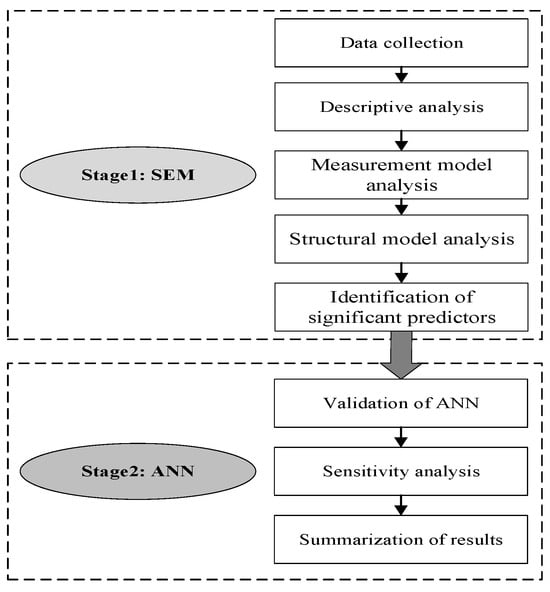
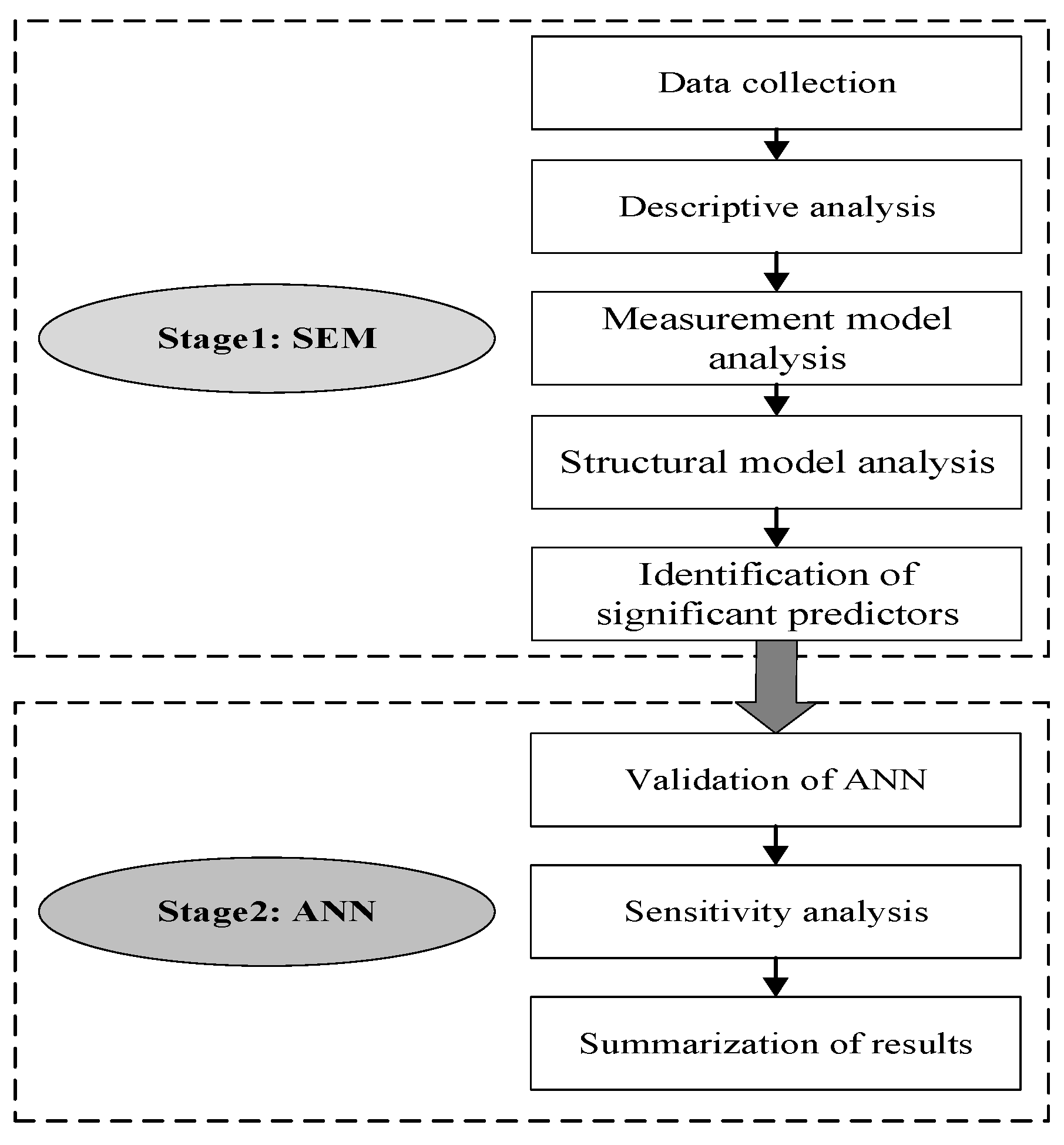
In this study, a hybrid SEM–ANN method is proposed to identify and predict the nonlinear relationship between key influencing factors. On the one hand, SEM only checks the linear model and is used to verify the relationship between hypotheses, which may lead to the complexity of the problems involved in oversimplification. On the other hand, the most well-known shortcoming of ANN is the “black box” attribute, which is not suitable for hypothesis testing and testing causality, but can improve the accuracy of model predictions. IBB is a classic “black box” problem, which is difficult to describe and quantify. Therefore, to compensate for the shortcomings of these two methods and give full play to their advantages, this study proposes a hybrid SEM–ANN model to deeply explore the internal mechanism of the generation of IBB of consumers. As shown in Figure 2, the research method consists of two stages: (1) SEM, which uses maximum likelihood estimation to test the hypothesis and determine which variables have a significant impact on IBB; (2) ANN, significant variables will be used as the input of the neural network to capture the nonlinear relationship between key variables and predict the accuracy of IBB (Algorithm 1).
Figure 2.
A hybrid SEM–ANN research.
| Algorithm 1: Two-stage hybrid SEM–ANN learning procedure |
| Input: Questionnaire dataset D with n samples and m construct items. Output: Trained ANN models, prediction accuracy, and normalized importance of predictors. Stage 1: SEM Analysis (Linear Hypothesis Testing)
Stage 2: ANN Analysis (Nonlinear Prediction and Sensitivity Analysis)
Return: Trained ANNs, RMSE values, and normalized importance rankings. |
4.2. Questionnaire Design
To improve the reliability and validity of the measurement scale, the items of all variables were derived from mature scales in the existing literature, such as the studies of Beatty and Ferrell [56], Komiak and Benbasat [18], and Zhang et al. [57]. These items were originally drafted in English, but they were intended for use in Chinese for participants. Therefore, the English questionnaire was translated into Chinese by a professional native English translator. After a careful analysis of the differences between these independently translated questionnaires, a definitive version of the Chinese questionnaire was agreed. This final version was then translated back into English by another native English professional translator to ensure consistency between the English and the Chinese versions of the questionnaire. At the same time, to ensure the comprehensibility and accuracy of the questionnaire, we also invited two experts with outstanding research on live-streaming e-commerce and consumer complaints to conduct a strict review of the questionnaire. Based on their suggestions, we made some minor adjustments.
The questionnaire designed in this paper mainly includes two parts: (1) referring to previous research results, demographic information mainly includes interviewees’ gender, age, educational background, income level, and years of watching live broadcasts [53]; (2) measurement items of variables. The Likert 7-point scale measures the scale from 1 to 7, indicating “completely disagree” to “completely agree”.
Before the formal questionnaire was issued, we invited 30 eligible university students to participate in the pre-survey to ensure that the questionnaire was comprehensible and readable. The participants came from consumers who believed the existing live-streaming e-commerce platform had a specific homogeneity phenomenon and still produced IBB. The pre-test found that the factor loading of the fourth measurement item of customized information, “product price acceptable,” was lower than the minimum value of 0.7, so this item was deleted. Therefore, number 4 is not included in the formal survey analysis, while Table 1 retains the complete initial item pool for transparency of the scale development process. Then, the final questionnaire is formed. Variables, corresponding items, and literature sources are shown in Table 1. Then, the final questionnaire is formed. Variables, corresponding items, and literature sources are shown in Table 1.
Table 1.
Variables, corresponding items, and literature sources.
4.3. Data Collection
The official data collection period was from 10 March 2025 to 20 April 2025. The two methods for collecting the questionnaire were as follows: (1) face-to-face interviews to ask questions and score the subjects; (2) social media tools to issue and retrieve questionnaires. Different samples can be enriched using online and offline data collection methods, and common methodological biases can be eliminated procedurally. At the same time, we informed respondents that there was no right or wrong answer and assured them that they would remain anonymous. A total of 400 questionnaires were distributed, and 347 valid questionnaires were collected after the invalid questionnaires with short answering times or consistent scores were excluded. The effective recovery rate was 86.75%.
5. Data Analysis and Results
5.1. Descriptive Analysis
The respondents’ demographic characteristics are shown in Table 2. Among them, 145 were male, accounting for 41.79%, and 202 were female, accounting for 58.21%. Comparatively speaking, women have a greater tendency to display irrational IBBs. Most interviewees were aged 26–30 and 31–40, and they are the main groups watching network broadcasts. From the income-level perspective, most interviewees have considerable income and a certain economic ability to pay. Most respondents who have watched live broadcasts for 1–3 years and 3–5 years indicate that they have rich experience in watching live broadcasts.
Table 2.
Demographic characteristics of respondents.
5.2. Reliability and Validity Test
Then, the reliability and validity of the scale were tested. Reliability refers to the reliability or consistency of the scale and the consistency of the results obtained when the same object is repeatedly measured by the same method. Validity refers to the scale’s validity, which refers to the degree of accuracy of the measurement index according to the measurement method or tool.
SmartPLS 4.0 software uses partial least squares (PLS) for statistical analysis and has a powerful modeling environment. This software is widely used in management, information systems, e-commerce, marketing, organizational behavior, and other fields. The PLS algorithm was run to obtain the load and dimension reliability of the external model. The collating results are shown in Table 3. All items’ factor loadings were higher than 0.7, the Cronbach’s alpha (α) value was more significant than 0.7, and composite reliabilities (C.R.) values exceeded 0.7 [9]. These values are above the minimum threshold, indicating that the scale has good reliability.
Table 3.
Reliability results.
In addition, it is necessary to check the measurement items further to prevent collinearity between variables. The variance inflation factor (VIF) is often used to measure the collinearity between variables [21]. In Table 3, the VIF values of all measurement items are less than the standard value of 3, indicating there are no serious collinearity problems.
Convergence validity indicates the extent to which the items in the scale under the same variable are aggregated under the same variable at the time of measurement. Average variance extracted (AVE) was used to test the convergent validity of the scale [9]. In Table 3, AVE values all exceed the minimum value of 0.5. In the values below the diagonal of Table 4, the square root of AVE for all variables is more significant than their respective correlation coefficients. It shows that the scale has good convergent validity. Differential validity refers to the degree to which a variable differs. The heterotrait–monotrait ratio (HTMT) was used for judgment. The smaller the HTMT value, the higher the differential validity between variables [14]. It can be seen from the values above the diagonal in Table 4 that the HTMT values of all variables are lower than the evaluation standard of 0.9, indicating that the differential validity of these seven variables is perfect.
Table 4.
Fornell–Larcker criterion and HTMT ratio.
5.3. Hypothesis Testing
Then, the partial least squares method is used to test the significance of each path by repeated sampling in SmartPLS4.0. The confidence level was set to 95% and bootstrapping = 5000. The results are shown in Table 5. In H1a, β = 0.224, T = 3.686 > 1.96, p = 0.000 < 0.05, so information individuation has a significant positive impact on perceived attention; thus, H1a is assumed to be valid. In H1b, β = 0.226, T = 2.984 > 1.96, p = 0.003 < 0.05, so customized information has a positive impact on perceived inspiration; thus, H1b is accepted. It is worth noting that, in H4b, T = 0.658 < 1.96, p = 0.511 > 0.05 failed the significance test. In other hypotheses, T > 1.96, p < 0.05, indicating that these hypotheses are valid.
Table 5.
Results of the main path testing.
Then, the mediating effects of perceived attention and perceived inspiration were examined through the bootstrapping step. In the process of calculating the total effect, it is found that the total effect of ANDS → IBB (p = 0.061 > 0.005) is not significant, indicating that there is no intermediary effect in ANDS → PA → IBB and ANDS → PI → IBB. It is also worth noting that although the total effect of OL → IBB (p = 0.016 < 0.005) is significant, OL → PI → IBB (p = 0.514 > 0.005) is not significant, so there is no intermediary effect on this path. In addition to the above paths, the direct, indirect, and total effects of other paths are significant; that is, these paths have intermediary effects.
Next, the Variance Accounted For (VAF) was calculated to measure the level of the mediating effect. VAF refers to the proportion of indirect and total effects [62]. A VAF < 20% indicates no mediation; 20% < VAF < 80% shows partial mediation; VAF > 80% indicates full mediation. In Table 6, in the path PD → PA → IBB, VAF = 17.9% < 20%, indicating that perceived attention does not mediate in this path. However, the VAF values of other paths were between 20% and 80%, indicating that perceived attention and inspiration partially mediated their respective paths.
Table 6.
Analysis of the mediating effect.
5.4. Analysis of ANN
ANN is a massively parallel distributed processor composed of simple processing units that can store experimental knowledge and make it available for use [47]. Its adaptability enables the structural changes in the data generation process to respond quickly to environmental changes. Compared with other statistical models, this model has apparent advantages in simulating neurons inside the human brain and achieves the purpose of learning experience through transmitting signals between neurons. Because of this, neural network models are often used to deal with complex human decision-making problems and are widely used in e-commerce, information systems, industrial manufacturing, and other fields [6,17,53].
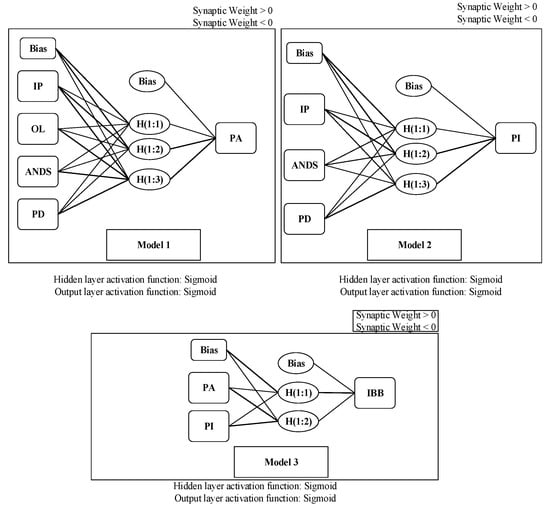
Therefore, this study uses an ANN to further explore the nonlinear relationship between the significant influencing factors and their prediction ability. The analysis was carried out on SPSS 24 software. Considering that only the statistically significant predictors obtained by SEM are employed in ANN, the research model shown in Figure 1 can be decomposed into three ANNs, as shown in Figure 3 At the same time, considering the simplicity of the model, the hidden layer of the three ANNs is one layer. Among them, the number of hidden-layer neurons was automatically generated [62].
Figure 3.
ANN models.
To effectively prevent the overfitting of ANNs, a 10-fold cross-validation method is adopted [15,37], in which 90% of the samples are used for training, and the remaining 10% are used for testing. The input layer is the antecedent variable that passes the SEM test; the number of hidden layers is determined by the complexity of the problem to be solved, and the output layer is the corresponding independent variable [14]. Using a nonlinear activation function, the data in the input neuron node is guided to the output neuron node through the implicit neuron node during learning [5]. Synaptic weights will be adjusted during learning to achieve the desired goal [63].
This study proposes the following three sub-models for neural network analysis, as shown in Figure 3. In Model 1, four neurons in the input layer represent customized information, observation learning, anchor novelty display, and price promotion, respectively. Perceptual attention is represented by one neuron in the output layer. In Model 2, three neurons are in the input layer, representing customized information, anchor novelty display, and promotion. Perceptual learning is represented by one neuron in the output layer. In Model 3, two neurons are in the input layer, representing perceptual attention and perceptual encouragement, respectively, and IBB is the output layer.
Sigmoid was chosen as the activation function. The hidden and output layers of the activation function to sigmoid were set, and the number of hidden nodes was automatically generated. The Sigmoid function is calculated as follows:
where a is the slope parameter of the sigmoid. With the change of a, Sigmoid with different slopes can be obtained.
Root mean square error (RMSE) is often used to measure the prediction accuracy of artificial neural network models [34]. The smaller the RMSE value, the closer it is to zero, the better the prediction performance of the artificial neural network model. In addition, we calculated a goodness-of-fit coefficient similar to the in the SEM analysis to further evaluate the performance of the ANNs [11]. The formula for calculating the two indicators is as follows:
Root mean square error (RMSE) is calculated by:
R-squared () is calculated by:
Table 7 shows the RMSE values of the training and test models and evaluates the prediction accuracy of the three ANNs. Among the three sub-models, the average RMSE values of the training model are 0.221, 0.181, and 0.195, and the average RMSE values of the testing model are 0.197, 0.169, and 0.170, respectively. These values are relatively small and differ greatly, indicating strong consistency. This significantly indicates that the model can generalize well without overfitting, which fully supports the robustness and accuracy of the model [1].
Table 7.
RMSE of ANN.
Furthermore, the value in Table 7 indicates that input neuron nodes can predict 0.830, 0.767, and 0.875 of perceived attention, perceived inspiration, and IBB, respectively. The predictive accuracy of perceived attention and perceived inspiration for IBB (ANN: = 0.875) is significantly higher than that of traditional linear models (SEM: = 0.524). It clearly shows that there is interaction gain between key variables, and the advantages of a single model cannot maximize the transformation effect, while the hybrid method can more accurately quantify the critical point of multi-feature coupling [1].
In addition, a sensitivity analysis reflects the nonlinear contribution strength of key variable combinations. The normalized importance is defined as the ratio of each input variable to the significant value embedded in the network [64]. As shown in Table 8, in Model 1, customized information was shown to have the most significant impact on perceived attention, followed by observation learning (92.50%), anchor novelty display (84.10%), and promotion (71.30%). In Model 2, anchor novelty display was shown to have the most significant impact on perceived inspiration, followed by customized information (83.50%) and promotion (72.30%). In Model 3, perceived inspiration was shown to significantly impact IBB, followed by perceived attention.
Table 8.
Results of the sensitivity analysis.
Surprisingly, in Model 1, in SEM, observational learning is the most significant factor affecting perceived attention, followed by newness display, customized information, and price promotion. However, in ANN, customized information is the most significant factor affecting perceived attention, followed by observational learning, anchor novelty display, and promotion. The analysis results of these two methods differ significantly. In Model 2, no matter whether in SEM or ANN, anchor novelty display is the most significant factor affecting perceived inspiration, and there is little difference between customized information and promotion of perceived inspiration. In model 3, the SEM and ANN results are consistent, and the effects on IBB are ranked as perceived attention and perceived inspiration, respectively. According to the analyses of Xiong et al. [65] and Wang et al. [66], the main reasons for the inconsistency are the nonlinearity and non-compensation of the artificial neural network model, and the higher prediction accuracy.
6. Conclusions
This study deconstructs IBB in homogeneous markets through ELM and confirms the core role of the “cognitive inertia cue arousal” mechanism. The results showed that both the product cognitive inertia (customized information and promotional discounts) and the peripheral cue arousal (anchor novelty display strategy and observation learning) positively affected perceived attention and perceptual inspiration. Furthermore, perceived attention and perceptual inspiration had a positive effect on IBB. Competition in homogeneous markets has shifted from product–function battles to contests over consumers’ cognitive resources. Enterprises need to activate “rational impulses” through the scientific design of clue combinations, while policies need to prevent decision overload caused by market failures.
6.1. Research Findings
Live-streaming e-commerce faces a serious homogenization problem, which hurts individuals, industries, and social development. To inject new vitality into live-streaming e-commerce and enhance consumers’ purchasing power, this paper focuses on the factors that are conducive to breaking the homogeneity of live streaming and predicts the impact of these factors on IBB. Based on ELM, the decision-making process of IBB is described from cognitive inertia and peripheral cue arousal and verified by the hybrid SEM–ANN method. The results of the experiment have some important research findings, which are discussed below:
Firstly, this study confirms that product cognitive inertia and peripheral cue arousal jointly influence IBB, shedding light on a novel decision-making mechanism for consumers in highly homogeneous markets. This finding challenges the conventional single-path cognition of either cognitive dominance or emotional drive. It differs significantly from the research findings of Habib and Qayyum, who argue that cognitive aspects precede emotional aspects, ultimately leading to impulsive actions [67]. Instead, our results suggest that these two pathways operate in parallel rather than sequentially—a distinction that carries important implications for understanding consumer decision making under information overload. The coexistence of both pathways also lends empirical support to the ELM’s core premise that individuals process information through both central and peripheral routes simultaneously, depending on contextual and individual factors.
Secondly, research has found that customized information has a positive impact on perceived attention and motivation. This finding is consistent with Correia and Colombin’s findings, who believe that customized information is more likely to attract consumers’ attention than generic information and is more likely to elicit a willingness to invest energy in viewing or paying attention to it [34].
It was found that the anchor’s novelty display strategy had a positive effect on perceived attention and perceived inspiration. This is an innovative finding. Previous studies have paid more attention to the influence of anchors’ professionalism, interactivity, and popularity [52,68]. Relatively speaking, the novelty display strategy of anchors is more able to catch the eyes of consumers, but also in line with consumers’ preferences, triggering their excitement and active emotional state.
This is also an innovative finding, as previous studies have paid little attention to the effect of observational learning on IBB. The research results support the positive impact of observational learning on perceived attention. However, the experimental results show that observational learning is an important influencing factor because consumers have social attributes. When they are in a social network with information overload, they observe others’ behaviors to assist in decision making.
Finally, the study further revealed that perceived attention does not exhibit a notable mediating effect between promotional discounts and IBB. This finding somewhat contradicts existing research, as Aydinli and Frank et al. posit that when consumers encounter incentive cues like price discounts, their attention shifts to focus solely on the product at hand, diminishing their motivation for psychological exertion and rendering them more prone to impulsive buying [45,69]. A plausible explanation could be that, when processing visual scenes, consumers are directed to focus on broader or more confined regions, which subsequently diminishes the intermediary role of perceived attention [70].
Notably, all these findings should be interpreted against the backdrop of market homogenization—the central contextual condition of our study. In highly homogenized live streaming environments, where product offerings and promotional messages are increasingly indistinguishable, consumers’ reliance on both cognitive inertia and peripheral cues becomes more pronounced. This suggests that homogenization does not merely suppress consumer interest; it also reshapes the very pathways through which impulsive decisions are made. Our findings thus extend the extant literature by revealing how contextual homogeneity interacts with individual information processing, a contingency that prior studies have largely overlooked.
6.2. Theoretical Contribution
In theory, compared with the existing literature, this study has made two new contributions. Firstly, this paper adopts a hybrid SEM–ANN method to capture the nonlinear relationship between product cognitive inertia and peripheral cue arousal, consumer perception, and impulse buying behavior, while improving prediction accuracy and robustness. The uniqueness of this lies in utilizing the advantages of ANN models to offset the disadvantages of SEM models. Secondly, this study confirms two pathways: product cognitive inertia and peripheral cue arousal. This discovery overturns the traditional single-path cognition of cognitive dominance or emotion-driven behavior, proving that the decision-making elasticity of consumers in live-streaming e-commerce originates from the dynamic energy conservation of cognitive systems and contextual clues, providing a new theoretical anchor for person–goods–venue matching.
6.3. Practical Contribution
In practice, this article deepens the understanding of the mechanism of impulse buying behavior generation in the context of intense market homogenization competition, providing a theoretical basis and practical framework for differentiated intervention strategies for multi-dimensional stakeholders such as retail managers, product managers, marketing practitioners, and policy makers.
For retail managers and marketing practitioners, it is possible to quickly identify the trigger points for impulsive behavior. Research has found that in excessively homogenized markets, product cognitive inertia and peripheral cue arousal compensate each other and are key levers that trigger impulse buying. Therefore, managers and marketing practitioners can recommend customized content, develop promotional strategies (such as the effectiveness of flash sales), select anchors with innovative skills, reward or encourage consumers to post bullet comments about products or services, and consciously activate dual paths.
For engineering or product managers, it is important to design beyond core functionality. The research findings emphasize that customized products are more likely to stimulate impulse buying desires when core functions are similar. Therefore, engineering and product teams need to consider “impulse buying potential” as one of the design considerations.
For policymakers, precise positioning of regulatory direction is crucial. The study demonstrates how consumers rely on product cognitive inertia and peripheral cue arousal in a homogeneous environment, which may lead to unplanned or even irrational consumption. This provides clear regulatory direction for policymakers to focus on areas where consumers are prone to impulsive consumption, such as fast-moving consumer goods and in-game purchases.
6.4. Shortcomings and Future Research
Although this study fully validated IBB under homogeneous competition and made some meaningful findings, there are still some shortcomings in the research process. First, our data were collected exclusively from Chinese consumers, who represent a unique market characterized by exceptionally high live-streaming e-commerce penetration. While this context offers rich empirical insights, it may limit the direct applicability of our findings to markets with different levels of live streaming adoption, consumer habits, or regulatory environments. Second, cultural dimensions prevalent in Chinese consumer behavior—such as collectivism, social conformity, and high-context communication—may moderate the relationships we observed, particularly those involving observational learning and peripheral cue arousal. These effects might manifest differently in individualistic cultures or in markets where live streaming commerce is still nascent. Third, we explicitly call for cross-cultural comparative studies and experimental designs to further test the robustness and external validity of our dual-path model across diverse national and cultural settings.
Author Contributions
Conceptualization, R.W. and S.L.; methodology, R.W.; software, R.W. and H.L.; formal analysis, S.L.; investigation, R.W.; data curation, R.W. and S.L.; writing, R.W. and H.L.; supervision, H.L.; funding acquisition, R.W. All authors have read and agreed to the published version of the manuscript.
Funding
This research was supported by High-level Scientific Research Incubation Project of Ningbo University of Finance & Economics under Grant No. 1320263903.
Institutional Review Board Statement
The study did not require ethical approval.
Informed Consent Statement
Informed consent was obtained from all subjects involved in the study.
Data Availability Statement
The data presented in this study are available on request from the corresponding author.
Acknowledgments
Thanks to the partial support of the Ningbo philosophy and Social Sciences Key Research Base “Research Base on Digital Economy Innovation and Linkage with Hub Free Trade Zones”.
Conflicts of Interest
The authors declare no conflicts of interest.
Abbreviations
The following abbreviations are used in this manuscript:
| IBB | impulse buying behavior |
| ELM | elaboration likelihood model |
| SEM | structural equation modeling |
| ANN | artificial neural networks |
| TPB | theory of planned behavior |
| SOR | stimulus–organism–response |
| TAM | technology acceptance model |
| SCT | social cognition theory |
| ANDS | anchor novelty display strategy |
| CI | customized information |
| OL | observation learning |
| PA | perceived attention |
| PD | promotional discounts |
| PI | perceptual inspiration |
| AVE | average variance extracted |
| HTMT | heterotrait–monotrait ratio |
| PLS | partial least squares |
| α | Cronbach’s alpha |
| C.R. | composite reliabilities |
| VIF | variance inflation factor |
| VAF | Variance Accounted For |
References
- Shams, M.S.; Mei, T.S.; Adnan, Z. Nexus between idiosyncratic deals and work engagement via psychological empowerment: A PLS-SEM approach. Manag. Sci. Lett. 2021, 11, 689–698. [Google Scholar] [CrossRef] [Scilit]
- Yan, Y.; Chen, H.; Shao, B.; Lei, Y. How IT affordances influence customer engagement in live-streaming commerce? A dual-stage analysis of PLS-SEM and fsQCA. J. Retail. Consum. Serv. 2023, 74, 103390. [Google Scholar] [CrossRef] [Scilit]
- He, G.; Yuan, J.; Yang, Y. Measuring academic cocoon from disparity and diversity perspectives. Scientometrics 2025, 130, 2445–2474. [Google Scholar] [CrossRef] [Scilit]
- Ghani, J.A.; Supnick, R.; Rooney, P. The experience of flow in computer-mediated and in face-to-face groups. In Proceedings of the Twelfth International Conference on Information Systems, New York, NY, USA, 16–18 December 1991; pp. 229–237. [Google Scholar]
- Leong, L.Y.; Hew, T.S.; Tan, G.W.H.; Ooi, K.B. Predicting the determinants of the NFC-enabled mobile credit card acceptance: A neural networks approach. Expert Syst. Appl. 2013, 40, 5604–5620. [Google Scholar] [CrossRef] [Scilit]
- Nguyen, L.T.; Duc, D.T.V.; Dang, T.Q.; Nguyen, D.P. Metaverse Banking Service: Are We Ready to Adopt? A Deep Learning-Based Dual-Stage SEM-ANN Analysis. Hum. Behav. Emerg. Technol. 2023, 2023, 6617371. [Google Scholar] [CrossRef] [Scilit]
- Wolfe, J.M. The level of attention: Mediating between the stimulus and perception. In Levels of Perception; Springer: New York, NY, USA, 2003; pp. 169–191. [Google Scholar]
- Petty, R.E.; Cacioppo, J.T. The effects of involvement on responses to argument quantity and quality: Central and peripheral routes to persuasion. J. Personal. Soc. Psychol. 1984, 46, 69. [Google Scholar] [CrossRef]
- Fornell, C.; Larcker, D.F. Evaluating structural equation models with unobservable variables and measurement error. J. Mark. Res. 1981, 18, 39–50. [Google Scholar] [CrossRef] [Scilit]
- Ramadania, R.; Ratnawati, R.; Juniwati, J.; Afifah, N.; Heriyadi, H.; Darma, D.C. Impulse buying and hedonic behaviour: A mediation effect of positive emotions. Virtual Econ. 2022, 5, 43–64. [Google Scholar] [CrossRef] [Scilit] [PubMed]
- Jayawardena, N.S.; Quach, S.; Bandyopadhyay, C.; Thaichon, P. Exploring the differential effects of consumer brand attitude persuasion for printed advertisements in luxury and nonluxury brands. Asia Pac. J. Mark. Logist. 2024, 36, 2155–2176. [Google Scholar]
- Wang, L. Research on the Existing Problems and Countermeasures of Live E-Commerce Economy in China. Account. Corp. Manag. 2022, 4, 41–49. [Google Scholar]
- Singh, J. Consumer complaint intentions and behavior: Definitional and taxonomical issues. J. Mark. 1988, 52, 93–107. [Google Scholar] [CrossRef] [Scilit]
- Henseler, J.; Ringle, C.M.; Sarstedt, M. A new criterion for assessing discriminant validity in variance-based structural equation modeling. J. Acad. Mark. Sci. 2015, 43, 115–135. [Google Scholar]
- Lee, V.H.; Hew, J.J.; Leong, L.Y.; Tan, G.W.H.; Ooi, K.B. Wearable payment: A deep learning-based dual-stage SEM-ANN analysis. Expert Syst. Appl. 2020, 157, 113477. [Google Scholar] [CrossRef] [Scilit]
- Nechushtai, E.; Zamith, R.; Lewis, S.C. More of the same? Homogenization in news recommendations when users search on Google, YouTube, Facebook, and Twitter. Mass Commun. Soc. 2024, 27, 1309–1335. [Google Scholar] [CrossRef] [Scilit] [PubMed]
- Tyagi, T.; Kumar, S.; Malik, A.K.; Vashisth, V. A novel neuro-optimization techniques for inventory models in manufacturing sectors. J. Comput. Cogn. Eng. 2023, 2, 204–209. [Google Scholar]
- Komiak, S.Y.; Benbasat, I. The effects of personalization and familiarity on trust and adoption of recommendation agents. MIS Q. 2006, 30, 941–960. [Google Scholar] [CrossRef] [Scilit]
- Hennig-Thurau, T.; Gwinner, K.P.; Walsh, G.; Gremler, D.D. Electronic word-of-mouth via consumer-opinion platforms: What motivates consumers to articulate themselves on the internet? J. Interact. Mark. 2004, 18, 38–52. [Google Scholar] [CrossRef] [Scilit]
- Bandura, A. Social Learning theory of aggression. J. Commun. 1978, 28, 12–29. [Google Scholar] [CrossRef] [Scilit] [PubMed]
- Chong, A.Y.L. A two-staged SEM-neural network approach for understanding and predicting the determinants of m-commerce adoption. Expert Syst. Appl. 2013, 40, 1240–1247. [Google Scholar] [CrossRef] [Scilit]
- Chen, B.; Wang, L.; Rasool, H.; Wang, J. Research on the impact of marketing strategy on consumers’ impulsive purchase behavior in livestreaming e-commerce. Front. Psychol. 2022, 13, 905531. [Google Scholar] [CrossRef] [Scilit] [PubMed]
- Gu, X.; Chen, F.; Yang, X.; Chen, H.; Wang, Y.; Hou, J.; Long, R.; Wang, Y. Evolutionary trend and network structure characteristics of publicity information dissemination about waste separation by different opinion leaders. Resour. Conserv. Recycl. 2023, 194, 106991. [Google Scholar] [CrossRef] [Scilit]
- Wakefield, L.T.; Wakefield, R.L. Anxiety and ephemeral social media use in negative eWOM creation. J. Interact. Mark. 2018, 41, 44–59. [Google Scholar] [CrossRef] [Scilit]
- Andreeva, I.; Kim, Y.; Chung, S. Inspiration by role models: The effect of source similarity, perceived goal attainability, and dispositional optimism. J. Media Psychol. 2024, 36, 390–396. [Google Scholar] [CrossRef] [Scilit]
- Iyer, G.R.; Blut, M.; Xiao, S.H.; Grewal, D. Impulse buying: A meta-analytic review. J. Acad. Mark. Sci. 2020, 48, 384–404. [Google Scholar]
- Riegger, A.S.; Klein, J.F.; Merfeld, K.; Henkel, S. Technology-enabled personalization in retail stores: Understanding drivers and barriers. J. Bus. Res. 2021, 123, 140–155. [Google Scholar] [CrossRef] [Scilit]
- Liébana-Cabanillas, F.; Marinkovic, V.; De Luna, I.R.; Kalinic, Z. Predicting the determinants of mobile payment acceptance: A hybrid SEM-neural network approach. Technol. Forecast. Soc. Change 2018, 129, 117–130. [Google Scholar] [CrossRef] [Scilit]
- Chen, A.; Lu, Y.; Wang, B. Customers’ purchase decision-making process in social commerce: A social learning perspective. Int. J. Inf. Manag. 2017, 37, 627–638. [Google Scholar] [CrossRef] [Scilit]
- Zeng, Q.; Guo, Q.; Zhuang, W.; Zhang, Y.; Fan, W. Do real-time reviews matter? Examining how bullet screen influences consumers’ purchase intention in live streaming commerce. Inf. Syst. Front. 2023, 25, 2051–2067. [Google Scholar]
- Palla, P.J.; Kyriacou, E.; Zarkada, A. The effect of involvement on attitude formation and strength in the digital domain. J. Mark. Commun. 2023, 29, 137–160. [Google Scholar] [CrossRef] [Scilit]
- MacKenzie, S.B. The role of attention in mediating the effect of advertising on attribute importance. J. Consum. Res. 1986, 13, 174–195. [Google Scholar] [CrossRef] [Scilit] [PubMed]
- Polonioli, A.; Vega-Mendoza, M.; Blankinship, B.; Carmel, D. Reporting in experimental philosophy: Current standards and recommendations for future practice. Rev. Philos. Psychol. 2021, 12, 49–73. [Google Scholar] [PubMed]
- Cyr, D.; Head, M.; Lim, E.; Stibe, A. Using the elaboration likelihood model to examine online persuasion through website design. Inf. Manag. 2018, 55, 807–821. [Google Scholar] [CrossRef] [Scilit]
- Li, G.; Jiang, Y.; Chang, L. The influence mechanism of interaction quality in live streaming shopping on consumers’ impulsive purchase intention. Front. Psychol. 2022, 13, 918196. [Google Scholar] [CrossRef] [Scilit] [PubMed]
- Xu, H.; Wang, C.; Dong, K.; Luo, R.; Yue, Z.; Pang, H. A study of methods to identify industry-university-research institution cooperation partners based on innovation Chain theory. J. Data Inf. Sci. 2018, 3, 38–61. [Google Scholar] [CrossRef] [Scilit]
- Nyrhinen, J.; Sirola, A.; Koskelainen, T.; Munnukka, J.; Wilska, T.A. Online antecedents for young consumers’ impulse buying behavior. Comput. Hum. Behav. 2024, 153, 108129. [Google Scholar] [CrossRef] [Scilit]
- Bai, Y.; Li, H.; Gu, M. Advance selling policies with stochastic consumer valuations and advertising effects: Dynamic pricing and inventory decisions. Int. J. Prod. Econ. 2024, 277, 109401. [Google Scholar] [CrossRef] [Scilit]
- Hu, X.S.; Yang, Y. Determinants of consumers’ choices in hotel online searches: A comparison of consideration and booking stages. Int. J. Hosp. Manag. 2020, 86, 102370. [Google Scholar] [CrossRef] [Scilit]
- Gnana Sheela, K.; Deepa, S.N. Review on methods to fix number of hidden neurons in neural networks. Math. Probl. Eng. 2013, 2013, 425740. [Google Scholar] [CrossRef] [Scilit]
- Correia, A.S.; Colombini, E.L. Attention, please! A survey of neural attention models in deep learning. Artif. Intell. Rev. 2022, 55, 6037–6124. [Google Scholar] [CrossRef] [Scilit]
- Huang, W.; Stokes, J.W. MtNet: A multi-task neural network for dynamic malware classification. In DIMVA 2016: Proceedings of the 13th International Conference on Detection of Intrusions and Malware, and Vulnerability Assessment; Lecture Notes in Computer Science; Springer: Berlin/Heidelberg, Germany, 2016; Volume 9721, pp. 399–418. [Google Scholar]
- Piao, J.; Liu, J.; Zhang, F.; Su, J.; Li, Y. Human–AI adaptive dynamics drives the emergence of information cocoons. Nat. Mach. Intell. 2023, 5, 1214–1224. [Google Scholar] [CrossRef] [Scilit]
- Lee, M.K.; Cheung, C.M.; Chen, Z. Acceptance of Internet-based learning medium: The role of extrinsic and intrinsic motivation. Inf. Manag. 2005, 42, 1095–1104. [Google Scholar] [CrossRef] [Scilit]
- Aydinli, A.; Bertini, M.; Lambrecht, A. Price Promotion for Emotional Impact. J. Mark. 2014, 78, 80–96. [Google Scholar] [CrossRef] [Scilit]
- Olden, J.D.; Rooney, T.P. On defining and quantifying biotic homogenization. Glob. Ecol. Biogeogr. 2006, 15, 113–120. [Google Scholar] [CrossRef] [Scilit]
- Haykin, S. (Ed.) Adaptive Radar Signal Processing; John Wiley & Sons: Hoboken, NJ, USA, 2007. [Google Scholar]
- Zhang, Y.; Zhang, T.; Yan, X. Understanding impulse buying in short video live E-commerce: The perspective of consumer vulnerability and product type. J. Retail. Consum. Serv. 2024, 79, 103853. [Google Scholar] [CrossRef] [Scilit]
- Fu, J.R.; Ju, P.H.; Hsu, C.W. Understanding why consumers engage in electronic word-of-mouth communication: Perspectives from theory of planned behavior and justice theory. Electron. Commer. Res. Appl. 2015, 14, 616–630. [Google Scholar] [CrossRef] [Scilit]
- Badgaiyan, A.J.; Verma, A. Does urge to buy impulsively differ from impulsive buying behaviour? Assessing the impact of situational factors. J. Retail. Consum. Serv. 2015, 22, 145–157. [Google Scholar] [CrossRef] [Scilit]
- Cacioppo, J.T.; Petty, R.E.; Kao, C.F.; Rodriguez, R. Central and peripheral routes to persuasion: An individual difference perspective. J. Pers. Soc. Psychol. 1986, 51, 1032. [Google Scholar] [CrossRef] [Scilit]
- Yim, M.Y.C.; Chu, S.C.; Sauer, P.L. Is augmented reality technology an effective tool for e-commerce? An interactivity and vividness perspective. J. Interact. Mark. 2017, 39, 89–103. [Google Scholar] [CrossRef] [Scilit]
- Wang, R.; Wang, H.; Li, S. Predicting the determinants of consumer complaint behavior in e-commerce live-streaming: A two-staged SEM-ANN approach. IEEE Trans. Eng. Manag. 2025, 72, 1027–1038. [Google Scholar] [CrossRef] [Scilit]
- Zafar, A.U.; Qiu, J.; Shahzad, M.; Shen, J.; Bhutto, T.A.; Irfan, M. Impulse buying in social commerce: Bundle offer, top reviews, and emotional intelligence. Asia Pac. J. Mark. Logist. 2021, 33, 945–973. [Google Scholar] [CrossRef] [Scilit]
- Ampadu, S.; Jiang, Y.; Debrah, E.; Antwi, C.O.; Amankwa, E.; Gyamfi, S.A.; Amoako, R. Online personalized recommended product quality and e-impulse buying: A conditional mediation analysis. J. Retail. Consum. Serv. 2022, 64, 102789. [Google Scholar] [CrossRef] [Scilit]
- Beatty, S.E.; Ferrell, M.E. Impulse buying: Modeling its precursors. J. Retail. 1998, 74, 169–191. [Google Scholar] [CrossRef] [Scilit]
- Zhang, K.Z.K.; Zhao, S.J.; Cheung, C.M.K.; Lee, M.K.O. Examining the influence of online reviews on consumers’ decision-making: A heuristic–systematic model. Decis. Support Syst. 2014, 67, 78–89. [Google Scholar] [CrossRef] [Scilit]
- Ha, S.H. Helping online customers decide through web personalization. IEEE Intell. Syst. 2002, 17, 34–43. [Google Scholar] [CrossRef]
- Xu, H.; Zhang, K.Z.K.; Zhao, S.J. A dual systems model of online impulse buying. Ind. Manag. Data Syst. 2020, 120, 845–861. [Google Scholar] [CrossRef] [Scilit]
- Wang, H.H. A study on the impact of e-commerce anchor interaction strategy on consumers’ willingness to continue to buy. In Proceedings of the 2022 3rd International Conference on E-commerce and Internet Technology, Zhangjiajie, China, 4–6 March 2022; pp. 35–46. [Google Scholar]
- Koufaris, M. Applying the technology acceptance model and flow theory to online consumer behavior. Inf. Syst. Res. 2002, 13, 205–225. [Google Scholar] [CrossRef] [Scilit]
- Yang, Z.; Tian, Y.; Fan, Y.; Liu, L.; Luo, Y.; Zhou, L.; Yu, H. The mediating roles of caregiver social support and self-efficacy on caregiver burden in Parkinson’s disease. J. Affect. Disord. 2019, 256, 302–308. [Google Scholar] [CrossRef] [Scilit] [PubMed]
- Hew, J.J.; Leong, L.Y.; Tan, G.W.H.; Ooi, K.B.; Lee, V.H. The age of mobile social commerce: An Artificial Neural Network analysis on its resistances. Technol. Forecast. Soc. Change 2019, 144, 311–324. [Google Scholar] [CrossRef] [Scilit]
- Sun, Y.; Lin, Y.; Wang, S. Research on the impact of green advertising information on green purchase behavior in social media: SEM-ANN approach. Asia Pac. J. Mark. Logist. 2025, 37, 3660–3679. [Google Scholar] [CrossRef] [Scilit]
- Xiong, L.; Wang, H.C.; Wang, C.W. Predicting mobile government service continuance: A two-stage structural equation modeling-artificial neural network approach. Gov. Inf. Q. 2022, 39, 101654. [Google Scholar] [CrossRef] [Scilit]
- Wang, R.; Li, S.; Zhang, L. From Traffic to Quality: A Study on the Dual-Path Driving Effects of Streamer Traits on Consumer Trust and Identification. J. Theor. Appl. Electron. Commer. Res. 2026, 21, 91. [Google Scholar] [CrossRef] [Scilit]
- Habib, M.D.; Qayyum, A. Cognitive emotion theory and emotion-action tendency in online impulsive buying behavior. J. Manag. Sci. 2018, 5, 86–99. [Google Scholar] [CrossRef] [Scilit]
- Leong, L.Y.; Hew, T.S.; Ooi, K.B.; Lee, V.H.; Hew, J.J. A hybrid SEM-neural network analysis of social media addiction. Expert Syst. Appl. 2019, 133, 296–316. [Google Scholar] [CrossRef] [Scilit]
- Frank, R.H. The Natural Economist: In Search of Explanations for Everyday Enigmas; Basic Books: New York, NY, USA, 2007. [Google Scholar]
- Streicher, M.C.; Estes, Z.; Büttner, O.B. Exploratory shopping: Attention affects in-store exploration and unplanned purchasing. J. Consum. Res. 2021, 48, 51–76. [Google Scholar] [CrossRef] [Scilit]

Disclaimer/Publisher’s Note: The statements, opinions and data contained in all publications are solely those of the individual author(s) and contributor(s) and not of MDPI and/or the editor(s). MDPI and/or the editor(s) disclaim responsibility for any injury to people or property resulting from any ideas, methods, instructions or products referred to in the content. |
© 2026 by the authors. Licensee MDPI, Basel, Switzerland. This article is an open access article distributed under the terms and conditions of the Creative Commons Attribution (CC BY) license.