


Abstract
Considering the high user engagement and collaborative content creation in the digital cultural industry, we explore how digital platform capabilities (DPCs) enable value co-creation in corporate innovation ecosystems (VCC-CIE). Drawing on dynamic capability theory and survey data from 504 employees of Chinese digital cultural enterprises, we analyze the impact of DPCs on VCC-CIE. DPCs were found to positively affect VCC-CIE, with organizational structural agility (OSA) and business model innovation (BMI) serving as mediators. Furthermore, digital business intensity (DBI) not only positively moderates the direct relationship between DPCs and VCC-CIE but also significantly moderates the mediating role of OSA, creating a moderated mediation model. This research advances our understanding of value co-creation in the digital age. Practically, it reveals that digital cultural enterprises can boost VCC-CIE by enhancing their DPCs, improving OSA, and adopting BMI.
1. Introduction
Empowered by digital technologies, enterprises obtain greater efficiency in resource allocation and improved innovation capabilities by developing their own innovation ecosystems and integrating them with both internal resources and those of other enterprises [1]. This method of operation promotes industrial upgrading in all aspects by promoting a value co-creation mechanism among enterprises [2]. In practice, however, due to insufficient capability of digital platforms, it is difficult to sustain this co-creation relationship. Amazon has encountered challenges in its platform value distribution mechanisms and ecosystem coordination over the years. Its third-party sellers are experiencing slim profits, slow growth, and strained relations. Similarly, Xiaomi’s ecosystem chain started with a low-margin strategy, which can help the business to “scale up quickly” but will also constrain the technology transformation and independent innovation capabilities of its member enterprises as it inevitably shrinks space for their development. This dilemma is largely due to failures of the platforms to effectively control resource orchestration and ecosystem coordination and establish a balanced mechanism. It can lead the member enterprises to be overly dependent on the platform brand instead of seeing accelerated independent growth [3]. This implies that digital platform capabilities (DPCs) have moved from a means of technical support for improving operational efficiency to strategic structures built around data-driven resource orchestration and ecosystem coordination that can be the reason for the success or failure of value co-creation in corporate innovation ecosystems (VCC-CIE) [4]. In this light, studying the way DPCs affect the effectiveness and sustainability of value co-creation holds substantial conceptual and applied relevance. Yet, the precise organizational mechanisms that translate platform capabilities into value co-creation, as well as the contextual conditions that limit or amplify this process, remain insufficiently conceptualized.
The theory of beneficial collaborative creation in innovative systems is inspired by the notion of business ecosystems [5], underlining the idea that different actors mutually maximize value through complementary collaboration. Existing research primarily explores joint value generation within creative innovation networks from a fluid operational viewpoint, encompassing collaborative behaviors [6], innovation pathways [2], and digital technology applications [1]. Influencing factors can be discussed from two angles: the system level and the participation level of participants. System-level studies include value co-creation models [6], operational mechanisms, and diversified participant structures [7]. Stakeholder-level studies include value orientation, interests, and trust [8], coordination capabilities, and dynamic exchange capability [9]. While system-level studies emphasize structural enablers and stakeholder-level studies focus on behavioral dynamics, these two streams have developed in parallel, with limited cross-level integration. This disconnect creates a theoretical blind spot: the factors identified in each stream can individually influence the efficiency and sustainability of value co-creation, yet we know much less about how structural capabilities are translated into actual co-created value through internal organizational processes. Another emerging trend impacting all aspects of business operations in recent decades is the popularization and adoption of electronic systems. Existing research has discovered the critical importance of DPCs as a powerful enabler, driving innovation [10] in improving collaborative efficiency [11] and strengthening corporate performance and adaptability [4]. While these studies have established the multifaceted value of DPCs, their findings remain largely fragmented across different functional domains, largely due to the absence of an integrative theoretical lens capable of capturing the systemic nature of platform-enabled transformation. Consequently, existing studies tend to examine DPCs in relation to distinct functional outcomes—some emphasize innovation, others efficiency or adaptability—yet rarely specify the mechanisms through which DPCs are translated into VCC-CIE outcomes or the conditions under which these effects are strengthened or weakened. This pattern suggests the existence of underexplored mediating pathways and moderating contingencies. This gap is particularly pronounced in research on how DPC-enabled platform capabilities drive VCC-CIE, especially in the context of the digital cultural industry. The integration of DPCs into traditional cultural industries has given rise to a distinctive value transformation pathway within ecosystem governance models [12]. However, despite its growing prevalence, a systematic analytical framework remains underdeveloped. The complexity inherent in high-frequency user engagement and diverse-content ecosystems has hindered both theoretical advancement and empirical inquiry—especially regarding the dynamic mechanisms and core drivers of value co-creation [13].
To address this gap, this paper draws upon the logic of “mechanism decomposition” and “boundary specification” to explicate two potential mediating pathways, organizational structural agility (OSA) and business model innovation (BMI), and a key boundary, condition digital business intensity (DBI), that may collectively explain how DPCs translate into VCC-CIE. Specifically, we select OSA and BMI as they represent two distinct yet complementary mechanisms—one focused on internal process reconfiguration and the other on external value logic redesign—that are theoretically more proximal to the demands of the rapidly shifting digital cultural industry than alternatives such as absorptive capacity or incremental innovation. Likewise, DBI is selected as a moderator because it captures a firm-internal preparedness that may decisively separate successful platform value conversion from mere platform adoption, a boundary that external environmental moderators often fail to explain. First, OSA is an enterprise’s ability to repurpose its resources and processes rapidly—a lower-order operational property capturing the speed of process-level reconfiguration, distinct from the higher-order, longer-horizon dynamic capabilities framework—and is likely the key path through which DPCs operate to empower the VCC-CIE. DPCs boost an enterprise’s intangible capital as well as its internal responsiveness and, in this way, shape its OSA [14]. Such agility often mediates between technological competencies and outcomes [15,16] and may thus play the dramatic bridging role between DPCs and VCC-CIE. Second, BMI serves as a key mechanism for value co-creation and is likely to be activated by DPCs to facilitate VCC-CIE outcomes. DPCs advantage systemic value creation by driving strategic flexibility [17]. In an altering circumstance, this business model innovation, actuated by digital capabilities, is crucial to assembling internal and external resources together, allowing for organizational learning and transformation, in addition to the mere accountable VCC-CIE [18]. Finally, DBI reflects the strategic heft that an enterprise has put into digital technologies and the degree of strategic fittedness. Whether DPCs can actually be transmuted into VCC-CIE is deeply rooted in this embeddedness and constitutes a crucial boundary condition. This intensity reflects a firm’s internal readiness for digital transformation and has been shown to significantly modify the association between DPCs and outcomes [19]. We position DBI as a moderator rather than a direct predictor because such readiness conditions the overall translation process rather than directly generating value co-creation, consistent with prior treatments of digital intensity as a contextual contingency [20].
The above theoretical mechanism requires testing in a real case with complex ecological characteristics. China’s vast and innovative digital cultural industry offers a suitable “natural setting”. In 2024, China’s cultural and related industries generated over CNY 19 trillion, of which 16 sub-industries featuring new cultural formats contributed CNY 6.66 trillion (up 12.4% year-on-year; National Bureau of Statistics). Within this dynamic ecosystem, global platforms such as Alibaba, Tencent, and Douyin have emerged, heavily relying on user participation, content co-creation, and ecosystem synergy. Thus, we can observe explicit samples to examine the relationships among our core variables. Accordingly, this study focuses on China’s digital cultural industry to answer three questions: How do DPCs drive VCC-CIE? What are the mechanisms and boundary conditions and, specifically, what are the roles of OSA, BMI, and DBI as mediators or moderators? We empirically test these effects via a questionnaire survey of employees in China’s digital cultural industry, aiming to provide theoretical and practical insights.
Contrasting with prior work, the incremental contributions of this study are reflected in the following: (1) Investigating how digital platform capabilities affect value co-creation in corporate innovation ecosystems, and extending the literature to the digital cultural industry, an area less studied than general industries; (2) empirically verifying the dual mediating roles of organizational structural agility and business model innovation, thereby clarifying the “black box” through which digital platform capabilities drive value co-creation, enriching interdisciplinary research on platform capabilities and ecosystem value co-creation, and offering evidence for the “platform empowerment → mediating mechanism → value co-creation” logic in the digital cultural industry; and (3) introducing digital business intensity as a moderator to capture the heterogeneous effects of different digitization levels, providing theoretical and practical references for policymakers to design differentiated support policies and advance the digital cultural industry.
This study is structured as follows: Part One is the introduction, Part Two is the theory and hypothesis, Part Three is the design, Part Four is the results, Part Five is the discussion, and, finally, Part Six is the conclusion.
2. Theoretical Basis and Hypothesis
2.1. The Impact of Digital Platform Capabilities on Value Co-Creation in Corporate Innovation Ecosystems
DPCs are the realization of an adaptive competency framework within an electronic environment. By more acutely sensing, efficiently utilizing, and flexibly reconfiguring via digital means, they enable enterprises to improve their capacity for VCC-CIE [21]. This is an essential basis for competitive advantage in the context of the rapidly shifting tastes of users in the digital culture industry among widely dispersed creative resources.
First, DPCs underpin technological support and data processing foundations for VCC-CIE by integrating both internal and external resources. Within this interdependent ecosystem, platforms rapidly collect and analyze data for accurate market insights [11,22]; integrate big data to enable free flow and collaboration of text, audio, and video [23]; and reduce resource idleness through data standardization, thereby enhancing the value co-creation currency of ecosystem resources [4].
Second, DPCs promote adaptability by increasing the ability of enterprises and ecosystem participants to interact and work with one another, enhancing VCC-CIE. Accelerating the co-evolution of the corporate innovation ecosystem, platforms connect internal and external processes via open interfaces for collaboration [24,25], facilitate multi-party collaboration to tailor offerings to technological and market changes [9], and reduce transaction costs to deepen value co-creation, thereby upgrading content outcomes, user experience, and the creative ecosystem [10].
Finally, DPCs build trustworthy bases for contribution to collaborative creation in VCC-CIE by elevating data governance and security. Within corporate innovation ecosystems, where trust reduces relational risk and encourages resource sharing, decentralized data sharing enhances collaboration security, blockchain and smart contracts enforce rules to foster sharing depth [26], and privacy computing integrated with blockchain supports secure data circulation, creating a trusted site for fusion innovation around cultural contents and user data [27].
To conclude, the current work advances the subsequent hypothesis:
H1.
DPCs exert a favorable influence on VCC-CIE.
2.2. The Mediating Role of Organizational Structural Agility
Dynamic capability theory accentuates that organizations need to adjust to change through flexible alterations [28]. In the context of the digital cultural industry, DPCs via their application are the core technological embodiment of dynamic capabilities within the corporate innovation ecosystem. DPCs shape firms’ OSA, which is a key facilitator of joint value generation in innovation networks.
First, DPCs positively promote OSA by breaking organizational response barriers in the interdependent ecosystem. Platforms realign internal and external data exposure through a joint interface, breaking down hierarchical barriers between reporting and the market [29]. Real-time user behavior data (e.g., reading metrics) allow enterprises to identify opportunities. For intelligent forecasting, platforms’ AI analytics capabilities promote proactive agility [1]. This forecasting ability helps anticipate cultural consumption trends, enabling enterprises to build high-order agility across the innovation ecosystem.
Second, OSA is critical for VCC-CIE. Through dynamic resource integration, agile firms coordinate internal and external resources, enabling stakeholders to collaborate and enhance co-creation capabilities [30]. By accelerating ecosystem co-evolution, they facilitate cross-boundary knowledge flow and open innovation, allowing better learning and absorption of creative ideas [15]. In the digital creative sector, this enables enterprises to rapidly assemble creators, technology, and operations; run product experiments based on user preferences; and continuously seize co-creation opportunities with ecosystem partners, thereby driving the breadth and depth of value co-creation.
In summary, this study advances the subsequent hypothesis:
H2.
OSA mediates the relationship between DPCs and VCC-CIE.
2.3. The Mediating Role of Business-Model Innovation
BMI enables enterprises to create competitive advantages through the systematic transformation of their value activities [31]. Informed by the framework of adaptive competencies [28], our study contends that in the content-driven, high-user-engagement digital cultural industry, DPCs as a dynamic capability can successfully integrate and reconfigure resources such as content, creator relationships, and value distribution, resulting in enterprise paradigm breakthrough and fostering joint benefit creation among a variety of actors within the corporate innovation ecosystem.
First, DPCs positively influence BMI. By integrating data, platforms pool internal and external information to form a knowledge base [32], enabling firms to redesign business models and optimize content formats and IP operations via real-time interactive data. Platforms also enable dynamic resource reconfiguration for systematic advancement of value generation, transmission, and acquisition [33]. Furthermore, strong platform capabilities drive business models toward digitalization, platformization, and ecosystemization [10], expanding the depth and sustainability of co-creation in the digital cultural industry.
Second, BMI is positively associated with VCC-CIE. By restructuring value networks, rebuilding cooperation mechanisms, and increasing system openness, it incentivizes stakeholder value exchange [34]. Examples in the digital cultural industry include flexible co-creation networks such as platform-based creation and IP-linked profit sharing, which enable resource circulation and expertise restructuring [35]. This facilitates quicker ecosystem response to market demands [36] and initiates stepwise cyclical breakthroughs and mutual value construction.
In summary, this research propels the following proposition:
H3.
BMI mediates the relationship between DPCs and VCC-CIE.
2.4. The Modulating Role of Digital Business Intensity
Guided by the dynamic capability theory of enterprises adopting and recombining resources to adjust to environmental changes, DBI illustrates the extent of application and exploration of digital technologies [19]. In the fast-changing digital cultural industry, where technology and demand vary rapidly, we conjecture that DBI might moderate the impact of technological system features on shared value creation in such innovation ecosystems, characterized by resource interdependence and co-evolution, impacting overall efficacy while also moderating the significant mediating role of the organizational structural agility embedded in this process.
DBI moderates the effect of DPCs on VCC-CIE through three channels. In resource integration, high DBI means that denser data flows [37] help firms assimilate dispersed creative assets, enhancing the ability of platforms to improve integration and co-creation outcomes [4]. In fostering collaboration, high DBI reduces friction in system integration [38], enabling digital cultural enterprises to link creators, developers, and channels more idiosyncratically, leading to agile project formations and unlocking collaborative innovation value [25]. In trust building, high DBI implies deeper data security investments [20], making partners more comfortable sharing data [27] and translating platform trustworthiness into co-creation outcomes. Consequently, the following proposition is advanced:
H4.
DBI moderates the relationship between DPCs and VCC-CIE.
The moderating effect of DBI on the extent to which DPCs enhance OSA within corporate innovation ecosystems appears in two forms. First, high DBI indicates a developed digital infrastructure [39], enabling firms to transfer platform-integrated behavioral data into cross-departmental actions, thus allowing DPCs to cut through information silos and enhance agility. Second, high DBI supports modular platform architecture [40], allowing predictions of consumption patterns and cultural creation points to be swiftly transformed into resource allocation for content production and IP matchmaking, thereby reinforcing the impact of DPCs on corporate transformation. Thus, DBI is expected to strengthen the positive relationship between DPCs and OSA. Given that OSA is proposed as a key mediating mechanism through which DPCs translate into VCC-CIE (as proposed in H2) and that DBI strengthens the DPC–OSA relationship, we further reason that this moderating effect should extend to the entire indirect pathway. Specifically, when DBI is high, the enhanced effect of DPCs on OSA is more likely to be channeled into VCC-CIE outcomes, thereby amplifying the overall mediating effect. Accordingly, we propose the following:
H5.
The indirect effect of DPCs on VCC-CIE via OSA is positively moderated by DBI, such that the mediating effect becomes stronger as DBI increases.
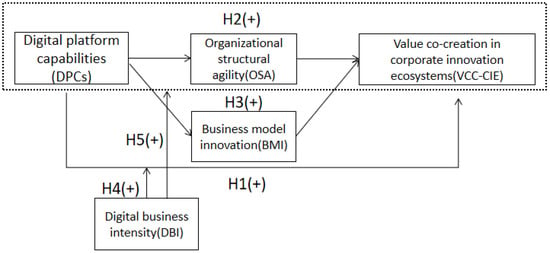
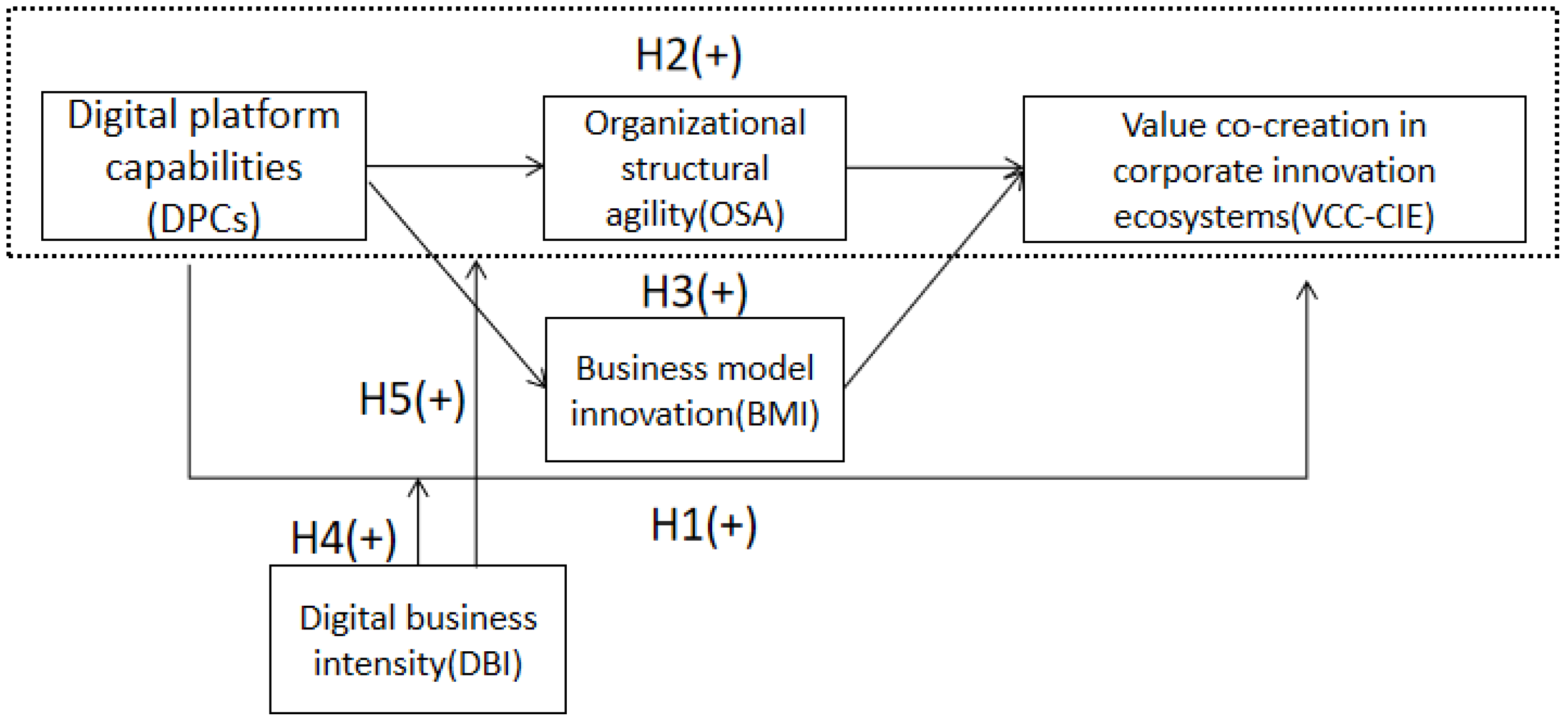
The conceptual paradigm constructed within the current investigation is presented in Figure 1.
Figure 1.
Theoretical model and assumptions. Arrows indicate hypothesized positive relationships.
3. Research Design
3.1. Research Variables and Research Tools
For DPCs, the digital platform capability measure developed by Jiang et al. and Cenamor et al. [11,21] was adopted in this study. It is broadly used in digital innovation research to assess digital “core functions,” focusing on resource coordination and adaptive environmental interactions. The eight items closely match the operational definition of digital platform capability used in this study.
For VCC-CIE, we adopted the Benefit Joint Creation Scale by Ranjan and Read [41]. This classic measure of value co-creation was developed in the context of service-dominant logic. We adapted it to our corporate innovation ecosystem context, using five positively worded items that measure value co-creation behaviors from different perspectives.
For OSA, we employed the Corporate Adaptive Capability Instrument by Cegarra-Navarro et al. [42]. This scale, centered on core organizational capabilities for dynamic responsiveness, effectively measures an enterprise’s adaptive and responsive characteristics in fast-paced environments using six items, fitting our study’s framework for evaluating organizational agility from the perspective of adaptive capability theory.
For BMI, we used Zott and Amit’s [43] Corporate Framework Blueprint Scale, an important and influential scale in the fields of entrepreneurship and strategy with solid theoretical foundations. We adapted it to our research context, resulting in eight positively worded items to measure firms’ business model design and its impact on corporate performance.
For DBI, we employed a scale developed by Nwankpa and Datta [44] that measures the depth of strategic commitment to technology adoption in enterprises. The scale comprises four positively worded items aimed at measuring strategic commitment to emerging and innovative digital technologies.
Control Variables: We controlled for enterprise size, age, and type, as these firm-level characteristics have been shown to influence innovation and collaborative outcomes [45]. Respondent demographics (gender, age, education, and position) were also included to account for individual-level perceptual variations, consistent with established practices in survey-based research [46].
3.2. Research Methodology and Subject Population
First, taking a cue from existing scales, the five research variables were integrated to create the “Survey on the effect of virtual system features on benefit Co-creation in Corporate Innovation Ecosystems.” The first part of this questionnaire obtained data on respondents’ gender, age, education level, current position, enterprise type, enterprise age, and enterprise size. In the second part, the five scales—DPCs, VCC-CIE, OSA, BMI, and DBI—were revised and adapted to the context of China’s digital cultural industry. For the questionnaire, the five-tiered Likert-type continuum was modified from 1, ‘Vigorously Reject’, to 5, ‘Fully Endorse.’
Second, national-scale experts were invited to comment on the scientific merit and authority of each scale. Third, a unified translation–back-translation was adopted to translate/modify proofreading each item of this scale, ensuring that the material of this survey maintained the original core information of the scale. After the questionnaire was roughly established, an online pre-survey was conducted in early July 2025, aiming for 30 valid questionnaires filled by experts in statistics and employee representatives of digital cultural industry enterprises. According to the pre-survey results, this questionnaire received two modifications: first, the wording of items was simplified and optimized to facilitate maximum understanding and allow for “controlling the response time” as a behavioral indicator and, second, vague expressions were corrected.
The structured investigation was carried out from 20 July to 8 August. To boost the reliability of our survey responses, we operationally defined respondents as digital cultural enterprise practitioners with insight into corporate digital platform innovation ecosystems. In the questionnaire design, we utilized “role screening” questions to concentrate on respondents such as “senior management”, “middle management”, and “frontline managers”, in addition to “core employees”, who are perhaps not in managerial titles but cater to the main operations. We used a categorized selection procedure to initially classify participants via “management level”, “enterprise size”, and “region” and then performed random sampling within each stratum to ensure representation across diverse groups and enterprise types. Our survey ultimately encompassed 91 prefecture-level cities across 26 provinces in China. We used a hybrid approach model of “in-house research + relying on and commissioning professional research firms” and concluded with a total of 568 valid responses. In light of the “common method bias”, we implemented tight controls in key procedural areas of questionnaire design and distribution. First, we employed “reverse scoring” in some scale items in the questionnaire design. Second, in our distribution of the questionnaire, we assured participants of the purpose of the survey, its anonymity and confidentiality, and its derived academic significance, and encouraged truthful answers. Validation through reverse-scoring verification and extreme score screening enabled us to eliminate invalid samples, resulting in 504 valid questionnaires. We achieved an average response rate of 88.7%, and the over fivefold response from societies compared to the count of elements in the questionnaire gave downweight data support for the analysis [47].
3.3. Data Analysis Approach
Data were analyzed using SPSS 27.0 and AMOS 28.0 software in five stages: reliability testing, validity analysis, common method bias analysis, model fit tests, and hypothesis testing. More specifically, we calculated Cronbach’s alpha coefficient for reliability testing, in addition to KMO for sampling adequacy tests and Bartlett’s sphericity test for validity. Our next step was to perform a validating component examination to examine integrated consistency and unified validity, determine the validity of our hypothesized model linking digital platform capabilities along with collaborative value generation within the innovative community of enterprises, and eliminate substantial common method bias. Our last step was to explore the scholarly postulates by examining the interconnections among observed and latent variables.
4. Research Findings
4.1. Descriptive Statistical Analysis
Table 1 shows the subset dispersion attributes. Most data came from frontline managers with direct knowledge of daily operations. Participants’ high education levels ensured response quality. Sample enterprises were 6–10 years old with 300–499 employees, representing a normal developmental stage where firms consider digital platform capabilities and begin ecosystem-based value co-creation. This provides reliable empirical evidence for analysis. The sample covers 26 provinces and 91 prefecture-level cities across China, with diverse enterprise types and sizes represented. The broad geographic coverage and stratified sampling design enhance the representativeness of our sample for the digital cultural industry in China. In summary, the sample broadly describes the target population and provides effective empirical evidence.
Table 1.
Sample distribution characteristics.
4.2. Correlation Tests in Structural Equation Modeling
4.2.1. Validity and Reliability Testing
In this study, we computed Cronbach’s α coefficients to examine the reliability and internal consistency of the scales developed and analyzed. The estimation results are displayed in Table 2. Cronbach’s α coefficients for the DPCs, VCC-CIE, OSA, BMI, and DBI scales were 0.918, 0.888, 0.909, 0.927, and 0.875, respectively. All of the values above 0.7 indicate acceptable internal consistencies; thus, the entire model is deemed to be robust, with high reliability and validity.
Table 2.
Variables and results of reliability and validity analysis.
Using SPSS 27, the content validity test showed a KMO of 0.937 (above 0.7) and Bartlett’s sphericity test demonstrated significance (p < 0.001), confirming the questionnaire’s content validity.
To establish convergent validity, confirmatory factor analysis was performed. As can be seen in Table 2, the composite reliability (CR) for each variable was 0.9184, 0.888, 0.9092, 0.9273, and 0.8754, respectively, each surpassing 0.7, and the mean variance captured per variable (AVE) was 0.5846, 0.6135, 0.6257, 0.6147, and 0.6372, respectively, each higher than 0.5, signifying acceptable consistent accuracy regarding each latent variable. Additionally, as presented in Table 3, the factor loadings for each observed variable ranged from 0.736 to 0.831, all exceeding the recommended threshold of 0.5, further supporting the convergent validity of the measures.
Table 3.
Standardized factor loadings for all measurement items.
As seen in Table 4, each of the variables’ square roots of the mean variance extracted are 0.7646, 0.791, 0.7840, 0.7833, and 0.7982, which all exceed the association metrics between them and alternative parameters. This reveals that each of the variables possesses good discriminant validity.
Table 4.
Pearson correlation analysis and AVE root mean square values.
4.2.2. Common Method Bias
To assess the potential threat of common method bias, we conducted Harman’s single-factor test. Five factors with eigenvalues above 1 emerged, explaining 67.66% of the variance, with the first factor accounting for 17.18%. According to Podsakoff et al. [48], if a single factor explains less than 50% of the total variance, common method bias is unlikely to threaten the validity of conclusions. However, as Harman’s test is a relatively conservative diagnostic approach, we acknowledge that it does not fully eliminate the possibility of common method bias. We therefore discuss this limitation further in the Research Limitations and Future Directions subsection.
4.2.3. Model Fit Test
This study uses structural equation modeling (SEM) due to its methodological fit: First, SEM handles multiple latent variables and their path relationships simultaneously [49], fitting the theoretical framework. Second, by jointly estimating measurement and structural models, it directly examines causal relationships while controlling measurement error, yielding more accurate estimates than traditional regression [50]. Third, SEM provides overall model fit indices to thoroughly evaluate how well the conceptual framework matches the data, offering a global validity criterion.
Table 5 below shows the model fit indices for this study. The results were as follows: CMIN/DF = 2.386 (<3.0), CFI = 0.948 (>0.90), TLI = 0.943 (>0.90), NFI = 0.914 (>0.90), and RMSEA = 0.052 (<0.08), indicating acceptable fit for the majority of indices [51]. The SRMR is 0.0907, which is slightly above the recommended cutoff of 0.08. Regarding GFI (0.884) and AGFI (0.862), while values above 0.90 are generally considered indicative of good fit, Hair et al. [52] suggest that values in the range of 0.80–0.89 may be considered acceptable (i.e., marginal fit), particularly when other fit indices demonstrate strong performance. Given that the majority of fit indices—particularly the more robust ones such as CFI, TLI, and RMSEA—fall within acceptable ranges, we interpret the overall model fit as acceptable, with some marginal indices. In line with the recommendation that model fit evaluation should be based on a comprehensive assessment of multiple indicators rather than a single index, we adopt a cautious interpretation of the overall model fit.
Table 5.
Model fit.
4.3. Interpretation of Model Results
4.3.1. Hypothesis Path Testing
We used AMOS 28 to construct the structural equation model and evaluate the results. As shown in Table 6, DPCs have a significant positive effect on VCC-CIE (β = 0.141, p < 0.01), indicating that the development of DPCs contributes to VCC-CIE, thus supporting hypothesis H1. DPCs also have a significant positive effect on OSA (β = 0.350, p < 0.001), suggesting that improving DPCs helps enterprises build more flexible organizational agility. OSA, in turn, has a significant positive effect on VCC-CIE (β = 0.229, p < 0.001), showing that agile adjustment enhances the ability of enterprises to collaborate and create value with ecosystem participants, thereby supporting hypothesis H2. Furthermore, DPCs have a significant positive effect on BMI (β = 0.354, p < 0.001), indicating that enhancing DPCs gives enterprises greater capacity to promote BMI. BMI exerts a significant positive effect on VCC-CIE (β = 0.266, p < 0.001), demonstrating that BMI effectively promotes value co-creation among multiple stakeholders in the innovation network, thus supporting hypothesis H3.
Table 6.
Results of hypothesis tests.
While the direct effect of DPCs on VCC-CIE is significant (β = 0.145), the notably larger effects on OSA (β = 0.350) and BMI (β = 0.347) suggest that in the digital cultural industry, DPCs create value primarily by enabling these mediating pathways, with the direct pathway playing a secondary yet still meaningful role.
4.3.2. Mediation Effect Test
Using the Bootstrap sampling method of AMOS 28, we examined the mediating roles of OSA and BMI in the relationship between DPCs and VCC-CIE. The results (Table 7) show that the direct effect of DPCs on VCC-CIE was significant (unstd. estimate = 0.141, 95% CI [0.04, 0.249], not including zero), supporting H1. The indirect effect through OSA was significant (unstd. estimate = 0.08, 95% CI [0.041, 0.122], excluding zero), accounting for 25.39% of the total effect (0.082/0.323) and thus confirming H2. The indirect effect through BMI was also significant (unstd. estimate = 0.094, 95% CI [0.053, 0.136], not containing zero), accounting for 30.03% (0.097/0.323) and supporting H3. The total indirect effect was 0.174 (95% CI [0.123, 0.228], not including zero), representing 55.42% of the total effect (0.179/0.323), while the total effect of DPCs on VCC-CIE was 0.315 (95% CI [0.214, 0.420]).
Table 7.
Analysis of direct and mediating effects.
Our findings demonstrate that OSA and BMI serve as parallel mediators in the relationship between DPCs and VCC-CIE. Specifically, higher DPCs enhance either OSA or BMI, which, in turn, increases VCC-CIE. The difference between the two standardized indirect effects was −0.014 (p = 0.677), with a 95% confidence interval [−0.079, 0.056] that included zero, indicating no significant difference between the two mediation paths.
4.3.3. Moderation Effect Test
Following the previous step, we further assessed the moderating effect of DBI on the relationship between DPCs and VCC-CIE. The results of the moderation effect model are presented in Table 8. The coefficient of the interaction term (DPCs × DBI) was 0.013, which is positive, with p = 0.044, which is less than 0.05, indicating statistical significance. This suggests that DBI acts as a positive moderator between DPCs and VCC-CIE. In other words, higher DBI strengthens the positive effect of DPCs on VCC-CIE. Thus, hypothesis H4 is supported.
Table 8.
Moderating effect analysis.
4.3.4. Moderated Mediation Analysis
To test the moderated mediation hypothesis, we conducted a conditional process analysis using PROCESS Model 7 Hayes [53] with 5000 bootstrap resamples, including both OSA and BMI as parallel mediators to control for their intercorrelation and isolate the specific indirect effect. The results showed that the interaction term (DPCs × DBI) on OSA was significant (coeff = 0.0198, p = 0.011). As shown in Table 9, the index of moderated mediation for the hypothesized OSA pathway was 0.0035 (95% CI = [0.0005, 0.0067]), excluding zero, indicating a significant moderated mediation effect. In contrast, the parallel BMI pathway yielded an index of 0.0028 (95% CI = [−0.0007, 0.0067]), suggesting that the moderating effect is specific to the OSA-mediated mechanism. Table 10 further displays the conditional indirect effects via OSA. The indirect effect was not significant at low DBI (effect = 0.0109, 95% CI includes 0) but became significant and progressively stronger at medium (effect = 0.0281, 95% CI = [0.0141, 0.0447]) and high (effect = 0.0426, 95% CI = [0.0212, 0.0683]) DBI levels. These results support the moderated mediation hypothesis (H5), indicating that higher digital business intensity enhances the mediating role of organizational structural agility.
Table 9.
Index of moderated mediation.
Table 10.
Conditional indirect effects at different levels of DBI.
5. Discussion
This study finds that DPCs have a positive impact on VCC-CIE, thus confirming research hypothesis H1. In line with dynamic capability theory and more recent evidence, this study finds support for the expectation that digital platforms facilitate collaborative innovation through the integration of resources, harnessing of synergies, and development of trust [9,11]. Nevertheless, existing research on platforms has primarily focused on the manufacturing and consumer internet sectors, and, here, we further empirically examine the unique operational mechanisms in the digital cultural industry. Our findings demonstrate that DPCs are more than mere technological facilitators in the cultural and creative sector. More significantly, they are deeply embedded in the character of cultural content, significantly increasing the efficiency of VCC-CIE for non-standardized creative resources. This finding further extends the use of the platform–industry fit theory to the cultural sector, underlining the importance of “creative fit”. Although reverse causality cannot be fully excluded—more innovative firms may inherently possess stronger platform capabilities—our theoretical grounding in dynamic capability logic and statistical controls for firm-level heterogeneity partially mitigate this concern.
This study confirms that OSA plays a positive mediating role between DPCs and VCC-CIE, thereby verifying research hypothesis H2. Although this result is largely consistent with existing research [54], from a dynamic capabilities perspective, our study provides a deeper explanation of the mechanism: DPCs enhance VCC-CIE by improving OSA through restructuring organizational response patterns. Specifically, digital platforms “normalize” the breaking of information barriers inside the organization through real-time data interaction and AI analytics, moving enterprises from “passive adaptation” to “proactive agility” [1,55]. We further demonstrate the importance of this mechanism in the digital cultural industry innovation ecosystem, showing that DPCs enhance synergy and resource integration efficiency among diverse actors by boosting intellectual capital and increasing process responsiveness, thus enabling value co-creation.
The study also discovered that BMI has a positive mediating role between DPCs and VCC-CIE, confirming research hypothesis H3. In this study, the theoretical foundation is drawn from the dynamic capability perspective and is also consistent with existing research [56]. Our study expands the explanatory boundaries of existing theory in the context of the digital cultural industry by revealing the bridging function of BMI between DPCs and VCC-CIE. Specifically, DPCs drive VCC-CIE through BMI by reconstructing the logics of value creation, and the integration/reconfiguration capabilities associated with digital platforms lay the basis for business model innovation.
The moderating effect of DBI is positive, both between DPCs and VCC-CIE (H4) and between DPCs and the mediating variable OSA (H5), thus validating the research hypotheses. While this finding is consistent with the complementarity rationale of digital capability [57], our study further clarifies the generative mechanism: deep digital business integration builds an efficient “operating channel” for enterprises, strengthening the dynamic capabilities to integrate technology and reconfigure resources [58]. The barriers faced by DPCs in creating organizational agility and cross-boundary collaborative innovation change from the friction of “Value Co-Creation Base → Operational Channel” (OBC) to the friction of OSA → OBC. Additionally, unlike prior studies that mainly emphasize the necessity of digital matching, we distinguish two pathways—complementary synergy and operational empowerment—through which DBI promotes platform co-creation effectiveness, thereby deepening the application of dynamic capability theory within digital ecosystems. Our findings also provide significant practical implications for cultural enterprises to coordinate platform development and business digitalization.
6. Conclusions
6.1. Theoretical Contributions
This study makes three contributions. First, it extends DPC research to the digital cultural industry, introducing “creative fit” to platform–industry fit theory. Second, it opens the black box of capability translation by identifying OSA and BMI as dual mediators: internal process reconfiguration and external value logic redesign. Third, it identifies DBI as a boundary condition, distinguishing two pathways (complementary synergy and operational empowerment) through which internal digital readiness moderates platform value conversion.
6.2. Practice Insights
For knowledge-intensive, platform-mediated industries (e.g., digital cultural companies), our findings confirm that DPCs positively affect VCC-CIE. Building on the three theoretical pathways underlying this effect—technological integration, collaborative interaction, and data governance—enterprises can advance value co-creation through three complementary approaches. First, they can reinforce the technological foundation of platforms, concentrating mainly on core areas such as digital content generation and the optimization of immersive interactive experiences. Thus, enterprises can follow the technical path of the Dunhuang Academy’s “Digital Grotto of Buddhist Scriptures” to transform R&D investment into a reusable tool for digital content production. Second, they can improve the ecosystem collaboration mechanism. By learning from the experience of Meituan’s “Green Mountain Plan” and adopting a “basic service fee + innovation incentive”, model enterprises can lower the threshold for participation of small and micro-enterprises. Finally, enterprises can deepen data-empowered applications. The implementation of digital watermarking and encryption technologies for data security will empower ecosystem participants with precise decision support for boosting their co-creation capabilities.
Consistent with the significant mediating roles of OSA and BMI identified in our results, enterprises can promote these mechanisms in two aspects. In organizational structures, breaking departmental barriers to establish cross-departmental matrix teams [59] enables better response to user needs and platform opportunities. For example, in film and TV IP development, cross-team collaboration of creative and technical staff enhances responsiveness, while a dynamic resource allocation mechanism uses platform feedback data (e.g., short-video production and traffic) to optimize shooting resources and adjust dynamically. In business models, platforms can gather scattered cultural resources to derive “IP incubation + multi-channel monetization” models. For example, cooperation with authors, painters, and producers to extend literary IPs into comics, dramas, and merchandise while establishing a dynamic optimization mechanism for value distribution and profit models—continuously adjusting split parameters based on user curation and partner interactions—can contribute to making the ecosystem’s overall IP more creative and diverse.
The moderating role of DBI suggests that firms with higher digital readiness derive greater benefits from DPCs. To operationalize this, organizations can leverage DBI by calibrating effects on three dimensions. The first is strengthening the direct path: organizations could establish light-footed connective mechanisms between digital investment and co-created value. This can be achieved by creating explicit digital budgets for technologies such as “AI creative assistants” that spur user engagement, and measuring how such technologies link to paid conversion probability. Furthermore, organizations can devise a value assessment mechanism for co-created digital projects as a gating metric for acceptable projects. Second, they can mobilize the intermediary pathway by creating a data-driven agile operations system. The implementation of “data dashboards” (e.g., in short videos) could empower operations teams with real-time monitoring and resource allocation authority, enabling rapid autonomous intervention when metrics veer off course. In addition, they could create a “1124” agile response mechanism and weave “response efficiency” into performance metrics to ensure that digital capabilities translate into agility. Finally, organizations can help teams cross-pollinate and engage by explaining the benefit of tiling cross-dimensional contributions into project metrics, showing synergy greater than the sum of parts. They can drive trust through the integration of technology, content, and operations.
6.3. Research Limitations and Future Directions
This study provides useful theoretical implications and empirical evidence on how DPCs lead to VCC-CIE. However, it has several limitations that future research could address.
First, our examined mediating mechanism does not incorporate network capabilities, which are crucial for accessing external resources and driving value co-creation. Future work should include this dimension to uncover more pathways of DPC influence.
Second, we focused on China’s digital cultural industry; generalization to other institutional or industry contexts remains unclear. Extending to other countries and sectors would test the model’s universality and robustness.
Third, cross-sectional data prevented capturing dynamic variable evolution and may raise common method bias concerns. Longitudinal data could describe changing dynamics, clarify causal relationships, and better address such biases.
Beyond these limitations, several directions could further extend this research agenda. Future studies might enrich the theoretical framework by integrating complementary perspectives such as platform governance or service-dominant logic. Methodologically, mixed-method designs and multi-source data would further reduce common method bias and deepen understanding of co-creation mechanisms. Contextual extensions could differentiate platform types and incorporate additional mediators or moderators. The development of maturity models for digital platform capabilities also represents a promising practical direction. We hope that these suggestions inspire future inquiry in this area.
Author Contributions
S.L.: Conceptualization, Methodology, Formal Analysis, Writing—Original Draft, Writing—Review & Editing, Visualization, Project Administration; Q.K.: Conceptualization, Resources, Supervision, Writing—Review & Editing, Funding Acquisition. All authors have read and agreed to the published version of the manuscript.
Funding
This research was funded by the National Social Science Fund of China (grant no. 24XGL015).
Institutional Review Board Statement
This study was reviewed and approved by Guilin University of Technology (approval no. GLUT-IRB-015; approval date: 15 July 2025). The research involved anonymous surveys with adult participants, and no identifiable personal information was collected. The study posed no foreseeable risks to participants and was conducted in accordance with the Declaration of Helsinki.
Informed Consent Statement
Informed consent was obtained from all subjects involved in the study. Participants were informed of the study’s purpose, the anonymous nature of the survey, and their right to withdraw at any time. Completion and submission of the questionnaire implied consent.
Data Availability Statement
The data that support the findings of this study are available from the corresponding author upon reasonable request. The data are not publicly available due to privacy or ethical restrictions.
Acknowledgments
The authors would like to thank all survey respondents for their participation and valuable input. We also extend our gratitude to the professional research firms that assisted in data collection. In addition, we would like to thank Xidui Qiu for his valuable assistance with data analysis and manuscript revision during the revision process.
Conflicts of Interest
The authors declare no conflicts of interest. The funders had no role in the design of the study; in the collection, analysis, or interpretation of data; in the writing of the manuscript; or in the decision to publish the results.
Abbreviations
The following abbreviations are used in this manuscript:
| DPCs | Digital Platform Capabilities |
| VCC-CIE | Value Co-creation in Corporate Innovation Ecosystems |
| OSA | Organizational Structural Agility |
| BMI | Business Model Innovation |
| DBI | Digital Business Intensity |
References
- Xu, X.; Yuan, H. The impact of AI capability on breakthrough technological innovation in China: A perspective of value co-creation within innovation ecosystems. Asia Pac. Bus. Rev. 2025, 1–31. [Google Scholar] [CrossRef] [Scilit]
- Remneland Wikhamn, B.; Styhre, A. Open innovation ecosystem organizing from a process view: A longitudinal study in the making of an innovation hub. R D Manag. 2022, 53, 24–42. [Google Scholar] [CrossRef] [Scilit]
- Blackburn, O.; Ritala, P.; Keränen, J. Digital platforms for the circular economy: Exploring meta-organizational orchestration mechanisms. Organ. Environ. 2023, 36, 253–281. [Google Scholar]
- Jia, Y.; Cui, L.; Su, J.; Wu, L.; Akter, S.; Kumar, A. Digital servitization in digital enterprise: Leveraging digital platform capabilities to unlock data value. Int. J. Prod. Econ. 2024, 278, 109434. [Google Scholar] [CrossRef] [Scilit]
- Moore, J.F. The Death of Competition: Leadership and Strategy in the Age of Business Ecosystems; Harper Business: New York, NY, USA, 1996. [Google Scholar]
- Ji, H.; Zou, H.; Liu, B. Research on Dynamic Optimization and Coordination Strategy of Value Co-Creation in Digital Innovation Ecosystems. Sustainability 2023, 15, 7616. [Google Scholar] [CrossRef] [Scilit]
- Piantoni, G.; Arena, M.; Azzone, G. Exploring how different innovation ecosystems create shared value: Insights from a multiple case study analysis. Eur. J. Innov. Manag. 2023, 26, 206–232. [Google Scholar] [CrossRef] [Scilit]
- Xu, Y.; Sun, H.; Lyu, X. Analysis of decision-making for value co-creation in digital innovation systems: An evolutionary game model of complex networks. Manag. Decis. Econ. 2023, 44, 2869–2884. [Google Scholar] [CrossRef] [Scilit]
- Li, Y.; Fu, K.; Gong, X.; Xiang, Z.; Zhang, J.; Liao, C. Research on value co-creation mechanism of platform enterprises in digital innovation ecosystem: A case study on Haier HOPE platform in China. Front. Psychol. 2022, 13, 1055932. [Google Scholar] [CrossRef] [Scilit] [PubMed]
- Benitez, J.; Arenas, A.; Castillo, A.; Esteves, J. Impact of digital leadership capability on innovation performance: The role of platform digitization capability. Inf. Manag. 2022, 59, 103590. [Google Scholar] [CrossRef] [Scilit]
- Jiang, H.; Yang, J.; Gai, J. How digital platform capability affects the innovation performance of SMEs—Evidence from China. Technol. Soc. 2023, 72, 102187. [Google Scholar] [CrossRef] [Scilit]
- Poell, T.; Nieborg, D.B.; Duffy, B.E. Platforms and Cultural Production; John Wiley & Sons: Hoboken, NJ, USA, 2021. [Google Scholar]
- Zhao, Y.C.; Lian, J.; Zhang, Y.; Song, S.; Yao, X. Value co-creation in cultural heritage information practices: Literature review and future agenda: An Annual Review of Information Science and Technology (ARIST) paper. J. Assoc. Inf. Sci. Technol. 2024, 75, 298–323. [Google Scholar]
- Ahmed, A.; Bhatti, S.H.; Gölgeci, I.; Arslan, A. Digital platform capability and organizational agility of emerging market manufacturing SMEs: The mediating role of intellectual capital and the moderating role of environmental dynamism. Technol. Forecast. Soc. Change 2022, 177, 121513. [Google Scholar] [CrossRef] [Scilit]
- Guo, R.; Yin, H.; Liu, X. Coopetition, organizational agility, and innovation performance in digital new ventures. Ind. Mark. Manag. 2023, 111, 143–157. [Google Scholar] [CrossRef] [Scilit]
- Homayoun, S.; Salehi, M.; ArminKia, A.; Novakovic, V. The mediating effect of innovative performance on the relationship between the use of information technology and organizational agility in SMEs. Sustainability 2024, 16, 9649. [Google Scholar] [CrossRef] [Scilit]
- Bocken, N.; Heidenreich, S.; Spieth, P.; Tucci, C.; Zott, C. Innovating for impact: Harnessing business model innovation to tackle grand challenges. Strateg. Entrep. J. 2025, 19, 665–681. [Google Scholar] [CrossRef] [Scilit]
- Zhao, S.; Li, W.; Li, F. Organisational Resilience, Network Embeddedness and Business Model Innovation: Evidence from China. Sci. Technol. Soc. 2025, 30, 118–138. [Google Scholar] [CrossRef] [Scilit]
- Nwankpa, J.K.; Roumani, Y.; Datta, P. Process innovation in the digital age of business: The role of digital business intensity and knowledge management. J. Knowl. Manag. 2022, 26, 1319–1341. [Google Scholar]
- Nwankpa, J.K.; Roumani, Y.F. Remote work, employee productivity and innovation: The moderating roles of knowledge sharing and digital business intensity. J. Knowl. Manag. 2024, 28, 1793–1818. [Google Scholar] [CrossRef] [Scilit]
- Cenamor, J.; Parida, V.; Wincent, J. How entrepreneurial SMEs compete through digital platforms: The roles of digital platform capability, network capability and ambidexterity. J. Bus. Res. 2019, 100, 196–206. [Google Scholar] [CrossRef] [Scilit]
- Liu, L.; Long, J.; Liu, R.; Fan, Q.; Wan, W. Examining how and when digital platform capabilities drive technological innovation: A strategic information perspective. J. Enterp. Inf. Manag. 2023, 36, 553–582. [Google Scholar]
- Xiao, X.; Tian, Q.; Mao, H. How the interaction of big data analytics capabilities and digital platform capabilities affects service innovation: A dynamic capabilities view. IEEE Access 2020, 8, 18778–18796. [Google Scholar] [CrossRef] [Scilit]
- Wang, Y.; Tian, Q.; Li, X.; Xiao, X. Different roles, different strokes: How to leverage two types of digital platform capabilities to fuel service innovation. J. Bus. Res. 2022, 144, 1121–1128. [Google Scholar] [CrossRef] [Scilit]
- Li, X.; Cheng, L.; Zhou, H. Does digital platform capability enable Chinese SMEs’ business model innovation? The role of complementary assets and entrepreneurial orientation. Asian J. Technol. Innov. 2024, 33, 1–33. [Google Scholar] [CrossRef] [Scilit]
- Allouche, Y.; Tapas, N.; Longo, F.; Shabtai, A.; Wolfsthal, Y. Trade: Trusted anonymous data exchange: Threat sharing using blockchain technology. arXiv 2021, arXiv:2103.13158. [Google Scholar]
- Zubaydi, H.D.; Varga, P.; Molnár, S. Leveraging blockchain technology for ensuring security and privacy aspects in internet of things: A systematic literature review. Sensors 2023, 23, 788. [Google Scholar] [CrossRef] [Scilit] [PubMed]
- Teece, D.J.; Pisano, G.; Shuen, A. Dynamic capabilities and strategic management. Strateg. Manag. J. 1997, 18, 509–533. [Google Scholar] [CrossRef] [Scilit]
- Xu, M.; Zhang, Y.; Sun, H.; Tang, Y.; Li, J. How digital transformation enhances corporate innovation performance: The mediating roles of big data capabilities and organizational agility. Heliyon 2024, 10, e34905. [Google Scholar] [CrossRef] [Scilit] [PubMed]
- Fasnacht, D.; Proba, D. Leveraging inter-organizational agility for innovation. Strategy Leadersh. 2024, 52, 15–22. [Google Scholar] [CrossRef] [Scilit]
- Wang, F.; Jiang, J.; Cosenz, F. Understanding data-driven business model innovation in complexity: A system dynamics approach. J. Bus. Res. 2025, 186, 114967. [Google Scholar] [CrossRef] [Scilit]
- Wu, H.; Li, S.; Hou, W.; Zhang, X. Leveraging digital platforms for circular economy: A value creation view. Sustainability 2024, 16, 11180. [Google Scholar] [CrossRef] [Scilit]
- Li, Y.; Chen, Y.; Wang, J.; Zhou, Y.; Wang, C. Digital platform capability and innovation ambidexterity: The mediating role of strategic flexibility. J. Bus. Res. 2025, 186, 114971. [Google Scholar] [CrossRef] [Scilit]
- Wang, C.; Chen, M.; Wang, Q.; Fang, Y. The study of value network reconstruction and business model innovation driven by entrepreneurial orientation. Int. Entrep. Manag. J. 2023, 19, 2013–2036. [Google Scholar] [CrossRef] [Scilit]
- Madsen, H.L. Business model innovation and the global ecosystem for sustainable development. J. Clean. Prod. 2020, 247, 119102. [Google Scholar] [CrossRef] [Scilit]
- Najafi-Tavani, Z.; Zantidou, E.; Leonidou, C.N.; Zeriti, A. Business model innovation and export performance. J. Int. Bus. Stud. 2025, 56, 360–382. [Google Scholar]
- Liu, Y.; Mao, M.; Zhang, Y.; Xie, X. Leveraging digital empowerment for green product innovation: Unraveling the mediating role of resource integration and reconfiguration in Chinese manufacturing enterprises. Systems 2023, 11, 489. [Google Scholar] [CrossRef] [Scilit]
- Egodawele, M.; Sedera, D.; Bui, V. A Systematic Review of Digital Transformation Literature (2013–2021) and the development of an overarching apriori model to guide future research. arXiv 2022, arXiv:2212.03867. [Google Scholar]
- Kohli, R.; Melville, N.P. Digital innovation: A review and synthesis. Inf. Syst. J. 2019, 29, 200–223. [Google Scholar] [CrossRef] [Scilit]
- Plekhanov, D.; Franke, H.; Netland, T.H. Digital transformation: A review and research agenda. Eur. Manag. J. 2023, 41, 821–844. [Google Scholar] [CrossRef] [Scilit]
- Ranjan, K.R.; Read, S. Value co-creation: Concept and measurement. J. Acad. Mark. Sci. 2014, 44, 290–315. [Google Scholar] [CrossRef] [Scilit]
- Cegarra-Navarro, J.-G.; Soto-Acosta, P.; Wensley, A.K. Structured knowledge processes and firm performance: The role of organizational agility. J. Bus. Res. 2016, 69, 1544–1549. [Google Scholar] [CrossRef] [Scilit]
- Zott, C.; Amit, R. Business Model Design and the Performance of Entrepreneurial Firms. Organ. Sci. 2007, 18, 181–199. [Google Scholar] [CrossRef] [Scilit]
- Nwankpa, J.K.; Datta, P. Balancing exploration and exploitation of IT resources: The influence of Digital Business Intensity on perceived organizational performance. Eur. J. Inf. Syst. 2017, 26, 469–488. [Google Scholar] [CrossRef] [Scilit]
- Liao, Z.; Liu, X.; Sun, Y. Can corporate background characteristics predict environmental innovation? Evidence from a meta-analysis. Eur. Manag. J. 2023, 41, 1047–1055. [Google Scholar] [CrossRef] [Scilit]
- Kohler, U.; Class, F.; Sawert, T. Control variable selection in applied quantitative sociology: A critical review. Eur. Sociol. Rev. 2024, 40, 173–186. [Google Scholar]
- Bentler, P.M.; Chou, C.-P. Practical issues in structural modeling. Sociol. Methods Res. 1987, 16, 78–117. [Google Scholar] [CrossRef] [Scilit]
- Podsakoff, P.M.; MacKenzie, S.B.; Lee, J.-Y.; Podsakoff, N.P. Common method biases in behavioral research: A critical review of the literature and recommended remedies. J. Appl. Psychol. 2003, 88, 879–903. [Google Scholar] [CrossRef] [Scilit] [PubMed]
- Zhao, H.; Vermunt, J.K.; De Roover, K. Mixture Multilevel SEM vs. Multilevel SEM for comparing structural relations across groups in presence of measurement non-invariance. Front. Psychol. 2025, 16, 1463790. [Google Scholar] [CrossRef] [Scilit] [PubMed]
- Rosseel, Y.; Burghgraeve, E.; Loh, W.W.; Schermelleh-Engel, K. Structural after measurement (SAM) approaches for accommodating latent quadratic and interaction effects. Behav. Res. Methods 2025, 57, 101. [Google Scholar] [CrossRef] [Scilit] [PubMed]
- Hu, L.T.; Bentler, P.M. Cutoff criteria for fit indexes in covariance structure analysis: Conventional criteria versus new alternatives. Struct. Equ. Model. A Multidiscip. J. 1999, 6, 1–55. [Google Scholar] [CrossRef] [Scilit]
- Hair, J.F.; Babin, B.J.; Anderson, R.E.; Black, W.C. Multivariate Data Analysis; Cengage Learning: Boston, MA, USA, 2019. [Google Scholar]
- Hayes, A.F. Introduction to Mediation, Moderation, and Conditional Process Analysis: A Regression-Based Approach; Guilford Publications: New York, NY, USA, 2017. [Google Scholar]
- Rong, K.; Hu, L. Complementary Assets, Organizational Modularization, and Platform Enterprise Value Innovation. Systems 2023, 11, 323. [Google Scholar] [CrossRef] [Scilit]
- Li, H.; Yang, Z.; Jin, C.; Wang, J. How an industrial internet platform empowers the digital transformation of SMEs: Theoretical mechanism and business model. J. Knowl. Manag. 2023, 27, 105–120. [Google Scholar]
- Verhoef, P.C.; Broekhuizen, T.; Bart, Y.; Bhattacharya, A.; Dong, J.Q.; Fabian, N.; Haenlein, M. Digital transformation: A multidisciplinary reflection and research agenda. J. Bus. Res. 2021, 122, 889–901. [Google Scholar] [CrossRef] [Scilit]
- Deng, T.; Qiao, L.; Yao, X.; Chen, S.; Tang, X. A profit framework model for digital platforms based on value sharing and resource complementarity. Sustainability 2022, 14, 11954. [Google Scholar] [CrossRef] [Scilit]
- Li, L.; Lin, J.; Benitez, J.; Luo, X.; Mikalef, P. Seeking decision-making performance: Examining the role of E-commerce capability, digital business intensity, and organizational agility. Inf. Manag. 2025, 62, 104064. [Google Scholar] [CrossRef] [Scilit]
- Zhou, J.; Xu, T.; Chiao, Y.; Fang, Y. Interorganizational systems and supply chain agility in uncertain environments: The mediation role of supply chain collaboration. Inf. Syst. Res. 2024, 35, 184–202. [Google Scholar] [CrossRef] [Scilit]

Disclaimer/Publisher’s Note: The statements, opinions and data contained in all publications are solely those of the individual author(s) and contributor(s) and not of MDPI and/or the editor(s). MDPI and/or the editor(s) disclaim responsibility for any injury to people or property resulting from any ideas, methods, instructions or products referred to in the content. |
© 2026 by the authors. Licensee MDPI, Basel, Switzerland. This article is an open access article distributed under the terms and conditions of the Creative Commons Attribution (CC BY) license.