1. Introduction
Social commerce has become a major digital marketplace in which consumers encounter, evaluate, and discuss brands through social media platforms, influencer content, livestreaming, short videos, peer communication, and algorithmically curated recommendations. Unlike traditional e-commerce, which primarily emphasizes transaction efficiency and product search, social commerce embeds consumption within socially mediated interaction and user-generated communication. In such environments, consumers’ brand evaluations are shaped not only by product-related information but also by relational cues, influencer communication, peer conversations, and platform-enabled engagement. Prior research has therefore shown that influencer-related mechanisms, including parasocial relationships, credibility, perceived authenticity, and engagement, are closely associated with consumer responses such as purchase intention, eWOM intention, brand preference, and loyalty [
1,
2,
3,
4].
Despite this growing body of research, an important theoretical and managerial problem remains underexplored: influencer-driven engagement does not necessarily become public brand advocacy. Brands often invest in influencer campaigns that generate visible engagement metrics, such as views, likes, comments, saves, shares, clicks, and livestream participation. However, these responses may remain confined to the influencer’s content space and may not develop into broader brand-supportive communication. Consumers may enjoy watching an influencer’s product demonstration, liking a sponsored post, saving brand-related content, or participating in a livestream without being willing to recommend the endorsed brand on their own social media pages, defend the brand in broader online discussions, or attach their personal reputation to the brand. This creates a relationship-to-advocacy conversion problem in influencer-mediated social commerce: relational attachment to an influencer and engagement with brand-related content may be visible and measurable, but their transformation into public eWOM advocacy is not guaranteed.
This conversion problem is theoretically meaningful because customer engagement and eWOM advocacy intention represent different levels of consumer commitment. Customer engagement captures consumers’ cognitive, emotional, and behavioral involvement with brand-related content, whereas advocacy reflects a stronger and more explicit form of positive word of mouth involving active recommendation, support, and endorsement [
5,
6,
7]. Moreover, public advocacy is more reputationally consequential than ordinary engagement because word of mouth can perform social, symbolic, and impression-management functions [
8]. In influencer-mediated social commerce, consumers may therefore move from relational closeness to engagement without necessarily moving from engagement to public advocacy. Explaining this second conversion is critical for understanding why some influencer campaigns generate brand advocates, whereas others produce only temporary or platform-bound engagement.
Influencer marketing provides a suitable context for examining this issue because influencers operate as relational intermediaries between brands and consumers. Consumers frequently encounter brands through influencer recommendations, product demonstrations, storytelling, sponsored content, and livestreaming interactions rather than through official brand communication alone. This means that brand engagement in social commerce is often initiated through a relational actor rather than directly through the brand. Parasocial relationship is especially relevant in this context because it captures the one-sided psychological bond that consumers develop with media figures, celebrities, influencers, or public personalities [
9]. In social media environments, parasocial interaction has been extended to explain consumers’ relational bonds with brands and brand-related actors [
10]. Prior studies have linked parasocial relationships to purchase intention, eWOM intention, customer engagement, and brand-related outcomes [
1,
2,
3]. However, the engagement-based mechanism through which parasocial relationships become transformed into broader public advocacy remains insufficiently specified.
The present study argues that this mechanism should not be treated as a simple relational transfer from influencer to brand. Consumers may feel emotionally close to an influencer while remaining indifferent toward, skeptical of, or resistant to the endorsed brand. They may also question the authenticity of an endorsement if the influencer–brand association appears incongruent, overly commercialized, or inconsistent with the influencer’s established image. Prior research suggests that the persuasive effects of influencer recommendations may depend on product involvement, influencer–product congruence, sponsorship recognition, perceived commercial intent, and psychological reactance [
11,
12,
13]. Thus, the movement from parasocial relationship to brand engagement requires stronger theoretical clarification than the assumption that liking an influencer automatically leads to liking or advocating for every endorsed brand.
To address this issue, this study draws on the stimulus–organism–response framework, balance theory, and the social risk perspective. The stimulus–organism–response framework provides the overall structure for explaining how an external relational stimulus may activate an internal engagement state and lead to a behavioral response [
14]. Within this structure, balance theory explains why parasocial relationship may encourage consumers to engage with an endorsed brand [
15,
16]. In influencer-mediated social commerce, consumers, influencers, and brands form a triadic relationship. When consumers have a favorable parasocial relationship with an influencer and the influencer expresses positive support for a brand, consumers may be motivated to maintain psychological consistency within this triad. Under such conditions, engaging with the endorsed brand becomes one possible way to restore or maintain balance. This theorization does not imply that all influencer endorsements generate engagement. Rather, it recognizes that contextual factors such as influencer–brand congruence, prior brand attitude, brand familiarity, sponsorship recognition, product involvement, and perceived commercial intent may shape the strength of the parasocial relationship–engagement link [
11,
12,
13].
The social risk perspective further explains why customer engagement may not necessarily become eWOM advocacy. In this study, customer engagement refers to consumers’ cognitive, emotional, and behavioral engagement with a focal brand activated through influencer-mediated content, recommendations, livestreams, sponsored posts, product demonstrations, or social commerce interactions. Such engagement may include relatively low-visibility behaviors, such as viewing influencer-mediated brand content, liking or saving posts, clicking product links, browsing brand information, or commenting within the influencer’s content space. By contrast, eWOM advocacy intention refers to consumers’ willingness to actively recommend, support, and defend the brand beyond the influencer’s immediate follower community, such as on personal social media pages, in peer networks, or in broader online communities. This distinction is critical because public advocacy involves greater social risk and reputational exposure than ordinary engagement. Customer advocacy is not merely general positive word of mouth but a stronger, more explicit, and more enduring form of consumer support [
7]. Recent research has also shown that customer engagement can play an important role in online brand advocacy formation [
17].
Accordingly, perceived brand transparency is introduced as a boundary condition in the engagement–advocacy conversion process. Perceived brand transparency refers to consumers’ evaluation of whether a brand communicates information proactively, clearly, objectively, and openly. Recent research emphasizes that brand transparency should be understood from the consumer’s perspective rather than as a purely managerial disclosure practice [
18]. Moreover, information availability alone is insufficient; consumers’ perceived transparency depends on whether brand information is proactive, clear, and objective [
19]. Because perceived risk includes social and reputational dimensions, transparency may become especially salient when consumers decide whether to publicly recommend or defend a brand [
8,
20,
21]. Thus, perceived brand transparency may reduce the social risk of advocacy by assuring consumers that the brand communicates in a sufficiently open, clear, and accountable manner.
Against this background, the present study tests a moderated mediation model in which customer engagement mediates the relationship between parasocial relationship and eWOM advocacy intention, while perceived brand transparency moderates the relationship between customer engagement and eWOM advocacy intention. Specifically, parasocial relationship is conceptualized as a relational stimulus, customer engagement as an organismic engagement state, and eWOM advocacy intention as a public response. Perceived brand transparency is theorized as a boundary condition that strengthens the conversion from engagement to advocacy by reducing the social risk associated with public endorsement.
This study makes three contributions. First, it contributes to influencer marketing research by shifting the focus from whether influencers can generate favorable consumer responses to how parasocial relationships are converted into public brand advocacy. By doing so, the study clarifies why consumers’ attachment to influencers does not automatically translate into advocacy for endorsed brands and identifies customer engagement as the conversion mechanism linking influencer attachment to brand-supportive public response. Second, it contributes to customer engagement research by conceptualizing customer engagement as influencer-driven brand engagement. This perspective extends engagement research beyond direct brand–consumer interaction and explains how brand engagement can be initiated through a relational intermediary in social commerce. Third, it contributes to social commerce and brand transparency research by identifying perceived brand transparency as a conditional mechanism that strengthens the engagement–advocacy relationship. Rather than treating transparency merely as a direct antecedent of favorable brand evaluation, this study shows that transparency functions as an informational assurance condition that reduces the social risk of public advocacy and enables influencer-driven engagement to become broader eWOM advocacy intention.
2. Literature Review and Hypothesis Development
2.1. Theoretical Framework
This study examines how parasocial relationship with an influencer is associated with eWOM advocacy intention through customer engagement, and how perceived brand transparency conditions this engagement–advocacy conversion. The proposed model is grounded in the stimulus–organism–response framework [
14], refined by balance theory [
15,
16], and extended through the social risk perspective [
20]. These theoretical perspectives serve distinct but complementary roles. The stimulus–organism–response framework provides the overall structural logic linking an external relational stimulus to an internal engagement state and a subsequent behavioral response. Balance theory explains why consumers’ favorable parasocial relationship with an influencer may motivate engagement with an endorsed brand. The social risk perspective explains why engagement may not automatically become public eWOM advocacy and why perceived brand transparency may condition this conversion.
Within the stimulus–organism–response framework, external stimuli can activate internal organismic states, which subsequently shape behavioral responses [
14]. In the present study, parasocial relationship is conceptualized as a relational stimulus because it captures consumers’ perceived emotional closeness, familiarity, and one-sided relational bond with a focal influencer. Customer engagement is conceptualized as an organismic engagement state because it reflects consumers’ cognitive, emotional, and behavioral involvement with brand-related content activated through influencer communication. eWOM advocacy intention is conceptualized as a public response because it reflects consumers’ willingness to recommend, support, and defend the brand in visible online environments beyond the influencer’s immediate content space. This S–O–R logic is consistent with prior social commerce and influencer marketing studies that examine how platform-mediated or influencer-mediated stimuli shape internal consumer states and behavioral intentions [
1,
2,
3,
4].
However, the stimulus–organism–response framework alone does not fully explain why a relationship with an influencer should lead to engagement with an endorsed brand. Consumers may like an influencer without necessarily liking, trusting, or engaging with every brand promoted by that influencer. Therefore, balance theory is introduced to specify the psychological logic underlying the parasocial relationship–engagement link [
15,
16]. In influencer-mediated social commerce, consumers, influencers, and endorsed brands form a triadic relationship. When consumers hold a favorable parasocial relationship with an influencer and the influencer expresses positive support for a brand, consumers may be motivated to maintain psychological consistency within this triad. Under such conditions, attending to, evaluating, and interacting with the endorsed brand can become one way to maintain relational balance.
At the same time, balance restoration is not necessarily favorable to the endorsed brand. Consumers may restore balance by engaging with the brand, but they may also restore balance by downgrading their evaluation of the influencer if the endorsement appears inconsistent, opportunistic, overly commercialized, or incompatible with the influencer’s established image. Prior studies have shown that influencer endorsement effects may depend on influencer–product congruence, product involvement, sponsorship recognition, perceived commercial intent, and psychological reactance [
11,
12,
13]. Recent evidence also indicates that influencer campaigns can backfire when the brand–influencer relationship violates follower expectations [
22]. Thus, contextual factors such as influencer–brand congruence, prior brand attitude, brand familiarity, sponsorship recognition, product involvement, and perceived commercial intent may shape the strength and direction of the parasocial relationship–engagement link. Because these factors are not directly modeled in the present study, they are treated as theoretically relevant boundary conditions and discussed as limitations and future research opportunities.
The social risk perspective is used to explain the moderating role of perceived brand transparency in the engagement–advocacy link. Customer engagement in influencer-mediated social commerce may involve relatively low-visibility behaviors, such as viewing, liking, saving, clicking, or commenting on influencer-mediated brand content. By contrast, eWOM advocacy intention involves public recommendation, support, or defense of the brand beyond the influencer’s immediate follower community. Such advocacy exposes consumers to reputational consequences because they attach their own social credibility to the endorsed brand. Perceived risk theory suggests that consumer decisions may involve not only financial or performance risk but also social and psychological risk [
20]. In online word-of-mouth contexts, public recommendation can also serve social and impression-management functions [
8]. Therefore, consumers may hesitate to advocate for a brand publicly even when they have engaged with influencer-mediated brand content.
Perceived brand transparency may reduce this social risk by assuring consumers that the brand communicates proactively, clearly, objectively, and openly. Recent research emphasizes that perceived brand transparency should be understood from the consumer’s perspective rather than as a purely managerial disclosure practice [
18]. Other work further suggests that information availability alone is insufficient; consumers’ perceived transparency depends on whether information is communicated proactively, clearly, and objectively [
19]. Transparency is also more likely to become salient under conditions of decision risk and personal relevance [
21]. Accordingly, perceived brand transparency is theorized not simply as a direct antecedent of favorable brand evaluation but as an informational assurance condition that strengthens the conversion from engagement to public advocacy.
2.2. Parasocial Relationship
Parasocial relationship refers to a one-sided psychological relationship that audiences develop with media figures, celebrities, influencers, or public personalities. Horton and Wohl [
9] originally conceptualized parasocial interaction as a seemingly face-to-face relationship between media audiences and performers. Although such relationships are not reciprocal in the same way as interpersonal relationships, audiences may still experience familiarity, intimacy, emotional attachment, and perceived closeness with the media figure.
In social media and social commerce environments, parasocial relationship has become particularly relevant because consumers repeatedly encounter influencers through livestreaming, short videos, personal storytelling, sponsored posts, and platform-mediated interaction. Compared with traditional celebrity endorsement, influencer communication is often perceived as more personal, informal, interactive, and embedded in everyday life. These characteristics allow followers to develop a sense of relational closeness with influencers even when the relationship remains largely one-sided. This relational mechanism is particularly important in social commerce because consumers frequently encounter brands through influencers rather than through official brand channels.
Prior research has extended parasocial interaction to digital and brand-related contexts. Labrecque [
10] showed that parasocial interaction can foster consumer–brand relationships in social media environments. Hwang and Zhang [
1] found that parasocial relationships with digital celebrities influence followers’ purchase intentions and electronic word-of-mouth intentions. Recent influencer marketing studies further indicate that parasocial relationships can enhance customer engagement, brand preference, purchase intention, and eWOM-related outcomes [
2,
3]. Research on virtual influencers also suggests that parasocial mechanisms remain relevant in explaining follower engagement and platform stickiness [
23]. Taken together, these studies indicate that parasocial relationship is a meaningful relational antecedent in influencer-mediated social commerce.
Nevertheless, prior research has not fully explained how parasocial relationship with an influencer becomes translated into public advocacy for an endorsed brand. Much of the existing literature focuses on purchase intention, general eWOM intention, brand preference, or platform-related engagement [
1,
2,
3,
23]. These outcomes are important, but they do not fully capture consumers’ willingness to publicly recommend, support, and defend an endorsed brand beyond the influencer’s content space. The present study therefore shifts attention from whether parasocial relationship generates favorable consumer responses to how it may be converted into public brand advocacy through influencer-driven customer engagement.
2.3. Customer Engagement as Influencer-Driven Brand Engagement
Customer engagement generally refers to consumers’ cognitive, emotional, and behavioral investment in brand-related interactions. In the present study, influencer-driven brand engagement is treated as a specific form of customer engagement and is hereafter referred to as customer engagement. It refers to consumers’ cognitive, emotional, and behavioral engagement with a focal brand that is activated through influencer-mediated content, recommendations, livestreams, sponsored posts, product demonstrations, or social commerce interactions.
This conceptualization is important because the study does not examine general engagement with a brand’s official website, corporate social media page, or direct brand communication. Instead, it focuses on brand engagement that occurs within, or is triggered by, influencer-mediated communication. In this context, the influencer functions as a relational gateway through which consumers notice, evaluate, and interact with the endorsed brand. This view is consistent with prior research suggesting that social media engagement can be shaped by consumers’ interactions with brand-related content, social cues, and relational communication [
5,
6,
24].
Customer engagement may include attending to influencer-mediated brand content, watching brand-related videos or livestreams, liking or saving posts, commenting on brand-related content, clicking brand links, browsing product information, or participating in brand-related discussions initiated by the influencer. However, customer engagement does not include public recommendation, active brand defense, or explicit advocacy beyond the influencer’s immediate content space. These responses are treated as conceptually distinct outcomes under eWOM advocacy intention.
This distinction is consistent with the literature on consumers’ online brand-related activities. Muntinga et al. [
25] distinguished different levels of online brand-related activities, including consuming, contributing, and creating. This framework helps clarify that engagement can involve different degrees of visibility, intensity, and social exposure. In the present study, customer engagement is treated as a lower- to moderate-visibility form of brand-related involvement, whereas eWOM advocacy intention represents a more public and endorsement-oriented response. Therefore, the study distinguishes engagement behaviors that occur within influencer-mediated brand content from public advocacy behaviors that require consumers to attach their own social identity and reputation to the brand.
Prior engagement research also supports this multidimensional view. Van Doorn et al. [
5] conceptualized customer engagement behavior as customers’ behavioral manifestations toward a brand beyond purchase, including word of mouth, recommendations, reviews, and other voluntary actions. Hollebeek et al. [
6] conceptualized consumer brand engagement in social media as positively valenced cognitive, emotional, and behavioral activity during or related to brand interactions. Building on this perspective, the present study treats customer engagement as the mechanism through which parasocial relationship may be associated with brand-supportive outcomes in influencer-mediated social commerce.
2.4. eWOM Advocacy Intention
eWOM advocacy intention refers to consumers’ willingness to actively recommend, support, and defend a brand in online environments. Compared with general eWOM intention, advocacy intention represents a stronger, more proactive, and more publicly visible form of brand support. Sweeney et al. [
7] conceptualized customer advocacy as a distinctive form of positive word of mouth that is strong, explicit, passionate, and ongoing. In this sense, advocacy is not limited to casual positive comments; it involves a more deliberate willingness to support and promote the brand in socially visible contexts.
In the present study, eWOM advocacy intention is defined as consumers’ willingness to advocate for the brand beyond the influencer’s immediate follower community. This may include posting favorable opinions on personal social media pages, recommending the brand in broader online communities, sharing positive brand experiences with peers, or publicly defending the brand in digital conversations. Thus, eWOM advocacy intention is conceptually different from engagement within the influencer’s content space. While customer engagement may occur through influencer posts, livestreams, sponsored content, or brand-related interactions initiated by the influencer, eWOM advocacy intention involves a more visible and reputationally consequential form of public endorsement.
This distinction is theoretically important because advocacy involves social risk. When consumers publicly advocate for a brand, they are not merely interacting with content; they are using their own social reputation to support the brand. If the brand later appears dishonest, opaque, or problematic, the consumer’s own credibility may be damaged. Therefore, eWOM advocacy intention is a stronger outcome than ordinary engagement because it requires consumers to move from private or semi-private involvement to public endorsement. This argument is consistent with research showing that word of mouth can serve social and impression-management functions [
8] and that advocacy represents a strong and explicit form of consumer support [
7].
Because the present study conceptualizes eWOM advocacy intention as a public and reputationally consequential form of brand support, its measurement focuses on advocacy intentions that occur beyond the influencer’s immediate content space. The items therefore emphasize consumers’ willingness to recommend, support, and defend the brand in personally visible or broader online environments, such as personal social media pages, peer networks, public online communities, or external digital discussions. This operational focus helps distinguish eWOM advocacy intention from lower-visibility engagement behaviors within the influencer’s own content space. It also ensures that eWOM advocacy intention is not reduced to ordinary engagement behaviors such as liking, saving, browsing, or commenting within influencer-mediated brand content.
Prior research suggests that engagement can lead to advocacy-oriented outcomes. Wallace et al. [
24] found that consumer engagement with brands on social networking sites is associated with brand love and WOM-related outcomes. Aljarah et al. [
17] found that customer engagement mediates the relationship between user-generated and firm-generated content and online brand advocacy. Irawan and Cheng [
26] also showed that brand-owned social media content can elevate customer brand advocacy. Gao and Shao [
27] further found that consumer brand engagement promotes eWOM intention. These studies support the view that engaged consumers are more likely to become online brand advocates, while also leaving room to examine the conditions under which engagement is more likely to become public advocacy.
2.5. Perceived Brand Transparency
Perceived brand transparency refers to consumers’ subjective evaluation of the extent to which a brand openly, clearly, proactively, and objectively discloses relevant information. It is not merely the availability of information. Rather, it reflects whether consumers perceive that the brand communicates in a way that is understandable, honest, proactive, and useful for evaluating the brand.
Montecchi et al. [
18] conceptualized perceived brand transparency and developed a measurement scale, emphasizing that brand transparency should be understood from the consumer’s perspective. Sansome et al. [
19] further argued that information availability is necessary but insufficient for perceived brand transparency. Instead, consumer perceived brand transparency depends on perceived proactivity, clarity, and objectivity. This distinction is important because consumers may not perceive a brand as transparent simply because information exists; they must also perceive that the information is actively provided, clearly communicated, and unbiased.
In social commerce, perceived brand transparency is especially important because consumers often encounter brand-related information through influencers, sponsored posts, algorithmic recommendations, livestreams, and peer discussions. These environments may increase consumer skepticism because commercial intent is often blended with personal storytelling and social interaction. Transparent brand communication can therefore provide informational assurance that helps consumers determine whether a brand is worthy of public support. This assurance function is especially relevant when consumers consider whether to advocate for a brand publicly, because advocacy requires them to expose their own social reputation to potential judgment by others.
Sansome et al. [
21] further showed that consumers process brand transparency information in active, passive, or dormant ways, and that transparency becomes especially salient under conditions of decision risk and personal relevance. This supports the argument that perceived brand transparency should be particularly important when consumers face a higher-risk behavioral decision, such as publicly advocating for a brand. In the present study, perceived brand transparency is therefore theorized as a boundary condition that affects whether engagement can be converted into public eWOM advocacy. Rather than assuming that transparency automatically generates advocacy among all consumers, this study argues that transparency becomes especially influential when consumers are already engaged with the brand and are deciding whether public advocacy is socially defensible.
2.6. Parasocial Relationship and Customer Engagement
Parasocial relationship is expected to be positively associated with customer engagement. However, this relationship should not be understood as an unconditional transfer from liking an influencer to engaging with an endorsed brand. Consumers may feel close to an influencer but still feel indifferent toward, skeptical of, or even resistant to the brand being endorsed. Balance theory provides the psychological logic for explaining when parasocial relationship may be associated with brand engagement [
15,
16].
In influencer-mediated social commerce, consumers, influencers, and brands form a triadic relationship. When consumers hold a positive parasocial relationship with an influencer and the influencer expresses support for a brand through recommendation, endorsement, product demonstration, or sponsored content, consumers may experience psychological pressure to maintain consistency within this triad. In such a situation, engaging with the endorsed brand can become one way to maintain a balanced consumer–influencer–brand relationship. This explanation extends prior parasocial relationship research by specifying customer engagement as the mechanism through which influencer attachment may become connected to brand-related responses [
1,
2,
10].
This logic is particularly relevant in social commerce because influencers often introduce consumers to emerging, niche, or less familiar brands. In such situations, consumers may not yet hold strong prior attitudes toward the focal brand. When prior brand attitudes are relatively neutral or brand familiarity is limited, the influencer’s relational influence may become more salient. A strong parasocial relationship may therefore encourage consumers to attend to, evaluate, and interact with the endorsed brand as a way of preserving psychological consistency with the influencer. Recent studies have also shown that parasocial relationships can influence customer engagement and brand-related outcomes in influencer-mediated environments [
2,
3].
Nevertheless, balance restoration may also occur in the opposite direction. If the influencer–brand association appears incongruent, opportunistic, overly commercialized, or inconsistent with the influencer’s established image, consumers may restore balance by downgrading their evaluation of the influencer rather than by engaging with the brand. Prior research on influencer–product congruence, reactance, commercialization, and endorsement backfire supports this caution. Du et al. [
12] showed that parasocial relationships and influencer–product congruence jointly shape audience evaluations of product placement and that reactance plays an important role in this process. Lim et al. [
13] showed that commercialization of influencer content can negatively affect followers’ responses. Bentley et al. [
22] further demonstrated that influencer marketing campaigns may produce negative consumer responses when consumers perceive the brand–influencer relationship as violating expectations.
Thus, this study does not assume that parasocial relationship will always produce brand engagement. Rather, the positive parasocial relationship–engagement link is theorized as more likely to emerge when the influencer endorsement does not violate consumers’ expectations regarding fit, authenticity, and commercial appropriateness. Because contextual factors such as influencer–brand congruence, prior brand attitude, brand familiarity, sponsorship recognition, product involvement, and perceived commercial intent are not directly modeled in the present study, they are acknowledged as theoretically relevant boundary conditions and are revisited in the limitations and future research section.
Based on balance theory and prior parasocial relationship research, this study argues that consumers with stronger parasocial relationships are more likely to attend to, evaluate, and engage with influencer-mediated brand content. Therefore, the following hypothesis is proposed:
H1. Parasocial relationship is positively associated with customer engagement.
2.7. Customer Engagement and eWOM Advocacy Intention
Customer engagement is expected to be positively associated with eWOM advocacy intention. Engaged consumers are more likely to develop familiarity, involvement, and affective connection with the focal brand. As consumers repeatedly attend to, interact with, and emotionally invest in influencer-mediated brand content, they may become more willing to recommend and support the brand in broader online environments. Prior research has shown that customer engagement can lead to brand-related outcomes such as WOM, advocacy, loyalty, and recommendation intentions [
5,
6,
17,
24].
The distinction between customer engagement and eWOM advocacy intention is central to this study. Customer engagement may include relatively low-visibility behaviors, such as watching content, liking posts, saving information, clicking product links, or commenting within the influencer’s content space. eWOM advocacy intention, however, involves a stronger public endorsement of the brand beyond the influencer’s immediate follower community. Thus, eWOM advocacy intention represents a more advanced response that may emerge from engagement but should not be treated as identical to engagement. This distinction is consistent with prior work suggesting that online brand-related activities differ in visibility, intensity, and social exposure [
25].
Prior studies support the engagement-to-advocacy logic. Van Doorn et al. [
5] argued that customer engagement behaviors include voluntary actions beyond purchase, including WOM and recommendations. Hollebeek et al. [
6] emphasized the cognitive, emotional, and behavioral dimensions of brand engagement in social media. Gao and Shao [
27] found that consumer brand engagement promotes eWOM intention, while Aljarah et al. [
17] demonstrated that customer engagement plays an important role in online brand advocacy. Irawan and Cheng [
26] also showed that brand-owned social media content can elevate customer brand advocacy. Based on this literature, this study argues that consumers who are more engaged with influencer-mediated brand content are more likely to develop eWOM advocacy intention.
H2. Customer engagement is positively associated with eWOM advocacy intention.
2.8. The Mediating Role of Customer Engagement
Customer engagement, defined in this study as influencer-driven brand engagement, is proposed to mediate the relationship between parasocial relationship and eWOM advocacy intention. Although parasocial relationship may create relational closeness between consumers and influencers, such closeness does not automatically become public brand advocacy. Consumers may enjoy following an influencer without actively engaging with, recommending, or defending every brand the influencer promotes. Therefore, customer engagement serves as the conversion mechanism through which parasocial closeness is associated with brand-related advocacy intention.
From the perspective of balance theory, parasocial relationship encourages consumers to maintain consistency within the consumer–influencer–brand triad [
15,
16]. When the influencer supports a brand, consumers with stronger parasocial relationship may become more willing to engage with the brand in order to maintain psychological balance. This engagement then provides the experiential and relational basis for advocacy. Through repeated attention, interaction, and emotional involvement, the brand becomes more familiar, meaningful, and worthy of support. This mediation logic is consistent with prior research showing that parasocial relationships are associated with engagement and brand-related outcomes [
1,
2,
3], and that customer engagement can mediate the formation of online brand advocacy [
17].
This mediation logic also helps distinguish the present study from research that directly links parasocial relationship to purchase intention or general eWOM intention. Rather than assuming a direct persuasive effect, this study proposes that parasocial relationship is associated with eWOM advocacy intention through customer engagement. Prior studies have provided important evidence that parasocial relationships can influence purchase intention and eWOM intention [
1], and that influencer-related mechanisms can shape engagement and brand outcomes [
2,
3]. However, fewer studies have explicitly explained how parasocial relationship is converted into public advocacy for an endorsed brand beyond the influencer’s content space. The present study addresses this gap by positioning customer engagement as the intervening mechanism connecting influencer attachment to public brand-supportive intention.
H3. Customer engagement mediates the relationship between parasocial relationship and eWOM advocacy intention.
2.9. The Moderating Role of Perceived Brand Transparency
Perceived brand transparency is expected to positively moderate the relationship between customer engagement and eWOM advocacy intention. Although perceived brand transparency may also matter during consumers’ initial contact with a brand, its theoretical role should be especially salient at the advocacy stage. The reason lies in the difference between private risk and social risk.
Many customer engagement behaviors in influencer-mediated social commerce are relatively low in visibility and reputational commitment. Consumers may watch influencer-mediated brand content, like or save a post, click a product link, browse product information, or comment within the influencer’s content space without strongly attaching their public identity to the brand. These actions may involve some private risk, such as concerns about product quality, privacy, or commercial credibility. However, they do not necessarily require consumers to publicly stake their social reputation on the brand. This distinction is consistent with perceived risk theory, which recognizes that consumer decisions may involve social and psychological dimensions in addition to functional or financial concerns [
20].
By contrast, eWOM advocacy intention involves public endorsement beyond the influencer’s immediate follower community. When consumers recommend, support, or defend a brand on their own social media pages, in peer networks, or in broader online communities, they put their reputational capital at stake. If the brand is later criticized, exposed as dishonest, or perceived as problematic, the consumer who publicly advocated for it may suffer embarrassment, loss of credibility, or damage to social image. Because online word of mouth also serves social and impression-management functions [
8], the movement from customer engagement to eWOM advocacy intention involves a higher level of social risk than the movement from parasocial relationship to customer engagement.
Perceived brand transparency can reduce this social risk by assuring consumers that the brand communicates proactively, clearly, and objectively. When consumers perceive the brand as transparent, they are more likely to believe that public advocacy is socially defensible and reputationally safe. In contrast, when the brand is perceived as opaque, unclear, or strategically manipulative, even highly engaged consumers may hesitate to advocate for it publicly. Recent research supports this logic by showing that perceived brand transparency depends on proactive, clear, and objective communication [
19] and that transparency information becomes especially salient when consumers face decision risk and personal relevance [
21]. Therefore, perceived brand transparency is positioned as a moderator of the relationship between customer engagement and eWOM advocacy intention because it becomes especially important when consumers decide whether to convert low-visibility engagement into public brand advocacy.
This moderating argument also explains why perceived brand transparency may operate more strongly as an assurance condition than as a direct motivational driver. Transparency alone may not automatically motivate consumers to advocate for a brand if they have not developed sufficient engagement with the brand. However, when consumers are already engaged, perceived transparency can reduce the reputational uncertainty associated with public support and thereby strengthen the engagement–advocacy relationship. This conditional view is consistent with the present study’s argument that transparency matters most when consumers are deciding whether engagement should be converted into visible public advocacy.
H4. Perceived brand transparency positively moderates the relationship between customer engagement and eWOM advocacy intention, such that the positive relationship is stronger when perceived brand transparency is higher.
2.10. Moderated Mediation Effect
If perceived brand transparency strengthens the relationship between customer engagement and eWOM advocacy intention, then the indirect effect of parasocial relationship on eWOM advocacy intention through customer engagement should also depend on the level of perceived brand transparency. Specifically, when perceived brand transparency is high, consumers who develop engagement through a favorable parasocial relationship with an influencer are more likely to convert that engagement into public advocacy. Under this condition, the brand’s transparency reduces the social risk associated with public endorsement and increases consumers’ confidence that advocating for the brand will not damage their social reputation.
By contrast, when perceived brand transparency is low, the indirect effect of parasocial relationship on eWOM advocacy intention through customer engagement should be weaker. Consumers may still engage with brand-related influencer content because they like or feel connected to the influencer. However, they may hesitate to advocate for the brand beyond the influencer’s follower community if the brand itself appears opaque, unclear, or insufficiently accountable. In this case, influencer-driven engagement may remain within the influencer’s content space and fail to develop into broader public advocacy.
This moderated mediation logic clarifies the conditional nature of the proposed model. Parasocial relationship may activate engagement through balance-based relational consistency, while perceived brand transparency determines whether engagement can safely become public advocacy by reducing social risk and protecting consumers’ reputational capital. This argument integrates the S–O–R framework, balance theory, and the social risk perspective by explaining not only how parasocial relationship may lead to engagement, but also when engagement is more likely to become public advocacy. Therefore, the indirect effect of parasocial relationship on eWOM advocacy intention through customer engagement is expected to be stronger when perceived brand transparency is high.
H5. Perceived brand transparency moderates the indirect effect of parasocial relationship on eWOM advocacy intention through customer engagement, such that the indirect effect is stronger when perceived brand transparency is higher.
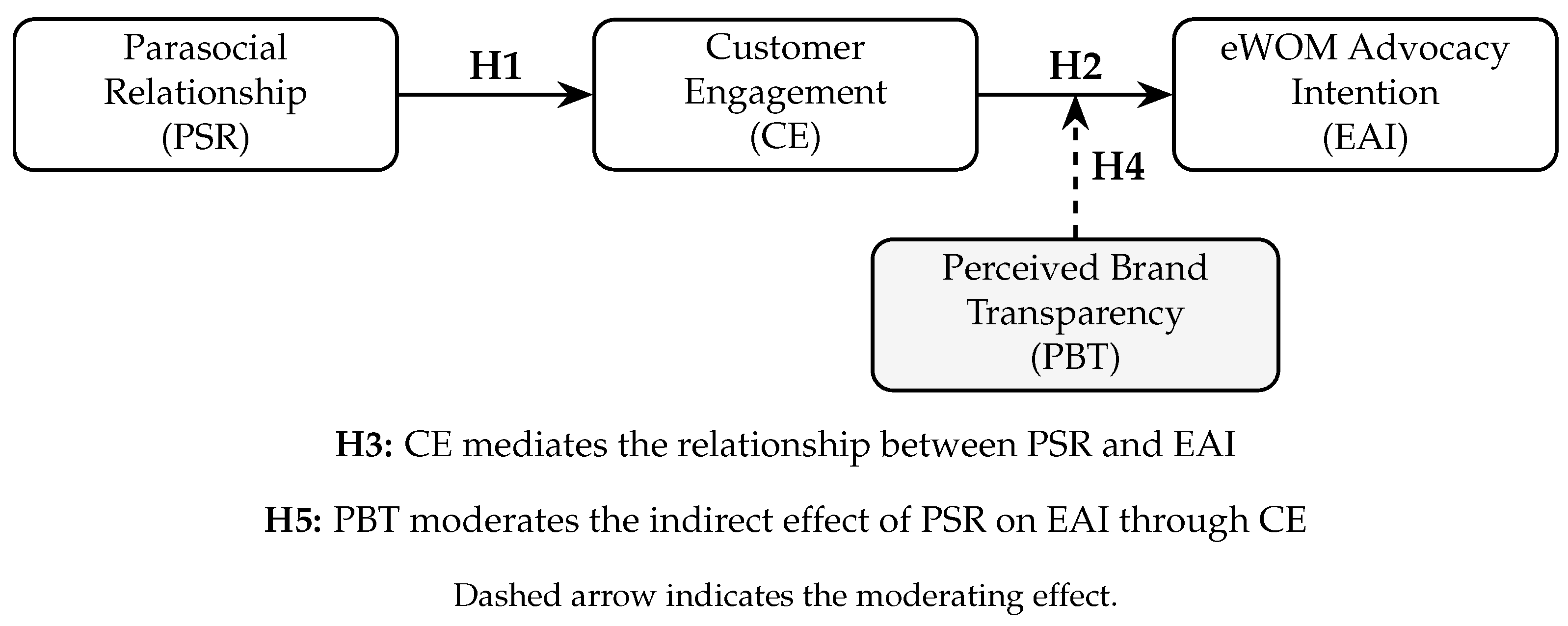
The conceptual framework of this study is presented in
Figure 1. Drawing on the stimulus–organism–response framework, parasocial relationship is conceptualized as a relational stimulus, customer engagement as the organismic engagement state, and eWOM advocacy intention as the public response. Balance theory explains the proposed link between parasocial relationship and customer engagement, whereas the social risk perspective explains why perceived brand transparency is expected to strengthen the conversion from customer engagement to eWOM advocacy intention. Thus,
Figure 1 illustrates the proposed moderated mediation model, in which customer engagement mediates the relationship between parasocial relationship and eWOM advocacy intention, and perceived brand transparency moderates the indirect effect through the customer engagement–eWOM advocacy intention path.
3. Research Methodology
3.1. Research Design
This study adopted a quantitative, cross-sectional survey design to examine the associations among parasocial relationship, customer engagement, perceived brand transparency, and eWOM advocacy intention in influencer-mediated social commerce. The empirical context of this study was Taiwan, where consumers frequently encounter influencer-endorsed brands through social media platforms, livestreaming, short videos, sponsored posts, and socially embedded online interactions. A survey-based approach was appropriate because the focal constructs concern consumers’ subjective evaluations of influencer relationships, brand-related engagement, perceived transparency, and online advocacy intention.
To enhance contextual specificity, respondents were asked to recall a specific brand that they had encountered through an influencer recommendation in a social commerce environment. They were then instructed to answer all focal measurement items based on that specific influencer-endorsed brand experience. This recall-based design reduced the risk that respondents would answer based on general attitudes toward influencer marketing, and instead encouraged them to evaluate the focal constructs in relation to an identifiable influencer–brand encounter.
Because the data were cross-sectional and self-reported, the proposed relationships should be interpreted as theoretically specified associations rather than definitive evidence of temporal or causal ordering. Accordingly, the empirical analysis assessed whether the observed data were consistent with the proposed moderated mediation framework.
3.2. Questionnaire Design and Measures
The questionnaire was designed to ensure contextual relevance, measurement clarity, and procedural separation among screening questions, the recall task, focal construct measures, and respondent profile items. The first section contained screening questions to confirm that respondents had relevant influencer-mediated social commerce experience. Respondents were required to indicate whether, within the past three months, they had encountered influencer-endorsed brand or product content on a social media platform, had interacted with the focal brand or related content, and were able to recall a specific influencer-endorsed brand experience.
The second section provided a situational recall instruction. Respondents were asked to recall the most recent or most memorable brand they had encountered through an influencer in a social commerce setting. This procedure was intended to ensure that responses were based on a concrete influencer-mediated promotional encounter rather than abstract impressions of influencers or brands.
The third section contained the measurement items for the focal constructs: parasocial relationship, customer engagement, perceived brand transparency, and eWOM advocacy intention. The final section collected demographic and usage-related information, including gender, age, education, focal social media platform, weekly social media use frequency, prior purchase due to influencer recommendation, recent purchase of the recalled brand, exposure to influencer-recommended content, current following status of the focal influencer, and exposure frequency to the focal influencer’s content.
All focal constructs were measured using multi-item scales adapted from established literature and modified to fit the influencer-mediated social commerce context in Taiwan. Unless otherwise stated, all items were measured on a seven-point Likert scale ranging from 1 = strongly disagree to 7 = strongly agree. The focal constructs were modeled as reflective constructs because their indicators were treated as manifestations of the underlying latent variables. The complete measurement items are reported in
Appendix A to allow readers to evaluate construct validity and contextual adaptation.
Parasocial relationship refers to consumers’ perceived emotional closeness, familiarity, and one-sided relational bond with the focal influencer. The items captured respondents’ perceived connection, familiarity, and emotional attachment toward the influencer who introduced or recommended the focal brand.
Customer engagement refers to consumers’ cognitive, emotional, and behavioral engagement with the focal brand activated through influencer-mediated content. In this study, customer engagement was conceptualized as influencer-driven brand engagement rather than general engagement with a brand’s official website or corporate social media account. The items therefore focused on respondents’ attention to, interest in, interaction with, and involvement in brand-related content introduced by the influencer.
Perceived brand transparency refers to consumers’ subjective evaluation of whether the focal brand communicates information proactively, clearly, objectively, and openly. The items assessed the extent to which respondents perceived the recalled brand as transparent, informative, open, and helpful for consumer judgment.
eWOM advocacy intention refers to consumers’ willingness to actively recommend, support, and defend the focal brand in online environments beyond the influencer’s immediate follower community. Because this construct was conceptualized as a public and reputationally consequential form of brand support, the items emphasized respondents’ willingness to recommend the brand on personally visible social media spaces, share favorable opinions in broader online communities, encourage people in their personal network to consider the brand, and publicly support or defend the brand in digital conversations. To sharpen the distinction between customer engagement and eWOM advocacy intention, EAI3 was worded to emphasize public support on one’s own social media or in broader online communities, rather than lower-visibility engagement behaviors such as liking, commenting, saving, or interacting with influencer-mediated brand content.
Table 1 summarizes the focal constructs and their primary measurement sources.
To enhance content validity and clarity, the questionnaire was reviewed by individuals with experience in digital marketing, social commerce, and consumer research. A pilot test was then conducted with respondents who matched the target population. Based on expert comments and pilot feedback, minor revisions were made to item wording, item order, and overall clarity. Because the questionnaire was administered in Chinese while the manuscript was prepared in English, translation and back-translation procedures were used to improve semantic equivalence between the Chinese questionnaire and the English construct definitions.
3.3. Control Variables
Several usage-related control variables were included to account for alternative explanations in the focal relationships. Specifically, weekly social media use frequency, prior purchase due to influencer recommendation, recent purchase of the recalled brand, and exposure frequency to the focal influencer’s content were included as control variables. These variables were considered relevant because consumers’ engagement with influencer-endorsed brand content and their willingness to advocate for the brand may vary according to their general social media activity, prior influencer-driven purchase experience, recent brand experience, and exposure to the focal influencer.
Weekly social media use frequency was included as a control variable for eWOM advocacy intention because consumers who use social media more frequently may have more opportunities and stronger habits of expressing opinions in online environments. Prior purchase due to influencer recommendation was linked to both customer engagement and eWOM advocacy intention because consumers with previous influencer-driven purchase experience may be more receptive to influencer-mediated brand content and more willing to support endorsed brands. Recent purchase of the recalled brand was linked to eWOM advocacy intention because recent consumption experience may influence consumers’ willingness to recommend or defend the brand. Exposure frequency to the focal influencer’s content was linked to both customer engagement and eWOM advocacy intention because repeated exposure may shape consumers’ familiarity with the influencer’s content and their responsiveness to influencer-mediated brand communication.
These control variables were modeled as single-item constructs in the PLS-SEM model. Demographic variables, including gender, age, and education, were used to describe the respondent profile rather than as focal controls in the structural model.
3.4. Sampling, Data Collection, and Screening
The target population consisted of consumers in Taiwan with relevant influencer-mediated social commerce experience. To be eligible for participation, respondents had to meet three criteria. First, they had to have encountered influencer-endorsed brand or product content on a social media platform within the past three months. Second, they had to have engaged in at least one form of interaction with the focal brand or related content, such as liking, commenting, saving, sharing, clicking a product link, browsing a product page, or watching a livestream. Third, they had to be able to recall a specific influencer-endorsed brand experience when answering the questionnaire.
This study employed purposive sampling through online convenience channels in Taiwan. An online self-administered questionnaire was appropriate because the study focused on consumers who actively use social media and are likely to encounter influencer-endorsed brand content. The survey link was distributed through social media and online communities, including Facebook groups, Instagram, and Dcard. The recruitment message briefly described the academic purpose of the study, the eligibility criteria, the voluntary nature of participation, and the anonymous treatment of responses.
A total of 700 responses were initially collected. Data screening was conducted according to the three contextual eligibility criteria. Because the study examined influencer-mediated social commerce based on a concrete recalled brand experience, respondents were excluded if they did not have relevant exposure, had not interacted with the focal brand or related content, or could not recall a specific influencer-endorsed brand experience. After applying these screening criteria sequentially, 328 responses were excluded and 372 valid responses were retained as the final analytical sample. Specifically, 80 responses were excluded because respondents had not encountered influencer-endorsed brand or product content, 188 responses were excluded because respondents had encountered such content but had not interacted with the focal brand or related content, and 60 responses were excluded because respondents had encountered and interacted with influencer-mediated brand content but could not recall a specific influencer-endorsed brand experience.
Table 2 summarizes the detailed screening outcome.
This screening procedure was adopted to ensure that all retained respondents evaluated the focal constructs based on a concrete influencer-mediated social commerce experience. Although the exclusion rate was relatively high, the screening criteria were necessary because the study specifically examined influencer-mediated social commerce experiences rather than general attitudes toward influencer marketing. Retaining respondents without relevant exposure, interaction, or recallable experience would have reduced the contextual validity of the construct assessments and increased measurement noise. Nevertheless, because a high exclusion rate may raise concerns about representativeness, this issue is acknowledged as a methodological limitation and should be considered when interpreting the generalizability of the findings.
The PLS-SEM analysis was conducted using SmartPLS 4.1.1.6 (SmartPLS GmbH, Oststeinbek, Germany). For the moderated mediation analysis, latent variable scores were exported from SmartPLS 4.1.1.6, and the additional bootstrap procedure was conducted to estimate the index of moderated mediation and the conditional indirect effects. The index of moderated mediation was calculated as the product of the PSR → CE path coefficient and the PBT × CE → EAI interaction coefficient. A 5000-case-resampling bootstrap procedure was used to estimate the confidence interval of the index of moderated mediation and the conditional indirect effects. Conditional indirect effects were estimated at low, mean, and high levels of perceived brand transparency, corresponding to SD, the mean, and SD of the PBT latent variable score.
3.5. Common Method Bias
Because the data were collected using self-reported survey responses, procedural remedies were adopted to reduce potential common method bias. Respondent anonymity was assured, participation was voluntary, and the questionnaire was organized into separate sections for screening questions, the recall task, focal constructs, and respondent profile items. Respondents were also instructed to answer the focal items based on a specific recalled influencer-endorsed brand experience. These procedures helped reduce evaluation apprehension, psychological consistency bias, and ambiguity in the response context. Statistical assessments of common method bias and collinearity are reported in the
Section 4.
3.6. Ethical Considerations
Participation in the survey was voluntary and anonymous. Before answering the questionnaire, respondents were informed of the academic purpose of the study, the general content of the questionnaire, and their right to discontinue participation at any time. No personally identifiable information was collected, and the data were used only for academic research purposes. Informed consent was obtained from all respondents before they proceeded to the questionnaire.
5. Discussion and Conclusions
5.1. Discussion of Findings
This study examined how a parasocial relationship with an influencer is associated with eWOM advocacy intention in influencer-mediated social commerce. Specifically, customer engagement was proposed as the mediating mechanism, while perceived brand transparency was proposed as the moderating condition that strengthens the conversion from engagement to advocacy. The empirical findings are consistent with the proposed moderated mediation framework. A parasocial relationship was positively associated with customer engagement, customer engagement was positively associated with eWOM advocacy intention, and customer engagement partially mediated the relationship between parasocial relationship and eWOM advocacy intention. In addition, perceived brand transparency strengthened the relationship between customer engagement and eWOM advocacy intention, and the indirect effect of parasocial relationship on eWOM advocacy intention through customer engagement was stronger when perceived brand transparency was higher.
First, the positive relationship between parasocial relationship and customer engagement suggests that relational closeness with influencers may serve as a relational gateway to influencer-driven brand engagement. Consumers who feel emotionally connected to an influencer are more likely to attend to, interact with, and become involved in the brand-related content introduced by that influencer. This finding is consistent with prior research suggesting that parasocial relationships shape consumer responses to influencer communication and social commerce activities [
1,
2,
3]. More importantly, the finding suggests that parasocial relationship does not function only as a direct persuasive mechanism. Rather, it may also be associated with consumers’ engagement with brand-related content in an influencer-mediated context. This supports the view that influencers operate not merely as promotional message sources but also as relational intermediaries through which consumers begin to engage with endorsed brands.
Second, customer engagement was positively associated with eWOM advocacy intention and mediated the relationship between parasocial relationship and eWOM advocacy intention. This finding suggests that customer engagement serves as a conversion mechanism through which relational closeness with an influencer is associated with public brand-supportive intention. Although consumers may feel close to an influencer, such closeness does not necessarily imply that they will publicly recommend, support, or defend every endorsed brand. Consumers first need to develop cognitive, emotional, or behavioral engagement with brand-related content before they are more likely to advocate for the brand in broader online environments. This finding clarifies the theoretical distinction between influencer attachment and brand advocacy: the former reflects a perceived relationship with a social media figure, whereas the latter requires consumers to attach their own social reputation to the endorsed brand.
The mediation result was partial rather than full, as the direct effect of parasocial relationship on eWOM advocacy intention remained significant after customer engagement was included. This pattern is theoretically meaningful. It suggests that parasocial relationship may be associated with eWOM advocacy intention through at least two routes. One route is engagement-based: consumers who feel close to an influencer become more involved with the endorsed brand and are subsequently more willing to advocate for it. The other route is a more direct relational endorsement route: consumers may rely on the influencer relationship itself as a basis for supporting the endorsed brand. Thus, the findings indicate that customer engagement is an important, but not exclusive, mechanism linking parasocial relationship to eWOM advocacy intention.
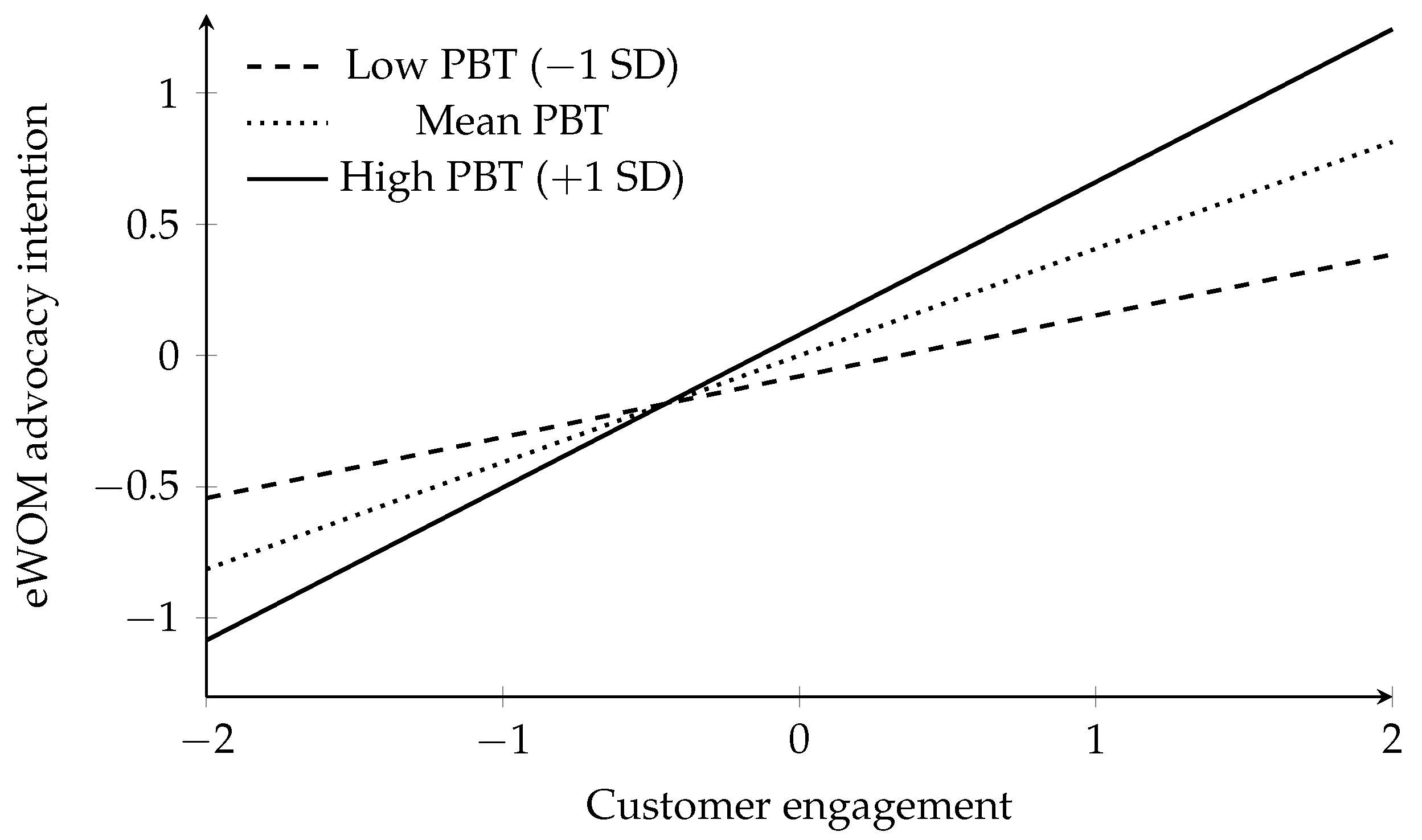
Third, the main effect of perceived brand transparency on eWOM advocacy intention was not significant at the 0.05 level, whereas the interaction effect between perceived brand transparency and customer engagement was significant. This pattern provides an important theoretical insight. Perceived brand transparency may not uniformly increase advocacy intention among all consumers. Instead, it becomes more consequential when consumers have already developed engagement with the brand. In this sense, transparency functions less as a standalone motivational driver of advocacy and more as an assurance condition that strengthens the engagement–advocacy conversion process. This interpretation helps explain why transparent brand communication may not automatically produce advocacy among disengaged consumers, but may become important among engaged consumers who are considering whether to publicly attach their personal reputation to a brand.
This finding is consistent with the social risk perspective. Public eWOM advocacy is more socially consequential than ordinary engagement because consumers use their own credibility and social identity to support the brand. When consumers recommend or defend a brand in personally visible online environments, they expose themselves to potential reputational costs if the brand is later criticized, perceived as dishonest, or considered problematic. Under such conditions, perceived brand transparency may reduce the social risk of advocacy by making public endorsement feel more defensible. Therefore, the significant interaction effect, combined with the non-significant main effect, supports the argument that transparency matters most when engaged consumers decide whether to convert private or semi-public engagement into public advocacy.
Fourth, the moderated mediation results further support the proposed relationship-to-advocacy conversion logic. The indirect effect of parasocial relationship on eWOM advocacy intention through customer engagement became stronger as perceived brand transparency increased. The conditional indirect effect was weakest at low levels of perceived brand transparency and strongest at high levels of perceived brand transparency. This finding indicates that parasocial relationship is more strongly associated with public advocacy when influencer-driven engagement is supported by perceptions of brand transparency. Thus, influencer-driven engagement should not be treated as the endpoint of influencer marketing. Engagement is more likely to develop into public eWOM advocacy when consumers perceive that the brand provides sufficient transparency to reduce the social risk of public endorsement.
Finally, the usage-related control variables provide additional insight. Prior purchase due to influencer recommendation was positively associated with customer engagement, suggesting that consumers with previous influencer-driven purchase experience may be more receptive to influencer-mediated brand content. This result implies that prior influencer-commerce experience may create a form of consumption readiness: consumers who have previously acted on influencer recommendations may be more likely to attend to, evaluate, and interact with subsequent influencer-endorsed brand content. Nevertheless, the hypothesized paths remained significant after the control variables were included, indicating that the proposed relationships among parasocial relationship, customer engagement, perceived brand transparency, and eWOM advocacy intention are not merely artifacts of consumers’ prior influencer-related purchase experience or general social media usage patterns.
5.2. Theoretical Contributions
This study makes several theoretical contributions to influencer marketing, social commerce, customer engagement, and brand transparency research.
First, this study extends influencer marketing research by explaining how parasocial relationship with an influencer is associated with public brand advocacy. Prior studies have examined the effects of parasocial relationships on consumer outcomes such as purchase intention, eWOM intention, brand preference, and loyalty [
1,
2,
3]. However, less is known about how consumers’ relational closeness with influencers becomes connected to public support for endorsed brands. By identifying customer engagement as a mediating mechanism, this study shows that parasocial relationship should not be treated only as a direct persuasive force. Instead, its influence is partly associated with influencer-driven brand engagement. This contribution addresses the theoretical gap between liking an influencer and publicly advocating for an endorsed brand.
Second, this study contributes to customer engagement research by distinguishing influencer-driven customer engagement from eWOM advocacy intention. Customer engagement and advocacy are conceptually related, but they are not equivalent. Customer engagement in this study refers to consumers’ cognitive, emotional, and behavioral involvement with brand-related content activated by influencer communication. eWOM advocacy intention, by contrast, refers to consumers’ willingness to publicly recommend, support, and defend the brand beyond the influencer’s immediate follower community. This distinction advances engagement research by showing that engagement is not only an outcome of influencer communication but also a mechanism through which relational influence is associated with higher-risk public advocacy. In doing so, this study clarifies the boundary between lower-visibility engagement behaviors and more reputationally consequential advocacy behaviors.
Third, this study contributes to brand transparency and social commerce research by identifying perceived brand transparency as a boundary condition in the engagement–advocacy conversion process. Prior transparency research emphasizes that perceived brand transparency involves consumers’ perceptions of proactive, clear, objective, and useful brand information [
18,
19]. The present findings extend this perspective by showing that perceived brand transparency becomes especially important when engaged consumers decide whether to publicly endorse a brand. The significant interaction effect, together with the non-significant main effect of perceived brand transparency, suggests that transparency does not necessarily create advocacy by itself. Rather, transparency strengthens the association between customer engagement and advocacy by reducing the perceived social risk of public endorsement. This contribution provides a more nuanced explanation of when and how perceived brand transparency matters in influencer-mediated social commerce.
Fourth, this study contributes to theory integration by combining the stimulus–organism–response framework, balance theory, and the social risk perspective into a coherent explanation of influencer-mediated brand advocacy. The stimulus–organism–response framework provides the structural logic linking parasocial relationship, customer engagement, and eWOM advocacy intention. Balance theory explains why consumers with favorable parasocial relationships may become more willing to engage with influencer-endorsed brands. The social risk perspective explains why perceived brand transparency strengthens the transition from engagement to advocacy. This integrated framework offers a more complete explanation of the relationship–engagement–advocacy conversion process in influencer-mediated social commerce.
5.3. Managerial Implications
The findings provide several implications for managers, brand strategists, and influencer marketing practitioners.
First, managers should not assume that high influencer engagement automatically translates into brand advocacy. Metrics such as views, likes, comments, saves, clicks, and livestream participation may indicate attention and interaction within the influencer’s content space, but they do not necessarily indicate consumers’ willingness to publicly recommend or defend the brand. The results show that customer engagement is important, but advocacy represents a more advanced and socially consequential outcome. Brands should therefore design influencer campaigns not only to generate engagement but also to create pathways that help engaged consumers become confident public advocates.
Second, brands should collaborate with influencers who can stimulate meaningful brand engagement rather than merely generate exposure. Influencers with large followings may increase visibility, but visibility alone may not be sufficient to produce brand advocacy. The findings indicate that parasocial relationship is positively associated with customer engagement. Therefore, brands should consider the quality of the influencer–follower relationship, the consistency of the influencer’s content, and the influencer’s ability to encourage followers to attend to, explore, and interact with brand-related information. Influencer selection should place greater emphasis on relational depth and engagement quality rather than follower count alone.
Third, brands should recognize that customer engagement and eWOM advocacy require different managerial strategies. Engagement can occur within the relatively protected environment of the influencer’s content space, where consumers may like, save, comment, or browse without strongly attaching their public identity to the brand. Advocacy, however, requires consumers to make the brand visible in their own social networks or broader online communities. Because advocacy involves greater social and reputational risk, brands need to provide sufficient assurance before expecting consumers to publicly recommend or defend them. This means that brands should reduce uncertainty, provide credible information, and make public endorsement feel socially defensible.
Fourth, perceived brand transparency should be treated as a strategic condition for converting engaged consumers into advocates. The findings show that transparency strengthens the relationship between customer engagement and eWOM advocacy intention. Therefore, brands should provide clear, proactive, and objective information about products, sponsorship arrangements, service policies, brand values, and potential limitations. In influencer campaigns, transparency should not be limited to compliance-oriented disclosure. Instead, it should be integrated into the broader communication strategy so that consumers feel they can safely support the brand in public online environments.
Fifth, brands should pay attention to consumers with prior influencer-driven purchase experience. Among the control variables, prior purchase due to influencer recommendation was positively associated with customer engagement. This suggests that consumers who have previously purchased products based on influencer recommendations may be more receptive to influencer-mediated brand content. Managers may therefore segment audiences based on prior influencer-driven purchasing behavior and design more targeted engagement and advocacy strategies for consumers who are already familiar with influencer-mediated consumption.
5.4. Limitations and Future Research
Despite its contributions, this study has several limitations that provide directions for future research.
First, the cross-sectional design limits causal inference. Although the proposed relationships are theoretically grounded and empirically supported, cross-sectional data cannot fully establish temporal ordering among parasocial relationship, customer engagement, perceived brand transparency, and eWOM advocacy intention. Future research could use longitudinal designs to examine whether parasocial relationships develop into customer engagement and advocacy over time. Experimental designs could also be used to manipulate perceived brand transparency, influencer–brand congruence, or sponsorship disclosure to provide stronger causal evidence.
Second, the sample was collected from consumers with influencer-mediated social commerce experience in Taiwan. Social commerce practices, influencer communication norms, and consumers’ willingness to publicly advocate for brands may vary across cultural and platform contexts. For example, the social meaning of public endorsement may differ across cultures, and advocacy behaviors may also vary across platforms such as Instagram, TikTok, YouTube, Facebook, Dcard, and online forums. Future research could replicate the model in different countries or compare platform-specific mechanisms.
Third, the exclusion rate was relatively high because the study required respondents to meet three contextual eligibility criteria: recent exposure to influencer-endorsed brand or product content, interaction with the focal brand or related content, and the ability to recall a specific influencer-endorsed brand experience. These criteria helped ensure contextual relevance and reduce measurement noise. However, excluding respondents without relevant exposure, interaction, or recallable experience may limit the representativeness of the final analytical sample. Future research could compare eligible and ineligible respondents or use stratified sampling to examine whether the proposed relationships differ across levels of influencer-mediated social commerce experience.
Fourth, this study measured eWOM advocacy intention rather than actual advocacy behavior. Although intention is an important predictor of behavior, actual advocacy may be influenced by additional situational and social factors. Future studies could incorporate behavioral indicators such as actual sharing, reposting, review writing, public commenting, referral behavior, or brand defense in online discussions. Such behavioral data would help validate whether eWOM advocacy intention translates into observable advocacy actions.
Fifth, although eWOM advocacy intention was worded to emphasize public recommendation, support, and defense beyond the influencer’s immediate content space, the conceptual boundary between customer engagement and advocacy remains an important issue for future research. Some online behaviors, such as sharing or commenting, may function as engagement in one context but advocacy in another depending on visibility, audience, and reputational exposure. Future studies could further distinguish private engagement, semi-public engagement, and public advocacy and examine whether these stages follow different antecedent mechanisms.
Sixth, although usage-related control variables were included, future research could incorporate additional contextual variables to further refine the model. In particular, influencer–brand congruence, sponsorship disclosure, prior brand attitude, product involvement, brand familiarity, and perceived commercial intent may influence whether consumers respond positively or negatively to influencer-endorsed brands. Including these variables would help clarify the boundary conditions under which parasocial relationships are associated with customer engagement and advocacy.
Seventh, this study focused on perceived brand transparency as the moderating condition in the engagement–advocacy relationship. Future research could examine other risk-reducing or trust-enhancing conditions, such as brand authenticity, brand credibility, perceived ethicality, platform trust, influencer authenticity, or community norm support. These variables may further explain why some engaged consumers become public advocates while others remain passive observers or private engagers.
Eighth, this study treated customer engagement as a reflective construct capturing cognitive, emotional, and behavioral engagement. Future research could examine whether different dimensions of engagement play distinct roles in the conversion from parasocial relationship to eWOM advocacy intention. For example, emotional engagement may be more important for advocacy motivation, while behavioral engagement may be more closely associated with actual sharing or recommending behavior. A more fine-grained analysis of engagement dimensions may provide deeper insight into how influencer-mediated brand engagement develops into advocacy.
Finally, although procedural and statistical remedies were adopted to address common method bias, the single-source self-reported design remains a limitation. Future research could combine survey data with behavioral data, platform analytics, experimental manipulations, or multi-source data to reduce common method concerns and strengthen the validity of the proposed relationships.
5.5. Conclusions
This study examined how parasocial relationship with influencers is associated with eWOM advocacy intention in influencer-mediated social commerce. Drawing on the stimulus–organism–response framework, balance theory, and the social risk perspective, the study tested a moderated mediation model in which customer engagement mediates the relationship between parasocial relationship and eWOM advocacy intention, while perceived brand transparency moderates the relationship between customer engagement and eWOM advocacy intention.
The findings show that parasocial relationship is positively associated with customer engagement, and customer engagement is positively associated with eWOM advocacy intention. Customer engagement partially mediates the relationship between parasocial relationship and eWOM advocacy intention, indicating that relational closeness with influencers is associated with public brand advocacy partly through influencer-driven brand engagement. Moreover, perceived brand transparency strengthens the relationship between customer engagement and eWOM advocacy intention and further strengthens the indirect effect of parasocial relationship on eWOM advocacy intention through customer engagement.
Overall, the study highlights that influencer-driven engagement is not the endpoint of influencer marketing. Consumers may interact with influencer-endorsed brand content without necessarily becoming public brand advocates. The conversion from engagement to advocacy is more likely when consumers perceive the brand as transparent, clear, and accountable. By distinguishing engagement from advocacy and identifying perceived brand transparency as a risk-reducing boundary condition, this study provides a more nuanced explanation of how influencer-mediated social commerce is associated with public eWOM advocacy.