


Abstract
Family firms are central to global economic stability and employment. Generational transitions, however, involve not only the transfer of leadership but also changes in organizational structures and culture. As digitalization becomes increasingly important for competitiveness, successors are introducing digital marketing practices that may influence organizational culture during leadership transitions. While previous research has examined digital transformation in family businesses, limited attention has been given to the role of digital marketing as a mechanism of cultural change during generational succession. This article addresses the question: How do second-generation successors use digital marketing practices to shape organizational culture during generational transitions in family firms? Drawing on practice theory and Schein’s model of organizational culture, the study explores how cultural change unfolds through everyday practices within organizations. The research employs a qualitative multiple-case study approach based on semi-structured interviews with representatives from 35 family firms in Latvia. The findings identify key digital marketing practices implemented by second-generation successors and illustrate how these practices influence organizational culture during the transition process. The results suggest that digital marketing can both reinforce existing organizational values and selectively reshape organizational identity and legitimacy. The study highlights digital marketing as a culturally legitimate tool through which successors can influence decision-making processes, coordination mechanisms, and authority structures during generational succession.
1. Introduction
For family businesses to survive in increasingly competitive markets, they must adopt digital technologies. However, digitalization also creates tensions, as it may challenge traditional family control, trust, identity, and long-term orientation [1]. Family firms often approach digitalization cautiously, relying on internal decision-making processes that evolve gradually until successors are ready to initiate change [2]. As a result, many organizations begin their digital transformation through digital marketing activities, which allow them to experiment with new technologies while maintaining control over internal operations [3]. According to a KPMG report [4], 70% of family businesses consider digitalization initiatives such as e-commerce or online service development, while 59% focus on social media and customer engagement practices. Earlier research by Zachary (2011) found that many family businesses operate without a clearly defined marketing-driven strategy or rely primarily on traditional marketing tools [5].
To remain competitive, firms must develop their businesses through both marketing strategies and digitalization initiatives. This often requires successors to introduce digital marketing methods alongside broader digital transformation processes. In practice, family firms experience continuous adjustments as social media engagement, branding activities, and customer communication reshape coordination patterns and internal relationships. Recent empirical studies show that digital marketing activities—particularly social media engagement—can positively influence both financial and non-financial performance by improving market visibility, customer engagement, and overall organizational performance [6]. Scholars also argue that digital marketing is essential for the long-term success of family firms, although its implementation must be balanced with the preservation of heritage and tradition [7]. Such changes are significant and often require adjustments across multiple organizational levels, including new systems, experimentation, and the development of new knowledge. Because many family firms prefer to retain strategic control and minimize external dependence, successors frequently implement digital marketing practices themselves rather than relying on large marketing agencies or external consultants [8].
The existing literature has largely examined digital marketing in family businesses as a set of technical tools or operational functions. However, limited research has explored how the implementation of digital marketing influences organizational culture or how it may challenge or reinforce core family values [9]. While scholarship on succession and digital transformation in family firms has grown in recent years, the role of second-generation successors in this transformation process remains insufficiently studied [10].
This research gap is particularly evident in post-Soviet contexts, where family businesses emerged after the dissolution of the Soviet Union and are now experiencing their first generational transitions. Family firms constitute the dominant organizational form worldwide and play a crucial role in economic stability and employment generation [11]. One of the most critical challenges faced by family firms is achieving continuity across generations, as succession often involves not only leadership transfer but also cultural reconfiguration [12]. Second-generation succession represents a particularly sensitive period in family firms because successors must simultaneously preserve founder-imprinted values while introducing renewal and adaptation [13,14,15]. In the post-Soviet context, many family firms established in the early 1990s are only now undergoing their first generational transitions, making succession a critical determinant of long-term survival [16,17]. These transitions occur within institutionally imprinted environments shaped by informality, paternalism, and high uncertainty, which may continue to influence decision-making logics and cultural dynamics [18,19].
Against this background, the research question guiding this study is: How do second-generation successors use digital marketing practices to reshape organizational culture during generational transitions in family firms? The study examines how successors introduce digital marketing practices that both address cultural tensions and transform existing organizational values into new practices. In doing so, it explores how digital marketing can function as a mechanism through which family firms negotiate cultural change during generational succession. The study contributes through theory bridging by connecting digital marketing practices with organizational culture enactment during succession in family firms.
2. Materials and Methods
2.1. Research Design and Theoretical Frameworks
This study draws on practice theory and Schein’s model of organizational culture to explain how cultural change unfolds through everyday organizational practices. Practice theory conceptualizes organizational phenomena as constituted through recurrent practices—interconnected patterns of doings, sayings, and material arrangements [20]—that express and reproduce values and assumptions shared by organizational members [21]. Prior research has shown that practices, or “how things are done,” play an important role in cultural processes and can help explain how culture influences a wide range of organizational outcomes, often without intentional planning or conscious recognition by actors [21]. Schein’s (2010) [20] model of organizational culture distinguishes among artifacts, espoused values, and basic underlying assumptions, and emphasizes that these assumptions develop through repeated, taken-for-granted ways of acting that have proven successful over time. Practice theory complements this view by clarifying the mechanism through which such assumptions emerge, showing how recurrent practices stabilize meanings, legitimacy, and authority [20]. Accordingly, new practices may initially appear as changes at the artifact level, but through repetition they can legitimize new values and eventually reshape underlying assumptions [22], thereby transforming the organizational system more broadly [23]. Integrating practice theory with Schein’s framework allows this study to explain both where cultural elements reside and how repeated engagement in new digital marketing practices can gradually transform underlying cultural assumptions.
De Massis and Foss (2018) argue that family business research should focus on actions, interactions, routines, and decision processes in order to explain how change is enacted, rather than concentrating only on outcomes [23]. Nordqvist and Melin (2010) similarly conceptualize strategy in family firms as an operational practice embedded in everyday activity [24]. Succession can also be understood as a practice, expressed through daily interactions and collective work activities [25,26]. Founders who establish their companies independently often build strong forms of organizational legitimacy, which second-generation successors must both preserve and reinterpret as they confront founder-imprinted legacies [25]. These successors may gradually reshape core organizational values through everyday operations, introducing new cultural standards through digital marketing practices that emphasize data-based decision making, professional communication, and teamwork. Second-generation succession represents a particularly sensitive period in family firms because successors must simultaneously preserve founder-imprinted values while introducing renewal and adaptation [13,14,15].
Applying practice theory makes it possible to understand digital marketing not merely as a technological or strategic choice, but as a bundle of organizational practices, including content creation, data analysis, customer interaction, and cross-functional coordination. These practices carry cultural meaning by shaping how decisions are made, how legitimacy is constructed, and how authority is distributed within the organization [27]. Changes in digital marketing practices may therefore gradually transform organizational culture even in the absence of explicit culture change programs. Together, practice theory and Schein’s cultural framework enable this study to theorize digital marketing as a mechanism of cultural change. Alternative theoretical approaches were considered but found to be less suitable for explaining micro-level cultural dynamics. For example, institutional theory primarily explains organizational change through external pressures and legitimacy seeking [28], but offers limited insight into how cultural change develops through daily organizational activities. Practice theory provides the micro-level mechanism [14] through which successor agency translates into cultural change, while Schein’s model captures the resulting cultural reconfiguration. The study also draws on the framework developed by Cesaroni et al. [29], which provides a useful basis for examining family business innovation through digital marketing in relation to Schein’s cultural levels. Leadership and succession perspectives in family business research often focus on the characteristics of individual successors and the outcomes of succession, while paying less attention to the practice-based processes through which cultural reconfiguration occurs [30].
Qualitative methods offer clear advantages when the aim of research is to uncover relationships and mechanisms [31]. They are particularly well suited to capturing lived experiences, meanings, and everyday practices underlying cultural change that are difficult to access through quantitative approaches [32]. Given the exploratory nature of the research question, this study adopts a qualitative multiple-case study design. De Massis and Kotlar (2014) identify succession and intra-family transitions as under-researched process phenomena that particularly benefit from qualitative case study approaches [28]. This method is especially appropriate for family business research, a field characterized by heterogeneity, multiple theoretical perspectives, and several levels of analysis, all of which require methods capable of capturing complex and context-embedded organizational processes.
2.2. Data Collection
To collect appropriate empirical data, participants were selected according to three criteria: (1) the firm is in Latvia and operates in different industries and regions of the country; (2) the firm is family-owned and family-controlled; and (3) a second-generation family member is actively involved in both strategic and operational management. The firms represented multiple industries, including wholesale and retail trade, manufacturing, agriculture, construction, logistics, professional services, and sports and recreation activities. The sample also included firms of different sizes: 14.6% micro-firms (1–10 employees), 46.3% small firms (11–50 employees), 34.1% medium-sized firms (51–250 employees), and 4.9% large firms (>250 employees). All firms were family-owned and family-controlled, with high levels of family ownership concentration.
Because the research questions required open discussion of potentially sensitive topics, participants were selected through purposive sampling complemented by snowball sampling. This approach enabled access to knowledgeable informants through professional and interpersonal networks and is well suited to qualitative research involving organizational elites and hard-to-reach populations [33]. In line with prior research on generational transitions in family firms, this study focuses primarily on second-generation successors as key informants, since they are central actors in interpreting and transforming founder-imprinted practices during the transition period.
Prior studies suggest that post-succession outcomes depend less on founders’ original plans than on how successors interpret the legacies they inherit [31]. The present research therefore follows established approaches in family business scholarship by treating interviews with second-generation successors as valid sources for studying organizational practices and cultural reconfiguration at the firm level. Previous reviews show that qualitative family business studies routinely aggregate individual actors’ experiences into firm-level constructs such as culture, performance, success, or change trajectories, particularly in case study and process-oriented designs [26]. In addition, secondary data were collected from company websites and publicly available media sources for interview preparation and deeper analysis.
The empirical material consists of 35 semi-structured interviews with second-generation successors. The interviews lasted between 40 and 80 min and were conducted primarily face-to-face. The interview guide included broader themes related to succession dynamics, newly introduced business practices, digital marketing activities, decision-making processes, and perceived organizational culture changes. Follow-up probing questions were used to elicit concrete examples, practices, and decision episodes relevant to succession and organizational change. For in-depth comparative analysis, a focused subsample of 16 cases was selected in which digital marketing activities were substantially more developed and empirically salient. These cases provided sufficiently rich material to analyze how different digital marketing practices relate to varying forms and intensities of organizational culture change during succession.
2.3. Data Analysis
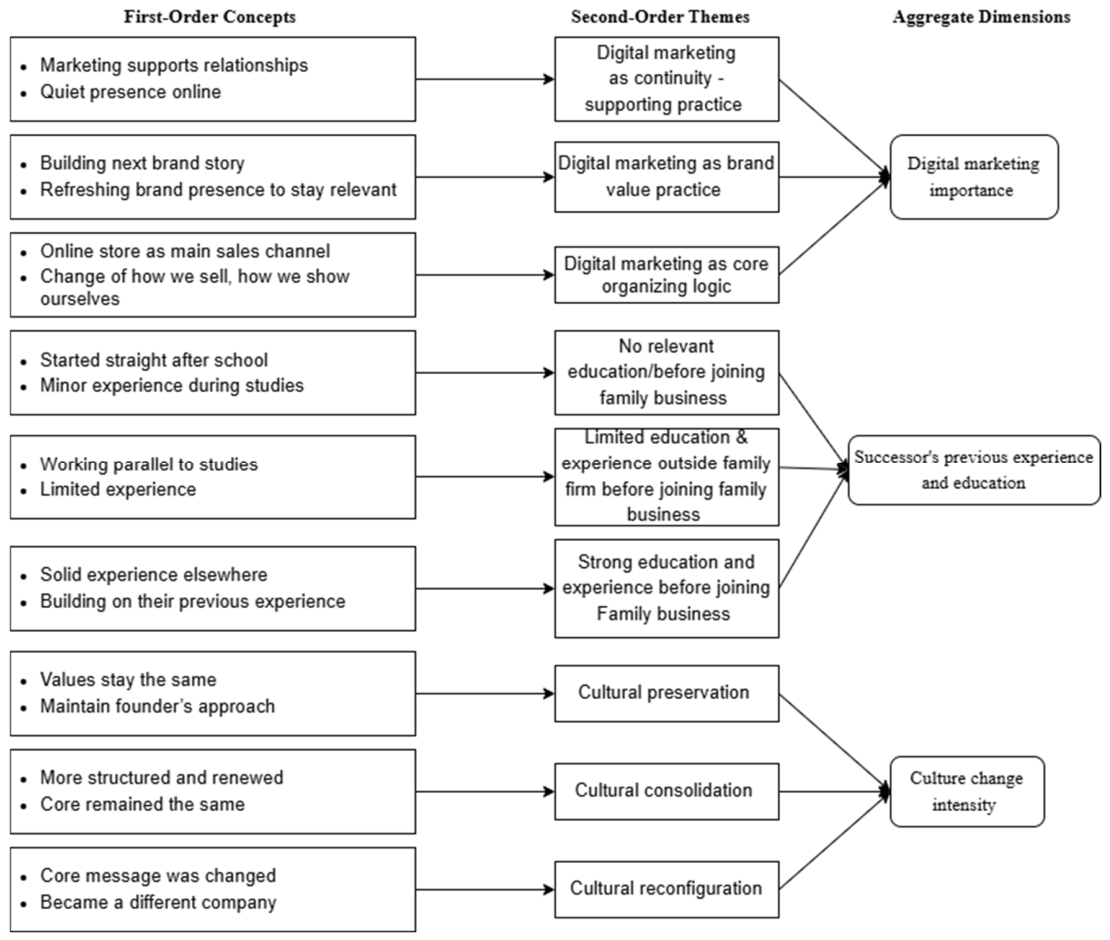
After transcription and anonymization, the interview data were analyzed using the Gioia methodology [33]. The analysis followed a predominantly inductive logic, developing first-order concepts grounded in informants’ accounts and then moving toward theory-informed abstraction in the form of second-order themes and aggregate dimensions. To ensure accuracy, the first author reviewed the material multiple times to refine and organize the codes and interpretations. To strengthen consistency in the interpretive process [34], the authors discussed the coding and emerging interpretations repeatedly throughout the analysis.
During the analysis, the cases were grouped into three analytically distinct types reflecting the role of digital marketing: digital marketing as a continuity-supporting practice, as a brand-value practice, and as a core transformation driver. This typology enabled systematic cross-case comparison and made it possible to examine how different configurations of digital marketing practices relate to different forms of organizational culture change during succession. The resulting coding structure is summarized in Figure 1.
Figure 1.
Data structure for process model.
In the later stages of analysis, the emerging themes were additionally interpreted through Schein’s three-level organizational culture framework. Artifacts were identified as visible organizational practices and structures, such as websites, online stores, social media activities, or digital communication routines. Espoused values referred to explicitly articulated priorities and principles, including transparency, customer orientation, professionalism, or reputation. Underlying assumptions were interpreted as deeper taken-for-granted beliefs regarding authority, legitimacy, value creation, growth, and decision making. Coding and interpretation were conducted iteratively by comparing interview excerpts across cases and discussing ambiguous examples among the authors. This process supported the development of analytically distinct patterns linking digital marketing practices to different trajectories of cultural change during generational transition. The resulting themes are presented in Appendix A and further explained in the Results Section.
3. Results
Digital marketing emerged as a recurring theme across the family firms included in the study and appeared frequently in discussions of second-generation succession processes. In some cases, successors entered the firm with clearly defined marketing-related responsibilities. In others, digital marketing was gradually introduced by successors who recognized its absence or perceived it as essential for the firm’s continued development and competitiveness. In several cases, digital marketing represented the successor’s first area of responsibility within the family business, and in some instances, successors had pursued formal education in marketing specifically to support the family firm.
In the three cases where triangulation interviews with founders were conducted, or where founders had publicly commented on the succession process, founders openly acknowledged their limited familiarity with digital technologies. One founder explained: “Digital presence is important, but I do not understand anything there. So, I fully trust my successor in these matters”.
At the same time, marketing-related decisions were among the most frequent sources of tension between founders and successors during the transition process. One successor explained: “There are topics where we do not agree with the opinion of the founder. There are, for example, issues of design and visual identity”. In Case FB21, the founder of a small retail chain had previously experienced unsuccessful marketing initiatives, which made it more difficult for the successor to convince the founder that new marketing strategies were appropriate for the business.
Across the full sample, approximately two-thirds of the cases (24 out of 35) explicitly referred to the importance of digital marketing and provided concrete examples of related activities. The remaining cases discussed marketing more generally or focused on digitalization initiatives in other organizational functions rather than on digital marketing practices. From these 24 cases, a subsample of 16 cases was purposefully selected in which narratives about digital marketing were particularly developed, enabling more detailed analysis of how digital marketing practices were enacted during generational transition.
Based on the interview data, the 16 selected cases were coded across digital marketing themes. The analysis revealed three distinct patterns in how family firms approached digital marketing practices: digital marketing as a continuity-supporting practice, digital marketing as a brand value practice, and digital marketing as a core transformation driver. Although some cases exhibited characteristics that overlapped categories, the classification reflects the dominant way in which digital marketing was enacted within each case. Firms from different industries appeared in each category, and firms operating within the same industry adopted different digital marketing approaches, indicating that the role of digital marketing during succession is shaped more by organizational context and successor agency than by industry characteristics.
In the following sections, we present the qualitative findings on how second-generation successors use digital marketing practices to reshape organizational culture during generational transitions in family firms. Consistent with practice theory, digital marketing is conceptualized as a set of recurrent organizational practices—comprising patterned doings, sayings, and material arrangements—through which successors exercise agency. Following Schein’s (2010) model of organizational culture, the analysis examines how these practices appear at the level of artifacts, become legitimized as espoused values, and in some cases contribute to shifts in underlying cultural assumptions [20].
3.1. Type 1: Digital Marketing as a Continuity-Supporting Practice
This section presents cases in which digital marketing functions primarily as a continuity-supporting practice. In these firms, digital marketing activities are limited in scope, routinized, and only weakly connected to core decision-making processes. Rather than driving fundamental change, digital marketing is implemented mainly to support existing business models, maintain customer relationships, and reinforce founder-imprinted cultural logic.
In these cases, successors introduce digital marketing primarily to maintain visibility and protect the firm’s reputation, which they often perceive as closely tied to their personal responsibility for the firm’s future. One successor explained: “If I don’t strengthen a new continuation of the story… then the whole brand will remain as the past”.
Digital marketing practices in this category remain largely instrumental and reactive, typically consisting of basic websites, social media accounts, and occasional online promotion. Although most successors had gained some education or experience outside the family business, they generally possessed limited formal training in digital marketing. Consequently, many managed these activities independently and learned through trial and error.
Only in one case (FB6) was digital marketing partly outsourced, as the successor acknowledged stronger expertise in another domain. In most cases, however, successors preferred to manage marketing activities internally, often motivated by cost considerations. As one respondent explained: “I create the digital advertisements myself. I learned that there is no need to pay advertising agencies 300 euros for something you can do yourself—Facebook and Google show a lot of things for you. It’s not necessarily easy, but it can be learned.” (FB9)
Prior experience outside the family firm sometimes enabled successors to recognize the opportunities digital marketing could offer and encouraged them to introduce these practices. Nevertheless, cultural change in this category remained limited and largely confined to the artifact level. The organization adopted digital tools and communication channels, yet these tools did not disrupt the core values underlying the organization.
At the artifact level, digital marketing appeared primarily as visible online platforms such as websites or social media channels. However, these tools did not significantly alter how organizational members coordinated activities or made strategic decisions.
At the value level, continuity-oriented values—such as product quality, long-term customer relationships, and operational reliability—remained dominant. Digital marketing was interpreted mainly as a supportive tool aligned with these values rather than as a source of new strategic priorities.
At the level of underlying assumptions, fundamental beliefs about how value is created in the firm—often rooted in craftsmanship, personal relationships, or founder intuition—remained largely unchanged. As one successor stated: “Digital marketing is not what determines how we work.” (FB9)
Overall, digital marketing in these cases functioned as a cultural stabilizing mechanism. It signaled modernity and professionalism externally while allowing the organization to maintain established decision-making structures and founder-centered routines internally.
3.2. Type 2: Digital Marketing as a Brand Value Practice
The second pattern includes cases where digital marketing became a key mechanism through which firms expressed and reinforced their organizational identity. In these firms, successors used digital marketing to develop brand narratives, visual identity, and coherent communication styles. In this study, brand value practices refer primarily to successor-driven efforts to shape external identity, legitimacy, and organizational self-presentation through digital channels.
Successors implemented digital marketing strategies primarily to manage the organization’s public image, reputation, and credibility. Firms recognized the importance of presenting themselves professionally to customers, partners, and broader audiences in increasingly competitive markets. Successors frequently described digital marketing as a way to “build the next story” of the company and prevent the brand from remaining associated only with the founder generation: “I had to build the next story.”; “If I don’t do it, the brand stays in the past.” Digital marketing was also driven by awareness that visibility and transparent communication help build trust and legitimacy. As one successor noted: “People see everything—reviews, comments, reactions. It makes you think otherwise.” (FB27)
Successors described digital marketing primarily as a way to shape how the company is perceived externally and to ensure consistency between organizational identity and public representation. Digital marketing practices in these firms typically involved visual identity development, consistent communication strategies, website redesign, and active social media management. This was particularly visible in cases where successors redesigned websites, curated social media communication, and personally controlled online content to ensure alignment with organizational identity: “We switched to a new website because the old one just didn’t fit what we wanted to look like.” (FB24); “Digital marketing for us is more about how we look from the outside.” (FB25); “Instagram and Facebook are maintained by me because it’s important to me that the content is consistent with who we are.” (FB34) In these cases, all successors had higher education and experience outside the family business. Some had achieved professional success before joining the firm. While most did not possess formal marketing degrees, they often had prior experience in communication-related roles or a strong personal interest in branding and public presentation.
At the artifact level, digital marketing was visible through redesigned websites, structured social media presence, and more consistent visual communication. As one successor explained: “It was important that the website looked orderly and professional because that’s the first thing the customer sees.” (FB24)
At the value level, digital marketing reinforced values related to transparency, reputation, and external orientation. Successors emphasized openness and credibility as core organizational principles. One respondent explained: “Digital marketing forces you to be more honest—you can’t promise what you can’t then fulfill.” (FB27)
This shift often reflected a broader shift from internal convenience to a stronger customer orientation. As one successor stated: “Previously, we focused more on what was convenient for us; now we think more about how the customer sees it.” (FB24)
At the level of underlying assumptions, digital marketing gradually reshaped beliefs about how trust and legitimacy are constructed in modern markets. While core beliefs about value creation—such as product quality and founder-established practices—remained largely intact, firms increasingly recognized that external communication and market presence are essential components of legitimacy.
In this category, digital marketing thus served both symbolic and communicative functions. It enabled successors to maintain and strengthen organizational identity while aligning the firm’s public representation with evolving market expectations.
3.3. Type 3: Digital Marketing as a Transformation Driver
The third pattern describes cases in which digital marketing served as a central driver of organizational reconfiguration. In these firms, digital marketing became embedded in operational routines, strategic decision-making, and performance evaluation systems.
Digital marketing in these cases is connected directly to broader strategic ambitions, including international expansion and organizational growth. From the empirical material, only three cases were categorized within this pattern. In each case, digital transformation was closely linked to internationalization and market expansion pressures. As one successor explained: “We opened new markets, even Japan. The new business direction was built internationally, and without digital channels it just wouldn’t be possible.” (FB2)
In these firms, digital marketing also served as an entry point for successors to establish their authority within the organization. Through the development of digital marketing systems—such as e-commerce platforms, influencer partnerships, and structured social media strategies—successors introduced new organizational procedures and contributed to broader institutional transformation.
Digital marketing was also used as a tool for education and market development, combining digital content, video communication, and professional media to build trust and legitimacy. One respondent described how digital communication became directly linked to market growth: “We realized we had to show how we do it. If they grow, we supply more, and so do we. It was a very important turning point and actually a very successful one.” (FB26)
Over time, digital marketing evolved into a platform for expertise, forecasting, and opinion leadership within the industry. As another respondent explained: “Our partners value us as opinion leaders—if the company says there will be supply problems or price changes, they believe it and act accordingly.” (FB26)
Across these cases, successors possessed substantial prior professional experience that allowed them to conceptualize digital marketing not simply as a promotional activity but as an organizational system integrated into strategy, operations, and learning processes.
Perceived cultural change in this category extended beyond artifacts and values to the level of underlying assumptions. At the artifact level, digital channels became primary interfaces for customer interaction, international communication, knowledge dissemination, and employer branding. At the value level, transparency, professionalism, learning, and accountability were explicitly articulated and reinforced through digital marketing practices.
At the level of underlying assumptions, digital marketing became inseparable from how the organization understood value creation, legitimacy, and growth in global markets. Firms increasingly viewed digital engagement as an essential component of their market position and long-term development.
In these cases, the introduction of digital marketing practices contributed to deeper organizational reconfiguration. Perceived cultural change occurred not only through formal leadership succession but also through the gradual institutionalization of new digital practices that reshaped decision-making processes, authority structures, and performance evaluation mechanisms.
4. Discussion
Building on an in-depth analysis of 16 cases in which digital marketing activities were particularly salient, the findings show that digital marketing functions not only as a promotional or customer engagement tool but also as a set of organizational practices through which successors enact agency, secure legitimacy, and influence perceived cultural change. Three analytically distinct patterns were identified across the cases, reflecting different roles that digital marketing plays during succession processes and the associated forms of cultural change.
4.1. Digital Marketing as Cultural Practice in Family Firms
This study demonstrates that digital marketing in family firms should not be understood merely as a technical or communication tool. Rather, it functions as a practice through which second-generation successors enact, maintain, or reshape organizational culture during generational transition. The entry of younger family members into decision-making roles often introduces new ideas, routines, and ways of working within the organization [35]. The findings indicate that the cultural impact of digital marketing depends less on the technologies themselves and more on how digital marketing practices become embedded in everyday organizational activities.
Digital marketing is rarely confined to a single organizational unit. Successful implementation typically requires digital skills across multiple departments, including logistics, warehouse management, and accounting [36]. For example, data-driven marketing depends on accurate data collection and analysis across organizational functions. When employees in different departments lack digital competencies, the effective use of digital marketing tools becomes difficult.
Interview results show that in several cases successors did not initially possess advanced digital skills or extensive knowledge of digital marketing. In this respect, they resembled the founders, who also had limited familiarity with digital technologies. As a result, digital marketing strategies often had to be developed from the ground up. Many firms were not fully prepared for digital transformation, which required adjustments not only in technical capabilities but also in organizational culture. Employees had to learn new skills, adopt digital tools, and adapt to continuously evolving digital environments. In some cases, new employees with digital expertise were recruited to support these processes. These findings highlight that digital marketing functions not only as a technical capability but also as a driver of broader perceived cultural change during generational transition. It encourages greater adaptability, stronger customer orientation, and increased digital competence while often fostering closer cooperation across departments.
Across the cases, digital marketing consisted of recurring practices such as content creation, platform management, online customer interaction, and the use of performance metrics. These practices shape what becomes visible within the organization, what is valued, and how legitimacy is constructed both internally and externally [37]. In this sense, digital marketing provides a practical arena through which successors can express priorities, demonstrate competence, and influence shared understandings of how work should be conducted within the organization.
At the same time, the findings suggest that digital marketing does not necessarily lead to deep cultural reconfiguration. This variation in cultural impact can be explained through Schein’s multi-level model of organizational culture. In many family firms, digital marketing remains confined to surface-level artifacts, such as websites or social media channels [38]. In other cases, digital marketing practices reinforce espoused values such as transparency, customer orientation, and professional communication. Only in a smaller number of cases does digital marketing contribute to changes in deeper assumptions about authority, decision making, and value creation. These findings suggest that while digital marketing adoption is widespread among second-generation successors, deeper cultural reconfiguration remains uneven across family firms.
The presence of multiple digital marketing practice types within the same industries further suggests that differences in digital marketing enactment are shaped less by industry characteristics and more by successor agency, organizational culture, and authority structures during succession.
4.2. Succession Through Practice: Authority and Legitimacy
The findings indicate that digital marketing practices can provide second-generation successors with a relatively low-conflict pathway to establish legitimacy and influence during generational transition, often before formal authority is transferred. By assuming responsibility for digital marketing initiatives, successors can demonstrate competence, responsiveness to market developments, and strategic awareness. These activities can strengthen their position within the organization without directly challenging the authority of the founder.
However, the findings also reveal clear limits to this practice-based pathway. Digital marketing can become a mechanism of cultural reconfiguration only when deeper assumptions regarding authority, value creation, and decision making are renegotiated. When these underlying assumptions remain unchanged, digital marketing practices tend to remain superficial and fail to become fully institutionalized.
In one case, digital marketing became a source of intergenerational tension. The successor viewed digital practices as essential for the firm’s future development, whereas the founder resisted their broader integration into organizational processes. As a result, attempts at cultural reconfiguration remained incomplete. Despite the successor’s efforts, digital marketing practices remained contested and fragile, illustrating that practice-based influence alone is insufficient when legitimacy at the level of authority is not granted.
Taken together, these findings suggest that succession is enacted not only through formal transfers of roles and ownership but also through everyday organizational practices. Digital marketing allows successors to build legitimacy incrementally; however, its transformative potential ultimately depends on whether such practices are recognized as legitimate sources of authority within the family firm.
4.3. From Digital Marketing Types to Cultural Change Mechanisms
The empirical analysis shows that digital marketing practices contribute to organizational culture change in different ways, corresponding to three broader cultural strategies adopted by successors during generational transition: cultural preservation, cultural consolidation, and cultural reconfiguration. These strategies are reflected in the three digital marketing practice types identified in the Results Section: digital marketing as a continuity-supporting practice, as a brand value practice, and as a core transformation driver.
These cultural strategies also resemble the innovation process types identified by Cesaroni et al. (2021), in which innovation trajectories are shaped by the interaction between founder and successor characteristics [29]. While the three digital marketing types capture distinct roles that digital marketing can play during generational transitions, cross-case comparison suggests that these types are underpinned by a smaller set of recurring cultural change mechanisms. Moving beyond typological description, this subsection therefore explains how digital marketing practices contribute to different forms and intensities of organizational culture change.
Consistent with a practice–theoretical perspective, digital marketing is conceptualized as a constellation of recurrent practices—including content creation, platform management, analytics use, and online customer interaction—through which successors enact agency [39]. These practices do not influence organizational culture directly. Instead, their cultural impact depends on how they are embedded in everyday work, how they become legitimized within the organization, and how they interact with existing authority structures. When interpreted through the lens of Schein’s cultural model, these mechanisms help explain why digital marketing remains confined to the artifact level in some firms, becomes institutionalized as espoused values in others, and contributes to shifts in underlying assumptions in a smaller subset of organizations (see Table 1).
Table 1.
Digital marketing practices as mechanisms of perceived cultural change during family firm succession.
Cross-case comparison further suggests that deep cultural reconfiguration through digital marketing occurred only when several conditions were simultaneously present. First, successors needed sufficient agency to introduce and sustain new digital practices over time. Second, these practices required at least partial openness to authority redistribution within the family firm, allowing successors to influence strategic decisions beyond operational marketing activities. Third, transformational cases were associated with stronger prior education or professional experience outside the family business, which enabled successors to conceptualize digital marketing as an organizational system rather than merely a communication tool. In most continuity-supporting and brand value cases, one or more of these conditions remained limited, resulting in cultural preservation or selective consolidation rather than deeper transformation.
Taken together, the identified cultural change mechanisms help explain why digital marketing practices lead to different cultural outcomes across family firms. However, these mechanisms do not operate in isolation. Rather, they unfold over time as successors experiment with, institutionalize, or abandon digital marketing practices under varying conditions of authority, legitimacy, and external pressure. To capture this dynamic dimension, the following section develops a process model that explains how digital marketing practices contribute to cultural preservation, consolidation, or transformation during generational succession.
4.4. A Process Model of Digital Marketing-Driven Perceived Cultural Change During Succession
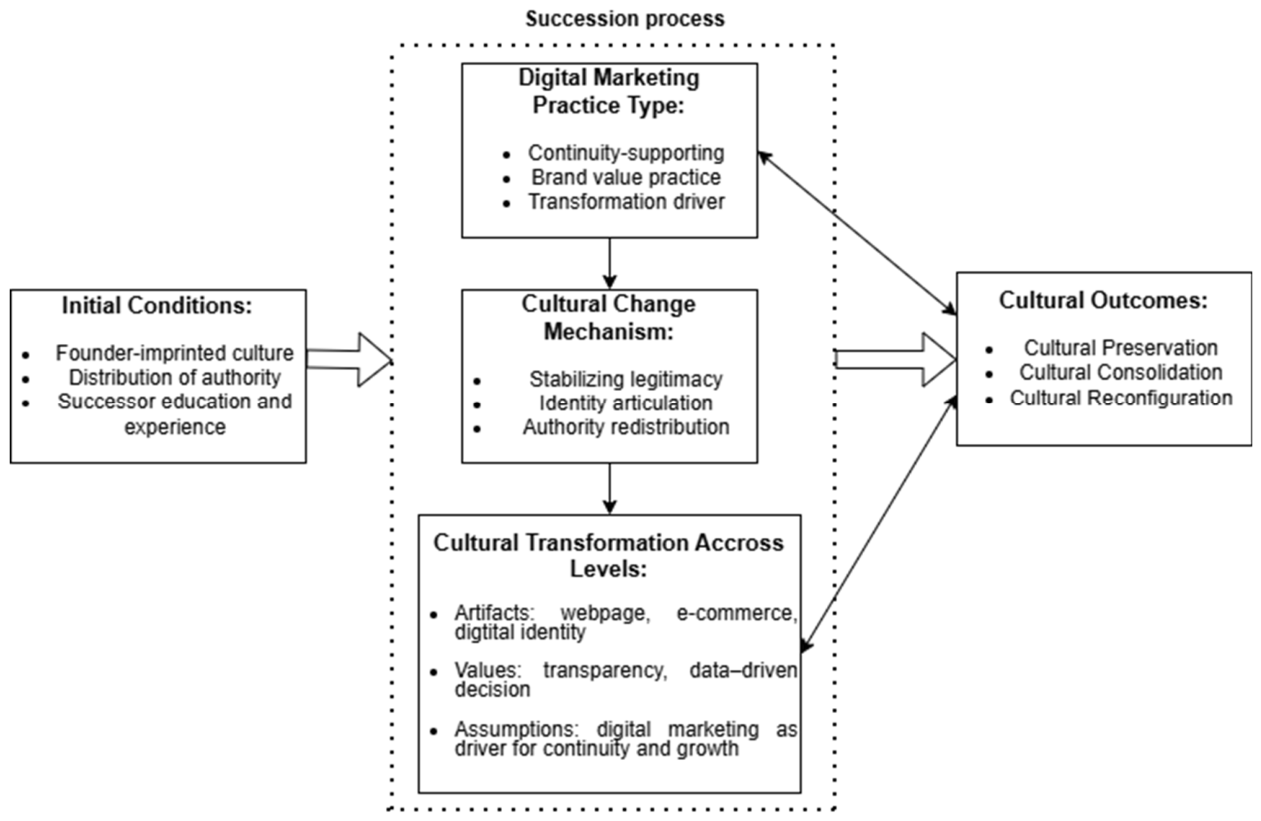
This section introduces a process model that synthesizes the empirical findings and explains how digital marketing practices shape organizational culture during generational transition in family firms (see Figure 2). Rather than viewing digital marketing adoption as a one-time strategic decision, the model conceptualizes it as an ongoing process through which successors gradually influence cultural patterns through everyday practices.
Figure 2.
Digital marketing as a mechanism of perceived cultural change during succession.
The process model consists of five interrelated elements: initial conditions, digital marketing enactment, cultural mechanisms, cultural reconfiguration across levels, and cultural outcomes.
Initial conditions refer to the structural and contextual factors that shape how digital marketing practices are introduced during succession. These conditions include the strength of founder authority, the degree of openness to change within the organization, the digital competencies of successors and employees, and external market pressures such as increased competition or internationalization. These factors influence both the scope of digital marketing initiatives and the degree of autonomy that successors possess when introducing new practices.
Digital marketing enactment refers to the everyday practices through which digital marketing is implemented within the organization. These practices include content creation, platform management, customer interaction via digital channels, data analysis, and cross-departmental coordination. Through repeated enactment, these practices gradually become embedded in organizational routines and shape how members of the organization communicate, coordinate, and evaluate performance.
Cultural mechanisms describe the processes through which these practices influence organizational culture. As demonstrated in the empirical analysis, digital marketing practices may stabilize existing cultural patterns, articulate new organizational identities, or redistribute authority within the firm. These mechanisms determine whether digital marketing practices remain symbolic tools or become drivers of deeper perceived cultural change.
Cultural reconfiguration across levels refers to how these mechanisms operate across Schein’s three levels of organizational culture. In some cases, digital marketing practices remain confined to the artifact level, appearing primarily as visible digital tools and communication platforms. In other cases, these practices become institutionalized as espoused values, influencing how organizations articulate their identity, reputation, and customer orientation. In a smaller subset of firms, digital marketing practices contribute to shifts in underlying assumptions regarding authority, legitimacy, and value creation.
Finally, cultural outcomes represent the observable trajectories of perceived cultural change resulting from the interaction of these elements. The empirical findings suggest three main outcomes: cultural preservation, where digital marketing reinforces existing cultural patterns; cultural consolidation, where digital marketing strengthens shared values and identity; and cultural reconfiguration, where digital marketing practices contribute to deeper changes in organizational assumptions and authority structures.
Together, these elements illustrate that digital marketing influences family firm culture not simply through technological adoption but through the gradual institutionalization of new practices that reshape how organizational members interpret, enact, and legitimize their roles during generational succession.
First, the process is shaped by initial conditions. These include founder-imprinted cultural logics, the distribution of authority between generations, successors’ prior education and professional experience, and external pressures such as market competition or internationalization. These conditions influence both the scope of digital marketing activities and the degree of autonomy that successors possess to implement changes.
Second, successors enact digital marketing through everyday practices such as content creation, platform management, data analysis, and customer and partner engagement. In doing so, they typically emphasize one dominant practice orientation in which digital marketing functions either as a continuity-supporting instrument, a brand value practice, or a transformation driver. These orientations guide how digital marketing is integrated into organizational routines and provide successors with an initial arena in which they can demonstrate competence, respond to external expectations, and gradually establish their role during the transition process.
Third, through repeated enactment, digital marketing practices activate different cultural change mechanisms. As shown in the previous section, these mechanisms operate through three primary processes: stabilizing legitimacy, identity articulation, and authority redistribution. The dominant mechanism determines how digital marketing practices become embedded in daily organizational life, how they are evaluated by founders and other organizational members, and how closely they are linked to broader strategic decision making.
These mechanisms, in turn, shape cultural reconfiguration across different levels of organizational culture. Changes first become visible at the artifact level through elements such as websites, e-commerce platforms, social media presence, and other digital communication tools. In some cases, these practices begin to influence espoused values, encouraging greater transparency, stronger customer orientation, and more data-informed decision making. In a smaller number of firms, digital marketing practices contribute to deeper shifts in underlying assumptions regarding how value is created, how authority is exercised, and how organizational success is defined.
Finally, the interaction of practices and mechanisms produces different cultural outcomes. These outcomes range from cultural preservation, where digital marketing supports existing cultural logics, to cultural consolidation, where shared values and organizational identity are selectively renewed, and to cultural reconfiguration, where underlying assumptions about authority, value creation, and success are redefined.
The model emphasizes that these outcomes are neither linear nor predetermined. Family firms may remain within a single pathway for extended periods, or move between pathways as conditions evolve. For example, firms that initially adopt digital marketing as a continuity-supporting practice may gradually shift toward brand value practices as successors gain legitimacy and influence. However, movement toward deeper cultural reconfiguration appears relatively rare and typically requires a combination of strong successor capabilities, openness to authority redistribution, and sustained external pressure.
Importantly, the model also accounts for stalled or blocked transformation processes. When digital marketing practices are actively promoted by successors but lack legitimacy in terms of authority or underlying assumptions, they remain fragile and contested. In such situations, digital marketing adoption does not translate into broader perceived cultural change, despite its perceived strategic importance.
5. Conclusions
This study examined how second-generation successors use digital marketing practices to reshape organizational culture during generational transitions in family firms. The findings demonstrate that digital marketing can function as a mechanism through which successors influence organizational culture by activating three key cultural processes: stabilizing legitimacy, identity articulation, and authority redistribution. These mechanisms shape whether succession leads to cultural preservation, consolidation, or transformation. In this sense, digital marketing becomes an important vehicle through which family firms navigate continuity and renewal during generational transition.
The results indicate that cultural reconfiguration depends less on technological capabilities than on how digital marketing practices are enacted and institutionalized within the organization. Digital marketing offers successors a relatively low-conflict entry point for influencing organizational culture during succession, allowing them to demonstrate competence and respond to external demands without directly challenging founder authority. The outcomes of this process depend largely on three factors: successor agency, the distribution of authority within the firm, and the prior knowledge and experience of successors.
The findings further show that while most second-generation successors introduce digital marketing initiatives, only a minority employ these practices in ways that reshape organizational culture at deeper levels. Three dominant patterns were identified:
- Reinforcement of existing family values and authority structures (Type 1).
- Selective renewal of organizational identity and legitimacy (Type 2).
- Deeper cultural reconfiguration affecting underlying assumptions (Type 3).
The study contributes to family business research by conceptualizing organizational culture during succession as a dynamic, multilevel process rather than a static organizational characteristic. It also contributes to digital marketing research by demonstrating that marketing practices can function as internal cultural mechanisms rather than merely external communication tools. In addition, the empirical evidence from a post-Soviet context responds to calls for greater contextual diversity in family business research.
From a practical perspective, the findings offer insights for family firm owners, successors, and advisors by highlighting the cultural implications of digital marketing initiatives during generational transition. Digital marketing can serve as a culturally legitimate and operationally practical pathway through which successors introduce renewal while maintaining organizational continuity.
As an exploratory qualitative study, the research also opens several avenues for future investigation. The process model developed in this study provides a basis for quantitative research examining how different digital marketing adoption patterns influence organizational culture, succession outcomes, and firm performance across larger samples of family businesses. The cultural mechanisms identified here—legitimacy stabilization, identity articulation, and authority redistribution—could be operationalized and tested through survey-based research. Future studies may also examine potential differences between family—based and non-family firms. In addition, it would be relevant to research how factors such as founder influence, governance structures, and successor characteristics shape the relationship between digital marketing practices and perceived cultural change during generational transition.
Author Contributions
Methodology, M.D.; writing—original draft, J.P.; writing—review and editing, K.S.S. All authors have read and agreed to the published version of the manuscript.
Funding
This research received no external funding.
Institutional Review Board Statement
Regarding ethical approval, according to the interpretation of the applicable institutional framework at the University of Latvia, this type of non-interventional qualitative research did not require formal approval from an Ethics Committee. The study did not involve vulnerable groups, medical interventions, biological samples, or special category personal data as defined under applicable regulations. This interpretation was based on the Regulations of the University of Latvia Human and Social Sciences Research Ethics Committee (approved on 12 January 2022), particularly regarding the scope of studies requiring formal ethical review. Nevertheless, the study was conducted in accordance with general ethical principles for social science research, including voluntary participation, confidentiality, minimization of risk, and anonymization of research data.
Informed Consent Statement
Informed consent was obtained from all subjects involved in the study.
Data Availability Statement
The original contributions presented in this study are included in the article. Further inquiries can be directed to the corresponding author.
Conflicts of Interest
The authors declare no conflict of interest.
Appendix A
Table A1.
Data structure: illustrative quotes, first-order concepts, second-order themes, and aggregate dimensions.
References
- Bouncken, R.B.; Covin, J.G.; Schmitt, F. Family firms’ digital transformation: Pathways and tensions. Small Bus. Econ. 2025, 66, 1353–1369. [Google Scholar] [CrossRef] [Scilit]
- Daskalopoulos, E.; Machek, O. Digital transformation in family businesses: A systematic literature review and research agenda. Proc. Eur. Conf. Manag. Leadersh. Gov. 2023, 19, 89–95. [Google Scholar]
- Matosas-López, L. (Ed.) The Impact of Digitalization on Current Marketing Strategies; Emerald Publishing: Bingley, UK, 2024; pp. 131–138. [Google Scholar]
- KPMG. Family Businesses in the Digital Economy; KPMG Report; KPMG: Sydney, Australia, 2017. [Google Scholar]
- Zachary, M.A.; McKenny, A.; Short, J.C.; Payne, G.T. Family business and market orientation: Construct validation and comparative analysis. Fam. Bus. Rev. 2011, 24, 233–251. [Google Scholar] [CrossRef] [Scilit]
- Homburg, C.; Jozić, D.; Kuehnl, C. Customer experience management: Toward implementing an evolving marketing concept. J. Acad. Mark. Sci. 2017, 45, 377–401. [Google Scholar] [CrossRef] [Scilit]
- Lovrinčević, M.; Škokić, V.; Bilić, I. Assessing the impact of social media on family business performance: The case of small wineries in Split-Dalmatia County. Adm. Sci. 2025, 15, 197. [Google Scholar] [CrossRef] [Scilit]
- Saura, J.; Palacios-Marqués, D.; Barbosa, B. A review of digital family businesses: Setting marketing strategies, business models, and technology applications. Int. J. Entrep. Behav. Res. 2022, 28, 144–165. [Google Scholar] [CrossRef] [Scilit]
- Gilmore, A.; Carson, D.; Grant, K. SME marketing in practice. Mark. Intell. Plan. 2001, 19, 6–11. [Google Scholar] [CrossRef] [Scilit]
- Al-Mansoori, N.; Sulaiman, L. Digital transformation strategies in family-owned businesses: Challenges and opportunities. Int. Acad. J. Innov. Res. 2025, 12, 14–28. [Google Scholar] [CrossRef] [Scilit]
- Villalonga, B.; Amit, R. Family ownership. Oxf. Rev. Econ. Policy 2020, 36, 241–257. [Google Scholar] [CrossRef] [Scilit]
- Zellweger, T.M.; Nason, R.S.; Nordqvist, M. From longevity of firms to transgenerational entrepreneurship of families: Introducing family entrepreneurial orientation. Fam. Bus. Rev. 2012, 25, 136–155. [Google Scholar] [CrossRef] [Scilit]
- Chirico, F.; Nordqvist, M. Dynamic capabilities and trans-generational value creation in family firms: The role of organizational culture. Int. Small Bus. J. 2010, 28, 487–504. [Google Scholar] [CrossRef] [Scilit]
- Serhan, C.; Nader, R.; Gereige, W. Modeling the effect of continuity and change as paradoxical forces in the inter-generational transition process of family businesses. J. Fam. Bus. Strategy 2023, 14, 100582. [Google Scholar] [CrossRef] [Scilit]
- Denison, D.; Lief, C.; Ward, J.L. Culture in family-owned enterprises: Recognizing and leveraging unique strengths. Fam. Bus. Rev. 2004, 17, 61–70. [Google Scholar] [CrossRef] [Scilit]
- Letonja, M.; Duh, M. Knowledge transfer in family businesses and its effects on the innovativeness of the next family generation. Knowl. Manag. Res. Pract. 2016, 14, 213–224. [Google Scholar] [CrossRef] [Scilit]
- Duh, M.; Primec, A. Family businesses’ succession in posttransition countries: What can be learned from the action research? J. Contemp. Manag. Issues 2022, 27, 19–39. [Google Scholar] [CrossRef] [Scilit]
- Manning, P.A.; Poljeva, T. The challenge of management development in the Baltic States in the twenty-first century. J. Manag. Dev. 1999, 18, 32–45. [Google Scholar] [CrossRef] [Scilit]
- Alas, R.; Vadi, M. The impact of organizational culture on organizational learning at six Estonian hospitals. TRAMES J. Humanit. Soc. Sci. 2003, 7, 220–233. [Google Scholar] [CrossRef] [Scilit]
- Schein, E.H. Organizational Culture and Leadership, 4th ed.; Jossey-Bass: San Francisco, CA, USA, 2010. [Google Scholar]
- Ren, T.; Liu, X.; Ding, J. Intergenerational dynamics of digital transformation in family firms. Technol. Soc. 2023, 74, 102261. [Google Scholar] [CrossRef] [Scilit]
- Berzins, J.; Pajuste, A. Family firm successions: First-generation transitions in Latvia. Financ. Res. Lett. 2024, 64, 105410. [Google Scholar] [CrossRef] [Scilit]
- De Massis, A.; Foss, N.J. Advancing family business research: The promise of microfoundations. Fam. Bus. Rev. 2018, 31, 386–396. [Google Scholar] [CrossRef] [Scilit]
- Nordqvist, M.; Melin, L. The promise of the strategy-as-practice perspective for family business strategy research. J. Fam. Bus. Strateg. 2010, 1, 15–25. [Google Scholar] [CrossRef] [Scilit]
- Nicolini, D. Practice Theory, Work, and Organization: An Introduction; Oxford University Press: Oxford, UK, 2012. [Google Scholar]
- Giorgi, S.; Lockwood, C.; Glynn, M.A. The many faces of culture: Making sense of 30 years of research on culture in organization studies. Acad. Manag. Ann. 2015, 9, 1–54. [Google Scholar] [CrossRef]
- Ge, B.; Hamilton, E.; Haag, K. An entrepreneurship-as-practice perspective of next-generation becoming family business successors: The role of discursive artefacts. Entrep. Reg. Dev. 2023, 36, 489–515. [Google Scholar] [CrossRef] [Scilit]
- De Massis, A.; Kotlar, J. The case study method in family business research: Guidelines for qualitative scholarship. J. Fam. Bus. Strateg. 2014, 5, 15–29. [Google Scholar] [CrossRef] [Scilit]
- Cesaroni, F.M.; Chamochumbi Diaz, G.D.; Sentuti, A. Family firms and innovation from founder to successor. Adm. Sci. 2021, 11, 54. [Google Scholar] [CrossRef] [Scilit]
- De Massis, A.; Frattini, F.; Majocchi, A.; Piscitello, L. Family firms in the global economy: Toward a deeper understanding of internationalization determinants, processes, and outcomes. Glob. Strateg. J. 2018, 8, 3–21. [Google Scholar] [CrossRef] [Scilit]
- Eisenhardt, K.M. Building theories from case study research. Acad. Manag. Rev. 1989, 14, 532–550. [Google Scholar] [CrossRef] [Scilit]
- Gioia, D.A.; Corley, K.G.; Hamilton, A.L. Seeking qualitative rigor in inductive research: Notes on the Gioia methodology. Organ. Res. Methods 2013, 16, 15–31. [Google Scholar] [CrossRef] [Scilit]
- Ting, H.; Memon, M.A.; Thurasamy, R.; Cheah, J.-H. Snowball sampling: A review and guidelines for survey research. Asian J. Bus. Res. 2025, 15, 1–15. [Google Scholar] [CrossRef] [Scilit]
- Fletcher, D.; De Massis, A.; Nordqvist, M. Qualitative research practices and family business scholarship: A review and future research agenda. J. Fam. Bus. Strateg. 2016, 7, 8–25. [Google Scholar] [CrossRef] [Scilit]
- Nordqvist, M.; Hall, A.; Melin, L. Qualitative research on family businesses: The relevance and usefulness of the interpretive approach. J. Manag. Organ. 2009, 15, 294–308. [Google Scholar] [CrossRef] [Scilit]
- Zhao, J.; Carney, M.; Zhang, S.; Zhu, L. How does intra-family succession affect strategic change and performance in China’s family firms? Asia Pac. J. Manag. 2020, 37, 363–389. [Google Scholar] [CrossRef] [Scilit]
- Porfírio, J.A.F.; Santos, P.; Rodrigues, R.M. Digital transformation in family businesses: An analysis of drivers using fsQCA. Sustainability 2024, 16, 10326. [Google Scholar] [CrossRef] [Scilit]
- Astrachan, B.C.; Botero, I.; Astrachan, J.H.; Prügl, R. Branding the family firm: A review, integrative framework proposal, and research agenda. J. Fam. Bus. Strateg. 2018, 9, 3–15. [Google Scholar] [CrossRef] [Scilit]
- Astrachan, C.B.; Prügl, R.; Hair, J.F.; Babin, B. Marketing and branding in family business: Assessing the landscape and charting a path forward. J. Fam. Bus. Strateg. 2019, 10, 3–7. [Google Scholar] [CrossRef] [Scilit]

Disclaimer/Publisher’s Note: The statements, opinions and data contained in all publications are solely those of the individual author(s) and contributor(s) and not of MDPI and/or the editor(s). MDPI and/or the editor(s) disclaim responsibility for any injury to people or property resulting from any ideas, methods, instructions or products referred to in the content. |
© 2026 by the authors. Licensee MDPI, Basel, Switzerland. This article is an open access article distributed under the terms and conditions of the Creative Commons Attribution (CC BY) license.