


Abstract
The adoption of immersive technologies, such as Virtual Try-On (VTO), has transformed how consumers evaluate products, interact digitally, and engage with brands. This study investigates the effects of experiential value, flow, perceived enjoyment, customer trust, and customer satisfaction on customer engagement behavior, within the Stimulus–Organism–Response (S–O–R) framework. Experiential value serves as the stimulus, flow and psychological states as the organism, and engagement as the response. Data were collected from 320 Indonesian e-commerce using a purposive sampling technique, targeting respondents with prior experience using Virtual Try-On (VTO) features through an online questionnaire distributed via Google Forms, and were subsequently analyzed using Partial Least Squares Structural Equation Modeling (PLS-SEM). The results show that experiential value and flow are fundamental drivers of immersive experiences. Interestingly, although flow significantly increased perceived enjoyment, these affective responses did not independently mediate the relationship with engagement behavior. Instead, customer trust and satisfaction acted as significant primary mediators, indicating a pragmatic immersion profile in which Indonesian consumers prioritize functional validation and system reliability over mere digital entertainment. These findings underscore that in markets with high uncertainty, evaluative and relational mechanisms are more important for sustained engagement than short-term hedonic responses. Practically, this research suggests that brands should prioritize photorealistic accuracy and biometric data security to foster long-term trust, while using enjoyment as a secondary engagement stimulus.
1. Introduction
Digital transformation has shifted the consumption paradigm from merely functional transactions to immersive, interaction-based experiences (experiential consumption) [1,2,3]. In this context, consumers evaluate products not only based on utilitarian attributes but also on the accompanying psychological experiences, such as emotional engagement, enjoyment, and trust during the decision-making process [4,5]. This shift aligns with the Stimulus–Organism–Response (S–O–R) theory, which explains that external stimuli (stimulus) influence an individual’s internal psychological state (organism), which in turn drives specific behavioral responses (response) [6,7].
The development of immersive technologies, particularly Augmented Reality (AR), is strengthening the role of stimuli in digital environments by providing increasingly realistic and contextual interactive experiences [8,9,10,11]. One of the most significant implementations of AR in the retail sector is Virtual Try-On (VTO), which allows users to virtually try on various products before making a purchase [12,13]. Within the S–O–R framework, the VTO feature functions as an experience-based stimulus that creates experiential value through realistic product visualizations, high levels of interactivity, and deeper sensory engagement [14,15]. However, the increased complexity of these digital stimuli does not automatically guarantee a positive behavioral response, especially when consumers still face uncertainty in assessing product suitability online [16].
The strategic role of VTO technology in Indonesia is underscored by the country’s rapidly growing e-commerce market, which was valued at USD 90.35 billion in 2025 and projected to surpass USD 104.21 billion by 2026. With smartphones facilitating 69.4% of these transactions, mobile-centric shopping has become the default [17,18]. Recent data from Google, Temasek, and Bain & Company’s e-Conomy SEA 2025 report highlights a 90% year-on-year surge in visual and video commerce transactions in Indonesia, heavily concentrated in fashion and beauty [19]. Consequently, VTO has transitioned from a novelty to a crucial strategic tool for mitigating product uncertainty in a high-growth landscape, making Indonesia a highly meaningful theoretical laboratory. In contrast to developed markets with high institutional trust and mature digital infrastructure, emerging markets like Indonesia are characterized by higher risk perception and uncertainty avoidance in online product evaluations [20,21,22]. In this environment, the transition from stimulus to response is non-linear, requiring a robust organism phase where trust and satisfaction act as vital filters [23,24].
While a substantial body of literature has examined psychological constructs such as flow, enjoyment, and trust in AR environments [25,26,27,28,29,30], these studies largely offer incremental contributions by treating these internal organism states as parallel, independent reactions to technology stimuli. For instance, prior research frequently assesses these mediators in isolation, modeling enjoyment or trust as parallel pathways to brand engagement or satisfaction [31,32,33,34]. These parallel models create a distinct theoretical gap, failing to explain why highly immersive VTO experiences often do not translate into sustained behavioral engagement. Furthermore, while flow has been widely studied on traditional digital platforms like websites and social media, its execution within VTO environments requires a completely different conceptual treatment. Unlike conventional digital interactions, VTO requires consumers to assess product fit, size accuracy, and visual compatibility under conditions of perceived risk [26,27]. In this context, flow is not merely a short-term hedonic experience but it also serves as a critical functional mechanism for validation [35,36,37,38,39].
To address these distinct gaps, this study aims to fulfill three core objectives. We examine the effect of experiential value on customer engagement in VTO environments. We analyze the mediating role of flow alongside the subsequent parallel effects of perceived enjoyment, trust, and satisfaction. Finally, we provide empirical evidence of the psychological mechanisms underlying Indonesian consumers’ digital experiences. The genuine theoretical advancement of this study lies in re-conceptualizing the “Organism” phase by establishing a strict sequential dependency. We argue that cognitive immersion (Flow) acts as a mandatory internal gateway and a structural prerequisite triggered by VTO experiential value. Once a state of flow is established, consumers simultaneously process affective (Enjoyment), relational (Trust), and evaluative (Satisfaction) responses that collectively drive engagement behavior. By proving this sequential dependency, this study moves beyond incremental model-building to explain why superficial digital entertainment fails to secure long-term behavior without the foundational presence of psychological flow. Practically, these findings provide guidance for optimizing AR rendering and photorealistic accuracy while offering policy-relevant insights for promoting immersive technology adoption in Indonesia.
The remainder of this paper is organized as follows. Section 2 reviews the theoretical background and formulates the research hypotheses. Section 3 outlines the research methodology, including sampling procedures and data collection. Section 4 presents the empirical data analysis and its results. Section 5 provides a discussion of the findings. Section 6 elaborates on the theoretical, managerial, and policy implications of this study. Section 7 presents the concise conclusions. Finally, Section 8 discusses the limitations of the study and suggests directions for future research.
2. Theoretical Framework and Hypotheses Development
2.1. Stimulus–Organism–Response (S–O–R) Theory
The Stimulus–Organism–Response (S–O–R) theory was first proposed by Mehrabian and Russell (1974) [40] and has become an important framework for understanding consumer behavior, including in digital environments. First, stimuli (S) are external environmental factors, cues, or incentives that individuals encounter and perceive on e-commerce platforms. Stimuli (S) can include technological features, influencer familiarity, interaction quality, and experiential factors such as immersion and enjoyment experienced by the individual [41,42]. Next, the organism (O) refers to the individual’s internal psychological processes or states that serve as a link between external stimuli and behavioral outcomes (responses) [8]. At this stage, the organism encompasses cognitive states, such as perceived usefulness, perceived value, and brand attitude, as well as emotional responses, such as parasocial interactions and immersive experiences [7,43]. These cognitive states and emotional responses reflect the individual’s internal evaluation of the stimuli received and influence subsequent behavioral tendencies. Third, the response (R) encompasses the final behavioral outcomes resulting from the internal processing of stimuli. These responses represent observable behavioral manifestations that emerge from the complex interaction between environmental stimuli and internal psychological processing [44].
However, from a behavioral science perspective, the mechanism driving this framework is not merely correlational, but psychologically transformative. Based on the S–O–R theory, every consumer interaction with a digital element can be understood as a stimulus that triggers a specific internal psychological reaction (the organism) [45]. According to the foundational philosophy of the paradigm, environmental cues do not directly compel behavior, but rather they must first be cognitively and affectively assimilated by the user. In the context of this research, experiential value acts as the primary stimulus. Behaviorally, when the user’s brain processes this high-fidelity information and sensory input in a Virtual Try-On (VTO) environment, it reduces cognitive inhibition and triggers a state of deep psychological absorption. This absorption elicits sequential psychological states, including flow, enjoyment, trust, and satisfaction. As users become immersed, they engage in continuous internal evaluation of the system’s reliability. Philosophically, these organismic states shift the user’s internal orientation from a state of passive external observation to active psychological involvement. In environmental psychology, when an organism experience reduced risk, increased confidence, and positive affect in a given environment, it triggers ‘approach behavior.’ Therefore, in this study, sustained customer engagement behavior represents the primary approach response, driven entirely by the user’s internally validated trust in the VTO environment. Thus, experiential value becomes a crucial starting point in the dynamics of consumer behavior, and the following discussion will emphasize this concept as the foundation of the proposed S–O–R model.
2.2. Customer Engagement Behavior
Customer engagement has been believed to be key to e-commerce success, where engagement is defined as the level of individual participation and connection with activities within an e-commerce platform [7,46]. Customer engagement behavior also refers to the intensity of an individual’s participation in various activities or interactions with a company, whether customer-initiated or company-facilitated [47]. Ref. [48] asserts that customer engagement is an individual’s motivational state toward a brand in a specific consumption context, reflected through brand interactions encompassing emotional, cognitive, and behavioral dimensions. Strong customer engagement has been empirically proven to improve the quality of relationships between companies and customers, while also having positive implications for company performance [4,49]. In this context, CEB reflects voluntary, active, and participatory user behavior, such as sharing content, writing reviews, recommending products, and engaging in social interactions with brands [50].
2.3. Experiential Value
Experiential value encompasses the entire rational and emotional experience consumers experience before, during, and after consumption, and determines the extent to which these experiences create relevant and meaningful engagement for individuals [51]. This shift emphasizes the importance of creating experiences that not only fulfill functional needs but also stimulate emotions and create meaningful impressions for consumers [9]. In the context of digital interactions, experiential value refers to the emotional, sensory, and cognitive benefits users derive from interacting with a digital system [52,53]. Based on the Stimulus–Organism–Response (S–O–R) framework, experiential value acts as a primary stimulus that influences an individual’s cognitive and emotional state during interactions with digital technology [54]. This value is reflected through sensory, emotional, and mental aspects that shape users’ perceptions of the richness of experience, level of enjoyment, and meaningfulness of digital interactions [55].
In the use of Virtual Try-On (VTO) technology, factors such as interactivity, visual realism, personalization, and system responsiveness directly contribute to improving the quality of the user experience and psychological immersion. Strong experiential value not only shapes positive brand perceptions but also triggers the psychological state of flow, a state where individuals feel fully engaged in the digital activity being undertaken [56]. Literature shows that rich experiential cues, including vivid visuals, intuitive interfaces, and emotional interactivity, significantly increase the likelihood of achieving flow by strengthening the perception of control and reducing cognitive load [57]. In the context of digital shopping, experiential value serves as an emotional trigger that strengthens the S–O–R mechanism, where experiential stimuli generate an internal psychological response in the form of immersive engagement. In addition to influencing internal psychological states, experiential value also directly contributes to customer engagement behavior, reflecting consumers’ active participation in brand-related activities [58]. Empirical studies show that rich experiences in augmented reality-based shopping environments significantly enhance customer engagement through emotional resonance and simultaneously enhancing hedonic and utilitarian value [49]. Dimensions of experiential value, particularly sense, feel, and relate, have also been shown to drive reuse, advocacy, and other forms of behavioral engagement [1]. In the context of immersive technologies such as VTO, strong experiential value can transform passive digital interactions into active and sustained behavioral engagement. Based on these arguments, the following hypothesis is formulated:
H1.
Experiential value has a significant influence on flow when using VTO technology.
H2.
Experiential value has a significant influence on customer engagement behavior when using VTO technology.
2.4. Flow
Flow, as developed by Mihaly Csikszentmihalyi (1997) [59], describes the optimal psychological state when an individual is fully engaged in an activity, characterized by high focus, intrinsic enjoyment, and deep engagement [60,61]. Individuals in a state of flow are typically driven by intrinsic motivation, engaging in the activity for its inherent enjoyment rather than for external rewards, as the experience itself yields deep personal satisfaction [57,60]. The occurrence of flow is influenced by a balance between challenge and skill, clear goals, immediate feedback, and intense concentration on the activity, which allows for sustained engagement and a smooth and satisfying experience [62,63]. Within the Stimulus–Organism–Response (S–O–R) framework, flow represents the organismic state that occurs when individuals experience attentional absorption, intrinsic motivation, and seamless interaction during digital activities. When users enter a state of flow, they tend to experience stronger positive emotional responses, such as enjoyment, pleasure, and intrinsic satisfaction [64].
Numerous studies have shown that flow significantly increases perceived enjoyment by creating a sense of immersion in the activity, a perception of competence, and a heightened sense of control over digital interactions [65,66]. At this point, a clear theoretical boundary is needed to distinguish these constructs beyond their functional placement. Flow operates as a purely cognitive state of deep mental absorption and focused attention. In contrast, perceived enjoyment is an affective response reflecting the emotional pleasure and positive mood derived from the interaction. This cognitive-to-affective sequence explains why cognitive immersion (flow) must occur to trigger emotional reward (enjoyment). Furthermore, flow plays a crucial role in building trust in digital technology. Deep immersion and smooth interactions encourage users to perceive the system as competent, stable, and reliable, while reducing perceptions of risk and uncertainty [60]. Furthermore, flow directly contributes to customer satisfaction. Optimal engagement, high focus, and intrinsic experiences during VTO usage enhance positive post-experience evaluations. This occurs because flow lowers interaction barriers, strengthens emotional engagement, and increases the hedonic value of digital experiences [42]. Thus, flow acts as a key organismic state linking the quality of digital experiences to various evaluative responses and user behaviors. Based on this review, the following hypotheses are formulated:
H3.
Flow has a significant influence on perceived enjoyment when using VTO technology.
H4.
Flow has a significant influence on customer trust when using VTO technology.
H5.
Flow has a significant influence on customer satisfaction when using VTO technology.
2.5. Perceived Enjoyment
Perceived enjoyment refers to the extent to which an individual experiences pleasure or enjoyment from using a system or participating in an activity, regardless of expected performance consequences [65]. This construct reflects intrinsic motivation and hedonic experiences, where individuals engage in an activity because of its inherent pleasure, rather than solely to achieve utilitarian goals [25]. Perceived enjoyment is both subjective and affective, reflecting an individual’s positive emotional response to experiences such as joy, pleasure, and entertainment during and after technology use [18]. Within the Stimulus–Organism–Response (S–O–R) framework, perceived enjoyment represents an organism’s response to a positive experiential stimulus, which subsequently influences user behavior. In digital environments, enjoyable experiences can increase motivation, strengthen emotional bonds, and encourage willingness to actively participate [52]. In the context of Virtual Try-On (VTO) technology, perceived enjoyment encourages feature exploration, participation in brand communities, and advocacy, thus becoming a key driver of voluntary, sustained, and socially oriented customer engagement [45].
Importantly, customer engagement does not occur automatically when users experience flow. Behavioral engagement emerges most strongly when the flow experience is accompanied by positive affective responses, particularly feelings of enjoyment and satisfaction. When users perceive the interaction as enjoyable, the immersive experience becomes intrinsically rewarding rather than merely cognitively absorbing [15]. Prior research suggests that intensive interaction with visually rich and interactive content stimulates hedonic responses, such as enjoyment, interest, and positive emotions [67,68]. As a result, users who derive enjoyment from immersive experiences are more likely to prolong their interaction duration, provide feedback, share content, and actively participate in brand-related activities. Thus, perceived enjoyment functions as a key psychological mechanism that translates flow into meaningful customer engagement. Without the affective pleasure accompanying flow, engagement is unlikely to develop fully. This underscores the critical role of perceived enjoyment as an intervening factor in transforming immersive experiences into meaningful and sustained engagement behaviors. By enhancing users’ emotional attachment and intrinsic motivation, perceived enjoyment amplifies the behavioral consequences of flow, thereby facilitating deeper and more enduring customer engagement. Consequently, the following hypotheses are proposed:
H6.
Perceived enjoyment has a significant influence on customer engagement when using VTO technology.
H6a.
Perceived enjoyment mediates the relationship between flow and customer engagement behavior when using VTO technology.
2.6. Customer Trust
Customer trust is a key element in digital commerce, reflecting users’ willingness to rely on a platform or brand amid uncertainty and risk [69,70]. Trust is the foundation of long-term relationships between consumers and businesses, as it increases commitment, reduces uncertainty, and encourages repeat purchasing behavior and brand advocacy [71,72]. Factors influencing trust include the platform or company’s competence, integrity, honesty, and reliability [1]. Within the Stimulus–Organism–Response (S–O–R) framework, trust functions as an organism’s cognitive–affective state triggered by experiential stimuli, such as system reliability, security, and transparency. In immersive technologies like Virtual Try-On (VTO), trust becomes crucial because users rely on the accuracy of product representation and the protection of personal data [25]. Trust influences customer engagement behavior through two main mechanisms. First, trust lowers perceived risk and increases feelings of safety, making users more willing to explore features, share content, and participate in interactive activities [46]. Second, trust strengthens relational bonds with brands, encouraging voluntary behaviors such as advocacy, community participation, and content creation [73]. In the context of VTO, when users believe that a platform accurately and securely displays products, they are more likely to engage actively, share try-on results, and participate in brand-related community interactions.
In addition to its direct effect, flow is also thought to indirectly increase customer engagement behavior through customer trust. Flow represents a state of deep involvement, concentration, and total immersion in an activity [38]. However, behavioral engagement is more likely to manifest when this immersive experience also cultivates a sense of security, confidence, and perceived reliability in the platform, which is reflected in customer trust [74]. Prior research indicates that intensive and immersive usage experiences can enhance consumers’ perceptions of system credibility, reliability, and integrity [75]. When users feel comfortable and trust the technology, whether in terms of functionality, security, or service quality, this trust encourages them to engage more actively, such as participating in interactions, providing feedback, and developing long-term relationships with the brand [76]. Flow, therefore, serves as a trigger for deep experiential engagement, while customer trust acts as the psychological mechanism bridging the gap between immersive experiences and actual customer engagement. This reasoning reinforces the proposition that customer trust functions as a critical intervening variable in the relationship between flow and customer engagement behavior. Based on these arguments, the following hypotheses are formulated:
H7.
Customer trust has a significant influence on customer engagement behavior when using VTO technology.
H7a.
Customer trust mediates the relationship between flow and customer engagement behavior when using VTO technology.
2.7. Customer Satisfaction
Customer satisfaction is a post-experience evaluation that reflects the extent to which users perceive an experience, product, or service to have met or exceeded their expectations [77,78]. In a digital context, satisfaction influences users’ subsequent behavior, particularly voluntary engagement actions, such as sharing experiences, creating content, and recommending the platform to others [3,34]. Within the Stimulus–Organism–Response (S–O–R) framework, satisfaction functions as an organism’s evaluative response that links experiential stimuli to subsequent behavior [45]. In Virtual Try-On (VTO), satisfaction arises from a combination of smooth interaction, accurate visualization, hedonic enjoyment, and perceived usefulness of the system in supporting decision-making. When users’ expectations are met, they experience positive emotions that drive active participation, social engagement, and brand advocacy [49,66].
Satisfaction also mediates the relationship between flow and customer engagement. Immersive experiences (flow) enhance users’ positive evaluations of the interaction, which in turn drive engagement behaviors such as feature exploration, content creation, and brand advocacy [37]. Prior research has demonstrated that immersive and enjoyable experiences enhance consumer satisfaction by meeting expectations, delivering perceived value, and fostering positive emotional responses [76]. Satisfied users are more likely to exhibit higher engagement behaviors, including repeated usage, active participation, and emotional involvement with the brand or platform [52,79]. In summary, flow acts as the antecedent of deep experiential engagement, while customer satisfaction functions as the evaluative mechanism that transforms immersive experiences into sustained customer engagement. Based on this, the following hypotheses are proposed. According to this review, the following hypotheses are formulated:
H8.
Customer satisfaction has a significant influence on customer engagement when using VTO technology.
H8a.
Customer satisfaction mediates the relationship between flow and customer engagement behavior when using VTO technology.
3. Methods
This study aims to analyze the influence of experiential value on flow and customer engagement behavior in the use of Virtual Try-On (VTO) technology. In this model, experiential value acts as an exogenous latent variable, while flow, perceived enjoyment, trust, and satisfaction serve as parallel mediating latent variables, and customer engagement behavior serves as an endogenous latent variable. To capture a highly relevant sample, a purposive sampling technique was employed, utilizing a mandatory screening question to ensure respondents had actively used VTO features during recent online shopping activities. Following the Ten Times Rule [80], a sample of 320 valid respondents were obtained. The demographic profile (Table 1) indicates that VTO users are predominantly digital natives aged 17–25 years (64.1%), primarily utilizing platforms such as Shopee (44.4%), Tokopedia, and Lazada. Geographically, the majority reside in western Indonesia (78.8%), providing a robust and representative context for analyzing immersive digital interactions in the Indonesian e-commerce ecosystem.
Table 1.
Demographic Characteristics of Respondents (n = 320).
Primary data were collected through an online survey using a five-point Likert scale (1 = Strongly Disagree to 5 = Strongly Agree). The research protocol strictly adhered to ethical guidelines; the introductory section explicitly explained the study’s purpose, guaranteed data confidentiality, and required voluntary consent before proceeding. To organically reach active digital consumers, the survey was distributed via public links within relevant e-commerce and social media communities, including Instagram, TikTok, and WhatsApp. To ensure measurement rigor and clarity, all construct scales were adapted from previously validated literature, with a complete list of items, original sources, and reliability scores. Given the use of cross-sectional, self-reported data, we implemented both procedural and statistical remedies to address potential biases. Procedurally, participant anonymity was guaranteed to reduce evaluation apprehension. Statistically, Common Method Bias (CMB) was assessed using a Full Collinearity Assessment. The results confirmed that all inner Variance Inflation Factor (VIF) values remained well below the conservative threshold of 3.3, demonstrating that the model is free from pathological collinearity and that CMB does not pose a significant threat to the validity of the findings [80,81].
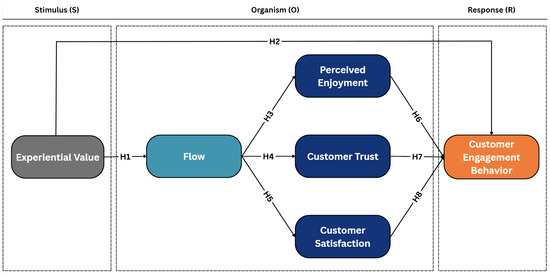
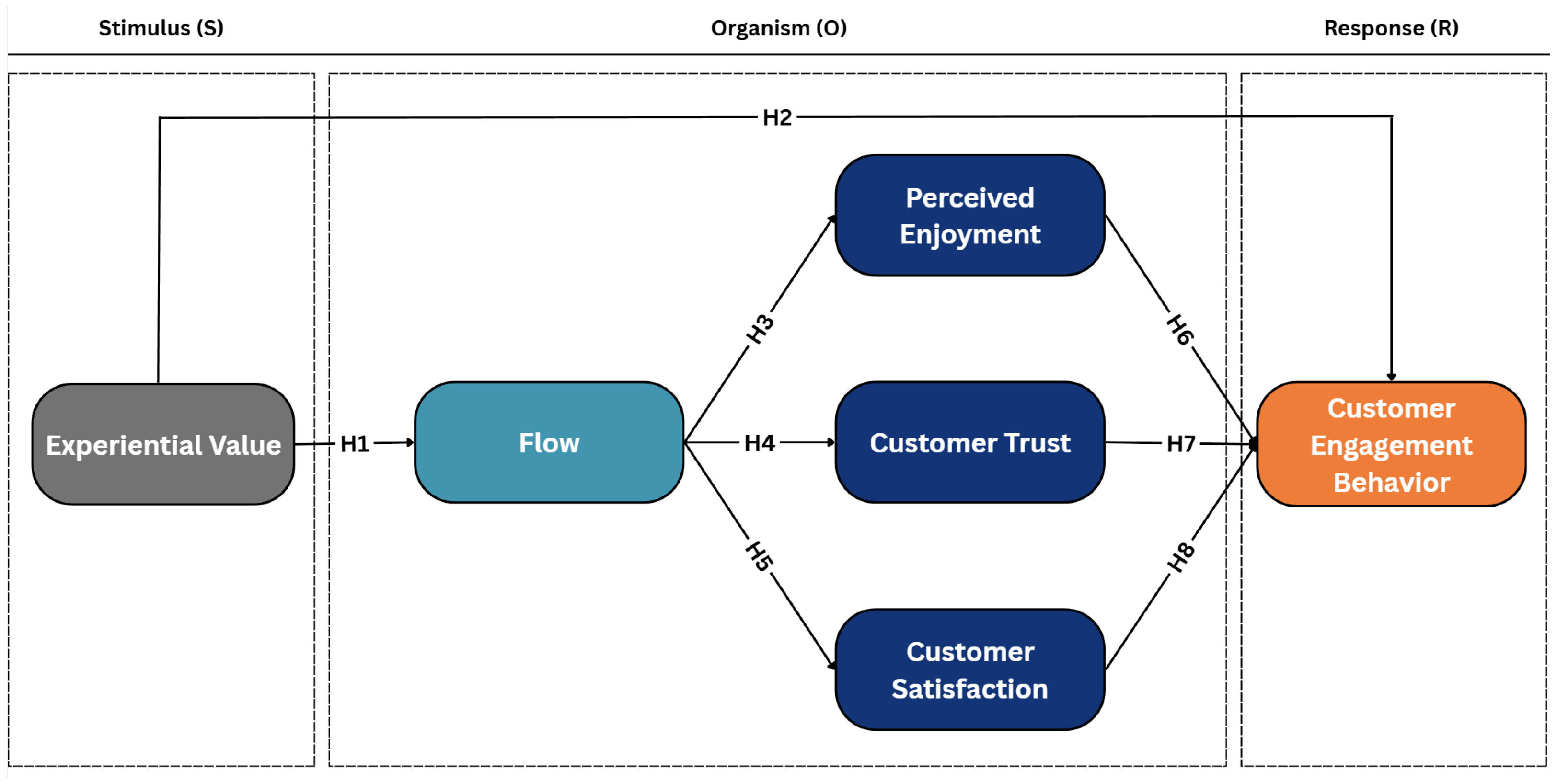
The collected research data were then analyzed using Partial Least Squares–Structural Equation Modeling (PLS-SEM), as illustrated in Figure 1. The data analysis process was carried out in two main stages. The first stage was the evaluation of the measurement model which aimed to assess the validity and reliability of the construct. This evaluation included testing convergent validity through outer loading values (>0.70) and Average Variance Extracted (AVE > 0.50) [80], as well as discriminant validity assessed using the Heterotrait–Monotrait Ratio criteria (HTMT < 0.90) [82]. Next, construct reliability was evaluated based on Cronbach’s alpha (>0.70), composite reliability (>0.70), and rho_A (>0.70). In the second stage, the structural model was evaluated using a bootstrapping procedure (5000 subsamples) to assess the explanatory power (R2), path coefficients, and the significance of both direct and mediating relationships among the constructs [83,84,85].
Figure 1.
Research Framework.
4. Results
This study aims to explore the role of experiential value in increasing flow, which in turn influences perceived enjoyment, customer satisfaction, and customer trust, ultimately driving customer engagement behavior in the context of using Virtual Try-On technology. Data collection was conducted through the distribution of questionnaires to consumers in Indonesia, with a total of 320 respondents participating in this study. Table 2 presents the results of the research instrument testing, which includes convergent validity and construct reliability.
Table 2.
Instrument Validity and Reliability Results.
Table 1 presents the evaluation of the measurement model, encompassing convergent validity, construct reliability, discriminant validity, and multicollinearity. Convergent validity was established through outer loadings and Average Variance Extracted (AVE) values. All indicators displayed outer loadings ranging from 0.702 to 0.781, exceeding the recommended 0.70 threshold. Furthermore, the AVE for each construct surpassed 0.50, indicate adequate variance explanation [80]. Construct reliability was confirmed via Cronbach’s alpha, composite reliability, and rho_A, with all values exceeding 0.70, suggesting strong internal consistency [89]. Discriminant validity was verified using the Heterotrait–Monotrait (HTMT) criterion; as shown in Table 3, all values remained below 0.90, confirming that the constructs are empirically distinct [90]. Finally, the potential for multicollinearity was tested using the Variance Inflation Factor (VIF) values. The results showed that all VIF values were below the recommended threshold, thus concluding that there were no collinearity issues in the measurement model [81].
Table 3.
HTMT Discriminant Validity Assessment.
The structural model was evaluated to assess the predictive capability of the proposed framework, focusing primarily on the coefficient of determination (R2), as shown in Table 4. The model explains 50.7% of the variance in Customer Engagement Behavior (R2 = 0.507). While this indicates moderate-to-substantial predictive power, it also suggests that nearly half of the variance is driven by factors outside the current model, such as external social influence or price-related incentives common in the Indonesian market. Similarly, the model explains 36.5% of the variance in Customer Satisfaction (R2 = 0.365). This moderate value reflects the complexity of satisfaction as an evaluative construct, which likely integrates situational factors beyond digital immersion. Customer Trust (R2 = 0.231) and perceived enjoyment (R2 = 0.239) showed weaker-to-moderate explanatory power. In the case of trust, this suggests that while VTO immersion contributes to reliability perceptions, external signals like brand reputation and payment security remain critical components. The Flow construct recorded an R2 of 0.292, indicating that while experiential value is a primary driver, other interface-specific elements likely contribute to the state of cognitive absorption. The results of the structural model fit index evaluation indicate that the model is able to represent empirical data well. The Standardized Root Mean Square Residual (SRMR) value is below the recommended threshold of 0.08, thus meeting the feasibility criteria of the PLS-SEM model.
Table 4.
Goodness of Fit Results.
Hypothesis testing in this study was conducted through a bootstrapping procedure in PLS-SEM to assess the significance of direct relationships between latent constructs, as shown in Table 5. This analysis used path coefficients, t-statistics, and p-values, with a significance level of 5% (t-value > 1.65; p-value < 0.05). The direct path from Experiential Value (EV) to Customer Engagement Behavior (CEB) was significant (β = 0.293; t = 3.346; p < 0.001). EV also showed a strong positive influence on flow (FL) (β = 0.540; t = 7.058; p < 0.001). Furthermore, flow was shown to significantly influence customer satisfaction (CS) (β = 0.604; t = 7.628; p < 0.001), customer trust (CT) (β = 0.481; t = 5.449; p < 0.001), and perceived enjoyment (PE) (β = 0.488; t = 5.888; p < 0.001). In terms of direct drivers of engagement behavior, customer satisfaction (β = 0.200; t = 2.322; p = 0.010), customer trust (β = 0.216; t = 2.147; p = 0.016), and perceived enjoyment (β = 0.169; t = 1.704; p = 0.044) all showed positive and significant effects. However, the results of the indirect effects test revealed important differences among the mediating mechanisms. The mediation paths from FL to CS and subsequently to CEB (β = 0.121; t = 2.186; p = 0.014), and from FL to CT and subsequently to CEB (β = 0.104; t = 2.024; p = 0.022), were found to be significant. In contrast, the mediation path from FL to PE and subsequently to CEB did not show statistical significance (β = 0.082; t = 1.636; p = 0.051). Overall, these results suggest that customer engagement behavior in the VTO context is driven more by evaluative and relational mechanisms than by fleeting pleasure, thus confirming the central role of satisfaction and trust as key mediators between immersive experiences and customer engagement.
Table 5.
Hypotheses Test Results.
5. Discussion
This study examines the relationship between experiential value, flow, perceived enjoyment, customer trust, customer satisfaction, and customer engagement behavior in the context of Virtual Try-On (VTO) technology. By applying the S–O–R framework, the results demonstrate that experiential value is a powerful predictor of flow (H1 supported; β = 0.540), confirming that valuable experiences are a key prerequisite for developing a state of deep psychological engagement. Experiential value acts as a multidimensional stimulus that triggers positive psychological responses in digital environments [51,60]. Consistent with this, deep cognitive absorption and focused engagement, as key components of flow, tend to emerge when users interact with stimulating and emotionally meaningful interfaces [67,91]. Sensory and immersive cues in AR/VR environments can promote deep immersion, which in turn increases user engagement and desire to continue using the system [57,92]. Furthermore, experiential value has been shown to have a significant direct influence on customer engagement behavior (H2 supported; β = 0.293). This indicates that even without full immersion, positive experience evaluations can drive engagement through emotional resonance, a finding that aligns with Yu et al. (2025) regarding the richness of experience in AI-based try-on systems [2,44,49,74]. Thus, it can be argued that experiential value is a key driver of customer engagement in VTO environments, through both affective and cognitive pathways [93,94].
Flow was found to have the strongest influence on customer satisfaction (H5 supported; β = 0.604), followed by perceived enjoyment (H3 supported; β = 0.488) and customer trust (H4 supported; β = 0.481). These findings suggest that immersive experiences primarily contribute to functional and evaluative post-experience evaluations, while also strengthening customers’ affective and relational responses. Flow, characterized by immersion, deep concentration, and ease of interaction, drives positive evaluations of the overall system experience [37,61]. In the context of virtual environments, flow enhances user satisfaction through the quality of the interactive experience and the enhancement of perceived hedonic value [7,95]. Flow also triggers intrinsic enjoyment during interactions as users feel a sense of control [64,66,88]. As emphasized by Rasool et al. (2025) and Shepherd (2022), this intense cognitive focus increases intrinsic motivation, activating positive affective states and contributing to the formation of trust by creating a sense of security and system reliability [50,51,60,77].
Regarding actual behavior outcomes, customer trust emerged as the strongest predictor (H7 supported; β = 0.216), followed by customer satisfaction (H8 supported; β = 0.200), while perceived enjoyment has a relatively weaker influence (H6 supported; β = 0.169). These findings confirm that customer engagement in the VTO environment is driven more by belief-based mechanisms and rational evaluation than by immediate pleasure. Trust is a key element in building long-term relationships, where users believe the platform can display products accurately and safely, they move beyond mere “playing” to active exploration and brand-related community interactions [46,96,97]. While satisfaction drives continued participation through the fulfillment of functional and hedonic values [49,66], enjoyment serves primarily as a trigger for initial exploration rather than sustained commitment [15,45,67].
The mediation testing revealed a fascinating insight into the Indonesian digital consumer mindset. Only customer satisfaction (H8a supported; p = 0.014) and customer trust (H7a supported; p = 0.022) acted as significant mediators, whereas perceived enjoyment failed to mediate the relationship (H6a not supported; p = 0.051). This indicates that while flow increases enjoyment, this short-term affective response is not strong enough to transform immersion into sustained behavior in a market characterized by high skepticism and product uncertainty [20,21,22,68]. We term this profile Pragmatic Immersion. For these users, VTO is an important functional validator used to prove a product will work in real life. While users may leave a session feeling entertained, that euphoria will not translate into engagement unless it is backed by a strong sense of trust and functional satisfaction.
Beyond these individual psychological pathways, the overall predictive power of the model offers further insights. The empirical results indicate that the antecedent constructs collectively explain 50.7 percent of the variance in customer engagement behavior. This moderate-to-strong explanatory power is consistent with recent behavioral science research on immersive digital environments [32,45]. In the specific context of Indonesia, capturing 50.7 percent of the variance confirms that experiential value and psychological flow are indeed primary drivers of engagement. However, the remaining unexplained variance highlights the complex nature of the Indonesian e-commerce landscape. As a highly collectivist and socially driven market, Indonesian consumers are heavily influenced by external socio-cultural factors. It is highly probable that integrating external variables such as electronic word-of-mouth, peer validation, or aggressive platform-specific promotional subsidies would capture the remaining variance.
To position these findings clearly, this study moves beyond previous technology-centered research that often treats psychological states as independent predictors or parallel causal sequences [15,16,28,43,98]. Our findings empirically validate a distinct sequential psychological mechanism. Unlike models suggesting that affective states precede immersion, our results suggest that cognitive immersion (flow) acts as a mandatory “cognitive gatekeeper.” Without this initial flow experience triggered by experiential value, the transition to perceived enjoyment, trust, and satisfaction is incomplete. Overall, these findings extend the theoretical understanding of S–O–R by demonstrating that in the context of immersive technologies, evaluative and relational mechanisms are more important determinants of customer engagement than short-term hedonic responses. Practically, these findings emphasize that VTO platform development should prioritize elements that enhance customer trust and satisfaction, such as product visualization accuracy, system reliability, and ease of interaction, while user enjoyment remains a complementary affective factor that supports initial engagement.
6. Implications
6.1. Theoretical Implications
This study provides a comprehensive examination of the psychological and behavioral mechanisms that drive customer engagement in Virtual Try-On (VTO) environments. By applying and extending the Stimulus–Organism–Response (S–O–R) framework, the results demonstrate that experiential value is the fundamental stimulus that triggers hierarchical organic processes. Theoretically, this study explains the S–O–R mechanism by demonstrating that a stimulus (experience value) initiates a two-stage psychological transition within the ‘Organism’. First, the stimulus triggers a state of Flow, which acts as a crucial cognitive gateway. Once this state of deep absorption is established, it simultaneously activates three distinct but interrelated psychological mediators including perceived enjoyment (affective), trust (cognitive–evaluative), and customer satisfaction (evaluative). Unlike previous models that treat these as isolated triggers, our findings suggest that Flow provides the mental environment necessary for these three states to be processed in parallel. This holistic internal reaction reduces the user’s perceived risk and maximizes positive affect, which collectively converge to produce the final ‘Response’ of sustained customer engagement behavior. This suggests that in VTO, Flow is the ‘engine’ that drives the emotional and relational assessments necessary for commerce.
6.2. Practical Implications
Practically, brands operating in high-growth markets like Indonesia could benefit from adopting a pragmatic immersion strategy that balances sensory stimulation with functional utility. Because technical fluency drives user immersion, practitioners should optimize AR rendering for mid-range smartphones. Given the diverse hardware landscape in Indonesia’s mass market, ensuring VTO features are lightweight and bandwidth-efficient helps prevent technical friction from disrupting the consumer experience flow. Furthermore, as customer trust emerges as the strongest predictor of engagement, retailers are encouraged to prioritize photorealistic accuracy and functional validation over deceptive aesthetic filters. Managers can implement verified conformance indicators to ensure that virtual representations match the physical product. Such transparency effectively transforms users’ initial curiosity, sparked by the stimulus, into a long-term, confident relationship with the platform.
Furthermore, the significant role of satisfaction suggests that VTO interfaces might best serve as decision-support tools, not simply entertainment features. Brands can enhance this evaluation process by integrating side-by-side product comparisons and real-time social sharing tools. In collectivist societies like Indonesia, interpersonal validation is often a cultural prerequisite for digital transactions; therefore, enabling users to seek direct feedback from their social circles through VTO interfaces can bridge the gap between individual and behavioral engagement. Finally, while perceived enjoyment drives initial participation, its failure to act as a significant mediator suggests that hedonic elements should be treated as an entry hook rather than a core value proposition. Marketing efforts might initially leverage the enjoyment of the AR experience but should aim to quickly transition users to the functional reliability and satisfying usability of the tool to ensure continued engagement.
To promote immersive technology adoption at a macro level, industry leaders and policymakers must establish clear guidelines that help managers improve their operational practice. First, establishing an industry-wide “truth-in-AR” standard accuracy policy provides a clear framework for managers to ensure that VTO representations remain transparent, thereby protecting the consumer trust that underpins engagement. Second, because this technology relies heavily on physical attributes, policymakers must enforce clear biometric data governance aligned with Indonesia’s Personal Data Protection Law. A robust national data policy helps practitioners implement transparent consent mechanisms without legal ambiguity, thereby mitigating perceived risks to consumers. Finally, government digital infrastructure policies should incentivize the expansion of reliable network access beyond major metropolitan centers to semi-urban and rural regions. This inclusive policy allows app developers and managers to invest in and confidently deploy lightweight VTO frameworks to a much broader demographic.
The implementation of these strategic policies allows e-commerce platforms to actively strengthen the operational relationships within this established psychological model. Specifically, enforcing strict industry standards for augmented reality accuracy directly elevates the initial experiential value, serving as a high-quality stimulus that pulls users into a deeper state of cognitive flow. Once this uninterrupted flow is achieved, policy-driven interface enhancements ensure the interaction translates into genuine perceived enjoyment. Furthermore, integrating transparent data privacy frameworks and verified user review systems directly reinforces customer trust and customer satisfaction. In the final analysis, systematically supporting the transition from initial experiential value and flow to robust trust and satisfaction ensures that these selected policies successfully connect temporary digital immersion with sustained customer engagement behavior in the Virtual Try-On ecosystem. Consequently, this study bridges the gap between human psychology, managerial strategy, and digital policy to offer a strong and actionable foundation for the future of immersive commerce in Indonesia.
7. Conclusions
This study found that experiential value is a crucial factor driving users’ psychological and behavioral responses in the context of Virtual Try-On (VTO) technology. Based on the Stimulus–Organism–Response (S–O–R) framework, experiential value acts as a stimulus that triggers organismic states such as flow, perceived enjoyment, customer trust, and customer satisfaction, which subsequently influence customer engagement. The results confirm that experiential value and flow have the most dominant influence on customer engagement behavior, while perceived enjoyment acts as a supporting affective response that does not directly transmit the influence of flow into engagement, and trust and satisfaction serve as significant mediators in the relationship. These findings suggest that in immersive digital environments, initial experiences (experiential value and flow) play a central role in shaping behavioral engagement, while evaluative and relational mechanisms (trust and satisfaction) confirm the continuity of engagement. Implementing the suggested technical optimizations, consumer trust frameworks, and macro-level digital policies will allow e-commerce platforms to systematically transform temporary digital immersion into long-term, robust behavioral engagement. Consequently, this study offers a cohesive, actionable foundation for the future of the immersive commerce ecosystem in Indonesia.
8. Limitations and Future Research
While this study makes significant contributions, several limitations warrant consideration. First, the data were collected solely from Indonesian users on a specific e-commerce platform. While the sample size (n = 320) is sufficient for PLS-SEM analysis, this geographic and demographic focus limits the generalizability of the findings. Future research is recommended to include cross-country or cross-cultural samples to explore whether VTO adoption mechanisms are similar across different digital contexts. Second, this study did not include moderator variables that could potentially influence the relationships between constructs, such as gender, prior experience with AR, brand familiarity, or technology readiness. Adding moderator variables could enrich our understanding of consumers’ psychological and behavioral responses to VTO. Furthermore, the rapid development of AR and AI technologies could alter user responses over time.
Additionally, the measurement model yielded tightly clustered factor loadings, predominantly in the 0.7 range, without the higher extremes typically seen in behavioral science constructs. This reduced variance is likely attributable to the highly homogenous demographic profile of the purposive sample, which predominantly consisted of young Gen Z consumers concentrated in western Indonesia. This demographic homogeneity likely led to highly uniform cognitive interpretations of the Likert scale items. Future studies should employ more diverse, cross-regional sampling to capture a broader variance in psychometric responses. Furthermore, both longitudinal research and experimental designs can help observe these changes and isolate causal mechanisms within the S–O–R framework. Finally, although this research is S–O–R-based, integrating other theoretical perspectives, such as the Technology Acceptance Model (TAM), Uses and Gratifications Theory (UGT), or the Cognitive–Affective–Conative (CAC) framework, could enrich our understanding of digital consumer behavior. By incorporating this research agenda, future studies are expected to expand the findings, increase generalizability, and deepen theoretical and practical understanding of how immersive VTO experiences shape the psychological state and engagement behavior of customers in the evolving digital commerce landscape.
Author Contributions
Conceptualization, N.P.C.A.N., M.M.D., A.A.G.W., N.S.S. and C.A.M.; methodology, N.P.C.A.N., N.S.S. and C.A.M.; software, C.A.M. and M.S.M.U.; validation, N.S.S. and C.A.M.; formal analysis, C.A.M. and M.S.M.U.; investigation, N.P.C.A.N., M.M.D. and A.A.G.W.; resources, N.P.C.A.N., M.M.D., A.A.G.W. and C.A.M.; data curation, C.A.M.; writing—original draft preparation, N.P.C.A.N., M.M.D., A.A.G.W., N.S.S. and C.A.M.; writing—review and editing, N.P.C.A.N., M.M.D., A.A.G.W., N.S.S., C.A.M. and M.S.M.U.; visualization, N.P.C.A.N., M.M.D., A.A.G.W., N.S.S. and C.A.M.; supervision, N.S.S.; project administration, N.S.S.; funding acquisition, N.S.S. All authors have read and agreed to the published version of the manuscript.
Funding
This research received no external funding.
Institutional Review Board Statement
The study was conducted in accordance with the Declaration of Helsinki, and approved by the Universitas Pendidikan Nasional Ethics Committee (protocol code 001A/KO.IN.UND/II/2026 and date of approval 6 February 2026).
Informed Consent Statement
Informed consent was obtained from all subjects involved in the study.
Data Availability Statement
The data presented in this study are available upon request from the corresponding author.
Conflicts of Interest
The authors declare no conflicts of interest.
References
- Nawaz, M.Z.; Guzmán, F.; Nawaz, S. Technology-enabled engagement process of brand virtual-try-on services. J. Prod. Brand Manag. 2025, 34, 44–60. [Google Scholar] [CrossRef] [Scilit]
- Lavoye, V.; Sipilä, J.; Mero, J. The emperor’ s new clothes: Self-explorative engagement in virtual try-on service experiences positively impacts brand outcomes. J. Serv. Mark. 2026, 27, 1–21. [Google Scholar]
- Gil-lópez, C.; Guixeres, J.; Marín-morales, J.; Torrecilla, C.; Williams, E.; Alcañiz, M. Is mixed reality technology an effective tool for retail? A vividness and interaction perspective. Front. Virtual Real. 2023, 4, 1067932. [Google Scholar] [CrossRef] [Scilit]
- Barari, M.; Ross, M.; Thaichon, S.; Surachartkumtonkun, J. A meta-analysis of customer engagement behaviour. Int. J. Consum. Stud. 2020, 45, 457–477. [Google Scholar] [CrossRef] [Scilit]
- Chen, C.; Ni, J.; Zhang, P. Virtual Try-On Systems in Fashion Consumption: A Systematic Review. Appl. Sci. 2024, 14, 11839. [Google Scholar] [CrossRef] [Scilit]
- Zhou, T. Understanding User Social Commerce Usage Intention. Inf. Resour. Manag. J. 2019, 32, 56–71. [Google Scholar] [CrossRef] [Scilit]
- Herzallah, F.; Abosamaha, A.J.; Mohammad, S.; Alhayek, M. Social commerce attributes, customer engagement and repurchase intention in social commerce platforms: A stimulus–organism– response approach. J. Open Innov. Technol. Mark. Complex. 2025, 11, 100635. [Google Scholar] [CrossRef] [Scilit]
- Kim, J.; Kim, M.; Park, M.; Yoo, J. Telematics and Informatics Immersive interactive technologies and virtual shopping experiences: Differences in consumer perceptions between augmented reality (AR) and virtual reality (VR). Telemat. Inform. 2023, 77, 101936. [Google Scholar] [CrossRef] [Scilit]
- Baber, R.; Baber, P.; Narula, S. Driving AR Experience to Purchase Intention: Examining the Role of Users’ Immersiveness, Perceived Innovativeness and Engagement in Virtual Try. Int. J. Consum. Stud. 2026, 50, e70185. [Google Scholar] [CrossRef] [Scilit]
- Reljić, V.; Milenković, I.; Dudić, S.; Šulc, J.; Bajči, B. Augmented Reality Applications in Industry 4.0 Environment. Appl. Sci. 2021, 11, 5592. [Google Scholar] [CrossRef] [Scilit]
- Rauschnabel, P.A. Augmented reality is eating the real-world! The substitution of physical products by holograms. Int. J. Inf. Manag. 2021, 57, 102279. [Google Scholar] [CrossRef] [Scilit]
- Lee, H.; Xu, Y.; Porterfield, A. Antecedents and moderators of consumer adoption toward AR-enhanced virtual try-on technology: A stimulus-organism-response approach. Int. J. Consum. Stud. 2022, 46, 1319–1338. [Google Scholar] [CrossRef] [Scilit]
- Shih, J.; Yeh, C.-C. Identification of Factors Influencing Consumers’ Use of Virtual Try-On Technology Based on UTAUT2 Model. Eng. Proc. 2025, 108, 8. [Google Scholar]
- Patnaik, A.; Patnaik, A.K.; Panigrahy, T.; Rout, M.; Patnaik, S.R. Exploring the Evolution of Virtual Try-On Technologies: A Comprehensive Review from a User-Centric Perspective. Educ. Adm. Theory Pract. 2024, 30, 8271–8287. [Google Scholar] [CrossRef] [Scilit]
- Ngo, T.T.A.; Tran, T.T.; An, G.K.; Nguyen, P.T. Investigating the influence of augmented reality marketing application on consumer purchase intentions: A study in the E-commerce sector. Comput. Hum. Behav. Rep. 2025, 18, 100648. [Google Scholar] [CrossRef] [Scilit]
- Akter, M.S.; Khan, S.A.; Sultana, N.; Islam, M.T. Unpacking How Virtual Try-On Technology Influences Consumer Decision-Making in Online Shopping: Insights from Bangladesh. Hum. Behav. Emerg. Technol. 2025, 2025, 7070627. [Google Scholar] [CrossRef] [Scilit]
- Mordor Intelligence. Indonesia e-Commerce Market Size & Share Analysis—Growth Trends & Forecasts (2026–2031); Mordor Intelligence: Hyderabad, India, 2026. [Google Scholar]
- Costa, A.; Marozzo, V.; Abbate, T. Consumers’ attitudes toward virtual try-on technology: An extended TAM model. Int. J. Retail. Distrib. Manag. 2026, 53, 184–199. [Google Scholar] [CrossRef] [Scilit]
- Google, Temasek, Bain & Company. e-Conomy SEA 2025: From Digital Decade to AI Reality: Accelerating the Future in ASEAN; Google, Temasek, Bain & Company: Singapore, 2025. [Google Scholar]
- Rafique, W.; Qadir, J.; Ml, A.I. Internet of everything meets the metaverse: Bridging physical and virtual worlds with blockchain. Comput. Sci. Rev. 2024, 54, 100678. [Google Scholar] [CrossRef] [Scilit]
- Yim, M.Y.; Chu, S.; Sauer, P.L. Is Augmented Reality Technology an Effective Tool for E-commerce? An Interactivity and Vividness Perspective. J. Interact. Mark. 2017, 39, 89–103. [Google Scholar] [CrossRef] [Scilit]
- Taub, G.; Elmalech, A.; Aharony, N. Augmented Impressions: The role of augmented reality in shaping perceived product value and enhancing purchase intention. Comput. Hum. Behav. Rep. 2025, 19, 100726. [Google Scholar] [CrossRef] [Scilit]
- Subawa, N.S.; Widhiasthini, N.W.; Astawa, I.P.; Dwiatmadja, C.; Permatasari, N.P.I. The practices of virtual reality marketing in the tourism sector, a case study of Bali, Indonesia. Curr. Issues Tour. 2021, 24, 3284–3295. [Google Scholar] [CrossRef] [Scilit]
- Dağ, K.; Çavuşoğlu, S.; Akçacı, T. The effect of consumer inspiration on experience extension in augmented reality marketing. Span. J. Mark. ESIC 2026, 30, 214–236. [Google Scholar] [CrossRef] [Scilit]
- Nguyen, Q.H.; Hanh, T.T.; Hanh, N.L.M.; Nhi, N.D.L.; Anh, D.N.; Linh, H.T. The impacts of virtual try-on for online shopping on consumer purchase intention: The moderating role of technology experience. Cogent Bus. Manag. 2025, 12, 2500774. [Google Scholar] [CrossRef] [Scilit]
- Smink, A.R.; van Reijmersdal, E.A.; Noort, G.V.; Neijens, P. Shopping in augmented reality: The effects of spatial presence, personalization and intrusiveness on app and brand responses. J. Bus. Res. 2020, 118, 474–485. [Google Scholar] [CrossRef] [Scilit]
- Hilken, T.; Chylinski, M.; Keeling, D.I.; Heller, J.; Ruyter Kde Mahr, D. How to strategically choose or combine augmented and virtual reality for improved online experiential retailing. Psychol. Mark. 2022, 39, 495–507. [Google Scholar] [CrossRef] [Scilit]
- Naveen, L.; Khan, I.; Saleh, A.; Narayan, R. The influence of mobile augmented reality on consumer behavior: Insights into affective, cognitive, and behavioral responses. Comput. Human. Behav. 2025, 165, 108558. [Google Scholar] [CrossRef] [Scilit]
- Javornik, A.; Marder, B.; Pizzetti, M.; Warlop, L. Augmented self—The effects of virtual face augmentation on consumers’. J. Bus. Res. 2021, 130, 170–187. [Google Scholar] [CrossRef] [Scilit]
- Heller, J.; Chylinski, M.; Ruyter, K.; De Mahr, D.; Keeling, D.I. Let Me Imagine That for You: Transforming the Retail Frontline Through Augmenting Customer Mental Imagery Ability. J. Retail. 2019, 95, 94–114. [Google Scholar] [CrossRef] [Scilit]
- Liang, X.; Huo, Y.; Luo, P. What drives impulsive travel intention in tourism live streaming? A chain mediation model based on SOR framework. J. Travel. Tour. Mark. 2024, 41, 169–185. [Google Scholar] [CrossRef] [Scilit]
- McLean, G.; Wilson, A. Shopping in the digital world: Examining customer brand engagement through augmented reality mobile applications. Comput. Human. Behav. 2019, 101, 210–224. [Google Scholar] [CrossRef] [Scilit]
- Tuncer, I. The relationship between IT affordance, flow experience, trust, and social commerce intention: An exploration using the S-O-R paradigm. Technol. Soc. 2021, 65, 101567. [Google Scholar] [CrossRef] [Scilit]
- Gupta, S.; Kiran, R.; Sharma, R.K. Analyzing the complexities of chatbots, virtual try-on and digital payment mode on customer satisfaction: An empirical study of online shoppers. Eur. J. Manag. Bus. Econ. 2025, ahead-of-print. [Google Scholar] [CrossRef] [Scilit]
- Yung, R.; Khoo-Lattimore, C.; Potter, L.E. Virtual reality and tourism marketing: Conceptualizing a framework on presence, emotion, and intention. Curr. Issues Tour. 2021, 24, 1505–1525. [Google Scholar] [CrossRef] [Scilit]
- Flavián, C.; Ibáñez-sánchez, S.; Orús, C. The impact of virtual, augmented and mixed reality technologies on the customer experience. J. Bus. Res. 2019, 100, 547–560. [Google Scholar] [CrossRef] [Scilit]
- Ruangkanjanases, A.; Khan, A.; Sivarak, O. Modeling the Consumers’ Flow Experience in E-commerce: The Integration of ECM and TAM with the Antecedents of Flow Experience. SAGE Open 2024, 14, 21582440241258595. [Google Scholar] [CrossRef] [Scilit]
- Zhong, Z.; Hamouda, M. The impact of immersive and flow experiences on consumer participation in hyper-connected shopping platforms: A metaverse perspective. J. Consum. Behav. 2024, 23, 2826–2845. [Google Scholar] [CrossRef] [Scilit]
- Zhang, T.; Wang, W.Y.C.; Cao, L.; Wang, Y. The role of virtual try-on technology in online purchase decision from consumers’ aspect. Internet Res. 2019, 29, 529–551. [Google Scholar] [CrossRef] [Scilit]
- Mehrabian, A.; Russell, J.A. An Approach to Environmental Psychology; The MIT Press: Cambridge, MA, USA, 1974. [Google Scholar]
- Zhu, L.; Li, H.; Wang, F.K.; He, W.; Tian, Z. How online reviews affect purchase intention: A new model based on the stimulus-organism-response (S-O-R) framework. Aslib J. Inf. Manag. 2020, 72, 463–488. [Google Scholar] [CrossRef] [Scilit]
- Erensoy, A.; Mathrani, A.; Schnack, A.; Elms, J.; Baghaei, N. Consumer behavior in immersive virtual reality retail environments: A systematic literature review using the stimuli-organisms-responses (S-O-R) model. J. Consum. Behav. 2024, 23, 2781–2811. [Google Scholar] [CrossRef] [Scilit]
- Gao, Y.; Liang, J. The Impact of AI-Powered Try-On Technology on Online Consumers’ Impulsive Buying Intention: The Moderating Role of Brand Trust. Sustainability 2025, 17, 2789. [Google Scholar] [CrossRef] [Scilit]
- Yu, L.; Tang, W.; Gao, W. A study on the mechanism of live streamer’s behavior characteristics affecting consumers’ impulsive buying: The role of perceived value and social identity. Acta Psychol. 2025, 255, 104950. [Google Scholar] [CrossRef] [Scilit]
- Sung, E.; Bae, S.; Han, D.D.; Kwon, O. Consumer engagement via interactive artificial intelligence and mixed reality. Int. J. Inf. Manag. 2021, 60, 102382. [Google Scholar] [CrossRef] [Scilit]
- Sharma, S.; Sharma, A. Insights into customer engagement in a mobile app context: Review and research agenda. Cogent Bus. Manag. 2024, 11, 2382922. [Google Scholar] [CrossRef] [Scilit]
- Lim, W.M.; Rasul, T. Customer engagement and social media: Revisiting the past to inform the future. J. Bus. Res. 2022, 148, 325–342. [Google Scholar] [CrossRef] [Scilit]
- Hollebeek, L.D.; Clark, M.K.; Andreassen, T.W.; Sigurdsson, V.; Smith, D. Virtual reality through the customer journey: Framework and propositions. J. Retail. Consum. Serv. 2020, 55, 102056. [Google Scholar] [CrossRef] [Scilit]
- Sharma, S.; Sharma, A. Investigating the drivers and outcomes of shopping app engagement-An application of the SOR framework. Vis. J. Bus. Perspect. 2025, 0, 1–14. [Google Scholar] [CrossRef] [Scilit]
- Rasool, A.; Islam, J.U.; Shah, F.A. Unravelling relational dynamics between experiential value and customer engagement: Does customer gender matter? J. Mark. Commun. 2025, 31, 634–661. [Google Scholar] [CrossRef] [Scilit]
- Hwan, J.; Minjeong, K.; Jungmin, K.; Minjung, Y. Augmented reality in delivering experiential values: Moderating role of task complexity. Virtual Real. 2024, 28, 19. [Google Scholar] [CrossRef] [Scilit]
- Voicu, M.; Sîrghi, N.; Toth, D.M.-M. Consumers’ Experience and Satisfaction Using Augmented Reality Apps in E-Shopping: New Empirical Evidence. Appl. Sci. 2023, 13, 9596. [Google Scholar] [CrossRef] [Scilit]
- Guo, C.; Zhang, X. The impact of AR online shopping experience on customer purchase intention: An empirical study based on the TAM model. PLoS ONE 2024, 19, e0309468. [Google Scholar] [CrossRef] [Scilit] [PubMed]
- Gahlot, P.; Suryavanshi, K.; Gandhi, A. Revolutionizing decision-making: How retailers can harness the potential of avatars in augmented reality to enrich the customer experience? Cogent Bus. Manag. 2024, 11, 2432542. [Google Scholar] [CrossRef] [Scilit]
- Hasnain, S.; Kazmi, A.; Ahmed, R.R.; Soomro, K.A.; Hashem, E.A.; Akhtar, H.; Parmar, V. Role of Augmented Reality in Changing Consumer Behavior and Decision Making: Case of Pakistan. Sustainability 2021, 13, 14064. [Google Scholar] [CrossRef] [Scilit]
- Kulikovskaja, V.; Hubert, M.; Grunert, K.G.; Zhao, H. Driving marketing outcomes through social media-based customer engagement. J. Retail. Consum. Serv. 2023, 74, 103445. [Google Scholar] [CrossRef] [Scilit]
- Peifer, C.; Wolters, G.; Harmat, L.; Heutte, J.; Tan, J.; Freire, T.; Tavares, D.; Fonte, C.; Andersen, F.O. A Scoping Review of Flow Research. Front. Psychol. 2022, 13, 815665. [Google Scholar] [CrossRef] [Scilit]
- Monaro, M.; Bettelli, A.; Portello, G.; Pierobon, L.; Orso, V.; Caputo, A.; Luisa, M.; Giachetti, A.; Gamberini, L. Enhancing shopping experience in augmented reality by customizing product manipulation modalities: A customer experience study. Int. J. Hum.-Comput. Stud. 2025, 202, 103553. [Google Scholar] [CrossRef] [Scilit]
- Csikszentmihalyi, M. Flow and the Psychology of Discovery and Invention; Harper Perennial: New York, NY, USA, 1997. [Google Scholar]
- Shepherd, J. Flow and the dynamics of conscious thought. Phenomenol. Cogn. Sci. 2022, 21, 969–988. [Google Scholar] [CrossRef] [Scilit]
- Gupta, P.; Chauhan, S.; Goel, S. Task-technology synergy of augmented reality retail technology features: A meta-analysis. Span. J. Mark. ESIC 2025, 29, 518–537. [Google Scholar] [CrossRef] [Scilit]
- Hwang, J.; Choi, L. Having fun while receiving rewards?: Exploration of gamification in loyalty programs for consumer loyalty. J. Bus. Res. 2020, 106, 365–376. [Google Scholar] [CrossRef] [Scilit]
- Wu, J.; Zhang, Z.; Wu, Y.; Tang, X. The effectiveness of immersive media in promoting consumer Products: Augmented vs. virtual reality. J. Retail. Consum. Serv. 2025, 86, 104323. [Google Scholar] [CrossRef] [Scilit]
- Brannon, J.; Mclean, G.; Shah, E.; Mack, R. Blending the real world and the virtual world: Exploring the role of flow in augmented reality experiences. J. Bus. Res. 2021, 122, 423–436. [Google Scholar] [CrossRef] [Scilit]
- Kawabata, M.; Mallett, C.J. Progressing the construct of enjoyment: Conceptualizing enjoyment as a proactive process. Discov. Psychol. 2022, 2, 2. [Google Scholar] [CrossRef] [Scilit]
- Maziriri, E.T.; Mashapa, M.M.; Nyagadza, B. As far as my eyes can see: Generation Y consumers’ use of virtual reality glasses to determine tourist destinations. Cogent Bus. Manag. 2023, 10, 2246745. [Google Scholar] [CrossRef] [Scilit]
- Yang, J.; Lin, Z. From screen to reality: How AR drives consumer engagement and purchase intention. J. Digit. Econ. 2024, 3, 37–46. [Google Scholar] [CrossRef] [Scilit]
- Rauschnabel, P.A.; Felix, R.; Hinsch, C. Augmented reality marketing: How mobile AR-apps can improve brands through inspiration. J. Retail. Consum. Serv. 2019, 49, 43–53. [Google Scholar] [CrossRef] [Scilit]
- Kataria, S.; Saini, V.K.; Sharma, A.K.; Yadav, R.; Kohli, H. An integrative approach to the nexus of brand loyalty and corporate social responsibility. Int. Rev. Public Nonprofit Mark. 2021, 18, 361–385. [Google Scholar] [CrossRef] [Scilit]
- Hung, S.W.; Cheng, M.J.; Chiu, P.C. Do antecedents of trust and satisfaction promote consumer loyalty in physical and virtual stores? A multi-channel view. Serv. Bus. 2019, 13, 1–23. [Google Scholar] [CrossRef] [Scilit]
- Raman, P. Understanding female consumers’ intention to shop online: The role of trust, convenience and customer service. Asia Pac. J. Mark. Logist. 2019, 31, 1138–1160. [Google Scholar] [CrossRef] [Scilit]
- Dabbous, A.; Aoun Barakat, K.; Merhej Sayegh, M. Social Commerce Success: Antecedents of Purchase Intention and the Mediating Role of Trust. J. Internet Commer. 2020, 19, 262–297. [Google Scholar] [CrossRef] [Scilit]
- Tandon, U.; Ertz, M.; Sakshi, K.; Case, E. POD Mode of Payment, Return Policies and Virtual-Try-on Technology as Predictors of Trust: An Emerging Economy Case. J. Promot. Manag. 2021, 27, 832–855. [Google Scholar] [CrossRef] [Scilit]
- Gefen, D. E-commerce: The role of familiarity and trust. Omega 2000, 28, 725–737. [Google Scholar] [CrossRef] [Scilit]
- Guo, Y.; Ng, W.; Hao, F.; Zhang, C.; Liu, S.; Aman, A.M. Trust in Virtual Interaction: The Role of Avatars in Sustainable Customer Relationships. Sustainability 2023, 15, 14026. [Google Scholar] [CrossRef] [Scilit]
- Santini Fde, O.; Ladeira, W.J.; Pinto, D.C.; Herter, M.M.; Sampaio, C.H.; Babin, B.J. Customer engagement in social media: A framework and meta-analysis. J. Acad. Mark. Sci. 2020, 48, 1211–1228. [Google Scholar] [CrossRef] [Scilit]
- Dölarslan, E.S. Assessing the effects of satisfaction and value on customer loyalty behaviors in service environments: High-speed railway in Turkey as a case study. Manag. Res. Rev. 2014, 37, 706–727. [Google Scholar] [CrossRef] [Scilit]
- Mittal, V.; Han, K.; Frennea, C.; Blut, M.; Shaik, M. Customer satisfaction, loyalty behaviors, and firm financial performance: What 40 years of research tells us. Mark. Lett. 2023, 34, 171–187. [Google Scholar] [CrossRef] [Scilit]
- Fadhillah, A.; Zebua, Y.; Prayoga, Y. Analysis of Information Quality, Trust and Satisfaction on Customer Participation (Case Study on Customer Online Shop Shopee in Rantauprapat). Bp. Int. Res. Crit. Inst. Humanit. Soc. Sci. 2021, 4, 3039–3051. [Google Scholar] [CrossRef] [Scilit]
- Hair, J.F.; Risher, J.J.; Sarstedt, M.; Ringle, C.M. When to use and how to report the results of PLS-SEM. Eur. Bus. Rev. 2019, 31, 2–24. [Google Scholar] [CrossRef] [Scilit]
- Kock, N. Common method bias in PLS-SEM: A full collinearity assessment approach. Int. J. e-Collab. IJeC 2015, 11, 1–10. [Google Scholar] [CrossRef] [Scilit]
- Dijkstra, T.K.; Henseler, J. Consistent and asymptotically normal PLS estimators for linear structural equations. Comput. Stat. Data Anal. 2015, 81, 10–23. [Google Scholar] [CrossRef] [Scilit]
- Hair, J.F.; Hult, G.T.M.; Ringle, C.M.; Sarstedt, M. A Primer on Partial Least Squares Structural Equation Modeling (PLS-SEM), 3rd ed.; SAGE Publications Inc.: Thousand Oaks, CA, USA, 2022. [Google Scholar]
- Ringle, C.M.; Sarstedt, M.; Sinkovics, N.; Sinkovics, R.R. A perspective on using partial least squares structural equation modelling in data articles. Data Brief 2023, 48, 109074. [Google Scholar] [CrossRef] [Scilit] [PubMed]
- Richter, N.F.; Hauff, S.; Ringle, C.M.; Gudergan, S.P. The Use of Partial Least Squares Structural Equation Modeling and Complementary Methods in International Management Research. Manag. Int. Rev. 2022, 62, 449–470. [Google Scholar] [CrossRef] [Scilit]
- Wang, S.W.; Ngamsiriudom, W.; Hsieh, C.H. Trust disposition, trust antecedents, trust, and behavioral intention. Serv. Ind. J. 2015, 35, 555–572. [Google Scholar] [CrossRef] [Scilit]
- Marriott, H.R.; Williams, M.D. Exploring consumers perceived risk and trust for mobile shopping: A theoretical framework and empirical study. J. Retail. Consum. Serv. 2018, 42, 133–146. [Google Scholar] [CrossRef] [Scilit]
- Kowalczuk, P.; Siepmann, C.; Adler, J. Cognitive, affective, and behavioral consumer responses to augmented reality in e-commerce: A comparative study. J. Bus. Res. 2021, 124, 357–373. [Google Scholar] [CrossRef] [Scilit]
- Dijkstra, T.K.; Henseler, J. Consistent Partial Least Squares Path Modelling. MIS Q. 2015, 39, 297–316. [Google Scholar] [CrossRef] [Scilit]
- Henseler, J.; Ringle, C.M.; Sarstedt, M. A new criterion for assessing discriminant validity in variance-based structural equation modeling. J. Acad. Mark. Sci. 2015, 43, 115–135. [Google Scholar] [CrossRef] [Scilit]
- Wedel, M.; Bigné, E.; Zhang, J. Virtual and augmented reality: Advancing research in consumer marketing. Int. J. Res. Mark. 2020, 37, 443–465. [Google Scholar] [CrossRef] [Scilit]
- Wyszynski, M.; Weber, S.; Niehaves, B. Computers in Human Behavior Reports Individuals with low self-esteem benefit most from interactivity in virtual try-on systems. Comput. Hum. Behav. Rep. 2025, 20, 100772. [Google Scholar] [CrossRef] [Scilit]
- Watson, A.; Alexander, B.; Salavati, L. The impact of experiential augmented reality applications on fashion purchase intention intention. Int. J. Retail. Distrib. Manag. 2018, 48, 433–451. [Google Scholar] [CrossRef] [Scilit]
- Nhan, V.K.; Tam, L.T.; Dung, H.T.; Vu, N.T. A conceptual model for studying the immersive mobile augmented reality application-enhanced experience. Heliyon 2022, 8, e10141. [Google Scholar] [CrossRef] [Scilit] [PubMed]
- An, S.; Choi, Y.; Lee, C.-K. Virtual travel experience and destination marketing: Effects of sense and information quality on flow and visit intention. J. Destin. Mark. Manag. 2021, 19, 100492. [Google Scholar] [CrossRef] [Scilit]
- Rosário, A.; Raimundo, R. Consumer marketing strategy and e-commerce in the last decade: A literature review. J. Theor. Appl. Electron. Commer. Res. 2021, 16, 3003–3024. [Google Scholar] [CrossRef] [Scilit]
- Petit, O.; Velasco, C.; Spence, C. Digital Sensory Marketing: Integrating New Technologies into Multisensory Online Experience. J. Interact. Mark. 2019, 45, 42–61. [Google Scholar] [CrossRef] [Scilit]
- Lavoye, V.; Kumar, H. Understanding how augmented reality’ s immersive experience and privacy concerns impact consumer responses: A cognitive perspective. J. Retail. Consum. Serv. 2025, 87, 104425. [Google Scholar] [CrossRef] [Scilit]

Disclaimer/Publisher’s Note: The statements, opinions and data contained in all publications are solely those of the individual author(s) and contributor(s) and not of MDPI and/or the editor(s). MDPI and/or the editor(s) disclaim responsibility for any injury to people or property resulting from any ideas, methods, instructions or products referred to in the content. |
© 2026 by the authors. Licensee MDPI, Basel, Switzerland. This article is an open access article distributed under the terms and conditions of the Creative Commons Attribution (CC BY) license.