


Abstract
With growing interest in the effects of AI disclosure on user-generated content, empirical studies have produced mixed results. While some studies report negative consequences of disclosure, others suggest that transparent AI use does not necessarily reduce perceived authenticity or product evaluations. There is still limited knowledge about how AI disclosure in online reviews influences consumer perceptions when AI is presented as a support tool rather than a replacement for human input. To address this gap, the present study examines how AI disclosure and AI-related review cues influence consumer trust. The study compares three labeled review scenarios—reviews without AI-related information, AI-assisted labeled reviews, and AI-generated labeled reviews. The textual content of the reviews remained constant across conditions, while only AI-related labels and images were varied. This study also examines how these labeled scenarios relate to perceived authenticity and whether perceived authenticity mediates the relationship between labeled review scenarios and consumer trust. Based on survey data from 370 users of digital marketplaces in Latvia, analyzed using repeated-measures ANOVA, pairwise comparisons, and mediation analysis, this study found that: (1) reviews labeled as AI-generated showed the lowest levels of consumer trust and perceived authenticity, whereas AI-assisted labeled reviews were evaluated more favorably than AI-generated labeled reviews; (2) differences across the three scenarios were statistically significant for both consumer trust and perceived authenticity; and (3) perceived authenticity significantly mediated the relationship between labeled review scenarios and consumer trust. This study contributes to the literature by providing a more nuanced understanding of how AI disclosure and AI-related review cues shape consumer trust. It suggests that the key issue is not AI disclosure alone, but how AI-related cues shape perceived authenticity and, in turn, consumer trust.
1. Introduction
Although AI-generated content can enhance personalization and emotional engagement, consumers still tend to perceive human-centered content as more authentic, effortful, and trustworthy [1,2]. Users do not always clearly distinguish between content perceived as human-created and content perceived as AI-generated, which further complicates assessments of authenticity and reliability [3,4]. Perceived accuracy and transparency regarding AI use have been shown to influence engagement with, and trust in, such content [5], while hybrid approaches may alleviate these concerns and elicit responses similar to those associated with content perceived as fully human-created [6].
Knowing the origin of content helps audiences understand who created it and how, making AI disclosure an important cue for message interpretation [7]. When AI involvement is explicitly disclosed, it may reduce trust by changing how consumers perceive both the message and the organization behind it, while making the content appear less genuine and reliable [8,9]. Even when the text itself remains unchanged, the assumption that it was produced by AI can affect how it is evaluated and how consumers perceive its quality and credibility [10]. Under conditions of uncertainty, consumers rely on disclosure, authorship cues, and other indicators of content origin to assess credibility, making source transparency a central element in the evaluation of AI-mediated communication [11,12]. In line with this perspective, the present study focuses on AI-related disclosure and presentation cues rather than on differences in the review text.
Disclosure conveys a signal that consumers may perceive as an indication of process transparency and reliability, which in turn shapes whether the content is judged to be trustworthy [13]. However, if the signal is missing, too vague, or perceived as dubious, it becomes more difficult for consumers to understand who is behind the content and how much reliance can be placed on its credibility, thereby reducing trust [9,14].
Although transparency can help build trust, it can also lead to negative reactions when it does not align with consumer expectations [15,16]. Despite growing interest in AI’s credibility, the literature still lacks clarity on how AI disclosure and AI-related cues in user-generated reviews affect consumer trust in a marketplace context. Most prior studies examine trust in AI in broader contexts such as automated decision-making, recommender systems, personalization, chatbots, and algorithmic news, rather than in user-generated product reviews as marketplace signals [17,18]. Existing research has focused mainly on AI-generated review summaries and on factors such as transparency, valence, inconsistency, and platform design, rather than on user-generated product reviews themselves [14,19]. To address this gap, the present study examines how AI disclosure and AI-related presentation cues affect consumer trust in user-generated product reviews through the lens of signaling theory. This study extends this perspective by showing that AI-related cues in reviews operate as layered signals, that perceived authenticity links these signals to consumer trust, and that the effect of disclosure depends on how such cues are presented and interpreted. This leads to the following research question:
RQ: How do AI-related disclosure and presentation cues in user-generated product reviews influence consumer trust in digital marketplaces?
The remainder of this article is organized as follows: Section 2 presents the theoretical background and hypothesis; Section 3 describes the methods of research; this is followed by data analysis in Section 4; Section 5 discusses the results, consequences, and limitations of the research; and Section 6 draws conclusions.
2. Literature Review
2.1. Theoretical Background
2.1.1. Signaling Theory as the Primary Theoretical Lens
Signaling theory provides a relevant conceptual framework for explaining how consumers evaluate information in digital marketplaces under conditions of uncertainty and information asymmetry. In an online environment, buyers are typically unable to directly verify product quality, seller reliability, or the authenticity of user content before making a purchase. As a result, they rely on observable cues to infer hidden characteristics of the marketplace offering [20]. Under such conditions, signals become an important mechanism for reducing perceived risk and building trust, as they allow indirect information to be interpreted as an indicator of quality and reliability [21].
According to signaling theory, a signal is an observed property, action, or characteristic through which one party transmits information about a difficult-to-observe quality to another [20]. In digital marketplaces, relevant signals include seller reputations, ratings, warranties, feedback mechanisms, third-party certifications, and other platform infrastructure elements that help consumers assess the reliability and competence of market participants [22]. Therefore, evaluations in digital marketplaces are based not only on the content of the product or message itself, but also on the signals that accompany it within the market environment [23].
The value of a signal is determined not only by its existence but also by whether it is perceived as reliable, understandable, and truly useful for reducing uncertainty in decision-making [24]. Additionally, signal performance depends on context. The same signal can strengthen confidence in one market situation but be less significant in another, depending on product type, consumer characteristics, and the overall signal configuration on the platform [24,25]. In addition, studies have shown that excessive signals may reduce their usefulness because consumers may experience overload and become less able to discern meaningful quality indicators [26].
This logic is especially important in the context of user reviews. In digital marketplaces, reviews themselves are among the central signals consumers use to judge product quality and reduce uncertainty before purchasing [27]. E-commerce research shows that the quality of online reviews, platform feedback mechanisms, reputation systems, and interactions among platform channels influence consumer trust and the willingness to rely on reviews in decision-making [28]. This means that a user review can be viewed not only as a personal opinion, but also as a market signal whose significance depends on whether it is perceived as credible, useful, and authentic [27]. Moreover, the interaction of reviews with other information channels on the platform reinforces their role in product evaluation and in the formation of purchase-related trust [28].
From the perspective of signaling theory, the involvement of artificial intelligence in generating user reviews can be viewed as a significant signal that influences how consumers interpret content origin, credibility, and reliability [14]. The way a review is presented—as a review without AI-related information, an AI-assisted review, or a fully AI-generated review—serves as an observable cue from which consumers may infer the degree of human involvement, the effort invested, and the authenticity of the message. In turn, disclosure of AI use may serve as an additional signal that either reduces uncertainty or heightens skepticism if it is perceived as an indicator of lower authenticity or legitimacy [8,9]. In this study, signaling theory serves as the main theoretical framework for explaining how consumers interpret AI-related review cues as signals of source origin, human involvement, and review credibility in digital marketplaces.
2.1.2. AI Use in User-Generated Product Reviews as a Marketplace Signal
In digital marketplaces, user reviews have long served as a key source of information through which consumers form perceptions of product quality, reduce uncertainty, and make purchasing decisions [29]. Modern platforms are increasingly integrating AI into the review ecosystem to analyze reviews, generate summaries, create content, and support consumer choice, thereby changing the structure of the information environment in which consumers evaluate products [30]. As a result, a marketplace review is no longer merely a user’s opinion, but a more complex market signal whose significance depends not only on its content, but also on how it is created, presented, and processed by the platform [19].
The involvement of AI changes the meaning of a review as a signal, since consumers begin to evaluate not only the review content itself, but also the presumed origin of the text, the degree of human involvement, and the likelihood of manipulation or automated interference [14,31]. Studies have shown that users perceive AI-generated and human-generated reviews differently, and that differences in content origin affect review adoption and the overall evaluation of trustworthy information in e-commerce environments [32]. Moreover, consumers’ ability to distinguish AI-generated from human-written reviews remains limited, which makes review origin especially important for assessing credibility and authenticity [33]. Therefore, AI participation affects the functioning of a review as a signal because it changes how consumers interpret its authenticity, reliability, and diagnostic value [30,31].
Within this logic, it is useful to distinguish at least three review formats: reviews presented without AI-related information, AI-assisted reviews, and fully AI-generated reviews [34]. A review without AI-related information is more closely associated with personal experience, human involvement, and the traditional logic of user-generated content, and may therefore be perceived as a more natural source of social information [32]. An AI-assisted review implies a combination of human involvement and technological support and may therefore occupy an intermediate position between reviews presented without AI-related information and fully AI-generated content in terms of trust and decision confidence [34,35]. A fully AI-generated review is more strongly associated with automation, algorithmic processing, and the potential artificiality of the source, which may cause its credibility and authenticity to be assessed differently than that of reviews with visible human contribution [14,31]. Accordingly, the way a review is presented affects perceived quality, credibility, and trust, because consumers evaluate not only the informational content of the text, but also whether the review appears useful, believable, transparent, and consistent with expectations of an authentic user experience [30].
Existing research has shown that trust in AI-generated reviews depends on content quality, explainability, transparency, review breadth, and product category, which means that the influence of AI use is not uniform and should be analyzed in the context of review perception as a signal [29,30]. In addition, hybrid review systems, in which human and AI reviews coexist, can enhance trust and decision confidence compared with situations in which consumers are exposed only to fully AI-generated content, which further confirms the importance of distinguishing among types of AI involvement in reviews [34].
In the context of digital marketplaces, differences in how reviews are presented should be considered significant marketplace signals that affect perceptions of quality, credibility, and trust, thereby providing the basis for hypotheses about differences among reviews presented without AI-related information, AI-assisted reviews, and fully AI-generated review scenarios [32,34]. Accordingly, the three review scenarios examined in this study should be understood not merely as content categories but as distinct signals of source origin and perceived human effort.
2.1.3. Disclosure, Source Transparency, and Consumer Interpretation
Disclosure matters because it helps consumers understand the origin of content and thereby reduces uncertainty when evaluating a message [36]. Source transparency is important not in itself, but as a mechanism through which users interpret authorship, origin, and information reliability [37]. Therefore, disclosure should be regarded not merely as a label, but as an interpretive cue through which consumers draw conclusions about the trustworthiness, authenticity, and credibility of content [38]. At the same time, research shows that the effect of disclosure is not unequivocally positive, because excessively explicit or poorly integrated disclosure of AI involvement can reduce trust and increase skepticism [9]. Thus, AI disclosure affects consumer trust not directly, but through how consumers interpret the origin and authenticity of the message, thereby providing the theoretical basis for the signaling effect of disclosure on trust [8].
In the context of online reviews, disclosure is particularly important because it helps distinguish human-authored content from AI-mediated content and thereby sets the framework for subsequent evaluations of the message [14]. When information about the origin of a review is embedded in the interface in a clear and appropriate way, it can enhance perceptions of fairness and accountability and, in turn, increase trust in both the platform and the message itself [7]. However, if disclosure is perceived as formal, intrusive, or poorly aligned with content quality, it may not reduce doubts but instead increase concerns about the credibility and legitimacy of the review [9]. Consequently, not only the mere fact of AI disclosure matters for consumer trust, but also how this signal is presented and how it shapes the interpretation of review authenticity and reliability [8]. From this perspective, disclosure functions not only as information about AI use, but also as a framing signal that shapes how other review cues are interpreted.
2.1.4. Perceived Authenticity and Consumer Trust
In the literature, perceived authenticity is considered one of the key mechanisms for evaluating user-generated content in digital marketplaces, as it helps consumers assess how genuine, sincere, and trustworthy a review appears to be [39]. Authentic online reviews enhance consumer trust, whereas the perception of a review as fake or insincere undermines trust not only in the message itself but also in the platform as a whole [39,40]. Trust serves as an important link between the quality and authenticity of review content and outcomes such as purchase intention and review adoption, which makes authenticity an important predictor of subsequent consumer behavior [41]. Perceived authenticity should be considered not as a secondary characteristic of a review, but as a central mechanism through which user-generated information is transformed into trust judgments [42].
Perceived authenticity is closely connected with human effort, sincerity, credibility, and source evaluation, as consumers assess not only the content of a review, but also whether it appears to reflect genuine experience and meaningful author involvement [43]. Reviews perceived as factual, moderately detailed, coherent, and written in a natural style are generally considered more credible and authentic, whereas excessively emotional, exaggerated, or clearly artificial messages reduce trust [44]. Accordingly, authenticity is closely intertwined with assessments of author sincerity, argument quality, and source plausibility, and therefore directly affects the perceived credibility of the review [43].
Against this background, the involvement of AI in content creation may reduce perceived authenticity when a review is interpreted as less connected to real human experience, involving less personal effort, and carrying a greater likelihood of artificial or manipulative origin [45]. Consequently, perceived authenticity can serve as a mediator between labeled review scenarios and consumer trust, because it is through judgments of authenticity that consumers decide how far a review can be trusted and used in purchase-related decision-making [39]. Thus, perceived authenticity represents the interpretive link through which marketplace signals are translated into consumer trust judgments.
Taken together, these perspectives suggest that AI-related review cues, disclosure, and perceived authenticity should be understood as interconnected elements of a signaling process through which consumers infer source origin, human involvement, and the trustworthiness of online reviews.
2.2. Hypothesis and Model Development
2.2.1. AI Use in Reviews and Consumer Trust
User reviews in digital marketplaces serve an important informational function because they help consumers reduce uncertainty and assess product quality before purchase. Therefore, trust in such reviews has a direct impact on consumer decision-making [27,39]. Existing research shows that content origin affects how messages are perceived. Content presented without AI-related information is usually associated with greater human involvement, personal experience, sincerity, and effort, whereas AI-generated content is more often perceived as less authentic and less reliable, especially when its authorship is known or assumed by users [10]. Similarly, research on AI-generated reviews shows that even when users are not always confident in distinguishing AI-written from human-written reviews, the assumed or disclosed origin of a review can alter its credibility, adoption, and trustworthiness [14,32].
From the perspective of signaling theory, this means that reviews presented without AI-related information are more likely to signal personal experience and authenticity, whereas fully AI-generated review scenarios may be interpreted as less authentic and less trustworthy, because they imply a lower degree of human participation [20]. At the same time, AI-assisted reviews occupy an intermediate position, as they combine human input with technological support and may therefore be perceived as more reliable than fully AI-generated reviews, although not necessarily as equally authentic as reviews presented without AI-related information [34]. Consequently, the literature suggests that consumer trust will be lower for reviews labeled as AI-generated than for reviews presented without AI-related information, which provides the basis for H1 [12,34].
H1.
Reviews labeled as AI-generated will lead to lower consumer trust compared to reviews presented without AI-related information.
2.2.2. AI-Assisted Versus Fully AI-Generated Labeled Reviews
The existing literature draws an increasingly clear distinction between content created entirely by AI and content created with human involvement using AI as a support tool. Research indicates that human–AI collaborative content is generally perceived differently from fully AI-generated content, as the presence of human participation maintains a sense of control, editorial intervention, and authorship responsibility [34,35]. Therefore, AI-assisted reviews may be perceived as closer to traditional user-generated content because they combine technological efficiency with visible human contribution [32]. By contrast, fully AI-generated reviews are more strongly associated with an automated origin, which may weaken perceptions of authenticity, personal experience, and sincerity that underlie trust in marketplace reviews [14].
From the perspective of signaling theory, this means that an AI-assisted review may send a stronger signal of human involvement than a fully AI-generated review and may therefore be interpreted as a more authentic and trustworthy source of information. Empirical research in e-commerce confirms that hybrid review systems can enhance trust and decision confidence compared with situations in which consumers are exposed only to fully AI-generated review content [34]. Studies on AI-generated content have shown that perceptions of trustworthy information depend not only on text quality, but also on the presumed method of its creation, because consumers take the degree of human involvement into account when evaluating review credibility and usefulness [30]. Consequently, AI-assisted reviews can be expected to elicit higher consumer trust than fully AI-generated reviews, because the retained element of human involvement makes them more convincing in terms of authenticity, credibility, and reliability. In light of this evidence, the following hypothesis is proposed:
H2.
Reviews labeled as AI-assisted will generate higher consumer trust than reviews labeled as fully AI-generated.
2.2.3. The Signaling Effect of AI Disclosure
From the perspective of signaling theory, the disclosure of AI participation should be considered a signal of content origin that helps consumers interpret how a review was produced under conditions of information asymmetry [20]. In digital marketplaces, such signals are important because users cannot directly verify the origin and quality of review content and therefore rely on cues related to authorship, transparency, and source credibility [21,23]. AI disclosure labeling is not merely a technical label, but an interpretive cue that shapes perceptions of review authenticity, transparency, and trustworthiness [8]. The same review can be perceived differently depending on whether AI involvement is disclosed, as consumers use information about the origin of the message to form judgments about its credibility and legitimacy [10].
At the same time, the effect of disclosure is not unambiguously positive, because transparency can both reduce uncertainty and amplify skepticism depending on the context and on how the signal is perceived [7,9]. If disclosure is perceived as a clear and appropriate signal of origin, it can enhance perceived transparency and help consumers better assess the source of the message [46]. However, if an AI label triggers doubts about the human authenticity of the content or is perceived as a signal of lower authenticity, disclosure may reduce trust rather than strengthen it [8,12]. Thus, AI disclosure may function as one of the interpretive cues within a review scenario, shaping perceptions of authenticity and transparency that are associated with consumer trust in online reviews [42]. Accordingly, the following hypothesis is proposed:
H3.
AI-related disclosure cues in user-generated reviews will be associated with lower perceived authenticity and consumer trust.
2.2.4. The Mediating Role of Perceived Authenticity
From the perspective of signaling theory, differences in AI-related review scenarios can be considered initial signals on the basis of which consumers draw conclusions about content origin, authenticity, and reliability [20]. The signal does not automatically determine trust, because its influence depends on how it is interpreted by consumers during the evaluation of review content [13]. In the context of user-generated reviews, such an interpretation is represented by perceived authenticity, that is, the degree to which a review is perceived as genuine, sincere, and reflective of actual user experience [39]. Accordingly, authenticity should be considered not as a secondary characteristic of a message, but as a key interpretive mechanism through which consumers transform cues about content origin into judgments about credibility and trustworthiness [42].
AI-generated content is generally perceived as less authentic compared to human-generated content, especially when consumers are aware of or suspect its automated origin [10,47]. This is because AI involvement can weaken perceptions of human effort, sincerity, lived experience, and personal authorship, which traditionally form the basis of trust in user reviews [16]. At the same time, the literature on AI-assisted and hybrid content suggests that maintaining visible human involvement can support a higher level of perceived authenticity than in the case of fully AI-generated content, even if AI is actively involved in creating the message [34]. Consequently, different forms of AI involvement likely shape consumer trust not directly, but through their effect on perceived authenticity, because it is through judgments of authenticity that consumers determine how trustworthy a review is and whether it can be used in decision-making [32]. On this basis, perceived authenticity is expected to mediate the relationship between AI-related review scenarios and consumer trust, because scenario cues function as signals, authenticity reflects consumers’ interpretation of those signals, and trust represents the resulting evaluative outcome. Accordingly, the following hypothesis is proposed:
H4.
Perceived authenticity mediates the relationship between AI-related review scenarios and consumer trust.
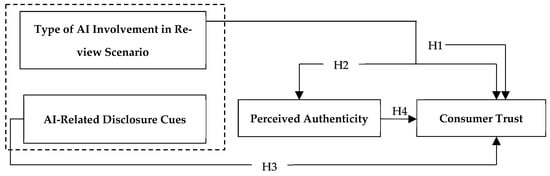
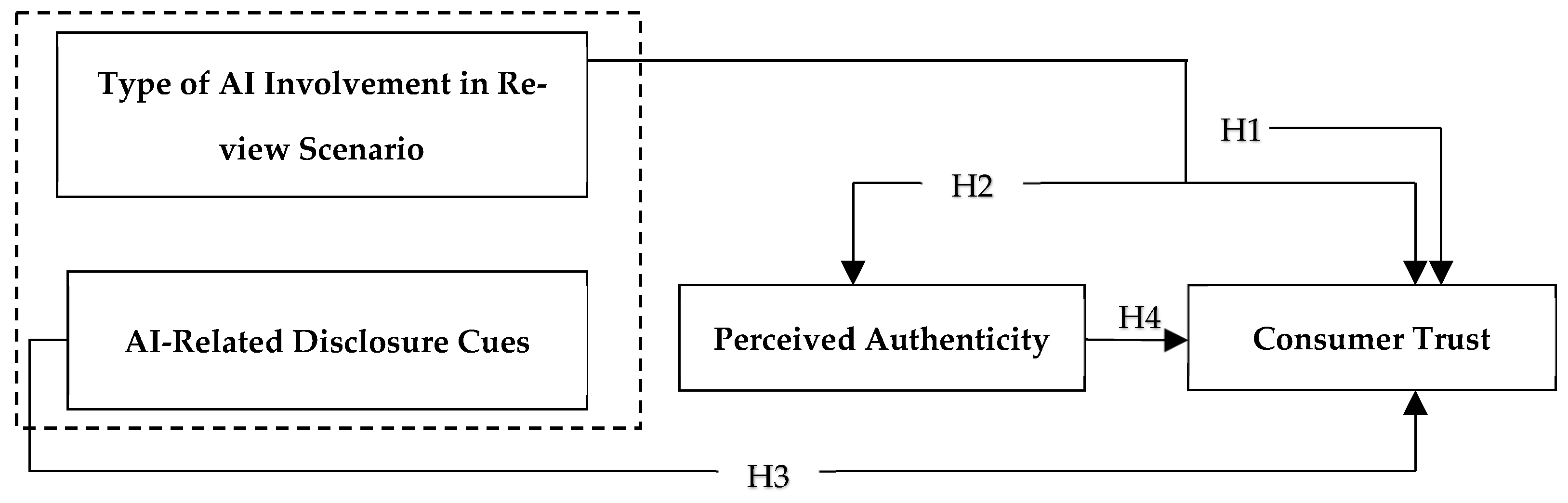
The following research model was constructed based on the above hypotheses (Figure 1).
Figure 1.
Research model.
3. Materials and Methods
3.1. Sampling and Data Collection
This study employed a within-subject experimental design and used a structured online questionnaire to collect data on consumer responses to different AI-related review scenarios. Participants evaluated all three scenarios: (1) Reviews Without AI-Related Information, (2) AI-Assisted Labeled Reviews, and (3) AI-Generated Labeled Reviews. The written review text remained identical across all conditions. Thus, this study isolates the effect of AI-related labels and visual presentation cues rather than differences in review text or review authorship. The experimental design captures responses to labeled review scenarios and AI-related presentation cues rather than differences in review content authenticity itself. The only differences concerned the visual image associated with the review and the AI disclosure label indicating the degree of AI involvement. In the Review Without AI-Related Information condition, the review was presented with the original product image and without any AI-related information. In the AI-Assisted Labeled Review condition, the review text remained unchanged, the image background was enhanced using AI, and a label indicated that only the background had been edited. In the AI-Generated Labeled Review condition, the same review text was combined with an AI-generated image labeled “AI-generated”. Each respondent evaluated all three scenarios, thereby allowing within-subject comparison. The scenario variable was treated as a within-subject categorical factor with three levels: Review Without AI-Related Information, AI-Assisted Labeled Review, and AI-Generated Labeled Review. To minimize potential order effects, the presentation order of the scenarios was randomized. After viewing each scenario, participants assessed the review using a structured questionnaire measuring perceived authenticity and consumer trust on a five-point Likert scale. Example screenshots of the three-review stimulus and the questionnaire developed through the QuestionPro platform are provided in Appendix A.
The questionnaire was distributed through an online survey link using a convenience sampling approach. The link was shared with potential marketplace users residing in Latvia through the researcher’s personal and professional networks. This method allowed the researcher to effectively reach participants familiar with digital platforms and online product reviews. The survey dataset included 397 response records, of which 370 were fully completed, and 27 were incomplete. No duplicates were identified in the dataset. The main analyses were conducted using the fully completed responses (N = 370), while the repeated-measures ANOVA was based exclusively on the complete records (N = 369). Because the same respondents evaluated all three scenarios, the scenario variable was analyzed as a repeated within-subject factor rather than as an independent-group variable. The findings should be interpreted with caution in terms of external validity and generalizability because the sample was non-probabilistic and recruited through the researcher’s networks.
To reduce the risk of common method bias, questions measuring different variables were arranged in random order in the questionnaire. In the introductory section, respondents were informed about the anonymity of the survey, its academic purpose, and the confidentiality of their responses.
As shown in Table 1, 52.70% of the study participants were women, 45.14% were men, and 2.16% chose not to specify their gender. The largest share of the sample was made up of respondents in the age group 26–35 (31.08%), followed by participants aged 18–25 (28.11%). The level of education ranged from secondary to doctoral degrees, with 44.32% of respondents having a bachelor’s degree and 24.32% having a master’s degree. Regarding the frequency of reading online reviews before making a purchase, 31.89% of participants indicated that they do so for almost every online purchase, while 33.78% responded that they read reviews frequently.
Table 1.
Descriptive statistics of sample characteristics.
This distribution indicates that the sample consisted of respondents with practical experience using reviews in digital marketplaces, which supports its relevance to the study.
3.2. Measures
The research model includes perceived authenticity, consumer trust, and perceptions of AI use in user-generated content. All responses were rated on a five-point Likert scale (1 = strongly disagree; 5 = strongly agree). To support content validity, the items were adapted from existing scales reported in the literature, whereas the empirical assessment in this study focused primarily on internal consistency. Some rewording was undertaken to maintain conceptual consistency with the experimental scenarios and the marketplace review context. The final wording of the measurement items is presented in Table 2.
Table 2.
Measurement items used in the questionnaire.
Consumer trust (CT) was measured using a four-item scale adapted from Filieri (2016) [48], reflecting review credibility, reliability, and trustworthiness. These items reflect respondents’ perceptions of a review as credible, reliable, and trustworthy, as well as their willingness to rely on it when evaluating a product.
Perceived authenticity (PA) was measured using a four-item scale adapted from prior research on the authenticity of user-generated content and online reviews. These items assess the degree to which a review is perceived as genuine, natural, and reflective of the user’s actual experience [49].
AI Perception (AI) was assessed using a single-item manipulation check measuring whether respondents noticed AI-related cues in the review stimulus. This item was included to verify whether participants recognized the intended review conditions.
AI Transparency Perception (AT) was assessed with a single item developed for the purposes of this study based on prior research on AI disclosure and transparency. This item reflects whether information about AI use influences respondents’ trust in the review. The full measurement items used in the study are presented in Appendix B.
3.3. Statistical Analysis
The scenario variable was treated as a within-subject categorical factor with three levels: Review Without AI-Related Information, AI-Assisted Labeled Review, and AI-Generated Labeled Review. Because each participant evaluated all three scenarios, repeated-measures analyses were used, and only complete cases were retained (N = 369). Differences across scenarios were tested using one-way repeated-measures ANOVA for Consumer Trust and Perceived Authenticity, followed by Bonferroni-adjusted pairwise comparisons. Mauchly’s test of sphericity was conducted for the repeated-measures ANOVA models. Because the assumption of sphericity was violated for both Consumer Trust and Perceived Authenticity (p < 0.001), Greenhouse–Geisser corrections were applied where appropriate. Mediation analysis was conducted separately for each pairwise comparison of the labeled review scenarios. In each model, the scenario contrast was coded as a binary independent variable, Perceived Authenticity was specified as the mediator, Consumer Trust was specified as the dependent variable, and the indirect effect was estimated as a × b.
4. Results
4.1. Common Method Bias
As the data in this study were collected using a self-reported online questionnaire, a statistical approach was used to assess the possible influence of common method bias. First, Harman’s one-factor test was performed on all measurement items included in the questionnaire. The results showed that the first extracted factor explained 22.1% of the total variance, which is below the commonly accepted threshold of 40%. This suggests that common method bias is unlikely to pose a serious threat to the study results.
Collectively, these findings suggest that method-related bias is unlikely to have substantially affected the observed relationships. The measurement scales were considered appropriate for additional reliability assessment.
4.2. Internal Consistency of the Measurement Scales
The internal consistency of the two multi-item constructs used in this study—Perceived Authenticity and Consumer Trust—was assessed across the three scenarios using Cronbach’s alpha and mean inter-item correlation. These indicators were used to evaluate the internal consistency and homogeneity of the measurement scales within each experimental condition.
The results of the internal consistency assessment are presented in Table 3.
Table 3.
Internal consistency of the measurement scales across the three scenarios.
The Consumer Trust scale showed acceptable internal consistency in the Review Without AI-Related Information (α = 0.654; MIIC = 0.321) and AI-Assisted Labeled Review (α = 0.638; MIIC = 0.305) scenarios, and high internal consistency in the AI-Generated Labeled Review scenario (α = 0.849; MIIC = 0.586). The Perceived Authenticity scale showed more variable internal consistency: borderline acceptable in the Review Without AI-Related Information scenario (α = 0.695; MIIC = 0.359), weaker in the AI-Assisted Labeled Review scenario (α = 0.564; MIIC = 0.241), and good in the AI-Generated Labeled Review scenario (α = 0.810; MIIC = 0.516). The scales showed acceptable but heterogeneous internal consistency across scenarios. Because the Perceived Authenticity scale showed the lowest internal consistency in the AI-assisted condition, additional item-level diagnostics for PA1_AA–PA4_AA were conducted and are presented in Table 4. Importantly, this issue was localized to the AI-assisted labeled condition, whereas the same construct showed acceptable to good internal consistency in the other two scenarios.
Table 4.
Reliability diagnostics for the Perceived Authenticity scale in the AI-assisted labeled condition.
According to Table 4, the corrected item–total correlations for the Perceived Authenticity scale in the AI-assisted labeled condition ranged from 0.229 to 0.462, with three of the four items above 0.30 and item PA3_AA showing a weaker but still positive correlation with the total scale. Excluding individual items did not lead to a significant increase in Cronbach’s alpha, and the MIIC value of 0.245 was within the recommended range for short multi-item scales. These diagnostics suggest that the scale was less cohesive in the AI-assisted labeled condition, but not uniformly unstable; it was therefore retained with caution for subsequent analyses. This issue is particularly relevant for the mediation analysis, because Perceived Authenticity was used as the mediator in the later models.
4.3. Manipulation Check
To verify whether participants perceived the experimental manipulations as intended, a manipulation check was conducted across the three labeled review scenarios. The results are presented in Table 5.
Table 5.
Means, standard deviations, and ANOVA results for the manipulation check across the three scenarios.
The manipulation check showed statistically significant differences across the three labeled review scenarios for both items. Only complete cases were included in the repeated-measures ANOVA (N = 369). For item AI1, significant differences were found between conditions (F (2, 736) = 540.10, p < 0.001). The mean was lowest in the Review Without AI-Related Information (M = 2.20, SD = 1.073), higher in the AI-Assisted Labeled Review scenario (M = 3.42, SD = 0.856), and highest in the AI-Generated Labeled Review scenario (M = 4.36, SD = 0.832). This finding suggests that respondents were able to differentiate the degree of AI involvement signaled by the labels and visual cues. Furthermore, statistically significant differences were identified for item AT1 (“Information about whether AI was used influences how much I trust this review”), F (2, 736) = 34.12, p < 0.001: the mean value was 3.93 (SD = 0.762) for the Review Without AI-Related Information, 3.77 (SD = 0.792) for the AI-Assisted Labeled Review, and 4.19 (SD = 0.800) for the AI-Generated Labeled Review. The findings suggest that participants not only recognized AI-related information but also considered it relevant to their trust in the review.
These results support the effectiveness of experimental manipulation and suggest that participants perceived the differences between the labeled review scenarios in line with the research design.
4.4. Descriptive Statistics
This section presents descriptive statistics for the primary study variables across the three labeled review scenarios. The following scenarios were included: Review Without AI-Related Information, AI-Assisted Labeled Review, and AI-Generated Labeled Review. For each variable, the sample size (N), mean (M), standard deviation (SD), and minimum and maximum values were calculated, providing an overview of the distribution of the indicators in each condition.
As demonstrated in Table 6, the highest mean values for both Consumer Trust and Perceived Authenticity are observed in the Review Without AI-Related Information scenario (CT: M = 4.18, SD = 0.46; PA: M = 4.04, SD = 0.60), while the lowest values are observed in the AI-Generated Labeled Review scenario (CT: M = 2.30, SD = 0.74; PA: M = 2.27, SD = 0.77). The AI-Assisted Labeled Review scenario occupies an intermediate position for both variables (CT: M = 3.56, SD = 0.47; PA: M = 3.35, SD = 0.51). The findings suggest that stronger AI-related labels and presentation cues are associated with reduced consumer trust and perceived authenticity. This pattern is consistent with the logic of the proposed hypotheses.
Table 6.
Descriptive statistics of the main constructs across the three scenarios.
4.5. Hypothesis Testing Across the Three Scenarios
To test the hypotheses, a one-way repeated-measures ANOVA was conducted because the same respondents evaluated all three labeled review scenarios. Only complete cases were included in this analysis (N = 369), and the scenario variable was modeled as a within-subject factor with three levels. Mauchly’s test indicated that the assumption of sphericity was violated for Consumer Trust, χ2(2) = 183.40, p < 0.001, and for Perceived Authenticity, χ2(2) = 236.30, p < 0.001. Therefore, Greenhouse–Geisser corrections were applied in the repeated-measures ANOVA analyses.
The corrected results remained statistically significant; therefore, uncorrected degrees of freedom are reported in Table 7 for ease of presentation. The results for Consumer Trust and Perceived Authenticity are presented in Table 7.
Table 7.
Repeated-measures ANOVA results for Consumer Trust and Perceived Authenticity across the three scenarios.
To further examine differences across the three labeled review scenarios, post hoc pairwise comparisons were conducted based on estimated marginal means with Bonferroni adjustment. Separate results for Consumer Trust and Perceived Authenticity are presented in Table 8.
Table 8.
Bonferroni-adjusted pairwise comparisons across the three scenarios.
As demonstrated in Table 8, all pairwise comparisons were statistically significant for both Consumer Trust and Perceived Authenticity after Bonferroni adjustment (p < 0.001).
For Consumer Trust, significant differences were identified between the Review Without AI-Related Information and AI-Assisted Labeled Review scenarios (MD = 0.621, SE = 0.028), the Review Without AI-Related Information and AI-Generated Labeled Review scenarios (MD = 1.875, SE = 0.051), and the AI-Assisted Labeled Review and AI-Generated Labeled Review scenarios (MD = 1.254, SE = 0.040). A similar pattern was observed for Perceived Authenticity, with statistically significant differences found between Review Without AI-Related Information and AI-Assisted Labeled Review (MD = 0.692, SE = 0.031), Review Without AI-Related Information and AI-Generated Labeled Review (MD = 1.775, SE = 0.058), and AI-Assisted Labeled Review and AI-Generated Labeled Review (MD = 1.083, SE = 0.042). When considered as a whole, the findings suggest a consistent decrease in both consumer trust and perceived authenticity across review scenarios with increasing AI-related signaling cues.
4.6. Mediation Analysis
To test whether perceived authenticity mediates the effect of labeled review scenarios on consumer trust, mediation analysis was conducted separately for each pairwise comparison of the labeled review scenarios. In each model, scenario contrast served as the independent variable, perceived authenticity served as the mediator, and consumer trust served as the dependent variable. Table 9 presents the estimated mediation paths for each comparison, including the effect of labeled review scenario on perceived authenticity (a—path), the effect of perceived authenticity on consumer trust (b—path), and the indirect effect.
Table 9.
Mediation analysis results for the indirect effect of the labeled review scenario on consumer trust through perceived authenticity.
As demonstrated in Table 9, the indirect effect of the labeled review scenario on Consumer Trust through Perceived Authenticity was positive and statistically significant in all three pairwise comparisons. The largest indirect effect was observed for the comparison between the Review Without AI-Related Information and AI-Generated Labeled Review scenarios, suggesting a particularly pronounced mediating role of perceived authenticity in that contrast. Overall, these findings support the mediating role of Perceived Authenticity in the relationship between labeled review scenario and Consumer Trust.
These mediation results should be interpreted with caution, particularly for comparisons involving the AI-assisted labeled review, because the Perceived Authenticity scale showed relatively weak internal consistency in that condition.
4.7. Summary of Hypothesis Testing
This section presents a summary of the results obtained from testing the proposed hypotheses, with these results being based on the statistical analyses that were conducted. The results of this study are presented in Table 10.
Table 10.
Overview of hypothesis testing results.
5. Discussion
This study examines how AI disclosure and AI-related review cues influence self-reported consumer trust and perceived authenticity across the labeled review scenarios tested. Support for H1 indicates that the AI-Generated Labeled Review elicited lower trust than the Review Without AI-Related Information scenario, which is consistent with prior research [12,47]. The repeated-measures ANOVA and post hoc comparisons showed that stronger AI-related cues were associated with lower consumer trust and perceived authenticity. This pattern underscores the importance of content origin as a signal in digital commerce environments [20,21]. Although the direction of these differences is broadly consistent with prior research, the contribution of this study lies in showing how labeled review scenarios and AI-related cues are interpreted through perceived authenticity to shape consumer trust.
Support for H2 similarly indicates that reviews labeled as AI-assisted elicited higher trust than reviews labeled as fully AI-generated. This indicates that consumers value not only the use of AI itself, but the extent to which human involvement is signaled in the review presentation. This interpretation is consistent with studies showing that AI-assisted reviews are perceived more favorably because they retain signs of human involvement and authenticity [32,34]. This study contributes by showing that AI-assisted review formats are not merely intermediate in outcome terms, but are interpreted differently because they continue to signal some degree of human involvement.
The findings related to H3 suggest that AI-related disclosure cues may be associated with lower trust when they heighten doubts about the authenticity and sincerity of the review. This is consistent with research indicating that disclosure is not a neutral label, but an interpretive signal capable of both reducing uncertainty and eliciting skepticism regarding message credibility and authenticity [8,9]. These results should be interpreted with caution because the study did not treat disclosure as an independent factor, and the findings are limited to the labeled review scenarios and self-reported evaluations examined. It is therefore possible that the observed differences reflect the combined effect of labels, visual cues, and scenario framing rather than disclosure alone.
Support for H4 indicates that perceived authenticity plays a key mediating role in the relationship between labeled review scenarios and consumer trust. The mediation results suggest that the effect of scenario type on trust is not direct, but operates through consumers’ interpretations of the authenticity, naturalness, and sincerity of the review. At the same time, this finding should be interpreted with caution, as the Perceived Authenticity measure showed relatively weak internal consistency in the AI-assisted labeled condition, which may have affected the stability of the mediation estimates involving this scenario. These findings are consistent with studies that view authenticity as a central mechanism for evaluating user-generated content and one of the most important foundations of trust in online reviews [39,42]. These findings suggest that companies and digital platforms should consider not only signals of AI involvement but also how AI-related cues shape perceived authenticity and trust.
5.1. Theoretical Implications
This study contributes to signaling theory by clarifying how AI-related review cues shape consumer trust in digital marketplaces. These findings suggest that indications of AI use do not operate as standalone signals, but interact with perceptions of authenticity and source credibility. These findings suggest that, in the context of digital commerce, what matters is not only AI disclosure, but also whether cues of human involvement, sincerity, and authentic user experience are preserved [8,9]. The findings further indicate that trust in AI-mediated review content is shaped less by disclosure alone than by how disclosure and related cues are interpreted through perceived authenticity [14]. This study’s contribution lies not primarily in demonstrating that AI-generated reviews are trusted less than reviews presented without AI-related information, but in specifying how signaling theory explains these evaluations through layered cues and authenticity-based interpretation.
While disclosing AI involvement may increase clarity regarding the origin of a review, it does not always enhance trust, because in some cases it also triggers doubts about the sincerity, naturalness, and authenticity of the message. In this sense, the results extend prior studies showing that transparency alone does not guarantee a positive effect when it is interpreted as a signal of lower authenticity or excessive artificiality [8].
Labeled review scenarios function as layered signals, disclosure frames their interpretation, and perceived authenticity serves as the mechanism through which trust judgments are formed. This study, therefore, contributes to the literature on signaling theory, authenticity research, and consumer trust by showing that the key issue lies not in AI disclosure per se, but in how AI-related cues may trigger a perceived loss of human authenticity.
5.2. Practical Implications
The findings have important practical implications for digital marketplaces, companies, and digital marketers using AI in user-generated content. The findings suggest that consumer trust is influenced by how AI involvement is disclosed and presented in the review scenarios examined in this study. Reviews labeled as fully AI-generated receive the lowest levels of trust and perceived authenticity, whereas reviews labeled as AI-assisted are evaluated more favorably. Within the context of the present findings, platforms may benefit from differentiating between AI-assisted and AI-generated labeled reviews and from applying more careful disclosure practices to reviews presented with stronger AI-related cues, especially where reviews play an important role in reducing pre-purchase uncertainty [14,32]. In practice, this could involve separate labeling for AI-assisted and fully AI-generated reviews, careful design of the visibility of AI-generated labels in sensitive product categories, and additional guidelines for review content in which human involvement is minimal.
The findings suggest that disclosure is not a neutral cue. It can enhance transparency regarding review origin, but may also undermine trust by creating doubts about authenticity. In this context, digital marketplaces may benefit from disclosure policies that distinguish between AI-assisted and fully AI-generated content rather than relying on a uniform policy. The form of the disclosure is as important as its presence: the label must be clear, understandable, and contextually appropriate to help users interpret the origin of the review without unnecessarily increasing skepticism [7,8]. For example, platforms could use more precise formulations such as “text edited with AI assistance” or “image background enhanced with AI” instead of the general label “AI-generated,” as such distinctions better reflect the degree of AI involvement.
Companies integrating AI into their content strategies may find that review formats signaling some level of human involvement are perceived more favorably than those presented as fully AI-generated. Human involvement and editorial control help maintain higher trust when AI is used. Therefore, businesses may benefit from using AI as a tool for refinement and efficiency while ensuring that review-like content still conveys a credible sense of human experience. In practice, firms may use AI to structure text, refine style, improve visual design, and summarize content; they should remain cautious about how AI-generated review elements are presented to users.
Platforms need to pay attention not only to review content, but also to how signals of content origin are integrated into the interface. When AI disclosure is clear, unobtrusive, and consistently integrated, it may reduce uncertainty and help users better assess the source of the review. As a result, the design of review interfaces and transparency cues represents a strategically important consideration for platforms seeking to maintain user trust. Disclosure can be built into the review card as a brief explanation next to the author’s name or image, rather than as a separate warning visually separated from the review itself, which may heighten perceptions of artificiality.
In addition, user reactions to different methods of AI labeling should be regularly tested as part of platform design and governance decisions [12,14]. For companies and brands, this implies that consumer trust depends not only on the technical quality of the review but also on whether the message is grounded in human experience, accountability, and authenticity [42]. A/B tests of disclosure designs, user feedback loops, and regular monitoring of trust metrics can support platform governance and content strategy.
In a broader sense, the findings of the research show that a successful integration of AI into review-based environments depends on the balance between efficiency, transparency, and authenticity. When organizations rely on AI-related review cues without considering their effect on perceived authenticity, they may undermine trust in review ecosystems. Companies and platforms that combine transparent AI use with visible human involvement and carefully designed disclosure practices are more likely to preserve consumer trust in digital review ecosystems.
5.3. Limitations and Future Research Directions
Despite the theoretical and practical significance of the findings, this study has several limitations. First, the sample was selected using convenience sampling and included users of digital platforms from Latvia only, which limits the generalizability of the results to other cultural and market contexts. Given that trust perceptions and responses to AI-related cues may vary across cultural and platform contexts, this limitation should be taken into account when interpreting the broader applicability of the findings. Second, although the experimental design allowed comparison of the same respondents’ reactions across three scenarios, the review text remained constant across conditions. This study, therefore, reflects perceptions of AI-related labels and visual presentation cues rather than differences in actual review authorship or review generation in real marketplace settings. Since AI disclosure was not examined as an independent experimental factor, the findings do not allow for definitive conclusions about its specific effect and should therefore be interpreted with caution. Third, the Perceived Authenticity scale showed lower internal consistency in the AI-assisted labeled condition, which may indicate a more ambiguous perception of the hybrid scenario. This limitation is particularly important for the mediation analysis because Perceived Authenticity was modeled as the mediator. Therefore, results involving the AI-assisted labeled scenario should be interpreted with caution. The data were collected via self-report, which creates a risk of social desirability and other response biases. In addition, the study captures self-reported perceptions rather than actual consumer behavior, and therefore does not allow conclusions about how AI-related review cues influence behavioral outcomes such as click-through, purchase intention, or review adoption in realistic marketplace settings.
Future research should extend these findings by incorporating behavioral measures, such as click-through behavior, purchase intention in simulated marketplace settings, and review adoption. Additionally, this study did not cover the full range of technological factors that may influence trust in reviews on digital marketplaces. Future research should explore in greater depth how personalization systems, recommendation algorithms, and other forms of AI support influence perceptions of authenticity and trust in review environments. Ethical aspects, including AI disclosure practices, transparency regarding the origin of reviews, and consumer protection against misleading AI-mediated content, also deserve special attention. Finally, longitudinal, experimental, and behavioral studies could provide a deeper understanding of how AI disclosure, perceived authenticity, and consumer trust are reflected not only in self-reports but also in actual consumer behavior, especially when review text is experimentally manipulated.
6. Conclusions
Previous studies have already examined issues related to trust in AI-generated content, transparency, and disclosure, though most often within the broader contexts of AI-mediated communication, automated decision-making, or algorithmic content evaluation [8,9,14]. This study expands on this literature by analyzing AI disclosure, AI-related review cues, and the mediating role of perceived authenticity in shaping consumer trust in digital marketplaces. It focuses on user-generated product reviews as market signals that play a key role in reducing uncertainty in purchase decisions. The results showed that, as AI-related labels and presentation cues became stronger, both perceived authenticity and consumer trust decreased, whereas reviews labeled as AI-assisted were perceived more favorably than reviews labeled as fully AI-generated. Perceived authenticity was found to act as a significant mediator of the relationship between labeled review scenarios and consumer trust.
These findings contribute to the literature by showing that evaluations of AI-mediated reviews depend not only on disclosure itself, but also on how AI-related cues are interpreted through authenticity. This study suggests that the key issue does not lie in AI disclosure itself, but in how AI-related cues may trigger a perceived loss of human authenticity. This study contributes not by identifying unexpected differences across review scenarios, but by clarifying the mechanism through which AI-related cues influence consumer trust. The practical significance of this study lies in highlighting the importance of distinguishing between AI-assisted and AI-generated labeled review formats, as well as developing more thoughtful disclosure policies capable of maintaining transparency without undermining trust. At the same time, this study has limitations related to convenience sampling, its focus on a single country, and the use of self-reported data. Promising avenues for future research include studies using more diverse samples across different cultural and platform contexts, as well as research on other factors, including product type, disclosure format, and actual user behavioral responses to AI-mediated reviews. These conclusions should therefore be interpreted in light of the study’s reliance on a Latvian convenience sample, self-reported evaluations, and experimentally labeled review scenarios.
Author Contributions
Conceptualization, D.D.; methodology, D.D. and K.S.S.; software, D.D.; validation, K.S.S.; formal analysis, D.D.; investigation, D.D. and K.S.S.; resources, D.D.; data curation, D.D.; writing—original draft preparation, D.D.; writing—review and editing, K.S.S.; visualization, D.D. and K.S.S.; supervision, K.S.S.; project administration, K.S.S.; funding acquisition, K.S.S. All authors have read and agreed to the published version of the manuscript.
Funding
This research received no external funding.
Institutional Review Board Statement
The data collection for this study was conducted in Latvia. The study adheres to general European Union research ethics principles, including those reflected in the General Data Protection Regulation (GDPR, Regulation (EU) 2016/679), as well as standard national practices for social science research involving human participants. Under these principles, formal ethical review is typically required only when research involves sensitive personal data, identifiable individuals, or physical or psychological intervention. The present study is based on a fully anonymous, non-interventional online survey conducted among adult participants. No sensitive personal data were collected, no intervention was performed, and no identifiable information was recorded. Therefore, the study falls outside the scope of mandatory ethical review under applicable EU-level principles and corresponding national practices in Latvia. Given its anonymous and non-sensitive nature, it does not require formal ethical approval under applicable national and EU-level research ethics standards.
Informed Consent Statement
Informed consent was obtained from all subjects involved in the study before participation in the online questionnaire.
Data Availability Statement
The data presented in this study are available on request from the corresponding authors. The data are not publicly available due to privacy and confidentiality considerations.
Conflicts of Interest
The authors declare no conflict of interest.
Appendix A. Questionnaire and Experimental Stimuli
Three review scenarios were designed in such a way that the written review text remained unchanged across all conditions. The only differences concerned the visual image associated with the review and the AI disclosure label indicating the degree of AI involvement. In scenario (a), the review was presented with the original product image and without any AI information. In scenario (b), the review text remained the same, but the image background was enhanced using AI and accompanied by a label explaining that only the background was edited. In scenario (c), the same review text was combined with an AI-generated image and a label indicating that the image was created using artificial intelligence. Examples of three scenarios are presented in Figure A1.
Figure A1.
Example screenshots of the experimental stimuli used in the survey: (a) Review Without AI-Related Information, (b) AI-assisted Labeled Review, (c) AI-Generated Labeled Review. * indicates the AI-related label displayed in the review scenario.


Questionnaire survey
Thank you for participating in this survey, which explores how consumers perceive product reviews in online marketplaces and how the use of artificial intelligence (AI) in user-generated content may influence their perceptions and trust.
During the survey, you will be shown several examples of product reviews. Some of these reviews may involve the use of artificial intelligence in the creation or modification of the visual content. After viewing each review, you will be asked to evaluate it based on your personal opinion.
This survey will take approximately 5–7 min to complete. Your responses are completely anonymous, and all data will be used solely for academic research purposes. All information will be kept strictly confidential.
1. Gender: □ male □ female □ prefer not to say
2. Age: □ 18–25 □ 26–35 □ 36–45 □ above 46
3. Education: □ High school and below □ Bachelor’s □ Master’s □ Doctorate
4. Frequency of reading online product reviews before making a purchase: □ Almost every time □ Often □ Sometimes □ Rarely
Note: To reduce common method bias, items measuring different variables were randomly arranged in the questionnaire to avoid the consecutive presentation of items with the same structure.
Instructions: Please read the product review presented in the scenario and indicate the extent to which you agree with the following statements.
(1 = strongly disagree; 2 = disagree; 3 = average; 4 = agree; 5 = strongly agree)
Table A1.
Measurement items used in the study.
Appendix B. Descriptive Statistics of Measurement Items
Table A2.
Descriptive statistics for measurement items across the experimental review scenarios.
References
- Lee, D.C.; Jhang, J.; Baek, T.H. AI-Generated News Content: The Impact of AI Writer Identity and Perceived AI Human-Likeness. Int. J. Hum.-Comput. Interact. 2025, 41, 13862–13874. [Google Scholar] [CrossRef] [Scilit]
- Voutsa, M.C.; Kerkidou, D.; Hatzithomas, L. Laughing at Bias: An Exploratory Study on Generation Z’s Persuasion and Skepticism Toward AI- vs. Human-Generated Sexist Humorous Ads; Communications in Computer and Information Science; Springer: Berlin/Heidelberg, Germany, 2026. [Google Scholar] [CrossRef] [Scilit]
- Chen, C.; Zhang, D.; Zhu, L.; Zhang, F. Exploring Consumer Responses to AI-Generated Visual Marketing Content: A Dual-Process Theory Perspective. Int. J. Consum. Stud. 2025, 49, e70121. [Google Scholar] [CrossRef] [Scilit]
- Park, J.; Oh, C.; Kim, H.Y. AI vs. Human-Generated Content and Accounts on Instagram: User Preferences, Evaluations, and Ethical Considerations. Technol. Soc. 2024, 79, 102705. [Google Scholar] [CrossRef] [Scilit]
- Stanko-Kaczmarek, M.; Dera, L.; Koscielska, H. “Between the Lines”: Perceptions of Poetry with Authorship Attributed to Artificial Intelligence or Humans—A Comparative Analysis. J. Creat. Behav. 2025, 59, e1513. [Google Scholar] [CrossRef] [Scilit]
- Al Hosni, J. Preserving Authorial Voice in Academic Texts in the Age of Generative AI: A Thematic Literature Review. Arab World Engl. J. 2025, 16, 244–258. [Google Scholar] [CrossRef] [Scilit]
- Haresamudram, K.; Larsson, S.; Heintz, F. Three Levels of AI Transparency. Computer 2023, 56, 93–100. [Google Scholar] [CrossRef] [Scilit]
- Koning, B.; Voorveld, H.A. Disclaimer! This Content Is AI-Generated: How AI-Disclosures Influence Trust in Advertisements and Organizations. J. Interact. Advert. 2025, 25, 240–253. [Google Scholar] [CrossRef] [Scilit]
- Schilke, O.; Reimann, M. The Transparency Dilemma: How AI Disclosure Erodes Trust. Organ. Behav. Hum. Decis. Process. 2025, 188, 104405. [Google Scholar] [CrossRef] [Scilit]
- Lermann Henestrosa, A.; Kimmerle, J. The Effects of Assumed AI vs. Human Authorship on the Perception of a GPT-Generated Text. J. Media 2024, 5, 1085–1097. [Google Scholar] [CrossRef] [Scilit]
- Nordhoff, A.C.; Zumstein, D. Use and Influence of Large Language Models for Optimizing Product Texts in E-Commerce. In Digital Management and Artificial Intelligence; Geibel, R.C., Machavariani, S., Eds.; ISPC 2024; Springer: Cham, Switzerland, 2025. [Google Scholar] [CrossRef] [Scilit]
- Majerova, J.; Nadanyiova, M.; Patik, L. One Step Forward, Two Steps Back: AI Generated Content vs. Perceived Trust, Authenticity and Credibility. Intellect. Econ. 2025, 19, 150–170. [Google Scholar] [CrossRef] [Scilit]
- Bitzer, T.; Wiener, M.; Cram, W. Algorithmic Transparency: Concepts, Antecedents, and Consequences—A Review and Research Framework. Commun. Assoc. Inf. Syst. 2023, 52, 293–331. [Google Scholar] [CrossRef] [Scilit]
- Amos, C.; Zhang, L. Consumer Reactions to Perceived Undisclosed ChatGPT Usage in an Online Review Context. Telemat. Inform. 2024, 93, 102163. [Google Scholar] [CrossRef] [Scilit]
- Kizilcec, R.F. How Much Information? Effects of Transparency on Trust in an Algorithmic Interface. In Proceedings of the 2016 CHI Conference on Human Factors in Computing Systems (CHI ’16); Association for Computing Machinery: New York, NY, USA, 2016; pp. 2390–2395. [Google Scholar] [CrossRef] [Scilit]
- Yu, L.; Li, Y. Artificial Intelligence Decision-Making Transparency and Employees’ Trust: The Parallel Multiple Mediating Effect of Effectiveness and Discomfort. Behav. Sci. 2022, 12, 127. [Google Scholar] [CrossRef] [Scilit]
- Storms, E.; Alvarado, O.; Monteiro-Krebs, L. “Transparency is Meant for Control” and Vice Versa: Learning from Co-Designing and Evaluating Algorithmic News Recommenders. Proc. ACM Hum.-Comput. Interact. 2022, 6, 405. [Google Scholar] [CrossRef] [Scilit]
- Zhou, T.; Lu, H. The Effect of Trust on User Adoption of AI-Generated Content. Electron. Libr. 2025, 43, 61–76. [Google Scholar] [CrossRef] [Scilit]
- Luo, L.; Liu, L.; Zheng, Y. When AI Summary Is Inconsistent with Aggregated Rating: The Role of Trust, Valence, and Algorithmic Explanation in Consumer Attitudes. Telemat. Inform. 2026, 104, 102361. [Google Scholar] [CrossRef] [Scilit]
- Mavlanova, T.; Benbunan-Fich, R.; Koufaris, M. Signaling Theory and Information Asymmetry in Online Commerce. Inf. Manag. 2012, 49, 240–247. [Google Scholar] [CrossRef] [Scilit]
- Li, L.; Tadelis, S.; Zhou, X. Buying Reputation as a Signal of Quality: Evidence from an Online Marketplace. Rand J. Econ. 2020, 51, 965–988. [Google Scholar] [CrossRef] [Scilit]
- Guo, X.; Deng, H.; Zhang, S.; Chen, G. Signals of Competence and Warmth on E-Commerce Platforms. Data Inf. Manag. 2020, 4, 81–93. [Google Scholar] [CrossRef] [Scilit]
- Ranganathan, C. The Role of Extrinsic Cues in Consumer Decision Process in Online Shopping Environments. J. Electron. Commer. Organ. 2012, 10, 52–71. [Google Scholar] [CrossRef] [Scilit]
- Li, H.; Fang, Y.; Wang, Y.; Lim, K.H.; Liang, L. Are All Signals Equal? Investigating the Differential Effects of Online Signals on the Sales Performance of E-Marketplace Sellers. Inf. Technol. People 2015, 28, 699–723. [Google Scholar] [CrossRef] [Scilit]
- Dong, X.; Li, X.; Yao, T. How Configuration Strategy of Multi-Subject Generated Signals Influences Online Consumption Decision-Making: The FsQCA Investigation Based on Signaling Theory. Electron. Commer. Res. 2025. [Google Scholar] [CrossRef] [Scilit]
- Rösch, J. Too Much Trust? When More Signals Do Not Help in Digital Marketplaces. Digit. Policy Regul. Gov. 2025, ahead-of-print. [Google Scholar] [CrossRef] [Scilit]
- Zhang, H.; Chen, D.; Sun, R. The Study of Consumer Trust in C2C E-Commerce Based on Reputation Score, Information Disclosure, Online Consumer Review Quality. In Proceedings of the 2010 International Conference on Management of E-Commerce and E-Government, Chengdu, China, 23–24 October 2010; pp. 184–187. [Google Scholar] [CrossRef]
- Wang, G.; Li, Z.; Liao, S.S. Interacting Reviews and Q&As on E-Commerce Platforms: Three Information Channel Interaction Designs. In PACIS 2025 Proceedings; Association for Information Systems: Atlanta, GA, USA, 2025; Volume 8, Available online: https://aisel.aisnet.org/pacis2025/general_topic/general_topic/8 (accessed on 3 May 2026).
- Yu, X.; Xu, D.J.; Li, K. Effects of AI Reviews on Consumers’ Purchase Intention: Influence of Product Category, Review Breadth, and Consumer Review Volume. Decis. Support Syst. 2026, 201, 114590. [Google Scholar] [CrossRef] [Scilit]
- Jia, M.; Zhao, Y.; Zhang, X. Navigating the Perceived Credibility and Adoption of AI-Generated Review Summaries in Online Shopping: An Affordance Perspective. Inf. Process. Manag. 2026, 63, 104404. [Google Scholar] [CrossRef] [Scilit]
- Zhao, Y.; Tang, S.; Zhang, H.; Lyu, L. AI vs. Human: A Large-Scale Analysis of AI-Generated Fake Reviews, Human-Generated Fake Reviews and Authentic Reviews. J. Retail. Consum. Serv. 2025, 87, 104400. [Google Scholar] [CrossRef] [Scilit]
- Cheng, X.; Zeng, A.; Yang, B.; Liu, Y.; Zhang, X. Online Reviews Generated by Generative Artificial Intelligence versus Human: A Study of Perceived Differences and User Adoption Behavior. Electron. Commer. Res. Appl. 2025, 71, 101497. [Google Scholar] [CrossRef] [Scilit]
- Kovács, B. The Turing Test of Online Reviews: Can We Tell the Difference between Human-Written and GPT-4-Written Online Reviews? Mark. Lett. 2024, 35, 651–666. [Google Scholar] [CrossRef] [Scilit]
- Li, Y.; Ha, H.-Y. Human and AI Reviews Coexist: How Hybrid Review Systems Enhance Trust and Decision Confidence in E-Commerce. J. Theor. Appl. Electron. Commer. Res. 2026, 21, 14. [Google Scholar] [CrossRef] [Scilit]
- Devane, D.; Pope, J.; Byrne, P.; Forde, E.; Woloshin, S.; Culloty, E.; Dahly, D.; Hess Elgersma, I.; Munthe-Kaas, H.; Judge, C.; et al. Comparison of AI-Assisted and Human-Generated Plain Language Summaries for Cochrane Reviews: Protocol for a Randomised Trial (HIET-1) [Registered Report—Stage I]. J. Clin. Epidemiol. 2025, 185, 111894. [Google Scholar] [CrossRef] [Scilit]
- Koliska, M. Trust and Journalistic Transparency Online. J. Stud. 2022, 23, 1488–1509. [Google Scholar] [CrossRef] [Scilit]
- Norambuena, B.K.; Farina, K.R.; Horning, M.; Mitra, T. Watching the Watchdogs: Using Transparency Cues to Help News Audiences Assess Information Quality. Media Commun. 2023, 11, 274–285. [Google Scholar] [CrossRef] [Scilit]
- Henke, J.; Holtrup, S.; Möhring, W. The More, the Better? Effects of Transparency Tools and Moderators on the Perceived Credibility of News Articles. Journalism 2023, 24, 1301–1321. [Google Scholar] [CrossRef] [Scilit]
- Peña-García, N.; Losada-Otálora, M.; Auza, D.P.; Cruz, M.P. Reviews, Trust, and Customer Experience in Online Marketplaces: The Case of Mercado Libre Colombia. Front. Commun. 2024, 9, 1460321. [Google Scholar] [CrossRef] [Scilit]
- Xia, R.; Dong, X.; An, J.; Wang, H. The Impact of Fake Online Reviews on Customer Satisfaction: An Empirical Study on JD.com. Electron. Commer. Res. 2025, 25, 4689–4716. [Google Scholar] [CrossRef] [Scilit]
- Lee, J.; Hong, I.B. Consumer’s Electronic Word-of-Mouth Adoption: The Trust Transfer Perspective. Int. J. Electron. Commer. 2019, 23, 595–627. [Google Scholar] [CrossRef] [Scilit]
- Hochstein, R.E.; Harmeling, C.M.; Perko, T. Toward a Theory of Consumer Digital Trust: Meta-Analytic Evidence of Its Role in the Effectiveness of User-Generated Content. J. Acad. Mark. Sci. 2025, 53, 1034–1054. [Google Scholar] [CrossRef] [Scilit]
- Hsieh, Y.; Lu, L. Trustworthiness Evaluation of Reviews for Products with Their Traits in E-Commercial Communities. Asia Pac. J. Mark. Logist. 2025, ahead-of-print. [Google Scholar] [CrossRef]
- Román, S.; Riquelme, I.P.; Iacobucci, D. Fake or Credible? Antecedents and Consequences of Perceived Credibility in Exaggerated Online Reviews. J. Bus. Res. 2023, 156, 113466. [Google Scholar] [CrossRef] [Scilit]
- Bhangale, S.; Roy, P.K. Is It Genuine or Fake? Analyzing E-Commerce Reviews Using Large Language Models. Knowl.-Based Syst. 2025, 330, 114556. [Google Scholar] [CrossRef] [Scilit]
- Grimmelikhuijsen, S. Explaining Why the Computer Says No: Algorithmic Transparency Affects the Perceived Trustworthiness of Automated Decision-Making. Public Adm. Rev. 2023, 83, 241–262. [Google Scholar] [CrossRef] [Scilit]
- Israfilzade, K. AI-Generated versus Human-Created Advertising: Effects on Consumer Trust and Purchase Intent. Equilib. Q. J. Econ. Econ. Policy 2025, 20, 1301–1337. [Google Scholar] [CrossRef] [Scilit]
- Filieri, R. What makes an online consumer review trustworthy? Ann. Tour. Res. 2016, 58, 46–64. [Google Scholar] [CrossRef] [Scilit]
- Zhu, T.; Weissburg, I.; Zhang, K.; Wang, W.Y. Human bias in the face of AI: Examining human judgment against text labeled as AI generated. In Findings of the Association for Computational Linguistics: ACL 2025; Association for Computational Linguistics: Vienna, Austria, 2025; pp. 25907–25914. [Google Scholar]

Disclaimer/Publisher’s Note: The statements, opinions and data contained in all publications are solely those of the individual author(s) and contributor(s) and not of MDPI and/or the editor(s). MDPI and/or the editor(s) disclaim responsibility for any injury to people or property resulting from any ideas, methods, instructions or products referred to in the content. |
© 2026 by the authors. Licensee MDPI, Basel, Switzerland. This article is an open access article distributed under the terms and conditions of the Creative Commons Attribution (CC BY) license.