


Abstract
Digital markets display a common monetization contrast: broad common interfaces often rely substantially on advertisers, merchants, enterprise customers, or other business-side actors, whereas narrower products more readily sustain direct consumer pricing. Existing research explains important parts of this contrast through demand-side pricing conditions and domain-specific institutional and technological conditions, but lacks a common supply-side criterion for comparing the feasibility of unified consumer pricing across settings. The objective of this paper is to develop a common supply-side transaction-cost criterion for assessing how observable product conditions affect the feasibility of organizing a unified consumer price across different digital settings. The framework follows Coase and examines the transaction costs of organizing a unified consumer transaction. Product architecture is defined as the organization of uses and functions within the same customer-facing product or common interface. Two distinct product conditions are identified. When the same product or common interface combines substantively different economic uses, greater dispersion in consumer use values makes a coherent target customer more costly to identify (Proposition 1). Lower product standardization makes the paid object and its required performance more difficult to specify and verify (Proposition 2). The argument concerns pronounced product conditions rather than ordinary consumer heterogeneity, which can often be managed through segmentation or differentiated pricing. Structured case comparisons across media, digital platforms, software ecosystems, and generative artificial intelligence examine these relationships. Across the cases, the evidence is consistent with the propositions: extreme use-value dispersion can make unified consumer pricing difficult even when delivery is standardized, while general-purpose AI combines this condition with non-standardized output. Narrower products and transaction units more readily support direct pricing.
1. Introduction
In early 2025, OpenAI was unusually consumer-oriented among leading AI firms, deriving most of its revenue from ChatGPT consumer subscriptions [1]. By 2026, however, the monetization architecture had become increasingly differentiated: enterprise customers accounted for more than 40 percent of OpenAI revenue [2], and OpenAI began testing advertising on free tiers [3]. Consumer subscriptions remained important, but they increasingly coexisted with enterprise plans, API access, and advertising. The OpenAI trajectory is not an isolated event; it reflects a recurring pattern across digital markets. Taking ChatGPT as a prominent example, this paper addresses a broader puzzle: why can a unified consumer price become difficult to sustain even for digital products with some of the largest consumer audiences in history?
This paper argues that one part of the answer lies in product architecture. A common interface such as ChatGPT can support substantively different economic uses, from casual conversation and writing to coding, research, tutoring, and business analysis. Following Coase [4], this paper treats consumer pricing as a problem of using the price mechanism. Two distinct transaction-cost margins are central. First, when the same product combines highly unrelated uses, consumer use values become widely dispersed, increasing the cost of identifying a sufficiently coherent target customer for a unified price. Second, when the paid product is non-standardized, what the consumer is purchasing and what constitutes satisfactory performance become more difficult to specify before agreement and verify afterward. These conditions can occur separately or together. When they become sufficiently severe, unified consumer pricing becomes relatively less feasible, increasing the attractiveness of narrower paid products or alternative paying sides.
In this paper, 2C refers to arrangements in which the immediate payer is an individual end user. 2B refers to arrangements in which the immediate payer is a business-side actor, including advertisers, merchants, distributors, enterprise customers, and ecosystem partners. Payment mechanisms or customer categories such as API access, cloud usage, or developer subscriptions do not by themselves determine whether a transaction is classified as 2B or 2C. The two can coexist within the same product; the relevant outcome is therefore the monetization mix rather than a binary classification. Unified consumer pricing refers to charging a target customer group directly for a defined paid product or service. Multiple subscription tiers are compatible with this definition. Not all users of a broader interface need to subscribe or pay the same price. Product architecture refers here to the customer-facing organization of functions and uses within the same product or common interface. This conceptualization extends the conventional product-architecture literature—which focuses mainly on components, modularity, and technical standards—by examining how functions are organized from the customer side.
Existing literature approaches different parts of this problem from different directions. Two-sided market theory explains how prices are allocated across market sides when cross-group externalities matter [5,6,7]. Media economics examines how audience heterogeneity, advertiser demand, and content differentiation affect advertising and subscription models [8,9,10]. Price discrimination, versioning, and bundling explain how firms respond to heterogeneous valuations through differentiated prices and products [11,12]. Software and open-source research emphasize modularity, licensing, governance, participation incentives, and complementary services [13,14,15,16]. Recent research on generative AI examines consumer willingness to pay, pricing mechanisms, model differentiation, and API pricing [17,18,19]. Taken together, these literatures explain important parts of monetization through demand-side pricing conditions and domain-specific institutional and technological conditions.
What remains missing is a common supply-side criterion for comparing the feasibility of unified consumer pricing across these different settings. This paper provides such a criterion through transaction costs. Following Coase [4], using the price mechanism involves the costs of discovering relevant prices, negotiating and concluding contracts, and supervising and enforcing performance. The present framework links these costs to two observable product conditions. First, when the same product or common interface combines substantively different economic uses, consumer use values become more dispersed, increasing the cost of identifying a sufficiently coherent target customer. Second, lower product standardization makes the paid object and its required performance more difficult to specify and verify, increasing the costs of negotiating and concluding contracts and of supervising and enforcing performance. These two relationships correspond to the transaction-cost margins developed in Section 3. Accordingly, the objective of this paper is to develop a transaction-cost framework for assessing how observable product conditions affect the feasibility of organizing a unified consumer price.
The empirical analysis uses structured case comparisons across media, digital platforms, software ecosystems, and generative AI. The unit of analysis is the specific product or common interface for which consumer pricing is contemplated, rather than the firm or corporate portfolio. Product conditions are identified before the monetization outcome is interpreted. The design places particular weight on theoretically revealing contrasts in which the product conditions differ sharply. General broadcasting, general Search, messaging super-apps, and NVIDIA CUDA provide settings in which use-value dispersion is high while delivery or the underlying technical object remains comparatively standardized, allowing Proposition 1 to be examined separately from Proposition 2. General-purpose AI provides the strongest joint setting because highly dispersed uses coexist with non-standardized outputs. Amazon Prime is included as a boundary case: despite substantial functional breadth, its membership remains organized around a comparatively coherent retail customer and a standardized paid bundle. Evidence comes from company reports, regulatory filings, pricing pages, product and technical documentation, contractual materials, API documentation, and other public sources. Because the cases span historical and current settings, the study does not impose a single common observation window; evidence is dated to the source used for each case.
Generative AI provides the strongest joint application of the argument. ChatGPT combines highly dispersed uses with a non-standardized core output. Claude Code narrows the focus toward software development, where the target customer and performance criteria are easier to identify. Gemini, DeepSeek, and Qwen provide further configurations involving consumer plans, enterprise products, API pricing, and open-weight distribution.
The primary contribution of this paper is therefore a common supply-side transaction-cost criterion for comparing the feasibility of unified consumer pricing across otherwise different digital settings. Existing research remains important for explaining demand-side pricing, cross-group effects, advertising value, licensing, complementary services, computing costs, and other domain-specific conditions. The present framework adds a comparative criterion by linking observable product architecture to the costs of identifying a coherent target customer and of specifying and verifying the paid transaction. The empirical analysis then examines whether these transaction-cost margins recur across media, digital platforms, software ecosystems, and generative AI.
The remainder of the paper is organized as follows. Section 2 reviews the relevant literature. Section 3 develops the theoretical framework and the two propositions. Section 4 presents the comparative case design and evidence. Section 5 presents the empirical analysis and discussion. Section 6 concludes.
2. Literature Review
2.1. Platform Pricing and Two-Sided Markets
Two-sided market theory explains how platforms allocate prices across different user groups when cross-group externalities affect participation and demand [5,6,7,20]. A central finding in this literature is that platforms frequently subsidize consumer access and charge business-side participants—such as advertisers, merchants, or developers—when a larger consumer base increases the value received by those business actors. This mechanism effectively explains the revenue structures of many digital marketplaces and advertising-supported platforms, where the platform’s primary value proposition to businesses is the aggregated attention or transaction volume of the consumer side.
2.2. Media Economics and Content Monetization
Media economics examines how audience structure, content differentiation, and advertiser demand shape revenue models [8,9,10]. The historical reliance of general broadcasting on advertising has been explained by the difficulty of charging heterogeneous audiences directly [8,9], while empirical studies document the subsequent transition toward fragmented, on-demand, and subscription-oriented viewing [21,22,23,24,25]. Price discrimination, versioning, and bundling further explain how media firms separate consumers into identifiable segments or product tiers to capture heterogeneous willingness to pay [11,12]. These mechanisms show that audience heterogeneity alone does not prevent direct consumer pricing, provided the content remains within a bounded, recognizable category and can be packaged into workable product versions.
2.3. Software, Open-Source, and AI Ecosystems
Research on software architecture and open-source ecosystems emphasizes modularity, participation incentives, governance, licensing, and complementary services [13,14,15,16]. Empirically, this literature explains why broadly reusable base software (e.g., Linux) is often distributed freely, while monetization is attached to narrower, enterprise-grade services such as reliability, compliance, and lifecycle support (e.g., Red Hat, Ubuntu Pro). Research on industry platforms further shows that proprietary foundational technologies can support broad ecosystems of complementary applications and services, extending the platform logic beyond open-source software [26]. Recent research on generative AI examines consumer willingness to pay and pricing mechanisms [17,18], as well as market pricing, model differentiation, and token-based API pricing [19]. This literature extends established pricing questions to generative AI, particularly the choice among subscription, usage-based, and API pricing.
2.4. Synthesis: The Transaction-Cost Gap
Existing studies explain monetization through demand-side pricing conditions and domain-specific institutional and technological conditions. Two-sided market theory emphasizes cross-group effects [5,6,7], while price discrimination, versioning, and bundling emphasize heterogeneous willingness to pay [11,12]. Recent AI pricing research similarly examines willingness to pay and pricing mechanisms [17,18], while research on software emphasizes licensing, governance, and complementary services [13,14,15,16].
What remains missing is a common supply-side criterion for assessing the feasibility of unified consumer pricing across these different settings. This paper provides such a criterion through transaction costs. Following Coase [4], using the price mechanism involves the costs of discovering relevant prices, negotiating and concluding contracts, and supervising and enforcing performance. These costs can be related to observable supply-side conditions, allowing the feasibility of unified consumer pricing to be assessed without first estimating willingness to pay across every relevant group. This approach is consistent with Alchian [27], who showed that economic outcomes can be predicted from the conditions governing selection without reconstructing the complete optimizing calculations of individual decision makers. Section 3 develops this argument.
3. Theoretical Framework
3.1. 2B and 2C as Alternative Uses of the Price Mechanism
This paper interprets 2B and 2C as two arrangements for using the price mechanism and classifies them according to the identity of the immediate payer. Under a 2C arrangement, the immediate payer is an individual end user. Under a 2B arrangement, the immediate payer is a business-side actor, such as an advertiser, merchant, distributor, enterprise customer, or ecosystem partner. A producer that sells its product to a distributor therefore uses a 2B arrangement even when the final user is an individual consumer. Similarly, a firm purchasing a product for use by its own employees is classified as 2B because the immediate payer is the firm.
Payer identity is distinguished from payment mechanism. API access, cloud usage, or a developer subscription does not by itself determine whether a transaction is 2B or 2C. An individual developer purchasing access on a personal account is classified as 2C, whereas a firm purchasing the same type of access for organizational use is classified as 2B. The two arrangements can coexist within the same product. A digital product may therefore receive payments from individual end users alongside payments from advertisers, enterprise customers, merchants, or other business-side actors. The theoretical question concerns the relative importance of 2B and 2C arrangements rather than an exclusive choice between them.
Coase [4] identified three costs of using the price mechanism: discovering relevant prices, negotiating and concluding contracts, and supervising and enforcing performance. These costs can be examined separately because different product features and contractual arrangements affect different transaction margins.
Online marketplaces provide a simple illustration. Internet search, product listings, and comparison systems reduce the costs of finding products, counterparties, and relevant prices. Communication tools reduce the costs of discussing product attributes, delivery conditions, and contractual terms. Escrow, delayed payment release, dispute-resolution procedures, and buyer-protection arrangements reduce the costs of supervising delivery and enforcing performance. These institutional arrangements can be observed even when the exact accounting value of the transaction costs cannot be calculated.
The comparison in this paper is made at the margin. It does not require calculating the total transaction costs of consumer-side and business-side arrangements, nor does it assume that 2B arrangements generally have lower total costs. The relevant question is whether an observable change in the product raises a particular consumer-side transaction cost while the corresponding conditions of an available business-side arrangement remain approximately unchanged. When consumer-side transaction costs increase on the relevant margin, unified 2C pricing becomes relatively less attractive.
3.2. Product Architecture, Target Customers, and Unified Consumer Pricing
Traditional studies of product architecture commonly examine the organization of components and functions, the degree of modularity and interdependence, and the technical interfaces connecting different parts of a product. This paper examines how uses and functions are organized within the product or common interface presented to consumers.
The unit of analysis is the particular product or common interface for which a consumer price is considered. A corporate portfolio may contain many products without requiring them to be sold through one common consumer price. Conversely, a single product or interface may combine many unrelated uses even though it appears as only one item in the corporate portfolio. Product architecture must therefore be identified from the product itself rather than from the overall size of the firm or ecosystem.
The number of functions alone does not determine whether direct consumer pricing is difficult. A product may contain many features while continuing to serve a recognizable customer group and consumption setting. A vehicle may offer multiple models, configurations, and optional features. A service establishment may offer several related services, packages, memberships, and add-ons. These alternatives can support multiple prices because they remain connected to a recognizable product category, use, and customer group.
The problem becomes different when substantively unrelated uses are combined within the same product or common interface. A messaging window may be used for family communication, education, office work, commercial negotiation, entertainment, and social interaction. A general search box may serve users seeking news, shopping information, academic materials, entertainment, professional advice, or navigation. A general-purpose AI dialogue box may be used for casual conversation, translation, academic research, coding, writing, tutoring, business analysis, and workflow automation.
The users of these products are already present. The relevant difficulty is finding, among users with highly different use values, a target customer whose valuations are sufficiently similar to support a common paid product and a relevant consumer price. In this paper, a target customer refers to a group of consumers whose use values and willingness to pay are sufficiently close for the producer to offer them substantially the same product at a common price.
This condition can be examined before observing the monetization result. The product page, functions, use settings, and intended applications provide evidence about whether the product indicates a relatively clear target customer. A successful subscription cannot be used retrospectively to classify a product as focused, and reliance on advertising or enterprise revenue cannot be used retrospectively to classify a product as broad.
When a product serves a recognizable use and customer group, comparable products, prevailing price ranges, and consumer responses provide information for determining a relevant price. This dispersion is reflected in willingness to pay. The producer must devote more resources to determining which users can form a common paying group and what price is relevant to that group.
A high unified price may be acceptable to users who derive substantial commercial or professional value while excluding users who derive only occasional or recreational value. A low unified price may attract a larger group while leaving much of the value obtained by high-value users uncaptured. Addressing this problem through more differentiated pricing requires increasingly fine distinctions among potential paying groups and therefore more resources to determine which users can form a common paying group and what price is relevant to that group. The difficulty arises from the absence of a sufficiently coherent target customer for the product or common interface as a whole.
Proposition 1.
Pronounced dispersion in consumer use values across substantively unrelated uses within the same product or common interface increases the costs of finding a target customer.
Proposition 1 concerns an extreme degree of dispersion rather than ordinary differences among consumers. As discussed in Section 2, heterogeneous willingness to pay can be addressed through segmentation, versioning, tiered pricing, and usage-based pricing. These pricing arrangements require the producer to identify economically meaningful customer groups or product versions. When the same interface combines substantively unrelated uses, the associated valuation profiles become more dispersed and increasingly fine distinctions among potential paying groups are required. The costs of identifying and classifying a relevant target customer therefore rise with the degree of use-value dispersion.
3.3. Product Standardization, Contracting, and Performance
The second product condition concerns product standardization. The quantity or access being purchased can be standardized even when the quality of the product delivered is not. For example, an AI service can specify the number of tokens, usage limits, or access rights in advance. However, the quality of the resulting output may vary substantially across tasks and may be difficult to specify before agreement or verify after delivery under a common standard. Product standardization therefore concerns whether the quality of what is delivered is sufficiently consistent across transactions to be judged by a common standard. To apply this consistently, product standardization must be evaluated with reference to the specific contractual object of the transaction. Depending on the service, standardization may refer to access rights, delivery, or output performance.
Standardization of the contracting procedure and standardization of the product must be distinguished. A clickwrap agreement can reduce the cost of bargaining separately with each consumer and reduce the mechanical cost of concluding accepted contracts. It does not remove the cost of determining what the paid product contains, which functions and usage limits are included, what performance is promised, and which common terms can be offered to consumers.
When the product is non-standardized, the content and required performance of the transaction become more difficult to specify before agreement. The parties face higher costs in determining what is included, what level of quality is required, what limits apply, and which failures constitute non-performance. The same non-standardization creates difficulties after delivery because performance cannot be evaluated through a single common criterion.
General-purpose AI provides a clear example of this distinction regarding output performance. An AI subscription may promise access to specified capabilities and usage allowances without guaranteeing a particular substantive result. While this access dimension is standardized, the performance dimension remains non-standardized because the service is applied to substantively unrelated tasks. Unlike coding tasks, which possess at least some objective mechanical verification criteria (e.g., compilation success and passing tests), the performance expected from translation, academic research, writing, tutoring, and business analysis lacks such common standards. A research output may require source verification. A translation may require linguistic and contextual review. A written analysis may require repeated checks for facts, logic, omissions, and unauthorized changes.
Proposition 2.
Lower product standardization increases the costs of negotiating and concluding contracts and of supervising and enforcing performance because the required quality is more difficult to specify before agreement and verify after delivery.
The two product conditions do not always occur together. Free broadcasting may serve consumers with highly dispersed use values while the content and delivery of the service remain relatively standardized. In that case, the main difficulty concerns finding a target customer and determining a relevant consumer price.
General-purpose AI can combine both conditions. The common interface serves many substantively unrelated uses, producing substantial dispersion in consumer use values. The outputs also vary across tasks and users and cannot be assessed through a single performance criterion. The transaction costs identified in Propositions 1 and 2 may therefore increase simultaneously, although they arise from different observable product conditions.
3.4. Implications for 2B and 2C Monetization
When the consumer-side transaction costs identified above rise, the producer can respond in several ways. It may retain a basic consumer subscription while relying more heavily on other paying parties. It may sell advertising, merchant access, enterprise services, API usage, cloud services, or ecosystem participation. It may also separate a narrower function from the common interface and charge for that function independently.
A separately priced API, coding product, enterprise package, or professional service can create a more clearly defined transaction. The paying customer, usage unit, contractual content, and performance requirement may be easier to identify than those of the original common consumer interface. Such an arrangement does not necessarily establish a unified price for the original product. It can instead create a narrower paid product with lower transaction costs on the relevant margins.
Holding the relevant conditions of available business-side arrangements approximately constant, greater dispersion in consumer use values, lower product standardization, or the simultaneous presence of both conditions, raise the relevant transaction costs of direct consumer pricing. As these costs increase on the relevant margin, unified 2C pricing becomes relatively less feasible, and monetization becomes more likely to rely on business-side arrangements or separately priced narrower products.
The empirical analysis therefore examines whether the proposed transaction-cost framework provides a common supply-side criterion across the different settings reviewed in Section 2. The cases are consistent with the framework where observable product conditions and the corresponding transaction-cost margins move in the predicted direction, while alternative explanations and relevant factors may also affect the observed monetization arrangements. Consequently, product functions, use settings, customer groups, and performance-verification requirements must be identified independently of the observed monetization outcome.
Figure 1 summarizes the framework. It presents the two observable product conditions that affect whether a unified consumer price can be organized. When the same product or common interface combines substantively different economic uses, the resulting dispersion in consumer use values increases the cost of identifying a coherent target customer. Lower product standardization increases the cost of specifying and verifying what the price purchases.
Figure 1.
Product Conditions and the Unified Consumer Price. Source: Authors’ elaboration. Note: The unified consumer price denotes the common price charged for a defined paid product or service. The figure represents theoretical relationships and contains no estimated demand curve, payment proportion, equilibrium price, or numerical threshold.
4. Methodology
4.1. Research Design and Setting
This paper uses a multiple-case research design for structured comparative theory elaboration, guided by transaction cost economics. Multiple cases permit comparison across settings and allow the analysis to examine whether observable differences in product conditions are associated with the transaction-cost margins and monetization arrangements predicted by the two propositions [28,29,30,31]. The focal unit of analysis is the particular product or common interface for which a consumer price is considered, rather than the firm, corporate portfolio, or ecosystem as a whole. The monetization arrangement is the observed outcome.
The empirical setting consists of a sequence of case comparisons across media, digital platforms, software ecosystems, and generative AI. Across these cases, firms face the same pricing problem: how strongly to rely on direct end-user payment relative to payments from business-side actors. The design combines cross-industry comparisons, within-domain comparisons, and within-firm or within-ecosystem comparisons, which provide complementary forms of comparative evidence. Cross-industry comparisons examine whether the same predicted relationships recur across settings that differ substantially in technology, regulation, consumer populations, firm organization, and industry structure. Within-domain comparisons examine the relationships among more similar products and consumer settings, such as YouTube and Bilibili or LINE and WeChat. Within-firm or within-ecosystem comparisons provide the closest control over the surrounding environment: Tencent permits comparison among products within the same corporate ecosystem, while Claude–Claude Code provides a within-firm comparison in which the firm and broader technological and organizational setting remain approximately constant while the focal product conditions differ. The selected cases include both relatively stable monetization arrangements and frontier AI cases whose pricing is still changing. In both groups, the analysis relies on public documentation such as annual reports, earnings releases, official pricing pages, API documents, product descriptions, contractual materials, and corporate announcements.
Cases are selected for theoretical relevance rather than statistical representativeness. Three criteria guide inclusion. First, the focal product or common interface must be distinguishable from the wider corporate portfolio. Second, its functions, use settings, and relevant contractual or performance conditions must be identifiable from public evidence without using the observed revenue model to define the product condition. Third, sufficient evidence must be available to identify how the product is priced or otherwise monetized.
Because the monetization arrangements of many cases were publicly known when the cases were selected, case selection itself is not treated as independent evidence for the theory. The analysis therefore includes cases that display the predicted pattern together with boundary or potentially disconfirming cases. Amazon Prime is included because a broad multi-service bundle sustains a common consumer membership price.
The cases range from moderate contrasts, such as advertising-supported versus paid media, to extreme cases such as general search interfaces, WeChat, and general-purpose AI assistants. Table 1 summarizes the case domains, focal products or comparisons, observable product conditions, monetization arrangements, and analytical roles.
Table 1.
Case selection and analytical role.
Some intermediate cases are inherently less informative. Advertising-supported and subscription online television services, for example, may offer substantially overlapping categories of content, leaving only modest observable differences in the product conditions relevant to Proposition 1. The empirical comparisons therefore place greater weight on cases in which the relevant product conditions differ sharply.
The analysis tracks observable product conditions, evidence relevant to the corresponding transaction-cost margins, and monetization arrangements across the selected cases. This design requires public documentation on product structure, pricing, contractual terms, performance requirements, and monetization. Detailed revenue decomposition is required only when the analysis makes a claim about the relative importance or change in the relative importance of 2B and 2C revenue. For boundary cases based on the persistence of a particular pricing arrangement (e.g., Amazon Prime), component-level accounting data is not required to demonstrate the viability of a unified consumer price. Case selection therefore strictly prioritizes theoretical relevance, variation, and documentation quality [28,32].
4.2. Data Collection
Data collection separates the observable product conditions identified in Section 3 from the monetization outcome.
For Proposition 1, the case record first identifies the directly observable diversity and relatedness of the functions and use settings served through the same product or common interface. Product descriptions, use examples, interface functions, intended applications, and usage categories are used to establish these observed use conditions. Use-value dispersion is not directly observed from these documents; it is theoretically inferred from the extent to which the documented uses represent substantively different economic purposes. This inference is made before the monetization outcome is interpreted.
For Proposition 2, the case record identifies the degree to which the content and required performance of the paid product can be specified before agreement and verified after delivery. Relevant evidence includes plan descriptions, usage rights and limits, terms of service, API specifications, service descriptions, performance criteria, testing requirements, and other documentation showing how the product and its performance are defined.
Monetization arrangement records both payer identity and payment mechanism. For classification purposes, 2C refers to transactions in which the immediate payer is an individual end user, whereas 2B refers to transactions in which the immediate payer is a business-side actor. Subscriptions, memberships, purchases, API usage, and cloud usage describe payment mechanisms and do not by themselves determine payer identity. The coexistence of 2B and 2C arrangements is recorded as hybrid monetization. A shift toward 2B or 2C is recorded only when revenue shares, growth rates, or other evidence permits a comparison of their relative importance over time.
The analysis relies primarily on public corporate documents, including annual reports, SEC filings, earnings releases, investor materials, official pricing pages, and API documentation. Academic literature is used to establish the institutional and technological context of each case. For privately held AI firms without SEC filings, media reports concerning revenue are not treated as standalone evidence; product structure and pricing claims are verified against official documentation. Because pricing pages and product descriptions can change, access dates are recorded for dynamic webpages without a fixed publication date, and archived versions are consulted where available. Supplementary Table S1 lists the principal documents used for each case to provide a structured and transparent evidence record. The Supplementary Material does not provide an exhaustive documentary audit trail because complete search logs, a complete document universe, and complete inclusion and exclusion records were not maintained from the outset.
For each case, the paper builds a structured case record organized around six elements: (1) the focal product or common interface; (2) its documented functions and use settings; (3) evidence relevant to Proposition 1; (4) evidence relevant to Proposition 2; (5) the monetization arrangement; and (6) the principal alternative explanations and relevant factors. Evidence is checked across documents to limit circular inference from the observed revenue model back to the proposed mechanism. Product breadth, target-customer clarity, and product standardization are identified independently of the observed monetization arrangement and are established before that outcome is interpreted. To make this coding procedure transparent, Supplementary Table S2 provides the common case-record template used to organize these six elements. Case classification was conducted by the first author using the common case-record template. Where a case was not clearly classifiable from the initial documentary evidence, the classification was re-examined against the definitions in Section 3.2 and Section 3.3 and the underlying product and contractual documentation before a final classification was assigned. Ambiguous classifications were discussed by both authors before the final classification was assigned.
4.3. Data Analysis
The two propositions are examined separately using a common analytical sequence applied across cases. First, the focal product or common interface and its observable functions and use settings are identified. Second, the observable evidence relevant to Proposition 1 and Proposition 2 is examined. Third, the monetization arrangement is identified. Fourth, the observed pattern is compared with the theoretical prediction. The monetization outcome is therefore interpreted only after the relevant product conditions have been established.
The media contrast between advertising-supported television and paid streaming serves as the inductive starting case, allowing the transaction-cost margin in Proposition 1 to be considered separately from Proposition 2. Tencent is treated as a within-ecosystem product comparison, comparing the broader WeChat interface with narrower Tencent products while holding the surrounding corporate environment constant. Amazon Prime serves as a boundary case to define the limits of the prediction, as discussed in Section 4.1. CUDA provides a proprietary foundational-software comparison with Linux, allowing the Proposition 1 pattern to be examined where open-source licensing is absent.
Cross-case comparison is organized at three levels. Within-firm or within-ecosystem comparisons hold the surrounding organizational and external environment most nearly constant while the relevant product conditions vary. Within-domain comparisons provide repeated comparisons among products that share similar technological functions, consumer settings, or market structures. Cross-industry comparisons examine whether the same predicted relationships recur across substantially different institutional, technological, and market environments. These three levels are complementary: within-firm or within-ecosystem comparisons provide the closest comparative control, within-domain comparisons provide replication under more comparable market conditions, and cross-industry comparisons examine the generality of the predicted relationships.
Relevant alternative explanations and relevant factors are acknowledged where appropriate, while the paper examines whether the transaction-cost framework provides a common supply-side criterion across domains.
Where meaningful changes occur over time, the analysis examines the chronology of changes in product structure, pricing arrangements, and monetization. Temporal ordering provides evidence relevant to reverse causality, and claims about direction are limited to cases in which the documented sequence permits such an inference.
5. Findings
The two propositions are assessed separately throughout: a product may combine highly heterogeneous consumer uses while remaining technically standardized, or serve a recognizable target customer while producing less standardized outputs. To avoid repetitive theoretical exposition across cases, Table 2 summarizes the cross-case patterns regarding product conditions, alternative explanations and relevant factors, and observed monetization mixes. The subsequent text focuses on the unique boundary conditions and process evidence of each domain.
Table 2.
Cross-case comparison of product conditions and monetization mixes.
5.1. Use-Value Dispersion as the Primary Margin
5.1.1. General Broadcasting and Focused Subscriptions
Traditional free-to-air television provides the starting case. A general broadcast channel combines news, sports, films, dramas, variety shows, and other programs within a common programming flow [33,34,35,36]. Viewers interested mainly in sports, news, drama, or entertainment may therefore consume the same product while attaching very different values to different parts of its programming. The transaction-cost difficulty lies not in reaching an audience, but in identifying within that heterogeneous audience a sufficiently coherent target customer for substantially the same paid product and determining a relevant unified consumer price. Advertising avoids this particular pricing problem by allowing broadcasters to sell aggregated audience attention to advertisers without requiring the broadcaster to organize direct consumer pricing for a heterogeneous audience [37,38,39,40].
Broadcasting also shows why Propositions 1 and 2 should be separated. Consumer use values may be widely dispersed even when output performance is comparatively standardized. A programming schedule and the broadcast signal can be specified in advance, and whether the scheduled content is transmitted can be observed after delivery. The broadcasting case therefore primarily illustrates Proposition 1. Regulation, spectrum allocation, advertiser demand, and the economics of mass audience aggregation remain important additional explanations for the historical organization of television.
Focused subscription services provide the opposite product condition. Netflix organizes its consumer product around on-demand video entertainment; Spotify around music and audio; and Disney+ around a recognizable entertainment bundle. Consumers differ in preferred films, series, artists, genres, and franchises, but these differences remain within more bounded consumption categories than the combination of unrelated uses found in general broadcasting or general-purpose digital platforms.
Consequently, the target customer is easier to identify. Proposition 1 concerns the extreme case in which variation extends across fundamentally unrelated uses, making a relevant paying group and a workable unified consumer price increasingly difficult to identify. Variation within a recognizable product category presents a less severe pricing problem.
These services also present comparatively standardized output performance under Proposition 2. The contracted performance—access to a defined content service and functioning digital playback—can be specified in advance and verified after payment. Netflix reports that substantially all revenue is derived from monthly membership fees. Spotify combines Premium and Ad-Supported businesses, but Premium revenue reached €13.819 billion in 2024, compared with €1.854 billion from the Ad-Supported segment [41,42]. Disney+ likewise demonstrates that a content service may include substantial variety while remaining organized around a recognizable paid entertainment product [43]. These cases show that variety alone does not create the condition in Proposition 1; the relatedness of the uses matters.
5.1.2. General Search Engines
General search engines provide another extreme Proposition 1 setting that reinforces this pattern. Google Search, Baidu Search, and Bing all present a common interface serving a very wide range of purposes [44,45]: weather, academic information, news, entertainment, travel, local services, medical information, products, suppliers, professional knowledge, and commercial opportunities. The difficulty lies in identifying a target customer for unified consumer pricing. A person checking the weather, a student searching for academic material, and a firm searching for a supplier may use the same interface while receiving radically different economic value. These uses do not naturally identify one paying customer group or one relevant unified consumer price, providing consistent illustrations of the high use-value-dispersion condition across the three search engines.
Crucially, general search engines help separate Proposition 1 from Proposition 2 by demonstrating that high use-value dispersion can coexist with a comparatively standardized search transaction. The relevant output takes a common form: a query produces a ranked set of results, and whether that output is delivered can be readily observed. Consequently, extreme dispersion of use values is the primary transaction-cost margin examined here for a unified 2C subscription.
Advertising provides an alternative monetization arrangement that avoids the need to organize direct consumer pricing for heterogeneous search users. The observed pattern is consistent with extreme use-value dispersion making a unified consumer subscription relatively difficult to organize while specific search intents remain valuable to advertisers.
Alphabet reports that Google Services’ revenue is generated primarily from advertising, while also including subscriptions, platforms, and devices. Baidu reported Baidu Core revenue of RMB 104.7 billion (approximately USD 14.35 billion) in 2024, including RMB 73.0 billion (approximately USD 10.00 billion) from online marketing and RMB 31.7 billion (approximately USD 4.35 billion) from non-online-marketing activities, mainly AI Cloud [46,47,48]. These company-level figures are treated only as contextual evidence. Microsoft likewise operates search advertising through Bing, matching advertising to users searching for relevant products, services, and information [49]. Across all three engines, the pattern is clear: a common interface serves highly heterogeneous uses, and general search is not organized around one unified consumer subscription.
5.1.3. Messaging Super-Apps
WeChat provides an especially sharp platform-level case. Its basic messaging interface serves a vast and highly heterogeneous user population. Consequently, a coherent target customer for the interface as a whole is difficult to define, and consumer willingness to pay is highly dispersed. This makes a unified consumer price difficult to organize for the product as a whole. Proposition 2 points in a different direction. Despite the diversity of uses, the core messaging output is comparatively standardized: whether a message is successfully transmitted and delivered can be evaluated under a common performance criterion.
Consistent with this product-level constraint, WeChat does not rely on a unified 2C fee for the broad interface. Mini Programs provide the clearest example: developers and businesses organize much narrower transactions (e.g., restaurant ordering or retail) around specific uses. These specific applications identify clear target customers according to a particular use [50]. Tencent disclosures accordingly show monetization attached to these narrower services, payment processing, and business services, rather than a unified consumer price for the WeChat interface itself [51,52].
LINE provides a cross-platform replication of this structure. While the core messaging platform serves a broad, undefined user base, monetization is attached to more specific products and services, such as paid Official Accounts, Stickers Premium, and LINE MINI Apps provided by developers and businesses [53,54].
5.1.4. Open-Source Software
This pattern of high use-value dispersion with comparatively standardized technical performance is further replicated in open-source software ecosystems. Linux extends the comparison beyond media and consumer platforms. The Linux kernel functions across individual development, enterprise servers, cloud infrastructure, embedded systems, devices, and supercomputing. A cloud provider, a device manufacturer, an enterprise server operator, and an individual developer can therefore use the same underlying technology for fundamentally different economic purposes.
This condition is relevant primarily to Proposition 1. The diverse users and use cases do not point naturally to one target customer or one relevant unified consumer price for the Linux kernel as a whole. Open-source licensing, community contribution, and complementary-service strategies are important institutional features of this ecosystem and may independently affect the availability and organization of the kernel [13,14,15].
The pricing comparison becomes clearer in Red Hat and Ubuntu Pro. Red Hat attaches payment to enterprise distributions, management tools, reliability, support, lifecycle services, and related enterprise products [55,56,57]. The target customer is much narrower than the universe of Linux users: enterprises purchasing reliability, management, security, support, compliance, and continuity. Ubuntu Pro similarly packages security maintenance, compliance, patching, vulnerability management, lifecycle support, and enterprise assistance around the underlying Ubuntu system.
These narrower services affect both propositions. Under Proposition 1, a particular enterprise need identifies a more recognizable paying customer than the Linux kernel as a general technological foundation. Under Proposition 2, obligations such as security coverage, updates, support terms, and lifecycle services can be specified in a paid arrangement, and their delivery can be checked more readily. Canonical official pricing materials, for example, define Ubuntu Pro around specific security and support services and provide explicit pricing arrangements for deployment [58,59].
In the Red Hat and Ubuntu Pro cases, payment is not attached to the Linux kernel itself but to more specific complementary enterprise services. This is the same pattern observed in the YouTube and Bilibili cases, where payment is attached to more specific paid products, membership rights, or creator-level offerings.
NVIDIA CUDA
The same pattern extends beyond open-source software to proprietary technological foundations. NVIDIA CUDA is a general-purpose parallel computing platform and programming model used across a wide range of compute-intensive applications. NVIDIA describes CUDA as the foundational development platform underlying its GPUs and reports millions of developers using CUDA and related software tools across multiple end markets [60]. The NVIDIA CUDA Toolkit is distributed free of charge [61].
CUDA provides an informative case because the two propositions point in different directions. Under Proposition 1, the same foundational technology supports highly heterogeneous economic uses, including artificial intelligence, scientific computing, data analytics, simulation, and other compute-intensive applications. A CUDA developer is therefore technically identifiable, but CUDA use does not define one economically coherent paying customer or one common use value. Under Proposition 2, however, the software object is comparatively standardized. CUDA provides documented programming models, APIs, compilers, runtime libraries, and technical specifications [62]. The case therefore resembles general Search in combining high use-value dispersion with a comparatively standardized underlying product.
NVIDIA does not rely on a unified charge for access to this broad foundational software layer. Monetization instead attaches to more specific transaction objects around the CUDA ecosystem, including GPUs and computing systems, paid enterprise software such as NVIDIA AI Enterprise and vGPU, and cloud services such as DGX Cloud [60]. This pattern is particularly informative when compared with Linux. Open-source licensing provides an independent explanation for free distribution of the Linux kernel, whereas CUDA is a proprietary platform. Yet in both settings, the broad foundational layer is available without a unified direct price while payment is attached to narrower products or services with more identifiable customers and more clearly specified transaction objects. The CUDA case is therefore consistent primarily with Proposition 1 and shows that the narrowing pattern observed in foundational software is not limited to open-source licensing.
5.2. Joint Effects of Use-Value Dispersion and Low Product Standardization
5.2.1. Broad Content Platforms: YouTube and Bilibili
YouTube and Bilibili provide a sharper contrast. The same platform can be used for short-form entertainment, long-form video, music, education, product reviews, games, livestreaming, professional information, creator communities, and many other purposes. These uses are substantially more heterogeneous than differences among films on Netflix or songs on Spotify. The platform-level target customer is consequently much harder to define for one unified paid product.
A viewer seeking entertainment, a student watching instructional material, a gamer following livestreams, and a professional seeking technical information may use the same platform while deriving very different economic values from it. YouTube Premium and Bilibili premium membership demonstrate that consumer subscriptions remain feasible, but neither arrangement requires the conclusion that all users of the common platform form one coherent paying group. Bilibili’s premium membership, for example, is primarily anchored in access to copyrighted anime and exclusive series rather than the entire platform. This specific content bundle identifies a much clearer target customer—viewers seeking licensed animation—allowing the platform to sustain a unified subscription price for this narrower paid object, even though the broader platform interface remains too diffuse for unified consumer pricing. YouTube reported more than 100 million YouTube Music and Premium subscribers in early 2024, while Bilibili reported approximately 22.7 million premium members at the end of 2024 alongside advertising and mobile game revenues [63,64].
Proposition 2 is also relevant at the platform level. Although access to YouTube and Bilibili is standardized, the content delivered through the common platform is generated by a large and changing population of creators and varies substantially across topics, formats, quality, frequency, and reliability. The platform-wide content product is therefore less standardized than the access interface itself: what a consumer would receive from a unified payment for the platform as a whole is difficult to specify and evaluate through one common standard. At the same time, the components that support direct consumer pricing are typically narrower and more standardized. Bilibili anchors premium membership on licensed content and defined membership rights, while YouTube Premium delivers clearly specified features such as ad-free viewing and background play. For these narrowed offerings, both the paying group and the paid object are more clearly defined and delivery is more readily verified.
The creator level provides an additional within-platform comparison. A channel or creator producing recognizable content repeatedly around a defined subject (e.g., gaming, education, or technology) serves a much narrower use than the platform as a whole [65,66]. Crucially, individual creators can directly monetize their specific audience through upgraded, paid features—such as Bilibili’s “charging-exclusive videos” or YouTube’s channel memberships [64,67,68,69]. Creator output may vary substantially in topic, format, frequency, and quality, but direct pricing becomes easier to organize when the creator narrows the subject matter and provides a more predictable paid content object. In these transactions, the target audience is more specific and identifiable, while the content or access rights attached to payment can be more clearly defined and verified [70,71]. The same platform can therefore contain a broad common interface with a diffuse target customer and relatively non-standardized content, alongside much narrower creator-level products that support direct consumer pricing.
5.2.2. General-Purpose Artificial Intelligence
General-purpose artificial intelligence provides a more extreme joint case for Propositions 1 and 2. The same dialogue interface can be used for casual conversation, writing, translation, coding, tutoring, research, image generation, business analysis, and workflow automation. These represent substantially different economic purposes, not merely different preferences within one recognizable consumption category. Proposition 1 therefore applies strongly: a large user base does not resolve the difficulty of identifying a sufficiently coherent target customer for a unified consumer price. Furthermore, the paid output itself is difficult to specify through one common performance standard. A satisfactory translation, software program, research summary, and business analysis are evaluated according to radically different criteria [72,73]. General-purpose AI thus combines high dispersion of consumer use values with substantial non-standardization of the delivered output.
ChatGPT provides a prominent example of differentiated monetization under the joint conditions identified in Propositions 1 and 2. Although initially heavily reliant on consumer subscriptions [2], the underlying product architecture combines highly dispersed uses with non-standardized outputs. Over time, the monetization architecture became increasingly differentiated. OpenAI progressively separated individual subscription plans from Business and Enterprise arrangements, separately priced API access, and introduced advertising on its Free and Go tiers [3,74,75]. At the company level, OpenAI reported that by April 2026 enterprise customers accounted for more than 40% of revenue and were expected to reach parity with consumer revenue by the end of the year [2]. This trajectory is consistent with the prediction that, when use-value dispersion is extremely high and product standardization is low, reliance on unified consumer pricing becomes more difficult and monetization may differentiate across narrower, more identifiable, or more measurable transactions.
Anthropic provides a critical within-domain contrast. General Claude faces the same broad-interface problem as ChatGPT. Claude Code, however, narrows the product specifically toward software development [76]. This narrowing significantly reduces the dispersion in consumer use values, as the target customer—developers and development teams—becomes more recognizable. More importantly for Proposition 2, unlike open-ended text generation or business analysis—where output quality is subjective—coding tasks possess objective mechanical verification criteria (e.g., compilation success, unit test coverage, and error logs). This makes ex-post supervision and performance verification easier. Because the delivered output can be more readily verified and the target customer is clearer, these observable differences are consistent with lower transaction-cost pressures on the relevant contracting and verification margins, as predicted for a narrower and more verifiable paid product.
Across the broader AI industry, monetization currently combines consumer subscriptions with enterprise, API, cloud, advertising, and ecosystem arrangements rather than relying exclusively on one universal consumer subscription.
Google (Gemini) relies heavily on its existing advertising business and Workspace ecosystem. Rather than forcing a universal 2C subscription, it divides AI capabilities into narrower business and cloud transactions (e.g., Vertex AI), leveraging intent-targeted advertising and enterprise software bundles [46,77,78,79].
DeepSeek and Qwen provide a different institutional setting because their open-weight strategies are independently explained by open-source and ecosystem considerations [80,81]. Their monetization nevertheless also includes narrower and measurable transaction units such as API usage and cloud-based model access [82,83]. Under the present framework, these transactions identify clearer paying customers and more precisely specified units of usage than the general-purpose interface as a whole. An API call or cloud-based model invocation represents a quantifiable unit of consumption directed at an identifiable developer or enterprise customer, although the quality of the resulting output may remain task-dependent.
5.3. Boundary Setting
Amazon Prime provides an important boundary case because it demonstrates that a broad functional bundle can sustain a unified consumer subscription. Prime combines shopping, delivery, video entertainment, live sports, and other services under a single membership [84]. Amazon explicitly identifies an “avid shopper” as a customer for whom the fast, free delivery offered by Prime alone may justify the membership, supporting a plausible interpretation that the service is positioned around a recognizable retail-oriented paying group [85].
Superficially, Prime contains many different features. Its documented positioning nevertheless suggests that the membership can be organized around a common retail-oriented value proposition, particularly for frequent shoppers seeking delivery and transaction benefits. Complementary services such as Prime Video and Prime Music broaden the bundle, although the available evidence does not establish that all components serve related economic purposes for every subscriber.
Therefore, Prime provides a plausible boundary case in which substantial functional breadth can coexist with a comparatively recognizable target customer. The observed positioning is consistent with economically manageable use-value dispersion for at least an important segment of Prime members, rather than establishing that use values are concentrated across all subscribers. Furthermore, under Proposition 2, the paid membership bundle is comparatively standardized. Core membership benefits, including defined delivery entitlements and service access, are offered under common terms and can be verified after use.
This boundary case demonstrates that observable product breadth must be carefully distinguished from economically relevant use-value dispersion. Unified pricing becomes structurally difficult when the target customer becomes unclear, not simply when the number of features increases.
5.4. Discussion and Managerial Implications
The cross-case comparisons demonstrate that observable product conditions must be evaluated independently of monetization outcomes. Media, general search, super-apps, and foundational software show that high use-value dispersion can coexist with comparatively standardized performance of the relevant product or transaction, making target-customer identification the primary constraint. Conversely, content platforms such as YouTube and Bilibili and general-purpose AI show that high use-value dispersion can combine with lower product standardization, making unified 2C pricing relatively less feasible and increasing reliance on business-side arrangements or separately priced narrower products.
Monetization may also be affected by factors such as regulation, competition, intellectual property, capital-market conditions, firm strategy, enterprise sales history, investor composition, and parent-company structure. The comparative design addresses these factors in two ways. First, these factors vary substantially across the industries and firms examined here, whereas similar relationships between the observable product conditions and monetization arrangements recur across media, digital platforms, software, and AI. This recurring cross-case pattern is consistent with the transaction-cost framework. Second, the within-firm comparisons hold many firm-level factors approximately constant while the relevant product conditions vary across products. The Claude–Claude Code comparison, for example, keeps the firm, investor background, and broader enterprise orientation broadly unchanged while product scope, target-customer clarity, and output verifiability differ. Taken together, the cross-case and within-firm evidence indicates that the transaction-cost framework provides a common explanation for recurring patterns across settings in which these firm- and industry-specific factors differ.
Amazon Prime provides an important boundary case, suggesting that observable product breadth need not imply extreme use-value dispersion when the documented positioning remains centered on a recognizable target customer. This clarifies that the relevant condition is target-customer clarity rather than feature count alone.
The framework has clear limits. The two product conditions concern the feasibility of organizing a unified consumer price; they do not by themselves determine the observed monetization mix. This leaves room for hybrid monetization, in which consumer subscriptions coexist with advertising, enterprise, API, or other business-side payments. Advertising value, network effects, usage measurability, service costs, regulation, and other domain-specific conditions may also affect the attractiveness of particular revenue arrangements. The present cross-domain comparison does not attempt to estimate the separate effect of each of these factors. The empirical evidence is therefore interpreted in terms of whether the observed patterns are consistent with the theoretical predictions, rather than as definitive causal identification.
Managerially, the framework offers a conceptual diagnostic. Managers should first assess whether a common interface combines substantively unrelated uses that obscure a coherent paying group (P1). Second, they must determine if the paid product’s performance can be specified and verified (P2). Where these pressures are severe, firms may respond in two ways: by relying more heavily on 2B arrangements, or by narrowing the paid product into a more specific and measurable transaction that can support direct consumer pricing.
6. Conclusions
This paper develops a common supply-side transaction-cost criterion for assessing the feasibility of unified consumer pricing. Across the cases, pronounced use-value dispersion and lower product standardization are associated with greater difficulty in organizing a unified consumer price, while narrower paid transactions and alternative paying sides become relatively more attractive.
Existing research provides important explanations and identifies relevant factors within particular settings. Cross-group externalities explain pricing in two-sided markets; audience structure and advertiser demand explain media; price discrimination, versioning, and bundling explain differentiated consumer pricing; licensing and complementary services explain open-source monetization; and computing costs, API metering, and enterprise requirements explain important features of AI pricing. The transaction-cost framework provides a common supply-side criterion across these settings because the costs of finding a coherent target customer, specifying the paid product, concluding the transaction, and verifying performance arise whenever producers charge consumers directly.
The case comparisons are consistent with these theoretical predictions while also defining their limits. Focused subscription products provide relatively clear target customers and standardized paid objects. General broadcasting and search show that high dispersion in consumer use values can coexist with standardized delivery, making the target-customer margin in Proposition 1 more important than the contracting margin in Proposition 2. Messaging super-apps illustrate how platforms with highly dispersed uses bypass unified pricing by delegating transactions to narrower, third-party applications. Content platforms such as YouTube and Bilibili show that high use-value dispersion can coexist with substantial product non-standardization, while direct pricing is concentrated on narrower and more standardized paid components. General-purpose AI combines highly dispersed uses with non-standardized outputs, bringing both propositions into the same setting. Amazon Prime shows that a broad bundle can sustain a unified consumer price when its services serve a clear, common target customer, while open-source software and foundational tools show that broadly reusable technologies can serve highly dispersed uses, making a unified consumer price more difficult to organize. The propositions therefore predict the feasibility of a unified consumer price rather than a deterministic choice between 2B and 2C.
Generative AI provides the strongest current application. A general-purpose AI interface can serve writing, coding, tutoring, research, translation, business analysis, workflow automation, and many other uses whose economic values and performance standards differ substantially. Consumer subscriptions can remain important, while enterprise plans, API access, cloud services, advertising, and narrower paid products attach payment to different customers, uses, or pricing units. The growing differentiation of AI monetization is consistent with the theoretical predictions developed in this paper. As general-purpose interfaces expand into increasingly heterogeneous uses, subsequent changes in consumer subscriptions, enterprise arrangements, API pricing, advertising, and narrower paid products can provide further evidence on whether monetization develops in the predicted direction.
Supplementary Materials
The following supporting information can be downloaded at: https://www.mdpi.com/article/10.3390/jtaer21100356/s1, Table S1: Principal Sources and Structured Case Evidence; Table S2: Common Case-Record Coding Template; Table S3: Completed Case Record Example: ChatGPT (General-Purpose AI).
Author Contributions
J.D.: conceptualization, methodology, investigation, data curation, writing—original draft. Y.Z.: conceptualization, methodology, validation, supervision, writing—review & editing. J.D. performed the initial document collection and coding of the case records; Y.Z. cross-checked the coded case records against the source documents and reviewed the theoretical interpretation. Both authors discussed and approved the analytical framework, the final coding, and the manuscript. All authors have read and agreed to the published version of the manuscript.
Funding
This research received no external funding.
Institutional Review Board Statement
Not applicable.
Informed Consent Statement
Not applicable.
Data Availability Statement
The data that support the findings of this study are publicly available from company annual reports, investor disclosures, official pricing pages, regulatory filings, and other sources cited in the reference list.
Conflicts of Interest
The authors declare no conflict of interest.
References
- Reuters. Anthropic Hits $3 Billion in Annualized Revenue on Business Demand for AI. 30 May 2025. Available online: https://www.reuters.com/business/anthropic-hits-3-billion-annualized-revenue-business-demand-ai-2025-05-30/ (accessed on 27 August 2026).
- OpenAI. The Next Phase of Enterprise AI. 8 April 2026. Available online: https://openai.com/index/next-phase-of-enterprise-ai/ (accessed on 27 August 2026).
- OpenAI. ChatGPT—Release Notes: Testing Ads in ChatGPT (Free, Go). 9 February 2026. Available online: https://help.openai.com/en/articles/6825453-chatgpt-release-notes (accessed on 27 August 2026).
- Coase, R.H. The nature of the firm. Economica 1937, 4, 386–405. [Google Scholar] [CrossRef]
- Rochet, J.-C.; Tirole, J. Platform competition in two-sided markets. J. Eur. Econ. Assoc. 2003, 1, 990–1029. [Google Scholar] [CrossRef] [Scilit]
- Armstrong, M. Competition in two-sided markets. RAND J. Econ. 2006, 37, 668–691. [Google Scholar] [CrossRef] [Scilit]
- Parker, G.G.; Van Alstyne, M.W. Two-sided network effects: A theory of information product design. Manag. Sci. 2005, 51, 1494–1504. [Google Scholar] [CrossRef] [Scilit]
- Steiner, P.O. Program patterns and preferences, and the workability of competition in radio broadcasting. Q. J. Econ. 1952, 66, 194–223. [Google Scholar] [CrossRef] [Scilit]
- Anderson, S.P.; Coate, S. Market provision of broadcasting. Rev. Econ. Stud. 2005, 72, 947–972. [Google Scholar] [CrossRef] [Scilit]
- Peitz, M.; Valletti, T. Content and advertising in the media: Pay-TV versus free-to-air. Int. J. Ind. Organ. 2008, 26, 949–965. [Google Scholar] [CrossRef] [Scilit]
- Varian, H.R. Versioning Information Goods; University of California: Berkeley, CA, USA, 1997. [Google Scholar]
- Bakos, Y.; Brynjolfsson, E. Bundling information goods: Pricing, profits, and efficiency. Manag. Sci. 1999, 45, 1613–1630. [Google Scholar] [CrossRef] [Scilit]
- Lerner, J.; Tirole, J. Some simple economics of open source. J. Ind. Econ. 2002, 50, 197–234. [Google Scholar] [CrossRef] [Scilit]
- O’Mahony, S. Guarding the commons: How community managed software projects protect their work. Res. Policy 2003, 32, 1179–1198. [Google Scholar] [CrossRef] [Scilit]
- Baldwin, C.Y.; Clark, K.B. The architecture of participation: Does code architecture mitigate free riding in the open source development model? Manag. Sci. 2006, 52, 1116–1127. [Google Scholar] [CrossRef] [Scilit]
- West, J.; O’Mahony, S. The role of participation architecture in growing sponsored open source communities. Ind. Innov. 2008, 15, 145–168. [Google Scholar] [CrossRef] [Scilit]
- Lupa-Wójcik, I. Students’ willingness to pay for access to ChatGPT. Eur. Res. Stud. J. 2024, 27, 730–745. [Google Scholar] [CrossRef] [Scilit]
- Yan, X.; Hu, Y.; Zhu, J.; Yang, X. User psychological perception and pricing mechanism of AI large language model. J. Theor. Appl. Electron. Commer. Res. 2025, 20, 241. [Google Scholar] [CrossRef] [Scilit]
- Demirer, M.; Fradkin, A.; Tadelis, N.; Peng, S. The Emerging Market for Intelligence: Pricing, Supply, and Demand for LLMs; NBER Working Paper No. 34608; National Bureau of Economic Research: Cambridge, MA, USA, 2025; Available online: https://www.nber.org/papers/w34608 (accessed on 27 August 2026).
- Lian, Z.; Van Ryzin, G. Optimal growth in two-sided markets. Manag. Sci. 2021, 67, 6862–6879. [Google Scholar] [CrossRef] [Scilit]
- Napoli, P.M. Audience Evolution: New Technologies and the Transformation of Media Audiences; Columbia University Press: New York, NY, USA, 2011. [Google Scholar]
- Lotz, A.D. The Television Will Be Revolutionized, 2nd ed.; New York University Press: New York, NY, USA, 2014. [Google Scholar]
- Lotz, A.D. Portals: A Treatise on Internet-Distributed Television; Michigan Publishing: Ann Arbor, MI, USA, 2017. [Google Scholar]
- Webster, J.G. The Marketplace of Attention: How Audiences Take Shape in a Digital Age; MIT Press: Cambridge, MA, USA, 2014. [Google Scholar]
- Tryon, C. TV got better: Netflix’s original programming strategies and the on-demand television transition. Media Ind. J. 2015, 2, 104–116. [Google Scholar] [CrossRef] [Scilit]
- Gawer, A.; Cusumano, M.A. Industry platforms and ecosystem innovation. J. Prod. Innov. Manag. 2014, 31, 417–433. [Google Scholar] [CrossRef] [Scilit]
- Alchian, A.A. Uncertainty, evolution, and economic theory. J. Political Econ. 1950, 58, 211–221. [Google Scholar] [CrossRef] [Scilit]
- Eisenhardt, K.M. Building theories from case study research. Acad. Manag. Rev. 1989, 14, 532–550. [Google Scholar] [CrossRef] [Scilit]
- Eisenhardt, K.M.; Graebner, M.E. Theory building from cases: Opportunities and challenges. Acad. Manag. J. 2007, 50, 25–32. [Google Scholar] [CrossRef] [Scilit]
- Ketokivi, M.; Choi, T. Renaissance of case research as a scientific method. J. Oper. Manag. 2014, 32, 232–240. [Google Scholar] [CrossRef] [Scilit]
- Yin, R.K. Case Study Research and Applications: Design and Methods, 6th ed.; SAGE: Thousand Oaks, CA, USA, 2018. [Google Scholar]
- Siggelkow, N. Persuasion with case studies. Acad. Manag. J. 2007, 50, 20–24. [Google Scholar] [CrossRef] [Scilit]
- Williams, R. Television: Technology and Cultural Form; Fontana: London, UK, 1974. [Google Scholar]
- Goodhardt, G.J.; Ehrenberg, A.S.C.; Collins, M.A. The Television Audience: Patterns of Viewing; Saxon House: Farnborough, UK, 1975. [Google Scholar]
- Webster, J.G.; Phalen, P.F. The Mass Audience: Rediscovering the Dominant Model; Lawrence Erlbaum Associates: Mahwah, NJ, USA, 1997. [Google Scholar]
- Webster, J.G. Audience flow past and present: Television inheritance effects reconsidered. J. Broadcast. Electron. Media 2006, 50, 323–337. [Google Scholar] [CrossRef] [Scilit]
- Smythe, D.W. Communications: Blindspot of Western Marxism. Can. J. Political Soc. Theory 1977, 1, 1–27. [Google Scholar]
- Owen, B.M.; Wildman, S.S. Video Economics; Harvard University Press: Cambridge, MA, USA, 1992. [Google Scholar]
- Anderson, S.P.; Gabszewicz, J.J. The media and advertising: A tale of two-sided markets. In Handbook of the Economics of Art and Culture; Ginsburgh, V.A., Throsby, D., Eds.; Elsevier: Amsterdam, The Netherlands, 2006; Volume 1, pp. 567–614. [Google Scholar]
- Wilbur, K.C. A two-sided, empirical model of television advertising and viewing markets. Mark. Sci. 2008, 27, 356–378. [Google Scholar] [CrossRef] [Scilit]
- Netflix, Inc. Annual Report (Form 10-K) for the Fiscal Year Ended December 31, 2024; U.S. Securities and Exchange Commission: Washington, DC, USA, 2025. Available online: https://www.sec.gov/Archives/edgar/data/1065280/000106528025000044/nflx-20241231.htm (accessed on 27 August 2026).
- Spotify Technology S.A. Annual Report 2024; Spotify Technology S.A.: Stockholm, Sweden, 2025; Available online: https://s29.q4cdn.com/175625835/files/doc_financials/2024/ar/Annual-Report-2024.pdf (accessed on 27 August 2026).
- The Walt Disney Company. 2024 Annual Report; The Walt Disney Company: Burbank, CA, USA, 2025; Available online: https://thewaltdisneycompany.com/app/uploads/2025/01/2024-Annual-Report.pdf (accessed on 27 August 2026).
- Broder, A. A taxonomy of web search. ACM SIGIR Forum 2002, 36, 3–10. [Google Scholar] [CrossRef] [Scilit]
- Rose, D.E.; Levinson, D. Understanding user goals in web search. In Proceedings of the 13th International Conference on World Wide Web, New York, NY, USA, 17–20 May 2004; pp. 13–19. [Google Scholar] [CrossRef] [Scilit]
- Alphabet Inc. Annual Report (Form 10-K) for the Fiscal Year Ended December 31, 2025; U.S. Securities and Exchange Commission: Washington, DC, USA, 2026. Available online: https://www.sec.gov/Archives/edgar/data/1652044/000165204426000018/goog-20251231.htm (accessed on 27 August 2026).
- Alphabet Inc. Alphabet Announces Fourth Quarter 2025 and Fiscal Year Results. 4 February 2026. Available online: https://abc.xyz/investor/news/news-details/2026/Alphabet-Announces-Fourth-Quarter-2025-and-Fiscal-Year-Results-2026-KEvZIMKBLS/default.aspx (accessed on 27 August 2026).
- Baidu Inc. Annual Report on Form 20-F for the Fiscal Year Ended December 31, 2024; U.S. Securities and Exchange Commission: Washington, DC, USA, 2025. Available online: https://www.sec.gov/Archives/edgar/data/1329099/000119312525066199/d853848d20f.htm (accessed on 27 August 2026).
- Microsoft Advertising. Microsoft Search Ads. Available online: https://about.ads.microsoft.com/en/solutions/ad-products-formats/search (accessed on 27 August 2026).
- Schreieck, M.; Ou, A.; Krcmar, H. Mini-App ecosystems. Bus. Inf. Syst. Eng. 2023, 65, 85–93. [Google Scholar] [CrossRef] [Scilit]
- Tencent Holdings Limited. Annual Report 2024; Tencent Holdings Limited: Shenzhen, China, 2025; Available online: https://static.www.tencent.com/uploads/2025/04/08/1132b72b565389d1b913aea60a648d73.pdf (accessed on 27 August 2026).
- Tencent Holdings Limited. Tencent Announces 2024 Annual Results. 19 March 2025. Available online: https://static.www.tencent.com/uploads/2025/03/19/81cb1f36bec218d27d6e0b24eec012b6.pdf (accessed on 27 August 2026).
- LY Corporation. FY2024 Full Year & Q4 Earnings Presentation; LY Corporation: Tokyo, Japan, 2025; Available online: https://www.lycorp.co.jp/en/ir/library/presentations/main/016/teaserItems2/02/linkList/04/link/en2024q4_presentation.pdf (accessed on 27 August 2026).
- LINE Developers. The Differences Between Native Apps and LINE MINI Apps. Available online: https://developers.line.biz/en/docs/line-mini-app/discover/native-mini/ (accessed on 27 August 2026).
- Red Hat. Buy Red Hat Enterprise Linux Server. Available online: https://www.redhat.com/en/store/red-hat-enterprise-linux-server (accessed on 27 August 2026).
- Red Hat. Red Hat Enterprise Linux Subscription Guide. Available online: https://www.redhat.com/en/resources/red-hat-enterprise-linux-subscription-guide (accessed on 27 August 2026).
- Red Hat. Red Hat Enterprise Linux (RHEL) Extended Update Support (EUS) Overview. 2024. Available online: https://access.redhat.com/articles/rhel-eus (accessed on 27 August 2026).
- Canonical. Ubuntu Pro. Available online: https://ubuntu.com/pro (accessed on 27 August 2026).
- Canonical. Ubuntu Pro: Plans and Pricing. Available online: https://ubuntu.com/pricing/pro (accessed on 27 August 2026).
- NVIDIA Corporation. Annual Report on Form 10-K for the Fiscal Year Ended January 28, 2024; U.S. Securities and Exchange Commission: Washington, DC, USA, 2024. Available online: https://www.sec.gov/Archives/edgar/data/1045810/000104581024000029/nvda-20240128.htm (accessed on 27 August 2026).
- Bentz, J.; Armstrong, R.; Bhat, A. Developers Can Now Get NVIDIA CUDA Directly from Their Favorite Third-Party Platforms. NVIDIA Technical Blog, 10 September 2025. Available online: https://developer.nvidia.com/blog/developers-can-now-get-cuda-directly-from-their-favorite-third-party-platforms/ (accessed on 27 August 2026).
- NVIDIA. CUDA C++ Programming Guide, Release 12.3; NVIDIA: Santa Clara, CA, USA, 2023; Available online: https://docs.nvidia.com/cuda/archive/12.3.0/pdf/CUDA_C_Programming_Guide.pdf (accessed on 27 August 2026).
- YouTube. Crossing 100 Million YouTube Music and Premium Subscribers, Thanks to You. YouTube Blog, 1 February 2024. Available online: https://blog.youtube/news-and-events/youtube-music-premium-100-million-subscribers/ (accessed on 27 August 2026).
- Bilibili Inc. 2024 Annual Report; Bilibili Inc.: Shanghai, China, 2025; Available online: https://ir.bilibili.com/media/jesfytmo/bilibili-inc-2024-annual-report.pdf (accessed on 27 August 2026).
- Casner, B.; Teh, T.-H. Content-hosting platforms: Discovery, membership, or both? RAND J. Econ. 2025, 56, 668–688. [Google Scholar] [CrossRef] [Scilit]
- El Sanyoura, L.; Anderson, A. Quantifying the creator economy: A large-scale analysis of Patreon. Proc. Int. AAAI Conf. Web Soc. Media 2022, 16, 829–840. [Google Scholar] [CrossRef] [Scilit]
- Panjwani, A.; Xiong, H. The effect of subscription revenue on content creation and advertising strategies. Inf. Econ. Policy 2026, 72, 101163. [Google Scholar] [CrossRef] [Scilit]
- Wang, Y.; Wu, D.; Yan, X. You are worth my tipping: Why do people voluntarily pay for user-generated-content on social media platforms? Electron. Commer. Res. Appl. 2025, 71, 101501. [Google Scholar] [CrossRef] [Scilit]
- YouTube Help. Get Started with Channel Memberships on YouTube. Available online: https://support.google.com/youtube/answer/7636690 (accessed on 27 August 2026).
- Regner, T. Crowdfunding a monthly income: An analysis of the membership platform Patreon. J. Cult. Econ. 2021, 45, 133–142. [Google Scholar] [CrossRef] [Scilit]
- Kim, J.M. Effects of YouTube EastaTV channel membership benefits on membership enrollment and evangelism. J. Korean Soc. Des. Cult. 2023, 29, 59–68. [Google Scholar] [CrossRef] [Scilit]
- Liang, P.; Bommasani, R.; Lee, T.; Tsipras, D.; Soylu, D.; Yasunaga, M.; Zhang, Y.; Narayanan, D.; Wu, Y.; Kumar, A.; et al. Holistic evaluation of language models. Trans. Mach. Learn. Res. 2023. Available online: https://mlanthology.org/tmlr/2023/liang2023tmlr-holistic/ (accessed on 27 August 2026).
- Chang, Y.; Wang, X.; Wang, J.; Wu, Y.; Yang, L.; Zhu, K.; Chen, H.; Yi, X.; Wang, C.; Wang, Y.; et al. A survey on evaluation of large language models. ACM Trans. Intell. Syst. Technol. 2024, 15, 1–45. [Google Scholar] [CrossRef] [Scilit]
- OpenAI. API Pricing. Available online: https://openai.com/api/pricing/ (accessed on 27 August 2026).
- OpenAI. ChatGPT Pricing. Available online: https://openai.com/chatgpt/pricing/ (accessed on 27 August 2026).
- Anthropic. Claude Code and New Admin Controls for Business Plans. 20 August 2025. Available online: https://www.anthropic.com/news/claude-code-on-team-and-enterprise (accessed on 27 August 2026).
- Google. Google AI Plans. Google One. Available online: https://one.google.com/about/google-ai-plans/ (accessed on 27 August 2026).
- Google. Gemini Enterprise. Google Cloud. Available online: https://cloud.google.com/gemini-enterprise (accessed on 27 August 2026).
- Google. Vertex AI Pricing. Google Cloud. Available online: https://cloud.google.com/vertex-ai/pricing (accessed on 27 August 2026).
- DeepSeek-AI. DeepSeek-V3. GitHub. 2024. Available online: https://github.com/deepseek-ai/DeepSeek-V3 (accessed on 27 August 2026).
- Qwen Team. Qwen3. GitHub. 2025. Available online: https://github.com/QwenLM/qwen3 (accessed on 27 August 2026).
- DeepSeek-AI. DeepSeek API Pricing. DeepSeek API Docs. Available online: https://api-docs.deepseek.com/quick_start/pricing (accessed on 27 August 2026).
- Alibaba Cloud. Model Inference Pricing. Alibaba Cloud Document Center. 2026. Available online: https://www.alibabacloud.com/help/en/model-studio/model-pricing (accessed on 27 August 2026).
- Amazon.com, Inc. Annual Report on Form 10-K for the Year Ended December 31, 2025; Amazon.com, Inc.: Seattle, WA, USA, 2026. Available online: https://www.sec.gov/Archives/edgar/data/1018724/000101872426000004/amzn-20251231.htm (accessed on 27 August 2026).
- Rosmarin, R. Is a Prime Membership Worth It? The Short Answer Is Yes. About Amazon. Available online: https://www.aboutamazon.com/news/retail/amazon-prime-membership-worth-it (accessed on 27 August 2026).
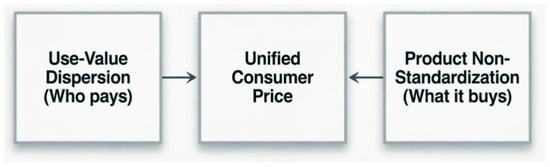
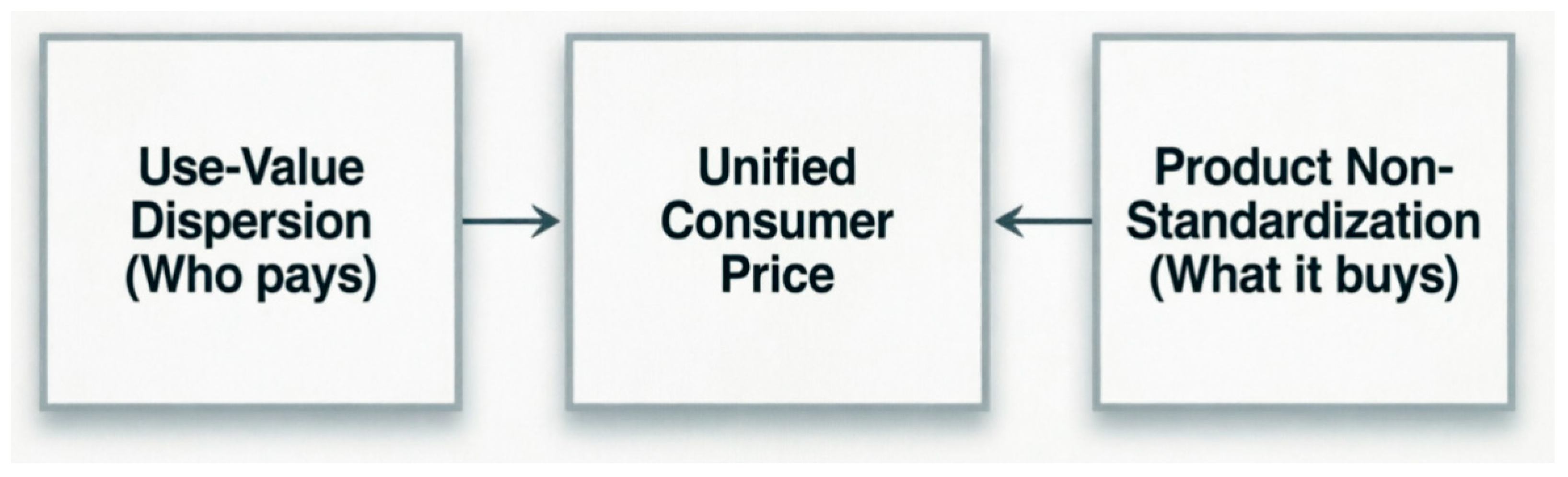

Disclaimer/Publisher’s Note: The statements, opinions and data contained in all publications are solely those of the individual author(s) and contributor(s) and not of MDPI and/or the editor(s). MDPI and/or the editor(s) disclaim responsibility for any injury to people or property resulting from any ideas, methods, instructions or products referred to in the content. |
© 2026 by the authors. Licensee MDPI, Basel, Switzerland. This article is an open access article distributed under the terms and conditions of the Creative Commons Attribution (CC BY) license.