

Innovative Strategies for Enhancing Plant Tolerance to Abiotic and Biotic Stresses and Ensuring Food Safety in Changing Climates
Topic Information
Dear Colleagues,
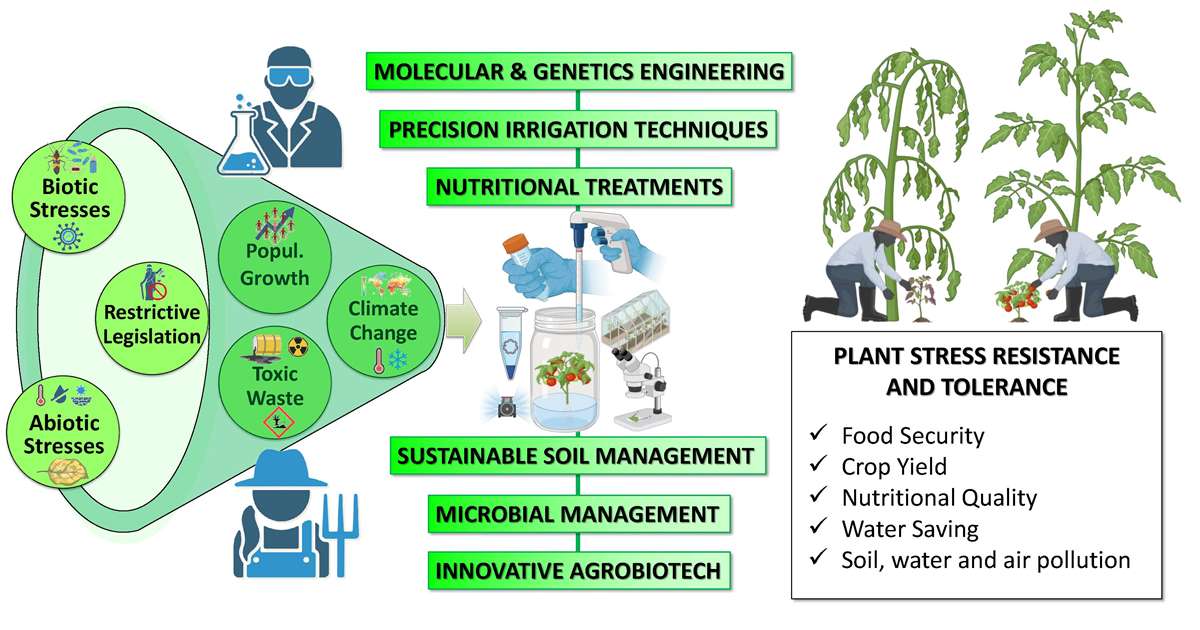
Climate change and population growth pose significant challenges to global food security, particularly with the world population expected to reach 9.5 billion by 2050. The increasing frequency of biotic and abiotic stresses, such as drought, salinity, extreme temperatures, and emerging diseases, are threatening crop productivity and quality. This abstract highlights the urgent need to develop innovative and sustainable strategies to enhance stress tolerance in plants. Key approaches include genetic modification, microbial symbiosis, optimized water management strategies and/or techniques like drip irrigation, and sustainable soil management. Genetic engineering tools such as CRISPR can enhance plant resilience, while beneficial microorganisms may improve water uptake and nutrient absorption. Precision agriculture technologies can optimize water use, reduce waste, and improve crop efficiency. Moreover, addressing plant stresses requires a focus not only on crop yield but also on food quality, ensuring essential nutrients are retained even in stress conditions. Collaborative research efforts across different disciplines—plant physiology, genetics, agronomy, and environmental sciences—are essential to overcoming these challenges. This Research Topic calls on scientists to contribute to developing eco-friendly, innovative agricultural practices that will secure global food supplies and promote a sustainable agricultural future.
Call for Researchers to Join This Research Topic
Addressing the complex challenge of abiotic and abiotic stresses in plants, particularly drought stress, requires a multidisciplinary and collaborative effort from scientists around the world. Researchers specializing in plant physiology, genetics, molecular biology, agronomy, and environmental sciences must come together to share insights, innovations, and strategies that will help build a more resilient and sustainable global food system.
This Research Topic invites contributions that explore the novel approaches to enhancing plant tolerance to plant stresses. By investigating the physiological, molecular, and agronomic responses of plants to environmental stressors, we can develop actionable strategies to improve crop resilience and ensure food security for future generations. Whether through genetic engineering, microbial symbiosis, precision agriculture, or sustainable soil management, we must work together to push the boundaries of knowledge and innovation.
Join us in this critical effort to achieve a food-secure future in the face of climate change and population growth. Let us collectively shape a modern, eco-friendly, and sustainable agricultural landscape that ensures both productivity and environmental stewardship.
Dr. José Ramón Acosta-Motos
Dr. Sara Álvarez
Dr. María del Rosario Álvarez Morales
Dr. María José Clemente-Moreno
Dr. María del Rosario Conesa-Saura
Dr. Juan de Dios Franco-Navarro
Dr. María José Gómez-Bellot
Dr. Isabel M. Martínez Alcalá
Dr. Víctor Meseguer Sánchez
Topic Editors
Keywords
- abiotic and biotic stress
- agriculture
- climate change
- food security
- molecular biology and genetic engineering
- plant resilience
- nutritional quality
- soil management
- microbial symbiosis
- precision irrigation techniques
- alternative water sources
- sustainability
- circular economy
Participating Journals


14,475 Articles
Launched in 2011
4.5Impact Factor
7.8CiteScore
17 DaysSubmission to First Decision
2 DaysAcceptance to Publication
Q1Highest JCR Category Ranking

20,464 Articles
Launched in 2011
4.1Impact Factor
7.6CiteScore
18 DaysSubmission to First Decision
3 DaysAcceptance to Publication
Q1Highest JCR Category Ranking

27,211 Articles
Launched in 2012
6.0Impact Factor
10.3CiteScore
15 DaysSubmission to First Decision
3 DaysAcceptance to Publication
Q1Highest JCR Category Ranking

7,703 Articles
Launched in 2015
3.4Impact Factor
6.1CiteScore
17 DaysSubmission to First Decision
2 DaysAcceptance to Publication
Q1Highest JCR Category Ranking

24,043 Articles
Launched in 2012
4.7Impact Factor
8.5CiteScore
15 DaysSubmission to First Decision
3 DaysAcceptance to Publication
Q1Highest JCR Category Ranking

244 Articles
Launched in 2022
3.0Impact Factor
4.0CiteScore
21 DaysSubmission to First Decision
4 DaysAcceptance to Publication
Q1Highest JCR Category Ranking

110,116 Articles
Launched in 2009
4.1Impact Factor
8.9CiteScore
17 DaysSubmission to First Decision
4 DaysAcceptance to Publication
Q2Highest JCR Category Ranking

32,622 Articles
Launched in 2009
3.5Impact Factor
6.7CiteScore
18 DaysSubmission to First Decision
3 DaysAcceptance to Publication
Q2Highest JCR Category Ranking