Skip to Content
  • Indexed in
    Scopus
  • 38 days
    Time to First Decision

Get Alerted

Add your email address to receive forthcoming issues of this journal.

All Articles (100)

Elderly psoriasis patients (≥65 years) demonstrate mainly preserved but substantially delayed therapeutic responses to IL-17 and IL-23 inhibitors, achieving lower PASI90 rates at early time-points with eventual “catch-up” by week 52, alongside increased adverse-event-driven discontinuation. This review synthesizes clinical efficacy data from real-world studies with emerging mechanistic evidence on immunosenescence and cellular senescence to propose the “Inflammatory Noise Floor” hypothesis. We postulate that senescent keratinocytes and fibroblasts constitutively secrete SASP cytokines (IL-6, IL-8, TNF-α) through pathways partially independent of IL-23/IL-17, potentially establishing a persistent baseline inflammation that IL-23/IL-17 blockade might not suppress. Concurrently, immunosenescence, characterized by CD8+CD28 T-cell accumulation, exhaustion marker upregulation, and Treg dysfunction, is hypothesized to impair adaptive immune re-equilibration. This dual mechanism represents one plausible, albeit theoretical, explanatory framework for the temporal lag, PASI plateau effects, and infection risk observed in elderly patients. Optimizing outcomes in the elderly may require a pragmatic approach: accepting stable PASI 75-90 as a successful endpoint and prospectively validating extended assessment timelines. While a direct correlation remains to be proven, this framework identifies cellular and immunosenescence as potential targets for future senotherapeutic interventions.

8 May 2026
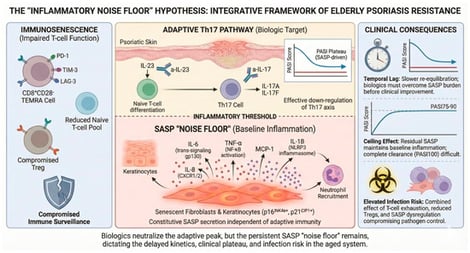
The “Inflammatory Noise Floor” Hypothesis: An Integrative Framework of Elderly Psoriasis Resistance. This schematic illustrates the proposed mechanism explaining altered therapeutic responses in aging psoriasis patients, integrating immunosenescence and cellular senescence. Central Panel: The diagram is bisected by an “Inflammatory Threshold.” Above it, Adaptive Th17 Pathways (the “Ceiling”) are effectively targeted by biologic agents (anti-IL-23, anti-IL-17), neutralizing the acute inflammatory peak. Below the threshold, the SASP “Noise Floor” persists independent of adaptive immunity. Senescent fibroblasts and keratinocytes maintain a baseline inflammatory state and sustaining neutrophil recruitment. Left Panel: Immunosenescence concurrently impairs immune function, characterized by the accumulation of exhausted T-cells (CD8+CD28− TEMRA expressing PD-1, TIM-3, LAG-3 markers), reduced naive T-cell pools, and compromised regulatory T-cell (Treg) function, leading to impaired immune surveillance. Right Panel: The persistent SASP floor combined with immunosenescence is hypothesized to contribute to three key Clinical Consequences: a “Temporal Lag” potentially linked to slower immune re-equilibration; a “Ceiling Effect” where residual SASP inflammation leads to a PASI plateau; and an “Elevated Infection Risk” due to compromised pathogen control. This framework is a hypothesis-generating model integrating clinical observations with mechanistic data from separate studies. Direct quantitative correlation between SASP burden and biologic response kinetics in elderly psoriasis patients has not been established.
  • Systematic Review
  • Open Access

Effectiveness of Biotin Supplementation for Hair Growth in Patients with Alopecia: A Systematic Review

  • Pedro Moltó-Balado,
  • Andrea Simeó-Monzo and
  • Alba del Barrio-Gonzalez

Background: Biotin (vitamin B7) is widely marketed and used as an over-the-counter supplement for hair, skin, and nails, despite uncertainty about its clinical benefit for alopecia and hair growth. While overt biotin deficiency can be associated with hair changes, clinically meaningful deficiency is uncommon in individuals consuming a balanced diet, and published findings on biotin status in hair loss populations are inconsistent. Methods: This is a systematic review following PRISMA. A search was conducted in PubMed/MEDLINE (PROSPERO: CRD420251274919) for human studies evaluating biotin (alone or in combination) and including hair outcomes. The synthesis was qualitative due to clinical and methodological heterogeneity. Results: Ten studies were included. Across controlled and quasi-experimental interventions, biotin monotherapy did not show consistent benefit on objective hair growth outcomes; when improvements were reported, they typically occurred in combined regimens and were difficult to attribute specifically to biotin. Studies showed mixed findings on “low” biotin levels in hair loss populations, whereas controlled studies in telogen effluvium found no significant differences in serum biotin versus controls. No serious adverse events attributable to biotin were identified; however, high-dose biotin may interfere with immunoassays, potentially leading to clinically relevant false laboratory results. Conclusions: Current evidence does not support routine biotin supplementation for alopecia in the absence of documented deficiency, although it may be considered in scenarios with risk or confirmation of deficiency/malabsorption.

4 May 2026

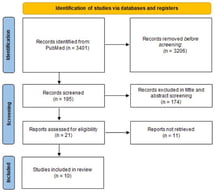
Flowchart.

The skin serves as a primary defensive barrier to protect the body from environmental contaminants, infections and trauma. Unfortunately, skin barrier’s structural and functional integrity can be compromised, disrupted or impaired due to a combination of internal and external factors, making it vulnerable and often leading to a wide range of skin conditions characterized by dryness, heightened sensitivity, and increased susceptibility to damage and infections. In addition, the integrity of the skin barrier tends to deteriorate progressively with age. As people age, their skin naturally changes and can also be compromised by a plethora of factors that reduce its strength and resilience. The aging skin becomes thinner and more sensitive, coinciding with a variety of structural–functional alterations, decreased levels of natural moisturizing factor (NMF), lipid content and hydration, increased transepidermal water loss (TEWL), altered skin surface pH (pHss) and microbiome diversity. All these age-related skin integrity alterations make the skin drier, flakier, itchy, and fragile, and more susceptible to damage and breakdown, thus diminishing its ability to effectively protect, repair and heal efficiently. Identifying skin integrity issues before they progress will foster positive outcomes through effective preventive measures. Hence, it is important to understand the impact of skincare formulations on skin integrity in compromised aging skin. A well-considered, evidence-based approach to skincare can provide cleansing, moisturizing and protective benefits, while aiding the reduction in skin integrity issues like dry and itchy skin, sensitive skin, bruising, skin tears, pressure injuries (PIs), lower leg ulcers and moisture-associated skin damage (MASD). Managing skin integrity in compromised aging skin begins with gentle skin cleansing, adequate moisturization and protective barrier care to ensure the skin’s function is maximized.

1 May 2026

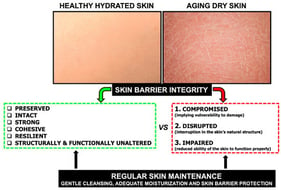
Skin barrier integrity serves as a fundamental indicator of the skin’s barrier function, structural coherence, and overall physiological health. Regular skin maintenance encompassing gentle cleansing, adequate moisturization, and skin barrier protection is essential not only for maintaining the homeostasis of healthy skin (green) but also for restoring and enhancing the function and resilience of compromised aging skin (red). Images of human skin—healthy, hydrated human skin (left), and aging dry human skin (right)—were obtained from the Shutterstock Image Library under a Standard License.

Hidradenitis suppurativa (HS) is a chronic inflammatory dermatosis characterized by recurrent nodules, abscesses, and sinus tract formation in intertriginous skin. Although HS is increasingly recognized as an autoinflammatory condition rather than a classical infection, antimicrobial therapies remain central to disease management, implicating a potential role for the cutaneous microbiome in disease activity. Recent advances in culture-independent sequencing techniques have enabled more detailed characterization of microbial communities in HS, revealing consistent alterations in microbial composition and diversity. Compared with healthy skin, HS lesions exhibit reduced microbial diversity, depletion of commensal organisms such as Cutibacterium acnes, and enrichment of anaerobic bacteria including Prevotella, Porphyromonas, and Finegoldia. These alterations are more pronounced in chronic, tunnel-forming disease and are frequently associated with biofilm formation, which may contribute to treatment resistance and persistent inflammation. Microbiome changes have also been observed beyond overtly lesional skin, suggesting a broader field effect. Evidence regarding extracutaneous microbial compartments, particularly the gut microbiome, remains limited and heterogeneous, while methodological variability in sampling, sequencing, and treatment exposure continues to complicate cross-study comparisons. Emerging data further suggest that immune-targeted therapies, including biologic and small-molecule agents, may indirectly influence microbial community structure through modulation of the inflammatory milieu. Collectively, the available evidence supports cutaneous dysbiosis as a characteristic feature of HS that may potentially interact bidirectionally with immune dysfunction. Future longitudinal, multi-omic studies integrated with clinical phenotyping will be critical to clarify causal relationships and to determine whether microbiome modulation can be leveraged to improve therapeutic outcomes in HS.

1 May 2026

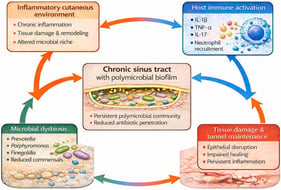
Proposed model illustrating a self-perpetuating cycle between microbial dysbiosis, chronic inflammation, and host immune activation in hidradenitis suppurativa. Microbial enrichment and immune signaling are depicted as interacting processes rather than primary initiating events.

News & Conferences

Volumes

Latest Issues

Open for Submission

Editor's Choice

XFacebookLinkedIn
Dermato - ISSN 2673-6179