Skip to Content

Current Issues in Molecular Biology

Current Issues in Molecular Biology is an international, scientific, peer-reviewed, open access journal on molecular biology, published monthly online by MDPI (from Volume 43, Issue 1 - 2021).

Get Alerted

Add your email address to receive forthcoming issues of this journal.

All Articles (4,105)

Perfluorooctanoic acid (PFOA) is an environmentally persistent chemical that enters the gastrointestinal tract (GIT) via the food chain, posing a harmful, long-term threat to human health. In response to this challenge, research on the PFOA-GIT interaction is thriving. Currently, studies on the effect of PFOA on the epithelial cells of the GIT and those on its influence on the microbial community are often implemented separately, and less attention has been paid to the combinational effects of the chemical, the gut microbiome and metabolome. In the present study, we co-cultured fecal samples from healthy adults aged 25–70 in the ex vivo SIFR® simulator, adding PFOA at 10 mg/L to represent the accumulated effects of long-term exposure. The results obtained from bacterial cell counting by flow cytometry and shotgun metagenomic sequencing revealed that PFOA was broadly disruptive to the microbiome and that Pseudomonadota emerged as the dominant phylum by replacing Bacteriodota and Bacillota, including key members of short-chain fatty acid-producing groups. Bacterial culture media with and without PFOA were collected and used in human colonoid cell culture for TEER and transcription measurement. It was shown that the PFOA-impacted microbial culture had stronger effects on the cell’s protective functions, in terms of tissue junction tightening, mucin biosynthesis, and immune response, than either untreated bacterial culture or PFOA alone. The results point out the possibility that the combination of PFOA and PFOA-impacted bacterial metabolites more strongly induces a change in epithelial cells’ protective function than either one alone.

22 May 2026
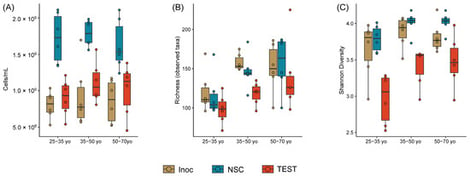
Microbial community growth and diversity is inhibited by PFOA addition. (A) Cell counts from flow cytometry. (B) Richness as measured by the number of species identified. (C) The Shannon Diversity Index. Boxplots show the median and IQR with points overlaid to represent six individual donors per age group.

The GRAS transcription factor family plays a pivotal role in plant stress adaptation, yet its systematic characterization and the underlying drought-responsive mechanisms remain poorly elucidated in Populus deltoides. Here, a genome-wide identification and analysis of GRAS genes in P. deltoides was performed, and a total of 92 family members were identified and classified into 12 distinct subfamilies through phylogenetic analysis. Evolutionary analysis revealed a high degree of conservation between the GRAS proteins of P. deltoides and those of Arabidopsis thaliana, Oryza sativa, and Solanum lycopersicum. Genomic duplication events, including 90 segmental and 11 tandem duplications, were identified as the primary drivers of GRAS family expansion. Promoter cis-element analysis uncovered an enrichment of stress-responsive elements (MBS, ABRE) and phytohormone-related motifs (e.g., TATC-box). Transcriptomic profiling further revealed distinct drought-inducible expression patterns of GRAS genes: PdeGRAS49 exhibited rapid upregulation at the early stage of drought exposure (1–3 h), whereas DELLA subfamily members PdeGRAS51 and PdeGRAS59 reached their expression peaks at 6–9 h, and PdeGRAS34 and PdeGRAS77 maintained sustained activation throughout 12–24 h. Moreover, the drought-inducible expression patterns of five DELLA genes were confirmed by qRT-PCR validation. Collectively, this study provides crucial genomic insights into the GRAS family and valuable candidate gene resources, which lay a foundation for molecular breeding of drought-tolerant P. deltoides cultivars via manipulating GRAS-mediated regulatory mechanisms.

22 May 2026

Necroptosis has been implicated in the pathogenesis of Stevens–Johnson syndrome and toxic epidermal necrolysis (SJS/TEN), with prior studies demonstrating tissue-level involvement of receptor-interacting protein kinases RIPK1 and RIPK3. However, their systemic expression in the circulatory compartment remains incompletely characterized. The objective of this study is to evaluate circulating levels of RIPK1 and RIPK3 in patients with SJS/TEN and explore their potential association with diseases. Serum samples from patients with SJS/TEN and control groups were analyzed for RIPK1 and RIPK3 levels using ELISA. Group differences were assessed using non-parametric statistical methods. Circulating levels of RIPK1 and RIPK3 were elevated in patients with SJS/TEN compared with controls. These findings were consistent across analyses; however, variability within groups and overlap between cohorts were observed. These results suggest an association between increased circulating RIPK1 and RIPK3 levels and SJS/TEN. Given the limited sample size, heterogeneous control populations, and lack of functional or phosphorylation-specific assays, these findings should be considered exploratory. Further studies incorporating larger cohorts and mechanistic validation are needed to clarify the role of necroptosis-related pathways in the systemic manifestations of SJS/TEN.

21 May 2026

Inflammation is increasingly recognized as a dynamic and interconnected regulatory network rather than a linear signaling cascade, in which immune signaling, oxidative stress, metabolic adaptation, and tissue-specific microenvironmental factors collectively shape inflammatory responses [...]

21 May 2026

News & Conferences

Volumes

Latest Issues

Open for Submission

Editor's Choice

XFacebookLinkedIn
Curr. Issues Mol. Biol. - ISSN 1467-3045