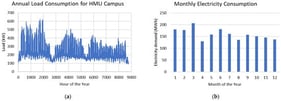
Smart microgrids are localized energy systems that integrate distributed energy resources, such as photovoltaics (PVs) and battery storage, to optimize energy use, enhance reliability, and minimize environmental impacts. This paper investigates the operation of a smart microgrid installed at the Hellenic Mediterranean University (HMU) campus in Heraklion, Crete, Greece. The system, consisting of PVs and battery storage, operates under a zero feed-in scheme, which maximizes on-site self-consumption while preventing electricity exports to the main grid. With increasing PV penetration and growing grid congestion, this scheme is an increasingly relevant strategy for microgrid operations, including university campuses. A properly sized PV–battery microgrid operating under zero feed-in operation can remain financially viable over its lifetime, while additionally it can achieve significant environmental benefits. The study performed at the HMU Campus utilizes measured hourly data of load demand, solar irradiance, and ambient temperature, while PV and battery components were modeled based on real technical specifications. The study evaluates the system using financial and environmental performance metrics, specifically net present value (NPV) and annual greenhouse gas (GHG) emission reductions, complemented by sensitivity analyses for battery technology (lead–carbon and lithium-ion), load demand levels, varying electricity prices, and projected reductions in lithium-ion battery costs over the coming years. The findings indicate that the microgrid can substantially reduce grid electricity consumption, achieving annual GHG emission reductions exceeding 600 tons of CO
2. From a financial perspective, the optimal configuration consisting of a 760 kWp PV array paired with a 1250 kWh lead–carbon battery system provides a system autonomy of 46% and achieves an NPV of EUR 1.41 million over a 25-year horizon. Higher load demands and electricity prices increase the NPV of the optimal system, whereas lower load demands enhance the system’s autonomy. The anticipated reduction in lithium-ion battery costs over the next 5–10 years is expected to provide improved financial results compared to the base-case scenario. These results highlight the techno-economic viability of zero feed-in microgrids and provide valuable insights for the planning and deployment of similar systems in regions with increasing renewable penetration and grid constraints.