Tackling Organized Crime and Human Trafficking
Share This Topical Collection
Editor
 Prof. Dr. James O. Finckenauer
Prof. Dr. James O. Finckenauer
E-Mail
Website
Guest Editor
School of Criminal Justice, Rutgers University, Newark, NJ 07102, USA
Interests: criminology; juvenile delinquency/justice; organized crime; human trafficking; comparative crime and justice; law enforcement; violence
Topical Collection Information
Dear Colleagues,
“The business of trafficking in people represents the juxtaposition between human desires and needs, and market demands, entrepreneurial spirit, and unscrupulousness, which has fueled a variety of organized crime” (Finckenauer, 2007). This leads to the question of whether human trafficking is a form of organized crime, or an example of a crime that is organized? Considering this question and the associated possibilities, in this Special Issue we wish to examine the current knowledge and understanding of this topic. To that end, we invite authors to consider numerous possible concerns, and pose other questions that they believe will shed further light on the overall issue.
Possible questions include (but are not limited to):
- What is the current state of our knowledge and understanding of the involvement of organized crime in human trafficking? What are the sources of this information? How reliable and valid are those sources?
- Is there any evidence of involvement in human trafficking by any of the traditional and best-known criminal organizations, e.g., Italian/Sicilian Mafia, La Cosa Nostra, Russian mafiya, Japanese Yakuza, Chinese triads, Central American maras, etc.?
- Who are the traffickers? How are they recruited and by whom? What is their relationship, if any, with the persons being trafficked? How are they organized? Is the organizational arrangement different for domestic vs. transnational trafficking?
- What is the relationship, if any, between persons engaged in human smuggling and those engaged in human trafficking? Are they organized differently? If so, how?
- How does the potential of organized crime involvement impact the nature of the investigation and prosecution of human trafficking cases?
- Is there any evidence that organized crime involvement in human trafficking has been intentionally hyped so as to bring more attention and greater, but perhaps undue, importance to the issue?
To address these questions, we welcome both original and empirical research, as well as works that compile and synthesize existing research literature with emphasis on the most current research.
Prof. Dr. James O. Finckenauer
Guest Editor
Manuscript Submission Information
Manuscripts should be submitted online at www.mdpi.com by registering and logging in to this website. Once you are registered, click here to go to the submission form. All submissions that pass pre-check are peer-reviewed. Accepted papers will be published continuously in the journal (as soon as accepted) and will be listed together on the collection website. Research articles, review articles as well as short communications are invited. For planned papers, a title and short abstract (about 250 words) can be sent to the Editorial Office for assessment.
Submitted manuscripts should not have been published previously, nor be under consideration for publication elsewhere (except conference proceedings papers). All manuscripts are thoroughly refereed through a double-anonymized peer-review process. A guide for authors and other relevant information for submission of manuscripts is available on the Instructions for Authors page. Social Sciences is an international peer-reviewed open access monthly journal published by MDPI.
Please visit the Instructions for Authors page before submitting a manuscript.
The Article Processing Charge (APC) for publication in this open access journal is 1800 CHF (Swiss Francs).
Submitted papers should be well formatted and use good English. Authors may use MDPI's
English editing service prior to publication or during author revisions.
Keywords
- organized crime
- human trafficking
- criminal organizations
- criminal gangs
- trafficking in persons
- sex trafficking
- labor trafficking
- mafia
- transnational organized crime
Published Papers (6 papers)
Open AccessArticle
The Convergence of Trafficking and Migrant Smuggling in West Africa: Migration Pressure Factors and Criminal Actors
by
Concepción Anguita-Olmedo
Cited by 2 | Viewed by 6501
Abstract
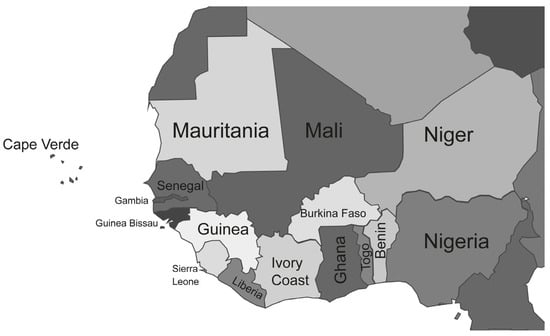
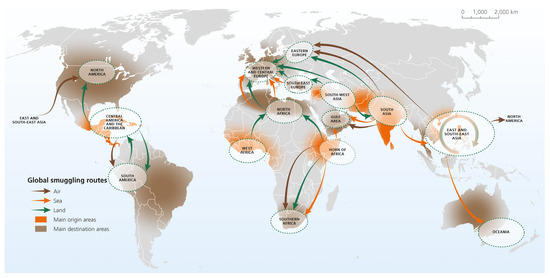
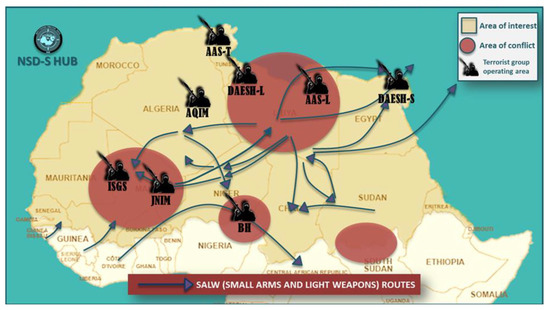
In West Africa, there is a very close link between the phenomenon of trafficking and migrant smuggling. This article will analyze the pressure elements and the causes that drive sub-Saharan people to migrate, placing themselves in the hands of criminal networks that end
[...] Read more.
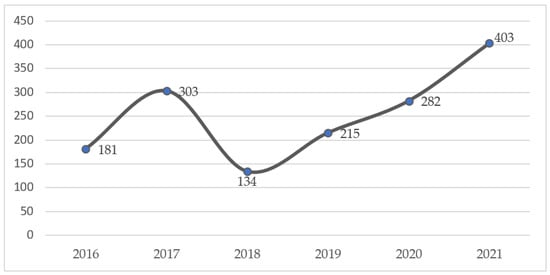
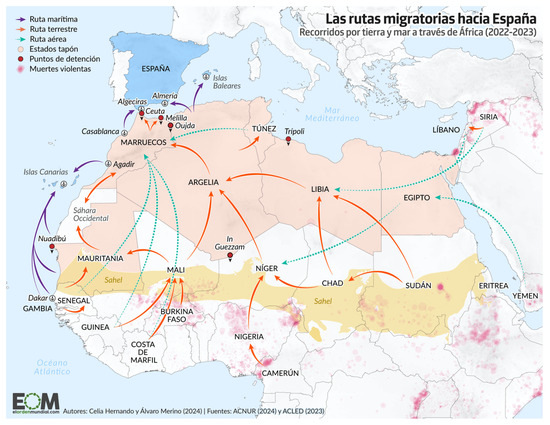
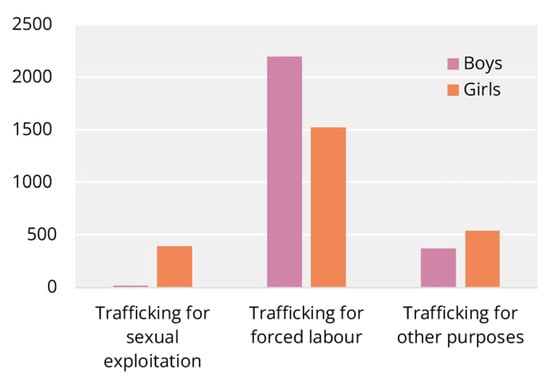
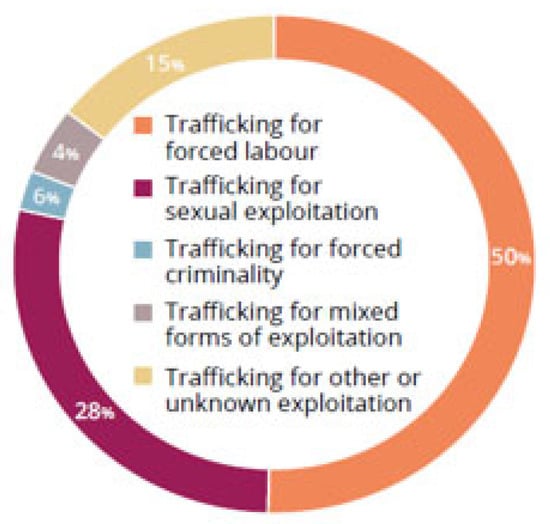
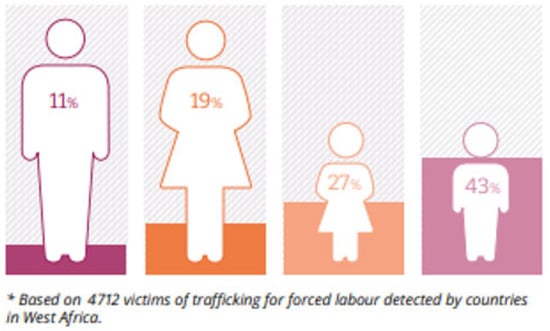
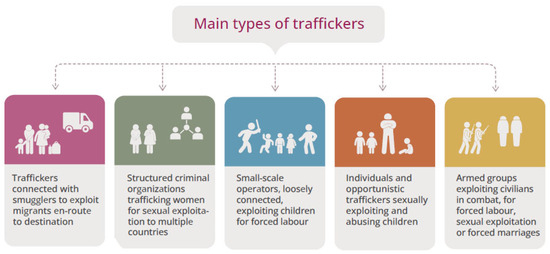
In West Africa, there is a very close link between the phenomenon of trafficking and migrant smuggling. This article will analyze the pressure elements and the causes that drive sub-Saharan people to migrate, placing themselves in the hands of criminal networks that end up exploiting them—women and minors sexually, and men through forced labor. The main corridors departing from West Africa and the characteristics of the criminal groups exercising criminal governance will also be addressed. This research has used both primary and secondary sources, as well as empirical fieldwork consisting of interviews with security force officials, international humanitarian aid organizations, and academic experts on migration issues related to trafficking and smuggling. Our research reveals that the origin of migration is multifactorial. The violence experienced in West Africa, but also the misgovernance, the lack of opportunities for a very young population with limited prospects, and the human insecurity affecting the entire region, are the main reasons that compel people to migrate. In these migration processes, the safety of migrants is compromised as they are forced to start their journey through clandestine means, which exposes them to trafficking networks and thus to violence and exploitation. It is along the migration routes where trafficking and migrant smuggling converge.
Full article
►▼
Show Figures
Open AccessArticle
Female Offenders in Human Trafficking: Analyzing Roles in a Spanish Sample
by
Andrea Giménez-Salinas
Cited by 6 | Viewed by 4943
Abstract
Offenders convicted of trafficking human beings for sexual exploitation involve a high percentage of women compared to other similar offenses. Previous studies have searched for explanations for the dynamics of the illegal sex market and the coercion experienced by victims during the process
[...] Read more.
Offenders convicted of trafficking human beings for sexual exploitation involve a high percentage of women compared to other similar offenses. Previous studies have searched for explanations for the dynamics of the illegal sex market and the coercion experienced by victims during the process of exploitation and exit. This article analyses the content of 58 judicial decisions involving a sample of 148 women convicted in Spain of trafficking in human beings between 2017 and 2024. Two main dimensions are explored: the criminal organizations performing the sexual exploitation phase in Spain and the characteristics, positions, and roles of women traffickers within the criminal organizations. Half of the sample occupies leadership roles, while the other half consists of supporters, especially in larger trafficking networks. Regarding the positions and roles of women offenders, supporters and partners in crime are at higher risk of being coerced due to the nature of their roles or partnerships.
Full article
Open AccessArticle
How Human Trafficking Fuels Erosion of Liberal Democracies—In Fiction and Fact, and from within and without
by
Jill E.B. Coster van Voorhout
Cited by 3 | Viewed by 17461
Abstract
On the same day that the human trafficker Ms. Ghislaine Maxwell was sentenced to 20 years’ imprisonment, many people closely watched the sixth hearing of the House Select Committee on the attack of the United States Capitol on 6 January 2021 (28 June
[...] Read more.
On the same day that the human trafficker Ms. Ghislaine Maxwell was sentenced to 20 years’ imprisonment, many people closely watched the sixth hearing of the House Select Committee on the attack of the United States Capitol on 6 January 2021 (28 June 2022). What, if anything, do these ostensibly varied crimes have in common? Seeking to answer this fundamental question, this article explores the usually under-researched connection between trafficking in persons and the documented decline of liberal democracies worldwide. Globally, democratic societies governed by the rule of law appear to be under assault, and therefore this article explores relevant examples of how human trafficking contributes to the erosion of liberal democracy, in fiction and fact, and from within and without. In other words, this article takes us from ‘Pizzagate’ to profits.
Full article
Open AccessArticle
How Hoteliers Act in the Form of Organized Crime in Human Trafficking: A Case Study from Turkey
by
Mahmut Cengiz and Oguzhan Omer Demir
Cited by 4 | Viewed by 8409
Abstract
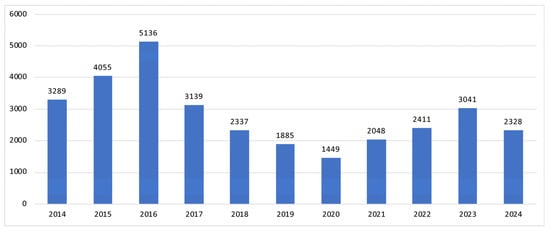
Because of supply and demand factors, human trafficking for sexual exploitation has always been a profitable industry. Turkey, as a host country for immigrants from both former Soviet countries and the Middle East, combines supply and demand together, attracting illicit business. Few studies
[...] Read more.
Because of supply and demand factors, human trafficking for sexual exploitation has always been a profitable industry. Turkey, as a host country for immigrants from both former Soviet countries and the Middle East, combines supply and demand together, attracting illicit business. Few studies have been conducted in the previous two decades to investigate the organized criminal element of human trafficking in this region. This research is based on ethnographic research in which trafficking victims (N = 11) were interviewed, and on-site observations were made. Our findings revealed that the trafficking industry in our study area was carried out by persons who were only loosely related to one another. There was no sophisticated, long-lasting sex trafficking organization. Membership was not severely limited, and individuals did not identify themselves as members of a well-known criminal organization. We provided policy recommendations and proposals for future research to address female trafficking for sexual exploitation.
Full article
►▼
Show Figures
Open AccessBrief Report
Policing Sex Trafficking in the ‘Virtual Red-Light District’: A Research Note
by
Xavier L’Hoiry, Alessandro Moretti and Georgios A. Antonopoulos
Cited by 1 | Viewed by 4105
Abstract
Working alongside a police force in the United Kingdom, the study briefly presented in this note, sought to create an analytical tool (the Sexual Trafficking Identification Matrix—STIM) with which policing actors could distinguish between Adult Services Website (ASW) profiles posted by independent sex
[...] Read more.
Working alongside a police force in the United Kingdom, the study briefly presented in this note, sought to create an analytical tool (the Sexual Trafficking Identification Matrix—STIM) with which policing actors could distinguish between Adult Services Website (ASW) profiles posted by independent sex workers and profiles created by traffickers. Distinguishing between these will potentially allow law enforcement agencies to prioritise their investigatory efforts more efficiently.
Full article
Open AccessArticle
August Vollmer, Traffic in Women, and the Theory of Organized Crime
by
Paul Knepper
Cited by 1 | Viewed by 6306
Abstract
During the 1920s, the League of Nations carried out the first intercontinental investigation into the traffic in women. Although this work is virtually unknown in criminology, the investigators, William Snow and Bascom Johnson, formulated the conceptual language of “trafficking” used today. It was
[...] Read more.
During the 1920s, the League of Nations carried out the first intercontinental investigation into the traffic in women. Although this work is virtually unknown in criminology, the investigators, William Snow and Bascom Johnson, formulated the conceptual language of “trafficking” used today. It was also during the 1920s that Frederick Thrasher and John Landesco published their pioneering works on “organized crime” drawing on research in Chicago. The advantages of the League’s model can be seen in the response to a 1924 report of a white slave traffic ring in Los Angeles by August Vollmer, the celebrated founder of professionalism in American policing. Vollmer’s language of a white slave traffic ring in Los Angeles recalls a nineteenth-century understanding of traffic in women but previews the illegal enterprise model that emerges from the industrial city. Drawing on their understanding of crime in port cities, Snow and Johnson situate the traffic in women within a social networks model. Vollmer looked for the spider, Snow and Johnson looked at the web.
Full article