
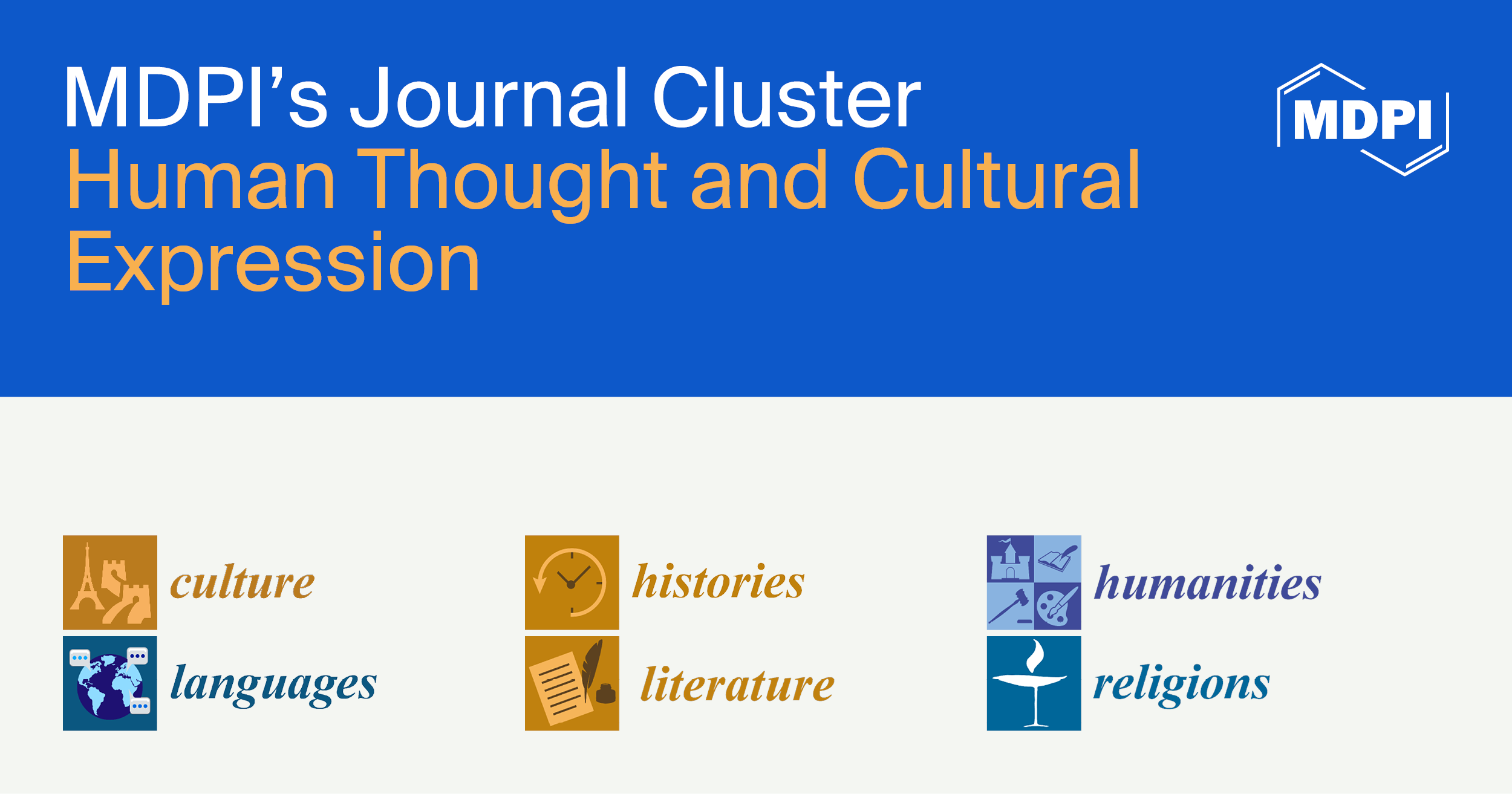
MDPI’s Journal Cluster of Human Thought and Cultural Expression
The exploration and understanding of human thought and cultural expression are vital to preserving the rich diversity of perspectives, beliefs, and creative traditions that define societies worldwide. MDPI’s journal cluster on human thought and cultural expression brings together publications dedicated to specific dimensions of philosophy, humanities, and the arts, as well as interdisciplinary studies that examine culture and cognition on a broader scale. As globalization and technological progress continue to reshape how humans think, communicate, and create, the demand for insightful research in these fields grows ever more urgent. MDPI’s journals in this area will play an increasingly important role in advancing scholarly dialogue and ensuring that valuable insights are accessible to researchers, educators, and practitioners across the globe.
The participating journals are as follows:
- Culture (ISSN: 3042-8165) is a peer-reviewed academic journal dedicated to publishing original research on cultural practices, cultural theory, and cultural policy in a broad sense. The journal aims to foster cross-cultural understanding and critically examine the value of cultural diversity in the context of globalization. Culture is led by Editors-in-Chief Prof. Dr. Caiwu Fu (Wuhan University) and Prof. Dr. Longxi Zhang (Peking University);
- Histories (ISSN: 2409-9252) is an international, peer-reviewed, open access journal that explores the dynamics of change and continuity in human societies across various scales and through diverse approaches, as reflected in its six sections. The journal Histories promotes global scholarly debate on a wide array of human narratives that have evolved over the centuries and continue to transform today. Histories is led by Editor-in-Chief Prof. Dr. Matteo Valleriani (Max Planck Institute for the History of Science);
- Humanities (ISSN: 2076-0787) is a peer-reviewed, scholarly, open access journal focused on the meaning of cultural expression and perceptions of human existence as seen through different interpretative lenses. The journal’s core focus surrounds the question of human cultures and their narratives as expressed in writing, speech acts, art, architecture, music, dance, and other ways of exploring human experience that involve telling a human story. Humanities is led by Editor-in-Chief Prof. Dr. Albrecht Classen (University of Arizona);
- Languages (ISSN: 2226-471X) is an international, open access scholarly journal whose central concern is the promotion of understanding of the world’s languages in all its diversity. Languages aims to present discussions and developments of multidisciplinary research and thereby generating broad and practical applications for the study of languages in the current world. Languages is led by Editors-in-Chief Prof. Dr. Anthony Pak-Hin Kong (University of Hong Kong) and Prof. Dr. Jeanine Treffers-Daller (University of Reading);
- Literature (ISSN: 2410-9789) provides an advanced forum for studies related to the literature of all times and places. The aim of Literature is to encourage researchers to publish their innovative ideas and results in as much detail as possible. Literature is led by Editor-in-Chief Prof. Dr. Jerome F. Bump (University of Texas at Austin);
- Religions (ISSN: 2077-1444) is an international, open access scholarly journal, publishing peer reviewed studies of religious thought and practice. It is available online to promote critical, hermeneutical, historical, and constructive conversations. Religions aims to serve the interests of a wide range of thoughtful readers and academic scholars of religion, as well as theologians, philosophers, social scientists, anthropologists, psychologists, neuroscientists and others interested in the multidisciplinary study of religions. Religions is led by Editors-in-Chief Prof. Dr. Klaus Baumann (Albert-Ludwigs-Universität Freiburg) and Prof. Dr. Arndt Büssing (Witten/Herdecke University).
|
Journal |
Launch year |
Impact Factor (2024) |
CiteScore (2024) |
First Decision (median) |
Acceptance to Publication (median) |
APC |
|
|
2025 |
/ |
/ |
19 |
4 |
1000 |
|
|
2021 |
0.2 |
/ |
40.3 |
6.9 |
1000 |
|
|
2012 |
0.3 |
0.5 |
33.7 |
4.5 |
1400 |
|
|
2016 |
1.2 |
1.8 |
56.6 |
10.7 |
1400 |
|
|
2021 |
/ |
/ |
36.1 |
3.6 |
1000 |
|
|
2010 |
0.6 |
1.3 |
25.4 |
4.5 |
1800 |


MDPI’s mission and values:
As a pioneer of academic open access publishing, MDPI has been serving the scientific community since 1996. Our aim is to foster scientific exchange in all forms, across all disciplines. MDPI’s guidelines for disseminating open science are based on the following values and guiding principles:
- Open Access—All of our content is published as open access and distributed under a Creative Commons License, providing free access to science and the latest research, allowing articles to be freely shared and content to be re-used with proper attribution;
- Timeliness and Efficiency—Publishing the latest research through thorough editorial work, ensuring a first decision is provided to authors in under 32 days and papers are published within 7–10 days upon acceptance;
- Simplicity—Offering user-friendly tools and services in one place to enhance the efficiency of our editorial process;
- High-Quality Service—Supporting scholars and their work by providing a range of options such as journal publication at mdpi.com, early publication at preprints.org, and conferences on sciforum.net to make a positive impact on research;
- Flexibility—Adapting and developing new tools and services to meet the changing needs of the research community, driven by feedback from authors, editors, and readers;
- Rooted in Sustainability—Ensuring the long-term preservation of published papers and supporting the future of science through partnerships, sponsorships, and awards.
By adhering to these values and principles, MDPI remains committed to advancing scientific knowledge and promoting open-science practices.
Selected Special Issues:
“The Thinker as Artist and the Artist as Thinker—Literature and the History of Political Philosophy”
Guest Editor: Dr. Dustin Gish
Deadline for manuscript submissions: 30 April 2026
“Transforming Religion in the Anthropocene”
Guest Editors: Prof. Dr. Patrick Becker and Claudia Gialousis
Deadline for manuscript submissions: 30 May 2026;
“The Impact of Cognates on Comprehension and Memory”
Guest Editor: Dr. Ana I. Schwartz
Deadline for manuscript submissions: 15 August 2026;
“How Has the Outer World Engaged Chinese Literature and Culture?”
Guest Editor: Prof. Dr. Robert Kibler
Deadline for manuscript submissions: 1 September 2026
“Interactions Across Borders in Historical Contexts: Interdisciplinary Approaches”
Guest Editors: Prof. Dr. Pablo Sánchez Léon, Dr. Mariana Boscariol and Dr. André Murteira
Deadline for manuscript submissions: 1 December 2026
Selected Articles:
Culture
“What Is the Aesthetic Value of Industrial Heritage? A Study Grounded in the Chinese Context”
by Sunny Han Han
Culture 2025, 1(1), 2; https://doi.org/10.3390/culture1010002
Histories
“Dynamics of Racial Mixing in New Orleans and St. Augustine (Florida) in the Second Half of the Eighteenth Century: An Analysis from Critical Intersectionality”
by Cosme Jesús Gómez Carrasco
Histories 2025, 5(3), 43; https://doi.org/10.3390/histories5030043
Humanities
“Human, All Too Human: Do We Lose Free Spirit in the Digital Age?”
by Aleksandra Sushchenko and Olena Yatsenko
Humanities 2025, 14(1), 6; https://doi.org/10.3390/h14010006
Languages
“Predictions of Individual Differences in the Acquisition of Native and Non-Native Languages: An Update of BLC Theory”
by Jan Hulstijn
Languages 2024, 9(5), 173; https://doi.org/10.3390/languages9050173
Literature
“As in Forests, So in Verse: Clearings and the Poetics of Lack in Finnish Forest Poetry”
by Karoliina Lummaa
Literature 2023, 3(4), 385-401; https://doi.org/10.3390/literature3040026
Religions
“Poured Out on Your Sons and Daughters: Pneumatologically Shaped Pedagogical Practices for Engaging Children in Congregational Worship”
by Angela Perigo and Jeremy Perigo
Religions 2025, 16(2), 243; https://doi.org/10.3390/rel16020243