
- Article

20 Pages
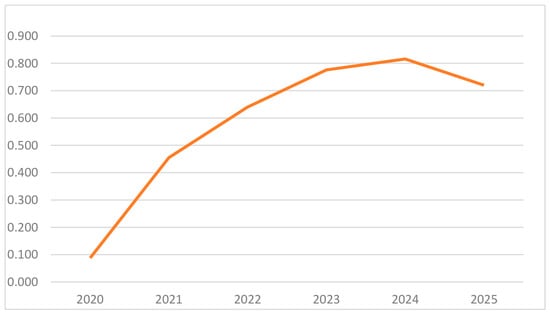
This study develops and evaluates a normative policy-weighted, constrained resource-allocation framework, implemented through a composite indicator (C) and a linear allocation rule, to foster open research competence among Ukrainian university staff and align academic publishing with European standards. Using SCImago/Scopus data on open-access (OA) publications by Ukrainian institutions, the number of Ukrainian journals indexed in Scopus, and an author-constructed ordinal index of Open Science training intensity (Tr) for 2020–2025, linear programming was applied to guide resource allocation, and a retrospective reference case decomposition of observed C values was used to interpret changes in the indicator. OA share among Scopus-indexed Ukrainian-affiliated outputs rose from 50.25% (2020) to 63.64% (2025), while Scopus-indexed Ukrainian journals fell from 202 (2022) to 168 (2025). An integral open-research competence indicator increased from 0.088 (2020) to 0.816 (2024) before declining to 0.720 (2025). Under pre-specified policy weights and constraints, the allocation rule yields a corner-solution allocation of 45% to OA support, 35% to Open Science training, and 20% to journal infrastructure. The framework is a transparent decision-support tool for prioritising limited resources; it does not claim causal inference between capacity-building factors and Open Science outcomes.
Publications
12 October 2026