Systematic Review

A Systematic Review of Arts Practice-Based Research Abstracts from Small and/or Specialist Institutions


by
Samantha Broadhead
1,*,
Henry Gonnet
1 and
Marianna Tsionki
2
1
Research Department, Leeds Arts University, Blenheim Walk, Leeds LS2 8AQ, UK
2
Curation and Library Services, Leeds Arts University, Blenheim Walk, Leeds LS2 8AQ, UK
*
Author to whom correspondence should be addressed.
Publications 2026, 14(1), 13; https://doi.org/10.3390/publications14010013
Submission received: 16 December 2025 / Revised: 2 February 2026 / Accepted: 4 February 2026 / Published: 12 February 2026

Abstract

Through this qualitative systematic review, the authors ask the following: To what extent is the 300-word abstract fit for purpose in representing art and design practice-based research outputs on small and/or specialist institutional repositories? The abstract is an important part of the metadata when an Arts Practice-Based Output (APBO) is deposited on a repository. APBOs are non-traditional item types resulting from creative/artistic research processes. Examples include exhibitions, artefacts and digital videos. Little is known about how effectively these abstracts communicate research processes and insights across the art and design sector. This study aims to investigate how well the abstract communicates information about the arts practice-based research through a systematic review of APBOs. The eligibility criteria for inclusion in the review were as follows: APBOs must be from the date range January 2019 to January 2024, be an item type where the 300-word abstract is required, the abstract must be part of the publicly available metadata for the item, and outputs must be practice-based and from the art and design field. The date range (2019–2024) was employed because, during this time, APBOs had gained recognition in the wider research environment. APBOs from the reviewers’ institutional repository were not included in this study to avoid bias that could skew the results of the review. The data repositories from small and/or specialist Higher Education Institutions in the United Kingdom were searched for outputs which appeared to meet the eligibility criteria. These types of institution prioritise and produce more of these output types. A quality tool appropriate for creative/artistic research was applied to the identified dataset of APBOs. The resulting 27 APBOs’ 300-word abstracts were analysed using a thematic approach. Findings suggest that the 300-word abstracts contained information about the quality indicators such as whether the project got funding, the identities of prestigious collaborators and/or dissemination vehicles, and the international recognition of the research. Other identified themes were methodologies, contribution to knowledge, subject matter and item type.

1. Introduction

The aim of this study is to improve the policy and practice related to the archiving of Arts Practice-Based Research Outputs (APBOs) on institutional repositories in the United Kingdom (UK). Improved portrayal of APBOs on repositories would enhance the presentation of the research and show the researchers’ work off to the best advantage. It would make the work more accessible to academics and those outside academia, widening the audience for practice-based research. By increasing the visibility of arts practice-based research, it is hoped that the insights derived from this work will inform new work and be cited as the starting point for new investigations. In particular, the lines of inquiry focus on the effectiveness of the corresponding 300-word abstract in representing the creative output. The research question that guided the study was “To what extent is the 300-word abstract fit for purpose in representing arts practice-based outputs on small and/or specialist institutional repositories?”.
For the purposes of this article, the term 300-word abstract is used to denote the associated statements required for APBOs as part of the repository metadata. In other words, the abstracts would be deemed fit for purpose if they contributed towards their Findability, Accessibility, Interoperability and Reuse in other research (GO FAIR, 2016) and represented the underpinning research in a useful manner. This study considered the quality of the publicly available 300-word abstracts and not that of the outputs themselves and their underpinning research.
APBOs are derived from innovative and creative research methods often employed by researchers from the art and design field. As this is different from mainstream social research, the approach requires some further explanation. The research insights gained from this method come from the creative practices such as artmaking, designing, curating or filmmaking. The arts offer ”ways of knowing” derived from sensory perception leading to aesthetic, emotional and intellectual responses to the world. These different ways of knowing can potentially enhance a researcher’s comprehension of complex human and non-human interactions.
The research that produces APBOs is practice-focussed and driven by the making process. New knowledge is gleaned from the researcher’s reflection on the process and the outcomes of the practice. The outcomes of practice are not those traditionally associated with other disciplines, such as text-based articles and book chapters, but could be exhibitions, digital videos or creative projects (all examples of APBOs) (Candy, 2006; Rolling, 2014; Candy et al., 2021). Dallow (2003) noted that the practice-based approach, “allows the research work of the creative practitioner to ask questions not only…about work…but through work” (p. 59). This is achieved through considered introspection that can be shared with other researchers (S. Brown & Patterson, 2021; Dallow, 2003; Xue & Desmet, 2019). Frayling et al. (1997) argued that as part of the dissemination of the research, practice-based researchers are, “obliged also to map for his or her peers the route by which they arrived at their product/s” (p. 13). In other words, arts practice-based researchers whose research outcomes are APBOs need to explain their processes and insights, and this can be done through the associated 300-word abstract. These characteristics of arts practice-based research have direct implications for how such work is represented, discovered, and assessed within institutional research infrastructures.
Institutional repositories have become essential mechanisms for open access, yet their capacity to meaningfully represent practice-based arts research remains uneven and constrained by longstanding research assessment requirements. As APBOs proliferate, and as new initiatives seek to strengthen the documentation and visibility of practice-based research, the 300-word abstract remains the dominant means through which arts research is rendered legible within repositories. This is because the abstracts provide a textual element to APBOs, which are often non-textual items. Having a text-based element in the publicly accessible metadata of an APBO deposit contributes towards its discoverability and reuse in other research (GO FAIR, 2016). Higher-quality abstracts provide those accessing APBOs on a repository a clearer understanding of the research process and the new knowledge which was generated through the research. They also communicate the specificities of the research which are not evident from the non-textual item on its own (REF, 2019, p. 58). Despite their centrality, little is known about how effectively these abstracts communicate research processes and insights across the sector. This gap in knowledge provides the rationale for the present study, which undertakes a qualitative systematic review of APBO abstracts to examine how they are currently functioning as research summaries within small and/or specialist institutional repositories. Small and/or specialist institutions in the UK generally have fewer than 3000 students, and many have specialist provision in a particular subject area such as the visual arts, music, or teacher training (Bols, 2023). This specialist provision is reflected in the types of research outputs deposited in their institutional repositories, with a high proportion of art and design programmes generating practice-based research outputs (APBOs) whose abstracts foreground creative processes, modes of dissemination, and disciplinary contexts specific to these fields.
Given that the focus of this study is on repository representations of practice-based research, a systematic review was identified as an appropriate method for examining patterns across institutions and outputs. This approach was chosen because it is a method whereby the reviewers could systematically search, critically appraise, and synthesise the repository data (Temple University Libraries, n.d.). The process is also accountable and replicable and can be updateable to ensure reports reflect current research (EPPI, 2025). The design of this study was informed by the PRISMA 2020 statement: an updated guideline for reporting systematic reviews (Page et al., 2021). However, due to the novel nature of this study being about creative outputs, some modifications were made which involved adapting the Critical Appraisal Skills Programme (CASP) for checking the quality of APBOs.
The objectives of this project were to collect, map, and analyse 300-word abstracts for APBO deposits hosted on institutional repositories of similar size and discipline area to the reviewers’ affiliated institution. The intention was to locate, present, and discuss emergent themes from the data collected. This was done to gain an insight into the new knowledge that is being generated in the sector through practice-based arts research and how this is communicated in the 300-word abstract.
Data were collected from 20 research output repositories that archived APBOs specifically from institutions that are of similar size and scope to the HEI where the reviewers instigating this investigation are employed. The eligibility criteria for inclusion in the review were as follows:
  • Outputs must be from 1 January 2019 to 1 January 2024;
  • Be an item type where the 300-word abstract is required;
  • The 300-word abstract must be part of the publicly available metadata for the item;
  • Outputs are practice-based and from the art and design field.
Outputs from the reviewers’ institutional repository were not included in the study to avoid bias that could skew the results of the systematic review. The resulting 27 APBOs, focusing on their 300-word abstracts, were analysed using a thematic approach. Overall findings suggest that some 300-word abstracts focus on quality indicators such as whether the project got funding, the identities of prestigious collaborators and/or dissemination vehicles, and the international recognition of the creative research. There was an observation that the exhibition was a dominant item type in the final dataset. This could possibly skew the findings, as the identified practices of writing abstracts may be part of a wider culture of exhibiting creative works. Recommendations were made to improve the policy and practice of archiving APBOs on institutional repositories, which included the development of protocols for writing 300-word abstracts to gain consistency across institutions and training of repository managers to develop and implement such protocols.

2. Context of APBO Policy and Practice in the UK

A research repository is a publicly accessible online platform for collecting, managing, preserving and sharing research outputs and other scholarly materials (Nneka & Kaosisochukwu, 2021). Repositories generally tend to either be institutional (where the content hosted is research from a specific institution) or subject-specific (hosting research from a specific discipline area or in a particular format). There also tends to be separations between repositories for the disseminated outputs of research such as articles or exhibitions, repositories for data generated during research which underpins and validates findings, and repositories that host preprints or early versions of scholarly work (UKRI, 2016, p. 3). At of the time of writing, the Joint Information Systems Committee’s (Jisc) directory for voluntary repository indexing (OpenDOAR) hosts over 6000 registered research repositories from around the world, and the repository aggregator CORE has indexed 379,000,000 research outputs (Jisc, n.d.; CORE, n.d.).
During the previous two decades, repositories have played a crucial role in enabling open access to the outputs of research undertaken at UK research organisations and HEIs, providing free access to an ever-increasing quantity of current research to all “scientists, scholars, teachers, students, and other curious minds” (Marsh, 2015; Budapest Open Access Initiative, 2002). Repositories are instrumental facilitators of production, preservation and access to new knowledge, as they provide researchers worldwide with platforms where they can store and retrieve current research that can serve as a foundation for further inquiry (Vasantha et al., 2024; Rothfritz et al., 2025). In the preface to Martin Paul Eve’s Open Access and the Humanities, Suber (2014, p. ix) articulates that whilst free access to research undertaken in the sciences helps accelerate the development of new medicines and useful technologies, in the arts and humanities it enriches “education, politics, compassion, imagination and understanding”. It is therefore important that research from all discipline areas is represented on repositories in meaningful ways to maximise their benefit to society. These dynamics of visibility and accessibility intersect directly with the UK’s research assessment, which significantly shapes expectations around how practice-based outputs are deposited and described in institutional repositories.
In the UK, funding for research is distributed via a dual-funding system, with two main routes: Strategic Institutional Research Funding (SIRF) funding to Higher Education Institutions (HEIs) arising from the Research Excellence Framework (REF), and project-specific grants from the UK Research Councils and other funders (UKRI, 2023). The REF is a process through which research undertaken at UK HEIs is assessed approximately every seven years. Through REF, the UK government weights the allocation of annual SIRF against each individual HEI’s results, allocating £2 billion per year of public funding (REF, 2025b). Areas assessed at the last REF in 2021 included Outputs (60%), Impact (25%), and Environment (15%). REF 2021 was split into four assessment Main Panels (A, B, C, and D), who oversaw Units of Assessment (UoAs) corresponding to discipline areas within the panel member’s expertise. Each assessment Main Panel had different set criteria and working methods reflecting the discipline areas it assesses. In 2021, the UoA for Art and Design: History Practice and Theory (UoA 32) fell under the purview of REF Main Panel D. For the next REF in 2029, outputs will be submitted under the same output item types as in REF 2021 and will be assessed within the same UoAs and Main Panels.
Panel D’s working methods and criteria provide a framework for submissions to the UoAs it covers, including a description of output item types which can be submitted to these UoAs (REF, 2019, pp. 93–97). The item types covered include both traditional research outputs (including articles, books and book sections) and non-traditional output types (including artefacts, compositions and digital media). Non-traditional research outputs submitted to UoA 32 are often derived, though not exclusively, from arts-based or practice-based processes of investigation generating new knowledge through creative outcomes such as exhibitions, artworks, software, performances or music. For many years research assessment exercises have required that, unlike traditional text-based research outputs, APBOs must be accompanied by a 300-word supporting statement/abstract detailing the research process, the insights and new knowledge created, and how the research was disseminated (RAE, 2006; REF, 2012, 2019). This provides a framework for the author to explain their process of investigation, how it led to new insights, and how these insights were effectively shared—mirroring Research England’s definition of research (REF, 2025a).
The statements required by research assessment for APBOs are often included in the publicly available metadata of the deposited output, providing a concise summary that offers context and the research process and insights. In effect, the statements fulfil the same role as an abstract, which for research outputs such as journal articles, as well as books and book sections published by academic publishers, are typically an embedded component of publication (University of Oxford, n.d.). Traditionally, the purpose of an abstract is to provide a succinct summary of the research it represents, with information on why the study was carried out, the process, and the findings (Reid, 2020). However, they also play an important role in enabling interoperability and sorting and/or indexing content for archiving, as a poorly written abstract can lead to poor findability leading to search obscurity (Alspach, 2017). For an APBO the 300-word abstract forms an important part of a deposit, because the research undertaken is typically not explicit in the output itself, which is often non-textual. As 300 words is a relatively low word count for such an integral part of the research record, many arts researchers have begun advocating for inclusion of portfolios containing extended research narratives on APBO deposits. However, due to a lack of structured guidance or oversight, these have proven highly problematic because of their “scale, length, size and format”, making them impractical for their “intended audiences to usefully explore”, as well as presenting a risk regarding research integrity owing to a lack of review for their contents (Bulley & Şahin, 2021, p. 41). Additionally, an extended research narrative from a portfolio does not enable interoperability to the extent a 300-word abstract does.
In spite of these challenges, the 300-word abstract remains a crucial component of the metadata record for creative research outputs. This is because they play an instrumental role in enabling individuals to search for, identify and evaluate relevant APBOs hosted on repositories, supporting both discoverability and the assessment of research significance for subsequent scholarly use. As APBOs become more common, there has been an increasing sector-wide effort to recognise and develop clearer mechanisms for supporting arts-based and practice-based research. These efforts include research projects such as Sustaining Practice Assets for Research, Knowledge, Learning and Engagement (SPARKLE), which aims to create a “national infrastructure for the storage, discovery, access, analysis and preservation of practice-based research assets”, and Materialising Open Research Practices in the Humanities and Social Sciences (MORPHSS), which looks to “devise ways to encourage and embed innovative open research processes within humanities and social sciences” (Jackson et al., 2023; Moore et al., 2025). There has also been an increase in the number of groups and conferences promoting arts-based research and research management, including arts Special Interest Groups at the Association for Research Managers and Administrators (ARMA) and the UK Reproducibility Network (UKRN), as well as the annual Capturing Creativity seminar series and the Society for Artistic Research (ARMA, n.d.; UKRN, 2025; Drake, 2025).

3. Materials and Methods

3.1. Rationale for Employing a Qualitative Systematic Review

A qualitative systematic review is useful for synthesising text-based outputs on a substantive research topic and for examining research methods themselves (Noyes et al., 2008). However, this method has tended not to be applied to creative outputs. De Jager et al. (2017) have carried out a systematic review to consider digital storytelling as a research method, but few studies have applied this method to creative research more broadly. Also, Daykin et al. (2021) undertook a qualitative systematic review into the role of social capital in participatory arts for wellbeing; however, this study looked at text-based outputs rather than APBOs. Our aim was to comprehensively review the effectiveness of 300-word abstracts in representing practice-based research outputs on institutional repositories. A qualitative systematic review was therefore well-suited to the aims of the study. The project design was informed by the PRISMA 2020 statement: an updated guideline for reporting systematic reviews (Page et al., 2021). The PRISMA 2020 checklist shows how this review has followed the guidance as far as possible. As this was a qualitative study, some of the quantitative checklist items do not fully align, although where possible qualitative equivalents have been reported (see Supplementary Materials).

3.2. Ethical Considerations

As part of the ethical review process, it was argued that outputs from the reviewers’ own institutional repository could present a conflict of interest—particularly if the work was authored or co-authored by someone working on the project. To mitigate this, outputs authored or co-authored by any reviewers working on this project were not included in the analysis. In addition, outputs from the repository belonging to the reviewers’ affiliated university were not included.
It was unlikely that the output data collected would contain any unlawful or harmful material as it came from institutional repositories; therefore, the projects should have been through an ethical approval process before the research was initiated. However, the reviewers acknowledged that politics shift and change, and it was possible that such materials could be present in open repositories. The data gathered went through two quality checks before being included in the dataset, including filtering any unlawful or harmful material present in the repository records. Examples would include breaches of the UK Equality Act 2010. No instances of unlawful or harmful material were found in the data collected. The reviewers also recognised that within a relatively small and collaborative sector they may have prior professional relationships with authors whose work appeared in the dataset. These relationships could include supervisory roles, co-authorships, participation in joint projects, or involvement in this particular research output or other research projects in any other capacity. To manage any potential conflict of interest, reviewers recused themselves from assessing any outputs with which they felt they have been too closely connected in a current or former role. In such cases the item was assessed solely by the remaining reviewers.

3.3. Who Was Carrying out the Review?

The group of three reviewers comprised a researcher with expertise in leading inclusive research cultures in art and design discipline areas, a researcher in art theory and curatorial theory and practice, and a repository manager with expertise in open research and arts meta-research.

3.4. Eligibility Criteria

Outputs must have been disseminated between 1 January 2019–1 January 2024 (over 5 years) and must be an item type where the 300-word abstract from REF 2021 is required. This abstract must be in the publicly available metadata for the item. Outputs were to be practice-based and from the art and design field. As previously mentioned, outputs from the reviewers’ institutional repository were not included in the study to avoid bias that could skew the results of the systematic review. Data collection was carried out between 26 June and 15 August 2024 by one of the reviewers.

3.5. Search Strategy

Data was collected from 20 research repositories containing practice-based art and design research outputs in the UK. The data was collected by searching each repository manually by APBO item type. The item types searched included the following: artefact, show/exhibition, composition, performance, image, digital video, audio, and creative project. Data meeting the above parameters was collected and arranged in a dataset with the following fields: code for the institution; date; item type; title; abstract; licence and item URL. From this initial search, outputs were identified (n = 352). The dataset was created using Microsoft Excel Version 2404 (Build 17531.20128).
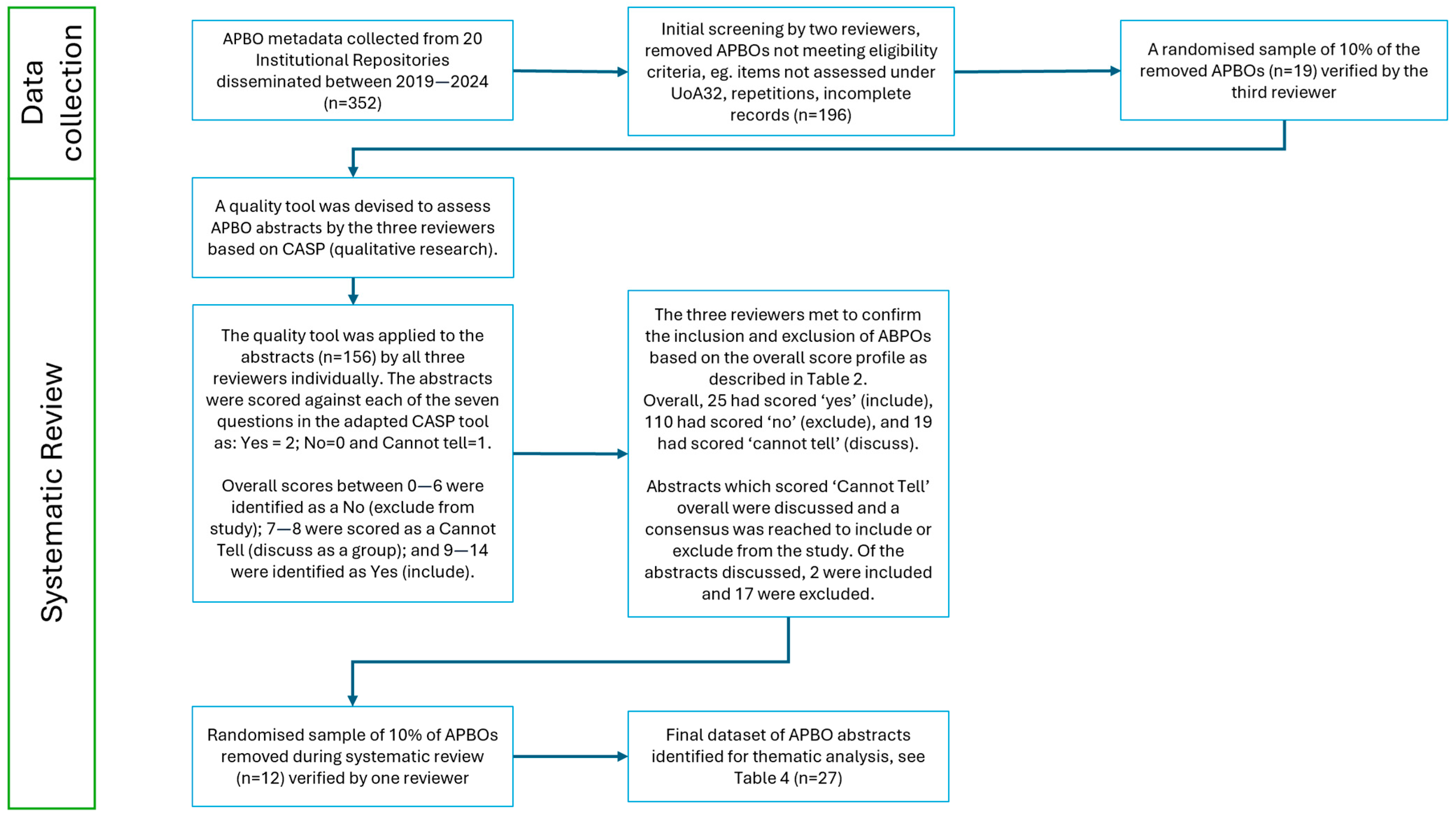
Two of the reviewers (the third reviewer carried out the quality check described in Section 3.6) screened the resulting dataset looking for and removing outputs which did not meet the eligibility criteria, had incomplete metadata records, or had ethical concerns (see Section 3.2). At this stage, duplicates were also removed. In total, 2.8% of outputs collected were duplicated items (n = 10). This led to a new dataset of n = 156.

3.6. Quality Assurance

Of the outputs that were removed, a randomised sample of 10% (n = 19) was checked by the third reviewer to verify the decision to remove. All three reviewers then met to discuss the outcome, where agreement was reached over the third reviewer’s assessment that it was correct to remove the 19 from the sample; therefore, the dataset remained at n = 156.

3.7. Quality Assessment (CASP Check List Modified)

A tool was created to assess the quality of the remaining database of outputs drawing on the CASP. Each reviewer independently proposed a series of questions in a shared document to guide the assessment and ensure the outputs met an appropriate standard of quality. These questions were informed by the structure of the CASP checklist for qualitative studies (CASP, 2018) but modified to reflect the specific characteristics of practice-based art and design research. This modification involved removing questions that addressed general qualitative methods that were based on participant contributions because these were not relevant to practice-based arts research. The term “valid” was replaced with the terms authentic/trustworthy/meaningful because these are attributes associated with practice-based arts research (Leavy, 2015; Sinner et al., 2019; Bassey, 1999). The three reviewers met to reach a consensus on the final checklist, agreeing on seven questions (see Appendix A) and to support consistency and transparency in the application of the checklist; the reviewers agreed on shared interpretive guidance for each question:
The first question from the modified CASP tool was “Are there clear lines of inquiry or research questions?”. An important quality of research is that it is driven by clear research questions and/or lines of inquiry. Clear lines of inquiry or research questions were identified where the abstract explicitly stated, or clearly implied, a guiding research question, problem, or investigative focus. If the research question(s) were clearly explained, then the APBO would be scored 2 (yes). If the research questions were unclear and difficult to identify, the score would be 1 (cannot tell). If there were no research questions mentioned in the abstract, then the APBO would be scored a 0 (no).
Question 2 from the modified CASP tool was “Have the research method/s been clearly explained?”. This refers to whether the abstract described how creative practice functioned as a method of inquiry. A good understanding of the methods employed in the research means that readers know how the work can be repeated if necessary. They can also support the evaluation of how meaningful the insights are in relation to the method. If the research method was clearly explained to the reviewers, then the APBO would be scored 2. If the method was not written in a transparent way and is difficult to understand, then the APBO would be scored a 1. If the abstract only described the topic and not the method, then the APBO would be scored a 0.
The third question was “Have the research insights been clearly articulated?”. Whether or not a contribution to knowledge has been made indicates the quality of research underpinning an output. Research insights that are clearly articulated required explicit statements of what was learned, revealed, or generated through the research process/method. If the research insights were clear to the reviewers, then the APBO would be scored 2. If the insights were confused and not expressed well, then the APBO would be scored a 1. If the abstract only described the process and made no attempt at explaining the insights, then the APBO would be scored a 0.
“Are the insights authentic/trustworthy/meaningful?” was the fourth question from the modified CASP tool. Authenticity and trustworthiness indicate that any stated insights were grounded in the described practice and context rather than asserted without support. If the insights were reasonable and the reader could see how they had been derived from the method and the context in which the research was undertaken, then the score would be 2. If the links between the insights and the method were not made explicit, then the score 1 was given. If the insights were not present or were not derived from the method that was described, then the score given would be 0.
Question 5 was “Does the research raise any ethical concerns?”. Ethical consideration is part of the rigour of an output. Ethical considerations were noted where relevant, particularly in relation to collaboration, representation, or engagement with participants or communities. To ascertain whether or not ethical research had been undertaken, the abstract and related materials were read. A score of 2 was given if there had been an explicit mention made about ethics in the record. If the discussion about ethics was not present, then a score of 1 was given. A score of 0 was attributed to the APBO if there were clear breaches in ethical practice apparent in the work and these had not been addressed.
Question 6 asks “Are there associated materials that are accessible and support the abstract, or is there just a metadata record?”. In order to judge the quality of the APBO there needed to be accessible materials (images, films, additional texts, websites) available through links in the repository record. Associated materials were considered accessible where links were functional and provided meaningful contextual support. If there were accessible materials that could be viewed by the reviewers, then a score of 2 was given. If the links did not work or additional passwords were required to view the materials, then a score of 1 was ascribed to the output. Where there were no additional materials and the APBO was only recorded as a meta-data field, then the APBO was scored a 0.
The seventh and final question asks “How well does the output’s method and/or insights transfer to other artistic or scientific practices, pedagogical contexts, and an informed readership?”. This question ascertains whether the research design and or the contribution of knowledge could be the starting point or basis for other work done in similar or different disciplines and therefore has value. Transferability referred to whether the abstract indicated potential relevance beyond the specific case under review. The decision to score the APBO as 2 was based on statements that described the potential influence of the work. If the APBO was unclear, a score of 1 was given, and if there was no mention of how the work could be applied in future research, a score of 0 was given.

3.8. Decision to Include or Exclude from Study

The adapted CASP tool was devised to include or exclude outputs from the study based on the reviewers’ total scores for each APBO. A calculation was undertaken which if resulted in a Yes, the output was included, if No, it was excluded, and if the result was in dispute, then it was discussed at a meeting between all three reviewers.
Each output was scored for each question Yes = 2, No = 0 and Cannot tell = 1. Variations in the three reviewers’ individual scorings in the table below (Table 1) are indicative of their varied areas of expertise. This is to be seen as a strength of this study, as it included input from different professional perspectives within an arts research culture.
The reviewers independently scored each output and recorded the results on a spread sheet. Overall, scores between 0 and 6 were identified as a No; 7–8 were scored as a Cannot Tell; and 9–14 were a Yes.
The spreadsheet formula was based on the total found in column P and row x where x is the output row number:
=IF(Px > 8, “Yes”, IF(Px = 7, “Cannot tell”, IF(Px = 8, “Cannot tell”, “No”)))
When all the scores were collected from each reviewer, if there were two or three Nos for each output, then the output would be omitted from the study. Two or three Yeses would be included.
The reviewers met to reach a decision on the outputs that had conflicting scores. The following outputs were discussed as a team if they had the score patten of the following:
  • One No and two Cannot tells;
  • One Yes and two Cannot tells;
  • Three Cannot tells;
  • One Yes, one No and one Cannot tell.
Each output marked “to discuss” was reviewed again by the team (See Table 2). At the meeting, each reviewer explained their individual scores and the reasons for them. The abstracts were re-read, discussed within the group and, following consensus the outcome, were amended to Yes or No depending on the final evaluation of the output.
After a consensus was agreed between the three reviewers, a further quality check was performed by one reviewer, who reviewed 10% of the outputs which had not met the requirements of the quality tool. When this process had been completed, the final number of identified outputs were n = 27 (see Table 3).
There was little discussion regarding the outputs that were ultimately included as there was agreement between the three reviewers. Only one output initially marked for “discussion” was subsequently judged suitable for inclusion; all other items for discussions ended with a decision of “No” to not include. In these cases, the abstract did not provide sufficient clarity to fulfil its function of representing the research output to the reader.
The diagram below (Figure 1) represents the different stages of the systematic review undertaken. The exclusion criteria for the Data Collection stage can be found at Section 3.5 of this article. The exclusion criteria for the Systematic Review stage can be found above in Section 3.7 and Section 3.8.
Reflections on the process included that by undertaking this systematic review; the reviewers found many repetitions and incomplete metadata records, broken links or links provided in place of the required descriptive metadata. There were also links to websites or films which could not be viewed. Some outputs initially appeared to be practice-based outputs in art and design, but upon closer inspection turned out to be outputs undertaken in other fields as a tool for public engagement rather than art and design research. There were some examples where the deposited item consisted solely of marketing material—such as promotional text for an exhibition or a screening—without any method or insights. Some of the repositories did not appear to have any established protocols for inclusion on the repository. These difficulties are far less common in text-based outputs such as articles or book chapters, which follow well-established protocols developed over many years. There were also instances where abstracts were not included in the publicly available metadata on the repository but were included in accompanied PDF files associated with the output. There were some items which were not included due to perceived ethical issues where co-authors had not been cited correctly on the repository record. Some outputs had no item associated with the record (PDF, images, videos, links); therefore, it was difficult to assess quality due to lack of context and content.

4. Results and Analysis

Table 4 represents the 27 outputs arising from the systematic review process. The abstracts of these APBOs were analysed by the three reviewers using a thematic approach.
Thematic analysis was considered the most appropriate method for inquiry so patterns could be identified in the ways the abstracts were written. The types of information that were considered important to include in the abstract could be identified. The reviewers closely read the abstracts to become familiar with the material. A coding system for identifying themes present was established by drawing upon Robinson’s (2022) Conducting thematic analysis on brief texts: The structured tabular approach. Each reviewer then identified codes in the abstracts through systematic close reading and identification of notable common features (Braun & Clarke, 2006).
The reviewers then came together in-person, and each wrote their codes on sticky notes. These sticky notes were then clustered together and moved about on a board until the overall themes emerged.
The themes agreed between the three researchers were identified as follows:
  • Quality indicators statements, referring to funding, institutional partnerships, prestige of venues, awards, or forms of recognition used to signal research quality;
  • Methodologies, encompassing descriptions of how creative practice functioned as a method of inquiry, including processes, collaborations, and experimental approaches;
  • Contribution to knowledge within the arts and in other disciplines referring to how abstracts articulated new insights, understandings, or relevance beyond the immediate project;
  • Subject matter and item type, capturing both the thematic focus of the work and the form of the output (e.g., exhibition, performance, artefact).
These themes were then reapplied to the abstracts independently by the three reviewers to check their relevance. When this had been done, the reviewers met and confirmed these as the themes to be discussed in detail. These themes form the basis of the Section 4 and are discussed in relation to the existing literature in Section 5. The APBOs are represented in a table to show which themes are present in each abstract (Table 5).
The themes recorded in this table are discussed in the following section.

5. Discussion

This qualitative systematic review set out to examine to what extent the 300-words abstract is fit for purpose in representing APBOs on small and/or specialist institutional repositories. It is important to emphasise that the analysis has focused exclusively on the publicly available abstracts and associated metadata, not on the intrinsic quality of the creative outputs or the robustness of the underpinning research. The works themselves may well constitute rigorous and innovative contributions to knowledge; this research investigates whether their 300-word abstracts adequately communicate that contribution within the constraints and conventions of REF requirements impacting repository metadata.
The systematic review process underlines both the promise and the fragility of current practices. From an initial pool of 352 outputs identified across 20 research repositories, only 27 (approximately 7.7%) met the eligibility criteria and the quality thresholds established through the adapted CASP-based assessment. This sharp reduction was due not only to issues with the abstracts themselves but also to incomplete or inconsistent metadata records, broken links, missing associated materials, and cases where outputs were more accurately described as marketing or public engagement activities rather than practice-based research. There were also instances where the abstract was only available within an attached PDF, which decreases discoverability of the output (Alspach, 2017). These findings echo broader concerns in the literature about the unevenness of repository infrastructures and workflows (Marsh, 2015; Vasantha et al., 2024; Rothfritz et al., 2025) and suggest that, in the context of APBOs, the 300-word abstract is often not being used—or supported—as an effective vehicle for scholarly communication.

5.1. Theme: Quality Indicator Statements

Within the final set of 27 outputs, the thematic analysis revealed that many abstracts were oriented towards what we identified as quality indicator statements, foregrounding elements such as the following: funded status (Gough, 2019; Clark and Fedotov-Clements 2022; Ridout & Fell-Clark, 2022; Kolaiti, 2023), institutional partners (Waring, 2019; Gough, 2019; Marchbank, 2023; Kolaiti, 2023), high-profile venues (Marchbank, 2023; Huse, 2020; Hegarty, 2019), or forms of international recognition (Bowen, 2020; Shepherd, 2019; Wenham-Clarke, 2020; Gough, 2019; Clark, 2019b, 2020; Davies, 2020; Williams, 2023). Examples include explicit references to competitive fellowships and major research grants (Bowen, 2020), funding from universities and national bodies (Gough, 2019), commissions and exhibitions in major museums and cultural institutions (Clark, 2020; Davies, 2020; Williams, 2023), participation in international festivals and events and selection for high-profile, peer-reviewed exhibitions or awards shortlists (Huse, 2020; Wenham-Clarke, 2020; Marchbank, 2023; Davies, 2020; Hegarty, 2019). It is worth noting that exhibitions and festivals are not just quality indicators, they are also evidence of the research having been disseminated—which is part of the REF requirements for the 300-word abstracts. In the context of a research assessment culture where institutional funding and reputational capital are linked to REF outcomes (UKRI, 2023; REF, 2025b), this emphasis is understandable. For APBOs, which do not typically undergo conventional pre-publication peer review, such quality indicators operate as sector-recognised validators of research quality, signalling credibility, originality and significance within a format that must communicate multiple forms of value within the maximum of 300 words (REF, 2019). This should not be interpreted as weakness in the abstracts themselves. Rather, it reflects structural pressures on APBO authors who must balance demonstrating research quality, contextualising creative work and meeting institutional assessment requirements within a constrained textual form.
This structural pressure is compounded by a broader lack of consistency in how APBO abstracts are written and understood across institutions. The quality assessment process revealed that some outputs were excluded not because the associated creative work lacked rigour but because the accompanying abstract did not clearly articulate lines of inquiry, methodological approaches, or research insights. These findings do not necessarily suggest a deficit in research quality but a lack of shared sector-wide understanding of what a 300-word abstract for an APBO is expected to contain. Unlike text-based outputs where abstract conventions are long established and consistently an intrinsic part of publication, APBO authors typically develop an abstract after dissemination at the point of depositing an item into an institutional repository. APBO authors appear to receive uneven guidance across institutions, leading to considerable variation in how the format is interpreted and enacted.

5.2. Theme: Methodologies

A second key theme concerns how methodologies are presented. Many of the abstracts in the sample devote significant space to describing their process, often in ways that foreground experimentation, collaboration and situated practice (Shepherd, 2019; Clark, 2019a; Buckeridge, 2023; Ridout, 2022; Wilson & Snæbjörnsdóttir, 2019; Huse, 2020). Methodological accounts range from auto-ethnographic sculptural installations addressing female ageing (Richardson, 2019), to cross-disciplinary collaborations with environmental scientists (Hubmann, 2022), intertidal soundscapes (Jenkins, 2023) or air-quality citizen science (Natress & Bryant, 2023), or from durational performances structured by conversational protocols and live notation (Buckeridge, 2022) to socially engaged projects on infant mental health (Kolaiti, 2023), genetic conditions (Wenham-Clarke, 2020) or labour during the pandemic (Poyser, 2021). Several works explicitly reference theoretical frameworks or conceptual tools (for example, hydro-ecological thinking, speech-as-shaped-air, aspect, seeing) and link these to specific research environments such as residencies, workshops, field visits or laboratories (Ridout & Fell-Clark, 2022; Ridout, 2022; Shepherd, 2019; Hubmann, 2022). Such abstracts use the 300 words to make methodologies visible as a core component of practice-based research. At the same time, the level of specificity varies. In some cases, the reader gains a clear sense of research design, partners, sites and procedures; in others, methodological detail is present but more implicit, folded into curatorial narrative or conceptual description. The overall picture is therefore one in which methodological innovation is strongly in evidence but not always framed in ways that respond to conventional expectations about research questions, methods and outcomes.

5.3. Theme: Contribution to Knowledge

A related theme concerns how contributions to knowledge—both within the arts and in relation to other disciplines—are articulated. Across the sample there are numerous examples of work that speak directly to other fields. Within the arts, contributions are made to debates on drawing and plant life (Bowen, 2020), feminist accounts of menopause (Richardson, 2019), performance notation (Buckeridge, 2022), socially engaged practice (Poyser, 2021), transmission art (Waring, 2019), collage (Loydell, 2021) and ecological modes of exhibition-making (Ridout & Fell-Clark, 2022; Jenkins, 2023).
The majority of abstracts describe interdisciplinary contributions to knowledge between art and design and other disciplines such as sociology, ecology and biology. Contributions to knowledge that are solely to do with art and design as a distinct discipline are less frequent and are often woven in with insights into other discipline areas.
However, the way that these contributions are stated is uneven. Some abstracts clearly articulate how the project extends or reframes the existing literature or practices, while others gesture more generally towards themes such as environmental awareness, social justice, community engagement or memory, leaving the reader to infer the precise nature of the contribution to knowledge. Contributions that are intrinsic to the art and design discipline areas were rare (K. Brown, 2019), as contributions to knowledge mostly refer to other discipline areas. This may be due to the tendency towards interdisciplinary collaborations within the sample. This again should not be read as a judgement on the research itself; rather, it highlights the difficulty of condensing complex, often multi-year practice-based projects into a short, non-specialist text that is expected to function simultaneously as a REF statement, a repository abstract and a discoverability tool.

5.4. Theme: Subject Matter and Item Type

Subject matter emerged as the most straightforward theme to identify, with many abstracts effectively signalling their topical focus. For example, climate change and species extinction (Hubmann, 2022; Wilson & Snæbjörnsdóttir, 2019; Bowen, 2020; Jenkins, 2023), intertidal and marine environments (Jenkins, 2023), family and kinship (Shepherd, 2019; Wenham-Clarke, 2020; Clark, 2019b; Poyser, 2021; Kolaiti, 2023) labour and logistics (Poyser, 2021), archives and memory (Marchbank, 2023; Bennett, 2023; Buckeridge, 2022; Clark, 2019a; Davies, 2020), or urban public health (Natress & Bryant, 2023). From a search and indexing perspective, this is valuable; it allows users to locate work aligned with their interests and supports the broader open access aspiration of making research available to diverse publics.
A further issue emerging from the dataset concerns the ambiguity of the exhibition format itself. Within many repositories, exhibition is treated as a self-evident research output, yet the term simultaneously denotes at least two fundamentally different modes of practice: the exhibition as a vehicle for disseminating research (a platform through which findings, artworks, or processes are made public) and the exhibition as a form of research in its own right, particularly within curatorial practice where the conceptual, methodological and relational work of assembling an exhibition constitutes the core research contribution. These distinctions are rarely made explicit in metadata or abstracts. As a result, the category exhibition often collapses together artefacts, curatorial methodologies, and public engagement activities, obscuring the underlying research logics. This conflation makes it difficult to evaluate research quality, to articulate trajectories of enquiry, and to understand how practice-based research is actually being produced within institutional contexts.

6. Limitations of the Method

As with any method there are limitations. For example, different institutions have different understandings of what an APBO is, so consistency across the institutional repositories could not be established. After the quality check, a large majority of APBOs of the item type exhibitions were in the dataset which could skew the findings. In addition to this, as has already been argued, how an exhibition is defined may vary, not only between institutions but also between arts practice-based researchers. The CASP tool required the reviewers to identify ethical research; however, due to the protocols of APBOs, very often ethical processes were not made explicit.
Methodologically, the project demonstrates that qualitative systematic review techniques, as outlined in EPPI and PRISMA guidance, can be adapted to interrogate the textual paratexts of creative outputs. The creation and use of a quality assessment tool tailored to APBO metadata constitutes an important contribution in its own right, offering a transparent and replicable way of evaluating whether abstracts are functioning as meaningful research summaries. At the same time, the high exclusion rate and the frequency of “cannot tell” responses reveal a structural mismatch: quality appraisal frameworks developed for qualitative social science assume longer, method-rich texts, whereas APBO abstracts are extremely short, multifunctional summaries. The tool therefore exposes gaps in the abstracts but also highlights the limits of the 300-word abstract, a format that was never designed to contain this level of methodological detail. The tool foregrounds gaps and ambiguities, but it cannot fully capture the complexity of practice-based research, particularly when repository records are incomplete.
There was a diversity in style, length, and priorities included in the abstracts. Some abstracts went over the 300-word limit, and because they met the quality criteria they were included in the final dataset.
The scope was limited to a particular set of repositories and reflected the practices of a specific type of institution. Further research could look at repositories from different kinds of institutions not only in the UK but also in the international context.

7. Conclusions and Recommendations

Higher-quality abstracts are beneficial to the academics who have undertaken the research, those who are accessing the research on a repository, and society as a whole. This is because the research undertaken is represented in the best possible way for the researcher; it improves the Findability, Accessibility, Interoperability, and Reusability (FAIR) of the research and means that other researchers and members of the public can access current artistic research which is represented in a meaningful way.
These findings suggest that in their current form and usage, 300-word abstracts are only partially fit for purpose in representing art and design practice-based outputs on small and/or specialist institutional repositories. They remain indispensable, given the role in discoverability, research assessment and open access, but they are not consistently realising this potential. Addressing this will require action on multiple levels: clearer sector-wide guidance on what APBO abstracts should contain; guidance that distinguishes research processes and outputs from marketing tools or engagement activities; training and support for researchers and repository managers; and further work to align APBO abstract practices with emerging infrastructures which may arise from current research initiatives such as the Enact Practice Research Data Service: PR Voices and SPARKLE Phase 2 and MORPHSS. Most importantly, any such developments must respect the specificity of arts research while recognising that, without clear and accessible textual representation, the insights generated by practice risk remaining less visible in the very repositories designed to make them publicly available. At the same time, it is important to acknowledge that many of the contributions made by art and design research are not solely textual: they are visual, spatial, sonic, material and relational. The current REF guidance requiring a 300-word limit for the supporting statements for APBOs constrains the detail in which these complex multi-dimensional forms of knowledge can be articulated and contextualised for research assessment. Strengthening textual guidance is therefore necessary, but it must be accompanied by repository infrastructures that can support richer, multimodal forms of documentation—whether through integrated metadata, image sequences, audio extracts, process documentation or links to expanded paratexts. Without such developments, practice-based research will continue to be flattened into an overly narrow representational frame, obscuring precisely the kinds of insights that distinguish it. Following on from this qualitative systematic review, a range of recommendations have been identified:
  • Targeted continuous professional development (CPD) to support shared conventions and institutional alignment in the writing and review of APBO abstracts by arts researchers and repository managers. The findings demonstrate a need for PhD programmes to train arts researchers in writing APBO abstracts. They indicate a need for targeted continuous professional development (CPD) for both early career arts researchers without PhDs and repository managers who are responsible for writing, reviewing, and curating 300-word abstracts for APBOs. While arts researchers often possess highly developed skills in articulating their work through artistic, curatorial, and critical forms, the writing of 300-word APBO abstracts constitutes a specific research genre shaped by repository infrastructures, REF requirements, and open access mandates. Unlike text-based outputs, APBO abstracts are frequently written at the point of repository deposit and must fulfil multiple functions simultaneously. They must articulate a clear research topic or line of inquiry, explain how creative practice functioned as a research method, and communicate insights or contributions to knowledge that may not be immediately legible from the creative output itself. It is also important to recognise that arts research careers are frequently non-linear. Many academics enter higher education following extended professional practice as artists, designers, or curators and may not hold a PhD, or may undertake doctoral study later in their careers. Even where doctoral training has been completed, abstract writing for practice-based outputs—particularly in forms aligned with REF assessment and repository metadata—is rarely an explicit or consistently embedded component of arts PhD programmes. For these reasons, CPD represents an appropriate and inclusive intervention that complements, rather than replaces, early-career research training. CPD initiatives should therefore focus on developing shared, sector-wide understandings of what constitutes a high-quality APBO abstract, with particular emphasis on distinguishing research articulation from promotional or marketing language.
    Training could be delivered through workshops, special interest groups, written guidance, and peer-led sessions and supported by anonymised examples or vignettes of effective abstracts drawn from high-quality repository records. Such provision would benefit from being aligned with well-designed abstract templates that prompt authors to address core research elements consistently. CPD should also recognise the critical mediating role of repository managers, equipping them with the confidence and expertise to support researchers at the point of deposit and to apply consistent standards across records.
  • Development of protocols for archiving arts-based outputs on repositories and promoted by sector bodies. The review reveals a lack of consistent protocols governing how APBOs are archived and described across the institutional repositories the data used to inform this study was collected from. To address this, clearer protocols are required to guide both abstract writing and the structuring of repository records for APBOs. Based on the analysis presented in this study, effective protocols for APBO abstracts should specify core criteria, including the following:
    • Clear articulation of the research topic and line of inquiry;
    • Explanation of the practice research method;
    • Concise identification of insights or contributions to knowledge, including those emerging through process;
    • Contextual information regarding dissemination, without allowing indicators of prestige to dominate the account.
    In addition, protocols should address repository design considerations to ensure that infrastructures are capable of accommodating the multimodal and processual nature of APBOs. This includes guidance on the use of templates for consistent metadata entry, the presentation of multiple associated files (such as images, audio, video, or process documentation) in coherent sequences, and clearer differentiation between item types (for example, exhibitions as research outputs versus exhibitions as dissemination formats). Sector-level initiatives such as SPARKLE, PR Voices, MORPHSS, the Enact Practice Research Data Service and related projects provide important reference points for how such protocols might be developed and promoted collaboratively. Endorsement by sector bodies would support wider adoption and greater consistency across institutions.
  • Quality assurance checks on outputs in repositories are undertaken by repository staff on a regular basis. Quality assurance processes are well established within institutional repositories and routinely applied to text-based research outputs. However, the findings of this review indicate that such processes are not always consistently adapted to the specific characteristics of APBOs, which often involve multiple files, non-textual materials, and process-based documentation. The high rate of exclusion observed during the systematic review highlights the importance of routine quality assurance checks on APBO records. While the intrinsic quality of creative research cannot be assessed solely through metadata, minimum standards for repository records are essential to ensure research integrity, usability, and discoverability. The findings show that many APBO abstracts are lacking clearly explained information. To address this, the adapted CASP-based tool developed for this study can be used as the basis for quality assurance checks to verify that APBO abstracts
    • Contain an identifiable research topic and research question or inquiry;
    • Clearly articulate the methods;
    • Effectively explain insights or knowledge generated through the research;
    • (Where appropriate) correctly attribute collaborators;
    • Acknowledge ethical considerations where the ethics of the research may appear questionable from content on the record.
    Best practice would involve embedding these checks within clear repository workflows, including review at the point of deposit and periodic auditing of records. An annual repository review process, undertaken by trained repository staff, could help identify incomplete metadata, broken links, inconsistencies in abstract quality, and support ongoing improvement. Such processes, when combined with appropriate infrastructure and sustained training for both researchers and repository managers, would strengthen the efficacy of repositories as a means to share the outputs of arts practice-based research.

Supplementary Materials

The following supporting information can be downloaded at: https://www.mdpi.com/article/10.3390/publications14010013/s1. Table S1: PRISMA 2020 Checklist: A Systematic Review of Arts Practice-based Research Abstracts from Small and/or Specialist Institutions.

Author Contributions

Conceptualization, S.B.; methodology, S.B.; software, H.G.; validation, M.T.; formal analysis, M.T., S.B. and H.G.; investigation, S.B., M.T. and H.G.; data curation, H.G.; writing—original draft preparation, S.B., H.G. and M.T.; writing—review and editing, S.B., H.G. and M.T.; visualization, S.B. and H.G.; project administration, H.G. All authors have read and agreed to the published version of the manuscript.

Funding

This research received funding from Leeds Arts University.

Acknowledgments

The authors would like to thank Leeds Arts University for supporting this research. They would also like to thank Christopher Graham for proofreading this article.

Conflicts of Interest

The authors declare no conflicts of interest. The funders had no role in the design of the study; in the collection, analyses, or interpretation of data; in the writing of the manuscript; or in the decision to publish the results.

Abbreviations

The following abbreviations are used in this manuscript:
APBOArts Practice Based Research Output
ARMAAssociation of Research Managers and Administrators
CASPCritical Appraisal Skills Programme
CORECOnnecting REpositories
EPPIEvidence for Policy and Practice Information
FAIRFindable, Accessible, Interoperable, Reusable
HEIHigher Education Institution
JiscJoint information system committee
MORPHSSMaterialising Open Research Practices in the Humanities and Social Sciences
OpenDOAROpen Directory of Open Access Repositories
PDFPortable Document Format
PRISMAPreferred Reporting Items for Systematic Reviews and Meta-Analyses
RAEResearch Assessment Exercise
REFResearch Excellence Framework
SARSociety for Artistic Research
SIRFStrategic Institutional Research Funding
SPARKLESustaining Practice Assets for Research, Knowledge, Learning and Engagement
UKUnited Kingdom
UKRIUnited Kingdom Research and Innovation
UKRNUnited Kingdom Reproducibility Network
UoAUnit of Assessment
URLUniform Resource Locator

Appendix A

List of CASP questions adapted for Arts Practice-Based Outputs:
  • Are there clear lines of inquiry or research questions? Yes/no/cannot tell
  • Have the research method/s been clearly explained? Yes/no/cannot tell
  • Have the research insights been clearly articulated? Yes/no/cannot tell
  • Are the insights authentic/trustworthy/meaningful? Yes/no/cannot tell
  • Does the research raise any ethical concerns? Yes/no/cannot tell
  • Are there associated materials that are accessible and support the abstract, or is there just a metadata record? Yes/no/cannot tell
  • How well does the output’s method and/or insights transfer to other artistic or scientific practices, pedagogical contexts, and an informed readership? Yes/no/cannot tell

References

  1. Alspach, J. G. (2017). Writing for publication 101: Why the abstract is so important. Critical Care Nurse, 37(4), 12–15. [Google Scholar] [CrossRef] [PubMed][Green Version]
  2. Association of Research Managers and Administrators (ARMA). (n.d.). Arts & humanities special interest group. ARMA. Available online: https://arma.ac.uk/dashboard/network/special-interest-groups/arts-humanities-nonmembers// (accessed on 13 November 2025).
  3. Bassey, M. (1999). Case study research in educational settings. McGraw-Hill Education. [Google Scholar]
  4. Bennett, G. (2023). Almost reality: A virtual travel series (exhibited at the Haunted Landscapes conference 2023). Falmouth Repository. Available online: https://repository.falmouth.ac.uk/5192/ (accessed on 16 December 2025).
  5. Bols, A. (2023). Complaint handling in small and specialist institutions: Insights from GuildHE. HE Professional. Available online: https://heprofessional.co.uk/edition/complaint-handling-in-small-and-specialist-institutions-insights-from-guildhe (accessed on 16 December 2025).
  6. Bowen, S. (2020). After hortus malabaricus: Sensing and presencing rare plants. Arts University Bournemouth Research Excellence and Impact (AUBREI). Available online: https://research.aub.ac.uk/id/eprint/5/ (accessed on 16 December 2025).
  7. Braun, V., & Clarke, V. (2006). Using thematic analysis in psychology. Qualitative Research in Psychology, 3(2), 77–101. [Google Scholar] [CrossRef]
  8. Brown, K. (2019). And a body turns. Falmouth Repository. Available online: https://repository.falmouth.ac.uk/3554/ (accessed on 16 December 2025).
  9. Brown, S., & Patterson, A. (2021). Me-search? Search me! A new twist in the tale of introspection. Journal of Marketing Management, 37(13–14), 1343–1373. [Google Scholar] [CrossRef]
  10. Buckeridge, B. (2022). Bird talk, 2022. Falmouth Repository. Available online: https://repository.falmouth.ac.uk/5286/ (accessed on 16 December 2025).
  11. Buckeridge, B. (2023). Four in the floor | six in the air. Falmouth Repository. Available online: https://repository.falmouth.ac.uk/5284/ (accessed on 16 December 2025).
  12. Budapest Open Access Initiative. (2002). Read the declaration. Budapest open access initiative. Available online: https://www.budapestopenaccessinitiative.org/read/ (accessed on 3 February 2026).
  13. Bulley, J., & Şahin, O. (2021). Practice research-report 1: What is practice research? and report 2: How can practice research be shared? PRAG-UK. Available online: https://research.gold.ac.uk/id/eprint/30222/ (accessed on 8 January 2025).
  14. Candy, L. (2006). Practice based research: A guide (Creativity Cognition Studios Report 2006-V1.0). CCS. [Google Scholar]
  15. Candy, L., Edmonds, E., & Vear, C. (2021). Practice-based research. In C. Vear (Ed.), The Routledge international handbook of practice-based research (pp. 27–41). Routledge. [Google Scholar]
  16. Clark, T. (2019a). Mutable/multiple. Falmouth Repository. Available online: https://repository.falmouth.ac.uk/4017/ (accessed on 16 December 2025).
  17. Clark, T. (2019b). Who’s looking at the family, now? Falmouth Repository. Available online: https://repository.falmouth.ac.uk/4018/ (accessed on 16 December 2025).
  18. Clark, T. (2020). Masculinities: Liberation through photography. Falmouth Repository. Available online: https://repository.falmouth.ac.uk/4016/ (accessed on 16 December 2025).
  19. COnnecting REpositories (CORE). (n.d.). CORE: COnnecting REpositories. CORE. Available online: https://core.ac.uk/ (accessed on 27 November 2025).
  20. Critical Appraisal Skills Programme (CASP). (2018). CASP qualitative checklist. CASP. Available online: https://casp-uk.net/casp-checklists/CASP-checklist-qualitative-2024.pdf (accessed on 16 December 2025).
  21. Dallow, P. (2003). Representing creativeness: Practice-based approaches to research in creative arts. Art, Design & Communication in Higher Education, 2(1), 49–66. [Google Scholar] [CrossRef]
  22. Davies, L. (2020). Quinn. Falmouth Repository. Available online: https://repository.falmouth.ac.uk/3939/ (accessed on 16 December 2025).
  23. Daykin, N., Mansfield, L., Meads, C., Gray, K., Golding, A., Tomlinson, A., & Victor, C. (2021). The role of social capital in participatory arts for wellbeing: Findings from a qualitative systematic review. Arts & Health: An International Journal for Research, Policy and Practice, 13(2), 134–157. [Google Scholar] [CrossRef]
  24. De Jager, A., Fogarty, A., Tewson, A., Lenette, C., & Boydell, K. M. (2017). Digital storytelling in research: A systematic review. The Qualitative Report, 22(10), 2548–2582. [Google Scholar] [CrossRef]
  25. Drake, C. (2025). Capturing creativity 2025—Recordings of presentations and powerpoint slides from each seminar. BathSPAdata. [Google Scholar] [CrossRef]
  26. Evidence for Policy & Practice Information Centre (EPPI). (2025). What is a systematic review? University College London, Institute of Education. Available online: https://eppi.ioe.ac.uk/cms/Default.aspx?tabid=67 (accessed on 13 November 2025).
  27. Frayling, C., Stead, V., Archer, B., Cook, N., Powell, J., Scrivener, S., & Tovey, M. (1997). Practice-based doctorates in the creative and performing arts and design. UK Council for Graduate Education. [Google Scholar]
  28. GO Findable, Accessible, Interoperable, Reusable (GO FAIR). (2016). FAIR principles. GO FAIR Initiative. Available online: https://www.go-fair.org/fair-principles/ (accessed on 19 January 2026).
  29. Gough, P. (2019). Turbulence, conflict and the garden of remediation, Charles Green, Lyndell Brown, Paul Gough and Jon Cattapan. Arts University Bournemouth Research Excellence and Impact. Available online: https://research.aub.ac.uk/id/eprint/82/ (accessed on 16 December 2025).
  30. Hegarty, S. (2019). Tapping the air: Weak signals for six radios and nightfall. Southampton Solent University. Available online: https://pure.solent.ac.uk/en/publications/tapping-the-air-weak-signals-for-six-radios-and-nightfall/ (accessed on 16 December 2025).
  31. Hubmann, T. (2022). Seaweed futures. Falmouth Repository. Available online: https://repository.falmouth.ac.uk/5191/ (accessed on 16 December 2025).
  32. Huse, D. (2020). Remnants from the London Thames: Collecting and printmaking with Amy-Leigh Bird. Southampton Solent University. Available online: https://pure.solent.ac.uk/en/publications/remnants-from-the-london-thames-collecting-and-printmaking-with-a/ (accessed on 16 December 2025).
  33. Jackson, T., Knowles, C., McLaughlin, S., Kotarski, R., De Little, A., Warren, M., & Horne, A. (2023). Sustaining Practice Assets for Research, Knowledge, Learning and Engagement (SPARKLE): Final report and recommendations. White Rose Research Online. Available online: https://eprints.whiterose.ac.uk/id/eprint/203045/ (accessed on 16 December 2025).
  34. Jenkins, H. (2023). Intertidal perspectives-alternative mix. Research at York St John. Available online: https://ray.yorksj.ac.uk/id/eprint/9367/ (accessed on 16 December 2025).
  35. Jisc. (n.d.). OpenDOAR: Directory of open access repositories. OpenDOAR. Available online: https://opendoar.ac.uk/ (accessed on 27 November 2025).
  36. Kolaiti, C. (2023). The teddy bear cabinet: Please mind the gap. Research at York St John. Available online: https://ray.yorksj.ac.uk/id/eprint/9418/ (accessed on 16 December 2025).
  37. Leavy, P. (2015). Method meets art: Arts-based research practice (2nd ed.). Guilford Press. [Google Scholar]
  38. Loydell, R. (2021). I didn’t lick it. Falmouth Repository. Available online: https://repository.falmouth.ac.uk/4331/ (accessed on 16 December 2025).
  39. Marchbank, C. (2023). Witness/memory/recall. Falmouth Repository. Available online: https://repository.falmouth.ac.uk/5340/ (accessed on 16 December 2025).
  40. Marsh, R. M. (2015). The role of institutional repositories in developing the communication of scholarly research. OCLC Systems & Services: International Digital Library Perspectives, 31(4), 163–195. [Google Scholar] [CrossRef]
  41. Moore, S., Addams, J., Adema, J., Barnes, M., Bertolani, V., Kiesewetter, R., Pinfield, S., Roper, A., & Soni, S. (2025). MORPHSS: Project deliverables. Humanities Commons. Available online: https://morphss.hcommons.org/project-deliverables/ (accessed on 13 November 2025).
  42. Natress, C., & Bryant, D. (2023). York air map exhibition. Research at York St John. Available online: https://ray.yorksj.ac.uk/id/eprint/8670/ (accessed on 3 February 2026).
  43. Nneka, C. M., & Kaosisochukwu, C. (2021). Institutional repository for global knowledge sharing. Journal of ICT Development, Applications and Research, 3(1/2), 41–49. [Google Scholar] [CrossRef]
  44. Noyes, J., Popay, J., Pearson, A., Hannes, K., & Booth, A. (2008). Qualitative research and Cochrane reviews. In J. Higgins, & S. Greens (Eds.), Cochrane handbook for systematic review of interventions (pp. 571–591). Wiley. [Google Scholar] [CrossRef]
  45. Page, M. J., McKenzie, J. E., Bossuyt, P. M., Boutron, I., Hoffmann, T. C., Mulrow, C. D., Shamseer, L., Tetzlaff, J. M., & Moher, D. (2021). Updating guidance for reporting systematic reviews: Development of the PRISMA 2020 statement. Journal of Clinical Epidemiology, 134, 103–112. [Google Scholar] [CrossRef] [PubMed]
  46. Poyser, T. (2021). Masked: A portrait of Amazon. University of Cumbria. Available online: https://research.cumbria.ac.uk/en/publications/masked-a-portrait-of-amazon/ (accessed on 16 December 2025).
  47. Reid, T. (2020). Writing an abstract—A six point checklist (with samples). University of Bath. Available online: https://blogs.bath.ac.uk/academic-and-employability-skills/2020/07/07/writing-an-abstract-a-six-point-checklist-with-samples/ (accessed on 12 November 2025).
  48. Research Assessment Exercise (RAE). (2006). Panel criteria and working methods, panel F. RAE. Available online: https://dera.ioe.ac.uk/id/eprint/5420/1/rae0305.pdf (accessed on 12 November 2025).
  49. Research Excellence Framework (REF). (2012). REF 2014: Panel criteria and working methods. REF. Available online: https://2014.ref.ac.uk/media/ref/content/pub/panelcriteriaandworkingmethods/01_12_1.pdf (accessed on 13 November 2025).
  50. Research Excellence Framework (REF). (2019). REF 2021: Panel criteria and working methods (2019/02). REF. Available online: https://2021.ref.ac.uk/publications-and-reports/panel-criteria-and-working-methods-201902/index.html (accessed on 12 November 2025).
  51. Research Excellence Framework (REF). (2025a). Research excellence framework. REF. Available online: https://2029.ref.ac.uk/ (accessed on 12 November 2025).
  52. Research Excellence Framework (REF). (2025b). What is the REF? REF. Available online: https://2029.ref.ac.uk/about/what-is-the-ref/ (accessed on 12 November 2025).
  53. Richardson, L. (2019). Within and between: Women, bodies, generations. Arts University Bournemouth Research Excellence and Impact (AUBREI). Available online: https://research.aub.ac.uk/id/eprint/85/ (accessed on 16 December 2025).
  54. Ridout, L. (2022). Remembering air. Falmouth Repository. Available online: https://repository.falmouth.ac.uk/5195/ (accessed on 16 December 2025).
  55. Ridout, L., & Fell-Clark, J. (2022). On paper, lines & puffs of language. Falmouth Repository. Available online: https://repository.falmouth.ac.uk/5194/ (accessed on 16 December 2025).
  56. Robinson, O. C. (2022). Conducting thematic analysis on brief texts: The structured tabular approach. Qualitative Psychology, 9(2), 194–208. [Google Scholar] [CrossRef]
  57. Rolling, J. H., Jr. (2014). Artistic method in research as a flexible architecture for theory-building. International Review of Qualitative Research, 7(2), 161–168. [Google Scholar] [CrossRef]
  58. Rothfritz, L., Matthias, L., Pampel, H., & Wrzesinski, M. (2025). Current challenges and future directions for institutional repositories: A systematic literature review. An Annual Review of Information Science and Technology (ARIST) paper. Journal of the Association for Information Science and Technology, 77, 301–322. [Google Scholar] [CrossRef]
  59. Shepherd, D. (2019). Downstream. Arts University Bournemouth Research Excellence and Impact (AUBREI). Available online: https://research.aub.ac.uk/id/eprint/23/ (accessed on 16 December 2025).
  60. Sinner, A., Irwin, R. L., & Adams, J. (Eds.). (2019). Provoking the field: International perspectives on visual arts PhDs in education. Intellect Books. [Google Scholar]
  61. Suber, P. (2014). Preface. In M. P. Eve (Ed.), Open access and the humanities (pp. ix–xi). Cambridge University Press. [Google Scholar]
  62. Temple University Libraries. (n.d.). FAIR data and reproducibility. Research Guides at Temple University. Available online: https://guides.temple.edu/c.php?g=78618&p=9548660 (accessed on 19 January 2026).
  63. UK Reproducibility Network (UKRN). (2025). Special interest groups. UKRN. Available online: https://www.ukrn.org/special-interest-groups/ (accessed on 13 November 2025).
  64. UK Research and Innovation (UKRI). (2016). Concordat on open research data. UKRI. Available online: https://www.ukri.org/wp-content/uploads/2020/10/UKRI-020920-ConcordatonOpenResearchData.pdf (accessed on 3 February 2026).
  65. UK Research and Innovation (UKRI). (2023). Explainer: Dual support funding for research and innovation. UKRI. Available online: https://www.ukri.org/publications/explainer-dual-support-funding-for-uk-research-and-innovation/explainer-dual-support-funding-for-research-and-innovation/ (accessed on 13 November 2025).
  66. University of Oxford. (n.d.). Writing abstracts. Oxford Lifelong Learning, University of Oxford. Available online: https://lifelong-learning.ox.ac.uk/about/writing-abstracts (accessed on 13 November 2025).
  67. Vasantha, M. C., Nandeesh, M. G., & Adithya Kumari, H. (2024). Institutional repository: A modern approach to academic resource management. Library Progress International, 44(3), 22709–22715. Available online: https://bpasjournals.com/library-science/index.php/journal/article/view/2898 (accessed on 3 February 2026).
  68. Waring, R. (2019). Transmission. Arts University Bournemouth Research Excellence and Impact (AUBREI). Available online: https://research.aub.ac.uk/id/eprint/335/ (accessed on 16 December 2025).
  69. Wenham-Clarke, P. (2020). Our human condition. Arts University Bournemouth Research Excellence and Impact (AUBREI). Available online: https://research.aub.ac.uk/id/eprint/49/ (accessed on 16 December 2025).
  70. Williams, R. (2023). The alchemist’s shack. University of Cumbria. Available online: https://research.cumbria.ac.uk/en/publications/the-alchemists-shack/ (accessed on 16 December 2025).
  71. Wilson, M., & Snæbjörnsdóttir, B. (2019). The only show in town [exhibition]. University of Cumbria. Available online: https://research.cumbria.ac.uk/en/publications/the-only-show-in-town-exhibition/ (accessed on 16 December 2025).
  72. Xue, H., & Desmet, P. M. (2019). Researcher introspection for experience driven design research. Design Studies, 63, 37–64. [Google Scholar] [CrossRef]
Figure 1. Diagram to show systematic review process.
Publications 14 00013 g001
Table 1. A table of the scoring for each CASP question per reviewer per APBO abstract.
Scores per CASP Question
Q1Q2Q3Q4Q5Q6Q7Total
Reviewer:123123123123123123123123
Output Number1122222221221122122122101412
222222122111112122222112129
3221221111222011222222111210
42212221211111210222219139
5222221111221122222121111310
6222222222221111222222131312
71012122112111122221101179
8111222211011111222001889
9221222222221112222121121311
1022122211111111122211110109
112022022011001012022011109
12222222222112112002222101014
13222222221221112222110121210
1422222122122111122211112129
15222222221222111222112121212
1622022122022111122200111116
17222221112112111222112101012
1822222122122111122211112129
190021012012021012021029011
2000221221121211122211110711
2100222222222111122201191011
22112222221221111122111101110
232222210011121122201129910
2422122111211111122211110109
25222221111111112000222999
26221221110110111220001994
27000221220111112220111995
Key: Publications 14 00013 i001 = Yes Publications 14 00013 i002 = Cannot Tell Publications 14 00013 i003 = No.
Table 2. A table to show the decision-making process.
Combinations of Possible Scores (in No Particular Order)Outcome
YesYesNoYes
YesYesYesYes
YesNoNoNo
NoNoNoNo
NoYesCannot tellDiscuss
Cannot tellCannot tellCannot tellDiscuss
Cannot tellCannot tellYesDiscuss
Cannot tellCannot tellNoDiscuss
Table 3. Decision process for included outputs Y = Yes, N = No, CT = Cannot Tell.
Output TitleR1R2R3Decision After DiscussionRisk of Bias
1After Hortus Malabaricus: Sensing and Presencing Rare PlantsYYYNot applicable (N/A)Low
2DownstreamYYYN/ALow
3Our Human ConditionYYYN/ALow
4TRANSMISSIONYYYN/ALow
5Turbulence, Conflict and the Garden of Remediation, Charles Green, Lyndell Brown, Paul Gough and Jon CattapanYYYN/ALow
6Within and Between: Women, Bodies, GenerationsYYYN/ALow
7FOUR ON THE FLOOR | SIX IN THE AIRYCTYN/ALow
8Almost Reality: A Virtual Travel series (exhibited at the Haunted Landscapes conference 2023)CTCTYYLow
9and a body turnsYYYN/ALow
10Bird Talk, YYYN/ALow
11I Didn’t Lick ItYNYN/ALow
12Masculinities: Liberation through PhotographyYYYN/ALow
13Mutable/MultipleYYYN/ALow
14On Paper, Lines & Puffs of LanguageYYNN/ALow
15QuinnYYYN/ALow
16Remembering AirYYNN/ALow
17Seaweed FuturesYYYN/ALow
18Who’s looking at the family, now?YYYN/ALow
19Witness/Memory/RecallYNYN/ALow
20Masked: A portrait of AmazonYCTYN/ALow
21The alchemist’s shackYYYN/ALow
22The only show in town [exhibition]YYYN/ALow
23Intertidal PerspectivesYYYN/ALow
24The Teddy Bear Cabinet: Please Mind The GapYYYN/ALow
25York Air Map ExhibitionYYYN/ALow
26REMNANTS FROM THE LONDON THAMES: Collecting and Printmaking with Amy-Leigh BirdYYNN/ALow
27Tapping the air: weak signals for six radios and nightfallYYCTN/ALow
Table 4. Decision process for included outputs.
AUTHOR(S)DATEITEM TYPETITLELICENCELINK
Bowen, S2020Show/ExhibitionAfter Hortus Malabaricus: Sensing and Presencing Rare Plantsnonehttps://research.aub.ac.uk/id/eprint/5/ (accessed on 3 February 2026)
Shepherd, D2019Show/ExhibitionDownstreamnonehttps://research.aub.ac.uk/id/eprint/23/ (accessed on 3 February 2026)
Wenham-Clarke, P2020Show/ExhibitionOur Human Conditionnonehttps://research.aub.ac.uk/id/eprint/49/ (accessed on 3 February 2026)
Waring, R2019Show/ExhibitionTRANSMISSIONnonehttps://research.aub.ac.uk/id/eprint/335/ (accessed on 3 February 2026)
Gough, P2019Show/ExhibitionTurbulence, Conflict and the Garden of Remediation, Charles Green, Lyndell Brown, Paul Gough and Jon Cattapannonehttps://research.aub.ac.uk/id/eprint/82/ (accessed on 3 February 2026)
Richardson, L2019Show/ExhibitionWithin and Between: Women, Bodies, Generationsnonehttps://research.aub.ac.uk/id/eprint/85/ (accessed on 3 February 2026)
Buckeridge, B2023Show/ExhibitionFOUR ON THE FLOOR | SIX IN THE AIRCC BY-NChttps://repository.falmouth.ac.uk/5284/ (accessed on 3 February 2026)
Bennett, G2023Show/ExhibitionAlmost Reality: A Virtual Travel series (exhibited at the Haunted Landscapes conference 2023)CC BY-NC-NDhttps://repository.falmouth.ac.uk/5192/ (accessed on 3 February 2026)
Brown, K2019Show/Exhibitionand a body turnsCC BY-NC-NDhttps://repository.falmouth.ac.uk/3554/ (accessed on 3 February 2026)
Buckerage, B2022PerformanceBird TalkCC BY-NChttps://repository.falmouth.ac.uk/5286/ (accessed on 3 February 2026)
Loydell, R2021Show/ExhibitionI Didn’t Lick Itnonehttps://repository.falmouth.ac.uk/4331/ (accessed on 3 February 2026)
Clark, T2020Show/ExhibitionMasculinities: Liberation through PhotographyRestricted itemhttps://repository.falmouth.ac.uk/4016/ (accessed on 3 February 2026)
Clark, T2019Show/ExhibitionMutable/MultipleCC BY-NChttps://repository.falmouth.ac.uk/4017/ (accessed on 3 February 2026)
Ridout, L & Fell-Clark, J2022VideoOn Paper, Lines & Puffs of LanguageCC BY-NChttps://repository.falmouth.ac.uk/5194/ (accessed on 3 February 2026)
Davies, L2020Show/ExhibitionQuinnCC BY-NC-NDhttps://repository.falmouth.ac.uk/3939/ (accessed on 3 February 2026)
Ridout, L2022Show/ExhibitionRemembering AirCC BY-NChttps://repository.falmouth.ac.uk/5195/ (accessed on 3 February 2026)
Hubmann, T2022Show/ExhibitionSeaweed FuturesCC BY-NChttps://repository.falmouth.ac.uk/5191/ (accessed on 3 February 2026)
Clark, T2019Show/ExhibitionWho’s looking at the family, now?CC BY-NChttps://repository.falmouth.ac.uk/4018/ (accessed on 3 February 2026)
Marchbank, C2023Show/ExhibitionWitness/Memory/RecallCC BY-NChttps://repository.falmouth.ac.uk/5340/ (accessed on 3 February 2026)
Poyser, T2021Show/ExhibitionMasked: A portrait of Amazonnonehttps://research.cumbria.ac.uk/en/publications/masked-a-portrait-of-amazon/ (accessed on 3 February 2026)
Williams, R2023Show/ExhibitionThe alchemist’s shackCC BY-NChttps://research.cumbria.ac.uk/en/publications/the-alchemists-shack/ (accessed on 3 February 2026)
Wilson, M & Snæbjörnsdóttir, B2019Show/ExhibitionThe only show in town [exhibition]CC BY-NChttps://research.cumbria.ac.uk/en/publications/the-only-show-in-town-exhibition/ (accessed on 3 February 2026)
Jenkins, H2023CompositionIntertidal Perspectivesnonehttps://ray.yorksj.ac.uk/id/eprint/9367/ (accessed on 3 February 2026)
Kolaiti, C2023Show/ExhibitionThe Teddy Bear Cabinet: Please Mind The Gapnonehttps://ray.yorksj.ac.uk/id/eprint/9418/ (accessed on 3 February 2026)
Natress, C & Bryant, D2023Show/ExhibitionYork Air Map Exhibitionnonehttps://ray.yorksj.ac.uk/id/eprint/8670/ (accessed on 3 February 2026)
Huse, D2020ArtefactREMNANTS FROM THE LONDON THAMES: Collecting and Printmaking with Amy-Leigh Birdnonehttps://pure.solent.ac.uk/en/publications/remnants-from-the-london-thames-collecting-and-printmaking-with-a (accessed on 3 February 2026)
Hegarty, S2019Show/ExhibitionTapping the air: weak signals for six radios and nightfallnonehttps://pure.solent.ac.uk/en/publications/tapping-the-air-weak-signals-for-six-radios-and-nightfall (accessed on 3 February 2026)
Table 5. Themes present in each abstract.
THEMES PRESENT IN ABSTRACT
APBO NUMBERTITLEQuality Indicator StatementsMethodologiesContribution to KnowledgeSubject Matter and Item Type
1After Hortus Malabaricus: Sensing and Presencing Rare PlantsYYYY
2DownstreamYYYN
3Our Human ConditionYNYY
4TRANSMISSIONYYNY
5Turbulence, Conflict and the Garden of Remediation, Charles Green, Lyndell Brown, Paul Gough and Jon CattapanYYYY
6Within and Between: Women, Bodies, GenerationsYYYY
7FOUR ON THE FLOOR | SIX IN THE AIRNYYN
8Almost Reality: A Virtual Travel series (exhibited at the Haunted Landscapes conference 2023)YYYY
9and a body turnsNYYN
10Bird Talk, 2022NYYY
11I Didn’t Lick ItNYYN
12Masculinities: Liberation through PhotographyNYYY
13Mutable/MultipleNYYY
14On Paper, Lines & Puffs of LanguageYYYY
15QuinnYYYY
16Remembering AirYYYY
17Seaweed FuturesNYYN
18Who’s looking at the family, now?NYYY
19Witness/Memory/RecallYNYN
20Masked: A portrait of AmazonNYYY
21The alchemist’s shackYYYN
22The only show in town [exhibition]NYYY
23Intertidal PerspectivesYYYY
24The Teddy Bear Cabinet: Please Mind The GapYYNY
25York Air Map ExhibitionYYYN
26REMNANTS FROM THE LONDON THAMES: Collecting and Printmaking with Amy-Leigh BirdYYYY
27Tapping the air: weak signals for six radios and nightfallYYYY
Disclaimer/Publisher’s Note: The statements, opinions and data contained in all publications are solely those of the individual author(s) and contributor(s) and not of MDPI and/or the editor(s). MDPI and/or the editor(s) disclaim responsibility for any injury to people or property resulting from any ideas, methods, instructions or products referred to in the content.