Systematic Review

Open Data Research in Spain Published via the Diamond Route: A Systematic Review

by
Ricardo Curto-Rodríguez
1,*,
Alberto Leal-Matilla
2,
Daniel Ferrández
2 and
Rafael Marcos-Sánchez
3
1
Facultad de Economía y Empresa, Universidad de Oviedo, 33066 Oviedo, Spain
2
Departamento de Tecnología de la Edificación, E.T.S. de Edificación de Madrid, Universidad Politécnica de Madrid, Avda. Juan de Herrera, 6, 28040 Madrid, Spain
3
Facultad de Educación, Universidad Internacional de La Rioja (UNIR), 26006 Logroño, Spain
*
Author to whom correspondence should be addressed.
Publications 2026, 14(1), 16; https://doi.org/10.3390/publications14010016
Submission received: 28 December 2025 / Revised: 21 February 2026 / Accepted: 26 February 2026 / Published: 3 March 2026
(This article belongs to the Special Issue Diamond Open Access)

Abstract

In the information society, open data is an important resource for creating economic value. This study conducts a systematic review, following the PRISMA methodology, of articles published between 2000 and 2025 in Scopus and Web of Science that include the terms Open Data and Spain (in Spanish or English) in their title and/or abstract, with the aim of assessing how Law 37/2007 on the reuse of public sector information has influenced the publications analyzed. After identifying 240 articles in Scopus and 109 in Web of Science and applying the exclusion criteria, we observe that 37 studies use the Diamond Open-Access publishing route. The results are organized into four categories corresponding to the research questions, which represent a meaningful theoretical contribution and enhance current knowledge on open data research in Spain. The identification of obstacles to the effective use of open data—such as the lack of standardization, poor information quality, and the vague definition of reuse conditions—entails practical implications of significant value for managers of open data portals seeking to improve their initiatives.

1. Introduction

The open government movement is not new; it first appeared in Parks (1957). It is a political and administrative model grounded in transparency, accountability, and citizen participation. Open data refer to the technical accessibility and reusability of government datasets to foster transparency and generate public value. The term open data was coined in the late 1970s in the United Kingdom (Moreno-Carmona et al., 2020) and began to gain traction during the following decade (Ramírez-Alujas, 2012). Curto-Rodríguez et al. (2024) highlight three key drivers: the adoption of information-access regulations in more than 100 countries (Curto-Rodríguez, 2021), the creation of the Open Government Partnership, and President Obama’s leadership in promoting the agenda.
The United States is often considered the first country to implement this governance model in practice. It is built on the core principles of open government—transparency, participation, and collaboration. This is due to President Obama’s first memorandum (Obama, 2009a), as well as open data initiatives based on the second memorandum issued by the former U.S. president (Obama, 2009b).
These open data initiatives soon became an emerging global movement aimed at disseminating existing information in a way that allows it to be accessed, redistributed, and freely reused by anyone (while always respecting data privacy and security), in accordance with a set of premises that originated in the eight principles of open data (Open Government Working Group, 2007).
The rapid expansion of these initiatives occurred across multiple countries and at all levels of government, as well as within private organizations, driven by the potential of open data to create value (Hrustek et al., 2024; Curto-Rodríguez et al., 2025). At present, more than 2600 open data portals can be identified worldwide, according to the Inception initiative (Opendatasoft, n.d.), within a supply of open data that may be considered to be growing exponentially (Gao et al., 2023; Wibowo et al., 2023).
A significant proportion of these initiatives are European, which is not surprising given the strong institutional and regulatory support provided by the European Union. First, it is worth highlighting the former Vice-President of the European Commission and Commissioner for the Digital Agenda’s statement that “data is the new oil of the digital era” (Kroes, 2012). Several studies commissioned by the European Union corroborate this claim, such as Vickery (2011) and the more recent report by the European Data Portal (2020), which estimates that open data contribute between €199.51 and €334.20 billion to value creation in the EU-27. It is important to note that the “Open Data Impact” profile on the European portal still cites that report as the primary reference for quantifying the economic value of open data, as no more recent assessment is currently available.
Second, the legislative dimension is also noteworthy, beginning with the first regulation that established a common framework to enable and govern the reuse of information generated by public sector bodies, namely (Directiva 2003/98/EC of the European Parliament and of the Council of 17 November 2003, n.d.), known as the PSI (Public Sector Information) Directive. This regulation was amended by (Directiva 2013/37/UE, n.d.) and subsequently replaced by (Directiva (EU) 2019/1024, n.d.), known as the Open Data Directive. In addition, the Data Union Strategy (European Commission, 2025) has been established as a roadmap to consolidate a robust, secure, and competitive European data ecosystem, based on three pillars: expanding access to high-quality data for artificial intelligence and innovation; simplifying regulation; and protecting European data sovereignty.
Within the European Union, Spain is often regarded as a leading country in open data, both due to the number of its portals (Abella et al., 2022a) and its positions in supranational studies such as the OECD’s OURdata (Open–Useful–Reusable Data) Index, where it ranked fifth (OECD, 2023), and the 2024 Open Data Maturity report, in which it placed sixth among the 36 countries analyzed (European Union, 2025). For this reason, Spain was selected as the framework for this research.
On the one hand, although the typology and usefulness of open data are diverse—with up to ten sources of value identified (Ministry for Digital Transformation and Public Administration, 2025)—their theoretical and methodological foundations have not yet been examined in depth by scholars (Tang & Li, 2024). Moreover, there remain opportunities for improvement in data provision (Sadiq & Indulska, 2017) and considerable uncertainty regarding the returns on the substantial investments made in this domain (Ali et al., 2024), generating a gap that this study seeks to address. This research aims to analyze that gap by identifying the main theoretical and empirical shortcomings in the field of open data in Spain. On the other hand, although previous bibliometric studies have explored general trends in data reuse, empirical evidence remains limited (Urdánigo-Zambrano et al., 2026).
This investigation was conducted using systematic review techniques. This approach was selected because of its capacity to rigorously examine the scientific developments addressed in this article (Arya et al., 2021). Compared with other narrative approaches, systematic reviews are characterized by explicit inclusion criteria, a reproducible protocol, and a critical appraisal process that enables the identification of patterns, gaps, and directions for future research (Riberholt et al., 2022; Leal-Matilla et al., 2025).
This case study is relevant because Spain is considered a leading example in the European open data landscape. Our analysis focuses on research published in journals aligned with open data principles, such as Diamond Open-Access journals. The primary objective is to assess how Law 37/2007 on the reuse of public sector information has influenced publications focused on Spain up to the year 2025.
Following this introduction, the paper is structured as follows: the Section 2 presents the research questions, specific objectives, and methodology; the Section 3 reports the main results obtained; and the Section 4 discusses these findings and outlines the principal conclusions. The paper concludes with the references used in preparing this manuscript.

2. Materials and Methods

This section details how the systematic review conducted in the present study was carried out. To this end, the search criteria, keyword combinations used, article selection and exclusion methods, and data collection process are described. The methodology is presented in accordance with the PRISMA, which ensure the traceability, transparency, and reproducibility of the method employed (Blanco et al., 2020).

2.1. Research Questions and Specific Objectives

To conduct a systematic analysis of the development and consolidation of Diamond Open-Access journals in relation to the reuse of public sector information, based on the initial question, the following research questions were obtained inductively from the analysis of the selected articles:
 RQ1.
What objectives and approaches are pursued by Diamond Open-Access studies on open data in Spain during the period 2000–2025?
 RQ2.
What types of data, methods, infrastructures, and technical approaches are employed by Diamond Open-Access studies on open data?
 RQ3.
What limitations, barriers, and challenges are documented in Diamond Open-Access studies regarding the accessibility, standardization, licensing, and quality of open data?
 RQ4.
What practical applications, impacts, and value-creation opportunities do these Diamond Open-Access studies generate for decision-making, public policies, and business intelligence?
To address these questions, a bibliographic search was conducted with the following restrictions: (i) publications published between 2000 and 2025; (ii) filtering by titles and abstracts, which generally indicate the prominence of the searched terms within the studies; and (iii) primarily considering articles written in English and Spanish.
The decision to limit this review to articles published in Diamond Open-Access journals aligns with the study’s objective and the Special Issue’s focus, which aims to analyze scientific output disseminated without APCs and under sustainable publishing models. We acknowledge that this delimitation introduces an inherent bias by excluding research published under other access models (Gold, Hybrid, or Subscription). However, this restriction is considered necessary to accurately characterize the Diamond Open-Access model’s contribution to open data in Spain. Therefore, the findings should be interpreted within this specific framework.

2.2. Search Strategy, Inclusion and Exclusion Criteria, and Selection Process

In June 2025, a review of research published in the Scopus and Web of Science (WoS) databases was conducted. Information available in Google Scholar was also examined; however, it was ultimately excluded because it did not provide rigorous filtering by thematic relevance, indexation, or article type. Boolean operators were used to refine each search, narrowing the results to a more precise set of publications, as shown in Table 1 (Leal-Matilla et al., 2025; De Lahoz et al., 2023).
Inclusion criteria were defined as follows:
  • Articles published between 2000 and 2025, in English or Spanish, that have been peer-reviewed.
  • Articles from Diamond Open-Access journals.
  • Review articles.
  • Articles indexed on the topic of Law 37/2007. This criterion is particularly relevant because Law 37/2007 on the Reuse of Public Sector Information establishes the basic framework enabling individuals and companies to reuse public-sector documents and information. It also sets out the rules governing formats, licenses, and fees (in those cases where they apply).
The following were excluded:
  • Articles not written in English or Spanish.
  • Articles not related to the themes established in Law 37/2007.
  • Articles not from Diamond Open-Access journals.
The retrieved data were organized and analyzed separately for each search combination. An Excel database was created with two sheets: one for the articles retrieved from Web of Science and another for those from Scopus. Both sheets followed the same standardized structure, which included: (a) Authors, (b) Full author names, (c) Author ID, (d) Title, (e) Year, (f) Document type (scientific article or international conference paper), (g) Number of citations, (h) DOI, (i) Link, (j) General affiliation, (k) Authors with individual affiliations, (l) Abstract, (m) Author keywords, (n) Indexed keywords, (o) Document language, (p) Document type, (q) Publication stage, and (r) Open-access status.
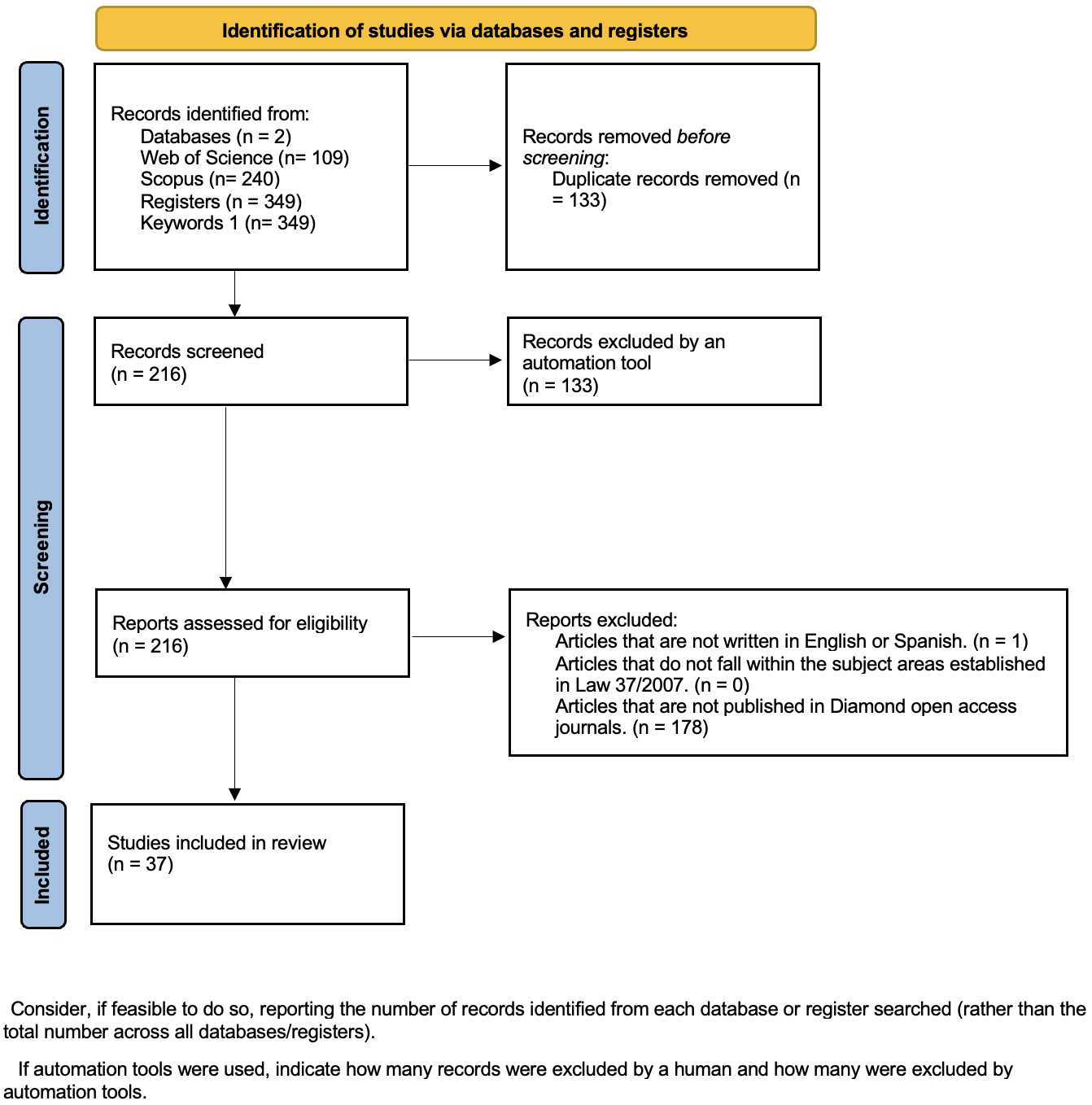
After separating the records into two matrices (Title + Web of Science and Title + Scopus), duplicates were searched across both databases. In this stage, 133 duplicate articles were identified. Removal was carried out through cross-validation of title and DOI, using Excel’s comparison tool. After deleting the duplicates, the remaining records were copied into a sheet named “Clean database.” Each article was then manually reviewed and accepted or rejected according to the predefined inclusion and exclusion criteria.
The accepted articles were added to the final sheet for the Diamond Open-Access analysis. In the last sheet, the research questions were addressed for each included article, which enabled the creation of the final results dataset. The entire identification, screening, and selection process is summarized in the PRISMA diagram; see Figure 1 (Haddaway et al., 2022).
It is important to clarify that this review examines exclusively publications focusing on Spain, regardless of the authors’ or the journal’s country of origin. The determining criterion for inclusion was that the study explicitly addressed the Spanish case in relation to open data, whether fully or partially. Therefore, the geographical origin of the publication was not considered among the inclusion or exclusion criteria.

2.3. Data Analysis

The data from the included studies were extracted using an Excel spreadsheet specifically designed for this review. In this matrix, each row represented an article, and each column corresponded to a predefined analytical question, identical across all studies.
The extraction instrument captured bibliographic information and organized the analysis into four blocks:
(1)
Study orientation and objectives: aim, type of impact (social, economic, environmental), and focus on innovation or knowledge transfer.
(2)
Open-access laws and policies: relationship with legislation on the use of public information, European regulations, open data policies, and institutions’ internal rules.
(3)
Methodological and technical aspects: method employed (experimental, practical, documentary, quantitative figures, mapping, language processing, etc.), whether open data was used, whether the process was replicable, and whether code, data, or information repositories were reusable.
(4)
Applicability and transferability: links with productive sectors, ability to create digital tools, efficiency, cost reduction, sustainability, identified limitations, and future recommendations.
Although PSI (public sector information—i.e., data generated or managed by public bodies) frames our conceptual and regulatory approach, the inclusion criteria did not restrict the sample to studies solely focused on PSI. Consequently, the predominance of PSI-related data observed in the results emerges as an empirical pattern within the Diamond Open-Access literature on Spain, rather than an artifact of the selection design.
Using Excel made it possible to construct a qualitative comparative matrix, enabling all studies to be assessed according to the same set of questions. This organization allowed for:
  • Cross-sectional comparison of articles.
  • Identification of recurring patterns.
  • Detection of methodological convergences and divergences.
  • Judgement of the coherence between stated objectives, methods, and uses.
Excel was not used as advanced statistical software. Instead, it served as a systematic analytical coding tool to organize, compare, and interpret the collected information consistently.
The final analysis was based on the comparative interpretation of each variable’s responses. This enabled us to address the research questions and determine the degree of consolidation of the Diamond Open-Access model and the reuse of public data in the scientific literature analyzed.

2.4. Excluded Articles

After removing duplicates and applying the inclusion criteria, the final database consisted of 216 records. Of these, 37 met the Diamond Open-Access model and were included in the final analysis; 179 were excluded for not aligning with the model. Exclusion was primarily due to the lack of connection to the Diamond Open-Access model or the absence of explicit reference to the reuse of public sector information within the context of Law 37/2007. Figure 1 presents the screening process details; these are provided in the Supplementary Materials (Page et al., 2021) and summarized in the PRISMA diagram.

3. Results

The analysis of the 37 selected studies shows that open data constitute a heterogeneous academic environment in which, over the past 25 years (with the majority of publications concentrated in the last 10 years), institutional, technological, scientific, and industrial approaches converge.
Despite the thematic diversity among the studies included in this review, this analysis has demonstrated coherence in this particular environment regarding the approaches used to define open data, its values, its true limitations within this specific ecosystem, and the potential applications derived from this information for purposes such as public planning, administration, and business intelligence. The results are divided into four categories, each directly related to answering one of the research questions.

3.1. Objectives and Approaches of Diamond Open-Access Studies on Open Data in Spain

The first cross-sectional analysis of the literature reveals that open data has not been perceived solely as an objective but also as a facilitating tool to address a wide range of phenomena.
The primary group of bibliographic reviews focuses on measuring the quality and maturity of institutional portals, specifically in regional and municipal formats, to verify whether open government policies have effectively contributed to a culture of open, reusable data. This particular group includes studies that examine everything from the early stages of open data policies in Spain to the present, highlighting gaps, regional discrepancies, and inconsistencies that depend on the adopted regulations and best practices.
Bibliographic reviews such as those by Clabo and Ramos-Vielba (2015), Martín-González and Sainz-Iglesias (2015), Clemente (2015), and González-Limón and Rodríguez-Ramos (2019) argue that much open data has been perceived in a more legal sense, with an approach far from practical reuse. This belief is maintained in these more recent articles, such as those by García-García and Curto-Rodríguez (2019), Curto-Rodríguez (2020), and Gálvez-De-La-Cuesta et al. (2020), García-García and Alonso-Magdaleno (2021, 2023), and Cobarsí-Morales et al. (2022), which follow similar lines of thought as to why institutional portals still face issues with structuring and data consistency.
At the same time, constituting a second category, increasing attention has been paid to open science and to studies addressing the management of scientific publications and data access in universities and research organizations. Some examples include research by De Filippo et al. (2019), De Filippo and Lascurain-Sánchez (2023), Abad García et al. (2022), and others like Baquero Pérez (2021), which place open data in a general scientific production environment where factors such as licenses, indicators, and culture play a role.
A third category of studies analyzes specific sectors, using them as material to learn about social processes, urbanization, culture, epidemic phenomena, and economics. Fields such as data journalism, political communication, and data verification seem to be those where open data has most radically changed professional activity, as shown, for example, in studies like those by Borges-Rey et al. (2018), Díez-Garrido (2021), Antón-Bravo and Serrano Tellería (2021), and more specifically, Camperos-Reyes and Gonçalves Sant’Ana (2021). In the broader field of culture and heritage studies, works such as those by Obregón Sierra (2022), García-Esparza (2022), and Booth et al. (2021) demonstrate the use of data for trend analysis and citizen participation. Furthermore, Magallón-Rosa et al. (2017) show how civil society organizations in Spain are using civic technologies based on open data to strengthen transparency and citizen participation.
In urban territorial studies, works such as Ureña-Cámara et al. (2021), Fernández-Maroto et al. (2023), Ramón-Morte et al. (2024), and Balado & Solla (2024) demonstrate the use of open geospatial data for urban planning.
In studies on epidemic phenomena, for example, the survey by Ortega-García et al. (2020) demonstrates the use of time series data for evaluation. Similarly, other studies analyze recent social changes, such as those by Gonzálvez-Gallego et al. (2021) and Antonovica et al. (2024).
A fourth category includes studies with clearly technological purposes: platform creation, semantic models, sophisticated indicators, geospatial analysis methods, and natural language processing solutions. This line of research, represented here by studies like those by Degbelo et al. (2016), Granell et al. (2018), García-García and Alonso-Magdaleno (2021), Curto-Rodríguez and Marcos Sánchez (2024), Balado and Solla (2024), and finally, Orbegozo-Terradillos et al. (2025), foresees improvements in interoperability and the analysis of open data.
The aggregation of these objectives results in a field that encompasses institutional analysis and innovation, sectoral exploration, and methodological developments, in which open data play a role in monitoring, understanding, measuring, and transforming reality.

3.2. Data Types, Methods, and Infrastructures Employed in Diamond Open-Access Studies on Open Data

The systematic review presented in this article reveals a wide diversity of data types. However, based on comparisons across studies, a threefold classification emerges: institutional data, scientific/bibliographic data, and sector-specific data. Most studies draw on institutional data originating primarily from public websites managed by regional and/or municipal authorities. Although public sector information (PSI) frames our analytical perspective, its predominance in the reviewed sample emerges as an empirical pattern rather than a selection artifact. In other words, Diamond Open-Access studies on Spain appear to be driven predominantly by institutional datasets, whereas non-institutional open data (e.g., corporate, civic, or community repositories) remain comparatively underrepresented in this corpus. This pattern helps contextualize the limitations discussed later—standardization, licensing, and updating—which are characteristic challenges associated with PSI. These datasets typically include budgets and public contracts, regulations, management data, time series, legal information, and statistical records.
Scientific and bibliographic data are the most common in open science studies, where publication records, metadata, impact factors, and citation indices are employed. The research conducted by De Filippo et al. (2019), De Filippo and Lascurain-Sánchez (2023), Abad García et al. (2022), and Baquero Pérez (2021) uses these data to explore publication trends, university policies, and advances in open access. Specialized sectoral datasets also play an important role in studies covering fields such as epidemiology (Ortega-García et al., 2020), culture (Obregón Sierra, 2022; García-Esparza, 2022; Booth et al., 2021), mobility, urban planning, and territorial space (Ureña-Cámara et al., 2021; Fernández-Maroto et al., 2023; Ramón-Morte et al., 2024; Balado & Solla, 2024), as well as sociology (Gonzálvez-Gallego et al., 2021; Antonovica et al., 2024).
In methodological terms, this systematic review identifies a diverse landscape encompassing comparative studies, case studies, text mining, statistical analyses, geospatial methods, and tool-design approaches. Natural language processing techniques have recently gained relevance in legislative studies and communication sciences (see, for example, Orbegozo-Terradillos et al., 2025; Borges-Rey et al., 2018; Díez-Garrido, 2021).
GIS and BIM frameworks have become increasingly prominent in urban planning research (see, for example, Fernández-Maroto et al., 2023; García-García & Alonso-Magdaleno, 2021; Ureña-Cámara et al., 2021). Statistical studies have also been employed for research purposes in marketing and public health (see, for example, Rey-Blanco et al., 2023; Ortega-García et al., 2020).
At the technical level, most studies reveal data models with challenging properties: heterogeneous formats, poor metadata quality, incomplete data structures, semantic discrepancies, and a constant need for data cleaning and normalization. This is even more evident in studies that handle unstructured data, such as those by Gálvez-De-La-Cuesta et al. (2020), Abad García et al. (2022), and Orbegozo-Terradillos et al. (2025).

3.3. Limit Documented Limitations, Barriers, and Challenges Affecting the Accessibility and Quality of Open Data

The identified studies are generally consistent in specifying a series of common factors that negatively affect the accessibility and reuse of open data. Among the factors that most directly hinder data openness are the degree and varying levels of standardization regarding internal structure and the consistency of variable names.
In transparency studies by Clabo and Ramos-Vielba (2015), Martín-González and Sainz-Iglesias (2015), González-Limón and Rodríguez-Ramos (2019), García-García and Curto-Rodríguez (2019), and in more recent transparency research by Cobarsí-Morales et al. (2022), it becomes evident that access continues to be problematic due to discrepancies among regions. This appears to be a recurring issue across other sectors, as each institution defines it differently, as shown in studies such as Fernández-Maroto et al. (2023), Abad García et al. (2022), and more recent works in other domains, such as De Filippo et al. (2019). Along these lines, Magallón-Rosa et al. (2017) emphasize that the lack of coordination between administrations and civil organizations, together with poor interoperability, limits the real impact of civic technologies based on open data in Spain.
A second barrier compounds this lack of standardization: data quality and timeliness. In epidemiological studies, for example, data quality issues identified by Ortega-García et al. (2020) include delays, discrepancies, and shifts in criteria that negatively affect longitudinal studies. In mobility and urban-planning analyses, data quality problems identified by Ramón-Morte et al. (2024), among others, such as Balado and Solla (2024), include a lack of density and the absence of periodic updates. In the real estate market, the data quality problems identified in studies such as Rey-Blanco et al. (2023) include errors and biases in datasets distributed across multiple platforms.
A third category that frequently emerges as a barrier to research data reuse concerns uncertainty associated with usage licenses. This is a critical consideration when examining institutional portals. Studies by Caridad Sebastián and Martínez Cardama (2016), García-García and Curto-Rodríguez (2019), García-García and Alonso-Magdaleno (2021, 2023), and Cobarsí-Morales et al. (2022) demonstrate that reuse conditions are inadequately defined, leading to legal uncertainty that limits their use by companies and researchers.
A fourth limitation involves non-reusable formats, such as PDF files, images, and documents, which hinder automated use. This issue has been repeatedly highlighted in studies by Gálvez-De-La-Cuesta et al. (2020), Abad García et al. (2022), and Orbegozo-Terradillos et al. (2025), which describe the challenges involved in transforming such content into analyzable or reusable data.
Finally, several studies highlight cases of seemingly transparent processes in which data are made public for administrative purposes without a clear intention of practical use. This observation appears in evaluations of regional and municipal websites, such as those by Curto-Rodríguez (2020, 2021, 2023), García-García and Curto-Rodríguez (2019), Gálvez-De-La-Cuesta et al. (2020), and García-García and Alonso-Magdaleno (2023).

3.4. Practical Applications, Impact, and Value Creation for Decision-Making and Business Intelligence

A cross-sectional analysis of the literature reveals a substantial body of work with real potential for use in decision-making contexts. At the same time, other studies do not explicitly address business intelligence, but they provide models, indicators, or methodologies applicable to innovative analytical tools. In the literature on public management and transparency, research such as that by Clabo and Ramos-Vielba (2015), Caridad Sebastián and Martínez Cardama (2016), García-García and Curto-Rodríguez (2019), and García-García and Alonso-Magdaleno (2021, 2023) presents elements that could be used as indicators in management dashboards or in the evaluation of public policies. In these cases, standardization and cross-cultural or inter-territorial comparison may offer opportunities for improvement.
Specifically, in certain sectors, open data enable advanced analyses with practical applications: in housing, for instance, the study by Rey-Blanco et al. (2023) allows for easy identification of geo-temporal market trends; in public health, the survey by Ortega-García et al. (2020) illustrates how open epidemiological data can inform health decision-making; for urban planning, open geodata facilitate planning tasks, as evidenced in the studies by Ureña-Cámara et al. (2021), Fernández-Maroto et al. (2023), De Filippo and Lascurain-Sánchez (2023), and Ramón-Morte et al. (2024). For mobility issues, Balado and Solla (2024) offer analytical models for smart environments.
In fields such as communication studies and cultural studies, although open data can support business intelligence, it is not the primary purpose. Research such as that by Borges-Rey et al. (2018), Díez-Garrido (2021), Obregón Sierra (2022), and Booth et al. (2021) may apply to institutional communication planning, cultural marketing, and audience analysis. Finally, in the scientific literature, studies such as those by De Filippo et al. (2019), Abad García et al. (2022), and Baquero Pérez (2021) provide explicit applications of academic intelligence for tracking institutional influence and research-planning policies.
Taken together, this evidence indicates that open data can be considered a foundational infrastructure for decision-making in the public and private sectors, territorial planning, research, and innovation, provided that adequate conditions of standardization and up-to-date information are ensured (see Table 2).

4. Discussion

This study conducted a systematic review, specifying the search criteria, the keyword combinations used, the methods for selecting and excluding articles, and the compilation of the information obtained using the PRISMA methodology. This approach enhances transparency in the preparation of the article and ensures its traceability and reproducibility.
The manuscript shows that the Diamond Open-Access route for publishing open-data articles in Spain is not the most widely used (used in only 17 percent of cases). It seeks to identify emerging trends in the selected sample covering the last 25 years (2000–2025) and finds that most works are concentrated in the last 10 years. These results must be interpreted within the context of the Spanish case and the subset of Diamond Open-Access publications analyzed. To enhance clarity, the discussion is explicitly framed around the four research questions (RQ1–RQ4), revisiting them in order:
 RQ1.
What objectives and approaches are pursued by Diamond Open-Access studies on open data in Spain during the period 2000–2025?
Our findings indicate heterogeneous aims (institutional assessment, open science, sectoral analyses, and technological development), consistent with early and recent evidence on Spain’s open data landscape. When comparing our findings with related studies, it is essential to refer to several early works on open data in Spain. For example, Garriga-Portolá (2011) identified a surge in open data initiatives, noting that the real challenge was not “opening up information” but maintaining, managing, and facilitating its continuous reuse so that citizens and businesses could effectively benefit from it. Another study by the same author bears a telling title—El Frankenstein español del Open Data: avances importantes, lagunas clamorosas—which illustrates an early-stage landscape with significant work still to be done (Garriga-Portolá, 2013).
In a similar vein, Curto-Rodríguez (2015) documented an initially uneven regional coverage of open data—key for strengthening accountability—a pattern that persists over the ten years examined by Curto-Rodríguez et al. (2025). The author also conducted a valuable study showing unequal attention across Spain’s autonomous communities regarding four aspects of open data portals: the number of datasets, applications developed using those datasets, available interaction options, and portal functionality (Curto-Rodríguez, 2021). The conclusions again confirm the heterogeneity in how initiatives are formulated and implemented. This aligns with the diversity of approaches and themes identified in our own investigation.
Other Spanish researchers have also examined open data. Corrales-Garay et al. (2019) mapped the open data literature and found that the dominant fields of application are Engineering, Health, Public Administration, Management, and Education. Our study similarly identifies areas with greater and lesser degrees of development. Subsequently, the authors proposed a “impact process” model and analyzed how open innovation influences data reuse (Corrales-Garay et al., 2020).
A particularly relevant contribution consists of a series of reports on the reuse of open data in Spain. These biannual analyses consistently highlight that the key challenge is no longer “publishing more data,” but rather improving effective reuse (i.e., the quality, homogeneity, and usefulness of datasets), identifying bottlenecks, aligning supply and demand, and generating greater value (Abella et al., 2017, 2019, 2022b, 2024).
Finally, we identified only one literature review focused on open data reuse in Spain: the study by Ortiz-de-Urbina-Criado et al. (2025), whose search retrieved 48 documents covering up to 20 different fields of knowledge—again illustrating the thematic heterogeneity in this domain.
 RQ2.
What types of data, methods, infrastructures, and technical approaches are employed by Diamond Open-Access studies on open data?
The corpus relies predominantly on institutional/public-administration datasets, with non-institutional sources underrepresented; methods range from GIS/NLP to statistical and tool-design approaches. Our review finds that open data research in Spain relies predominantly on institutional or public-administration datasets, rather than on data stored in corporate or privately managed repositories.
 RQ3.
What limitations, barriers, and challenges are documented in Diamond Open-Access studies regarding the accessibility, standardization, licensing, and quality of open data?
The main obstacles concern standardization and internal structure, data quality and timeliness, and licensing/reuse conditions that create legal uncertainty for companies and researchers. The fact that this study identifies several factors that negatively affect the accessibility and reuse of open data—undoubtedly the two core reasons for making information available to the public—is of central importance. These findings on barriers and limitations represent one of the most detailed implications of the study and are of particular significance for those responsible for open data initiatives. The results highlight the need to address gaps in key areas such as internal data structure and standardization, data quality and timeliness (i.e., providing information at the moment it becomes relevant), and the poor implementation of licences or reuse conditions, which generate legal uncertainty. These challenges, widely described in the reviewed literature, continue to hinder the effective reuse of open data.
 RQ4.
What practical applications, impacts, and value-creation opportunities do these Diamond Open-Access studies generate for decision-making, public policies, and business intelligence?
While multiple sectoral applications are evidenced, the quantification of created value remains limited; open data function as a decision-support infrastructure where standardisation and up-to-date information are ensured. Another relevant finding is that many studies do not quantify the potential value created by the information provided, despite this being a primary objective of open data initiatives. This is especially important because, as Vera-Martínez et al. (2018) note for the case of Mexico, Spain lacks governmental evaluation mechanisms to assess the quality of its initiatives; assessments must therefore be inferred indirectly through international indices, which indicate only relative positioning rather than absolute performance. For example, our review did not identify relevant research, such as demographic data studies that could support marketing segmentation, or trade and consumption datasets of interest for business intelligence—topics that would reasonably be expected in a mature open data ecosystem. It seems counterintuitive that the literature does not assess the actual usefulness of initiatives based on their intended purpose, overlooking studies that focus on data demand and user perspectives.

5. Conclusions

The systematization undertaken enabled us to structure the findings and address the four key research questions posed.
First, open data research in Spain is examined from different perspectives. This allows us to distinguish four groups: studies that assess the degree of development of tools that store open data—specifically open data portals, with analyses focused on municipal and regional levels; research on the contributions of open data to open science; studies that examine specific domains of information, such as economic, social, or urban-development data; and those focused on the technological dimension, which detail platform-building processes or the semantic models employed.
Second, regarding data types and technical characteristics, most studies reveal data models with complex properties: heterogeneous formats, poor-quality metadata, incomplete data structures, semantic inconsistencies, and a continual need for data cleaning and normalization.
Third, the limitations identified—such as data complexity and heterogeneity—make it difficult to fully leverage open data, thereby addressing the third research question.
Finally, we argue that the heterogeneity observed in our study is consistent with the existence of multiple sources of value in open data and with the multidisciplinary nature of the topic, which can be approached from various fields (law, accounting, marketing, communication, etc.). This finding responds to the fourth research question.
In addition, this study has limitations. It is deliberately confined to the Spanish context and to scientific output published exclusively in Diamond Open-Access journals. Due to this methodological delimitation, the conclusions should not be extrapolated to other open-access models (Gold, Hybrid, or Subscription) or to the broader international open data literature, as these contexts may exhibit different dynamics, levels of maturity, and editorial behaviors. Consequently, the findings must be interpreted within the specific framework of Spain and the Diamond Open-Access publishing ecosystem analyzed. However, we consider this a valuable starting point for understanding the focus of open data research in a developed country that holds a prominent position in supranational open data rankings. Another limitation is the relatively small number of observations—37 in total—stemming from the ad hoc nature of the study for the journal’s specific topic (Diamond Open-Access publications).
Given these limitations, future research directions must be considered. These include analyses of other countries with comparable levels of economic or technological development, as well as those occupying similar positions in open data performance rankings. Moreover, thanks to the comprehensive database created for this study and made publicly available to all interested parties, the authors of this article (or any other researcher) may further deepen the analysis by incorporating additional key questions or expanding the scope to include works beyond Diamond Open-Access publications.
Ultimately, we hope that open data continue to be analyzed as an invaluable source of economic value—one that facilitates everyday life, supports informed business decision-making, and promotes transparency and accountability across institutions of all kinds. Open data should be regarded as a fundamental input for this purpose, provided that appropriate conditions of standardization and updating are ensured—something that, unfortunately, does not appear to be occurring according to the publications consulted.

Supplementary Materials

The following supporting information can be downloaded at: https://www.mdpi.com/article/10.3390/publications14010016/s1, Table S1: PRISMA 2020 Checklist A Systematic Review of Arts Practice-based Research Abstracts from Small and/or Specialist Institutions. The following supporting information can be downloaded at: https://zenodo.org/records/18716603, accessed on 24 February 2026.

Author Contributions

Conceptualization, R.C.-R., A.L.-M. and R.M.-S.; methodology, R.C.-R. and A.L.-M.; software, R.C.-R., A.L.-M., R.M.-S. and D.F.; validation, R.C.-R., A.L.-M., R.M.-S. and D.F.; formal analysis, R.C.-R., A.L.-M. and R.M.-S.; investigation, R.C.-R., A.L.-M. and R.M.-S.; resources, R.C.-R., A.L.-M. and R.M.-S.; data curation, R.C.-R., A.L.-M., R.M.-S. and D.F.; writing—original draft preparation, R.C.-R., A.L.-M., R.M.-S. and D.F.; writing—review and editing, R.C.-R., R.M.-S. and D.F.; visualization, R.C.-R., A.L.-M., R.M.-S. and D.F.; supervision, R.M.-S. and D.F.; project administration, R.C.-R., A.L.-M., R.M.-S. and D.F.; funding acquisition, D.F. All authors have read and agreed to the published version of the manuscript.

Funding

This research received no external funding.

Data Availability Statement

The Excel file containing the publication data is included as a supplement.

Conflicts of Interest

The authors declare no conflicts of interest.

References

  1. Abad García, M. F., González Teruel, A., Abadal, E., & Ollé i Castellà, C. (2022). Las universidades españolas y la ciencia abierta: Un estudio sobre barreras y elementos favorecedores. BiD: Textos Universitaris de Biblioteconomia I Documentació, 49. [Google Scholar] [CrossRef] [Scilit]
  2. Abella, A., Ortiz-de-Urbina-Criado, M., & De-Pablos-Heredero, C. (2017). La reutilización de datos abiertos: Una oportunidad para España. COTEC Editorial. Available online: https://burjcdigital.urjc.es/items/85df47a8-e3b9-4710-a3ad-50502f30b734 (accessed on 27 December 2025).
  3. Abella, A., Ortiz-de-Urbina-Criado, M., & De-Pablos-Heredero, C. (2022a). Criteria for the identification of ineffective open data portals: Pretender open data portals. Profesional de la Información, 31(1), e310111. [Google Scholar] [CrossRef] [Scilit]
  4. Abella, A., Ortiz-de-Urbina-Criado, M., De-Pablos-Heredero, C., & García Luna, D. (2022b). La reutilización de datos abiertos en España III. ESIC Editorial. Available online: https://www.meloda.org/wp-content/uploads/2024/04/ESTUDIO-COTEC_IV-REUTILIZACION-DE-DATOS-ABIERTOS_V3.pdf (accessed on 27 December 2025).
  5. Abella, A., Ortiz-de-Urbina-Criado, M., De-Pablos-Heredero, C., & García Luna, D. (2024). La reutilización de datos abiertos en España IV. COTEC Editorial. [Google Scholar]
  6. Abella, A., Ortiz-de-Urbina-Criado, M., De-Pablos-Heredero, C., Vidal-Cabo, C., & Ferrer-Sapena, A. (2019). La reutilización de datos abiertos en España II. DesideDatum. [Google Scholar]
  7. Ali, M., Papageorgiou, G., Aziz, A., Loukis, E., Charalabidis, Y., Alexopoulos, C., & Pellicer, F. J. L. (2024). A framework for the multi-dimensional assessment of interoperability for open data ecosystems development. Information Polity, 29(4), 439–466. [Google Scholar] [CrossRef] [Scilit]
  8. Antonovica, A., De Esteban Curiel, J., Del Rosario Sánchez Morales, M., & Guede, J. R. S. (2024). Empirical study of the COVID-19 social effects on gender and generations: Scientific insights for future public policies. OBETS Revista de Ciencias Sociales, 19(1), 33–52. [Google Scholar] [CrossRef] [Scilit]
  9. Antón-Bravo, A., & Serrano Tellería, A. (2021). Innovación en la docencia del periodismo a través de la ciencia de datos: Innovation in journalism education through data science. European Public & Social Innovation Review, 6(1), 70–84. [Google Scholar] [CrossRef] [Scilit]
  10. Arya, S., Kaji, A., & Boermeester, M. (2021). Prisma reporting guidelines for meta-analyses and systematic reviews. JAMA Surgery, 156, 789–790. [Google Scholar] [CrossRef] [Scilit]
  11. Balado, J., & Solla, M. (2024). Multi-criteria GIS for sponge city planning with open data sources in vigo (Spain). ISPRS Annals of The Photogrammetry, Remote Sensing And Spatial Information Sciences, X-4/W5-2024, 41–48. [Google Scholar] [CrossRef] [Scilit]
  12. Baquero Pérez, P. J. (2021). Datos abiertos entrelazados para una mejor información jurídica. Revista Española de la Transparencia, 12, 87–123. [Google Scholar] [CrossRef] [Scilit]
  13. Blanco, D., Rubio, E. M., Marín, M. M., & De Agustina, B. (2020, October 21–23). Propuesta metodológica para revisión sistemática en el ámbito de la ingeniería basada en PRISMA. XXIII Congreso Nacional de Ingeniería Mecánica, Jaén, Spain. Available online: https://scholar.google.com/scholar_lookup?title=Propuesta+metodol%C3%B3gica+para+revisi%C3%B3n+sistem%C3%A1tica+en+el+%C3%A1mbito+de+la+ingenier%C3%ADa+basada+en+PRISMA&conference=Proceedings+of+the+XXIII+Congreso+Nacional+de+Ingenier%C3%ADa+Mec%C3%A1nica&author=Blanco,+D.&author=Rubio,+E.M.&author=Mar%C3%ADn,+M.M.&author=De+Agustina,+B.&publication_year=2020 (accessed on 27 December 2025).
  14. Booth, P., Navarrete, T., & Ogundipe, A. (2021). Museum open data ecosystems: A comparative study. Journal of Documentation, 78(4), 761–779. [Google Scholar] [CrossRef] [Scilit]
  15. Borges Rey, E., Heravi, B., & Uskali, T. (2018). Periodismo de datos iberoamericano: Desarrollo, contestación y cambio social. Presentación. Revista ICONO14, 16(2), 1–13. [Google Scholar] [CrossRef] [Scilit]
  16. Camperos-Reyes, J. T., & Gonçalves Sant’Ana, R. C. (2021). Abordajes de metadatos para publicadores de datos gubernamentales en el contexto de Iberoamérica. Revista Interamericana de Bibliotecología, 44(3), e339110. [Google Scholar] [CrossRef] [Scilit]
  17. Caridad Sebastián, M., & Martínez Cardama, S. (2016). Gobierno y parlamento abierto: La participación ciudadana en el tratamiento y visualización de la información pública. Revista Interamericana De Bibliotecología, 39(1), 47–56. [Google Scholar] [CrossRef]
  18. Clabo, N., & Ramos-Vielba, I. (2015). Reutilización de datos abiertos en la administración pública en España y uso de licencias-tipo. Revista Española de Documentación Científica, 38(3), e097. [Google Scholar] [CrossRef] [Scilit]
  19. Clemente, N. C. (2015). Luces y sombras del marco normativo del acceso abierto en la administración general del Estado en España. Revista General de Información y Documentación, 25(2), 245–263. [Google Scholar] [CrossRef] [Scilit]
  20. Cobarsí-Morales, J., Calver-Liñan, L., & Segundo-Martín, E. (2022). Muertes por COVID-19 en España durante la ‘primera ola’: Datos cuantitativos y su tratamiento periodístico. Revista General de Información y Documentación, 32(1), 61–91. [Google Scholar] [CrossRef] [Scilit]
  21. Corrales-Garay, D., Ortiz-de-Urbina-Criado, M., & Mora-Valentín, E. M. (2019). Knowledge areas, themes and future research on open data: A co-word analysis. Government Information Quarterly, 36(1), 77–87. [Google Scholar] [CrossRef] [Scilit]
  22. Corrales-Garay, D., Ortiz-de-Urbina-Criado, M., & Mora-Valentín, E.-M. (2020). A research agenda on open data impact process for open innovation. IEEE Access, 8, 34696–34705. [Google Scholar] [CrossRef] [Scilit]
  23. Curto-Rodríguez, R. (2015). Los portales de datos abiertos autonómicos y la rendición de cuentas. Auditoría Pública: Revista de los Organos Autónomos de Control Externo, 66, 75–83. Available online: https://www.revistatransparencia.com/ret/article/view/152 (accessed on 27 December 2025).
  24. Curto-Rodríguez, R. (2020). Gobiernos autonómicos españoles y transparencia activa de sus repositorios digitales. Una revisión taxonómica. Política y Sociedad, 57(2), 543–565. [Google Scholar] [CrossRef] [Scilit]
  25. Curto-Rodríguez, R. (2021). Análisis multidimensional de los portales de datos abiertos autonómicos españoles. Revista Española de Documentación Científica, 44(1), e284. [Google Scholar] [CrossRef] [Scilit]
  26. Curto-Rodríguez, R. (2023). Transparencia para su explotación: Gobiernos intermedios español y mexicano. Perfiles Latinoamericanos, 31(61), 1–24. [Google Scholar] [CrossRef] [Scilit]
  27. Curto-Rodríguez, R., & Marcos Sánchez, R. (2024). Datos abiertos para la creación de valor: Atención e interés para el marketing. European Public & Social Innovation Review, 9, 1–16. [Google Scholar] [CrossRef] [Scilit]
  28. Curto-Rodríguez, R., Marcos-Sánchez, R., & Del Canto García, S. (2025). Diez años de transparencia activa autonómica en España mediante datos abiertos: Periodo 2013-2023. Revista Latina de Comunicación Social, 83, 1–19. [Google Scholar] [CrossRef] [Scilit]
  29. Curto-Rodríguez, R., Marcos-Sánchez, R., & Ferrández, D. (2024). Open Government in Spain: An Introspective Analysis. Administrative Sciences, 14, 89. [Google Scholar] [CrossRef] [Scilit]
  30. De Filippo, D., & Lascurain-Sánchez, M. L. (2023). La implicación de España en actividades científicas sobre ciencia abierta. Análisis de proyectos y publicaciones científicas. Revista Española de Documentación Científica, 46(2), e358. [Google Scholar] [CrossRef] [Scilit]
  31. De Filippo, D., Silva, P., & Borges, M. M. (2019). Caracterización de las publicaciones de España y Portugal sobre Open Science y análisis de su presencia en las redes sociales. Revista Española de Documentación Científica, 42(2), e235. [Google Scholar] [CrossRef] [Scilit]
  32. Degbelo, A., Bhattacharya, D., Trilles, S., Canut, C. G., Kray, C., & Schiestel, N. (2016). Designing a semantic API for open city data. JeDEM—eJournal of eDemocracy and Open Government, 8(2), 21–58. [Google Scholar] [CrossRef] [Scilit]
  33. De Lahoz, M. E., Barjola, P., Peláez, I., Ferrera, D., Fernandes-Magalhaes, R., & Mercado, F. (2023). Unveiling the Role of Contingent Negative Variation (CNV) in Migraine: A Review of Electrophysiological Studies in Adults and Children. Biomedicines, 11(11), 3030. [Google Scholar] [CrossRef] [Scilit] [PubMed]
  34. Directiva 2003/98/CE del Parlamento Europeo y del Consejo, de 17 de noviembre de 2003, relativa a la reutilización de la información del sector público. (n.d.). Available online: https://www.boe.es/buscar/doc.php?id=DOUE-L-2003-82244 (accessed on 27 December 2025).
  35. Directiva 2013/37/UE del Parlamento Europeo y del Consejo, de 26 de junio de 2013, por la que se modifica la Directiva 2003/98/CE relativa a la reutilización de la información del sector público. (n.d.). Available online: https://www.boe.es/doue/2013/175/L00001-00008.pdf (accessed on 27 December 2025).
  36. Directiva (EU) 2019/1024 del Parlamento Europeo y del Consejo, de 20 de junio de 2019, relativa a los datos abiertos y la reutilización de la información del sector público. (n.d.). Available online: https://eur-lex.europa.eu/eli/dir/2019/1024/oj?eliuri=eli%3Adir%3A2019%3A1024%3Aoj&locale=en (accessed on 27 December 2025).
  37. Díez-Garrido, M. (2021). La ineludible monitorización pública y civil de la transparencia informativa en España. Revista de Estudios Políticos, 194, 189–211. [Google Scholar] [CrossRef] [Scilit]
  38. European Commission. (2025). Data union strategy. Unlocking data for AI. Available online: https://eur-lex.europa.eu/legal-content/ES/TXT/?uri=COM:2025:835:FIN (accessed on 27 December 2025).
  39. European Data Portal. (2020). The economic impact of open data. Opportunities for value creation in Europe. Available online: https://data.europa.eu/sites/default/files/the-economic-impact-of-open-data.pdf (accessed on 27 December 2025).
  40. European Union. (2025). Open data maturity 2024. En data.europa.eu. Available online: https://data.europa.eu/es/open-data-maturity/2025 (accessed on 27 December 2025).
  41. Fernández-Maroto, M., Rodríguez, M. A., Sánchez, V. A. L., López Bragado, D., & González, E. R. (2023). Modelo de Información Urbana de Barrio (MIUB) para regeneración urbana: Una propuesta metodológica. ZARCH, 19, 170–183. [Google Scholar] [CrossRef] [Scilit]
  42. Gao, Y., Janssen, M., & Zhang, C. (2023). Understanding the evolution of open government data research:towards open data sustainability and smartness. International Review of Administrative Sciences, 89(1), 59–75. [Google Scholar] [CrossRef] [Scilit]
  43. García-Esparza, J. A. (2022). Abandon and reuse—The engineered space at a time of pandemics. VITRUVIO—International Journal of Architectural Technology and Sustainability, 7(1), 104–115. [Google Scholar] [CrossRef] [Scilit]
  44. García-García, J., & Alonso-Magdaleno, M. I. (2021). Herramientas de visualización gráfica online para datos abiertos presupuestarios de administraciones públicas. Revista Española de Documentación Científica, 44(3), e305. [Google Scholar] [CrossRef] [Scilit]
  45. García-García, J., & Alonso-Magdaleno, M. I. (2023). Examining the Impact of Transparency Portals on Media Coverage. JeDEM—eJournal of eDemocracy and Open Government, 15(1), 169–190. [Google Scholar] [CrossRef] [Scilit]
  46. García-García, J., & Curto-Rodríguez, R. (2019). El ejercicio de la rendición de cuentas mediante portales de datos abiertos en las comunidades autónomas españolas. IDP Revista de Internet Derecho y Política, 29, 1–15. [Google Scholar] [CrossRef] [Scilit]
  47. Garriga-Portolá, M. (2011). ¿Datos abiertos? Sí, pero de forma sostenible. El Profesional de la Información, 20(3), 298–303. [Google Scholar] [CrossRef] [Scilit]
  48. Garriga-Portolá, M. (2013). El Frankenstein español del Open Data: Avances importantes, lagunas clamorosas. Telos: Cuadernos de Comunicación e Innovación, 94, 68–73. Available online: https://telos.fundaciontelefonica.com/archivo/numero094/el-frankenstein-espanol-del-open-data/?output=pdf (accessed on 27 December 2025).
  49. Gálvez-De-La-Cuesta, M., Gertrudix-Barrio, M., & García-García, F. (2020). Datos abiertos y educación: Formación de docentes en la sociedad digital. Páginas de Educación, 13(2), 1–20. [Google Scholar] [CrossRef] [Scilit]
  50. González-Limón, M., & Rodríguez-Ramos, A. (2019). Revisión del cumplimiento de los Datos Abiertos por los Ayuntamientos españoles en la iniciativa Aporta. Revista Española de Documentación Científica, 42(4), e247. [Google Scholar] [CrossRef] [Scilit]
  51. Gonzálvez-Gallego, N., Nieto-Torrejón, L., & Pérez-Cárceles, M. C. (2021). Una medida global de gobierno abierto para la OCDE. Recomendaciones para España. El Trimestre Económico, 88(349), 219–245. [Google Scholar] [CrossRef] [Scilit]
  52. Granell, C., Bhattacharya, D., Casteleyn, S., Degbelo, A., Gould, M., Kray, C., Painho, M., & Trilles, S. (2018). Geo-C: Enabling open cities and the open city toolkit. The International Archives of the Photogrammetry, Remote Sensing and Spatial Information Sciences, XLII-4/W8, 61–68. [Google Scholar] [CrossRef] [Scilit]
  53. Haddaway, N. R., Page, M. J., Pritchard, C. C., & McGuinness, L. A. (2022). PRISMA2020: An R package and Shiny app for producing PRISMA 2020-compliant flow diagrams, with interactivity for optimised digital transparency and Open Synthesis. Campbell Systematic Reviews, 18(2), e1230. [Google Scholar] [CrossRef] [Scilit]
  54. Hrustek, L., Kević, K., & Varga, F. (2024). Open data for transparency of government tenders: A state analysis in croatian agriculture land lease. ISPRS International Journal of Geo-Information, 13(11), 401. [Google Scholar] [CrossRef] [Scilit]
  55. Kroes, N. (2012, March 5). From crisis of trust to open governing. SPEECH/12/149, Bratislava, Slovakia. Available online: https://ec.europa.eu/commission/presscorner/detail/en/SPEECH_12_149 (accessed on 27 December 2025).
  56. Leal, A., Ferrández, D., Prieto, M. I., & Varum, H. (2025). Systematic review on the behaviour of carbon and stainless steel reinforcing bars in buildings under high temperatures. Buildings, 15(9), 1539. [Google Scholar] [CrossRef] [Scilit]
  57. Magallón-Rosa, R., Bolaños-Huertas, V., & Anderica-Caffarena, V. (2017). Changing civil society in Spain through transparency and civic technologies. Observatorio (OBS*), 11(3), 61–77. [Google Scholar] [CrossRef] [Scilit]
  58. Martín-González, Y., & Sainz-Iglesias, P. (2015). Aplicación de la norma técnica de interoperabilidad de reutilización de recursos de información en los catálogos de información pública de las comunidades autónomas. Revista General de Información y Documentación, 25(2), 287–311. [Google Scholar] [CrossRef] [Scilit]
  59. Ministry for Digital Transformation and Public Administration. (2025). Apertura de Datos: 10 apuntes clave sobre el valor de los datos abiertos. Available online: https://datos.gob.es/es/noticias/apertura-de-datos-10-apuntes-clave-sobre-el-valor-de-los-datos-abiertos (accessed on 27 December 2025).
  60. Moreno-Carmona, C., Feria-Domínguez, J. M., & Troncoso, A. (2020). Applying the open government principles to the university’s strategic planning: A sound practice. Sustainability, 12, 1826. [Google Scholar] [CrossRef] [Scilit]
  61. Obama, B. (2009a). Executive office of the president, office of management and budget, memorandum for the heads of executive departments and agencies: Open government directive. Available online: https://www.treasury.gov/open/Documents/m10-06.pdf (accessed on 27 December 2025).
  62. Obama, B. (2009b). Memorandum for the heads of executive departments and agencies. Available online: http://www.gpo.gov/fdsys/pkg/FR-2009-01-26/pdf/E9-1777.pdf (accessed on 27 December 2025).
  63. Obregón Sierra, Á. (2022). Inserción de metadatos de las bibliotecas españolas en Wikidata: Un modelo de datos abiertos enlazados. Revista Española de Documentación Científica, 45(3), a330. [Google Scholar] [CrossRef] [Scilit]
  64. OECD. (2023). OURdata index. Available online: https://www.oecd.org/en/publications/2023-oecd-open-useful-and-re-usable-data-ourdata-index_a37f51c3-en.html (accessed on 27 December 2025).
  65. Opendatasoft. (n.d.). Open data inception—A list of 2600+ open data portals in the world. Open Data Inception. Available online: https://opendatainception.io/ (accessed on 27 December 2025).
  66. Open Government Working Group. (2007). 8 principles of open government data. Available online: https://public.resource.org/8_principles.html (accessed on 27 December 2025).
  67. Orbegozo-Terradillos, J., Larrondo-Ureta, A., Escribano, N., Fernández, S. P., & Agerri, R. (2025). BasqueParl: Descifrar la huella retórica en el Parlamento Vasco con el procesamiento del lenguaje natural. Palabra Clave, 28(1), e2813. [Google Scholar] [CrossRef] [Scilit]
  68. Ortega-García, J. A., Martínez-Hernández, I., Boldo, E., Cárceles-Álvarez, A., Solano-Navarro, C., Ramis, R., Aguilar-Ros, E., Sánchez-Solis, M., & López-Hernández, F. (2020). Contaminación atmosférica urbana e ingresos hospitalarios por asma y enfermedades respiratorias agudas en la ciudad de Murcia (España). Anales de Pediatría, 93(2), 95–102. [Google Scholar] [CrossRef] [Scilit] [PubMed]
  69. Ortiz-de-Urbina-Criado, M., Abella, A., De-Pablos-Heredero, C., & Ramírez-Herrero, V. (2025). Realidad y Retos de la Reutilización de Datos Abiertos. WPOM-Working Papers on Operations Management, 16, 1–20. [Google Scholar] [CrossRef] [Scilit]
  70. Page, M. J., McKenzie, J. E., Bossuyt, P. M., Boutron, I., Hoffmann, T. C., Mulrow, C. D., Shamseer, L., Tetzlaff, J. M., Akl, E. A., Brennan, S. E., & Chou, R. (2021). The PRISMA 2020 statement: An updated guideline for reporting systematic reviews. BMJ, 372, n71. [Google Scholar] [CrossRef] [Scilit]
  71. Parks, W. (1957). The open government principle: Applying the right to know under the constitution. The George Washington Law Review, 26(1), 1–22. [Google Scholar]
  72. Ramírez-Alujas, Á. V. (2012). Gobierno abierto es la respuesta: ¿Cuál era la pregunta? Más Poder Local, 12, 14–22. Available online: https://dialnet.unirioja.es/servlet/articulo?codigo=4013852 (accessed on 20 February 2026).
  73. Ramón-Morte, A., Moreno, D. P., & Moltó-Mantero, E. (2024). Mapping frost risk in fruit trees using GIS-based analysis: A case study in the province of Alicante (Spain). GeoFocus Revista Internacional de Ciencia y Tecnología de la Información Geográfica, 33, 129–155. [Google Scholar] [CrossRef] [Scilit]
  74. Rey-Blanco, D., González, J., & Sánchez, D. (2023). Relación entre precios de alquiler en portales inmobiliarios y precios de mercado. Evidencias para la Comunidad de Madrid. Revista EURE—Revista De Estudios Urbano Regionales, 50(150), 1–23. [Google Scholar] [CrossRef] [Scilit]
  75. Riberholt, C. G., Olsen, M. H., Milan, J. B., & Gluud, C. (2022). Major mistakes and errors in the use of trial sequential analysis in systematic reviews or meta-analyses–protocol for a systematic review. Systematic Reviews, 11, 114. [Google Scholar] [CrossRef] [Scilit]
  76. Sadiq, S., & Indulska, M. (2017). Open data: Quality over quantity. International Journal of Information Management, 37(3), 150–154. [Google Scholar] [CrossRef] [Scilit]
  77. Tang, Y., & Li, S. (2024). Research of open government data in China: A systematic literature study in public administration (2013–2023). Chinese Public Administration Review, 15(2), 128–141. [Google Scholar] [CrossRef] [Scilit]
  78. Urdánigo-Zambrano, J., Torres, B., De-Pablos-Heredero, C., Herrera-Feijoo, R., & García, A. (2026). Open data reuse in agricultural, livestock, and environmental systems: A global scoping review with a case analysis of Ecuador. Land, 15, 13. [Google Scholar] [CrossRef] [Scilit]
  79. Ureña-Cámara, M. A., Nogueras-Iso, J., & Lacasta, J. (2021). Revisión de la calidad de los conjuntos de datos abiertos sobre presupuestos. Revista Cartográfica, 103, 145–163. [Google Scholar] [CrossRef] [Scilit]
  80. Vera-Martínez, M., Navarro, A. B., & Rocha-Romero, D. (2018). Políticas públicas de datos abiertos en México. Revista Buen Gobierno, 1(1), 1–26. [Google Scholar] [CrossRef] [Scilit] [PubMed]
  81. Vickery, G. (2011). Review of recent studies on psi re-use and related market developments. Available online: https://www.researchgate.net/profile/Graham-Vickery-2/publication/265573154_Review_of_Recent_Studies_on_PSI_Re-Use_and_Related_Market_Development/links/5f5a828e4585154dbbc86872/Review-of-Recent-Studies-on-PSI-Re-Use-and-Related-Market-Development.pdf (accessed on 27 December 2025).
  82. Wibowo, W. S., Fadhil, A., Sensuse, D. I., Lusa, S., Putro, P. A. W., & Yulfitri, A. (2023). Pinpointing factors in the success of integrated information system toward open government data initiative: A perspective from employees. International Journal of Advanced Computer Science and Applications, 14(1), 94–109. [Google Scholar] [CrossRef] [Scilit]
Figure 1. PRISMA flow diagram for the literature search in this review (Databases: Web of Science and Scopus).
Publications 14 00016 g001
Table 1. Keywords used, search date, databases, and number of results.
KeywordSearch DateDatabase Results
“Open-data” and “Spain”10 June 2025Scopus240
WOS109
Table 2. Articles analyzed in the results in ascending order by year.
Year/AuthorsFull TitleSection(s)Key Ideas
2015Clabo, N., & Ramos-Vielba, I.Reutilización de datos abiertos en la administración pública en España y uso de licencias-tipoSection 3.1, Section 3.2, Section 3.3 and Section 3.4They show a predominantly legal approach; highlight licensing issues and lack of reuse; useful for public management indicators.
2015Martín-González, Y., & Sainz-Iglesias, P.Aplicación de la norma técnica de interoperabilidad de reutilización de recursos de información en los catálogos de información pública de las comunidades autónomasSection 3.1, Section 3.2 and Section 3.3They identify regional gaps and interoperability problems among public catalogues.
2015Clemente, N. C.Luces y sombras del marco normativo del acceso abierto en la Administración General del Estado en EspañaSection 3.1 and Section 3.2Provides a regulatory critique; reveals a legal rather than a reuse-oriented focus.
2016Caridad Sebastián, M., & Martínez Cardama, S.Gobierno y Parlamento abierto: la participación ciudadana en el tratamiento y visualización de la información públicaSection 3.3 and Section 3.4Highlight legal uncertainty caused by poorly defined licenses; offer useful indicators for assessing transparency.
2016Degbelo, A. et al.Designing a Semantic API for Open City DataSection 3.1 and Section 3.2Classified as technological development for semantic interoperability.
2017Magallón-Rosa, R. et al.Changing civil society in Spain through transparency and civic technologiesSection 3.1 and Section 3.3It demonstrates the growing use of open data by civil society organizations and the relationship between transparency and citizen participation in Spain.
2018Borges Rey, E. et al.Periodismo de datos iberoamericano: desarrollo, contestación y cambio socialSection 3.1, Section 3.2 and Section 3.4A notable case in which open data transform journalistic practice.
2018Granell, C. et al.GEO-C: Enabling Open Cities and the Open City ToolkitSection 3.1 and Section 3.2Example of technological innovation for open cities.
2019González-Limón, M. & Rodríguez-Ramos, A.Revisión del cumplimiento de los Datos Abiertos por los Ayuntamientos españoles en la iniciativa AportaSection 3.1, Section 3.2 and Section 3.3Shows inequalities in municipal compliance and standardization shortcomings.
2019García-García, J., & Curto-Rodríguez, R.El ejercicio de la rendición de cuentas mediante portales de datos abiertos en las comunidades autónomas españolasSection 3.1, Section 3.3 and Section 3.4Indicates a still formalistic use not oriented toward reuse.
2019De Filippo, D., Silva, P., & Borges, M. M.Caracterización de las publicaciones de España y Portugal sobre Open Science y análisis de su presencia en las redes socialesSection 3.1, Section 3.2, Section 3.3 and Section 3.4Demonstrates the relevance of bibliographic data in open science and existing institutional limitations.
2020Curto-Rodríguez, R.Gobiernos autonómicos españoles y transparencia activa de sus repositorios digitales. Una revisión taxonómicaSection 3.1, Section 3.2 and Section 3.3Taxonomy of digital repositories; shows administrative transparency rather than reuse.
2020Gálvez-de-la-Cuesta, M. et al.Datos abiertos y educación: formación de docentes en la sociedad digitalSection 3.1, Section 3.2 and Section 3.3Highlights problems with unstructured data and non-reusable formats.
2020Ortega-García, J. A. et al.Contaminación atmosférica urbana e ingresos hospitalarios por asma y enfermedades respiratorias agudas en la ciudad de Murcia (España) Section 3.1, Section 3.2, Section 3.3 and Section 3.4Epidemiological case; shows delays and quality issues; high usefulness for decision-making.
2021García-García, J. & Alonso-Magdaleno, M. I.Herramientas de visualización gráfica online para datos abiertos presupuestarios de administraciones públicasSection 3.1, Section 3.2 and Section 3.4Example of tools with potential for public-sector dashboards.
2021Ureña-Cámara, M. A. et al.Revisión de la calidad de los conjuntos de datos abiertos sobre presupuestosSection 3.1, Section 3.2 and Section 3.4Analysis of budgetary data quality using GIS.
2021Baquero Pérez, P. J.Datos abiertos entrelazados para una mejor información jurídicaSection 3.1, Section 3.2 and Section 3.4Legal case; LOD applied to regulatory frameworks.
2021Díez-Garrido, M.La ineludible monitorización pública y civil de la transparencia informativa en EspañaSection 3.1, Section 3.2 and Section 3.4Links open data with public oversight.
2021Antón-Bravo, A. & Serrano Tellería, A.Innovación en la docencia del periodismo a través de la ciencia de datosSection 3.1 and Section 3.2Example of teaching adaptation to data science.
2021Camperos-Reyes, J. T., & Gonçalves Sant’Ana, R. C.Abordajes de metadatos para publicadores de datos gubernamentales en el contexto de IberoaméricaSection 3.1 and Section 3.2Emphasizes the importance of metadata standardization.
2021Gonzálvez-Gallego, N. et al.Una medida global de gobierno abierto para la OCDE. Recomendaciones para EspañaSection 3.1 and Section 3.2International comparison useful for measuring progress.
2021Curto-Rodríguez, R.Análisis multidimensional de los portales de datos abiertos autonómicos españolesSection 3.1, Section 3.2 and Section 3.3Measures regional performance; shows shortcomings in updating.
2021Booth, P., Navarrete, T., & Ogundipe, A.Museum open data ecosystems: a comparative studySection 3.1 and Section 3.4Cultural case; useful for audience analysis.
2022Abad García, M. F. et al.Las universidades españolas y la ciencia abierta: un estudio sobre barreras y elementos favorecedoresSection 3.1, Section 3.2, Section 3.3 and Section 3.4Lists barriers and enablers in open science.
2022Obregón Sierra, Á.Inserción de metadatos de las bibliotecas españolas en Wikidata: un modelo de datos abiertos enlazadosSection 3.1, Section 3.2 and Section 3.4LOD case with libraries; useful for interoperability.
2022García-Esparza, J. A.Abandon and reuse—The engineered space at a time of pandemicsSection 3.1 and Section 3.2Cultural use of open data during the pandemic.
2022Cobarsí-Morales, J. et al.Muertes por COVID-19 en España durante la ‘primera ola’: Datos cuantitativos y su tratamiento periodísticoSection 3.1, Section 3.2 and Section 3.3Highlights issues with non-reusable formats and semantic dispersion.
2023Curto-Rodríguez, R.Transparencia para su explotación: gobiernos intermedios español y mexicanoSection 3.1 and Section 3.3The active transparency in intermediate governments (Spain and Mexico) continues to show problems with updating and effective reuse; it reinforces the idea of “administrative” transparency rather than practical transparency.
2023De Filippo, D. & Lascurain-Sánchez, M. L.La implicación de España en actividades científicas sobre ciencia abierta. Análisis de proyectos y publicaciones científicasSection 3.1, Section 3.2 and Section 3.4Use of bibliographic data for academic intelligence.
2023Fernández-Maroto, M. et al.Modelo de Información Urbana de Barrio (MIUB) para regeneración urbana: una propuesta metodológicaSection 3.1, Section 3.2, Section 3.3 and Section 3.4GIS case; shows need for periodic updating.
2023García-García, J. & Alonso-Magdaleno, M. I.Examining the Impact of Transparency Portals on Media CoverageSection 3.1, Section 3.2, Section 3.3 and Section 3.4Demonstrates media impact and shortcomings in licenses and conditions.
2023Rey-Blanco, D. et al.Relación entre precios de alquiler en portales inmobiliarios y precios de mercado. Evidencias para la Comunidad de MadridSection 3.2, Section 3.3 and Section 3.4Real-estate sector case; identifies biases and incomplete series.
2024Ramón-Morte, A. et al.Mapping frost risk in fruit trees using GIS-based analysis: a case study in the province of Alicante (Spain)Section 3.1, Section 3.2, Section 3.3 and Section 3.4Use of geodata; shows density and update problems.
2024Balado, J., & Solla, M.Multi-Criteria GIS for Sponge City Planning with Open Data Sources in Vigo (Spain)Section 3.1, Section 3.2, Section 3.3 and Section 3.4Multicriteria model; strengthens the value of open geodata in planning.
2024Antonovica, A. et al.Empirical study of the COVID-19 social effects on gender and generations: scientific insights for future public policiesSection 3.1 and Section 3.2Social COVID case; use of open data for comparative analysis.
2024Curto-Rodríguez, R. & Marcos-Sánchez, R.Datos abiertos para la creación de valor: atención e interés para el marketingSection 3.1 and Section 3.2Case applied to marketing and value creation.
2025Orbegozo-Terradillos, J. et al.BasqueParl: descifrar la huella retórica en el Parlamento Vasco con el procesamiento del lenguaje naturalSection 3.1 and Section 3.2Advanced NLP case applied to open legislative data.
Disclaimer/Publisher’s Note: The statements, opinions and data contained in all publications are solely those of the individual author(s) and contributor(s) and not of MDPI and/or the editor(s). MDPI and/or the editor(s) disclaim responsibility for any injury to people or property resulting from any ideas, methods, instructions or products referred to in the content.