Essay

Can Hahnemann’s Conceptualization of the Active Principle of Highly Diluted Potentized Preparations Contribute to Today’s Research?


1
Institute of Integrative Medicine, University of Witten/Herdecke, D-58455 Witten, Germany
2
Scientific Society for Homeopathy (WissHom), 06366 Köthen, Germany
*
Author to whom correspondence should be addressed.
Philosophies 2026, 11(4), 104; https://doi.org/10.3390/philosophies11040104 (registering DOI)
Submission received: 22 April 2026 / Revised: 5 June 2026 / Accepted: 10 June 2026 / Published: 25 June 2026

Abstract

The German physician Samuel Hahnemann (1755–1843) established the basic principles of homeopathy as a medical specialty 200 years ago. Nowadays homeopathy is generally categorized as a method of complementary medicine, because its principles seem difficult to relate to modern western biomedicine and due to a different philosophical background. One important aspect is that Hahnemann ascribed the mode of action of homeopathic remedies—highly diluted potentized preparations (HDPPs)—to a non-physical force, called geistartig (literally translated as spirit-like). However, the term geistartig is nowadays difficult to understand and to translate, and it is open to misunderstanding. To build a bridge to today’s science, we aimed to clarify the meaning of geistartig. We therefore analyzed the complete body of Hahnemann’s publications and found that Hahnemann provided a consistent conceptualization of geistartig. The term geistartig encompasses the dynamic (force-like) effects of HDPPs and includes substance-specific gestalt-organizing effects, which differ from the known physical forces. A detailed analysis reveals that the hypothesis of such non-physical gestalt-organizing forces agrees with the concepts of modern biology and can also be tested empirically. We thus conclude that Hahnemann’s concept of the active principle of HDPPs can be related to contemporary research.

1. Introduction

Homeopathy, a therapy practiced worldwide, lacks an explanation of its mode of action in terms of contemporary science, particularly regarding the specific effects of highly diluted potentized preparations (HDPPs), which in all likelihood no longer contain any molecules of the original substance.
However, Hahnemann, the founder of homeopathy, had a concept for the active principle of HDPPs and their target, the vital force, characterizing both as geistartig. Yet the German term geistartig is difficult to translate without provoking misunderstandings. Translations such as spirit-like or spiritual may give reason to reproach homeopathy for being unscientific, particularly as geistartig refers to HDPPs [1].
Some evidence for the efficacy of HDPPs beyond placebo can be found in preclinical and clinical research, though this is debated, mainly due to the lack of a scientifically plausible mode of action [1,2,3,4,5,6,7,8,9,10,11]. Interestingly, today’s homeopathic professional formations often still refer to Hahnemann’s original German textbooks [12,13,14] or their translations. However, these books were written over 200 years ago. The concept of a vital force was meanwhile abandoned in current science and replaced by a purely physicochemical view of life, initiated by the in vitro synthesis of urea in 1828 by Wöhler [15]. The dynamistic view of matter in 19th century physics was replaced by an atomistic view [16]. In Kuhn’s view [17], during such paradigmatic shifts, words are associated with differing meanings by competing schools, and concepts of the replaced school are lost [17].
Therefore, in order to possibly build a bridge to today’s science, our aim was to understand the meaning of Hahnemann’s concept of geistartig as described in his original German writings, especially on the paradigmatic background of his time, and to trace the development of his concept of geistartig in the course of his evolving understanding of homeopathic preparations (HPs) in general. The notion HP comprises all homeopathic preparations, including those which contain material of the original substance as well as HDPPs.
To provide a basis for further discussion of the usefulness of Hahnemann’s ideas for today’s research into the nature of HDPPs and their mode of action, we specifically asked:
  • Is Hahnemann’s usage of the term geistartig logically consistent, and is its meaning precisely defined?
  • Does Hahnemann base his concept of the mode of action of HDPPs on empirical findings?
  • Is Hahnemann’s theory of the active principle of HDPPs and their mode of action epistemologically classifiable?
  • Can Hahnemann’s concept be used in contemporary science and research?

2. Results

In the following sections we present our results regarding Hahnemann’s conceptualization of geistartig, his empirical basis, the epistemological classification of the concept geistartig, and its usability in modern science.

2.1. Hahnemann’s Concept of Geistartig

The meaning and the consistent usage of the term geistartig are derived from our analysis of Hahnemann’s use of words with the root geist* and the root dynami*, which often accompanies geist*, and from his change in wording with a growing understanding of remedy effects and developing manufacturing methods. Incidences of geist* and dynami* are available as the Supplementary Material “Meanings of geist* and of the related term dynami*” (Online Resource S1). The extracted text passages from the relevant incidents can be retrieved from the quotation list (Online Resource S2).

2.1.1. Progression of Hahnemann’s Comprehension of HPs to HDPPs

HPs are used according to the Law of Similars. Therefore, Hahnemann recommended small doses, because the sick organism is sensitive to the remedy, which can provoke the very symptoms of its disease [18] (p. 223). In the beginning, Hahnemann still used material doses of several grans (1 gran = 0.06 g) or fractions of a gran [18]. Soon after, he described the dynamic effects of material remedies acting on the “living fiber” and gave examples of the adverse reactions caused by large doses. In this first mention of the term dynamic, he contrasted it with chemical effects [19].
During the first phase of optimizing the quality of HPs, Hahnemann attempted to find the smallest possible but effective dose to avoid harm. In 1799, he recommended small doses of, for example, 1/100 to 1/1000 gran for Stramonium [20] (p. 18666). Finally, he arrived at dilutions of 1/24,000,000 gran per drop for Belladonna using a 3-step procedure of dilution in alcohol and succussion [21]. To make the effectiveness of such dilutions plausible, Hahnemann argued that by an in-depth dilution, the Belladonna force spreads over the entire solvent and provides more contact points to the “living fiber” than the compact pill, particularly since the HP acts dynamically and not atomically [22] (p. 349). In 1805, Hahnemann characterized the effect of HPs for the first time as fast rein geistig (nearly purely geistig) [23] (p. 20965). He described the effect spreading immediately over the whole body, independent of its place of application, provided the HP contacts the “irritable fiber” within the mucosa. In 1810, Hahnemann considered the HP itself as material, regardless of the degree of dilution [24] (§ 245). Until then, he considered dilution to enlarge the pharmaceutically active surface and succussion to merely provide the in-depth dilution, warning simultaneously of the intensity of the HP thus produced [24] (§§ 250–251).
The Supplementary Material “Hahnemann’s understanding of remedy effects” (Online Resource S3) provides an overview of Hahnemann’s developing preparation methods along with the characteristics of the HP and its assumed mode of action until 1819.
From 1819 onwards, Hahnemann assigned immaterial properties to the HP itself. He compared the active principle of HPs with “imponderables,” such as warmth and light [25] (§ 305), [26] (§ 278), [27] (§ 305), [28] (§ 280).
The development of HPs entered a second phase in 1821, focusing on the qualitative unfolding of forces by increased degrees of potentization (stepwise dilution and succussion). The Supplementary Material “Hahnemann’s understanding of remedy effects” (Online Resource S3) also provides an overview of Hahnemann’s developing preparation methods and his concept of the potentized HP from 1821 until 1842. In 1829, Hahnemann recommended the 30c potency as the standard, to foster the comparability of observations [29] (p. 352). He advised the 30c potency especially for provings to release the full plenitude of hidden forces [30] (§ 128). The 30c potencies are succussed and diluted 30 times at a 1:100 ratio, which exceeds the inverse of Avogadro’s number; they are HDPPs. Hahnemann’s latest development of Q-potencies, which were diluted to a degree of 1:50,000 at each step of potentization, was only available to the public in 1921. Then, Q-potencies were not used in provings.
Observing the effects of his HDPPs, Hahnemann claimed that the substances consisted of pure latent force, primarily solidified but released by dilution and succussion [31] (p. 723). From 1827 onward, Hahnemann [32] consequently used the term potentize or dynamize to denote his method of remedy preparation. He argued against the term “dilution”, as potentization causes valorization of substances and disclosure of their hidden specific force [33] (§ 269, footnote). He stated that, by increasing the number of succussion strokes, the geist of the substance (its immaterial essence) can unfold [26] (§ 285), [27] (§ 312), [28] (§ 287). Thus, the full richness of hidden forces can be released [28] (§ 128). This unfolding of subtly differentiated qualities is essential for treatment according to the Law of Similars. Hahnemann stated that the HDPP does not act by quantity but by quality, namely, by its dynamic appropriateness and by the homeopathically chosen remedy [34] (p. 851).
Finally, Hahnemann dismissed his previous comparison with imponderable substances and applied the term geistartig not only to the force exerted by HDPPs but also to the causative agent of the force. While he had previously pointed to the increase in surface area by dilution, he later stated that neither the physical atoms nor the mathematical surface increase were responsible for the observed effects, but the specific force of the dematerialized dynamized substance [35] (pp. 21973–21974). He argued that it is highly probable that potentized matter finally dissolves completely into its essence (intrinsic nature), which he characterized as geistartig [33] (§ 270 footnote).
Based on this development, Hahnemann’s understanding of the term geistartig can be evaluated.

2.1.2. The Meaning of Geistartig

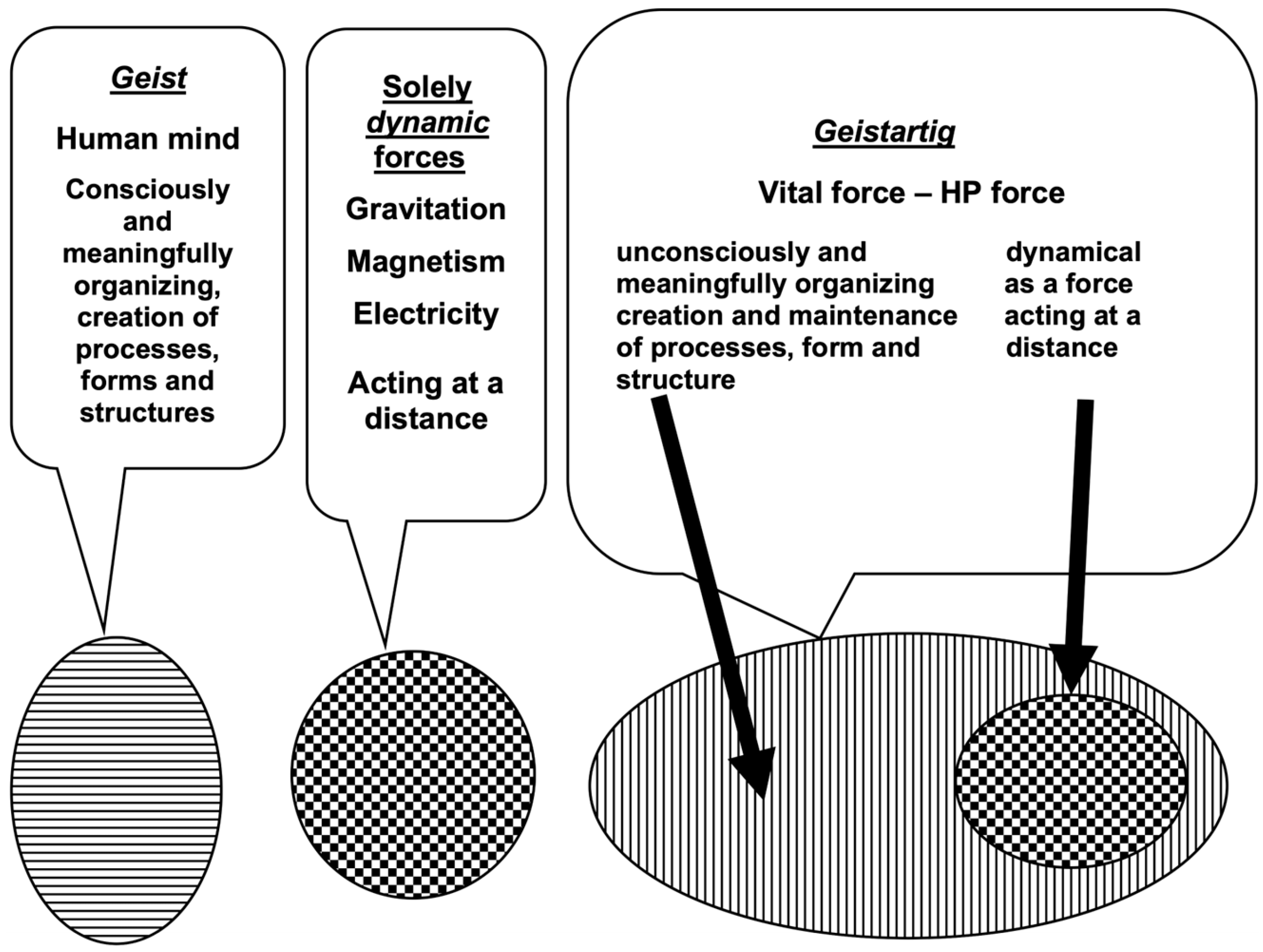
From 1797 to 1819, Hahnemann used the term dynamic to describe the mode of action of homeopathic remedies, very rarely accompanied by variants of Geist/geistig. Dynamic was a common technical term in the 18th/19th century, attributed to forces acting at a distance, such as electricity, gravitation or magnetism.
The term geistartig appeared only in the second phase, from 1821 to 1842. Geistartig was initially attributed to the vital force. In 1833, Hahnemann assumed a vital force, characterized as geistartig, was causing the harmonic co-action of the processes within a living organism, and were goal-oriented towards the organism as a whole [33] (§ 9). He concluded on the existence and the role of the vital force as a consequence of its absence, arguing that the dead body, subdued only by physical and chemical forces, disintegrates into its physico-chemical constituents [30] (§ 11). Hahnemann stated that being geistartig, the vital force could only be directly affected by remedies that are geistartig too [35] (§ 16), [30] (§ 16).
Simultaneously, Hahnemann discovered the qualitative unfolding of the symptoms provoked by remedies in provings with HDPPs (Online Resource S3).
In contrast to the varying, sporadic usage of terms containing the root geist* in his previous writings, without a single appearance of the term geistartig, the term geistartig was used frequently and continuously in Hahnemann’s later writings. It appears 17 times in the 5th edition and 33 times in the 6th edition of Organon of Medicine (Online Resource S1). Geistartig is used to specify the nature of the vital force and the agents that can influence the vital force directly, namely HPs and particularly HDPPs.
Comparable to the vital force, HPs cause meaningful qualitative changes in the processes of the human body, which are specific for each substance and unfold increasingly by potentization, demonstrated by HDPPs. Therefore, Hahnemann emphasized that purely physical forces differ from dynamic HP forces in their effect on the living organism [33] (Introduction footnote).
In summary, Hahnemann’s designation of the HDPP force as geistartig includes a dynamically acting force aspect and a qualitative aspect of organizing processes in living organisms in a meaningful manner, specific to each substance. Finally, Hahnemann applied the term geistartig not only to the force exerted by HPs, particularly by HDPPs, but in the case of HDPPs, also to the causative agent of this force [35] (§ 270 footnote).
The term geistartig represents a collocation, coined by Hahnemann, which can be translated as “similar to Geist.” Geist denotes the human mind, which is able to consciously understand meaningful structures. In contrast, the vital force and the HP force accomplish meaningful structures in the human organism, but unconsciously. Therefore, vital force, HP force and the active principle of HDPPs are “similar to Geist” (geistartig), but are not Geist itself.
Hahnemann’s understanding of forces characterized as geistartig in relation to dynamic forces is summarized and graphically illustrated in Figure 1.

2.2. Hahnemann’s Empirical Basis

Hahnemann developed a systematic method for gaining knowledge about the substance-specific effects of HPs on the human organism in the form of drug provings, described in The Organon of Medicine [24] (§§ 83–123), [25] (§§ 110–152), [26] (§§ 98–133), [27] (§§ 110–152), [28] (§§ 105–145), [33] (§§ 105–145). Provers must be healthy, to avoid mixing the disease symptoms with the remedy effects. They must be of both sexes and different physiques and avoid disturbing stimuli. The HP should be taken daily on an empty stomach. Provers should explore upcoming symptoms under varying conditions and write down their observations immediately, including the concomitant circumstances. Hahnemann ascribed all “primary symptoms”, appearing soon to the HP. He judged “secondary symptoms” to appear later and to be opposite to these, as overreactions of the vital force at large doses. Only primary symptoms should be respected. Proving must continue until no new symptoms occur.
The proving results are documented in Fragmenta [36], Reine Arzneimittellehre (RAL) [14,32,37,38,39,40,41,42,43,44,45,46,47,48,49], and Die chronischen Krankheiten (CKH) [50,51,52,53,54,55,56,57]. These documents list the observed specific effects of each HP on humans. The entries come from the provings that Hahnemann carried out on himself, his family or his students and, in the case of the RAL and the CKH, also from observations made by others. For each substance, descriptions for identification and for further manufacturing as well as hints for usage are provided. The origin of a symptom is given by the name of the prover or by a referenced publication. According to Hahnemann, the proving symptoms without a reference were observed by himself or by his family members [58] (p. 887).
From the beginning until 1829, Hahnemann advised the use of un-potentized HPs, containing material doses of the original substance, in provings [59] (pp. 534–535). However, in 1833, he suggested using 30c potencies for all provings [28] (§ 128). The first detailed description for preparing 30c potencies [37] (pp. 79–80) stems from 1833: plant juice was stepwise diluted 30 times in a ratio of 1:100 with alcohol and, for each step, shaken vigorously twice [28] (§ 270), and later, ten times [55] (pp. 26643). For insoluble substances, such as metals and minerals, Hahnemann discovered the method of trituration in lactose [41]. Thereby, colloidal dilutions of the substance could be produced. To prepare “antipsoric” HPs (HPs for chronic diseases), dry substances should be triturated in three steps, using a ratio of substance/lactose of 1/100 and one hour of trituration per step. The resulting 3c potency served as a base for 27 subsequent steps of 1:100 dilution and succussion in liquid medium, to prepare a 30c potency. Finally, poppy-seed-sized globules were moistened by the liquid [60] (pp. 768–771).
Hahnemann particularly referred to the provings conducted with 30c potencies when he stated that potentization fosters the qualitative unfolding of details in symptoms provoked by HPs [28] (§ 128). Un-potentized Belladonna, for example, showed 175 symptoms in the RAL first edition [38], whereas Belladonna 30c showed 1400 symptoms in the RAL third edition [37]. Furthermore, these symptoms exhibited a much greater level of detail. For example, the symptom “Anfälle von Schwindel mit Stumpfsinnigkeit einige Minuten lang” (dizziness with boredom for some minutes) [38] (p. 13) is supplemented by seven detailed proving reports on dizziness, such as “Drehen im Kopfe und zugleich ein ähnliches Drehen in der Herzgrube; nach Aufstehen ward es beim Gehen so schlimm, dass sie nichts mehr unterscheiden konnte, es schwand alles vor den Augen” (spinning in the head and simultaneous spinning in the stomach, worse after rising and walking, such that nothing could be seen anymore) [37] (p. 22089).
Hahnemann stated that even the totally immaterialized HDPP is effective [35] (§ 270). This claim is justified by documented proving reports with 30c potencies [48,57]. In view of this observation, his supposition that by continued potentization, the substance completely dissolves into its essence, which he calls geistartig [35] (§ 270, footnote), can be judged an admissible logical conclusion.
Finally, Hahnemann stated that HPs act dynamically, at a distance. He made his claim based on the following observations on patients for which he did not provide verifiable references to the reader of his publication:
  • HPs affect the entire body, independent of the place of application [23] (p. 37).
  • The effects of HPs spread immediately over the entire body without a time delay [30] (§ 288).
Hahnemann’s method of “smelling”, placing a remedy at a short distance from the nostrils for a certain period of time, is compatible with the concept of an effect at a distance. Hahnemann suggested smelling one globule of 30c potency [26] (p. 283 annotation) [28] (p. 294) to reduce the strength of the remedy in homeopathic treatment. In these cases, too, Hahnemann relied on his experience treating patients, providing no documented evidence to the public, however.

2.3. Epistemological Classification of Hahnemann’s Concept

In the beginning, Hahnemann called the active principle, even of HDPPs, “still material, though of only little weight” [24] (§ 245). Thereby, he assumed the infinite divisibility of matter, in accordance with the dynamistic school of science [61]. Later, Hahnemann called the remedy imponderable, “without any weight,” [28] (§ 305), [29] (§ 278), [30] (§ 305) consisting of pure latent force [34] (p. 723). Interestingly, his contemporary Kant [62] concluded, through a priori reasoning, that matter is constituted by forces. Hahnemann’s final statement that potentization completely dissolves substances into their immaterial essence, called geistartig [35] (§ 270 footnote), can also be viewed as pointing to a force-like essence of matter, as geistartig includes the property dynamic. Hahnemann also followed the dynamistic school of science by adopting the principle of action at a distance, introduced by Newton [63], for the assumed mode of action of homeopathic remedies. Hahnemann’s definition of dynamic force [35] (§ 270 footnote) agrees with Newton’s concept.
In contrast to dynamic, the term geistartig was not commonly used 200 years ago. Hahnemann introduced it, pointing to the organizing quality of the force. In this regard, Hahnemann’s ideas bear similarities with those of Kant. Kant differentiates between organizing and physical forces, with the latter exerting only moving effects (acceleration, deceleration, deformation). He states that moving forces alone cannot explain the functioning of organisms that require specific organizing forces [64] (p. 65). Based on empirically observable phenomena, Kant concluded that living beings have a teleological nature.
He developed the concept of a non-physical vital force, invisible but detectable by observable effects in living organisms [64]. For this concept, he introduced the epistemological category regulative idea of reason that can be regarded only as an aid to the understanding but not as something that constitutively determines its content.
Similarly, Hahnemann’s concept of the vital force is derived from empirical observations. Similar to Kant, Hahnemann held a teleological view of life, expressed, for example, in his main statement about the vital force [33] (§ 9). He used the concept of the vital force to refer to the causal principle of the teleologically acting agent while also emphasizing that this is not an observable reality; it serves as a help for thinking [33] (§ 15). Hahnemann praised Kant, because he demonstrated the limits of philosophy and human knowledge at the point where experience ends [65].
In summary, Hahnemann’s concept of the vital force is empirically based, guided by a teleological view of life and a dynamic view of matter. It respects the limits of cognition, as claimed by Kant [66].
The results of Section 2.1, Section 2.2 and Section 2.3. form the basis for the question of the current usability of Hahnemann’s concept.

2.4. Usefulness of Hahnemann’s Concept for Modern Homeopathy Research

2.4.1. Hahnemann’s Observations

Hahnemann based his concepts on systematic observations. His claims that HPs, including HDPPs, reorganize physiological processes in a substance-specific qualitative manner, fostered by potentization, can be verified by conducting provings or individualized homeopathic treatments in studies which respect modern scientific standards and use Hahnemann’s well-documented methods [13,14,20,35]. Hahnemann’s statement that HPs can also act without material contact, based on sporadic observations on patients, can also be easily tested in preclinical and clinical research.

2.4.2. Hahnemann’s Epistemological Stance

Hahnemann’s concept of pharmaceutical forces, particularly that of HDPPs, were derived from systematic observations and was based on a teleological view of life that will be compared with insights from modern biology below. It respects the limits of cognition, as claimed by Kant [66].

2.4.3. Hahnemann’s Understanding of Matter

Hahnemann refuted the atomistic school of science and followed the dynamistic school, which assumed that forces, not atoms, were the essence of matter [61]. This view will be discussed from the viewpoint of modern science below.
In summary, Hahnemann’s concept of the active principle of homeopathic remedies may be usable in modern science. The possible links will be discussed.

3. Discussion

In this Section, we discuss the empirical evidence for Hahnemann’s claims from today’s homeopathy research and potentially fruitful further questions.

3.1. Specific Properties of HDPPs

Hahnemann provided evidence through proving records for the efficacy of HDPPs and their organizing faculty, increased by potentization. However, the number of provers was small, and to Hahnemann’s own judgement, some of them lacked reliability [67] (p. 14). Although Hahnemann was aware of the problem that provers reported symptoms that could not be attributed to the remedy, he did not work with placebo controls. This method was not generally known at that time. Hence, the statements based on the proving results need further confirmation. In fact, there are some provings that partially observed specific effects of the HDPPs against a placebo, which await further replication [68,69,70,71,72].
The structuring and ordering properties of HDPPs could be observed by some first experiments in homeopathic basic research, using “image-creating” methods to assess the presumed structuring and ordering properties. For example, drops from eluates of wheat seedlings, treated with Arsenicum trioxide 45X [73] or with Zincum metallicum 30c [74], were dried on microscope slides, and the residues showed complex patterns differing from the corresponding controls. In other experiments, aqueous solutions of mashed cress seeds, germinated in Stannum metallicum 30x, were applied to a copper chloride solution in a Petri dish and evaporated [75,76]. In all the cases, the analysis of the residues by pattern recognition software revealed significant differences regarding texture, complexity and symmetry in the patterns produced by the HDPPs compared to the controls. The role of potentization is illustrated by an increase in complexity with increasing succussion strokes [77].
Hahnemann’s claims regarding the assumed action without physical contact are based on his observations of patients, but the studies were not published by him. These claims need confirmation by methods obeying modern standards. Some studies in this direction exist. Endler et al. [78,79] explored the influence of Thyroxine 30x in sealed glass vials placed in a water basin with tadpoles on the metamorphosis of the animals. Bell et al. [80,81,82] published observations of the effects of HDPPs on humans without physical contact by using an “olfactory” application according to Hahnemann’s procedure of letting patients “smell” HDPPs. Various preclinical experiments explored the physicochemical properties [2,3,4,5,6,7] of homeopathic preparations. Some experiments suggest the existence of an electromagnetic field component. Cartwright discusses that HDPPs might possess specific local molecular electric fields, observed by the reactions of solvatochromic dyes with HDPPs [83,84,85]. Montagnier et al. [86] and Elia et al. [87] report to have recorded electromagnetic signals emitted from HDPPs. Witt et al. [88] observed empirical evidence for interactions of HDPPs with electromagnetic radiation. These results agree with Hahnemann’s supposition that electricity or magnetism could be carriers of the specific information of the remedy [23] (p. 20970).
Thus, in summary, there are some first empirical hints for the force-like effects of HDPPs without material contact that need further confirmation, and it is worth exploring the nature of the presumed force-like interaction. This especially concerns a possible information transfer, including identifying the nature of the carrier of information and of the informative active principle.

3.2. Hahnemann’s Claims Compared to Concepts of Modern Science

The specific effects of HDPPs are contested primarily because they contradict the principle that pharmaceutical effects are based on the interactions of molecules composed of atoms constituted of electrons orbiting a nucleus of protons and neutrons [89]. However, this view relies on a simplified view of matter with a limited scope of validity. According to Bohr, a co-founder of quantum theory, the elementary constituents of reality are not particles or atoms but observable phenomena whose appearance depend on the experimental setting [90]. From 20th century physics, we know the phenomenon of matter waves [91]. This means that the simple particle model of matter had to be replaced by a model that merely makes probabilistic statements about the occurrence of events. This introduced indeterminism into the physics of matter. However, indeterminism leaves room for further influences [92], and in this case particularly, for non-physical influences.
Hence, Hahnemann’s refusal of an atomistic view of matter as composed of localizable particles shows similarities to concepts in modern physics. Hahnemann’s assumption of an additional non-physical force-like principle might be specified by the concept of Polanyi [93]. Polanyi introduced the concept of boundary conditions to explain specific life phenomena. Boundary conditions are immaterial overarching principles that limit the scope of physical and chemical laws but leave them untouched within their scope of validity. The active principle in HDPPs claimed by Hahnemann might be understood in that way.
In particular, Hahnemann’s term geistartig, used for characterizing the active principle of HDPPs and the vital force, implies a teleological interpretation. It includes the aspect of meaningful goal-oriented organization towards a wholeness, represented both by the vital force and by the essence of the potentized substance.
This gestalt-forming property is included in the concept denoted by the term geistartig. However, few modern theories on the mode of action of homeopathic remedies consider this aspect. Theories of self-organization that refer to chaos theory [94,95,96,97,98] must be supplemented with regard to the subjects of goal-oriented meaning and the organizing self. Contemporary biological theories take this aspect into account, particularly through the concept of orchestration [99] (p. 31), [100] (p. 108–110), [101] (p. 193). Orchestration refers to a meaningful, goal-oriented process in space and time which governs the behavior of molecules in the sense of a harmonious interaction within the living whole. Though molecules are necessary for its realization, the process’s specificity is determined only by the organism as a whole and its biological subunits, such as organs, tissues, and cells.
Bastide and Lagache [102], and subsequently Bonamin and Waisse [103], refer to the measurable physico-chemical modifications of the solvent by potentization and suggest treating them as signs, which are interpreted by the receiving organism. They rely on biosemiotics, which treats life processes as meaning-processing sign processes [104,105]. In biosemiotics, not molecules, but biological units such as subcellular organelles, cells, organs, and the organism as a whole, are the autonomous agents, the interpreting instance that provides meaning [105] (p. 154). Thereby, meaning is created without human consciousness, a crucial aspect of Hahnemann’s concept of geistartig. However, if the properties of HDPPs are seen as signs, how can these signs represent the essence of the potentized substance and not only the meaning for the receiving organism? According to Hahnemann’s provings, the entirety of the symptoms a remedy can provoke is specific for the substance, not for the receiving organism. This trait is in line with some provings that follow modern standards [68,69,70,71,72].
For the HDPPs of substances taken from organisms, biosemiotics assumes lawful processes, oriented towards the organism, e.g., Arnica or Pulsatilla, as their meaning-creating goal. The epitome of the laws, mediated by the organism which organizes the substance, could be equalized with Hahnemann’s essence of the substance, the hypothesized active principle of the remedy, comprehensibly characterized as geistartig. For inorganic substances, such as metals, their specific law of formation would be assumed as their essence.
The role of potentization and the process of information transfer and conservation from the meaningfully organized substance to the HDPP as meaningfully organized solvent, dry or liquid, must still be explored.
In summary, modern scientific results are not incompatible with Hahnemann’s concept of the mode of action of HDPPs and their active principle, which is represented by the essence of the original substance as a meaningful, organizing wholeness. His concepts could and should inspire and stimulate further research.

4. Materials and Methods

As the basis for our investigation, we analyzed the complete original texts published by Hahnemann from 1793, when he released his pharmacopoeia Apothekerlexikon [20], until his last publication, Organon der Heilkunst 6th ed. [35]. The Supplementary Material “Scope of literature search and selected documents” is available (Online Resource S4).
We did not analyze questions related to the Law of Similars, which states that a disease should be treated by a remedy that, in healthy humans, evokes symptoms similar to those of the disease [18]. We focused on Hahnemann’s concepts of the nature of HPs. Therefore, we restricted our analysis of Hahnemann’s empirical basis to his method of homeopathic provings (“pathogenetic trials”) [106], testing the effects of homeopathic preparations on healthy adults, and ignoring his handwritten case reports.
The term geistartig represents a collocation, meaning “similar to Geist.” The expression Geist is used in German in different ways; its actual meaning must be derived from the context. To explore and identify Hahnemann’s concept of geistartig, we performed a full-text search in Digitale Bibliothek [107] with the search term geist*, additionally with dynami*, a term often accompanying geist*. The result is available as Supplementary Material “Meanings of geist* and of the related term dynami*” (Online Resource S1). From these findings, we selected text passages containing the term geist*, referring to a remedy, the human organism or its diseases, the human mind, or a natural force, and added them to a quotation list, available as Supplementary Material “Quotation list—Hahnemann original” (Online Resource S2). We also extracted passages that contained information on the nature of homeopathic remedies that were not recorded in previous searches. Subsequently, we manually scanned all remaining documents from our literature list (Online Resource S4) for statements about the preparation and nature of HPs, their mode of action, and the usage of the terms geist* or dynami*. We added informative text passages in this regard to our quotation list (Online Resource S2).
To answer our research questions, we analyzed the retrieved mentions of the term geistartig regarding its meaning and consistent use, we examined the empirical basis of Hahnemann’s claims, primarily by means of documented provings, and we explored Hahnemann’s published methodology for possible classification. We juxtaposed the results with the requirements of modern science, asking for the usability of Hahnemann’s concept. We furthermore explored Hahnemann’s concepts to identify potential avenues for further basic research in the field of HDPPs.

5. Conclusions

Hahnemann used the term geistartig to characterize the active principle of HDPPs and the assumed vital force in organisms which reacts to HDPPs.
Geistartig characterizes a force which
  • meaningfully organizes processes in organisms in a substance-specific manner,
  • is latently present in substances and is brought to efficacy through potentization,
  • can act without material contact (dynamically),
  • is of the same kind as the force which enlivens organisms, different from physical forces.
The concept of geistartig is clearly defined, consistently used, empirically based, adopts a teleological view of life and respects the limits of cognition, as claimed by Kant.
Recent experiments from clinical and basic research corroborate the substance-specific organizing faculty of HDPPs; some first evidence for contactless (force-like) effects exists but requires further confirmation.
The crucial aspect of geistartig, meaningful organization, goal-oriented both towards the wholeness of the human organism in case of the assumed vital force, and towards the essence of the potentized substance in case of HDPPs, can be researched by the corresponding scientific methods. Examples for such approaches are given above, including experiments showing the ordering properties of HDPPs. Further future research might benefit from the concepts of modern biology that assume living biological units, subcellular organelles, cells, organs, and organisms, not molecules, as the meaning-providing autonomous agents. This approach might be particularly fruitful in view of Hahnemann’s claim that the force of the homeopathic remedy must be of the same kind as the force that enlivens the human body.
Thus, Hahnemann’s concept geistartig could contribute to the actual search for the active principle of HDPPs, particularly by its claim of a meaningful, organizing force aiming at wholeness.

Supplementary Materials

The following supporting information can be downloaded at: https://www.mdpi.com/article/10.3390/philosophies11040104/s1. In the Supplementary Materials, we used the following references: Online Resource S1: Meanings of geist* and of the related term dynami*: [18,20,23,30,32,35,37,46,47,48,49,53]. Online Resource S2: Quotation list—Hahnemann original: [18,19,20,21,22,23,24,25,26,27,28,29,30,31,32,33,34,35,36,37,39,40,41,48,49,55,57,59,60,108,109,110,111,112,113,114,115,116,117,118,119,120,121,122,123,124,125,126,127,128,129,130,131,132,133]. Online Resource S3: Hahnemann’s understanding of remedy effects: [18,19,21,24,28,30,32,35,39,41,42,43,45,46,51,52,57,111,112,131,133]. Online Resource S4: Scope of literature search and selected documents: [14,18,19,20,21,22,23,24,25,26,27,28,30,31,32,34,35,36,37,38,39,40,41,42,43,44,45,46,47,48,49,50,51,52,53,54,55,56,57,58,59,60,108,109,110,111,112,114,115,116,117,118,119,120,121,122,123,124,125,126,127,128,129,130,131,132,133,134,135,136,137,138,139,140,141,142].

Author Contributions

Conceptualization, R.K., P.H., S.W., and S.B.; methodology, R.K., P.H., S.W., and S.B.; validation, R.K., P.H., S.W., and S.B.; formal analysis, R.K., P.H., S.W., and S.B.; investigation, R.K.; resources, R.K.; data curation, R.K.; writing—original draft preparation, R.K.; writing—review and editing, R.K., P.H., S.W., and S.B.; supervision, P.H., S.W., and S.B.; project administration, S.B.; funding acquisition, R.K. and S.B. All authors have read and agreed to the published version of the manuscript.

Funding

This research was funded by “Rudolf Steiner-Fonds für wissenschaftliche Forschung”, Nuremberg, Germany. The “Rudolf Steiner-Fonds für wissenschaftliche Forschung” had no influence on the content of our research.

Institutional Review Board Statement

Not applicable.

Informed Consent Statement

Not applicable.

Data Availability Statement

Data are available as Supplementary Materials.

Acknowledgments

We would like to thank the “Institut für Geschichte der Medizin” in Stuttgart, Germany, for providing us with access to Hahnemann’s complete printed works. We thank Klaus von Ammon for his suggestions regarding unambiguous English formulations of German terms.

Conflicts of Interest

The authors declare no conflict of interest.

Abbreviations

The following abbreviations are used in this manuscript:
HDPPHighly diluted potentized preparation
HPHomeopathic preparation
CKHDie chronischen Krankheiten
RALReine Arzneimittellehre

References

  1. Sehon, S.; Stanley, D. Evidence and simplicity: Why we should reject homeopathy. J. Eval. Clin. Pract. 2010, 2, 276–281. [Google Scholar] [CrossRef] [PubMed]
  2. Klein, S.D.; Würtenberger, S.; Wolf, U.; Baumgartner, S.; Tournier, A. Physicochemical Investigations of Homeopathic Preparations: A Systematic Review and Bibliometric Analysis—Part 1. J. Altern. Complement. Med. 2018, 5, 409–442. [Google Scholar] [CrossRef] [PubMed]
  3. Tournier, A.; Klein, S.D.; Würtenberger, S.; Wolf, U.; Baumgartner, S. Physicochemical Investigations of Homeopathic Preparations: A Systematic Review and Bibliometric Analysis—Part 2. J. Altern. Complement. Med. 2019, 9, 890–901. [Google Scholar] [CrossRef] [PubMed]
  4. Tournier, A.; Würtenberger, S.; Klein, S.D.; Baumgartner, S. Physicochemical Investigations of Homeopathic Preparations: A Systematic Review and Bibliometric Analysis—Part 3. J. Altern. Complement. Med. 2021, 1, 45–57. [Google Scholar] [CrossRef] [PubMed]
  5. Ücker, A.; Baumgartner, S.; Sokol, A.; Huber, R.; Doesburg, P.; Jäger, T. Systematic Review of Plant-Based Homeopathic Basic Research: An Update. Homeopathy 2018, 2, 115–129. [Google Scholar] [CrossRef] [PubMed]
  6. Witt, C.M.; Bluth, M.; Albrecht, H.; Weisshuhn, T.E.R.; Baumgartner, S.; Willich, S.N. The in vitro evidence for an effect of high homeopathic potencies—A systematic review of the literature. Complement. Ther. Med. 2007, 2, 128–138. [Google Scholar] [CrossRef] [PubMed]
  7. Endler, P.C.; Bellavite, P.; Bonamin, L.; Jäger, T.; Mazon, S. Replications of fundamental research models in ultra high dilutions 1994 and 2015—Update on a bibliometric study. Homeopathy 2015, 4, 234–245. [Google Scholar] [CrossRef] [PubMed]
  8. Hamre, H.J.; Glockmann, A.; Ammon, K.v.; Riley, D.S.; Kiene, H. Efficacy of homoeopathic treatment: Systematic review of meta-analyses of randomised placebo-controlled homoeopathy trials for any indication. Syst. Rev. 2023, 1, 191. [Google Scholar] [CrossRef] [PubMed]
  9. Mathie, R.T.; Lloyd, S.M.; Legg, L.A.; Clausen, J.; Moss, S.; Davidson, J.R.T.; Ford, I. Randomised placebo-controlled trials of individualised homeopathic treatment: Systematic review and meta-analysis. Syst. Rev. 2014, 1, 142. [Google Scholar] [CrossRef] [PubMed]
  10. Mathie, R.T.; Ramparsad, N.; Legg, L.A.; Clausen, J.; Moss, S.; Davidson, J.R.; Messow, C.-M.; McConnachie, A. Randomised, double-blind, placebo-controlled trials of non-individualised homeopathic treatment: Systematic review and meta-analysis. Syst. Rev. 2017, 1, 63. [Google Scholar] [CrossRef] [PubMed]
  11. Schulz, V.M.; Ücker, A.; Scherr, C.; Tournier, A.; Jäger, T.; Baumgartner, S. Systematic review of conceptual criticisms of homeopathy. Heliyon 2023, 9, e21287. [Google Scholar] [CrossRef] [PubMed]
  12. Hahnemann, S. Organon der Heilkunst Textkritische Ausgabe. In Organon der Heilkunst: Textkritische Ausgabe der von Samuel Hahnemann für Die 6. Auflage Vorgesehenen Fassung, 6th ed.; Haug: Heidelberg, Germany, 1992. [Google Scholar]
  13. Hahnemann, S. Die Chronischen Krankheiten. In Digitale Bibliothek 3.69. Samuel Hahnemann: Gesammelte Werke; Directmedia Publishing GmbH: Berlin, Germany, 2003; pp. 25612–29318. [Google Scholar]
  14. Hahnemann, S. Reine Arzneimittellehre. In Digitale Bibliothek 3.69. Samuel Hahnemann: Gesammelte Werke; Directmedia Publishing GmbH: BerlIn Germany, 2003; pp. 22069–25611. [Google Scholar]
  15. Schott, H. (Ed.) Die Chronik der Medizin; Chronik Verlag: Gütersloh, Germany; München, Germany, 2000. [Google Scholar]
  16. Hermann, A. Der Dynamismus—Ein Paradigma Anfang des 19. Jahrhunderts. Phys. Blätter 1981, 10, 322–324. [Google Scholar] [CrossRef]
  17. Kuhn, T.S. Die Struktur Wissenschaftlicher Revolutionen, 4th ed.; Suhrkamp: Frankfurt am Main, Germany, 1979. [Google Scholar]
  18. Hahnemann, S. Versuch über ein neues Prinzip zur Auffindung der Heilkräfte der Arzneisubstanzen. In Gesammelte Kleine Schriften; Schmidt, J.M., Kaiser, D., Eds.; Haug: Heidelberg, Germany, 2001; pp. 212–250. [Google Scholar]
  19. Hahnemann, S. Gegenmittel einiger heroischen Gewächssubstanzen. In Gesammelte kleine Schriften; Schmidt, J.M., Kaiser, D., Eds.; Haug: Heidelberg, Germany, 2001; pp. 264–269. [Google Scholar]
  20. Hahnemann, S. Apothekerlexikon. In Digitale Bibliothek 3.69. Samuel Hahnemann: Gesammelte Werke; Directmedia Publishing GmbH: Berlin, Germany, 2003; pp. 23–20802. [Google Scholar]
  21. Hahnemann, S. Heilung und Verhütung des Scharlachfiebers. In Gesammelte Kleine Schriften; Schmidt, J.M., Kaiser, D., Eds.; Haug: Heidelberg, Germany, 2001; pp. 299–311. [Google Scholar]
  22. Hahnemann, S. Über die Kraft kleiner Gaben der Arzneien überhaupt und der Belladonna insbesondere. In Gesammelte Kleine Schriften; Schmidt, J.M., Kaiser, D., Eds.; Haug: Heidelberg, Germany, 2001; pp. 348–350. [Google Scholar]
  23. Hahnemann, S. Heilkunde der Erfahrung. In Digitale Bibliothek 3.69. Samuel Hahnemann: Gesammelte Werke; Directmedia Publishing GmbH: Berlin, Germany, 2003; pp. 20920–21012. [Google Scholar]
  24. Hahnemann, S. Organon der rationellen Heilkunde. In Organon-Synopse. Die 6 Auflagen von 1810–1842 im Überblick; Luft, B., Wischner, M., Eds.; Haug: Heidelberg, Germany, 2001; pp. 2–876. [Google Scholar]
  25. Hahnemann, S. Organon der Heilkunst 2. Auflage. In Organon-Synopse. Die 6 Auflagen von 1810–1842 im Überblick; Luft, B., Wischner, M., Eds.; Haug: Heidelberg, Germany, 2001; pp. 2–876. [Google Scholar]
  26. Hahnemann, S. Organon der Heilkunst 4. Auflage. In Organon-Synopse. Die 6 Auflagen von 1810–1842 im Überblick; Luft, B., Wischner, M., Eds.; Haug: Heidelberg, Germany, 2001; pp. 2–876. [Google Scholar]
  27. Hahnemann, S. Organon der Heilkunst 3. Auflage. In Organon-Synopse. Die 6 Auflagen von 1810–1842 im Überblick; Luft, B., Wischner, M., Eds.; Haug: Heidelberg, Germany, 2001; pp. 2–876. [Google Scholar]
  28. Hahnemann, S. Organon der Heilkunst 5. Auflage. In Organon-Synopse. Die 6 Auflagen von 1810–1842 im Überblick; Luft, B., Wischner, M., Eds.; Haug: Heidelberg, Germany, 2001; pp. 2–876. [Google Scholar]
  29. Haehl, R. Samuel Hahnemann. Sein Leben und Schaffen; Severus-Verlag: Hamburg, Germany, 2014; Volume 1. [Google Scholar]
  30. Hahnemann, S. Organon der Heilkunst 5. Auflage. In Digitale Bibliothek 3.69. Samuel Hahnemann: Gesammelte Werke; Directmedia Publishing GmbH: Berlin, Germany, 2003; pp. 21013–21528. [Google Scholar]
  31. Hahnemann, S. Wie können kleine Gaben so sehr verdünnter Arznei, wie die Homöopathie sie vorschreibt, noch Kraft, noch große Kraft haben? In Gesammelte Kleine Schriften; Schmidt, J.M., Kaiser, D., Eds.; Haug: Heidelberg, Germany, 2001; pp. 722–726. [Google Scholar]
  32. Hahnemann, S. Reine Arzneimittellehre. Sechster Theil. In Digitale Bibliothek 3.69. Samuel Hahnemann: Gesammelte Werke; Directmedia Publishing GmbH: Berlin, Germany, 2003; pp. 25121–25611. [Google Scholar]
  33. Hahnemann, S. Organon der Heilkunst 6. Auflage. In Organon-Synopse. Die 6 Auflagen von 1810–1842 im Überblick; Luft, B., Wischner, M., Eds.; Haug: Heidelberg, Germany, 2001; pp. 2–876. [Google Scholar]
  34. Hahnemann, S. Geist der homöopathischen Heil-Lehre. In Gesammelte Kleine Schriften; Schmidt, J.M., Kaiser, D., Eds.; Haug: Heidelberg, Germany, 2001; pp. 842–852. [Google Scholar]
  35. Hahnemann, S. Organon der Heilkunst 6. Auflage. Nach der handschriftlichen Neubearbeitung Hahnemanns für die 6. Auflage von Richard Haehl. In Digitale Bibliothek 3.69. Samuel Hahnemann: Gesammelte Werke; Directmedia Publishing GmbH: Berlin, Germany, 2003; pp. 22068–51529. [Google Scholar]
  36. Wettemann, M. Samuel Hahnemanns. Fragmenta de Viribus Medicamentorum. Die Erste Materia Medica Homoeopathica. Doctoral Thesis, Tübingen University, Tübingen, Germany, 2000; pp. 95–371. [Google Scholar]
  37. Hahnemann, S. Reine Arzneimittellehre. Erster Theil. In Digitale Bibliothek 3.69. Samuel Hahnemann: Gesammelte Werke; Directmedia Publishing GmbH: Berlin, Germany, 2003; pp. 22069–22860. [Google Scholar]
  38. Hahnemann, S. Reine Arzneimittellehre. Erster Theil, 1st ed.; Arnoldische Buchhandlung: Dresden, Germany, 1811; Volume 1. [Google Scholar]
  39. Hahnemann, S. Reine Arzneimittellehre. Zweiter Theil—Nebst einer Abhandlung: Geist der homöopathischen Heil-Lehre, 1st ed.; Arnoldische Buchhandlung: Dresden, Germany, 1816; Volume 2. [Google Scholar]
  40. Hahnemann, S. Reine Arzneimittellehre. Dritter Theil—Nebst Einer Abhandlung: Beleuchtung der Quellen der Gewöhnlichen Materia Medica, 1st ed.; Arnoldische Buchhandlung: Dresden, Germany, 1817; Volume 3. [Google Scholar]
  41. Hahnemann, S. Reine Arzneimittellehre. Vierter Theil—An: Eine Erinnerung, und: Der ärztliche Beobachter, ein Bruchstück, 1st ed.; Arnoldische Buchhandlung: Dresden, Germany, 1818; Volume 4. [Google Scholar]
  42. Hahnemann, S. Reine Arzneimittellehre. Fünfter Theil, 1st ed.; Arnoldische Buchhandlung: Dresden, Germany, 1819; Volume 5. [Google Scholar]
  43. Hahnemann, S. Reine Arzneimittellehre. Sechster Theil, 1st ed.; Arnoldische Buchhandlung: Dresden, Germany, 1821; Volume 6. [Google Scholar]
  44. Hahnemann, S. Reine Arzneimittellehre. Erster Theil, Zweite, Vermehrte Auflage, 2nd ed.; Arnoldische Buchhandlung: Dresden, Germany, 1822; Volume 1. [Google Scholar]
  45. Hahnemann, S. Reine Arzneimittellehre. Zweiter Theil—Zweite, Vermehrte Auflage, 2nd ed.; Arnoldische Buchhandlung: Dresden, Germany, 1824; Volume 2. [Google Scholar]
  46. Hahnemann, S. Reine Arzneimittellehre. Fünfter Theil. In Digitale Bibliothek 3.69. Samuel Hahnemann: Gesammelte Werke; Directmedia Publishing GmbH: Berlin, Germany, 2003; pp. 24626–25120. [Google Scholar]
  47. Hahnemann, S. Reine Arzneimittellehre. Vierter Theil. In Digitale Bibliothek 3.69. Samuel Hahnemann: Gesammelte Werke; Directmedia Publishing GmbH: Berlin, Germany, 2003; pp. 24122–24625. [Google Scholar]
  48. Hahnemann, S. Reine Arzneimittellehre. Zweiter Theil. In Digitale Bibliothek 3.69. Samuel Hahnemann: Gesammelte Werke, 3rd ed.; Directmedia Publishing GmbH: Berlin, Germany, 2003; pp. 22861–23587. [Google Scholar]
  49. Hahnemann, S. Reine Arzneimittellehre. Dritter Theil. In Digitale Bibliothek 3.69. Samuel Hahnemann: Gesammelte Werke; Directmedia Publishing GmbH: Berlin, Germany, 2003; pp. 23588–24121. [Google Scholar]
  50. Hahnemann, S. Die Chronischen Krankheiten, Ihre Eigenthümliche Natur und Homöopathische Heilung. Antipsorische Arzneien. Dritte Abtheilung, 1st ed.; Arnoldische Buchhandlung: Dresden, Germany, 1830; Volume 4. [Google Scholar]
  51. Hahnemann, S. Die Chronischen Krankheiten, Ihre Eigenthümliche Natur und Homöopathische Heilung. Dritter Theil. Antipsorische Arzneien; Arnoldische Buchhandlung: Dresden, Germany; Leipzig, Germany, 1829; Volume 3. [Google Scholar]
  52. Hahnemann, S. Die Chronischen Krankheiten, Ihre Eigenthümliche Natur und Homöopathische Heilung. Zweiter Theil. Antipsorische Arzneien, 1st ed.; Arnoldische Buchhandlung: Dresden, Germany; Leipzig, Germany, 1828; Volume 2. [Google Scholar]
  53. Hahnemann, S. Die Chronischen Krankheiten. Ihre eigenthümliche Natur und homöopathische Heilung. In Digitale Bibliothek 3.69. Samuel Hahnemann: Gesammelte Werke; Directmedia Publishing GmbH: Berlin, Germany, 2003; pp. 25612–29318. [Google Scholar]
  54. Hahnemann, S. Die Chronischen Krankheiten. Arzneimittel—Zweiter Theil. Ihre eigentümliche Natur und homöopathische Heilung. In Digitale Bibliothek 3.69. Samuel Hahnemann: Gesammelte Werke; Directmedia Publishing GmbH: Berlin, Germany, 2003; pp. 25960–26633. [Google Scholar]
  55. Hahnemann, S. Die Chronischen Krankheiten. Arzneimittel—Dritter Theil. Ihre eigentümliche Natur und homöopathische Heilung. In Digitale Bibliothek 3.69. Samuel Hahnemann: Gesammelte Werke; Directmedia Publishing GmbH: Berlin, Germany, 2003; pp. 26634–27371. [Google Scholar]
  56. Hahnemann, S. Die Chronischen Krankheiten. Arzneimittel—Vierter Theil. Ihre eigentümliche Natur und homöopathische Heilung. In Digitale Bibliothek 3.69. Samuel Hahnemann: Gesammelte Werke; Directmedia Publishing GmbH: Berlin, Germany, 2003; pp. 27372–28324. [Google Scholar]
  57. Hahnemann, S. Die Chronischen Krankheiten. Arzneimittel—Fünfter Theil. Ihre eigentümliche Natur und homöopathische Heilung. In Digitale Bibliothek 3.69. Samuel Hahnemann: Gesammelte Werke; Directmedia Publishing GmbH: Berlin, Germany, 2003; pp. 28318–28325. [Google Scholar]
  58. Hahnemann, S. Wie Sam. Hahnemann seine Arzneiprüfungen angestellt habe? In Gesammelte Kleine Schriften; Schmidt, J.M., Kaiser, D., Eds.; Haug: Heidelberg, Germany, 2001; pp. 887–889. [Google Scholar]
  59. Luft, B.; Wischner, M. (Eds.) Organon-Synopse. Die 6 Auflagen von 1810–1842 im Überblick; Haug: Heidelberg, Germany, 2001. [Google Scholar]
  60. Hahnemann, S. Anleitung zur Bereitung der antipsorischen Arzneien. In Gesammelte kleine Schriften; Schmidt, J.M., Kaiser, D., Eds.; Haug: Heidelberg, Germany, 2001; pp. 767–773. [Google Scholar]
  61. Hermann, A. Dynamismus und Atomismus—Die beiden Systeme der Physik in der 1. Hälfte des 19. Jahrhunderts. Erkenntnis 1976, 10, 311–322. [Google Scholar] [CrossRef]
  62. Kant, I. Metaphysische Anfangsgründe der Naturwissenschaften; CreateSpace Independent Publishing Platform: Berlin, Germany, 2016. [Google Scholar]
  63. Newton, I. The Mathematical Principles of Natural Philosophy; Leedham-Green, C.R., Ed.; Cambridge University Press: Cambridge, UK, 2021. [Google Scholar]
  64. Kant, I. Kritik der Urteilskraft; Philip Reclam Jun.: Stuttgart, Germany, 1986. [Google Scholar]
  65. Tischner, R. Geschichte der Homöopathie; Springer: Wien, Austria; New York, NY, USA, 1998; p. 129. [Google Scholar]
  66. Kant, I. Kritik der Reinen Vernunft, 2nd ed.; Cassirer, E., Ed.; Bruno Cassirer: Berlin, Germany, 1913. [Google Scholar]
  67. Lucae, C.; Wischner, M. Rein oder nicht rein? Z. Für Klass. Homöopathie 2010, 54, 13–22. [Google Scholar] [CrossRef]
  68. Möllinger, H.; Schneider, R.; Löffel, M.; Walach, H. A Double-Blind, Randomized, Homeopathic Pathogenetic Trial with Healthy Persons: Comparing Two High Potencies. Forsch. Komplentarmed Klass. Naturheilkd. 2004, 11, 274–280. [Google Scholar] [CrossRef] [PubMed]
  69. Walach, H.; Sherr, J.; Schneider, R.; Shabi, R.; Bond, A.; Rieberer, G. Homeopathic proving symptoms: Result of a local, non-local, or placebo process? A blinded, placebo-controlled pilot study. Homeopathy 2004, 93, 179–185. [Google Scholar] [CrossRef] [PubMed]
  70. Walach, H.; Möllinger, H.; Sherr, J.; Schneider, R. Homeopathic pathogenetic trials produce more specific than non-specific symptoms: Results from two double-blind placebo controlled trials. J. Psychopharmacol. 2008, 5, 543–545. [Google Scholar] [CrossRef] [PubMed]
  71. Möllinger, H.; Schneider, R.; Walach, H. Homeopathic pathogenetic trials produce specific symptoms different from placebo. Complement. Med. Res. 2009, 2, 105–110. [Google Scholar] [CrossRef] [PubMed]
  72. Piltan, D.; Rist, L.; Simoes-Wüst, A.P.; Saller, R. Test of a Homeopathic Dilution of Aconitum napellus—A Clinical, Randomized, Double-Blind, Controlled Crossover Study in Healthy Volunteers. Forsch. Komplementmed. 2009, 16, 168–173. [Google Scholar] [CrossRef] [PubMed]
  73. Kokornaczyk, M.O.; Trebbi, G.; Dinelli, G.; Marotti, I.; Bregola, V.; Nani, D.; Borghini, F.; Betti, L. Droplet evaporation method as a new potential approach for highlighting the effectiveness of ultra high dilutions. Complement. Ther. Med. 2014, 2, 333–340. [Google Scholar] [CrossRef] [PubMed]
  74. Kokornaczyk, M.O.; Baumgartner, S.; Betti, L. Polycrystalline structures formed in evaporating droplets as a parameter to test the action of Zincum metallicum 30c in a wheat seed model. Homeopathy 2016, 2, 173–179. [Google Scholar] [CrossRef] [PubMed]
  75. Doesburg, P.; Andersen, J.O.; Scherr, C.; Baumgartner, S. Empirical investigation of preparations produced according to the European Pharmacopoeia monograph 1038. Eur. J. Pharm. Sci. 2019, 137, 104987. [Google Scholar] [CrossRef] [PubMed]
  76. Baumgartner, S.; Doesburg, P.; Scherr, C.; Andersen, J.-O. Development of a biocrystallisation assay for examining effects of homeopathic preparations using cress seedlings. Evid.-Based Complement. Altern. Med. 2012, 1, 125945. [Google Scholar] [CrossRef] [PubMed]
  77. Betti, L.; Trebbi, G.; Kokornaczyk, M.O.; Nani, D.; Peruzzi, M.; Dinelli, G.; Bellavite, P.; Brizzi, M. Number of succussion strokes affects effectiveness of ultra-high-diluted arsenic on in vitro wheat germination and polycrystalline structures obtained by droplet evaporation method. Homeopathy 2017, 1, 47–54. [Google Scholar] [CrossRef] [PubMed]
  78. Endler, P.C.; Pongratz, W.; Smith, C.W.; Schulte, J. Non-molecular information transfer from thyroxine to frogs with regard to homeopathic toxicology. Vet. Hum. Toxicol. 1995, 3, 259–260. [Google Scholar] [CrossRef] [PubMed]
  79. Endler, P.C.; Pongratz, W.; van Wijk, R.; Wiegant, F.A.C.; Waltl, K.; Gehrer, M.; Hilgers, H. A Zoological Example on Ultra High Dilution Research. Energetic Coupling Between the Dilution and the Organism in a Model of Amphibia. In Ultra High Dilution; Endler, P.C., Schulte, J., Eds.; Springer: Dordrecht, The Netherlands, 1994; pp. 39–68. [Google Scholar]
  80. Bell, I.R.; Brooks, A.J.; Howerter, A.; Jackson, N.; Schwartz, G.E. Short-term effects of repeated olfactory administration of homeopathic sulphur or pulsatilla on electroencephalographic alpha power in healthy young adults. Homeopathy 2011, 4, 203–211. [Google Scholar] [CrossRef] [PubMed]
  81. Bell, I.R.; Brooks, A.J.; Howerter, A.; Jackson, N.; Schwartz, G.E. Acute electroencephalographic effects from repeated olfactory administration of homeopathic remedies in individuals with self-reported chemical sensitivity. Altern. Ther. Health Med. 2013, 1, 46–57. [Google Scholar]
  82. Bell, I.R.; Howerter, A.; Jackson, N.; Brooks, A.J.; Schwartz, G.E. Multiweek resting EEG cordance change patterns from repeated olfactory activation with two constitutionally salient homeopathic remedies in healthy young adults. J. Altern. Complement. Med. 2012, 5, 445–453. [Google Scholar] [CrossRef] [PubMed]
  83. Cartwright, S.J. Solvatochromic dyes detect the presence of homeopathic potencies. Homeopathy 2016, 1, 55–65. [Google Scholar] [CrossRef] [PubMed]
  84. Cartwright, S.J. Interaction of homeopathic potencies with the water soluble solvatochromic dye bis-dimethylaminofuchsone. Part 1: pH studies. Homeopathy 2017, 1, 37–46. [Google Scholar] [CrossRef] [PubMed]
  85. Cartwright, S.J. Homeopathic Potencies May Possess an Electric Field(-like) Component: Evidence from the Use of Encapsulated Solvatochromic Dyes. Homeopathy 2020, 1, 14–22. [Google Scholar] [CrossRef] [PubMed]
  86. Montagnier, L.; Aïssa, J.; Ferris, S.; Montagnier, J.-L.; Lavallée, C. Electromagnetic signals are produced by aqueous nanostructures derived from bacterial DNA sequences. Interdiscip. Sci. Comput. Life Sci. 2009, 2, 81–90. [Google Scholar] [CrossRef] [PubMed]
  87. Elia, V.; Marrari, L.A.; Napoli, E. Aqueous nanostructures in water induced by electromagnetic fields emitted by EDS. J. Therm. Anal. Calorim. 2012, 2, 843–851. [Google Scholar] [CrossRef]
  88. Witt, C.; Lüdtke, R.; Weisshuhn, T.E.R.; Willich, S.N. High homeopathic potencies are different from potentized solvent when investigated with the REDEM technology. Complement. Med. Res. 2005, 1, 6–13. [Google Scholar] [CrossRef] [PubMed]
  89. Mutschler, E.; Geisslinger, G.; Menzel, S.; Gudermann, T.; Hinz, B.; Ruth, P. Mutschler Arzneimittelwirkungen. Pharmakologie—Klinische Pharmakologie—Toxikologie, 11th ed.; Wissenschaftliche Verlagsgesellschaft: Stuttgart, Germany, 2020. [Google Scholar]
  90. Westphal, W.; Rotta, H. (Eds.) Nils Bohr—Atomphysik und menschliche Erkenntnis I, 2nd ed.; Vieweg: Braunschweig, Germany, 1964. [Google Scholar]
  91. Louis de Broglie—Nobel Prize Lecture. Available online: https://www.nobelprize.org/prizes/physics/1929/broglie/lecture/ (accessed on 9 June 2026).
  92. Anscombe, G.E.M. Causality and Determination; Cambridge University Press: Cambridge, UK, 1971. [Google Scholar]
  93. Polanyi, M. Life’s irreducible structure. Live mechanisms and information in DNA are boundary conditions with a sequence of boundaries above them. Science 1968, 3834, 1308–1312. [Google Scholar] [CrossRef] [PubMed]
  94. Bell, I.R. The Complexity of the Homeopathic Healing Response Part 1: The Role of the Body as a Complex Adaptive System in Simillimum-Initiated Recovery from Disease. Homeopathy 2020, 2, 42–50. [Google Scholar] [CrossRef] [PubMed]
  95. Bellavite, P. Complexity science and homeopathy: A synthetic overview. Homeopathy 2003, 4, 203–212. [Google Scholar] [CrossRef] [PubMed]
  96. Ivanovas, G. Abschied von der Lebenskraft–über die Organisation des Lebendigen. Homöopathie Konkret 2008, 3, 97–102. [Google Scholar]
  97. Teixeira, M.Z. Correlation between Vitalism and Genetics According to the Paradigm of Complexity. Homeopathy 2020, 1, 30–36. [Google Scholar] [CrossRef] [PubMed]
  98. Treuherz, F. Steiner and the Similimum. Homœopathic and anthroposophic medicine: The relationship of the ideas of Hahnemann, Goethe and Steiner. Work 1922, 1, 110–111. [Google Scholar]
  99. Fox Keller, E. The Century of the Gene; Harvard University Press: Cambridge, MA, USA, 2000. [Google Scholar]
  100. Heusser, P. Anthroposophy and Science: An Introduction; Peter Lang Edition: Frankfurt am Main, Germany; Bern, Switzerland; Brussels, Belgium; New York, NY, USA; Oxford, UK; Warsaw, Poland; Vienna, Austria, 2016. [Google Scholar]
  101. Rosslenbroich, B. Properties of Life: Toward a Theory of Organismic Biology; Vienna series in theoretical biology; The MIT Press: Cambridge, MA, USA, 2023. [Google Scholar]
  102. Bastide, M.; Lagache, A. A communication process: A new paradigm applied to high-dilution effects on the living body. Altern. Ther. Health Med. 1997, 4, 35–39. [Google Scholar]
  103. Bonamin, L.V.; Waisse, S. Biology and sign theory: Homeopathy emerging as a biosemiotic system. J. Med. Pers. 2015, 1, 18–22. [Google Scholar] [CrossRef]
  104. Hoffmeyer, J. Biosemiotics; University of Scranton Press: Scranton, PA, USA, 2008. [Google Scholar]
  105. Hoffmeyer, J. Why do we need a semiotic understanding of life? The problem of agency. In Beyond Mechanism. Putting Life Back into Biology; Henning, B.G., Scarfe, A.C., Eds.; Lexington Books: Lanham, MD, USA, 2013; pp. 147–168. [Google Scholar]
  106. Swayne, J. International Dictionary of Homeopathy; Chruchill Livingstone: Edingburgh, UK, 2000. [Google Scholar]
  107. Hahnemann, S. Digitale Bibliothek 3.69. Samuel Hahnemann: Gesammelte Werke; Directmedia Publishing GmbH: Berlin, Germany, 2003. [Google Scholar]
  108. Hahnemann, S. Valediction (Rede). In Gesammelte Kleine Schriften; Schmidt, J.M., Kaiser, D., Eds.; Haug: Heidelberg, Germany, 2001; pp. 3–11. [Google Scholar]
  109. Hahnemann, S. Aesculap auf der Waagschale. In Gesammelte Kleine Schriften; Schmidt, J.M., Kaiser, D., Eds.; Haug: Heidelberg, Germany, 2001; pp. 370–386. [Google Scholar]
  110. Hahnemann, S. Ueber den Werth der speculativen Arzneysysteme. In Gesammelte Kleine Schriften; Schmidt, J.M., Kaiser, D., Eds.; Haug: Heidelberg, Germany, 2001; pp. 502–514. [Google Scholar]
  111. Hahnemann, S. Geist der neuen Heillehre. In Gesammelte Kleine Schriften; Schmidt, J.M., Kaiser, D., Eds.; Haug: Heidelberg, Germany, 2001; pp. 639–647. [Google Scholar]
  112. Hahnemann, S. Vorwort über die Wiederholung eines homöopathischen Arzneimittels. In Gesammelte Kleine Schriften; Schmidt, J.M., Kaiser, D., Eds.; Haug: Heidelberg, Germany, 2001; pp. 858–862. [Google Scholar]
  113. Hahnemann, S. Nachtrag zum Vorworte über die Wiederholung der Gabe eines homöopathischen Arzneimittels. In Gesammelte Kleine Schriften; Schmidt, J.M., Kaiser, D., Eds.; Haug: Heidelberg, Germany, 2001; pp. 834–835. [Google Scholar]
  114. Hahnemann, S. Vorwort über die Wiederholung der Gabe eines homöopathischen Arzneimittels. In Gesammelte Kleine Schriften; Schmidt, J.M., Kaiser, D., Eds.; Haug: Heidelberg, Germany, 2001; pp. 823–828. [Google Scholar]
  115. Hahnemann, S. Vorwort über das Technische in der Homöopathik. In Gesammelte Kleine Schriften; Schmidt, J.M., Kaiser, D., Eds.; Haug: Heidelberg, Germany, 2001; pp. 879–883. [Google Scholar]
  116. Hahnemann, S. Was sind Gifte? Was sind Arzneien? In Gesammelte Kleine Schriften; Schmidt, J.M., Kaiser, D., Eds.; Haug: Heidelberg, Germany, 2001; pp. 454–460. [Google Scholar]
  117. Hahnemann, S. Belehrung für den Wahrheitssucher in Nr. 165 d. Bl. In Gesammelte Kleine Schriften; Schmidt, J.M., Kaiser, D., Eds.; Haug: Heidelberg, Germany, 2001; pp. 754–756. [Google Scholar]
  118. Hahnemann, S. Wie können kleine Gaben so sehr verdünnter Arznei, wie die Homöopathie sie vorschreibt, noch Kraft, noch so große Kraft haben? In Gesammelte Kleine Schriften; Schmidt, J.M., Kaiser, D., Eds.; Haug: Heidelberg, Germany, 2001; pp. 763–766. [Google Scholar]
  119. Hahnemann, S. Die Arzneien. In Gesammelte Kleine Schriften; Schmidt, J.M., Kaiser, D., Eds.; Haug: Heidelberg, Germany, 2001; pp. 869–876. [Google Scholar]
  120. Hahnemann, S. Über Chinasurrogate. In Gesammelte Kleine Schriften; Schmidt, J.M., Kaiser, D., Eds.; Haug: Heidelberg, Germany, 2001; pp. 438–444. [Google Scholar]
  121. Hahnemann, S. Über die Surrogate ausländischer Arzneyen. In Gesammelte Kleine Schriften; Schmidt, J.M., Kaiser, D., Eds.; Haug: Heidelberg, Germany, 2001; pp. 515–519. [Google Scholar]
  122. Hahnemann, S. Kurze Beleuchtung verschiedener Prinzipien, die Arzneymittel einzutheieln (1806/15). In Gesammelte Kleine Schriften; Schmidt, J.M., Kaiser, D., Eds.; Haug: Heidelberg, Germany, 2001; pp. 447–451. [Google Scholar]
  123. Hahnemann, S. Nachschrift an den Herausgeber. zum Schreiben des Hrn. Kollegienrath Korsakof zu Dimitrof an Hrn. Hofrath Hahnemann. In Gesammelte Kleine Schriften; Schmidt, J.M., Kaiser, D., Eds.; Haug: Heidelberg, Germany, 2001; p. 775. [Google Scholar]
  124. Hahnemann, S. Nachschrift des Herrn Hofrath Dr. S. Hahnemann. In Gesammelte Kleine Schriften; Schmidt, J.M., Kaiser, D., Eds.; Haug: Heidelberg, Germany, 2001; pp. 822–823. [Google Scholar]
  125. Hahnemann, S. Nachschrift des Herrn Hofrath, S. Hahnemann. In Gesammelte Kleine Schriften; Schmidt, J.M., Kaiser, D., Eds.; Haug: Heidelberg, Germany, 2001; pp. 828–829. [Google Scholar]
  126. Hahnemann, S. Beleuchtung der Quellen der gewöhnlichen Materia medica (Reine Arzneimittellehre, 1817). In Gesammelte Kleine Schriften; Schmidt, J.M., Kaiser, D., Eds.; Haug: Heidelberg, Germany, 2001; pp. 677–701. [Google Scholar]
  127. Hahnemann, S. Vorerinnerung zur zweiten Auflage. In Gesammelte Kleine Schriften; Schmidt, J.M., Kaiser, D., Eds.; Haug: Heidelberg, Germany, 2001; pp. 711–713. [Google Scholar]
  128. Hahnemann, S. Vorrede des deutschen Herausgebers. In Gesammelte Kleine Schriften; Schmidt, J.M., Kaiser, D., Eds.; Haug: Heidelberg, Germany, 2001; pp. 288–292. [Google Scholar]
  129. Hahnemann, F. Widerlegung der Anfälle Heckers auf das Organon der Rationellen Heilkunde. Ein erläuternder Kommentar zur homöopathischen Heillehre; Arnoldsche Buchhandlung: Dresden, Germany, 1811. [Google Scholar]
  130. Hahnemann, S. Historisch-medizinische Dissertation über den Helleborismus bei den Alten. Habilitation. In Gesammelte Kleine Schriften; Schmidt, J.M., Kaiser, D., Eds.; Haug: Heidelberg, Germany, 2001; pp. 553–637. [Google Scholar]
  131. Hahnemann, S. Die Chronischen Krankheiten. Arzneimittel—Erster Theil. Ihre eigentümliche Natur und homöopathische Heilung. In Digitale Bibliothek 3.69. Samuel Hahnemann: Gesammelte Werke; Directmedia Publishing GmbH: Berlin, Germany, 2003; pp. 25612–25959. [Google Scholar]
  132. Hahnemann, S. Einleitung in die Lehre von den ansteckenden Krankheiten und Seuchen. von D.A.H.F. Gutfeld, ausüb. Arzt in Altona. In Gesammelte kleine Schriften; Schmidt, J.M., Kaiser, D., Eds.; Haug: Heidelberg, Germany, 2001; pp. 428–435. [Google Scholar]
  133. Hahnemann, S. Etwas über die Pülverung der Ignatzbohnen und der Krähenaugen. In Gesammelte kleine Schriften; Schmidt, J.M., Kaiser, D., Eds.; Haug: Heidelberg, Germany, 2001; p. 281. [Google Scholar]
  134. Hahnemann, S. Fragmentarische Bemerkungen zu Browns elements of “medicine”. In Gesammelte kleine Schriften; Schmidt, J.M., Kaiser, D., Eds.; Haug: Heidelberg, Germany, 2001; pp. 340–347. [Google Scholar]
  135. Hahnemann, S. Heilkunde der Erfahrung. In Gesammelte kleine Schriften; Schmidt, J.M., Kaiser, D., Eds.; Haug: Heidelberg, Germany, 2001; pp. 384–417. [Google Scholar]
  136. Hahnemann, S. Vorrede zur vierten Ausgabe. In Gesammelte kleine Schriften; Schmidt, J.M., Kaiser, D., Eds.; Haug: Heidelberg, Germany, 2001; p. 774. [Google Scholar]
  137. Hahnemann, S. Vorwort Dilutionen und Potenzen. In Gesammelte kleine Schriften; Schmidt, J.M., Kaiser, D., Eds.; Haug: Heidelberg, Germany, 2001; pp. 885–886. [Google Scholar]
  138. Hahnemann, S. Die Chronischen Krankheiten, ihre eigenthümliche Natur und Homöopathische Heilung. Zweiter Theil. Antipsorische Arzneien, 1st ed.; Vol. 1; Arnoldische Buchhandlung: Dresden, Germany; Leipzig, Germany, 1828. [Google Scholar]
  139. Hahnemann, S. Unterricht für Wundärzte über Die venerischen Krankheiten; Siegfried Lebrecht Grufius: Leipzig, Germany, 1789. [Google Scholar]
  140. Hahnemann, S. Ueber die Kraft kleiner Gaben und der Arzneien überhaupt und der Belladonna insbesondere: Ein Schreiben an H. In Kleine Medicinische Schriften von Samuel Hahnemann; Stapf, E., Ed.; Arnoldische Buchhandlung: Dresden, Germany; Leipzig, Germany, 1829. [Google Scholar]
  141. Beleuchtung der Quellen der gewöhnlichen Materia medica (Reine Arzneimittellehre, 1825). In Gesammelte Kleine Schriften; Schmidt, J.M., Kaiser, D., Eds.; Haug: Heidelberg, Germany, 2001; pp. 732–753. [Google Scholar]
  142. Schmidt, J.M.; Kaiser, D. (Eds.) Gesammelte Kleine Schriften; Haug: Heidelberg, Germany, 2001. [Google Scholar]
Figure 1. Hahnemann’s distinction between forces called geistartig and dynamic forces.
Philosophies 11 00104 g001
Disclaimer/Publisher’s Note: The statements, opinions and data contained in all publications are solely those of the individual author(s) and contributor(s) and not of MDPI and/or the editor(s). MDPI and/or the editor(s) disclaim responsibility for any injury to people or property resulting from any ideas, methods, instructions or products referred to in the content.