


Abstract
Antimicrobial resistance—partly driven by inappropriate antibiotic consumption—is a major public health threat. Point-of-care (POC) procalcitonin testing can reduce antibiotic prescribing safely. Within an implementation-effectiveness trial, we conducted a two-phase participatory context analysis to identify and prioritise determinants of POC procalcitonin adoption, implementation and continued use in Swiss primary care. First, we conducted 32 semi-structured interviews with 34 participants, including physicians, representatives of medical organisations, patient representatives and other stakeholders. By coding transcripts deductively using the Consolidated Framework for Implementation Research and inductively, we identified 86 potential determinants. Second, in a focus group with ten ImpPro research team members, 15 determinants were identified as ‘not requiring change’, and ten were considered ‘unchangeable’. Among the remaining 61 determinants, 41 were prioritised through dot-voting and group discussion. These key implementation determinants were inductively grouped into eight themes. The themes with the highest priority were: (1) physicians’ awareness, knowledge, and access to education regarding POC procalcitonin, (2) scientific evidence supporting POC procalcitonin-guided antibiotic prescribing, (3) physician motivation and (4) endorsement of POC procalcitonin by credible organisations and experts. Addressing these determinants will likely require a tailored, multifaceted (combining several unique strategies), and multilevel (targeting different levels of the system) implementation strategy.
1. Introduction
Antibiotic resistance has become one of the greatest threats to global public health [1], estimated to have contributed to 4.95 million deaths in 2019 [2]. The World Health Organisation names the overuse of antibiotics as a catalyst for drug-resistant organisms [1]. In Switzerland, 87% of the total consumption of antibiotics occurs in medical practices, with higher consumption per inhabitant in the French- and Italian-speaking regions of Switzerland than in the German-speaking part [3]. Almost 20% of antibiotics are being prescribed for lower respiratory tract infections (LRTIs) [3]. While antibiotic treatment is often required for bacterial infections, only one in five LRTIs has a bacterial aetiology, and one in ten has a mixed aetiology [4]. Diagnostic uncertainty has been identified as one of the main reasons for antibiotic overprescribing for respiratory tract infections [5]. Procalcitonin, an inflammatory biomarker measured in blood samples, may help guide antibiotic prescribing by reducing diagnostic uncertainty, as higher procalcitonin levels were associated with an increased probability of bacterial pathogens [6]. However, withholding antibiotic treatment based on procalcitonin levels has been questioned and needs further investigation [7]. UltraPro, a cluster-randomised controlled trial recently conducted in primary care in Switzerland, found that, compared to usual care, the use of point-of-care (POC) procalcitonin testing reduced antibiotic prescribing for patients with clinical evidence of community-acquired pneumonia by an absolute 26% without affecting patient safety [8]. The Swiss Society of Infectious Diseases mentions the use of procalcitonin to guide antibiotic prescribing for LRTIs [9], but POC procalcitonin is currently not reimbursed in the outpatient setting, and thus not yet integrated in the routine practice of Swiss physicians.
The ImpPro project is a hybrid type-2 implementation-effectiveness trial set in primary care practices in French-speaking Switzerland. It has two primary aims. The implementation aim is to develop and evaluate a multifaceted implementation strategy to increase adoption, implementation, and sustained use of POC procalcitonin-guided antibiotic prescribing. The effectiveness aim is to evaluate if POC procalcitonin reduces antibiotic prescribing for LRTIs in a real-life setting.
In this article, we report results of the context analysis of the ImpPro trial, drawing on a structured methodology. This two-phase methodology used a participatory approach to, one, identify and, two, prioritise factors likely to influence the implementation process (i.e., implementation determinants) [10]. As described by Bührmann et al. [11], such a “prospective process involving systematic identification of determinants of practices within a local context” should be the first step in developing a context-specific, tailored implementation strategy. The tailoring procedure described by Bührmann et al. aligns with the implementation strategy development methodology of ImpPro, which included a four-step participatory procedure. “Implementation strategy ideation and selection” represent steps three and four [10,11]. Here, we describe steps one and two, in which we aimed to identify and prioritise implementation determinants for POC procalcitonin-guided antibiotic prescribing, following a rigorous identification process and drawing on existing prioritisation methods [12].
2. Materials and Methods
To identify and prioritise implementation determinants for POC procalcitonin-guided antibiotic prescribing, we applied a two-phase participatory approach, which has been described in detail in the study protocol [10]. The first phase included stakeholder interviews to identify a wide range of potential implementation determinants. The second phase included a survey and a focus group with ImpPro research team members to rate, discuss and prioritise the potential implementation determinants identified in phase one and to select the key implementation determinants to be subsequently addressed by implementation strategies within the ImpPro project. The initiation of the ImpPro project is contingent upon the reimbursement of POC procalcitonin by the relevant Swiss health authorities. Therefore, the implementation determinant of ‘reimbursement’ is regarded as pre-established and will not be addressed in this paper.
This study was conducted in Switzerland. Eligible participants for interviews, the survey and the focus group were stakeholders for the implementation of POC procalcitonin in the primary care setting (e.g., primary care physicians, representatives from medical organisations, medical practice assistants, ImpPro members). After providing informed consent, participants took part in online interviews that were audio- and video-recorded via an online meeting platform. Interviews conducted in person were audio-recorded. Self-employed interviewees or interviewees attending in their free time were offered a book voucher of 20–50 Swiss Francs.
Data reporting followed the Standards for Reporting Qualitative Research (SRQR) Criteria [13].
2.1. Ethics
The context analysis for ImpPro did not fall within the scope of the Human Research Act, and the cantonal ethics commission of Zurich waived the need for a formal evaluation (Nr. Req-2023-00392).
2.2. Guiding Framework
The Updated Consolidated Framework for Implementation Research (CFIR) was used as a guiding framework for the interview guide and deductive analysis [14]. The CFIR is a determinant framework comprising more than 50 constructs grouped into five domains: innovation, outer setting, inner setting, individuals, and implementation process. For our context analysis, the innovation was defined as the POC procalcitonin test and the POC procalcitonin-guided antibiotic prescribing. The inner setting referred to the primary care practice; the outer setting included the social and physical environment outside of the primary care practice (e.g., the socio-economic context); the individuals domain included the stakeholders for the implementation process (i.e., people and entities who could influence or are affected by the implementation of POC procalcitonin in primary care practices) and their characteristics (e.g., motivation). The fifth domain, the “implementation process”, was not analysed as part of the contextual analysis, as implementation had not taken place at the time of the interviews.
2.3. Phase One: Identifying Potential Implementation Determinants
2.3.1. Participants
We conducted interviews with stakeholders recruited through purposive sampling to ensure high information power [15]. Initial interviewees were identified from websites of governmental and professional organisations, and recommendations from ImpPro research team members familiar with the primary care setting through their previous experience in primary care research and their involvement in the UltraPro predecessor study. Further interviewees were identified using a snowball-sampling technique [16]. Sampling stopped when a comprehensive understanding of the primary care setting was achieved, comprising the viewpoints of stakeholders within and outside of the practices. For the stakeholder group of primary care physicians (referred to as physicians in this article), we applied a purposeful, maximum variation sampling regarding gender, years practising, practice setting (urban vs. rural), group vs. single practice, and experience with POC procalcitonin testing due to participating in the UltraPro predecessor study [8,17].
2.3.2. Data Collection and Analysis
The semi-structured interview guide included approximately 15 open-ended questions and was iteratively adapted throughout data collection to fit the interviewee’s profession and role, and to close remaining knowledge gaps. The core version of the interview guide has been published as a supplementary file in the study protocol [10]. Interviews lasted 30–60 min and were conducted between March and November 2023. Interviews were held in English, French, or German by a PhD candidate and psychologist (S.C.L.G.) together with either a senior researcher and infectiologist (A.W.), or a PhD candidate and physician (J.D.).
Interviews were transcribed verbatim in the original language and only translated into English when included as quotes in the present manuscript. Interview transcripts were coded deductively on the software MaxQDA 2022® (release 22.8.0) with a codebook based on the updated CFIR [14,18]. Implementation determinants were inductively identified from these deductively coded segments, allowing for a more nuanced and context-specific description of data. Three researchers (A.W., S.C.L.G., J.D.) coded transcripts independently before holding consensus discussions. Disagreements were resolved by discussion or a fourth researcher (L.C.).
2.4. Phase Two: Selecting and Prioritising Implementation Determinants
2.4.1. Participants
Researchers working for ImpPro were invited to participate in phase two.
2.4.2. Data Collection and Analysis
During a focus group discussion and dot voting, implementation determinants identified in phase one were prioritised based on their perceived changeability and importance [12]. A determinant was defined as changeable if it could be modified with a reasonable amount of investment and within the study’s timeframe. A determinant was defined as important if its modification would likely lead to a substantially improved implementation of POC procalcitonin.
To facilitate the focus group discussion, a pre-discussion survey was administered using Unipark© [19]. Supplementary File S1 contains a summarised version of the pre-focus group survey developed for this study. In this survey, participants were asked to rate each determinant on (1) changeability and (2) importance on ten-point Likert scales. The median values and inter-quartile ranges of perceived changeability and importance were then calculated per determinant on Microsoft Excel. All determinants of phase one, along with changeability and importance results, were displayed in a two-hour online focus group moderated by A.W. on the collaborative online whiteboard Miro® [20]. Supplementary File S2 contains the moderator guide developed for this study. During the focus group, participants first discussed and excluded determinants that did not require change (e.g., determinants that theoretically could influence the implementation but were already satisfactorily covered in the present context) or were not changeable within the project timeframe of three years. Then, a dot-voting with 120 dots per participant was conducted to prioritise the remaining determinants (assignment of more than one dot per determinant was allowed). All determinants with a cumulative dot count above ten, along with a few additional determinants identified by ImpPro research team members with the highest context-specific knowledge (A.W., S.C.L.G., N.B.-B. and Y.M.), were considered key determinants. Key implementation determinants were then grouped (S.C.L.G., A.W.) into inductively defined determinant themes. Dot-vote medians were calculated per determinant theme on Microsoft Excel.
3. Results
In phase one, we conducted 32 semi-structured interviews with 34 participants. Due to insufficient audio quality of the recording, one interview could not be transcribed. Interviews were held with one interviewee, except for one group interview with three laboratory machine providers of the same company. Interviewee characteristics are provided in Table 1. The roles of the interviewed stakeholder groups are defined in Supplementary File S3. In phase two, participants were 11 ImpPro research team members with backgrounds in family medicine, infectious diseases, implementation science, pharmacy, epidemiology and health economics, several of whom had expertise in the field of primary care. Of these 11 members, ten completed the survey and ten participated in the focus group.
Table 1.
Interview participants by stakeholder category (N = 34). Interviews were held individually, except for one group interview (consisting of three laboratory machine provider representatives). While ten participants were interviewed in the role of physicians, 11 additional participants interviewed in other roles were also physicians and sometimes articulated their perspective as physicians (to ensure anonymity, double professions are not disclosed).
3.1. Phase One: Identified Potential Implementation Determinants
In phase one, we identified a total of 86 potential implementation determinants. When coded deductively, 29 (33.7%) belonged to the CFIR domain individuals, 22 (25.6%) to outer setting, 21 (24.4%) to innovation, and 14 (16.3%) to inner setting (“Appendix A” contains the implementation determinants identified in phase one).
3.2. Phase Two: Selected and Prioritised Implementation Determinants
The pre-discussion survey assessing the changeability and importance of the 86 potential implementation determinants showed a median changeability score of 5.5 (interquartile range (IQR): 3.5–7) and a median importance score of 7 (IQR: 6.5–8), with both measures rated on a ten-point scale.
3.2.1. Exclusion of Potential Implementation Determinants
In the first step of the focus group, 25 (29.1%) of the implementation determinants were excluded: 15 (17.4%) were deemed ‘not requiring change’, and ten (11.6%) were considered ‘unchangeable within the study’s timeframe’ (Table 2). Determinants excluded due to not requiring change were, e.g., the design of the POC procalcitonin device (e.g., device size, time to test result), which was already considered a good fit. Also, the medical practice assistants’ technical skills, which were considered sufficient, and the intrinsically present laboratory machine provider’s motivation and skills in selling and providing technical support for POC procalcitonin testing were excluded. Unchangeable determinants were, e.g., the seasonality of respiratory illnesses and the national shortage of medical personnel. Additional determinants were excluded because they could not be changed within the project’s timeframe, such as the cost of POC procalcitonin testing for society and for patients with high deductibles.
Table 2.
Determinants excluded during the focus group. Excluded determinants are grouped by reason for exclusion.
3.2.2. Key Implementation Determinants
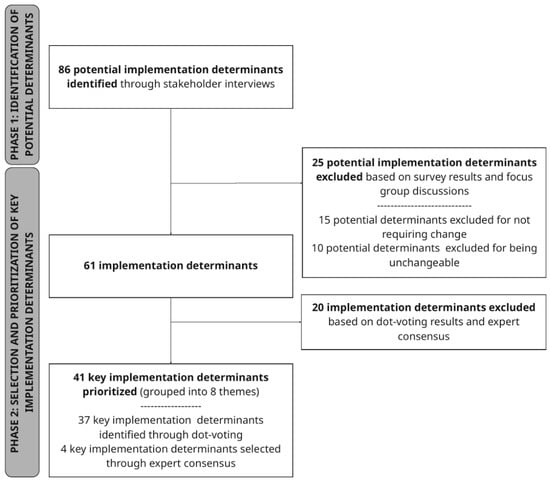
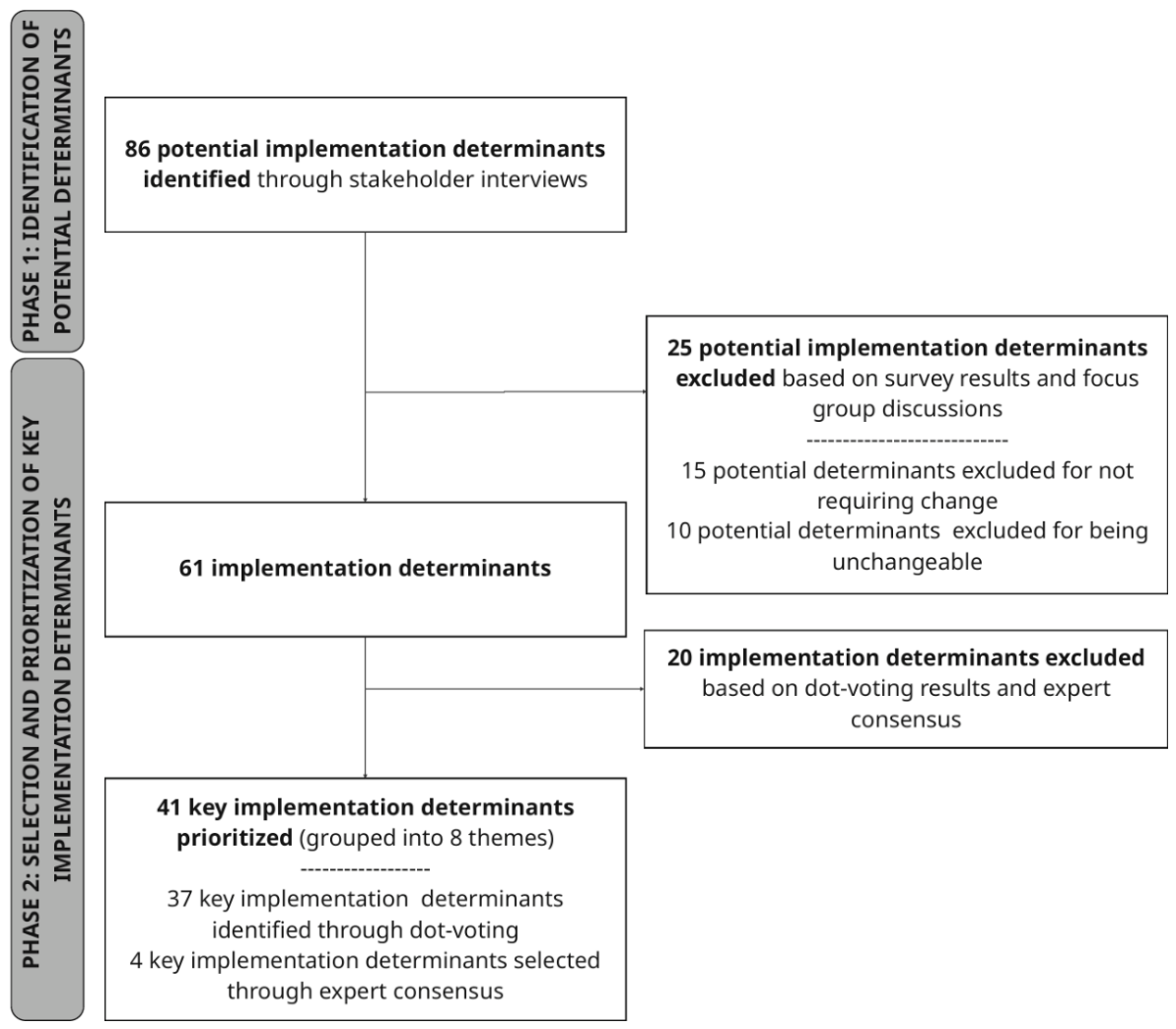
Of the remaining 61 implementation determinants, 37 were identified as key determinants through dot-voting, and an additional four were selected by ImpPro research member consensus (Figure 1). These 41 key determinants (dot-voting median: 18, IQR: 12–25) were grouped into eight determinant themes (Table 3), described below.
Figure 1.
Graphic representation of the identification of potential implementation determinants (phase 1), the selection of implementation determinants (phase 2), and prioritisation of key implementation determinants (phase 2).
Table 3.
Determinant themes and dot-voting scores. Determinant themes are in bold, including the median and the interquartile range per determinant theme. For each determinant theme, key implementation determinants are listed below with their dot-voting score. A higher dot-voting score signifies higher attributed importance.
3.2.3. Physician Awareness, Knowledge and Access to Education Regarding POC Procalcitonin (Median Dot-Voting Score: 29.5, Inter-Quartile Range (IQR): 20.3–50)
At the time of the interviews, POC procalcitonin was neither widely used nor reimbursed in the primary care setting. Physicians and managers were often unaware of which laboratory machines available on the Swiss market could perform procalcitonin testing, the indications for its use, or the threshold values used to guide antibiotic prescribing. A few physicians reported having some knowledge of procalcitonin use in inpatient care, primarily from their hospital training.
Physician: “At the moment nobody [no family medicine physician] knows [POC-procalcitonin]. You have the tests in the hospitals. It is done in the hospitals, but we don’t have the experience in the practice”.
Knowledge about all aforementioned aspects was identified as essential for the successful implementation and use of POC procalcitonin. While physicians generally reported good access to education and information, their preferred sources varied. Most commonly, they cited Swiss scientific journals, national conferences, or guidelines issued by Swiss professional societies or regional experts.
3.2.4. Scientific Evidence Supporting POC Procalcitonin-Guided Antibiotic Prescribing (Dot-Voting Score: 21, IQR Not Applicable (n = 1))
The scientific evidence supporting the use of POC procalcitonin to guide antibiotic prescribing was mentioned as a determinant by some physicians but was more frequently mentioned by representatives of professional organisations that considered advocating the use of POC procalcitonin. Many interviewed physicians—and even more so representatives of organisations—questioned whether sufficient scientific evidence currently exists to support the use of POC procalcitonin for the outpatient setting. They specifically mentioned a lack of studies directly comparing the effectiveness and safety of POC-C-reactive protein (an inflammatory biomarker test which is already broadly used in the Swiss primary care setting) with POC procalcitonin in guiding antibiotic prescribing.
Organisation representative: “I know only one study that compared the additional value of procalcitonin to C-reactive protein. It’s quite an older study. (…) In this study procalcitonin did not provide an additional value. In other words, it depends on whether we can demonstrate that procalcitonin really does offer a benefit. That means that it is clinically more effective than C-reactive protein and the costs are justifiable. Then I would say, ‘let’s go’.”
3.2.5. Motivation of Physicians and/or Practice Managers to Implement POC Procalcitonin (Median Dot-Voting Score: 19, IQR: 15.5–23.5)
Individual motivation to implement the POC test and prescribe antibiotics according to test results was identified as essential for successful implementation. Physicians’ and managers’ motivation to implement and use POC procalcitonin ranged from very low to very high, with greater motivation among physicians who had previously used POC procalcitonin during the UltraPro trial and those working in walk-in clinics. Motivation was described as being influenced by all implementation determinants mentioned.
3.2.6. Endorsement of POC Procalcitonin by Trustworthy Organisations and Experts (Median Dot-Voting Score: 19, IQR: 11–28)
Physicians emphasised that endorsement of POC procalcitonin by trustworthy sources is essential. They specifically highlighted that advocacy by multiple organisations and experts, rather than just a single one, is particularly motivating to drive practice change and facilitate POC procalcitonin’s adoption and implementation.
Organisation representative: “[reducing physicians’ overestimation of the effect of antibiotics] requires information [education] again and again and again via various channels.”
The most frequently mentioned trustworthy sources were Swiss professional societies for general internal medicine, primary care, and infectious diseases, academic institutes for family medicine, infectious diseases (ID) physicians from regional hospitals, health authorities and regulatory authorities. Peers and sometimes laboratory machine providers were also mentioned. Physicians’ reliance on these sources was, at least in part, attributed to a lack of time to engage with the primary scientific literature on the topic.
The interviewed organisation representatives and experts generally stated that they only advocate for an innovation when they are convinced by the supporting scientific evidence (see following theme). While some representatives of societies felt that endorsing POC procalcitonin fell outside their responsibilities or was not appropriate for their role, others considered it one of several antimicrobial stewardship innovations worth supporting. Organisations often appear to take a reactive stance in advocating for innovations, typically responding to individuals or organisations that approach them with specific requests for support.
Organisation representative: “If we have good evidence to tell our colleagues [members] from a research point of view or from an academic point of view, then a position paper could be a possibility to spread the information [about POC procalcitonin or another innovation].”
3.2.7. Patient Perceived Need for an Accurate Diagnosis via a Blood Test (Dot-Voting Score: 16, IQR Not Applicable (n = 1))
The interviewed patient representatives stated that having an objective test is reassuring, but they also emphasised their trust in physicians’ clinical judgement. Interestingly, all three patient representatives preferred a test with a blurry threshold for prescribing antibiotics as they felt it allowed room for physicians to incorporate clinical signs and symptoms into their decision-making.
3.2.8. Perceived Need and Benefit of POC Procalcitonin in Diagnosis and Patient Communication (Median Dot-Voting Score: 15, IQR: 11.5–19.5)
Many physicians reported a low perceived need for POC procalcitonin, noting that they rarely encounter patients for whom the test would be indicated, such as suspected pneumonia. Among physicians, those practising in urban areas perceived a lower need compared to their rural counterparts, largely due to their proximity to alternative diagnostic tools, such as radiology services available at nearby institutes. However, physicians identified four situations in which they perceived POC procalcitonin would be useful and reassuring. First, among physicians working in walk-in clinics, where emergency consultations for suspected pneumonia are more frequent, patients are frequently seen for the first time with limited follow-up opportunities. Second, for elderly or immunocompromised patients with suspected pneumonia, where diagnostic uncertainty is higher, and misdiagnoses are more relevant. Third, when patients presented with suspected pneumonia shortly before weekends or holidays, it limited their access to follow-up care. Fourth, POC procalcitonin was seen as helpful in conversations about withholding antibiotics, as the numerical result provided reassurance to patients and supported the physician’s decision.
Physician: “I often take the example of a respiratory tract infection on Friday. If we could make, I would say, a relatively reliable decision at that moment–supported by effective biomarkers-everyone would have better weekends.”
POC procalcitonin was frequently compared to POC-C-reactive protein. Interviewees expressed mixed opinions: while some mentioned that procalcitonin has a higher specificity and clearly defined threshold for diagnosing bacterial infections, others questioned whether potential advantages justify the effort and challenges associated with introducing a new test.
3.2.9. Availability, Trialability and Cost of POC Procalcitonin (Median Dot-Voting Score: 13, IQR: 12–16)
Many physicians expressed the desire to have access to a POC procalcitonin device for a trial period to gain firsthand experience with the test.
Physician: “People need to make their own experience, that is, to really personally validate this kind of test themselves and to see how it can help them and how it can be beneficial for the patients.”
Furthermore, the availability of a wider selection of devices that permit POC procalcitonin testing—rather than just one or two options—was identified as a facilitator for adoption. Ideally, the procalcitonin test could be performed on a POC device that is already in use in the physicians’ practice. Interviewees agreed that purchasing and using POC procalcitonin tests should be at least cost-neutral, with some suggesting that the potential for financial profit could further support implementation.
Physician: “The main costs are rental and operating costs for the machine. Then there are the types of financial benefits. It is important that there is a profit or a cost-neutral operation, but no loss.”
3.2.10. Physician Exposure to Large Amounts of Information (Dot-Voting Score: 7, IQR Not Applicable (n = 1))
Given their time-intensive clinical schedules, many physicians expressed feelings of being overwhelmed by the sheer volume of new guidelines, treatment recommendations, innovative technologies, and regulations they are expected to be aware of and integrate into their practice. This abundance of information was reported to make it challenging to stay up to date and adopt innovations—including POC procalcitonin—into clinical practice.
Physician: “Everybody’s a bit burnt out and [this is] in part due to the [sheer] amount of information we’re facing every day. That can be quite exhausting.”
4. Discussion
In this two-phase, participatory contextual analysis, we first identified a wide range of 86 potential implementation determinants for POC procalcitonin-guided antibiotic prescribing in LRTIs in Swiss primary care. We then prioritised determinants based on changeability and importance, leading to the identification of eight determinant themes to be targeted during future tailored implementation efforts. Implementation determinants rated as most important were the physician’s awareness and knowledge about the several aspects of POC procalcitonin testing (e.g., its reimbursement, indications). Currently, physicians and organisational stakeholders hold mixed attitudes regarding the scientific evidence supporting the use of POC procalcitonin in the outpatient setting and the general need for a new POC test to apply in outpatients with LRTIs. Trialability of POC-tests was mentioned as an important facilitator. Physicians and representatives from organisations emerged as the most central stakeholders for implementing POC procalcitonin within primary care settings, whereas medical practice assistants and patient representatives appeared to have a more limited role in the implementation process.
The primary care physicians are the key decision-makers regarding the immediate adoption, implementation and use of the test, and their motivation to implement POC procalcitonin-guided antibiotic prescribing is thus central. Only in practices with a manager, there is a second person who substantially contributes to the decision-making process of adopting POC procalcitonin devices. Medical practice assistants play a crucial role in the practical implementation and execution of the test. The interviews confirmed that, as POC procalcitonin compares to many other POC tests, medical practice assistants possess the necessary technical skills. Still, they seem to hold very limited authority to decide on the adoption and use of the test. In congruence with the literature, the few patient representatives interviewed expressed general interest in a test that provided an objective result [21], while also emphasising the importance of incorporating the physician’s clinical expertise into the diagnostic process. Given the limited information provided during the interviews and the complexity of the topic, patient representatives did not exhibit a preference for POC procalcitonin over the established POC-C-reactive protein.
While being a crucial facilitator for adoption and implementation, the motivation to adopt POC procalcitonin among physicians was mixed. Motivation was highly linked to the perceived need for POC procalcitonin, i.e., the recognition that the test is necessary, beneficial, and valuable for improving the current practices in antibiotic decision-making. Physicians who had previously used the test, i.e., the physicians allocated to the arms of the randomised controlled UltraPro trial that were using POC procalcitonin, seemed more motivated in integrating the test into their clinical routine. This finding links directly to the key determinant of trialability, the degree to which an innovation can be experimented with before full implementation [14]. Due to being non-binding and leaving the option of withdrawal, trialability was perceived by our interviewees as reducing the physicians’ risk of implementing a device that later does not meet their needs. In a qualitative study that followed the UltraPro trial, physicians who had utilised POC procalcitonin testing reported positive experiences, identifying the test as trustworthy, easy to use, and giving results that help reassure both the physician and the patient [22], and therefore having the potential to improve their prescribing decisions. Both our study and the aforementioned study identified specific patient populations—such as the elderly, immunocompromised individuals, and patients requiring reassurance when withholding antibiotics—for which POC procalcitonin could be particularly beneficial.
Another crucial determinant for adoption, implementation and use was awareness and knowledge regarding POC procalcitonin’s reimbursement status, availability, clinical indication, and diagnostic thresholds. However, physicians stated being increasingly overwhelmed by a constant deluge of information and struggling to stay updated amidst the sheer quantity of new guidelines, treatment recommendations and emerging technologies. The literature confirms that Swiss primary care physicians experience a relative increase in administrative work compared to time spent with patients [23], with administrative burden having been linked to burnout and lower job satisfaction [23,24,25]. In our study, physicians reported that this contributed to their reliance on the endorsement and advocacy of innovations by professional organisations, hospital experts, and peers. Repetitive mentioning from multiple trusted sources was reported to be especially important to capturing physicians’ attention and fostering interest in an innovation. The influence of stakeholder endorsement on innovation adoption has already been emphasised by several established theories (e.g., diffusion of innovations [26], unified theory of acceptance and use of technology [27]). In implementation science, the importance of drawing attention to outer-setting determinants has been highlighted [28]. E.g., ‘dissemination’ and ‘social interaction’ were identified as decisive factors for clinical guideline implementation [29], and a systematic review identified that determinants influencing antibiotic prescribing include relational pressure and social norms [30]. In primary care, the adoption of POC testing for LRTIs could be positively influenced by the endorsement in guidelines, the support by organisations, and the integration into quality improvement programmes [31]. Consistently, we identified endorsing stakeholders (e.g., professional organisations, hospital ID physicians) as very important for implementing POC procalcitonin in the Swiss primary care setting. With physicians stressing that they have too little time to read the scientific literature and endorsing bodies stating that they will first verify and only endorse an innovation once they are convinced by it, the scientific evidence on the effectiveness and safety of POC procalcitonin will most likely be mainly reviewed by the latter.
As we prioritised determinants that are changeable within the project’s timeframe of 2–3 years, the cost of the testing device and some other relevant determinants to implementing and using POC procalcitonin were excluded in the prioritisation step and are only briefly mentioned in this report. In the Swiss outpatient setting, and given the devices currently available, physicians and medical practice assistants perceived the innovation’s design and technical characteristics (e.g., the time-to-result of 15–20 min, the size of the device) as appropriate and suitable for their needs. Under different circumstances, such design characteristics might represent barriers, as seen in the UltraPro study, where a majority of physicians perceived the time-to-result of POC procalcitonin as interfering with their routine workflow [22].
This study should be interpreted in light of some limitations and strengths. First, we describe the implementation context of the primary care setting of one specific high-income country, which limits the generalizability to other settings. Second, there is a risk for selection bias, as interviewees participated on a voluntary basis and especially motivated and opinionated participants likely were overrepresented. Additionally, due to feasibility reasons, some stakeholder groups—such as patient representatives and medical practice assistants—were only interviewed in small numbers. While opinions and views within these groups were homogeneous, we cannot rule out the possibility that divergent perspectives may have been underrepresented. Third, there is a risk of social desirability bias, as the interviewers were part of the ImpPro team, and interviewees were aware of the study’s aim to evaluate the implementation and effectiveness of POC procalcitonin. To mitigate this potential bias, the research team fostered an atmosphere of mutual trust and respect during all interviews, emphasising the importance of capturing all perspectives, including critical viewpoints. During the focus group, participants held varying hierarchical positions. We used an anonymous voting procedure, but we still cannot exclude the possibility that the presence of superiors might have introduced a bias during discussion. Then, as POC procalcitonin is not yet reimbursed, the discussion about POC procalcitonin was hypothetical to a certain extent, and some participants lacked personal experience with the innovation. To mitigate this limitation, the interviewers provided the interview partners with some information about the test, while making it clear that they held a neutral standpoint. Also, we interviewed several physicians who had participated in the UltraPro study and had used the POC procalcitonin test. When physicians with dual roles were taken into account, non-UltraPro (and non-user) physicians were also substantially represented within the sample. We consider the inclusion of both users and non-users as a particular strength of our study, as both groups added important and complementary information regarding implementation determinants. Finally, grouping prioritised determinants into themes was a deviation from the originally proposed protocol. This adjustment became necessary due to the high number of key implementation determinants identified during the prioritisation phase. This thematic grouping provided a clearer overview and will allow a more structured approach to tailoring strategies.
We report a step-by-step reproducible and participatory methodology for a context analysis conducted in two phases, engaging research, clinical, and policy partners to collectively identify and prioritise potential implementation determinants. As suggested in the protocol by Bührmann et al. [11], the identification of implementation determinants using stakeholders is an important preliminary step to designing context-specific, tailored implementation strategies. We transparently report the results of each step, as documenting the selection and prioritisation process, leading to reducing the number of implementation determinants by half, is important, as this decision process has a direct influence on strategy development, which in turn has a direct effect on implementation success. Furthermore, the excluded determinants, especially those rated important but unchangeable, might help to interpret implementation outcomes.
5. Conclusions
Through the application of a step-by-step procedure, a total of eight potentially changeable implementation determinant themes were identified that are believed to influence the adoption, implementation, and sustained use of POC procalcitonin testing to guide antibiotic prescribing in Swiss primary care and, hypothetically, in other settings with similar characteristics. Physicians (individual level) and professional organisations (organisational level) were identified as key stakeholders, underlining the need for a multilevel implementation strategy. Physicians who had not yet used POC procalcitonin testing tended to be more sceptical, with several determinants, such as knowledge, motivation, and perceived need, acting as barriers to the implementation. These barriers need to be addressed through appropriate implementation strategies, while facilitators such as the endorsement by professional societies and the test’s trialability should be leveraged. Thus, a multifaceted, multilevel implementation strategy is needed.
Supplementary Materials
The following supporting information can be downloaded at https://www.mdpi.com/article/10.3390/phc25020010/s1, S1: pre focus group survey; S2: focus group moderator guide; S3: roles of interviewed stakeholder groups.
Author Contributions
A.W., S.C.L.G. and L.C. designed the study. Y.M. and N.B.-B. provided contact information for participants. S.C.L.G., A.W. and J.D. conducted interviews. A.W. moderated the focus group. Data analysis, including codebook development, was performed by S.C.L.G., A.W., J.D., L.C., S.C.L.G., A.W., J.D. and L.C. interpreted the findings. Y.M., J.D., N.B.-B., C.P.-S., A.N. (Anna Nicolet), A.N. (Anne Niquille) and S.S. contributed to the interpretation of findings. S.C.L.G. and A.W. drafted the manuscript. L.C., Y.M., J.D., N.B.-B., C.P.-S., A.N. (Anna Nicolet), A.N. (Anne Niquille), S.S., J.M. and A.P. provided a critical review of the manuscript. All authors have read and agreed to the published version of the manuscript.
Funding
This study was funded by the Swiss National Science Foundation (SNSF) grant number 212429.
Institutional Review Board Statement
This study adhered to the Declaration of Helsinki. The context analysis for ImpPro did not fall within the scope of the Human Research Act, and the cantonal ethics commission of Zurich waived the need for a formal evaluation (Nr. Req-2023-00392). No patient data was used for this study, and no patients were interviewed.
Informed Consent Statement
Participants provided written consent to the publication of anonymised quotes, ensuring participant confidentiality.
Data Availability Statement
The processed data will be available upon reasonable request by contacting the corresponding author. Raw transcripts or recordings of interviews collected for this study will not be shared in order to protect the privacy and confidentiality of the interviewees.
Acknowledgments
The authors would like to extend their gratitude to the participants for their valuable input. OpenAI ChatGPT-4 was used to edit text for non-native speakers.
Conflicts of Interest
The authors declare no conflicts of interest.
Abbreviations
The following abbreviations are used in this manuscript:
| POC | Point-Of-Care |
| LRTI | Lower Respiratory Tract Infections |
| CFIR | Consolidated Framework for Implementation Research |
| ID | Infectious Diseases |
Appendix A
Table A1.
Potential implementation determinants identified in phase 1, with each determinant’s median survey score in changeability and importance, and each determinant’s importance dot-voting score.
References
- WHO. Antimicrobial Resistance Fact Sheet. Available online: https://cdn.who.int/media/docs/default-source/antimicrobial-resistance/amr-factsheet.pdf (accessed on 8 January 2024).
- Murray, C.J.; Ikuta, K.S.; Sharara, F.; Swetschinski, L.; Aguilar, G.R.; Gray, A.; Han, C.; Bisignano, C.; Rao, P.; Wool, E. Global burden of bacterial antimicrobial resistance in 2019: A systematic analysis. Lancet 2022, 399, 629–655. [Google Scholar] [CrossRef] [Scilit]
- Federal Office of Public Health; Federal Food Safety and Veterinary Office. Swiss Antibiotic Resistance Report 2024. Usage of Antibiotics and Occurrence of Antibiotic Resistance in Switzerland. November 2024. Available online: https://www.bag.admin.ch/dam/en/sd-web/csiB6SF6WE8c/swiss_antibiotic_resistance_report_2024_faktenblatt.pdf (accessed on 1 July 2026).
- Ieven, M.; Coenen, S.; Loens, K.; Lammens, C.; Coenjaerts, F.; Vanderstraeten, A.; Henriques-Normark, B.; Crook, D.; Huygen, K.; Butler, C.; et al. Aetiology of lower respiratory tract infection in adults in primary care: A prospective study in 11 European countries. Clin. Microbiol. Infect. 2018, 24, 1158–1163. [Google Scholar] [CrossRef] [Scilit] [PubMed]
- Martínez-González, N.A.; Plate, A.; Jäger, L.; Senn, O.; Neuner-Jehle, S. The role of point-of-care C-reactive protein testing in antibiotic prescribing for respiratory tract infections: A survey among Swiss general practitioners. Antibiotics 2022, 11, 543. [Google Scholar] [CrossRef] [Scilit] [PubMed]
- Self, W.H.; Balk, R.A.; Grijalva, C.G.; Williams, D.J.; Zhu, Y.; Anderson, E.J.; Waterer, G.W.; Courtney, D.M.; Bramley, A.M.; Trabue, C.; et al. Procalcitonin as a marker of etiology in adults hospitalized with community-acquired pneumonia. Clin. Infect. Dis. 2017, 65, 183–190. [Google Scholar] [CrossRef] [Scilit] [PubMed]
- Kamat, I.S.; Ramachandran, V.; Eswaran, H.; Guffey, D.; Musher, D.M. Procalcitonin to distinguish viral from bacterial pneumonia: A systematic review and meta-analysis. Clin. Infect. Dis. 2020, 70, 538–542. [Google Scholar] [CrossRef] [Scilit] [PubMed]
- Lhopitallier, L.; Kronenberg, A.; Meuwly, J.-Y.; Locatelli, I.; Mueller, Y.; Senn, N.; D’Acremont, V.; Boillat-Blanco, N. Procalcitonin and lung ultrasonography point-of-care testing to determine antibiotic prescription in patients with lower respiratory tract infection in primary care: Pragmatic cluster randomised trial. BMJ 2021, 374, n2132. [Google Scholar] [CrossRef] [Scilit] [PubMed]
- Swiss Society for Infectious Diseases (SSI). Pneumonie/Ambulant-erworbene Pneumonie CAP [Internet]. Bern: SSI; 15 May 2024. Available online: https://ssi.guidelines.ch/guideline/3007/de (accessed on 1 July 2026).
- Wolfensberger, A.; Gendolla, S.C.; Dunaiceva, J.; Plüss-Suard, C.; Niquille, A.; Nicolet, A.; Marti, J.; Powell, B.J.; Naef, R.; Boillat-Blanco, N.; et al. Systematic method for developing tailored strategies for implementing point-of-care procalcitonin testing to guide antibiotic prescribing in Swiss primary care: A protocol for a mixed-methods participatory approach. BMJ Open 2025, 15, e091285. [Google Scholar] [CrossRef] [Scilit] [PubMed]
- Bührmann, L.; Schuurmans, J.; Ruwaard, J.; Fleuren, M.; Etzelmüller, A.; Piera-Jiménez, J.; Finch, T.; Rapley, T.; Potthoff, S.; Aouizerate, B.; et al. Tailored implementation of internet-based cognitive behavioural therapy in the multinational context of the ImpleMentAll project: A study protocol for a stepped wedge cluster randomized trial. Trials 2020, 21, 893. [Google Scholar] [CrossRef] [Scilit] [PubMed]
- Green, L.W.; Gielen, A.C.; Peterson, D.V.; Kreuter, M.W.; Ottoson, J.M. Health Program Planning, Implementation, and Evaluation; Johns Hopkins University Press: Baltimore, MD, USA, 2022. [Google Scholar]
- O’Brien, B.C.; Harris, I.B.; Beckman, T.J.; Reed, D.A.; Cook, D.A. Standards for reporting qualitative research: A synthesis of recommendations. Acad. Med. 2014, 89, 1245–1251. [Google Scholar] [CrossRef] [Scilit] [PubMed]
- Damschroder, L.J.; Reardon, C.M.; Widerquist, M.A.O.; Lowery, J. The updated Consolidated Framework for Implementation Research based on user feedback. Implement. Sci. 2022, 17, 75. [Google Scholar] [CrossRef] [Scilit] [PubMed]
- Malterud, K.; Siersma, V.D.; Guassora, A.D. Sample size in qualitative interview studies: Guided by information power. Qual. Health Res. 2016, 26, 1753–1760. [Google Scholar] [CrossRef] [Scilit] [PubMed]
- Naderifar, M.; Goli, H.; Ghaljaie, F. Snowball sampling: A purposeful method of sampling in qualitative research. Strides Dev. Med. Educ. 2017, 14, e67670. [Google Scholar] [CrossRef] [Scilit]
- Patton, M.Q. Qualitative Research & Evaluation Methods: Integrating Theory and Practice, 4th ed.; Sage: Thousand Oaks, CA, USA, 2015. [Google Scholar]
- VERBI Software. MAXQDA 2022; Release 22.8.0; [Computer software]; VERBI Software Consult Sozialforschung GmbH.: Berlin, Germany, 2023; Available online: https://www.maxqda.com.
- Unipark©. Online Survey Software. 2022. Available online: https://www.unipark.com/en/ (accessed on 4 March 2025).
- Miro©. Miro Board. Miro Enterprise. 2022. Available online: https://miro.com.
- Wanat, M.; Hoste, M.E.; Anastasaki, M.; Böhmer, F.; Colliers, A.; Gkamaletsou, M.; Loeffler, C.; Lionis, C.; Malania, L.; Shah, M.; et al. “The doctors were more knowledgeable about what I had”: Patient views on the value of point-of-care tests for managing respiratory infections in European primary care. BJGP Open 2025, 9. [Google Scholar] [CrossRef] [Scilit] [PubMed]
- Geis, D.; Canova, N.; Lhopitallier, L.; Kronenberg, A.; Meuwly, J.-Y.; Senn, N.; Mueller, Y.; Fasseur, F.; Boillat-Blanco, N. Exploration of the Acceptance of the Use of Procalcitonin Point-of-Care Testing and Lung Ultrasonography by General Practitioners to Decide on Antibiotic Prescriptions for Lower Respiratory Infections: A Qualitative Study. BMJ Open 2023, 13, e063922. [Google Scholar] [CrossRef] [Scilit] [PubMed]
- Gerber, T.; Giezendanner, S.; Zeller, A. Measuring workload of Swiss general practice: A five-yearly questionnaire-based survey on general practitioners’ self-reported working activities (2005–2020). Swiss Med. Wkly. 2022, 152, w30196. [Google Scholar] [CrossRef] [Scilit] [PubMed]
- DeChant, P.F.; Acs, A.; Rhee, K.B.; Boulanger, T.S.; Snowdon, J.L.; Tutty, M.A.; Sinsky, C.A.; Craig, K.J.T. Effect of organization-directed workplace interventions on physician burnout: A systematic review. Mayo Clin. Proc. Innov. Qual. Outcomes 2019, 3, 384–408. [Google Scholar] [CrossRef] [Scilit] [PubMed]
- Arigoni, F.; Bovier, P.A.; Sappino, A.-P. Trend in burnout among Swiss doctors. Swiss Med. Wkly. 2010, 140, w13070. [Google Scholar] [CrossRef] [Scilit] [PubMed]
- Rogers, E.M. Diffusion of Innovations, 5th ed.; Simon and Schuster, 2003; ISBN 978-0-7432-5823-4. [Google Scholar]
- Venkatesh, V.; Thong, J.Y.; Xu, X. Consumer acceptance and use of information technology: Extending the Unified Theory of Acceptance and Use of Technology1. MIS Q. 2012, 36, 157–178. [Google Scholar] [CrossRef] [Scilit]
- Leeman, J.; Baquero, B.; Bender, M.; Choy-Brown, M.; Ko, L.K.; Nilsen, P.; Wangen, M.; Birken, S.A. Advancing the use of organization theory in implementation science. Prev. Med. 2019, 129, 105832. [Google Scholar] [CrossRef] [Scilit]
- Fischer, F.; Lange, K.; Klose, K.; Greiner, W.; Kraemer, A. Barriers and strategies in guideline implementation—A scoping review. Healthcare 2016, 4, 36. [Google Scholar] [CrossRef] [Scilit] [PubMed]
- Chan, O.S.; Lam, W.; Zhao, S.; Tun, H.; Liu, P.; Wu, P. Why prescribe antibiotics? A systematic review of knowledge, tension, and motivation among clinicians in low-, middle-and high-income countries. Soc. Sci. Med. 2024, 345, 116600. [Google Scholar] [CrossRef] [Scilit] [PubMed]
- Huddy, J.R.; Ni, M.Z.; Barlow, J.; Majeed, A.; Hanna, G.B. Point-of-care C reactive protein for the diagnosis of lower respiratory tract infection in NHS primary care: A qualitative study of barriers and facilitators to adoption. BMJ Open 2016, 6, e009959. [Google Scholar] [CrossRef] [Scilit] [PubMed]

Disclaimer/Publisher’s Note: The statements, opinions and data contained in all publications are solely those of the individual author(s) and contributor(s) and not of MDPI and/or the editor(s). MDPI and/or the editor(s) disclaim responsibility for any injury to people or property resulting from any ideas, methods, instructions or products referred to in the content. |
© 2026 by the authors. Licensee MDPI, Basel, Switzerland. This article is an open access article distributed under the terms and conditions of the Creative Commons Attribution (CC BY) license.