Skip Content
You are currently on the new version of our website. Access the old version .
  • 1.8
    Impact Factor
  • 23 days
    Time to First Decision

Pharmacy

Pharmacy is an international, scientific, peer-reviewed, and open access journal dealing with pharmacy education and practice, and is published bimonthly online by MDPI. 
The Academy of Pharmaceutical Sciences (APS) is affiliated with Pharmacy and its members receive discounts on the article processing charges.

All Articles (1,700)

Background: Written educational materials are widely used in community pharmacies to support patient education, and available evidence suggests their effectiveness in improving short-term knowledge. However, there remains a need for well-documented, practice-oriented evaluations of pharmacist-developed materials in real-world community pharmacy settings. The aim of this study was to evaluate the immediate impact of a pharmacist-developed educational leaflet on women’s health knowledge and its perceived usefulness, clarity, and acceptability. Methods: This study evaluated pharmacist-developed educational leaflets addressing women’s health topics using a pre–post study design. The study was conducted in Poland and involved 266 adult women. All participants completed a five-question knowledge test before and immediately after reading the educational leaflet, followed by a self-assessment of perceived usefulness, clarity, and visual appeal. Descriptive statistics were performed to summarize the results. Results: A statistically significant increase in knowledge was observed after exposure to the educational material, with mean scores rising from 2.8 ± 1.2 to 4.6 ± 0.7 (out of 5, p < 0.001). The greatest improvements were noted in topics related to sexually transmitted infection self-testing and pregnancy testing. Most participants rated the leaflet as useful, comprehensible, attractive, and engaging, with higher ratings reported among younger and better-educated respondents. Conclusions: Pharmacist-developed educational leaflets can support short-term knowledge acquisition and are perceived positively by women across age groups. These findings highlight the potential role of community pharmacies in delivering accessible written health education, while underscoring the need for future studies to assess long-term knowledge retention, behavioral outcomes, and topic-specific, targeted materials.

5 February 2026
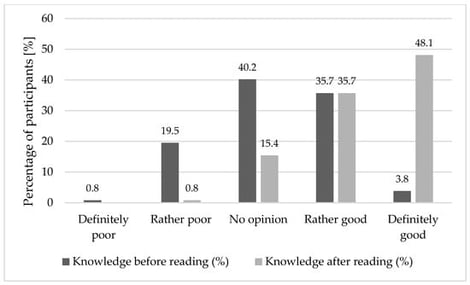
Self-assessment of respondents’ knowledge before and after reading educational materials on women’s health (n = 266).

Oral Contraceptive Knowledge Among Adolescents and Young Women

  • Nga-Weng (Ivy) Leong,
  • Marie Barnard and
  • Erin Holmes
  • + 1 author

This study aims to describe oral contraceptive knowledge among adolescents and young women, and to examine individuals’ characteristics associated with oral contraceptive knowledge. A cross-sectional survey was administered using an online panel. Females aged 16 to 24 were recruited. Oral contraceptive knowledge was measured using nine items with six domains, including oral contraceptive use, efficacy, indication, mechanism of action, risks, and side effects. A summated score was created, with a score of 9 indicating highest level of knowledge. Multivariable regression was used to examine significant socio-demographics and clinical characteristics. Among the 700 included responses, largest proportion of respondents were White (45.43%) and were covered by public insurance (43.14%). A total of 446 (63.71%) respondents expressed at least slight interest in using over-the-counter oral contraceptives. Overall, the mean score of knowledge was 4.08 out of 9. Most did not correctly answer questions about side effects, the mechanism of action and appropriate use. Similar patterns were observed among those who were interested in over-the-counter oral contraceptives (mean = 4.11). Adolescents and young women had a low level of oral contraceptive knowledge. With a high proportion of individuals interested in over-the-counter oral contraceptives, additional information support is needed to support informed contraception choice and use.

5 February 2026

Role of the Pharmacist in Supporting the Use of Connected Health Devices: Example of Connected Watches

  • Cordélia Salomez-Ihl,
  • Léa Liaigre and
  • Pierrick Bedouch
  • + 7 authors

The use of Connected Medical Devices (CMDs) is growing significantly throughout the world. Although they are not dispensed in pharmacies and are not part of the pharmacy-only drug dispensing system, clinical pharmacists must be able to support patients in the use of these new technologies, which are central to their care. The aim of this study is to identify the role of the community pharmacist in supporting patients who use CMDs, using the case of connected watches in electrophysiology. Semi-structured interviews were conducted between 15 February and 20 April 2024 by a pharmacy student. The questionnaires were drafted in collaboration with a pharmacist, a cardiac electrophysiologist, a methodologist specializing in the evaluation of medical devices, and an ethical philosopher specializing in the support and acceptability of new technologies. The aim of these questionnaires was to study the use of connected watches and support for patients who own them. A total of 4 cardiac electrophysiologists and 10 cardiac electrophysiology patients were interviewed, and then 6 pharmacists were also questioned about the roles identified by physicians and patients. This study identified a major need on the part of specialist physicians for clinical pharmacist support in helping patients use connected watches. Patients expressed a high level of confidence in their pharmacists to support them, and in the motivation of pharmacists’ ability to take up these challenges. A number of challenges remain, such as the effective integration of this support into pharmacy practice, remuneration, and the organization of collaboration between clinical pharmacists and hospital electrophysiologists.

3 February 2026

Background: Pharmacology plays a central role in linking biomedical science concepts with their application in clinical practice across medical and healthcare education. Globally, the pharmacological curriculum has evolved, just like other disciplines, through the integration of case-based, problem-based, and hybrid teaching models that led to firm clinical reasoning and long-term learning. Thus, this study aims to evaluate and compare the learning outcomes of pharmacology curricula across the globe by adopting a systematic review and meta-analysis research approach. Methods: This comprehensive review was conducted with transparency and integrity in accordance with Preferred Reporting Items for Systematic Reviews and Meta-Analyses (PRISMA 2020) guidelines and was registered with PROSPERO (CRD420251207753). Five electronic databases, including MEDLINE (PubMed), EMBASE, CINAHL, PsycINFO, and the Cochrane Library were searched from January 2000 to October 2025. The Cochrane Library tool was used for the risk of bias assessment of randomised controlled trials, while the Joanna Briggs Institute (JBI) checklist was used for mixed-design, quasi-experimental, and cross-sectional cohorts. Review Manager 5.4 was used for statistical analysis. Results: Out of 3300 identified studies, 11 met the inclusion criteria, spanning 11 countries (published between 2007 and 2025). Integrated and case-based curricula significantly improved pharmacology knowledge compared to traditional lecture-based methods (SMD = 0.35; 95% CI: 0.07–0.64; I2 = 75%). Student satisfaction also favours integrated learning (OR = 1.53; 95% CI: 1.16–2.02; I2 = 46%). Most included studies were of moderate-to-high methodological quality. Conclusion: Globally, active and integrated pharmacology curricula foster greater cognitive understanding and learner satisfaction than conventional models. However, significant variability persists in resource-limited settings, leading to unequal competency in prescribing and therapeutic reasoning. Australian pharmacology programmes align broadly with international standards but require greater standardisation in assessment and experiential learning.

3 February 2026

News & Conferences

Issues

Open for Submission

Editor's Choice

Reprints of Collections

Medicines Reuse
Reprint

Medicines Reuse

Editors: Parastou Donyai
Embedded Pharmacists in Primary Care
Reprint

Embedded Pharmacists in Primary Care

Editors: George E. MacKinnon III, PhD, MS, RPh, Nathan Lamberton, PharmD, BCPS

Get Alerted

Add your email address to receive forthcoming issues of this journal.

XFacebookLinkedIn
Pharmacy - ISSN 2226-4787