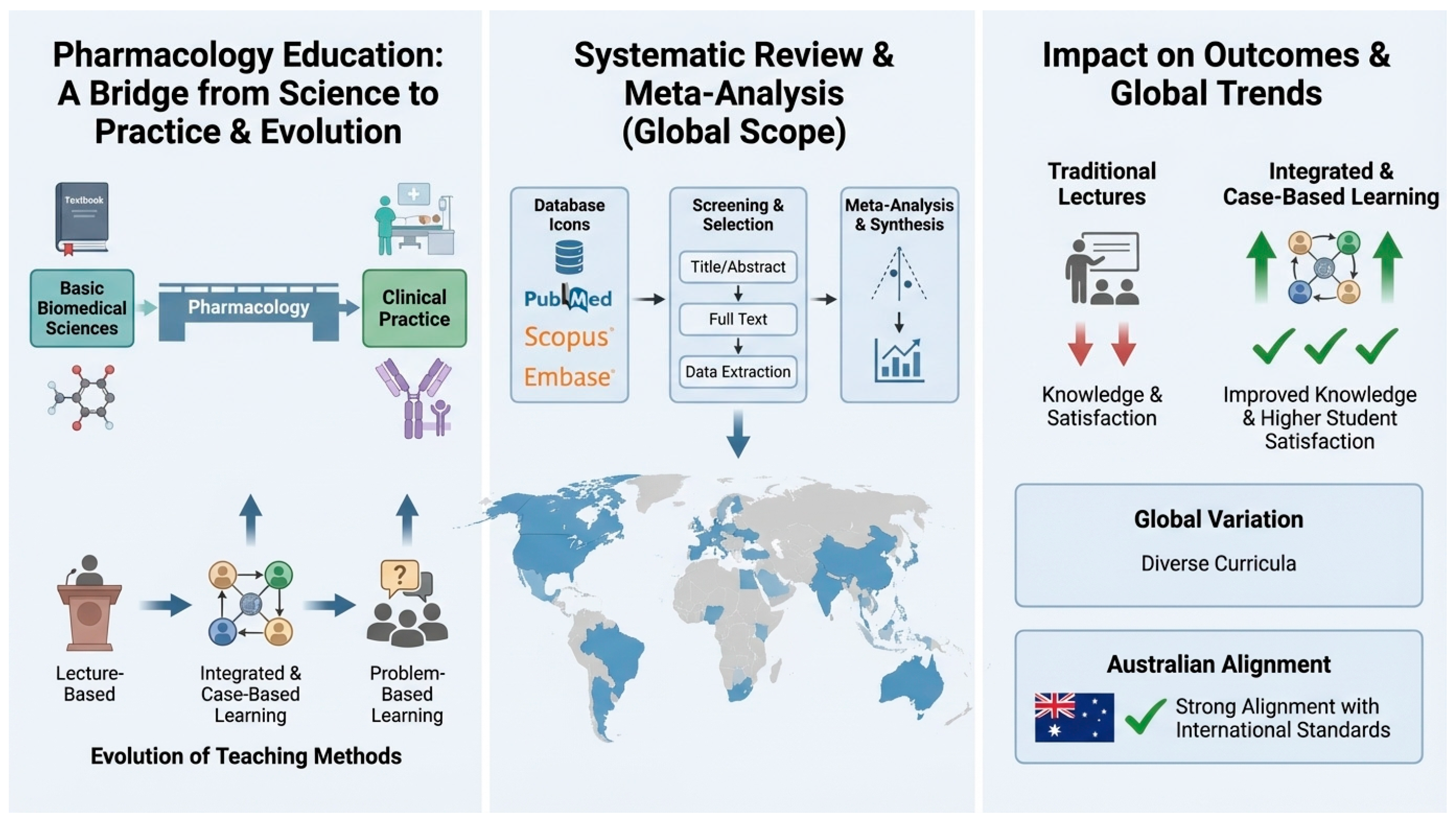

International Benchmarking of Pharmacology Curricula and Prescribing Related Learning Outcomes, Implications for Australian Health Professional Education: A Systematic Review and Meta-Analysis


Abstract
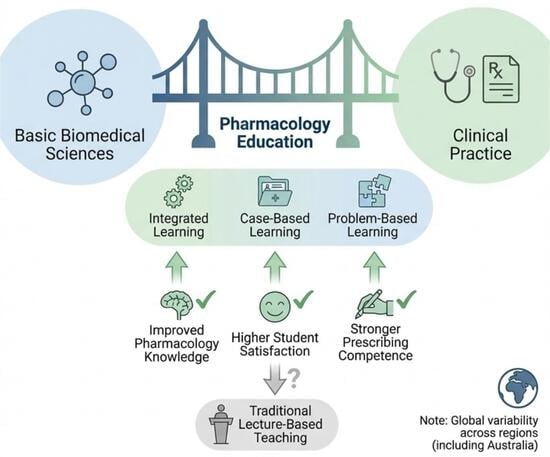
1. Introduction
2. Objectives
- Map pharmacology curricula designs worldwide and in Australia.
- Compare learning outcomes and prescribing competence across countries.
- Quantify effects of teaching approaches on knowledge and prescribing outcomes.
- Identify gaps and priorities for Australian programmes.
3. Key Questions
- How do Australian curricula differ from international models in content, integration, and assessment?
- Which approaches improve pharmacology knowledge and prescribing outcomes?
- What is Australia’s relative position on competency frameworks and core concepts adoption?
4. Methods
4.1. PICOS Framework
4.2. Eligibility Criteria
4.2.1. Inclusion Criteria
4.2.2. Exclusion Criteria
4.3. Search Strategy
4.4. Study Selection & Data Extraction
4.5. Methodological Quality Assessment
4.6. Risk of Bias Assessment
4.7. Statistical Analysis
5. Results
5.1. Study Selection
5.2. Characteristics of Included Studies
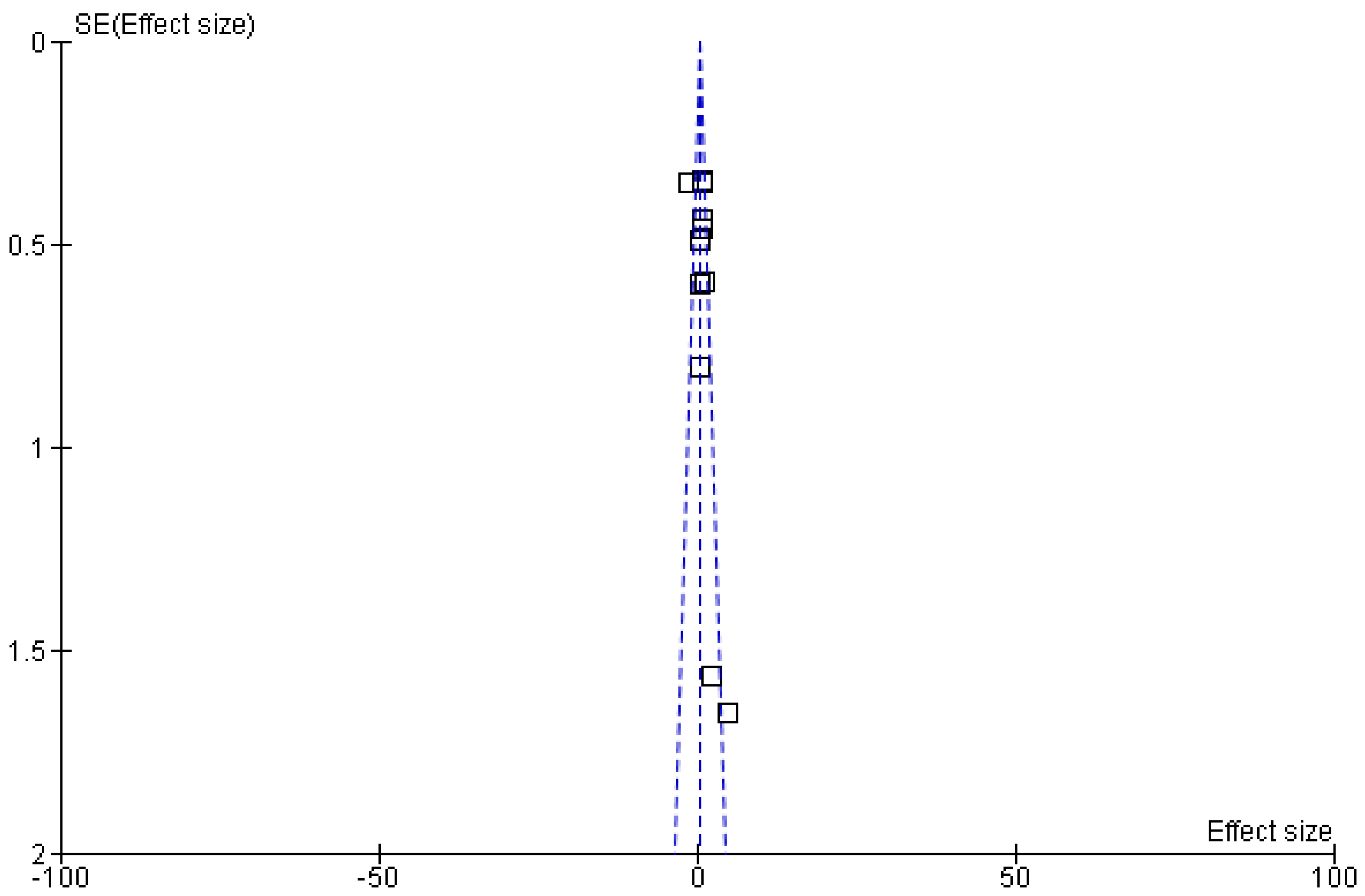
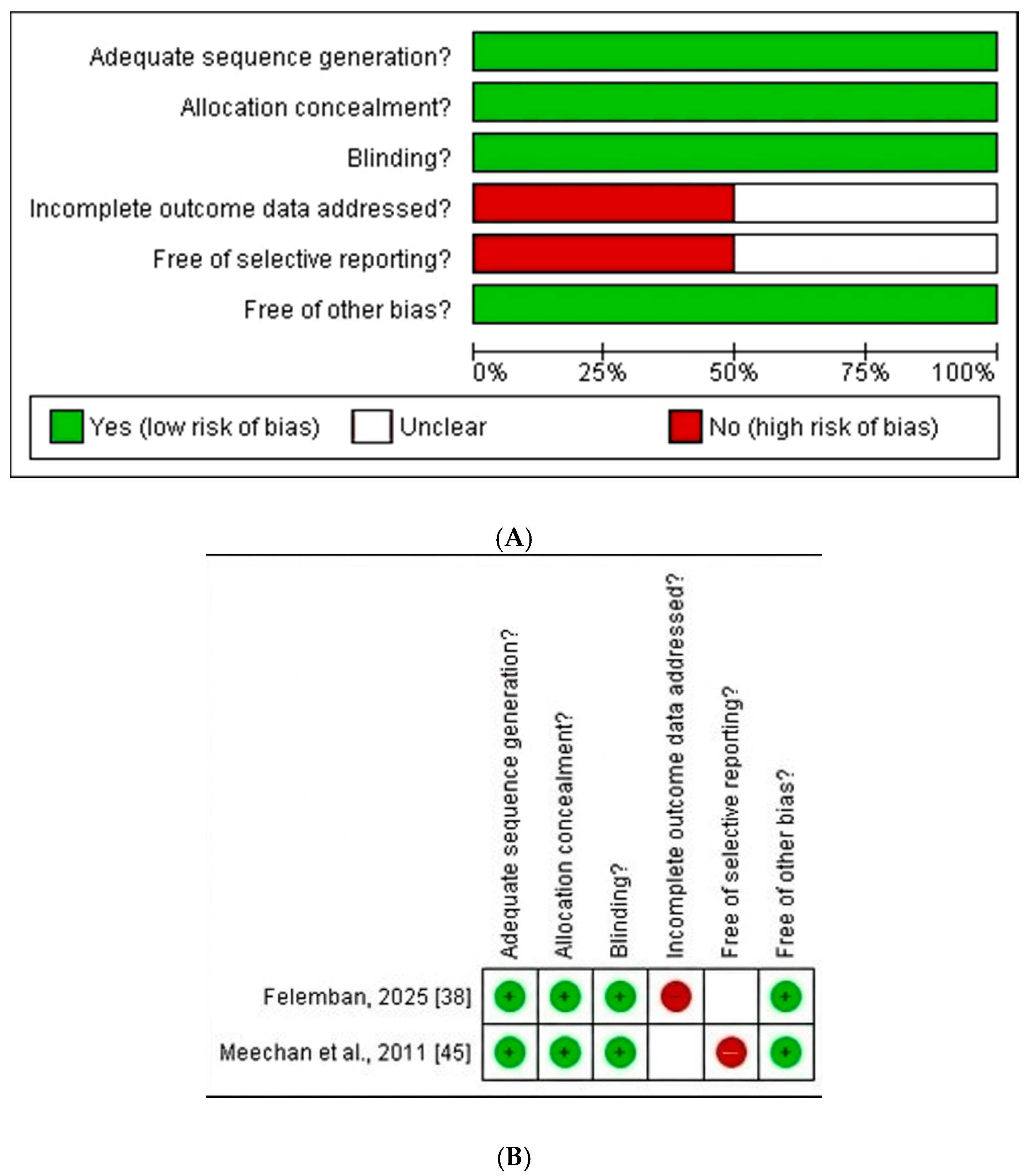
5.3. Risk Bias Assessment
5.4. Quality Assessment of Included Studies
5.5. Primary Outcomes
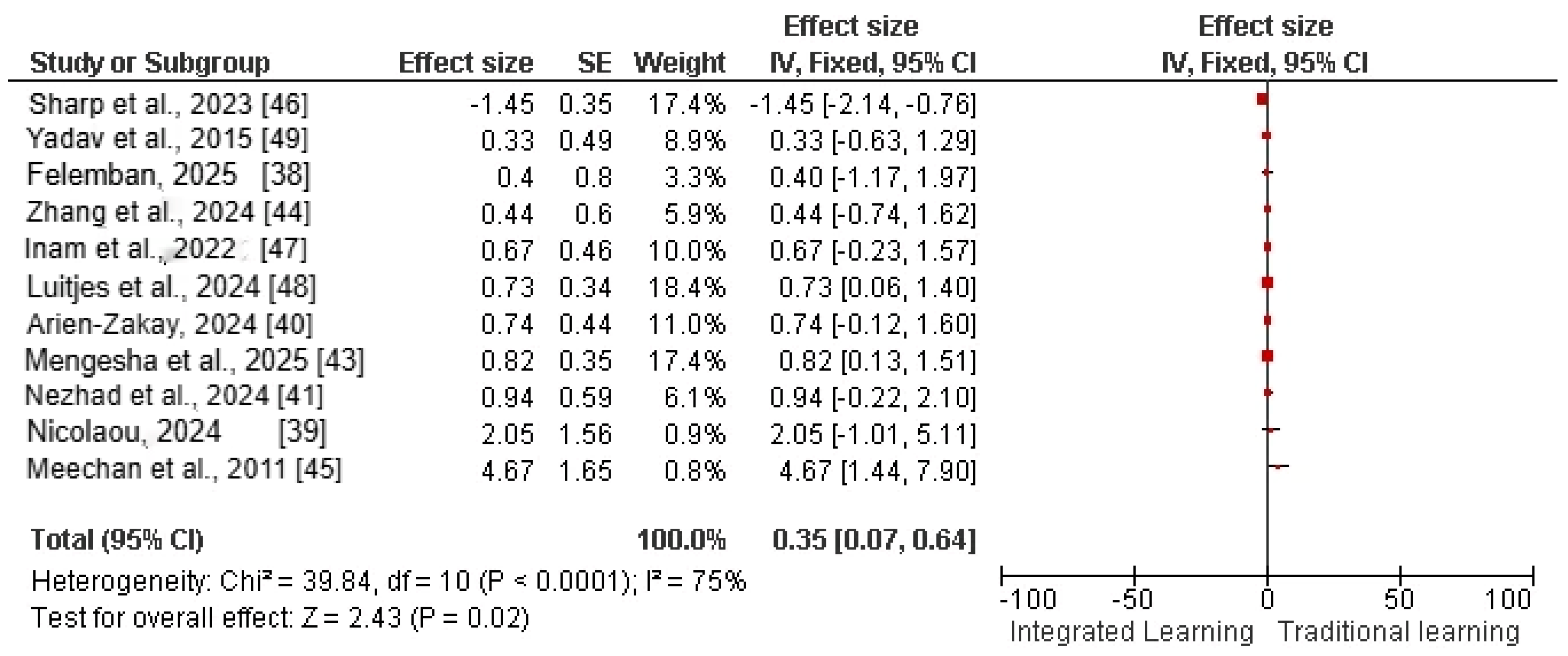
5.5.1. Pharmacology Knowledge
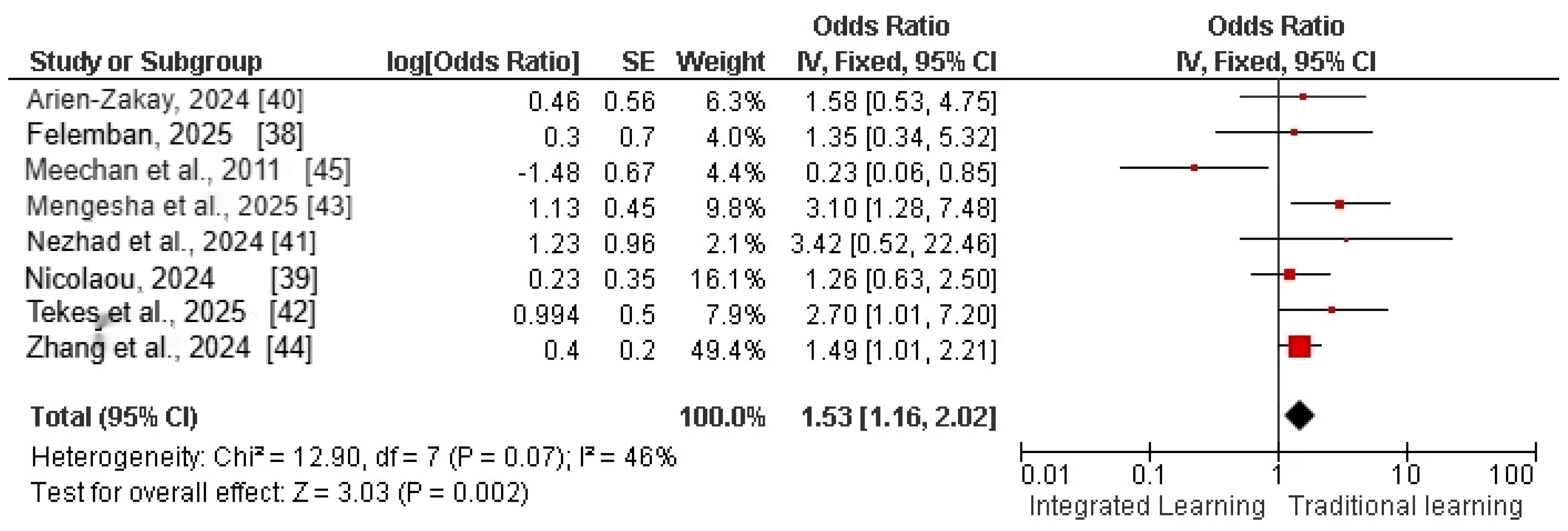
5.5.2. Student Satisfaction
6. Discussion
7. Limitations
8. Conclusions
Supplementary Materials
Author Contributions
Funding
Institutional Review Board Statement
Informed Consent Statement
Data Availability Statement
Acknowledgments
Conflicts of Interest
References
- Bryant, B.J.; Knights, K.M. Pharmacology for Health Professionals, 3rd ed.; Elsevier: St Leonards, Australia, 2011. [Google Scholar]
- Guilding, C.; Kelly-Laubscher, R.; Netere, A.; Babey, A.M.; Restini, C.; Cunningham, M.; Kelly, J.P.; Koenig, J.; Karpa, K.; Hawes, M.; et al. Developing an international concept-based curriculum for pharmacology education: The promise of core concepts and concept inventories. Br. J. Clin. Pharmacol. 2025, 91, 2142–2150. [Google Scholar] [CrossRef]
- McFadden, R. Introducing Pharmacology: For Nursing and Healthcare Professionals; Routledge: London, UK, 2024. [Google Scholar]
- Fasinu, P.S.; Wilborn, T.W. Pharmacology education in the medical curriculum: Challenges and opportunities for improvement. Pharmacol. Res. Perspect. 2024, 12, e1178. [Google Scholar] [CrossRef]
- Gleason, B.L.; Siracuse, M.V.; Moniri, N.H.; Birnie, C.R.; Okamoto, C.T.; Crouch, M.A. Evolution of preprofessional pharmacy curricula. Am. J. Pharm. Educ. 2013, 77, 95. [Google Scholar] [CrossRef]
- Grisafi, D.; Ceschi, A.; Avalos Clerici, V.; Scaglione, F. The Contribution of Clinical Pharmacologists in Precision Medicine: An Opportunity for Health Care Improvement. Curr. Ther. Res. Clin. Exp. 2021, 94, 100628. [Google Scholar] [CrossRef] [PubMed]
- Katoue, M.G.; Schwinghammer, T.L. Competency-based education in pharmacy: A review of its development, applications, and challenges. J. Eval. Clin. Pract. 2020, 26, 1114–1123. [Google Scholar] [CrossRef] [PubMed]
- Ho, S.S.; Kember, D.; Lau, C.B.; Au Yeung, M.Y.; Leung, D.Y.; Chow, M.S. An outcomes-based approach to curriculum development in pharmacy. Am. J. Pharm. Educ. 2009, 73, 14. [Google Scholar] [CrossRef][Green Version]
- White, P.J.; Guilding, C.; Angelo, T.; Kelly, J.P.; Gorman, L.; Tucker, S.J.; Fun, A.; Han, J.; Chen, G.; Samak, Y.; et al. Identifying the core concepts of pharmacology education: A global initiative. Br. J. Pharmacol. 2023, 180, 1197–1209. [Google Scholar] [CrossRef]
- Babar, Z.U. Ten recommendations to improve pharmacy practice in low and middle-income countries (LMICs). J. Pharm. Policy Pract. 2021, 14, 6. [Google Scholar] [CrossRef] [PubMed]
- Ghaddar, F.; Saba, K.; Zgheib, N.K. Teaching pharmacogenetics in low and middle income countries (LMICS): An empirical study of the lessons learned. Curr. Pharmacogenom. Pers. Med. 2012, 10, 217–225. [Google Scholar] [CrossRef]
- Esmaily, H.M.; Savage, C.; Vahidi, R.; Amini, A.; Zarrintan, M.H.; Wahlstrom, R. Identifying outcome-based indicators and developing a curriculum for a continuing medical education programme on rational prescribing using a modified Delphi process. BMC Med. Educ. 2008, 8, 33. [Google Scholar] [CrossRef]
- Ross, S.; Loke, Y.K. Development of learning outcomes for an undergraduate prescribing curriculum (British Pharmacological Society prescribing initiative). Br. J. Clin. Pharmacol. 2010, 70, 604–608. [Google Scholar] [CrossRef]
- Chang, O.; Holbrook, A.M.; Lohit, S.; Deng, J.; Xu, J.; Lee, M.; Cheng, A. Comparability of Objective Structured Clinical Examinations (OSCEs) and Written Tests for Assessing Medical School Students’ Competencies: A Scoping Review. Eval. Health Prof. 2023, 46, 213–224. [Google Scholar] [CrossRef] [PubMed]
- Wallenstein, J.; Heron, S.; Santen, S.; Shayne, P.; Ander, D. A core competency-based objective structured clinical examination (OSCE) can predict future resident performance. Acad. Emerg. Med. 2010, 17, S67–S71. [Google Scholar] [CrossRef]
- Shrader, S.; Farland, M.Z.; Danielson, J.; Sicat, B.; Umland, E.M. A Systematic Review of Assessment Tools Measuring Interprofessional Education Outcomes Relevant to Pharmacy Education. Am. J. Pharm. Educ. 2017, 81, 119. [Google Scholar] [CrossRef] [PubMed]
- Croft, H.; Gilligan, C.; Rasiah, R.; Levett-Jones, T.; Schneider, J. Current Trends and Opportunities for Competency Assessment in Pharmacy Education-A Literature Review. Pharmacy 2019, 7, 67. [Google Scholar] [CrossRef] [PubMed]
- Keijsers, C.J.; Segers, W.S.; de Wildt, D.J.; Brouwers, J.R.; Keijsers, L.; Jansen, P.A. Implementation of the WHO-6-step method in the medical curriculum to improve pharmacology knowledge and pharmacotherapy skills. Br. J. Clin. Pharmacol. 2015, 79, 896–906. [Google Scholar] [CrossRef]
- Maccarrick, G. A practical guide to using the World Federation for Medical Education standards. WFME 2: Educational program. Ir. J. Med. Sci. 2010, 179, 489–491. [Google Scholar] [CrossRef]
- Quesnelle, K.M.; Zaveri, N.T.; Schneid, S.D.; Blumer, J.B.; Szarek, J.L.; Kruidering, M.; Lee, M.W. Design of a foundational sciences curriculum: Applying the ICAP framework to pharmacology education in integrated medical curricula. Pharmacol. Res. Perspect. 2021, 9, e00762. [Google Scholar] [CrossRef]
- Bottacin, W.E.; de Souza, T.T.; Melchiors, A.C.; Reis, W.C.T. Preparing pharmacists for the digital age: How pharmacy courses are adapting to challenges and opportunities. Am. J. Pharm. Educ. 2024, 88, 100700. [Google Scholar] [CrossRef]
- Lloyd, H.; Hinton, T.; Bullock, S.; Babey, A.M.; Davis, E.; Fernandes, L.; Hart, J.; Musgrave, I.; Ziogas, J. An evaluation of pharmacology curricula in Australian science and health-related degree programs. BMC Med. Educ. 2013, 13, 153. [Google Scholar] [CrossRef]
- Singh, H.K.; Kennedy, G.A.; Stupans, I. Does the national competency standards framework for pharmacists in Australia support the provision of behaviour change interventions? Health Promot. J. Aust. 2022, 33, 480–487. [Google Scholar] [CrossRef] [PubMed]
- Hicks, A. A Review of the Current Medical Science Career Framework in Australia and Recommendations for the Future. Int. J. Biomed. Lab. Sci. 2023, 12, 48–57. [Google Scholar]
- McPhail, R.; Avery, M.; Fisher, R.; Fitzgerald, A.; Fulop, L. The changing face of healthcare accreditation in Australia. Asia Pac. J. Health Manag. 2015, 10, 58–64. Available online: https://research-repository.griffith.edu.au/server/api/core/bitstreams/f74bc22a-e608-5503-a749-e37c41e800ff/content (accessed on 20 January 2026).
- Breare, H.; Hassan, A.; Maxwell-Smith, C.; Kerr, D.A.; Sim, T.F.; Mullan, B.A. Exploring the integration of behaviour change training in Australian pharmacy education: A curriculum review. Curr. Pharm. Teach. Learn. 2025, 17, 102405. [Google Scholar] [CrossRef]
- Crowley, F.C.; Restini, C.; Burke, K.; Rieder, M.J. Exploring the landscape of pharmacology education in Health Professions Programs: From historical perspectives to current approaches to teaching. Eur. J. Pharmacol. 2025, 994, 177386. [Google Scholar] [CrossRef]
- Pires, C.; Cavaco, A. Scoping Pharmacy Students’ Learning Outcomes: Where Do We Stand? Pharmacy 2019, 7, 23. [Google Scholar] [CrossRef]
- Brinkman, D.J.; Tichelaar, J.; Okorie, M.; Bissell, L.; Christiaens, T.; Likic, R.; Maciulaitis, R.; Costa, J.; Sanz, E.J.; Tamba, B.I.; et al. Pharmacology and Therapeutics Education in the European Union Needs Harmonization and Modernization: A Cross-sectional Survey Among 185 Medical Schools in 27 Countries. Clin. Pharmacol. Ther. 2017, 102, 815–822. [Google Scholar] [CrossRef] [PubMed]
- Murray, M.D. Curricular considerations for pharmaceutical comparative effectiveness research. Pharmacoepidemiol. Drug Saf. 2011, 20, 797–804. [Google Scholar] [CrossRef]
- Wenning, L.; Pillai, G.C.; Knepper, T.C.; Ilic, K.; Ali, A.M.; Hibma, J.E. Clinical Pharmacology Worldwide: A Global Health Perspective. Clin. Pharmacol. Ther. 2021, 110, 946–951. [Google Scholar] [CrossRef]
- Page, M.J.; McKenzie, J.E.; Bossuyt, P.M.; Boutron, I.; Hoffmann, T.C.; Mulrow, C.D.; Shamseer, L.; Tetzlaff, J.M.; Akl, E.A.; Brennan, S.E. The PRISMA 2020 statement: An updated guideline for reporting systematic reviews. BMJ 2021, 372, 71. [Google Scholar] [CrossRef]
- Schiavenato, M.; Chu, F. PICO: What it is and what it is not. Nurse Educ. Pract. 2021, 56, 103194. [Google Scholar] [CrossRef]
- Munn, Z.; Barker, T.H.; Moola, S.; Tufanaru, C.; Stern, C.; McArthur, A.; Stephenson, M.; Aromataris, E. Methodological quality of case series studies: An introduction to the JBI critical appraisal tool. JBI Evid. Synth. 2020, 18, 2127–2133. [Google Scholar] [CrossRef]
- Sterne, J.A. Why the Cochrane risk of bias tool should not include funding source as a standard item. Cochrane Database Syst. Rev. 2013, 2013, ED000076. [Google Scholar] [CrossRef] [PubMed]
- Schmidt, L.; Shokraneh, F.; Steinhausen, K.; Adams, C.E. Introducing RAPTOR: RevMan Parsing Tool for Reviewers. Syst. Rev. 2019, 8, 151. [Google Scholar] [CrossRef] [PubMed]
- Hamman, E.A.; Pappalardo, P.; Bence, J.R.; Peacor, S.D.; Osenberg, C.W. Bias in meta-analyses using Hedges’d. Ecosphere 2018, 9, e02419. [Google Scholar] [CrossRef]
- Felemban, R.A.; Khan, M.A.; Alharbi, N.S. Comparing Case-Based and Lecture-Based Learning Methods in Pharmacology Teaching: Assessing Learning Outcomes, Memory Retention, and Student Satisfaction at the College of Medicine, King Saud Bin Abdulaziz University for Health Sciences, Jeddah, Saudi Arabia. J. Med. Educ. Curric. Dev. 2025, 12, 23821205251332814. [Google Scholar] [CrossRef] [PubMed]
- Nicolaou, S.A.; Televantou, I.; Papageorgiou, A.; Albert, A.P.; Hitchings, A.W.; McCrorie, P.; Nicolaou, P. Factors affecting pharmacology learning in integrated PBL in diverse medical students: A mixed methods study. BMC Med. Educ. 2024, 24, 324. [Google Scholar] [CrossRef]
- Arien-Zakay, H. Blended learning in nursing pharmacology: Elevating cognitive skills, engagement and academic outcomes. Front. Pharmacol. 2024, 15, 1361415. [Google Scholar] [CrossRef]
- Nezhad, M.T.; Shayanfar, A.; Yaqoubi, S.; Hamedeyazdan, S.; Kazemi, M.; Garjani, A.; Dizaji, N.M. Implementation of an integrated pharmacy education system for pharmacy students: A controlled educational trial. BMC Med. Educ. 2024, 24, 1272. [Google Scholar] [CrossRef]
- Tekes, E.; Gungor, B.; Silan, C.; Toraman, C. Enhancing pharmacology education through role-play: Impact on student attitudes. BMC Med. Educ. 2025, 25, 1306. [Google Scholar] [CrossRef]
- Mengesha, A.K.; Beyna, A.T.; Chanie, G.S.; Taye, W.A.; Alemayehu, T.T.; Bizuneh, G.K.; Aragie, Y.S.; Geremew, G.W.; Ayele, H.S. Impact of pharmacology perception and learning strategies on academic achievement in undergraduate pharmacy students. Sci. Rep. 2025, 15, 16425. [Google Scholar] [CrossRef]
- Zhang, Y.; Liu, J.; Xu, W.; Kong, Q. Evaluation of Student Performance Based on Integrated Teaching Method in Pharmacology Curricula. Indian J. Pharm. Educ. Res. 2024, 58, 411–416. [Google Scholar] [CrossRef]
- Meechan, R.; Mason, V.; Catling, J. The impact of an integrated pharmacology and medicines management curriculum for undergraduate adult nursing students on the acquisition of applied drug/pharmacology knowledge. Nurse Educ. Today 2011, 31, 383–389. [Google Scholar] [CrossRef]
- Sharp, K.; Teli, S.E.S.I.; Mahajan, H.; Sonawane, R. Comparative study between academic performances of traditional versus competency-based medical education MBBS curriculum students in Pharmacology. Natl. J. Physiol. Pharm. Pharmacol. 2023, 13, 971. [Google Scholar] [CrossRef]
- Inam, A.; Latif, M.Z.; Qureshi, M.A. Impact of integrated modular pharmacology curriculum on undergraduate medical student’s performance. Pak. J. Med. Health Sci. 2022, 16, 49. [Google Scholar] [CrossRef]
- Luitjes, N.L.D.; van der Velden, G.J.; Pandit, R. Using Team-Based Learning to Teach Pharmacology within the Medical Curriculum. Pharmacy 2024, 12, 91. [Google Scholar] [CrossRef]
- Yadav, P.P.; Chaudhary, M.; Patel, J.; Shah, A.; Kantharia, N.D. Effectiveness of integrated teaching module in pharmacology among medical undergraduates. Int. J. Appl. Basic Med. Res. 2016, 6, 215–219. [Google Scholar] [CrossRef]
- Reznikov, K.M. Paradigm of modern pharmacology: Development and current approaches. Res. Results Pharmacol. 2016, 2, 107–114. [Google Scholar] [CrossRef]
- Aref, H.A.T.; Wright, B.M.; Davis, B.R.; Fowlin, J.M. High-level curricular integration in pharmacy schools: A systematic literature review. Curr. Pharm. Teach. Learn. 2021, 13, 1724–1734. [Google Scholar] [CrossRef]
- Gill, M.; Andersen, E.; Hilsmann, N. Best practices for teaching pharmacology to undergraduate nursing students: A systematic review of the literature. Nurse Educ. Today 2019, 74, 15–24. [Google Scholar] [CrossRef]
- Matinho, D.; Pietrandrea, M.; Echeverria, C.; Helderman, R.; Masters, M.; Regan, D.; Shu, S.; Moreno, R.; McHugh, D. A systematic review of integrated learning definitions, frameworks, and practices in recent health professions education literature. Educ. Sci. 2022, 12, 165. [Google Scholar] [CrossRef]
- Kosari, S.; Buss, V.H.; Peterson, G.M.; Yee, K.C.; Naunton, M.; Bushell, M.; Chiu, L.; Thomas, J. Evaluation of Pharmaceutical Compounding Training in the Australian Undergraduate Pharmacy Curricula. Pharmacy 2020, 8, 27. [Google Scholar] [CrossRef] [PubMed]
- Venugopal, M.L.; Yong, F.R.; Krzyzaniak, N.; La Caze, A.; Freeman, C. Mapping Australian pharmacy school curricula for content related to pharmacogenomics. Explor. Res. Clin. Soc. Pharm. 2022, 8, 100192. [Google Scholar] [CrossRef] [PubMed]
- Stupans, I.; Atkinson, J.; Mestrovic, A.; Nash, R.; Rouse, M.J. A Shared Focus: Comparing the Australian, Canadian, United Kingdom and United States Pharmacy Learning Outcome Frameworks and the Global Competency Framework. Pharmacy 2016, 4, 26. [Google Scholar] [CrossRef]






| Component | Description |
|---|---|
| Population (P) | Students of medicine, pharmacy, nursing, dentistry, and Allied health departments studying pharmacological curricula across global institutions. |
| Intervention (I) | Teaching approaches in pharmacology and clinical pharmacology, including integrated, PBL, flipped, simulation, VR, gamification, concept-based curricula, and competency frameworks. |
| Comparison (C) | Traditional Lecture-Based Teaching, Conventional Teaching Methods, Standard Curriculum. |
| Outcomes (O) | Primary outcomes are knowledge, Academic Performance, Knowledge Assessment, Clinical Competence, Objective Structured Clinical Examination, Prescribing Competency, Student Satisfaction scores. |
| Study Design (S) | Randomised Controlled Trial, Quasi-Experimental Study, Cross-Sectional Study, Mixed Methods Study, Curriculum Evaluation, national surveys, Delphi frameworks, and mixed methods. |
| Author, Year | Region/Country | Study Population | Study Groups | Study Design | Assessment Tool | Institute | Study Period | Pharmacology Knowledge | Student Satisfaction (Likert Scale) |
|---|---|---|---|---|---|---|---|---|---|
| Felemban et al., 2025 [38] | Saudi Arabia | 76 medical students | Case based learning = 40 Lecture based learning = 36 | Randomised experimental study | General electronic survey | College of Medicine (COM) of King Saud bin Abdulaziz University for Health Sciences (KSAU-HS) | 4 weeks 2023–2024 | G1 = 4.08 (1.63) G2 = 4.75 (1.72) 0.40 [95%CI; 0.20–1.09] | G1 = 4.53 (0.74) G2 = 4.73 (0.51) 0.30 [95% CI; 0.10–0.80] |
| Nicolaou et al., 2024 [39] | United Kingdom | 296 medical students | Case based learning = 58 Lecture based learning = 209 | Mixed methods study | Student questionnaire | St. George’s University of London and University of Nicosia | 2022–2024 | G1 = 18.0 ± 5.02 G2 = 28.90 ± 5.39 2.05 [95%CI; 1.65–3.07] | G1 = 3.6 ± 0.8 G2 = 3.8 ± 0.9 0.23 [95% CI; 0.05–0.40] |
| Arien-Zakay et al., 2024 [40] | Israel | 1275 Undergraduate nursing students (pre-clinical pharmacology) | Lecture-based learning (LBL) = 849 Blended learning = 426 | Quasi-experimental cohort | Final in-class exam & end-of-course satisfaction course | Hebrew University of Jerusalem | 2016–2020 | G1 = 64.6 ± 16.0 G2 = 76.4 ± 16.0 0.74 = [95% CI; 0.56–1.1] | G1 = 328 7.8 ± 1.3 G2 = 133 8.3 ± 0.7 0.46 [95% CI; 0.34–0.95] |
| Nezhad et al., 2024 [41] | Middle East: Iran | 240 undergraduate pharmacy students | Integrated group = 120 Traditional group = 120 | Quasi-experimental, pre–post comparative study | Final exam & validated 5-point Likert-scale questionnaire | Tehran University of Medical Sciences | 2021–2023 | G1 = 82.4 ± 7.6 G2 = 74.8 ± 8.5 0.94 | G1 = 4.3 ± 0.6 G2 = 3.5 ± 0.7 SMD = 1.23 |
| Tekeş et al., 2025 [42] * | Turkey | 97 medical students | Pre-test vs. post-test | Mixed-methods quantitative study | Likert scale | Çanakkale Onsekiz Mart University | 2023–2024 | G1 = 41.15 ± 4.11 G2 = 37.24 ± 3.73 0.994 | |
| Mengesha et al., 2025 [43] | Ethiopia | 420 undergraduate health science students | Active learning = 210 Passive learning = 210 | Cross-sectional, descriptive-analytical | Pharmacology knowledge & student satisfaction Likert scale | University of Gondar, College of Medicine and Health Sciences | October–December 2024 | G1 = 14.6 ± 2.8 G2 = 12.1 ± 3.2 0.82 (0.61–1.04, p < 0.001) | G1 = 4.1 ± 0.6 G2 = 3.3 ± 0.8 1.13 (0.92–1.34, p < 0.01) |
| Zhang et al., 2024 [44] | China | 245 undergraduate medical students | Integrated teaching = 119 Conventional teaching = 121 | Prospective cohort study | Pharmacology drug exam | Anhui Medical University, Hefei, China | 2019–2020 | G1: 64 ± 17.6 G2: 56 ± 18.9 0.44 (0.14–0.74) | G1 = 22 G2 = 12 0.40 |
| Meechan et al., 2011 [45] | UK | 240 Undergraduate adult nursing students | Integrated teaching = 120 Conventional teaching = 120 | Randomised Controlled Trial | Pharmacology Assessment Tool, & Self-Assessment Rating Score (SARS)—7-item, 4-point Likert | Institute of Health & Society, University of Worcester | 2007–2008 | G1 = 63.98 ± 2.91 G2 = 48.62 ± 3.59 4.67 [95% CI; 3.98, 5.36] | G1 = 2.33 (0.729) G2 = 3.57 (0.927) −1.48 = 95% CI ≈ [−1.88, −1.08] |
| Sharp et al., 2023 [46] | India | 175 MBBS students | Modern curriculum = 98 Old curriculum = 77 | Cross-sectional comparative study | Performance in exams | Govt. Medical College, Jalgaon, Maharashtra, India | 2017–2019 | G1 = 66.2 ± 7.3 G2 = 75.8 ± 5.4 −1.45 [95%CI: −0.45, −3.67] | |
| Inam et al., 2022 [47] | Pakistan | 305 undergraduate MBBS students | Integrated curriculum = 137 Traditional curriculum = 168 | Observational, cross-sectional study | Final Professional Pharmacology Examination | Azra Naheed Medical College, Superior University | April–May 2022 | G1 = 188.04 ± 31.8 G2 = 204.98 ± 17.0 0.67 (0.44–0.90) | |
| Luitjes et al., 2024 [48] | Netherlands | 686 students | Team-based learning (TBL) = 196 Conventional = 490 | Mixed-method study | Final exam and feedback questionnaire | Utrecht University Medical School, UMC Utrecht | 2021–2023 | G1 = 76.74 ± 14.85 G2 = 64.33 ± 17.85 0.73 (0.56–0.90) | |
| Yadav et al., 2015 [49] | India | 330 undergraduate medical students | Integrated teaching = 165 Conventional = 165 | Quasi-experimental design | Pre and post knowledge scores | Government Medical College & New Civil Hospital, Surat | 2013–2014 | G1 = 24.48 ± 6.58 G2 = 19.52 ± 4.87 G = 0.33 (0.08–0.57) |
| Author (Year) | Q1 Similar Groups | Q2 Exposure Measured | Q3 Valid Exposure | Q4 Confounders Identified | Q5 Confounders Addressed | Q6 Outcome Free at Start | Q7 Valid Outcomes | Q8 Follow-Up Sufficient | Q9 Complete Follow-Up | Q10 Incomplete Follow-Up Addressed | Q11 Stats Appropriate | Total (Out of 11) | Quality |
|---|---|---|---|---|---|---|---|---|---|---|---|---|---|
| Nicolaou et al., 2024 [39] | ✓ | ✓ | ✓ | ? | ✗ | ✓ | ✓ | ✓ | ✗ | ✗ | ✓ | 7/11 | Moderate–High |
| Arien-Zakay et al., 2024 [40] | ✓ | ✓ | ✓ | ? | ✗ | ✓ | ✓ | ✓ | ✓ | ? | ✓ | 8/11 | High |
| Nezhad et al., 2024 [41] | ✓ | ✓ | ✓ | ✓ | ? | ✓ | ✓ | ✓ | ✓ | ? | ✓ | 9/11 | High |
| Tekeş et al., 2025 [42] * | ✓ | ✓ | ✓ | ? | ✗ | ✓ | ✓ | ✓ | ✗ | ✗ | ✓ | 7/11 | Moderate–High |
| Mengesha et al., 2025 [43] | ✓ | ✓ | ✓ | ✓ | ✓ | ✓ | ✓ | ✓ | ? | ? | ✓ | 9/11 | High |
| Zhang et al., 2024 [44] | ✓ | ✓ | ✓ | ✗ | ✗ | ✓ | ✓ | ✓ | ? | ✗ | ✓ | 7/11 | Moderate–High |
| Meechan et al., 2011 [45] | ✓ | ✓ | ✓ | ? | ✗ | ✓ | ✓ | ✓ | ✗ | ✗ | ✓ | 7/11 | Moderate–High |
| Sharp et al., 2023 [46] | ✓ | ✓ | ✓ | ? | ✗ | ✓ | ✓ | ✓ | ✓ | ✗ | ✓ | 8/11 | High |
| Inam et al., 2022 [47] | ✓ | ✓ | ✓ | ? | ✗ | ✓ | ✓ | ✓ | ✓ | ✗ | ✓ | 8/11 | High |
| Luitjes et al., 2024 [48] | ✓ | ✓ | ✓ | ✗ | ✗ | ✓ | ✓ | ✓ | ? | ✗ | ✓ | 7/11 | Moderate–High |
| Yadav et al., 2015 [49] | ✓ | ✓ | ✓ | ? | ✗ | ✓ | ✓ | ✓ | ✗ | ✗ | ✓ | 7/11 | Moderate–High |
Disclaimer/Publisher’s Note: The statements, opinions and data contained in all publications are solely those of the individual author(s) and contributor(s) and not of MDPI and/or the editor(s). MDPI and/or the editor(s) disclaim responsibility for any injury to people or property resulting from any ideas, methods, instructions or products referred to in the content. |
© 2026 by the authors. Licensee MDPI, Basel, Switzerland. This article is an open access article distributed under the terms and conditions of the Creative Commons Attribution (CC BY) license.
Share and Cite
Omar, S.H.; Barwick, A. International Benchmarking of Pharmacology Curricula and Prescribing Related Learning Outcomes, Implications for Australian Health Professional Education: A Systematic Review and Meta-Analysis. Pharmacy 2026, 14, 27. https://doi.org/10.3390/pharmacy14010027
Omar SH, Barwick A. International Benchmarking of Pharmacology Curricula and Prescribing Related Learning Outcomes, Implications for Australian Health Professional Education: A Systematic Review and Meta-Analysis. Pharmacy. 2026; 14(1):27. https://doi.org/10.3390/pharmacy14010027
Chicago/Turabian StyleOmar, Syed Haris, and Anna Barwick. 2026. "International Benchmarking of Pharmacology Curricula and Prescribing Related Learning Outcomes, Implications for Australian Health Professional Education: A Systematic Review and Meta-Analysis" Pharmacy 14, no. 1: 27. https://doi.org/10.3390/pharmacy14010027
APA StyleOmar, S. H., & Barwick, A. (2026). International Benchmarking of Pharmacology Curricula and Prescribing Related Learning Outcomes, Implications for Australian Health Professional Education: A Systematic Review and Meta-Analysis. Pharmacy, 14(1), 27. https://doi.org/10.3390/pharmacy14010027