Skip to Content
You are currently on the new version of our website. Access the old version .

Pathogens

Pathogens is an international, peer-reviewed, open access journal on pathogens and pathogen-host interactions published monthly online by MDPI.

Indexed in PubMed | Quartile Ranking JCR - Q2 (Microbiology)

All Articles (9,104)

Congenital toxoplasmosis (CT) results from vertical transmission of Toxoplasma gondii during maternal infection in pregnancy. Early diagnosis in newborns is crucial to initiate timely therapy and prevent long-term sequelae. The IgM Immunosorbent Agglutination Assay (ISAGA) has historically been considered an important diagnostic tool for CT; however, its recent market withdrawal necessitates alternative approaches. We conducted a retrospective observational study at Fondazione IRCCS Policlinico San Matteo, Pavia, Italy, including 44 newborns born to mothers with confirmed toxoplasmosis between 2019 and 2022. Newborns were classified as CT (n = 19) or non-CT (n = 25) based on serological follow-up, comparative Western blot (CWB) and Interferon Gamma Release Assay (IGRA). Sensitivity and specificity of CWB, IgM Chemiluminescent Immunoassay (CLIA), and IgM ISAGA were assessed at birth and at one month. At birth, CWB demonstrated 88.9% sensitivity, significantly higher than IgM CLIA (52.6%) and IgM ISAGA (57.9%). Specificity was 100% at birth and 92% at one month. CWB retained high sensitivity at one month (81.8%). IGRA complemented CWB in confirming or excluding infection in cases with equivocal or false-negative serology. Comparative Western blot thus represents a robust diagnostic alternative for CT, ensuring early detection and timely treatment, particularly in the absence of IgM ISAGA.

17 February 2026

On the left, an example of comparative Western blot in a non-congenital infection. On the right, an example of congenital toxoplasmosis diagnosed by comparative Western blot; arrows indicate additional bands present in the newborn’s serum. A classic IgM pattern is a triplet of bands at 75, 90, and 100 kDa (see green “T” in the image); m, mother; c, child. Image taken from the test kit’s Instructions for Use [12].

Rift Valley fever (RVF) transmission has intensified in southwestern Uganda since 2016. To quantify human and livestock exposure and associated risks, we conducted a cross-sectional serosurvey in Isingiro, Kabale and Rubanda districts between October and November 2023. A total of 766 humans and 2383 livestock were sampled and tested for RVF antibodies using ELISA, with structured questionnaires capturing demographic, behavioral and environmental data. Human seroprevalence was 11.5% (88/766), varying by district (13.8% Isingiro, 11.8% Rubanda, 6.8% Kabale; p = 0.04). Independent predictors from the multivariate model included raw-meat consumption (aOR 6.11; 95% CI 1.16–27.80), cattle ownership (aOR 2.33; 95% CI 1.27–4.36), male sex (aOR 1.64; 95% CI 1.02–2.66) and younger age compared with ≥50 years (31–49 years: aOR 2.02; 95% CI 1.20–3.48; 18–30 years: aOR 2.37; 95% CI 1.04–5.14). Herd-level seroprevalence was 42.5% (204/480), associated with cattle presence (aOR 6.48; 95% CI 4.10–10.40), lack of carcass burial (aOR 15.70; 95% CI 4.23–63.60), on-farm slaughter (aOR 2.14; 95% CI 1.21–3.89) and increased mosquito activity (aOR 1.75; 95% CI 1.13–2.73). Animal-level seroprevalence was 14.6% (347/2383), highest in cattle (33.8%), with cattle having markedly higher odds than goats (aOR 6.73; 95% CI 4.96–9.14). These findings demonstrate substantial transmission and highlight cattle-centered interfaces as primary targets for control to humans.

17 February 2026

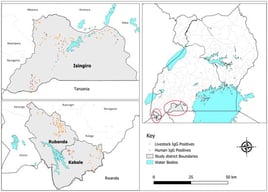
Human and animal seropositivity and sampling sites across Kabale, Rubanda, and Isingiro.

Paramyxoviruses in Bats in Poland—The First Detection

  • Anna Orłowska,
  • Karol Stasiak and
  • Marcin Smreczak
  • + 1 author

Bats are hosts to many diseases that emerge in humans and livestock. Knowledge about the diversity and circulation of paramyxoviruses in European bat populations, despite their recognized importance, remains limited. Here, we present data on the first detection of paramyxoviruses in Poland in the new bat species of Cnephaeus serotinus and Cnephaeus nilsonii, which have never been previously recognized as paramyxovirus hosts, as well as in Myotis daubentonii and two unknown bat species. Viral RNA was detected in fecal and intestinal samples using the semi-nested RT-PCR protocol followed by Sanger sequencing. A widespread comprehensive phylogenetic study supported by haplotype network analyses of 376 nt sequences of paramyxoviruses detected in bats worldwide revealed that paramyxoviruses are closely related to the host and strongly correlate to the area of origin.

17 February 2026

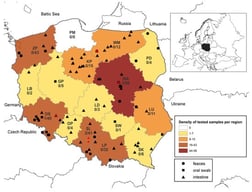
Distribution of bat samples included in the study. Different kinds of samples (feces, oral swab, and intestine) per voivodeship and RT-PCR results (black: negative, red: positive) are shown. The number of positive vs. total samples per region are indicated in each voivodeship. Abbreviations: MA (Masovia), LS (Lower Silesia), WP (Greater Poland), SL (Silesia), PM (Pomerania), LD (Łódź), MP (Lesser Poland), ZP (West Pomerania), LB (Lubusz), KP (Kuyavian–Pomeranian), OP (Opole), PD (Podlaskie), SW (Świętokrzyskie), WM (Warmian–Masurian), PK (Subcarpathian), LU (Lublin).

Early and rapid diagnosis of drug resistance in tuberculosis (TB) plays a key role in reducing the spread of resistance and enabling effective treatment. The aim of this study was to investigate mutations in drug resistance-associated gene regions of Mycobacterium tuberculosis complex (MTBC) isolates resistant to at least two first-line anti-tuberculosis drugs through sequence analysis, in order to characterize the core molecular features of these strains in the region and to identify previously unreported, geographically distinct novel mutation sites. The drug susceptibility of 23 clinical isolates was assessed using the BACTEC MGIT 960 system, and resistance-associated point mutations were identified through DNA sequence analysis and comparison with GenBank reference sequences. AAG → AGG mutation was detected in the rpsL gene region at codon 43 (n = 7) and codon 88 (n = 1). Additionally, GAG → GCG point mutation was identified at codon 70 (n = 2), representing a new region not previously reported in the literature. The most frequent mutation was AGC → ACC at katG codon 315 (n = 10), followed by a C → T substitution at position −15 of the inhA promoter region (n = 4). Additionally, TCG → TTG at rpoB codon 531 (n = 4) and ATG → GTG at embB codon 306 (n = 1) were detected. The detection of resistance-associated mutations is essential for controlling drug-resistant tuberculosis. In this study, a novel rpsL mutation (GAG → GCG) at codon 70 and a previously unreported codon 88 mutation in our country were identified, contributing to the understanding of molecular resistance mechanisms and epidemiology.

16 February 2026

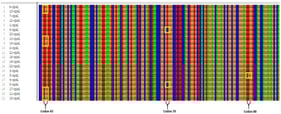
Image of polymorphic regions showing AAG → AGG conversion at codon 43, GAG → GCG at codon 70, and AAG → AGG conversion at codon 88 of the rpsL gene region responsible for SM resistance.

News & Conferences

Issues

Open for Submission

Editor's Choice

Reprints of Collections

Chagas Disease
Reprint

Chagas Disease

Celebrating the 115th Anniversary of the Discovery of <em>Trypanosoma cruzi</em>
Editors: Michel Tibayrenc
Parasitic Diseases of Fish
Reprint

Parasitic Diseases of Fish

Identification, Host-Parasite Interactions and Molecular Biology
Editors: Gokhlesh Kumar, Arun Sudhagar, Kandasamy Saravanan

Get Alerted

Add your email address to receive forthcoming issues of this journal.

XFacebookLinkedIn
Pathogens - ISSN 2076-0817