Treating Extensively Drug-Resistant Acinetobacter baumannii: Considerations for Host Characteristics and Type of Infections

 ,
,  , , ,
, , , 
Abstract
1. Historical Overview of the Emergence and Epidemiology of Acinetobacter baumannii: A Significant Pathogen Associated with Nosocomial Infections
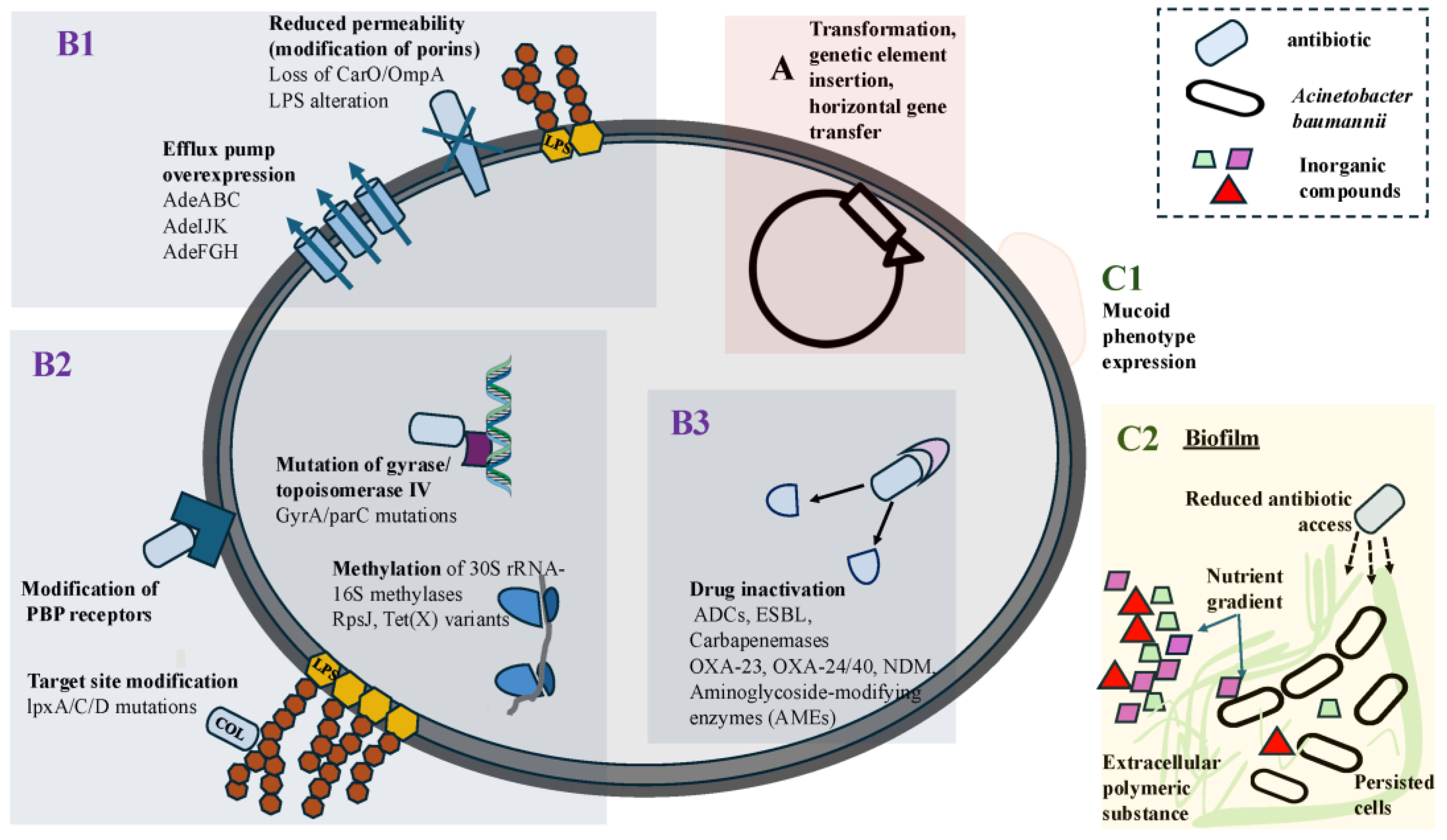
2. Morphological and Biochemical Characteristics of the Pathogen; Mechanisms of Resistance

| Resistance Mechanism | Representative Examples in A. baumannii | Typical Impact | References |
|---|---|---|---|
| β-Lactamase production | OXA-23, OXA-24/40, NDM, ADCs | Carbapenem & cephalosporin resistance | [35,36] |
| Target mutations/inactivation | gyrA/parC mutations; rpsJ; tet(X) variants; lpxA/C/D mutations | Fluoroquinolone, tigecycline, polymyxin resistance | [37] |
| Efflux pump over-expression | AdeABC, AdeIJK, AdeFGH | Broad-spectrum reduced susceptibility | [38] |
| Reduced permeability | Loss of CarO/OmpA, LPS alteration | Lower antibiotic influx, increased tolerance | [39] |
| Inactivation or reduced binding of aminoglycosides | Production of aminoglycoside-modifying enzymes (AMEs) and 16S rRNA methylases | Aminoglycoside resistance | [36] |
| Biofilm & persistence phenotypes | Surface adherence, small cell morphotypes | Chronic infection, relapse, colonization | [33,36] |
3. First-Line Antimicrobials for Carbapenem-Resistant A. baumannii Infections
| Drug | Class/Mechanism of Action | Indication/Type of Infection | Special Considerations | References |
|---|---|---|---|---|
| Colistin | Polymyxins/interaction with lipid A moiety of outer membrane | HAP/VAP/ bacteremia/UTI | Nephrotoxicity | [48,49,50,51,52] |
| Minocycline | Tetracyclines/interaction with 30S ribosome, inhibition of protein synthesis | Pneumonia/CNS/prostate/abdominal infections | Gastrointestinal adverse effects/photosensitivity | [53,54,55] |
| Tigecycline | Tetracyclines/interaction with 30S ribosome, inhibition of protein synthesis | Bile duct/abdominal infections | Gastrointestinal adverse effects/ hepatic dysfunction | [56,57] |
| Eravacycline | Tetracyclines/interaction with 30S ribosome, inhibition of protein synthesis | Complicated intra-abdominal infections | Gastrointestinal adverse effects/photosensitivity | [58,59] |
| Sulbactam | Beta-lactamase inhibitor | Skin and skin structure infections, intra-abdominal/gynecological infections, HAP/VAP | Gastrointestinal adverse effects | [56,60,61,62,63] |
| Cefiderocol | Inhibition of PBP3-cell wall synthesis/binding to outer membrane iron transporters | Urinary tract, HAP/VAP and systemic infections | Gastrointestinal adverse effects, hepatotoxicity | [64,65,66] |
4. Combination Treatment vs. Monotherapy: Evidence from Existing Literature
| Drugs | Proposed Mechanism of Action | Type of Infection Used | Strength of Available Data | References |
|---|---|---|---|---|
| Colistin–meropenem | Permeabilization of the bacterial outer membrane, permitting the entry of large hydrophobic molecules (carbapenem) | Bacteremia, HAP/VAP | Low | [67,68] |
| Colistin–tigecycline | Disruption of the membrane facilitating penetration of tigecycline in the cell | Bacteremia, HAP/VAP | Low | [69] |
| Colistin–glycopeptides | Disruption of the outer membrane, enabling glycopeptides to access cell wall targets from which they are usually excluded | In vitro data | Low | [84,85] |
| Colistin–daptomycin | Colistin disrupts the bacterial outer membrane, allowing daptomycin to reach its target inside the cell (cytoplasmic membrane) | In vitro data | Low | [84,85] |
| Sulbactam–colistin | Both drugs’ act against bacterial cell components, particularly the cell envelope | Mainly HAP/VAP | Moderate | [60,70,71,72] |
| Sulbactam–minocycline | Minocycline can overcome certain resistance mechanisms, such as efflux pumps (e.g., TetA and RND pumps) and thus enhance the function of the bata-lactamase inhibitor | In vitro data HAP/VAP | Moderate | [60,70,71,72] |
| Sulbactam–tigecycline | Sulbactam may reduce the MIC of tigecycline | HAP/VAP | Low | [60,70,71,72] |
| Fosfomycin–colistin | Synergistic inhibition of synthesis and disruption of the membrane | HAP/VAP, Bacteremia, SSTI, Intra-abdominal | Moderate | [77,78] |
| Fosfomycin–cefiderocol | Fosfomycin weakens the bacterial cell wall, and cefiderocol can more effectively deliver enter and bind to its target | HAP/VAP, Bacteremia, CVC infection | Moderate | [74,75] |
5. Treatment Considerations Based on Patients’ Characteristics/Types of Infections
5.1. Biofilms
5.2. Pneumonia
5.3. CNS Infections
5.4. Endocarditis
5.5. Chronic Kidney Disease (CKD)
5.6. Pregnancy
5.7. Pediatric Patients
6. Novel Antimicrobial Agents Currently in the Development Pipeline
6.1. Antimicrobial Drugs
6.2. Bacteriophages
6.3. Antimicrobial Peptides
7. Summary of Current State: Where Do We Stand
Author Contributions
Funding
Institutional Review Board Statement
Informed Consent Statement
Data Availability Statement
Conflicts of Interest
Abbreviations
| ALT | Antibiotic Lock Therapy |
| AMP | Antimicrobial Peptide |
| BID | Twice A Day |
| CAP | Community-Acquired Pneumonia |
| CDC | Centers for Disease Control and Prevention |
| CKD | Chronic Kidney Disease |
| CLABSI | Central-Line Associated Bloodstream Infection |
| CLSI | Clinical and Laboratory Standards Institute |
| CNS | Central Nervous System |
| CPK | Creatine Kinase |
| CPS | Capsular Polysaccharide |
| CRAB | Carbapenem-Resistant Acinetobacter baumannii |
| CrCl | Creatinine Clearance |
| CRE | Carbapenem-Resistant Enterobacteriaceae |
| CSF | Cerebrospinal Fluid |
| DBO | Diazabicyclooctane |
| ECDC | European Centre for Disease Prevention and Control |
| ELF | Epithelial Lining Fluid |
| EMA | European Medicines Agency |
| ESCMID | European Society of Clinical Microbiology and Infectious Diseases |
| FDA | Food and Drug Administration |
| GNB | Gram-negative Bacteria |
| HAP | Hospital-Acquired Pneumonia |
| ICU | Intensive Care Unit |
| IDSA | Infectious Diseases Society of America |
| IV | Intravenous |
| IVT/ITH | Intraventricular/Intrathecal |
| LPS | Lipopolysaccharide |
| MDR | Multidrug-Resistant |
| MDRO | Multidrug-resistant Organism |
| MIC | Minimum Inhibitory Concentration |
| PBP1 | Penicillin-binding Protein 1 |
| PBP3 | Penicillin-binding Protein 3 |
| PDR | Pandrug-resistant |
| PL | Phospholipase |
| SARS-CoV-2 | Severe Acute Respiratory Syndrome Coronavirus-2 |
| SSTI | Skin And Soft Tissue Infection |
| TDM | Therapeutic Drug Monitoring |
| UTI | Urinary Tract Infection |
| VAP | Ventilator-Associated Pneumonia |
| WHO | World Health Organization |
| XDR | Extensively Drug-Resistant |
References
- Henriksen, S.D. Moraxella, Acinetobacter, and the Mimeae. Bacteriol. Rev. 1973, 37, 522–561. [Google Scholar] [CrossRef]
- Peleg, A.Y.; Seifert, H.; Paterson, D.L. Acinetobacter baumannii: Emergence of a successful pathogen. Clin. Microbiol. Rev. 2008, 21, 538–582. [Google Scholar] [CrossRef]
- Brisou, J.; Prevot, A.R. Etudes de systématique bactérienne. X. Révision des especes réunies dans le genre Achromobacter [Studies on bacterial taxonomy. X. The revision of species under Acromobacter group]. Ann. Inst. Pasteur 1954, 86, 722–728. [Google Scholar] [PubMed]
- Baumann, P.; Doudoroff, M.; Stanier, R.Y. A study of the Moraxella group. II. Oxidative-negative species (genus Acinetobacter). J. Bacteriol. 1968, 95, 1520–1541. [Google Scholar] [CrossRef]
- Bouvet, P.; Grimont, P. Taxonomy of the Genus Acinetobacter with the Recognition of Acinetobacter baumannii sp. nov. Acinetobacter haemolyticus sp. nov. Acinetobacter johnsonii sp. nov. and Acinetobacter junii sp. nov. and Emended Descriptions of Acinetobacter calcoaceticus and Acinetobacter lwofii. Int. J. Syst. Bacteriol. 1986, 36, 228–240. [Google Scholar] [CrossRef]
- Dijkshoorn, L.; Nemec, A.; Seifert, H. An increasing threat in hospitals: Multidrug-resistant Acinetobacter baumannii. Nat. Rev. Microbiol. 2007, 5, 939–951. [Google Scholar] [CrossRef]
- Jawad, A.; Seifert, H.; Snelling, A.M.; Heritage, J.; Hawkey, P.M. Survival of Acinetobacter baumannii on dry surfaces: Comparison of outbreak and sporadic isolates. J. Clin. Microbiol. 1998, 36, 1938–1941. [Google Scholar] [CrossRef] [PubMed]
- Longo, F.; Vuotto, C.; Donelli, G. Biofilm formation in Acinetobacter baumannii. New Microbiol. 2014, 37, 119–127. [Google Scholar] [PubMed]
- Choudhary, M.; Shrivastava, R.; Vashistt, J. Acinetobacter baumannii Biofilm Formation: Association with Antimicrobial Resistance and Prolonged Survival under Desiccation. Curr. Microbiol. 2022, 79, 361. [Google Scholar] [CrossRef]
- Bergogne-Bérézin, E.; Towner, K.J. Acinetobacter spp. as nosocomial pathogens: Microbiological, clinical, and epidemiological features. Clin. Microbiol. Rev. 1996, 9, 148–165. [Google Scholar] [CrossRef]
- WHO. WHO Bacterial Priority Pathogens List, 2024: Bacterial Pathogens of Public Health Importance to Guide Research, Development and Strategies to Prevent and Control Antimicrobial Resistance; WHO: Geneva, Switzerland, 2024. [Google Scholar]
- Wang, S.H.; Yang, K.Y.; Sheu, C.C.; Lin, Y.C.; Chan, M.C.; Feng, J.Y.; Chen, C.M.; Chen, C.Y.; Zheng, Z.R.; Chou, Y.C.; et al. The prevalence, presentation and outcome of colistin susceptible-only Acinetobacter baumannii-associated pneumonia in intensive care unit: A multicenter observational study. Sci. Rep. 2023, 13, 140. [Google Scholar] [CrossRef]
- Mohd Sazlly Lim, S.; Zainal Abidin, A.; Liew, S.M.; Roberts, J.A.; Sime, F.B. The global prevalence of multidrug-resistance among Acinetobacter baumannii causing hospital-acquired and ventilator-associated pneumonia and its associated mortality: A systematic review and meta-analysis. J. Infect. 2019, 79, 593–600. [Google Scholar] [CrossRef] [PubMed]
- Rotini, G.; de Mangou, A.; Combe, A.; Jabot, J.; Puech, B.; Dangers, L.; Nativel, M.; Allou, N.; Miltgen, G.; Vidal, C. Case Report: Severe Community-Acquired Pneumonia in Réunion Island due to Acinetobacter baumannii. Am. J. Trop. Med. Hyg. 2024, 111, 136–140. [Google Scholar] [CrossRef] [PubMed]
- Anstey, N.M.; Currie, B.J.; Withnall, K.M. Community-acquired Acinetobacter pneumonia in the Northern Territory of Australia. Clin. Infect. Dis. 1992, 14, 83–91. [Google Scholar] [CrossRef]
- Ong, C.W.; Lye, D.C.; Khoo, K.L.; Chua, G.S.; Yeoh, S.F.; Leo, Y.S.; Tambyah, P.A.; Chua, A.C. Severe community-acquired Acinetobacter baumannii pneumonia: An emerging highly lethal infectious disease in the Asia-Pacific. Respirology 2009, 14, 1200–1205. [Google Scholar] [CrossRef]
- Nutman, A.; Temkin, E.; Wullfhart, L.; Schechner, V.; Schwaber, M.J.; Carmeli, Y. Acinetobacter baumannii Bloodstream Infections: A Nationwide Study in Israel. Microorganisms 2023, 11, 2178. [Google Scholar] [CrossRef] [PubMed]
- Wisplinghoff, H.; Edmond, M.B.; Pfaller, M.A.; Jones, R.N.; Wenzel, R.P.; Seifert, H. Nosocomial bloodstream infections caused by Acinetobacter species in United States hospitals: Clinical features, molecular epidemiology, and antimicrobial susceptibility. Clin. Infect. Dis. 2000, 31, 690–697. [Google Scholar] [CrossRef]
- Li, L.; Chen, D.; Liu, P.; Dai, L.; Tang, Z.; Yi, S.; Ye, M. Risk Factors for Development and Mortality of Bloodstream Infections Caused by Carbapenem-Resistant Acinetobacter baumannii. Infect. Drug Resist. 2024, 17, 5699–5706. [Google Scholar] [CrossRef]
- Sharma, R.; Lakhanpal, D. Acinetobacter baumannii: A comprehensive review of global epidemiology, clinical implications, host interactions, mechanisms of antimicrobial resistance and mitigation strategies. Microb. Pathog. 2025, 204, 107605. [Google Scholar] [CrossRef]
- Kumar, S.; Sen, P.; Gaind, R.; Verma, P.K.; Gupta, P.; Suri, P.R.; Nagpal, S.; Rai, A.K. Prospective surveillance of device-associated health care-associated infection in an intensive care unit of a tertiary care hospital in New Delhi, India. Am. J. Infect. Control 2018, 46, 202–206. [Google Scholar] [CrossRef]
- Hamidian, M.; Nigro, S.J. Emergence, molecular mechanisms and global spread of carbapenem-resistant Acinetobacter baumannii. Microb. Genom. 2019, 5, e000306. [Google Scholar] [CrossRef]
- World Health Organization (WHO). Global Priority List of Antibiotic-Resistant Bacteria to Guide Research, Discovery, and Development of New Antibiotics; World Health Organization (WHO): Geneva, Switzerland, 2017. [Google Scholar]
- Raut, S.; Rijal, K.R.; Khatiwada, S.; Karna, S.; Khanal, R.; Adhikari, J.; Adhikari, B. Trend and Characteristics of Acinetobacter baumannii Infections in Patients Attending Universal College of Medical Sciences, Bhairahawa, Western Nepal: A Longitudinal Study of 2018. Infect. Drug Resist. 2020, 13, 1631–1641. [Google Scholar] [CrossRef] [PubMed]
- Kim, S.-H.; Mun, S.J. Comparative Analysis of Clinical Characteristics and Antimicrobial Resistance Between Acinetobacter baumannii and Other Acinetobacter Species. Pathogens 2025, 14, 46. [Google Scholar] [CrossRef] [PubMed]
- Hostacká, A.; Klokocníková, L. Characteristics of clinical Acinetobacter spp. Strains. Folia Microbiol. 2002, 47, 579–582. [Google Scholar] [CrossRef]
- Ayoub Moubareck, C.; Hammoudi Halat, D. Insights into Acinetobacter baumannii: A review of microbiological, virulence, and resistance traits in a threatening nosocomial pathogen. Antibiotics 2020, 9, 119. [Google Scholar] [CrossRef] [PubMed]
- Kan, J.; Shan, W.; Yin, X.C.M. Insights into mucoid Acinetobacter baumannii: A review of microbiological characteristics, virulence, and pathogenic mechanisms in a threatening nosocomial pathogen. Microbiol. Res. 2022, 261, 127057. [Google Scholar] [CrossRef]
- Rakovitsky, N.; Lellouche, J.; Ben David, D.; Frenk, S.; Elmalih, P.; Weber, G.; Kon, H.; Schwartz, D.; Wolfhart, L.; Temkin, E.; et al. Increased capsule thickness and hypermotility are traits of carbapenem-resistant Acinetobacter baumannii ST3 strains causing fulminant infection. Open Forum Infect. Dis. 2021, 8, ofab386. [Google Scholar] [CrossRef]
- Kebriaee, A.N.; Behzadi, P.; Mohammadian, T.; Fooladi, A.A.I.; Hosseini, M.S. Distribution of antimicrobial resistance genes and virulence genes in different genotypes of Acinetobacter baumannii. BMC Infect. Dis. 2025, 25, 1230. [Google Scholar] [CrossRef]
- Szemraj, M.; Piechota, M.; Olszowiec, K.; Wicha, J.; Pruss, A.; Sienkiewicz, M.; Witeska, M.; Szweda, P.; Kot, B. High Prevalence of Virulence and blaOXA Genes Encoding Carbapenemases Among Acinetobacter baumannii Isolates from Hospitalised Patients in Three Regions of Poland. Pathogens 2025, 14, 731. [Google Scholar] [CrossRef]
- Scoffone, V.C.; Trespidi, G.; Barbieri, G.; Arshad, A.; Israyilova, A.; Buroni, S. The Evolution of Antimicrobial Resistance in Acinetobacter baumannii and New Strategies to Fight It. Antibiotics 2025, 14, 85. [Google Scholar] [CrossRef]
- Castanheira, M.; Mendes, R.E.; Gales, A.C. Global Epidemiology and Mechanisms of Resistance of Acinetobacter baumannii-calcoaceticus Complex. Clin. Infect. Dis. 2023, 76, S166–S178. [Google Scholar] [CrossRef]
- Cain, A.K.; Hamidian, M. Portrait of a killer: Uncovering resistance mechanisms and global spread of Acinetobacter baumannii. PLoS Pathog. 2023, 19, e1011520. [Google Scholar] [CrossRef]
- Lee, C.R.; Lee, J.H.; Park, M.; Park, K.S.; Bae, I.K.; Kim, Y.B.; Cha, C.-J.; Jeong, B.C.; Lee, S.H. Biology of Acinetobacter baumannii: Pathogenesis, Antibiotic Resistance Mechanisms, and Prospective Treatment Options. Front. Cell. Infect. Microbiol. 2017, 7, 55. [Google Scholar] [CrossRef]
- Vrancianu, C.O.; Gheorghe, I.; Czobor, I.B.; Chifiriuc, M.C. Antibiotic Resistance Profiles, Molecular Mechanisms and Innovative Treatment Strategies of Acinetobacter baumannii. Microorganisms 2020, 8, 935. [Google Scholar] [CrossRef]
- Kyriakidis, I.; Vasileiou, E.; Pana, Z.D.; Tragiannidis, A. Acinetobacter baumannii Antibiotic Resistance Mechanisms. Pathogens 2021, 10, 373. [Google Scholar] [CrossRef]
- Shi, J.; Cheng, J.; Liu, S.; Zhu, Y.; Zhu, M. Acinetobacter baumannii: An evolving and cunning opponent. Front. Microbiol. 2024, 15, 1332108. [Google Scholar] [CrossRef]
- Marino, A.; Augello, E.; Stracquadanio, S.; Bellanca, C.M.; Cosentino, F.; Spampinato, S.; Cantarella, G.; Bernardini, R.; Stefani, S.; Cacopardo, B.; et al. Unveiling the Secrets of Acinetobacter baumannii: Resistance, Current Treatments, and Future Innovations. Int. J. Mol. Sci. 2024, 25, 6814. [Google Scholar] [CrossRef] [PubMed]
- Chen, C.L.; Yang, K.Y.; Peng, C.K.; Chan, M.C.; Sheu, C.C.; Feng, J.Y.; Wang, S.H.; Huang, W.H.; Chen, C.M.; Tseng, H.Y.; et al. Outcomes of carbapenem-resistant Acinetobacter baumannii bloodstream infections in intensive care units and prognostic effect of different antimicrobial regimens. Ann. Intensive Care 2025, 15, 162. [Google Scholar] [CrossRef] [PubMed]
- Antimicrobial Resistance in the EU/EEA (EARS-Net)—Annual Epidemiological Report 2023. Available online: https://www.ecdc.europa.eu/en/publications-data/antimicrobial-resistance-eueea-ears-net-annual-epidemiological-report-2023 (accessed on 26 October 2025).
- Sharma, S.; Banerjee, T.; Yadav, G.; Kumar, A. Susceptibility profile of bla OXA-23 and metallo-β-lactamases co-harbouring isolates of carbapenem resistant Acinetobacter baumannii (CRAB) against standard drugs and combinations. Front. Cell. Infect. Microbiol. 2023, 12, 1068840. [Google Scholar] [CrossRef]
- Jitmuang, A.; Tiengrim, S.; Thamlikitkul, V.; Koomanachai, P. In vitro activity of sulbactam in combination with other antimicrobial agents against extensively drug-resistant Acinetobacter baumannii. Microbiol. Spectr. 2025, 13, e0137925. [Google Scholar] [CrossRef]
- Huralska, M.; Pogue, J.M.; Rybak, M.; Abdul-Mutakabbir, J.C.; Stamper, K.; Marchaim, D.; Thamlikitkul, V.; Carmeli, Y.; Chiu, C.H.; Daikos, G.; et al. The Impact of Synergistic Therapy Between Colistin and Meropenem on Outcomes of Patients with Pneumonia or Bloodstream Infection due to Carbapenem-Resistant Gram-Negative Pathogens. Clin. Infect. Dis. 2025, ciaf398. [Google Scholar] [CrossRef] [PubMed]
- Tsolakidou, P.; Tsikrikonis, G.; Tsaprouni, K.; Souplioti, M.; Sxoina, E. Shifting molecular epidemiology of carbapenem-resistant Klebsiella pneumoniae in a regional Greek hospital: Department-specific trends and national context (2022–2024). Acta Microbiol. Immunol. Hung. 2025, 72, 212–219. [Google Scholar] [CrossRef] [PubMed]
- Rout, B.P.; Dash, S.K.; Otta, S.; Behera, B.; Praharaj, I.; Sahu, K.K. Colistin resistance in carbapenem non-susceptible Acinetobacter baumannii in a tertiary care hospital in India: Clinical characteristics, antibiotic susceptibility and molecular characterization. Mol. Biol. Rep. 2024, 51, 357. [Google Scholar] [CrossRef]
- Karakalpakidis, D.; Papadopoulos, T.; Paraskeva, M.; Tsitlakidou, M.-E.; Vagdatli, E.; Katsifa, H.; Beloukas, A.; Kotzamanidis, C.; Kottaridi, C. When the Last Line Fails: Characterization of Colistin-Resistant Acinetobacter baumannii Reveals High Virulence and Limited Clonal Dissemination in Greek Hospitals. Pathogens 2025, 14, 730. [Google Scholar] [CrossRef]
- Li, J.; Nation, R.L.; Milne, R.W.; Turnidge, J.D.; Koulthard, K. Evaluation of colistin as an agent against multi-resistant Gram-negative bacteria. Int. J. Antimicrob. Agents 2005, 25, 11–25. [Google Scholar] [CrossRef]
- El-Sayed Ahmed, M.A.E.-G.; Zhong, L.-L.; Shen, C.; Yang, Y.; Doi, Y.; Tian, G.-B. Colistin and its role in the Era of antibiotic resistance: An extended review (2000–2019). Emerg. Microbes Infect. 2020, 9, 868–885. [Google Scholar] [CrossRef] [PubMed]
- Grégoire, N.; Aranzana-Climent, V.; Magréault, S.; Marchand, S.; Couet, W. Clinical Pharmacokinetics and Pharmacodynamics of Colistin. Clin. Pharmacokinet. 2017, 56, 1441–1460. [Google Scholar] [CrossRef]
- Katip, W.; Rayanakorn, A.; Taruangsri, P.; Nampuan, T. Risk Factors for Mortality in Patients Treated with Colistin Monotherapy for Carbapenem-Resistant Acinetobacter baumannii Infections. Infect. Dis. Clin. Microbiol. 2025, 7, 254–262. [Google Scholar] [CrossRef]
- Arrayasillapatorn, N.; Promsen, P.; Kritmetapak, K.; Anunnatsiri, S.; Chotmongkol, W.; Anutrakulchai, S. Colistin-Induced Acute Kidney Injury and the Effect on Survival in Patients with Multidrug-Resistant Gram-Negative Infections: Significance of Drug Doses Adjusted to Ideal Body Weight. Int. J. Nephrol. 2021, 2021, 7795096. [Google Scholar] [CrossRef]
- Pfaller, M.A.; Shortridge, D.; Carvalhaes, C.G.; Castanheira, M. Trends in the susceptibility of U.S. Acinetobacter baumannii-calcoaceticus species complex and Stenotrophomonas maltophilia isolates to minocycline, 2014–2021. Microbiol. Spectr. 2023, 11, e0198123. [Google Scholar] [CrossRef]
- Lashinsky, J.N.; Henig, O.; Pogue, J.M.; Kaye, K.S. Minocycline for the Treatment of Multidrug and Extensively Drug-Resistant A. baumannii: A Review. Infect. Dis. Ther. 2017, 6, 99–211. [Google Scholar] [CrossRef]
- Lodise, T.P.; Van Wart, S.; Sund, Z.M.; Bressler, A.M.; Khan, A.; Makley, A.T.; Hamad, Y.; Salata, R.A.; Silveira, F.P.; Sims, M.D.; et al. Pharmacokinetic and pharmacodynamic profiling of minocycline for injection following a single infusion in critically Ill adults in a phase IV open-label multicenter study (ACUMIN). Antimicrob. Agents Chemother. 2021, 65, e01809-20. [Google Scholar] [CrossRef]
- Jung, S.Y.; Lee, S.H.; Lee, S.Y.; Yang, S.; Noh, H.; Chung, E.K.; Lee, J.I. Antimicrobials for the treatment of drug-resistant Acinetobacter baumannii pneumonia in critically ill patients: A systemic review and Bayesian network meta-analysis. Crit. Care 2017, 21, 319. [Google Scholar] [CrossRef]
- Kim, T.; Jeon, E.H.; Hong, Y.-K.; Jung, J.; Kim, M.J.; Sung, H.; Kim, M.-N.; Kim, S.-H.; Choi, S.-A.; Lee, S.-O.; et al. Minocycline Susceptibility of Carbapenem-Resistant Acinetobacter baumannii Blood Isolates from a Single Center in Korea: Role of tetB in Resistance. Infect. Chemother. 2025, 57, 111–118. [Google Scholar] [CrossRef]
- Morrissey, I.; Olesky, M.; Hawser, S.; Lob, S.H.; Karlowsky, J.A.; Corey, G.R.; Bassetti, M.; Corey, F. In vitro activity of eravacycline against gram-negative bacilli isolated in clinical laboratories worldwide from 2013 to 2017. Antimicrob. Agents Chemother. 2020, 64, e01699-19. [Google Scholar] [CrossRef]
- Scott, C.J.; Zhu, E.; Jayakumar, R.A.; Shan, G.; Viswesh, V. Versus Efficacy of eravacycline best previously available therapy for adults with pneumonia due to difficult-to-treat resistant (DTR). Ann. Pharmacother. 2022, 56, 1299–1307. [Google Scholar] [CrossRef]
- Liu, J.; Shu, Y.; Zhu, F.; Feng, B.; Zhang, Z.; Liu, L.; Wang, G. Comparative efficacy and safety of combination therapy with high-dose sulbactam or colistin with additional antibacterial agents for multiple drug-resistant and extensively drug-resistant Acinetobacter baumannii infections: A systematic review and network. J. Glob. Antimicrob. Resist. 2021, 24, 136–147. [Google Scholar] [CrossRef]
- Tamma, P.; Immel, S.; Karaba, S.M.; Soto, C.L.; Conzemius, R.; Gisriel, E.; Tekle, T.; Stambaugh, H.; Johnson, E.; Tornheim, J.A.; et al. Successful Treatment of Carbapenem-Resistant Acinetobacter baumannii Meningitis with Sulbactam-Durlobactam. Clin. Infect. Dis. 2024, 79, 819–825. [Google Scholar] [CrossRef] [PubMed]
- El-Ghali, A.; Kunz Coyne, A.J.; Caniff, K.; Bleick, C.; Rybak, M.J. Sulbactam-durlobactam: A novel β-lactam-β-lactamase inhibitor combination targeting carbapenem-resistant Acinetobacter baumannii infections. Pharmacotherapy 2023, 43, 502–513. [Google Scholar] [CrossRef] [PubMed]
- Kaye, K.S.; Shorr, A.F.; Wunderink, R.G.; Du, B.; Poirier, G.E.; Rana, K.; Miller, A.; Lewis, D.; O’Donnell, J.; Chen, L.; et al. Efficacy and safety of sulbactam-durlobactam versus colistin for the treatment of patients with serious infections caused by Acinetobacter baumannii-calcoaceticus complex: A multicentre, randomised, active-controlled, phase 3, non-inferiority clinical trial (ATTACK). Lancet Infect. Dis. 2023, 23, 1072–1084. [Google Scholar] [CrossRef] [PubMed]
- Paul, M.; Carrara, E.; Retamar, P.; Tängdén, T.; Bitterman, R.; Bonomo, R.A.; de Waele, J.; Daikos, G.L.; Akova, M.; Harbarth, S.; et al. European Society of Clinical Microbiology and Infectious Diseases (ESCMID) guidelines for the treatment of infections caused by multidrug-resistant Gram-negative bacilli (endorsed by European society of intensive care medicine). Clin. Microbiol. Infect. 2022, 28, 521–547. [Google Scholar] [CrossRef] [PubMed]
- Tamma, P.D.; Heil, E.L.; Justo, J.A.; Mathers, A.J.; Satlin, M.J.; Bonomo, R.A. Infectious Diseases Society of America 2024 guidance on the treatment of antimicrobial-resistant Gram-negative infections. Clin Infect Dis. 2024, ciae403. [Google Scholar] [CrossRef]
- Kubin, C.J.; Garzia, C.; Uhlemann, A.-C. Acinetobacter baumannii treatment strategies: A review of therapeutic challenges and considerations. Antimicrob. Agents Chemother. 2025, 69, e0106324. [Google Scholar] [CrossRef]
- Huang, C.; Chen, I.; Tang, T. Colistin Monotherapy versus Colistin plus Meropenem Combination Therapy for the Treatment of Multidrug-Resistant Acinetobacter baumannii Infection: A Meta-Analysis. J. Clin. Med. 2022, 11, 3239. [Google Scholar] [CrossRef]
- Kaye, K.S.; Marchaim, D.; Thamlikitkul, V.; Carmeli, Y.; Chiu, C.-H.; Daikos, G.; Dhar, S.; Durante-Mangoni, E.; Gikas, A.; Kotanidou, A.; et al. Colistin Monotherapy versus Combination Therapy for Carbapenem-Resistant Organisms. NEJM Evid. 2023, 2, EVIDoa2200131. [Google Scholar] [CrossRef]
- Li, J.; Yang, X.; Chen, L.; Duan, X.; Jiang, Z. In Vitro Activity of Various Antibiotics in Combination with Tigecycline Against Acinetobacter baumannii: A Systematic Review and Meta-Analysis. Microb. Drug Resist. 2017, 23, 982–993. [Google Scholar] [CrossRef]
- Ungthammakhun, C.; Vasikasin, V.; Changpradub, D. Clinical outcomes of colistin in combination with either 6-G sulbactam or carbapenems for the treatment of extensively drug-resistant Acinetobacter baumannii pneumonia with high MIC to sulbactam, a prospective cohort study. Infect. Drug Resist. 2019, 12, 2899–2904. [Google Scholar] [CrossRef]
- Makris, D.; Petinaki, E.; Tsolaki, V.; Manoulakas, E.; Mantzarlis, K.; Apostolopoulou, O.; Sfyras, D.; Zakynthinos, E. Colistin versus colistin combined with ampicillin-sulbactam for multiresistant Acinetobacter baumannii ventilator-associated pneumonia treatment: An open-labelprospective study. Indian. J. Crit. Care Med. 2018, 22, 67–77. [Google Scholar] [CrossRef]
- Bartal, C.; Rolston, K.V.I.; Nesher, L. Carbapenem-resistant Acinetobacter baumannii: Colonization, Infection and Current Treatment Options. Infect. Dis. Ther. 2022, 11, 683–694. [Google Scholar] [CrossRef]
- Pyrpasopoulou, A.; Pitsava, G.; Iosifidis, E.; Imvrios, G.; Massa, E.; Mouloudi, E.; Goulis, I.; Chatzidrosou, E.; Antachopoulos, C.; Fouzas, I.; et al. Intravenous fosfomycin in patients with liver disease for extensively drug-resistant Gram-negative bacteria. J. Infect. 2018, 77, 448–454. [Google Scholar] [CrossRef] [PubMed]
- Walsh, C.C.; Landersdorfer, C.B.; McIntosh, M.P.; Peleg, A.Y.; Hirsch, E.B.; Kirkpatrick, C.M.; Bergen, P.J. Clinically relevant concentrations of fosfomycin combined with polymyxin B, tobramycin or ciprofloxacin enhance bacterial killing of Pseudomonas aeruginosa, but do not suppress the emergence of fosfomycin resistance. J. Antimicrob. Chemother. 2016, 71, 2218–2229. [Google Scholar] [CrossRef]
- Perdigao Neto, L.V.; Oliveira, M.S.; Martins, R.C.R.; Marchi, A.P.; Gaudereto, J.J.; da Costa, L.A.T.J.; de Lima, L.F.A.; Takeda, C.F.V.; Costa, S.F.; Levin, A.S. Fosfomycin in severe infections due to genetically distinct pan-drug-resistant Gram-negative microorganisms: Synergy with meropenem. J. Antimicrob. Chemother. 2019, 74, 177–181. [Google Scholar] [CrossRef]
- Lim, M.S.; Heffernan, A.J.; Roberts, J.A.; Sime, F.B. Pharmacodynamic Analysis of Meropenem and Fosfomycin Combination Against Carbapenem-Resistant Acinetobacter baumannii in Patients with Normal Renal Clearance: Can It Be a Treatment Option? Microb. Drug Resist. 2021, 27, 546–552. [Google Scholar] [CrossRef] [PubMed]
- Assimakopoulos, S.F.; Karamouzos, V.; Eleftheriotis, G.; Lagadinou, M.; Bartzavali, C.; Kolonitsiou, F.; Paliogianni, F.; Fligou, F.; Marangos, M. Efficacy of Fosfomycin-Containing Regimens for Treatment of Bacteremia due to Pan-Drug Resistant Acinetobacter baumannii in Critically Ill Patients: A Case Series Study. Pathogens 2023, 12, 286. [Google Scholar] [CrossRef]
- Sirijatuphat, R.; Thamlikitkul, V. Preliminary study of colistin versus colistin plus fosfomycin for treatment of carbapenem-resistant Acinetobacter baumannii infections. Antimicrob. Agents Chemother. 2014, 58, 5598–5601. [Google Scholar] [CrossRef]
- Russo, A.; Bassetti, M.; Bellelli, V.; Bianchi, L.; Marincola Cattaneo, F.; Mazzocchetti, S.; Paciacconi, E.; Cottini, F.; Schiattarella, A.; Tufaro, G.; et al. Efficacy of a Fosfomycin-Containing Regimen for Treatment of Severe Pneumonia Caused by Multidrug-Resistant Acinetobacter baumannii: A Prospective, Observational Study. Infect. Dis. Ther. 2021, 10, 187–200. [Google Scholar] [CrossRef]
- Russo, A.; Bruni, A.; Gullì, S.; Borrazzo, C.; Quirino, A.; Lionello, R.; Serapide, F.; Garofalo, E.; Serraino, R.; Romeo, F.; et al. Efficacy of cefiderocol- vs colistin-containing regimen for treatment of bacteraemic ventilator-associated pneumonia caused by carbapenem-resistant Acinetobacter baumannii in patients with COVID-19. Int. J. Antimicrob. Agents. 2023, 62, 106825. [Google Scholar] [CrossRef]
- Mantzana, P.; Protonotariou, E.; Kassomenaki, A.; Meletis, G.; Tychala, A.; Keskilidou, E.; Arhonti, M.; Katsanou, C.; Daviti, A.; Vasilaki, O.; et al. In Vitro Synergistic Activity of Antimicrobial Combination sagainst Carbapenem- and Colistin-Resistant Acinetobacter baumannii and Klebsiella pneumoniae. Antibiotics 2023, 12, 93. [Google Scholar] [CrossRef]
- Aydemir, H.; Akduman, D.; Piskin, N.; Comert, F.; Horuz, E.; Terzi, A.; KOkturk, F.; Ornek, T.; Celebi, G. Colistin vs. the combination of colistin and rifampicin for the treatment of carbapenem-resistant Acinetobacter baumannii ventilator-associated pneumonia. Epidemiol. Infect. 2013, 141, 1214–1222. [Google Scholar] [CrossRef] [PubMed]
- Durante-Mangoni, E.; Signoriello, G.; Andini, R.; Mattei, A.; De Cristoforo, M.; Murino, P.; Bassetti, M.; Malacarne, P.; Petrosillo, N.; Galdieri, N.; et al. Colistin and rifampicin compared with colistin alone for the treatment of serious infections due to extensively drug-resistant Acinetobacter baumannii: A multicenter, randomized clinical trial. Clin. Infect. Dis. 2013, 57, 349–358. [Google Scholar] [CrossRef] [PubMed]
- Claeys, K.C.; Fiorvento, A.D.; Rybak, M.J. A Review of Novel Combinations of Colistin and Lipopeptide or Glycopeptide Antibiotics for the Treatment of Multidrug-Resistant Acinetobacter baumannii. Infect. Dis. Ther. 2014, 3, 69–81. [Google Scholar] [CrossRef]
- Karakonstantis, S.; Ioannou, P.; Samonis, G.; Kofteridis, D.P. Systematic Review of Antimicrobial Combination Options for Pandrug-Resistant Acinetobacter baumannii. Antibiotics 2021, 10, 1344. [Google Scholar] [CrossRef]
- Hughes, G.; Webber, M.A. Novel approaches to the treatment of bacterial biofilm infections. Br. J. Pharmacol. 2017, 174, 2237–2246. [Google Scholar] [CrossRef] [PubMed]
- Pitiriga, V.; Bakalis, J.; Kampos, E.; Kanellopoulos, P.; Saroglou, G.; Tsakris, A. Duration of central venous catheter placement and central line-associated bloodstream infections after the adoption of prevention bundles: A two-year retrospective study. Antimicrob. Resist. Infect. Control 2022, 11, 96. [Google Scholar] [CrossRef] [PubMed]
- Mermel, L.A.; Allon, M.; Bouza, E.; Craven, D.E.; Flynn, P.; O’Grady, N.P.; Raad, I.I.; Rijnders, B.J.; Sherertz, R.J.; Warren, D.K. Clinical practice guidelines for the diagnosis and management of intravascular catheter-related infection: 2009 Update by the Infectious Diseases Society of America. Clin. Infect. Dis. 2009, 49, 1–45. [Google Scholar] [CrossRef]
- Erol, H.B.; Kaskatepe, B.; Yildiz, S.; Altanlar, N. The effect of phage-antibiotic combination strategy on multidrug-resistant Acinetobacter baumannii biofilms. J. Microbiol. Methods 2023, 210, 106752. [Google Scholar] [CrossRef]
- De Angelis, M.; Mascellino, M.T.; Miele, M.C.; Al Ismail, D.; Colone, M.; Stringaro, A.; Vullo, V.; Venditti, M.; Mastroianni, C.M.; Oliva, A. High activity of N-acetylcysteine in combination with β-lactams against carbapenem-resistant Klebsiella pneumoniae and Acinetobacter baumannii. Antibiotics 2022, 11, 225. [Google Scholar] [CrossRef]
- García, A.; Solar, H.; González, C.; Zemelman, R. Effect of EDTA on the resistance of clinical isolates of Acinetobacter baumannii to the bactericidal activity of normal human serum. J. Med. Microbiol. 2000, 49, 1047–1051. [Google Scholar] [CrossRef] [PubMed][Green Version]
- Ozbek, B.; Otuk, G. In vitro effectiveness of colistin, tigecycline and levofloxacin alone and in combination with clarithromycin and/or heparin as lock solutions against embedded Acinetobacter baumannii strains. J. Antimicrob. Chemother. 2015, 70, 1043–1048. [Google Scholar] [CrossRef]
- Peng, Q.; Lin, F.; Ling, B. In vitro activity of biofilm inhibitors in combination with antibacterial drugs against extensively drug-resistant Acinetobacter baumannii. Sci. Rep. 2020, 10, 18097. [Google Scholar] [CrossRef]
- Cammarata, A.P.; Safir, M.C.; Trang, M.; Larson, K.B.; O’Donnell, J.P.; Bhavnani, S.M.; Rubino, C.M. Population pharmacokinetic analyses for sulbactam-durlobactam using Phase 1, 2, and 3 data. Antimicrob. Agents Chemother. 2025, 69, e0048524. [Google Scholar] [CrossRef] [PubMed]
- Hackel, M.A.; Tsuji, M.; Yamano, Y.; Echols, R.; Karlowsky, J.A.; Sahm, D.F. In Vitro Activity of the Siderophore Cephalosporin, Cefiderocol, against Carbapenem-Nonsusceptible and Multidrug-Resistant Isolates of Gram-Negative Bacilli Collected Worldwide in 2014 to 2016. Antimicrob. Agents Chemother. 2018, 62, e01968-17. [Google Scholar] [CrossRef] [PubMed]
- Katsube, T.; Echols, R.; Wajima, T. Pharmacokinetic and Pharmacodynamic Profiles of Cefiderocol, a Novel Siderophore Cephalosporin. Clin. Infect. Dis. 2019, 69, S552–S558. [Google Scholar] [CrossRef]
- Bassetti, M.; Echols, R.; Matsunaga, Y.; Ariyasu, M.; Doi, Y.; Ferrer, R.; Lodise, T.P.; Naas, T.; Niki, Y.; Paterson, D.L.; et al. Efficacy and safety of cefiderocol or best available therapy for the treatment of serious infections caused by carbapenem-resistant Gram-negative bacteria (CREDIBLE-CR): A randomised, open-label, multicentre, pathogen-focused, descriptive, phase 3 trial. Lancet Infect. Dis. 2021, 21, 226–240. [Google Scholar] [CrossRef] [PubMed]
- Wunderink, R.G.; Matsunaga, Y.; Ariyasu, M.; Clevenbergh, P.; Echols, R.; Kaye, K.S.; Kollef, M.; Menon, A.; Pogue, J.M.; Shorr, A.F.; et al. Cefiderocol versus high-dose, extended-infusion meropenem for the treatment of Gram-negative nosocomial pneumonia (APEKS-NP): A randomised, double-blind, phase 3, non-inferiority trial. Lancet Infect. Dis. 2021, 21, 213–225. [Google Scholar] [CrossRef]
- Zhan, Y.; Mao, W.; Zhao, C.; Lu, D.; Chen, C.; Hu, W.; Yang, Q. Comparison of cefiderocol and colistin-based regimens for the treatment of severe infections caused by carbapenem-resistant Acinetobacter baumannii: A systematic review with meta-analysis and trial sequential analysis. BMC Infect. Dis. 2024, 24, 967. [Google Scholar] [CrossRef]
- Dimopoulos, G.; Almyroudi, M.P.; Kapralos, I.; Apostolopoulou, O.; Flevari, A.; Nicolau, D.P.; Dokoumetzidis, A. Intrapulmonary pharmacokinetics of high doses of tigecycline in patients with ventilator-associated pneumonia. Int. J. Antimicrob. Agents 2022, 59, 106487. [Google Scholar] [CrossRef]
- Yahav, D.; Lador, A.; Paul, M.; Leibovici, L. Efficacy and safety of tigecycline: A systematic review and meta-analysis. J. Antimicrob. Chemother. 2011, 66, 1963–1971. [Google Scholar] [CrossRef]
- Deng, Y.; Chen, L.; Yue, M.; Huang, X.; Yang, Y.; Yu, H. Sulbactam combined with tigecycline improves outcomes in patients with severe multidrug-resistant Acinetobacter baumannii pneumonia. BMC Infect. Dis. 2022, 22, 795. [Google Scholar] [CrossRef]
- Zhou, J.; Ledesma, K.R.; Chang, K.T.; Abodakpi, H.; Gao, S.; Tam, V.H. Pharmacokinetics and Pharmacodynamics of Minocycline against Acinetobacter baumannii in a Neutropenic Murine Pneumonia Model. Antimicrob. Agents Chemother. 2017, 61, e02371-16. [Google Scholar] [CrossRef]
- Goff, D.A.; Bauer, K.A.; Mangino, J.E. Bad bugs need old drugs: A stewardship program’s evaluation of minocycline for multidrug-resistant Acinetobacter baumannii infections. Clin. Infect. Dis. 2014, 59, S381–S387. [Google Scholar] [CrossRef]
- Connors, K.P.; Housman, S.T.; Pope, J.S.; Russomanno, J.; Salerno, E.; Shore, E.; Redican, S.; Nicolau, D.P. Phase I, open-label, safety and pharmacokinetic study to assess bronchopulmonary disposition of intravenous eravacycline in healthy men and women. Antimicrob. Agents Chemother. 2014, 58, 2113–2118. [Google Scholar] [CrossRef]
- Cheah, S.E.; Wang, J.; Nguyen, V.T.; Turnidge, J.D.; Li, J.; Nation, R.L. New pharmacokinetic/pharmacodynamic studies of systemically administered colistin against Pseudomonas aeruginosa and Acinetobacter baumannii in mouse thigh and lung infection models: Smaller response in lung infection. J. Antimicrob. Chemother. 2015, 70, 3291–3297. [Google Scholar] [CrossRef]
- Paul, M.; Daikos, G.L.; Durante-Mangoni, E.; Yahav, D.; Carmeli, Y.; Benattar, Y.D.; Skiada, A.; Andini, R.; Eliakim-Raz, N.; Nutman, A.; et al. Colistin alone versus colistin plus meropenem for treatment of severe infections caused by carbapenem-resistant Gram-negative bacteria: An open-label, randomised controlled trial. Lancet Infect. Dis. 2018, 18, 391–400. [Google Scholar] [CrossRef]
- Vardakas, K.Z.; Mavroudis, A.D.; Georgiou, M.; Falagas, M.E. Intravenous plus inhaled versus intravenous colistin monotherapy for lower respiratory tract infections: A systematic review and meta-analysis. J. Infect. 2018, 76, 321–327. [Google Scholar] [CrossRef] [PubMed]
- Rattanaumpawan, P.; Lorsutthitham, J.; Ungprasert, P.; Angkasekwinai, N.; Thamlikitkul, V. Randomized controlled trial of nebulized colistimethate sodium as adjunctive therapy of ventilator-associated pneumonia caused by Gram-negative bacteria. J. Antimicrob. Chemother. 2010, 65, 2645–2649. [Google Scholar] [CrossRef]
- Falagas, M.E.; Bliziotis, I.A.; Tam, V.H. Intraventricular or intrathecal use of polymyxins in patients with Gram-negative meningitis: A systematic review of the available evidence. Int. J. Antimicrob. Agents 2007, 29, 9–25. [Google Scholar] [CrossRef] [PubMed]
- Pallotto, C.; Fiorio, M.; D’Avolio, A.; Sgrelli, A.; Baldelli, F.; Di Perri, G.; De Socio, G.V. Cerebrospinal fluid penetration of tigecycline. Scand. J. Infect. Dis. 2014, 46, 69–72. [Google Scholar] [CrossRef]
- Theofanopoulos, A.; Fermeli, D.; Vekios, D.; Bizos, A.; Marangos, M.; Constantoyannis, C.; Panagiotopoulos, V.; Assimakopoulos, S.F. Successful treatment of pan-drug resistant Acinetobacter baumannii nosocomial meningitis/ventriculitis by combined intravenous and intrathecal colistin-tigecycline administration: A case series. Infez. Med. 2022, 31, 103–107. [Google Scholar] [CrossRef] [PubMed]
- Rodriguez Guardado, A.; Blanco, A.; Asensi, V.; Perez, F.; Rial, J.C.; Pintado, V.; Bustillo, E.; Lantero, M.; Tenza, E.; Alvarez, M.; et al. Multidrug-resistant Acinetobacter meningitis in neurosurgical patients with intraventricular catheters: Assessment of different treatments. J. Antimicrob. Chemother. 2008, 61, 908–913. [Google Scholar] [CrossRef]
- Kim, B.N.; Peleg, A.Y.; Lodise, T.P.; Lipman, J.; Li, J.; Nation, R.; Paterson, D.L. Management of meningitis due to antibiotic-resistant Acinetobacter species. Lancet Infect. Dis. 2009, 9, 245–255. [Google Scholar] [CrossRef]
- Sollima, A.; Rossini, F.; Lanza, P.; Pallotto, C.; Meschiari, M.; Gentile, I.; Stellini, R.; Lenzi, A.; Mulé, A.; Castagna, F.; et al. Role of Cefiderocol in Multidrug-Resistant Gram-Negative Central Nervous System Infections: Real Life Experience and State-of-the-Art. Antibiotics 2024, 13, 453. [Google Scholar] [CrossRef]
- Kufel, W.D.; Abouelhassan, Y.; Steele, J.M.; Gutierrez, R.L.; Perwez, T.; Bourdages, G.; Nicolau, D.P. Plasma and cerebrospinal fluid concentrations of cefiderocol during successful treatment of carbapenem-resistant Acinetobacter baumannii meningitis. J. Antimicrob. Chemother. 2022, 77, 2737–2741. [Google Scholar] [CrossRef]
- Wang, X.; Liu, Q.; Wu, B.; Zhao, H.; Hu, J.; Li, N. Successful treatment of carbapenem-resistant Acinetobacter baumannii meningitis and purulent ventriculitis using cefiderocol combination therapy: A case report and literature review. Eur. J. Clin. Microbiol. Infect. Dis. 2025, 44, 1245–1250. [Google Scholar] [CrossRef] [PubMed]
- Marcelo, C.; de Gea Grela, A.; Palazuelos, M.M.; Veganzones, J.; Grandioso, D.; Diaz-Pollan, B. Clinical Cure of a Difficult-to-Treat Resistant Pseudomonas aeruginosa Ventriculitis Using Cefiderocol: A Case Report and Literature Review. Open Forum Infect. Dis. 2022, 9, ofac391. [Google Scholar] [CrossRef] [PubMed]
- Meschiari, M.; Volpi, S.; Faltoni, M.; Dolci, G.; Orlando, G.; Franceschini, E.; Menozzi, M.; Sarti, M.; Del Fabro, G.; Fumarola, B.; et al. Real-life experience with compassionate use of cefiderocol for difficult-to-treat resistant Pseudomonas aeruginosa (DTR-P) infections. JAC-Antimicrob. Resist. 2021, 3, dlab188. [Google Scholar] [CrossRef] [PubMed]
- Luque-Paz, D.; Bennis, Y.; Jaubert, P.; Dubee, V.; Wolff, M.; Mortaza, S. Cerebrospinal fluid concentrations of cefiderocol during the treatment of extensively drug-resistant Pseudomonas aeruginosa ventriculitis. J. Antimicrob. Chemother. 2022, 77, 1787–1789. [Google Scholar] [CrossRef]
- Pouya, N.; Finch, N.A.; Granillo, A.; Bhimraj, A.; Tam, V.H.; Miller, W.R. Pharmacokinetics of sulbactam-durlobactam in patients with Acinetobacter baumannii ventriculitis: A report of two cases. Antimicrob. Agents Chemother. 2025, 69, e0067425. [Google Scholar] [CrossRef]
- Snowdin, J.W.; Mercuro, N.J.; Madaio, M.P.; Rawlings, S.A. Case report: Successful treatment of OXA-23 Acinetobacter baumannii neurosurgical infection and meningitis with sulbactam-durlobactam combination therapy. Front. Med. 2024, 11, 1381123. [Google Scholar] [CrossRef]
- Saivin, S.; Houin, G. Clinical pharmacokinetics of doxycycline and minocycline. Clin. Pharmacokinet. 1988, 15, 355–366. [Google Scholar] [CrossRef]
- Ioannou, P.; Mavrikaki, V.; Kofteridis, D.P. Infective endocarditis by Acinetobacter species: A systematic review. J. Chemother. 2021, 33, 203–215. [Google Scholar] [CrossRef] [PubMed]
- Pitsikakis, K.; Skandalakis, M.; Fragkiadakis, K.; Baliou, S.; Ioannou, P. Infective endocarditis by carbapenem-resistant Gram-negative bacteria—A systematic review. Germs 2024, 14, 149–161. [Google Scholar] [CrossRef]
- Rodriguez-Hernandez, M.J.; Jimenez-Mejias, M.E.; Pichardo, C.; Cuberos, L.; Garcia-Curiel, A.; Pachon, J. Colistin efficacy in an experimental model of Acinetobacter baumannii endocarditis. Clin. Microbiol. Infect. 2004, 10, 581–584. [Google Scholar] [CrossRef] [PubMed]
- Shokouhi, S.; Kamrani, G.; Ghasemzadeh, I.; Baziboroun, M. Acinetobacter endocarditis: A rare nosocomial infection of native heart valves. Iran. J. Microbiol. 2021, 13, 724–727. [Google Scholar] [CrossRef] [PubMed]
- Prasannan, B.K.; Mukthar, F.C.; Unni, V.N.; Mohan, S.; Vinodkumar, K. Colistin nephrotoxicity: Age and baseline kidney functions hold the key. Indian J. Nephrol. 2021, 31, 449–453. [Google Scholar] [CrossRef]
- Bilal, M.; El Tabei, L.; Büsker, S.; Krauss, C.; Fuhr, U.; Taubert, M. Clinical Pharmacokinetics and Pharmacodynamics of Cefiderocol. Clin. Pharmacokinet. 2021, 60, 1495–1508. [Google Scholar] [CrossRef]
- Ilges, D.; Sörgel, F.; Friberg, L.; Wirtz, T.; Zeitlinger, M. Pharmacokinetics of Sulbactam/Durlobactam in a Patient with Acute Renal Failure, Severe Obesity, and Carbapenem-Resistant Acinetobacter baumannii Bacteremia: A Case Report. Pharmacotherapy 2025, 45, 522–528. [Google Scholar] [CrossRef]
- Matusik, E.; Boidin, C.; Friggeri, A.; Richard, J.-C.; Bitker, L.; Roberts, J.A.; Goutelle, S. Therapeutic Drug Monitoring of Antibiotic Drugs in Patients Receiving Continuous Renal Replacement Therapy or Intermittent Hemodialysis: A Critical Review. Ther. Drug Monit. 2022, 44, 86–102. [Google Scholar] [CrossRef]
- Fragkou, P.C.; Poulakou, G.; Blizou, A.; Blizou, M.; Rapti, V.; Karageorgopoulos, D.E.; Koulenti, D.; Papadopoulos, A.; Matthaiou, D.K.; Tsiodras, S. The Role of Minocycline in the Treatment of Nosocomial Infections Caused by Multidrug, Extensively Drug and Pandrug Resistant Acinetobacter baumannii: A Systematic Review of Clinical Evidence. Microorganisms 2019, 7, 159. [Google Scholar] [CrossRef]
- FDA Label. Available online: https://nctr-crs.fda.gov/fdalabel/ui/search (accessed on 20 July 2024).
- Nguyen, J.; Madonia, V.; Bland, C.M.; Stover, K.R.; Eiland, L.S.; Keating, J.; Lemmon, M.; Bookstaver, P.B. A review of antibiotic safety in pregnancy–2025 update. Pharmacotherapy 2025, 45, 227–237. [Google Scholar] [CrossRef]
- Antachopoulos, C.; Geladari, A.; Landersdorfer, C.B.; Volakli, E.; Ilia, S.; Gikas, E.; Gika, H.; Sdougka, M.; Nation, R.L.; Roilides, E. Population Pharmacokinetics and Outcomes of Critically Ill Pediatric Patients Treated with Intravenous Colistin at Higher Than Recommended Doses. Antimicrob. Agents Chemother. 2021, 65, e00002-21. [Google Scholar] [CrossRef]
- Chibabhai, V.; Bekker, A.; Black, M.; Demopoulos, D.; Dramowski, A.; du Plessis, N.M.; Pillay-Fuentes Lorente, V.; Nana, T.; Rabie, H.; Reubenson, G.; et al. Appropriate use of colistin in neonates, infants and children: Interim guidance. S. Afr. J. Infect. Dis. 2023, 38, 555. [Google Scholar] [CrossRef]
- Zeng, F.-R.; Chang, C.-N.; Ho, S.-Y. Managing drug-resistant Acinetobacter baumannii infection in premature infants. J. Med. Sci. 2025, 45, 68–71. [Google Scholar] [CrossRef]
- Iosifidis, E.; Violaki, A.; Michalopoulou, E.; Volakli, E.; Diamanti, E.; Koliouskas, D.; Antachopoulos, C.; Drossou-Agakidou, V.; Sdougka, M.; Roilides, E. Use of Tigecycline in Pediatric Patients with Infections Predominantly due to Extensively Drug-Resistant Gram-Negative Bacteria. J. Pediatr. Infect. Dis. Soc. 2017, 6, 123–128. [Google Scholar] [CrossRef]
- Punpanich, W.; Nithitamsakun, N.; Treeratweeraphong, V.; Suntarattiwong, P. Risk factors for carbapenem non-susceptibility and mortality in Acinetobacter baumannii bacteremia in children. Int. J. Infect. Dis. 2012, 16, e811–e815. [Google Scholar] [CrossRef]
- Lockowitz, C.R.; Hsu, A.J.; Chiotos, K.; Bio, L.L.; Dassner, A.M.; Gainey, A.B.; Girotto, J.E.; Iacono, D.; Morrisette, T.; Stimes, G.; et al. Suggested Dosing of Select β-lactam Agents for the Treatment of Antimicrobial-Resistant Gram-Negative Infections in Children. J. Pediatr. Infect. Dis. Soc. 2025, 14, piaf004. [Google Scholar] [CrossRef]
- Moya, B.; Barcelo, I.M.; Bhagwat, S.; Patel, M.; Bou, G.; Papp-Wallace, K.M.; Bonomo, R.A.; Oliver, A. WCK 5107 (Zidebactam) and WCK 5153 Are Novel Inhibitors of PBP2 Showing Potent “β-Lactam Enhancer” Activity against Pseudomonas aeruginosa, Including Multidrug-Resistant Metallo-β-Lactamase-Producing High-Risk Clones. Antimicrob. Agents Chemother. 2017, 61, e02529-16. [Google Scholar] [CrossRef] [PubMed]
- Avery, L.M.; Abdelraouf, K.; Nicolau, D.P. Assessment of the In Vivo Efficacy of WCK 5222 (Cefepime-Zidebactam) against Carbapenem-Resistant Acinetobacter baumannii in the Neutropenic Murine Lung Infection Model. Antimicrob. Agents Chemother. 2018, 62, e00948-18. [Google Scholar] [CrossRef]
- Almarzoky Abuhussain, S.S.; Avery, L.M.; Abdelraouf, K.; Nicolau, D.P. In Vivo Efficacy of Humanized WCK 5222 (Cefepime-Zidebactam) Exposures against Carbapenem-Resistant Acinetobacter baumannii in the Neutropenic Thigh Model. Antimicrob. Agents Chemother. 2019, 63, e01931-18. [Google Scholar] [CrossRef] [PubMed]
- Katsarou, A.; Stathopoulos, P.; Tzvetanova, I.D.; Asimotou, C.-M.; Falagas, M.E. β-Lactam/β-Lactamase Inhibitor Combination Antibiotics Under Development. Pathogens 2025, 14, 168. [Google Scholar] [CrossRef] [PubMed]
- Pal, N.; Sharma, P.; Kumawat, M.; Singh, S.; Verma, V.; Tiwari, R.R.; Kumar Sarma, D.; Nagpal, R.; Kumar, M. Phage therapy: An alternative treatment modality for MDR bacterial infections. Infect. Dis. 2024, 56, 785–817. [Google Scholar] [CrossRef]
- Alrafaie, A. Harnessing phages to tackle antimicrobial resistance: A Saudi Arabian perspective. Front. Cell. Infect. Microbiol. 2025, 15, 1702890. [Google Scholar] [CrossRef]
- Li, Y.; Xiao, S.; Huang, G. Acinetobacter baumannii Bacteriophage: Progress in Isolation, Genome Sequencing, Preclinical Research, and Clinical Application. Curr. Microbiol. 2023, 80, 199. [Google Scholar] [CrossRef] [PubMed]
- Tan, X.; Chen, H.; Zhang, M.; Zhao, Y.; Jiang, Y.; Liu, X.; Huang, W.; Ma, Y. Clinical Experience of Personalized Phage Therapy Against Carbapenem-Resistant Acinetobacter baumannii Lung Infection in a Patient with Chronic Obstructive Pulmonary Disease. Front. Cell. Infect. Microbiol. 2021, 11, 631585. [Google Scholar] [CrossRef]
- Zhao, L.; Li, X.; Cong, H.; Yu, B. Bacteriophage antimicrobial therapy: From mechanism exploration to biomedical applications. Biomed. Pharmacother. 2025, 193, 118502. [Google Scholar] [CrossRef]
- Mahlapuu, M.; Håkansson, J.; Ringstad, L.; Björn, C. Antimicrobial Peptides: An Emerging Category of Therapeutic Agents. Front. Cell. Infect. Microbiol. 2016, 6, 194. [Google Scholar] [CrossRef]
- Michaeli, J.; Mandel, S.; Maximov, S.; Zazoun, J.; Savoia, P.; Kothari, N.; Valmont, T.; Ferrari, L.; Duncan, L.R.; Hawser, S.; et al. In Vitro and In Vivo Antimicrobial Activity of the Novel Peptide OMN6 against Multidrug-Resistant Acinetobacter baumannii. Antibiotics 2022, 11, 1201. [Google Scholar] [CrossRef] [PubMed]
- Rajapaksha, D.C.; Edirisinghe, S.L.; Nikapitiya, C.; Whang, I.; De Zoysa, M. The Antimicrobial Peptide Octopromycin Suppresses Biofilm Formation and Quorum Sensing in Acinetobacter baumannii. Antibiotics 2023, 12, 623. [Google Scholar] [CrossRef] [PubMed]
- Kim, B.; Lee, J.K.; Son, M.; Lee, H.; Lee, C.Y.; Jeong, J.; Song, D.; Yoon, H.; Hwang, E.; Jeong, M.S.; et al. Therapeutic Potential of Novel Antimicrobial Peptide Pap12-6-10: Mechanisms of Antibacterial and Anti-inflammatory Action Against Gram-Negative Sepsis. J. Med. Chem. 2025, 68, 20283–20303. [Google Scholar] [CrossRef] [PubMed]
- Rakhshani, Y.; Hosseini, H.M.; Mirhosseini, H.A.; Sotoodehnejadnematalahi, F.; Amani, J. Evaluation of Antimicrobial Activity of Novel Chimeric M-PEX12 Peptide Against Acinetobacter baumannii. Iran J. Pharm. Res. 2025, 24, e154484. [Google Scholar] [CrossRef]
- Dijksteel, G.S.; Ulrich, M.M.W.; Middelkoop, E.; Boekema, B.K.H.L. Review: Lessons Learned from Clinical Trials Using Antimicrobial Peptides (AMPs). Front. Microbiol. 2021, 12, 616979. [Google Scholar] [CrossRef]
- Chopra, T.; Marchaim, D.; Awali, R.A.; Krishna, A.; Johnson, P.; Tansek, R.; Chaudary, K.; Lephart, P.; Slim, J.; Hothi, J.; et al. Epidemiology of bloodstream infections caused by Acinetobacter baumannii and impact of drug resistance to both carbapenems and ampicillin-sulbactam on clinical outcomes. Antimicrob. Agents Chemother. 2013, 57, 6270–6275. [Google Scholar] [CrossRef] [PubMed]
- Nutman, A.; Lellouche, J.; Temkin, E.; Daikos, G.; Skiada, A.; Durante-Mangoni, E.; Dishon-Benattar, Y.; Bitterman, R.; Yahav, D.; Daitch, V.; et al. Colistin plus meropenem for carbapenem-resistant Gram-negative infections: In vitro synergism is not associated with better clinical outcomes. Clin. Microbiol. Infect. 2020, 26, 1185–1191. [Google Scholar] [CrossRef] [PubMed]
- Lai, C.; Ma, Z.; Zhang, J.; Wang, J.; Wang, J.; Wu, Z.; Luo, Y. Efficiency of combination therapy versus monotherapy for the treatment of infections due to carbapenem-resistant Gram-negative bacteria: A systematic review and meta-analysis. Syst. Rev. 2024, 13, 309. [Google Scholar] [CrossRef] [PubMed]
- Wang, Y.; Wang, J.; Wang, R.; Cai, Y. Resistance to ceftazidime-avibactam and underlying mechanisms. J. Glob. Antimicrob. Resist. 2020, 22, 18–27. [Google Scholar] [CrossRef]

| Proposed Regimens | Special Considerations | |
|---|---|---|
| Biofilms | a. Core antibiotics: Imipenem, meropenem, tigecycline and polymyxin B. b. Future therapeutic options: Quorum-sensing inhibitors and biofilm-disrupting agents (e.g., N-acetylcysteine, EDTA, etc.), bacteriophages. | a. Mechanical interventions. b. Consider combination with biofilm inhibitors (zinc lactate, stannous fluoride, furanone, azithromycin, rifampicin). |
| Pneumonia | a. Sulbactam-based combinations. b. Cefiderocol-based regimens. c. High-dose tigecycline combination regimens. d. Colistin synergistically with other antimicrobials. | Sub-optimal levels of most active antimicrobials in ELF. |
| CNS infections | a. First-line treatment: Colistin IV and IVT/ITH. b. Cefiderocol combination regimens. c. Minocycline. | a. Aggressive source control together with combination of systemic and intraventricular/intrathecal therapy. b. Limited penetration of standard of care antimicrobials in the CNS. c. IVT/ITH administration of antibiotics associated with meningeal irritation. |
| Endocarditis | Strictly combination regimens; limited clinical data. | Early surgical intervention is highly recommended. |
| CKD | a. Therapeutic drug monitoring is crucial to maintain optimal drug exposure (colistin, aminoglycosides, vancomycin). b. Supplemental antibiotic doses after hemodialysis may be required. c. Combination of active antimicrobials with other nephrotoxic drugs is discouraged. | |
| Pregnancy | a. The majority of active antibiotics exhibit limited safety data in this population (patients are excluded from clinical studies). b. Sulbactam- and cefiderocol-based regimens (no evidence of teratogenicity in animal studies-pregnancy category B). | a. Antibiotic therapy should use the lowest effective dose and shortest duration possible, guided by microbiological data and obstetric consultation. b. Strict infection control measures are essential to prevent outbreaks. |
| Pediatric patients | a. Limited pharmacokinetic, safety and efficacy data in this age group. b. Colistin remains the standard-of-care with limited pharmacokinetic data. c. In case of colistin resistance: Sulbactam-based regimens, tigecycline (although off-label in younger children and limited by pharmacokinetics) and novel agents or compassionate use antibiotics if available. | a. Optimize supportive care (source control, removal of infected devices, ventilator/line management). b. Close infectious disease and pharmacy consultation are essential due to the increased risk of further resistance development. |
Disclaimer/Publisher’s Note: The statements, opinions and data contained in all publications are solely those of the individual author(s) and contributor(s) and not of MDPI and/or the editor(s). MDPI and/or the editor(s) disclaim responsibility for any injury to people or property resulting from any ideas, methods, instructions or products referred to in the content. |
© 2026 by the authors. Licensee MDPI, Basel, Switzerland. This article is an open access article distributed under the terms and conditions of the Creative Commons Attribution (CC BY) license.
Share and Cite
Geladari, A.; Kouroupis, D.; Vafeidou, K.; Liakos, V.; Magoudi, M.; Papathanasiou, A.-I.; Iosifidis, E.; Roilides, E.; Antachopoulos, C.; Pyrpasopoulou, A. Treating Extensively Drug-Resistant Acinetobacter baumannii: Considerations for Host Characteristics and Type of Infections. Pathogens 2026, 15, 81. https://doi.org/10.3390/pathogens15010081
Geladari A, Kouroupis D, Vafeidou K, Liakos V, Magoudi M, Papathanasiou A-I, Iosifidis E, Roilides E, Antachopoulos C, Pyrpasopoulou A. Treating Extensively Drug-Resistant Acinetobacter baumannii: Considerations for Host Characteristics and Type of Infections. Pathogens. 2026; 15(1):81. https://doi.org/10.3390/pathogens15010081
Chicago/Turabian StyleGeladari, Anastasia, Dimitrios Kouroupis, Kyriaki Vafeidou, Vasileios Liakos, Maria Magoudi, Anastasia-Izampella Papathanasiou, Elias Iosifidis, Emmanuel Roilides, Charalampos Antachopoulos, and Athina Pyrpasopoulou. 2026. "Treating Extensively Drug-Resistant Acinetobacter baumannii: Considerations for Host Characteristics and Type of Infections" Pathogens 15, no. 1: 81. https://doi.org/10.3390/pathogens15010081
APA StyleGeladari, A., Kouroupis, D., Vafeidou, K., Liakos, V., Magoudi, M., Papathanasiou, A.-I., Iosifidis, E., Roilides, E., Antachopoulos, C., & Pyrpasopoulou, A. (2026). Treating Extensively Drug-Resistant Acinetobacter baumannii: Considerations for Host Characteristics and Type of Infections. Pathogens, 15(1), 81. https://doi.org/10.3390/pathogens15010081