Clinical and Epidemiological Characteristics of an Oropouche Virus Outbreak in Loreto, Peru (October 2024–March 2025)


Abstract
1. Introduction
2. Materials and Methods
2.1. Study Design and Setting
2.2. Case Definitions [23]
- Suspected Oropouche Case: a person presenting with acute onset fever (or history of fever) of up to 5 days of evolution associated with severe headache and two or more of the following manifestations: (i) myalgia or arthralgia (ii) chills (iii) photophobia (iv) dizziness (v) retro-orbital pain (vi) nausea, vomiting, or diarrhea, (vii) any central nervous system (CNS) manifestation (diplopia, paresthesia, meningitis, encephalitis, meningoencephalitis).
- Probable Oropouche Case: any suspected case that also meets at least one of the following criteria: (i) lives in or has traveled to an area with confirmed transmission of Oropouche cases, (ii) has an epidemiological link to a confirmed Oropouche case, (iii) has a positive Oropouche ELISA IgM test result.
- Confirmed Oropouche Case: any suspected case with a positive result for Oropouche virus (OROV) detection (viral RNA via RT-qPCR or viral antigens) or presenting with antibody seroconversion or a fourfold or greater increase in antibody titer in paired samples taken more than 7–10 days apart (with a convalescent sample taken more than 14 days after symptom onset).
- Severe Oropouche: a case presenting with any of the described signs of severity (weak pulse, cold extremities, pulse pressure < 20 mmHg, shock, severe bleeding, Glasgow Coma Scale < 15) or leading to the patient’s death.
2.3. Data Collection and Variables
2.4. Study Subjects
2.5. Statistical Analysis Strategy
2.6. Ethical Considerations
3. Results
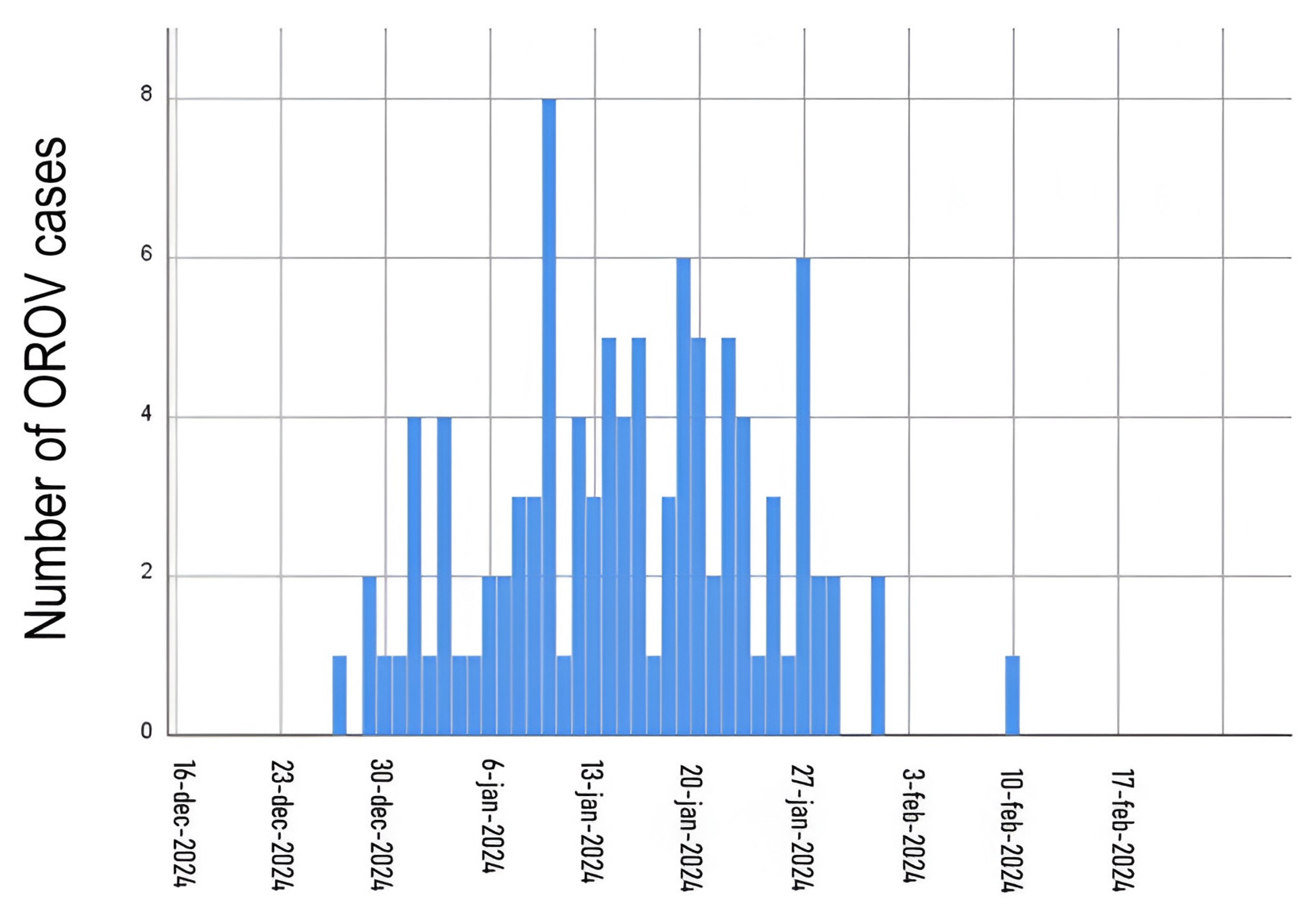
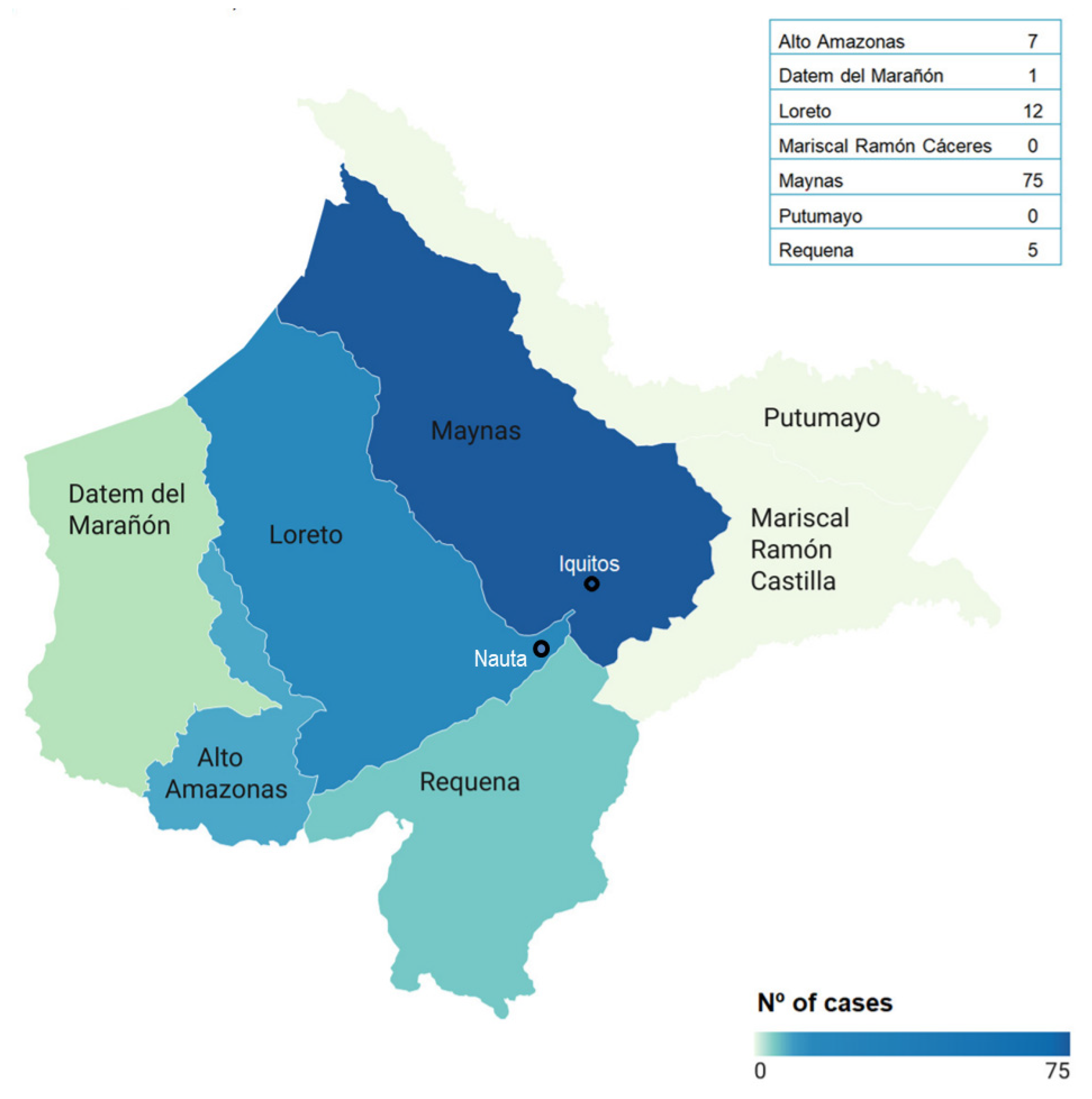
3.1. Temporal and Geographic Distribution
3.2. Diagnostic Confirmation and Coinfections
3.3. Oropouche Fever Clinical Presentation
3.4. Oropouche Fever Hospitalizations
3.5. Age and Gender Subgroup Analysis
3.6. Pregnancy Outcomes
3.7. Atypical and Neurological Presentations
4. Discussion
5. Conclusions
Author Contributions
Funding
Institutional Review Board Statement
Informed Consent Statement
Data Availability Statement
Acknowledgments
Conflicts of Interest
Abbreviations
| OROV | Oropouche virus |
| DENV | Dengue virus |
| RT-qPCR | real-time polymerase chain reaction |
| PAHO | Pan American Health Organization |
Appendix A

| Characteristics | Women n/N (%) | Men n/N (%) | OR (95%CI) | p-Value |
|---|---|---|---|---|
| Arthralgia | 32/41 (78.0%) | 33/59 (55.9%) | 2.80 (1.13–6.89) | 0.018 |
| Fever | 33/41 (80.5%) | 55/59 (93.2%) | 0.30 (0.08–1.07) | 0.054 |
| Nausea and vomiting | 14/41 (34.1%) | 28/59 (47.5%) | 0.57 (0.25–1.31) | 0.131 |
| Rash | 0/41 (0.0%) | 2/59 (3.4%) | NC | 0.346 |
| Back pain | 10/41 (24.4%) | 24/59 (40.7%) | 0.47 (0.19–1.14) | 0.069 |
| Retro-ocular pain | 8/41 (19.5%) | 20/59 (33.9%) | 0.47 (0.18–1.21) | 0.087 |
| Headache | 32/41 (78.0%) | 46/59 (78.0%) | 1.00 (0.38–2.63) | 0.596 |
| Myalgia | 29/41 (70.7%) | 43/59 (72.9%) | 0.89 (0.37–2.17) | 0.494 |
| Abdominal pain | 2/41 (4.9%) | 8/59 (13.6%) | 0.33 (0.07–1.63) | 0.138 |
| Persistent vomiting | 1/41 (2.4%) | 6/59 (10.2%) | 0.22 (0.02–1.91) | 0.137 |
| Hospitalized | 1/41 (2.4%) | 7/59 (11.9%) | 0.19 (0.02–1.57) | 0.087 |
| Characteristics | Children (≤14 Years Old) n/N (%) | Adults n/N (%) | OR (95%CI) | p-Value |
|---|---|---|---|---|
| Arthralgia | 13/25 (52.0%) | 52/75 (69.3%) | 0.47 (0.19–1.21) | 0.093 |
| Fever | 21/25 (84.0%) | 67/75 (89.3%) | 0.63 (0.17–2.3) | 0.347 |
| Nausea and vomiting | 14/25 (56.0%) | 28/75 (37.3%) | 2.13 (0.85–5.35) | 0.081 |
| Rash | 0/25 (0.0%) | 2/75 (2.7%) | NC | 0.561 |
| Back pain | 8/25 (32.0%) | 26/75 (34.7%) | 0.88 (0.34–2.33) | 0.505 |
| Retro-ocular pain | 4/25 (16.0%) | 24/75 (32.0%) | 0.41 (0.13–1.31) | 0.096 |
| Headache | 20/25 (80.0%) | 58/75 (77.3%) | 1.17 (0.38–3.59) | 0.511 |
| Myalgia | 18/25 (75.0%) | 54/75 (72.0%) | 1.00 (0.36–2.74) | 0.594 |
| Abdominal pain | 0/25 (0.0%) | 10/75 (13.3%) | 0.87 (0.79–0.95) | 0.048 |
| Persistent vomiting | 0/25 (0.0%) | 7/75 (9.3%) | 0.91 (0.84–0.97) | 0.124 |
| Hospitalized | 0/25 (0.0%) | 8/75 (10.7%) | NC | 0.091 |
References
- Romero-Alvarez, D.; Escobar, L.E. Oropouche fever, an emergent disease from the Americas. Microbes Infect. 2018, 20, 135–146. [Google Scholar] [CrossRef]
- da Costa, F.B.; Cavalcanti, A.C.; Erbisti, R.S.; Dias, V.Z.; Moreira, C.G.d.C.; Grifo, M.M.; Vaz, M.C.d.S.; Camargo, A.C.; de Souza, L.M.; dos Santos, F.B.; et al. Introduction and Spatial–Temporal Distribution of Oropouche Virus in Rio de Janeiro State, Brazil. Pathogens 2025, 14, 833. [Google Scholar] [CrossRef]
- Epidemiological Update Oropouche in the Americas Region—11 February 2025—PAHO/WHO. Pan American Health Organization. Available online: https://www.paho.org/en/documents/epidemiological-update-oropouche-americas-region-11-february-2025 (accessed on 29 November 2025).
- Labiod, N.; Sánchez-Seco, M.P.; Goikoetxea, J.; Zurita, N.D.; Norman, F.F.; Martínez, M.M.; Alonso, P.A.; Hernández-Betancor, A.; Sempere-Alcocer, M.A.; Moure, Z.; et al. Case series of Oropouche fever among travellers returning from Cuba to Spain, 2024. Euro Surveill. 2025, 30, 2400719. [Google Scholar] [CrossRef]
- Bartlett, M.L.; Miley, K.; Vermund, S.H.; Weaver, S.C. Arthropod-borne disease challenges from planetary warming, urbanization, and migration. Virol. J. 2025, 22, 325. [Google Scholar] [CrossRef]
- Sakkas, H.; Bozidis, P.; Franks, A.; Papadopoulou, C. Oropouche Fever: A Review. Viruses 2018, 10, 175. [Google Scholar] [CrossRef] [PubMed]
- Zhang, Y.; Liu, X.; Wu, Z.; Feng, S.; Lu, K.; Zhu, W.; Sun, H.; Niu, G. Oropouche virus: A neglected global arboviral threat. Virus Res. 2024, 341, 199318. [Google Scholar] [CrossRef] [PubMed]
- Briese, T.; Bird, B.; Kapoor, V.; Nichol, S.T.; Lipkin, W.I. Batai and Ngari Viruses: M Segment Reassortment and Association with Severe Febrile Disease Outbreaks in East Africa. J. Virol. 2006, 80, 5627–5630. [Google Scholar] [CrossRef] [PubMed]
- Tilston-Lunel, N.L.; Hughes, J.; Acrani, G.O.; da Silva, D.E.A.; Azevedo, R.S.S.; Rodrigues, S.G.; Vasconcelos, P.F.C.; Nunes, M.R.T.; Elliott, R.M. Genetic analysis of members of the species Oropouche virus and identification of a novel M segment sequence. J. Gen. Virol. 2015, 96, 1636–1650. [Google Scholar] [CrossRef]
- Bai, F.; Denyoh, P.M.D.; Urquhart, C.; Shrestha, S.; Yee, D.A. A Comprehensive Review of the Neglected and Emerging Oropouche Virus. Viruses 2025, 17, 439. [Google Scholar] [CrossRef]
- Castilletti, C.; Huits, R.; Mantovani, R.P.; Accordini, S.; Alladio, F.; Gobbi, F. Replication-Competent Oropouche Virus in Semen of Traveler Returning to Italy from Cuba, 2024. Emerg. Infect. Dis. 2024, 30, 2684–2686. [Google Scholar] [CrossRef]
- Mourão, M.P.G.; de Melo, G.C.; Nascimento, J.; Mwangi, V.I.; Sacchetto, L.; Gardinassi, L.G.; Netto, R.L.A.; Mota, J.; Pinto, S.D.; Tavares, M.; et al. Clinical and laboratory profiles of Oropouche virus disease from the 2024 outbreak in Manaus, Brazilian Amazon. PLoS Negl. Trop. Dis. 2025, 19, e0013604. [Google Scholar] [CrossRef]
- Moreira, H.M.; Sgorlon, G.; Queiroz, J.A.S.; Roca, T.P.; Ribeiro, J.; Teixeira, K.S.; Passos-Silva, A.M.; Araújo, A.; Gasparelo, N.W.F.; Santos, A.d.O.D.; et al. Outbreak of Oropouche virus in frontier regions in western Amazon. Microbiol. Spectr. 2024, 12, e0162923. [Google Scholar] [CrossRef] [PubMed]
- Ramírez-García, E.A.; Higuita, N.I.A.; Henao-Martínez, A.F.; Franco-Paredes, C.; Marcos, L.A.; Celis-Salinas, J.C.; Ramal-Asayag, C.; Morales, M.C. Polymerase Chain Reaction–Confirmed Oropouche Virus Disease in Loreto, Perú: A Case Series from December 2023 Through September 2024. Ann. Intern. Med. 2025, 179, 1. [Google Scholar] [CrossRef]
- Fernández, J.R.d.A.; García, C.E.P.; Herrera, B.A.; Plaza, I.B.; de la Cruz, Y.G.; Aguirre, S.R.; Cardellá, V.K.; Tirado, M.G.G. Report of an unusual association of Oropouche Fever with Guillain-Barré syndrome in Cuba, 2024. Eur. J. Clin. Microbiol. Infect. Dis. 2024, 43, 2233–2237. [Google Scholar] [CrossRef] [PubMed]
- Sah, R.; Satapathy, P.; Gaidhane, A.M.; Vadia, N.; Menon, S.V.; Chennakesavulu, K.; Panigrahi, R.; Bushi, G.; Singh, M.; Sah, S.; et al. Neurological Manifestations in Oropouche Virus Infection: A Systematic Review and Meta-Analysis. J. Med. Virol. 2025, 97, e70532. [Google Scholar] [CrossRef] [PubMed]
- Cola, J.P.; dos Santos, A.P.B.; Zanotti, R.L.; Costa, A.E.d.S.D.; Del Carro, K.B.; Coelho, L.d.A.L.; Miranda, A.E.; Vicente, C.R. Maternal and Fetal Implications of Oropouche Fever, Espírito Santo State, Brazil, 2024. Emerg. Infect. Dis. 2025, 31, 645–651. [Google Scholar] [CrossRef]
- Bandeira, A.C.; Pereira, F.M.; Leal, A.; Santos, S.P.; Barbosa, A.C.; Souza, M.S.P.L.; de Souza, D.R.; Guimaraes, N.; Fonseca, V.; Giovanetti, M.; et al. Fatal Oropouche Virus Infections in Nonendemic Region, Brazil, 2024. Emerg. Infect. Dis. 2024, 30, 2370–2374. [Google Scholar] [CrossRef]
- Baisley, K.J.; Watts, D.M.; Munstermann, L.E.; Wilson, M.L. Epidemiology of endemic Oropouche virus transmission in upper Amazonian Peru. Am. J. Trop. Med. Hyg. 1998, 59, 710–716. [Google Scholar] [CrossRef]
- Oropouche Virus Disease—Peru. Available online: https://www.who.int/emergencies/disease-outbreak-news/item/03-june-2016-oropouche-peru-en (accessed on 18 December 2025).
- Schwartz, D.A. Novel Reassortants of Oropouche Virus (OROV) Are Causing Maternal–Fetal Infection During Pregnancy, Stillbirth, Congenital Microcephaly and Malformation Syndromes. Genes 2025, 16, 87. [Google Scholar] [CrossRef]
- Ministerio de Salud de Perú. Estadística Poblacional. Available online: https://www.minsa.gob.pe/reunis/data/poblacion_estimada.asp (accessed on 29 November 2025).
- Enfermedad por Virus Oropouche—OPS/OMS. Organización Panamericana de la Salud. 6 February 2025. Available online: https://www.paho.org/es/temas/enfermedad-por-virus-oropouche (accessed on 6 March 2025).
- Riccò, M.; Corrado, S.; Bottazzoli, M.; Marchesi, F.; Gili, R.; Bianchi, F.P.; Frisicale, E.M.; Guicciardi, S.; Fiacchini, D.; Tafuri, S.; et al. (Re-)Emergence of Oropouche Virus (OROV) Infections: Systematic Review and Meta-Analysis of Observational Studies. Viruses 2024, 16, 1498. [Google Scholar] [CrossRef]
- Ukoaka, B.M.; Okesanya, O.J.; Daniel, F.M.; Ahmed, M.M.; Udam, N.G.; Wagwula, P.M.; Lawal, H. Updated WHO list of emerging pathogens for a potential future pandemic: Implications for public health and global preparedness. Le Infez. Med. 2024, 32, 463–477. [Google Scholar] [CrossRef]
- Olortegui, M.P.; Schiaffino, F.; Peñataro Yori, P.; Colston, J.M.; Shapiama Lopez, V.; Pinedo Vasquez, T.; Kosek, M.N. Genomic Epidemiology of 2023–2024 Oropouche Outbreak in Iquitos, Peru reveals independent origin from a concurrent outbreak in Brazil. medRxiv 2024, 2024.12.08.24318674. [Google Scholar] [CrossRef]
- Tortosa, F.; Castillo, G.G.; Izcovich, A.; Luz, K.; dos Santos, T.; Gonzalez-Escobar, G.; Ragusa, M.A.; Gresh, L.; Mendez-Rico, J.A.; Reveiz, L. Revisión sistemática viva de las manifestaciones clínicas de la fiebre de Oropouche: Claves para diferenciarla del dengue y otras arbovirosis. Rev. Panam. Salud Pública 2024, 48, e136. [Google Scholar] [CrossRef] [PubMed]
- Bhardwaj, U.; Pandey, N.; Rastogi, M.; Singh, S.K. Gist of Zika Virus pathogenesis. Virology 2021, 560, 86–95. [Google Scholar] [CrossRef]
- Wang, Z.; Huang, L.; Zhang, X.; Huang, L.; Zhu, X.; Long, X.; Cao, D.; Li, Y. Clinical presentation of Oropouche virus infection: A systematic review and meta-analysis. PLoS Negl. Trop. Dis. 2025, 19, e0012962. [Google Scholar] [CrossRef] [PubMed]
- Almeida, G.M.; Souza, J.P.; Mendes, N.D.; Pontelli, M.C.; Pinheiro, N.R.; Nogueira, G.O.; Cardoso, R.S.; Paiva, I.M.; Ferrari, G.D.; Veras, F.P.; et al. Neural Infection by Oropouche Virus in Adult Human Brain Slices Induces an Inflammatory and Toxic Response. Front. Neurosci. 2021, 15, 674576. [Google Scholar] [CrossRef]
- González-Quevedo, A.; Lestayo O’Farrill, Z.; Mustelier Becquer, R. Oropouche virus—Another antecedent event for Guillain–Barré syndrome? Rev. Panam. Salud Pública 2025, 49, e23. [Google Scholar] [CrossRef] [PubMed]
- Pareek, A.; Singhal, R.; Pareek, A.; Chuturgoon, A.; Apostolopoulos, V. Rising threat of Oropouche virus transmission from mother to child: An urgent call for action. Travel. Med. Infect. Dis. 2024, 62, 102776. [Google Scholar] [CrossRef]
- Martins, F.E.d.N.; Chiang, J.O.; Nunes, B.T.D.; Ribeiro, B.d.F.R.; Martins, L.C.; Casseb, L.M.N.; Henriques, D.F.; de Oliveira, C.S.; Maciel, E.L.N.; Cravo, L.d.C.C.; et al. Newborns with microcephaly in Brazil and potential vertical transmission of Oropouche virus: A case series. Lancet Infect. Dis. 2025, 25, 155–165. [Google Scholar] [CrossRef]
- Filho, C.G.; Neto, A.S.L.; Maia, A.M.P.C.; da Silva, L.O.R.; Cavalcante, R.d.C.; Monteiro, H.d.S.; Marques, K.C.A.; Oliveira, R.d.S.; Gadelha, S.d.A.C.; de Melo, D.N.; et al. A Case of Vertical Transmission of Oropouche Virus in Brazil. N. Engl. J. Med. 2024, 391, 2055–2057. [Google Scholar] [CrossRef]
- Srivastava, S.; Sharma, D.; Kumar, S.; Mali, S.N.; Mehta, R.; Apostolopoulos, V.; Rodriguez-Morales, A.J. Pregnancy Loss, Oropouche Virus and the Lessons from Pernambuco, Brazil. Infez. Med. 2024, 32, 417–420. [Google Scholar] [CrossRef] [PubMed]
- Schwartz, D.A.; Dashraath, P.; Baud, D. Oropouche Virus (OROV) in Pregnancy: An Emerging Cause of Placental and Fetal Infection Associated with Stillbirth and Microcephaly following Vertical Transmission. Viruses 2024, 16, 1435. [Google Scholar] [CrossRef] [PubMed]


| Characteristics | N (%) |
|---|---|
| Gender | |
| Women | 59 (59%) |
| Male | 41 (41%) |
| Pregnant women | 6 (6%) |
| Age, years old; median (IQR) | 28 (14.25–40.75) |
| Origin: urban | 81 (81%) |
| Documented previous dengue infection | 4 (4%) |
| History of the yellow fever vaccine | 9 (9%) |
| Comorbidities | 3 (3%) |
| Symptoms | |
| Fever | 88 (88%) |
| Arthralgia | 65 (65%) |
| Arthralgia (hands) | 48 (48%) |
| Arthralgia (feet) | 52 (52%) |
| Myalgia | 72 (72%) |
| Headache | 78 (78%) |
| Retro-ocular pain | 28 (28%) |
| Back pain | 34 (34%) |
| Rash | 2 (2%) |
| Conjunctivitis | 0 (0%) |
| Nausea or vomiting | 42 (42%) |
| Alarm Signs | |
| Abdominal pain | 10 (10%) |
| Dyspnea or chest pain | 0 (0%) |
| Effusions | 0 (0%) |
| Persistent vomiting | 7 (7%) |
| Hypothermia | 0 (0%) |
| Oliguria | 0 (0%) |
| Hepatomegaly | 0 (0%) |
| Jaundice | 0 (0%) |
| Neurological symptoms | 0 (0%) |
| High hematocrit | 0 (0%) |
| Severity Markers | |
| Oropouche severe | 0 (0%) |
| Hospitalization | 8 (8%) |
| Death | 0 (0%) |
| Characteristics | Hospitalized n/N (%) | Not Hospitalized n/N (%) | OR (95%CI) | p-Value |
|---|---|---|---|---|
| Abdominal pain | 6/8 (75%) | 4/92 (4.3%) | 66.0 (9.9–436.0) | <0.0001 |
| Persistent vomiting | 5/8 (62.5%) | 2/92 (2.2%) | 75.0 (10.1–555.8) | <0.0001 |
| Arthralgia | 8/8 (100.0%) | 57/92 (62.0%) | NC | 0.027 |
| Fever | 7/8 (87.5%) | 81/92 (88.0%) | 0.95 (0.11–8.47) | 0.655 |
| Myalgia | 8/8 (100.0%) | 64/92 (69.6%) | NC | 0.064 |
| Headache | 7/8 (87.5%) | 71/92 (77.2%) | 2.07 (0.24–17.79) | 0.438 |
| Back pain | 5/8 (62.5%) | 29/92 (31.5%) | 3.62 (0.81–16.18) | 0.086 |
| Retro-ocular pain | 2/8 (25.0%) | 26/92 (28.3%) | 0.85 (0.16–4.46) | 0.603 |
| Rash | 0/8 (0.0%) | 2/92 (2.2%) | NC | 0.846 |
| Conjunctivitis | 0/8 (0.0%) | 0/92 (0.0%) | NC | NC |
| Nausea/vomiting | 5/8 (62.5%) | 37/92 (40.2%) | 2.47 (0.56–11.00) | 0.197 |
| Gender (woman) | 7/8 (87.5%) | 52/92 (56.5%) | 3.48 (0.55–22.08) | 0.087 |
| Origin (urban) | 5/8 (62.5%) | 76/92 (82.6%) | 2.85 (0.62–13.16) | 0.174 |
| Age (adults) | 8/8 (100.0%) | 67/92 (72.8%) | NC | 0.091 |
| Pregnancy | 3/8 (37.5%) | 3/92 (3.3%) | 17.8 (2.8–111.7) | 0.006 |
| Case Number | Age | Weeks of Pregnancy at Diagnosis | Delivery Week | Newborn Weight | Complications | Description |
|---|---|---|---|---|---|---|
| Case 1 | 33 | 20 | 35 + 2 | 2705 g | Yes | Premature rupture of membranes, neonatal hyperbilirubinemia |
| Case 2 | 19 | 34 | 39 | 3200 g | No | |
| Case 3 | 22 | 37 | 40 | 3700 g | No | |
| Case 4 | 15 | 35 | 40 | 3900 g | No | |
| Case 5 | 25 | 26 | 37 | 2700 g | Yes | Preeclampsia, caesarean section |
| Case 6 | 16 | 5 | 37 | 4500 g | Yes | Macrosomia |
Disclaimer/Publisher’s Note: The statements, opinions and data contained in all publications are solely those of the individual author(s) and contributor(s) and not of MDPI and/or the editor(s). MDPI and/or the editor(s) disclaim responsibility for any injury to people or property resulting from any ideas, methods, instructions or products referred to in the content. |
© 2026 by the authors. Licensee MDPI, Basel, Switzerland. This article is an open access article distributed under the terms and conditions of the Creative Commons Attribution (CC BY) license.
Share and Cite
Rojo-Pérez, M.Á.; Ramírez-García, E.A.; Llenas-García, J. Clinical and Epidemiological Characteristics of an Oropouche Virus Outbreak in Loreto, Peru (October 2024–March 2025). Pathogens 2026, 15, 119. https://doi.org/10.3390/pathogens15010119
Rojo-Pérez MÁ, Ramírez-García EA, Llenas-García J. Clinical and Epidemiological Characteristics of an Oropouche Virus Outbreak in Loreto, Peru (October 2024–March 2025). Pathogens. 2026; 15(1):119. https://doi.org/10.3390/pathogens15010119
Chicago/Turabian StyleRojo-Pérez, Miguel Ángel, Edgar A. Ramírez-García, and Jara Llenas-García. 2026. "Clinical and Epidemiological Characteristics of an Oropouche Virus Outbreak in Loreto, Peru (October 2024–March 2025)" Pathogens 15, no. 1: 119. https://doi.org/10.3390/pathogens15010119
APA StyleRojo-Pérez, M. Á., Ramírez-García, E. A., & Llenas-García, J. (2026). Clinical and Epidemiological Characteristics of an Oropouche Virus Outbreak in Loreto, Peru (October 2024–March 2025). Pathogens, 15(1), 119. https://doi.org/10.3390/pathogens15010119