
Skip to Content

Optoelectronics

Optoelectronics is an international, peer-reviewed, open access journal on the interaction between light, materials, electronic devices, and intelligent systems, published quarterly online by MDPI.
  • Open Access— free for readers, with article processing charges (APC) paid by authors or their institutions.
  • Rapid Publication: first decisions in 18 days; acceptance to publication in 7 days (median values for MDPI journals in the first half of 2026).
  • Recognition of Reviewers: Reviewers whose reports are timely and of high quality receive an APC discount voucher for a future publication in an MDPI journal. Become a reviewer.
  • Optoelectronics is a companion journal of Electronics and Photonics.

Get Alerted

Add your email address to receive forthcoming issues of this journal.

All Articles (5)

  • Perspective
  • Open Access

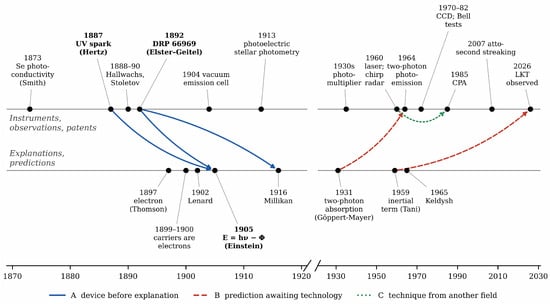
Photoelectric detection did not merely replace the eye; it created measurement functions the eye has never possessed. This Perspective follows that transition from Hertz’s accidental observation in 1887 that ultraviolet light facilitates a spark discharge, through the quantitative work of Hallwachs and Stoletov, to German patent No. 66969, granted in 1892 to the schoolteachers Julius Elster and Hans Geitel for measuring light intensity with a photoelectric vacuum cell and allowed to lapse in 1895. This first patented photoemissive detector delivered an electric current proportional to the incident light, objective and recordable, five years before the electron was identified and thirteen years before Einstein, then a patent examiner in Bern, explained the effect. The article discusses the plausible but undocumented influence of the patent office on Einstein, follows the descendants of the Elster–Geitel cell into image sensors and photomultipliers, which made possible the tests of Bell’s inequalities with entangled photons recognised by the 2022 Nobel Prize, and shows that the pattern recurs in the laser era, where multiphoton, strong-field and attosecond photoemission resolve electron dynamics on timescales shorter than an optical cycle. The photoelectric streak camera and its attosecond counterpart, in which the optical field replaces the deflecting voltage, join detection and ultrafast photoemission in a single principle. Throughout this history, working technology has repeatedly preceded physical understanding.

Optoelectronics

11 November 2026

Timeline of photoelectric detection, 1873–2026. Upper line: instruments, observations and patents; lower line: explanations and theoretical predictions. Arrows mark the intervals discussed in Section 7: (A) devices and observations preceding their explanation; (B) predictions awaiting an enabling technology; (C) a technique transferred from another field. The time axis is broken at 1920 and compressed thereafter.
  • Article
  • Open Access

Semiconductor manufacturing relies on specialized yellow lighting in lithography fabs to reduce photoresist degradation, but the spectral characteristics of such lighting also motivate evaluation of its effects on human-related responses. This study evaluates whether candlelight-style LED illumination can serve as an alternative lighting condition while maintaining photoresist compatibility. We compare the two lighting conditions across fabrication-related measurements, spectral calculations, questionnaire responses, concentration maintenance, viewing clarity, and intraocular pressure. The results include a smaller increase in photoresist viscosity under an accelerated exposure test, differences in calculated MPE and MSS values, descriptive differences in questionnaire responses, concentration-maintenance trends, and visual-response measurements. Because several outcomes are descriptive or modeled and some experimental details could not be independently verified from the retained records, the findings are interpreted cautiously.

Optoelectronics

29 October 2026

  • Article
  • Open Access

Excessive blue light exposure might severely threaten retinal health and disrupt circadian rhythms. To mitigate these hazards, candlelight-style sources were developed; however, fabricating high-efficiency, large-area, wet-processed candlelight organic light-emitting diodes (OLEDs) remains challenging. This study demonstrates a high-efficiency, blue-light-free candlelight OLED fabricated via wet process by incorporating a [2-(3,6-dimethoxy-9H-carbazol-9-yl)ethyl]phosphonic acid (MeO-2PACz) self-assembled monolayer between hole injection and emissive layers. At 1000 cd/m2, the resultant power efficacy, current efficiency and external quantum efficiency can be increased by 22%, 15% and 12%, respectively. Notably, at a high luminance of 10,000 cd/m2, the corresponding efficiencies remain enhanced by 34%, 22%, and 19%, respectively. This device exhibits a color temperature of 1991 K, permitting at 100 lx a maximum exposure limit of 71,211 s, 130 times longer than a cold-white OLED. The enhancement of device efficiencies may be attributed to the reduction in hole injection resistance and the suppression of non-radiative electron leakage.

Optoelectronics

15 October 2026

  • Editorial
  • Open Access

The past decade has witnessed transformative progress across optoelectronics, where photon-electron transduction underpins core infrastructure for high-capacity optical communications, advanced imaging, distributed sensing, quantum technologies and emerging AI photonic hardware [...]

Optoelectronics

29 September 2026

Highly Accessed Articles

News & Conferences

Latest Issues

Open for Submission

Journal Sections

XFacebookLinkedIn
Optoelectronics - ISSN 3043-1700