
- Article

22 Pages
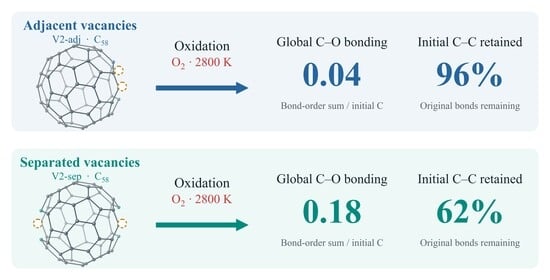
ReaxFF molecular dynamics was used to examine oxygen–carbon bonding and carbon network reconstruction of pristine C60, monovacancy C59, and two specific C58 vacancy configurations at 1600-2800 K. Oxidation and oxygen-free conditions each used three independent trajectories and 200 ps production periods. At 2800 K and nominal oxygen loading of 0.5, the normalized C–O bond order sums were 0.04075 ± 0.03532 for V2-adj and 0.17501 ± 0.04520 for V2-sep. Their initial C–C retention fractions were 0.9617 ± 0.0397 and 0.6231 ± 0.1279, respectively. These late-stage differences persisted across bond order thresholds of 0.30–0.40. Matched oxygen-free controls showed substantial thermal reconstruction, especially for V1, demonstrating that connectivity replacement cannot generally be attributed to oxygen attack. The V2-sep mean was 7.85% below an additive two-V1 bonding benchmark, but the difference was smaller than its propagated sampling uncertainty. The results concern the selected configurations and parametrization, whose initial coordination environments differ; they do not establish universal vacancy separation effects or real soot oxidation kinetics.
Materials
22 October 2026
![Measured strength and tear initiation across four composition–treatment states [31]. (a) Yield strength (YS); (b) Kahn unit initiation energy (UIE), defined as energy to maximum tear load divided by initial ligament area; (c) measured Cu/Mg/Ag contents and thermal schedules. The category labels denote nominal Mg contents, not a continuous single-variable experiment. All sheets were 1.6 mm thick, water quenched, pre-stretched by 2%, and peak-aged at 160 °C; the homogenization, solution temperature, and peak-aging time covary. The reproduced graphical error bars have unreported statistical definitions and specimen counts, and are not assigned standard deviation (SD), standard error (SE), or confidence interval (CI) meanings. Extraction details are in Methods S1. UIE is not KIC; source-model quantities are separated in Table S2. Possible baseline overlap with [44] is retained in the source records.](https://mdpi-res.com/materials/materials-19-04429/article_deploy/html/images/materials-19-04429-ag-550.jpg)
![The arrangement of the prestressing steel strand within the individual molds for the test specimens [17].](https://mdpi-res.com/materials/materials-19-04426/article_deploy/html/images/materials-19-04426-g001-550.jpg)
![(a) Electrical conductivity and (b) Seebeck coefficient as a function of the temperature for several oxide materials synthesized by pulsed laser deposition. Data from Refs. [13,14,15,16,17,18].](https://mdpi-res.com/materials/materials-19-03184/article_deploy/html/images/materials-19-03184-ag-550.jpg)
![Schematic comparison of chalcopyrite CIGS and kesterite CZTSSe thin-film solar cells, highlighting absorber composition, crystal-structure relationship, band-gap tunability, representative device architecture, and dominant performance-limiting factors. CIGS has reached certified efficiencies above 23%, whereas CZTSSe offers earth-abundant chemistry but remains limited by antisite disorder, secondary phases, and interface recombination. AI-assisted schematic; scientific basis supported by Refs. [1,5,6,7,8,9].](https://mdpi-res.com/materials/materials-19-02989/article_deploy/html/images/materials-19-02989-g001-550.jpg)