
Skip to Content
You are currently on the new version of our website. Access the old version .
  • 3.7
    Impact Factor
  • 7.0
    CiteScore
  • 15 days
    Submission to First Decision
  • 4 days
    Acceptance to Publication

Materials

Materials is an international peer-reviewed, open access journal on materials science and engineering published semimonthly online by MDPI. The Spanish Materials Society (SOCIEMAT), Manufacturing Engineering Society (MES) and Chinese Society of Micro-Nano Technology (CSMNT) are affiliated with Materials and their members receive discounts on the article processing charges.

Get Alerted

Add your email address to receive forthcoming issues of this journal.

All Articles (58,780)

  • Article
  • Open Access

Geopolymer concrete produced from fly ash and ground granulated blast furnace slag (GGBFS) has been proposed as a lower-carbon alternative to Portland cement concrete, and blending the two precursors allows for curing at ambient temperature. However, the combined influence of the precursor proportion and activator formulation on the durability of such concretes is not well documented, because mechanical and durability properties have mostly been studied separately. The objective of this study was therefore to evaluate, within a single experimental programme, how the fly ash-to-slag proportion and three combined activator formulations affect the fresh, mechanical and durability properties of ambient-cured hybrid geopolymer concrete. This study examines the influence of the fly ash-to-slag proportion and of three combined activator formulations (nominal Si/Al of 2.0, 2.5 and 3.0, each paired with an SS/SH ratio of 1.5, 2.0 and 2.5, respectively) on the fresh-state, mechanical, and durability characteristics of ambient-cured hybrid geopolymer concrete. Twelve mixture compositions were systematically designed at a constant binder content (500 kg/m3) and NaOH concentration (10 M); the alkaline solution-to-binder ratio varied from 0.33 to 0.39 with the activator formulation. Because Si/Al and SS/SH were varied together, their individual effects could not be separated. Progressive augmentation of the GGBFS proportion from 20% to 50% increased strength and improved the measured durability indicators, while reducing slump and setting time. The best-performing mixture in most tests (M11: 50% GGBFS, nominal Si/Al = 2.5, SS/SH = 2.0) attained a 28-day compressive strength of 60.3 MPa, water absorption of 3.8%, ultrasonic pulse velocity of 4.79 km/s and the lowest freeze–thaw strength loss (4.8%); the highest formulation (M12) was marginally better in the 90-day sulfate test (1.9% versus 2.0% strength loss). Conversely, the highest activator formulation (Si/Al = 3.0, SS/SH = 2.5) slightly reduced strength and increased shrinkage and freeze–thaw strength loss relative to the intermediate one; a viscosity-related limitation of ion mobility is a possible but unverified explanation. These outcomes show that precursor blending and activator formulation strongly affect the laboratory performance of ambient-cured fly ash–GGBFS geopolymer concrete; structural suitability, field durability and environmental benefit were not assessed.

Materials

13 November 2026

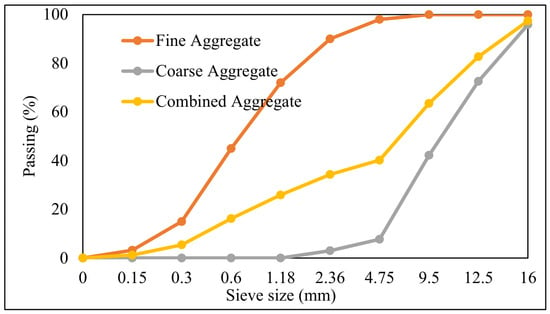
Gradation curves of the fine aggregate, coarse aggregate and their combined (36:64) blend.
  • Article
  • Open Access

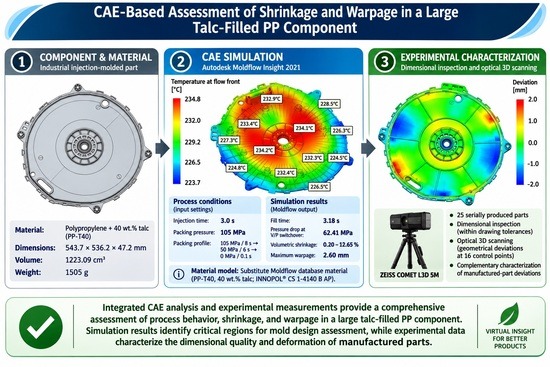
This paper presents a numerical analysis of the filling and packing processes, cooling behavior, shrinkage, and warpage in a large-scale injection-molded component produced from polypropylene filled with 40% talc. Simulations were conducted using Autodesk Moldflow Insight 2021 to evaluate process behavior and identify potential dimensional quality issues during injection molding. The simulation model encompassed the filling, packing, and cooling phases, as well as the resulting warpage of the molded part. The Moldflow report listed a fill time of 3.18 s and a filling pressure requirement of approximately 62 MPa under the selected processing conditions. The predicted volumetric shrinkage ranged from 0.20% to 12.65%, and local areas with an elevated risk of sink marks, air traps, and weld lines were identified. The cooling analysis showed localized regions of elevated cycle-averaged temperature on the mold side of the part–mold interface as well as regions with longer predicted times until the specified polymer ejection temperature was reached. The maximum predicted warpage reached 2.60 mm. Dimensional measurements showed that all evaluated dimensions were within the prescribed tolerances in the measured production batch, although preliminary process-capability indices varied among the monitored characteristics, with several values below the specified acceptance criterion of Cpk > 1.67, including values below 1.0. Optical 3D scanning provided complementary experimental information on the geometric deviations of the manufactured parts; a quantitative validation of the Moldflow warpage predictions was not possible with the available data. The numerical analysis employed a substitute Moldflow database material model because a complete material model for the actual production grade was unavailable. Therefore, the quantitative transfer of the predicted shrinkage and warpage values to the production material has not been established. The simulation results provide preliminary spatial guidance for assessing the mold configuration, whereas quantitative shrinkage and warpage predictions require reassessment using a material model based on experimentally determined data for the actual production grade.

Materials

13 November 2026

CAD model of the analyzed injection-molded component, Zen Tub Cover (Part No. R22443589).
  • Article
  • Open Access

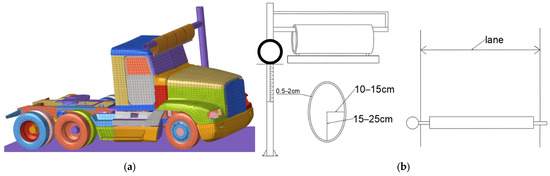
Traditional height-limiting warning barriers address the issues of susceptibility to damage and difficulty in operation and maintenance. This paper proposes a rubber-tube-suspended height-restriction frame. Based on the LSDYNA explicit dynamics platform, a finite element model for an over-height vehicle height-restriction frame was developed to simulate collisions between over-height vehicles and the rubber-tube height-restriction frame. The model systematically analyzes the collision response patterns under full-width frontal collisions and lateral collisions with offsets of 1/2 and 1/4. The results indicate that a frontal collision consists of two concentrated contact phases: an initial high-intensity impact followed by a secondary low-intensity impact. During these phases, the maximum contact reaction force reaches 148.3 kN, providing effective tactile feedback for the driver without damaging the vehicle’s roof steel structure. The secondary impact occurs during the phase where the vehicle and the rubber tube move in the same direction, at which point the peak contact force drops to 35 kN. This energy dissipation is attributed to the combined effect of reduced relative velocity at the contact interface and the unloading of tangential slip. Energy analysis shows that impact kinetic energy is dissipated gradually through a hierarchical process: it is first converted into strain energy, and subsequently into frictional energy, rotational kinetic energy, and gravitational potential energy. Among these dissipation pathways, frictional energy at the vehicle-tube interface (approximately 3.0 × 10⁶ N × mm) dominates in the early stage, whereas frictional energy at the tube–beam interface (approximately 3.8 × 10⁶ N × mm) becomes the primary dissipation mechanism during the long-period oscillation stage. The maximum von Mises equivalent stress in the rubber component is 1.678 MPa, providing sufficient safety margin. Offset collisions can reduce peak contact forces by 32.6–46.5%, although local stresses increase slightly. However, under all test conditions, the maximum von Mises stress in the rubber component remains below the material’s tensile strength, thereby ensuring a sufficient safety margin. This suspended rubber-tube-type high-speed limit warning barrier provides effective contact warning under a variety of impact conditions while minimizing damage to both the vehicle and the barrier itself. The research findings provide a quantitative basis for the design of passive high-speed limit warning facilities.

Materials

13 November 2026

Model diagram of the vehicle–alert limit elevated system. (a) Vehicle–alert limit elevated system finite element diagram. (b) Alert limit elevated system CAD diagram.
  • Article
  • Open Access

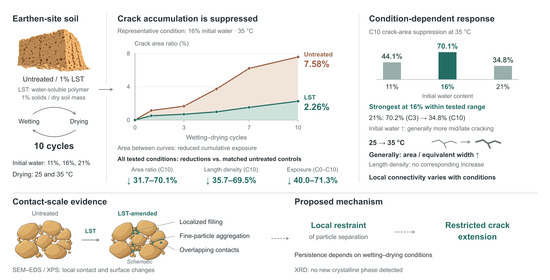
Wetting–drying cycles threaten the integrity of earthen heritage and its repair materials. This study examined the effects of initial water content and drying temperature on crack evolution in earthen-site soil amended with a laboratory-developed water-soluble polymer (designated LST). Untreated and LST-amended specimens underwent ten cycles at initial water contents of 11%, 16%, and 21% and drying temperatures of 25 and 35 °C. Image analysis quantified crack geometry, network topology, and cumulative cracking, complemented by scanning electron microscopy (SEM) with energy-dispersive X-ray spectroscopy (EDS), X-ray diffraction (XRD), and X-ray photoelectron spectroscopy (XPS). In the analyzed images, LST reduced the mean final crack area ratio by 31.7–70.1% and crack length density by 35.7–69.5%. Cumulative cracking exposure, estimated from six observation points, was 40.0–71.3% lower with LST. Local connectivity varied with the test conditions. Higher initial water contents generally intensified intermediate- and late-stage cracking, whereas higher temperatures increased crack area and equivalent width without a corresponding increase in length density. Among the three initial water contents tested, relative suppression was strongest at 16% and weakened during later cycles at 21%. After the first drying stage, SEM showed particle clusters and fine particles in interparticle gaps in multiple fields of the amended soil. The XPS spectra differed in the C 1s and Ca 2p regions, and XRD detected no identifiable new crystalline phase. Local particle contacts may help restrict crack extension, although particle displacement and polymer transport during rewetting were not measured. This study can inform the performance evaluation of new materials for the consolidation of earthen heritage sites.

Materials

13 November 2026

Particle-size characteristics of the Jingtai test soil and published earthen-site soils: (a) particle-size fractions; (b) characteristic particle diameters and grading coefficients; (c) ternary compositional distribution; and (d) CLR-PCA distribution.

Highly Accessed Articles

News & Conferences

Latest Issues

Open for Submission

Journal Sections

XFacebookLinkedIn
Materials - ISSN 1996-1944