You are currently viewing a new version of our website. To view the old version click .

Journal of Nuclear Engineering

Journal of Nuclear Engineering is an international, peer-reviewed, open access journal on nuclear and radiation sciences and applications, published quarterly online by MDPI.

Quartile Ranking JCR - Q3 (Nuclear Science and Technology)

All Articles (211)

Lead halide perovskites, exemplified by methylammonium (MA) lead iodide (MAPbI3), combine strong optical absorption, long carrier diffusion lengths, and defect-tolerant electronic structure with facile processing, making them attractive for photovoltaics and radiation detection. Yet, their behavior under electron irradiation remains insufficiently understood, limiting deployment in space and dosimetry contexts. Here, we employ Monte Carlo simulations (Geant4) to model electron interactions with MAPbI3 across energies from 0.1 to 100 MeV and absorber thicknesses from 10 μm to 1 cm. We quantify deposited energy, event statistics, energy per interaction, non-ionizing energy loss, and dominant radiation effects. The results reveal strong thickness-dependent regimes: thin photovoltaic-type layers (~hundreds of nanometers) are largely transparent to MeV electrons, minimizing bulk damage but allowing localized ionization, exciton self-trapping, and photoexcitation-driven ion migration. Although localized excitations can temporarily improve carrier collection under short-term exposure, their cumulative effect drives ionic rearrangement and defect growth, ultimately reducing device stability. In contrast, thicker detector-type films (10–100 μm) sustain multiple scattering and ionization cascades, enhancing sensitivity but accelerating defect accumulation. At centimeter scales, energy deposition saturates, enabling bulk-like absorption for high-flux dosimetry. Overall, electron irradiation in MAPbI3 is dominated by electronic excitation rather than ballistic displacements, underscoring the need to optimize thickness and composition to balance efficiency, sensitivity, and durability.
10 December 2025

Electrons’ flows in simulation volume at various energies in 1 cm thick perovskite: (a) 0.1 MeV, (b) 1 MeV, (c) 10 MeV, (d) 100 MeV; green—secondary photons, red—electrons, blue—secondary positrons.
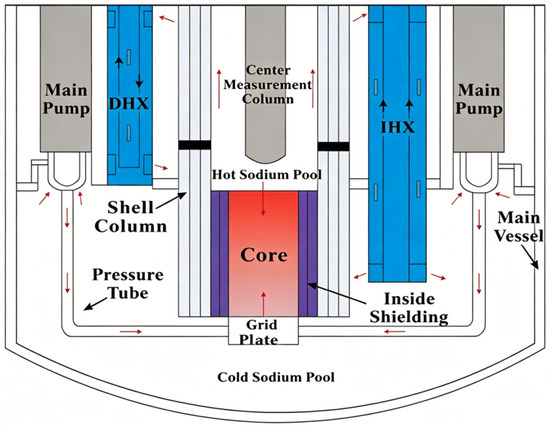
This work investigated machine-learning algorithms for remote-control and autonomous operation of the Very-Small, Long-Life, Modular (VSLLIM) microreactor. This walk-away safe reactor can continuously generate 1.0–10 MW of thermal power for 92 and 5.6 full power years, respectively, is cooled by natural circulation of in-vessel liquid sodium, does not require on-site storage of either fresh or spent nuclear fuel, and offers redundant means of control and passive decay heat removal. The two ML algorithms investigated are Supervised Learning with Long Short-Term Memory networks (SL-LSTM) and Soft-Actor Critic with Feedforward Neural Networks (SAC-FNN). They are trained to manage the movement of the control rods in the reactor core during various transients including startup, shutdown, and to change the reactor steady state power up to 10 MW. The trained algorithms are incorporated into a Programmable Logic Controller (PLC) coupled to a digital twin dynamic model of the VSLLIM microreactor. Although the SL-LSTM algorithms demonstrate high prediction accuracy of up to 99.95%, they demonstrate inferior performance when incorporated into the PLC. Conversely, the PLC with SAC-FNN algorithm accurately adjusts the control rods positions during the reactor startup transients to within ±1.6% of target values.

2 December 2025

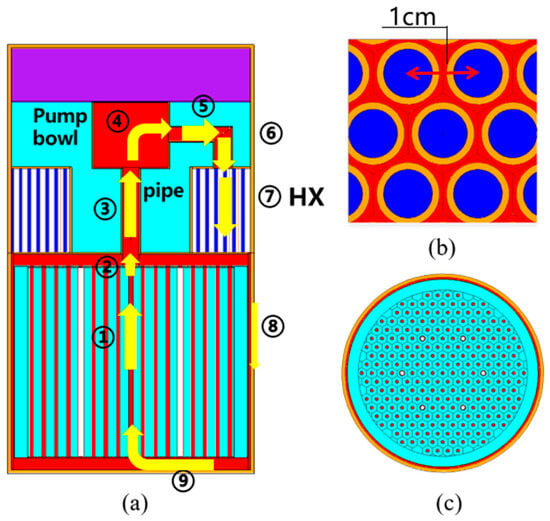
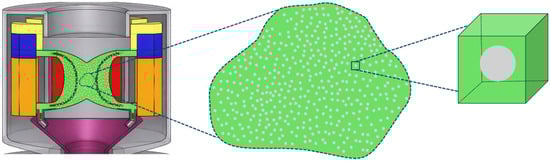
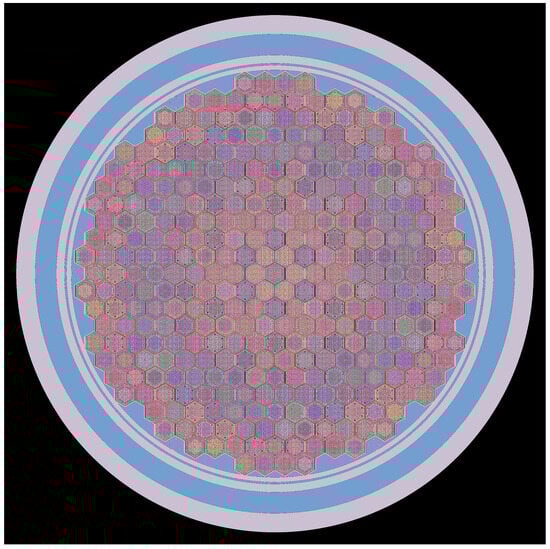
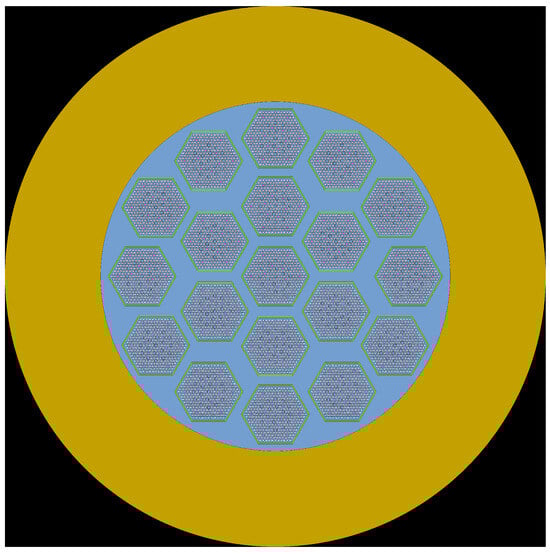
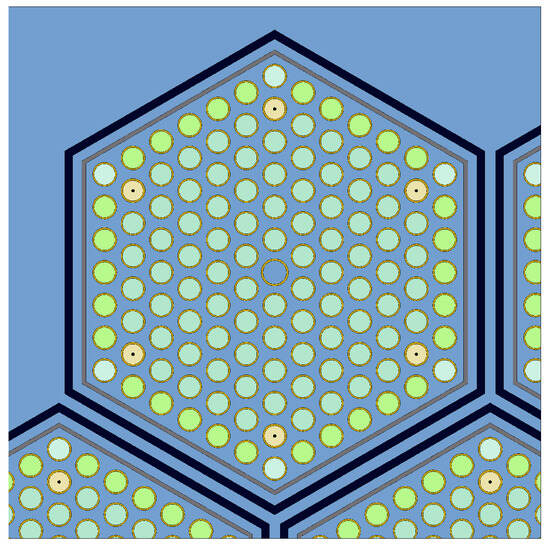
Longitudinal and radial cross section views of the VSLLIM microreactor for generating 1–10 MWth; (a) natural circulation of in-vessel liquid sodium and (b) primary control rod groups and the ESD assembly. Adapted from [25].

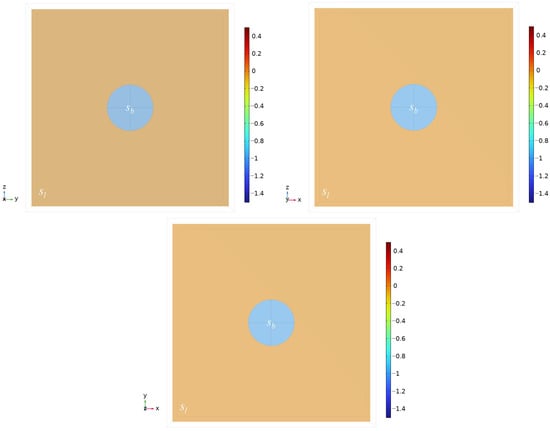
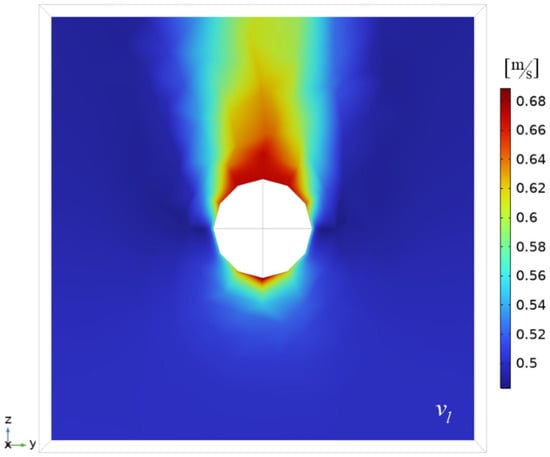
Growing environmental awareness has renewed interest in thorium as a nuclear fuel, underscoring the need for further studies to evaluate how reactors perform when conventional fuels are replaced with thorium-based alternatives. In this study, thermal hydraulics and solid mechanics computations were simulated using COMSOL multiphysics to investigate the safe operating conditions of a heavy water reactor with thorium-based fuel. The thermo-mechanical analysis of the fuel rod under transient heating conditions provides critical insights into strain, displacement, stress, and coolant flow behavior at elevated volumetric heat sources. After 3 s of heating, the strain distribution in the fuel exhibits a high-strain core surrounded by a low-strain rim, with peak volumetric strain increasing nearly linearly from 0.006 to 0.014 as heat generation rises. Displacement profiles confirm that radial deformation is concentrated at the outer surface, while axial elongation remains uniform and scales systematically with power. The resulting von Mises stress fields show maxima at the outer surface, increasing from ~0.06 to 0.15 GPa at the centerline with higher heat input but remaining within structural safety margins. Cladding simulations demonstrate nearly uniform axial expansion, with displacements increasing from ~0.012 mm to 0.03 mm across the investigated power range, and average strain remains negligible (≈10−4), while mean stresses increase moderately yet stay well below the yield strength of zirconium alloys, confirming safe elastic behavior. Hydrodynamic analysis shows that coolant velocity decreases smoothly along the axial direction but maintains stability, with only minor reductions under increased heat sources. Overall, the coupled thermo-mechanical and fluid-dynamic results confirm that both the fuel and cladding remain structurally stable under the studied conditions. By using COMSOL’s multiphysics capabilities, and unlike most legacy codes optimized for uranium-based fuel, this work is designed to easily incorporate non-traditional fuels such as thorium-based systems, including user-defined material properties, temperature-dependent thermal polynomial formulas, and mechanical response.

30 November 2025

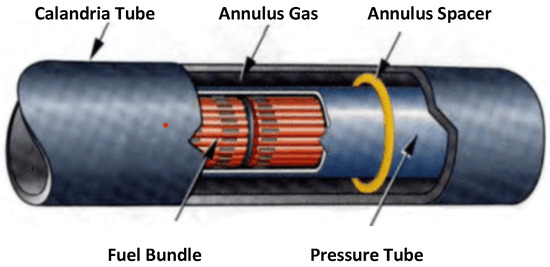
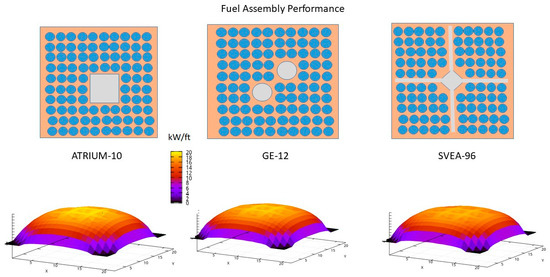
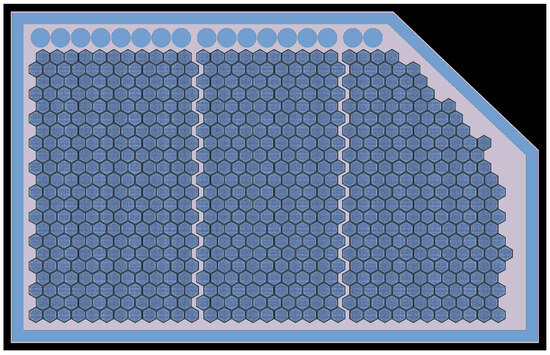
Vertical and horizontal cross-sections of CANDU-6 bundle and fuel pin. Adapted with permission from Ref. [29]. Copyright 2022, Elsevier.

Fibre Bragg grating (FBG) grid sensors are an underexplored technology with potential to benefit nuclear thermal hydraulics experiments. This paper presents a new FBG grid sensor consisting of 38 FBGs across 8 flow-crossing chords. Using this sensor, experiments determined for the first time that an FBG grid can detect large air bubbles rising in standing liquids—demonstrated in both columns of water and 20W50 automotive oil. The instrument’s sensitivity was quantified by comparing its measurements to high-speed camera recordings. Analysis of Bragg wavelength shift timings on each chord enabled the surface of a bubble to be reconstructed using the air–oil data. Finally, the increase in Bragg wavelength when bubbles interact with the FBG grid suggests a variant sensing principle different from that reported in the literature for FBG grids in flowing liquids.

30 November 2025

Impact of two wavelength-division multiplexed FBGs on a spectrum in optical fibre.

News & Conferences

Issues

Open for Submission

Editor's Choice

Get Alerted

Add your email address to receive forthcoming issues of this journal.

XFacebookLinkedIn
J. Nucl. Eng. - ISSN 2673-4362