Skip Content
You are currently on the new version of our website. Access the old version .

Journal of Manufacturing and Materials Processing

Journal of Manufacturing and Materials Processing is an international, peer-reviewed, open access journal on the scientific fundamentals and engineering methodologies of manufacturing and materials processing published monthly online by MDPI.

Quartile Ranking JCR - Q2 (Engineering, Mechanical | Engineering, Manufacturing | Materials Science, Multidisciplinary)

All Articles (1,632)

In mechanical engineering, interest in reliable and practicable technologies for nano- and microstructuring of tool surfaces is increasing. Femtosecond laser structuring offers a promising approach that combines high processing speeds with high precision. However, a knowledge gap remains regarding the optimal process parameters for achieving specific surface patterns on hot-work tool steel substrates. The current study aims to investigate the effects of laser scanning parameters on the formation of self-organized surface structures and the resulting topography and morphology. Therefore, samples were irradiated using a 300 fs laser with linearly polarized light (λ = 1030 nm). Scanning electron microscopy revealed four structure types: laser-induced periodic surface structures (LIPSSs), micrometric ripples, micro-crater structures, and pillared microstructures. The results for surface area and line roughness indicate that high laser pulse overlaps lower the strong ablation threshold more effectively than high scanning line overlaps, promoting the formation of pillared microstructures. For efficient ablation and increased surface roughness, higher pulse overlaps are therefore advantageous. In contrast, at low fluences, higher scanning line overlaps support a more homogeneous formation of nanostructures and reduce waviness.

7 February 2026
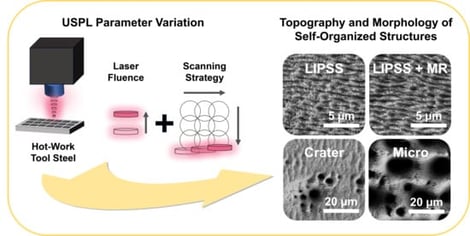
Schematic illustration of the laser setup and scanning system with the corresponding scanning parameters: theoretical circular focus diameter 


        d
      
      
        f


, line distance of the scanning lines 
  
    
      ∆
      d
    
  
, scanning velocity 


        v
      
      
        s


, laser pulse overlap 
  
    PO
  
, as well as scanning line overlap 
  
    LO
  
.

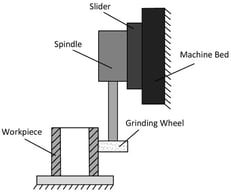
Ultra-precision grinding is widely used in fields such as precision instrumentation, military industry, and aerospace. Focusing on a grinding system based on hydrostatic support, this paper investigates the formation mechanism and variation patterns of roundness error during grinding. The dynamic equations are derived based on the structural characteristics of a vertical grinding system. The uncut chip thickness is formulated, enabling the prediction of grinding forces through mathematical expressions. The dynamic equations are solved using a fully discrete algorithm to obtain the surface profile of the workpiece after machining, and roundness error is extracted using the least squares method. As the speed ratio of the grinding wheel to the workpiece increases, the grinding accuracy improves, and the roundness error can be controlled within 0.2 μm. The farther the grinding force application point is from the center of the slider, the greater the roundness error. Under the condition of meeting the processing range, a shorter grinding wheel contact rod should be selected.

6 February 2026

Schematic Diagram of the Grinding Process System Structure.

Computed tomography and magnetic resonance imaging are two powerful modalities which can be used in the clinical setting to produce data for the creation of patient-specific finite element analysis (FEA) models and physical analogues—for instance, by using additive manufacturing (AM)—that mimic the properties of soft and hard tissues, both morphologically and mechanically. However, there remains a gap between creating a perfect biofidelic physical analogue and its computational counterpart. This gap exists because, firstly, in silico models are often too complex to realise, and secondly, real-life conditions are challenging to emulate both computationally and mechanically, as they involve multiscale situations that are inherently heterogeneous and patient specific. In this study, we applied a multi-scale approach to design and model porcine vertebral specimens. Our results identified critical design factors that affect the quality and accuracy of the models, specifically highlighting that scanning resolution/fidelity and the thresholding technique have a directly proportional impact on model accuracy. A small shift up and down the greyscale level by 20 units can affect the behaviour of the AM sample by as much as [−15% +47%]. Working up the levels for manufacturing, testing and modelling (i) cylindrical cores to (ii) whole vertebrae and then (iii) a whole spine motion segment, we observed that the fidelity of predictions reduces, and errors increase as the structure becomes more complicated and intricate (3.6%, 7.5% and 15%, respectively). We are confident that further material-level developments will provide solutions for the more intricate parts of spinal motion segments, such as the intervertebral discs and facets, which in their natural form are highly sophisticated structures. To the best of our knowledge, this is the first time a holistic multiscale approach has been implemented to produce AM biofidelic analogues of skeletal parts. Our data showed good agreement between the physical and in silico models, confirming that it is possible to model real-time objects and situations both physically and in silico. This ultimately will enable the development of accurate, patient-specific physical models for use in biomechanical testing and medicolegal applications.

6 February 2026

An example of a holistic approach involving the creation of both a physical model and an in silico (computational) model of a human skull, as studied in [15,16]. (A) A number of replicas of the skull were impacted at the same point in a drop tower, suitable illumination and high speed cameras were used, full details in [15,16]; (B) crack patterns at the site of impact were emanating in 3 diverging crack routes, which were identical in all replicas of the skull used [15]; (C) other cracks at the base of the skull (red square) appeared reliably and repeatedly in certain areas and where FEA modelling predicted them to appear (enlarged views of the area in (D,E)), showing a synergy and agreement between these two powerful biomechanical testing methodologies (AM produced physical model and in silico computational model).

A K-Means Clustering Approach for Accelerated Path Planning in GMA-DED: The Fast Advanced-Pixel Strategy

  • Rafael P. Ferreira,
  • Vinicius Lemes Jorge and
  • Américo Scotti
  • + 1 author

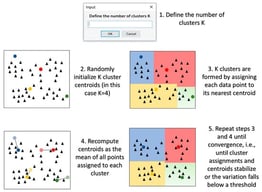
The performance of Gas Metal Arc-Directed Energy Deposition (GMA-DED) strongly depends on efficient path-planning strategies that balance trajectory quality and computational cost. With the purpose of developing a computationally faster and more scalable path-planning approach, this study introduces the Fast Advanced-Pixel strategy by integrating the K-means clustering algorithm into to the Advanced Pixel strategy version to reduce the dimensionality of an optimization problem. Computational validation was conducted on four geometrically distinct parts using different clustering configurations. Statistical analysis (ANOVA) was applied to assess the significance of the results. The findings revealed that by increasing the number of clusters, computational time is substantially reduced, achieving up to a twenty-fold improvement compared with the former strategy, while maintaining consistent trajectory quality. Experimental validation using complex parts, such as a “Jaw Gripper” and a “C-frame” of a resistance spot welding gun, confirmed defect-free deposition and dimensional agreement with the CAD models. Accordingly, within the scope of GMA-DED technology and pixel-based path-planning strategies, the Fast Advanced-Pixel approach demonstrates a significant improvement in computational efficiency while preserving trajectory quality, enabling the accurate and reliable fabrication of geometrically complex metallic parts.

5 February 2026

Demonstration of the standard K-means algorithm.

News & Conferences

Issues

Open for Submission

Editor's Choice

Reprints of Collections

Advanced Manufacturing and Surface Technology
Reprint

Advanced Manufacturing and Surface Technology

Editors: Dingding Xiang, Junying Hao, Xudong Sui, Kaiming Wang
Advanced Composites Manufacturing and Plastics Processing
Reprint

Advanced Composites Manufacturing and Plastics Processing

Editors: Patricia Krawczak, Ludwig Cardon

Get Alerted

Add your email address to receive forthcoming issues of this journal.

XFacebookLinkedIn
J. Manuf. Mater. Process. - ISSN 2504-4494