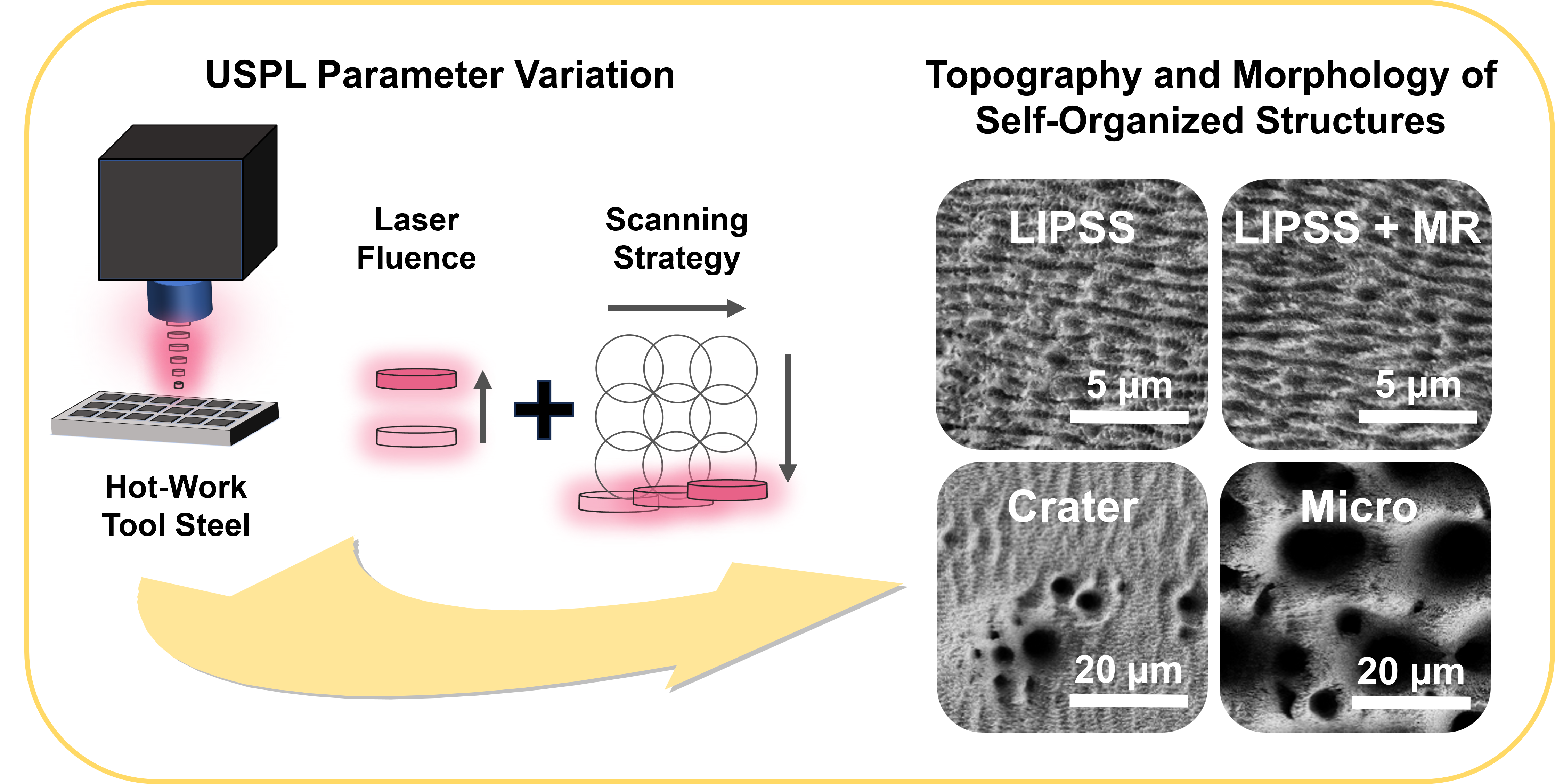


Effect of Laser Scanning Parameters on Topography and Morphology of Femtosecond Laser-Structured Hot-Work Tool Steel Surfaces


Abstract
1. Introduction
2. Materials and Methods
2.1. Materials
2.2. Laser Treatment
2.3. Surface Characterizations
2.4. Sa/Sq Ratio
2.5. Surface Roughness Isotropy
3. Results and Discussion
3.1. Surface Characterization of Femtosecond Laser-Structured Hot-Work Tool Steel Surfaces
3.2. Effect of Laser Scanning Parameters on Texturing of Hot-Work Tool Steel Surfaces
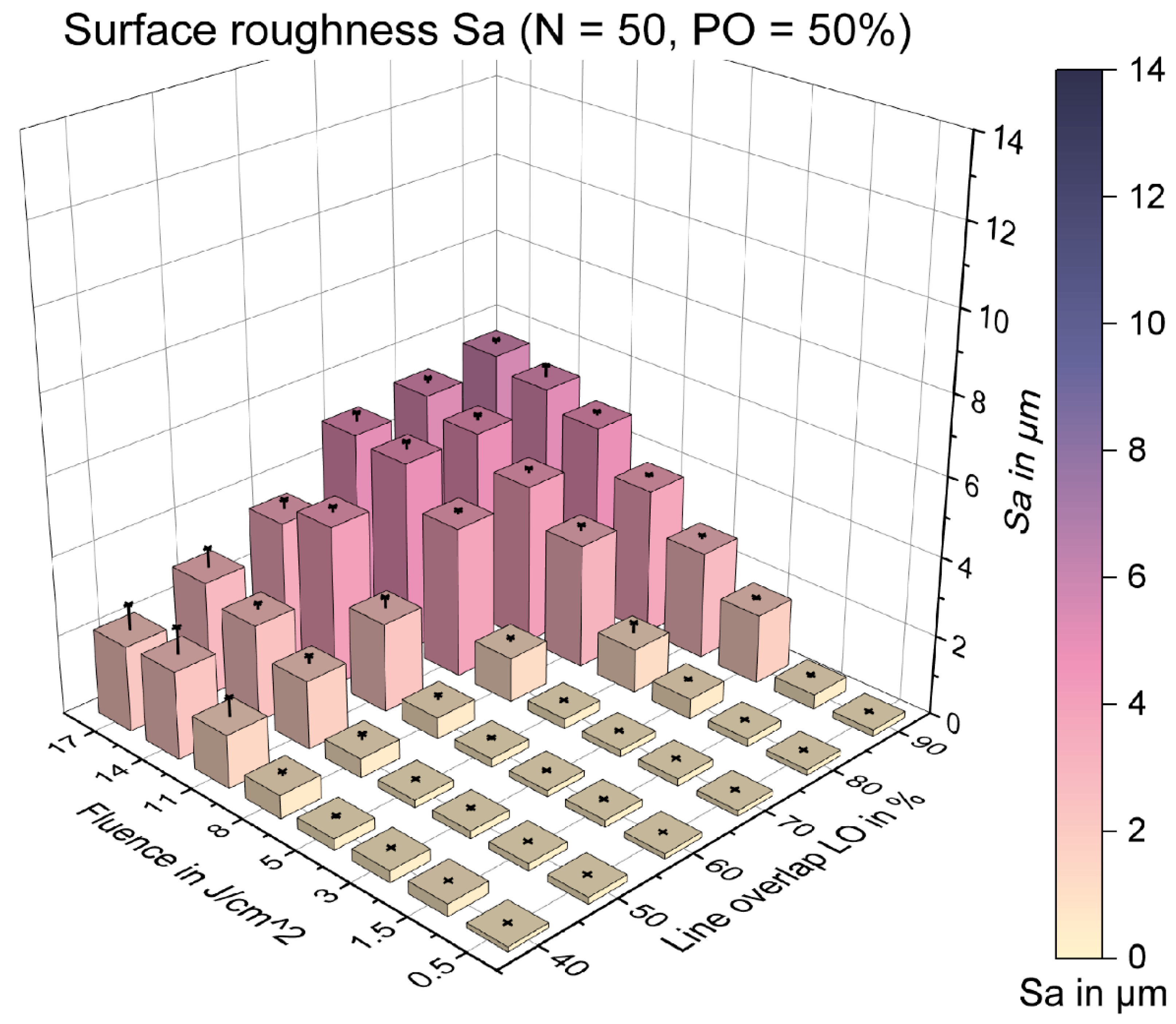
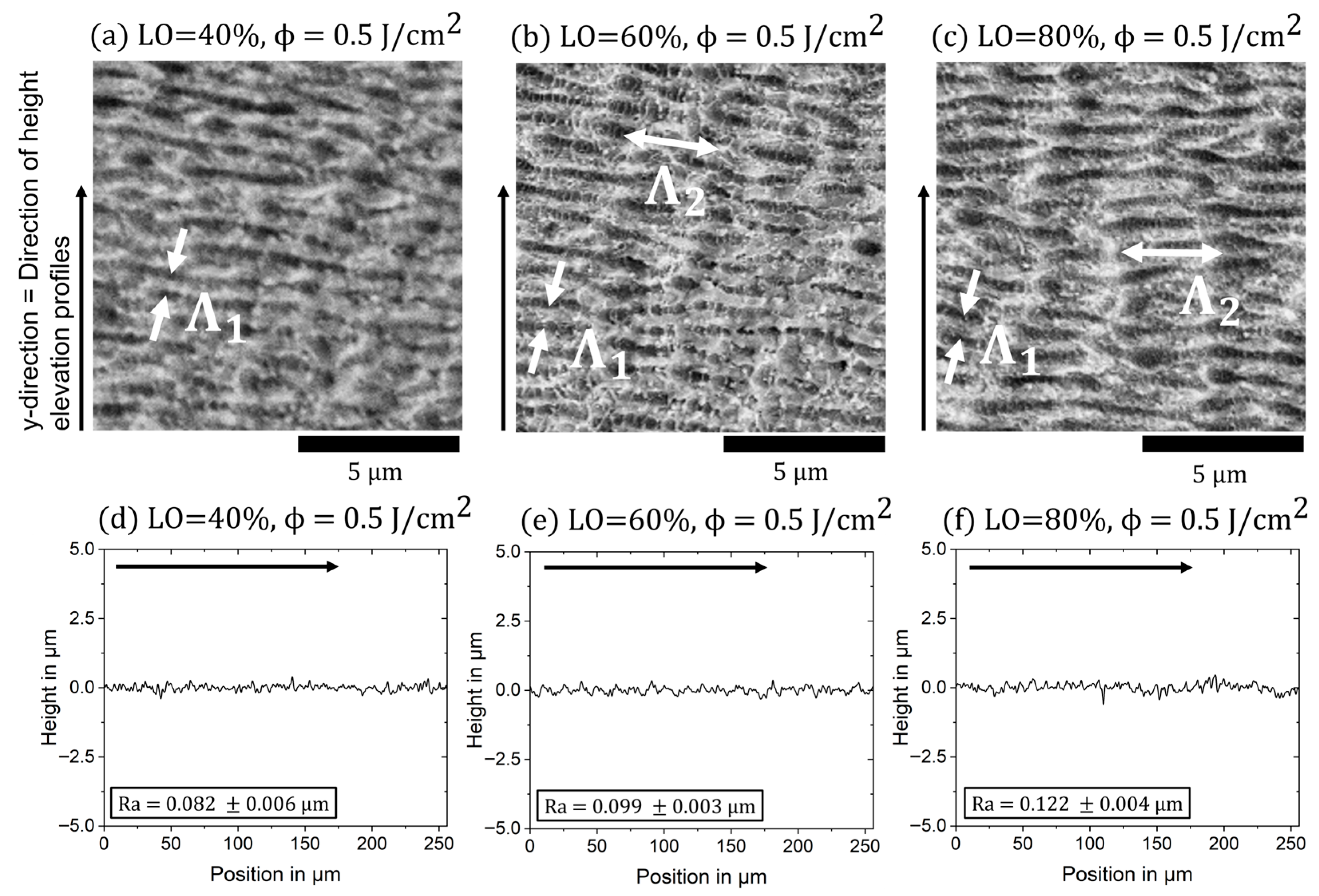
3.2.1. Effect of Scanning Line Overlap on Topography and Morphology

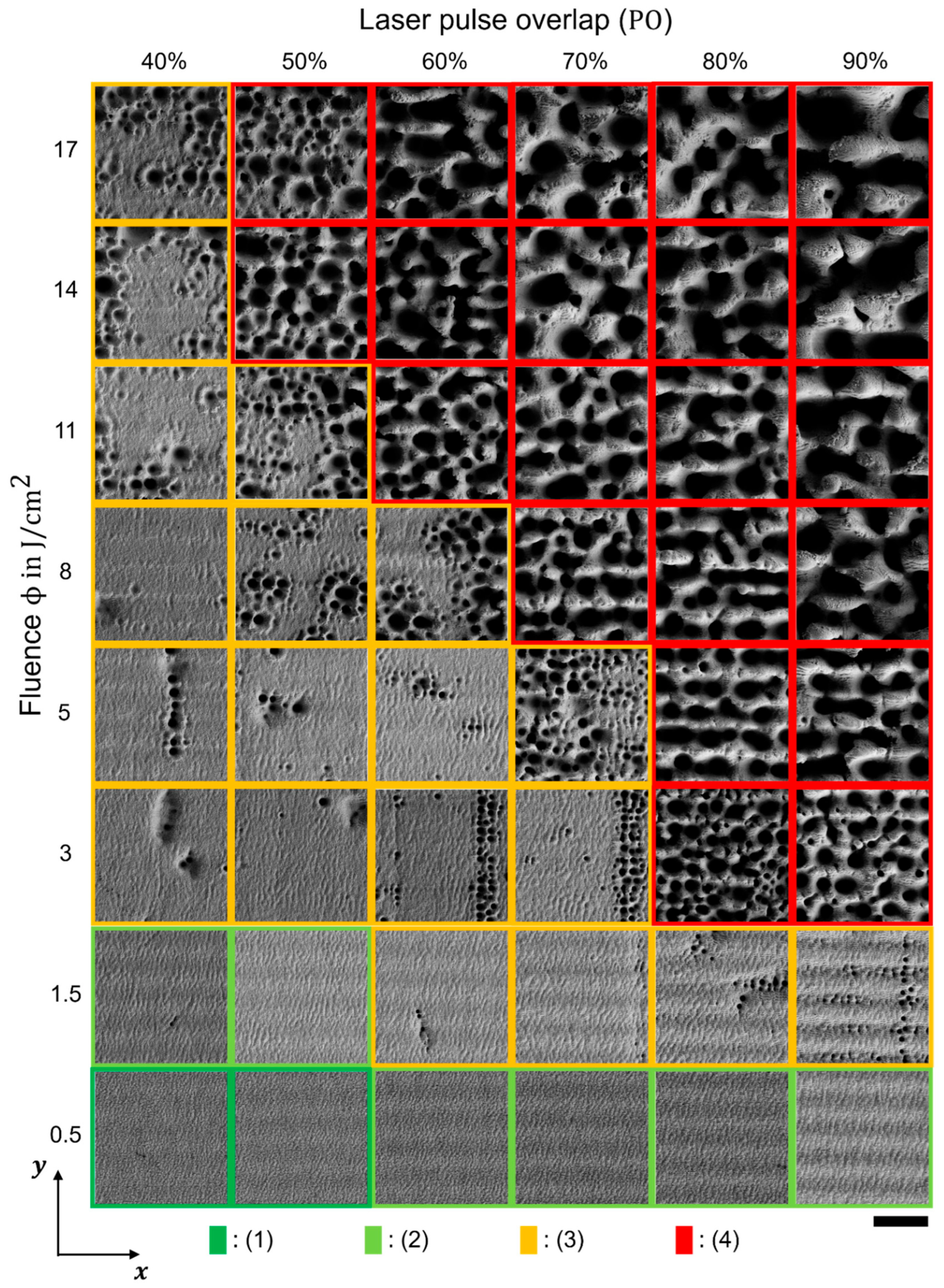
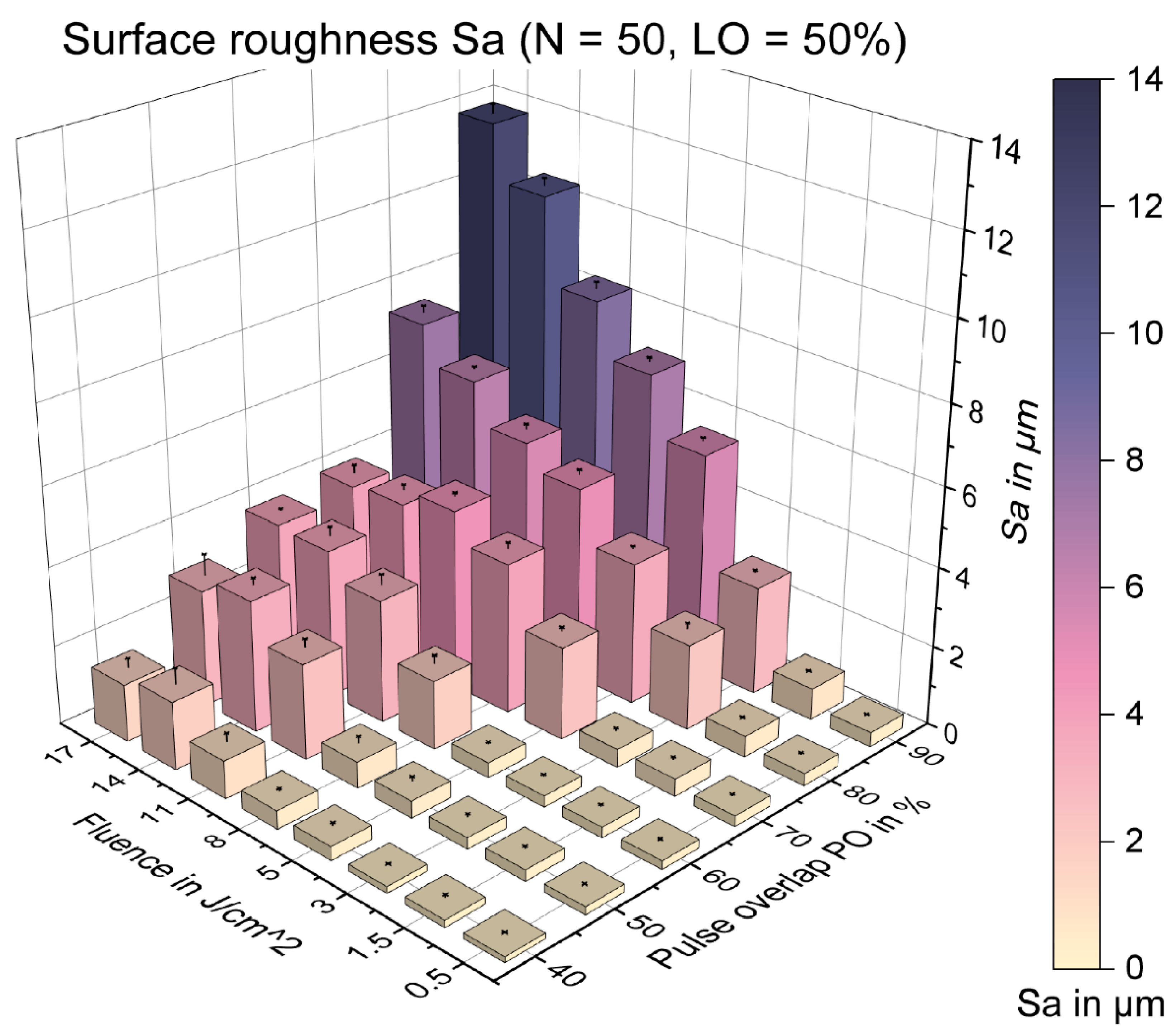
3.2.2. Effect of Laser Pulse Overlap on Topography and Morphology
3.3. Surface Height Distribution (Sa/Sq Ratio)
3.4. Surface Height Distribution (Isotropy-Factor)
4. Conclusions
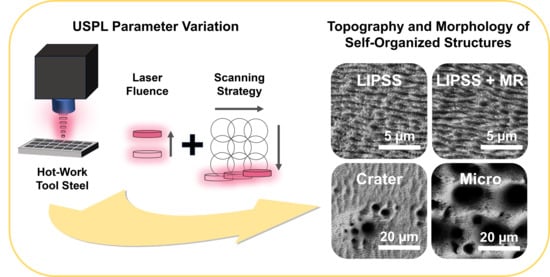
- All investigated laser parameters and scanning strategies have a significant influence on the generation of the self-organized, laser-induced surface structures. It was shown that the strong ablation threshold depends on the laser pulse overlap, the scanning line overlap, as well as on the fluence.
- High laser pulse overlaps lead to more pronounced phase explosion and greater heat accumulation compared to high scanning line overlaps, ultimately resulting in a reduction in the strong ablation threshold.
- For high efficiency in terms of material removal rate and surface roughness, a relatively high laser pulse overlap should be preferred.
- To efficiently achieve high roughness with the lowest possible fluence, high overlaps should be used (at a fixed , POs from 70 to 90%; and at a fixed , LOs from 70 to 90%).
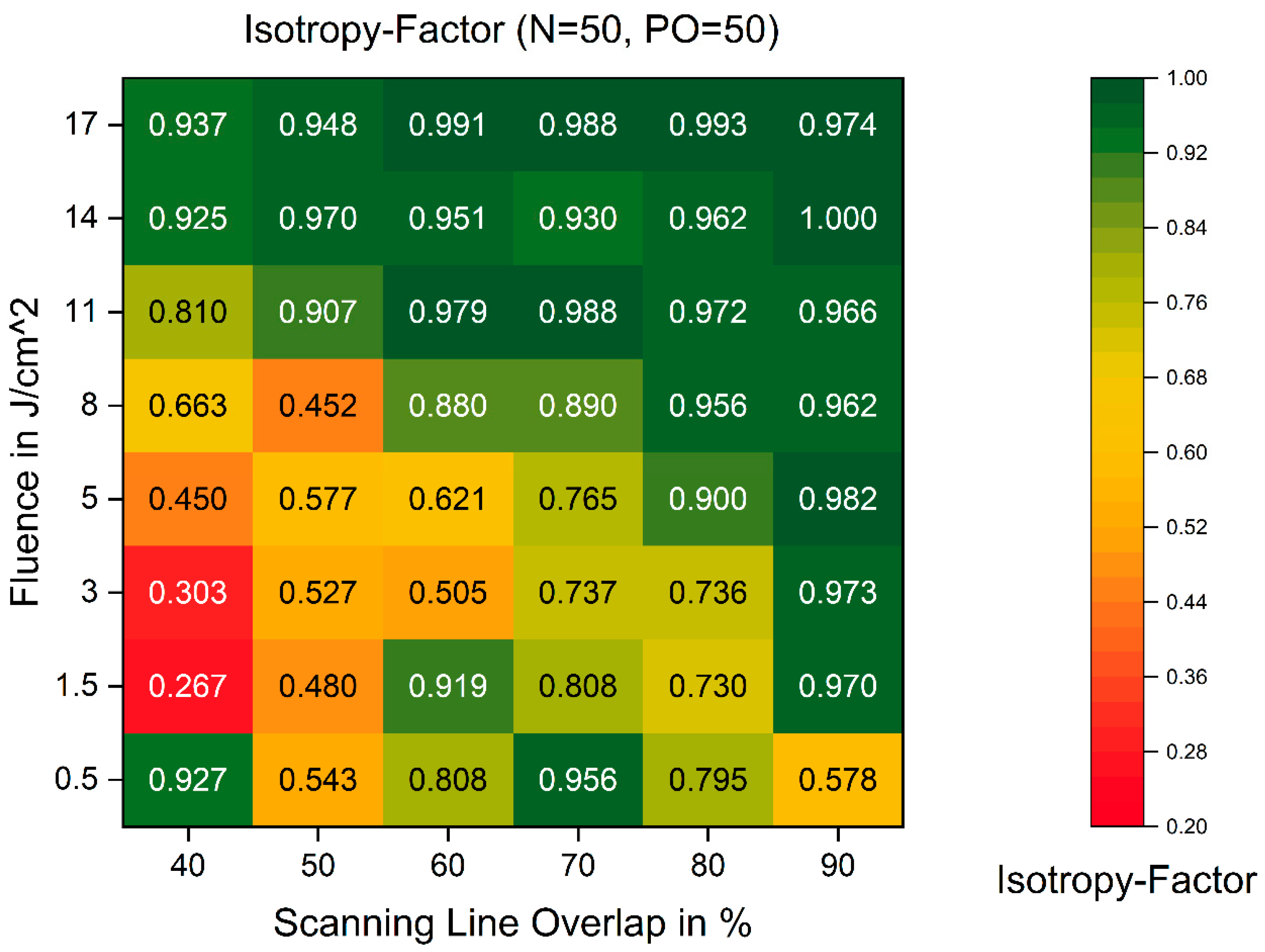
- To achieve an isotropy factor close to 1, the focus should be on the realization of nano- and self-organized microstructures. Crater structures that result in higher surface anisotropy should be avoided. For microstructures, isotropic structures are created in the fluence range of , for all laser pulse overlaps and scanning line overlaps. At lower fluences, relatively high pulse and line overlaps (PO and LO) are preferable to obtain nanostructured surfaces that are as isotropic as possible, aside from the inherent alignment characteristic of LIPSS. To achieve relatively isotropic nanostructured surfaces, the isotropy factor is an important metric, since changes in processing parameters can otherwise result in highly directional structures.
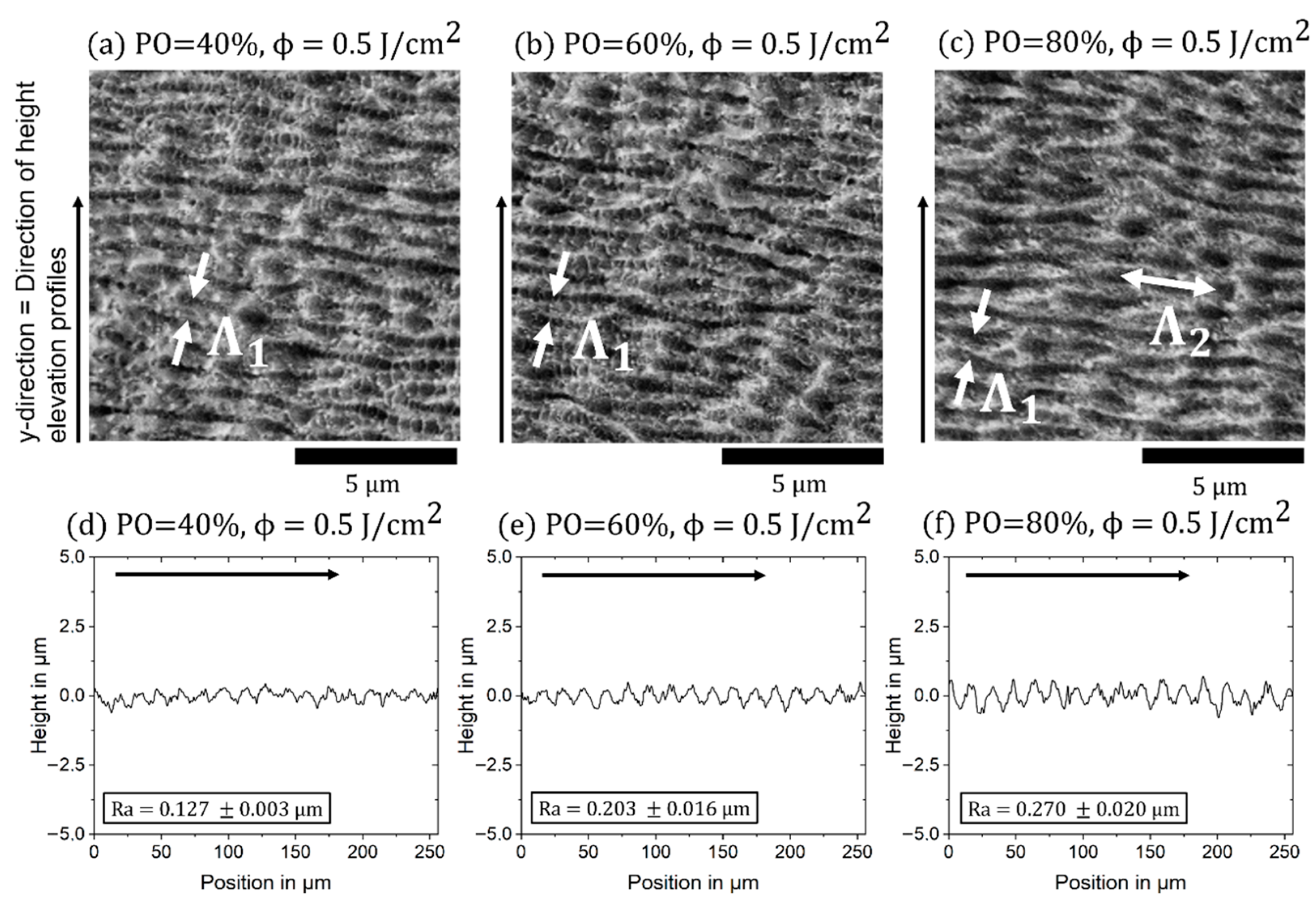
- At low fluence levels, higher scanning line overlap promotes a more homogenous formation of nanostructures with reduced waviness.
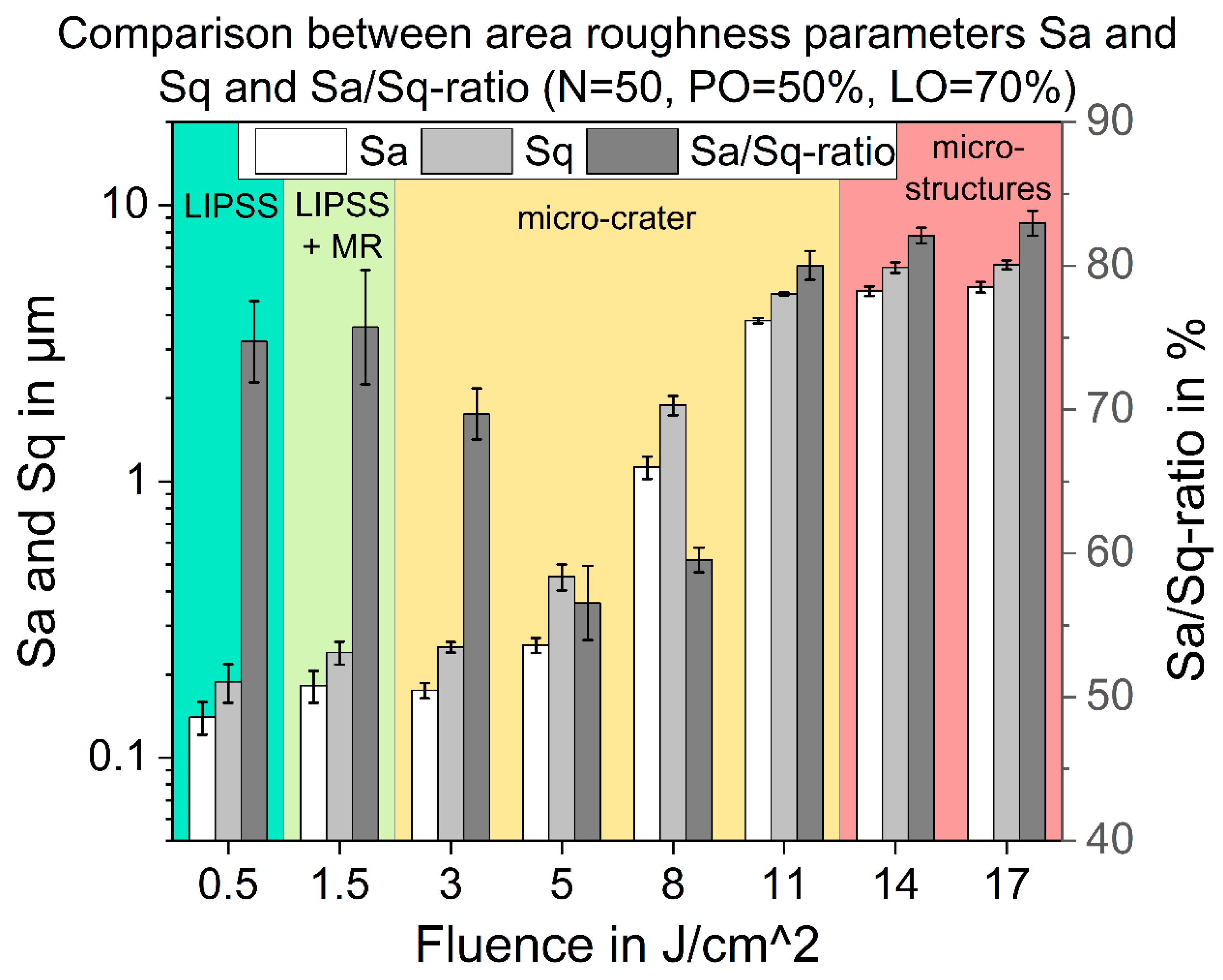
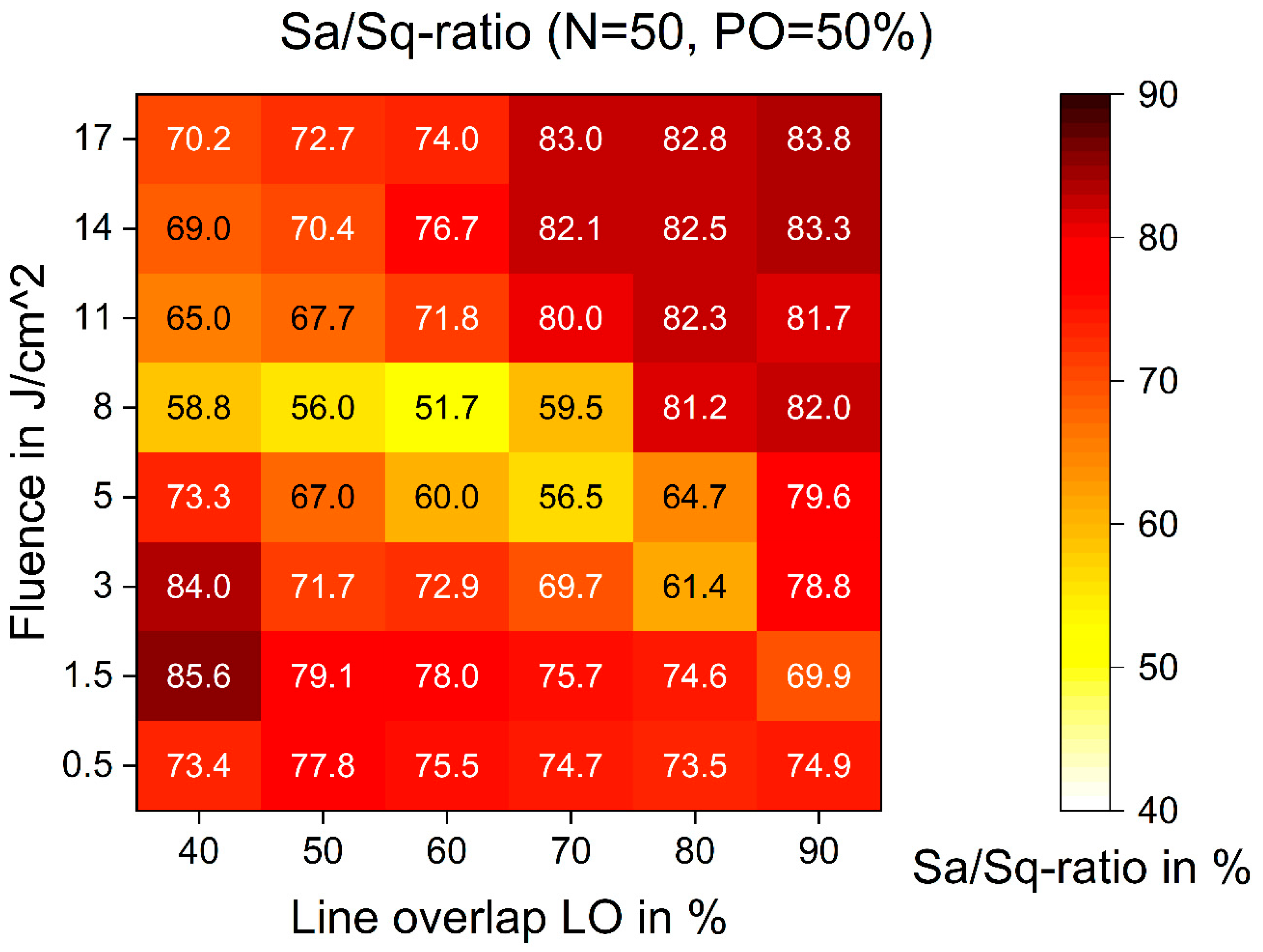
- The calculation of the Sa/Sq ratio revealed differences in surface homogeneity exceeding 30% between the resulting surface structures, depending on the applied structuring parameters.
- By calculating the surface roughness isotropy factor using the orthogonal arithmetical mean heights Ra, it was quantitatively demonstrated that anisotropic structures primarily occur in the lower fluence range and in the medium fluence range when both scanning line overlap and laser pulse overlap are low.
Supplementary Materials
Author Contributions
Funding
Data Availability Statement
Acknowledgments
Conflicts of Interest
Abbreviations
| LIPSSs | Laser-induced periodic surface structures |
| MR | (Sub-)micrometric ripple |
| PO | Laser pulse overlap |
| LO | Scanning line overlap |
| SEM | Scanning electron microscope |
| LSFL | Low-spatial-frequency LIPSS |
| HSFL | High-spatial-frequency LIPSS |
| IF | Isotropy factor |
References
- He, Z.; Lei, L.; Lin, S.; Tian, S.; Tian, W.; Yu, Z.; Li, F. Metal Material Processing Using Femtosecond Lasers: Theories, Principles, and Applications. Materials 2024, 17, 3386. [Google Scholar] [CrossRef] [PubMed]
- Finger, J.; Kalupka, C.; Reininghaus, M. High power ultra-short pulse laser ablation of IN718 using high repetition rates. J. Mater. Process. Technol. 2015, 226, 221–227. [Google Scholar] [CrossRef]
- Masato, D.; Piccolo, L.; Lucchetta, G.; Sorgato, M. Texturing Technologies for Plastics Injection Molding: A Review. Micromachines 2022, 13, 1211. [Google Scholar] [CrossRef]
- Calabrese, L.; Azzolini, M.; Bassi, F.; Gallus, E.; Bocchi, S.; Maccarini, G.; Pellegrini, G.; Ravasio, C. Micro-Milling Process of Metals: A Comparison between Femtosecond Laser and EDM Techniques. J. Manuf. Mater. Process. 2021, 5, 125. [Google Scholar] [CrossRef]
- Ahmmed, K.; Grambow, C.; Kietzig, A.-M. Fabrication of Micro/Nano Structures on Metals by Femtosecond Laser Micromachining. Micromachines 2014, 5, 1219–1253. [Google Scholar] [CrossRef]
- Vorobyev, A.Y.; Guo, C. Direct femtosecond laser surface nano/microstructuring and its applications. Laser Photonics Rev. 2013, 7, 385–407. [Google Scholar] [CrossRef]
- Ince, F.D.; Özel, T. Laser surface texturing of materials for surface functionalization: A holistic review. Surf. Coat. Technol. 2025, 498, 131818. [Google Scholar] [CrossRef]
- Chen, Z.; Yang, J.; Liu, H.; Zhao, Y.; Pan, R. A short review on functionalized metallic surfaces by ultrafast laser micromachining. Int. J. Adv. Manuf. Technol. 2022, 119, 6919–6948. [Google Scholar] [CrossRef]
- Orazi, L.; Sorgato, M.; Piccolo, L.; Masato, D.; Lucchetta, G. Generation and Characterization of Laser Induced Periodic Surface Structures on Plastic Injection Molds. Lasers Manuf. Mater. Process. 2020, 7, 207–221. [Google Scholar] [CrossRef]
- Ghadiri Zahrani, E.; Fakharzadeh Jahromi, A.; Azarhoushang, B. Development of Polymer Hydrophobic Surfaces Through Combined Laser Ablation and Hot Embossing Processes. J. Manuf. Mater. Process. 2024, 8, 262. [Google Scholar] [CrossRef]
- Florian, C.; Skoulas, E.; Puerto, D.; Mimidis, A.; Stratakis, E.; Solis, J.; Siegel, J. Controlling the Wettability of Steel Surfaces Processed with Femtosecond Laser Pulses. ACS Appl. Mater. Interfaces 2018, 10, 36564–36571. [Google Scholar] [CrossRef]
- Stratakis, E.; Bonse, J.; Heitz, J.; Siegel, J.; Tsibidis, G.D.; Skoulas, E.; Papadopoulos, A.; Mimidis, A.; Joel, A.-C.; Comanns, P.; et al. Laser engineering of biomimetic surfaces. Mater. Sci. Eng. R Rep. 2020, 141, 100562. [Google Scholar] [CrossRef]
- Schnell, G.; Studemund, H.; Thomas, R.; Seitz, H. Experimental investigations on the friction behavior of partially femtosecond laser-textured journal bearing shells. Tribol. Int. 2023, 188, 108764. [Google Scholar] [CrossRef]
- Gamaly, E.G.; Rode, A.V.; Luther-Davies, B.; Tikhonchuk, V.T. Ablation of solids by femtosecond lasers: Ablation mechanism and ablation thresholds for metals and dielectrics. Phys. Plasmas 2002, 9, 949–957. [Google Scholar] [CrossRef]
- Rethfeld, B.; Sokolowski-Tinten, K.; von der Linde, D.; Anisimov, S.I. Timescales in the response of materials to femtosecond laser excitation. Appl. Phys. A Mater. Sci. Process. 2004, 79, 767–769. [Google Scholar] [CrossRef]
- Zhigilei, L.V.; Lin, Z.; Ivanov, D.S. Atomistic Modeling of Short Pulse Laser Ablation of Metals: Connections between Melting, Spallation, and Phase Explosion. J. Phys. Chem. C 2009, 113, 11892–11906. [Google Scholar] [CrossRef]
- Bonse, J.; Kirner, S.V.; Krüger, J. Laser-Induced Periodic Surface Structures (LIPSS). In Handbook of Laser Micro- and Nano-Engineering; Sugioka, K., Ed.; Springer International Publishing: Cham, Switzerland, 2020; pp. 1–59. ISBN 978-3-319-69537-2. [Google Scholar]
- Petelin, J.; Marš, M.; Mur, J.; Petkovšek, R. Managing Residual Heat Effects in Femtosecond Laser Material Processing by Pulse-on-Demand Operation. J. Manuf. Mater. Process. 2024, 8, 254. [Google Scholar] [CrossRef]
- Schnell, G.; Duenow, U.; Seitz, H. Effect of Laser Pulse Overlap and Scanning Line Overlap on Femtosecond Laser-Structured Ti6Al4V Surfaces. Materials 2020, 13, 969. [Google Scholar] [CrossRef] [PubMed]
- JJ Nivas, J.; Allahyari, E.; Gesuele, F.; Maddalena, P.; Fittipaldi, R.; Vecchione, A.; Bruzzese, R.; Amoruso, S. Influence of ambient pressure on surface structures generated by ultrashort laser pulse irradiation. Appl. Phys. A Mater. Sci. Process. 2018, 124, 198. [Google Scholar] [CrossRef]
- Berczeli, M.; Tajti, F.; Juhász, G.; Weltsch, Z. Changing the High Strength Steel Surface Properties with Femtosecond Laser Beam. Opt. Laser Technol. 2024, 174, 110556. [Google Scholar] [CrossRef]
- Schnell, G.; Piehl, J.; Hartig, T.; Dubhorn, N.; Aliyeva, A.; Springer, A.; Strunskus, T.; Faupel, F.; Schröder, S.; Seitz, H. PFAS-free superhydrophobic surfaces using femtosecond laser processing and hot-filament chemical vapor deposition. Surf. Interfaces 2025, 73, 107605. [Google Scholar] [CrossRef]
- Chen, Z.; Zhou, J.; Cen, W.; Yan, Y.; Guo, W. Femtosecond Laser Fabrication of Wettability-Functional Surfaces: A Review of Materials, Structures, Processing, and Applications. Nanomaterials 2025, 15, 573. [Google Scholar] [CrossRef]
- Müller, F.A.; Kunz, C.; Gräf, S. Bio-Inspired Functional Surfaces Based on Laser-Induced Periodic Surface Structures. Materials 2016, 9, 476. [Google Scholar] [CrossRef]
- Vorobyev, A.Y.; Guo, C. Multifunctional surfaces produced by femtosecond laser pulses. J. Appl. Phys. 2015, 117, 033103. [Google Scholar] [CrossRef]
- Orazi, L.; Gnilitskyi, I.; Serro, A.P. Laser Nanopatterning for Wettability Applications. J. Micro Nano-Manuf. 2017, 5, 021008. [Google Scholar] [CrossRef]
- Abdel-Aal, H.A. Functional surfaces for tribological applications: Inspiration and design. Surf. Topogr. Metrol. Prop. 2016, 4, 43001. [Google Scholar] [CrossRef]
- Bonse, J.; Kirner, S.V.; Griepentrog, M.; Spaltmann, D.; Krüger, J. Femtosecond Laser Texturing of Surfaces for Tribological Applications. Materials 2018, 11, 801. [Google Scholar] [CrossRef] [PubMed]
- Sorgato, M.; Zanini, F.; Masato, D.; Lucchetta, G. Submicron laser-textured vents for self-cleaning injection molds. J. Appl. Polym. Sci. 2020, 137, 49280. [Google Scholar] [CrossRef]
- Xu, Q.; Zhang, W.; Dong, C.; Sreeprasad, T.S.; Xia, Z. Biomimetic self-cleaning surfaces: Synthesis, mechanism and applications. J. R. Soc. Interface 2016, 13, 20160300. [Google Scholar] [CrossRef]
- Schnell, G.; Polley, C.; Thomas, R.; Bartling, S.; Wagner, J.; Springer, A.; Seitz, H. How droplets move on laser-structured surfaces: Determination of droplet adhesion forces on nano- and microstructured surfaces. J. Colloid Interface Sci. 2023, 630, 951–964. [Google Scholar] [CrossRef]
- Sorgato, M.; Masato, D.; Lucchetta, G.; Orazi, L. Effect of different laser-induced periodic surface structures on polymer slip in PET injection moulding. CIRP Ann. 2018, 67, 575–578. [Google Scholar] [CrossRef]
- Deng, J.; Lian, Y.; Wu, Z.; Xing, Y. Performance of femtosecond laser-textured cutting tools deposited with WS2 solid lubricant coatings. Surf. Coat. Technol. 2013, 222, 135–143. [Google Scholar] [CrossRef]
- Norström, L.-Å.; Öhrberg, N. Development of hot-work tool steel for high-temperature applications. Met. Technol. 1981, 8, 22–26. [Google Scholar] [CrossRef]
- Hafenstein, S.; Werner, E.; Wilzer, J.; Theisen, W.; Weber, S.; Sunderkötter, C.; Bachmann, M. Influence of Temperature and Tempering Conditions on Thermal Conductivity of Hot Work Tool Steels for Hot Stamping Applications. Steel Res. Int. 2015, 86, 1628–1635. [Google Scholar] [CrossRef]
- Sorgato, M.; Masato, D.; Piccolo, L.; Lucchetta, G. Plastic intensity reduction using thermally insulating coatings for injection molds. CIRP J. Manuf. Sci. Technol. 2020, 30, 79–86. [Google Scholar] [CrossRef]
- Klocke, F.; Arntz, K.; Teli, M.; Winands, K.; Wegener, M.; Oliari, S. State-of-the-art Laser Additive Manufacturing for Hot-work Tool Steels. Procedia CIRP 2017, 63, 58–63. [Google Scholar] [CrossRef]
- Ebrahimi, M.; Konaganti, V.K.; Moradi, S.; Doufas, A.K.; Hatzikiriakos, S.G. Slip of polymer melts over micro/nano-patterned metallic surfaces. Soft Matter 2016, 12, 9759–9768. [Google Scholar] [CrossRef]
- Bellantone, V.; Surace, R.; Modica, F.; Fassi, I. Evaluation of mold roughness influence on injected thin micro-cavities. Int. J. Adv. Manuf. Technol. 2018, 94, 4565–4575. [Google Scholar] [CrossRef]
- Sorgato, M.; Masato, D.; Lucchetta, G. Effects of machined cavity texture on ejection force in micro injection molding. Precis. Eng. 2017, 50, 440–448. [Google Scholar] [CrossRef]
- Piccolo, L.; Sorgato, M.; Batal, A.; Dimov, S.; Lucchetta, G.; Masato, D. Functionalization of Plastic Parts by Replication of Variable Pitch Laser-Induced Periodic Surface Structures. Micromachines 2020, 11, 429. [Google Scholar] [CrossRef]
- Gao, P.; MacKay, I.; Gruber, A.; Krantz, J.; Piccolo, L.; Lucchetta, G.; Pelaccia, R.; Orazi, L.; Masato, D. Wetting Characteristics of Laser-Ablated Hierarchical Textures Replicated by Micro Injection Molding. Micromachines 2023, 14, 863. [Google Scholar] [CrossRef]
- Schnell, G.; Lund, H.; Bartling, S.; Polley, C.; Riaz, A.; Senz, V.; Springer, A.; Seitz, H. Heat accumulation during femtosecond laser treatment at high repetition rate—A morphological, chemical and crystallographic characterization of self-organized structures on Ti6Al4V. Appl. Surf. Sci. 2021, 570, 151115. [Google Scholar] [CrossRef]
- Jia, X.; Luo, J.; Li, K.; Wang, C.; Li, Z.; Wang, M.; Jiang, Z.; Veiko, V.P.; Duan, J. Ultrafast laser welding of transparent materials: From principles to applications. Int. J. Extrem. Manuf. 2025, 7, 32001. [Google Scholar] [CrossRef]
- ISO 4957:2018; Tool Steels. ISO International Organization for Standardization: Geneva, Switzerland, 2018.
- Byskov-Nielsen, J.; Savolainen, J.-M.; Christensen, M.S.; Balling, P. Ultra-short pulse laser ablation of metals: Threshold fluence, incubation coefficient and ablation rates. Appl. Phys. A 2010, 101, 97–101. [Google Scholar] [CrossRef]
- Wu, P.H.; Cheng, C.W.; Chang, C.P.; Wu, T.M.; Wang, J.K. Fabrication of large-area hydrophobic surfaces with femtosecond-laser-structured molds. J. Micromech. Microeng. 2011, 21, 115032. [Google Scholar] [CrossRef]
- Bonse, J.; Hohm, S.; Kirner, S.V.; Rosenfeld, A.; Kruger, J. Laser-Induced Periodic Surface Structures—A Scientific Evergreen. IEEE J. Select. Top. Quantum Electron. 2017, 23, 9000615. [Google Scholar] [CrossRef]
- Todhunter, L.D.; Leach, R.K.; Lawes, S.; Blateyron, F. Industrial survey of ISO surface texture parameters. CIRP J. Manuf. Sci. Technol. 2017, 19, 84–92. [Google Scholar] [CrossRef]
- ISO 25178; Geometrical Product Specifications (GPS)-Surface Texture. ISO International Organization for Standardization: Geneva, Switzerland, 2021.
- ISO 21920; Geometrical Product Specifications (GPS). ISO International Organization for Standardization: Geneva, Switzerland, 2021.
- ISO 3274; Geometrical Product Specifications (GPS)-Surface Texture: Profile Method-Nominal Characteristics of Contact (Stylus) Instruments. ISO International Organization for Standardization: Geneva, Switzerland, 1996.
- Pawlus, P.; Reizer, R.; Wieczorowski, M.; Królczyk, G. Parametric description of one-process surface texture. Measurement 2022, 204, 112066. [Google Scholar] [CrossRef]
- Zuhlke, C.A.; Anderson, T.P.; Alexander, D.R. Understanding the formation of self-organized micro/nanostructures on metal surfaces from femtosecond laser ablation using stop-motion SEM imaging. In Laser-Based Micro- and Nanoprocessing VIII. SPIE LASE, San Francisco, CA, USA, 1 February 2014; Klotzbach, U., Washio, K., Arnold, C.B., Eds.; SPIE: Bellingham, WA, USA, 2014; p. 89680C. [Google Scholar]
- Moradi, S.; Kamal, S.; Englezos, P.; Hatzikiriakos, S.G. Femtosecond laser irradiation of metallic surfaces: Effects of laser parameters on superhydrophobicity. Nanotechnology 2013, 24, 415302. [Google Scholar] [CrossRef]
- Nolte, S.; Momma, C.; Jacobs, H.; Tünnermann, A.; Chichkov, B.N.; Wellegehausen, B.; Welling, H. Ablation of metals by ultrashort laser pulses. J. Opt. Soc. Am. B 1997, 14, 2716. [Google Scholar] [CrossRef]
- Hashida, M.; Semerok, A.; Gobert, O.; Petite, G.; Izawa, Y.; Wagner, J. Ablation threshold dependence on pulse duration for copper. Appl. Surf. Sci. 2002, 197–198, 862–867. [Google Scholar] [CrossRef]
- Bizi-bandoki, P.; Benayoun, S.; Valette, S.; Beaugiraud, B.; Audouard, E. Modifications of roughness and wettability properties of metals induced by femtosecond laser treatment. Appl. Surf. Sci. 2011, 257, 5213–5218. [Google Scholar] [CrossRef]
- Zuhlke, C.A.; Anderson, T.P.; Alexander, D.R. Formation of multiscale surface structures on nickel via above surface growth and below surface growth mechanisms using femtosecond laser pulses. Opt. Express 2013, 21, 8460–8473. [Google Scholar] [CrossRef]
- Raciukaitis, G.; Brikas, M.; Gecys, P.; Gedvilas, M. Accumulation effects in laser ablation of metals with high-repetition-rate lasers. In High-Power Laser Ablation VII. High-Power Laser Ablation 2008, Taos, New Mexico, 20 April 2008; Phipps, C.R., Ed.; SPIE: Bellingham, WA, USA, 2008; p. 70052L. [Google Scholar]
- Mannion, P.; Magee, J.; Coyne, E.; O’Connor, G.; Glynn, T. The effect of damage accumulation behaviour on ablation thresholds and damage morphology in ultrafast laser micro-machining of common metals in air. Appl. Surf. Sci. 2004, 233, 275–287. [Google Scholar] [CrossRef]
- Thomas, R.; Westphal, E.; Schnell, G.; Seitz, H. Machine Learning Classification of Self-Organized Surface Structures in Ultrashort-Pulse Laser Processing Based on Light Microscopic Images. Micromachines 2024, 15, 491. [Google Scholar] [CrossRef] [PubMed]



| Composition (%) | C | Si | Mn | Cr | Mo | V |
|---|---|---|---|---|---|---|
| X37CrMoV5-1 | 0.33–0.41 | 0.80–1.20 | 0.25–0.50 | 4.80–5.50 | 1.10–1.50 | 0.30–0.50 |
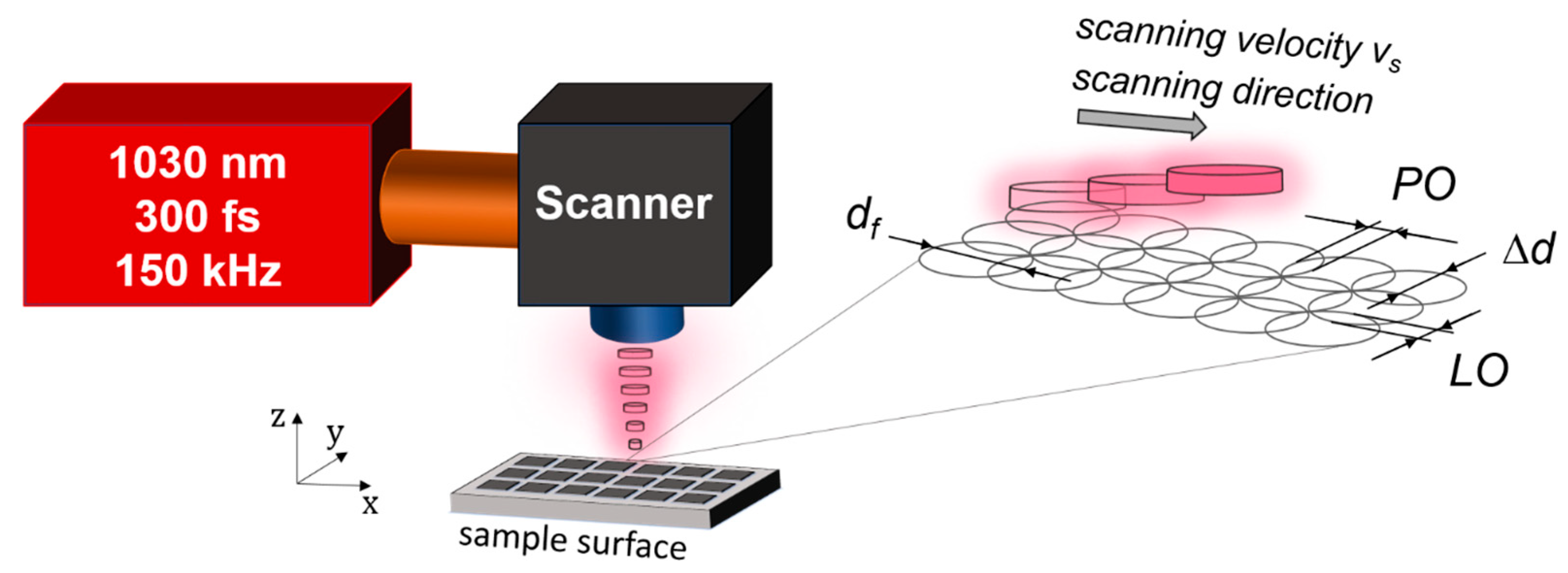
| Laser Process Parameter | Symbol | Unit | Value |
|---|---|---|---|
| Wavelength | nm | 1030 (IR) | |
| Theoretical circular focus diameter ( intensity level) | μm | 31.6 | |
| Pulse duration | fs | 300 | |
| Frequency/Pulse repetition rate | kHz | 150 | |
| -factor (beam quality) | - | 1.2 |
| Laser Scanning Parameter + Variations | Symbol | Unit | Values |
|---|---|---|---|
| Laser pulse overlap (at fix LO of 50%) | PO | - | 40%; 50%; 60%; 70%; 80%; 90% |
| Scanning velocity | vs | m/s | 2.850; 2.375; 1.900; 1.425; 0.950; 0.475 |
| Scanning line overlap (at fix PO of 50%) | LO | - | 40%; 50%; 60%; 70%; 80%; 90% |
| Scanning line distance | μm | 19; 16; 13; 10; 6; 3 | |
| Pulse energy | EP | μJ | 3.9; 11.8; 23.6; 39.3; 63.0; 86.6; 110.2; 133.9 |
| Fluence | J/cm2 | 0.5; 1.5; 3.0; 5.0; 8.0; 11.0; 14.0; 17.0 | |
| Number of overscans | N | - | 50 |
| Arithmetical Mean Height Ra/µm | Cut-Off Wavelength λC/µm | Low-Pass Filter λS/µm | Total Measuring Distance ln,max/µm |
|---|---|---|---|
| 250 | 2.5 | 585 | |
| 800 | 2.5 | 1872 | |
| 2500 | 8.0 | 5853 |
| Arithmetical Mean Height Sa/µm | Cut-Off Wavelength λC/µm | Low-Pass Filter λS/µm | Total Measuring Area |
|---|---|---|---|
| 80 | - | ||
| 80 | - | ||
| 80 | - |
Disclaimer/Publisher’s Note: The statements, opinions and data contained in all publications are solely those of the individual author(s) and contributor(s) and not of MDPI and/or the editor(s). MDPI and/or the editor(s) disclaim responsibility for any injury to people or property resulting from any ideas, methods, instructions or products referred to in the content. |
© 2026 by the authors. Licensee MDPI, Basel, Switzerland. This article is an open access article distributed under the terms and conditions of the Creative Commons Attribution (CC BY) license.
Share and Cite
Thomas, R.; Seitz, H.; Schnell, G. Effect of Laser Scanning Parameters on Topography and Morphology of Femtosecond Laser-Structured Hot-Work Tool Steel Surfaces. J. Manuf. Mater. Process. 2026, 10, 58. https://doi.org/10.3390/jmmp10020058
Thomas R, Seitz H, Schnell G. Effect of Laser Scanning Parameters on Topography and Morphology of Femtosecond Laser-Structured Hot-Work Tool Steel Surfaces. Journal of Manufacturing and Materials Processing. 2026; 10(2):58. https://doi.org/10.3390/jmmp10020058
Chicago/Turabian StyleThomas, Robert, Hermann Seitz, and Georg Schnell. 2026. "Effect of Laser Scanning Parameters on Topography and Morphology of Femtosecond Laser-Structured Hot-Work Tool Steel Surfaces" Journal of Manufacturing and Materials Processing 10, no. 2: 58. https://doi.org/10.3390/jmmp10020058
APA StyleThomas, R., Seitz, H., & Schnell, G. (2026). Effect of Laser Scanning Parameters on Topography and Morphology of Femtosecond Laser-Structured Hot-Work Tool Steel Surfaces. Journal of Manufacturing and Materials Processing, 10(2), 58. https://doi.org/10.3390/jmmp10020058