


Decarbonising Maritime Transport: Advanced Energy Systems, Alternative Fuels and Data-Driven Optimisation
Special Issue Information
Dear Colleagues,
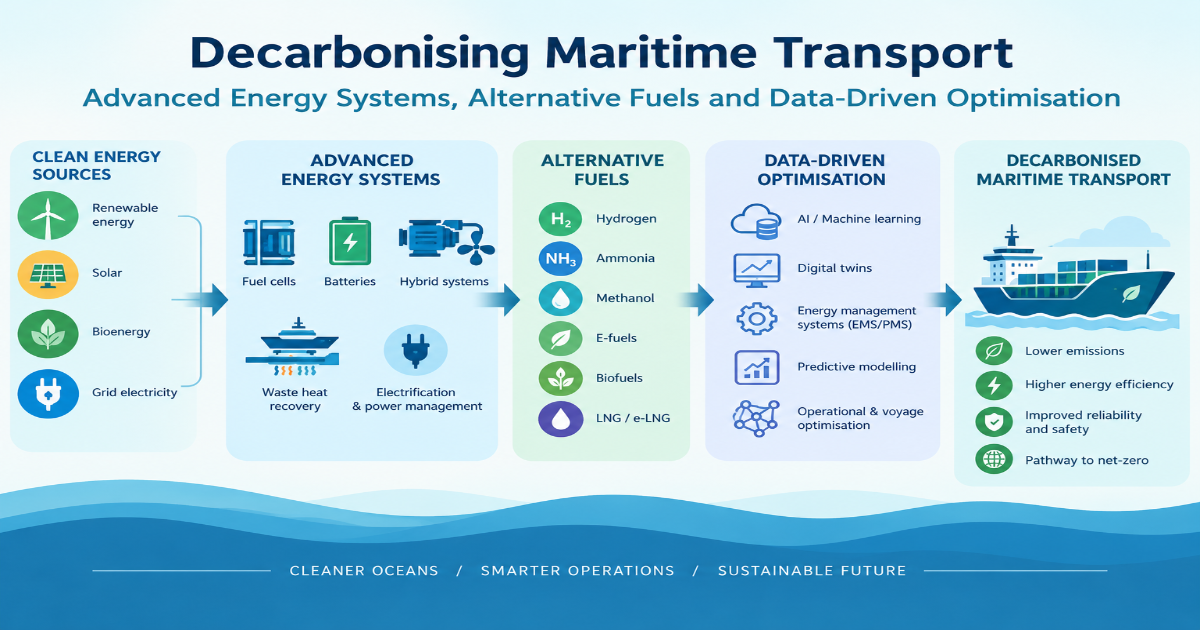
The maritime transport sector plays a fundamental role in global trade and economic development, while simultaneously facing increasing pressure to reduce greenhouse gas emissions and improve energy efficiency. The transition towards a low- and ultimately zero-carbon maritime sector requires the development and integration of advanced propulsion and energy systems, alternative low- and zero-carbon fuels, renewable energy technologies, energy storage, and intelligent operational strategies. In parallel, the increasing availability of onboard and operational data provides new opportunities for data-driven modelling, performance assessment, predictive maintenance, optimisation, and energy management.
This Special Issue aims to present and disseminate recent advances in technologies, methodologies, and applications supporting the decarbonisation of maritime transport. Emphasis is placed on the integration of advanced energy systems with alternative fuels and data-driven approaches to improve vessel energy efficiency, environmental performance, reliability, and economic viability. Contributions addressing both technological development and system-level integration are encouraged, including studies based on numerical modelling, experimental investigation, real-world operational data, optimisation, and techno-economic or environmental assessment.
Topics of interest include, but are not limited to:
- Advanced marine energy and propulsion systems, including fuel cells, batteries, hybrid systems, electrification, renewable energy integration, and waste heat recovery;
- Alternative and low-/zero-carbon marine fuels, including hydrogen, ammonia, methanol, e-fuels, biofuels, and other emerging fuel pathways;
- Energy management and power management systems for ships;
- Data-driven modelling, machine learning, artificial intelligence, digital twins, and predictive analytics for maritime applications;
- Performance prediction, energy efficiency optimisation, voyage optimisation, and intelligent operational strategies;
- Multi-objective optimisation and decision-support methods for marine energy systems;
- Techno-economic, environmental, life cycle, and well-to-wake assessments of emerging maritime technologies;
- Emission reduction strategies, carbon-neutral shipping, and pathways towards net-zero maritime transport;
- Integrated ship energy systems and future maritime energy architectures;
Original research articles, review articles, and methodological contributions addressing these topics are welcome. The Special Issue seeks to bring together researchers and practitioners from marine engineering, energy systems, alternative fuels, data science, and transportation research to advance practical and scalable solutions for the decarbonisation of maritime transport.
Dr. Onur Yuksel
Prof. Dr. Eduardo Blanco-Davis
Guest Editors
Manuscript Submission Information
Manuscripts should be submitted online at www.mdpi.com by registering and logging in to this website. Once you are registered, click here to go to the submission form. Manuscripts can be submitted until the deadline. All submissions that pass pre-check are peer-reviewed. Accepted papers will be published continuously in the journal (as soon as accepted) and will be listed together on the Special Issue website. Research articles, review articles as well as short communications are invited. For planned papers, a title and short abstract (about 250 words) can be sent to the Editorial Office for assessment.
Submitted manuscripts should not have been published previously, nor be under consideration for publication elsewhere (except conference proceedings papers). All manuscripts are thoroughly refereed through a single-anonymized peer-review process. A guide for authors and other relevant information for submission of manuscripts is available on the Instructions for Authors page. Future Transportation is an international peer-reviewed open access semimonthly journal published by MDPI.
Please visit the Instructions for Authors page before submitting a manuscript. The Article Processing Charge (APC) for publication in this open access journal is 1200 CHF (Swiss Francs). Submitted papers should be well formatted and use good English. Authors may use MDPI's English editing service prior to publication or during author revisions.
Keywords
- maritime decarbonisation
- advanced energy systems
- data-driven optimisation
- machine learning
- maritime energy systems
- alternative marine fuels
- hybrid marine propulsion
- energy management
- digital twins
Benefits of Publishing in a Special Issue
- Ease of navigation: Grouping papers by topic helps scholars navigate broad scope journals more efficiently.
- Greater discoverability: Special Issues support the reach and impact of scientific research. Articles in Special Issues are more discoverable and cited more frequently.
- Expansion of research network: Special Issues facilitate connections among authors, fostering scientific collaborations.
- External promotion: Articles in Special Issues are often promoted through the journal's social media, increasing their visibility.
- Reprint: MDPI Books provides the opportunity to republish successful Special Issues in book format, both online and in print.
Published Papers


Future Transp. - ISSN 2673-7590