Skip Content
You are currently on the new version of our website. Access the old version .

Econometrics

Econometrics is an international, peer-reviewed, open access journal on econometric modeling and forecasting, as well as new advances in econometrics theory, and is published quarterly online by MDPI. 

All Articles (521)

The delisting of Binance USD (BUSD) constitutes a major regulatory intervention in the stablecoin market and provides a unique opportunity to examine how targeted regulation affects liquidity allocation, market concentration, and short-run systemic risk in crypto-asset markets. Using daily data for 2023 and a linear and nonlinear Local Projections event-study framework, this paper analyzes the dynamic market responses to the BUSD delisting across major stablecoins and cryptocurrencies. The results show that liquidity displaced from BUSD is reallocated primarily toward USDT and USDC, leading to a measurable increase in stablecoin market concentration, while decentralized and algorithmic stablecoins absorb only a limited share of the shock. At the same time, Bitcoin and Ethereum experience temporary liquidity contractions followed by a relatively rapid recovery, suggesting conditional resilience of core crypto-assets. Overall, the findings document how a regulatory-induced exit of a major stablecoin reshapes short-run market dynamics and concentration patterns, highlighting potential trade-offs between regulatory enforcement and market structure. The paper contributes to the literature by providing the first empirical analysis of the BUSD delisting and by illustrating the usefulness of Local Projections for studying regulatory shocks in cryptocurrency markets.

16 January 2026
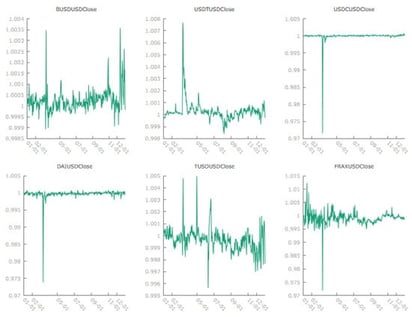
Data for stablecoins. Note: BUSDUSDClose stands for the Binance’s BUSD Closing Price, USDTUSDClose for the Tether’s USDT Closing Price, USDCUSDClose for the Circle’s USDC Closing Price, DAIUSDClose for the DAI Closing Price, TUSDUSDClose for the True USD Closing Price, and FRAXUSDClose for the FRAX Closing Price in daily frequency from 1 January to 31 December 2023.

Social Security Transfers and Fiscal Sustainability in Turkey: Evidence from 1984–2024

  • Huriye Gonca Diler,
  • Nurgül E. Barın and
  • Simon Grima
  • + 1 author

Social security systems constitute a structurally significant component of public finance in developing economies and often generate persistent fiscal pressures through budgetary transfers. Demographic transformation, widespread informality in labor markets, and weaknesses in contribution-based financing increase the dependence of social security systems on public resources. The objective of this study is to examine whether budget transfers to the social security system affect fiscal sustainability in Turkey by analyzing their relationship with the budget deficit and the public sector borrowing requirement. The analysis employs annual data for Turkey covering the period of 1984–2024. A comprehensive time-series econometric framework is adopted, incorporating conventional and structural-break unit root tests, the ARDL bounds testing approach with error correction modeling, and the Toda–Yamamoto causality method. The empirical findings provide evidence of a stable long-run relationship among the variables. The results indicate that social security budget transfers exert a statistically significant and persistent effect on the public sector borrowing requirement, while no direct long-run effect on the headline budget deficit is detected. Causality results further confirm that fiscal pressures associated with social security financing materialize primarily through borrowing dynamics rather than short-term budgetary imbalances. By explicitly modelling social security budget transfers as an independent fiscal channel over a long historical horizon, this study contributes to the literature by offering new empirical insights into the fiscal sustainability implications of social security financing in Turkey. The findings also provide policy-relevant evidence for developing economies facing similar institutional, demographic, and fiscal challenges.

31 January 2026

Shock Next Door: Geographic Spillovers in FinTech Lending After Natural Disasters

  • David Kuo Chuen Lee,
  • Weibiao Xu and
  • Ding Ding
  • + 2 authors

We examine geographic spillovers in digital credit markets by studying how natural disasters affect borrowing behavior in adjacent, physically undamaged regions. Using granular loan-level data from Indonesia’s largest FinTech lender (2021–2023) and leveraging quasi-random variation in disaster timing and location, we estimate fixed-effects specifications that incorporate spatially lagged disaster exposure (an SLX-type spatial approach) to quantify spillovers. Disasters generate economically significant spillovers in neighboring provinces: a 1% increase in disaster frequency raises local borrowing by 0.036%, approximately 20% of the direct effect. Spillovers vary sharply with geographic connectivity—land-connected provinces experience effects about 6.6 times larger than sea-connected provinces. These results highlight that digital lending platforms can transmit geographically proximate risks beyond directly affected areas through channels that differ from traditional banking networks. The systematic nature of these spillovers suggests that disaster-response strategies may be more effective when they consider adjacent regions. That platform risk management can be strengthened by integrating spatial disaster exposure and connectivity into credit monitoring and decision rules.

15 January 2026

The references of most of the observations that econometricians have are ill defined. To use such data in an empirical analysis, the econometrician in charge must find a way to give them economic meaning. In this paper, I have data and an econometric model, and I set out to show how economic theory can be used to interpret the variables and parameters of my econometric model. According to Ragnar Frisch, that is a difficult task. Economic theories reside in a Model World and the econometrician’s data reside in the Real World; the rational laws in the model world are fundamentally different from the empirical laws in the real world; and between the two worlds there is a gap that can never be bridged To accomplish my task, I build a bridge between Frisch’s two worlds with applied formal-econometric arguments, invent a pertinent model-world economic theory, walk the bridge with the invented theory, and use it to give economic meaning to the variables and parameters of my econometric model. At the end I demonstrate that the invented theory and the bridge I use in my analysis are empirically relevant in the empirical context of my econometric model.

6 January 2026

News & Conferences

Issues

Open for Submission

Editor's Choice

Get Alerted

Add your email address to receive forthcoming issues of this journal.

XFacebookLinkedIn
Econometrics - ISSN 2225-1146