Skip to Content

Behavioral Sciences

Behavioral Sciences is an international, peer-reviewed, open access journal on psychology, neuroscience, cognitive science, behavioral biology and behavioral genetics, published monthly online by MDPI.

Indexed in PubMed | Quartile Ranking JCR - Q2 (Psychology, Multidisciplinary)

Get Alerted

Add your email address to receive forthcoming issues of this journal.

All Articles (6,342)

Digital-intelligence transformation in education has made pre-service teachers’ Technological Pedagogical Content Knowledge (TPACK) a strategic concern in teacher preparation. Survey data from 11,818 pre-service teachers across 17 local normal universities in China were analyzed through hierarchical regression, quantile regression, and structural equation modeling to examine how perceived university ICT support and perceived AI support in education are associated with self-reported TPACK. Both forms of support showed significant direct and model-conform indirect associations with self-reported TPACK, but the quantile coefficients varied across the TPACK distribution: university ICT support showed a modestly fluctuating descriptive pattern, whereas AI support in education peaked at the median and attenuated at upper quantiles. ICT self-efficacy and AI competency expectancy each formed significant indirect pathways in the hypothesized model, although the ICT pathway was more strongly indirect and the AI pathway remained more strongly direct. Additional checks of university-level ICCs, cluster-robust standard errors, and measurement invariance across key subgroups supported the robustness and comparability of the findings. These patterns clarify how perceived ICT and AI support are differentially associated with self-reported TPACK and provide empirical grounds for more precise, human-in-the-loop support designs in teacher education.

4 June 2026
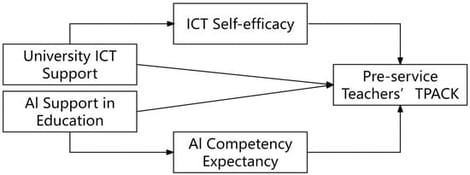
Theoretical model of the relationships among university ICT support, AI support in education, ICT self-efficacy, AI competency expectancy, and pre-service teachers’ TPACK.

Having a sibling with a disability is known to significantly impact career choices. However, the experiences and emotional processes of such individuals who pursue a career in a helping profession are not fully understood. This study aimed to clarify how the experience of growing up with a sibling with a disability in Japan has influenced their decision to pursue a career in a helping profession, as well as their approach to life as a helping professional. Following a descriptive qualitative approach, semi-structured interviews were conducted with people with a sibling with a disability, and the results were analyzed qualitatively and inductively. The participants did not necessarily have a clear motivation to pursue a career in a helping profession; rather, they were influenced by their family experiences and living environments from childhood, as well as emotional conflicts. Supporting clients and their families enabled them to deepen their understanding of disabilities and welfare, as well as to resolve their own unresolved issues. The findings of this study highlight the need for support for siblings of people with disabilities. Providing siblings with opportunities to reflect on their experiences and find meaning in them is considered important for supporting self-understanding and well-being.

4 June 2026

Fitting in or Not Fitting in: Cultural Congruity as a Correlate of Motivation for Intergroup Contact

  • Marina M. Doucerain,
  • Myra Deraîche and
  • Alhassane Balde
  • + 2 authors

It is well established in social psychology that intergroup contact is beneficial to reduce intergroup bias. Based on this insight, a growing body of work has focused on correlates of people’s motivation to seek or avoid intergroup contact. The present study contributes to this literature by probing motivation for an ecologically valid and ideal form of intergroup contact: intercultural twinnings (structured exchange activities between people of diverse linguistic and ethnocultural backgrounds). We examined three facets of motivation (contact willingness; intrinsic motivation; and contact opt-in as a proxy for behavioral intent) and a range of well-established intergroup contact associates. We also tested the role of cultural congruity with the dominant society, inspired by push–pull theories of migration. Participants included 214 students in Québec, Canada. The results show that motivational profiles differed depending on motivation facets. Intergroup anxiety was negatively related to intrinsic motivation; desire for self-expansion was positively related to all three facets; ethnocentrism was negatively associated with our behavioral proxy. Cultural congruity was associated with all three facets through a suppression effect, such that greater perception of not fitting in Québec society was related to higher motivation indices once avoidance dispositions were taken into account. With prevalent intergroup tensions, better understanding how to “bring the horse to the contact water” is essential.

4 June 2026

Fear of Missing Out (FoMO) has been increasingly recognized as a psychological driver of problematic mobile phone use and sleep disturbances among young adults. However, existing research is fragmented, with limited integration of cognitive–affective and behavioral mechanisms within a unified theoretical framework. Drawing on the Interaction of Person-Affect-Cognition-Execution (I-PACE) model, a process-oriented framework in which problematic smartphone use mediates the association between FoMO and sleep quality, with sensation seeking examined as a boundary condition. Data from 1124 Chinese undergraduate students showed that FoMO was associated with poor sleep quality. Problematic smartphone use partially mediated this association, suggesting that FoMO is linked to sleep outcomes through both direct cognitive–affective processes and indirect behavioral pathways. Sensation seeking significantly strengthened the associations between FoMO and problematic smartphone use, as well as between problematic smartphone use and sleep quality, whereas it was not significantly associated with the direct FoMO-sleep link, indicating pathway-specific moderation primarily operating at the behavioral execution level. These findings provide empirical support for an I-PACE-based process model of FoMO-related sleep problems and highlight behavioral engagement processes as a key target for interventions among high-risk individuals.

4 June 2026

News & Conferences

Volumes

Latest Issues

Open for Submission

Editor's Choice

Reprints of Collections

Rethinking Leadership Development
Reprint

Rethinking Leadership Development

Contributions from Theory and Research
Editors: A. Rui Gomes, Catarina Morais
Suicidal Behaviors
Reprint

Suicidal Behaviors

Prevention, Intervention and Postvention
Editors: Irene Caro-Cañizares, María Cantero-García, Eva Izquierdo-Sotorrío
XFacebookLinkedIn
Behav. Sci. - ISSN 2076-328X