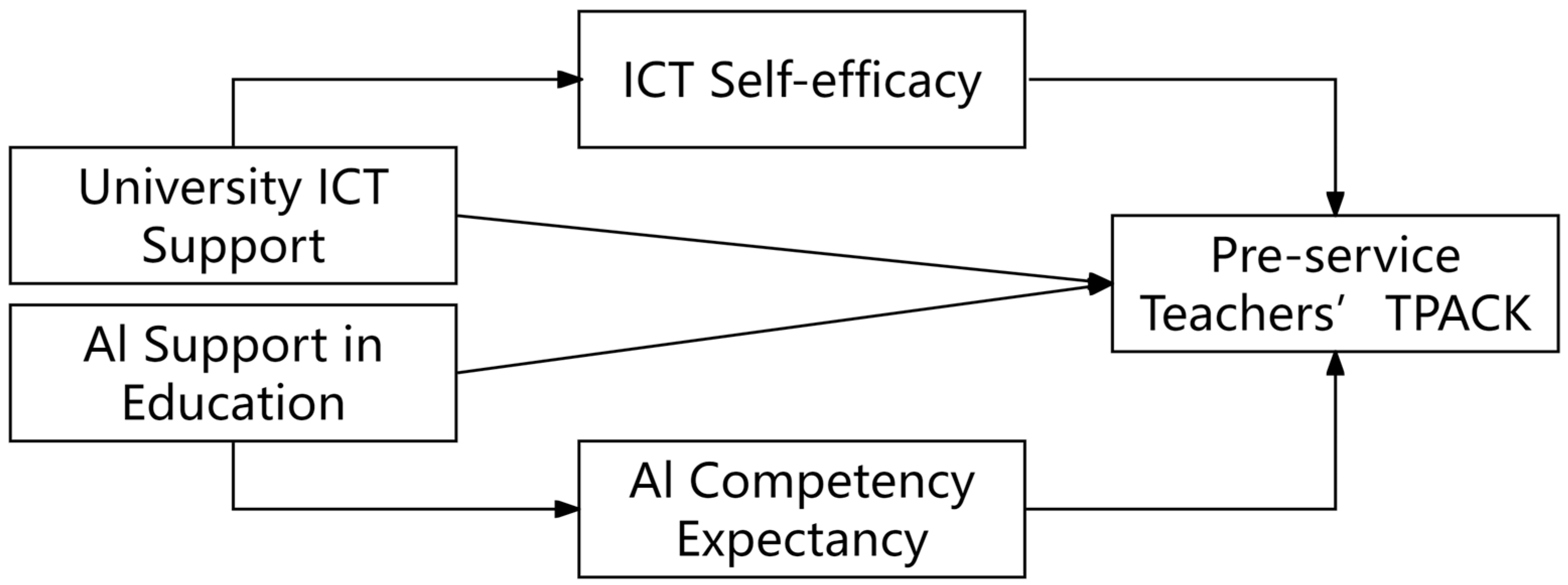
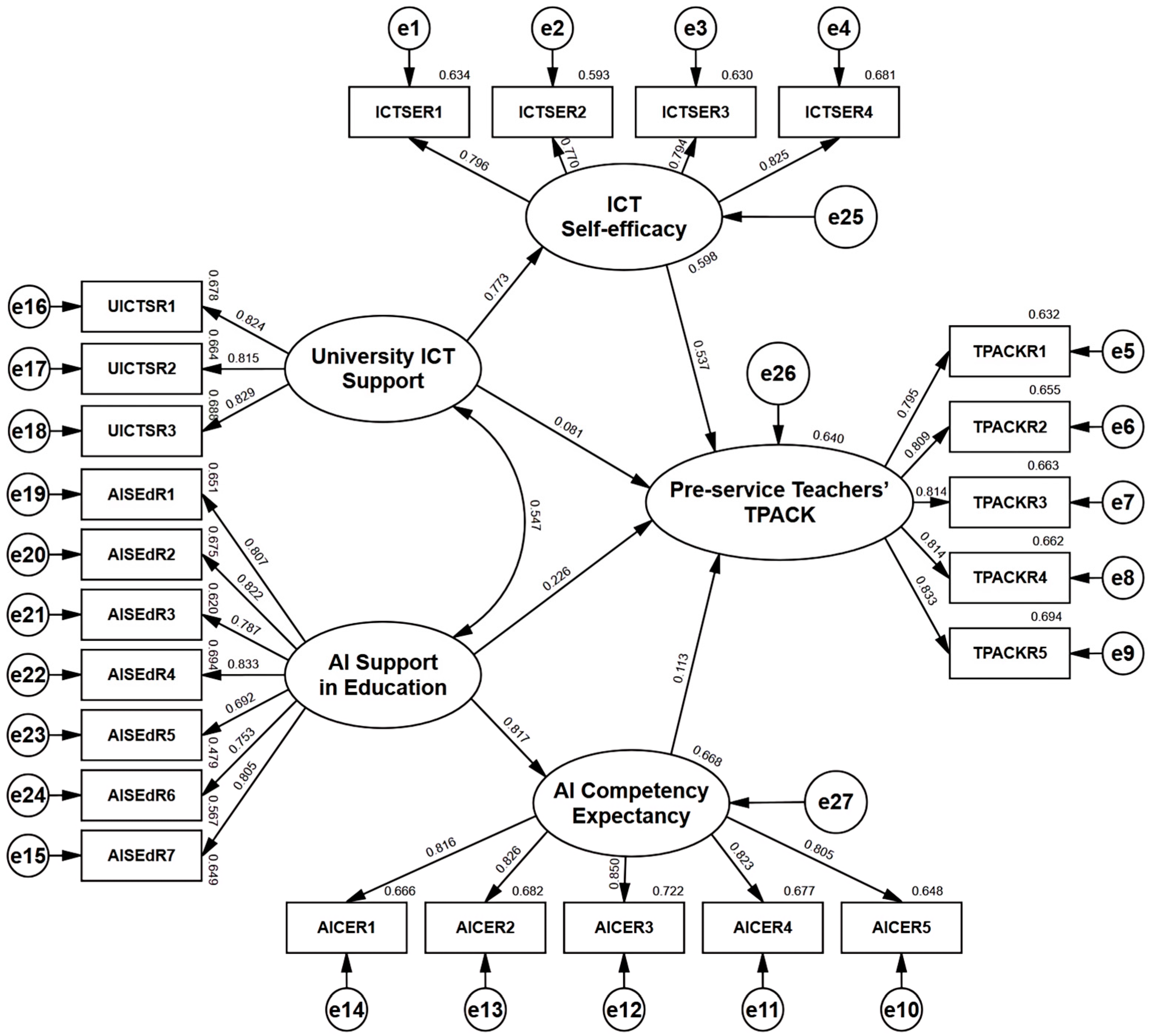
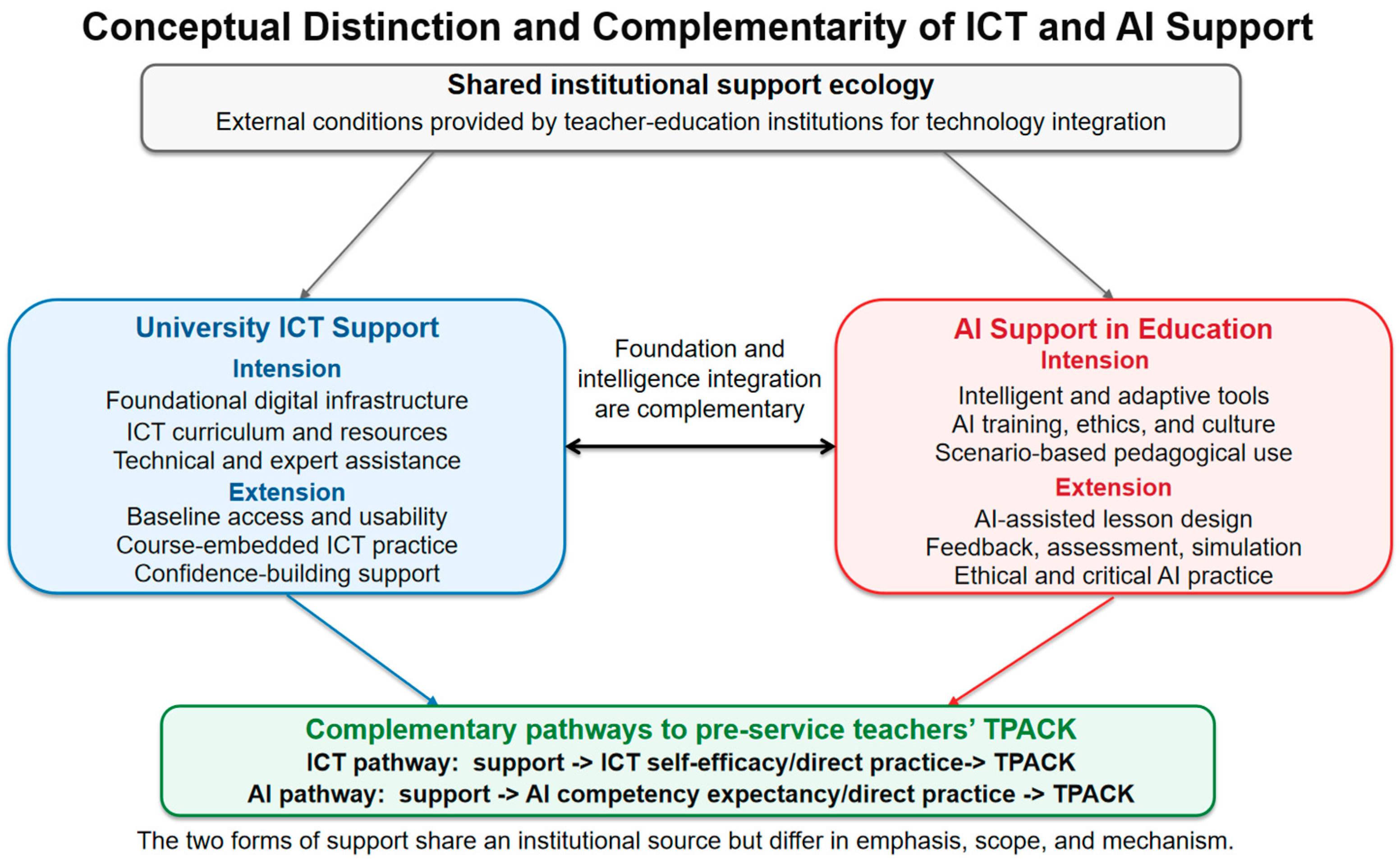
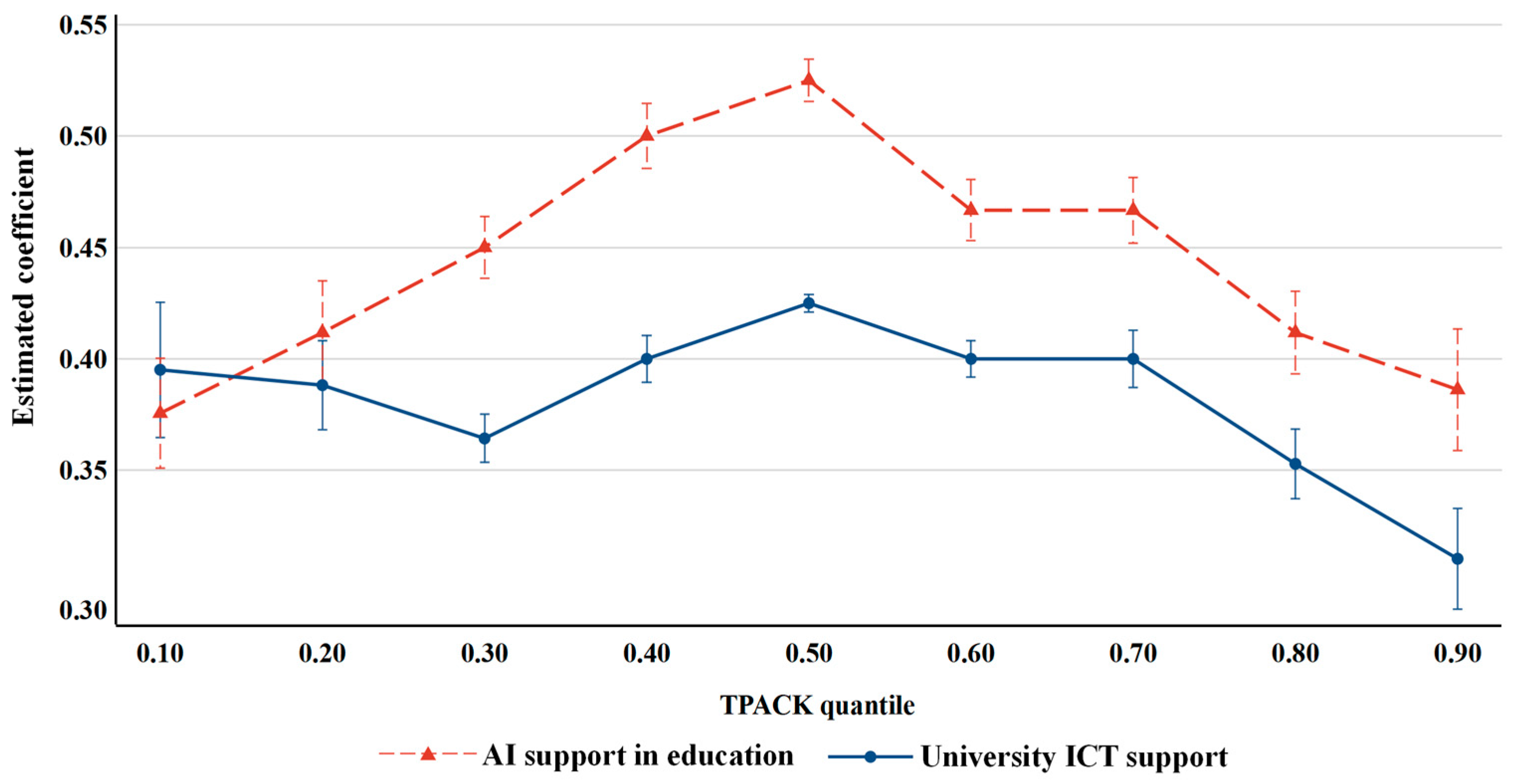
From Foundation to Intelligence Integration: The Synergistic Associations of ICT and AI Support with Pre-Service Teachers’ TPACK Development

Abstract
1. Introduction
2. Literature Review
2.1. The Relationship Between University ICT Support and Pre-Service Teachers’ TPACK
2.2. The Relationship Between AI Support in Education and Pre-Service Teachers’ TPACK
2.3. The Mediating Role of ICT Self-Efficacy
2.4. The Mediating Role of AI Competency Expectancy
3. Materials and Methods
3.1. Participants
3.2. Variables and Measures
3.2.1. Pre-Service Teachers’ TPACK
3.2.2. University ICT Support
3.2.3. ICT Self-Efficacy
3.2.4. AI Support in Education
3.2.5. AI Competency Expectancy
3.3. Data Analysis
4. Results
4.1. Multilevel Structure and Common Method Bias Test
4.2. Direct Association Test Results
4.3. Quantile-Specific Association Patterns
4.4. Mediating Association Test Results
5. Discussion
5.1. Theoretical Contributions
5.2. Practical Implications
5.3. Limitations and Future Directions
6. Conclusions
Author Contributions
Funding
Institutional Review Board Statement
Informed Consent Statement
Data Availability Statement
Acknowledgments
Conflicts of Interest
Appendix A. Measurement Validation and Statistical Diagnostics

| Construct | University Variance | Residual Variance | ICC |
|---|---|---|---|
| University ICT support | 0.009 | 0.524 | 0.016 |
| AI support in education | 0.004 | 0.386 | 0.010 |
| ICT self-efficacy | 0.006 | 0.479 | 0.013 |
| AI competency expectancy | 0.004 | 0.409 | 0.011 |
| TPACK | 0.007 | 0.436 | 0.015 |
| Grouping | Model | CFI | TLI | RMSEA | SRMR | Delta CFI | Delta RMSEA |
|---|---|---|---|---|---|---|---|
| Gender | Configural | 0.978 | 0.975 | 0.039 | 0.022 | ||
| Gender | Metric | 0.978 | 0.976 | 0.039 | 0.023 | 0.000 | −0.001 |
| Gender | Scalar | 0.977 | 0.976 | 0.038 | 0.023 | −0.001 | 0.000 |
| Household registration | Configural | 0.978 | 0.975 | 0.039 | 0.022 | ||
| Household registration | Metric | 0.978 | 0.976 | 0.038 | 0.022 | 0.000 | −0.001 |
| Household registration | Scalar | 0.978 | 0.977 | 0.038 | 0.023 | 0.000 | −0.001 |
| Identity type | Configural | 0.979 | 0.976 | 0.039 | 0.022 | ||
| Identity type | Metric | 0.979 | 0.976 | 0.038 | 0.022 | 0.000 | −0.001 |
| Identity type | Scalar | 0.979 | 0.977 | 0.037 | 0.022 | 0.000 | −0.001 |
| Major type | Configural | 0.977 | 0.973 | 0.041 | 0.023 | ||
| Major type | Metric | 0.977 | 0.975 | 0.039 | 0.024 | 0.000 | −0.001 |
| Major type | Scalar | 0.976 | 0.975 | 0.039 | 0.025 | −0.001 | 0.000 |
| Comparison | Predictor | Wald F | p |
|---|---|---|---|
| Q0.1 vs. Q0.5 | University ICT support | 3.947 | 0.047 |
| Q0.1 vs. Q0.5 | AI support in education | 150.795 | <0.001 |
| Q0.5 vs. Q0.9 | University ICT support | 109.394 | <0.001 |
| Q0.5 vs. Q0.9 | AI support in education | 111.079 | <0.001 |
| Q0.1 vs. Q0.9 | University ICT support | 21.508 | <0.001 |
| Q0.1 vs. Q0.9 | AI support in education | 0.357 | 0.550 |
References
- Abbitt, J. T. (2011). An investigation of the relationship between self-efficacy beliefs about technology integration and technological pedagogical content knowledge (TPACK) among preservice teachers. Journal of Digital Learning in Teacher Education, 27(4), 134–143. [Google Scholar] [CrossRef]
- Adnan, M., Tondeur, J., Scherer, R., & Siddiq, F. (2024). Profiling teacher educators: Ready to prepare the next generation for educational technology use? Technology, Pedagogy and Education, 33(4), 527–544. [Google Scholar] [CrossRef]
- Aldemir, T., Bicer, A., Kilinc, S., Moon, J., & Kwok, M. (2025). Exploring emergent AI-TPACK competencies in a two-week AI literacy module for preservice teachers. Teaching and Teacher Education, 168, 105231. [Google Scholar] [CrossRef]
- Anderson, S. E., & Maninger, R. M. (2007). Preservice teachers’ abilities, beliefs, and intentions regarding technology integration. Journal of Educational Computing Research, 37(2), 151–172. [Google Scholar] [CrossRef]
- Angeli, C., & Valanides, N. (2009). Epistemological and methodological issues for the conceptualization, development, and assessment of ICT-TPCK: Advances in technological pedagogical content knowledge (TPCK). Computers & Education, 52(1), 154–168. [Google Scholar] [CrossRef]
- Bagozzi, R. P. (1981). Evaluating structural equation models with unobservable variables and measurement error: A comment. Journal of Marketing Research, 18(3), 375–381. [Google Scholar] [CrossRef]
- Bagozzi, R. P., & Yi, Y. (1988). On the evaluation of structural equation models. Journal of the Academy of Marketing Science, 16(1), 74–94. [Google Scholar] [CrossRef]
- Bai, X., Guo, R., & Gu, X. (2024). Effect of teachers’ TPACK on their behavioral intention to use technology: Chain mediating effect of technology self-efficacy and attitude toward use. Education and Information Technologies, 29, 1013–1032. [Google Scholar] [CrossRef]
- Bandura, A. (1977). Self-efficacy: Toward a unifying theory of behavioral change. Psychological Review, 84(2), 191–215. [Google Scholar] [CrossRef]
- Bandura, A., Freeman, W. H., & Lightsey, R. (1999). Self-efficacy: The exercise of control. Journal of Cognitive Psychotherapy, 13(2), 158–166. [Google Scholar] [CrossRef]
- Baran, E., Canbazoglu Bilici, S., Albayrak Sari, A., & Tondeur, J. (2019). Investigating the impact of teacher education strategies on preservice teachers’ TPACK. British Journal of Educational Technology, 50(1), 357–370. [Google Scholar] [CrossRef]
- Barbieri, W., & Nguyen, N. N. (2025). Generative AI as a “placement buddy”: Supporting pre-service teachers in work-integrated learning, self-management and crisis resolution. Australasian Journal of Educational Technology, 41(2), 34–49. [Google Scholar] [CrossRef]
- Bilici, S. C., Yamak, H., Kavak, N., & Güzey, S. S. (2013). Technological pedagogical content knowledge self-efficacy scale (TPACK-SeS) for pre-service science teachers: Construction, validation, and reliability. Eurasian Journal of Educational Research, 13(52), 37–60. Available online: https://files.eric.ed.gov/fulltext/EJ1060363.pdf (accessed on 3 February 2026).
- Bueno, R. W. S., & Niess, M. L. (2023). Redesigning mathematics preservice teachers’ preparation for teaching with technology: A qualitative cross-case analysis using TPACK lenses. Computers & Education, 205, 104895. [Google Scholar] [CrossRef]
- Celik, I. (2023). Towards intelligent-TPACK: An empirical study on teachers’ professional knowledge to ethically integrate artificial intelligence (AI)-based tools into education. Computers in Human Behavior, 138, 107468. [Google Scholar] [CrossRef]
- Celik, I., Kontkanen, S., Laru, J., & Dalyanci, A. A. (2026). Co-constructing adaptive lesson plans with GenAI: Pre-service teachers’ intelligent-TPACK and prompt engineering strategies. Computers & Education, 241, 105485. [Google Scholar] [CrossRef]
- Chai, C. S., Koh, J. H. L., & Tsai, C.-C. (2010). Facilitating preservice teachers’ development of technological, pedagogical, and content knowledge (TPACK). Journal of Educational Technology & Society, 13(4), 63–73. Available online: http://www.jstor.org/stable/jeductechsoci.13.4.63 (accessed on 3 February 2026).
- Chen, K., Gu, Y., & Xiang, J.-M. (2020). A study on the self-efficacy of pre-service science teachers’ TPACK. Heilongjiang Researches on Higher Education, 38(3), 105–111. (In Chinese) [Google Scholar]
- Chen, L., Chen, P., & Lin, Z. (2020). Artificial intelligence in education: A review. IEEE Access, 8, 75264–75278. [Google Scholar] [CrossRef]
- Compeau, D. R., & Higgins, C. A. (1995). Computer self-efficacy: Development of a measure and initial test. MIS Quarterly, 19(2), 189–211. [Google Scholar] [CrossRef]
- Çolak Yazıcı, S. (2026). Is knowing technology enough? Barriers and perceptions of prospective teachers towards the use of technology in chemistry courses. Research in Science & Technological Education, 1–23. [Google Scholar] [CrossRef]
- Dai, W. (2023). An empirical study on English preservice teachers’ digital competence regarding ICT self-efficacy, collegial collaboration and infrastructural support. Heliyon, 9(9), e19538. [Google Scholar] [CrossRef] [PubMed]
- Davis, F. D. (1989). Perceived usefulness, perceived ease of use, and user acceptance of information technology. MIS Quarterly, 13(3), 319–340. [Google Scholar] [CrossRef]
- Deng, L., & Wang, Q.-L. (2022). Investigation and improvement path of physics-major pre-service teachers’ TPACK level. Journal of Teacher Education, 9(3), 153–164. (In Chinese) [Google Scholar]
- Dong, Y., Sang, G.-Y., & Cai, J.-X. (2014). An empirical study on TPACK of pre-service teachers. Teacher Education Research, 26(3), 36–43. (In Chinese) [Google Scholar]
- Dong, Y., Xu, C., Chai, C. S., & Zhai, X. (2020). Exploring the structural relationship among teachers’ technostress, technological pedagogical content knowledge (TPACK), computer self-efficacy and school support. The Asia-Pacific Education Researcher, 29(2), 147–157. [Google Scholar] [CrossRef]
- Eyal, L., Rabin, E., & Meirovitz, T. (2023). Pre-service teachers’ attitudes toward integrating digital games in learning as cognitive tools for developing higher-order thinking and lifelong learning. Education Sciences, 13(12), 1165. [Google Scholar] [CrossRef]
- Fang, X., Zhao, J.-W., & Yin, J.-J. (2026). Digital transformation anxiety of primary and secondary school teachers: Causes and solutions. Journal of Teacher Education, 13(1), 95–103. (In Chinese) [Google Scholar]
- Farjon, D., Smits, A., & Voogt, J. (2019). Technology integration of pre-service teachers explained by attitudes and beliefs, competency, access, and experience. Computers & Education, 130, 81–93. [Google Scholar] [CrossRef]
- Foulger, T. S., Buss, R. R., Wetzel, K., & Lindsey, L. (2015). Instructors’ growth in TPACK: Teaching technology-infused methods courses to preservice teachers. Journal of Digital Learning in Teacher Education, 31(4), 134–147. [Google Scholar] [CrossRef]
- Gromik, N., Litz, D., & Liu, B. (2024). Technology, pedagogy, and content knowledge: An Australian case study. Education Sciences, 14(1), 37. [Google Scholar] [CrossRef]
- Guo, C., Mu, M., Chen, J., & Chen, X. (2026). Supporting pre-service teachers’ TPACK development and technology integration in collaborative lesson planning. Humanities and Social Sciences Communications, 13, 322. [Google Scholar] [CrossRef]
- Hair, J. F., Ringle, C. M., & Sarstedt, M. (2011). PLS-SEM: Indeed a silver bullet. Journal of Marketing Theory and Practice, 19(2), 139–152. [Google Scholar] [CrossRef]
- Heine, S., & König, J. (2025). Applying artificial intelligence in teacher education: Preservice teachers’ attitudes and reflections in using ChatGPT for teaching and learning. European Journal of Teacher Education, 48(5), 934–963. [Google Scholar] [CrossRef]
- Henriksen, D., Woo, L. J., & Mishra, P. (2025). Beyond tools and training: Building sustainable learning environments that evolve with AI. TechTrends, 69, 869–875. [Google Scholar] [CrossRef]
- Holden, H., & Rada, R. (2011). Understanding the influence of perceived usability and technology self-efficacy on teachers’ technology acceptance. Journal of Research on Technology in Education, 43(4), 343–367. [Google Scholar] [CrossRef]
- Holmes, W., Bialik, M., & Fadel, C. (2022). Artificial intelligence in education: Promises and implications for teaching and learning (2nd ed.). Center for Curriculum Redesign. [Google Scholar]
- Hou, M., & Shen, Y. (2024). Explaining preservice teachers’ intention and behavior to use technology-enabled learning in China: A multi-group analysis across experiences. Psychology in the Schools, 61, 4538–4557. [Google Scholar] [CrossRef]
- Hu, L., & Bentler, P. M. (1999). Cutoff criteria for fit indexes in covariance structure analysis: Conventional criteria versus new alternatives. Structural Equation Modeling, 6(1), 1–55. [Google Scholar] [CrossRef]
- Hu, W., Tian, J., & Li, Y. (2025). Enhancing student engagement in online collaborative writing through a generative AI-based conversational agent. The Internet and Higher Education, 65, 100979. [Google Scholar] [CrossRef]
- Hughes, J. E., Liu, S., & Lim, M. (2016). Technological modeling: Faculty use of technologies in preservice teacher education from 2004 to 2012. Contemporary Issues in Technology and Teacher Education, 16(2), 184–207. Available online: https://citejournal.org/volume-16/issue-2-16/current-practice/technological-modeling-faculty-use-of-technologies-in-preservice-teacher-education-from-2004-to-2012 (accessed on 3 February 2026).
- Joo, Y. J., Lim, K. Y., & Kim, N. H. (2016). The effects of secondary teachers’ technostress on the intention to use technology in South Korea. Computers and Education, 95, 114–122. [Google Scholar] [CrossRef]
- Kadıoğlu-Akbulut, C., Cetin-Dindar, A., Acar-Şeşen, B., & Küçük, S. (2023). Predicting preservice science teachers’ TPACK through ICT usage. Education and Information Technologies, 28(9), 11269–11289. [Google Scholar] [CrossRef]
- Koehler, M. J., & Mishra, P. (2006). Technological pedagogical content knowledge: A framework for teacher knowledge. Teachers College Record, 108(6), 1017–1054. [Google Scholar] [CrossRef]
- Koehler, M. J., & Mishra, P. (2009). What is technological pedagogical content knowledge? Contemporary Issues in Technology and Teacher Education, 9(1), 60–70. Available online: https://jwilson.coe.uga.edu/EMAT7050/articles/KoehlerMishra.pdf (accessed on 3 February 2026). [CrossRef]
- Koh, J. H. L., Chai, C. S., & Tsai, C.-C. (2014). Demographic factors, TPACK constructs, and teachers’ perceptions of constructivist-oriented TPACK. Journal of Educational Technology & Society, 17(1), 185–196. Available online: https://www.jstor.org/stable/jeductechsoci.17.1.185 (accessed on 3 February 2026).
- König, J., Heine, S., Jäger-Biela, D., & Rothland, M. (2024). ICT integration in teachers’ lesson plans: A scoping review of empirical studies. European Journal of Teacher Education, 47(4), 821–849. [Google Scholar] [CrossRef]
- Lachner, A., Fabian, A., Franke, U., Preiß, J., Jacob, L., Führer, C., Küchler, U., Paravicini, W., Randler, C., & Thomas, P. (2021). Fostering pre-service teachers’ technological pedagogical content knowledge (TPACK): A quasi-experimental field study. Computers and Education, 174, 104304. [Google Scholar] [CrossRef]
- Lai, J. W. (2024). Adapting self-regulated learning in an age of generative artificial intelligence chatbots. Future Internet, 16(6), 218. [Google Scholar] [CrossRef]
- Laru, J., Celik, I., Jokela, I., & Mäkitalo, K. (2025). The antecedents of pre-service teachers’ AI literacy: Perceptions about own AI driven applications, attitude towards AI and knowledge in machine learning. European Journal of Teacher Education, 48(5), 964–986. [Google Scholar] [CrossRef]
- Lee, M.-H., & Tsai, C.-C. (2010). Exploring teachers’ perceived self-efficacy and technological pedagogical content knowledge with respect to educational use of the World Wide Web. Instructional Science, 38(1), 1–21. [Google Scholar] [CrossRef]
- Lee, Y., & Lee, J. (2014). Enhancing pre-service teachers’ self-efficacy beliefs for technology integration through lesson planning practice. Computers and Education, 73, 121–128. [Google Scholar] [CrossRef]
- Li, K., Wang, P., & Chen, G. (2025). How can AI be integrated into teacher professional development programs? A systematic review based on an adapted technology-based learning model. Teaching and Teacher Education, 168, 105219. [Google Scholar] [CrossRef]
- Liu, C.-X., & Zou, J.-M. (2005). Investigation and analysis on teachers’ informational anxiety. E-Education Research, 26(5), 42–46. (In Chinese) [Google Scholar]
- López-Vargas, O., Duarte-Suárez, L., & Ibáñez-Ibáñez, J. (2017). Teacher’s computer self-efficacy and its relationship with cognitive style and TPACK. Improving Schools, 20(3), 264–277. [Google Scholar] [CrossRef]
- Lu, C., Lee, J. C.-K., & Gu, M. M. (2025). Integrating digital technologies into teaching: A study on pre-service language teachers’ perceptions and practice. Education and Information Technologie, 30, 19537–19557. [Google Scholar] [CrossRef]
- Ma, A.-Q., Jiang, Q., & Zhao, W. (2018). Influencing factors and prediction of teachers’ ICT application competency: An integrated perspective of human, technology, and knowledge. Modern Distance Education, 40(6), 21–33. (In Chinese) [Google Scholar]
- MacDowell, P., Moskalyk, K., Korchinski, K., & Morrison, D. (2024). Preparing educators to teach and create with generative artificial intelligence. Canadian Journal of Learning and Technology, 50(4), 1–23. [Google Scholar] [CrossRef]
- McCoy, S., & Lynam, A. M. (2022). How field experience shapes pre-service primary teachers’ technology integration knowledge and practice. Teacher Development, 26(4), 567–586. [Google Scholar] [CrossRef]
- Mikeska, J. N., Bhatia, A., Halder, S., Maxwell, T., Beigman Klebanov, B., Longwill, B., Behl, K., & Shekell, C. (2025). Generative AI teaching simulations as formative assessment tools within preservice teacher preparation. In Proceedings of the artificial intelligence in measurement and education conference (AIME-Con) (pp. 212–220). National Council on Measurement in Education (NCME). Available online: https://aclanthology.org/2025.aimecon-main.23/ (accessed on 3 February 2026).
- Moreira-Fontán, E., García-Señorán, M., Conde-Rodríguez, Á., & González, A. (2019). Teachers’ ICT-related self-efficacy, job resources, and positive emotions: Their structural relations with autonomous motivation and work engagement. Computers and Education, 134, 63–77. [Google Scholar] [CrossRef]
- Mukuka, A., & Alex, J. K. (2025). Profiling mathematics teacher educators’ readiness for digital technology integration: Evidence from Zambia. Journal of Mathematics Teacher Education, 28, 315–339. [Google Scholar] [CrossRef]
- Mumtaz, S. (2000). Factors affecting teachers’ use of information and communications technology: A review of the literature. Journal of Information Technology for Teacher Education, 9(3), 319–342. [Google Scholar] [CrossRef]
- Nazaretsky, T., Cukurova, M., & Alexandron, G. (2022, March 21–25). An instrument for measuring teachers’ trust in AI-based educational technology. LAK22: 12th International Learning Analytics and Knowledge Conference (pp. 56–66), Online. [Google Scholar]
- Nelson, M. J., Voithofer, R., & Cheng, S.-L. (2019). Mediating factors that influence the technology integration practices of teacher educators. Computers & Education, 128, 330–344. [Google Scholar] [CrossRef]
- Nguyen, A., Ngo, H. N., Hong, Y., Dang, B., & Nguyen, B.-P. T. (2023). Ethical principles for artificial intelligence in education. Education and Information Technologies, 28(4), 4221–4241. [Google Scholar] [CrossRef] [PubMed]
- Nguyen, G. N. H., Bower, M., & Stevenson, M. (2022). The discourse of design: Patterns of TPACK Contribution during pre-service teacher learning design conversations. Education and Information Technologies, 27(6), 8235–8264. [Google Scholar] [CrossRef] [PubMed]
- Ning, Y., Zhang, C., Xu, B., Zhou, Y., & Wijaya, T. T. (2024). Teachers’ AI-TPACK: Exploring the relationship between knowledge elements. Sustainability, 16(3), 978. [Google Scholar] [CrossRef]
- Onbasili, Ü. I. (2026). Empowering pre-service teachers with generative AI: A GenAI-TPACK-based approach to digital storytelling. Education and Information Technologies, 1–45. [Google Scholar] [CrossRef]
- Pamuk, S. (2012). Understanding preservice teachers’ technology use through TPACK framework. Journal of Computer Assisted Learning, 28(5), 425–439. [Google Scholar] [CrossRef]
- Petko, D., Prasse, D., & Cantieni, A. (2018). The interplay of school readiness and teacher readiness for educational technology integration: A structural equation model. Computers in the Schools, 35(1), 1–18. [Google Scholar] [CrossRef]
- Pfitzner-Eden, F. (2016). Why do I feel more confident? Bandura’s sources predict preservice teachers’ latent changes in teacher self-efficacy. Frontiers in Psychology, 7(7), 1486. [Google Scholar] [CrossRef]
- Pozas, M., Letzel, V., & Frohn, J. (2024). An empirical study exploring pre-service teachers’ profiles and their prospective ICT integration: Is it a matter of attitudes, self-efficacy, self-concept or concerns? Journal of Computers in Education, 11, 237–257. [Google Scholar] [CrossRef]
- Ross, E., McMaster, N., & Clarkin, M. (2026). Teacher preparation for integrating technology in primary education: Using action plans with pre-service teachers to enhance their self-efficacy in technology pedagogy. Education and Information Technologies, 31, 891–922. [Google Scholar] [CrossRef]
- Rui, X., Celik, I., & Edwards, J. (2025). Understanding pre-service teachers’ needs for integrating AI-based tools in instruction through intelligent TPACK framework. Computers and Education Open, 9, 100317. [Google Scholar] [CrossRef]
- Sandholtz, J. H., Ringstaff, C., & Dwyer, D. C. (1997). Teaching with technology: Creating student-centered classrooms. Teachers College Press. [Google Scholar]
- Scherer, R., & Siddiq, F. (2015). Revisiting teachers’ computer self-efficacy: A differentiated view on gender differences. Computers in Human Behavior, 53, 48–57. [Google Scholar] [CrossRef]
- Schmid, M., Brianza, E., & Petko, D. (2021). Self-reported technological pedagogical content knowledge (TPACK) of pre-service teachers in relation to digital technology use in lesson plans. Computers in Human Behavior, 115, 106586. [Google Scholar] [CrossRef]
- Schubatzky, T., Burde, J. P., Große-Heilmann, R., Lachner, A., Riese, J., & Weiler, D. (2025). From knowledge to intention: The role of TPACK and self-efficacy in technology integration. Computers and Education Open, 8, 100246. [Google Scholar] [CrossRef]
- Shulman, L. S. (1987). Knowledge and Teaching: Foundations of the New Reform. Harvard Educational Review, 57(1), 1–23. [Google Scholar] [CrossRef]
- Swai, C. T. (2025). A systematic review of classroom technologies supporting student centered teaching. Discover Education, 4, 564. [Google Scholar] [CrossRef]
- Techakosit, S., Rukngam, T., Nookhong, J., & Wannapiroon, P. (2026). An experiential design learning model within a digital learning ecosystem for enhancing AI competencies and instructional innovation in pre-service science teacher education. Education Sciences, 16, 314. [Google Scholar] [CrossRef]
- Tondeur, J., Scherer, R., Baran, E., Siddiq, F., Valtonen, T., & Seppälä, A. (2019). Teacher educators as gatekeepers: Preparing the next generation of teachers for technology integration in education. British Journal of Educational Technology, 50(3), 1189–1209. [Google Scholar] [CrossRef]
- Tondeur, J., Trevisan, O., Howard, S. K., & van Braak, J. (2025). Preparing preservice teachers to teach with digital technologies: An update of effective SQD-strategies. Computers & Education, 232, 105262. [Google Scholar] [CrossRef]
- Tondeur, J., van Braak, J., Ertmer, P. A., & Ottenbreit-Leftwich, A. (2017). Understanding the relationship between teachers’ pedagogical beliefs and technology use in education: A systematic review of qualitative evidence. Educational Technology Research and Development, 65(3), 555–575, (Erratum in 2017, Educational Technology Research and Development, 65, 577). [Google Scholar] [CrossRef]
- Tondeur, J., van Braak, J., Sang, G., Voogt, J., Fisser, P., & Ottenbreit-Leftwich, A. (2012). Preparing pre-service teachers to integrate technology in education: A synthesis of qualitative evidence. Computers & Education, 59(1), 134–144. [Google Scholar] [CrossRef]
- Tømte, C., & Lazareva, A. (2023). Educating for professional digital competence? Exploring teacher education in a new learning space. In R. Pinheiro, C. Edelhard Tømte, L. Barman, L. Degn, & L. Geschwind (Eds.), Digital transformations in nordic higher education. Palgrave Macmillan. [Google Scholar] [CrossRef]
- Tsybulsky, D., & Muchnik-Rozanov, Y. (2023). The contribution of a project-based learning course, designed as a pedagogy of practice, to the development of preservice teachers’ professional identity. Teaching and Teacher Education, 124, 104020. [Google Scholar] [CrossRef]
- Valtonen, T., Kukkonen, J., Kontkanen, S., Sormunen, K., Dillon, P., & Seppälä, E. (2015). The impact of authentic learning experiences with ICT on pre-service teachers’ intentions to use ICT for teaching and learning. Computers & Education, 81, 49–58. [Google Scholar] [CrossRef]
- Verano-Tacoronte, D., Bolívar-Cruz, A., & Sosa-Cabrera, S. (2025). Are university teachers ready for generative artificial intelligence? Unpacking faculty anxiety in the ChatGPT era. Education and Information Technologies, 30(14), 20495–20522. [Google Scholar] [CrossRef]
- Wang, Q. (2020). A study on the relationship among TPACK, attitudes toward technology, and self-efficacy of technology integration of pre-service teachers of international Chinese language education. Journal of Northwest Normal University (Social Sciences), 57(5), 127–135. (In Chinese) [Google Scholar]
- Wang, Q., & Zhao, G. (2021). ICT self-efficacy mediates most effects of university ICT support on preservice teachers’ TPACK: Evidence from three normal universities in China. British Journal of Educational Technology, 52(6), 2319–2339. [Google Scholar] [CrossRef]
- Wu, M. L. (2018). Structural equation modeling: Advanced practice with Amos (pp. 21–24). Chongqing University Press. [Google Scholar]
- Xiong, X.-B., Zheng, R., & Li, Y.-H. (2020). Investigation on TPACK of minority pre-service teachers. E-Education Research, 41(3), 122–128. (In Chinese) [Google Scholar]
- Xu, P., Wang, Y.-N., Liu, Y.-H., & Zhang, H. (2025). Research on the construction of an influencing factor model for the transfer of teachers’ information technology application competency. Open Education Research, 21(4), 106–112. (In Chinese) [Google Scholar]
- Yu, L., Deng, S.-J., & Zhang, X.-Y. (2025). The evolution context, internal logic, and development trend of AI technology enabling education. E-Education Research, 46(6), 13–20+28. (In Chinese) [Google Scholar]
- Zawacki-Richter, O., Marín, V. I., Bond, M., & Gouverneur, F. (2019). Systematic review of research on artificial intelligence applications in higher education-where are the educators? International Journal of Educational Technology in Higher Education, 16, 39. [Google Scholar] [CrossRef]
- Zeng, Y., Wang, Y., & Li, S. (2022). The relationship between teachers’ information technology integration self-efficacy and TPACK: A meta-analysis. Frontiers in Psychology, 13, 1091017. [Google Scholar] [CrossRef]
- Zhao, L.-L., Chen, X.-M., & Ma, Z.-Q. (2022). Teachers’ technological anxiety in the era of artificial intelligence: Cause analysis and resolution path. Journal of Capital Normal University (Social Sciences Edition), 43(6), 138–149. (In Chinese) [Google Scholar]
- Zhao, L.-L., & Lan, T. (2017). The relationship between teachers’ self-efficacy and TPACK in underdeveloped areas and its implications. Theory and Practice of Education, 37(29), 34–37. (In Chinese) [Google Scholar]
- Zhou, D.-D., Kuang, Z.-J., Yu, Y., & Tang, Y.-W. (2017). Current situation and promotion strategies of pre-service teachers’ information technology application competency based on new standards. China Educational Technology, 38(7), 42–46+66. (In Chinese) [Google Scholar]



| Variables | Categories | Number | Percentage/% |
|---|---|---|---|
| Gender | Male | 2612 | 22.10 |
| Female | 9206 | 77.90 | |
| Household Registration | Rural | 8137 | 68.85 |
| Urban | 3681 | 31.15 | |
| Ethnic Group | Han ethnicity | 9741 | 82.43 |
| Ethnic minorities | 2077 | 17.57 | |
| Directional Employment (Yes/No) | Yes | 1467 | 12.41 |
| No | 10,351 | 87.59 | |
| Identity Type | Tuition—free | 2120 | 17.94 |
| Non—tuition—free | 9698 | 82.06 | |
| Highest Education Level of Parents | Postgraduate | 118 | 1.00 |
| Junior College/Bachelor’s degree | 2278 | 19.28 | |
| Senior High School/Junior College | 3117 | 26.38 | |
| Junior High School and below | 6305 | 53.35 | |
| Major Type | Humanities and Social Sciences | 3032 | 25.65 |
| Science and Engineering | 4162 | 35.22 | |
| Arts and Sports | 2387 | 20.20 | |
| Comprehensive | 2237 | 18.93 | |
| Region | Eastern region | 1746 | 14.77 |
| Central region | 4325 | 36.60 | |
| Western region | 5747 | 48.63 | |
| Family Residence Location | Urban main district | 3057 | 25.87 |
| Urban—rural fringe area | 1643 | 13.90 | |
| Town center area | 1056 | 8.94 | |
| Town—rural fringe area | 1100 | 9.31 | |
| Rural area | 4962 | 41.99 | |
| Parents as Teachers (Yes/No) | Yes | 953 | 8.06 |
| No | 10,865 | 91.94 |
| Variables | Source | Items (n) | Standardized Factor Loadings | AVE | CR | Cronbach’s α |
|---|---|---|---|---|---|---|
| University ICT Support | Wang and Zhao (2021) | 3 | 0.858~0.915 | 0.776 | 0.912 | 0.865 |
| Al Support in Education | Nazaretsky et al. (2022) | 7 | 0.693~0.836 | 0.620 | 0.919 | 0.918 |
| ICT Self-efficacy | Wang and Zhao (2021) | 4 | 0.788~0.836 | 0.649 | 0.881 | 0.873 |
| Al Competency Expectancy | Zhao et al. (2022) | 5 | 0.769~0.858 | 0.670 | 0.910 | 0.913 |
| TPACK | Wang and Zhao (2021) | 5 | 0.791~0.841 | 0.668 | 0.910 | 0.909 |
| Variables | M | S.D. | 1 | 2 | 3 | 4 | 5 |
|---|---|---|---|---|---|---|---|
| University ICT Support (1) | 3.921 | 0.729 | 0.826 | ||||
| AI Support in Education (2) | 3.908 | 0.625 | 0.459 ** | 0.787 | |||
| ICT Self-efficacy (3) | 3.784 | 0.696 | 0.659 ** | 0.471 ** | 0.796 | ||
| AI Competency Expectancy (4) | 3.913 | 0.643 | 0.420 ** | 0.743 ** | 0.443 ** | 0.824 | |
| TPACK (5) | 3.836 | 0.665 | 0.578 ** | 0.567 ** | 0.678 ** | 0.528 ** | 0.817 |
| Variables | Pre-Service Teachers’ TPACK | ICT Self-Efficacy | Al Competency Expectancy | |||||||||
|---|---|---|---|---|---|---|---|---|---|---|---|---|
| Model 1 | Model 2 | Model 3 | Model 4 | Model 5 | Model 6 | Model 7 | Model 8 | Model 9 | Model 10 | Model 11 | ||
| Intercept | 3.868 *** | 1.807 *** | 1.404 *** | 1.136 *** | 1.489 *** | 1.717 *** | 1.261 *** | 3.793 *** | 1.332 *** | 3.938 *** | 0.927 *** | |
| Control Variables | Gender | −0.008 | 0.001 | −0.062 *** | −0.046 *** | 0.023 | 0.021 | 0.026 * | 0.082 *** | 0.094 *** | −0.054 *** | −0.015 |
| Household Registration | −0.047 *** | −0.056 *** | −0.019 | −0.029 ** | −0.031 ** | −0.036 ** | −0.031 ** | −0.044 ** | −0.054 *** | −0.020 | 0.001 | |
| Identity Type | 0.011 | −0.011 | 0.003 | −0.004 | 0.008 | 0.008 | 0.007 | 0.013 | −0.014 | 0.006 | 0.002 | |
| Independent Variables | University ICT Support | 0.528 *** | 0.210 *** | 0.630 *** | ||||||||
| Al Support in Education | 0.604 *** | 0.416 *** | 0.765 *** | |||||||||
| Mediating Variables | ICT Self-efficacy | 0.650 *** | 0.504 *** | |||||||||
| Al Competency Expectancy | 0.546 *** | 0.246 *** | ||||||||||
| R2 | 0.001 | 0.335 | 0.462 | 0.491 | 0.322 | 0.279 | 0.348 | 0.003 | 0.439 | 0.001 | 0.553 | |
| Adjusted R2 | 0.001 | 0.335 | 0.461 | 0.491 | 0.322 | 0.279 | 0.347 | 0.003 | 0.439 | 0.001 | 0.552 | |
| F | 4.534 | 1490.357 | 2531.220 | 2282.397 | 1405.770 | 1145.264 | 1259.551 | 13.024 | 2308.213 | 5.742 | 3647.446 | |
| Variables | Quantile | ||||||||
|---|---|---|---|---|---|---|---|---|---|
| 0.10 | 0.20 | 0.30 | 0.40 | 0.50 | 0.60 | 0.70 | 0.80 | 0.90 | |
| Intercept | 0.195 * (0.076) | 0.388 *** (0.049) | 0.486 *** (0.032) | 0.300 *** (0.033) | 0.200 *** (0.019) | 0.533 *** (0.036) | 0.667 *** (0.031) | 1.177 *** (0.048) | 1.635 *** (0.059) |
| Control Variables | YES | YES | YES | YES | YES | YES | YES | YES | YES |
| University ICT Support | 0.395 *** (0.016) | 0.388 *** (0.049) | 0.364 *** (0.006) | 0.400 *** (0.005) | 0.425 *** (0.002) | 0.400 *** (0.004) | 0.400 *** (0.007) | 0.353 *** (0.008) | 0.310 *** (0.012) |
| Al Support in Education | 0.376 *** (0.013) | 0.412 *** (0.012) | 0.450 *** (0.007) | 0.500 *** (0.007) | 0.525 *** (0.005) | 0.467 *** (0.007) | 0.467 *** (0.008) | 0.412 *** (0.010) | 0.386 *** (0.014) |
| Model Path | Estimate | Product of Coefficients | Bias-Corrected 95%CI | Percentile 95%CI | p | |||
|---|---|---|---|---|---|---|---|---|
| SE | Z | Lower | Upper | Lower | Upper | |||
| Total: U-ICT-S →PT-TPACK | 0.496 | 0.012 | 41.333 | 0.472 | 0.520 | 0.472 | 0.520 | 0.000 |
| Total: AIS-Ed →PT-TPACK | 0.318 | 0.012 | 26.500 | 0.293 | 0.342 | 0.293 | 0.342 | 0.000 |
| Direct: U-ICT-S →PT-TPACK | 0.081 | 0.018 | 4.500 | 0.046 | 0.115 | 0.046 | 0.116 | 0.000 |
| Direct: AIS-Ed →PT-TPACK | 0.226 | 0.020 | 11.300 | 0.187 | 0.264 | 0.186 | 0.263 | 0.000 |
| Indirect: U-ICT-S →ICT-SE→PT-TPACK | 0.415 | 0.014 | 29.643 | 0.387 | 0.443 | 0.387 | 0.443 | 0.000 |
| Indirect: AIS-Ed →AI-CE→PT-TPACK | 0.093 | 0.015 | 6.200 | 0.063 | 0.122 | 0.064 | 0.123 | 0.000 |
| Contrast Total Effect | 0.178 | 0.023 | 7.739 | 0.133 | 0.223 | 0.133 | 0.224 | 0.000 |
| Contrast Direct Effect | −0.144 | 0.029 | −4.966 | −0.202 | −0.088 | −0.200 | −0.087 | 0.000 |
| Contrast Indirect Effect | 0.322 | 0.022 | 14.636 | 0.279 | 0.364 | 0.279 | 0.364 | 0.000 |
Disclaimer/Publisher’s Note: The statements, opinions and data contained in all publications are solely those of the individual author(s) and contributor(s) and not of MDPI and/or the editor(s). MDPI and/or the editor(s) disclaim responsibility for any injury to people or property resulting from any ideas, methods, instructions or products referred to in the content. |
© 2026 by the authors. Licensee MDPI, Basel, Switzerland. This article is an open access article distributed under the terms and conditions of the Creative Commons Attribution (CC BY) license.
Share and Cite
Liu, X.; Du, J.; Wang, J.; Song, H. From Foundation to Intelligence Integration: The Synergistic Associations of ICT and AI Support with Pre-Service Teachers’ TPACK Development. Behav. Sci. 2026, 16, 922. https://doi.org/10.3390/bs16060922
Liu X, Du J, Wang J, Song H. From Foundation to Intelligence Integration: The Synergistic Associations of ICT and AI Support with Pre-Service Teachers’ TPACK Development. Behavioral Sciences. 2026; 16(6):922. https://doi.org/10.3390/bs16060922
Chicago/Turabian StyleLiu, Xu, Jiaoyang Du, Jiacheng Wang, and Huan Song. 2026. "From Foundation to Intelligence Integration: The Synergistic Associations of ICT and AI Support with Pre-Service Teachers’ TPACK Development" Behavioral Sciences 16, no. 6: 922. https://doi.org/10.3390/bs16060922
APA StyleLiu, X., Du, J., Wang, J., & Song, H. (2026). From Foundation to Intelligence Integration: The Synergistic Associations of ICT and AI Support with Pre-Service Teachers’ TPACK Development. Behavioral Sciences, 16(6), 922. https://doi.org/10.3390/bs16060922