
Skip to Content
  • 2.3
    Impact Factor
  • 3.7
    CiteScore
  • 24 days
    Submission to First Decision
  • 7 days
    Acceptance to Publication

AppliedChem

AppliedChem is an international, peer-reviewed, open access journal on all aspects of applied chemistry published quarterly online by MDPI.
  • Open Access— free for readers, with article processing charges (APC) paid by authors or their institutions.
  • High Visibility: indexed within ESCI (Web of Science), Scopus, CAPlus / SciFinder, and other databases.
  • Rapid Publication: manuscripts are peer-reviewed and a first decision is provided to authors approximately 23.7 days after submission; acceptance to publication is undertaken in 6.9 days (median values for papers published in this journal in the first half of 2026).
  • Recognition of Reviewers: Reviewers whose reports are timely and of high quality receive an APC discount voucher for a future publication in an MDPI journal. Become a reviewer.

Get Alerted

Add your email address to receive forthcoming issues of this journal.

All Articles (214)

  • Article
  • Open Access

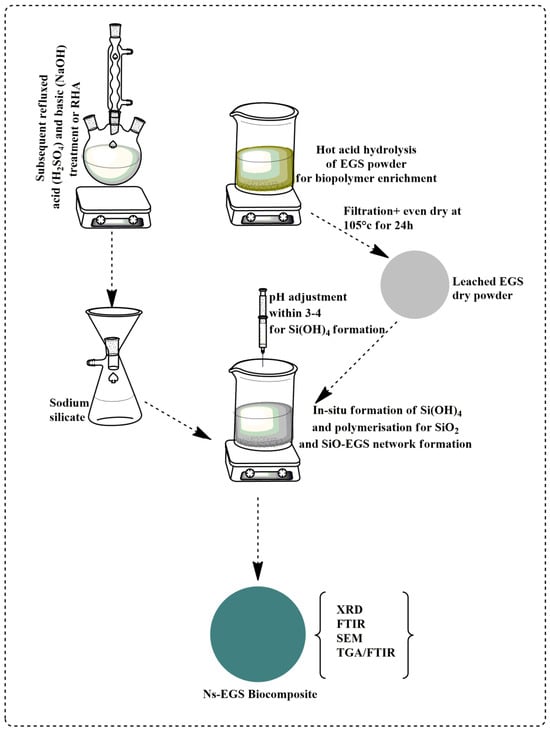
A novel biocomposite, Ns-EGS, was synthesized by combining nanosilica extracted from rice husks and Elaeis guineensis shells through the sol–gel method. This material was then used to remove the azo dye Azocarmin G from a simulated aqueous solution. X-ray diffraction (XRD), scanning electron microscopy (SEM), Fourier transform infrared spectroscopy (FTIR), and FTIR/TGA analysis characterized the biocomposite as having an amorphous and porous microstructure with a random distribution of nanosilica particles in the lignocellulosic matrix, showing the presence of various functional groups. The effect of contact time (0–120 min), adsorbent dose (0.05–0.3 g), initial dye concentration (25–150 mg/L), and initial pH (2.5–11) were investigated at three different temperatures (298 K, 312 K and 327 K). The results showed that adsorption was enhanced at acidic pH levels, with around a 90% removal rate achieved under optimal conditions. The experimental kinetic data preferentially fit the Hô model with an R2 = 0.999. This indicates that adsorption determines the process and shows an adsorbate–adsorbent affinity. The Langmuir model perfectly matched the equilibrium data with the highest correlation coefficient (R2) of 0.997 and the lowest value of RMSD. The monolayer adsorption capacity was found to be 128.21 mg/g at 327 K. The thermodynamic parameters revealed that the adsorption process is spontaneous (ΔG < 0) and endothermic (ΔH > 0). The low activation energy value of 15.62 kJ/mol, determined using the Arrhenius equation, suggests a physical adsorption process that involves weak Van der Waals and hydrogen-bond interactions.

AppliedChem

13 November 2026

Flowchart of the synthesis of Ns-EGS.
  • Article
  • Open Access

Exploratory ATR-FTIR and 1H NMR Characterization of Commercial Coconut Oils Market in Brazil

  • Manuella Salustiano Andrade Barros,
  • Letícia Caroline Candida Vaz and
  • Glaucia Braz Alcantara
  • + 8 authors

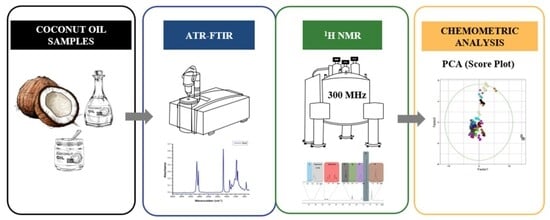
Coconut oil is a commercially important vegetable oil whose composition is relevant to food quality assessment. This study explored the complementary use of Attenuated Total Reflectance-Fourier Transform Infrared (ATR-FTIR) and proton nuclear magnetic resonance (1H NMR) spectroscopy, combined with principal component analysis (PCA), to characterize commercial coconut oils marketed in Brazil. Thirteen commercial samples available during the sampling period were analyzed, alongside an in-house coconut oil reference and comparison oils. The spectral patterns were interpreted in relation to fatty-acid composition, including features associated with unsaturated fatty acids. Most coconut oil samples clustered close to the reference sample, despite different brands, whereas two samples exhibited spectral profiles more similar to palm kernel oil than to the reference coconut oil. These observations describe similarities in the measured spectral profiles and do not establish adulteration. Overall, these findings highlight the complementary potential of 1H NMR and FTIR spectroscopy combined with chemometrics for the exploratory chemical characterization of coconut oils commercially available in Brazil. Further studies involving more reference samples and independent validation are required before authentication performance.

AppliedChem

12 November 2026

ATR-FTIR spectral profiles of (a) reference coconut oil (J); (b) potential adulterants, including palm oil (G), palm kernel oil (H), and liquid paraffin (Q); and (c) commercial coconut oil samples (A–F, I, K–P).
  • Article
  • Open Access

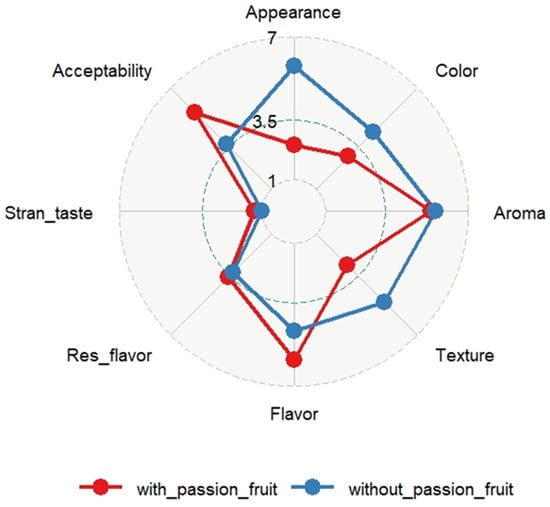
Incorporating stevia and passion fruit into beverages represents an innovative approach to developing low-calorie, functional drinks with enhanced nutritional value. This study focused on the development, metabolite characterization, and raw material stability of an herbal infusion by using leaf extracts of stevia (Stevia rebaudiana Bertoni) and fruits of passion fruit (Passiflora edulis f. flavicarpa). Stevia leaves were harvested 108 days after planting, while passion fruits were harvested at approximately 90% maturity from a naturally (without chemical fertilizers or pesticides) grown plantation at Colegio de Postgraduados, Campus Córdoba. The stevia leaves were dried, and both the dried leaves and passion fruit pulp were processed into powders. The resulting powders were thoroughly mixed and packaged in white food-grade paper envelopes. An untrained panel used a single-blind procedure to evaluate the herbal infusions under each treatment using organoleptic methods (sensory analysis). Then, an HPLC method was used in order to determine the content of main glycosides in new stevia leaves and in leaves that had been stored for eight years. Antioxidant assays of stevia and passion fruit, using new powder and powder that had been stored for an eight-year period, were performed. From the results of sensorial analysis, the herbal infusion with added passion fruit received the highest scores for acceptability, while the herbal infusion without passion fruit received the highest scores for appearance and texture. The Rebaudioside A content (58.99 ± 4.96 mg/g) in the new stevia powder was not significantly different from that in the old, stored stevia powder (57.52 ± 4.00 mg/g), whereas the results for stevioside content were exactly the opposite. The antioxidant activity in new stevia powder was more significant (p < 0.05) than that found in stored stevia powder, whereas for passion fruit it was exactly the opposite. This study underscores the potential of the developed formulation and the assessment of long-term storage conditions. Finally, this combination offers a promising basis for consuming non-nutritive sweeteners or herbal infusions as an innovative alternative.

AppliedChem

5 November 2026

Sensory values of stevia and passion fruit tea infusion. * Stran_taste: strange taste, Res_flavor: residual flavor.
  • Article
  • Open Access

Polyphenol-Based Preservation for Extended Shelf Life of Pullman Bread

  • Marianna Arvaniti,
  • Dimitra Tsoliakou and
  • Panagiotis Skandamis
  • + 3 authors

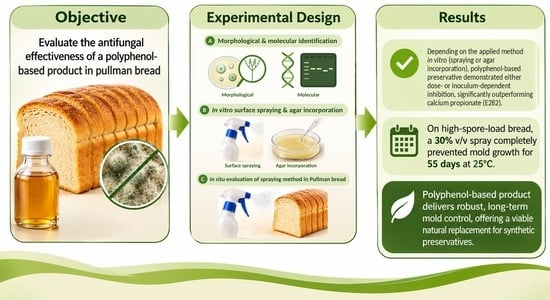
The increasing demand for clean-label foods has led to the development of natural preservation strategies based on plant-derived bioactive compounds. Flavomix ACE, a commercial polyphenol-based product, was evaluated as a natural antifungal treatment against spoilage fungi isolated from pullman bread. Two isolates were identified as Penicillium spp. and one as Cladosporium sp. ACE was assessed by surface spraying and agar incorporation under bread-relevant conditions and compared with potassium sorbate (E202) and calcium propionate (E282). ACE showed strong concentration- and inoculum-dependent antifungal activity. When incorporated into agar, complete inhibition was achieved for the liquid (1.7–5.0% v/v) and the powder form (1.3–4.6% w/v). Surface application required higher concentrations, particularly at the level of 105 spores/spot. E202 demonstrated greater antifungal activity than Ε282, which showed no inhibition of fungal growth at almost all tested inoculum levels. In inoculated bread stored at 25 °C, sprays containing 5–10% ACE delayed fungal growth for only 5–10 days. In contrast, 30% v/v ACE completely prevented visible mold growth for 55 days, even at 105 spores/spot. Overall, ACE demonstrated prolonged activity against bakery-associated fungi, outperforming E282 under the tested conditions. ACE shows potential as a clean-label antifungal system for long-shelf-life pullman bread.

AppliedChem

5 November 2026

Moldy bread sample received from Polypan company.

Highly Accessed Articles

News & Conferences

Latest Issues

Open for Submission

Journal Sections

XFacebookLinkedIn
AppliedChem - ISSN 2673-9623