


Abstract
Traditional cardiovascular risk calculators estimate population-based 5–10-year cardiovascular event rates but do not fully capture the life-course nature of atherosclerotic cardiovascular disease (ASCVD). Risk may be underestimated in younger adults with substantial cumulative exposure to atherogenic lipoproteins, overestimated in some older adults, and sub-optimally estimated in patients with important risk-enhancing factors, including lipoprotein(a) [Lp(a)], sex-specific risk modifiers, inflammatory conditions, and chronic kidney disease. Advances in vascular imaging such as computed tomography coronary angiography (CTCA) further complement conventional risk assessment by enabling direct identification of subclinical atherosclerosis and underlying disease burden. Despite these advances, contemporary cardiovascular risk management remains fragmented. Risk calculators, risk-enhancing factors, vascular imaging, and lipid management recommendations are frequently applied in isolation, often creating an implementation gap between cardiovascular risk assessment and personalized, guideline-directed LDL-C goals. To address this challenge, we propose the Identify and Act algorithm: a pragmatic implementation framework that integrates established evidence-based approaches into a structured clinical pathway directly linking cardiovascular risk assessment to personalized LDL-C goals. Rather than replacing existing risk calculators or lipid guidelines, the Identify and Act algorithm provides a practical framework for translating cardiovascular risk into personalized LDL-C treatment goals. By integrating short-term and lifetime risk assessment with risk refinement strategies, the framework aims to reduce the fragmentation of cardiovascular risk management, minimize clinical inertia, and facilitate implementation of evidence-based lipid-lowering strategies. Prospective validation is required to determine whether this approach advances LDL-C goal attainment, is cost-effective, and ultimately improves cardiovascular outcomes.
1. Introduction
Despite advances in the identification and management of cardiovascular disease over the past three decades, atherosclerotic cardiovascular disease (ASCVD) remains the leading cause of morbidity and mortality worldwide [1,2]. ASCVD is a chronic, progressive disease driven by cumulative lifetime exposure to ApoB-containing lipoproteins, of which LDL-C accounts for the majority, in conjunction with comorbidities that promote endothelial dysfunction, vascular inflammation, and plaque instability [2,3,4,5,6]. This life-course model of atherosclerosis highlights the importance of identifying at-risk individuals earlier, particularly within the primordial and primary prevention stages [7,8,9].
Contemporary cardiovascular risk assessment strategies primarily rely on validated short-term risk prediction tools such as PREVENT, SCORE2, QRISK3, and AusCVDRisk, which estimate the risk of cardiovascular events using traditional clinical variables [10,11,12,13,14]. These models typically incorporate risk factors such as age, sex, smoking status, blood pressure, and diabetes mellitus and are designed to improve population-level risk stratification and preventive care.
Important limitations nevertheless remain. Traditional cardiovascular risk factors account for only 50% of the attributable burden of cardiovascular disease in data from the Global Cardiovascular Risk Consortium, highlighting the contribution of additional biological, genetic, inflammatory, environmental, and sex-specific determinants of cardiovascular risk [4,15,16,17,18,19,20,21,22,23,24,25,26]. In addition, most contemporary risk prediction models remain heavily influenced by chronological age, frequently underestimating risk in younger individuals with substantial lifetime exposure to atherogenic lipoproteins while overestimating risk in some older adults. Although newer models such as PREVENT and QRISK Lifetime incorporate longer-term risk estimation, most contemporary approaches remain focused on short-term event prediction despite the prolonged subclinical evolution of atherosclerosis (Table 1) [1,2,7,8,9,15,27,28,29,30].
Table 1.
Commonly used short-term and lifetime cardiovascular risk calculators.
Beyond traditional risk-factor assessment, preventive cardiology has evolved substantially. Causal and risk-enhancing biomarkers such as lipoprotein(a) [Lp(a)], inflammatory markers, chronic kidney disease, metabolic dysfunction, adverse pregnancy outcomes, and premature menopause are increasingly recognized as important modifiers of cardiovascular risk [15,16,17,18,19,20,21,22,23,24,25]. In addition, advances in vascular imaging, including coronary artery calcium (CAC) scoring, carotid plaque assessment, and CTCA now permit direct identification of subclinical atherosclerosis and thus a more personalized assessment of underlying disease burden [9,26,31,32,33]. Collectively, these developments have shifted cardiovascular prevention from a probabilistic population-based estimation toward a more individualized and biologically informed model of care.
Despite these advances, cardiovascular risk management remains fragmented. Risk calculators, risk-enhancing factors, imaging modalities, and lipid management pathways are frequently applied in isolation, contributing to clinical inertia and the delayed implementation of evidence-based care [34,35,36,37,38,39]. The challenge in contemporary preventive cardiology is not just identifying cardiovascular risk, but personalizing LDL-C goals and moving the patient toward timely, guideline-directed, lipid-lowering strategies [3,11,27,28,29].
In this paper, we propose the Identify and Act algorithm, a contemporary framework for cardiovascular risk management that integrates traditional risk estimation tools with lifetime risk assessment, risk-enhancing factors, vascular imaging, and emerging biomarkers, such as Lp(a). The algorithm is designed to support earlier identification of at-risk individuals and facilitate more individualized preventive strategies across the life course. Importantly, the Identify and Act algorithm is not a new cardiovascular risk prediction tool; rather, it brings these established approaches together to guide clinicians from cardiovascular risk assessment to guideline-directed LDL-C goals.
2. The Identify and Act Algorithm
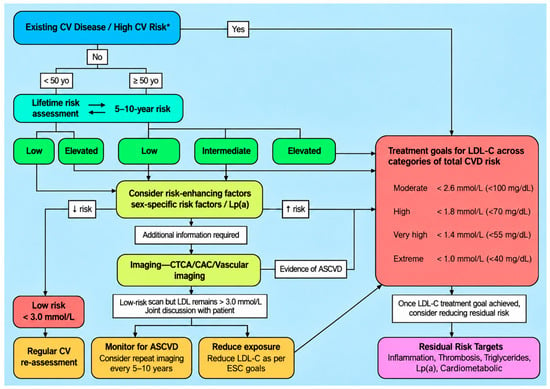
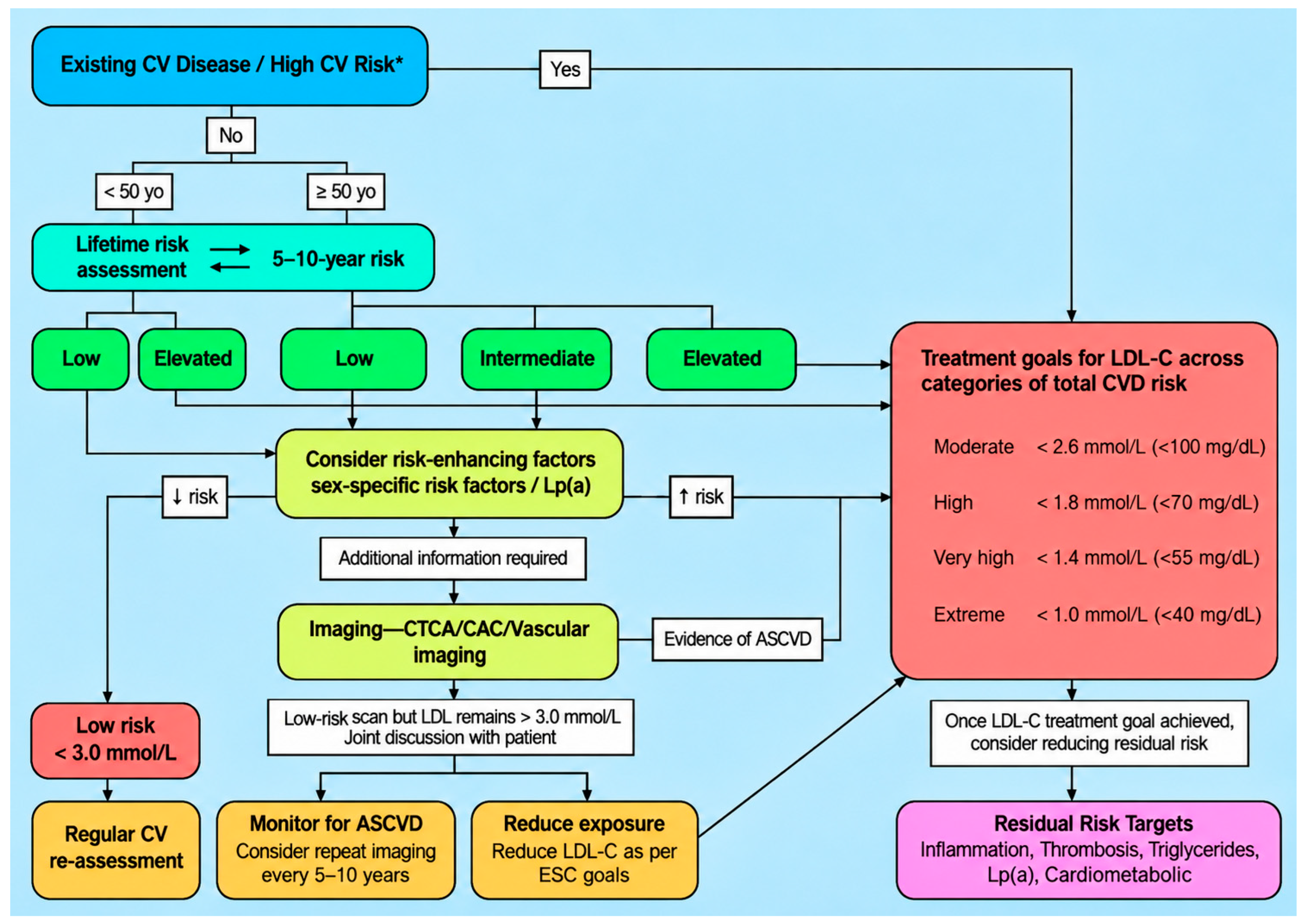
The framework comprises five sequential steps that guide clinicians from cardiovascular risk assessment to evidence-based LDL-C treatment goals (Figure 1).
Figure 1.
The proposed Identify and Act algorithm. * High CV risk: stage 3–5 CKD or familial hypercholesterolemia (FH); lifetime risk assessment: QRISK Lifetime, PREVENT; 5–10-year risk assessment: AusCVDrisk, QRISK3, SCORE2, PREVENT. Treatment goals. Low risk: Low lifetime and low 5–10-year risk with no additional risk/risk-enhancing factors (RFs). Moderate risk: Elevated lifetime risk and low/intermediate 5–10-year risk, or low lifetime risk and intermediate 5–10-year risk, without additional RFs or evidence of ASCVD on imaging; young patients with T1DM (<35 years) or T2DM (<50 years) with diabetes duration < 10 years and no other major risk factors. High risk: elevated lifetime risk and low/intermediate 5–10-year risk + additional RFs, or elevated 5–10-year risk; markedly elevated single risk factors, particularly TC > 8 mmol/L (310 mg/dL), LDL-C > 4.9 mmol/L (190 mg/dL), or BP ≥ 180/110 mmHg, FH without other major risk factors, moderate CKD (eGFR 30–59 mL/min/1.73 m2), or diabetes mellitus without target organ damage, with duration ≥10 years or another additional risk factor. Very high risk: clinical or imaging-confirmed ASCVD, SCORE2/SCORE2-OP ≥20%, FH with ASCVD or another major risk factor, severe CKD (eGFR < 30 mL/min/1.73 m2), diabetes mellitus with target organ damage, ≥3 major risk factors, or early-onset T1DM of long duration (>20 years). Extreme Risk: ASCVD patients with recurrent vascular events despite maximally tolerated statin-based therapy, polyvascular disease (e.g., coronary and peripheral arterial disease). Arrows indicate the direction of clinical decision-making. Colours distinguish the key stages of the algorithm, including initial risk identification (blue), risk estimation (green), risk refinement (lime green), LDL-C treatment goals (red), ongoing management (orange), and residual risk assessment (purple). CAC = coronary artery calcium score. CTCA = CT coronary angiogram. CVD = cardiovascular disease. ASCVD = atherosclerotic cardiovascular disease. CV = cardiovascular.
3. Initial Classification
- Identify patients with established ASCVD or very high baseline risk [e.g., familial hypercholesterolemia, stage 3–5 chronic kidney disease (CKD)] [10,11]. These patients proceed directly to guideline-directed LDL-C goals and LDL-C-lowering strategies [11,27,28,29].
- For others, use both short-term (5–10-year) and lifetime risk calculators, with lifetime risk generally more informative in individuals aged <50 years, and short-term risk more useful in those aged ≥50 years (Table 1) [10,12,13,14].
4. Risk Interpretation
- In this algorithm, short-term (5–10-year) risk is described as low, intermediate, or elevated to distinguish the assessment phase from the guideline-derived treatment-risk categories. The relationship between calculator-specific terminology (used in PREVENT, QRISK3, AusCVDRisk, and SCORE2) (Table 1), Identify and Act categories, and treatment-risk categories is summarized in Table 2 [10,12,13,14].Table 2. Mapping cardiovascular risk categories across calculators, the Identify and Act algorithm, and LDL-C treatment categories.
- Elevated lifetime risk or elevated short-term risk: proceed to appropriate guideline-directed LDL-C goals and LDL-C-lowering strategies [27,28,29].
- Low or intermediate risk—refine assessment.
5. Risk Refinement
- Consider risk-enhancing factors such as, but not limited to, Lp(a) ≥ 105 nmol/L, sex-specific RFs, major psychiatric disorders, and immune/inflammatory disease [27,28,29].
- If these factors shift the overall assessment toward higher risk, progress to appropriate guideline-directed LDL-C goals and LDL-C-lowering strategies [27,28,29]
- If uncertainty persists, consider vascular imaging (CAC, CTCA, or carotid ultrasound) to further refine risk [9,26,31,32,33].
6. Translation to LDL-C Goals
- Translate overall cardiovascular risk into appropriate guideline-directed LDL-C goals [8,27,28,29]
- Lifestyle optimization should underpin cardiovascular risk reduction at all levels of risk, alongside LDL-C-lowering strategies where indicated.
- Representative risk categories and corresponding LDL-C, non-HDL-C, and ApoB treatment goals are summarized in Table 3 [8,27,28,29].Table 3. Contemporary cardiovascular risk categories and corresponding lipid treatment goals integrated within the Identify and Act algorithm.
7. Follow-Up
- For patients at low risk, repeat cardiovascular risk estimation every 3–5 years [8,27,28,29].
- For patients at intermediate-to-high risk, reassess cardiovascular risk and LDL-C goals at least annually [8,27,28,29]
- Review and refine LDL-C goals as cardiovascular risk changes over time [8,27,28,29].
- Once LDL-C goals have been addressed, other contributors to residual cardiovascular risk, including elevated triglycerides, inflammation, and thrombosis, should be considered where clinically relevant (Figure 1).
- For patients who do not achieve LDL-C goals and decline lifestyle or LDL-C-lowering therapy, repeat imaging may be considered after 5–10 years, with consideration of cumulative radiation exposure when CT-based imaging is used [8,27,28,29].
8. Discussion
Despite advances in preventive cardiology, ASCVD remains the leading cause of morbidity and mortality worldwide [1,2]. Although cardiovascular risk assessment has become increasingly sophisticated, translating this evidence into timely, personalized, preventive care remains a persistent challenge. Clinical inertia, delayed treatment intensification, and fragmented application of risk assessment tools continue to contribute to suboptimal implementation of evidence-based lipid management [34,36,37,38,39].
The Identify and Act algorithm was developed to address this implementation gap. It was developed by author consensus, drawing on practical experience in primary care and specialist lipid practice. It does not introduce a new cardiovascular risk prediction model; instead, it organizes established risk assessment tools within a structured pathway, linking cardiovascular risk assessment directly to guideline-directed LDL-C treatment goals. By combining short-term and lifetime risk estimation with risk-enhancing factors and vascular imaging, the framework aims to facilitate earlier, more consistent, identification of LDL-C goals and implementation of appropriate preventive lipid-lowering therapy.
Traditional cardiovascular risk calculators remain the cornerstone of primary prevention, providing robust estimates of future cardiovascular events across diverse populations. They should be applied from their minimum validated age, with earlier assessment considered in individuals at increased cardiovascular risk. However, important limitations persist. Most prediction tools rely heavily on chronological age, potentially underestimating risk in younger individuals with substantial cumulative exposure to atherogenic lipoproteins while overestimating risk in some older adults.
In addition, differences in cohorts, calibration, and healthcare systems limit direct comparison between calculators. Risk calculators also vary in how they account for ethnicity and population-specific risk, including First Nations status, and may have limited validation in populations with CKD. Accordingly, the Identify and Act algorithm avoids reliance on rigid numerical thresholds during its initial risk assessment. Instead, individuals are categorized according to low, intermediate, or elevated short-term and lifetime cardiovascular risk, allowing the framework to remain adaptable across different risk calculators and healthcare settings (Table 2). Where short-term and lifetime risk categories are discordant, the higher risk category should guide management [10,12,13,14].
Lifetime cardiovascular risk assessment is a central component of the algorithm because it identifies younger individuals with substantial cumulative exposure to atherogenic lipoproteins despite apparently reassuring short-term risk estimates. Several validated tools are available for lifetime risk estimation, including QRISK Lifetime and PREVENT [13,15,40]. In regions where population-specific lifetime risk calculators are unavailable, these tools may be used cautiously to inform clinician–patient discussion, recognizing that they have not been validated in all populations. Importantly, thresholds for elevated lifetime risk differ between calculators and should therefore be interpreted within the context of the specific model being used. For example, a lifetime cardiovascular risk ≥39% has been used to identify elevated lifetime risk in younger adults using established US lifetime-risk models [15].
Risk-enhancing factors provide additional insight into the biological vulnerability of an individual beyond traditional risk-factor assessment, and are particularly valuable among individuals classified as at intermediate risk [27,28,29]. A persistently elevated high-sensitivity C-reactive protein (hsCRP > 2 mg/L) level is associated with increased cardiovascular risk. Another important inherited cardiovascular RF is Lp(a) [16]. Lp(a) is an ApoB-containing lipoprotein with an attached apolipoprotein(a) moiety, is >90% genetically determined, and reaches adult concentrations by early childhood [20]. Elevated concentrations are causally associated with ASCVD and aortic valve stenosis and confer risk in a concentration-dependent manner [16,17,18,19,20]. Individuals with markedly elevated Lp(a) concentrations may experience cardiovascular risk approaching that observed in familial hypercholesterolemia [17]. While dedicated Lp(a)-lowering therapies are not yet widely available in clinical practice, current management strategies aim to reduce collective cardiovascular risk through aggressive lowering of other ApoB-containing lipoproteins [27,28]. Within this context, incorporation of Lp(a) into the algorithm serves not merely as an additional biomarker, but as a mechanism to identify individuals who may benefit from earlier intensification of preventive strategies despite apparently reassuring short-term risk estimates.
Similarly, sex-specific and female-predominant cardiovascular RFs are increasingly recognized as important determinants of lifetime cardiovascular risk yet remain incompletely represented in conventional risk calculators [23,24]. Adverse pregnancy outcomes, pre-eclampsia, gestational diabetes mellitus, premature menopause, and polycystic ovarian syndrome are associated with increased future cardiovascular risk and may identify women with underlying endothelial dysfunction and adverse cardiometabolic susceptibility years before overt ASCVD develops. In addition, several disorders that disproportionately affect women, including rheumatoid arthritis, systemic lupus erythematosus, migraine disorders, and depression, are independently associated with accelerated vascular disease [23,25]. Recognition of these modifiers within the algorithm is intended to refine interpretation of cardiovascular vulnerability and support earlier preventive intervention through personalized LDL-C goals in individuals whose risk may otherwise be underestimated by conventional calculators alone.
Beyond biomarker-based risk refinement, vascular imaging has increasingly transformed cardiovascular prevention from probabilistic estimation toward direct visualization of disease burden. Carotid ultrasound, CAC scoring, and CTCA provide incremental prognostic information beyond traditional risk calculators and permit direct assessment of subclinical atherosclerosis [9,26,31,32,33]. Carotid ultrasound enables identification of early vascular disease and assessment of carotid plaque burden, while CAC scoring has emerged as a relatively accessible and validated tool for risk reclassification, particularly among intermediate-risk populations [31,32,33]. A CAC score of zero is associated with low short-term cardiovascular event rates in selected populations, although the absence of coronary calcification does not exclude non-calcified plaque [31,32]. The significance of imaging findings should be interpreted in the context of age and baseline risk rather than according to rigid thresholds; for example, a small burden of calcified plaque in a younger individual may carry greater significance than the same absolute CAC score in an older individual. Increasing plaque or CAC burden should therefore progressively strengthen consideration of a higher-risk classification and more intensive LDL-C lowering. CTCA provides more detailed assessment of total plaque burden, stenosis severity, and plaque morphology, offering further biological insight into the underlying atherosclerotic process [31].
Importantly, imaging may also play a behavioral and implementation role within preventive cardiology. Visualization of subclinical atherosclerosis has been associated with improved patient adherence to lifestyle modification and lipid-lowering therapy and may help overcome therapeutic inertia by reinforcing the tangible presence of vascular disease [35]. In this regard, imaging serves not only as a diagnostic modality but also as a communication tool that may strengthen shared decision-making between clinician and patient.
A central principle of the Identify and Act algorithm is that risk refinement should directly translate into actionable therapeutic goals. Recognition of elevated cardiovascular risk alone does not alter the trajectory of ASCVD unless it results in a meaningful reduction in cumulative LDL-C exposure. Accordingly, the algorithm links risk stratification directly to ESC-defined LDL-C goals, which are supported across current international dyslipidemia guidelines [28,29]. This approach emphasizes that LDL-C goals should reflect not only the presence of symptomatic ASCVD, but also lifetime exposure to atherogenic lipoproteins together with comorbidities that promote endothelial dysfunction. By integrating these elements within a single pathway, the algorithm seeks to create a clearer conceptual relationship between risk burden and treatment intensity for both clinicians and patients [34,37,39]. Although discussion of pharmacological management is beyond the scope of this review, clinicians have access to a broad range of evidence-based lipid-lowering therapies, including statins, ezetimibe, bempedoic acid and PCSK9-targeted therapies, which can be used individually or in combination to achieve guideline-recommended LDL-C goals. Patients presenting with higher baseline LDL-C concentrations or greater absolute cardiovascular risk will frequently require combination therapy to achieve these goals.
The major strength of this algorithm lies in its simplicity and broad clinical applicability. Rather than introducing a novel risk calculator or biomarker, the model integrates established evidence-based tools into a unified and pragmatic structure capable of being used across both primary care and specialist lipid clinics (Box 1). The algorithm incorporates readily available investigations with robust evidence linking them to cardiovascular outcomes and allows adaptation across different healthcare systems and regional risk calculators. The visual nature of the pathway may also facilitate clinician–patient communication and shared decision-making, particularly when discussing lifetime risk, imaging findings, and rationale for LDL-C-lowering therapy (Table 4).
Table 4.
Clinical vignettes illustrating the application of the Identify and Act algorithm.
Box 1. Clinical implications box.
- Assess cardiovascular risk using both short-term (5–10-year) and lifetime risk estimation, with lifetime risk particularly informative in adults <50 years.
- In patients with low or intermediate estimated risk, refine assessment using risk-enhancing factors (e.g., Lp(a), sex-specific factors, inflammatory disorders) and vascular imaging where appropriate.
- Translate the overall cardiovascular risk assessment directly into guideline-directed LDL-C treatment goals to support timely lipid-lowering strategies.
- Reassess cardiovascular risk over time, recognizing that ASCVD is progressive and management should evolve as risk changes.
However, this simplicity also represents an inherent limitation. No single-page algorithm can fully capture the complexity of an advanced cardiovascular risk assessment or account for the precise magnitude of risk associated with individual biomarkers, imaging findings, or comorbidities. The algorithm is therefore intended as a practical clinical scaffold rather than a replacement for detailed guideline-based assessment or specialist judgment.
Further limitations relate to accessibility and cost. Several investigations incorporated within the algorithm, including Lp(a) measurement and vascular imaging, remain incompletely reimbursed in many healthcare systems and may therefore increase short-term healthcare expenditure [21,32]. Imaging modalities such as CTCA also carry small but relevant risks associated with radiation exposure and contrast administration [31]. Moreover, while the algorithm aims to improve identification of at-risk individuals, broader application of imaging and biomarkers may increase the potential for over-classification or over-treatment in some populations. Prospective validation studies are therefore required to determine the balance between improved risk detection and false-positive classification.
Future research should evaluate the clinical utility, feasibility, and cost-effectiveness of integrated prevention algorithms such as this across diverse populations. Prospective studies comparing this model with traditional cardiovascular risk management are needed to determine whether integration of lifetime risk, risk-enhancing factors, and imaging translates into earlier treatment initiation, improved LDL-C goal attainment, reduced cumulative LDL-C exposure, and ultimately, lower cardiovascular event rates. Additional research is also required to better define optimal ages for initiation of cardiovascular risk assessment and biomarker testing, particularly in light of recent recommendations supporting earlier identification of lifetime cardiovascular risk [27]. As preventive cardiology continues to evolve toward more personalized and biology-driven approaches, integrated algorithms capable of translating complex evidence into routine clinical practice may become increasingly important.
9. Conclusions
The Identify and Act algorithm provides a pragmatic implementation framework that integrates contemporary cardiovascular risk assessment into a structured clinical pathway linking cardiovascular risk directly to personalized, guideline-directed LDL-C goals. By combining short-term and lifetime cardiovascular risk assessment, risk-enhancing factors, vascular imaging, and contemporary lipid targets, the framework is designed to facilitate earlier, more consistent translation of cardiovascular risk into personalized LDL-C goals.
Although the individual components of the framework are well established within contemporary preventive cardiology, their integration into a single implementation-focused pathway represents the principal innovation of the Identify and Act algorithm. By simplifying the transition from cardiovascular risk assessment to personalized LDL-C goals, the framework aims to reduce fragmentation of cardiovascular risk management, minimize clinical inertia, and facilitate the delivery of evidence-based lipid-lowering therapy. Prospective validation is now required to determine whether this implementation strategy improves LDL-C goal attainment, cost-effectiveness, and ultimately, cardiovascular outcomes.
Author Contributions
Conceptualization, R.H.; methodology, R.H. and K.K.; writing—original draft preparation, R.H. and K.K.; writing—review and editing, R.H. and K.K.; visualization, R.H.; All authors have read and agreed to the published version of the manuscript.
Funding
This research received no external funding.
Institutional Review Board Statement
Not applicable.
Informed Consent Statement
Not applicable.
Data Availability Statement
No new data were created or analyzed in this study. Data sharing is not applicable to this article.
Acknowledgments
During the preparation of this manuscript, the authors used ChatGPT (OpenAI, GPT-6) to assist with language editing, manuscript formatting and figure refinement. The authors reviewed and edited the output and take full responsibility for the content of this publication.
Conflicts of Interest
The authors declare no conflict of interest.
References
- Roth, G.A.; Mensah, G.A.; Johnson, C.O.; Addolorato, G.; Ammirati, E.; Baddour, L.M.; Barengo, N.C.; Beaton, A.Z.; Benjamin, E.J.; Benziger, C.P.; et al. Global burden of cardiovascular diseases and risk factors, 1990–2019: Update from the GBD 2019 study. J. Am. Coll. Cardiol. 2020, 76, 2982–3021, Erratum in J. Am. Coll. Cardiol. 2021, 77, 1958–1959. [Google Scholar] [CrossRef] [Scilit] [PubMed]
- Ference, B.A.; Ginsberg, H.N.; Graham, I.; Ray, K.K.; Packard, C.J.; Bruckert, E.; Hegele, R.A.; Krauss, R.M.; Raal, F.J.; Schunkert, H.; et al. Low-density lipoproteins cause atherosclerotic cardiovascular disease. 1. Evidence from genetic, epidemiologic, and clinical studies: A consensus statement from the European Atherosclerosis Society Consensus Panel. Eur. Heart J. 2017, 38, 2459–2472. [Google Scholar] [CrossRef] [Scilit] [PubMed]
- Ference, B.A.; Braunwald, E.; Catapano, A.L. The LDL cumulative exposure hypothesis: Evidence and practical applications. Nat. Rev. Cardiol. 2024, 21, 701–716. [Google Scholar] [CrossRef] [Scilit] [PubMed]
- The Global Cardiovascular Risk Consortium. Global effect of cardiovascular risk factors on lifetime estimates. N. Engl. J. Med. 2025, 393, 125–138. [Google Scholar] [CrossRef] [Scilit] [PubMed]
- Robinson, J.G.; Williams, K.J.; Gidding, S.; Borén, J.; Tabas, I.; Fisher, E.A.; Packard, C.; Pencina, M.; Fayad, Z.A.; Mani, V.; et al. Eradicating the burden of atherosclerotic cardiovascular disease by lowering apolipoprotein B lipoproteins earlier in life. J. Am. Heart Assoc. 2018, 7, e009778. [Google Scholar] [CrossRef] [Scilit] [PubMed]
- Domanski, M.J.; Wu, C.O.; Tian, X.; Hasan, A.A.; Ma, X.; Huang, Y.; Miao, R.; Reis, J.P.; Bae, S.; Husain, A.; et al. Association of incident cardiovascular disease with time course and cumulative exposure to multiple risk factors. J. Am. Coll. Cardiol. 2023, 81, 1151–1161. [Google Scholar] [CrossRef] [Scilit] [PubMed]
- Raitakari, O.; Pahkala, K.; Magnussen, C.G. Prevention of atherosclerosis from childhood. Nat. Rev. Cardiol. 2022, 19, 543–554. [Google Scholar] [CrossRef] [Scilit] [PubMed]
- de Lemos, J.A.; Navar, A.M. A life-course approach to cardiovascular disease prevention. Nat. Med. 2022, 28, 1133–1134. [Google Scholar] [CrossRef] [Scilit] [PubMed]
- Ahmadi, A.; Argulian, E.; Leipsic, J.; Newby, D.E.; Narula, J. From subclinical atherosclerosis to plaque progression and acute coronary events: JACC state-of-the-art review. J. Am. Coll. Cardiol. 2019, 74, 1608–1617. [Google Scholar] [CrossRef] [Scilit] [PubMed]
- National Heart Foundation of Australia. AusCVDRisk Calculator. Available online: https://www.cvdcheck.org.au/calculator (accessed on 1 January 2026).
- Nelson, M.R.; Banks, E.; Brown, A.; Chow, C.K.; Peiris, D.P.; Stocks, N.P.; Ao, R.D.; Raffoul, N.; Kalman, L.; Bradburn, E.; et al. 2023 Australian guideline for assessing and managing cardiovascular disease risk. Med. J. Aust. 2024, 220, 482–490. [Google Scholar] [CrossRef] [Scilit] [PubMed]
- Hippisley-Cox, J.; Coupland, C.; Brindle, P. Development and validation of QRISK3 risk prediction algorithms. BMJ 2017, 357, j2099. [Google Scholar] [CrossRef] [Scilit] [PubMed]
- Khan, S.S.; Matsushita, K.; Sang, Y.; Ballew, S.H.; Grams, M.E.; Surapaneni, A.; Blaha, M.J.; Carson, A.P.; Chang, A.R.; Ciemins, E.; et al. Development and Validation of the American Heart Association’s PREVENT Equations. Circulation 2024, 149, 430–449, Erratum in Circulation 2024, 149, e956; Erratum in Circulation 2026, 154, e665. [Google Scholar] [CrossRef] [Scilit] [PubMed]
- SCORE2 Working Group and ESC Cardiovascular Risk Collaboration. SCORE2 risk prediction algorithms: New models to estimate 10-year risk of cardiovascular disease in Europe. Eur. Heart J. 2021, 42, 2439–2454. [Google Scholar] [CrossRef] [Scilit] [PubMed]
- Berry, J.D.; Liu, K.; Folsom, A.R.; Lewis, C.E.; Carr, J.J.; Polak, J.F.; Shea, S.; Sidney, S.; O’LEary, D.H.; Chan, C.; et al. Prevalence and progression of subclinical atherosclerosis in younger adults with low short-term but high lifetime estimated risk for cardiovascular disease. Circulation 2009, 119, 382–389. [Google Scholar] [CrossRef] [Scilit] [PubMed]
- Nordestgaard, B.G.; Langsted, A. Lipoprotein(a) and cardiovascular disease. Lancet 2024, 404, 1255–1264. [Google Scholar] [CrossRef] [Scilit] [PubMed]
- Kronenberg, F.; Mora, S.; Stroes, E.S.G.; Ference, B.A.; Arsenault, B.J.; Berglund, L.; Dweck, M.R.; Koschinsky, M.; Lambert, G.; Mach, F.; et al. Lipoprotein(a) in atherosclerotic cardiovascular disease and aortic stenosis: A European Atherosclerosis Society consensus statement. Eur. Heart J. 2022, 43, 3925–3946. [Google Scholar] [CrossRef] [Scilit] [PubMed]
- Kostner, K.M.; Kostner, G.M. Lp(a) and the risk for cardiovascular disease: Focus on the Lp(a) paradox in diabetes mellitus. Int. J. Mol. Sci. 2022, 23, 3584. [Google Scholar] [CrossRef] [Scilit] [PubMed]
- Mehta, A.; Vasquez, N.; Ayers, C.R.; Patel, J.; Hooda, A.; Khera, A.; Blumenthal, R.S.; Shapiro, M.D.; Rodriguez, C.J.; Tsai, M.Y.; et al. Independent association of lipoprotein(a) and coronary artery calcification with atherosclerotic cardiovascular risk. J. Am. Coll. Cardiol. 2022, 79, 757–768. [Google Scholar] [CrossRef] [Scilit] [PubMed]
- Reyes-Soffer, G.; Ginsberg, H.N.; Berglund, L.; Duell, P.B.; Heffron, S.P.; Kamstrup, P.R.; Lloyd-Jones, D.M.; Marcovina, S.M.; Yeang, C.; Koschinsky, M.L.; et al. Lipoprotein(a): A genetically determined, causal, and prevalent risk factor for atherosclerotic cardiovascular disease: A scientific statement from the American Heart Association. Arterioscler. Thromb. Vasc. Biol. 2022, 42, e48–e60. [Google Scholar] [CrossRef] [Scilit] [PubMed]
- Morton, J.I.; Kronenberg, F.; Daccord, M.; Bedlington, N.; Geanta, M.; Silberzahn, T.; Chen, Z.; Eisele, J.-L.; Eliasen, B.; Harada-Shiba, M.; et al. Lp(a) testing for the primary prevention of cardiovascular disease in high-income countries: A cost-effectiveness analysis. Atherosclerosis 2025, 409, 120447. [Google Scholar] [CrossRef] [Scilit] [PubMed]
- Ridker, P.M. Inflammation, C-reactive protein, and cardiovascular disease: Moving past the marker versus mediator debate. Circ. Res. 2014, 114, 594–595. [Google Scholar] [CrossRef] [Scilit] [PubMed]
- Holven, K.B.; Roeters van Lennep, J. Sex differences in lipids: A life course approach. Atherosclerosis 2023, 384, 117270. [Google Scholar] [CrossRef] [Scilit] [PubMed]
- Rajendran, A.; Minhas, A.S.; Kazzi, B.; Varma, B.; Choi, E.; Thakkar, A.; Michos, E.D. Sex-specific differences in cardiovascular risk factors and implications for cardiovascular disease prevention in women. Atherosclerosis 2023, 384, 117269. [Google Scholar] [CrossRef] [Scilit] [PubMed]
- Porsch, F.; Binder, C.J. Autoimmune diseases and atherosclerotic cardiovascular disease. Nat. Rev. Cardiol. 2024, 21, 780–807. [Google Scholar] [CrossRef] [Scilit] [PubMed]
- Javaid, A.; Dardari, Z.A.; Mitchell, J.D.; Whelton, S.P.; Dzaye, O.; Lima, J.A.; Lloyd-Jones, D.M.; Budoff, M.; Nasir, K.; Berman, D.S.; et al. Distribution of coronary artery calcium by age, sex, and race among patients aged 30–45 years. J. Am. Coll. Cardiol. 2022, 79, 1873–1886. [Google Scholar] [CrossRef] [Scilit] [PubMed]
- Blumenthal, R.S.; Morris, P.B.; Gaudino, M.; Johnson, H.M.; Anderson, T.S.; Bittner, V.A.; Blankstein, R.; Brewer, L.C.; Cho, L.; de Ferranti, S.D.; et al. 2026 ACC/AHA/AACVPR/ABC/ACPM/ADA/AGS/APhA/ASPC/NLA/PCNA guideline on the management of dyslipidemia: A report of the American College of Cardiology/American Heart Association Joint Committee on Clinical Practice Guidelines. Circulation 2026, 153, 17, Erratum in Circulation 2026, 153, 25; Erratum in Circulation 2026, 154, 10. [Google Scholar] [CrossRef] [Scilit] [PubMed]
- Mach, F.; Baigent, C.; Catapano, A.L.; Koskinas, K.C.; Casula, M.; Badimon, L.; Chapman, M.J.; De Backer, G.G.; Delgado, V.; Ference, B.A.; et al. 2019 ESC/EAS Guidelines for the management of dyslipidaemias: Lipid modification to reduce cardiovascular risk: The Task Force for the management of dyslipidaemias of the European Society of Cardiology (ESC) and European Atherosclerosis Society (EAS). Eur. Heart J. 2020, 41, 111–188, Erratum in Eur. Heart J. 2025, 46, 4359–4378; Erratum in Eur. Heart J. 2026, 47, 697. [Google Scholar] [CrossRef] [Scilit] [PubMed]
- Mach, F.; Koskinas, K.C.; Roeters van Lennep, J.E.; Tokgözoğlu, L.; Badimon, L.; Baigent, C.; Benn, M.; Binder, C.J.; Catapano, A.L.; De Backer, G.G.; et al. 2025 focused update of the 2019 ESC/EAS Guidelines for the management of dyslipidaemias. Eur. Heart J. 2025, 46, 4359–4378. [Google Scholar] [CrossRef] [Scilit] [PubMed]
- Visseren, F.L.J.; Mach, F.; Smulders, Y.M.; Carballo, D.; Koskinas, K.C.; Bäck, M.; Benetos, A.; Biffi, A.; Boavida, J.-M.; Capodanno, D.; et al. 2021 ESC Guidelines on cardiovascular disease prevention in clinical practice. Eur. Heart J. 2021, 42, 3227–3337. [Google Scholar] [CrossRef] [Scilit] [PubMed]
- Budoff, M.J.; Lakshmanan, S.; Toth, P.P.; Hecht, H.S.; Shaw, L.J.; Maron, D.J.; Michos, E.D.; Williams, K.A.; Nasir, K.; Choi, A.D.; et al. Cardiac CT angiography in current practice: An American Society for Preventive Cardiology clinical practice statement. Am. J. Prev. Cardiol. 2022, 9, 100318. [Google Scholar] [CrossRef] [Scilit] [PubMed]
- Greenland, P.; Lloyd-Jones, D.M. Role of coronary artery calcium testing for risk assessment in primary prevention of atherosclerotic cardiovascular disease: A review. JAMA Cardiol. 2022, 7, 219–224. [Google Scholar] [CrossRef] [Scilit] [PubMed]
- Lorenz, M.W.; Markus, H.S.; Bots, M.L.; Rosvall, M.; Sitzer, M. Prediction of clinical cardiovascular events with carotid intima-media thickness: A systematic review and meta-analysis. Circulation 2007, 115, 459–467. [Google Scholar] [CrossRef] [Scilit] [PubMed]
- Damman, O.C.; Bogaerts, N.M.M.; van den Haak, M.J.; Timmermans, D.R.M. How lay people understand and make sense of personalized disease risk information. Health Expect. 2017, 20, 973–983. [Google Scholar] [CrossRef] [Scilit] [PubMed]
- Kalia, N.K.; Miller, L.G.; Nasir, K.; Blumenthal, R.S.; Agrawal, N.; Budoff, M.J. Visualizing coronary calcium is associated with improvements in adherence to statin therapy. Atherosclerosis 2006, 185, 394–399. [Google Scholar] [CrossRef] [Scilit] [PubMed]
- Leosdottir, M.; Schubert, J.; Brandts, J.; Gustafsson, S.; Cars, T.; Sundström, J.; Jernberg, T.; Ray, K.K.; Hagström, E. Early ezetimibe initiation after myocardial infarction protects against later cardiovascular outcomes in the SWEDEHEART registry. J. Am. Coll. Cardiol. 2025, 85, 1550–1564. [Google Scholar] [CrossRef] [Scilit] [PubMed]
- Marnell, C.S.; Koenig, W.; Bittner, V.; Watson, K.E.; Muntner, P.; Nordestgaard, B.G.; Yan, L.L.; Verbakel, M.; Rosenson, R.S. Barriers and emerging strategies to bridge gaps in implementation of evidence-based lipid-lowering therapies. Circ. Cardiovasc Qual. Outcomes 2026, 19, e012330. [Google Scholar] [CrossRef] [Scilit] [PubMed]
- Ray, K.K.; Haq, I.; Bilitou, A.; Manu, M.C.; Burden, A.; Aguiar, C.; Arca, M.; Connolly, D.L.; Eriksson, M.; Ferrières, J.; et al. Treatment gaps in the implementation of LDL cholesterol control among high- and very high-risk patients in Europe between 2020 and 2021: The multinational observational SANTORINI study. Lancet Reg. Health Eur. 2023, 29, 100624. [Google Scholar] [CrossRef] [Scilit] [PubMed]
- Vatri, M.; Faggiano, A.; Angelino, E.; Ambrosetti, M.; Faggiano, P.M.; Fattirolli, F. Therapeutic inertia in lipid-lowering treatment: A narrative review. J. Clin. Med. 2026, 15, 1075. [Google Scholar] [CrossRef] [Scilit] [PubMed]
- Lloyd-Jones, D.M.; Leip, E.P.; Larson, M.G.; D’agostino, R.B.; Beiser, A.; Wilson, P.W.; Wolf, P.A.; Levy, D. Prediction of lifetime risk for cardiovascular disease by risk factor burden at 50 years of age. Circulation 2006, 113, 791–798. [Google Scholar] [CrossRef] [Scilit] [PubMed]

Disclaimer/Publisher’s Note: The statements, opinions and data contained in all publications are solely those of the individual author(s) and contributor(s) and not of MDPI and/or the editor(s). MDPI and/or the editor(s) disclaim responsibility for any injury to people or property resulting from any ideas, methods, instructions or products referred to in the content. |
© 2026 by the authors. Licensee MDPI, Basel, Switzerland. This article is an open access article distributed under the terms and conditions of the Creative Commons Attribution (CC BY) license.