


Highlights
What are the main findings?
- Integrated ASI® and CO-OP produced greater improvements in COPM performance and morning and evening routines than time-matched ASI®-only.
- Follow-up differences also favored the integrated group for metacognition, global executive functioning, and COPM satisfaction, but not overall participation measured by SCOPE.
What are the implications of the main findings?
- Combining bottom-up ASI® with top-down CO-OP may provide additional benefits for individualized occupational performance and routine-related functioning.
- The benefits appear outcome-specific; larger studies with longer follow-up are needed to determine their effects on broader participation.
Abstract
Objective: Ayres Sensory Integration® (ASI®) and the Cognitive Orientation to Daily Occupational Performance (CO-OP) approach address different but potentially complementary factors affecting participation in children with autism. This study examined whether adding CO-OP to ASI® produced greater improvements in executive function and participation outcomes than ASI®-only. Methods: This two-arm randomized controlled trial included 26 children with autism aged 7–11 years, who were allocated to an integrated ASI® and CO-OP group (n = 13) or an ASI®-only group (n = 13). Both groups received 90 min of intervention per week for 10 weeks. Outcomes were assessed at baseline, immediately after the intervention, and at the one-month follow-up using the Behavior Rating Inventory of Executive Function (BRIEF), Executive Function and Occupational Routines Scale (EFORTS), Short Child Occupational Profile (SCOPE), and Canadian Occupational Performance Measure (COPM). The Performance Quality Rating Scale (PQRS) was administered only to the integrated group. Between-group differences were examined using improvement-oriented change scores. Results: All randomized participants completed the study. Compared with the ASI®-only group, the integrated group demonstrated greater improvements in EFORTS Factor 1 from baseline to post-intervention (p = 0.002, r = 0.612) and follow-up (p < 0.001, r = 0.731) and in COPM performance at post-intervention (p = 0.005, r = 0.547) and follow-up (p < 0.001, r = 0.661). From baseline to follow-up, between-group differences also favored the integrated group for the BRIEF Metacognition Index (p = 0.037, r = 0.409), Global Executive Composite (p = 0.027, r = 0.434), and COPM satisfaction (p = 0.003, r = 0.587). No significant between-group difference was observed in the SCOPE total score. Within the integrated group, PQRS scores improved significantly over time (χ2 = 24.133, p < 0.001, Kendall’s W = 0.928). Conclusions: These exploratory findings suggest that adding CO-OP to ASI® may provide additional benefits for selected executive function, routine-related, and occupational performance outcomes in children with autism. However, no between-group advantage was demonstrated for overall participation measured by SCOPE. Larger trials with longer follow-up periods and independent outcome assessment are needed to confirm these findings.
1. Introduction
Autism spectrum disorder (ASD) is a heterogeneous neurodevelopmental condition characterized by diverse patterns of sensory processing, communication, participation, and behavior [1]. Participation in children with ASD may vary depending on environmental demands, available support, and opportunities for engagement [2]. Supporting participation at home, at school, and in the community requires approaches that consider the child’s strengths [3]. Occupational therapy interventions aim to support the occupational performance and participation of children with autism by addressing individual, task-related, and environmental factors that influence daily living, motor performance, play, and social participation [4,5,6].
Executive function processes such as cognitive flexibility, planning, monitoring, and problem-solving are related to the participation of children with autism in self-care, play, school, and social activities [7,8]. Sensory, social, and organizational demands encountered during daily activities may increase the executive function demands placed on children with autism, particularly in situations requiring planning, flexibility, and self-regulation [1,9,10,11]. Therefore, interventions that incorporate strategies supporting planning, flexibility, self-monitoring, and problem-solving may facilitate children’s engagement in meaningful occupations and everyday routines [12,13,14]. From a developmental perspective, attentional control facilitates learning by supporting sustained engagement, resistance to distraction, and the allocation of cognitive resources to goal-directed activities. These processes interact with working memory, cognitive flexibility, and self-monitoring in everyday functioning [15].
Ayres Sensory Integration® (ASI®) is an individualized occupational therapy intervention designed to address sensory–motor difficulties that may affect children’s occupational performance and participation [16,17,18,19]. Previous research has described potential benefits for socialization, motor performance, and participation in daily activities [20,21], as well as attention, regulation, social interaction, play, and communication-related performance [22,23]. ASI® may also support planning, organization, coping, and praxis [24,25], which are relevant to occupational performance [16,21]. By targeting sensory–motor integration and regulation within meaningful activities, ASI® may facilitate engagement in daily occupations [26]. Accordingly, ASI® was selected in the present study as the core intervention and comparison condition because it represents a clinically meaningful, participation-oriented occupational therapy approach on which the added value of a cognitive strategy-based intervention could be examined.
The Cognitive Orientation to Daily Occupational Performance (CO-OP) approach is a client-centered, problem-solving method based on cognitive-behavioral and learning theory [27]. It targets executive functions through metacognition, guided discovery, and cognitive strategies [28]. It has been shown that the CO-OP approach supports performance in children with autism by developing problem-solving [27,29] and coping skills [30,31]. As a top-down approach [32], it boosts participation by supporting motor control, cognitive flexibility, and self-efficacy [33,34]. The most consistent evidence for the CO-OP approach across neurodevelopmental conditions concerns improvements in activities and participation [35,36,37,38,39], and emerging evidence suggests it may also be useful for children with autism when intervention targets are individualized and meaningful. However, evidence supporting the CO-OP approach specifically in children with autism remains limited and is primarily based on case reports and small-scale studies. Therefore, the potential additional benefits of integrating CO-OP with ASI® require further investigation in controlled trials.
Taken together, ASI® and CO-OP may be viewed as conceptually complementary rather than competing interventions. ASI® primarily addresses sensory integration, regulation, and praxis-related factors that may influence engagement [17,19], whereas CO-OP emphasizes cognitive strategy use, guided discovery, and self-monitoring during goal-directed occupational performance [27,40]. Conceptually, addressing sensory–motor and regulation-related barriers through ASI® may create opportunities for engagement in goal-directed activities, while CO-OP may help children develop, evaluate, and apply cognitive strategies to manage the demands of those activities. Their integration was therefore expected to yield greater improvements in selected everyday performance and executive-function-related outcomes than ASI® alone, although this potential benefit remains a hypothesis rather than an established additive effect. However, research directly comparing an integrated ASI® and CO-OP approach with ASI® alone in children with autism is lacking. Therefore, this randomized controlled trial compared a time-matched integrated ASI® and CO-OP program with an ASI®-only program in terms of participation and executive function outcomes in children with autism.
We hypothesized that children receiving the time-matched integrated ASI® and CO-OP program would demonstrate greater improvements in selected occupational performance and executive function outcomes than children receiving the ASI®-only program from baseline to post-intervention and one-month follow-up.
2. Method
2.1. Study Design and Ethical Considerations
This study was designed as a two-arm, parallel-group randomized controlled trial involving children with autism. Participant recruitment and data collection were conducted from September 2023 to January 2024. Outcomes were assessed at baseline, immediately after the 10-week intervention, and at the one-month follow-up. Over a 10-week intervention period, the integrated intervention group attended the clinic twice weekly. Each week, the children received one 30 min ASI®-only session and one 60 min integrated session comprising 30 min of ASI® and 30 min of CO-OP, resulting in a total intervention time of 90 min per week. The ASI®-only group attended the clinic twice weekly for 10 weeks and received two 45 min ASI® sessions per week, resulting in an equivalent total intervention time of 90 min per week. Thus, the two groups were matched for total weekly intervention time and session frequency, but not for ASI® dosage.
The study was conducted in accordance with the Declaration of Helsinki and was approved by the Ethics Committee of Bezmialem Vakıf University (approval number: E-54022451-050.05.04-116594; approval date: 26 July 2023). Written informed consent was obtained from the parents or legal guardians of all participating children prior to participation. The trial was registered at ClinicalTrials.gov (NCT06038435; registration posted on 14 September 2023).
2.2. Participants and Eligibility Criteria
This single-center study recruited participants from the Occupational Therapy Department of Bezmialem Vakıf University. Children with autism were included if they met predefined eligibility criteria. Potential participants were screened consecutively during the recruitment period based on the predefined eligibility criteria.
The inclusion criteria were as follows:
- Having been diagnosed with Autism Spectrum Disorder according to the DSM-5 by the Department of Child and Adolescent Mental Health;
- Being between 7 and 11 years of age;
- Scoring between 30 and 36 on the Childhood Autism Rating Scale (CARS).
The exclusion criteria were as follows:
- Having a comorbid neurological, psychiatric, or orthopedic diagnosis;
- Receiving any educational or rehabilitation support other than special education services.
The CARS score range of 30–36 was selected to include children with mild-to-moderate autism symptom severity; thus, the aim was to reduce clinical heterogeneity within the study sample. During the initial clinical assessment, children’s ability to understand instructions, communicate verbally, and participate in goal-directed activities was evaluated through clinical observation. No standardized cognitive or language assessment was administered.
2.3. Randomization, Allocation, and Blinding
Participants were randomly allocated in a 1:1 ratio to the integrated intervention group or the ASI®-only group using a computer-generated simple randomization sequence generated through Randomizer.org [41]. The randomization sequence was generated by the first author, and no allocation concealment procedure was used.
The study employed a single-blind design at the participant level. The children were not informed of their group allocation or of which intervention was considered the experimental condition. Parents were aware of the intervention received by their children. Owing to the nature of the interventions and the study’s implementation within a doctoral research project, the first author conducted the interventions, outcome assessments, and statistical analyses and was therefore not blinded to group allocation.
2.4. Intervention Procedures
All interventions were delivered by the first author and an occupational therapist, who had formal training and certification in both the CO-OP approach and ASI® intervention. The structural and process elements of the Ayres Sensory Integration® Fidelity Measure were used to guide the planning and delivery of ASI® sessions. Fidelity was assessed through video review of ASI® intervention sessions by an independent expert who was not involved in the study. The expert confirmed that the reviewed sessions were consistent with the core ASI® fidelity criteria. Similarly, the CO-OP intervention was delivered in accordance with its seven key features, including client-centered goal setting, dynamic performance analysis, cognitive strategy use, guided discovery, enabling principles, significant-other involvement, and intervention format.
2.4.1. Integrated ASI® and CO-OP Group
Children in the integrated intervention group attended the clinic twice weekly for 10 weeks. Each week, they received one 30 min ASI®-only session and one 60 min combined session consisting of 30 min of ASI® and 30 min of CO-OP. Thus, the program included 20 clinic sessions and a total weekly intervention time of 90 min.
The CO-OP component was delivered once weekly for 10 weeks and focused on the individualized occupational goals identified collaboratively with each child and their parent using the COPM. During the first CO-OP session, the child’s performance of the selected goal-directed occupations was examined using dynamic performance analysis and rated using the Performance Quality Rating Scale (PQRS). The global cognitive strategy Goal–Plan–Do–Check was introduced during the initial sessions, and domain-specific strategies were developed according to the performance difficulties identified for each child. Strategy use was reinforced throughout the intervention.
Guided discovery was used primarily during Sessions 2–9 to help children identify performance problems, generate possible solutions, and evaluate the effectiveness of their strategies. Enabling principles were applied to support independent problem-solving and occupational performance. Parents contributed to the identification and prioritization of occupational goals before the intervention. The CO-OP component was implemented in accordance with its core principles, including client-centered goal setting, dynamic performance analysis, cognitive strategy use, guided discovery, enabling principles, and significant-other involvement [32,42,43]. Parents were encouraged to support the use of the cognitive strategies introduced during CO-OP sessions in their children’s daily routines and goal-related activities outside the therapy setting.
The ASI® components were individualized using a data-driven decision-making process [44]. Assessment findings were synthesized to develop individualized clinical hypotheses, and intervention goals were established based on the occupations identified through the COPM. Sessions were then tailored to each child’s strengths, sensory–motor needs, and occupational goals. Outcomes were reviewed after the intervention and at the one-month follow-up. During ASI® sessions, individualized sensory–motor activities were selected according to each child’s clinical needs and occupational goals. The therapist adapted the activities and their level of challenge in response to the child’s performance, with the aim of supporting active engagement and adaptive responses.
2.4.2. ASI®-Only Group
Children in the ASI®-only group attended the clinic twice weekly for 10 weeks and received two 45 min ASI® sessions per week, resulting in 20 sessions and a total weekly intervention time of 90 min.
As in the integrated intervention group, COPM-based occupational goals were identified before the intervention. The ASI®-only program was individualized using the same data-driven decision-making process. Initial assessment findings were used to identify participation challenges, formulate clinical hypotheses, establish intervention goals, and tailor the sessions to each child’s strengths and sensory–motor needs.
2.5. Outcome Measures
Assessments were conducted face-to-face at baseline, immediately after the 10-week intervention, and at the one-month follow-up. Parent-reported measures were completed through face-to-face interviews, whereas performance-based measures were completed through clinical observation and video analysis. All outcome assessments were conducted by the first author.
2.5.1. Participant Characteristics and Screening Measures
Sociodemographic Form: A researcher-designed form was used to collect general information about the child and family context relevant to the study.
Childhood Autism Rating Scale: The Childhood Autism Rating Scale is a 15-item behavioral scale used to distinguish ASD from intellectual disability and to determine severity. It assesses domains like social relations, imitation, emotion, body/object use, adaptation, sensory responses, communication, activity, and general impressions. Each item is scored 1 (normal) to 4 (severely abnormal), with total scores from 15 to 60. Scores below 30 fall below the autism threshold, scores from 30 to 36.5 indicate mild-to-moderate symptom severity, and scores of 37 or above indicate severe symptom severity [45]. CARS was used for sample characterization and to verify that the participants met the predefined eligibility range of 30–36 points.
2.5.2. Primary Outcome Measures
The primary outcome measures were the BRIEF, EFORTS, and SCOPE, assessing everyday executive functioning, occupational routines, and participation-related characteristics, respectively.
Behavior Rating Inventory of Executive Function: The Behavior Rating Inventory of Executive Function assesses executive function behaviors at home and school with 86 items across 8 subscales (inhibit, self-monitor, plan/organize, shift, initiate, task monitor, emotional control, working memory, and organization of materials) and 2 indices (behavioral regulation and metacognition). The total score (global executive composite) combines these indices and uses a 3-point Likert scale. Index scores evaluate specific executive function dimensions; the total score reflects overall capacity [46]. The Turkish parent-report version of the BRIEF was used in this study. Its validity and reliability have previously been established in a normative sample of Turkish children. Cronbach’s alpha coefficients for the BRIEF parent-form subscales ranged from 0.60 to 0.94 [47]. Raw scores were used for the BRIEF indices and Global Executive Composite in the statistical analyses, with higher scores indicating greater executive function difficulties.
Executive Function and Occupational Routines Scale: The Executive Function and Occupational Routines Scale is a 30-item scale comprising three sections that assess children’s morning and evening routines (Factor 1), play and leisure routine (Factor 2), and social routine (Factor 3). The scale includes questions evaluating skills such as impulsivity, verbal and non-verbal memory, self-regulation, planning, and problem-solving. It utilizes a 1–5 Likert scoring system [48]. The Turkish version of the EFORTS was used in this study. Its validity and reliability have been established in Turkish children with dyslexia and typically developing children. In the Turkish adaptation study, internal consistency was high (Cronbach’s alpha = 0.93), and test–retest reliability over 14 days was 0.91 [49].
Short Child Occupational Profile: The Short Child Occupational Profile provides a comprehensive assessment of a child’s participation and takes a holistic approach to the factors that facilitate or hinder activity participation. The profile consists of six sections: volition, habituation, communication and interaction skills, process skills, motor skills, and environment, encompassing a total of 25 items. A 4-point Likert scale is used; higher scores indicate increased activity participation [50]. The Turkish version of the SCOPE was used in this study. Its cultural adaptation and psychometric properties have previously been examined in a Turkish pediatric sample, including children with different diagnoses and typically developing children. In the Turkish adaptation study, Cronbach’s alpha was 0.947 for the overall SCOPE score, and the reported test–retest correlation was 0.921 [51].
2.5.3. Secondary Outcome Measure
Canadian Occupational Performance Measure: The Canadian Occupational Performance Measure is a person-centered and semi-structured measure designed to establish intervention goals and assess perceived changes in performance (COPM-P) and satisfaction (COPM-S) over time. Clients are asked to identify occupations in self-care, productivity, and leisure where they experience challenges. The first 5 occupations determined in order of importance are scored by the client on a scale of 1–10 for performance and satisfaction [52]. COPM was used to identify individualized occupational goals and to evaluate changes in perceived occupational performance and satisfaction over time. The COPM was administered in Turkish. Previous research has supported its validity and reliability in Turkish-speaking children with cerebral palsy. The Turkish version of the COPM has demonstrated acceptable internal consistency (Cronbach’s α = 0.76–0.81) and excellent test–retest reliability (ICC > 0.90) [53]. In the present study, the COPM was completed with parents, who identified and rated their children’s occupational performance and satisfaction, while the children were also involved in the goal-setting process.
2.5.4. Exploratory Intervention-Specific Outcome
Performance Quality Rating Scale: The PQRS is an assessment tool designed to measure an individual’s performance in self-selected activities through direct observation and video analysis within the CO-OP approach. It evaluates how effectively an individual completes an activity and tracks changes over time. Performance is rated on a 10-point scale, where a score of 1 indicates “unable to perform the skill at all,” and a score of 10 signifies “performs the skill exceptionally well” [54]. PQRS was used only in the intervention group to evaluate the quality of performance in goal-directed occupations addressed through the combined intervention protocol. The PQRS was administered as an observational measure using the original 10-point performance rating criteria.
2.6. Data Analysis
An a priori sample size calculation was performed using G*Power version 3.1.9.6 [55], informed by the randomized controlled trial of Araujo et al. [56]. The calculation was based on a two-tailed independent-samples t-test, assuming a large, standardized effect size (Cohen’s d = 1.17), a significance level of 0.05, 80% statistical power, and equal group allocation. The required sample size was 26 participants (13 per group), corresponding to an actual calculated power of 81.66%. Data were analyzed using SPSS version 29.0.1. Normality was assessed with the Shapiro–Wilk test, and given the departures from normality and the small sample size, non-parametric tests were used (p < 0.05). Continuous data are presented as median and interquartile range (Q1–Q3), and categorical data as number and percentage. Baseline between-group comparisons were conducted using the Mann–Whitney U test for continuous variables and Fisher’s exact test for categorical variables. Between-group differences over time were examined by comparing improvement-oriented change scores from baseline to post-intervention (Δ1) and from baseline to the one-month follow-up (Δ2) using the Mann–Whitney U test. For BRIEF outcomes, change scores were calculated by subtracting post-intervention or follow-up scores from baseline scores. For EFORTS, SCOPE, and COPM, baseline scores were subtracted from post-intervention or follow-up scores. Thus, positive change scores indicated improvement across all outcomes. PQRS outcomes within the integrated ASI® and CO-OP group were analyzed using the Friedman test across baseline, post-intervention, and one-month follow-up. Wilcoxon signed-rank tests were subsequently used for pairwise comparisons, with Bonferroni-adjusted p values reported for the three comparisons. Kendall’s W was calculated as the effect size for the Friedman test. All statistical tests were two-sided, and statistical significance was set at p < 0.05. Given the multiple outcomes and comparisons, between-group analyses were interpreted as exploratory. The p values for between-group comparisons were not adjusted for multiple testing and should therefore be interpreted cautiously rather than as confirmatory evidence.
To assess the potential influence of baseline outcome differences, supplementary baseline-adjusted analyses were conducted using analysis of covariance (ANCOVA), with treatment group as the independent variable and the corresponding baseline score as a covariate. Heteroscedasticity-consistent (HC3) standard errors and stratified bootstrap confidence intervals based on 4000 resamples were used to assess the precision of the adjusted between-group differences. These analyses were considered exploratory and are presented in Supplementary Table S1.
3. Results
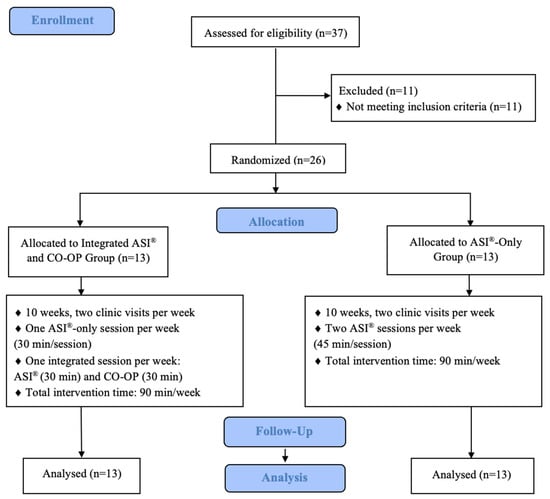
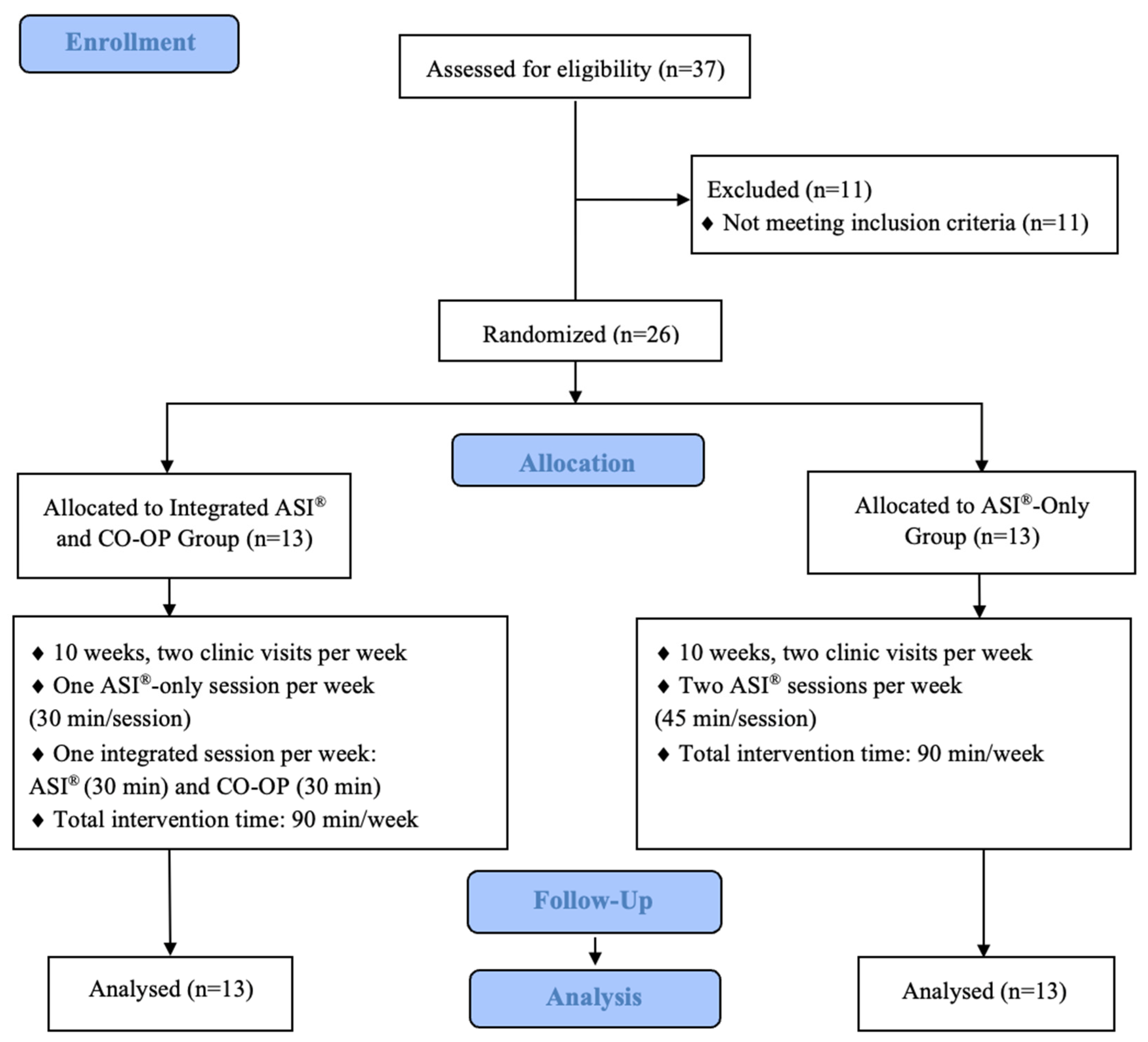
Thirty-seven children were assessed for eligibility, of whom 11 were excluded because they did not meet the eligibility criteria. The remaining 26 children were randomly allocated to either the integrated ASI® and CO-OP group (n = 13) or the ASI®-only group (n = 13). All participants completed the intervention protocol and the one-month follow-up assessment without missed sessions or dropout and were included in the final analysis (Figure 1).
Figure 1.
CONSORT flowchart.
The baseline demographic characteristics of both groups are presented in Table 1. No statistically significant between-group differences were observed in age, age at diagnosis, or sex distribution (all p > 0.05).
Table 1.
Baseline demographic characteristics.
Median outcome scores at baseline, post-intervention, and the one-month follow-up are presented in Table 2. Descriptively, BRIEF scores decreased, whereas EFORTS, SCOPE, and COPM scores generally increased over time in both groups. These changes appeared more pronounced in the integrated ASI® and CO-OP group, particularly at follow-up.
Table 2.
Outcome scores by group and assessment time.
Between-group comparisons showed significantly greater improvements in the integrated ASI® and CO-OP group from baseline to the one-month follow-up for the BRIEF Metacognition Index (p = 0.037) and Global Executive Composite (p = 0.027). Differences favoring the integrated group were also observed for EFORTS Factor 1 from baseline to post-intervention (p = 0.002) and from baseline to follow-up (p < 0.001). Greater improvements were observed in COPM performance at both post-intervention (p = 0.005) and follow-up (p < 0.001), as well as in COPM satisfaction at follow-up (p = 0.003). These findings are based on unadjusted between-group comparisons and should be interpreted as exploratory (Table 3).
Table 3.
Between-group comparisons of improvement-oriented change scores.
Supplementary baseline-adjusted analyses were conducted to evaluate the robustness of the between-group findings. The adjusted results generally supported the direction of the observed differences for EFORTS Factor 1, COPM performance, and the BRIEF Metacognition Index and Global Executive Composite at follow-up. However, some outcomes differed between the change-score and baseline-adjusted analyses, indicating sensitivity to the analytical approach. The full adjusted estimates, 95% confidence intervals, and p values are presented in Supplementary Table S1.
In the integrated ASI® and CO-OP group, PQRS scores improved significantly over time (χ2 = 24.133, p < 0.001, Kendall’s W = 0.928). Bonferroni-adjusted comparisons showed significant improvements from baseline to post-intervention and follow-up (both p < 0.001), whereas the change from post-intervention to follow-up was not significant (p = 0.094) (Table 4).
Table 4.
PQRS outcomes in the integrated ASI® and CO-OP group.
4. Discussion
This randomized controlled trial examined whether integrating the CO-OP with ASI® was associated with greater improvements in executive function and participation outcomes than ASI®-only in children with autism. Overall, the integrated group showed greater improvements in the BRIEF Metacognition Index and Global Executive Composite at follow-up and in EFORTS Factor 1 at both post-intervention and follow-up. No significant between-group difference was observed in SCOPE total score. For COPM, greater improvements were found in performance at both post-intervention and follow-up and in satisfaction at follow-up. These preliminary findings suggest that the integrated program may be associated with greater improvements in selected outcomes, although the small sample size and methodological limitations warrant cautious interpretation.
Participation-related outcome scores generally improved over time in both groups, whereas between-group comparisons showed greater changes in selected outcomes in the integrated group. This pattern is consistent with the role of ASI® as a participation-oriented occupational therapy intervention for children with autism, particularly in relation to individualized goals, occupational performance, and engagement in daily activities [57,58]. Previous studies have also reported gains in daily performance, participation, and socialization following ASI® intervention [5,18,23]. In the present study, the greater improvements observed in EFORTS Factor 1, COPM performance, and COPM satisfaction may suggest the integrated program may be associated with greater benefits for selected outcomes than ASI® alone, although these differences cannot be attributed specifically to CO-OP. Because COPM outcomes reflected individualized goals also addressed during the intervention, improvements in these scores should not be interpreted as evidence of generalized occupational performance gains.
One possible interpretation of these findings is that ASI® and CO-OP functioned as complementary rather than competing intervention components. ASI® intervention may have supported sensory–motor integration, regulation, and readiness for participation, whereas the CO-OP approach may have contributed by strengthening strategy use, guided problem-solving, and transfer during goal-directed occupations. This interpretation is consistent with previous research showing that CO-OP can support performance and participation in children with neurodevelopmental conditions [39,59] as well as with emerging evidence supporting its use in children with autism when intervention goals are individualized and meaningful [30]. In our study, the between-group findings for EFORTS Factor 1 and COPM, together with the within-group improvement in PQRS, are consistent with this complementary interpretation. However, because PQRS was administered only to the integrated group, it cannot provide evidence of a comparative treatment effect. The proposed contributions of sensory–motor regulation, readiness for participation, and cognitive strategy use remain theoretical because these potential mediating processes were not directly measured. The present findings therefore do not establish the mechanisms responsible for observed outcome differences.
However, the present two-arm design cannot determine whether the observed differences resulted from the cognitive strategy component itself or from other features of the integrated program, including differences in ASI® dosage, parental involvement, and session structure. Furthermore, without a CO-OP-only comparison group, the proposed complementarity of ASI® and CO-OP remains a theoretical interpretation rather than an experimentally established effect.
The PQRS provided an intervention-specific perspective on change in the quality of performance during goal-directed activities [60,61]. PQRS scores increased significantly from baseline to post-intervention and follow-up, whereas no significant change was observed between post-intervention and follow-up. A nonsignificant post-intervention to follow-up comparison (p = 0.094) does not establish maintenance of improvement. Because the PQRS was administered only to the integrated group and was rated by the treating therapist without blinding, these results cannot establish a comparative treatment effect and may be subject to assessment bias.
Executive function-related outcomes also showed a differentiated pattern. Improvements were also observed in the ASI®-only group. However, without an untreated or waitlist control group, these within-group changes cannot be attributed specifically to ASI®, as maturation, regression to the mean, concurrent special education, and nonspecific intervention effects may also have contributed [23,24,62,63]. At the same time, greater improvements in the BRIEF Metacognition Index and Global Executive Composite from baseline to follow-up suggest that integrating CO-OP with ASI® may provide additional support for metacognitive and goal-management demands. Because executive function is expressed within everyday routines and environmental demands [64], these findings may be more meaningfully interpreted as improvements in parent-reported executive functioning within everyday contexts rather than as isolated changes in cognitive capacity. This interpretation is also consistent with earlier studies showing that the CO-OP approach facilitates the use of global and domain-specific strategies, guided discovery, and transfer of problem-solving skills in children with autism and related groups [29,31,65].
Not all participation- and routine-related outcomes showed comparable changes. No significant between-group differences were found for EFORTS Factors 2 and 3 or the SCOPE total score. This pattern suggests that the effects of the integrated intervention were not uniform across all participation domains and may have been more evident for individualized goals and morning and evening routines. Therefore, these findings should not be interpreted as evidence of a generalized improvement in participation across different occupational domains. In particular, the absence of a between-group difference in SCOPE total score limits conclusions about the broader participation outcomes emphasized in the study aim.
This study has several limitations. First, the sample was small and relatively homogeneous due to restrictive eligibility criteria. Although this may have supported internal validity, it limits generalizability to the broader population of children with autism seen in clinical practice. The small sample size also limits the precision of the estimated intervention effects. Furthermore, multiple outcome comparisons were performed without adjustment for multiplicity in this relatively small sample, increasing the risk of Type I error. Therefore, the observed between-group differences should be considered exploratory and require confirmation in adequately powered trials. Second, the follow-up period was short. Third, the interventions, outcome assessments, and statistical analyses were conducted by the principal investigator, which may have increased the risk of performance, detection, and analytic bias. Furthermore, the absence of allocation concealment may have influenced outcome ratings, particularly those involving clinical observation and subjective judgments. Parent-reported outcomes, particularly BRIEF, EFORTS, and COPM, may also have been affected by parental expectations, potentially favoring the integrated intervention. Similarly, non-blinded ratings of observational outcomes, including SCOPE and PQRS, may have been susceptible to assessment bias; PQRS was assessed only in the integrated group and therefore does not inform between-group comparisons. In addition, delivery of both programs by one therapist introduced a risk of contamination between intervention approaches and differential therapeutic enthusiasm. The direction and magnitude of these potential biases cannot be determined from the available data. These methodological limitations should be considered when interpreting the between-group differences. Finally, although the total intervention time was matched between groups, the integrated group received a lower dose of ASI® than the ASI®-only group, which should be considered when interpreting the between-group differences. In addition, the CO-OP component was delivered in ten 30 min sessions, representing a relatively limited exposure that may not be equivalent to the intervention dosage used in other CO-OP studies. Although supplementary analyses adjusted for baseline outcome values, the small sample size and differences between analytical approaches limit the certainty of the estimated intervention effects.
5. Conclusions
The time-matched integrated ASI® and CO-OP program showed greater improvements than the ASI®-only program in COPM performance and EFORTS Factor 1 at post-intervention and follow-up and in COPM satisfaction, the BRIEF Metacognition Index, and the BRIEF Global Executive Composite at follow-up. No significant between-group differences were observed in SCOPE total score, EFORTS Factors 2 and 3, or BRIEF Behavioral Regulation Index. Given the unequal ASI® dosage between groups, these findings cannot be attributed specifically to CO-OP. These exploratory findings require confirmation in larger studies with appropriate control of multiple comparisons, longer follow-up periods, and blinded outcome assessment.
Supplementary Materials
The following supporting information can be downloaded at: https://www.mdpi.com/article/10.3390/children13111562/s1, Table S1: Baseline-adjusted Between-group Comparisons at Post-intervention and One-month Follow-up.
Author Contributions
Conceptualization, Z.Ç.Y. and G.B.; methodology, Z.Ç.Y. and G.B.; software, Z.Ç.Y.; validation, Z.Ç.Y. and G.B.; formal analysis, Z.Ç.Y.; investigation, Z.Ç.Y.; resources, Z.Ç.Y.; data curation, Z.Ç.Y.; writing—original draft preparation, Z.Ç.Y.; writing—review and editing, Z.Ç.Y. and G.B.; visualization, Z.Ç.Y.; supervision, G.B.; project administration, Z.Ç.Y.; funding acquisition, Z.Ç.Y. All authors have read and agreed to the published version of the manuscript.
Funding
This research received no external funding. The APC was funded by Atlas University.
Institutional Review Board Statement
The study was conducted in accordance with the Declaration of Helsinki. Approval was granted by the Ethics Committee of Bezmialem Vakıf University (approval number: E-54022451-050.05.04-116594; approval date: 26 July 2023).
Informed Consent Statement
Informed consent was obtained from all subjects involved in the study.
Data Availability Statement
The data presented in this study are available from the corresponding author upon reasonable request. The data are not publicly available due to privacy and ethical restrictions involving human participants.
Conflicts of Interest
The authors declare no conflicts of interest.
References
- Lord, C.; Brugha, T.S.; Charman, T.; Cusack, J.; Dumas, G.; Frazier, T.; Jones, E.J.; Jones, R.M.; Pickles, A.; State, M.W. Autism spectrum disorder. Nat. Rev. Dis. Primers 2020, 6, 5. [Google Scholar] [CrossRef] [Scilit] [PubMed]
- Simpson, K.; Adams, D. Parent-reported environmental factors and strategies to support home and community participation in children on the autism spectrum. Disabil. Rehabil. 2024, 46, 3970–3979. [Google Scholar] [CrossRef] [Scilit] [PubMed]
- Coussens, M.; Van Driessen, E.; De Baets, S.; Van Regenmortel, J.; Desoete, A.; Oostra, A.; Vanderstraeten, G.; Waelvelde, H.V.; Van de Velde, D. Parents’ perspectives on participation of young children with attention deficit hyperactivity disorder, developmental coordination disorder, and/or autism spectrum disorder: A systematic scoping review. Child Care Health Dev. 2020, 46, 232–243. [Google Scholar] [CrossRef] [Scilit] [PubMed]
- Weaver, L.L. Effectiveness of work, activities of daily living, education, and sleep interventions for people with autism spectrum disorder: A systematic review. Am. J. Occup. Ther. 2015, 69, 593–604. [Google Scholar] [CrossRef] [Scilit] [PubMed]
- Rosenberg, L.; Moran, A.; Bart, O. The associations among motor ability, social-communication skills, and participation in daily life activities in children with low-functioning autism spectrum disorder. J. Occup. Ther. Sch. Early Interv. 2017, 10, 137–146. [Google Scholar] [CrossRef] [Scilit]
- Rizk, S.; Pizur-Barnekow, K.; Darragh, A.R. Leisure and social participation and health-related quality of life in caregivers of children with autism. OTJR Occup. Particip. Health 2011, 31, 164–171. [Google Scholar] [CrossRef] [Scilit]
- Uddin, L.Q. Brain mechanisms supporting flexible cognition and behavior in adolescents with autism spectrum disorder. Biol. Psychiatry 2021, 89, 172–183. [Google Scholar] [CrossRef] [Scilit] [PubMed]
- Vivanti, G.; Bottema-Beutel, K.; Turner-Brown, L. Clinical Guide to Early Interventions for Children with Autism; Springer: Berlin/Heidelberg, Germany, 2020. [Google Scholar]
- Beheshti, S.Z.; Hosseini, S.-S.; Maroufizadeh, S.; Almasi-Hashiani, A. Occupational performance of children with autism spectrum disorder and quality of life of their mothers. BMC Res. Notes 2022, 15, 18. [Google Scholar] [CrossRef] [Scilit] [PubMed]
- Demetriou, E.A.; Lampit, A.; Quintana, D.S.; Naismith, S.L.; Song, Y.J.; Pye, J.E.; Hickie, I.; Guastella, A.J. Autism spectrum disorders: A meta-analysis of executive function. Mol. Psychiatry 2018, 23, 1198–1204. [Google Scholar] [CrossRef] [Scilit] [PubMed]
- Watroba, A.; Luttinen, J.; Lappalainen, P.; Tolonen, J.; Ruotsalainen, H. Effectiveness of school-based occupational therapy interventions on school skills and abilities among children with attention deficit hyperactivity and autism spectrum disorders: Systematic review. J. Occup. Ther. Sch. Early Interv. 2024, 17, 671–703. [Google Scholar] [CrossRef] [Scilit]
- Cavalli, G.; Galeoto, G.; Sogos, C.; Berardi, A.; Tofani, M. The efficacy of executive function interventions in children with autism spectrum disorder: A systematic review and meta-analysis. Expert Rev. Neurother. 2022, 22, 77–84. [Google Scholar] [CrossRef] [Scilit] [PubMed]
- Haertl, K.; Callahan, D.; Markovics, J.; Sheppard, S.S. Perspectives of adults living with autism spectrum disorder: Psychosocial and occupational implications. Occup. Ther. Ment. Health 2013, 29, 27–41. [Google Scholar] [CrossRef] [Scilit]
- O’Hearn, K.; Asato, M.; Ordaz, S.; Luna, B. Neurodevelopment and executive function in autism. Dev. Psychopathol. 2008, 20, 1103–1132. [Google Scholar] [CrossRef] [Scilit] [PubMed]
- Commodari, E.; La Rosa, V.L.; Foti, F. Attention skills, learning and academic abilities in children and adolescents with genetic disorders: A systematic review. Front. Psychol. 2025, 16, 1677418. [Google Scholar] [CrossRef] [Scilit] [PubMed]
- Barrios-Fernández, S.; Gozalo, M.; Díaz-González, B.; García-Gómez, A. A Complementary Sensory Tool for Children with Autism Spectrum Disorders. Children 2020, 7, 244. [Google Scholar] [CrossRef] [Scilit] [PubMed]
- Camino-Alarcón, J.; Robles-Bello, M.A.; Valencia-Naranjo, N.; Sarhani-Robles, A. A systematic review of treatment for children with autism spectrum disorder: The sensory processing and sensory integration approach. Children 2024, 11, 1222. [Google Scholar] [CrossRef] [Scilit] [PubMed]
- Omairi, C.; Mailloux, Z.; Antoniuk, S.A.; Schaaf, R. Occupational Therapy Using Ayres Sensory Integration®: A Randomized Controlled Trial in Brazil. Am. J. Occup. Ther. 2022, 76, 712–722. [Google Scholar] [CrossRef] [Scilit] [PubMed]
- Watling, R.; Hauer, S. Effectiveness of Ayres Sensory Integration® and sensory-based interventions for people with autism spectrum disorder: A systematic review. Am. J. Occup. Ther. 2015, 69, 604–616. [Google Scholar] [CrossRef] [Scilit] [PubMed]
- Piller, A.; Glennon, T.J.; Andelin, L.; Auld-Wright, K.; McHugh Conlin, J.; Teng, K.; Tarver, T. Occupational therapy interventions using Ayres Sensory Integration® for children and youth (2015–2024): A systematic review. Am. J. Occup. Ther. 2026, 80, 8001185030. [Google Scholar] [CrossRef] [Scilit] [PubMed]
- Schoen, S.A.; Lane, S.J.; Mailloux, Z.; May-Benson, T.; Parham, L.D.; Smith Roley, S.; Schaaf, R.C. A systematic review of ayres sensory integration intervention for children with autism. Autism Res. 2019, 12, 6–19. [Google Scholar] [CrossRef] [Scilit] [PubMed]
- Novak, I.; Honan, I. Effectiveness of paediatric occupational therapy for children with disabilities: A systematic review. Aust. Occup. Ther. J. 2019, 66, 258–273. [Google Scholar] [CrossRef] [Scilit] [PubMed]
- Schaaf, R.C.; Dumont, R.L.; Arbesman, M.; May-Benson, T.A. Efficacy of occupational therapy using Ayres Sensory Integration®: A systematic review. Am. J. Occup. Ther. 2018, 72, 12–22. [Google Scholar] [CrossRef] [Scilit] [PubMed]
- Clark, G.F.; Watling, R.; Parham, L.D.; Schaaf, R. Occupational therapy interventions for children and youth with challenges in sensory integration and sensory processing: A school-based practice case example. Am. J. Occup. Ther. 2019, 73, 549–557. [Google Scholar] [CrossRef] [Scilit] [PubMed]
- Lane, S.J.; Mailloux, Z.; Schoen, S.; Bundy, A.; May-Benson, T.A.; Parham, L.D.; Smith Roley, S.; Schaaf, R.C. Neural foundations of ayres sensory integration®. Brain Sci. 2019, 9, 153. [Google Scholar] [CrossRef] [Scilit] [PubMed]
- Whiting, C.C.; Schoen, S.A.; Bundy, A.; Lane, S.J.; Mailloux, Z.; Roley, S.S.; May-Benson, T.A.; Schaaf, R.C. Occupational therapy using Ayres Sensory Integration® in school-based practice: A call to action. Am. J. Occup. Ther. 2025, 79, 7901347020. [Google Scholar] [CrossRef] [Scilit] [PubMed]
- Houldin, A.; McEwen, S.E.; Howell, M.W.; Polatajko, H.J. The cognitive orientation to daily occupational performance approach and transfer: A scoping review. OTJR Occup. Particip. Health 2018, 38, 157–172. [Google Scholar] [CrossRef] [Scilit] [PubMed]
- Gimeno, H.; Polatajko, H. The Cognitive Orientation to daily Occupational Performance approach in childhood-onset disabilities. Dev. Med. Child Neurol. 2025, 67, 977–985. [Google Scholar] [CrossRef] [Scilit] [PubMed]
- Rodger, S.; Brandenburg, J. Cognitive Orientation to (daily) Occupational Performance (CO-OP) with children with Asperger’s syndrome who have motor-based occupational performance goals. Aust. Occup. Ther. J. 2009, 56, 41–50. [Google Scholar] [CrossRef] [Scilit] [PubMed]
- Kangarani-Farahani, M.; Thompson-Hodgetts, S.; Zwicker, J.G. Effectiveness of Cognitive Orientation to daily Occupational Performance for autistic children with developmental coordination disorder. Dev. Med. Child Neurol. 2025, 67, 216–222. [Google Scholar] [CrossRef] [Scilit] [PubMed]
- Rodger, S.; Springfield, E.; Polatajko, H.J. Cognitive Orientation for daily Occupational Performance approach for children with Asperger’s Syndrome: A case report. Phys. Occup. Ther. Pediatr. 2007, 27, 7–22. [Google Scholar] [CrossRef] [Scilit]
- Polatajko, H.J.; Mandich, A.D.; Miller, L.T.; Macnab, J.J. Cognitive orientation to daily occupational performance (CO-OP) part II the evidence. Phys. Occup. Ther. Pediatr. 2001, 20, 83–106. [Google Scholar] [CrossRef] [Scilit]
- Madieu, E.; Gagné-Trudel, S.; Therriault, P.Y.; Cantin, N. Effectiveness of CO-OP approach for children with neurodevelopmental disorders: A systematic review. Arch. Rehabil. Res. Clin. Transl. 2023, 5, 100260. [Google Scholar] [CrossRef] [Scilit] [PubMed]
- Özbeşer, H.; Tüzün, E.H.; Dericioğlu, B.; Övgün, Ç.D. Effects of cognitive orientation to daily occupational performance and conductive education treatment approaches on fine motor skills, activity and participation limitations in children with Down Syndrome: A randomised controlled trial. J. Autism Dev. Disord. 2024, 54, 168–181. [Google Scholar] [CrossRef] [Scilit] [PubMed]
- Gurlek, S.; Bumin, G. The effect of cognitive orientation to daily occupational performance in children with attention deficit hyperactivity disorder: A pilot randomized controlled study. Appl. Neuropsychol. Child 2026, 15, 169–178. [Google Scholar] [CrossRef] [Scilit] [PubMed]
- Peny-Dahlstrand, M.; Hofgren, C.; Lindquist, B.; Bergqvist, L.; Himmelmann, K.; Opheim, A.; Sjöwall, D.; Brock, K.; Öhrvall, A.-M. The Cognitive Orientation to daily Occupational Performance (CO-OP) Approach is superior to ordinary treatment for achievement of goals and transfer effects in children with cerebral palsy and spina bifida–a randomized controlled trial. Disabil. Rehabil. 2023, 45, 822–831. [Google Scholar] [CrossRef] [Scilit] [PubMed]
- Roostaei, M.; Dalvand, H.; Rassafiani, M.; Kelly, G.; Razi, B. Cognitive orientation to daily occupational performance (CO-OP) in children with cerebral palsy: A systematic review with meta-analysis. Can. J. Occup. Ther. 2022, 89, 72–91. [Google Scholar] [CrossRef] [Scilit] [PubMed]
- Thornton, A.; Licari, M.; Reid, S.; Armstrong, J.; Fallows, R.; Elliott, C. Cognitive orientation to (daily) occupational performance intervention leads to improvements in impairments, activity and participation in children with developmental coordination disorder. Disabil. Rehabil. 2016, 38, 979–986. [Google Scholar] [CrossRef] [Scilit] [PubMed]
- Yasunaga, M.; Miyaguchi, H.; Ishizuki, C.; Kita, Y.; Nakai, A. Cognitive orientation to daily occupational performance: A randomized controlled trial examining intervention effects on children with developmental coordination disorder traits. Brain Sci. 2023, 13, 721. [Google Scholar] [CrossRef] [Scilit] [PubMed]
- Öhrvall, A.-M.; Bergqvist, L.; Hofgren, C.; Peny-Dahlstrand, M. “With CO-OP I’m the boss”–experiences of the cognitive orientation to daily occupational performance approach as reported by young adults with cerebral palsy or spina bifida. Disabil. Rehabil. 2020, 42, 3645–3652. [Google Scholar] [CrossRef] [Scilit] [PubMed]
- Randomizer, R. Generate Numbers. 2023. Available online: https://randomizer.org/#randomize (accessed on 5 July 2023).
- Missiuna, C.; Mandich, A.D.; Polatajko, H.J.; Malloy-Miller, T. Cognitive orientation to daily occupational performance (CO-OP) part I-theoretical foundations. Phys. Occup. Ther. Pediatr. 2001, 20, 69–81. [Google Scholar] [CrossRef] [Scilit]
- Polatajko, H.J.; Mandich, A.D.; Missiuna, C.; Miller, L.T.; Macnab, J.J.; Malloy-Miller, T.; Kinsella, E.A. Cognitive orientation to daily occupational performance (CO-OP) part III-the protocol in brief. Phys. Occup. Ther. Pediatr. 2001, 20, 107–123. [Google Scholar] [CrossRef] [Scilit]
- Schaaf, R.C.; Mailloux, Z. Clinician’s Guide for Implementing Ayres Sensory Integration: Promoting Participation for Children with Autism; AOTA Press: Bethesda, MD, USA, 2015. [Google Scholar] [CrossRef] [Scilit]
- Schopler, E.; Reichler, R.J.; Renner, B.R. The Childhood Autism Rating Scale (CARS); WPS: Los Angeles, CA, USA, 2010. [Google Scholar]
- Gioia, G.A.; Isquith, P.K.; Retzlaff, P.D.; Espy, K.A. Confirmatory factor analysis of the Behavior Rating Inventory of Executive Function (BRIEF) in a clinical sample. Child Neuropsychol. 2002, 8, 249–257. [Google Scholar] [CrossRef] [Scilit] [PubMed]
- Batan, S.N.; Öktem-Tanör, Ö.; Kalem, E. Reliability and validity studies of Behavioral Rating Inventory of Executive Function (BRIEF) in a Turkish normative sample. Elem. Educ. Online 2011, 10, 894–904. [Google Scholar]
- Frisch, C.; Rosenblum, S. Reliability and validity of the executive function and occupational routines scale (EFORTS). Res. Dev. Disabil. 2014, 35, 2148–2157. [Google Scholar] [CrossRef] [Scilit] [PubMed]
- Akyürek, G.; Efe, A.; Bumin, G. Turkish adaptation of the executive functions and cccupational routines scale: Validity and reliability among children with dyslexia. Percept. Mot. Ski. 2023, 130, 364–385. [Google Scholar] [CrossRef] [Scilit] [PubMed]
- Bowyer, P.; Lee, J.; Kramer, J.; Taylor, R.R.; Kielhofner, G. Determining the clinical utility of the Short Child Occupational Profile (SCOPE). Br. J. Occup. Ther. 2012, 75, 19–28. [Google Scholar] [CrossRef] [Scilit]
- Huri, M.; Kashefimehr, B.; Kayihan, H.; Akel, S.; Öksüz, Ç.; Bumin, G.; Karayazgan, S.; Göksülük, D. Adaptation, reliability and the validity testing of a Turkish version of the Short Child Occupational Profile (SCOPE). In Proceedings of the Conference Abstract, European Academy of Childhood Disability Annual Meeting, Stockholm, Sweden, 1–4 June 2016. [Google Scholar]
- Law, M.; Baptiste, S.; McColl, M.; Opzoomer, A.; Polatajko, H.; Pollock, N. The Canadian occupational performance measure: An outcome measure for occupational therapy. Can. J. Occup. Ther. 1990, 57, 82–87. [Google Scholar] [CrossRef] [Scilit] [PubMed]
- Sağlamoğlu, E.; Temizkan, E.; Huri, M.; Ekici, G. Cultural adaptation, validity and reliability of the Turkish version of Canadian Occupational Performance Measure in children with cerebral palsy. Child Care Health Dev. 2025, 51, e70139. [Google Scholar] [CrossRef] [Scilit] [PubMed]
- Martini, R.; Rios, J.; Polatajko, H.; Wolf, T.; McEwen, S. The performance quality rating scale (PQRS): Reliability, convergent validity, and internal responsiveness for two scoring systems. Disabil. Rehabil. 2015, 37, 231–238. [Google Scholar] [CrossRef] [Scilit] [PubMed]
- Faul, F.; Erdfelder, E.; Lang, A.-G.; Buchner, A. G* Power 3: A flexible statistical power analysis program for the social, behavioral, and biomedical sciences. Behav. Res. Methods 2007, 39, 175–191. [Google Scholar] [CrossRef] [Scilit] [PubMed]
- Araujo, C.R.S.; Cardoso, A.A.; Polatajko, H.J.; de Castro Magalhães, L. Efficacy of the Cognitive Orientation to daily Occupational Performance (CO-OP) approach with and without parental coaching on activity and participation for children with developmental coordination disorder: A randomized clinical trial. Res. Dev. Disabil. 2021, 110, 103862. [Google Scholar] [CrossRef] [Scilit] [PubMed]
- Kashefimehr, B.; Kayihan, H.; Huri, M. The effect of sensory integration therapy on occupational performance in children with autism. OTJR Occup. Particip. Health 2018, 38, 75–83. [Google Scholar] [CrossRef] [Scilit] [PubMed]
- Whiting, C.C.; Schoen, S.A.; Niemeyer, L. A Sensory Integration Intervention in the School Setting to Support Performance and Participation: A Multiple-Baseline Study. Am. J. Occup. Ther. 2023, 77, 7702205060. [Google Scholar] [CrossRef] [Scilit] [PubMed]
- Izadi-Najafabadi, S.; Mirzakhani-Araghi, N.; Miri-Lavasani, N.; Nejati, V.; Pashazadeh-Azari, Z. Implicit and explicit motor learning: Application to children with Autism Spectrum Disorder (ASD). Res. Dev. Disabil. 2015, 47, 284–296. [Google Scholar] [CrossRef] [Scilit] [PubMed]
- Gimeno, H.; Farber, J.; Thornton, J.; Polatajko, H. The relative merits of an individualized versus a generic approach to rating functional performance in childhood dystonia. Children 2021, 8, 7. [Google Scholar] [CrossRef] [Scilit] [PubMed]
- Jutzi, K.S.; Linkewich, E.; Hunt, A.W.; McEwen, S. Does training in a top-down approach influence recorded goals and treatment plans? Can. J. Occup. Ther. 2020, 87, 42–51. [Google Scholar] [CrossRef] [Scilit] [PubMed]
- Deng, J.; Lei, T.; Du, X. Effects of sensory integration training on balance function and executive function in children with autism spectrum disorder: Evidence from Footscan and fNIRS. Front. Psychol. 2023, 14, 1269462. [Google Scholar] [CrossRef] [Scilit] [PubMed]
- Iwanaga, R.; Honda, S.; Nakane, H.; Tanaka, K.; Toeda, H.; Tanaka, G. Pilot study: Efficacy of sensory integration therapy for Japanese children with high-functioning autism spectrum disorder. Occup. Ther. Int. 2014, 21, 4–11. [Google Scholar] [CrossRef] [Scilit] [PubMed]
- Dellapiazza, F.; Michelon, C.; Oreve, M.-J.; Robel, L.; Schoenberger, M.; Chatel, C.; Vesperini, S.; Maffre, T.; Schmidt, R.; Blanc, N. The impact of atypical sensory processing on adaptive functioning and maladaptive behaviors in autism spectrum disorder during childhood: Results from the ELENA cohort. J. Autism Dev. Disord. 2020, 50, 2142–2152. [Google Scholar] [CrossRef] [Scilit] [PubMed]
- Rodger, S.; Vishram, A. Mastering social and organization goals: Strategy use by two children with Asperger syndrome during cognitive orientation to daily occupational performance. Phys. Occup. Ther. Pediatr. 2010, 30, 264–276. [Google Scholar] [CrossRef] [Scilit] [PubMed]

Disclaimer/Publisher’s Note: The statements, opinions and data contained in all publications are solely those of the individual author(s) and contributor(s) and not of MDPI and/or the editor(s). MDPI and/or the editor(s) disclaim responsibility for any injury to people or property resulting from any ideas, methods, instructions or products referred to in the content. |
© 2026 by the authors. Licensee MDPI, Basel, Switzerland. This article is an open access article distributed under the terms and conditions of the Creative Commons Attribution (CC BY) license.