


Abstract
The socio-ecological transition requires not only technological innovation but also new ways of recognizing the social, environmental, and territorial value generated by collective action. Many of these positive externalities remain invisible in conventional assessment frameworks, limiting the legitimacy, financing, and scaling of local sustainability initiatives. This article presents a strategic framework designed to identify and structure positive externalities in collective self-consumption and other transformative projects. The method combines four components: (i) normative identification through the Sustainable Development Goals; (ii) balanced multi-stakeholder participation to surface diverse perspectives; (iii) perceptive mapping using an adapted Kano model; and (iv) strategic articulation. The framework was applied in two contrasting contexts: an energy community centered on shared renewable production, and a women’s empowerment program focused on capability-building and social innovation. These applications do not aim at empirical replication or the validation of results, but at examining how the framework supports collective recognition and strategic structuring in different organizational settings. Across these distinct settings, it led to the formulation of coherent and actionable strategic roadmaps, illustrating how positive externalities can inform governance choices, strengthen institutional legitimacy, and support long-term project consolidation. These results suggest that collective recognition enables externalities to structure strategic action beyond their original sector, demonstrating the potential transferability of the approach. Developed within a research program supported by the French Agency for Ecological Transition (ADEME) and the national urban-transition initiative (PUCA), the framework provides a practical decision architecture for structuring shared value within coordinated strategies.
1. Introduction
The energy transition can no longer be reduced to producing more renewable kilowatt-hours. It represents a profound socio-technical shift that transforms infrastructures, institutions, and collective expectations [1,2].
Contemporary transition studies increasingly show that socio-ecological transitions are not only technological operations but deeply social and political processes in which legitimacy, equity, and governance shape long-term trajectories [3,4]. In this perspective, energy increasingly behaves as a collective good that supports cohesion, resilience, and shared prosperity.
Emerging initiatives such as collective self-consumption illustrate this shift. Beyond technical optimization, they reflect new forms of territorial appropriation, distributed cooperation, and citizen engagement [5]. However, their development remains fragile: regulatory complexity, tariff instability, and shrinking public budgets undermine their financial viability.
A growing body of literature shows that this fragility is reinforced by the narrow scope of conventional evaluation frameworks. Metrics such as cost–benefit analysis (CBA), internal rate of return (IRR), or carbon accounting privilege short-term financial performance and tend to overlook or marginalize wider social, territorial, and institutional co-benefits [6].
Even mainstream financial instruments, green bonds among them, tend to overlook broader co-benefits and institutional value, with environmental and social impacts only marginally reflected in their evaluation criteria [7]. As a consequence, many positive contributions (local employment, energy citizenship, social cohesion, territorial attractiveness) remain invisible within decision-making processes.
This recognition gap has now become critical. Recent policy frameworks (including the European Green Deal and the Just Transition Mechanism) explicitly call for integrating participation, social value, and multi-level governance into energy planning [8,9].
Energy justice research similarly highlights that transition strategies must embed fairness, inclusion, and shared benefits across distributional, procedural, and territorial dimensions [10,11]. At the same time, work on co-benefits shows that energy initiatives produce significant indirect advantages (in health, resilience, equity, or local development) that remain undervalued in mainstream assessments [12,13].
Despite these advances, methods for identifying, recognizing, and operationalizing positive externalities remain limited. In particular, existing approaches often conflate identification with valuation, or rely exclusively on either normative indicators or participatory narratives, limiting their capacity to operate in contexts marked by institutional resistance.
Developed within the PART’Extern project, supported by the French Agency for Ecological Transition (ADEME) and national partners in urban transitions (PUCA), this paper addresses this gap. The framework proposes to integrate normative, participatory, and perceptive dimensions to support the identification and collective recognition of positive externalities and to translate this recognition into actionable strategic orientations.
By linking value recognition with collective action, the approach contributes to a renewed understanding of how sustainability projects can align territorial innovation with institutional and financial legitimacy. Externalities thus appear not as secondary co-benefits but as strategic resources capable of guiding design, partnership-building, and long-term investment in the socio-ecological transition.
2. Conceptual Basis for the Methodological Framework
This section clarifies the key conceptual assumptions that justify the methodological choices made in this paper. Its purpose is straightforward: to explain why identifying positive externalities in collective sustainability projects is challenging, and why addressing this challenge requires a specific methodological approach.
2.1. Why Positive Externalities Are Difficult to Identify
Positive externalities are increasingly discussed as important components of socio-technical transitions. Despite this growing attention, they remain difficult to grasp in practice, as they tend to be diffuse and indirect. They are not produced by a single action or technology, but emerge from the way a project is organized, governed, and sustained over time [14,15,16].
As a result, identifying positive externalities is not simply a matter of measurement; it requires determining what should be considered as a meaningful effect within a given context.
This difficulty is particularly evident in community-based initiatives. Beyond technical or economic outputs, such projects often generate externalities related to trust, cooperation, legitimacy, or collective learning [17,18]. These externalities are essential for long-term project viability, but they are unevenly perceived and rarely captured by conventional evaluation tools. Consequently, positive externalities tend to remain under-recognized in strategic and policy discussions, even when they play a decisive role in practice.
2.2. Recognition Comes Before Valuation
A central assumption of this paper is that identifying positive externalities is not equivalent to valuing them. Recognition, valuation, and monetization are distinct processes, even though they are often treated as a single sequence in evaluation frameworks.
Recognition refers to the collective process through which actors identify and acknowledge externalities they consider beneficial. Valuation involves comparing or prioritizing these externalities, while monetization translates some of them into financial terms. Confusing these stages can lead to premature or contested valuation, especially when externalities are still debated or poorly understood.
This paper therefore focuses deliberately on recognition as a necessary first step. Without shared recognition, valuation lacks legitimacy and may reinforce existing power asymmetries or generate resistance. Recognition is thus a substantive process through which actors clarify what matters within their specific context [19,20].
From this perspective, recognition is a structured collective activity that shapes what can later be valued and how. This explains why the framework proposed in this paper is conceived as a pre-valuation approach: it supports informed strategic reflection without directly producing metrics or monetary values [21,22].
2.3. Perceptions, Meaning, and Resistance
Recognizing positive externalities involves engaging with stakeholder perceptions. In many analytical traditions, perceptions are treated with caution because they are associated with subjectivity. However, in collective projects, perceived effects strongly influence commitment, coordination, and long-term engagement.
Perceptions should therefore be understood as the way projects acquire meaning for those involved. They are shaped by roles, experiences, and institutional positions, and they constitute the practical reality through which collective action unfolds [23].
At the same time, participatory approaches based solely on open discussion face well-known limitations. Power relations, self-censorship, organizational boundaries, and strategic concerns can restrict what is expressed [24,25]. Some positive externalities may remain unrecognized because they fall outside dominant frames of reference or perceived responsibilities [26,27].
Resistance, in this sense, is a structural feature of collective processes, particularly when discussions implicitly raise questions about future priorities or resource allocation. Any method designed to identify positive externalities must therefore be able to function even when participation is partial and expressions are constrained [28].
2.4. The Role of Normative References
To address these limitations, the approach adopted here relies on shared normative frameworks such as the Sustainable Development Goals (SDGs) [29]. Their value does not lie in prescribing specific outcomes, but in providing a common structure that supports collective questioning across a broad range of sustainability dimensions [30,31].
Normative references offer a stable point of orientation that complements participatory processes. While participation captures context-specific perceptions, normative frameworks help ensure that certain issues are at least considered. In this way, they reduce the risk of systematic blind spots without imposing predefined priorities [32].
What normative frameworks provide is a sufficient level of coverage to make the identification process transparent, discussable, and transferable as a reasoning process.
2.5. Consequences for Methodological Design
Taken together, these considerations lead to clear methodological implications. Identifying positive externalities in collective sustainability projects requires an approach that acknowledges contextuality, treats recognition as distinct from valuation, accounts for resistance, and limits the risk of omission.
Neither participatory approaches alone nor indicator-based frameworks are sufficient to meet these requirements. Participatory approaches may lack coverage, while indicator-based frameworks may impose categories disconnected from lived experience. A hybrid approach is therefore proposed through the PART’Extern framework.
3. Methodology
3.1. Tree’s Structure
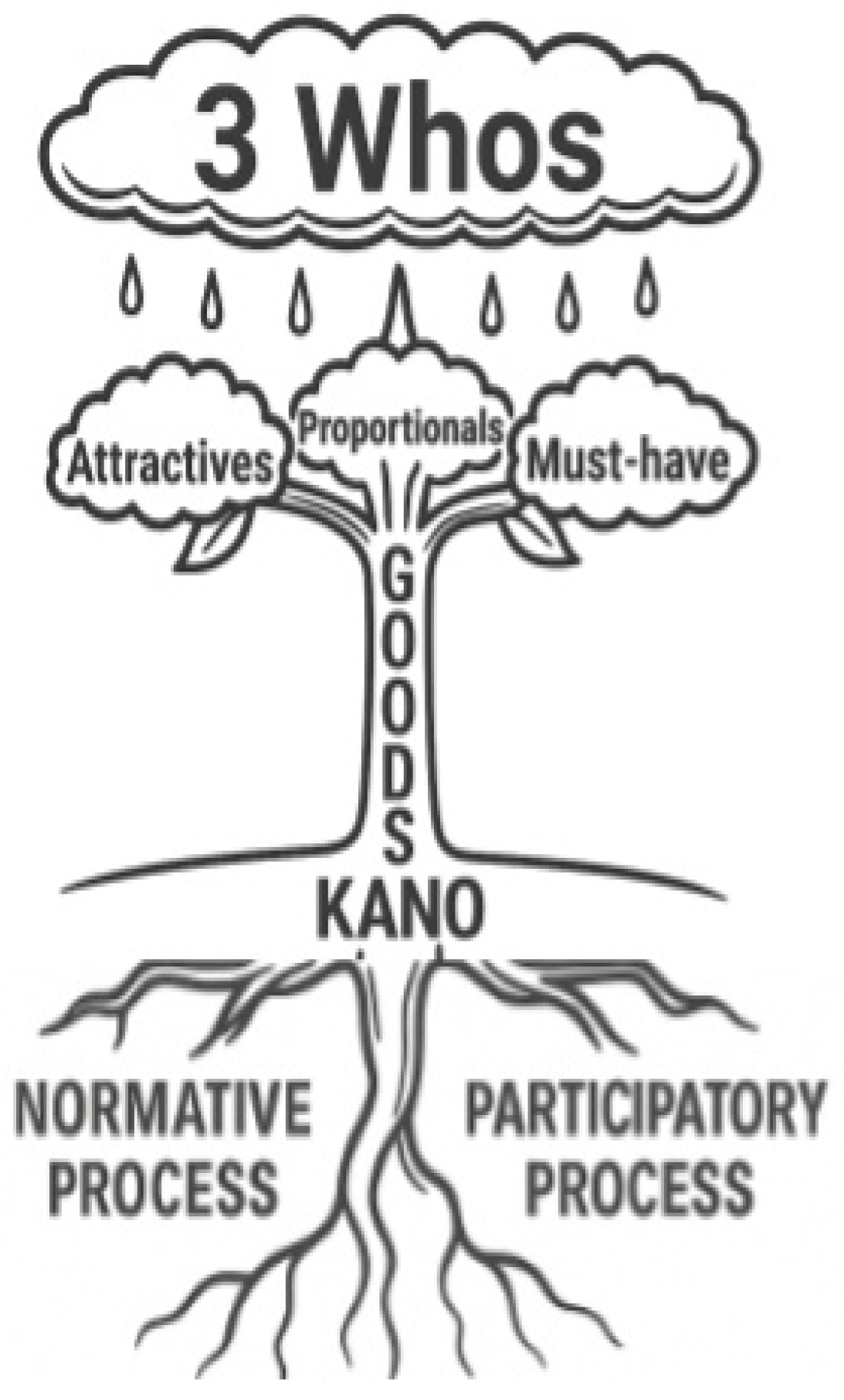
The PART’Extern methodology is organized as a coherent sequence linking the identification of positive externalities to strategic orientations. Figure 1 summarizes this structure, showing how normative references, participatory inputs, and perceptive analysis are articulated to support collective decision-making.
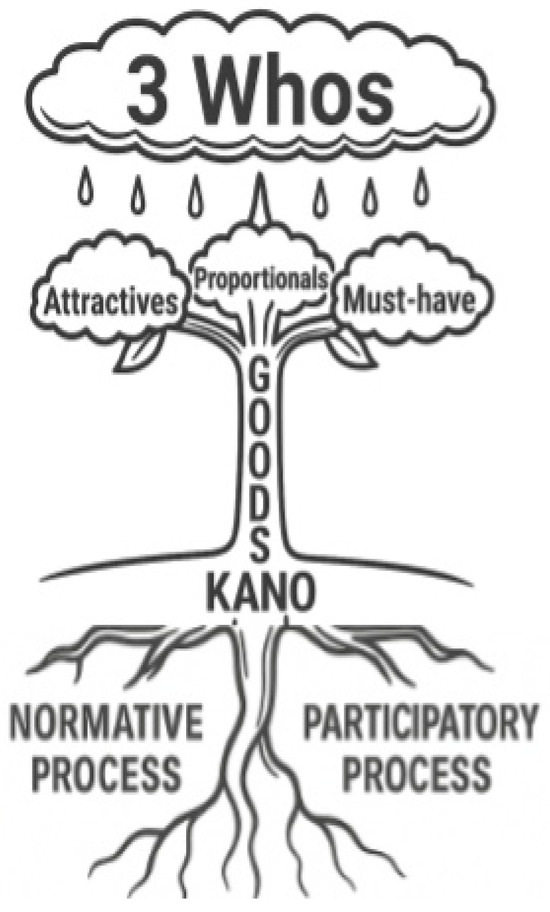
Figure 1.
Symbolic representation of the methodological framework.
The protocol unfolds through four interdependent phases:
- Phase 1—Normative identification, anchored in the Sustainable Development Goals;
- Phase 2—Participatory enrichment, involving multi-actor dialogue;
- Phase 3—Perceptive mapping, based on the adapted Kano matrix;
- Phase 4—Strategic action plan, linking results to governance.
3.2. Composition of the Working Group: The 3 Whos Principles
The PART’Extern methodology relies on a structured composition of the working group designed to generate complementary and actionable contributions. This composition follows the “3 Whos” principles, which operate at two levels: an external level related to the project ecosystem, and an internal level related to organizational roles.
At the external level, the working group is organized around three categories of contributors.
“Who does” refers to actors involved in the concrete implementation and operation of the project, bringing practical and operational insights.
“Who benefits” includes actors who experience the externalities of the project, contributing perspectives on perceived benefits and uses.
“Who governs” gathers actors involved in coordination, oversight, or strategic orientation, contributing institutional and decision-related viewpoints. Together, these three profiles structure a balanced contribution space rather than a representational one.
A second, internal level of the “3 Whos” principle complements this external balance by addressing how organizations contribute as collective actors. It focuses on the distribution of roles within organizations: who represents the organization, who implements decisions, and who assesses their effects.
This internal balance typically involves three profiles: a decision-maker responsible for strategic choices, an operational manager or technical lead in charge of implementation, and a sustainability or CSR (Corporate Social Responsibility) strategist responsible for transversal coherence and reporting. Structuring contributions along these internal roles helps ensure that strategic intent, operational reality, and evaluative perspectives are articulated throughout the identification process.
| Illustration 1—the British Social Impact Bonds These instruments [33,34] show how to distinguish the 3 Whos. The reduction in long-term unemployment, for instance, is financed because the State (Who governs) rewards results achieved by social operators (Who does) and experienced by beneficiaries (Who benefits). |
3.3. Normative Identification Through the Sustainable Development Goals
Phase 1 focuses on the normative identification of externalities using the Sustainable Development Goals (SDGs) as a shared reference framework. Unlike SDG-based assessment or reporting tools, the SDGs are mobilized here as an identification scaffold supporting ex ante exploration rather than ex post evaluation.
This phase is guided by a set of explicit evaluation criteria, which ensure that the identified externalities are sufficiently grounded, discussable, and actionable across participants and contexts. These criteria are defined as follows:
- C1—Coherence: the externality must fall within the project’s legitimate sphere of influence.
- C2—Causality: a clear link must connect the project to the expected externality through identifiable levers.
- C3—Complementarity: only externality not already internalized in financial or contractual results are considered.
- C4—Conditions: the regulatory, technical, or organizational prerequisites for the externality must be specified.
- C5—Measurability: each externality must have an observable indicator for monitoring over time.
| Illustration 2—Costa Rica’s Payment for Environmental Services Program This example [35,36] shows how the 5 Cs guides the structured recognition of externalities. C1: Legitimacy ensured by the direct involvement of participating farmers. C2: Forest protection improves water regulation and carbon storage C3: Additionality is guaranteed through a fuel tax that finances the payments. C4: The initiative relies on a solid legal framework and national governance. C5: The chosen indicators (hectares of forest protected) are measurable and verifiable. |
3.4. Enrichment Through Participatory Workshops
The participatory enrichment phase complements the normative identification by incorporating stakeholder perceptions. It is conducted through workshops organized in a neutral setting and facilitated by an external moderator acting as a methodological mediator. The facilitator ensures balanced participation without influencing the content of contributions. Under these conditions, participants are able to articulate their perspectives and experiences.
3.4.1. Participatory Generation of New Externalities
Phase 2 complements the SDG-based identification by directly involving participants in collective workshops.
Preparation is conducted through exploratory interviews with members of the working group and consultations with selected external and sectoral experts to gather diverse perspectives and inform technical assumptions.
During the workshops, an initial sequence invites participants to articulate perceived externalities without any prior reference to the SDGs. This ensures that the process remains grounded in lived experience and results in a first set of externalities rooted in the participants’ perceptions.
3.4.2. Collective Validation and Consolidation of Externalities
The second sequence of Phase 2 focuses on the collective validation of the externalities generated during the workshops. Participants review the proposed externalities using the C1–C5 criteria to ensure that each item meets the identification requirements.
Validated externalities are then compared with those identified through the SDG-based mapping in Phase 1. Overlaps are merged, and inconsistencies are discussed in order to produce a consolidated and coherent list of externalities.
3.5. Perceptive Mapping Using the Adapted Kano Matrix
3.5.1. Scoring Grid: Impact × Perceived Attractiveness
Phase 3 maps the validated externalities. In a first sequence, participants assess how strongly each externality affects the system (impact) and how desirable or motivating it appears from their perspective (perceived attractiveness).
While impact refers to observable effects, participants evaluate it based on their own experience, providing an interpretive rather than quantitative assessment.
For impact, the evaluation considers:
- Magnitude: the scale of the observable effect;
- Scope: the extent of the population, territory, or systems directly affected;
- Measurability: the degree to which the externality can be tracked through indicators.
For perceived attractiveness, the evaluation considers:
- Legitimacy: the alignment with stakeholders’ capacity or mandate to act;
- Diffusion potential: the likelihood of spreading replication beyond the scope;
- Funding appeal: the potential to attract financial or partnership support.
Scores are collected individually, following the “one person = one voice” principle, and then aggregated without negotiation to limit dominance effects. Stakeholder inputs are structured through explicit criteria, individual scoring, and collective consolidation, rather than through consensus-seeking or expert arbitration.
3.5.2. Mapping and Positioning Externalities: The “Royal Path”
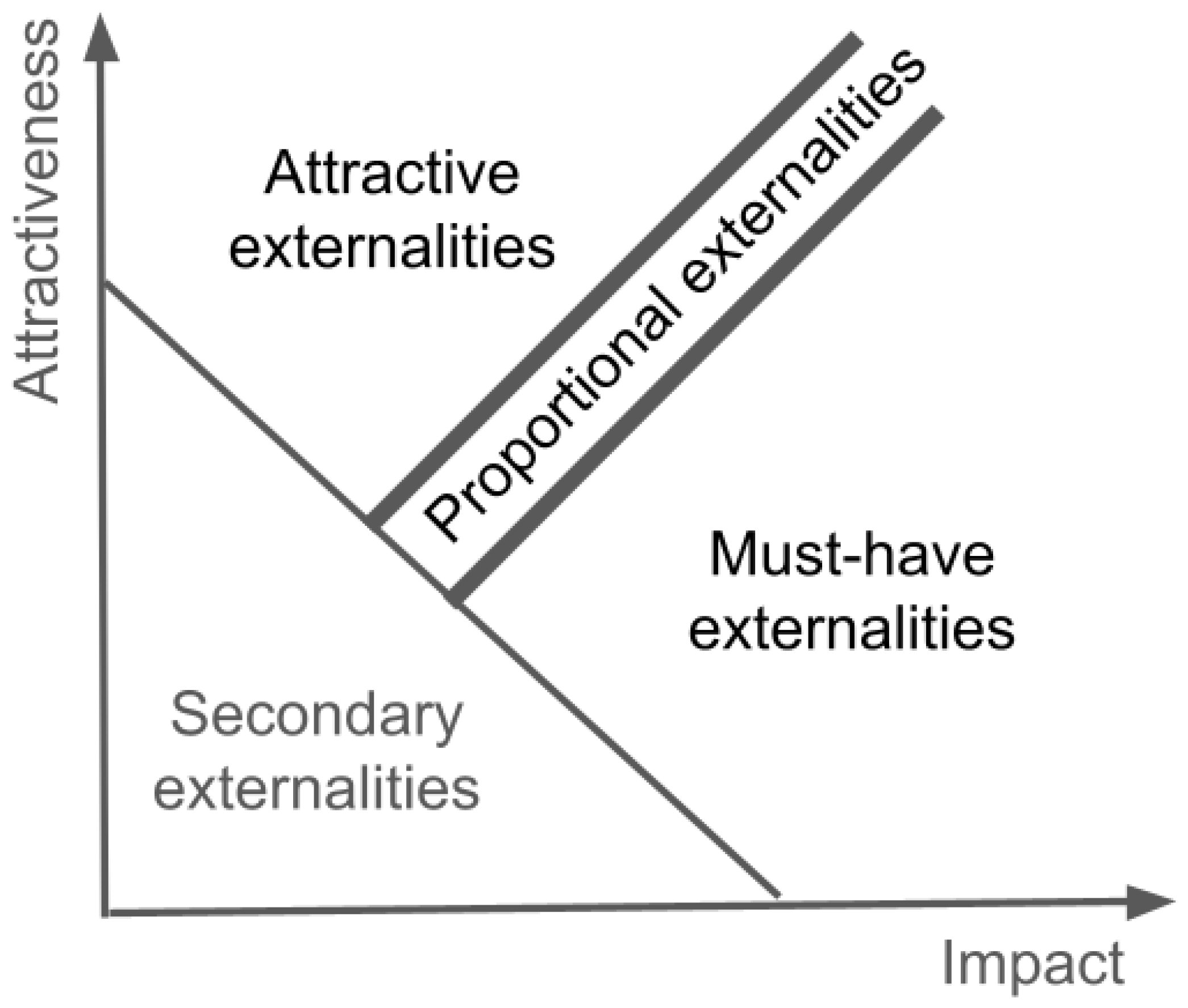
In a second sequence, the pairs of impact and perceived attractiveness are plotted on an adapted Kano matrix. The Kano model was originally developed in quality management to classify attributes according to their perceived impact. In this study, its logic was adapted as a perceptive mapping tool to position externalities along the dimensions of impact and perceived attractiveness [37,38]. This mapping makes it possible to identify externalities associated with indicators that can be monitored, turning perception into a basis for action and follow-up.
To achieve this, a first regression line provides a neutral mathematical reference against which the externalities can be positioned. During the workshop, participants then select two representative externalities, supported by reliable indicators and located close to the regression line, to serve as anchor points.
By connecting these anchors with the regression line, a corridor emerges, defining a plausible zone of proportionality. When participants collectively agree that this corridor includes externalities that can be monitored and managed through project indicators, it becomes the royal path, distinguishing four categories of externalities (Figure 2).
| Illustration 3—Perceptive mapping: Fair Trade Fair Trade [39,40] illustrates perceptive mapping: the minimum price acts as a must-be condition ensuring credibility, while the development premium and ethical recognition serve as attractive attributes motivating both producers and consumers. |
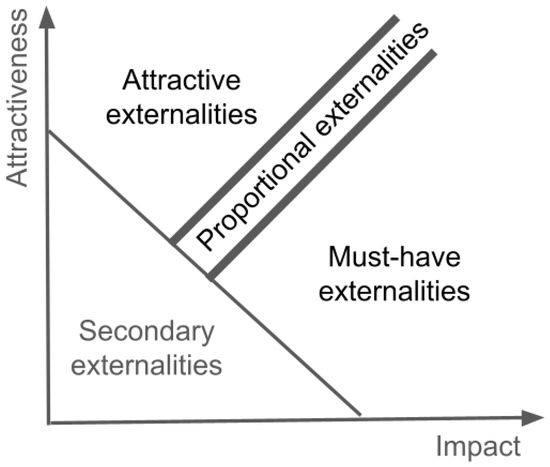
Figure 2.
Schematic representation of the adapted Kano matrix and the royal path, positioning the externalities.
3.6. From Perceptive Mapping to Strategic Orientation
Phase 4 translates the outputs of the perceptive mapping into strategic orientations that can inform governance, partnerships, and project steering. This phase focuses on structuring the results of the identification process in a form that is directly usable by project stakeholders.
At this stage, the consolidated set of externalities is connected to concrete areas of action by identifying potential levers related to governance arrangements, coordination mechanisms, and implementation priorities. The objective is not to evaluate or prioritize externalities, but to clarify how recognized externalities can be articulated with strategic decision-making processes.
Within the PART’Extern framework, externalities are progressively structured through a coherent process that moves from collective identification to strategic orientation. The originality of the framework lies not in the individual tools it mobilizes, but in their articulation within a single, integrated logic that enables this transition.
The outcome of this phase is the development of strategic roadmaps, which synthesize the identified externalities and articulate actionable orientations for different categories of actors. These roadmaps constitute the main output of the methodology and provide the entry point for the empirical results presented in the following section.
4. Results
The two applications presented below correspond to distinct empirical regimes: PART’Ener reflects an emergent and iterative in vivo application, while the Prix des Plurielles illustrates a more exploratory and strategic use of the framework.
Accordingly, transferability is understood here as the reproducibility of the methodological process, rather than as the replication of empirical results.
4.1. Experimental Context: PART’Ener Project Support by SeinergyLab
The experiment was conducted within SeinergyLab, an innovation hub dedicated to in situ testing for the energy transition and sustainable urban systems. This collaborative ecosystem brings together local authorities, companies, citizens, and experts with a long-standing culture of multi-actor cooperation, providing an enabling environment for participatory experimentation.
Located in the Grand Paris Seine & Oise territory (France), SeinergyLab hosts the PART’Ener project, which deploys urban photovoltaic canopies (100–300 kWp) through a co-investment and co-governance model shared by municipalities, businesses, and citizens. The electricity produced is fully self-consumed within the local community, contributing to local energy autonomy and stakeholder engagement.
4.2. Participants: Involvement and Engagement
For this experiment, participants belonged to the “Who Makes” category, including representatives of local authorities, companies, and operators directly involved in the PART’Ener project. Their participation reflected an operational focus, with actors engaged in project implementation and day-to-day operation contributing throughout the identification process.
4.3. Normative Identification Results for the PART’Ener Case
Out of the 169 SDG targets, 18 positive externalities (≈11%) were retained after applying the 5 C criteria. These externalities mainly clustered around seven key SDGs (7, 8, 9, 11, 12, 16, and 17), which accounted for nearly 85% of the results, as shown in Table 1.

Table 1.
Illustrative correspondences between the SDG targets and externalities identified for the PART’Ener project. Short titles correspond to official SDG target formulations, adapted for readability. Full descriptions are available in Resolution A/RES/70/1.
Among the retained externalities, those related to transparency, participation, and partnership represent nearly one third of the total. This distribution highlights the prominence of governance- and coordination-related externalities within the PART’Ener project.
4.4. Enrichment and Validation Through Participatory Workshops
4.4.1. Participatory for Free Identification of Externalities
During the participatory workshops, stakeholders identified 36 externalities associated with the PART’Ener project, which were subsequently refined to 20 plausible positive externalities after applying the C1–C5 criteria.
These externalities extend beyond those identified through the SDG-based mapping and include social and territorial externalities such as collective pride, shared learning, and local recognition. As illustrated in Table 2, expressions range from concrete outcomes, such as the reduction in unpaid electricity bills, to more aspirational formulations related to contribution to the common good.
Table 2.
Representative externalities identified during the workshops.
The diversity of identified externalities reflects differing expectations regarding value creation. Some participants emphasized collective engagement, cooperation, and local dynamics, while others focused on technical performance or economic externalities.
References to shared objectives, project feasibility, and collective success were recurrent during the workshops, indicating the presence of common frames of interpretation among participants.
4.4.2. Consolidation with Normative Identification
The externalities identified through the normative and participatory phases were consolidated into a unified set of 28 items. Overlapping or closely related formulations were merged, and externalities were classified according to their origin:
SDG only: ≈30%;
SDG + workshops: ≈30%;
Workshops only: ≈40%.
This distribution highlights the complementarity between normative and participatory identification processes.
4.5. Perceptive Mapping
4.5.1. Rating, Royal Path, and Kano Categorization
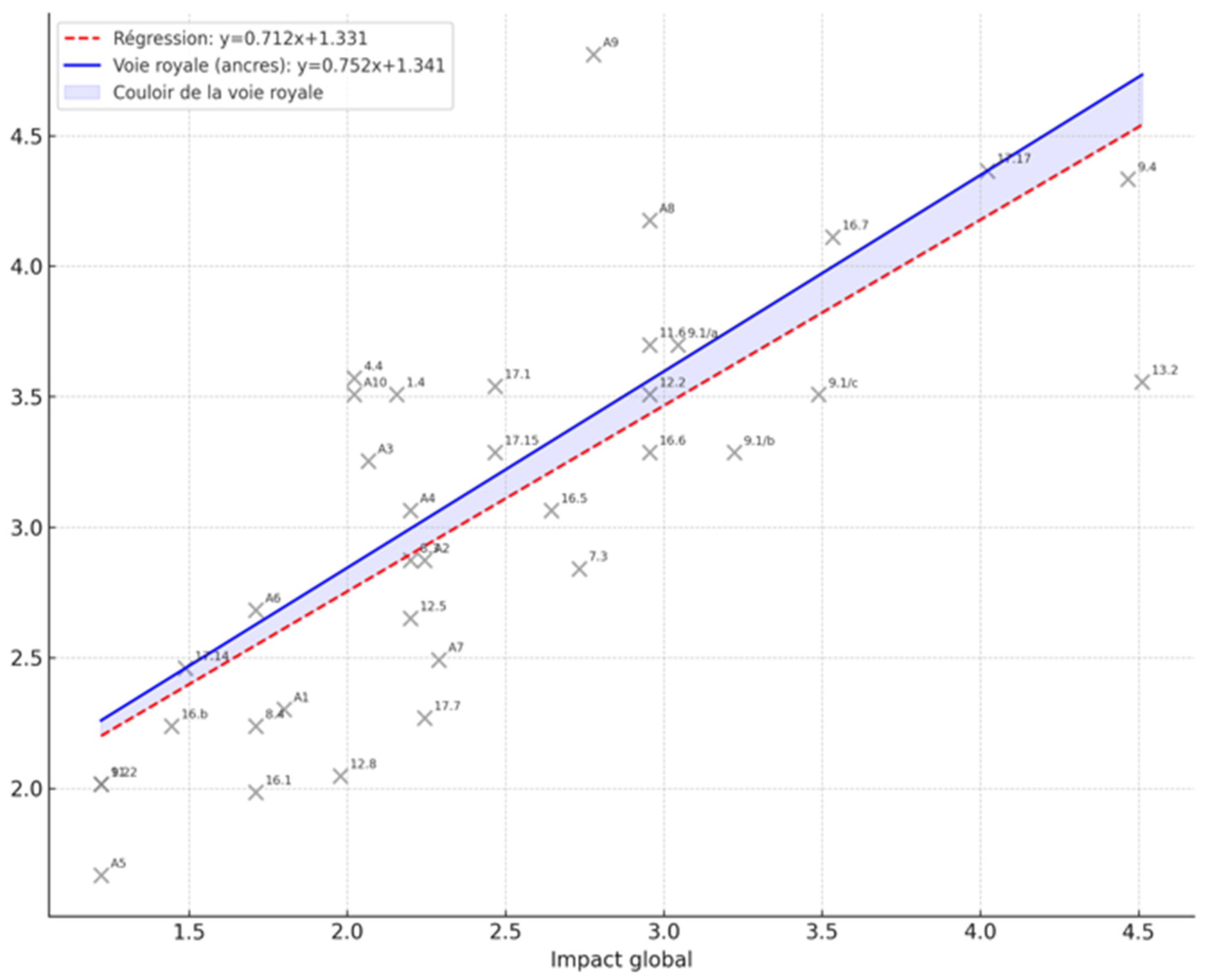
The consolidated externalities were positioned along the two dimensions of impact and perceived attractiveness. Through this positioning, participants co-constructed a “royal path” based on the linear regression of the scores.
Two representative externalities were selected as anchor points:
- CSR image (lower–medium anchor): a private good (in line with standard economic classifications, goods are commonly distinguished as private goods, club goods, common goods, and public goods [41,42]) carrying strategic value for the enterprises;
- Multi-stakeholder partnerships (upper anchor): a club good consistent with PART’Ener’s collaborative orientation.
The close alignment between the regression and anchor lines indicates a strong internal coherence, as illustrated in Figure 3.
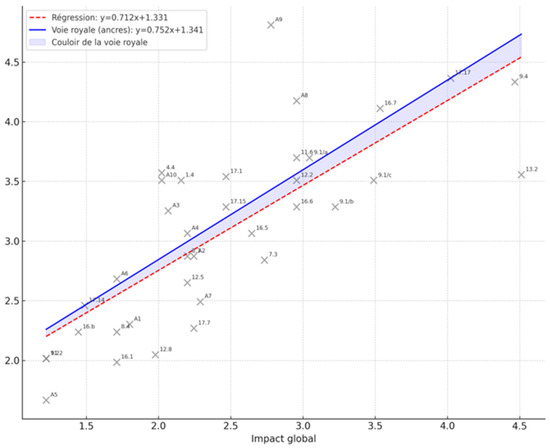
Figure 3.
Scatter plot of impact vs. attractiveness showing the regression line, anchor line, and the royal path.
Regression equation: Attractiveness = 0.683 × Impact + 1.418 (R2 = 0.69);
Anchor line: Attractiveness = 0.728 × Impact + 1.437;
Angular deviation ≈ 1.7°; RMSE ≈ 0.54.
4.5.2. Distribution of Externalities Across Perceptive Categories
A cross-reading of the perceptive categories showed distinct distributions when results are viewed by origin (normative vs. participatory) and by the typology of goods.
Externalities identified through the SDG framework were mostly classified as must-be (around three-quarters of the cases). Conversely, those emerging from participatory workshops were mainly classified as attractive, representing about half of the identified items.
When examined through the typology of goods, public and common goods were mostly linked to must-be externalities in about two-thirds of the cases. Club goods were more frequently associated with attractive externalities, representing nearly half of the cases.
4.5.3. Robustness Tests Across Alternative Configurations
The stability of the observed structures was examined through three alternative configurations of the perceptive mapping.
When impact was combined with importance, the resulting distribution showed a strong correlation (R2 ≈ 0.9) between the two dimensions, leading to limited differentiation among externalities. Using impact and perceived attractiveness resulted in a lower correlation (R2 ≈ 0.5), producing a more contrasted distribution of externalities across the matrix.
Additional configurations were explored by varying the weighting of impact and attractiveness sub-criteria (from 1 to 3). Across these variations, the overall structure remained stable, with 72% of items maintaining the same position. Observed shifts were limited and primarily affected externalities located near category boundaries.
Finally, alternative pairs of anchor pairs were used to define the royal path. In these configurations, the resulting positioning was closely aligned with the main regression, with only minor deviations observed near the corridor.
4.6. Strategic Roadmap for PART’Ener
The application of the PART’Extern framework resulted in the development of a strategic roadmap for the PART’Ener project, co-developed with key stakeholders. This roadmap translates the consolidated set of identified externalities into a structured set of strategic orientations and is summarized in Box 1.
The roadmap addresses issues related to the long-term viability of local self-consumption communities, territorial anchoring, and potential replication at the regional level. It provides a synthesis of how different externalities can be mobilized to support these objectives.
The roadmap is organized around the main stakeholder categories of the PART’Ener ecosystem: enterprises, the PART’Ener community, energy operators, and public authorities. For each category, it highlights a representative positive externality with potential for institutional or financial recognition.
The resulting strategic orientations articulate how perceived externalities are progressively translated into acknowledged value and, subsequently, into implementation mechanisms for each stakeholder category.
Box 1. PART’Ener—Strategic roadmap.
Enterprises—Strengthen investment attractiveness to engage local companies as co-investors or funding partners
CSR visibility and investment attractiveness reinforce the legitimacy of corporate involvement. Recognition emerges when contributions are aligned with CSR and extra-financial reporting frameworks.
Shared-value contracts and reciprocal partnerships translate this recognition into concrete co-investment and long-term engagement.
PART’Ener Community—Build a cohesive and evolving self-consumption community through shared governance
Multi-stakeholder cooperation and collective learning strengthen internal cohesion. Recognition arises from shared operating rules and a clear division of responsibilities.
Inclusive governance and proximity-based communication anchor this recognition in daily practice and foster long-term engagement.
Energy Operators—Reinforce the project’s economic model by integrating technical value into flexibility markets
Reduced Joule losses, improved grid flexibility, and greater territorial resilience demonstrate tangible technical benefits. Recognition is built when operators and local authorities acknowledge their shared interest.
Cooperative agreements for grid operation, storage, and participation in flexibility markets transform this recognition into operational and financial leverage.
Public Authorities—Enhance financial balance and replicability through carbon-finance mechanisms
Measured CO2 reductions substantiate the project’s contribution to public decarbonization goals. Recognition is strengthened through standardized certification and transparent reporting.
Joining or initiating voluntary carbon-offset programs and regional sustainability initiatives converts this recognition into scalable institutional and financial support.
4.7. Transferability in a Social Innovation Context: The Prix Des Plurielles
In addition to the PART’Ener case, the PART’Extern framework was mobilized in the context of the “Prix des Plurielles” (literally “Award of the Plurals”), a French programme whose name evokes the plurality of women’s voices, experiences, and trajectories, led by the Académie des Plurielles (ADP).
Unlike PART’Ener, this application does not aim to reproduce the full identification protocol, but to explore how the PART’Extern reasoning can inform strategic structuring and high-level roadmap formulation in a social innovation and empowerment context.
Rather than reproducing the full identification process, the approach relied on the core principles of PART’Extern to structure strategic reflection around positive externalities related to inclusion, learning, recognition, and collective capability-building. The resulting analysis supports the development of a consolidated roadmap discussed with the programme’s management and is summarized in Box 2.
The strategic roadmap for ADP is organized around four stakeholder categories specific to the program: enterprises, the Prix des Plurielles community, networks and institutions, and public authorities. It outlines how these actors can be articulated to reinforce the visibility, sustainability, and development of the Award model, as illustrated in the ADP roadmap.
Box 2. Prix des Plurielles—Strategic roadmap.
Enterprises—Support women’s professional advancement by reinforcing leadership and visibility
Greater confidence, leadership skills, and role-model visibility foster professional progression. Recognition emerges when organizations embed gender-equality and well-being principles into internal policies.
Tailored mentoring and training programs translate these commitments into concrete pathways for leadership development.
Award community—Strengthen the Award as a network of mutual support and collective learning
Mutual learning, solidarity, and belonging reinforce the community’s identity. Recognition comes from valuing participation and structuring open governance with clearly defined roles.
Cross-mentoring sessions and participatory events operationalize this recognition and encourage long-term engagement.
Networks & Institutions—Develop women’s skills and leadership as a shared resource
Collective competence grows when diverse institutions acknowledge women’s development as a common good. Recognition emerges through multi-actor workshops uniting public and private partners.
Leadership programs and awards supported by hybrid funding disseminate these practices and strengthen institutional anchoring.
Public Authorities—Reinforce institutional legitimacy by aligning the Award with equality and inclusion policies
Gender equality and social inclusion create public value when visibly demonstrated and supported. Recognition is consolidated through alignment with national and local equality frameworks.
Reports, testimonials, and methodological guides disseminate impacts and shared learning, turning recognition into durable legitimacy.
5. Discussion
5.1. Cross-Case Insights: What the Dual Application Reveals About Recognition Systems
The two experiments of PART’Extern (PART’Ener, a technical energy project, and the Prix des Plurielles (ADP), a social empowerment program) offer a sharp contrast. However, both show that externalities are not fixed attributes but collective constructions, shaped through participation, institutional anchoring, and shared interpretation.
Across these very different contexts, three transversal insights emerged. Taken together, they suggest that PART’Extern functions not only as an identification protocol but as a broader framework supporting collective sense-making and coordinated action across different contexts. These insights should be read as indicative rather than conclusive, supporting the validation of the framework at a design-science level rather than constituting empirical generalization.
First, perceptive mapping behaves consistently across domains. Technical externalities in PART’Ener and social externalities in ADP were both sorted into must-be (legitimacy conditions), proportional (monitoring anchors), and attractive (engagement levers). This convergence suggests that perception plays a structuring role in how externalities acquire collective relevance, regardless of whether the system is technical or human-centered.
Second, the typology of goods provides a stable architecture for organizing heterogeneous externalities. In PART’Ener, it clarified how value flows between enterprises, operators, communities, and public authorities. In ADP, it helped structure externalities across enterprises, award communities, institutional networks, and public actors. In both settings, the typology exposes who creates value, who benefits from it, and which coordination mechanisms make it actionable.
Third, the strategic roadmaps illustrate how the identification of externalities can be translated into a shared and actionable representation for project stakeholders. In both PART’Ener and ADP, the roadmap format connects perceived externalities to possible levers for institutional uptake and practical implementation, thereby helping clarify roles, priorities, and coordination points across actor groups.
5.2. Theoretical and Operational Perspectives
5.2.1. Integrating Negative Externalities
In some projects (particularly those involving pollution, land-use change, or social inequality), negative externalities naturally constitute the initial entry point for analysis. In contrast, the PART’Extern experiments presented here deliberately focused on positive externalities. This was not a form of avoidance but a strategic choice.
Existing research on decision-making shows that loss-oriented framing tends to trigger defensive reactions and risk-averse behaviors, whereas opportunity-oriented framing fosters openness, cooperation, and collective engagement [43,44].
Approaching sensitive issues through the lens of positive transformation (health improvement, regeneration, or inclusion) therefore creates more constructive conditions for dialogue, particularly in multi-actor settings where trust and legitimacy must be built.
Rather than avoiding negative externalities, the approach embeds them within a shared trajectory of improvement. This framing enables the recognition of shared risks alongside shared benefits. Positive and negative externalities thus emerge as two orientations of a single collective learning process, grounded in the same participatory and institutional dynamics.
5.2.2. Modeling Causal Chain
Energy-related externalities rarely arise from linear cause-and-effect relationships but from complex chains of interaction where technical, institutional, and social dynamics reinforce or offset one another.
Understanding these indirect processes requires analytical tools that capture interdependence and feedback loops, extending the perceptive logic of the adapted Kano model toward systemic modeling.
Two complementary approaches could strengthen the framework:
- Bayesian networks [45,46], which formalize probabilistic dependencies and reveal causal pathways, and
- System dynamics [47], which simulate feedback loops and adaptive behavior over time.
5.2.3. Toward an Integrated Decision-Support Tool
A digital adaptation of the protocol is underway to broaden its dissemination and usability. Core operations (data collection, scoring, consolidation, and feedback) can already be streamlined or automated through collaborative platforms and interactive interfaces.
Beyond efficiency gains, digital integration will allow for embedding analytical modules (Bayesian or dynamic modeling) within participatory workflows, linking perception-based assessment with systemic simulation.
This evolution opens the possibility of a semi-automated platform assisting local authorities, consultancies, and project operators in identifying externalities with full transparency and traceability. Ultimately, it enhances both accessibility and robustness, providing a practical pathway for large-scale deployment.
5.2.4. Conditions of Effectiveness and Implementation Considerations
The effectiveness of the PART’Extern framework depends less on sectoral characteristics or project scale than on a set of enabling conditions for collective identification and interpretation. These include a minimum institutional capacity to convene stakeholders, the existence of arenas for dialogue, and a willingness among participants to engage in shared reflection. Under such conditions, the framework helps structure collective understanding and align perceptions without requiring full consensus.
Importantly, these conditions are not framed as strict prerequisites. PART’Extern is designed to operate under partial participation, asymmetrical information, and even resistance. Rather than eliminating these constraints, the framework makes them visible and manageable through a structured process that supports collective clarification and coordination.
From an implementation perspective, the main challenges relate to coordination effort, facilitation, and appropriation by users. The framework is not intended to function as a self-standing technical tool. Its effective deployment benefits from methodological guidance and learning-oriented formats that support progressive appropriation, such as facilitated workshops, training sessions, or guided applications.
5.3. From Identification to Valuation
While this study focused on the identification of externalities and the coordination mechanisms that give them legitimacy, it also clarifies the conditions under which these externalities may later be valued. Identification allows externalities to be named, understood, and collectively acknowledged, creating a stable foundation for any subsequent assessment.
Introducing monetary valuation too early would bias perceptions toward short-term financial metrics such as Internal Rate of Return (IRR) or Cost–Benefit Analysis (CBA), masking social, territorial, or institutional value. In contrast, the PART’Extern framework deliberately separates identification from valuation in order to preserve participatory dynamics and avoid premature economic framing.
In this sense, PART’Extern can be understood as a pre-valuation framework: it does not monetize externalities but clarifies when and how value becomes legitimate, before any financial conversion. Future work may build on this foundation by examining how identified and collectively acknowledged externalities could inform subsequent approaches to risk reduction and resilience-building in long-term investment contexts.
6. Conclusions
This paper has addressed the challenge of identifying positive externalities in collective socio-ecological transition projects, where value creation extends beyond technical or financial outputs. Through the PART’Extern framework, it shows how normative and participatory identification processes can make such externalities explicit, discussable, and actionable for diverse stakeholders.
The application of PART’Extern in two contrasting contexts (an energy self-consumption project and a social empowerment program) illustrates how externalities can be articulated as shared reference points for collective strategic action. Rather than treating externalities as marginal co-benefits, the framework supports their consideration as structuring elements for coordination, legitimacy, and long-term project consolidation.
The main contribution of this work lies in proposing a methodological approach that links identification to collective decision-making without conflating it with valuation. This separation is intentional: it preserves the integrity of participatory dynamics and avoids premature financial framing that could bias collective recognition.
More broadly, this work suggests that externalities can function as collective compasses, helping actors clarify what matters, what mobilizes engagement, and what deserves to be carried forward. Recognizing these externalities is therefore not a technical add-on, but a condition for legitimacy and coordinated action in complex transition processes.
Future research may build on this contribution by exploring how identified and collectively acknowledged externalities could inform subsequent assessment and valuation processes, particularly in relation to risk reduction and resilience-building.
Author Contributions
Conceptualization, P.A.; methodology, P.A.; software, P.A.; validation, M.-G.M., M.R. and R.A.; formal analysis, M.-G.M. and M.R.; investigation, M.-G.M. and M.R.; resources, M.-G.M. and M.R.; data curation, M.-G.M. and M.R.; writing—original draft preparation, P.A.; writing—review and editing, P.A., M.-G.M., M.R. and R.A.; visualization, P.A.; supervision, M.-G.M. and R.A.; project administration, R.A.; funding acquisition, P.A., M.-G.M. and R.A. All authors have read and agreed to the published version of the manuscript.
Funding
This research was funded by the French Agency for Ecological Transition (ADEME), grant number 22ESD0047. The Article Processing Charge (APC) was waived by the publisher through a voucher.
Institutional Review Board Statement
Not applicable.
Informed Consent Statement
Not applicable.
Data Availability Statement
The data presented in this study are not publicly available due to confidentiality and ethical restrictions related to participatory workshops and organizational contexts.
Acknowledgments
This study was carried out as part of the PART’Extern project with financial support from ADEME (the French Environment and Energy Management Agency) and as part of the ENERCOM/“Energie en commun” research call, co-led by PUCA (Plan Urbanisme Construction Architecture) and ADEME. The analyses and results presented are the sole responsibility of the authors. The authors also thank the many stakeholders and experts who contributed to discussions and feedback throughout the project.
Conflicts of Interest
The authors declare no conflict of interest.
References
- Geels, F.W. Socio-technical transitions to sustainability: A review of criticisms and elaborations of the multi-level perspective. Curr. Opin. Environ. Sustain. 2019, 39, 187–201. [Google Scholar] [CrossRef]
- Markard, J.; Geels, F.W.; Raven, R. Challenges in the acceleration of sustainability transitions. Environ. Res. Lett. 2020, 15, 081001. [Google Scholar] [CrossRef]
- Avelino, F.; Wittmayer, J.M. Shifting power relations in sustainability transitions: A multi-actor perspective. J. Environ. Policy Plan. 2016, 18, 628–649. [Google Scholar] [CrossRef]
- Meadowcroft, J. What about the politics? Sustainable development, transition management, and long term energy transitions. Policy Sci. 2009, 42, 323–340. [Google Scholar] [CrossRef]
- Walker, G.; Devine-Wright, P. Community and decentralised energy: Emotions, identity and public engagement. Energy Policy 2008, 36, 497–500. [Google Scholar]
- Van den Bergh, J. Climate Policy Versus Growth Concerns: Suggestions for Economic Research and Communication. J. Behav. Exp. Econ. 2023, 107, 102125. [Google Scholar] [CrossRef]
- Flammer, C. Green bonds: Effectiveness and Implications for Public Policy. Environ. Energy Policy Econ. 2021, 2, 29–64. [Google Scholar]
- European Commission. The Just Transition Mechanism: Ensuring No One Is Left Behind; COM(2020) 22 Final; European Commission: Brussels, Belgium, 2020. [Google Scholar]
- Fiorino, D.J. Explaining the European Green Deal: Multi-level governance, participation, and social justice. Environ. Politics 2020, 29, 389–407. [Google Scholar]
- Jenkins, K.; McCauley, D.; Heffron, R.; Stephan, H.; Rehner, R. Energy justice: A conceptual review. Energy Res. Soc. Sci. 2016, 11, 174–182. [Google Scholar] [CrossRef]
- Sovacool, B.K.; Burke, M.; Baker, L.; Kotikalapudi, C.K.; Wlokas, H. New frontiers and conceptual frameworks for energy justice. Energy Policy 2017, 105, 677–691. [Google Scholar] [CrossRef]
- Ürge-Vorsatz, D.; Herrero, S.T.; Dubash, N.K.; Lecocq, F. Measuring the Co-Benefits of Climate Change Mitigation. Annu. Rev. Environ. Resour. 2014, 39, 549–582. [Google Scholar] [CrossRef]
- Gillingham, K.; Newell, R.G.; Palmer, K. Energy efficiency economics and policy. Annu. Rev. Resour. Econ. 2017, 9, 597–620. [Google Scholar]
- Scitovsky, T. Two Concepts of External Economies. J. Polit. Econ. 1954, 62, 143–151. [Google Scholar] [CrossRef]
- Coase, R.H. The Problem of Social Cost. J. Law Econ. 1960, 3, 1–44. [Google Scholar] [CrossRef]
- Ostrom, E. Governing the Commons: The Evolution of Institutions for Collective Action; Cambridge University Press: Cambridge, UK, 1990. [Google Scholar]
- Ferreira, E.; Sequeira, M.M.; Gouveia, J.P. Sharing Is Caring: Exploring Distributed Solar Photovoltaics and Local Electricity Consumption through a Renewable Energy Community. Sustainability 2024, 16, 2777. [Google Scholar] [CrossRef]
- Abadeço, M.; Rodrigues, M.J.; Ferrão, P.; Luz, G.; Freitas, S.; Brito, M.C. Solar Self-Consumption and Urban Energy Vulnerability: Case Study in Lisbon. Sustainability 2024, 16, 6635. [Google Scholar] [CrossRef]
- Stiglitz, J.E.; Sen, A.; Fitoussi, J.-P. Report by the Commission on the Measurement of Economic Performance and Social Progress; European Commission: Brussels, Belgium, 2009. [Google Scholar]
- Raworth, K. Doughnut Economics: Seven Ways to Think Like a 21st-Century Economist; Random House: London, UK, 2017. [Google Scholar]
- Habermas, J. The Theory of Communicative Action; Beacon Press: Boston, MA, USA, 1984. [Google Scholar]
- Reed, M.S. Stakeholder Participation for Environmental Management: A Literature Review. Biol. Conserv. 2008, 141, 2417–2431. [Google Scholar] [CrossRef]
- Sen, A. Development as Freedom; Oxford University Press: Oxford, UK, 1999. [Google Scholar]
- Pfeffer, J. Power in Organizations; Pitman: Marshfield, MA, USA, 1981. [Google Scholar]
- Argyris, C. Overcoming Organizational Defenses: Facilitating Organizational Learning; Allyn & Bacon: Boston, MA, USA, 1990. [Google Scholar]
- Samuelson, W.; Zeckhauser, R. Status Quo Bias in Decision Making. J. Risk Uncertain. 1988, 1, 7–59. [Google Scholar] [CrossRef]
- Kahneman, D.; Knetsch, J.L.; Thaler, R.H. Anomalies: The Endowment Effect, Loss Aversion, and Status Quo Bias. J. Econ. Perspect. 1991, 5, 193–206. [Google Scholar] [CrossRef]
- Morin, E. La Méthode, Tome 1: La Nature de la Nature; Seuil: Paris, France, 1977. [Google Scholar]
- United Nations. Transforming our World: The 2030 Agenda for Sustainable Development; A/RES/70/1; United Nations: Manhattan, NY, USA, 2015. [Google Scholar]
- Breuer, A.; Janetschek, H.; Malerba, D. (Eds.) Governing the SDGs: Interlinkages, Integration, and Implementation; Springer: Cham, Switzerland, 2023. [Google Scholar]
- Allen, C.; Metternicht, G.; Wiedmann, T. Initial Prioritization of SDG Targets for Australia: A Methodology Using a Systems Approach. Sustain. Sci. 2018, 13, 461–481. [Google Scholar]
- Nilsson, M.; Griggs, D.; Visbeck, M. Policy: Map the Interactions between Sustainable Development Goals. Nature 2016, 534, 320–322. [Google Scholar] [CrossRef]
- Warner, M.E. Private finance for public goods: Social impact bonds. J. Econ. Policy Reform 2013, 16, 303–319. [Google Scholar] [CrossRef]
- Fraser, A.; Tan, S.; Lagarde, M.; Mays, N. Narratives of Promise, Narratives of Caution: A Review of the Literature on Social Impact Bonds. Soc. Policy Adm. 2018, 52, 4–28. [Google Scholar] [CrossRef]
- Pagiola, S. Payments for Environmental Services in Costa Rica. Ecol. Econ. 2008, 65, 712–724. [Google Scholar] [CrossRef]
- Daniels, A.E.; Bagstad, K.; Esposito, V.; Moulaert, A.; Rodriguez, C.M. Understanding the impacts of Costa Rica’s PES: Are we asking the right questions? Ecol. Econ. 2010, 69, 2116–2126. [Google Scholar] [CrossRef]
- Kano, N.; Seraku, N.; Takahashi, F.; Tsuji, S. Attractive Quality and Must-Be Quality. J. Jpn. Soc. Qual. Control 1984, 41, 39–48. [Google Scholar]
- Berger, C.; Blauth, R.; Boger, D.; Bolster, C.; Burchill, G.; DuMouchel, W.; Pouliot, F.; Richter, R.; Rubinoff, A.; Shen, D.; et al. Kano’s Methods for Understanding Customer-Defined Quality. Cent. Qual. Manag. J. 1993, 4, 3–36. [Google Scholar]
- Raynolds, L.T.; Murray, D.; Heller, A. Regulating sustainability in the coffee sector: A comparative analysis of third-party environmental and social certification initiatives. Agric. Hum. Values 2007, 24, 147–163. [Google Scholar] [CrossRef]
- Dragusanu, R.; Giovannucci, D.; Nunn, N. The Economics of Fair Trade. J. Econ. Perspect. 2014, 28, 217–236. [Google Scholar] [CrossRef]
- Samuelson, P.A. The Pure Theory of Public Expenditure. Rev. Econ. Stat. 1954, 36, 387–389. [Google Scholar] [CrossRef]
- Valiorgue, B. Actions Collectives et Traitement des Externalités Négatives; Business administration; Université Clermont Auvergne (UCA): Clermont-Ferrand, France, 2016. [Google Scholar]
- Kahneman, D.; Tversky, A. Prospect Theory: An Analysis of Decision under Risk. Econometrica 1979, 47, 263–291. [Google Scholar] [CrossRef]
- Tversky, A.; Kahneman, D. The Framing of Decisions and the Psychology of Choice. Science 1981, 211, 453–458. [Google Scholar] [CrossRef] [PubMed]
- Naïm, P.; Wuillemin, P.-H.; Leray, P.; Pourret, O.; Becker, A. Réseaux Bayésiens; Eyrolles: Paris, France, 2004. [Google Scholar]
- Pearl, J. Causality: Models, Reasoning, and Inference, 2nd ed.; Cambridge University Press: Cambridge, UK, 2009. [Google Scholar]
- Forrester, J.W. Industrial Dynamics; MIT Press: Cambridge, MA, USA, 1961. [Google Scholar]
Disclaimer/Publisher’s Note: The statements, opinions and data contained in all publications are solely those of the individual author(s) and contributor(s) and not of MDPI and/or the editor(s). MDPI and/or the editor(s) disclaim responsibility for any injury to people or property resulting from any ideas, methods, instructions or products referred to in the content. |
© 2026 by the authors. Licensee MDPI, Basel, Switzerland. This article is an open access article distributed under the terms and conditions of the Creative Commons Attribution (CC BY) license.