Revealing Hidden Externalities for Collective Strategic Action


Abstract
1. Introduction
2. Conceptual Basis for the Methodological Framework
2.1. Why Positive Externalities Are Difficult to Identify
2.2. Recognition Comes Before Valuation
2.3. Perceptions, Meaning, and Resistance
2.4. The Role of Normative References
2.5. Consequences for Methodological Design
3. Methodology
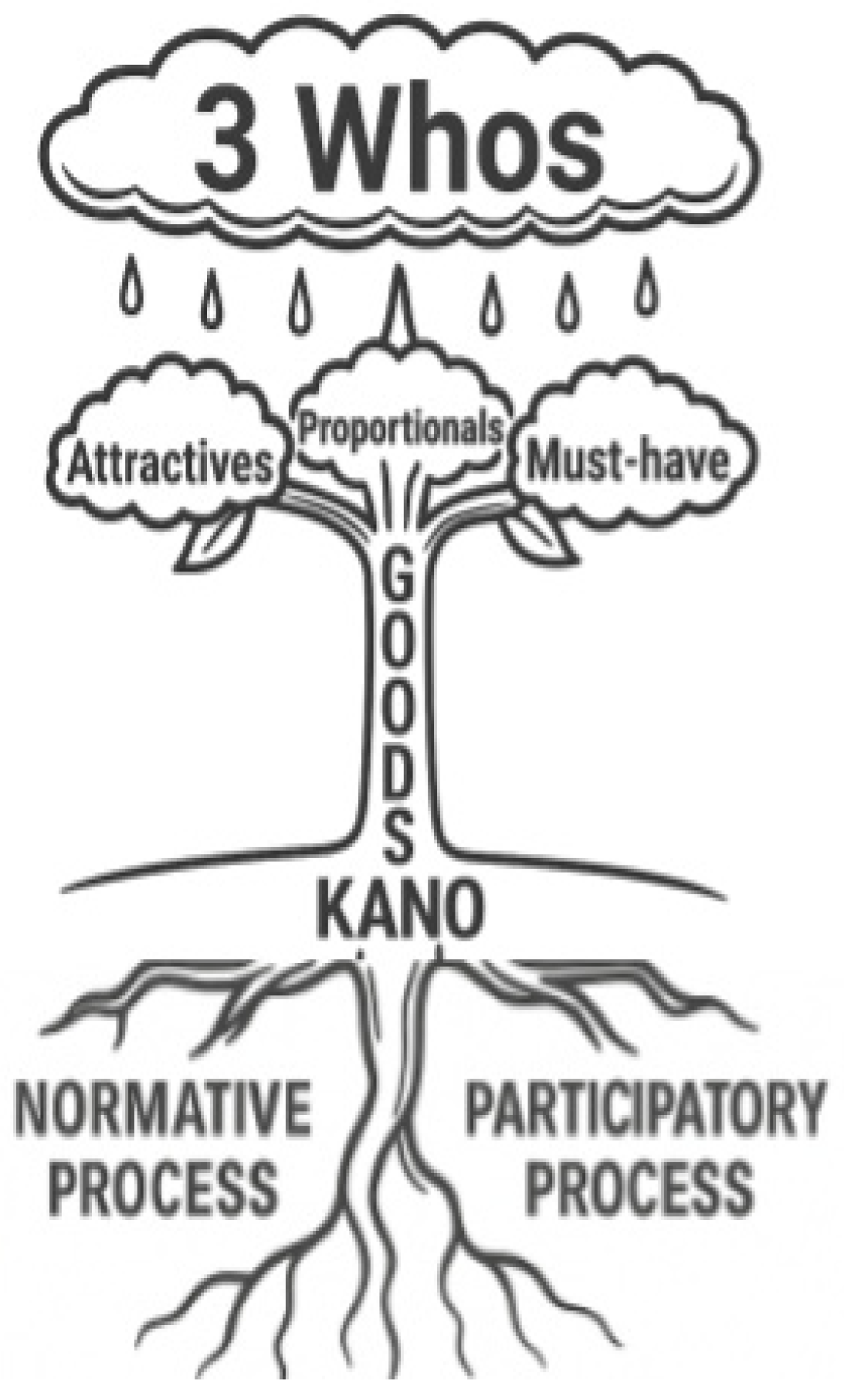
3.1. Tree’s Structure
- Phase 1—Normative identification, anchored in the Sustainable Development Goals;
- Phase 2—Participatory enrichment, involving multi-actor dialogue;
- Phase 3—Perceptive mapping, based on the adapted Kano matrix;
- Phase 4—Strategic action plan, linking results to governance.
3.2. Composition of the Working Group: The 3 Whos Principles
| Illustration 1—the British Social Impact Bonds These instruments [33,34] show how to distinguish the 3 Whos. The reduction in long-term unemployment, for instance, is financed because the State (Who governs) rewards results achieved by social operators (Who does) and experienced by beneficiaries (Who benefits). |
3.3. Normative Identification Through the Sustainable Development Goals
- C1—Coherence: the externality must fall within the project’s legitimate sphere of influence.
- C2—Causality: a clear link must connect the project to the expected externality through identifiable levers.
- C3—Complementarity: only externality not already internalized in financial or contractual results are considered.
- C4—Conditions: the regulatory, technical, or organizational prerequisites for the externality must be specified.
- C5—Measurability: each externality must have an observable indicator for monitoring over time.
| Illustration 2—Costa Rica’s Payment for Environmental Services Program This example [35,36] shows how the 5 Cs guides the structured recognition of externalities. C1: Legitimacy ensured by the direct involvement of participating farmers. C2: Forest protection improves water regulation and carbon storage C3: Additionality is guaranteed through a fuel tax that finances the payments. C4: The initiative relies on a solid legal framework and national governance. C5: The chosen indicators (hectares of forest protected) are measurable and verifiable. |
3.4. Enrichment Through Participatory Workshops
3.4.1. Participatory Generation of New Externalities
3.4.2. Collective Validation and Consolidation of Externalities
3.5. Perceptive Mapping Using the Adapted Kano Matrix
3.5.1. Scoring Grid: Impact × Perceived Attractiveness
- Magnitude: the scale of the observable effect;
- Scope: the extent of the population, territory, or systems directly affected;
- Measurability: the degree to which the externality can be tracked through indicators.
- Legitimacy: the alignment with stakeholders’ capacity or mandate to act;
- Diffusion potential: the likelihood of spreading replication beyond the scope;
- Funding appeal: the potential to attract financial or partnership support.
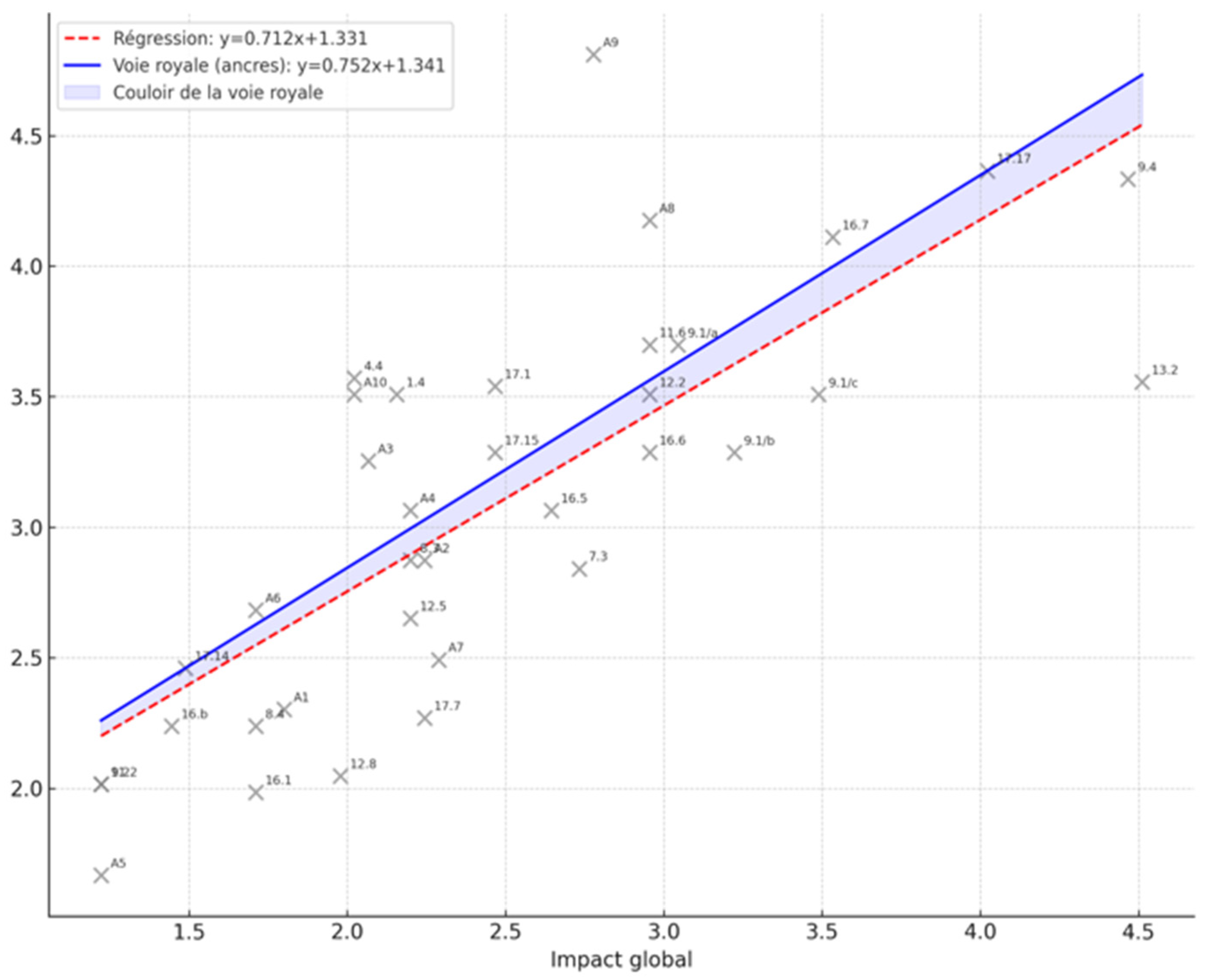
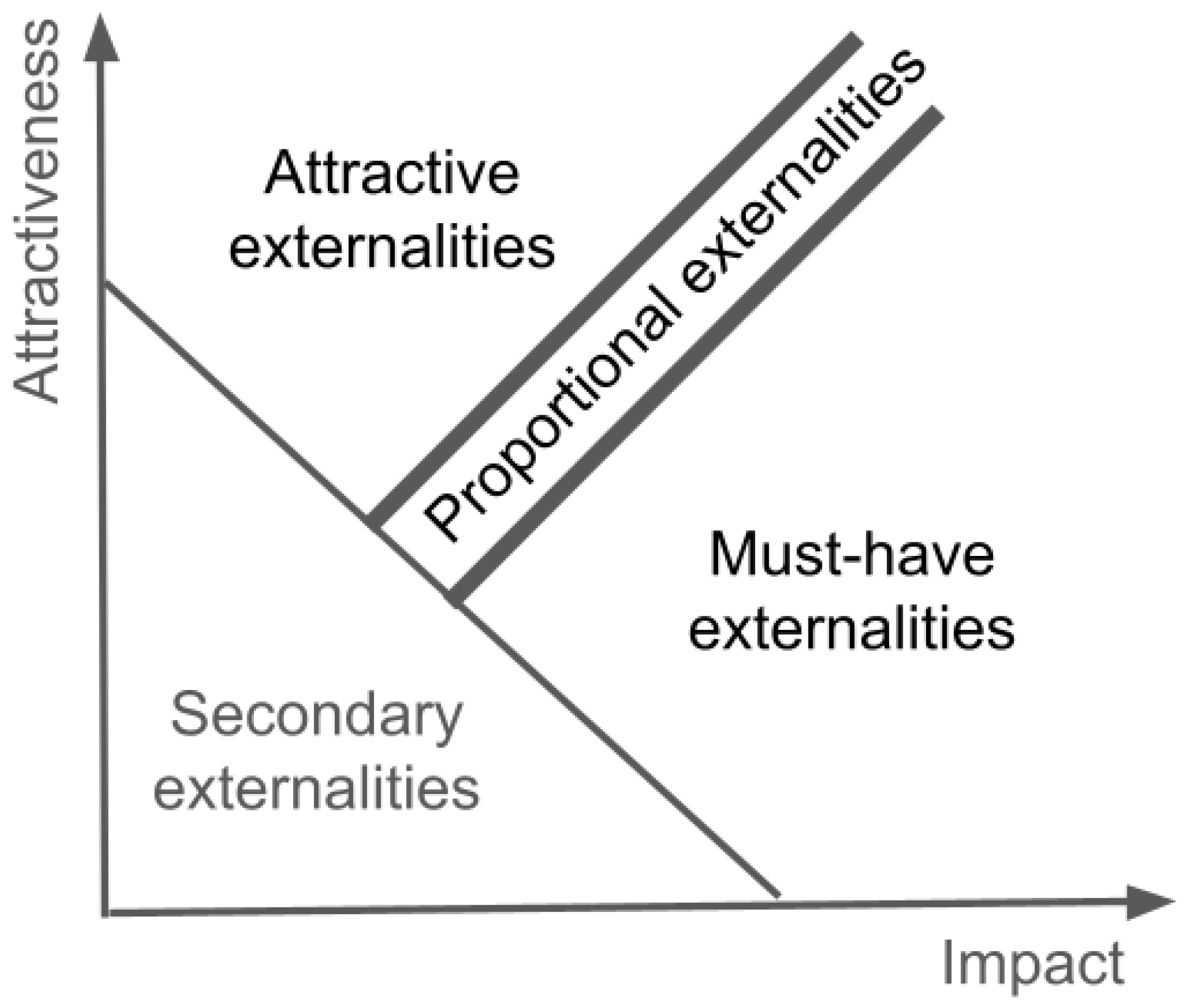
3.5.2. Mapping and Positioning Externalities: The “Royal Path”
| Illustration 3—Perceptive mapping: Fair Trade Fair Trade [39,40] illustrates perceptive mapping: the minimum price acts as a must-be condition ensuring credibility, while the development premium and ethical recognition serve as attractive attributes motivating both producers and consumers. |
3.6. From Perceptive Mapping to Strategic Orientation
4. Results
4.1. Experimental Context: PART’Ener Project Support by SeinergyLab
4.2. Participants: Involvement and Engagement
4.3. Normative Identification Results for the PART’Ener Case
4.4. Enrichment and Validation Through Participatory Workshops
4.4.1. Participatory for Free Identification of Externalities
4.4.2. Consolidation with Normative Identification
4.5. Perceptive Mapping
4.5.1. Rating, Royal Path, and Kano Categorization
- Multi-stakeholder partnerships (upper anchor): a club good consistent with PART’Ener’s collaborative orientation.
4.5.2. Distribution of Externalities Across Perceptive Categories
4.5.3. Robustness Tests Across Alternative Configurations
4.6. Strategic Roadmap for PART’Ener
4.7. Transferability in a Social Innovation Context: The Prix Des Plurielles
5. Discussion
5.1. Cross-Case Insights: What the Dual Application Reveals About Recognition Systems
5.2. Theoretical and Operational Perspectives
5.2.1. Integrating Negative Externalities
5.2.2. Modeling Causal Chain
5.2.3. Toward an Integrated Decision-Support Tool
5.2.4. Conditions of Effectiveness and Implementation Considerations
5.3. From Identification to Valuation
6. Conclusions
Author Contributions
Funding
Institutional Review Board Statement
Informed Consent Statement
Data Availability Statement
Acknowledgments
Conflicts of Interest
References
- Geels, F.W. Socio-technical transitions to sustainability: A review of criticisms and elaborations of the multi-level perspective. Curr. Opin. Environ. Sustain. 2019, 39, 187–201. [Google Scholar] [CrossRef]
- Markard, J.; Geels, F.W.; Raven, R. Challenges in the acceleration of sustainability transitions. Environ. Res. Lett. 2020, 15, 081001. [Google Scholar] [CrossRef]
- Avelino, F.; Wittmayer, J.M. Shifting power relations in sustainability transitions: A multi-actor perspective. J. Environ. Policy Plan. 2016, 18, 628–649. [Google Scholar] [CrossRef]
- Meadowcroft, J. What about the politics? Sustainable development, transition management, and long term energy transitions. Policy Sci. 2009, 42, 323–340. [Google Scholar] [CrossRef]
- Walker, G.; Devine-Wright, P. Community and decentralised energy: Emotions, identity and public engagement. Energy Policy 2008, 36, 497–500. [Google Scholar]
- Van den Bergh, J. Climate Policy Versus Growth Concerns: Suggestions for Economic Research and Communication. J. Behav. Exp. Econ. 2023, 107, 102125. [Google Scholar] [CrossRef]
- Flammer, C. Green bonds: Effectiveness and Implications for Public Policy. Environ. Energy Policy Econ. 2021, 2, 29–64. [Google Scholar]
- European Commission. The Just Transition Mechanism: Ensuring No One Is Left Behind; COM(2020) 22 Final; European Commission: Brussels, Belgium, 2020. [Google Scholar]
- Fiorino, D.J. Explaining the European Green Deal: Multi-level governance, participation, and social justice. Environ. Politics 2020, 29, 389–407. [Google Scholar]
- Jenkins, K.; McCauley, D.; Heffron, R.; Stephan, H.; Rehner, R. Energy justice: A conceptual review. Energy Res. Soc. Sci. 2016, 11, 174–182. [Google Scholar] [CrossRef]
- Sovacool, B.K.; Burke, M.; Baker, L.; Kotikalapudi, C.K.; Wlokas, H. New frontiers and conceptual frameworks for energy justice. Energy Policy 2017, 105, 677–691. [Google Scholar] [CrossRef]
- Ürge-Vorsatz, D.; Herrero, S.T.; Dubash, N.K.; Lecocq, F. Measuring the Co-Benefits of Climate Change Mitigation. Annu. Rev. Environ. Resour. 2014, 39, 549–582. [Google Scholar] [CrossRef]
- Gillingham, K.; Newell, R.G.; Palmer, K. Energy efficiency economics and policy. Annu. Rev. Resour. Econ. 2017, 9, 597–620. [Google Scholar]
- Scitovsky, T. Two Concepts of External Economies. J. Polit. Econ. 1954, 62, 143–151. [Google Scholar] [CrossRef]
- Coase, R.H. The Problem of Social Cost. J. Law Econ. 1960, 3, 1–44. [Google Scholar] [CrossRef]
- Ostrom, E. Governing the Commons: The Evolution of Institutions for Collective Action; Cambridge University Press: Cambridge, UK, 1990. [Google Scholar]
- Ferreira, E.; Sequeira, M.M.; Gouveia, J.P. Sharing Is Caring: Exploring Distributed Solar Photovoltaics and Local Electricity Consumption through a Renewable Energy Community. Sustainability 2024, 16, 2777. [Google Scholar] [CrossRef]
- Abadeço, M.; Rodrigues, M.J.; Ferrão, P.; Luz, G.; Freitas, S.; Brito, M.C. Solar Self-Consumption and Urban Energy Vulnerability: Case Study in Lisbon. Sustainability 2024, 16, 6635. [Google Scholar] [CrossRef]
- Stiglitz, J.E.; Sen, A.; Fitoussi, J.-P. Report by the Commission on the Measurement of Economic Performance and Social Progress; European Commission: Brussels, Belgium, 2009. [Google Scholar]
- Raworth, K. Doughnut Economics: Seven Ways to Think Like a 21st-Century Economist; Random House: London, UK, 2017. [Google Scholar]
- Habermas, J. The Theory of Communicative Action; Beacon Press: Boston, MA, USA, 1984. [Google Scholar]
- Reed, M.S. Stakeholder Participation for Environmental Management: A Literature Review. Biol. Conserv. 2008, 141, 2417–2431. [Google Scholar] [CrossRef]
- Sen, A. Development as Freedom; Oxford University Press: Oxford, UK, 1999. [Google Scholar]
- Pfeffer, J. Power in Organizations; Pitman: Marshfield, MA, USA, 1981. [Google Scholar]
- Argyris, C. Overcoming Organizational Defenses: Facilitating Organizational Learning; Allyn & Bacon: Boston, MA, USA, 1990. [Google Scholar]
- Samuelson, W.; Zeckhauser, R. Status Quo Bias in Decision Making. J. Risk Uncertain. 1988, 1, 7–59. [Google Scholar] [CrossRef]
- Kahneman, D.; Knetsch, J.L.; Thaler, R.H. Anomalies: The Endowment Effect, Loss Aversion, and Status Quo Bias. J. Econ. Perspect. 1991, 5, 193–206. [Google Scholar] [CrossRef]
- Morin, E. La Méthode, Tome 1: La Nature de la Nature; Seuil: Paris, France, 1977. [Google Scholar]
- United Nations. Transforming our World: The 2030 Agenda for Sustainable Development; A/RES/70/1; United Nations: Manhattan, NY, USA, 2015. [Google Scholar]
- Breuer, A.; Janetschek, H.; Malerba, D. (Eds.) Governing the SDGs: Interlinkages, Integration, and Implementation; Springer: Cham, Switzerland, 2023. [Google Scholar]
- Allen, C.; Metternicht, G.; Wiedmann, T. Initial Prioritization of SDG Targets for Australia: A Methodology Using a Systems Approach. Sustain. Sci. 2018, 13, 461–481. [Google Scholar]
- Nilsson, M.; Griggs, D.; Visbeck, M. Policy: Map the Interactions between Sustainable Development Goals. Nature 2016, 534, 320–322. [Google Scholar] [CrossRef]
- Warner, M.E. Private finance for public goods: Social impact bonds. J. Econ. Policy Reform 2013, 16, 303–319. [Google Scholar] [CrossRef]
- Fraser, A.; Tan, S.; Lagarde, M.; Mays, N. Narratives of Promise, Narratives of Caution: A Review of the Literature on Social Impact Bonds. Soc. Policy Adm. 2018, 52, 4–28. [Google Scholar] [CrossRef]
- Pagiola, S. Payments for Environmental Services in Costa Rica. Ecol. Econ. 2008, 65, 712–724. [Google Scholar] [CrossRef]
- Daniels, A.E.; Bagstad, K.; Esposito, V.; Moulaert, A.; Rodriguez, C.M. Understanding the impacts of Costa Rica’s PES: Are we asking the right questions? Ecol. Econ. 2010, 69, 2116–2126. [Google Scholar] [CrossRef]
- Kano, N.; Seraku, N.; Takahashi, F.; Tsuji, S. Attractive Quality and Must-Be Quality. J. Jpn. Soc. Qual. Control 1984, 41, 39–48. [Google Scholar]
- Berger, C.; Blauth, R.; Boger, D.; Bolster, C.; Burchill, G.; DuMouchel, W.; Pouliot, F.; Richter, R.; Rubinoff, A.; Shen, D.; et al. Kano’s Methods for Understanding Customer-Defined Quality. Cent. Qual. Manag. J. 1993, 4, 3–36. [Google Scholar]
- Raynolds, L.T.; Murray, D.; Heller, A. Regulating sustainability in the coffee sector: A comparative analysis of third-party environmental and social certification initiatives. Agric. Hum. Values 2007, 24, 147–163. [Google Scholar] [CrossRef]
- Dragusanu, R.; Giovannucci, D.; Nunn, N. The Economics of Fair Trade. J. Econ. Perspect. 2014, 28, 217–236. [Google Scholar] [CrossRef]
- Samuelson, P.A. The Pure Theory of Public Expenditure. Rev. Econ. Stat. 1954, 36, 387–389. [Google Scholar] [CrossRef]
- Valiorgue, B. Actions Collectives et Traitement des Externalités Négatives; Business administration; Université Clermont Auvergne (UCA): Clermont-Ferrand, France, 2016. [Google Scholar]
- Kahneman, D.; Tversky, A. Prospect Theory: An Analysis of Decision under Risk. Econometrica 1979, 47, 263–291. [Google Scholar] [CrossRef]
- Tversky, A.; Kahneman, D. The Framing of Decisions and the Psychology of Choice. Science 1981, 211, 453–458. [Google Scholar] [CrossRef] [PubMed]
- Naïm, P.; Wuillemin, P.-H.; Leray, P.; Pourret, O.; Becker, A. Réseaux Bayésiens; Eyrolles: Paris, France, 2004. [Google Scholar]
- Pearl, J. Causality: Models, Reasoning, and Inference, 2nd ed.; Cambridge University Press: Cambridge, UK, 2009. [Google Scholar]
- Forrester, J.W. Industrial Dynamics; MIT Press: Cambridge, MA, USA, 1961. [Google Scholar]



| SDGs | Short Title (UN) | Externality Identified for PART’Ener |
|---|---|---|
| 7.3 | Improve energy efficiency | The project reduces electrical losses by shortening the distance between local production and consumption. |
| 8.3 | Promote productive activities, decent jobs, entrepreneurship | The project creates local employment opportunities. |
| 9.1 | Develop reliable, sustainable, and resilient infrastructure | The project supports grid flexibility, balancing supply and demand at the territorial level. |
| 16.6 | Develop effective, accountable, and transparent institutions | The project improves public accountability through transparent reporting. |
| Externality Expressed During Workshop | Interpretation for PART’Ener Project | Main Dimensions Concerned |
|---|---|---|
| CSR image and employee loyalty | Maintain the license to operate by demonstrating contribution to public goals. | Integrate sustainability metrics and shared-value contracts into practices. |
| Pride in collective action and local belonging | Strengthening the collective sense of ownership and local recognition. | Social acceptability Democratic legitimacy |
| Cooperative learning | Exchange of knowledge between residents, technicians, and partners. | Collective capacity Shared governance |
| Territorial attractiveness | Improvement of the territory’s image and visibility. | Territorial dynamics Stakeholder mobilization |
| Reduction in unpaid bills | Greater consumer accountability, leading to fewer payment defaults. | Economic sustainability Local solidarity |
| Induced energy sobriety | Behavioral changes toward more responsible energy consumption. | Environmental Social sustainability |
Disclaimer/Publisher’s Note: The statements, opinions and data contained in all publications are solely those of the individual author(s) and contributor(s) and not of MDPI and/or the editor(s). MDPI and/or the editor(s) disclaim responsibility for any injury to people or property resulting from any ideas, methods, instructions or products referred to in the content. |
© 2026 by the authors. Licensee MDPI, Basel, Switzerland. This article is an open access article distributed under the terms and conditions of the Creative Commons Attribution (CC BY) license.
Share and Cite
Auclair, P.; Méry, M.-G.; Ramanamandimby, M.; Absi, R. Revealing Hidden Externalities for Collective Strategic Action. Sustainability 2026, 18, 1570. https://doi.org/10.3390/su18031570
Auclair P, Méry M-G, Ramanamandimby M, Absi R. Revealing Hidden Externalities for Collective Strategic Action. Sustainability. 2026; 18(3):1570. https://doi.org/10.3390/su18031570
Chicago/Turabian StyleAuclair, Patrice, Marie-Gabrielle Méry, Mialy Ramanamandimby, and Rafik Absi. 2026. "Revealing Hidden Externalities for Collective Strategic Action" Sustainability 18, no. 3: 1570. https://doi.org/10.3390/su18031570
APA StyleAuclair, P., Méry, M.-G., Ramanamandimby, M., & Absi, R. (2026). Revealing Hidden Externalities for Collective Strategic Action. Sustainability, 18(3), 1570. https://doi.org/10.3390/su18031570