


Abstract
Consider a formal context (G, M, I) as the basic mechanism to capture information about a set G of objects, a set M of attributes and the relation I ∈ G × M between them. Traditional use of Formal Concept Analysis has some shortcomings in its information-eliciting capabilities, which were expanded by the related processes of Formal Independence Analysis and Formal Equivalence Analysis, which analyse different information types. The core of these three approaches can be seen as different instantiations of a theorem by Birkhoff when applied to different concept-forming operators (technically, some types of Galois connection). In this paper, we propose the notion of context transform as a way to elicit new information types from contexts that we call information qualia. We apply this notion of context transform to explain how we may expect other formal analyses of different information qualia to arise from a formal context. We also use the concept of formal quale across the board to provide the affordances of many of the choices needed for practitioners to make effective use of data analysis techniques.
Keywords:
formal concept analysis; concept lattice; neighborhood lattice; antichains; formal independence analysis; contrapositive context; tomoi lattice; partitions lattice; formal equivalence analysis; formal context transform; mathematical qualia; information qualia MSC:
06A15; 06B15; 06B23; 00A71; 68P01; 68T30; 94A16; 94A15; 94D99
1. Introduction
Formal Concept Analysis (FCA) [1] is an unsupervised data analysis procedure that obtains a certain order lattice [2,3] starting from a binary relation , called the incidence (relation), between sets of formal objects G and attributes M. These names are standard in the literature issuing from the German school of FCA, where G stands for “Gegenstände”, (Eng. “objects”), and M stands for “Merkmäle”, (Eng. “attributes”). These three elements are collected into a formal context that is supposed to delimit or contextualise the “information” being analysed, hence the name. Note that except for the reification of the formal context, the procedure was well-known beforehand [4], based upon a construction of Birkoff’s [5], and the lattice was even called a Galois lattice [6], to honor the Galois connection behind it.
Conceived in the 1980s by R. Wille [7], the original intent of FCA was, in his own words, an “attempt to unfold lattice-theoretical concepts, results, and methods in a continuous relationship with their surroundings” ([7], §1), by leaning on the fact that there is a complete lattice related to the incidence, a result due to ∅. Ore ([8], Theorems 11.2.1–3) and G. Birkhoff ([5], Theorem 10). The present status and concerns of Lattice Theory, as well as how FCA figures in it, are described in [3].
Such abstract formalization has enabled a lot of applications in knowledge representation [6], decision making [9], biomedical domains [10,11], construction of formal ontologies [12] or customer segmentation and opinion mining [13,14] to name but a few.
The research line in this paper started by studying what other alternative conceptualisations of the information carried by a context might be and what affordances stem from them. Figure 1 shows a variety of formal analyses around a formal context are conceivable: FCA [7] highlights the notion of hierarchy as captured by upper and lower bounds and, by changing the underlying Galois connection to define the concept-forming operators, also Formal Independence Analysis (FIA) [15] in terms of the antichains of some order relation and, Formal Equivalence Analysis (FEA) [16] around the notion of partitions of object and attribute sets.
Figure 1.
Some approaches to analysing a formal context: each one has its own blind spots and mirages on the data and exploits a type of information (or quale).
It is worth noting that each of these analyses has either blind spots or mirages regarding the actual content of the context—this is specifically applied to FCA in this figure. That is to say, each of these procedures somehow misses information or produces spurious readings on the original data, whence all should be carried in parallel to balance the disadvantages of using each on its own. More about this will be said in Section 2.3.3.
Commonalities to all of these procedures pivot around the notions of eliciting, structuring and manipulating the information contained in a formal context. In other words, developing Exploratory Data Analysis (EDA) [17] for data in a formal context format. Our main undertaking in this paper is to create a conceptual framework that we call to understand these different types of analysis, and generalise and expand on them as a necessary step towards their better use.
From the discussions in the literature [7,15,16]—and greatly influenced by [2]—we can glean a procedure for the formal analysis and re-synthesis of the information kept in a formal context divided into two conceptually different phases (see Section 2):
- 1.
- An EDA phase, the (context) analysis phase, obtains a lattice in terms of some formal abstraction that instantiates the type of information being analysed into, e.g., for FCA, the sets of upper and lower bounds and their containment order to embody hierarchy.
- 2.
- A modelling phase, the (context) synthesis phase, obtains a formal context from a lattice that captures the information to be encoded in the context, by providing a set of formal objects, formal attributes and their relations, e.g., in standard FCA, for the standard context these are the join-irreducibles, the meet-irreducibles and the restriction of the lattice order to these as the incidence relation.
These two phases can be seen as mappings between contexts and lattices that we call a formal context transform where iterated analysis-synthesis cycles are possible. The name “transform” pays homage to the analysis-synthesis interpretations of mathematical devices like the Fourier or Laplace transform, in spite of being a conceptually different procedure.
1.1. Brief Overview of Our Proposal
An antitone Galois connection between the powersets of formal objects and attributes is embedded within FCA. Perhaps the first indication that there is more to changing the type of Galois connection between lattices for several different types of extensions to FCA comes from the example of Logical Concept Analysis (LCA) [18], where attributes are replaced by logical formulae which, under specific evaluations, return object extensions. Whereas FCA applies Frege’s definition of concepts in a straightforward way, LCA provides a model for concepts as used in mathematical practice.
We have proposed elsewhere to call the nuances that distinguish examples of Formal Context Transform (FCT) like FCA and LCA “formal qualia” (sing. “quale”) [19]. In the Philosophy of the Mind, qualia are irreducible, immanent and intrapersonal qualities of percepts in some cognitive theories, like “redness”, “Qualia is an unfamiliar term for something that could not be more familiar to each of us: the ways things seem to us” [20]. This is the idea we want to borrow for FCT as a modelling and EDA technique:
Formal qualia are the cognitive affordances we obtain from the information in a formal context because of the use of a particular type of FCT based on a concrete mathematical notion for modelling.
However, the original concept of qualia was developed for other purposes and we will only consider two of its aspects here as follows: ineffability—they cannot be communicated and must be experienced—and privacy—all interpersonal comparisons of qualia are impossible.
We also generalise over qualia in the following sense: in addition to there being a “redness” or “yellowness”, there is an abstraction of these qualia, e.g., Colour that can be actualised to a particular value, e.g., Colour: red. This reflects how qualia relate to each other so that we may have incompatible—like something being Colour: red and Colour: yellow at the same time—and co-existing qualia—like something being Colour: red and Flavour: sour at the same time, e.g., red wine.
We want to highlight that other formal qualia are evident when we consider other types of FCT, and we want to provide a guide on how to perceive and make use of those qualia.
Crucially, in this paper, we propound and investigate the following hypothesis:
Hypothesis 1.
For the purpose of apprehending the information contained in a formal context, each particular type of FCT is interpreted, apprehended and explored in terms of formal qualia. The order theory of these primitive mathematical notions is invoked to highlight a particular type of information—cast as formal pairs—as well as their context-dependent (data-induced) partial orders—made explicit as lattices.
For instance, in the case of FCA, the formal mathematical notion is that of sets of upper bounds or upsets in the lattices , and , with their respective containment orders and the type of information highlighted, the formal quale is that of Hierarchy between sets of attributes or objects. Such formal qualia provide us with distinct modelling affordances on real-world phenomena in the practice of data analysis and modelling. For instance, the Hierarchy invoked by FCA has often been related to lexical hierarchies like WordNet [21], among others, whence its candidacy for a “theory of concepts”. Therefore,
Desideratum 1.
It is in the interest of having richer toolsets for understanding and modelling data that more forms of FCT should be created, thus increasing the set of available formal qualia.
In the same way as functional analysis depends on the family of analysis functions, so does the formal analysis of contexts depend on the formal qualia to be perceived after the analysis. Likewise, the synthesis procedure for certain qualia pre-forms the reconstruction process for formal contexts.
Furthermore, since concept lattices have universal representation capabilities for complete (order) lattices, due to the Fundamental Theorem of FCA, all constructions can be referred to this basic one without loss of generality.
1.2. Reading Guide Highlighting Contributions
In this paper, we introduce a mathematical approach to investigating the qualitative information content of tabular data in the form of formal contexts.
To better support our proposal, after introducing the necessary preliminary definitions in Section 2.1 and Section 2.2, we show two examples of application of FCT to a formal context in Section 2.3: first, using standard FCA and, then, using FIA, which is an alternative conceptualisation of the information content of a formal context based on antichains [15]. Following [2], we introduce the conceptualisation of FCT as an analysis-synthesis process that uses basic mathematical abstractions—bounds in partial orders, antichains, etc.
In Section 3 we start by proposing and exploring the concept of formal qualia to understand and manipulate the different types of affordances of such formal analyses: for each type of FCT, we posit what qualia are provided by it. Based on this, we abduce and propose a pseudo-algorithm for developing new types of FCT. As an instance of this method, we introduce a new type of analysis based on a Galois adjunction, including an example data analysis.
2. Materials and Methods
2.1. Data and Information
Since our purpose is to read new “types of information” from formal contexts, addressing the problem of defining information is inescapable. As quantitative proposals, both Shannon’s [22,23] and Solomonoff–Kolmogorov–Chaitin’s [24] are extremely successful, but on the qualitative side, no approach is even remotely close to them, despite numerous attempts. We adopt here mainly the analysis and approach of [25] to define (semantic) information with some strong deviations: information is borne by data and data consists of the results of measurements on a system. Specifically,
we will assume that a single datum is reducible to a lack of uniformity (equality) under its diaphoric interpretation (from Gr. “diaphora”, “differences”).
This basic notion of data, again following [25], can be understood at three different levels:
- Data as “diaphora de re”, pure data before they are epistemically interpreted. They must be required by experience and so empirically inferred.
- Data as “diaphora de signo”, the lack of uniformity between the perception of at least two signals in the semiotic sense of the word, and
- Data as “diaphora de dicto”, a lack of uniformity between two (conventional) symbols.
Such a conception of data is available to be used in a General Definition of Information (GDI):
Definition 1
(Infon [25], information bearing construct). An infon σ is an instance of (semantic) information satisfying
- 1.
- σ consists of n data, with .
- 2.
- The data are well formed.
- 3.
- The well-formed data are meaningful.
Multiplicity entails, for instance, that null data has to be read as secondary data in the context of absent primary data. Well-formedness implies that data are clustered together following rules that govern the chosen system, code or language under analysis, and meaningfulness means that the data must comply with the meanings of said system, code or language.
If the data bearing the information is primary, secondary, metadata, etc., we will also refer to the information as primary, secondary, meta-information, etc.
2.2. On Formal Contexts
We assume that the reader here knows the standard notions on lattice and order theory [2,3]. Anyway, for the sake of self-containment, we sketch below the main notions that will be used in the rest of the paper.
The basic structure we use is that of a complete lattice , i.e., an ordered set in which any subset has a supremum and an infimum (denoted by and , respectively). As a consequence, has a maximum (⊤) and a minimum (⊥) element. A subset is said to be supremum- or ∨-dense (respectively, infimum- or ∧-dense) if, for all , there exists a subset such that (respectively, ).
Given , we say that
- is join-irreducible if and implies or for all .
- is meet-irreducible if and implies or for all .
denotes the set of join-irreducibles and the set of meet-irreducibles of .
A closure operator on is a mapping being isotone ( implies , for all ), extensive ( for all ) and idempotent ( for all ). An element is said to be closed (w.r.t ) if . The notion of closure operator is closely related to that of closure system ([26], Chapter 0). A subset is said to be a closure system—also known as Moore family—if and implies .
Given two complete lattices and , a Galois connection between and is pair of mappings and such that both of them are antitone ( implies , for all ) and both compositions, and , are extensive. It is well-known that the pair is a Galois connection if and only if, for all and ,
Closure systems and closure operators are two faces of the same phenomenon; the use of Galois connections [27] provides a third. This relationship is partially described in the following result:
Theorem 1
(Birkhoff ([5], Theorem 10)). Given a Galois connection between and , the map is a closure operator on and the map is a closure operator on . The maps ϕ and ψ, respectively, define dual isomorphisms between the corresponding closure systems. Specifically, the set with the order ≤ defined as
form a complete lattice such that, for any family , the supremum and the infimum are given by the following:
Definition 2
(Formal objects, attributes and contexts). Consider two non-empty sets G, whose elements are called formal objects, and M, whose elements are called formal attributes. Now consider an incidence relation between G and M. If we say that the formal object g is incident on the formal attribute m. Then, a formal context is the triple .
We will also use the following:
Definition 3
(Derived contexts). Let be a formal context. Then,
- is the complementary context to , where and
- is the dual context to , with the converse relation to I.
Furthermore, let be a complete lattice. Then,
- Its large or doubling context, is , and
- Its small or standard context, where and are the sets of join- and meet-irreducibles of .
Notice that G and M can be the same set, as in the case of the doubling context above. Therefore, this admits the specialisation of the theory for (homogeneous) binary relations, a fact that is leveraged in the development of conceptual scales [1] and in many uses for research, applications, etc.
2.2.1. Formal Contexts and Analysis Functions
The different types of function that recover or analyse information from a formal context were described thoroughly in [28,29,30]:
Definition 4
(Context analysis mappings and set-based functions). Let be a formal context, and let be the set complement (namely, for object sets, and likewise for attribute sets). Then, for instance,
- the polar maps or operators on objects and attributes are and , respectively, defined as follows:
- their dual polar maps or operators on objects and attributes are and , respectively.
For sets of objects (and relation-dually for subsets of attributes), the following conventional functions, which receive their name from their definition in modal logic [28], obtain interesting information from the following context:
- the possibility operator ,
- the necessity operator ,
- the sufficiency operator ,
- the dual sufficiency operator ,
For and we have
Some of the combinations of pairs of these operators fulfil the requisites in Theorem 1 as specialised to sets of formal objects and attributes with the inclusion order or its duals, and are therefore Galois-connection-forming [27,31]. But the alignment of the orders of the associated lattices of sets of objects and attributes changes:
- A left Galois Adjunction (GAl) is a pair of mappings and such thatnotated as .
- A right Galois Adjunction (GAr) is a pair of mappings and such thatnotated as .
- A Galois Connection (GC) (proper) is a pair of mappings and such thatwith attribute sets, the contravariantly decreasing relationship with increasing object sets is notated as
 .
- A dual or co-Galois Connection (co-GC) is a pair of mappings and such thatnotated as
 .
These connections are typically imbricated. For instance, they can be represented as a tetrahedron in domain diagrams, as in Figure 2 (see also [32]), or as tessellations in 2d space [27].
Figure 2.
The tetrahedron of Galois connections of context (G, M, I), modified from [32]. Clockwise from bottom left: the lattices of extents , intents , co-extents (neighbourhood of attributes, see Section 3.6), and co-intents (neighbourhood of objects, see Section 3.6). From left side of square, clockwise: the Galois connection, the right adjunction, the co-Galois connection, and the left adjunction. The diagonal connections are the complementation of extents and negation of intents.
In fact, the existence of the analysis functions subtly modifies, in turn, the concept of formal context, and the choice of analysis functions limits what information can be gleaned from the formal context. Consider the following “version” of the formal context:
Definition 5
(Reduced formal context). For each formal context , consider the notion of a reduced context:
where , and . So the formal objects of are the equivalence classes of formal objects of , , the formal attributes are the equivalence classes of formal attributes of , , and the incidence is defined by .
2.2.2. Some Cryptomorphisms of Formal Contexts
We can use cryptomorphisms [5], or non-apparent morphisms, in order to see a different type of information related to a formal context.
In the following, we write to denote the disjoint union of sets G and M, namely , and will make use of the following result.
Lemma 1
([15]). The three following structures are equivalent:
- A formal context , with
- A bipartite graph , with .
- A poset of height two, with the reflexive closure of where is the identity relation.
Each cryptomorphic structure may provide its own analysis functions. For instance, a different kind of analysis on the information borne by a formal context centres around the incomparability relation, and uses the anti-chains of rather than upper bounds.
2.3. Two Examples of Formal Context Transforms: FCA vs. FIA
In this section, we analyse a given formal context by using two different types of formal analysis in the literature, namely, FCA and FIA. In order to maintain this paper self-contained, the corresponding analysis-synthesis theorems are included in the Appendix; the interested reader can consult the details in [26] for FCA and [15] for FIA, and an analogue procedure for FEA [16].
2.3.1. Studying a Formal Context with FCA
To provide an example of the FCA results, consider the tabular representation of context which admits a non-trivial block-diagonal form of Figure 3a.
Figure 3.
Dual representations of qualitative information: (a) tabular representation. (b) concept lattice in reduced labelling, adapted from [15]. Black lower semicircles: object concepts: blue upper semicircles: attribute concepts.
In this context, the algorithms for obtaining the set of concepts and their order [33] would obtain the table of object- and attribute-concepts of Table 1. Finally, the Dedekind–McNeille completion would obtain , the concept lattice of Figure 3b.
Table 1.
Formal object- (a) and attribute-concepts (b) for .
2.3.2. Studying a Formal Context with FIA
We provide intuition for FIA by running over the previous example. For this purpose, Figure 4a is the bipartite graph representation of the context in Figure 3a, whose block structure is also apparent.
Figure 4.
Equivalent representations of an example context : (a) bipartite graph representation (left) and (b) tomoi lattice (right): black lower semicircles for object tomoi, blue upper semicircles for attribute tomoi.
Object and attribute tomoi—that is, pairs of antichains, see Appendix A.2—for the example context are listed in Table 2. Since the object-tomoi are meet-irreducible and the attribute tomoi join-irreducible, the Dedekind–MacNeille completion using the lattice operations finds the lattice of tomoi as seen in Figure 4b. Note that the illustration actually shows as since ConExp [34]—and indeed most SW used to calculate and represent formal contexts—only knows about concept lattices.
Table 2.
Object and attribute tomoi for and adapted from [15]: (a) Object tomoi; (b) Attribute tomoi.
Also, notice that if the formal context has empty rows, then these appear in the bottom tomos and thus must appear in every anti-chain of objects. Dually, if the formal context has empty columns, then the corresponding attributes appear in the top tomos and they must appear in every anti-chain of objects, so for all we have . As an extreme case—and dually to concept lattices—note that and if U is the everywhere true relation then . These are the “mirages” of FIA, which will be discussed later.
If we represent the tomoi lattice, as in Figure 4b, these special tomoi appear adjoined at top and bottom, and we have that (dually ) are included in every intent tomos (dually included in every extent tomos). Since we envisioned FIA as a part of techniques to develop factorisations of formal contexts and their lattices, the existence of these empty lines has to be accounted for as the first step in factorisations, much as full lines have to be taken care of in FCA.
The examples above provide evidence of how FCA and FIA supply paragons for the formal abstractions needed for such transform pairs:
- FCA ([7] and Appendix A.1) is the Formal Context Transform of the hierarchical information in a context in terms of its formal concepts.
- FIA ([15] and Appendix A.2) is the Formal Context Transform of the independence information in a context in terms of its formal tomoi, that is, pairs of antichains.
- Similarly, FEA ([16] and Appendix A.3) is the Formal Context Transform of the indiscernibility information in a context in terms of its base partitions.
2.3.3. Critical Analysis: Information Granules, Blind Spots and Mirages of Formal Analyses
It is well-known that FCA cannot say much about always or never incident attributes/objects:
- Empty-column attribute as well as full-row objects belong in the bottom concept of .
- Dually, empty-row objects and full-column attributes belong in the top concept.
Such attributes and objects are useless for data structuring purposes and are always reducible. The same holds on complements of full and empty lines for FIA [15], as explained in Section 2.3.2. This is one type of blind spot for either analysis.
Notice how both FCA and FIA start their construction with the information “granules” associated with the polars in (2) to a single formal object or attribute as per the phenomenon described in Definition 5. This means that the FCA and FIA procedures must treat formal objects with identical descriptions as equivalent, so that the construction of extents of formal concepts and tomoi is conducted modulo the blocks of partition , and likewise for the intents with partition . In this sense, we also say that both FCA and FIA are blind to the identities of the formal objects and attributes.
Example 1
(Blind spots in FCA, FIA). Such a phenomenon can be observed in the FCA and FIA of context : we can see from Figure 3b and Figure 4b, and Table 1 and Table 2 that objects and are indiscernible, as well as attributes and . Certainly, this phenomenon is explicitly engineered in the example, but it also appears quite commonly in real datasets.
Note that the process of Conceptual Exploration [1,35], is driven by this desire to recover the identity information in certain datasets of interest, so this issue is relevant also to the practice of FCA at large. Equivalently, since there is a notion of “mutual determination” of formal objects and attributes in a context—whether from the qualitative point of view of Psychology and Cognition, or from the purely quantitative measure of Information Theory—this is proof that regardless of the type of Galois connection or cryptomorphism, not all the information in the context is transported to the associated lattice, be it made of concepts, tomoi or partitions.
Example 2
(Mirages in FCT). As presented in previous sections, FCA sometimes over-constrains the form in which information is extracted from formal contexts.
For instance, consider a block-diagonalisable context, like in Figure 3. The associated concept lattice is a horizontal sum of the lattices of the blocks acting as subcontexts. But these are adjoined at top and bottom—since FCA requires that the concept lattice be bounded—suggesting common generalising and specialising concepts that are nowhere to be seen in the data. Indeed, they seem to be imposed by the process of contextualisation. Other formal analyses show similar artefacts.
In this respect, we say that all formal analyses show mirages, items of formal information that are actually artefacts. So it becomes necessary to become acquainted with them.
3. Results
The examples and the discussion in the previous section suggest that the informational characterisation of FCT is important. For that purpose, we introduce additional characterisations of the information in data-bearing structures.
3.1. Formalising Formal Qualia
Note that we have a choice regarding whether to encode the data in a context also as a bipartite graph or the specific order in Lemma 1, that is, in any of its cryptomorphic representations this holds as a datum de re. Likewise, once we have a concrete context in computer support, we have a datum de dicto, and by default, we consider the context as bearing (data) signals that we can extract; hence, it is eminently a datum de signo. Thus, there may be several values, its “type of being”: this is what we capture with the notion of formal quale value.
Definition 6.
A formal quale is the piece of information borne by a datum de re when it is well-formed and meaningful. It has the actual formal quale value accorded by the affordances of a particular datum de signo and/or de dicto, and the constraints imposed by it. The piece of information relates to the possible alternatives differentiated by the datum.
In order to prove our Hypothesis 1 we have to unfold this notion in the framework of FCT. The procedure seems straightforward:
Proposition 1.
Every step in the data modelling process that allows a choice introduces a new formal quale and requires a value to continue.
Proof.
Recall the definition of data as constraining affordances of captured differences. When we have choices available, then data can capture such differences. As a generic (difference) datum de re, this has to be a formal quale whose information depends on the gamut of choices available. Once the choice is made, we take the abstract algebraic structure describing the alternative to be the datum de signo, while the concrete data realising this abstract structure is the datum de dicto. □
The slogan is clear: “From each available choice, a new formal quale arises; from each actual choice, a formal quale value coalesces.” This can be captured as follows:
Corollary 1.
The information that formal qualia and their values carry is related to the choices taken to accurately describe the FCT being used.
Example 3
(Quale Relatedness). For instance, in the case of deciding which cryptomorphic data structure to use when framing the data, we propose a formal quale called Relatedness . We propose to use value Relatedness:Hierarchy when a formal context is chosen and Relatedness:Independence when the order representation is chosen. In the first instance Relatedness:Hierarchy , the datum is described, as per Table 3, either as an abstract (G, M, I) or as a concrete structure, e.g., using the logic quantifiers.
Table 3.
Description of known values of formal quale Relatedness, capturing the information focused on when choosing the cryptomorphism for the basic data structure.
Notice how every practitioner of FCA must apprehend its formal quale hierarchy, but since this is the default type of analysis, in the absence of another different quale—for instance independence—it becomes unperceived, apparently not existing.
The process of finding formal qualia and their value is, more or less, to analyse several types of FCT to realise what choices were there and which actually were taken for each type of FCT. A summary of our analysis on some identified types of FCT for Relatedness are shown in Section 4.
3.2. Formal Contexts as Data and Information
Contextualisation seems to be the process of minimally coalescing relational information into contexts, so we prove that formal contexts (G, M, I) already bear patent information:
Lemma 2.
Formal contexts bear information.
Proof.
Recall from the definition of a formal context that both G and M are described as sets, the most basic type of data. In fact, this is a basic concept in order theory, where sets are algebras endowed with a symmetric, anti-reflexive relation .
The primary data in the formal context seems to be the incident pairs in the incidence relation , , attesting to the relational nature of such data. These are also sets, and incident pairs seem to be minimal with respect to the definition of data, since they cannot be considered to convey information on their own, unless it is accorded by the metadata in G and M.
These data are multiple, well-formed—in the sense that table representations have specific requisites, e.g., no unfilled incident cells—and convey the minimal information of incidence. Therefore, they bear information. □
Notice that actual data-analysis practice—enabled by tools like ConExp [34]—instead of reduced to indices without an order, as above, objects and/or attributes may be endowed with labels, which induce meanings on the former by uncontextualised means, e.g., the natural language capabilities of the person carrying out the data analysis. Labels seem to be contextual meta-information, important for downstream interpretation of secondary information, e.g., formal concepts.
The orthodox approach to incidences is that the absence of a pair does not entail the non-relatedness of the elements in the pair [26]. But in our experience, this tenet is seldom adhered to, and the absence of an incident pair states, precisely, their non-relatedness. This is the way the derived contexts of Definition 3 enter the theory.
Lemma 3.
Derived contexts bear secondary information.
Proof.
By the paragraph above, the derived contexts of Definition 3 act as secondary data on the context, and this quality is induced onto the information they bear. □
Note, also, that a strong case has been made for FCA being the Linear Algebra of certain positive semirings [19]. This suggests that the distinction between using standard binary tables [26], matrices with entries in a fuzzy semiring [36,37], or in an idempotent semifield [38], that entails choosing a particular semiring to encode the contextual data—elsewhere referred to as the formal quale Bias [19]—also allows for the emergence of meaning. This is not pursued in this work—where we stick to the formal quale Bias:Boolean—and is left pending for further study.
Once acknowledged that the choice of structure can bear information, the important point is to detect which type of information the analysis functions extract from it. Since all analyses FCA, FIA and FEA are structured as Galois connections between complete lattices, we introduce a new formal quale to coalesce this.
Example 4
(QualeColouring). Recall that the analysis functions for formal contexts of Definition 4 allow us to define the (generalised) Galois connections of Figure 2. We record here that this choice of pairs of analysis functions licenses formal quale Colouring with values as collected in Table 4.
Table 4.
Description of known values of formal quale Colouring, capturing the information focused on when choosing the type of Galois connection for a context (G, M, I), a basic data structure Relatedness:hierarchy. Current practice suggests that the table for Relatedness:independence is similar, using the adequate analysis functions (see Definition A1).
Importantly, modelling or exploration of data using these analysis pairs provides different affordances on the information contained in the formal context, depending on how the operation is aggregated, either with joins or meets on objects and attributes, so this must be a new type of quale on the resulting information. In fact, we call this quale elsewhereColouring[19], since the type of the connection appears to “colour” the information extracted from the Galois Connection.
Note that these are also available for sets with values in semirings with an idempotent additive operation, that is, for a change in Bias [39,40].
To the question What is the information contained in a formal context? FCA’s answer is that the information contained in a context is the inclusion order between pairs of sets of formal objects and attributes as implied by the incidence. Among others, this is the distinction between FCA with Colouring:GC and Knowledge Space Theory (KST) with Colouring:GAl, which are both Relatedness:Hierarchy. Finally, notice that two types of Colouring are involved in obtaining the upper and lower approximation to a set in Rough Set Analysis (RSA) [41], after the construction in [29,30]. In this guise, RSA would not be an FCT but an application using two different types of FCT.
Finally, we could go over each of the cryptomorphisms and prove Lemma 2 and 3 to obtain specialised versions of Table 4. But in our experience, for all different values of Relatedness, the same values of Colouring are valid, if their expressions in terms of the data-bearing structure are different. In fact, FIA and FEA were created when the different Galois connections were found for the cryptomorphic data-bearing structures.
3.3. Lattices as Data and Information
We now turn to order lattices, the other main data-bearing structure, with the following basic result:
Lemma 4.
Non-empty finite lattices are infons, that is, items of information.
Proof.
Consider a finite lattice . Then clearly the set L carries data items unless it is empty, which is a corner case, and disallowed in the Lemma. We obtain the well-formedness conditions from the laws defining the algebraic structure on a non-empty carrier set. So for instance, every element can be canonically represented as the join of all its lower bounds that are join-irreducible, and dually for the meet and the meet-irreducibles. Finally, every possible pair of elements is either hierarchised or unrelated, that is, for all , we have or or or . □
This is a minimal mathematical statement counting as their meaning, since it has to hold, e.g., in a possible-worlds interpretation of the structure. Of course, the whole lattice has a wealth of these akin to a “theory” of the meaning of the whole lattice.
An easy corollary of this is as follows:
Corollary 2.
The information lattices bear is that contained in their elements and their relations.
In this sense, conceptual scales [1] instantiate precisely the type of meaning we are specifying here for FCA. Even corner cases, like lattices and have very precise meanings in the representation of epistemic phenomena, such as “undistinguishability” or “ordered duality”, respectively.
Note that since we do not use any structures in this paper other than lattices as a result of the analysis phase, there is no possibility of defining a quale for it: we do not have alternatives to make a difference, a datum.
3.4. Introducing a Quale for Differences in Mathematical Abstractions: Res
We have already seen how FCA obtains some of its information from the ordering relation between elements, FIA obtains it from the unrelated to relation and FEA concentrates on coarsenings of the identity. In applications beyond concept scaling we, among others, have proven elsewhere that concept lattices or neighbourhood lattices are effective in modelling lexical meaning for different semantic relations [21,42]. But for this purpose, both the G and M domains of the information have to be taken into consideration.
Notice that the information in lattices of closed (or open) elements obtained from primary data through FCT is much more elaborate:
- Firstly, it has been analysed—selected and extracted—by the analysis functions pertaining to one of the cryptomorphisms of the basic information structure in Section 2.2.2, accounted for by quale Relatedness.
- Secondly, in this process, one of the four types of Galois connection was selected, Colouring our perception of the information extracted.
- Thirdly, it has been put in relational form as elements in lattice orders, which we suggested was not quale-bearing above.
- Finally, it has been put in relational form as formal pairs, whether they be concepts, tomoi or partitions.
Clearly, the information affordances supplied by the formal pairs change from FCT to FCT above. While one is tempted to model psychological concepts with formal concepts, formal tomoi were designed to elicit possible disarticulation points for the data following the reductionist technique of breaking phenomena into smaller parts. These different affordances suggest that there is a quale lurking there.
Example 5
(Quale Res). We have decided to call Res (from lat. res “thing”) the new quale that the consideration of the nature of the elements in the formal pairs brings about.
This is clearly an immanent formal quale, inasmuch as it is decided by the type of mathematical abstraction used to capture the information, regardless of other possibilities or types of information. Its value lies in making comparable the potential for the capturing of information of two apparently distinct, unrelated mathematical abstractions.
So far, we have only recorded, Res:, Res:, and Res: as its values.
What is the difference between Res and Relatedness? On the one hand, Res evokes the affordances of using a particular mathematical abstraction to capture a notion of information existing in the information-bearing lattices. On the other hand, Relatedness evokes the affordances of capturing a particular type of order-related-abstraction on the information-bearing structure, e.g., formal contexts.
3.5. A Pseudo-Algorithm for Creating FCT
Drawing inspiration from FCA, we can provide a pseudo-algorithm for the process of designing and carrying out an FCT:
- 0.
- Consider a data-bearing cryptomorphic instance with its Relatedness value.
- For example, a (Bias:Boolean) formal context (G, M, I) for hierarchy.
The analysis phase has the following processes:
- 1.a
- Selecting an “information-bearing item” from those available out of two orders involving formal objects and attributes .
- For example, for FCA, use upper bounds on and .
- 1.b
- Selecting a pair of information extraction functions that build up a type of Galois connection between the and , that manifests a Colouring and produces the formal pairs of closed/open elements, .
- For example, in FCA these are the polars and the formal concepts.
- 1.c
- The fixpoints of iterating the components (also called polars) of the Galois connection will then form the concept lattice with a particular interpretation of the paired sets of items, manifesting Res.
- For example, in FCA, the set of concepts , the hierarchical order on the formal concepts ≤ and the concept lattice manifest Res:.
- 1.d
- The concept-inducing functions and based on the polars, allow us to embed the sets of formal objects and attributes “on common ground” for further ordering/comparison,
- For example, in FCA the sets of object- and attribute-concepts,
The implicit assumption here is that these are all the interesting affordances provided by the formal qualia being considered in the formal analysis carried out.
In turn, the synthesis phase has the following processes:
- 2.a
- Selecting two information-bearing subsets of the lattice as formal objects and attributes, that is, coalescing Res.
- For example, in the case of FCA, the sets of join- and meet-irreducibles in the case of using the reduced context representation , or the full sets of extents and intents, in the case of the doubling construction [43].
- 2.b
- Selecting a lattice-completion procedure from a partial order embedded in the lattice to certify that nothing is lost in the selection step above. This completion procedure acts as a representation theorem in terms of those elements selected in the first step. Notice that this coalesces Relatedness.
- For example, for FCA, the Dedekind–MacNeille completion on the suborders of join- and meet-irreducibles operates on the upper and lower bounds [44].
- 2.c
- Inducing a relation between the elements in the formal sets of objects and attributes in terms of the elements of the information-bearing elements of the lattice, that is, coalescing Colouring.
- For example, the hierarchical order of the formal concepts is translated as an incidence relation between objects and attributes themselves
Note that steps 2.b and 2.c of the synthesis phase are somehow related. Also, note how the formal context representation of data takes central stage, due to the fundamental theorems described in previous sections.
In fact, to properly generalise this procedure, we need more instances of it, which is our next endeavour. For that purpose, columns 2–3 of Table 5 consider a summary of the main mathematical objects and relations in the statement of the fundamental theorems of FCA and FIA for the synthesis and analysis phase. Next we create a new FCT following the pseudo-algorithm.
Table 5.
Comparison table for the mathematical entities needed to define an instance of FCT. GC = Galois Connection; GAl = Galois Adjunction on the left. For FONA results see Section 3.6.
3.6. An Example New Formal Context Transform
To strengthen the point about the usefulness of Colouring (see Section 3.2), and instantiate the pseudo-algorithm of Section 3.5, we now design a new FCT only distinguishable from FCA by this quale: we call it Formal Object Neighbourhood Analysis (FONA).
Since we are going to use a dual polar on the context, it is convenient to define some notation and terminology.
Definition 7.
Let be a formal context and let the formal attribute complements be . Consider the formal set of complements of attributes . Then we call the derived formal context .
Definition 8.
The span of a set of objects is a mapping , and the content of a set of attributes is a mapping which are defined as
Following the pattern of the Fundamental Theorems of FCA, FIA and FEA in Appendix A.1–Appendix A.3 we can now state the following theorem.
Theorem 2
(Fundamental Theorem of FONA). Let be a formal context. Then:
- 1.
- Context analysis phase
- (a)
- The operators span and content form a left Galois adjunction, .
- (b)
- The formal neighbourhoods of objects—that is, the pairs with , such that —are partially ordered by set inclusion as
- (c)
- The set of formal neighbourhoods of objects under this order carries a complete lattice structure in which infimum and supremum are given by
- (d)
- The mappings and defined asare such that is ∨-dense in and is ∧-dense in , and is equivalent to .
- 2.
- Context synthesis phase
- (a)
- A complete lattice is isomorphic to some if and only if there are mappings and such that such that is ∨-dense in V and is ∧-dense in V and is equivalent to for all and all .
- (b)
- In particular, consider the doubling context, , and the standard context, of , together with their attribute-complemented versions and . Then .
Proof.
For a proof of the analysis part, see ([27], Proposition 8) and ([28], Proposition 3). For the statement of the synthesis part and its integration in the whole theorem, see ([16], §2.2). To see this in a generalised setting, check [40,45]. □
This theorem details the left Galois adjunction at the bottom of Figure 2. The name of neighbourhood of objects comes from the span operator [28] which produces the attribute neighbourhood for each of the objects. This is the system of open sets referred to in Figure 2. The right adjunction—at the top side of Figure 2—dual to the one in the theorem above would define the neighbourhood of attributes, the other system of open sets.
Note that the two lattices involved are covariantly order-related with the lattice of co-intents conventionally represented in increasing order, and that the neighbourhood lattice is actually the pairing of these two:
This is an instance of Colouring:GAl with a covariant Relatedness:Hierarchy on the formal context with Bias:Boolean and Res:. The rest of its characterisation can be gleaned from Table 5. Indeed, we could develop two analogue FCT with Colouring:GAr and Colouring:coGC.
Running Example: FONA
Recall the context of Figure 3a in Section 2.3.1. The synthesis part of Theorem 2 shows that we can build the neighbourhood of objects lattice as the concept lattice of the attribute-complemented context [32]. This proceeds as follows:
- 1.
- Transform M into the set of attribute complements to obtain derived context .
- 2.
- Obtain the concept lattice which is isomorphic to but has complements to attributes instead of attributes.
- 3.
- Complement the intents of attribute complements, e.g., to obtain the system of co-intents.
With this procedure, we obtain the extents and co-intents listed in Table 6.
Table 6.
Object- and attribute-concepts for : (a) ; (b) .
Note that the lattice obtained is isomorphic to that of Figure 3b, but the co-intents are substituted in place of the intents. Note also that the previous quasi-algorithm also obtains the right-adjunction and the co-Galois connection Colouring, complementing only the objects, or both the objects and the attributes, respectively.
It also shows why all other values of Colouring can be considered as derived from GC when the FCT technique used is cast as a type of FCA on a derived context. But since all types of FCT presented so far have universal synthesis capabilities for complete (finite) lattices, any FCT could be considered the primary, while the rest would be derived. In this way, the notion of setting a default Colouring for data analysis arises, which explains Wille’s decision to use FCA as default.
4. Discussion
Wille was exquisitely careful, on importing the “concept” metaphor into FCA, not to assign to it any psychological status, as evident, first, from the set of examples he initially proposed (mathematical abstractions); second, by the insistence in context duality—that interchanges the roles of objects and attributes thus balancing their importance—and, finally and indirectly, from his later adhesion to other frameworks that actually purport to model actual cognitive constructs, e.g., conceptual graphs.
This leaves the onus on us, later-coming practitioners, to explain what it is that FCA and similar procedures like LCA are actually capturing from a formal context.
To start our enquiry, we explored the concept of a qualitative information grounded on mathematical abstractions. For lack of a better term, we borrowed quale (pl. qualia) from the philosophy of the mind, to describe these phenomena. But to position ourselves away from discussions of whether these qualia are actually perceivable or manipulable, we decided to ground them on formal mathematical abstractions, e.g., sets, orders, partitions, etc., in calling them formal qualia.
In our opinion, the importance of acknowledging formal qualia resides in the fact that only the existence of alternatives allows meaning to emerge from choice. Note how this dovetails perfectly with the GDI of a philosophy of information [25]: the differences are captured by the notion of data and information by the formal qualia and their values.
Supporting its generality, the framework introduced can be applied to things that originally do not resemble FCT. For instance, some pre-existing data analysis techniques related to FCA like KST [46] can be understood in terms of the FONA using anti-chains. Specifically, in [29,30] the authors explain why these types of FCA may be better for certain kind of data and later apply it to KST [47]. A perspective on KST from the point of view of FCA has already been put forward [48], but we want to emphasize here that the opposite exercise is also possible. This provides proof that Colouring and Relatedness may be instantiated with different values to achieve widely varying effects.
The result of further analyses on a set of chosen types of FCT with pairs of formal qualia and their values explored in this paper is summarised in Table 7.
Table 7.
Types of FCT analysed in this paper and their offered qualia. Key: GC = Galois Connection, GAl = Galois Adjunction on the left. a domain of logical formulas, antichains of X, set partitions of X.
Perhaps the first formal quale to make itself evident was Bias since the introduction of Bias:fuzzy concept lattices as early as [36,37,49]. Indeed for many years only new Bias es were added to the palette of possible analysis techniques [18,38,50,51]. Notice that by then the Colouring:GC was the only one considered, so it could not provide extra meaning to the exploration process.
But, from the fact that FCA uses a (properly speaking) Galois connection between the powersets of formal objects and attributes follows the fact that alternative modes of conceptualisation can be used to analyse the information in a formal context. This was already made explicit in [28,30], but not cast in terms of an alternative cognitive approach to the content of a formal context until [52], to the extent of our knowledge.
We have considered the way these formal components vary with respect to each other, a type of (formal) relational quale that we call their Colouring. One of the main affordances of Colouring is that formal concepts are contravariant, as are formal tomoi, but spans and contents are covariant, and these differences impinge on the practitioner’s cognition. Also, it is clear, by now, that beyond the particular instantiation of formal objects and attributes, the differences in the practice of KST very much pivot around what we have called Colouring here [48].
We argue further why Colouring is an instance of a relational formal quale. Note from Figure 2 that by composing adjacent pairs of Galois connections, two dual isomorphisms are generated  and
 , which are also dual isomorphisms when restricted to the images of the polarities and axialities. The first dual isomorphism is clearly about sets of objects, hence it can properly be conceived as a complementation. But, since the second isomorphism affects intents and co-intents, it should actually be thought of as a negation in the sense that is typically applied to logic formulas. Therefore, in FCT, any possible “complementation or negation” of formal concepts—as relational structures—has to take into consideration complementation of extents or negation of intents—related in a Colouring:GC way.
and , which are also dual isomorphisms when restricted to the images of the polarities and axialities. The first dual isomorphism is clearly about sets of objects, hence it can properly be conceived as a complementation. But, since the second isomorphism affects intents and co-intents, it should actually be thought of as a negation in the sense that is typically applied to logic formulas. Therefore, in FCT, any possible “complementation or negation” of formal concepts—as relational structures—has to take into consideration complementation of extents or negation of intents—related in a Colouring:GC way.The fact that different “types” of formal contexts capture different “types” of lattices has always been acknowledged in the FCA community, where it is one of the main reasons for defining standard scales [26], § 1.3. However, this is seen as a resource in the process of multi-dimensional scaling. Explained in our terms, this is a process whereby a formal context with a non-binary Bias is transformed into an informationally-equivalent form in the boolean Bias, despite this not being the original way this process was cast [53]. This reveals that conceptual scaling is a Bias-changing procedure first.
Some other immanent qualia appear when we use carrying sets of orders other than the powerset of formal objects and attributes. A requisite of the information being captured by the transform in question is that it takes the form of a partial order on some information-bearing item found from the context, and we can conceive it as being qualitative information about the context. In the original case, this was the subsets and the inclusion order. By extension, we may refer to partitions, antichains, etc. Then, as special values of a particular (formal) qualia: all users of such mathematical constructs have subjective experiences and (different, idiosyncratic) understandings of them. We have decided to call the formal quale that designates the affordances provided by this choice of mathematical abstraction Res, from the Latin term for “thing”. These are the basic information-bearing entities that we analyse a formal context into. Interestingly, the community has, up until now, mostly used Res:, Res:, and Res: as information-bearing “things”.
From the point of view of each of these formal qualia, the context may take one among several forms; that is, contexts are cryptomorphic—for instance, with named binary relations, bipartite graphs, pairs of partitions, etc. From our analyses of the different forms of FCT, an important requisite for a relevant and interesting FCT to exist is the existence of a complete lattice representation theorem for a particular cryptomorphism of the information in a context, e.g., formal contexts and Birkhoff’s theorem for FCA, bipartite graphs and Behrendt’s theorem for FIA, and so on. Notice that cryptomorphisms for closure systems—themselves cryptomorphic to complete lattices—exist aplenty [54].
One of the main affordances of FCT is that once we gain understanding of the underlying mathematical abstractions, its main formal abstractions become secondary formal qualia, e.g., formal concepts, formal tomoi, formal partitions, etc. In fact, they are very special formal qualia in that they are derived—not primitive—and they include pairs of dual elements. By this, we mean that the subjective perception of formal concepts in a concept lattice is quite different from that of nodes in a lattice: the former have two facades whereby to apprehend them, and both are productive when trying to reason about them, e.g., extensionally vs. intensionally. The net effect is that we can use these derived formal qualia to model quite different abstractions from the point of view of the application.
So far, practitioners of FCA and sister disciplines like RSA or KST have been considering different types of FCT, and this work tries to provide an explanation of why their affordances as modelling and EDA techniques are different: they provide different formal qualia to grasp the information encoded in data-bearing structures.
5. Conclusions
In this paper, we have presented an approach to investigating the information content of a formal context using very generic concepts from the Philosophy of Information, as a more encompassing discipline than Information Theory. The analysis-synthesis process of the information in data-bearing structures—formal contexts, bipartite graphs or 2-height orders—is called in this work a Formal Context Transform.
We present the concept of an FCT abducted from the specific instance described in the Fundamental Theorems of FCA, FIA, and FEA. We summarised our findings in this respect in Table 5 and in a pseudo-algorithm for obtaining new such procedures of analysis in Section 3.5. Then we used the pseudo-algorithm to obtain a new type of FCT that we called FONA.
To try and explain the different types of qualitative information afforded by using each particular type of FCT as a data analysis procedure, we have posited the concept of formal qualia, minimal differences in data-bearing items that provide cognitive affordances to understand and manipulate the results of analyses.
We showed how formal qualia come in several guises. First, there is the formal quale brought about by the choice of algebra for encoding the information in a formal context, which we call Bias. This affords us the opportunity to quantify the information within formal contexts as costs or utilities. Although we have concentrated on analysing instances of FCT based on Bias:Boolean that is the standard of FCA, we have mentioned other types of FCA that show a different value for this formal quale and whose more in-depth analysis is left for future work.
Then, there are four values of the relational quale Colouring as embodied in the four different types of Galois connections between two partial orders, viz. contravariant Galois and co-Galois connections and covariant Galois left (increasing) and right (decreasing) connections. This formal quale affords us the existence and relative change behaviour of the relational, data-induced information structure that we call formal pairs—or more generally, formal tuples.
A contribution of this paper is the positing of a formal quale Res whose choice deeply affects the understanding of the data contained in a formal context. So far, we know that the choice of subsets and their inclusion order Res:, anti-chains and their inclusion order Res: and set partitions and their refinement order Res: are generating different analyses of the information contained therein.
There are also emergent, complex formal qualia, like the ones used in FCA (Relatedness: hierarchy), FIA (Relatedness: independence) or FEA (Relatedness: indiscernibility). Each type of FCT obtains the qualitative information within a context in the form of a sublattice of the ambient lattices described by Res by describing how each of these elements arises as a “combination” of simple elements issued from the columns and rows of the context.
These types of qualia are of a different nature, and therefore, of varying interest in different applications. In the future, we plan to analyse new types of FCT to find their afforded formal qualia, and whether our framework for understanding the practice of eliciting the information in formal contexts needs to be expanded to more instances of analysis.
We have tried to provide a pattern for discerning how these new FCT might appear:
- They should adopt the guise of an analysis-synthesis theorem.
- For that purpose, specific, basic mathematical “entities” capable of capturing information should be identified, that is Res should be chosen.
- A formal context should be cryptomorphic to a relational structure based on the order of such mathematical entities. This amounts, perhaps, to finding a new representation theorem.
- The rest of formal qualia propounded in this text should be identified, chosen or otherwise engineered: Bias and Colouring.
- After the fact, we should analyse what type of Relatedness the construction provides and what its relation to previous types of FCT is.
Is it reasonable to expect other types of FCT to arise, that is, to extract some other type of information from formal contexts? This depends on our capability to perceive other formal qualia in the epistemological framework of formal contexts. Our proposal can serve as a guide for discovering such transforms.
Author Contributions
Conceptualization, F.J.V.-A., C.P.-M., I.P.C., P.C. and M.O.-A.; methodology, F.J.V.-A., C.P.-M., I.P.C., P.C. and M.O.-A.; validation, F.J.V.-A., C.P.-M., I.P.C., P.C. and M.O.-A.; formal analysis, F.J.V.-A., C.P.-M., I.P.C., P.C. and M.O.-A.; investigation, F.J.V.-A., C.P.-M., I.P.C., P.C. and M.O.-A.; writing—original draft preparation, F.J.V.-A., C.P.-M., I.P.C., P.C. and M.O.-A.; writing—review and editing, F.J.V.-A., C.P.-M., I.P.C., P.C. and M.O.-A.; visualization, F.J.V.-A. and M.O.-A.; project administration, F.J.V.-A., C.P.-M., I.P.C., P.C. and M.O.-A.; funding acquisition, F.J.V.-A., C.P.-M., I.P.C., P.C. and M.O.-A. All authors have read and agreed to the published version of the manuscript.
Funding
F.J.V.-A. and C.P.-M were partially supported by Grants PID2021-125780NB-I00 and PID2024-158251NB-C31 funded by Ministerio de Ciencia, Innovación y Universidades (MICIU)/Agencia Estatal de Investigación (AEI)/10.13039/501100011033 and by “ERDF/EU”. M.O.-A. was partially supported by Grant PID2022-140630NB-I00 funded by Ministerio de Ciencia, Innovación y Universidades (MICIU)/Agencia Estatal de Investigación (AEI)/10.13039/501100011033 and by “ERDF/EU”. I.P.C. and P.C. were partially supported by Grant PID2021-127870OB-I00 funded by Ministerio de Ciencia, Innovación y Universidades (MICIU)/Agencia Estatal de Investigación (AEI)/10.13039/501100011033 and by “ERDF/EU”.
Data Availability Statement
The original contributions presented in this study are included in the article. Further inquiries can be directed to the corresponding author.
Conflicts of Interest
The authors declare no conflicts of interest.
Abbreviations
The following abbreviations are used in this manuscript:
| co-GC | dual or co-Galois Connection |
| EDA | Exploratory Data Analysis |
| FCA | Formal Concept Analysis |
| FCT | Formal Context Transform |
| FEA | Formal Equivalence Analysis |
| FIA | Formal Independence Analysis |
| FONA | Formal Object Neighbourhood Analysis |
| GAl | left Galois Adjunction |
| GAr | right Galois Adjunction |
| GC | Galois Connection |
| GDI | General Definition of Information |
| KST | Knowledge Space Theory |
| LCA | Logical Concept Analysis |
| RSA | Rough Set Analysis |
Appendix A
Here we include the statement of the Analysis-Synthesis theorems for FCA and FIA cited in the text. For completion and comparison in later sections, we also include the analogue for FEA.
Appendix A.1. Analysis-Synthesis Theorem of FCA
Theorem A1
(Fundamental Theorem of FCA). Let be a formal context. Then:
- 1.
- Context analysis phase
- (a)
- The polar operators lifted to sets and as:form a Galois connection,
 .
- (b)
- The formal concepts —that is, the pairs with and such that and —are partially ordered by set inclusion as:
- (c)
- The set of formal concepts under this order is a complete lattice called the concept lattice whose infima and suprema are given by the following:
- (d)
- The mappings and defined as follows:are such that is ∨-dense in , is ∧-dense in , and is equivalent to for all and all .
- 2.
- Context synthesis phase
- (a)
- A complete lattice is isomorphic to some if and only if there are mappings and such that
- is ∨-dense in and is ∧-dense in , and
- is equivalent to for all and all .
- (b)
- In particular, consider the doubling context, , and the standard context, of , then .
This theorem describes the left-most Galois connection in Figure 2.
Appendix A.2. Analysis-Synthesis Theorem of FIA
FIA was introduced in [15] for the purpose of analysing independence of objects and attributes. We capture most of its results in the same analysis-synthesis pattern we used for FCA, but to carry out the analysis, we need to use the analysis functions defined in (A3):
Definition A1.
- 1.
- The (anti-chain) polar operators on and are defined as follows:
- 2.
- The formal tomoi are defined as pairs of antichains such that and , and these are partially ordered with the hierarchical order as
Theorem A2
(Fundamental theorem of FIA [15]). Let (G, M, I) be a formal context. Then:
- 1.
- Context analysis phase
- (a)
- The polar operators form a Galois connection
 .
- (b)
- The ordered set of formal tomoi withis a complete lattice called the(formal) tomoi lattice (of (G, M, I)) whose infima and suprema are given by the following:
- (c)
- The basic mappings for object-tomoi, , and attribute-tomoi, with definitionsare such that is ∨-dense in , is ∧-dense in , and is equivalent to for all and all .
- 2.
- Context synthesis phase
- (a)
- A complete lattice is isomorphic to some if and only if there are mappings and such that
- is ∨-dense in , is ∧-dense in , and
- is equivalent to for all and all .
- (b)
- In particular, consider the doubling context, , and the standard context, of , then .
Appendix A.3. Analysis-Synthesis Theorem of FEA
The proposal for a formal analysis of the information of a formal context in terms of equivalence relations is called Formal Equivalence Analysis (FEA) [16]. Let G be a set, and call a partition of G a set of non-empty, pairwise disjoint subsets of G whose union is G. The members of are called the blocks of the partition. A block that is a singleton is called trivial. If and belong to the same block, we write . Let denote the set of partitions over G, and define the coarsening order:
that we read as “ is less coarse than ”. The bottom of is , the set of trivial blocks. The top of is , the coarsest partition.
Given a context (G, M, I) define two partitions, and , in the sets of objects and attributes in reference to the left adjunction , respectively, by the following:
Note that using the polar of extents in Theorem A1. (1a) while the obvious analogue is not necessarily the case for .
To establish Formal Equivalence Analysis (FEA) we will use a similar technique as conducted with FIA: using the respect operations, and , below, we inject extents and co-intents into partitions which are refinements of and which we consider reference partitions:
We will also need the mappings and defined by
Theorem A3
(Fundamental theorem of FEA). Let be a formal context. Then:
- 1.
- Context analysis phase
- (a)
- The adjoined operators lifted to partitions of objects G and attributes M as and :form a left adjunction .
- (b)
- The set of pairs of formal partitions is partially ordered by lifting the partition order to adjunct pairs
- (c)
- The set of partition pairs with the previous order is a complete lattice called the partition lattice , with infima and suprema given by the following:
- (d)
- The mappings and are such that is ∨-dense in , is ∧-dense in , and is equivalent to .
- 2.
- Context synthesis phase
- (a)
- A complete lattice is isomorphic to if and only if there are mappings and such that
- is ∨-dense in , is ∧-dense in , and
- is equivalent to for all and all .
- (b)
- In particular, consider the doubling context, , and the standard context, of , and their attribute-complemented versions and . Then .
References
- Ganter, B.; Wille, R. Formal Concept Analysis: Mathematical Foundations, 2nd ed.; Springer: Berlin/Heidelberg, Germany, 2024. [Google Scholar]
- Davey, B.; Priestley, H. Introduction to Lattices and Order, 2nd ed.; Cambridge University Press: Cambridge, UK, 2002. [Google Scholar]
- Gratzer, G. General Lattice Theory; Birkhäuser: Basel, Switzerland, 2003. [Google Scholar]
- Barbut, M.; Monjardet, B. Ordre et Classification. Algèbre et Combinatoire, Tomes I et II; Méthodes Mathématiques des Sciences de l’Homme; Hachette: Paris, France, 1970. [Google Scholar]
- Birkhoff, G. Lattice Theory, 3rd ed.; American Mathematical Society: Providence, RI, USA, 1967. [Google Scholar]
- Andor, C.; Joó, A.; Mérö, L. Galois-Lattices: A Possible Representation of Knowledge Structures. Eval. Educ. 1985, 9, 207–215. [Google Scholar] [CrossRef] [Scilit]
- Wille, R. Restructuring lattice theory: An approach based on hierarchies of concepts. In Ordered Sets (Banff, Alta., 1981); Reidel: Dordrecht, The Netherlands; Boston, MA, USA, 1982; pp. 445–470. [Google Scholar] [CrossRef] [Scilit]
- Ore, O. Theory of equivalence relations. Duke Math. J. 1942, 9, 573–627. [Google Scholar] [CrossRef] [Scilit]
- Ren, X.; Li, D.; Zhai, Y. Research on mixed decision implications based on formal concept analysis. Int. J. Cogn. Comput. Eng. 2023, 4, 71–77. [Google Scholar] [CrossRef] [Scilit]
- Cordero, P.; Enciso, M.; López, D.; Mora, A. A conversational recommender system for diagnosis using fuzzy rules. Expert Syst. Appl. 2020, 154, 113449. [Google Scholar] [CrossRef] [Scilit]
- Khatri, M.; Yin, Y.; Deogun, J. Enhancing Interpretability in Medical Image Classification by Integrating Formal Concept Analysis with Convolutional Neural Networks. Biomimetics 2024, 9, 421. [Google Scholar] [CrossRef] [Scilit]
- Formica, A. Semantic Web Search Based on Rough Sets and Fuzzy Formal Concept Analysis. Knowl.-Based Syst. 2012, 26, 40–47. [Google Scholar] [CrossRef] [Scilit]
- Li, S.T.; Tsai, F.C. A fuzzy conceptualization model for text mining with application in opinion polarity classification. Knowl.-Based Syst. 2013, 39, 23–33. [Google Scholar] [CrossRef] [Scilit]
- Rungruang, C.; Riyapan, P.; Intarasit, A.; Chuarkham, K.; Muangprathub, J. RFM model customer segmentation based on hierarchical approach using FCA. Expert Syst. Appl. 2024, 237, 121449. [Google Scholar] [CrossRef] [Scilit]
- Valverde-Albacete, F.J.; Peláez-Moreno, C.; Cabrera, I.P.; Cordero, P.; Ojeda-Aciego, M. Formal Independence Analysis. In Information Processing and Management of Uncertainty in Knowledge-Based Systems. Theory and Foundations (IPMU 2018); Springer International Publishing: Cham, Switzerland, 2018; pp. 1–15. [Google Scholar] [CrossRef] [Scilit]
- Valverde-Albacete, F.J.; Peláez-Moreno, C.; Cordero, P.; Ojeda-Aciego, M. Formal Equivalence Analysis. In Proceedings of the 11th Conference of the European Society for Fuzzy Logic and Technology (EUSFLAT 2019), Prague, Czech Republic, 9–13 September 2019. [Google Scholar] [CrossRef] [Scilit]
- Tukey, J.W. Exploratory Data Analysis; Addison-Wesley: Boston, BA, USA, 1977. [Google Scholar]
- Ferré, S.; Ridoux, O. A Logical Generalization of Formal Concept Analysis. In Conceptual Structures: Logical, Linguistic, and Computational Issues; Ganter, B., Mineau, G.W., Eds.; Springer: Berlin/Heidelberg, Germany; Darmstadt, Germany, 2000; Volume 1867, pp. 371–384. [Google Scholar] [CrossRef] [Scilit]
- Valverde-Albacete, F.J.; Peláez-Moreno, C. The Linear Algebra in Extended Formal Concept Analysis Over Idempotent Semifields. In Formal Concept Analysis; Bertet, K., Borchmann, D., Cellier, P., Ferré, S., Eds.; Springer: Berlin/Heidelberg, Germany; Rennes, Germany, 2017; pp. 211–227. [Google Scholar] [CrossRef] [Scilit]
- Dennett, D.C. Quining Qualia. In Consciousness in Modern Science; Marcel, A., Bisiach, E., Eds.; Oxford University Press: Oxford, UK, 1988; p. 104. [Google Scholar]
- Priss, U.; Old, L.J. Concept Neighbourhoods in Lexical Databases. In ICFCA 2010; Kwuida, L., Sertkaya, B., Eds.; Lecture Notes in Computer Science; Springer: Berlin/Heidelberg, Germany, 2010; Volume 5986, pp. 283–295. [Google Scholar] [CrossRef] [Scilit]
- Shannon, C.E. A mathematical theory of communication. Parts I and II. Bell Syst. Tech. J. 1948, 27, 379–423. [Google Scholar] [CrossRef] [Scilit]
- Shannon, C.E. A mathematical theory of communication. Part III. Bell Syst. Tech. J. 1948, 27, 623–656. [Google Scholar] [CrossRef] [Scilit]
- Kolmogorov, A. Three Approaches to the Quantitative Definion of Information. Probl. Peredachi Informatsii 1965, 1, 3–11. [Google Scholar]
- Floridi, L. The Philosophy of Information; OUP: Oxford, UK, 2013. [Google Scholar]
- Ganter, B.; Wille, R. Formal Concept Analysis: Mathematical Foundations, 1st ed.; Springer: Berlin/Heidelberg, Germany, 1999. [Google Scholar]
- Erné, M.; Koslowski, J.; Melton, A.; Strecker, G. A primer on Galois Connections. In Proceedings of the 1991 Summer Conference on General Topology and Applications in Honor of Mary Ellen Rudin and Her Work; Todd, A., Ed.; Annals of the New York Academy of Sciences; New York Academy of Science: Madison, WI, USA, 1993; Volume 704, pp. 103–125. [Google Scholar]
- Düntsch; Gediga, G. Modal-style operators in qualitative data analysis. In Technical Report CS-02-15; Department of Computer Science, Brock University: St. Catharines, ON, Canada, 2002. [Google Scholar]
- Düntsch, I.; Gediga, G. Modal-style operators in qualitative data analysis. In Proceedings of the 2002 IEEE International Conference on Data Mining, Maebashi City, Japan, 9–12 December 2002; pp. 155–162. [Google Scholar] [CrossRef] [Scilit]
- Düntsch, I.; Gediga, G. Approximation operators in qualitative data analysis. In Theory and Applications of Relational Structures as Knowledge Instruments; de Swart, H., Orłowska, E., Schmidt, G., Roubens, M., Eds.; Lecture Notes in Computer Science; Springer: Berlin/Heidelberg, Germany, 2003; Volume 2929, pp. 214–230. [Google Scholar] [CrossRef] [Scilit]
- Erné, M. Adjunctions and Galois connections: Origins, History and Development. In Galois Connections and Applications; Denecke, K., Erné, M., Wismath, S., Eds.; Number 565 in Mathematics and Its Applications; Kluwer Academic: Dordrecht, The Netherlands; Boston, MA, USA; London, UK, 2004; pp. 1–138. [Google Scholar]
- Valverde-Albacete, F.J.; Peláez-Moreno, C. Four-Fold Formal Concept Analysis Based on Complete Idempotent Semifields. Mathematics 2021, 9, 173. [Google Scholar] [CrossRef] [Scilit]
- Ganter, B. Two Basic Algorithms in Concept Analysis. In Formal Concept Analysis, Proceedings of the of the 8th International Conference, ICFCA 2010, Agadir, Morocco, 15–18 March 2010; Springer: Berlin/Heidelberg, Germany, 2010; Volume 5986, pp. 312–340. [Google Scholar] [CrossRef] [Scilit]
- Yevtushenko, S. ConExp: Concept Explorer, 2006. Available online: https://conexp.sourceforge.net/index.html (accessed on 29 October 2025).
- Ganter, B.; Obiedkov, S. Conceptual Exploration; Springer: Berlin/Heidelberg, Germany, 2016. [Google Scholar]
- Burusco, A.; Fuentes-González, R. The Study of the L-fuzzy Concept Lattice. Mathw. Soft Comput. 1994, 3, 209–218. [Google Scholar]
- Bělohlávek, R. Fuzzy Relational Systems. Foundations and Principles; IFSR International Series on Systems Science and Engineering; Kluwer Academic: New York, USA, 2002; Volume 20. [Google Scholar]
- Valverde-Albacete, F.J.; Peláez-Moreno, C. K-Formal Concept Analysis as linear algebra over idempotent semifields. Inf. Sci. 2018, 467, 579–603. [Google Scholar] [CrossRef] [Scilit]
- Belohlavek, R. Fuzzy Galois Connections; Technical Report; Institute for Research and Applications of Fuzzy Modeling, University of Ostrava: Ostrava, Czech Republic, 1998. [Google Scholar]
- Valverde-Albacete, F.J.; Peláez-Moreno, C. Extending conceptualisation modes for generalised Formal Concept Analysis. Inf. Sci. 2011, 181, 1888–1909. [Google Scholar] [CrossRef] [Scilit]
- Pawlak, Z. Rough Sets. Theoretical Aspects of Reasoning About Data; Kluwer: Dordrecht, The Netherlands, 1991. [Google Scholar]
- Valverde-Albacete, F.J. Extracting Frame-Semantics Knowledge using Lattice Theory. J. Log. Comput. 2008, 18, 361–384. [Google Scholar] [CrossRef] [Scilit]
- Deiters, K.; Erné, M. Sums, products and negations of contexts and complete lattices. Algebra Univ. 2009, 60, 469–496. [Google Scholar] [CrossRef] [Scilit]
- Ganter, B.; Kuznetsov, S.O. Stepwise Construction of the Dedekind-MacNeille Completion. In Conceptual Structures: Theory, Tools and Applications (Montpellier, 1998); Springer: Berlin, Germany, 1998; Volume 1453, pp. 295–302. [Google Scholar] [CrossRef] [Scilit]
- García-Pardo, F.; Cabrera, I.; Cordero, P.; Ojeda-Aciego, M. On Galois Connections and Soft Computing. In Advances in Computational Intelligence; Rojas, I., Joya, G., Cabestany, J., Eds.; Springer: Berlin/Heidelberg, Germany, 2013; Volume 7903, LNCS, pp. 224–235. [Google Scholar] [CrossRef] [Scilit]
- Falmagne, J.C.; Doignon, J.P. Learning Spaces. Interdisciplinary Applied Mathematics; Springer: Berlin, Germany, 2011. [Google Scholar]
- Düntsch, I.; Gediga, G. Skills and knowledge structures. Br. J. Math. Stat. Psychol. 2011, 48, 9–27. [Google Scholar] [CrossRef] [Scilit]
- Ganter, B.; Bedek, M.; Heller, J.; Suck, R. An Invitation to Knowledge Space Theory. In Graph Structures for Knowledge Representation and Reasoning; Springer International Publishing: Cham, Switzerland, 2017; Volume 10308, pp. 3–19. [Google Scholar] [CrossRef] [Scilit]
- Pollandt, S. Fuzzy-Begriffe. Formale Begriffsanalyse Unscharfer Daten; Springer: Berlin/Heidelberg, Germany, 1997. [Google Scholar]
- Ganter, B.; Kuznetsov, S. Pattern Structures and Their Projections. In Conceptual Structures: Broadening the Base; Lecture Notes in Computer Science; Springer: Berlin/Heidelberg, Germany, 2001; Volume 2120, pp. 129–142. [Google Scholar] [CrossRef] [Scilit]
- Medina, J.; Ojeda-Aciego, M.; Ruiz-Calviño, J. Formal concept analysis via multi-adjoint concept lattices. Fuzzy Sets Syst. 2009, 160, 130–144. [Google Scholar] [CrossRef] [Scilit]
- Valverde-Albacete, F.J.; Peláez-Moreno, C. Further Galois connections between Semimodules over Idempotent Semirings. In Proceedings of the 4th Conference on Concept Lattices and Applications (CLA 07), Montpellier, France, 24–27 October 2007; Diatta, J., Eklund, P., Liquière, M., Eds.; LIRMM & University of Montpellier II. 2007; Volume 331, pp. 199–212. [Google Scholar]
- Hanika, T.; Hirth, J. On the Lattice of Conceptual Measurements. Inf. Sci. 2022, 613, 453–468. [Google Scholar] [CrossRef] [Scilit]
- Monjardet, B. The Presence of Lattice Theory in Discrete Problems of Mathematical Social Sciences. Why? Math. Soc. Sci. 2003, 46, 103–144. [Google Scholar] [CrossRef] [Scilit]
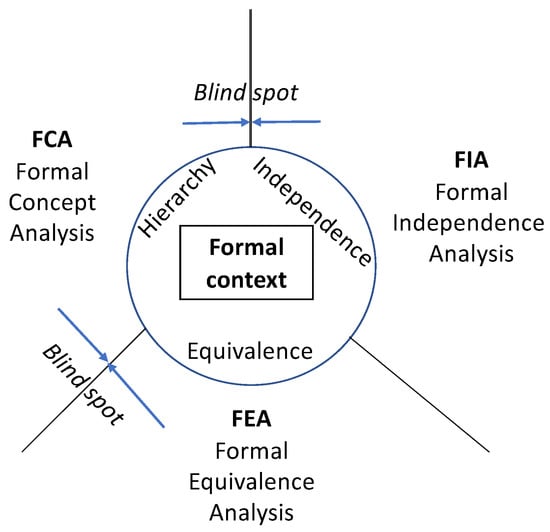
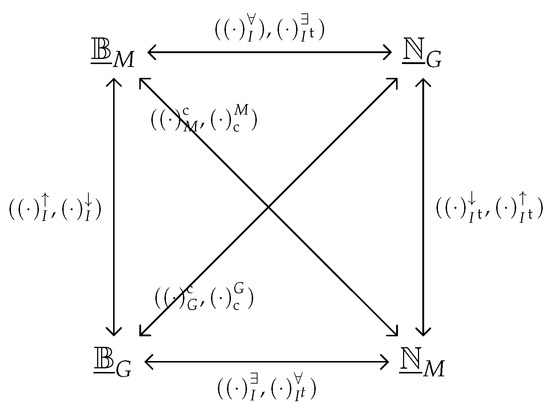
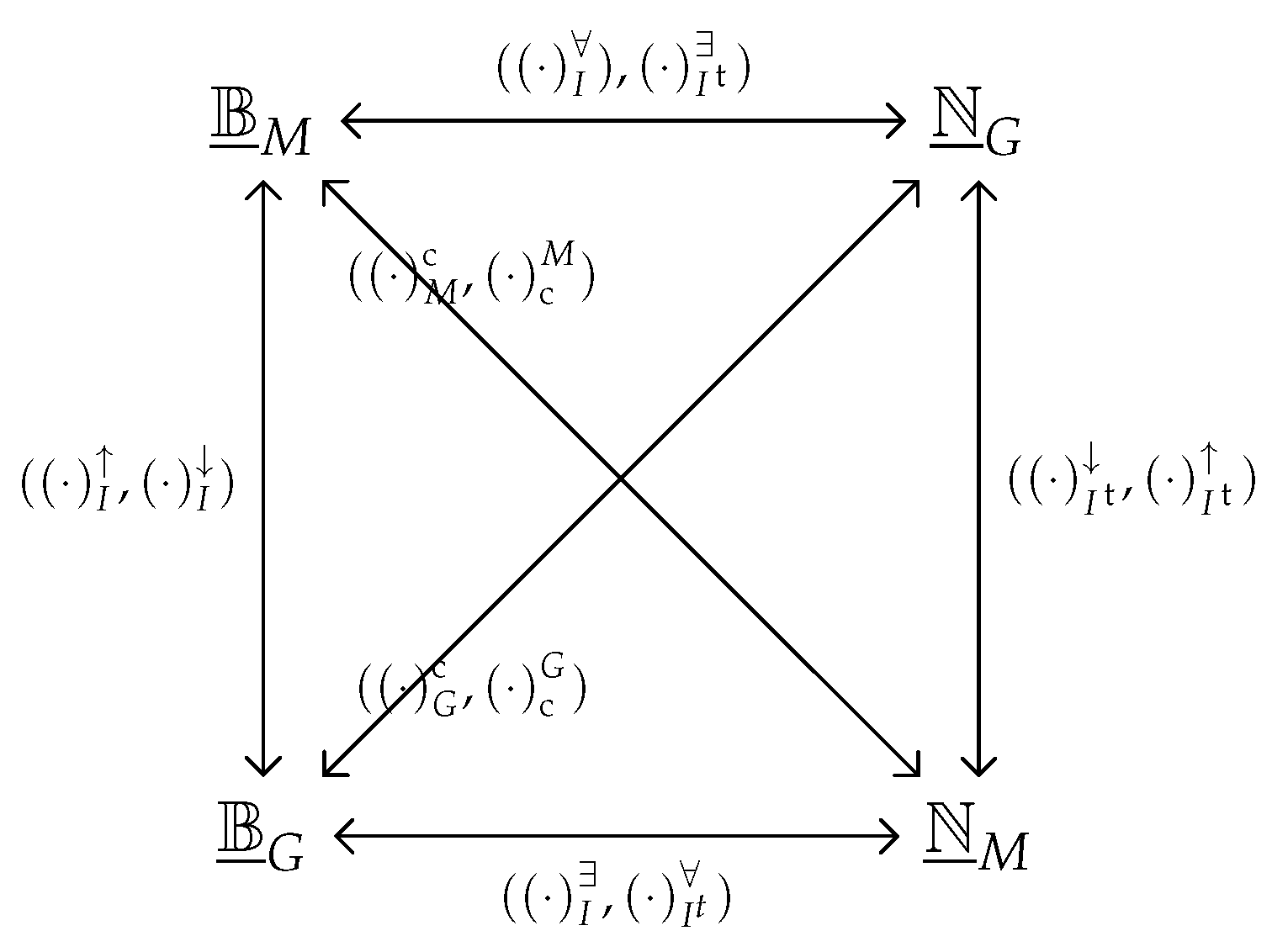
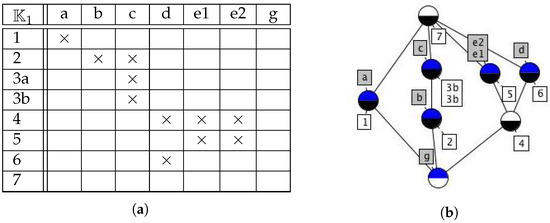
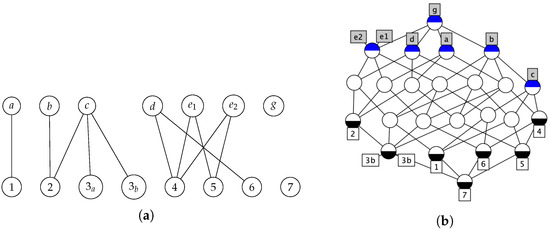



Disclaimer/Publisher’s Note: The statements, opinions and data contained in all publications are solely those of the individual author(s) and contributor(s) and not of MDPI and/or the editor(s). MDPI and/or the editor(s) disclaim responsibility for any injury to people or property resulting from any ideas, methods, instructions or products referred to in the content. |
© 2025 by the authors. Licensee MDPI, Basel, Switzerland. This article is an open access article distributed under the terms and conditions of the Creative Commons Attribution (CC BY) license.