


Abstract
Home-visiting nurses require supportive work environments. This study examined factors associated with home-visiting nurses’ intention to remain at their current home-visit nursing agency during the child-rearing stage. A cross-sectional online survey was conducted among Japanese home-visiting nurses with children younger than 13 years. Between July and August 2024, 4104 home-visit nursing agencies were faxed questionnaires. The survey assessed personal and family factors, workplace factors, the work–family interface, and intention to remain in the workplace. Responses were obtained from 347 participants, with 268 included in the analysis. In total, 184 participants (68.7%) intended to remain at their workplace. Univariate analysis compared groups based on intention to remain, followed by binary logistic regression analysis. Significant factors associated with intention to remain included part-time employment status (odds ratio [OR]: 0.370), duration of childcare leave of 1 year or more (OR: 0.218), managerial leadership (OR: 1.150), educational and career support for nursing quality (OR: 1.097), work–family negative spillover (OR: 0.906), and family–work negative spillover (OR: 0.805). The findings suggest the importance of supportive measures such as flexible work arrangements, support for nurses returning from extended parental leave, improved work–life balance, leadership development for managers, and enhanced educational and career support.
1. Introduction
A rapidly aging global population and the increased prevalence of chronic diseases among older adults have led to an unprecedented demand for home health care [1,2]. This demand is further exacerbated by an acute shortage of healthcare professionals across the world [2,3]. Japan is currently experiencing rapid aging [4]. In addition, the country has one of the largest gender gaps in the world [5]. Given that women constitute approximately 85% of the global nursing workforce [6], gender gaps could contribute to future challenges in recruiting and retaining healthcare and nursing care professionals in Japan. Therefore, Japan’s experience in home health care and workforce management could provide valuable insights for other countries with aging populations.
Home-visit nursing services in Japan have expanded to meet evolving societal needs and become increasingly important with the progression of an aging society. These services began in 1992, following the revised Health and Medical Service Law for the Elderly in 1991 that initially focused on providing care for older individuals [7]. In 1994, with amendments to the Health Insurance Act, the scope of home-visit nursing was expanded to include patients with intractable diseases and disabilities [8]. Since the implementation of the Long-Term Care Insurance Act in 2000, these services are offered under both the long-term care and health insurance systems [9], facilitating their widespread adoption.
Currently, home-visit nursing services in Japan serve multiple populations, such as those with terminal-stage cancer, neurological diseases, psychiatric conditions, and children with chronic conditions [8]. Along with rising demand, the number of users has steadily increased under both long-term care and health insurance frameworks. Consequently, the number of home-visit nursing agencies has grown from 8395 in 2001 to 15,285 in 2023, nearly doubling over the last two decades [10]. These services are critical in supporting home-based care in local communities by bridging the gap between health care and long-term care. With Japan’s population of older adults poised for further growth and the rising promotion of integrated community care systems [11,12], the demand for home-visit nursing services is also expected to increase.
However, with growing demand, home-visit nursing services are becoming increasingly specialized and complex. Japanese home-visiting nurses face several challenges such as excessive workloads [13] and higher turnover rates than other nursing professionals [14]. To address these issues, agency managers are required to improve the quality of the working environment in home-visit nursing agencies to attract and retain nurses.
The Japanese home-visit nursing system has adopted a social insurance model, with funding derived from social insurance and service providers encompassing diverse organizations such as for-profit corporations, medical corporations, social welfare organizations, and public agencies [10]. Moreover, the number of professionals in an agency and the geographic area also affect the home-visit nursing services provided [8]. Various organizations provide home health care under different systems across countries, such as home health agencies in the United States [15], district nurses affiliated with the National Health Service in the United Kingdom [3], and Buurtzorg in the Netherlands [16]. Given these differences, it is crucial to develop attractive work environments tailored to each country’s context to support the retention of home healthcare professionals.
In Japan, which has a large gender gap in the workforce, nurses’ career continuity is influenced by family responsibilities such as marriage, pregnancy, and child-rearing. This challenge is particularly pronounced among nurses in their 30 s and 40 s [17]. Home-visit nursing agencies employ many nurses in their 30 s and older [18]. Furthermore, compared to hospital and nursing facility nurses, home-visiting nurses’ intention to leave is significantly affected by an organizational culture that supports work-family balance [19]. Child-rearing nurses, in particular, face multiple challenges such as time and physical constraints, managing dual roles at work and home, and difficulties maintaining their careers [20]. Therefore, it is crucial to establish workplace environments within home-visit nursing agencies that enable nurses to manage life events such as raising children to sustain their employment.
This study aimed to identify the factors associated with home-visiting nurses’ intention to remain in the workplace during the child-rearing stage. Previous research on job retention among child-rearing nurses has focused primarily on hospital-based nurses and was conducted in East Asia [21,22,23,24]. However, home-visiting nurses differ significantly regarding employment arrangements, job responsibilities, and organizational support systems. These differences suggest that unique factors may influence home-visiting nurses’ intention to remain in the workplace, especially during child-rearing. As the demand for home-visit nursing continues to increase globally, organizations must create work environments that support a diverse workforce. Therefore, identifying the factors associated with home-visiting nurses’ career retention during the child-rearing stage in Japan is crucial to providing insights for countries facing similar aging populations and gender disparities.
Previous studies have identified various contributing factors underlying job retention among visiting and hospital nurses in the child-rearing stage. These include personal characteristics, such as age [24,25], self-rated health status [22,24], professional identity [26], and commitment to nursing [21]; family environments, such as parenting stress [22] and family support [21,24]; and employment status, including employment conditions [24,27], organizational ownership [28], salary [25,27], workload [27], and the duration of childcare leave taken at the workplace [22]. Additionally, workplace environments, such as communication with managers and colleagues [25,27,29], physical work environments [27,28], and education opportunities [27], have been shown to play a role. Furthermore, the work-family interface, including work-life balance [25,27,30], work-family enrichment [30], and work-family conflict [22,30], has been highlighted as a significant factor influencing job retention. The work-family interface refers to the influence of an individual’s work and family life, both positive and negative [31]. Research on job retention among home-visiting nurses suggests that their intention to remain in the workplace significantly affects their job retention [32]. Therefore, identifying the factors that influence home-visiting nurses’ intention to remain in the workplace is crucial for securing human resources in home-visit nursing agencies.
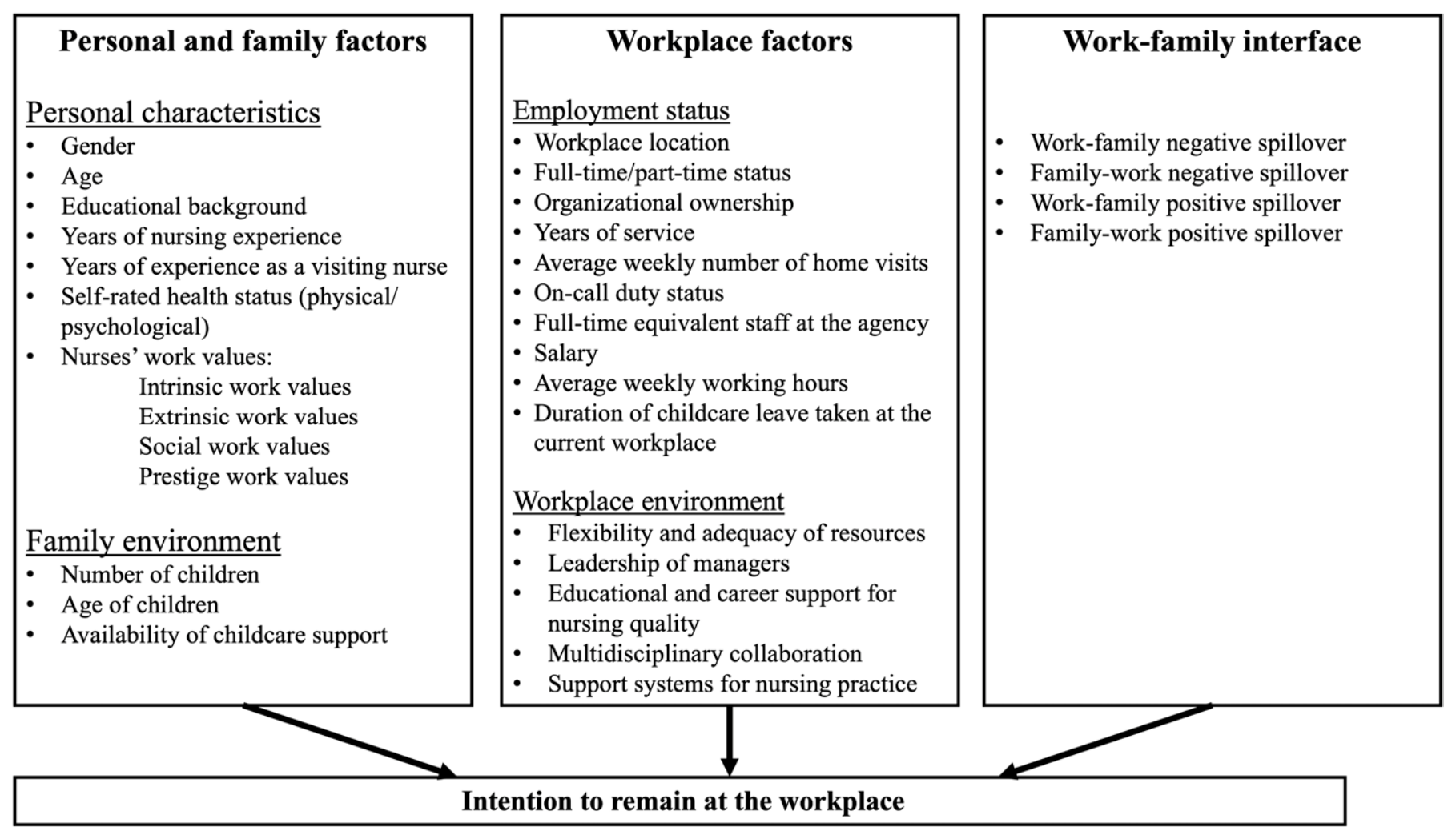
This study investigated the factors associated with the intention to remain in the workplace among home-visiting nurses in the child-rearing stage. Specifically, we examined the associations among personal characteristics, family environment, employment status, workplace environment, and work-family interface. Figure 1 illustrates the a priori conceptual framework used to organize the domains examined in this exploratory analysis.
Figure 1.
Conceptual framework of this study.
2. Materials and Methods
2.1. Design
This cross-sectional study used anonymous, self-administered online questionnaires. We used the STROBE reporting guideline [33] to draft this manuscript, and the STROBE reporting checklist [34] when editing.
2.2. Sample
The study participants were home-visiting nurses raising children while working at home-visit nursing agencies in Japan. The eligibility criteria were as follows: (1) home-visiting nurses (excluding managers) employed at home-visit nursing agencies, (2) those whose first child was under 13 years of age, (3) if childcare leave was taken for the first child, at least one month had passed since returning to work, and (4) those who could respond in Japanese. Sample size was determined using G*Power 3.1.9.7, with an effect size of 0.38 (based on a previous study [25]), significance level of 0.05, and power of 0.80. Next, referring to a previous study [29], the ratio of intention and no intention to remain at the workplace was set at 7:3. The sample size required to compare the two groups was 262.
2.3. Data Collection
The survey was conducted between July and August 2024 and targeted 4104 home-visit nursing agencies in Japan. To ensure the anonymity of the participants and reduce the burden of survey submission, explanatory documents, along with a QR code and URL link for an online questionnaire, were distributed via fax to the agencies. The fax was addressed to agency managers, who were asked to provide explanatory documents to home-visiting nurses who met the eligibility criteria for the study. More than one eligible nurse from the same agency was permitted to participate. As the survey was conducted anonymously, no agency identifiers were collected, and thus the number of participating agencies could not be determined. Responses to all items in the online questionnaire were required before submission to prevent unintentional missing data. For the item on income, the options “Don’t know” and “Prefer not to answer” were provided, thereby allowing participants to proceed without disclosing their income.
2.4. Survey Contents
2.4.1. Personal and Family Factors
Personal characteristics included gender, age, educational background, years of nursing experience, years of experience as a home-visiting nurse, self-rated health status, and work values.
Regarding educational background, the participants were asked to select one of the following options: (1) Practical nursing school, (2) High school health nursing course, (3) High school specialized course, (4) Vocational school, (5) Junior college, (6) University, (7) Master’s program, or (8) Doctoral program. Responses (1) to (5) were categorized as “Nursing specialized courses/Practical nursing training institutions” while responses (6) to (8) were categorized as “University/Graduate school.”
The self-rated health status was assessed for both physical and psychological aspects using the following options: (1) Very good, (2) Fairly good, (3) Not very good, and (4) Poor. Participants who selected (1) or (2) were classified as “Very good/Fairly good,” while those who selected (3) or (4) were classified as “Not very good/Poor.”
Nurses’ work values were measured using the short version of the Nurses’ Work Values Scale [35], which comprises three items each for intrinsic work values, extrinsic work values, social work values, and prestige work values, totaling 12 items. Each item was rated on a 5-point Likert scale from 1 (Not at all important) to 5 (Extremely important), and each subscale score was calculated by summing the scores for the corresponding items. The Cronbach’s alpha coefficients for the scale ranged from 0.80 to 0.91.
Information on family environment was collected by asking about the number and age of children and the availability of childcare support.
2.4.2. Workplace Factors
Employment status included workplace location, full-time or part-time status, organizational ownership, years of service, average weekly number of home visits, on-call duty status, full-time equivalent (FTE) staff at the agency, salary, average weekly working hours, and duration of childcare leave at the current workplace.
Workplace location options include: (1) City (population ≥ 500,000)/Tokyo 23 wards, (2) City (population ≥ 200,000), (3) City (population ≥ 100,000), (4) City (population < 100,000), and (5) Town/Village. Responses (1) and (2) were categorized as “City (population ≥ 200,000)/Tokyo 23 wards,” while responses (3) to (5) were categorized as “City (population < 200,000)/Town/Village.”
Organizational ownership was categorized as follows: (1) Medical corporation, (2) Public interest corporation, (3) For-profit corporation, (4) Local government, (5) Social welfare corporation, (6) Specified nonprofit corporation, (7) Medical association, and (8) Other. Responses were classified into four groups: “Medical corporation” (1), “Public interest corporation” (2), “For-profit corporation” (3), and “Other” (4–8). FTE staffing was categorized as: (1) <4 and (2) ≥4.
The duration of childcare leave taken at the current workplace was assessed using the following options: (1) Did not take leave (no overlap between childcare leave and tenure at the current workplace), (2) Did not take leave (returned to work after maternity leave while employed at the current workplace), (3) ≥2 months to <3 months postpartum, (4) ≥3 months to <5 months postpartum, (5) ≥5 months to <7 months postpartum, (6) ≥7 months to <9 months postpartum, (7) ≥9 months to <12 months postpartum, (8) ≥12 months to <15 months postpartum, (9) ≥15 months to <18 months postpartum, and (10) ≥18 months postpartum. Responses were categorized as follows: “No childcare leave” for options (1) and (2), “Less than one year” for options (3) to (7), and “One year or more” for options (8) to (10). For participants with two or more children who had taken childcare leave multiple times, the classification was based on the longest leave taken for a child. This approach provided a consistent participant-level classification of childcare leave duration.
Workplace environment was measured using the Work Environment Scale for Visiting Nurses (WESVN) [36]. The scale consists of five factors with 35 items: “Flexibility and Adequacy of Resources” (12 items), “Leadership of Managers” (9 items), “Educational and Career Support for Nursing Quality” (8 items), “Multidisciplinary Collaboration” (3 items), and “Support Systems for Nursing Practice” (three items). Each item was rated on a 4-point Likert scale from 1 (Strongly disagree) to 4 (Strongly agree), and each subscale score was calculated by summing the scores for the corresponding items. Higher subscale scores indicate more favorable workplace environments. Cronbach’s alpha coefficients for the five factors ranged from 0.75 to 0.91, and the overall Cronbach’s alpha for the scale was 0.95.
2.4.3. Work-Family Interface
Work-family interface was measured using the Japanese version of the Survey Work–Home Interaction Nijmegen [37]. This scale consists of four subdimensions: “Work-family negative spillover (WFNS): negative spillover from work to family” with eight items, “Family-work negative spillover (FWNS): negative spillover from family to work” with four items, “Work-family positive spillover (WFPS): positive spillover from work to family” with five items, and “Family-work positive spillover (FWPS): positive spillover from family to work” with five items. Responses were rated on a 4-point Likert scale from 0 (Never) to 3 (Always), and scores were calculated by summing the item scores for each subdimension. Higher scores indicate greater levels of the corresponding type of spillover. Cronbach’s alpha coefficients for the subscales ranged from 0.75 to 0.86.
In the present sample, internal consistency was assessed using Cronbach’s alpha for each subscale of the Nurses’ Work Values Scale, WESVN, and Work–Family Spillover Scale. Cronbach’s alpha coefficients ranged from 0.776 to 0.932, as shown in Supplementary Table S1.
2.4.4. Intention to Remain at the Workplace
The intention to remain at the workplace was assessed by asking the participants, “Do you want to continue working as a home-visiting nurse at your current agency?” They were asked to select one of the following options: (1) I want to continue working here for as long as possible, (2) I want to continue working as a home-visiting nurse but at a different agency, (3) I want to continue working as a nurse but at a different type of workplace (e.g., a hospital), (4) I want to quit my job, or (5) Others. Participants who selected option (1) were classified as having an “Intention to remain at the workplace,” while those who selected option (2) to (5) were classified as having “No intention to remain at the workplace.” This item was included in the questionnaire to assess participants’ intention to remain at their current workplace and was dichotomized a priori for the planned binary logistic regression analysis.
2.5. Data Analysis
Descriptive statistics were calculated for the variables, with continuous variables presented as means and standard deviations and categorical variables as absolute frequencies and percentages. Participants were categorized into two groups based on their intention to remain in the workplace, and comparisons were made for personal, family, and workplace factors and work-family interface. Continuous variables were analyzed using t-tests, whereas categorical variables were analyzed using chi-squared tests. Binary logistic regression analysis was conducted with the intention to remain at the workplace as the dependent variable and personal and family factors, workplace factors, and work-family interface as explanatory variables. Categorical variables were dummy coded for inclusion in the binary logistic regression analysis. Because the conceptual framework included multiple domains with a relatively large number of candidate variables and considering the available sample size, explanatory variables for the binary logistic regression analysis were selected from those showing significant differences in the univariate analyses using a stepwise procedure based on the Akaike information criterion (AIC) to obtain a parsimonious model that balanced model fit and complexity [38]. In addition to the primary analysis, a theory-informed sensitivity analysis was conducted. Employment status, duration of childcare leave taken at the current workplace, managerial leadership, educational and career support, WFNS, and FWNS were included as variables of substantive interest. Age and self-rated physical health status were included as adjustment variables based on the a priori conceptual framework and previous studies. All variables were entered simultaneously into the binary logistic regression model. Complete-case analysis was used to ensure that all candidate variables were evaluated using the same analytical dataset throughout the variable-selection process. As a sensitivity analysis for missing data, the final multivariable model was rerun using all eligible participants, including those with missing income information, with complete data for the variables included in the final model. The variance inflation factor (VIF) was assessed to evaluate multicollinearity among the variables retained in the final model.
Statistical significance was set at p < 0.05. All statistical analyses were performed using JMP Pro software (version 17.0; SAS Institute Inc., Cary, NC, USA).
2.6. Ethical Considerations
The explanatory document outlined the study details and specified that only those who agreed to participate were asked to complete the questionnaire. It was also explained that nonparticipation would not result in any disadvantages. Additionally, it was clarified that the responses would be statistically processed and reported in a manner that ensured anonymity, making it impossible to withdraw consent after the questionnaire was submitted. The online questionnaire included an initial item confirming whether the participants had read the explanatory document and agreed to participate in the study. Only those who provided informed consent were able to submit their responses. This study was approved by the Ethics Committee of Tohoku University Graduate School of Medicine (Approval Number: 2024-1-142; Approval Date: 29 May 2024). This study was conducted following the ethical standards of the Declaration of Helsinki.
3. Results
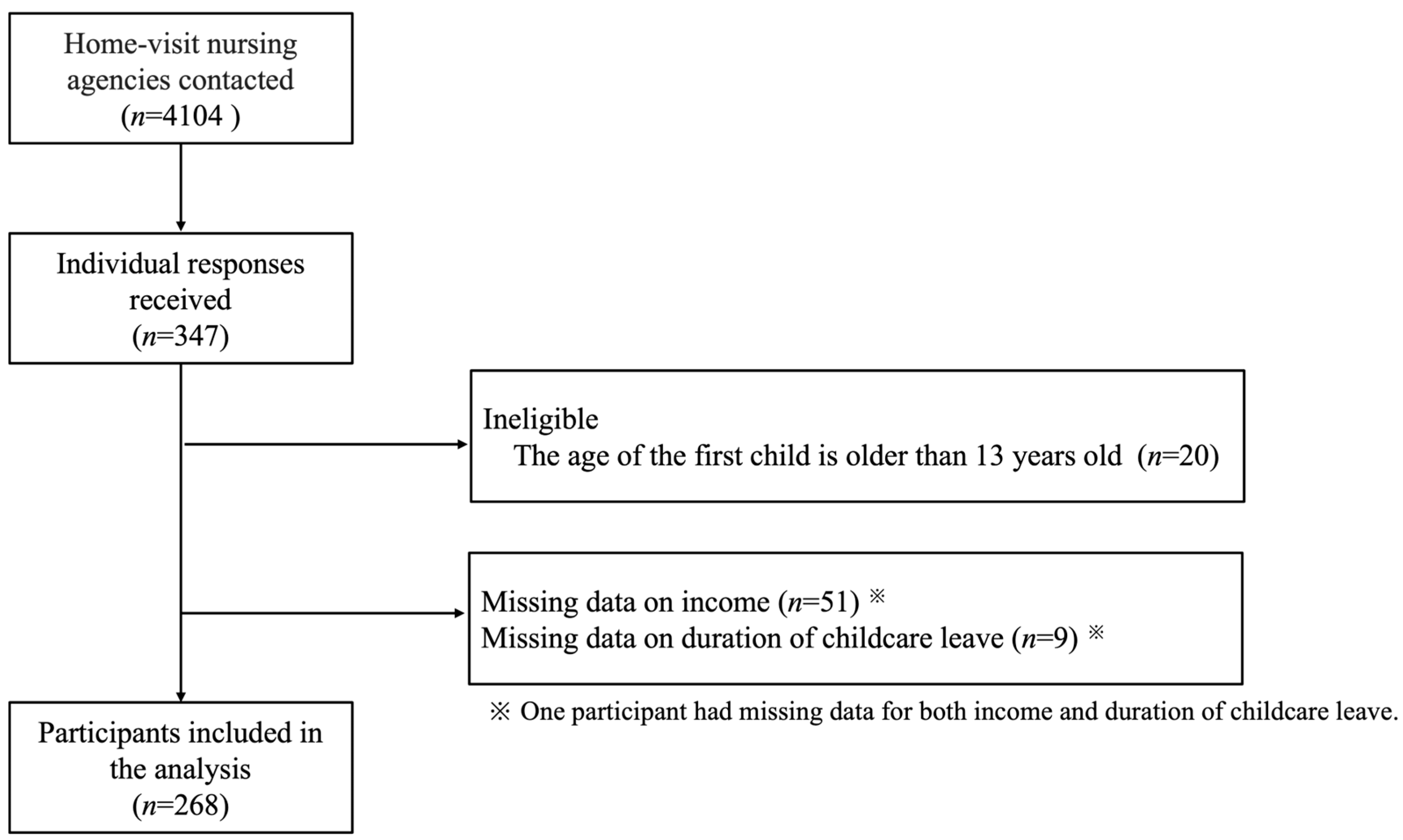
Study information, including an invitation to participate in the online questionnaire, was distributed to 4104 home-visit nursing agencies. Responses were received from 347 individual home-visiting nurses. Of these, 20 participants who did not meet the eligibility criteria and 59 participants with incomplete or missing responses were excluded, leaving 268 participants for analysis (analysis inclusion rate among respondents: 77.2%; Figure 2). As the number of eligible nurses who received the invitation is unknown, an individual-level response rate could not be calculated.
Figure 2.
Flow diagram of participant recruitment and inclusion in the analysis.
Among the 268 participants included in the analysis, 184 (68.7%) selected “I want to continue working here for as long as possible” and were classified as having an intention to remain at their current workplace. The remaining participants selected “I want to continue working as a home-visiting nurse, but at a different agency,” “I want to continue working as a nurse, but at a different type of workplace,” “I want to quit my job,” or “Other.” The distribution of the original five response categories is presented in Supplementary Table S2. Examples of “Other” responses included intentions to pursue graduate education, seek employment as a public health nurse or in occupations outside nursing, or uncertainty about future career plans.
3.1. Participant Characteristics and Univariate Analysis of Factors
3.1.1. Personal and Family Factors
Table 1 presents participants’ personal and family characteristics and the results of the univariate analysis. Most participants were female (n = 256, 95.5%) and in their 30 s (n = 164, 61.2%). Their mean age was 37.5 years (standard deviation [SD] = 5.4). The mean years of nursing experience was 13.2 years (SD = 6.2), and the mean years of experience as a home-visiting nurse was 4.1 years (SD = 3.3). Regarding self-rated physical health status, 246 participants (91.8%) rated their physical health as “Very good/Fairly good”, while 233 participants (86.9%) reported the same for their psychological health status. The mean number of children was 1.7 (SD = 0.7), and 258 participants (96.3%) reported that childcare support was available.
Table 1.
Characteristics of participants and results of the univariate analysis (personal and family factors).
Univariate analysis showed significant differences between the two groups, based on the intention to remain in the workplace, for the following variables: self-rated physical health status (p = 0.003), self-rated psychological health status (p < 0.001), intrinsic work values (p < 0.001), social work values (p < 0.001), and prestige work values (p = 0.040) subscales of the Nurses’ Work Values Scale, as well as the age of the third child (p = 0.028).
3.1.2. Workplace Factors
Table 2 presents participants’ workplace characteristics and the results of the univariate analysis. Among the participants, 167 (62.3%) were employed full-time, and the mean number of years of service was 4.1 years (SD = 4.0). A total of 121 participants (45.1%) reported performing on-call duties. Regarding the agencies’ FTE staff, 73.1% had four or more FTE staff. Concerning the duration of childcare leave taken at their current workplace, 168 participants (62.7%) responded “Never,” while 53 (19.8%) responded “1 year or more.”
Table 2.
Characteristics of participants and results of the univariate analysis (workplace factors).
3.1.3. Work-Family Interface
Table 3 presents participants’ characteristics related to work-family interface and the results of the univariate analysis. Univariate analysis showed significant differences between the two groups, based on the intention to remain in the workplace, for the following variables: WFNS (p < 0.001), FWNS (p < 0.001), and FWPS (p = 0.009).
Table 3.
Characteristics of participants and results of the univariate analysis (work–family interface).
3.2. Multivariate Analysis of Factors
Table 4 presents the results of the binary logistic regression analysis examining the variables associated with the intention to remain in the workplace. Using the stepwise method based on the Akaike information criterion, the following explanatory variables were selected: “Intrinsic work values” in the Nurses’ Work Values Scale, full-time/part-time status, duration of childcare leave taken at the current workplace, “Leadership of Managers” and “Educational and Career Support for Nursing Quality” in the WESVN scale, WFNS, and FWNS. The VIF was calculated for each explanatory variable retained in the final model. The VIF values ranged from 1.072 to 1.697, indicating that multicollinearity was unlikely to meaningfully influence the regression estimates. The final model was statistically significant overall (likelihood ratio test: χ2 = 92.406, p < 0.001), with an AIC of 258.890. The final model included eight regression parameters. Based on the less frequent outcome category (no intention to remain in the workplace: n = 84), the effective events-per-parameter ratio was 10.5, meeting the commonly recommended minimum of 10 events per parameter for logistic regression analysis [39].
Table 4.
Factors associated with the intention to remain in the workplace: Binary logistic regression analysis.
Significant associations were observed for the following variables: part-time employment status (odds ratio [OR]: 0.370, 95% confidence interval [CI]: 0.187–0.731), duration of childcare leave of 1 year or more (OR: 0.218, 95% CI: 0.098–0.484), “Leadership of Managers” (OR: 1.150, 95% CI: 1.057–1.251), “Educational and Career Support for Nursing Quality” (OR: 1.097, 95% CI: 1.007–1.194), WFNS (OR: 0.906, 95% CI: 0.848–0.968), and FWNS (OR: 0.805, 95% CI: 0.655–0.989). A sensitivity analysis was performed using a more homogeneous reference category for childcare leave duration to assess the robustness of the findings. The results showed that the association between childcare leave of 1 year or more and intention to remain at the current workplace was consistent with that observed in the primary analysis (Supplementary Table S3). The theory-informed sensitivity analysis showed associations similar to those observed in the primary analysis. Part-time employment, childcare leave of 1 year or more, higher WFNS scores, and higher FWNS scores were associated with lower intention to remain at the current workplace, whereas managerial leadership and educational and career support were associated with higher intention to remain. The ORs and their 95% CIs were broadly comparable to those in the primary analysis. In addition, the theory-based sensitivity analysis showed that age was associated with a higher intention to remain in the workplace (OR = 1.087, 95% CI: 1.020–1.159) (Supplementary Table S4). In an additional sensitivity analysis for missing data, the final multivariable model was rerun among 318 participants with complete data for the variables included in the final model, without excluding participants solely because of missing income information. The direction and magnitude of the principal associations were generally consistent with those observed in the primary analysis (Supplementary Table S5).
4. Discussion
This study aimed to identify the factors associated with home-visiting nurses’ intention to remain in the workplace during the child-rearing stage. The findings suggest that working part-time, taking childcare leave for more than one year, and experiencing negative interactions between work and family are factors negatively associated with the intention to remain in the workplace. In contrast, positive associations were observed between managerial leadership and educational and career support for nursing quality. To the best of our knowledge, the present study is the first to explore factors associated with home-visiting nurses’ intention to remain at their current workplace during the child-rearing stage. By focusing on this specific population, our study contributes novel evidence to the literature on home-visiting nurses’ work environments and career continuity during child-rearing, an area that has received limited attention despite the challenges of balancing professional practice and family responsibilities.
4.1. Factors Negatively Associated with the Intention to Remain in the Workplace
This study identified three factors significantly negatively associated with the intention to remain in the workplace. The first factor is part-time status. Generally, part-time employment is associated with financial instability and limited career advancement opportunities [40], leading to lower financial and job satisfaction. A survey conducted by the U.S. Bureau of Labor Statistics on working mothers also highlighted that part-time employment often lacks paid leave and provides insufficient advance notice of work schedules, making it less accommodating of family needs [41]. Additionally, previous studies on home-visiting nurses have indicated that the lack of full-time positions strongly motivates nurses to leave home-visit nursing and seek employment in other healthcare fields [27]. Employment and financial stability are significant for supporting the family during child-rearing. However, the observed association between part-time employment and intention to remain may also reflect the underlying circumstances related to childcare demands, work-place policies, career stage, financial circumstances, or other family-related factors, which were not fully captured in this study. Therefore, the findings should not be interpreted as indicating that part-time employment itself reduces the intention to remain. Rather, employment arrangements that provide greater security, predictability, and flexibility for both full-time and part-time nurses may be important for supporting their intention to remain at the current workplace. These findings suggest that employment arrangements offering greater security and predictability may be associated with nurses’ intention to remain at the current workplace. Future research should investigate factors associated with part-time home-visiting nurses’ intention to remain at the current workplace and explore the circumstances underlying this association.
The second factor is taking childcare leave for more than one year. This finding aligns with research on hospital nurses raising children, which suggested that longer childcare leave was associated with reduced intention to remain in the workplace [22]. Other studies have also indicated that extended childcare leave may lead to lower organizational commitment [42]. In Japan, the proportion of men taking childcare leave has increased substantially in recent years, reaching 40.5% compared with 86.6% among women; nevertheless, a substantial gender gap in childcare-leave uptake remains [43]. Since most home-visiting nurses, including those in this study, were women, gender-based societal expectations may be relevant to their employment experiences during child-rearing. However, the observed association should not be interpreted as indicating that extended childcare leave reduces workplace commitment or the intention to remain. Longer childcare leave may reflect various underlying circumstances, including age or number of children, employment history, workplace policies, family support, and conditions surrounding return to work. Therefore, residual confounding by these and other unmeasured factors may partly explain the observed association. To support nurses’ intention to remain at the current workplace after childcare leave, home-visit nursing agencies should ensure that managers provide the necessary information and support before and after leave. Future research should also explore the specific types of support that home-visiting nurses in the child-rearing stage require both in the workplace and at home.
The third factor is the negative spillover between work and family (WFNS and FWNS, respectively). Previous studies of home-visiting nurses have shown that nurses who perceive a positive relationship between work and family exhibit higher work engagement [44]. However, stepwise logistic regression in this study retained only negative spillovers, whereas positive spillovers were not significant predictors. This finding aligns with research on Japanese workers with preschool-aged children, which demonstrates that both WFNS and FWNS are positively correlated with psychological distress, with a more substantial impact than positive spillover [45]. Moreover, the effects of WFNS and FWNS on psychological distress are more significant in women than in men [45]. Given that most participants in this study were women, it is plausible that work-related psychological distress may be associated with their intention to remain in the workplace. To address negative work-family spillover, managers should consider implementing flexible working hours, improved scheduling, workload adjustments to enhance efficiency, and psychological support to help nurses manage work-to-family or family-to-work spillovers.
4.2. Factors Positively Associated with the Intention to Remain in the Workplace
This study identified two factors significantly and positively associated with the intention to remain in the workplace. The first is managerial leadership. Home-visit nursing in Japan requires nurses to visit different households alone and provide care in independent work environments, making it difficult for nurses to support each other during home visits. Managerial leadership and appropriate support may be critical for home-visiting nurses in this work setting. Previous studies among hospital nurses have reported the associations of managerial leadership with work engagement, turnover intention, and nurse retention [46,47,48,49]. However, research specifically focusing on home-visiting nurses is limited. The findings of this study suggest that similar to hospital settings, managerial leadership may be positively associated with home-visiting nurses’ intention to remain at their current workplace. Leadership development in the home care sector is recognized as an international priority [50]. Therefore, further research is needed to clarify the specific leadership characteristics required in home-visit nursing and how they are associated with nurses’ intention to remain and subsequent employment outcomes. Developing managerial leadership in home-visit nursing requires a more comprehensive approach. Managers must possess various skills, including clinical expertise, team management, business operations, and staff education. Therefore, beyond individual agency efforts, it is essential to strengthen leadership training programs at the national level.
Second, educational and career support to improve nursing quality was positively associated with nurses’ intention to remain. Home-visiting nurses in the child-rearing stage had fewer years of experience as both nurses (mean years = 13.2, SD = 6.2) and home-visiting nurses (mean years = 4.1, SD = 3.3) than the overall home-visit nursing workforce [29,44]. This finding suggests that educational support may be important for intention to remain at the current workplace. Additionally, while nurses in the child-rearing stage represent a generation expected to continue their careers, research has highlighted women’s barriers to career advancement after childbirth and childcare and the difficulties they face in maintaining their careers [51]. For nurses with career gaps due to childbirth and childcare or those struggling to balance work and family responsibilities, appropriate career support may be an important factor associated with their intention to remain. Previous research has indicated that small-scale home-visit nursing agencies can increase the number of nurses by ensuring training opportunities through scheduled programs [52]. Establishing training opportunities within each agency and enhancing the external training opportunities provided by government agencies and nursing associations to compensate for shortages in staffing and resources are necessary strategies.
Finally, professional identity in nursing is a crucial factor that enables nurses to take ownership of their practices, leading to higher job satisfaction and retention rates [53]. Therefore, besides improving workplace conditions, such as employment stability and childcare leave policies, creating an environment that fosters the establishment and enhancement of professional identity in nursing through managerial leadership, education, and career support is essential for home-visiting nurses in the child-rearing stage.
4.3. Limitations
Our study had several limitations. First, the survey was distributed to home-visit nursing agencies via fax, potentially introducing sampling bias. This method, chosen to ensure anonymity and reduce the response burden, may have skewed the sample toward agencies that own and actively use fax machines.
Second, participant recruitment through agency managers may have led to selection bias. Although efforts have been made to minimize managerial influence by emphasizing participant anonymity and voluntary participation, the potential impact of this bias on the findings cannot be ruled out.
Third, because the number of eligible nurses who actually received the invitation is unknown and the number of respondents among the contacted agencies was relatively small, non-response bias cannot be excluded. Participants who chose to respond may have differed systematically from non-respondents in terms of their workplace experiences, perceptions, and intention to remain at the current workplace. Furthermore, as agency identifiers were not collected to preserve participant anonymity, we were unable to determine the number of participating agencies or account for possible clustering of respondents within agencies. Consequently, the statistical independence of observations could not be formally evaluated. Therefore, the findings should be interpreted with appropriate caution owing to their limited external validity.
Fourth, because both the explanatory variables and the outcomes were assessed using the same self-administered questionnaire, common-method variance may have influenced the observed associations. Additionally, the self-reported data may have been subject to social desirability bias or inaccuracies in reporting personal, family, or work-related attributes.
Fifth, the outcome variable was dichotomized by classifying only participants who wished to remain at their current workplace for as long as possible as having the intention to remain. Consequently, participants who intended to transfer to another home-visit nursing agency, change practice settings, leave the nursing profession, or those who selected the “other” response were combined into a single comparison group. These career intentions may be influenced by various factors, and thus the observed associations should be interpreted with caution. Future studies should separately examine these career intentions using more detailed outcome classifications or multinomial analytical approaches where appropriate.
Sixth, complete-case analysis was used to ensure a common analytical dataset throughout the univariate screening and subsequent AIC-based stepwise variable-selection procedure. Although this approach provided consistency across analyses, excluding participants with missing data may have reduced the statistical power and introduced selection bias. Moreover, the sample size was limited in relation to the number of candidate variables considered. The sample size calculation was based on detecting differences between two groups rather than on the requirements of multivariable logistic regression. The AIC-based stepwise variable-selection procedure was used to obtain a parsimonious model with balanced model fit and complexity. The final model achieved an effective events-per-parameter ratio of 10.5, which met the commonly recommended minimum of 10 events per parameter. However, variables that were not selected may nonetheless have acted as confounders, and the selected model may have been sample dependent. Although the principal associations were generally consistent in the theory-informed sensitivity analysis, residual confounding by other measured or unmeasured factors cannot be excluded. Further, some degree of overfitting cannot be excluded because of the relatively small sample size and the exploratory, data-driven variable-selection procedure. Therefore, the variables retained in the final model should be interpreted as factors associated with the intention to remain at the workplace in this exploratory analysis, rather than as definitive independent predictors or causal determinants.
Seventh, the cross-sectional design precludes causal inference and prevents establishing temporal relationships between the identified factors and intention to remain. Therefore, the possibility of reverse causation cannot be excluded. The observed associations may partly reflect residual confounding or selection effects related to unmeasured individual, family, employment, or workplace characteristics. Thus, longitudinal studies are needed to clarify these temporal relationships and underlying mechanisms.
Finally, this study focused on Japanese visiting nurses in the child-rearing stage, limiting the generalizability of the findings to other countries with different healthcare systems and cultural contexts. When applying these findings outside Japan, it is essential to consider cultural and institutional differences.
5. Conclusions
This study examined the factors associated with the intention to remain in the current workplace among home-visiting nurses in the child-rearing stage. The results suggested that part-time employment status, taking childcare leave for more than one year, and negative work-family interactions were negatively associated with the intention to remain. Conversely, managerial leadership and continuing educational and career support were positively associated with the intention to remain.
These findings suggest that supportive workplace environments—including employment arrangements that enhance employment security, predictability and flexibility, return-to-work support after childcare leave; initiatives that facilitate work–life balance; fostering managerial leadership; and expanding educational and career development support—may be associated with greater intention to remain at the current workplace among home-visiting nurses during the child-rearing stage. This study provides novel insights into factors associated with intention to remain at the current workplace among home-visiting nurses balancing professional practice and family responsibilities.
Supplementary Materials
The following supporting information can be downloaded at: https://www.mdpi.com/article/10.3390/occuphealth1040044/s1, Table S1. Internal consistency of the multi-item instruments (n = 268); Table S2. Distribution of the original five response categories for intention to remain at the workplace (n = 268); Table S3. Sensitivity analysis using a restricted reference category for childcare leave duration; Table S4. Theory-informed sensitivity analysis of the principal associations (n = 268); Table S5. Sensitivity analysis including participants with missing income information (n = 318).
Author Contributions
Conceptualization, S.U. and Y.H.; methodology, S.U. and Y.H.; formal analysis, S.U.; investigation, S.U. and Y.H.; writing—original draft preparation, S.U.; writing—review and editing, Y.H., A.M., K.N., M.I., Y.S.T. and J.O.; supervision, Y.H. All authors have read and agreed to the published version of the manuscript.
Funding
This research was funded by the Nana-r home-visit nursing research grant (Grant Number: 06002) and JSPS KAKENHI (Grant Number: 22K17434).
Institutional Review Board Statement
The study was conducted in accordance with the guidelines of the Declaration of Helsinki and approved by the Ethics Committee of Tohoku University Graduate School of Medicine (Approval Number: 2024-1-142; Approval Date: 29 May 2024).
Informed Consent Statement
Informed consent was obtained from all subjects involved in the study.
Data Availability Statement
The data that support the findings of this study are available from the corresponding author upon reasonable request.
Acknowledgments
We would like to thank the participants and home-visit nursing agencies for their cooperation in this study.
Conflicts of Interest
The authors declare no conflicts of interest.
References
- Butler, S.M. Caring for an aging U.S. population—The good news and the bad news. JAMA Health Forum 2024, 5, e241893. [Google Scholar] [CrossRef] [Scilit]
- Zeng, Y.; Que, S.; Lin, C.; Fang, Y. The expected demand for elderly care services and anticipated living arrangements among the oldest old in China based on the Andersen model. Front. Public Health 2021, 9, 715586. [Google Scholar] [CrossRef] [Scilit]
- Drennan, V.M. More care out of hospital? A qualitative exploration of the factors influencing the development of the district nursing workforce in England. J. Health Serv. Res. Policy 2019, 24, 11–18. [Google Scholar] [CrossRef] [Scilit]
- Baba, H.; Aung, M.N.; Miyagi, A.; Masu, A.; Yokobori, Y.; Kiyohara, H.; Otake, E.; Yuasa, M. Exploring the contribution of Japan’s experience in addressing rapid aging in Asia: Focus on dementia care. Glob. Health Med. 2024, 6, 19–32. [Google Scholar] [CrossRef] [Scilit]
- World Economic Forum. Global Gender Gap Report 2024. Available online: https://www.weforum.org/publications/global-gender-gap-report-2024 (accessed on 11 August 2026).
- World Health Organization. State of the World’s Nursing 2025; World Health Organization: Geneva, Switzerland, 2025; Available online: https://iris.who.int/bitstream/handle/10665/381329/9789240110236-eng.pdf (accessed on 11 August 2026).
- Japan Visiting Nursing Foundation. Structure of the Visiting Nursing System in Japan. Available online: https://files.jvnf.or.jp/files/user/kenkyu/R7/Structure_of_the_Visiting_Nursing_system_in_Japan_EN.pdf (accessed on 19 August 2026).
- Fukui, S.; Yamamoto-Mitani, N.; Fujita, J. Five types of home-visit nursing agencies in Japan based on characteristics of service delivery: Cluster analysis of three nationwide surveys. BMC Health Serv. Res. 2014, 14, 644. [Google Scholar] [CrossRef] [Scilit]
- Fukui, S.; Yoshiuchi, K.; Fujita, J.; Ikezaki, S. Determinants of financial performance of home-visit nursing agencies in Japan. BMC Health Serv. Res. 2014, 14, 11. [Google Scholar] [CrossRef] [Scilit]
- Japan Visiting Nursing Foundation. The Present and Future of Visiting Nursing 2025. Available online: https://files.jvnf.or.jp/files/user/houmon/visiting_nursing_system/2025_EN.pdf (accessed on 19 August 2026).
- Song, P.; Tang, W. The community-based integrated care system in Japan: Health care and nursing care challenges posed by super-aged society. Biosci. Trends 2019, 13, 279–281. [Google Scholar] [CrossRef] [Scilit]
- Statistics Bureau of Japan. Statistical Handbook of Japan 2025: Chapter 2 Population. Available online: https://www.stat.go.jp/english/data/handbook/index.html (accessed on 19 August 2026).
- Cao, X.; Naruse, T. Effect of time pressure on the burnout of home-visiting nurses: The moderating role of relational coordination with nursing managers. Jpn. J. Nurs. Sci. 2019, 16, 221–231. [Google Scholar] [CrossRef] [Scilit]
- Japanese Nursing Association. Data on Factors Contributing to the Limited Growth of Home-Visit Nursing. Material 2 Presented at the 5th Meeting of the Ministry of Health, Labour and Welfare Study Group on the Revision of Medical Care Plans, 13 July 2011. Available online: https://www.mhlw.go.jp/stf/shingi/2r9852000001jlr7-att/2r9852000001jlv6.pdf (accessed on 11 August 2026). (In Japanese)
- Pennsylvania Department of Health. Home Health. Available online: https://www.pa.gov/agencies/health/facilities/out-patient-healthcare-facilities/home-health.html (accessed on 11 August 2026).
- Buurtzorg. Home Buurtzorg. Available online: https://www.buurtzorg.com (accessed on 11 August 2026).
- Ministry of Health, Labour and Welfare. Additional Materials on the Situation Regarding the Securing of Nurses and Other Nursing Staff. Material 2 Presented at the 2nd Meeting of the Subcommittee on the Basic Guidelines for Securing Nursing Personnel, 7 July 2023. Available online: https://www.mhlw.go.jp/content/10800000/001118187.pdf (accessed on 11 August 2026). (In Japanese)
- Ministry of Health, Labour and Welfare. Reference Materials on the Situation Regarding the Securing of Nurses and Other Nursing Staff. Reference Material 1 Presented at the 1st Meeting of the Subcommittee on the Basic Guidelines for Securing Nursing Personnel. 29 May 2023. Available online: https://www.mhlw.go.jp/content/10800000/001101182.pdf (accessed on 19 August 2026). (In Japanese)
- Yamaguchi, Y.; Inoue, T.; Harada, H.; Oike, M. Job control, work-family balance and nurses’ intention to leave their profession and organization: A comparative cross-sectional survey. Int. J. Nurs. Stud. 2016, 64, 52–62. [Google Scholar] [CrossRef] [Scilit]
- Ong, P.; Cong, X.; Yeo, Y.; Shorey, S. Experiences of nurses managing parenthood and career: A systematic review and meta-synthesis. Int. Nurs. Rev. 2024, 71, 610–625. [Google Scholar] [CrossRef] [Scilit]
- Iwashita, M.; Takada, M. Factors related to career continuation among nurses raising children. J. Jpn. Acad. Nurs. Adm. Polic. 2012, 16, 45–56. (In Japanese) [Google Scholar] [CrossRef]
- Jung, Y.-E.; Sung, M.-H. Do parenting stress, work-family conflict, and resilience affect retention intention in Korean nurses returning to work after parental leave?: A cross-sectional study. Korean J. Women Health Nurs. 2022, 28, 18–26. (In Korean) [Google Scholar] [CrossRef] [Scilit]
- Maki, M.; Doi-Kanno, M.; Kanoya, Y. The status of the support to nurses with caring their children or after delivering by hospitals and its influences on continuation of their employment. J. Nurs. Adm. Polic. 2016, 20, 49–60. (In Japanese) [Google Scholar] [CrossRef]
- Shimizu, Y.; Tomoyama, G.; Kano, T. Factors impacting the willingness of female nursing staff to continue working at their hospital of employment during their child-rearing period. Bull. Gunma Prefect. Coll. Health Sci. 2021, 16, 67–80. (In Japanese) [Google Scholar]
- Tourangeau, A.E.; Patterson, E.; Saari, M.; Thomson, H.; Cranley, L. Work-related factors influencing home care nurse intent to remain employed. Health Care Manag. Rev. 2017, 42, 87–97. [Google Scholar] [CrossRef] [Scilit]
- Nishida, S.; Nishida, K. Factors related to the professional identity of novice visiting nurses. J. Jpn. Acad. Home Health Care 2016, 19, 51–58. (In Japanese) [Google Scholar] [CrossRef]
- Tourangeau, A.; Patterson, E.; Rowe, A.; Saari, M.; Thomson, H.; MacDonald, G.; Cranley, L.; Squires, M. Factors influencing home care nurse intention to remain employed. J. Nurs. Manag. 2014, 22, 1015–1026. [Google Scholar] [CrossRef] [Scilit]
- Miyama, M. Factors associated with visiting nurses’ intent to continue working. J. Jpn. Acad. Community Health Nurs. 2016, 19, 66–74. (In Japanese) [Google Scholar] [CrossRef]
- Noguchi-Watanabe, M.; Yamamoto-Mitani, N.; Nagami, Y.; Eltaybani, S.; Inagaki, A.; Taniguchi, Y. Homecare nurses’ length of conversation and intention to remain at the workplace: A multilevel analysis. J. Nurs. Manag. 2021, 29, 721–730. [Google Scholar] [CrossRef] [Scilit]
- Lee, J.H.; Hwang, J.I. The effects of hospitals’ family-friendly management on married female nurses’ retention intention: Focused on the mediating effects of work-family interface. J. Korean Acad. Nurs. 2019, 49, 386–397. (In Korean) [Google Scholar] [CrossRef] [Scilit]
- Holmes, E.K.; Thomas, C.R.; Petts, R.J.; Hill, E.J. The work-family interface. In Cross-Cultural Family Research and Practice; Halford, W.K., Van De Vijver, F., Eds.; Academic Press: Cambridge, MA, USA, 2020; pp. 323–354. [Google Scholar] [CrossRef] [Scilit]
- Ellenbecker, C.H. A theoretical model of job retention for home health care nurses. J. Adv. Nurs. 2004, 47, 303–310. [Google Scholar] [CrossRef] [Scilit]
- von Elm, E.; Altman, D.G.; Egger, M.; Pocock, S.J.; Gøtzsche, P.C.; Vandenbroucke, J.P. The strengthening the reporting of observational studies in epidemiology (STROBE) statement: Guidelines for reporting observational studies. Ann. Intern. Med. 2007, 147, 573–577. [Google Scholar] [CrossRef] [Scilit]
- von Elm, E.; Altman, D.G.; Egger, M.; Pocock, S.J.; Gøtzsche, P.C.; Vandenbroucke, J.P. The STROBE Reporting Checklist. In The EQUATOR Network Reporting Guideline Platform; Harwood, J., Albury, C., de Beyer, J., Schlüssel, M., Collins, G., Eds.; The UK EQUATOR Centre: Oxford, UK, 2025; Available online: https://resources.equator-network.org/reporting-guidelines/strobe/strobe-checklist.docx (accessed on 11 August 2026).
- Hara, Y.; Hirayama, H.; Ito, S.; Asakura, K.; Takada, N.; Sugiyama, S.; Matsunaga, A.; Iwamoto, M.; Omori, J. Short version of the work values scale for registered nurses, midwives, public health nurses, and licensed practical nurses: Development and evaluation. Nurs. Forum 2025, 2025, 7600613. [Google Scholar] [CrossRef] [Scilit]
- Kamimoto, T.; Onishi, M. Development, reliability, and validity of a work environment scale for visiting nurses. J. Jpn. Acad. Nurs. Sci. 2023, 43, 143–153. (In Japanese) [Google Scholar] [CrossRef] [Scilit]
- Shimada, K.; Shimazu, A.; Geurts, S.A.E.; Kawakami, N. Reliability and validity of the Japanese version of the Survey Work–Home Interaction—NijmeGen, the SWING (SWING-J). Community Work Fam. 2019, 22, 267–283. [Google Scholar] [CrossRef] [Scilit]
- Sanchez-Pinto, L.N.; Venable, L.R.; Fahrenbach, J.; Churpek, M.M. Comparison of variable selection methods for clinical predictive modeling. Int. J. Med. Inform. 2018, 116, 10–17. [Google Scholar] [CrossRef] [Scilit]
- Peduzzi, P.; Concato, J.; Kemper, E.; Holford, T.R.; Feinstein, A.R. A simulation study of the number of events per variable in logistic regression analysis. J. Clin. Epidemiol. 1996, 49, 1373–1379. [Google Scholar] [CrossRef] [Scilit] [PubMed]
- Japan Institute for Labour Policy and Training. Labor Situation in Japan and Its Analysis: Detailed Exposition 2016/2017; Japan Institute for Labour Policy and Training: Tokyo, Japan, 2017; Available online: https://www.jil.go.jp/english/lsj/detailed/2016-2017/all.pdf (accessed on 11 August 2026).
- United States Department of Labor, Bureau of Labor Statistics. Does Part-Time Work Offer Flexibility to Employed Mothers? Available online: https://www.bls.gov/opub/mlr/2022/article/does-part-time-work-offer-flexibility-to-employed-mothers.htm (accessed on 11 August 2026).
- Gangl, M.; Ziefle, A. The making of a good woman: Extended parental leave entitlements and mothers’ work commitment in Germany. Am. J. Sociol. 2015, 121, 511–563. [Google Scholar] [CrossRef] [Scilit]
- Ministry of Health, Labour and Welfare. Basic Survey of Gender Equality in Employment Management 2024; Ministry of Health, Labour and Welfare: Tokyo, Japan, 2025; Available online: https://www.mhlw.go.jp/toukei/list/dl/71-r06/06.pdf (accessed on 11 August 2026). (In Japanese)
- Naruse, T.; Sakai, M.; Watai, I.; Taguchi, A.; Kuwahara, Y.; Nagata, S.; Murashima, S. Individual and organizational factors related to work engagement among home-visiting nurses in Japan. Jpn. J. Nurs. Sci. 2013, 10, 267–272. [Google Scholar] [CrossRef] [Scilit]
- Shimada, K.; Shimazu, A.; Bakker, A.B.; Demerouti, E.; Kawakami, N. Work-family spillover among Japanese dual-earner couples: A large community-based study. J. Occup. Health 2010, 52, 335–343. [Google Scholar] [CrossRef] [Scilit]
- Alluhaybi, A.; Usher, K.; Durkin, J.; Wilson, A. Clinical nurse managers’ leadership styles and staff nurses’ work engagement in Saudi Arabia: A cross-sectional study. PLoS ONE 2024, 19, e0296082. [Google Scholar] [CrossRef] [Scilit]
- Magbity, J.B.; Ofei, A.M.A.; Wilson, D. Leadership styles of nurse managers and turnover intention. Hosp. Top. 2020, 98, 45–50. [Google Scholar] [CrossRef] [Scilit]
- Marufu, T.C.; Collins, A.; Vargas, L.; Gillespie, L.; Almghairbi, D. Factors influencing retention among hospital nurses: Systematic review. Br. J. Nurs. 2021, 30, 302–308. [Google Scholar] [CrossRef] [Scilit]
- Suliman, M.; Aljezawi, M.; Almansi, S.; Musa, A.; Alazam, M.; Ta’an, W.F. Effect of nurse managers’ leadership styles on predicted nurse turnover. Nurs. Manag. 2020, 27, 20–25. [Google Scholar] [CrossRef] [Scilit]
- Jarrín, O.F.; Pouladi, F.A.; Madigan, E.A. International priorities for home care education, research, practice, and management: Qualitative content analysis. Nurse Educ. Today 2019, 73, 83–87. [Google Scholar] [CrossRef] [Scilit]
- Torres, A.J.C.; Barbosa-Silva, L.; Oliveira-Silva, L.C.; Miziara, O.P.P.; Guahy, U.C.R.; Fisher, A.N.; Ryan, M.K. The impact of motherhood on women’s career progression: A scoping review of evidence-based interventions. Behav. Sci. 2024, 14, 275. [Google Scholar] [CrossRef] [Scilit]
- Morioka, N.; Okubo, S.; Yumoto, Y.; Ogata, Y. Training opportunities and the increase in the number of nurses in home-visit nursing agencies in Japan: A panel data analysis. BMC Health Serv. Res. 2019, 19, 398. [Google Scholar] [CrossRef] [Scilit]
- Hinkley, T.-L.; Kuhl, L.; Liebig, D. Professional identity in nursing. Nurse Lead. 2023, 21, 174–178. [Google Scholar] [CrossRef] [Scilit]

Disclaimer/Publisher’s Note: The statements, opinions and data contained in all publications are solely those of the individual author(s) and contributor(s) and not of MDPI and/or the editor(s). MDPI and/or the editor(s) disclaim responsibility for any injury to people or property resulting from any ideas, methods, instructions or products referred to in the content. |
© 2026 by the authors. Licensee MDPI, Basel, Switzerland. This article is an open access article distributed under the terms and conditions of the Creative Commons Attribution (CC BY) license.