


Abstract
High-involvement work systems (HIWSs) have been an important organisational aspect in increasing employee job performance. However, the high-involvement work system is often looked at collectively using one dimension instead of through the individual dimensions of the work system. Using the power, information sharing, rewards, and knowledge (PIRK) model, the present cross-lagged study aims to examine the influence of the individual dimensions of the PIRK model on employees’ opportunities for skill development and emotional job demands, subsequent quality of work (QoW) and the processes involved. This quantitative cross-lagged study involved 120 New Zealand (NZ) employees (80.8% female; mean age = 32.4 years) from various industries. The results showed a significant positive effect of opportunities for skill development on employees’ QoW. In addition, the four dimensions of the PIRK model had significant positive effects on opportunities for skill development. However, only the information-sharing and knowledge dimensions produced a significant negative effect on emotional job demands. Opportunities for skill development mediated the relationship between the four dimensions of the PIRK model and employees’ QoW, whereas emotional job demands only mediated the relationship between the information-sharing and knowledge dimensions of the PIRK model and employees’ QoW. This study contributes to the limited cross-lagged and longitudinal research on human resource work systems and provides empirical evidence on the role of the organisational work system in supporting employee QoW through opportunities for skill development and emotional job demands.
1. Introduction
A growing body of research (e.g., [1,2,3]) exists pointing towards the strong correlation between Human Resource Management (HRM) systems and positive outcomes for both employees and their organisations. Among the many HRM systems, such as high-performance work systems and high commitment work systems, high-involvement work systems (HIWSs) have been considered one of the most important systems available in improving employee quality of work (QoW) [4]. High-involvement work systems (HIWSs) primarily emphasise employee involvement and empowerment [5], in contrast to high-performance work systems, which emphasise performance and productivity [6], and high-commitment work systems, which emphasise employee commitment and loyalty [7].
High-involvement work systems are meaningful, interrelated patterns of organisational practices designed to enhance performance by treating employees as valuable resources [6]. Within Strategic Human Resource Management (SHRM), high-involvement approaches aim to decentralise decision-making, empowering employees across all levels with greater authority [8]. Although many studies have bundled various HRM practices and labelled them as work systems [9], these bundles often lack conceptual consistency and clarity. In contrast, Lawler [10] and Vandenberg et al. [11] focus on four key dimensions that underpin the high-involvement construct in enhancing employee participation; these dimensions comprise power (P), information sharing (I), rewards (R) and knowledge (K) (i.e., the PIRK model).
One recent study confirmed the positive correlation between employees’ positive perceptions of PIRK, employee resilience, other outcomes comprising job performance and satisfaction, and positive mental health and retention [12]. High-involvement work systems enable organisations to respond more efficiently and effectively to environmental changes and customer needs through empowering employees in decision-making and taking action at the frontline [13]. When emphasis is placed on employee’s authority and responsibility, the quality of their work directly impacts the success of the entire organisation. Although previous research on PIRK points towards a stronger, more resilient workforce, to the authors’ knowledge, no prior research has indicated the impact on QoW.
Quality of work (QoW) refers to the multidimensional features of an employee’s job, such as work intensity, job design, social and physical working conditions, that shape their well-being, functioning, and overall experience at work [14]. Schleicher et al. [15], in their review of performance management systems spanning the past 30 years, critique these systems for failing to capture the true value of employee contributions. Most frameworks focus on achieving key performance indicators, often overlooking QoW, which reflects depth, accuracy, creativity, and value. QoW differs from job performance and organisational citizenship behaviour, as it is characterised by an individual’s self-reflection on the quality of their output. Emphasising QoW offers a more nuanced understanding of employee morale and productivity, and serves as an extension of both job performance and organisational citizenship behaviour [16].
In addition, there are conflicting views regarding HRM systems. The ‘dark side’ perspective, for example, the view that such systems may cause employees to become overworked, is seen by some managers as a significant barrier to implementing high-involvement work systems [17]. This contrasts with the mutual gains perspective which suggests that both the employee and the organisation benefit from well-designed HRM systems. By reinforcing the mutual gains perspective, we support the view that organisational-level factors, rather than the individual-level factors, can enhance employees’ QoW [18,19].
Additional previous research in this field has been cross-sectional in nature and thus has failed to incorporate a longitudinal evaluation over an extended time [20]. Due to the cross-sectional nature of these studies, very little is known about the process followed that eventually leads to the desired outcomes. To address this gap, the current study conducted a quantitative cross-lagged study on the New Zealand (NZ) population, using a temporal design with a three-week time delay between Time 1 and Time 2 of data collection.
In addressing these gaps, the present study draws on Lawler’s [10] PIRK model and examines its dimensions separately [6,21,22] to provide a more fine-grained understanding of how each HR practice relates to employees’ QoW through opportunities for skill development and emotional job demands, which are increasingly important in today’s dynamic and demanding work environments. At the core of the Job Demands–Resources (JD-R) model [23,24] lies the assumption that all professions have their own specific risk factors linked to job stress; these can be categorised into two general groups, namely, job demands and job resources. Bakker and Demerouti [25] stated that providing employees with the necessary resources at work, such as an appropriate amount of autonomy over their work and accessibility to information which supports their work, results in a buffering of the adverse impacts of job demands. Furthermore, the JD-R model states that the level of stress experienced by an individual employee depends on the number of demands placed on that employee, along with the number of resources with which that individual employee can alleviate the level of stress [26].
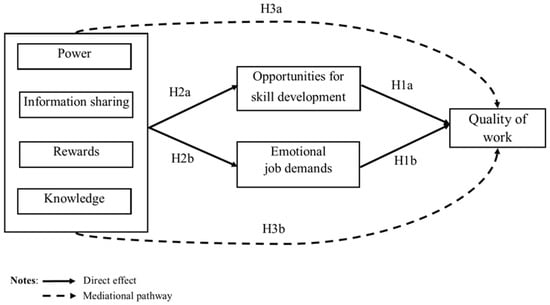
The study builds on the JD-R theory by presenting employee involvement as an overarching theme within an organisation, presented in conjunction with job demands and job resources and resulting in a measure of an individual employee’s QoW. The proposed model is presented in Figure 1 below.
Figure 1.
Proposed Model.
2. Literature Review and Hypotheses: Development Opportunities for Skill Development, Emotional Job Demands, and Quality of Work
Job resources can be defined as aspects of the job that are functional in achieving work objectives and reducing job demands, as well as encouraging personal development, learning and growth [25]. A motivational process embodies job resources, stating that resources have (internal and external) motivational effects on employees, with these leading to positive outcomes, such as an increase in work engagement and performance, and a decrease in cynicism [25]. In response to this relationship, employee skill development has become an increasingly researched topic within the organisational literature.
When opportunities to develop skills in the workplace are provided to employees, these opportunities can motivate employees to step out of their professional comfort zone and draw on their knowledge, skills and abilities to establish effective solutions [27]. This job resource, therefore, stimulates a fulfilling and positive work-related state of mind through both the achievement of goals and satisfaction of basic needs. It is through this affective–motivational state that positive organisational outcomes arise [28].
Demerouti et al. [24] defined job demands as “those physical, social, or organisational aspects of the job that require sustained physical or mental effort and are therefore associated with certain physiological and psychological costs” (p. 501). A job demand refers to a demand that can create emotional exhaustion at work causing a “depletion of emotional and mental energy” ([29], p. 336). A longitudinal investigation conducted by Vegchel et al. [30] found that emotional job demands predict emotional exhaustion and lead to workplace burnout over time. The degree of mental exhaustion associated with emotional job demands causes a reduction in employees’ QoW [31]. Maslach and Leiter [31] highlighted that the level of burnout associated with emotional job demands creates a lack of control and engagement over one’s work, leading to a reduction in the standard of work produced by the employee. Hence,
Hypothesis 1.
(a) Opportunities for skill development at Time 1 have a positive relationship with QoW at Time 2, while (b) emotional job demands at Time 1 have a negative relationship with QoW at Time 2.
2.1. High-Involvement Work System (HIWS), Opportunities for Skill Development, and Emotional Job Demands
Studies in the literature support the view that the HIWS augments workforce commitment by appealing to individual employees’ inner drive [5]. In turn, the effective implementation of the HIWS improves employees’ skills and behaviours in strategic planning and implementation, leading to greater organisational efficiency [32,33]. Rodgers and Ferketish [34] stated this simply as the way to “unleash the talent and energy of employees at every level of the organisation” (p. 2).
With correct implementation of the HIWS, employees become a key source of competitive advantage for an organisation [35,36]. In addition to the outcomes mentioned above, the HIWS provides employees with appropriate, ongoing training which enables the development of knowledge essential for effective performance [36].
2.1.1. Power
The first dimension underpinning the PIRK construct is power. This construct refers to the power through which an employee has autonomy and can make decisions that affect the organisation [36]. Empowering employees with their own decision-making power can be a valuable tool for pushing operational decisions down to lower levels of the workplace [37].
2.1.2. Information Sharing
The second dimension of the PIRK model is information sharing. This aspect is apparent when details regarding the organisation, its goals and its strategies are perceived as being communicated openly to employees [36]. Long-standing arguments have persisted among scholars regarding the importance of open communication through which employees can receive the necessary information required for participation and quality decision-making [36,38].
2.1.3. Rewards
The third dimension of the PIRK model ensures that employees are rewarded for their efforts through incentives, with employees beginning to perceive that these incentives link their behaviours to outcomes [36]. Scholars have agreed that performance-based rewards wield significant influence over the strength of employees’ attitudes and behaviours [39,40]. An individual’s level of remuneration is one such incentive which can instil these attitudes and behaviours. Scholars have found a significant correlation between insufficient recognition and rewards and high rates of burnout [31]. When rewards and recognition are awarded consistently in the workplace, an employee is more likely to feel satisfied with their job [31] and motivated to perform better at work [41,42].
2.1.4. Knowledge
Ongoing training, appropriate to an organisation’s objectives, helps in the development of employee knowledge required for effective performance. Wilson and Western [43] stated that training and development were common areas underutilised by organisations; however, they are significant ways of enhancing the full potential of the workforce. In today’s workplace, it is common for many annual training and development plans to remain unchanged or to be viewed as irrelevant to the nature of the business [43]. In this instance, employees’ skills and abilities can remain stagnant in the ever-changing world of work, which can create significant pressures on the individual employee. The understanding of each PIRK dimension, as informed by the previous literature, has led to the development of the following hypotheses:
Hypothesis 2.
The high-involvement work system (HIWS) (i.e., power, information sharing, rewards, knowledge) has (a) a positive relationship with opportunities for skill development, but (b) a negative relationship with emotional job demands.
2.2. Opportunities for Skill Development and Emotional Job Demands as Mediators in the Relationships Between the High-Involvement Work System (HIWS) and Quality of Work (QoW)
The objectives for adopting a high-involvement approach include empowering employees to make higher-quality decisions more frequently, enhancing their access to the essential knowledge needed and rewarding them for their efforts [6]. Vandenberg et al. [11] proposed two pathways to explain the influence that high involvement has on employee and organisation output: a “cognitive” path and a “motivational” path. The cognitive path proposes that high-involvement processes “take greater advantage of the skills and abilities their employees already have” ([11], p. 304). When an employee is empowered to utilise these skills in the way that they decide is best, their “performance should be better than when employees’ actions are dictated by someone with less relevant experience or knowledge” ([11], p. 305). In addition, the motivational path proposes that greater employee involvement leads to improved effectiveness through enhanced motivation [44]. The cognitive and motivational pathways outlined by Vandenberg et al. [11] are essential in understanding how job demands and job resources influence the relationship between the predictor and outcome variables.
The first dimension, power, involves the extent of employees’ autonomy and participation in decision-making. Encouraging employees to feel independent and fostering a sense of responsibility form the essential foundation for the process of empowerment, in much the same way that it is seen critical to enhance the employee’s opportunity to participate [45]. This empowers employees through their own decision-making abilities. In line with the cognitive path, employees are empowered to utilise their skillset to benefit both themselves and their organisation [20]. When additional opportunities to develop these skills are introduced, this strengthens employees’ ability to make effective decisions [11]. Hence, employees’ motivation to produce work of high quality may be enhanced. Indeed, Morrison et al. [46] found that the development of skills is one of the strongest predictors of job-related affective well-being.
Conversely, emotional job demands can be seen to disrupt the motivational pathway outlined by Vandenberg et al. [11]. Kilroy et al. [47] found that job demands (i.e., role conflict and role overload) partially mediated the relationship between the HIWS and burnout. Hence, for the relationship between empowerment and employees’ QoW to flourish in the workplace, Berg et al. [48] stated that the high-involvement system should be characterised by a flexible working life for employees and an ability to balance family life, while having the autonomy to make decisions for themselves and hold greater intrinsic control.
The information-sharing dimension, “a source of power and effectiveness” ([10], p. 24), occurs in both downward and upward flow (management to employee as well as employee to management). Hence, when an employee is well informed and feels that they have been heard, mutual trust can form between the employee and manager [20,49]. A trusting workplace environment is essential for skill development [50]. In turn, skill development fosters a healthy workplace where positive outcomes are more likely to be achieved [51]. Opportunities to develop skills are likely to enhance this relationship. Employees may begin to utilise the information to make more meaningful changes to their work and life decisions, increasing quality in both areas. Alternatively, emotional job demands may produce a feeling of job strain and of being overwhelmed when greater access to information is available [52]. Hence, job demands are likely to negatively influence an employees’ QoW.
The role of rewards can be considered “important determinants of behaviour in organisations and should be directly related to promotions, providing recognition to individual-level, group-level and organisational-level performance” ([10], p. 25). Being recognised and rewarded for good performance is key to motivating an employee to continue developing their skills in the workplace. This relationship then feeds into the effectiveness of the employee in the organisation [32]. Therefore, an effective employee can make decisions which lead themselves to more positive outcomes, both in and out of the workplace. Maslach and Leiter [31] stated that a lack of recognition creates a feeling of inefficiency which may influence a drop in the motivation to continue seeking opportunities to develop at work, while reducing the level of quality that the employee holds for themselves and their work. Moreover, Bakker et al. [23] stated that emotional job demands can overtax an employee’s mental resources. Therefore, emotional job demands may alter the effort–reward relationship for an employee. More specifically, when emotional job demands are present, an imbalance may occur between the efforts an employee puts into their work to remain afloat in response to those job demands and the recognition they receive in response. Hence, this disrupts the direct effect that rewards have on the employees’ QoW.
Lastly, knowledge encompasses the improvements of employees’ skills through various training, coaching, mentoring or job rotation opportunities. More involved employees gain greater responsibilities at work and require additional technical and thinking skills to perform [10]. The knowledge dimension falls in line with the cognitive path proposed by Vandenberg et al. [11] in which systems of high-involvement take advantage of employees’ pre-existing knowledge. When opportunities to develop skills are introduced, employees with pre-existing knowledge of the workplace will understand the importance of developing skills that fall in line with organisational objectives. Hence, the level of responsibility placed on an employee may create an obligation to develop and utilise their knowledge. Emotional job demands may alter this relationship, creating barriers to improved QoW. Indeed, scholars have found that high job demands lead to emotional exhaustion, resulting in a decrease in job satisfaction [53]. With unsatisfied employees, an organisation may experience lowered levels of work quality and an overall decrease in employees’ motivation. If the job demands remain unsupported by job resources, employee burnout is likely to develop [54]. Accordingly, the current study hypothesised the following:
Hypothesis 3.
(a) Opportunities for skill development and (b) emotional job demands mediate the relationship between the high-involvement work system (HIWS) at Time 1 (i.e., power, information sharing, rewards, knowledge) and QoW at Time 2.
3. Methodology
3.1. Participants
Considering the prior literature and the objectives of the research, the study acknowledges that workplace demands and resources shape employees’ perceptions and behaviours over time [52,55]. While these factors are objectively present, their effects are best understood through employees’ self-reported experiences. Through a cross-lagged research design, the study utilised a quantitative dataset to test the hypotheses.
The dataset consisted of 120 NZ employees with 80.8% being female (n = 97). Respondents were aged between 18 and 39 years (n = 69, 57.5%). Thirty-five point eight percent (n = 43) of respondents were married and 32.5% (n = 39) were living with a partner. Most participants were of NZ European/Pākehā ethnicity comprising 66.7% (n = 80), followed by Māori (10%, n = 12), Pacific Islander (3.3%, n = 4), and Asian (3.3%, n = 4). Most had a bachelor’s degree (34.2%, n = 41), followed by postgraduate degree (30%, n = 36) and tertiary certificate or diploma (20.8%, n = 25).
While a predominantly female sample size was considered as a potential limitation, supporting research has shown women are generally more likely to participate in longitudinal research than men [56]. In addition, no significant sex differences were found in the variables investigated, so this did not pose a major issue for the study. In terms of sample size, the attrition rate of 52% between Time 1 (N = 230) and Time 2 (N = 120) for this study is not unusual in longitudinal workplace research where changing availability and voluntary participation reduce follow-up rates [27,57]. A cross-lagged review paper of 174 studies by Orth et al. [58], along with a simulation study on appropriate sample sizes for cross-lagged designs by Lösener and Moerbeek [59], concluded that a moderate sample size of between 100 and 150 participants is sufficient for analytical purposes.
Participants were recruited through the newsletters of several organisations and approached to assess their willingness to participate in the study. Participants were required to be 18 years of age or older and actively working full time, part time or casually in an NZ company. Organisations that expressed interest supplied their email contact details, subsequently receiving a study overview and a link to the online survey for dissemination within their organisation. Participants were provided with a link to a participant information sheet and those who agreed to participate then proceeded to answer the questionnaire. Three weeks later, participants were invited once again to participate in phase two of the study. A three-week interval between Time 1 and Time 2 was supported by prior research [60,61] related to the JD-R model, which suggests that mediators such as job resources, need satisfaction, and burnout can fluctuate within weeks and influence proximal outcomes. A meta-analysis by Zhao et al. [62], drawing on 268 longitudinal studies, showed that a 3- to 4-week interval is commonly used to capture dynamic change processes, as this timeframe reduces recall bias and improves temporal precision in mediation analyses.
3.2. Measures
High-involvement work systems (HIWS) were measured using the 18-item scale established by Riordan et al. [36], which encompasses the four core dimensions of the PIRK model, namely, power, information sharing, rewards and knowledge. The scale utilises a 5-point Likert scale, ranging from ‘1’ = strongly disagree to ‘5’ = strongly agree. An example of an item for power is “I have enough input in deciding how to accomplish my work”. An example of an item for information sharing is “The channels for employee communication with top management are effective”. An example of an item for rewards is “I am satisfied with the amount of recognition I receive when I do a good job”. An example of an item for knowledge is “I receive sufficient training to do my job”. This scale was administered at Time 1.
Opportunities for skill development were measured using three items from the ‘opportunities for skill development’ scale of the Copenhagen Psychosocial Questionnaire (COPSOQ) [63] using a 5-point Likert scale, ranging from ‘0–20’ = never/hardly ever to ‘81–100’ = always [64,65]. An example of an item is “does your work give you the opportunity to develop your skills?” This scale was administered at Time 1 and Time 2.
Emotional job demands were measured using five items from the ‘emotional job demands’ scale of the Copenhagen Psychosocial Questionnaire (COPSOQ) [63] using a 5-point Likert scale, ranging from ‘0’ = never/hardly ever to ‘100’ = always. An example of an item is “is your workload unevenly distributed so it piles up?” This scale was administered at Time 1 and Time 2.
Quality of work (QoW) was measured using three items from the NZ version of the Copenhagen Psychosocial Questionnaire (COPSOQ) [63] using a 5-point Likert scale, ranging from ‘0’ = never/hardly ever to ‘100’ = always. An example of an item is “to what extent do you find it possible to perform your work tasks at a satisfactory quality?” This scale was administered at Time 1 and Time 2.
3.3. Strategy Analysis
Data was analysed using IBM SPSS Statistics (formerly known as the Statistical Package for the Social Sciences) version 29.0. Participants’ data were initially checked for corresponding missing values, outliers, duplicate responses and responses identified as being associated with bots. The empirical literature on the identification of suspect bots was used to establish bot responses through the visual analytics approach [66]. After removing responses from bots, the final sample number was 250.
All demographic information were found to have no influence on the constructs. Hence, they were not controlled. Multiple linear regressions and mediational analyses were conducted using the PROCESS macro [67] with bootstrapping procedures used to test the indirect effects.
4. Results
The bivariate correlations are presented in Table 1 below.
Table 1.
Means, standard deviations, Cronbach’s alpha and Pearson’s bivariate correlations between variables.
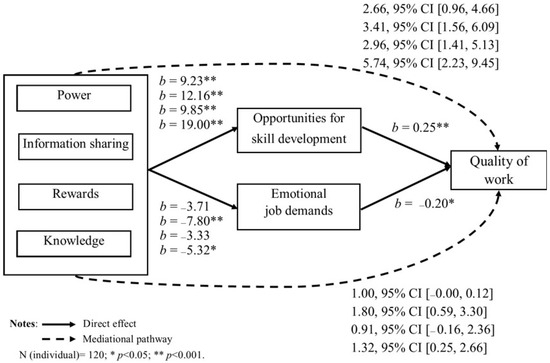
Hypothesis 1 predicted that (a) opportunities for skill development at Time 1 would have a positive relationship with QoW at Time 2, while (b) emotional job demands at Time 1 would have a negative relationship with QoW at Time 2. Opportunities for skill development at Time 1 had a positive effect on QoW at Time 2 (B = 0.25, SE = 0.06, β = 0.39, t = 4.37, p < 0.001). Emotional job demands at Time 1 had a positive effect on QoW at Time 2 (B = −0.20, SE = 0.08, β = −0.24, t = −2.54, p = 0.013). Thus, Hypothesis 1 was supported.
Hypothesis 2a predicted that power, information sharing, rewards, and knowledge at Time 1 would have a positive relationship with opportunities for skill development at Time 2. For Hypothesis 2a, all four components at Time 1, when examined separately, had significant positive effects on opportunities for skill development at Time 2. Power at Time 1 had a significant positive effect on opportunities for skill development at Time 2 (B = 9.23, SE = 2.53, β = 0.33, t = 3.65, p < 0.001). Information sharing at Time 1 had a significant positive effect on opportunities for skill development at Time 2 (B = 12.16, SE = 2.45, β = 0.43, t = 4.96, p < 0.001). Rewards at Time 1 had a significant positive effect on opportunities for skill development at Time 2 (B = 9.85, SE = 2.00, β = 0.43, t = 4.92, p < 0.001). Knowledge at Time 1 had a significant positive effect on opportunities for skill development at Time 2 (B = 19.00, SE = 1.70, β = 0.73, t = 11.19, p < 0.001). Hypothesis 2 was supported.
We further tested PIRK at Time 1 collectively on opportunity for skill development at Time 2. The overall model was significant, F(4, 110) = 31.84, p < 0.001, explaining 55% of the variance in Y (R2 = 0.74, adjusted R2 = 0.53). Among the predictors, only knowledge (B = 17, p < 0.001) was a significant positive predictor of opportunities for skill development, whereas power (B = 1.24, p = 0.55), information sharing (B = 0.85, p = 0.72), and rewards (B = 2.14, p = 0.25) were not significant.
Hypothesis 2b predicted that power, information sharing, rewards, and knowledge at Time 1 would have a negative relationship with emotional job demands at Time 2. When examined separately, only two out of the four components at Time 1 had negative effects on emotional job demands at Time 2. Power at Time 1 had a non-significant effect on emotional job demands at Time 2 (B = −3.71, SE = 2.26, β = −0.16, t = −1.64, p = 0.104). Information sharing at Time 1 had a significant negative effect on emotional job demands at Time 2 (B = −7.80, SE = 2.20, β = −0.32, t = −1.79, p < 0.001). Rewards at Time 1 had a non-significant effect on emotional job demands at Time 2 (B = −3.33, SE = 1.86, β = −0.17, t = −2.57, p = 0.077). Knowledge at Time 1 had a significant positive effect on emotional job demands at Time 2 (B = −5.32, SE = 2.07, β = −0.24, t = 3.93, p = 0.011). Hypothesis 2b was partially supported.
We further tested PIRK at Time 1 collectively on emotional job demands at Time 2. The overall model was significant, F(4, 110) = 3.33, p = 0.013, explaining 11% of the variance in Y (R2 = 0.34, adjusted R2 = 0.08). Among the predictors, only information sharing (B = −6.67, p = 0.021) was a significant negative predictor of emotional job demands, whereas power (B = −0.34, p = 0.89), rewards (B = 0.46, p = 0.83), and knowledge (B = −2.31, p = 0.37) were not significant.
Hypothesis 3a predicted that opportunities for skill development would mediate the relationship between power, information sharing, rewards, and knowledge at Time 1 and quality of work at Time 2. A bootstrapped mediation analysis using PROCESS indicated a significant indirect effect of power on QoW through opportunities for skill development (indirect effect = 2.66, 95% CI [0.96, 4.66]). Because the confidence interval did not include zero, the mediation effect was significant. The analysis also indicated a significant indirect effect of information sharing on QoW through opportunities for skill development (indirect effect = 3.41, 95% CI [1.56, 6.09]). Because the confidence interval did not include zero, the mediation effect was significant. Furthermore, the analysis indicated a significant indirect effect of rewards on QoW through opportunities for skill development (indirect effect = 2.96, 95% CI [1.41, 5.13]). Finally, the analysis indicated a significant indirect effect of knowledge on QoW through opportunities for skill development (indirect effect = 5.74, 95% CI [2.23, 9.45]). Hypothesis 3a was supported.
Hypothesis 3b predicted that emotional job demands would mediate the relationship between power, information sharing, rewards, and knowledge at Time 1 and quality of work at Time 2. A bootstrapped mediation analysis using PROCESS indicated a non-significant indirect effect of power on QoW through emotional job demands (indirect effect = 1.00, 95% CI [−0.00, 0.12]). However, the analysis indicated a significant indirect effect of information sharing on QoW through emotional job demands (indirect effect = 1.80, 95% CI [0.59, 3.30]). For rewards, the analysis indicated a significant indirect effect of rewards on QoW through emotional job demands (indirect effect = 0.91, 95% CI [−0.16, 2.36]). Finally, the analysis indicated a significant indirect effect of knowledge on QoW through emotional job demands (indirect effect = 1.32, 95% CI [0.25, 2.66]). Hypothesis 3b was partially supported.
Figure 2 displays the final model.
Figure 2.
The Final Model.
5. Discussion
The current study’s cross-lagged findings provide an in-depth understanding of the role HIWSs can have in terms of the impacts on an individual employees’ QoW throughout a long-term period. Specifically, this study investigated (1) how emotional job demands and opportunities for skill development impact an employees’ QoW; (2) how the HIWS is encapsulated by the PIRK model and influences the emotional job demands and opportunities for skill development experienced by an employee; and (3) the mediational role that job demands and job resources have on the relationship between the HIWS and an employees’ QoW.
Overall, using a two-wave cross-lagged design with a three-week time gap, the study found that the HIWS, as perceived through the PIRK model’s dimensions, provides empirical evidence of direct significant positive effects on employees’ opportunities for skill development and a significant negative effect of information sharing and knowledge on emotional job demands. The study found that opportunities for skill development mediate the relationship between all four dimensions of the PIRK model and employees’ QoW, whereas emotional job demands only mediate the relationship between the information-sharing and knowledge dimensions of the PIRK model. Overall, the findings suggest that the PIRK model is more strongly characterised by resource-enhancing practices than by demand-reducing practices.
5.1. Theoretical Contributions
This study makes several theoretical contributions to the existing literature. First, it provides empirical evidence supporting the positive relationship between opportunities for skill development and QoW, and the negative relationship between emotional job demands and QoW. These results are consistent with the JR-R model, which proposes that resources lead to improved work and personal outcomes, whereas demands lead to poorer work and personal outcomes [25].
The finding that opportunities for skill development increase QoW extends the work of scholars such as Lee et al. [27], who identified skill development and knowledge as key factors in motivating employees. When employees are provided with opportunities for skill development, they are better able to move beyond their professional comfort zones and enhance their existing skills, knowledge, and abilities. This, in turn, enables them to develop more effective workplace solutions. This affective–motivational state, highlighted by Schaufeli and Taris [28], is considered a key driver of positive organisational outcomes.
The results demonstrating a negative relationship between emotional job demands and QoW suggest that the level of stress experienced by employees depends on the demands placed upon them, which can adversely affect both personal and work-related outcomes [25,26]. Previous empirical research has also established this relationship, demonstrating that high job demands can significantly negatively affect employees’ personal well-being and work outcomes [20,47,68].
Overall, the significant findings for the PIRK dimensions of power, rewards, and knowledge in relation to opportunities for skill development, and the significant effects of the information-sharing and knowledge dimensions on emotional job demands, suggest that HRM systems are primarily resource-enhancing rather than demand-reducing. Although some PIRK dimensions showed significant relationships with employees’ emotional job demands, the overall pattern indicates a stronger role in enhancing resources than in reducing demands. This pattern is consistent with previous research on HRM systems [69,70], which similarly found that HRM practices, when examined as a system, generally do not reduce job demands.
When focussing specifically on the PIRK dimension of knowledge, the authors identify the importance of knowledge on the study’s job resources and job demands. Knowledge was found to have the strongest relationship with opportunities for skill development among all four of the PIRK dimensions. Research conducted by Rapp et al. [71] on the impact of knowledge on 175 employees in the pharmaceutical field showed that employees with less experience, yet high levels of knowledge about their organisation, were more inclined to work harder. In a more general sense, research conducted by Schieman and Plickert [72] highlighted knowledge as power, stating that employees with higher levels of knowledge about their organisation have greater levels of schedule control; experience more challenging, interesting and enriching work with greater economic rewards and security; and hold a higher level of trust at work. These findings support the positive association established in the present study between knowledge and opportunities for skill development, while also highlighting the important role that knowledge plays in enhancing access to job resources and reducing job demands.
Information sharing, one of the dimensions of the PIRK model, displayed a significant and negative relationship with emotional job demands. Therefore, the current study’s results suggest that an employee’s exposure to workplace information produces a significant decrease in emotional job demands. The findings support scholars’ work which suggests regular information sharing alleviates job demands by helping to develop a broader understanding of the employee’s role at work [73,74,75]. Therefore, information sharing may facilitate the sensemaking process whereby employees will attribute meaning to their roles. A study conducted by Lang et al. [68] supports these findings through its research, stating that role clarity moderated the job demand–strain relationship among participants. Specifically, participants who experienced high levels of job demands reported lower levels of physical and psychological strain when role clarity was high. In the same vein, Bliese and Castro’s [76] empirical research found that role clarity moderated the impact of job demands on psychological distress. These studies help to confirm the positive association of information sharing with emotional job demands found in the present study.
Rewards and recognition in the workplace act as a source of intrinsic motivation for employees [77]. This relationship dates to the early work of Maslow [78] on human motivation. Hence, a lack of rewards may be considered a significant barrier toward further training and development among employees. An explanation for the non-significant effect between the rewards dimension of the PIRK model and emotional job demands may lie in broader findings suggesting that employees are often inadequately rewarded for the time and effort they invest in their work, as reflected in reports by the Organisation for Economic Co-operation and Development (OECD)’s Better Life Index [79]. That is, in comparison to the rest of the world, the effort NZ employees exert into their work may be unbalanced in relation to the degree of rewards and recognition they receive. To further explain why this may be the case for NZ employees, the author of this paper turned to NZ’s unique business landscape, finding that 99% of NZ businesses are small to medium [79]. Small and medium-sized enterprises (SMEs) are therefore seen as the backbone of the NZ economy [80]. Due to the isolated nature of NZ, SMEs face challenges such as transporting goods, recruitment and retention, which all relate to NZ’s small population size and low average income [81]. Hence, the study’s findings, which show no significance between employees’ rewards and emotional job demands, may be a result of the financial constraints NZ experiences throughout its business landscape.
Through the results of the current study’s mediation analysis, partial mediation was found for opportunities for skill development and emotional job demands on the relationships between each PIRK component and QoW. The significant partial mediation results provide insight into the role played by opportunities for skill development and emotional job demands in the relationship of the HIWS with employees’ QoW, supporting past studies [82,83].
5.2. Practical Implications
Acknowledging that opportunities for skill development enhance QoW while emotional job demands reduce QoW, organisations considering the implementation of the HIWS should take into account the time and financial resources required. This process should involve the formulation of a plan with a suitable timeframe attached to each goal. The information-sharing and knowledge dimensions are especially important for QoW, as they are associated with higher opportunities for skill development and lower emotional job demands.
To enhance the information-sharing dimension, organisations should establish a level of transparency in which employees are provided with a clear vision from senior leaders and sufficient information to perform their work effectively, thereby ensuring high levels of information sharing within the workplace. Leaders should communicate when new information or changes arise so that employees are able to identify opportunities to develop their skills and abilities, which may also reduce their emotional job demands. To develop such a climate, organisations can ensure that there is adequate feedback and ongoing communication between top management, mid-level managers, and employees [84].
Given the strong and positive association between the knowledge dimension of PIRK on opportunities for skill development and emotional job demands, organisations should focus on providing employees with more access to training opportunities. In prioritising training and development in the workplace, organisations can assist their employees in making more impactful decisions to benefit the organisation. This is especially important for lower-level employees as they can share tacit knowledge that only their position level may experience in the workplace.
In relation to power, organisations may wish to adopt the “self-design” method developed by Ledford and Mohrman [85] to enhance the power dimension of the PIRK model. This approach gives employees the flexibility to make specific changes within their own units, enabling them to feel more empowered in how they carry out their work [20]. In addition, Guy [86] states that the sense of freedom associated with decision-making power can also be an important incentive and source of motivation for greater effort. Finally, organisations should ensure that employees are rewarded fairly and objectively based on their work outputs [11,41].
5.3. Strengths, Limitations and Future Directions
This cross-lagged study has produced robust conclusions on aspects within organisations which support employees’ quality of work (QoW). The study’s findings establish the importance of accessibility to opportunities for skill development in the workplace on employees’ QoW over time, such as three weeks in the case of this study. In addition, the study provides evidence of how job demands, and job resources can mediate the relationships of the HIWS with QoW. These findings support the progression of the high-involvement aspects within some NZ organisations and will hopefully provide evidence to support organisational-level change with employee outcomes as the focus, sparking further research in this field in the future. While the current study utilised a cross-lagged design to examine the proposed theoretical model, future research could employ a fully longitudinal design, whereby the independent variable is measured at Time 1, the mediator at Time 2, and the outcome variable at Time 3. Such a design would provide a more rigorous assessment of longitudinal mediation effects.
The study was designed and conducted to reduce the threat of common method variance (CMV) by ensuring the anonymity and privacy of all participants, by utilising different Likert scales for various constructs and by creating two waves of data collection, although these strategies still did not fully eliminate the threat of CMV. Future research should triangulate self-reports with multi-source and objective measures such as supervisor ratings of job performance or absenteeism rates. Parker and Kulik [87] successfully mitigated CMV in their research by combining self-report measures with supervisor performance ratings and employee records of absenteeism. Implementing these approaches would strengthen causal inference for mediation effects.
Due to limitations in the demographic profile of the participants, such as the relatively small sample size (120 participants), the predominance of female respondents, and the restricted age range of 18–39 years, the study does not capture a broader cross-section of the working population. In addition, the relationships between job demands, job resources, and QoW have only been examined within the New Zealand context, and these associations have not yet been tested in other countries. As a result, the current study cannot confirm whether similar patterns would emerge elsewhere. Future research could replicate this study with a wider age range of employees nested within organisations in New Zealand and across other countries, and examine additional employee outcomes, to gradually build a more comprehensive understanding of how job demands and job resources relate to employee outcomes within HIWS.
6. Conclusions
The present study has highlighted the importance of the information-sharing and knowledge dimensions of PIRK in increasing opportunities for skill development and reducing employees’ emotional job demands. In addition, the study suggests that organisations should strengthen information sharing as a means of reducing the emotional job demands experienced by employees and fostering a culture in which knowledge is valued. Future research could incorporate more objective data to complement the current findings and replicate the study with a broader sample of employees within New Zealand and internationally to determine whether the findings are generalisable. Such findings could assist New Zealand organisations in strengthening the sustainability and resilience of their workforce, thereby enhancing their competitive advantage and supporting the retention of a high-quality workforce.
Author Contributions
Conceptualisation, T.R.; methodology, T.R.; formal analysis, T.R.; investigation, T.R.; data curation, T.R.; writing—original draft preparation, T.R.; writing—review and editing, M.C.C.L.; supervision, M.C.C.L.; project administration, M.C.C.L. All authors have read and agreed to the published version of the manuscript.
Funding
This research was funded by Massey University’s Postgraduate Student Research Fund.
Institutional Review Board Statement
The study was conducted in accordance with the declaration of Helsinki and approved by the Research Ethics Chairs’ Committee of Massey University (Approval no: 4000027810, 31 July 2023).
Informed Consent Statement
Informed consent was obtained from all subjects involved in the study.
Data Availability Statement
The datasets generated and analysed during the current study are available from the corresponding author in response to a reasonable request.
Acknowledgments
We extend our gratitude to the editor and anonymous reviewers for the useful comments in improving the quality of this manuscript.
Conflicts of Interest
The authors declare no conflicts of interest.
References
- Bailey, T.; Berg, P.; Sandy, C. The effect of high-performance work practices on employee earnings in the steel, apparel, and medical electronics and imaging industries. Ind. Labor Relat. Rev. 2001, 54, 525–543. [Google Scholar] [CrossRef] [Scilit]
- Patterson, M.G.; West, M.A.; Wall, T.D. Integrated manufacturing, empowerment, and company performance. J. Organ. Behav. 2004, 25, 641–665. [Google Scholar] [CrossRef] [Scilit]
- Zacharatos, A.; Barling, J.; Iverson, R. High-performance work systems and occupational safety. J. Appl. Psychol. 2005, 90, 77–93. [Google Scholar] [CrossRef] [Scilit] [PubMed]
- Boxall, P.; Huo, M.L.; Macky, K.; Winterton, J. High-involvement work processes and systems: A review of theory, distribution, outcomes, and tensions. In Research in Personnel and Human Resources Management; Emerald Publishing Limited: Leeds, UK, 2019; Volume 37, pp. 1–52. [Google Scholar] [CrossRef] [Scilit]
- Bae, J.; Lawler, J.J. Organizational and HRM strategies in Korea: Impact on firm performance in an emerging economy. Acad. Manag. J. 2000, 43, 502–517. [Google Scholar] [CrossRef] [Scilit]
- Boxall, P.; Macky, K. Research and theory on high-performance work systems: Progressing the high-involvement stream. Hum. Resour. Manag. J. 2009, 19, 3–23. [Google Scholar] [CrossRef] [Scilit]
- Chen, S.L. Cross-level effects of high-commitment work systems on work engagement: The mediating role of psychological capital. Asia Pac. J. Hum. Resour. 2018, 56, 384–401. [Google Scholar] [CrossRef] [Scilit]
- O’Toole, J.; Lawler, E.E. The New American Workplace; St. Martin’s Publishing Group: Manhattan, NY, USA, 2007. [Google Scholar]
- Seeck, H.; Diehl, M.R. A literature review on HRM and innovation–taking stock and future directions. Int. J. Hum. Resour. Manag. 2017, 28, 913–944. [Google Scholar] [CrossRef] [Scilit]
- Lawler, E.E. High-Involvement Management: Participative Strategies for Improving Organizational Performance; Wiley: Hoboken, NJ, USA, 1986. [Google Scholar]
- Vandenberg, R.J.; Richardson, H.A.; Eastman, L.J. The impact of high involvement work processes on organizational effectiveness: A second-order latent variable approach. Group Organ. Manag. 1999, 24, 300–339. [Google Scholar] [CrossRef] [Scilit]
- Nguyen, M.; Malik, A.; Sharma, P.; Kingshott, R.; Gugnani, R. High involvement work system and organizational and employee resilience: Impact of digitalisation in crisis situations. Technol. Forecast. Soc. Change 2024, 205, 123510. [Google Scholar] [CrossRef] [Scilit]
- Kilroy, S.; Bosak, J.; Flood, P.C.; Peccei, R. Time to recover: The moderating role of psychological detachment in the link between perceptions of high-involvement work practices and burnout. J. Bus. Res. 2020, 108, 52–61. [Google Scholar] [CrossRef] [Scilit]
- Steffgen, G.; Sischka, P.E.; Fernandez de Henestrosa, M. The quality of work index and the quality of employment index: A multidimensional approach of job quality and its links to well-being at work. Int. J. Environ. Res. Public Health 2020, 17, 7771. [Google Scholar] [CrossRef] [Scilit] [PubMed]
- Schleicher, D.J.; Baumann, H.M.; Sullivan, D.W.; Yim, J. Evaluating the effectiveness of performance management: A 30-year integrative conceptual review. J. Appl. Psychol. 2019, 104, 851–887. [Google Scholar] [CrossRef] [Scilit] [PubMed]
- Green, F.; Lee, S.; Zhou, Y.; Zou, M. Work and life: The comparative importance of job quality for general well-being. Socio-Econ. Rev. 2024, 22, 835–857. [Google Scholar] [CrossRef] [Scilit]
- Mariappanadar, S.; Aust, I. The dark side of overwork: An empirical evidence of social harm of work from a sustainable HRM perspective. Int. Stud. Manag. Organ. 2017, 47, 372–387. [Google Scholar] [CrossRef] [Scilit]
- Fox, K.; Johnson, S.; Berkman, L.; Sianoja, M.; Soh, Y.; Kubzansky, L.; Kelly, E. Organisational- and group-level workplace interventions and their effect on multiple domains of worker well-being: A systematic review. Work Stress 2021, 36, 30–59. [Google Scholar] [CrossRef] [Scilit]
- Lovejoy, M.; Kelly, E.L.; Kubzansky, L.D.; Berkman, L.F. Work redesign for the 21st century: Promising strategies for enhancing worker well-being. Am. J. Public Health 2021, 111, 1787–1795. [Google Scholar] [CrossRef] [Scilit] [PubMed]
- Lee, M.C.C.; Kee, Y.J.; Lau, S.S.Y.; Jan, G. Investigating aspects of paternalistic leadership within the job demands–resources model. J. Manag. Organ. 2024, 30, 1900–1919. [Google Scholar] [CrossRef] [Scilit]
- Guest, D.E. Human resource management and performance: Still searching for some answers. Hum. Resour. Manag. J. 2011, 21, 3–13. [Google Scholar] [CrossRef] [Scilit]
- Jiang, K.; Lepak, D.P.; Hu, J.; Baer, J.C. How does human resource management influence organizational outcomes? A meta-analytic investigation of mediating mechanisms. Acad. Manag. J. 2012, 55, 1264–1294. [Google Scholar] [CrossRef] [Scilit]
- Bakker, A.B.; Demerouti, E. The job demands-resources model: State of the art. J. Manag. Psychol. 2007, 22, 309–328. [Google Scholar] [CrossRef] [Scilit]
- Demerouti, E.; Bakker, A.B.; Nachreiner, F.; Schaufeli, W.B. The job demands-resources model of burnout. J. Appl. Psychol. 2001, 86, 499–512. [Google Scholar] [CrossRef]
- Bakker, A.B.; Demerouti, E.; de Boer, E.; Schaufeli, W.B. Job demands and job resources as predictors of absence duration and frequency. J. Vocat. Behav. 2003, 62, 341–356. [Google Scholar] [CrossRef] [Scilit]
- Fila, M.J.; Paik, L.S.; Griffeth, R.W.; Allen, D. Disaggregating job satisfaction: Effects of perceived demands, control, and support. J. Bus. Psychol. 2014, 29, 639–649. [Google Scholar] [CrossRef] [Scilit]
- Lee, M.C.C.; Idris, M.A.; Tuckey, M. Supervisory coaching and performance feedback as mediators of the relationships between leadership styles, work engagement, and turnover intention. Hum. Resour. Dev. Int. 2019, 22, 257–282. [Google Scholar] [CrossRef] [Scilit]
- Schaufeli, W.B.; Taris, T.W. A critical review of the job demands-resources model: Implications for improving work and health. In Bridging Occupational, Organizational and Public Health: A Transdisciplinary Approach; Springer: Berlin/Heidelberg, Germany, 2014; pp. 43–68. [Google Scholar] [CrossRef] [Scilit]
- Moore, J. Why is this happening? A causal attribution approach to work exhaustion consequences. Acad. Manag. Rev. 2000, 25, 335–349. [Google Scholar] [CrossRef] [Scilit] [PubMed]
- Vegchel, N.V.; Jonge, J.D.; Söderfeldt, M.; Dormann, C.; Schaufeli, W. Quantitative versus emotional demands among Swedish human service employees: Moderating effects of job control and social support. Int. J. Stress Manag. 2004, 11, 21–40. [Google Scholar] [CrossRef] [Scilit]
- Maslach, C.; Leiter, M.P. Understanding the burnout experience: Recent research and its implications for psychiatry. World Psychiatry 2016, 15, 103–111. [Google Scholar] [CrossRef] [Scilit] [PubMed]
- Boxall, P.; Hutchison, A.; Wassenaar, B. How do high-involvement work processes influence employee outcomes? An examination of the mediating roles of skill utilisation and intrinsic motivation. Int. J. Hum. Resour. Manag. 2014, 26, 1737–1752. [Google Scholar] [CrossRef] [Scilit]
- Shin, S.; Jeong, I.; Bae, J. Do high-involvement HRM practices matter for worker creativity? a cross-level approach. Int. J. Hum. Resour. Manag. 2016, 29, 260–285. [Google Scholar] [CrossRef] [Scilit]
- Rodgers, R.W.; Ferketish, B.J. Creating a High-Involvement Culture Through a Value-Driven Change Process; Development Dimensions International: Bridgeville, PA, USA, 2005. [Google Scholar]
- Batt, R.; Colvin, A.J.S. An employment systems approach to turnover: Human resources practices, quits, dismissals, and performance. Acad. Manag. J. 2011, 54, 695–717. [Google Scholar] [CrossRef] [Scilit]
- Riordan, C.; Vandenberg, R.; Richardson, H. Employee involvement climate and organizational effectiveness. Hum. Resour. Manag. 2005, 44, 471–488. [Google Scholar] [CrossRef] [Scilit]
- Lee, M.C.C.; Idris, M.A.; Delfabbro, P.H. The linkages between hierarchical culture and empowering leadership and their effects on employees’ work engagement: Work meaningfulness as a mediator. Int. J. Stress Manag. 2017, 24, 392–415. [Google Scholar] [CrossRef] [Scilit]
- White, M.; Hill, S.; McGovern, P.; Mills, C.; Smeaton, D. ‘High-performance’ management practices, working hours and work-life balance. Br. J. Ind. Relat. 2003, 41, 175–195. [Google Scholar] [CrossRef] [Scilit]
- Sanders, K.; Jorgensen, F.; Shipton, H.; Van Rossenberg, Y.; Cunha, R.; Li, X.; Rodrigues, R.; Wong, S.I.; Dysvik, A. Performance-based rewards and innovative behaviors. Hum. Resour. Manag. 2018, 57, 1455–1468. [Google Scholar] [CrossRef] [Scilit]
- Thneibat, M.; Sweis, R. The impact of performance-based rewards and developmental performance appraisal on innovation: The mediating role of innovative work behaviour. Int. J. Product. Perform. Manag. 2022, 72, 1646–1666. [Google Scholar] [CrossRef] [Scilit]
- Mehmood, S.; Ramzan, M.; Akbar, M.T. Managing performance through reward system. J. Humanit. Soc. Sci. 2013, 15, 64–67. [Google Scholar] [CrossRef] [Scilit]
- Victor, J.; Hoole, C. The influence of organisational rewards on workplace trust and work engagement. SA J. Hum. Resour. Manag. 2017, 15, a853. [Google Scholar] [CrossRef] [Scilit]
- Wilson, J.P.; Western, S. Performance appraisal: An obstacle to training and development? J. Eur. Ind. Train. 2001, 24, 384–391. [Google Scholar] [CrossRef] [Scilit]
- Boxall, P.; Macky, K. High-involvement work processes, work intensification and employee well-being. Work Employ. Soc. 2014, 28, 963–984. [Google Scholar] [CrossRef] [Scilit]
- Appelbaum, E.; Bailey, T.; Berg, P.; Kalleberg, A. Manufacturing Advantage: Why High-Performance Work Systems Pay Off. Acad. Manag. Rev. 2001, 26, 459. [Google Scholar] [CrossRef] [Scilit] [PubMed]
- Morrison, D.; Cordery, J.; Girardi, A.; Payne, R. Job design, opportunities for skill utilization, and intrinsic job satisfaction. Eur. J. Work Organ. Psychol. 2005, 14, 59–79. [Google Scholar] [CrossRef] [Scilit]
- Kilroy, S.; Flood, P.; Bosak, J.; Chênevert, D. Perceptions of high-involvement work practices and burnout: The mediating role of job demands: HIWPs in health care. Hum. Resour. Manag. J. 2016, 26, 408–424. [Google Scholar] [CrossRef] [Scilit]
- Berg, P.; Kalleberg, A.L.; Appelbaum, E. Balancing work and family: The role of high-commitment environments. Ind. Relat. A J. Econ. Soc. 2003, 42, 168–188. [Google Scholar] [CrossRef] [Scilit]
- Lee, M.C.C.; Ding, A.Y.L. Hierarchical culture as a cross-level moderator of the relationship between transformational leadership, performance feedback, and employee job performance. Merits 2023, 3, 504–520. [Google Scholar] [CrossRef] [Scilit]
- Hauer, K.; ten Cate, O.; Boscardin, C.; Irby, D.; Iobst, W.; O’Sullivan, P. Understanding trust as an essential element of trainee supervision and learning in the workplace. Adv. Health Sci. Educ. Theory Pract. 2013, 19, 435–456. [Google Scholar] [CrossRef] [Scilit] [PubMed]
- Detsimas, N.; Coffey, V.; Sadiqi, Z.; Li, M. Workplace training and generic and technical skill development in the Australian construction industry. J. Manag. Dev. 2016, 35, 486–504. [Google Scholar] [CrossRef] [Scilit]
- Johnson, P.; Cassell, C. Epistemology and work psychology: New agendas. J. Occup. Organ. Psychol. 2001, 74, 125–143. [Google Scholar] [CrossRef] [Scilit]
- Koon, V.Y.; Pun, P.-Y. The mediating role of emotional exhaustion and job satisfaction on the relationship between job demands and instigated workplace incivility. J. Appl. Behav. Sci. 2017, 54, 187–207. [Google Scholar] [CrossRef] [Scilit]
- Fernandez de Henestrosa, M.; Sischka, P.E.; Steffgen, G. Examining the challenge-hindrance-threat distinction of job demands alongside job resources. Front. Psychol. 2023, 14, 1011815. [Google Scholar] [CrossRef] [Scilit] [PubMed]
- Fleetwood, S. Ontology in organization and management studies: A critical realist perspective. Organization 2005, 12, 197–222. [Google Scholar] [CrossRef] [Scilit]
- Mein, G.; Johal, S.; Grant, R.L.; Seale, C.; Ashcroft, R.; Tinker, A. Predictors of two forms of attrition in a longitudinal health study involving ageing participants: An analysis based on the Whitehall II study. BMC Med. Res. Methodol. 2012, 12, 164. [Google Scholar] [CrossRef] [Scilit] [PubMed]
- Ployhart, R.E.; Vandenberg, R.J. Longitudinal research: The theory, design, and analysis of change. J. Manag. 2010, 36, 94–120. [Google Scholar] [CrossRef] [Scilit]
- Orth, U.; Meier, L.L.; Bühler, J.L.; Dapp, L.C.; Krauss, S.; Messerli, D.; Robins, R.W. Effect size guidelines for cross-lagged effects. Psychol. Methods 2024, 29, 421–433. [Google Scholar] [CrossRef] [Scilit] [PubMed]
- Lösener, U.; Moerbeek, M. Bayesian sample size determination for longitudinal intervention studies with linear and log-linear growth. Behav. Res. Methods 2025, 57, 239. [Google Scholar] [CrossRef] [Scilit] [PubMed]
- Bakker, A.B.; Xanthopoulou, D.; Demerouti, E. How does chronic burnout affect dealing with weekly job demands? A test of central propositions in JD-R and COR-theories. Appl. Psychol. Int. Rev. 2023, 72, 389–410. [Google Scholar] [CrossRef] [Scilit]
- De Gieter, S.; Hofmans, J.; Bakker, A.B. Need satisfaction at work, job strain, and performance: A diary study. J. Occup. Health Psychol. 2018, 23, 361–372. [Google Scholar] [CrossRef] [Scilit] [PubMed]
- Zhao, H.H.; Shipp, A.J.; Carter, K.; Gonzalez-Mulé, E.; Xu, E. Time and change: A meta-analysis of temporal decisions in longitudinal studies. J. Organ. Behav. 2024, 45, 620–640. [Google Scholar] [CrossRef] [Scilit]
- Kristensen, T.; Hannerz, H.; Hogh, A.; Borg, V. The Copenhagen Psychosocial Questionnaire—A tool for the assessment and improvement of the psychosocial work environment. Scand. J. Work Environ. Health 2006, 31, 438–449. [Google Scholar] [CrossRef] [Scilit] [PubMed]
- Berthelsen, H.; Hakanen, J.J.; Westerlund, H. Copenhagen psychosocial questionnaire-a validation study using the job demand-resources model. PLoS ONE 2018, 13, e0196450. [Google Scholar] [CrossRef] [Scilit] [PubMed]
- Burr, H.; Berthelsen, H.; Moncada, S.; Nübling, M.; Dupret, E.; Demiral, Y.; Oudyk, J.; Kristensen, T.S.; Llorens, C.; Navarro, A.; et al. The third version of the Copenhagen psychosocial questionnaire. Saf. Health Work 2019, 10, 482–503. [Google Scholar] [CrossRef] [Scilit] [PubMed]
- Chen, A.T.; Komi, M.; Bessler, S.; Mikles, S.P.; Zhang, Y. Integrating statistical and visual analytic methods for bot identification of health-related survey data. J. Biomed. Inform. 2023, 144, 104439. [Google Scholar] [CrossRef] [Scilit] [PubMed]
- Hayes, A.F. Introduction to Mediation, Moderation, and Conditional Process Analysis: A Regression-Based Approach, 3rd ed.; Guilford Press: New York, NY, USA, 2022. [Google Scholar]
- Lang, J.; Thomas, J.L.; Bliese, P.D.; Adler, A.B. Job demands and job performance: The mediating effect of psychological and physical strain and the moderating effect of role clarity. J. Occup. Health Psychol. 2007, 12, 116–124. [Google Scholar] [CrossRef] [Scilit] [PubMed]
- Jensen, J.M.; Patel, P.C.; Messersmith, J.G. High-performance work systems and job control: Consequences for anxiety, role overload, and turnover intentions. J. Manag. 2013, 39, 1699–1724. [Google Scholar] [CrossRef] [Scilit]
- Ogbonnaya, C.; Daniels, K.; Connolly, S.; van Veldhoven, M. Integrated and isolated impact of high-performance work practices on employee health and well-being: A comparative study. J. Occup. Health Psychol. 2017, 22, 98–114. [Google Scholar] [CrossRef] [Scilit] [PubMed]
- Rapp, A.; Ahearne, M.; Mathieu, J.; Schillewaert, N. The impact of knowledge and empowerment on working smart and working hard: The moderating role of experience. Int. J. Res. Mark. 2006, 23, 279–293. [Google Scholar] [CrossRef] [Scilit]
- Schieman, S.; Plickert, G. How knowledge is power: Education and the sense of control. Soc. Forces 2008, 87, 153–183. [Google Scholar] [CrossRef] [Scilit]
- Bartunek, J.; Krim, R.M.; Necochea, R.; Humphries, M. Sensemaking, sensegiving, and leadership in strategic organizational development. In Advances in Qualitative Organization Research; JAI Press: Bingley, UK, 1999; Volume 2, pp. 36–71. [Google Scholar]
- Gioia, D.A.; Chittipeddi, K. Sensemaking and Sensegiving in Strategic Change Initiation. Strateg. Manag. J. 1991, 12, 433–448. [Google Scholar] [CrossRef] [Scilit]
- Maitlis, S.; Christianson, M. Sensemaking in Organizations: Taking Stock and Moving Forward. Acad. Manag. Ann. 2014, 8, 57–125. [Google Scholar] [CrossRef] [Scilit]
- Bliese, P.; Castro, C. Role clarity, work overload and organizational support: Multilevel evidence of the importance of support. Work Stress 2000, 14, 65–73. [Google Scholar] [CrossRef] [Scilit]
- Hansen, F.; Smith, M.; Hansen, R. Rewards and recognition in employee motivation. Compens. Benefits Rev. 2002, 34, 64–72. [Google Scholar] [CrossRef] [Scilit]
- Maslow, A. Motivation and Personality; Harper & Row: Manhattan, NY, USA, 1954. [Google Scholar]
- Organisation for Economic Co-Operation and Development (OECD). New Zealand: OECD Better Life Index. 2024. Available online: https://www.oecdbetterlifeindex.org/countries/new-zealand/ (accessed on 25 May 2024).
- Tongsuksai, S.; Mathrani, S.; Weerasinghe, K. Influential Characteristics and Benefits of Cloud ERP Adoption in New Zealand SMEs: A Vendors’ Perspective. IEEE Access 2023, 11, 23956–23979. [Google Scholar] [CrossRef] [Scilit]
- Ministry of Business and Innovation (MBIE). The New Zealand Small Business Strategy. 2019. Available online: https://www.mbie.govt.nz/assets/the-new-zealand-small-business-strategy.pdf (accessed on 14 May 2024).
- Conway, E.; Fu, N.; Monks, K.; Alfes, K.; Bailey, C. Demands or resources? The relationship between HR practices, employee engagement, and emotional exhaustion within a hybrid model of employment relations. Hum. Resour. Manag. 2016, 55, 901–917. [Google Scholar] [CrossRef] [Scilit]
- Mansour, S. Can strategic HRM bundles decrease emotional exhaustion and increase service recovery performance? Int. J. Manpow. 2023, 44, 503–523. [Google Scholar] [CrossRef] [Scilit]
- Lee, M.C.C.; Yeung, Y.M.; Lin, M.H. A multilevel mediational study on relationships between trust climate, leader–member exchange, trust, mistrust, communication and task performance. Psychol. Rep. 2025, 00332941251390423. [Google Scholar] [CrossRef] [Scilit] [PubMed]
- Ledford, G.E.; Mohrman, S.A. Self-design for high involvement: A large-scale organizational change. Hum. Relat. 1993, 46, 143–173. [Google Scholar] [CrossRef] [Scilit]
- Guy, F. High-involvement work practices and employee bargaining power. Empl. Relat. 2003, 25, 455–471. [Google Scholar] [CrossRef] [Scilit]
- Parker, P.A.; Kulik, J.A. Burnout Self- and supervisor-rated job performance, and absenteeism among nurses. J. Behav. Med. 1995, 18, 581–599. [Google Scholar] [CrossRef] [Scilit] [PubMed]

Disclaimer/Publisher’s Note: The statements, opinions and data contained in all publications are solely those of the individual author(s) and contributor(s) and not of MDPI and/or the editor(s). MDPI and/or the editor(s) disclaim responsibility for any injury to people or property resulting from any ideas, methods, instructions or products referred to in the content. |
© 2026 by the authors. Licensee MDPI, Basel, Switzerland. This article is an open access article distributed under the terms and conditions of the Creative Commons Attribution (CC BY) license.