


Abstract
(1) Background: The global expansion of teleworking has increased concern regarding musculoskeletal pain associated with home-based working conditions. This study quantified the prevalence of musculoskeletal pain among Brazilian teleworkers and explored ergonomic and environmental factors associated with the distribution of physical symptoms and the multisite pain burden. (2) Methods: A cross-sectional survey was conducted between June and August 2024, analyzing 184 valid responses from teleworkers across various professional sectors. Data were collected via an online questionnaire assessing sociodemographic characteristics, workstation ergonomics, and musculoskeletal symptoms using the Nordic Musculoskeletal Questionnaire (NMQ). Statistical analyses included Pearson’s chi-square tests, logistic regression, and exploratory Random Forest modeling to prioritize predictors. (3) Results: Musculoskeletal pain was reported by 74% of participants, with the lower back (40.8%), neck (36.4%), and upper back (30.4%) being the most frequently affected anatomical regions. The primary ergonomic and environmental factors associated with pain reports included discomfort with the desk and mouse, suboptimal thermal comfort, and prolonged sitting. Odds ratios demonstrated strong statistical co-occurrence between recent and 12-month pain reports, particularly for the shoulders, reflecting overlapping recall indicators rather than temporal symptom progression. (4) Conclusions: Musculoskeletal pain is highly prevalent among Brazilian teleworkers, showing clear links to localized workstation inadequacies and overlapping short- and long-term symptom reporting. These findings highlight the need for targeted institutional occupational health policies, such as ergonomics training and adjustable furniture provision, while future longitudinal research remains essential to confirm causal pathways.
1. Introduction
The adoption of telework and hybrid work, characterized by alternating office-based and remote work, increased rapidly during the COVID-19 pandemic [1]. The expansion of teleworking following the COVID-19 pandemic has profoundly transformed work organization, mobility patterns, and occupational health dynamics worldwide. What was once considered a marginal or flexible arrangement has become a predominant model across administrative, academic, and technical professions, thereby altering traditional boundaries between work and personal life [2]. This transition has introduced new ergonomic challenges, particularly regarding the adequacy of home workstations, including mouse devices, keyboards, monitors, chairs, desks, and laptops. Previous studies have shown that many teleworkers lack well-designed ergonomic workspaces [3,4]. Working from home also involves sedentary computer-screen work, which can lead to work-related musculoskeletal disorders (WRMSDs) [5]. Working from home adversely affects the musculoskeletal system [6]. WRMSD is among the most prevalent and costly occupational health problems worldwide [7]. While teleworking can enhance autonomy and productivity, it often occurs in settings lacking ergonomic standardization or institutional support, leading to prolonged static postures, repetitive movements, and psychosocial strain [8].
In Brazil, teleworking has become a structural feature of the post-pandemic labor market, particularly in education, public administration, and service sectors [9]. However, the ergonomic adequacy of home workstations remains poorly regulated, and disparities in housing conditions may exacerbate exposure to physical and psychosocial risks. Links between inadequate seating, monitor height, and repetitive tasks were associated with neck and lower back pain [8], as well as with prolonged computer time, occupational stress, and compliance with ergonomic principles at the workstation [10]. The use of household furniture while working from home has been associated with musculoskeletal complaints in many studies [11,12,13]. The type of chair and the type of display screen were also predictors of musculoskeletal pain [14]. A relationship was found between neck and lower back pain among teleworkers who performed activities in the bedroom [15]. The use of a floor chair or a floor cushion was associated with neck, shoulder, and lower back pain [16]. Additional ergonomic limitations include restricted device storage, poor screen positioning, and small desktop work areas [17]. In their review, Wutschert et al. reported that home-based teleworkers experienced suboptimal ergonomic conditions and that neck and back pain were common [18]. Additionally, another review found that working from home in a separate space is essential for maintaining boundaries with family members [17]. In the study by Casjen et al. [19], regression models indicated an increased risk of new or more severe pain among individuals without a home-based workstation, suggesting that a dedicated workstation may have a protective effect against musculoskeletal pain.
These issues are not evenly distributed: socioeconomic disparities influence the quality of home office conditions, access to ergonomic furniture, equipment, and the capacity to self-manage workload and posture. Consequently, teleworkers in lower socioeconomic strata or in developing economies are disproportionately exposed to preventable musculoskeletal and visual strain [20]. Understanding these inequalities is crucial for designing equitable occupational health strategies and establishing ergonomic standards tailored to the realities of remote and hybrid work. In this context, evaluating the prevalence and determinants of musculoskeletal pain among teleworkers is a critical step toward evidence-based interventions that promote sustainable, health-protective telework practices.
This study aimed to estimate the prevalence and anatomical distribution of musculoskeletal pain among Brazilian teleworkers and to examine the co-occurrence of pain reports across 7-day, 30-day, and 12-month recall periods. Conventional epidemiological analyses, including odds ratios and logistic regression, were combined with an exploratory Random Forest classification approach to rank the relative importance of potential predictors. The machine learning component was therefore used as a complementary analytical tool for pattern identification and predictor prioritization, rather than as a validated clinical or occupational health risk prediction model.
2. Materials and Methods
2.1. Study Design and Participants
This cross-sectional study investigated teleworkers in Brazil. Data were collected between June and September 2024 using a structured online questionnaire distributed via email and professional social networks. The inclusion criteria were: (1) being a teleworker at the time of the survey, (2) working at least partially in a remote or hybrid telework arrangement, and (3) being aged 18 years or older. Respondents who provided incomplete or inconsistent answers were excluded. A total of 184 valid responses were analyzed. Participants represented a wide range of professions, sectors, and educational levels, ensuring heterogeneity across occupational categories and teleworking conditions.
2.2. Questionnaire and Variables
The questionnaire included four sections: (i) sociodemographic data, (ii) work organization and teleworking conditions, (iii) ergonomic characteristics of the home workstation, and (iv) musculoskeletal pain symptoms based on standardized body regions, using the Nordic Questionnaire of Musculoskeletal System (NMQ). The musculoskeletal assessment encompassed nine anatomical regions (neck, shoulders, upper and lower back, wrists/hands, hips, thighs, knees, and ankles/feet) evaluated over three recall periods: 12 months, 30 days, and 7 days. The three recall periods allowed comparison of pain reports across short and longer recall windows. The 12-month recall period was used to estimate longer-term self-reported pain prevalence, whereas the 30- and 7-day periods captured more recent symptoms. Because the study was cross-sectional, these comparisons were interpreted as co-occurrence across recall periods rather than as evidence of temporal progression.
To differentiate between symptom-based classification and exploratory classification using non-symptom variables, two Random Forest models were developed. Model 1 used symptom-based variables to classify participants with multisite WRMSD burden, defined as pain reported in three or more anatomical regions over the 12-month recall period. Model 2 excluded symptom-based inputs and used demographic, ergonomic, and telework-context variables to classify participants with severe multisite WRMSD burden, defined as pain reported in five or more anatomical regions over the 12-month recall period. This distinction was adopted to separate general multisite symptom burden from a more stringent indicator of severe symptom distribution.
Multisite WRMSD burden was operationalized as the presence of pain in three or more distinct anatomical regions over the 12-month recall period. This threshold was used for descriptive and bivariate analyses and aligns with the literature suggesting that multisite pain is a proxy for greater symptom burden and functional limitation [21].
2.2.1. Sociodemographic and Occupational Variables
Collected variables included sex, age, educational level, number of dependents living at home, sector of employment (public, private, or other), job position, and years of service in the organization. Work-related variables covered teleworking modality (full-time, hybrid 3–4 days/week, or hybrid 1–2 days/week), contract type, and daily hours of remote work. Respondents were also asked whether they started teleworking after the COVID-19 pandemic.
2.2.2. Ergonomic Variables
Participants rated perceived discomfort and musculoskeletal strain associated with specific workstation elements, including the chair, desk, mouse, monitor, and laptop. For the main analysis, several categorical variables were dichotomized to reduce sparse response categories and improve the interpretability of odds ratios. Categories indicating inadequate, uncomfortable, irregular, or absent ergonomic conditions were grouped as “exposed,” whereas adequate or comfortable conditions were used as the reference category. This coding strategy was adopted due to the modest sample size and the need to maintain sufficient cell counts in crude and adjusted logistic regression models. However, dichotomization can reduce information, obscure dose–response patterns, and increase the possibility of residual misclassification.
Therefore, the results should be interpreted as associations with broad exposure categories rather than as effects of finely graded ergonomic conditions. By converting variables into binary measures, the analysis focused on the presence or absence of perceived ergonomic exposures, which was appropriate for exploring associations with self-reported musculoskeletal pain in this cross-sectional study.
2.2.3. Musculoskeletal Pain
Pain was assessed using a standardized body map from the Nordic Musculoskeletal Questionnaire (NMQ), covering recall periods of 12 months, 30 days, and 7 days. Body regions included the neck, shoulders, upper and lower back, wrists/hands, hips, knees, legs, and ankles/feet. Respondents reporting pain in ≥1 region during the last 12 months were classified as having musculoskeletal pain.
For exploratory classification and descriptive burden analysis, the primary analysis used 12-month pain data to represent longer-recall self-reported musculoskeletal pain. The 7- and 30-day recall periods were used to examine the co-occurrence of recent and 12-month pain reports.
Unadjusted (crude) Odds Ratios were calculated to identify preliminary associations between ergonomic and environmental factors and musculoskeletal pain reports across recall periods. Variables with p < 0.20 in the bivariate analysis or with theoretical relevance were subsequently entered into the multivariable logistic regression model to obtain adjusted odds ratios. Odds Ratios (ORs) and 95% confidence intervals were computed by comparing the likelihood of reporting musculoskeletal pain over 12 months among participants who reported pain in the preceding 7 and 30 days with those who did not. Analyses were performed separately for each body region using 2 × 2 contingency tables and verified through binary logistic regression.
When performing logistic regression and OR calculation for ergonomic and work-contextual factors, variables were consistently dichotomized to reflect the presence of risk: 0 = ‘No Risk’ (e.g., adequate condition, ≥8 h/day sitting) and 1 = ‘Risk’ (e.g., inadequate condition, sometimes/never or >8 h/day sitting). Therefore, an Odds Ratio (OR) > 1 indicates that the exposure to the ‘Risk’ category (coded as 1) is associated with an increased likelihood of reporting musculoskeletal pain.
2.3. Perceived Health and Physical Activity Covariates
Participants also self-rated their general health status (good, fair, or poor). They reported whether they regularly engaged in any physical activity (yes, sometimes, or no). Two operational definitions were used. First, multisite WRMSD burden was defined as pain reported in three or more anatomical regions over the 12-month recall period. This threshold was used for descriptive and bivariate analyses and is supported by previous study treating multisite pain as a proxy for greater symptom burden and functional limitation [21]. Second, severe multisite WRMSD burden was defined as pain reported in five or more anatomical regions over the 12-month recall period. This more stringent threshold was used only in the exploratory Random Forest severity classification model to identify variables associated with more extensive symptom distribution.
To differentiate between symptom-based classification and classification based on ergonomic and contextual variables, two distinct Random Forest models were developed.
Model 1—Symptom-based classification of multisite WRMSD burden: The first model classified participants with multisite WRMSD burden, defined as pain reported in three or more anatomical regions over the 12-month recall period.
Model 2—Exploratory classification of severe multisite WRMSD burden using non-symptom variables: The second model classified participants with severe multisite WRMSD burden, defined as pain reported in five or more anatomical regions over the 12-month recall period. This model used demographic, ergonomic, environmental, and telework-context variables and excluded symptom-based predictors.
This two-model approach allowed the analyses to distinguish between general and more severe multisite burden outcomes, without implying causal or longitudinal prediction.
2.4. Statistical and Machine Learning Analyses
The analysis was organized into four sequential components: descriptive prevalence analysis, crude association analysis, adjusted logistic regression, and exploratory Random Forest classification. Descriptive analyses were first used to summarize participant characteristics, telework conditions, and the prevalence of musculoskeletal pain by anatomical region and recall period. Crude associations between ergonomic or environmental exposures and multisite WRMSD burden were then evaluated using odds ratios and Fisher’s exact test. Adjusted logistic regression was subsequently used to estimate adjusted odds ratios and 95% confidence intervals for selected ergonomic and work-contextual factors while accounting for covariates such as sex, age, and daily sitting duration.
Given the modest sample size and the number of candidate predictors, model complexity was deliberately restricted. Adjusted logistic regression models were fitted using selected ergonomic and work-contextual variables with theoretical or bivariate relevance, rather than entering all available predictors simultaneously. For the Random Forest analysis, the objective was exploratory classification and variable ranking, not development of a validated prediction tool. Model performance was therefore interpreted cautiously, especially for the severe multisite WRMSD outcome, which had a small number of events.
Finally, Random Forest classification was used as an exploratory machine learning approach to classify severe multisite WRMSD burden and to rank variables by their contribution to classification performance. Logistic regression was therefore interpreted as an inferential association analysis, whereas Random Forest was interpreted as an exploratory classification and variable-ranking method. This analysis was exploratory and was not intended to produce a clinically validated prediction model. All analyses adhered to STROBE reporting recommendations for cross-sectional studies.
Data consistency was verified before statistical modeling. Variables presenting incomplete responses were examined for patterns of missingness. Because the proportion of missing data across all variables was below 5%, a listwise deletion approach was adopted. This procedure was specifically chosen to maintain the internal consistency and comparability of the analytical dataset across the bivariate analysis, multivariate logistic regression, and the Random Forest models. By including only complete cases in all analyses, we avoided bias introduced by imputation and preserved the homogeneity of the data used across statistical and machine learning techniques.
2.5. Analysis of Pain Reports Across Recall Periods
To examine the association between recent and longer-recall musculoskeletal pain reports, odds ratios and 95% confidence intervals were calculated to estimate the likelihood of reporting 12-month pain among participants who also reported pain in the 7- or 30-day recall periods. Each body region (neck, shoulders, upper and lower back, wrists/hands, hips, thighs, knees, and ankles/feet) was analyzed separately. Binary variables were coded as 1 = presence of pain and 0 = absence of pain, converting the original categorical coding (yes = 1, no = 2).
A value of OR > 1 indicated that pain reported in the 7- or 30-day recall period was associated with higher odds of also reporting pain in the 12-month recall period. Because of the cross-sectional design, these estimates were interpreted as associations across recall windows rather than as evidence that recent pain caused or predicted chronic pain. We investigated whether pain reported in short recall periods was associated with pain reported over 12 months and whether workstation characteristics, sitting duration, and environmental conditions were associated with this pattern. When cell frequencies were small, the resulting ORs were interpreted cautiously because sparse data can produce unstable and inflated estimates.
Analyses were conducted using Python 3.10 (SciPy 1.11) and SPSS 29.0, in accordance with epidemiological standards for cross-sectional association studies [22].
2.6. Ethical Considerations
The study protocol adhered to Brazilian National Health Council Resolution No. 510/2016, which governs research in the human and social sciences. Data were collected anonymously and voluntarily, with informed consent obtained from all participants at the start of the online survey. The Ethical Committee of São Paulo State University protocol is CAEE: 79120624.0.0000.5406, Brazil.
3. Results
As shown in Table 1, the sample comprised 184 teleworkers, of whom 59.8% were women and 38.6% were men, reflecting the predominance of female participation in remote work settings. Most respondents were between 30 and 50 years of age (47.8%), reflecting the demographic composition of the contemporary Brazilian telework force, and nearly 60% held postgraduate degrees or more, indicating a highly educated professional group. Nearly half lived with more than three people at home (49.9%), and most had no dependents (72.3%). Table 1 summarizes the demographic and occupational environmental characteristics.
Table 1.
Demographic and occupational environmental characteristics of the study population (n = 184).
As detailed in Table 1, the majority worked in the private sector (51.1%), followed by the public sector (33.7%), across a range of occupational roles. Regarding the company’s activities, Education and training were most reported (35.1%). The majority had been working in the company for more than 5 years (51.0%) and had signed a contract (43.5%). Most respondents worked in a hybrid model (63.9%), and 75.5% reported working remotely for up to 8 h per day; 44.6% reported flexible working hours. Despite this, 24.5% exceeded 8 h daily. More than one location was used for working from home (46.2%), including the office, bedroom, living room, and other spaces. Table 2 presents selected working conditions and perceptions from the population study.
Table 2.
Working conditions and perceptions of work and health of the population study (n = 184).
As shown in Table 2, most respondents (59.5%) reported that the temperature in their workplace was always comfortable. In addition, most respondents used an external mouse when working with a laptop, remained seated for 4–8 h/day during telework, and reported repetitive work. Most respondents perceived their general health as good (70.1%), reported regular physical activity (53.7%), and began teleworking after the COVID-19 pandemic (77.2%).
3.1. Descriptive Prevalence of Musculoskeletal Pain
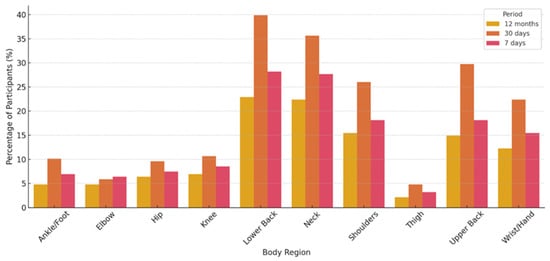
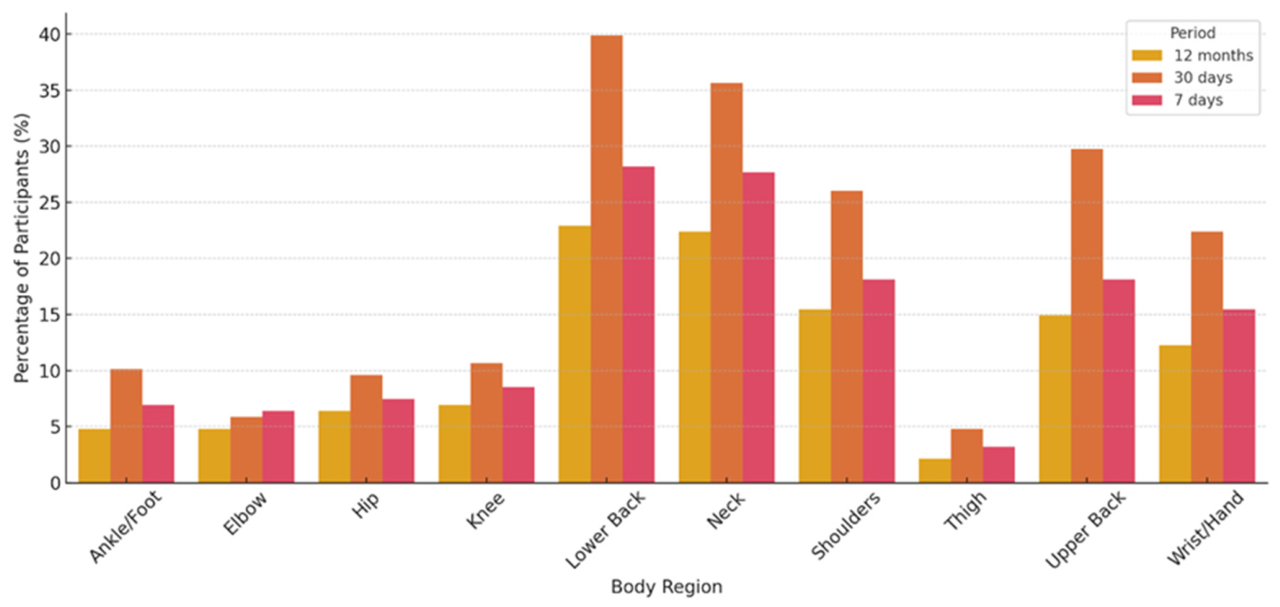
The body regions affected by WRMSD and time frames are presented in Figure 1.
Figure 1.
Prevalence of the pain by body region and time frame.
As illustrated in Figure 1, the prevalence of musculoskeletal pain was higher for the 12-month recall period than for the 30- and 7-day recall periods. The lower back (40.8%), neck (36.4%), and upper back (30.4%) were the most frequently affected regions. Shoulder pain also showed consistent reporting across recall windows. The lower prevalence observed for the 7-day recall period may reflect variation in symptom reporting across recall windows. To further examine this relationship, odds ratios were calculated to estimate the association between pain reported in the 7- or 30-day periods and pain reported in the 12-month period.
Some odds ratio estimates were very large, particularly for body regions in which recent pain reports strongly overlapped with 12-month pain reports. These large values should be interpreted with caution because they may reflect dependence among recall-period indicators for the same anatomical region, sparse cell counts in some 2 × 2 contingency tables, and instability of crude odds ratio estimates rather than a proportional increase in clinical risk. Therefore, these estimates were used only to describe the strength of statistical co-occurrence across recall periods.
3.2. Crude Associations Between Ergonomic Exposures and Multisite WRMSD Burden
To better understand the potential ergonomic and environmental correlates of musculoskeletal burden among teleworkers, we conducted bivariate analyses to examine crude associations between specific exposures and multisite WRMSD burden, defined as pain in three or more body regions over the 12-month recall period.
Table 3 presents the unadjusted odds ratios and Fisher’s exact p-values for key ergonomic and contextual exposures to identify preliminary associations with high WRMSD burden in this sample. Each odds ratio represents the unadjusted odds of pain among teleworkers exposed to specific ergonomic or contextual conditions relative to those unexposed. These crude associations provide preliminary evidence that ergonomic exposures are associated with reported WRMSD burden in telework settings.
Table 3.
Crude associations between ergonomic/environmental exposures and multisite WRMSD burden, defined as pain in three or more anatomical regions over the 12-month recall period (n = 184). Values represent unadjusted odds ratios (OR) and Fisher’s exact test p-values.
These crude odds ratios were used only to describe unadjusted associations between ergonomic or contextual exposures and multisite WRMSD burden. Variables showing statistical or theoretical relevance were then considered for the adjusted logistic regression analysis. Because these analyses were cross-sectional, the results should be interpreted as preliminary associations rather than evidence of causal contribution.
The results indicate that several ergonomic and environmental factors were associated with higher odds of multisite work-related musculoskeletal symptoms. Notably, working on a couch, lacking a supportive chair, and the absence of privacy were associated with nearly two-fold or greater odds of reporting multisite WRMSD burden. These findings should be interpreted cautiously because the associations are unadjusted and cross-sectional.
3.3. Adjusted Logistic Regression Analysis
Adjusted logistic regression was used to examine whether selected ergonomic and work-contextual variables remained associated with musculoskeletal pain after accounting for covariates. Results from this model should be interpreted as adjusted associations and not as causal effects. The adjusted logistic regression results are reported using adjusted odds ratios, 95% confidence intervals, and p-values.
Table 4 summarizes the results of the multivariable logistic regression model examining factors associated with musculoskeletal pain among teleworkers. Variables demonstrating statistical or theoretical relevance in the bivariate analysis were included, along with control variables such as sex, age, and daily sitting duration. This approach enabled estimation of adjusted odds ratios while accounting for selected covariates. Logistic regression and Random Forest modeling were used to provide complementary inferential and exploratory classification perspectives. The Random Forest model ranked variables by their contribution to classification performance rather than estimating causal risk.
Table 4.
Adjusted logistic regression analysis of factors associated with multisite WRMSD burden among Brazilian teleworkers. Values represent adjusted odds ratios, 95% confidence intervals, and p-values.
3.4. Random Forest Classification and Variable Importance
Random Forest analysis was used as an exploratory approach to examine variable-ranking patterns related to multisite and severe multisite WRMSD burden. Model performance was summarized using accuracy, AUC-ROC, balanced accuracy, sensitivity, and specificity, and variable importance was reported using mean decrease in Gini. These results were interpreted only as exploratory outputs and not as inferential associations or validated predictive evidence. Logistic regression was used to estimate adjusted associations, whereas Random Forest was used only for exploratory pattern identification and variable ranking.
Table 5a,b present the exploratory Random Forest results. Table 5a summarizes model-level performance metrics, whereas Table 5b presents the variable-importance rankings for each model. These findings should be interpreted as exploratory outputs rather than validated predictive evidence.
Table 5.
Random Forest model-level performance (a) and variable-importance rankings (b) for WRMSD burden among Brazilian teleworkers. (a) Model-level performance metrics; (b) Variable-importance ranking.
As presented in Table 5a, the symptom-based Random Forest model classified multisite WRMSD burden, defined as pain in three or more anatomical regions over the 12-month recall period, with an accuracy of 0.865 ± 0.045 and an AUC-ROC of 0.908 ± 0.033. However, sensitivity was moderate, indicating that some participants with multisite burden were not correctly identified. As shown in Table 5b, the highest-ranked variables in this model were recent pain reports, particularly neck pain in the 7-day recall period, lower-back pain in the 30-day recall period, shoulder pain in the 7-day recall period, wrist/hand pain in the 7-day recall period, and hip pain in the 30-day recall period. These findings indicate that recent symptom reports contributed strongly to the exploratory classification of broader multisite pain burden.
In contrast, as shown in Table 5a, Model 2, which used non-symptom demographic, ergonomic, environmental, and work-contextual variables to classify severe multisite WRMSD burden, should be interpreted with substantial caution. The severe-burden outcome included only eight events (4.3% of the sample), resulting in marked class imbalance. Although the model showed high apparent accuracy (0.957 ± 0.013), this result was driven by the correct classification of the majority non-severe class rather than by the identification of severe-burden cases. Sensitivity was 0.000 ± 0.000 and balanced accuracy was 0.500 ± 0.000, indicating that the model did not meaningfully identify participants with severe multisite WRMSD burden. Therefore, Model 2 should not be interpreted as a useful classifier, screening tool, or predictive model. As shown in Table 5b, its variable-importance output is reported only as a highly exploratory and unstable ranking exercise, intended to generate hypotheses for future studies with larger numbers of severe-burden cases.
4. Discussion
4.1. Sociodemographic and Household Dynamics
Most teleworkers in this sample were highly educated women, a demographic distribution that mirrors previous findings in remote work research [13]. This pattern reflects broader structural trends where advanced educational attainment often predicts greater access to teleworking opportunities, as higher levels of education are associated with employment in remote roles, including managerial, professional, and technical positions [23].
Nearly half of the respondents lived with more than three people at home, which can affect the quality of the immediate workspace, depending on household density [14]. Evaluating these structural factors, such as the number and size of cohabitants and the physical division of domestic spaces, is vital for analyzing individualized ergonomic needs [4]. Furthermore, while most respondents reported having no dependents, the literature frequently notes that household responsibilities and childcare duties can disproportionately exacerbate stress and domestic work conflicts, particularly for female teleworkers [13]. These blurred boundaries between professional and personal life [17,24] underscore the need for targeted organizational support to protect the health and well-being of remote employees [25].
4.2. Work Organization, Flexibility, and Physical Activity
The predominance of hybrid models among respondents highlights how flexible combinations of remote and in-office work have become a prominent work model worldwide post-pandemic [25]. However, hybrid configurations are not without ergonomic risks; prior research notes that, aside from lower back pain, hybrid workers frequently report heightened musculoskeletal pain across various body regions [6]. This vulnerability is likely compounded by extended working hours, since approximately 75% of our sample worked remotely for up to 8 h daily, and nearly a quarter exceeded that threshold. This widespread tendency to work for longer periods without breaks aligns with broader remote work patterns [17] and highlights the ongoing need for continuous training in good ergonomic practices.
While 44.6% of participants benefited from flexible hours, a factor known to enhance job satisfaction and help balance work–family commitments [26], this flexibility is often counterbalanced by reduced physical activity. Although 53.7% of respondents reported regular physical activity, the literature indicates that working from home systematically diminishes light physical activity due to eliminated commutes and fewer face-to-face social interactions [27], corroborating other studies documenting low levels of physical activity among teleworkers [28,29].
4.3. Workstation Conditions and Biomechanical Pathways
Workstation setup emerged as a prominent factor in managing musculoskeletal risk. Environmental conditions such as thermal discomfort and cold exposure are recognized contributors to physical and musculoskeletal risk [30], while the use of external peripherals is strongly recommended to optimize laptop workstation ergonomics [11,31]. In this study, 61.7% of respondents utilized an external mouse when working with a laptop [5]. However, a substantial portion of the sample continued to rely on ergonomically inadequate setups, including dining tables (25.0%), non-adjustable chairs (28.3%), or coaches (20.7%), matching workspace challenges commonly observed during the pandemic [8,13,14,15,16]. Furthermore, 46.2% teleworked from multiple locations within the home, which often indicates a lack of a dedicated home office or the need to shift spaces when family members are present. Such substandard setups and the absence of a separate room or distinct workspace are closely linked to elevated musculoskeletal complaints [19]. These findings support the inclusion of workstation discomfort related to the mouse, desk, and chair in multivariable models, though organizational and psychosocial dynamics also remain influential [5,6].
The high prevalence of musculoskeletal pain reported here, with the lower back and neck regions exhibiting the highest frequency of pain, is highly consistent with findings from European and Asian teleworker cohorts [8,32], as well as numerous other evaluations of computer workers [14,15,16,29,33]. These specific pain distributions are frequently tied to localized risk factors, such as the absence of a separate workspace [29], working in the bedroom [15], or using inadequate tables, floor chairs, and floor cushions [16]. Our multivariable models confirmed that workstation elements, particularly desk and mouse ergonomics, were associated with reported discomfort, illustrating the classic biomechanical pathway connecting static postures and repetitive upper-limb movements to spinal and shoulder strain [34]. Interestingly, this risk extended into knowledge-intensive sectors, showing that cognitively demanding tasks performed in constrained postures pose significant ergonomic challenges [35].
4.4. Recall Periods and Random Forest Model Explorations
The analysis revealed strong statistical co-occurrence between short-term (7- and 30-day) and long-term (12-month) pain reports, particularly within the shoulders, neck, and lower back. This alignment was mirrored in Random Forest Model 1, where recent symptoms (such as 7-day neck and shoulder pain) emerged as the top-ranked predictors for overall 12-month multisite burden.
Conversely, Random Forest Model 2, which used non-symptom variables to classify severe multisite burden (≥5 regions), proved highly unstable due to severe class imbalance (only 8 positive events). Model 2 exhibited a sensitivity of 0.000 and a balanced accuracy of 0.500, meaning it failed to reliably identify severe cases. Consequently, its variable importance rankings, which highlighted work–family interference and contract types, serve strictly as exploratory, hypothesis-generating outputs for future, larger-scale investigations rather than validated predictive, screening, or classification tools [36].
4.5. Limitations
Crucially, because this study employs a cross-sectional design, all identified relationships must be interpreted strictly as statistical associations rather than evidence of causal pathways or temporal symptom progression [20,37]. The pronounced odds ratios across the various recall windows do not indicate clinical chronicity; instead, they reflect inherent overlap in symptom recall and dependent reporting by the same participants for identical anatomical zones [22]. Furthermore, potential recall biases from self-reported survey data, information loss due to dichotomizing exposure variables, and small cell counts in specific anatomical subregions require that these findings be interpreted with caution. Future research that utilizes objective ergonomic metrics and robust longitudinal tracking is necessary to explicitly establish causal pathways and clarify symptom progression over time [6,20].
5. Conclusions
Musculoskeletal pain was highly prevalent among teleworkers in Brazil, with lower back and neck discomfort as the main complaints, consistent with prior evidence on remote work settings. Ergonomic inadequacies, particularly those related to desk setup and mouse ergonomics, along with environmental and organizational stressors, were strongly associated with higher rates of musculoskeletal pain. Recent pain reports co-occurred with 12-month pain reports, but this relationship reflects an overlap in symptom recall across windows rather than evidence of chronic clinical progression.
These findings support the need for occupational health policies tailored to telework, including ergonomics training, the institutional provision of adjustable furniture, and remote workstation assessments. Finally, while machine learning offers an exploratory pathway for variable ranking, larger longitudinal studies with sufficient numbers of severe-burden cases are strictly required before these models can be validated for predictive occupational health screening.
Supplementary Materials
The following supporting information can be downloaded at: https://www.mdpi.com/article/10.3390/occuphealth1020020/s1.
Author Contributions
Conceptualization M.d.C.B.d.A., I.d.A.N. and F.S.; methodology M.d.C.B.d.A., I.d.A.N. and F.S.; formal analysis M.d.C.B.d.A., I.d.A.N.; investigation M.d.C.B.d.A. and N.R.d.S.; writing—original draft preparation M.d.C.B.d.A., I.d.A.N. and F.S.; writing—review and editing M.d.C.B.d.A., I.d.A.N. and F.S.; visualization I.d.A.N. and F.S.; supervision M.d.C.B.d.A. and F.S.; project administration M.d.C.B.d.A. and F.S. All authors have read and agreed to the published version of the manuscript.
Funding
This research received no external funding.
Institutional Review Board Statement
The study was conducted in accordance with the ethical standards set forth in the 1964 Declaration of Helsinki and its later amendments, or comparable ethical standards, and was approved by the Ethical Committee of São Paulo State University, protocol number CAEE:79120624.0.0000.5406, Brazil, by 8 May 2024.
Informed Consent Statement
Informed consent was obtained from all subjects involved in the study.
Data Availability Statement
Data are available in the Supplementary Material.
Conflicts of Interest
The authors declare no conflicts of interest.
References
- Roquelaure, Y.; Bodin, J.; Cros, F.; Dascatha, A.; Fadel, M. The digital economy and hybrid work call for a review of compensation criteria for musculoskeletal disorder. Med. Lav. 2024, 115, e2024019. [Google Scholar] [CrossRef] [Scilit]
- Oakman, J.; Kinsman, N.; Stuckey, R.; Graham, M.; Weale, V. A rapid review of mental and physical health effects of working at home: How do we optimize health? BMC Public Health 2020, 20, 1825. [Google Scholar] [CrossRef] [Scilit]
- Milaković, M.; Koren, H.; Bradvica-Kelava, K.; Bubaš, M.; Nakić, J.; Jeličić, P.; Bucić, L.; Bekavac, B.; Čvrljak, J.; Capak, M. Telework-related risk factors for musculoskeletal disorders. Front. Public Health 2023, 11, 1155745. [Google Scholar] [CrossRef] [Scilit] [PubMed]
- Šagát, P.; Bartík, P.; Prieto González, P.; Tohănean, D.I.; Knjaz, D. Impact of COVID-19 quarantine on low back pain intensity, prevalence, and associated risk factors among adult citizens residing in Riyadh (Saudi Arabia): A cross-sectional study. Int. J. Environ. Res. Public Health 2020, 17, 7302. [Google Scholar] [CrossRef] [Scilit]
- Garcia, M.G.; Aguiar, B.; Bonilla, S.; Yepez, N.; Martin, B.J. Perceived physical discomfort and its associations with home office characteristics during the COVID-19 Pandemic. Hum. Factors 2024, 66, 916–932. [Google Scholar] [CrossRef] [Scilit] [PubMed]
- Bosma, E.; Loef, B.; Van Oostrom, S.H.; Proper, K.I. The longitudinal association between working from home and musculoskeletal pain during the COVID-19 pandemic. Int. Arch. Occup. Environ. Health 2023, 96, 521–535. [Google Scholar] [CrossRef] [Scilit] [PubMed]
- MacDonald, W.; Oakman, J. The problem with “ergonomics injuries”: What can ergonomists do? Appl. Ergon. 2022, 103, 103774. [Google Scholar] [CrossRef] [Scilit]
- Šagát, P.; Bartík, P.; Prieto González, P.; Tornero-Aguilera, J.F. Sedentary behavior and musculoskeletal discomfort in teleworkers. Front. Public Health 2021, 9, 748345. [Google Scholar]
- IBGE PNAD Contínua: Trabalho Remoto e Híbrido no Brasil. Instituto Brasileiro de Geografia e Estatística, Rio de Janeiro. 2024. Available online: https://www.ibge.gov.br/estatisticas/sociais/saude/17270-pnad-continua.html (accessed on 27 April 2026).
- Malinska, M.; Bugajska, J.; Bartuzi, P. Occupational and non-occupational risk factors for neck and lower back pain among computer workers: A cross-sectional study. Int. J. Occup. Saf. Ergon. 2021, 27, 1108–1115. [Google Scholar] [CrossRef] [Scilit]
- Cruz-Ausejo, L.; Copez-Lonzoy, A.; Vilela-Estrada, A.L.; Valverde, J.J.; Bohórquez, M.; Moscoso-Porras, M. Can working at home be a hazard? Ergonomic factors associated with musculoskeletal disorders among teleworkers during the COVID-19 pandemic: A scoping review. Int. J. Occup. Saf. Ergon. 2023, 29, 1335–1344. [Google Scholar] [CrossRef] [Scilit]
- Dockrell, S.; Culleton-Quinn, E. Remote working during the COVID-19 pandemic: Computer-related musculoskeletal symptoms in university staff. Work 2023, 74, 11–20. [Google Scholar] [CrossRef] [Scilit]
- Oakman, J.; Kinsman, N.; Lambert, K.; Stuckey, R.; Graham, M.; Weale, V. Working from home in Australia during the COVID-19 pandemic: Cross-sectional results from the Employees Working from Home (EWFH) study. BMJ Open 2022, 12, e052733. [Google Scholar] [CrossRef] [Scilit]
- Chim, J.M.Y.; Chen, T.L. Prediction of Work from Home and Musculoskeletal Discomfort: An Investigation of Ergonomic Factors in Work Arrangements and Home Workstation Setups Using the COVID-19 Experience. Int. J. Environ. Res. Public Health 2023, 20, 3050. [Google Scholar] [CrossRef] [Scilit]
- Larrea-Araujo, C.; Ayala-Granja, J.; Vinueza-Cabezas, A.; Acosta Vargas, P. Ergonomic risk factors of teleworking in Ecuador during the COVID-19 pandemic: A cross-sectional study. Int. J. Environ. Res. Public Health 2021, 18, 5063. [Google Scholar] [CrossRef] [Scilit]
- Du, T.; Iwakiri, K.; Sotoyama, M.; Tokizawa, K. Computer and furniture affecting musculoskeletal problems and work performance in work-from-home during the COVID-19 pandemic. J. Occup. Environ. Med. 2022, 64, 964–969. [Google Scholar] [CrossRef] [Scilit]
- Hall, C.E.; Brooks, S.K.; Mills, F.; Greenberg, N.; Weston, D. Experiences working from home: Umbrella review. J. Occup. Health 2024, 66, 13. [Google Scholar] [CrossRef] [Scilit] [PubMed]
- Wutschert, M.S.; Pereira, D.R.; Suterc, L.; Schulzec, H.; Elferinga, A. A systematic review of working conditions and occupational health in home office. Work 2022, 72, 839–852. [Google Scholar] [CrossRef] [Scilit] [PubMed]
- Casjens, S.; Grimsmann, S.; Wechsler, K.; Weber, B.; Clarenbach, C.; Petersen, J.; Neubauer, B.; Ellegast, R.; Behrens, T. Changes in musculoskeletal pain among computer workers when working from home. J. Occup. Environ. Med. 2025, 67, 363–370. [Google Scholar] [CrossRef] [Scilit] [PubMed]
- Moreira-Silva, I.; Queiroz, M.S.; Coury, H.J.C.G. Physical and psychosocial risk factors in tele-working: A systematic review. Appl. Ergon. 2023, 107, 103892. [Google Scholar] [CrossRef] [Scilit]
- Neupane, S.; Nygård, C.H.; Oakman, J. Work-related determinants of multi-site musculoskeletal pain among employees in the health care sector. Work 2016, 54, 689–697. [Google Scholar] [CrossRef] [Scilit]
- Schmidt, C.O.; Kohlmann, T. When to use the odds ratio or the relative risk? Int. J. Public Health 2008, 53, 165–167. [Google Scholar] [CrossRef] [Scilit]
- Dingel, J.I.; Neiman, B. How many jobs can be done at home? J. Public. Econ. 2020, 189, 104235. [Google Scholar] [CrossRef] [Scilit] [PubMed]
- Graham, M.; Weale, V.; Lambert, K.A.; Kinsman, N.; Stuckey, R.; Oakman, J. Working at home: The Impacts of COVID 19 on Health, Family-Work-Life Conflict, Gender, and Parental Responsibilities. JOEM 2023, 63, 938–943. [Google Scholar] [CrossRef] [Scilit]
- Vartiainen, M.; Vanharanta, O. True nature of hybrid work. Front. Organ. Psychol. 2024, 2, 1448894. [Google Scholar] [CrossRef] [Scilit]
- Gorjifard, R.; Bowe, S.J.; Blumenfeld, S.; Peace, C.; Crawford, J.O. Health and well-being effects of working from home: An overview of systematic reviews. N. Z. J. Employ. Relat. 2025, 49, 1–34. Available online: https://www.researchgate.net/profile/Roya-Gorjifard-2/publication/394259168_Health_and_Wellbeing_Effects_of_Working_from_Home_An_Overview_of_Systematic_Reviews/links/688fc9c87b62e240dd32ce38/Health-and-Wellbeing-Effects-of-Working-from-Home-An-Overview-of-Systematic-Reviews.pdf (accessed on 10 January 2026).
- Polspoel, M.; Mullie, P.; Reilly, T.; Van Tiggelen, D.; Calders, P. Comparison of physical activity and sedentary behavior between telework and office work in a working population during the COVID-19 pandemic: A systematic review and meta-analysis of observational studies. BMC Public Health 2025, 25, 1805. [Google Scholar] [CrossRef] [Scilit]
- Rodríguez-Nogueira, Ó.; Leirós-Rodríguez, R.; Benítez-Andrades, J.A.; Álvarez-Álvarez, M.J.; Marqués-Sánchez, P.; Pinto-Carral, A. Musculoskeletal pain and teleworking in times of COVID-19: Analysis of the impact on the workers at two Spanish universities. Int. J. Environ. Res. Public Health 2020, 18, 31. [Google Scholar] [CrossRef] [Scilit]
- Radulović, A.H.; Žaja, R.; Milošević, M.; Radulović, B.; Luketić, I.; Božić, T. Work from home and musculoskeletal pain in telecommunications workers during COVID-19 pandemic: A pilot study. Arh. Hig. Rada Toksikol. 2021, 72, 232–239. [Google Scholar] [CrossRef] [Scilit] [PubMed]
- Farbu, E.H.; Höper, A.C.; Reierth, E.; Nilsson, T.; Skandfer, M. Cold exposure and musculoskeletal conditions: A scoping review. Front. Physiol. 2022, 13, 934163. [Google Scholar] [CrossRef] [Scilit]
- Fiorini, L.A. Musculoskeletal pain among teleworkers: Frequency and associated factors. Hum. Factors Ergon. Manuf. 2023, 33, 357–365. [Google Scholar] [CrossRef] [Scilit]
- Moretti, A.; Menna, F.; Aulicino, M.; Paoletta, M.; Liguori, S.; Iolascon, G. Characterization of home working population during COVID-19 emergency: A cross-sectional analysis. Int. J. Environ. Res. Public Health 2022, 19, 836. [Google Scholar] [CrossRef] [Scilit]
- Gerding, T.; Syck, M.; Daniel, D.; Naylor, J.; Kotowski, S.E.; Gillespie, G.L.; Freeman, A.M.; Huston, T.R.; Davis, K.G. An assessment of ergonomic issues in the home offices of university employees sent home due to the COVID-19 pandemic. Work 2021, 68, 981–992. [Google Scholar] [CrossRef] [Scilit] [PubMed]
- Punnett, L.; Bergqvist, U. Visual Display Unit Work and Upper Extremity Musculoskeletal Disorders: A Review of Epidemiological Findings; World Health Organization: Geneva, Switzerland, 2021; Available online: https://apps.who.int/iris/handle/10665/41901 (accessed on 10 January 2026).
- Krause, N.; Burgel, B.; Rempel, D. Effort–reward imbalance and one-year change in neck–shoulder and upper extremity pain among call center computer operators. Scand. J. Work Environ. Health 2010, 36, 42–53. [Google Scholar] [CrossRef] [Scilit] [PubMed]
- Ahlholm, P.; Maghrebi, M. Machine learning for predicting the risk of musculoskeletal disorders among teleworkers. Saf. Sci. 2021, 139, 105273. [Google Scholar] [CrossRef] [Scilit]
- Hong, Q.N.; Li, J.; Kersalé, M.; Dieterlen, E.; Mares, A.; Ahmadian, Z.S.; Paquet, V.; Laberge, M.; Coutu, M.-F. Work disability and musculoskeletal disorders among teleworkers: A scoping review. J. Occup. Rehabil. 2025, 35, 17–29. [Google Scholar] [CrossRef] [Scilit]

Disclaimer/Publisher’s Note: The statements, opinions and data contained in all publications are solely those of the individual author(s) and contributor(s) and not of MDPI and/or the editor(s). MDPI and/or the editor(s) disclaim responsibility for any injury to people or property resulting from any ideas, methods, instructions or products referred to in the content. |
© 2026 by the authors. Licensee MDPI, Basel, Switzerland. This article is an open access article distributed under the terms and conditions of the Creative Commons Attribution (CC BY) license.