


Abstract
In architecture and construction, it is common practice to use acrylic products with a high flammable content, ranging from lacquers designed to improve the curing of concrete and mortar to resins that provide protection, sealing, flexibility, and elasticity. The drying process of the treated surface involves the formation of vapours of volatile organic compounds (VOCs); to prevent these from creating a potentially hazardous flammable atmosphere, a procedure is presented that establishes the maximum application rate for solvent-based products, providing equations that relate the maximum application area and the minimum drying time to the available air velocity in the work area. The results are provided for both indoor and outdoor applications. A maximum application rate is established to prevent the creation of areas classified as fire or explosion hazards: 1.5 m2/h indoors and 1 m2/h outdoors. When this is carried out at an ambient temperature of 20 °C, and from 40 °C upwards, it is not possible to apply the varnishes in practice without creating a flammable atmosphere.
1. Introduction
Architecture designs structures intended to stand the test of time through the use of adhesives and protective coatings [1], such as natural lacquer, which has been used by humans since the Neolithic period [2,3]. Furthermore, techniques aimed at reducing environmental impact and improving both the durability and performance of cements and concretes are constantly evolving [4], with the curing process being fundamental in determining the mechanical performance, durability, and sustainability of structures [5], including high-strength concretes [6] and precast elements [7].
In hot environments, it is common practice to use lacquers that slow down the evaporation of water during the curing process of concrete and mortar. Commercially available acrylic lacquers typically contain more than 50.0% solvents, usually xylene and ethylbenzene, which means that the product used in applications has flash points of around 20 °C. Furthermore, it is common to use varnishes for priming and consolidation. In these, the solvent is the main component of the mixture.
Both the application of lacquers and the curing process of concrete often involve the use of volatile organic compounds (VOCs) [8,9], which entail risks such as combustion due to the accumulation of their vapours, caused by poor ventilation [10]. Within the context of advances in the development of safety models in the field of risk management [11] including those associated with fires and explosions [12], by identifying potentially explosive mixtures [13], assessing their risks, and analysing the consequences [14], methods are available to characterise the combustion and explosion of vapours from flammable organic liquids and mixtures used in surface coatings [15,16] both experimentally [17] and theoretically [18,19], taking into account the non-ideality of the system [20], including in the presence of oxidising agents that lower the lower flammability limits (LFLs) [21], with techniques being developed to reduce their hazard potential, such as the addition of flame retardants [22].
The recovery of solvents at ambient temperature and pressure using solar energy is the subject of study [22], in addition to the drying capacity of building materials, which is influenced by surface airflow and the size of the treated surface [23]; knowledge of the evaporation process of chemical mixtures [24]; and an understanding of the evaporation process of BETEX [25] in workplace environments [26] or on polymer coatings [27] and underground structures [28,29].
However, the models assume air velocities higher than those typically found in workplace environments and tend to overestimate the influence of air velocity and underestimate the influence of the length of the evaporation surface [30]. The application of a thin film can cause brief but high-concentration emissions, as small spills reach their maximum evaporation immediately after they occur [31,32], with aqueous mixtures of hydrophobic compounds having a particular impact [30].
This study examines how to determine application limits to prevent the formation of a hazardous explosive atmosphere, using international standards as a reference [33,34] and taking into account the maximum application area and the necessary waiting time between applications, thereby establishing the maximum working efficiency and considering the residence time of the vapour following the application of the products
2. Materials and Methods
Commercial acrylic lacquer formulations typically contain more than 50.0% solvents, usually toluene, xylene, and ethylbenzene, which means that the product used in applications has flash points of around 20 °C. Furthermore, it is common to use primers and consolidating varnishes, in which the solvent is the main component of the mixture. Consequently, the application of both lacquers and the strippers used to remove them leads to the formation of a continuous film of flammable products, which, during the drying process, can result in the creation of a hazardous environment due to the risk of fire and explosion.
The aim is to establish the maximum application area for both commercial acrylic lacquers and varnishes so that the vapours generated do not pose a risk. Should an explosion occur, its consequences will be negligible; the pressure wave generated will not cause damage, and combustion will not generate sufficient heat to cause damage or ignite surrounding materials [33,34].
The extent of the hazardous area is determined by the available ventilation, which exerts a dual yet contradictory influence: increased air velocity allows the vapour generated during the drying process to be diluted, but at the same time, it accelerates evaporation from the surface of the liquid [22,30].
A key parameter in ventilation is the number of air changes per unit of time [33,35]:
where
- C = number of air changes (s−1);
- Qa = air flow (m3/s);
- V0 = total volume to be ventilated (m3);
- w = air velocity (m/s);
- Aw = cross-sectional area, which cuts through the air (m2);
- L0 = length of the air path within the space to be ventilated (m).
This mathematical expression allows the air velocity at the surface of the applied product to be determined. When calculating the evaporation rate of volatile chemicals, air velocities ranging from 0 to 5.1 m/s are considered [36]. Although natural ventilation is variable, standardised values have been adopted in standards relating to the classification of areas by fire or explosion risk (ATEX) in order to ensure the highest level of safety.
In the model presented, ventilation has been estimated by applying the standard UNE 202007 IN [34], which assumes an air velocity for confined environments in poorly ventilated spaces of 35 air changes per hour. This determines that the air changes per hour are 0.01 s−1, implying an air velocity of 0.05 m/s. In open environments, the velocity is 0.5 m/s, i.e., ten times higher, so the value of C will be 0.03 s−1. For its part, the international standard IEC 60079-10-1 [33] assumes, for the worst-case scenario regarding vapour dispersion, a wind speed of 0.25 m/s, just above the ground in calm weather conditions [33,34,35,36,37,38].
The ventilation capacity is determined across the longitudinal section of the path within the space to be ventilated; a constant air flow through a hypothetical cube of 15 m is assumed outdoors, and 1.7 m is assumed in poorly ventilated indoor areas [34]. A standardised wind speed of 0.5 m/s outdoors corresponds to 108 air changes per hour.
Furthermore, it is also possible to utilise the ventilation systems available in the buildings; in this case, the maximum flow velocities are less than 6 m/s [36,37,38,39,40] (Table 1).
Table 1.
Standardised air velocity [36,37,38].
Although a constant airflow is assumed across the longitudinal section of the path within the space to be ventilated, its behaviour is not uniform, as it exhibits a gradient tending towards zero across the structures themselves, a factor that is particularly significant at high air velocities.
It should be noted that the use of conventional air-conditioning systems on dry surfaces is not permitted, as flammable vapours are transferred to the installation itself; therefore, a specific ATEX marking must be established.
Liquids in equilibrium with the surrounding atmosphere generate a vapour layer above their surface, which can cause the concentration of this vapour to exceed the lower flammability limit of the substance or mixture, and consequently create an explosive atmosphere.
The amount of vapour generated depends on the temperature of the liquid and the surrounding air flow. The substance is in thermodynamic equilibrium with the environment and has the same temperature as the surrounding air. Furthermore, it is estimated that air circulation in the drying zone is less effective at diluting the generated vapour than in the rest of the volume under consideration.
The scientific literature presents two equations that can be used to calculate the vapour generated at the surface of an uncooled flammable liquid exposed to the atmosphere [33]:
where
- Qg = liquid evaporation rate (kg/s);
- Uw = wind speed at the liquid surface (m/s);
- A = evaporation area of the liquid’s free surface (m2);
- Pv = vapour pressure of the flammable substance (Pa);
- M = molar mass (kg/Kmol);
- T = fluid temperature (°K);
- R = universal gas constant (8314.5 J/kmol K).
For liquids with low vapour pressure that are at a temperature close to their boiling point, the following equation is also available [34]:
where
- Qg = Liquid evaporation rate (kg/s)
- A = Evaporation area of the free surface of a liquid (m2)
- uw = Wind speed at the liquid surface (m/s)
- f = Ventilation efficiency factor, values range from 1 to 5 (as this is a surface evaporation process, ventilation efficiency is minimal f = 5) (dimensionless)
- req = Equivalent radius of the liquid surface (m)
- M = molar mass (kg/Kmol);
- Pa = atmospheric pressure (Pa);
- Pv = vapour pressure of the flammable substance (Pa).
The determination of the conditions for safe application is based on ensuring a non-hazardous area; this requires a high dilution that allows the vapour concentration at the surface to be reduced rapidly and, furthermore, ensures that virtually no vapour remains after the application is complete. These conditions are met when the flammable volume is less than 0.1 m3 [33,35].
To determine this, vapour is characterised using the following equation [12]:
where
- Qc = characteristic of exhaust, in (m3/s);
- Qg = liquid evaporation rate (kg/s);
- ρg = vapor density (kg/m3);
- LFL = lower flammability limit (vol/vol).
To achieve a theoretical area of negligible extent, the characteristic evaporation rate must be less than 0.001 m3/s [33].
The required drying time between applications is implemented so that the average vapour concentration in the air falls below its lower flammability limit, the value of which is obtained using the following equation [34]:
where
- t = maximum residence time of the generated vapour (s);
- Xo = initial concentration of flammable substance expressed in the same units as the LFL, i.e., in % vol. or in kg/m3;
- C = number of fresh air changes per unit of time (s−1);
- f = factor accounting for the fact that the mixture is not ideal (dimensionless);
- LFL = lower flammability limit (vol/vol).
- k = safety factor applied to the LFL (typical value k = 0.25) (dimensionless).
The safety factor is applied because the effective ventilation capacity is always lower than the available capacity and because explosive mixtures may exist at temperatures up to 15 °C below the flash point [41].
Finally, the maximum application rate for each product is obtained by calculating the ratio of the maximum application area to the drying time, which has been equated to the vapour retention time:
where
- t = maximum residence time of the generated steam (s);
- th = minimum drying time (h).
The application parameters, maximum surface area, and drying time for toluene solvent in confined spaces and poorly ventilated areas are as follows (Table 2).
Table 2.
Application parameters of toluene in poorly ventilated areas.
The maximum work rate that allows a safe environment to be maintained whilst applying the solvent toluene is
where
- Vaplication = application rate: maximum application rate (m2/h);
- A = maximum application area (m2);
- th = minimum drying time (h);
The maximum yield for the manual application of toluene is
The results obtained using the proposed calculation method are based on environmental conditions of 20 °C and atmospheric pressure. Products are not always dried under these conditions; therefore, various mathematical models have been developed to provide results as a function of drying temperature. The best known of these is Antoine’s equation [42]:
where
- Pv = vapour pressure (mmHg);
- T = temperature (°C);
- A, B, C = Antoine coefficients (dimensionless).
The maximum surface area to which it can be applied without posing a risk decreases as air velocity increases due to a rise in the amount of vapour released into the atmosphere; this decrease is more pronounced at lower air velocities in accordance with the following equation:
where
- A = maximum application area (m2);
- w = air velocity (m/s).
The time interval to be observed between applications follows the same pattern:
where
- th = minimum drying time (h);
- w = air velocity (m/s);
- a = location-specific parameter (dimensionless).
- Indoor environments: a = 0.0409
- Indoor environments a = 0.1228
3. Results
Toluene is more likely to create a potentially hazardous flammable atmosphere than acrylic lacquers and varnishes; consequently, given that it constitutes the majority component, this approach entails accepting more conservative returns in exchange for a safer working environment. The results obtained for the characteristic air velocities in each zone, in accordance with the international standard IEC 60079-10-1 [33] and UNE 202007 IN [34], are shown below (Table 3).
Table 3.
Application parameters for toluene at 20 °C and atmospheric pressure, taking into account standardised air velocities [33,34].
As the air velocity increases, the surface dries more quickly, thereby significantly reducing the waiting time before continuing with the application of the products. However, this increase in airflow over the drying surface increases the amount of flammable vapour released into the atmosphere, which also reduces the application area.
The application rate required for the work to be considered safe varies depending on the equation used, with the value obtained indoors at high air velocities being particularly significant; the international standard UNE 202007-IN [34] provides more restrictive values.
The amount of flammable vapour increases with temperature, leading to a drastic reduction in the product application rate to prevent the generation of a flammable atmosphere (Table 4).
Table 4.
Application parameters for toluene at 40 °C and one atmosphere of pressure, taking into account standardised air velocities [33,34].
To achieve a theoretical area of negligible extent, the characteristic value of the off-gassing rate must be less than 0.001 m3/s [33]; therefore, for the solvent toluene, the maximum application area for confined spaces with poor ventilation is as follows (Table 5).
Table 5.
Results obtained by considering standardised air velocity [36,37,38].
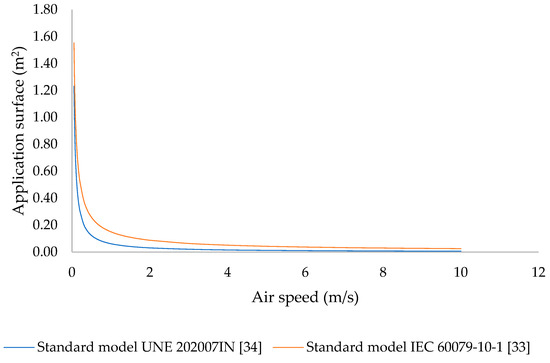
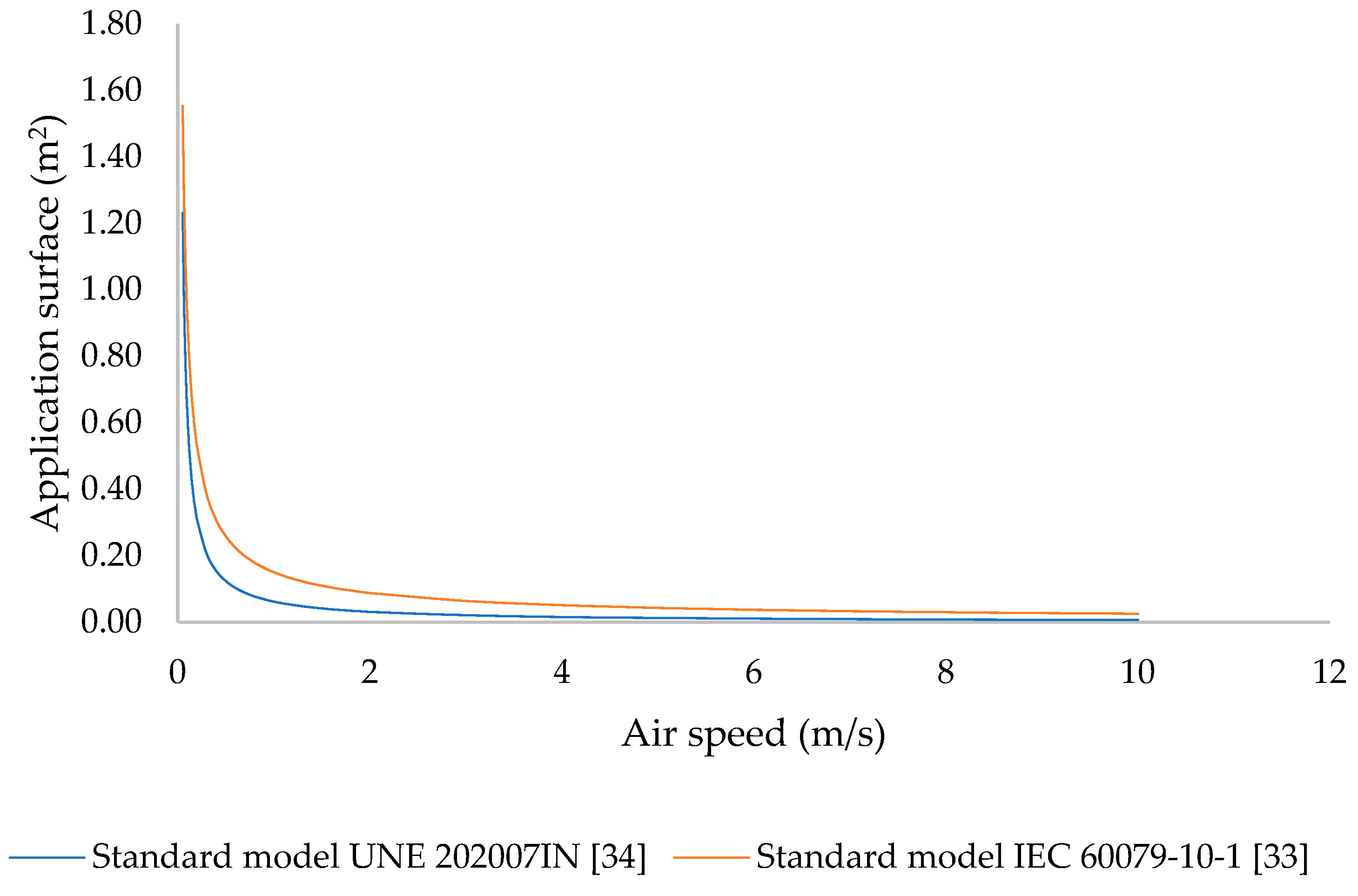
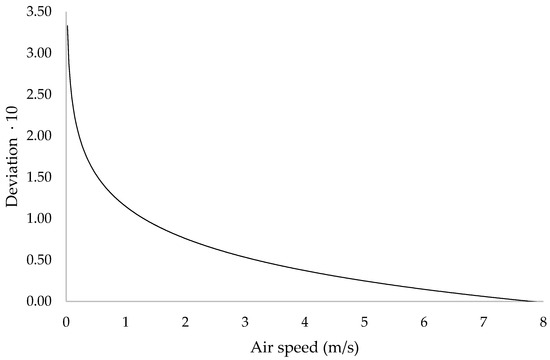
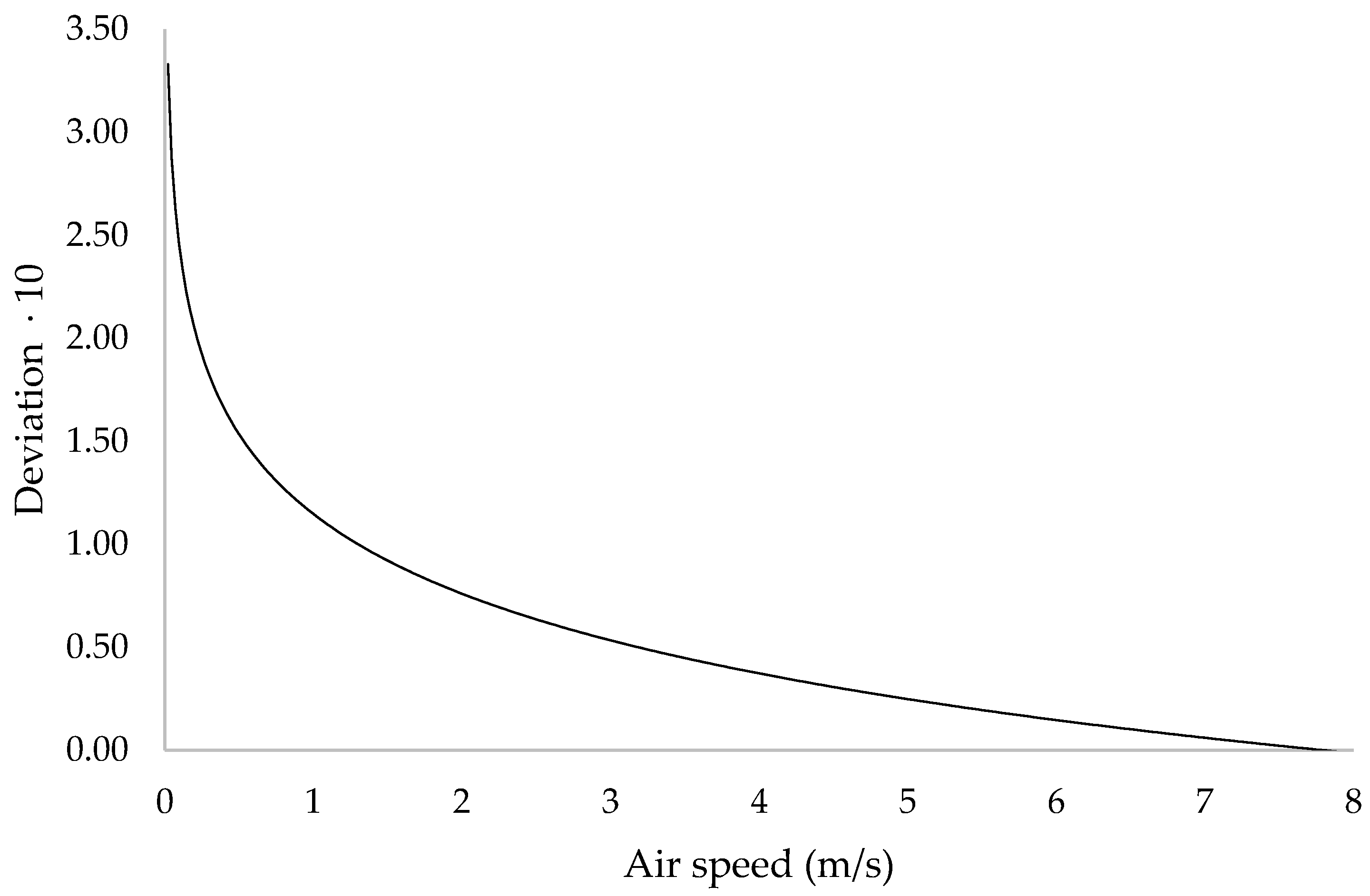
To analyse the difference in behaviour between the values obtained by applying both standards, the deviation in the maximum surface area of toluene application is examined under ambient conditions of 20 °C and at atmospheric pressure as a function of air velocity (Figure 1 and Figure 2).
Figure 1.
Maximum indoor application area for toluene as a function of air velocity.
Figure 2.
Deviation in the maximum indoor application rates for toluene as a function of air velocity relative to the international standard used.
Both models behave in exactly the same way, although the one set out in standard UNE 202007 IN [34] specifies more restrictive application surfaces.
The results obtained by applying the UNE 202007 IN [34] and IEC 60079-10-1 [33] standards show similar behaviour at high air velocities; however, as the airflow decreases, the differences become more pronounced, with the UNE 202007 IN [34] standard providing more conservative values, which are particularly significant at the speeds considered in studies on the evaporation of volatile chemicals [36], i.e., below 5 m/s.
The analysis of the behaviour of the product application parameters as a function of ambient temperature is carried out by studying commercial toluene. This has a purity of over 99.0%, so Antoine’s equation can be applied to obtain vapour saturation pressure values as a function of temperature. As this is a non-polar aromatic hydrocarbon that does not form hydrogen bonds, the valid temperature range extends up to its boiling point of 111 °C; however, at low temperatures, it is limited to a minimum of 6 °C, below which adjustments are required until its melting point of –95 °C is reached.
where
- Pv = vapour pressure (mmHg).
The calculation method described is valid only for the drying of the product. Consequently, the temperature at which this takes place must always be below the boiling point of the substance in question, which, in the case of toluene, is 111 °C.
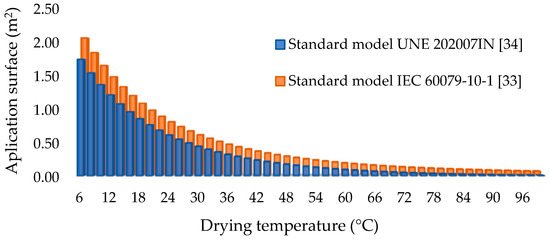
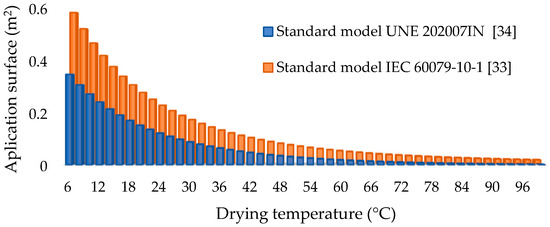
The values obtained were derived by considering the ventilation conditions set out in standard UNE 202007 IN [34] for poorly ventilated both indoor spaces (Figure 3) and outdoor environments (Figure 4).
Figure 3.
Maximum application area for toluene in poorly ventilated interiors depending on the drying temperature.
Figure 4.
Maximum application area for toluene in poorly ventilated outdoor areas depending on the drying temperature.
The effect of temperature on the application surface again shows a similar pattern to that observed for ventilation.
The results obtained by applying the UNE 202007 IN [34] standard are always more conservative, with the difference becoming more pronounced as the temperature decreases.
The values provided have been obtained by taking into account the external ventilation conditions set out in standard UNE 202007 IN [34] and the air velocity specified in IEC 60079-10-1 [33], as this better reflects the expected airflow over a drying surface.
The influence of temperature on the application surface again shows a similar pattern to that observed for ventilation. The values obtained by applying the UNE 202007 IN [34] standard are always lower, with the difference becoming more pronounced as the temperature decreases.
Outdoors, the higher effective air velocity accelerates evaporation, increasing the amount of fuel available in the atmosphere and raising the risk of ignition.
Whilst ensuring the same safety conditions, application indoors allows the treated area to be five times larger than when working outdoors.
It should be noted that the vapour pressures obtained by applying Antoine’s equation are higher than the actual values published in the UNE 202007 IN [34] standard, 1830 Pa at 20 °C and 6650 Pa at 40 °C, whilst the calculated values are 2911.31 Pa at 20 °C and 7886.94 Pa at 40 °C, representing a deviation from the ideal behaviour of 59.0% and 18.6%, respectively. This implies that, at higher temperatures, the deviation is smaller.
Of the compounds analysed, the solvent toluene is the one with the greatest capacity to generate a potentially hazardous flammable atmosphere, meaning that its application results in lower work efficiency.
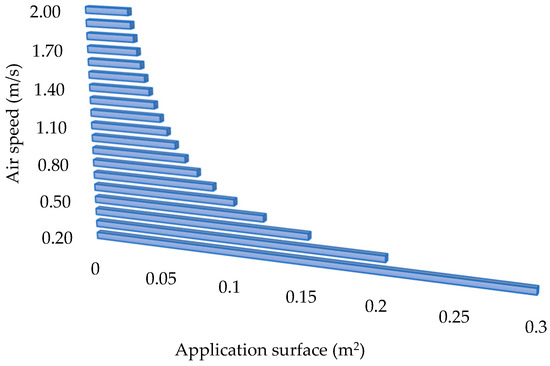
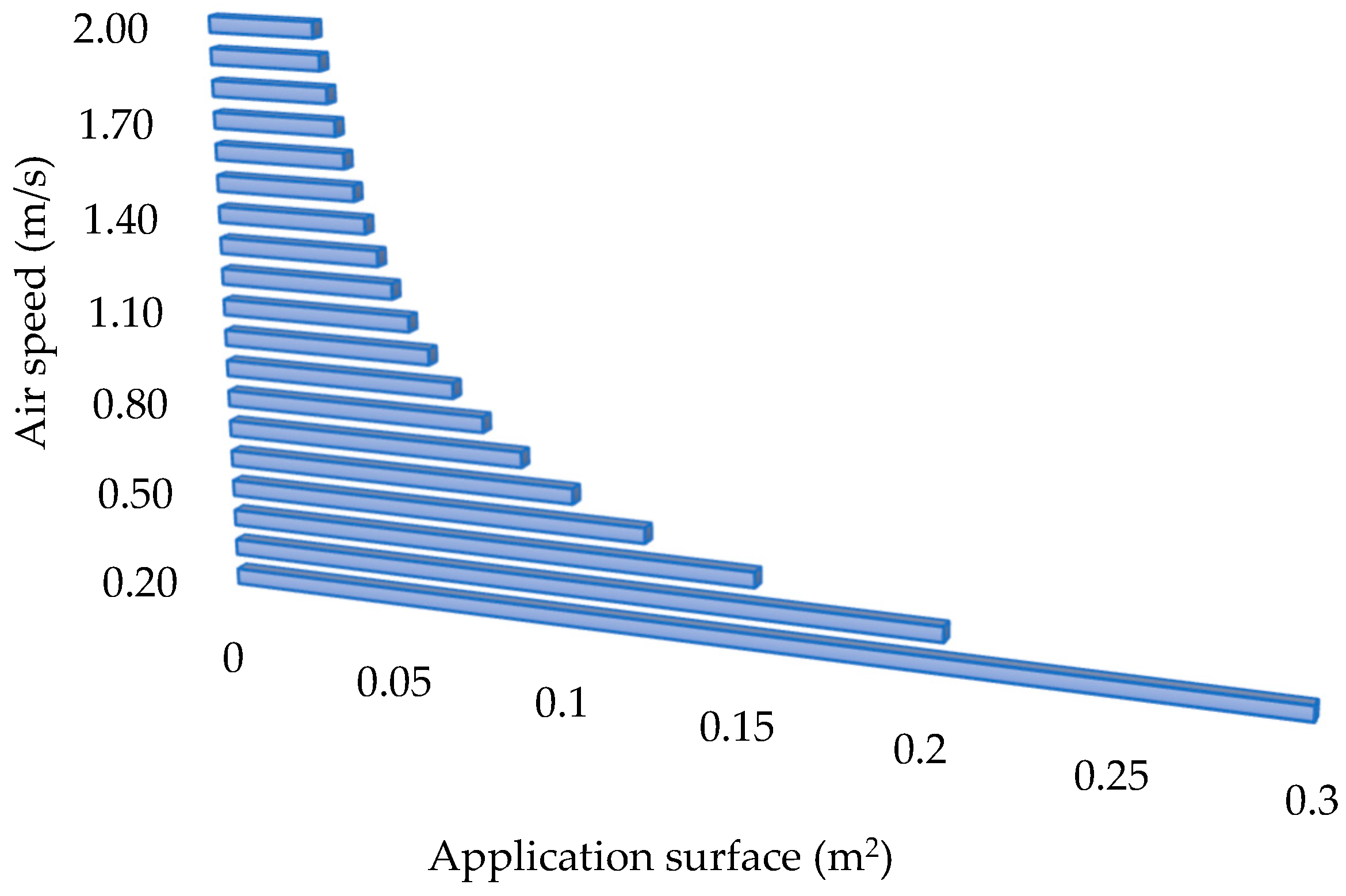
The results obtained for a commercial solvent-based acrylic lacquer are shown below. The influence of air velocity on the maximum application area, in both indoor and outdoor environments, is as follows (Figure 5).
Figure 5.
Maximum application area for commercial acrylic lacquer.
The application area is inversely proportional to the air velocity, with the product of the two being a constant equal to 0.0616.
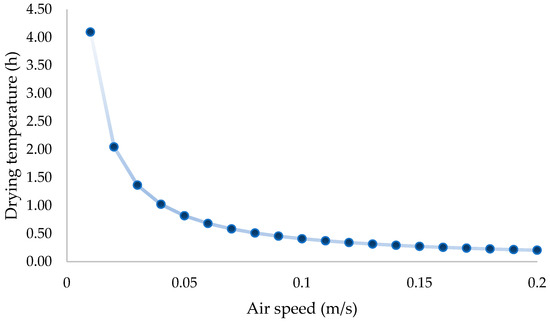
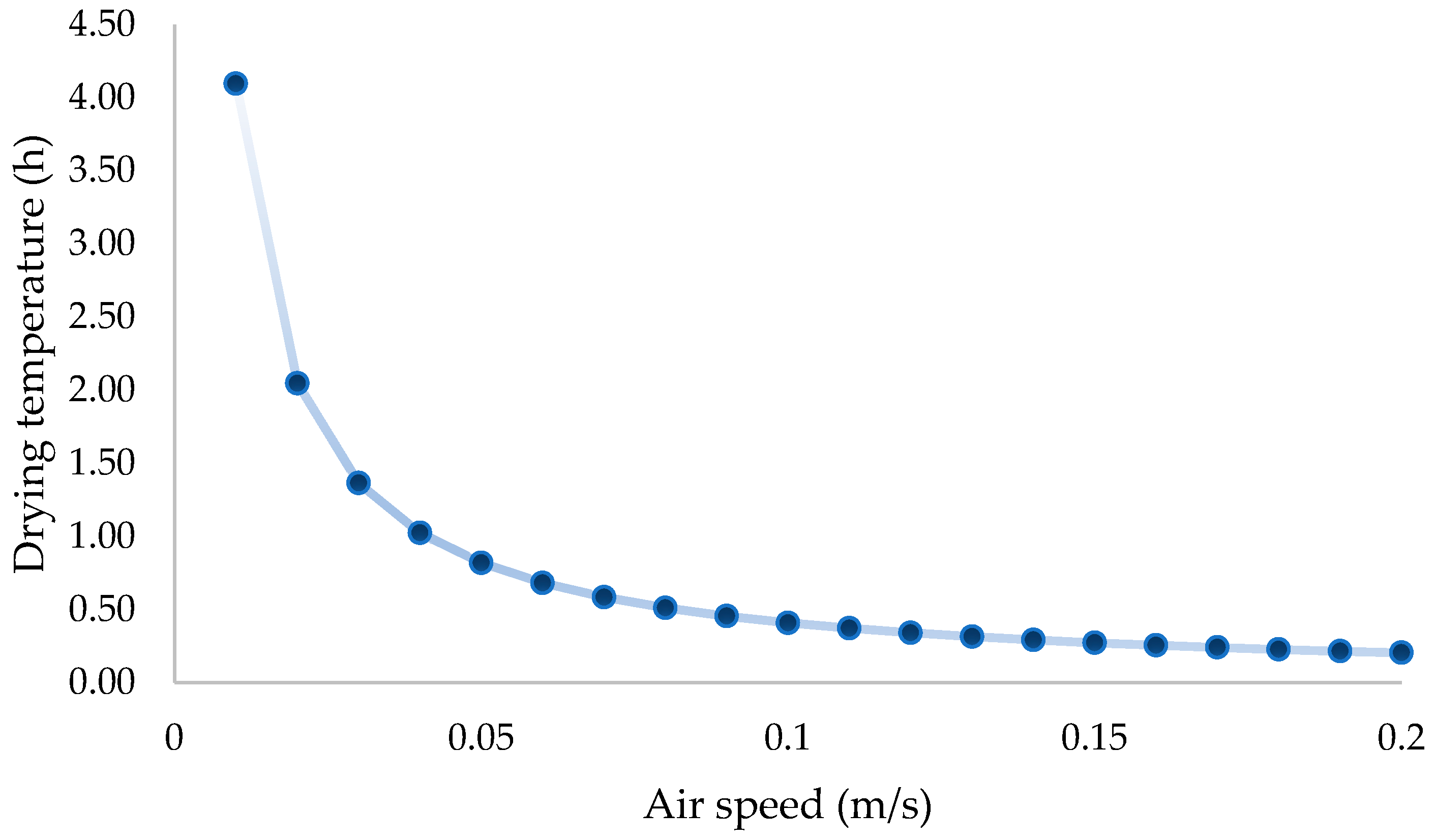
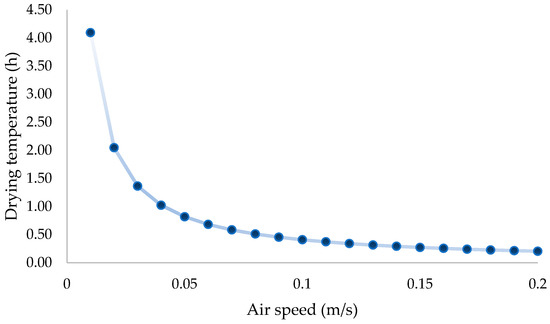
The effect of air velocity on the minimum drying time for a solvent-based acrylic lacquer is as follows (Figure 6 and Figure 7).
Figure 6.
Minimum indoor curing time for a commercial acrylic resin.
Figure 7.
Minimum outdoor drying time for a commercial acrylic resin.
In indoor environments, the effective air flow velocity over the lacquered surface is significantly lower than that found outdoors, thereby limiting the rate at which the solvent evaporates.
4. Discussion
The available scientific literature allows for a precise characterisation of the volatility and ignition hazards of flammable liquids; however, there is a knowledge gap in the empirical research required to establish protocols for the safe use of flammable products, limiting the translation of theoretical data into industrial practice.
As for the results, it should be noted that the increase in surface air flow velocity allows for greater dilution of the vapours generated during the drying process. Consequently, the waiting times between applications increase, but at the same time, the volume of vapour generated also increases, which means that the maximum application areas decrease, so that application rates remain constant.
Indoors, the standards used define a calculation volume that is much lower than that considered for outdoor environments. Consequently, the results obtained by applying the international standard UNE 202007 IN [34] are more appropriate, as this standard takes into account a ventilation efficiency factor. For outdoor use, the latest published version of the standards for the calculation of explosive atmospheres must be used, namely the international standard IEC 60079-10-1 [33].
Forced ventilation of the building to dry surfaces cannot be considered, as, although no hazardous zone is created in the work area, the evaporation rate is very high, and flammable vapours are carried into the facility itself; therefore, the facility must have the specific ATEX marking.
Finally, it should be noted that the use of the Antoine equation to determine the evaporation rate as a function of ambient temperature is only applicable to pure substances subjected to high temperatures.
5. Conclusions
A novel technical solution is provided through a simplified approach; calculation methods have been developed to determine the maximum application rates for solvent-based acrylic lacquers, varnishes, and the solvents themselves, in such a way as to prevent the formation of a potentially hazardous flammable atmosphere on concrete and mortar surfaces, so that these times can be incorporated into project planning and scheduling.
Indoors, solvents evaporate more slowly, as they do at low temperatures, allowing for higher application rates without creating a potentially hazardous flammable atmosphere.
To prevent the creation of areas classified as fire or explosion hazards, a maximum application rate of 1.5 m2/h indoors and 1 m2/h outdoors is established when applied at an ambient temperature of 20 °C.
As the ambient temperature rises, the application rate must be reduced, and at around 40 °C, it is not possible to apply the varnishes in practice without creating a flammable atmosphere.
The main limitation of this method is the variability in environmental conditions; to mitigate this, standardised natural ventilation values have been used, based on the application of international standards for the classification of hazardous areas at risk of fire and explosion. The restrictive parameters of these standards, together with an analysis of the compound with the greatest potential to generate a potentially dangerous flammable atmosphere, ensure a high level of reliability in the results. However, the monitoring of environmental conditions during the course of the work ensures that operations are carried out in complete safety.
This study provides a theoretical and highly practical analysis that enables the safe application of acrylic lacquers, varnishes, and solvents; however, the results presented do not replace field validation through environmental measurements that allow for an assessment of the complexity of the real-world scenario.
Author Contributions
J.M.B.-Á.: Conceptualization, writing—original draft, data curation, methodology, and software. Á.R.-B.: Writing—original draft preparation, investigation, writing—review and editing, and project administration. Á.R.-S.: Visualization, supervision, data curation, validation, and resources. B.M.V.-E.: Visualization, supervision, methodology, formal analysis, and resources. All authors have read and agreed to the published version of the manuscript.
Funding
This research received no external funding.
Institutional Review Board Statement
Not applicable.
Informed Consent Statement
Not applicable.
Data Availability Statement
The original contributions presented in the study are included in this article; further inquiries can be directed to the corresponding author.
Conflicts of Interest
The authors declare no conflicts of interest.
Abbreviations
The following abbreviations are used in this manuscript:
| ATEX | Explosive Atmospheres; |
| BETEX | Benzene, Toluene, Ethylbenzene, and Xylenes; |
| IEC | International Electrotechnical Commission; |
| VOCs | Volatile Organic Compounds. |
References
- Sims, C.B.; Furgal, J.C. Overview of the challenges and current solutions in organic and hybrid coatings for historical monuments and architecture. Polym. Int. 2024, 73, 591–602. [Google Scholar] [CrossRef] [Scilit]
- Chen, Y.; Zhang, G.; Zhang, G.; Ma, C. Rapid curing and self-stratifying lacquer coating with antifouling and anticorrosive properties. Chem. Eng. J. 2021, 421, 129755. [Google Scholar] [CrossRef] [Scilit]
- Wu, M.; Zhang, B.; Jiang, L.; Wu, J.; Sun, G. Natural lacquer was used as a coating and an adhesive 8000 years ago, by early humans at Kuahuqiao, determined by ELISA. J. Archaeol. Sci. 2018, 100, 80–87. [Google Scholar] [CrossRef] [Scilit]
- Haigh, R.; Ameri, S. Traditional and Advanced Curing Strategies for Concrete Materials: A Systematic Review of Mechanical Performance, Sustainability, and Future Directions. Appl. Sci. 2025, 15, 11055. [Google Scholar] [CrossRef] [Scilit]
- Coppola, L.; Beretta, S.; Bignozzi, M.C.; Bolzoni, F.; Brenna, A.; Cabrini, M.; Candamano, S.; Caputo, D.; Carsana, M.; Cioffi, R.; et al. The Improvement of Durability of Reinforced Concretes for Sustainable Structures: A Review on Different Approaches. Materials 2022, 15, 2728. [Google Scholar] [CrossRef] [Scilit]
- Singh, A.; Siddique, R. Review on effect of curing methods on high strength concrete. Constr. Build. Mater. 2024, 438, 136858. [Google Scholar] [CrossRef] [Scilit]
- Yang, H.; Shen, Z.; Zhang, M.; Wang, Z.; Li, J. Mechanical properties and microstructure of cement-based materials by different high-temperature curing methods: A review. J. Build. Eng. 2024, 96, 110464. [Google Scholar] [CrossRef] [Scilit]
- Zaheer, M.; Zhao, R.; Sadozai, S.; Zhu, F.; Ji, N.; Xu, L. Research on the influence of curing strategies on the compressive strength and hardening behaviour of concrete prepared with Ordinary Portland Cement. Case Stud. Constr. Mater. 2023, 18, e02045. [Google Scholar] [CrossRef] [Scilit]
- Zheng, Y.; Li, R.; Wang, J.; Pan, H.; Zhang, G.; Cheng, L. Innovative and environmentally friendly MICP surface curing: Enhancing mechanical and durability properties of concrete. J. Clean. Prod. 2024, 478, 143962. [Google Scholar] [CrossRef] [Scilit]
- Sinha, S. Spontaneous explosion due to volatile inflammable chemicals–invisible explosives. Toxicol. Anal. Clin. 2022, 34, 168. [Google Scholar] [CrossRef] [Scilit]
- Khan, F.; Rathnayaka, S.; Ahmed, S. Methods and models in process safety and risk management: Past, present and future. Process Saf. Environ. Prot. 2015, 98, 116–147. [Google Scholar] [CrossRef] [Scilit]
- Jiao, Z.; Ji, C.; Yuan, S.; Zhang, Z.; Wang, Q. Development of machine learning based prediction models for hazardous properties of chemical mixtures. J. Loss Prev. Process Ind. 2020, 67, 104226. [Google Scholar] [CrossRef] [Scilit]
- Zakel, S.; Brandes, E.; Schröder, V. Reliable safety characteristics of flammable gases and liquids—The database CHEMSAFE. J. Loss Prev. Process Ind. 2019, 62, 103914. [Google Scholar] [CrossRef] [Scilit]
- Doregar, R.; Dana, T.; Roayaei, E.; Monavari, S.M.; Jozi, S.A. The Environmental Risk Assessment of Fire and Explosion in Storage Tanks of Petroleum Products. Sustainability 2022, 14, 10747. [Google Scholar] [CrossRef] [Scilit]
- Jia, Z.; Pan, Y.; Yang, L.; Liu, Y.; Jiang, J. Lower flammability limits of flammable ternary organic mixtures: Synergistic behavior. J. Loss Prev. Process Ind. 2020, 66, 104173. [Google Scholar] [CrossRef] [Scilit]
- Chen, C.C.; Lai, C.P.; Guo, Y.C. A novel model for predicting lower flammability limits using Quantitative Structure Activity Relationship approach. J. Loss Prev. Process Ind. 2017, 49, 240–247. [Google Scholar] [CrossRef] [Scilit]
- Albahri, T. Prediction of the lower flammability limit percent in air of pure compounds from their molecular structures. Fire Saf. J. 2013, 59, 188–201. [Google Scholar] [CrossRef] [Scilit]
- Goethals, M.; Vanderstraeten, B.; Berghmans, J.; De Smedt, G.; Vliegen, S.; Van’t Oost, E. Experimental study of the flammability limits of toluene–air mixtures at elevated pressure and temperature. J. Hazard. Mater. 1999, 70, 93–104. [Google Scholar] [CrossRef] [Scilit]
- Luttrell, W.E.; Peterson, H.R. Ethylbenzene. J. Chem. Health Saf. 2011, 18, 41–42. [Google Scholar] [CrossRef] [Scilit]
- Liaw, H.J.; Tsai, T.P. Flash-point estimation for binary partially miscible mixtures of flammable solvents by UNIFAC group contribution methods. Fluid Phase Equilib. 2014, 375, 275–285. [Google Scholar] [CrossRef] [Scilit]
- Torabian, E.; Amin, M. New structure-based models for the prediction of flash point of multi-component organic mixtures. Thermochim. Acta 2019, 672, 162–172. [Google Scholar] [CrossRef] [Scilit]
- Mei, Q.; Yang, C.; Jiang, Y.; Han, K. Ambient-temperature recovery of high-boiling solvent by solar-driven interfacial evaporation. Chem. Eng. Sci. 2026, 326, 123597. [Google Scholar] [CrossRef] [Scilit]
- Xu, P.; Gao, C.; Ma, J.; Fang, Y.; Wang, Z.; An, Z.; Hwang, U.; Yang, X.; Yahong, X.; Kim, S. High fire-safety epoxy resin with functional polymer/metal–organic framework hybrids. Eur. Polym. J. 2024, 220, 113505. [Google Scholar] [CrossRef] [Scilit]
- Smith, R. Predicting evaporation rates and times for spills of chemical mixtures. Ann. Occup. Hyg. 2001, 45, 437–445. [Google Scholar] [CrossRef] [Scilit] [PubMed]
- Heymes, F.; Aprin, L.; Bony, A.; Forestier, S.; Cirocchi, S.; Dusserre, G. An experimental investigation of evaporation rates for different volatile organic compounds. Proc. Saf. Prog. 2013, 32, 193–198. [Google Scholar] [CrossRef] [Scilit]
- Nielsen, F.; Olsen, E.; Fredenslund, A. Prediction of isothermal evaporation rates of pure volatile organic compounds in occupational environments—A theoretical appro-ach based on laminar boundary layer theory. Ann. Occup. Hyg. 1995, 39, 497–511. [Google Scholar] [CrossRef] [Scilit]
- Wolf, C.; Gambaryan-Roisman, T. Wetting and Evaporation of Solvents on Thin Soluble Substrates. Colloids Interfaces 2020, 4, 48. [Google Scholar] [CrossRef] [Scilit]
- McManus, T.N.; Rosa, A.; Haddad, A. Development of a Method to Study Evaporation of a Volatile Solvent in an Isolated Subsurface Structure: A Practical Exercise in Risk Minimization. Infrastructures 2020, 5, 68. [Google Scholar] [CrossRef] [Scilit]
- McManus, T.N.; Haddad, A. Solvent Evaporation in an Isolated Subsurface Structure: An Unrecognized and Underappreciated Risk. Infrastructures 2019, 4, 47. [Google Scholar] [CrossRef] [Scilit]
- Nielsen, F.; Olsen, E. On the prediction of evaporation rates—With special emphasis on aqueous solutions. Ann. Occup. Hyg. 1995, 39, 513–522. [Google Scholar] [CrossRef] [Scilit]
- Keil, C.B.; Nicas, M. Predicting Room Vapor Concentrations Due to Spills of Organic Solvents. Am. Ind. Hyg. Assoc. J. 2003, 64, 445–454. [Google Scholar] [CrossRef]
- Kudryashova, O.B.; Pavlenko, A.A.; Titov, S.S.; Vorozhtsov, A.B. A mathematical model for evaporation of explosive thin film. J. Energ. Mater. 2021, 39, 246–254. [Google Scholar] [CrossRef] [Scilit]
- EN IEC 60079-10-1:2022; Explosive Atmospheres—Part 10-1: Classification of Areas—Explosive Gas Atmospheres. European Committee for Standardization (CEN): Brussels, Belgium, 2022.
- UNE 202007 IN; Application Guide of EN 60079-10: 2006. Electrical Apparatus for Explosive Gas Atmospheres. Classification of Hazardous Areas. European Committee for Standardization (CEN): Brussels, Belgium, 2006.
- ANSI/ASHRAE Standart 62.1-2022; Ventilation and Acceptable Indoor Air Quality. ASHRAE and American National Standards Institute: Washington, DC, USA, 2022. Available online: https://ashrae.iwrapper.com/ASHRAE_PREVIEW_ONLY_STANDARDS/STD_62.1_2022 (accessed on 26 February 2026).
- Shah, M.M. Calculation of evaporation of chemicals into air. Chem. Eng. Sci. 2025, 316, 121937. [Google Scholar] [CrossRef] [Scilit]
- EN 16798-3:2018; Energy Performance of Buildings-Ventilation for Buildings-Part 3: For Non-Residential Buildings—Performance Requirements for Ventilation and Room-Conditioning Systems (Modules M5-1, M5-4). European Committee for Standardization (CEN): Brussels, Belgium, 2018.
- EN 12101-2:2021; Smoke and Heat Control Systems—Part 2: Natural Smoke and Heat Exhaust Ventilators. European Committee for Standardization (CEN): Brussels, Belgium, 2021.
- Ballesteros-Álvarez, J.M.; Romero-Barriuso, A.; Villena-Escribano, B.M.; Rodríguez-Sáiz, A.; González-Gaya, C. Investigating the effectiveness of a new indoor ventilation model in reducing the spread of disease: A case of sports centres amid the COVID-19 pandemic. Heliyon 2024, 10, e27877. [Google Scholar] [CrossRef] [Scilit] [PubMed]
- Romero-Barriuso, Á.; Ballesteros-Álvarez, J.M.; Villena-Escribano, B.M.; Rodríguez-Sáiz, Á.; González-Gaya, C. Occupancy and Air Quality Model for Outdoor Events: A Strategy for Preventing Disease Transmission at Mass Events. Buildings 2025, 15, 677. [Google Scholar] [CrossRef] [Scilit]
- Brandes, E.; Mitu, M.; Pawel, D. The lower explosion point—A good measure for explosion prevention: Experiment and calculation for pure compounds and somemixtures. J. Loss Prev. Process Ind. 2007, 20, 536–540. [Google Scholar] [CrossRef] [Scilit]
- Forero, L.A.; Velásquez, J.J. Wagner liquid–vapour pressure equation constants from a simple methodology. J. Chem. Thermodyn. 2011, 43, 1235–1251. [Google Scholar] [CrossRef] [Scilit]

Disclaimer/Publisher’s Note: The statements, opinions and data contained in all publications are solely those of the individual author(s) and contributor(s) and not of MDPI and/or the editor(s). MDPI and/or the editor(s) disclaim responsibility for any injury to people or property resulting from any ideas, methods, instructions or products referred to in the content. |
© 2026 by the authors. Licensee MDPI, Basel, Switzerland. This article is an open access article distributed under the terms and conditions of the Creative Commons Attribution (CC BY) license.