


Abstract
The Brazilian Amazon constitutes a critical energy frontier where hydropower expansion frequently conflicts with environmental preservation. This study addresses this challenge by proposing an integrated framework that couples techno-economic feasibility assessments with systematic sustainability metrics for hydropower repowering. Applied to the Taguatinga Small Hydropower Plant (SHPP), the methodology revealed significant gains: turbine efficiency increased from 72% to 90%, the capacity factor improved from 0.63 to 0.76, and an additional 281 kW (1878 MWh/year) was generated at just 2159 US$/kW—substantially lower than new construction costs. The repowering achieved exceptional sustainability indices: Environmental Index = 1.00 (Very High), Socioeconomic Index = 0.76 (High), and overall Sustainability Index = 0.88 (Very High), with an absence of significant additional emissions associated with changes in the reservoir’s surface area. This study addresses the notable scarcity of operational methodologies in the literature that systematically couple multidimensional sustainability metrics with techno-economic feasibility analysis for hydropower repowering. The results demonstrate that this approach can increase SHPP installed power by 15–440% across the Legal Amazon while minimizing environmental impacts. The method offers a replicable solution for the climate–water–energy nexus, optimizing water use efficiency while supporting decarbonization goals and addressing regional energy poverty through sustainable infrastructure modernization.
1. Introduction
Electric utilities operate within a complex landscape of challenges, including climate change, energy security vulnerabilities, and the requirement for universal access, alongside the traditional pillars of security, efficiency, reliability, and sustainability [1,2,3,4,5,6,7].
To meet escalating demand for affordable and renewable energy, significant efforts have been directed towards harnessing alternative sources like wind, solar, and biomass [8]. However, the inherent intermittency of these sources poses substantial operational [9] and economic [10] challenges. Consequently, refurbishing and uprating existing generating assets has emerged as a strategic imperative [4]. Small Hydropower Plants (SHPPs) stand out as particularly attractive, offering a compelling combination of renewability, lower capital investment, and shorter development timelines [4,8,11].
While high-capacity facilities provide strategic energy reserves and are not intermittent, their true merits are debated [12] due to their significant environmental and social impacts, which are often underestimated [13]. The energy transition in the Amazon should not be viewed merely as a technical process of decarbonization but as a reconfiguration of power structures and territoriality. While the expansion of major hydro-installations often leads to multidimensional injustices and structural inequalities [14], repowering emerges as a transformative opportunity to optimize water use without repeating patterns of social exclusion.
Hydropower repowering can maximize the energy generation of an existing project, allowing for the efficient use of local water resources with minimal incremental environmental impacts. It promotes decentralized renewable electricity generation and sustainable practices [4] and can help mitigate the negative consequences of climate change on generation systems [15]. The process consists of interventions in civil structures, the water conveyance system, and electromechanical equipment, leading to simultaneous gains in power and efficiency [11]. These interventions can be categorized as rehabilitation (restoring original performance), revitalization (using project margins), or expansion (new constructions) [16,17].
This intervention has been reported in the literature in its methodological [17], feasibility [11,16], cost [18,19,20], practical experience [8,21], competitive solution [22] and incremental power aspects [17,23,24,25,26]. In terms of the sustainability of the practice [4], it has contributed to the energy independence of local communities, the preservation of industrial historical heritage [27], local development [4,28], microgeneration in isolated areas and the replacement of water wheels [29]. In particular, this applies to the addition of generator sets in large hydropower plants with empty wells in Brazil [30,31].
Sustainability, due to its multifaceted nature [32,33], must be the guiding perspective for new energy solutions, requiring coordinated management of water, territory, and related resources [34,35]. Repowering of SHPPs is a sustainable alternative, as it is environmentally friendly [36] and ensures the optimized exploitation of natural resources. However, systematic measurement of the sustainability of repowering projects is a critical gap in the literature. Recently, Roy and Roy [37] highlighted the classification and evaluation of sustainability indicators as particular gaps and recognized the limitations of generalizing an empirical sustainability index.
While comprehensive global frameworks such as the Hydropower Sustainability Standard (HSS) [38] provide essential qualitative guidelines and certification protocols for evaluating environmental, social, and governance (ESG) performance throughout a project’s life cycle, they function primarily as high-level assessment and benchmarking tools. A distinct gap remains for an operational, quantitative framework that mathematically couples technical redesign parameters (such as hydrological efficiency and equipment uprating) directly with localized, environment-specific sustainability metrics. The integration proposed in this study addresses this gap by combining physical engineering optimization with a localized, index-based evaluation suited for decision-support in data-scarce regions.
In the Amazon, the main difficulties for progress are associated with environmental and social impacts [17,39,40,41,42,43,44,45], governance aspects [39,40,44], and economic viability [16,17,43]. Extreme droughts in the region, driven by a combination of human actions (e.g., deforestation, wildfires) [46], the climate crisis, and natural phenomena like El Niño [47], have exacerbated this scenario. These droughts reduce available surface water, limiting energy production and increasing operational costs. For instance, a significant reduction in water availability for generation is projected for the Tocantins–Araguaia basin under climate and land-use change scenarios [48].
Oliveira et al. [4] presented reflections on what constitutes hydropower repowering as a sustainable practice. Building on this debate, this paper proposes a sustainability index for repowering based on indicators adapted from the Brazilian Energy Research Company [49]. This index is linked to the Maximum Theoretical Gain Method (MTGM) to aid in decision-making regarding the feasibility of SHPP projects. The SHPP Taguatinga, located in the Legal Amazon, was chosen for the case study because it has already undergone repowering in the expansion modality and still has a margin for significant energy increases through rehabilitation.
2. Materials and Methods
The SHP Taguatinga is named after the municipality where it is located, in the state of Tocantins. It is situated on Abreu Creek, whose watershed covers 136.85 km2 from its dam. The municipality has 2341.92 km2 and a population density of 5.98 inhabitants/km2 [50]. The plant began operations in January 1983; however, in June 1999, the ANEEL Dispatch No. 228/99 approved the new Basic Project for an installed power of 1800 kW, and its exploration was granted to the Electric Power Company of the state of Tocantins (Palmas, Brazil) [51], which characterized a repowering of the expansion modality.
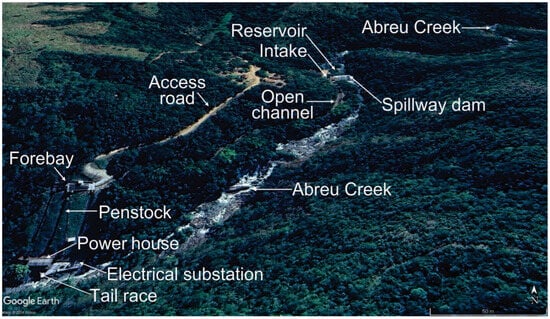
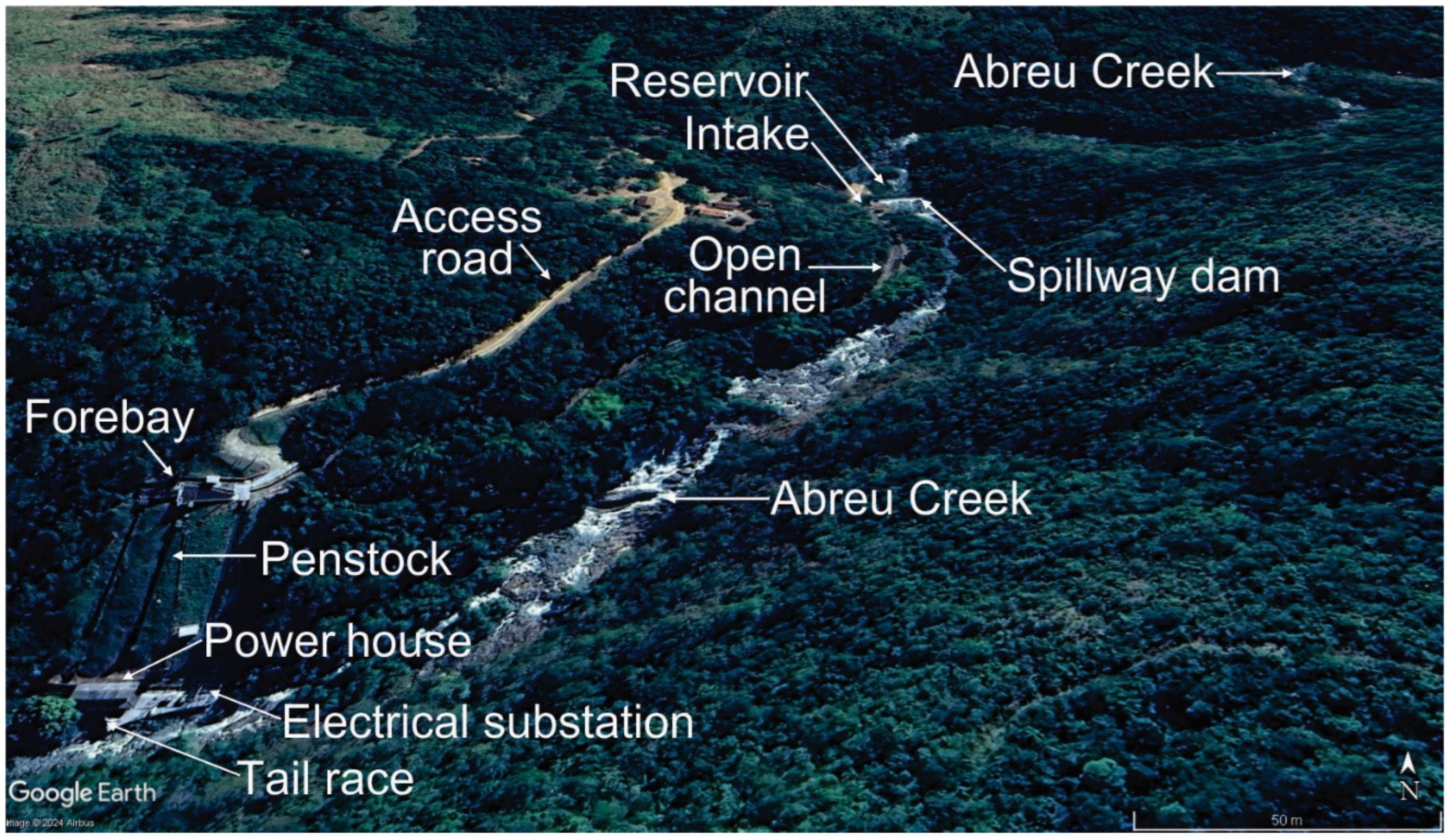
The plant has a typical arrangement of a diversion SHPP (Figure 1) and can be found at the following coordinates: 12°28′13″ S, 46°26′48″ W. This is a run-of-river plant (designed to operate with the natural flow rates of the river) and has a flooded area of 0.0002 km2 confined to the natural river channel. The main disadvantage of its tiny reservoir are that it does not allow the attenuation of peak floods nor strategic reserves for energy generation.
Figure 1.
Arrangement of SHPP Taguatinga.
To perform this study, the following historical data were gathered: hydrological, topographical, dimensional data from the original project, and operational data, all acquired from the National Water Agency (ANA) and Brazilian Electricity Regulatory Agency (ANEEL). Both the method of transferring flow characteristics from a neighboring streamflow station to the area of interest and the MTGM [4] were employed to define the type, installed capacity, and economic benefit of the project’s repowering.
With the absence of a streamflow station with reliable data in Abreu Creek, the inflow discharges were estimated by transferring data from the streamflow of Lavanderia (Brazilian code 21750000), using the criteria of proximity, similarity and extension of the available historical series (46 years). The average specific flow (m3/s.km2) of this station was calculated and transferred to the watershed of interest by balancing its drainage areas. The Lavanderia station is located on Mosquito River, an affluent of Palma River (state code: sub-basin 21), 37 km distant from SHPP Taguatinga. The covered area of the Lavanderia station (1024.26 km2) and the main physiographic characteristics of the watershed associated with the power plant were established in the software QGIS (version 3.24). While spatial streamflow transposition inherently introduces localized runoff uncertainties, this approach constitutes the standard engineering practice established by Brazilian regulatory guidelines for preliminary feasibility screening in remote, data-scarce basins, where hydrometeorological monitoring networks are notoriously sparse.
The MTGM, synthetically, consists of updating the available inflow discharges to confirm changes in the river regime, topographic reassessment opposed to the original arrangement, dimensional reassessments of the hydraulic conveyance system, and verifying possible inadequacies of the project and/or the generator group behavior. The mentioned method is dubbed the theoretical maximum gain because, in the absence of information, data from the literature or simplifying assumptions are used for estimates.
Efficiency gains in repowering projects can be achieved by promoting improvements in civil/hydraulic structures to reduce losses and in the generator group, aiming for energy efficiency and optimal utilization of water resources. The installed power of a hydropower plant is given by the following expression.
where P is the installed power (W); ɳt is the turbine efficiency (dimensionless); ɳg is the electric generator efficiency (dimensionless); ɳgb is the gearbox efficiency (dimensionless) [52], if existent; γ is the specific weight of water (N/m3); Qp is the project flow rate (m3/s); and H is the net head (m). The gearbox has the function of multiplying the turbine rotation imposed by the flow, allowing the electric generator to achieve higher angular speeds and, thus, smaller diameters (applied for low heads).
One of the main indicators of the dimensional aging of a hydropower plant is its capacity factor, CF, defined by the following relation:
CF = Energy Generated/(Installed Power Hours in Period)
It is possible to estimate the energy generated after the repowering process, ER (kWh), using the equation
where CFnew is the new capacity factor (dimensionless), and t is the considered time (h).
On one hand, the annual gross revenue, AGR (US$), can be forecasted by the following expression:
where T is the energy tariff (US$/kWh).
On the other hand, the interventions were valued using cost formulations adjusted by the National Index of Construction Cost (INCC) in Brazil for the base year of 2022. In this way, it was possible to infer the energy and economic benefits of the project.
While global assessment frameworks such as the Hydropower Sustainability Standard establish performance requirements for the life cycle of hydropower projects, including major refurbishments, there remains a distinct gap in the literature for an integrated methodology that explicitly couples techno-economic redesign protocols with systematic sustainability metrics specifically tailored for repowering interventions [38]. For this purpose, we used the methodology originally created to assess the socio-economic and environmental sustainability of new hydropower plants in the ten-year expansion plans for the Brazilian electricity sector [49]. This methodology was adapted to fit the specificities of the practice of repowering hydropower plants.
The Technical Note DEA 21/10 was created to establish sustainability indices that would represent the interactions between Brazilian hydroelectric projects and their respective natural and socio-economic environments [49]. It should be noted that this proposal is still under debate. However, its specifications have been applied, starting with the 2019 Ten-Year Energy Expansion Plan (PDE-2019) [53], in an attempt to respond to criticism and suggestions from various sectors of Brazilian society.
For their original function, fifteen indicators were established, classified into the following sustainability levels: very low, low, medium, high and very high. The metrics for these indicators are summarized in Table 1 and Table 2. Consequently, the indexes generated with these indicators were categorized as follows: i ≤ 0.2, very low sustainability (sVL); 0.2 < i ≤ 0.4, low sustainability (sL); 0.4 < i ≤ 0.6, average sustainability (sA); 0.6 < i ≤ 0.8, high sustainability (sH); and 0.8 < i ≤ 1.0, very high sustainability (sVH). To ensure reproducibility, all the baseline formulation inputs and environmental index calculations followed the protocols established in Technical Note DEA 21/10 [49]; a comprehensive parametric breakdown is available therein.
Table 1.
Sustainability indicators for the environmental dimension of hydropower plants.
Table 2.
Sustainability indicators for the socio-economic dimension of hydropower plants.
By similarity, the Environmental Index EIHR and the Socioeconomic Index SEIHR were defined for a hydropower repowering project, computed by the arithmetic mean of the values assigned to their respective indicators. Finally, the Hydropower Repowering Sustainability Index (SIHR) is determined by the arithmetic mean between EIHR and SEIHR.
3. Results and Discussion
3.1. Resizing of Hydroenergy Utilization
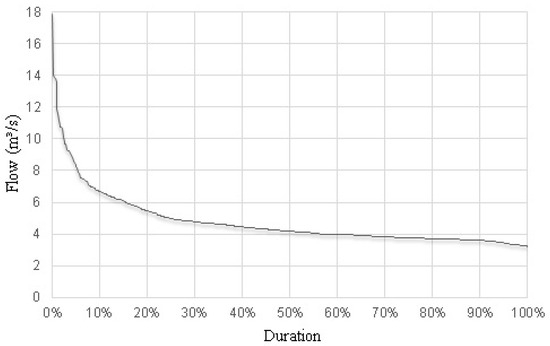
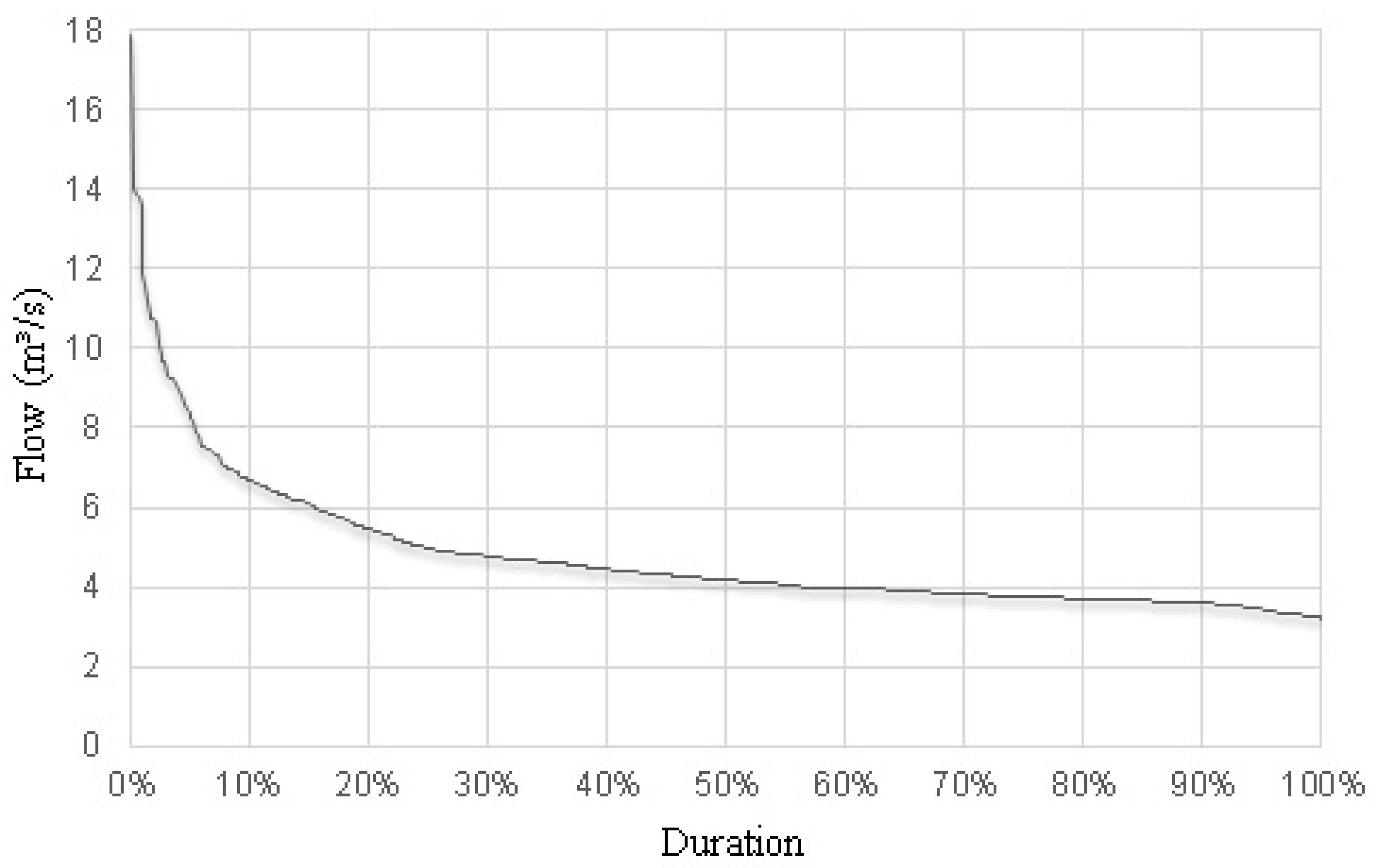
Traditionally, the flow duration curve of monthly average flows is used in hydroenergy studies, and the flow duration curve of daily average flows is used to assess power aspects such as firm power and reliability [52]. Therefore, the energy resizing was performed using the monthly flow duration curve (Figure 2) based on the collected hydrological series. Out of the 46 years of historical records from the Lavandeira station, the 30 years of consistent data were considered, and the inconsistent ones were discarded. So, an annual average flow of 37.2 m3/s was obtained for the reference streamflow station and 4.97 m3/s for the interest area.
Figure 2.
Monthly flow duration curve of Abreu Creek.
The maximum extreme flows were calculated applying the classic Gumbel method (1941) [54], and they serve to support possible critical scenarios related to the dam and spillways, as well as to avoid negative environmental impacts due to dam ruptures or operational failures. The flows for the 500-, 1000-, and 10,000-year return periods are, respectively, 117.65 m3/s, 129.11 m3/s, and 167.15 m3/s.
For characterizing the original utilization and energy reassessment, the main dimensional data from the SHPP Taguatinga project were collected, such as gross head, Hgross = 46.03 m; net head, H = 45.02 m; hydraulic losses, hL = 1.01 m; project flow rate, Qp = 4.55 m3/s; licensed power, Plic = 1800 kW; and long term average flow, Qmltoriginal = 3.9 m3/s.
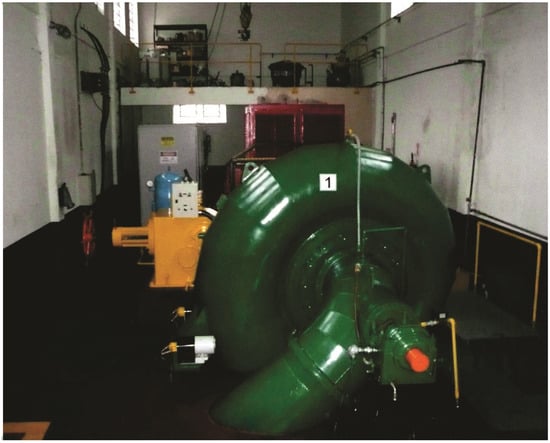
The spillway dam is made of reinforced concrete, with a height of 2.7 m and a crest width of 35 m. Installed in the powerhouse is a generator group: a Francis turbine with a rated power, turbine flow rate, nominal head and rotation of 1800 kW, 4.55 m3/s, 45.90 m, and 900 rpm, respectively (Figure 3); and an electric generator with a rated power, power factor, and nominal voltage of 2060 kVA, 0.850, and 2400 V, respectively [53,55].
Figure 3.
Francis turbine installed in the SHPP Taguatinga power house.
The assessment of the energy efficiency of the SHPP was based on the declaration of gross electricity generation made to ANEEL by the respective concessionaires (Table 3). It is important to highlight that at no point in the historical series did the plant generate the concession power, limited by the electric generator to 1751 kW. In addition, in compliance with the obligations of the Normative Resolution 420/2010, the concessionaire of SHPP Taguatinga declared its updated, installed and net powers as 1455 and 1421 kW, respectively [51].
Table 3.
Historical generation of SHPP Taguatinga (MWmed).
Hydroelectric utilization depends primarily on the available flow rates and heads over time, constrained by the layout of the existing infrastructure [11]. After the dimensional and operational characterization of the SHPP Taguatinga, its underutilization of local resources for energy transformation was verified through its current capacity factor, estimated at CF = 0.63. Ideally, this should be around CF = 0.76, considering the turbine’s nominal flow rate and the available net head.
Without intending to exhaust all possible alternatives for repowering, the energy reassessment of the utilization focused on modernizing the electric generator and completely replacing the obsolete hydraulic turbine. Because we lacked access to the project for the constructed channel to characterize the existing conveyance system, we were unable to verify the maximum permissible flow rate. Additionally, the channel was built in a rugged region that makes increasing its capacity infeasible, which hinders the possibility of repowering in the expansion modality.
In this context, the option for repowering was guided by the limitation of the generator’s output power, 1751 kW, by the original design flow rate of the conveyance system, 4.55 m3/s, and by the net head of the built hydrocivil arrangement, 45.02 m. Based on the data from Table 1, an average monthly generation power of 1105 kW was calculated. Therefore, the energy performance of the plant is approximately 9680 MWh/year, disregarding its unavailability.
For the original design head and flow rate, adopting a realistic efficiency of 0.90 for the new turbine, and considering the constraints imposed by the already constructed powerhouse, a resulting power of 1809 kW is obtained. Under these conditions, classical selection diagrams for hydraulic turbines indicate that a suitable machine is of the Francis type. The output power at the coupled generator is 1736 kW, assuming a conservative efficiency of 0.96.
With the power of the existent electric generator known to be 1751 kW, it is possible to conclude that it will not need a replacement. Consequently, the energy generated after the repowering is about 11,558 MWh/year. It is notable, then, that there is an additional installed power of 281 kW and an additional energy of 1878 MWh/year, characterizing a repowering in the rehabilitation modality.
The disadvantage of the rehabilitation modality is the cost of downtime of the plant during the construction, installation, and/or integration of new equipment and their commissioning test periods. Based on the authors’ experience and previous knowledge of the project, a downtime period of approximately 120 days was estimated for the integration of the new turbine in the powerhouse, resulting in an estimated energy loss of 3182 MWh.
The preliminary analysis to verify the economic viability of the rehabilitation of the SHPP Taguatinga was performed by applying the MTGM [4] and the simple return period for decision making. In addition, in the absence of specific regulations for the additional energy from the hydropower repowering, this amount must be negotiated in the Brazilian Free Market. The annual revenue from the sale of the additional energy was based on a price of 0.0484 US$/kWh, which was the rate in the North Region of Brazil in 2021. Therefore, the forecasted additional annual revenue is US$ 97,598. On the contrary, the corresponding downtime cost of the plant, for the 120 days of interventions, is around US$ 165,405.
The annual operation and maintenance costs are in the range of 0.74 to 1.23 US$/MWh, and the insurance costs are between 0.05 and 0.06 US$/MWh for a hydropower power plant [56]. Therefore, the minimum values were adopted, as it is an SHPP, totaling annual costs of 0.79 US$/MWh. With monetary correction for 2022, the value reached 2.21 US$/MWh.
In order to estimate the cost of materials, equipment and implementation services, the cost expressions of Souza et al. (1999) [52] were used, which were economically updated. The INCC stipulated by the Getúlio Vargas Foundation was chosen for updates from 1998 to 2022, resulting in a correction factor of 593%. The following expressions were obtained for the hydraulic turbine plus the flywheel, speed governor, and valve, respectively:
For the computation of costs with freight, insurance, assembly, and testing of the new equipment, a value of 15% over the acquisition cost of the equipment was applied [52], which, when added, totaled US$ 441,392. The investment cost comprised this amount plus the cost of plant downtime, totaling US$ 606,798. A planning horizon of 20 years was considered for the redesign. The structuring of the respective cash flow, with annual inflows and outflows, resulted in a simple payback of approximately 6.9 years.
It is important to define the methodological boundaries of this evaluation. The combined MTGM and SIHR framework proposed herein is designed as a strategic screening and decision-support tool for the preliminary planning and prioritization phase of repowering, rather than a final, bankable Techno-Economic Feasibility Study or detailed Basic Design. A key advantage of the MTGM is its operational simplicity and efficiency in handling data-scarce environments by utilizing simplified assumptions and standardized historical parameters to rapidly assess uprating viability without incurring prohibitive engineering costs. While a comprehensive sensitivity analysis incorporating electricity price fluctuations, inflation, and dynamic discount rates is highly applicable and indeed necessary during subsequent, detailed project phases to secure final investment decisions, the utilization of a baseline historical price (0.0484 US$/kWh) and simple payback (6.9 years) remains highly appropriate, robust, and standard for initial pre-feasibility screening.
To make explicit the technical terminology and distinct power classifications (such as licensed, installed, and mechanical powers) and to improve the overall readability of the results, the main technical and economic parameters for both the existing and proposed configurations are consolidated and compared in Table 4.
Table 4.
Technical and economic parameters of SHPP Taguatinga before and after repowering.
According to the perspectives of the Brazilian Association of Small Hydropower Plants [57], with monetary updates for the base year of the present study, the investment in an SHPP should be limited to a ceiling of US$ 2.62 million per installed MW to be considered profitable. The repowering of the SHPP Taguatinga has a cost of about US$ 2.16 million per MW and, therefore, is economically viable and attractive to the entrepreneur.
It is interesting to note that the SHPP Ponte Alta, currently in operation in the state of Tocantins and geographically close to the SHPP Taguatinga, has an installed capacity of 280 kW [51]. In other words, it is possible to exceed the generation capacity of the former by merely replacing the turbine of the latter, resulting in a gain in installed power of around 19.31%.
Knowing that the ecological flow in Tocantins (Decree 2.432/05) is 25% of the flow with 90% permanence, as a comparison for determining the repowering design flow, the method of Romero-Añazco et al. (2019) [28] is presented:
where Qm is the average daily flow for the hydrological year, Qe is the ecological flow, and Q80 is the flow that runs through the river for a period of 80 days per year.
The methods of Oliveira et al. (2022) [4] and Romero-Añazco et al. (2019) [28] were compared. The former resulted in a flow of 4.55 m3/s and 38% permanence, while the latter resulted in a flow of 4.11 m3/s and 53% permanence. The difference in the forecast reaches 10.71%, reinforcing the knowledge that the project flow is dependent on the method used.
Based on this study and prior research on repowering SHPPs in the Brazilian Legal Amazon, overall increases in installed power of 15% to 440% are technically feasible by exploiting local water resources more efficiently without altering reservoir levels. To prevent overgeneralization, three technical repowering scenarios strictly bound these potential increases: (i) pure electromechanical rehabilitation (focused on upgrading obsolete runners or generator insulation classes within existing footprints, as demonstrated in SHPP Taguatinga) consistently yields a narrow increase of 15% to 40%; (ii) plant revitalization (optimizing pre-existing structural and hydraulic design margins to remove localized bottlenecks, as investigated in SHPP Bagagem) achieves gains of 40% to 100% [4]; and (iii) physical expansion (installing additional parallel units or constructing parallel conveyances to capture unutilized flow-duration margins, as seen in SHPP Lajeado and SHPP Bagagem alternatives) enables capacity gains of 100% to 440% [4,11,17].
Finally, after defining the energy and economic benefits of the repowering of the SHPP Taguatinga, the indication of its environmental and socio-economic benefits was determined by the composition of its sustainability index. In light of the adaptations made, to be detailed in Section 3.2, the method is here named the Hydropower Repowering Sustainability Index, SIHR.
3.2. Assessment of Sustainability Indicators
The environmental dimension, within the domain of the direct influence area of the SHPP under study, which involves the physical and biotic environments, is composed of the following indicators: incremental flooded area, vegetation loss, incremental flooded river stretch, interference in conservation unit, and interference in priority area for biodiversity conservation.
The environmental impacts caused by the implementation of an SHPP are primarily related to its geographic location and the characteristics of its reservoir [4]. In this context, the first indicator aims to confront the negative consequences of the reservoir formation with the benefits of energy generation [49]. However, in the redesign, there will only be new negative impacts of this nature if there are a dam raise and a corresponding increase in the water level of the reservoir to gain head. Fortunately, this case would be the exception in SHPPs, which are typically designed as run-of-river systems. Therefore, for hydropower repowering, it is convenient to define the indicator of incremental flooded area as follows:
In the rehabilitation project of the studied SHPP, there is no incremental flooded area, resulting in IIFA = 0. This means that there is no incremental flooding for an additional power return of 0.281 MW, representing an sVH class (IIFA ≤ 0.25 km2/MW). In ecological terms, it helps to maintain the integrity of the river ecosystem [58].
The indicator of vegetation loss, IVL, is null because interventions are limited to turbine replacement. This indicator reflects the negative effects resulting from the suppression and/or flooding of local vegetation, directly related to habitat loss, food risks for fauna, reduction in carbon sequestration through photosynthesis, and greenhouse gas emissions. With IVL less than 5 km2, a limit that would not represent significant impacts on the survival of most terrestrial vertebrate populations [49], the consequence is an sVH class.
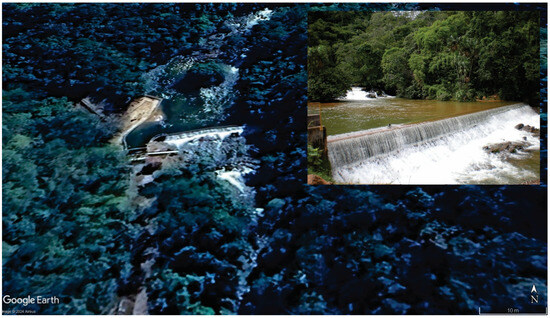
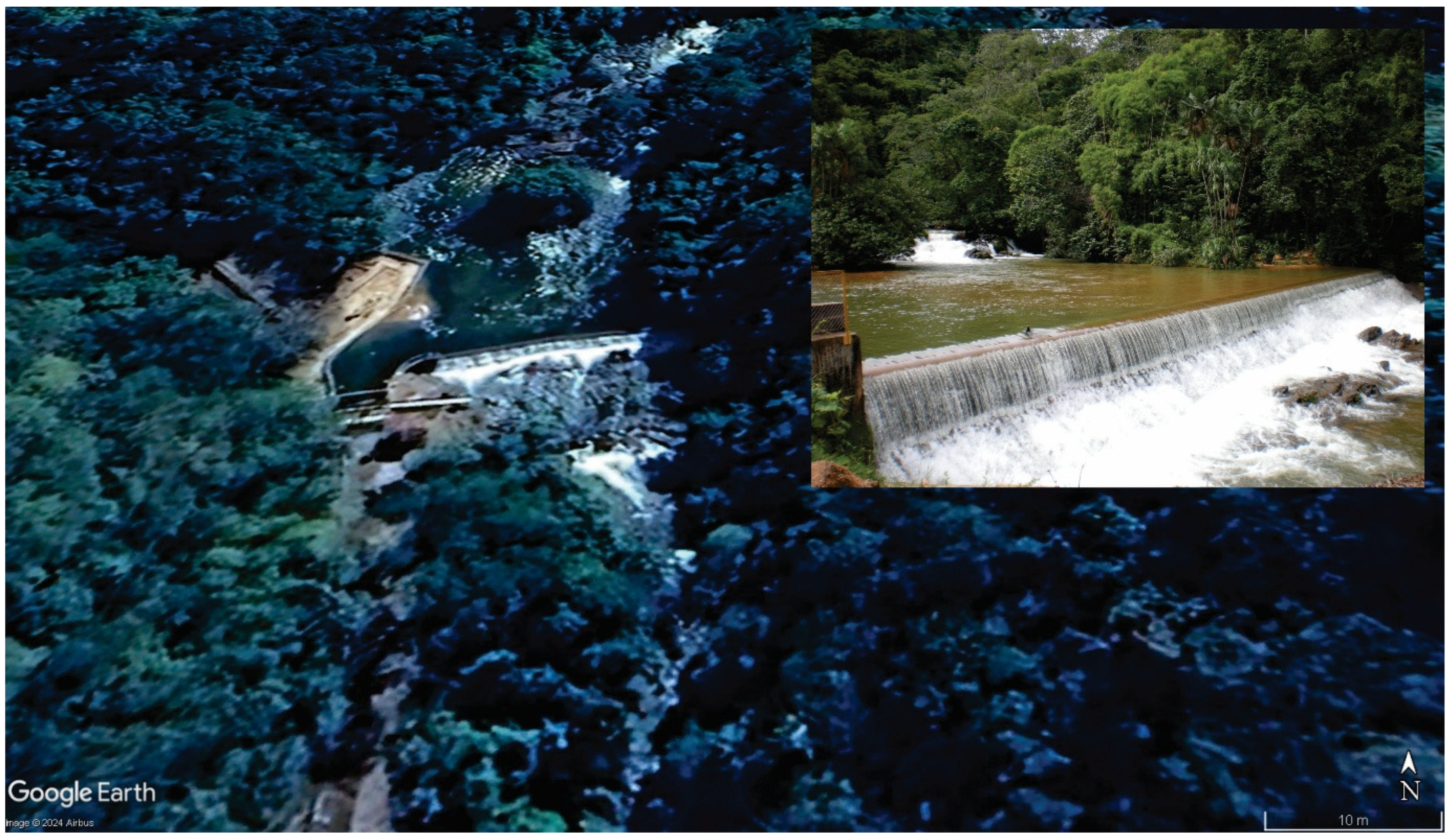
The IIFRS, an indicator of incremental flooded river stretch, is also null. This is because it is directly linked to the unchanged water level of the original reservoir (Figure 4). The hypothesis adopted in the methodology [49] is that the negative effect of reservoir formation is proportional to the extent of the flooded river stretch, setting an sVH class for flooded stretches up to a limit of 20 km. It is worth noting that the currently flooded stretch is approximately 0.05 km.
Figure 4.
Small reservoir formed at the Abreu Creek waterfall (12°28′13″ S, 46°26′48″ W; Geographic Coordinate System: WGS84). No environmental Conservation Units or officially protected biological corridors intersect the project area within the regulatory 10 km buffer zone.
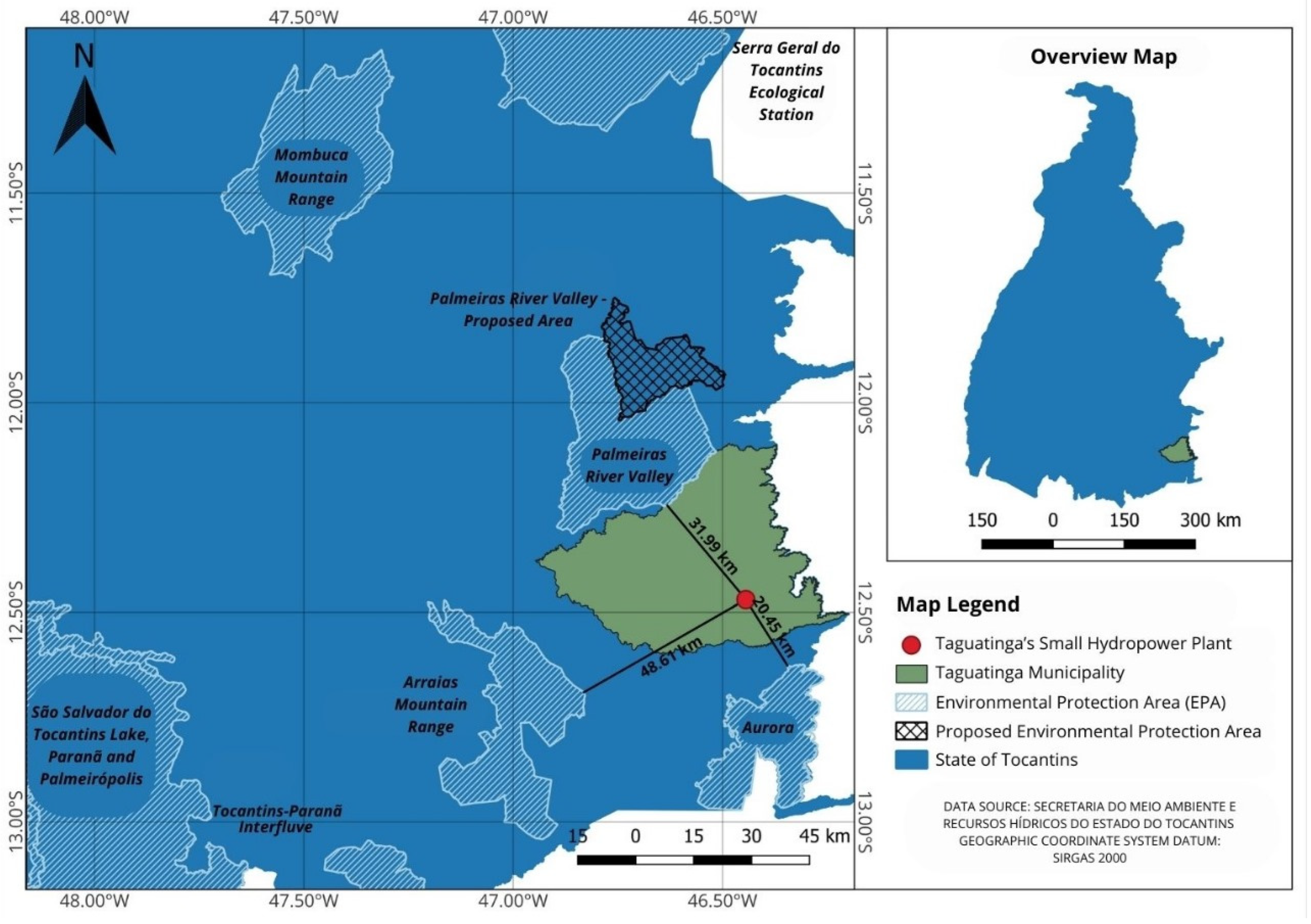
The indicators of interference in conservation unit, IICU, and priority area for biodiversity conservation, IPABC, are considered sVH class when the project is more than 10 km away from these areas. In this context, applying Geographic Information System (GIS) techniques on cartographic databases from the Planning and Budget Secretariat of Tocantins, it can be observed that the nearest Environmental Protection Area (EPA) to the project is Aurora, approximately 20.45 km far from it (Figure 5). Therefore, both IIUC and IPABC represent an sVH class.
Figure 5.
Minimum distances between the SHPP Taguatinga and the nearby established or proposed conservation units.
In the socioeconomic dimension for hydropower sustainability, the methodology incorporates the specificities of the population and infrastructure affected by the project, in addition to the economic issues related to its direct influence area, internalized in the following indicators: affected population, interference in indigenous lands, interference in settlements of the National Institute of Colonization and Agrarian Reform (INCRA), interference in infrastructure potential for local employment, interference in urban areas, interference in regional circulation and communication, loss of productive area; temporary impact on municipal revenue, and permanent impact on municipal revenue.
The inclusion of socioeconomic criteria to establish an empirical sustainability index helps to satisfactorily consider impacts on populations and related dimensions, which have been pointed out as complicating accurate measurement of hydropower sustainability [36] that, together with persistent externalities, leads to an underestimation of energy production costs and overall project viability [59]. In addition, traditional assessments have often focused on carbon emissions and have consequently neglected wider sustainability impacts [60] or are limited to qualitative aspects [61].
From the perspective of energy justice, repowering aligns with Sustainable Development Goal (SDG) 7 by promoting clean and affordable energy. By focusing on the rehabilitation of existing infrastructure, it prevents the forced displacement of communities and the loss of indigenous territories—key factors in the conflicts and resistance that characterize the Amazonian energy frontier.
In measuring the impacts caused by the removal and resettlement of part of the population in urban and/or rural areas, the affected population indicator (IAP) represents the total number of people or families affected by the reservoir formation. In the specific case, IAP = 0 due to the absence of a reservoir. The reference for this indicator is the estimated average of the population affected by operating HPs in the country, which relates to the sVH class when it is less than 500 people or 125 families [49].
In Brazil, indigenous lands are constitutionally federal property, non-transferable, and unavailable. The interference in indigenous lands indicator is a determinant of the environmental viability of a hydropower plant. Furthermore, specific anthropological studies are required for HPs affecting indigenous territories. Interference can be direct when a portion of land is affected or indirect when there are implications in the territory due to proximity to the project [49]. In the present study, interference in indigenous lands (IIL) is nonexistent because these lands are more than 10 km away from the project, characterizing sVH. The Xerente and Ava-Canoeiro territories of the Araguaia River are approximately 340 and 359 km away from SHPP Taguatinga, respectively. It is emphasized that this indicator is crucial for the safety of indigenous communities in the Legal Amazon.
Rehabilitation interventions do not interfere with INCRA settlements, and, therefore, the INCRA interference indicator (IINCRA) returns to the sVH class. This indicator is defined by
Seeking to estimate the negative effect of migration of people to meet the necessary workforce or the construction and installation works, which results in an overload of local infrastructure, especially in health, education, basic sanitation, and real estate sectors, the interference in infrastructure indicator (III) was established, materialized by the following expression
where NEG is the number of employments generated, PSM is the populations of the support municipalities, and k is the average number of people in a family, considered as three.
It is estimated that six outsourced collaborators are necessary for the services of replacing the hydraulic turbine, installing the coupled equipment, and commissioning. The civil work for integrating the new equipment into the existing powerhouse structure, including the turbine suction pipe, would require approximately five additional collaborators. Considering that Taguatinga has a population of 14,011 inhabitants [50], the resulting III is equal to 0.002, indicating sVH, i.e., less than 5% of the total local population. On the other hand, the potential for local employment, IPLE, is very low due to the limited extent of temporary interventions, resulting in an sVL class, regardless of the proportion of the unemployed population compared to the economically active. Along the same lines, it can be stated that the rehabilitation of the SHPP minimally impacts the urban core of Taguatinga city and does not compromise essential services. Thus, the indicator of interference in urban areas, IIUA, is classified as sVH.
Regarding the aspect of interference in regional circulation and communication, IIRCC, the SHPP can be classified as sVH, as it does not compromise local circulation nor prevent the directly affected population from using routes determined by their social relationships, passenger and freight transport routes, and river routes, among others. This is because the dimensions of the reservoir are negligible. Furthermore, its civil and hydraulic structures are in a rugged region without local circulation routes. Therefore, the resulting loss of the productive area is also null, meaning the ILPA = 0 indicator is less than 0.05, revealing sVH. It should be noted that the dam is in a region with rocky outcrops.
The last indicators reflect the temporary impact on municipal revenue, ITIMR, and the permanent impact on municipal revenue, IPIMR, related to the annual incremental revenue from any nature of services and the Financial Compensation for the Use of Water Resources for Electricity Generation, respectively.
The services for implementing hydropower projects, especially in the areas of civil construction, assembly, and testing, positively impact municipal revenue, which can be measured through the Tax on Services of Any Nature—ISS/ISSQN, under the jurisdiction of municipalities and the Federal District. Traditionally, civil construction and assembly services are the base for calculating ISS, totaling US$ 39,996 in the rehabilitation of an SHPP (10% of the total equipment acquisition cost). Given that the applicable rate in the host municipality is 3%, the ISS annually collected amounts of up to US$ 1200. Meanwhile, the temporary effect of project implementation on municipal revenue, ITIMR, is established by the ratio between the ISS determined for the period and the budgetary revenue of Taguatinga municipality, which totaled US$ 241,033 in 2022, according to its Transparency Portal. Therefore, ITIMR is 0.005 and corresponds to the sVL class (i < 0.05).
The construction and assembly costs in hydropower plants with a capacity equal to or less than 100 MW were estimated at 866.25 US$/kW, considering projects from the ten-year energy expansion plans (TEP), specifically TEP 2020 and 2019. Similarly, the average ISS collection during the construction of hydropower plants was estimated at 25.99 US$/kW [49]. In this study, these values are forecasted to be 142.33 US$/kW and 4.27 US$/kW, respectively.
It is worth noting the inadequacy of ITIMR concerning repowering, which aims to increase energy generation while minimizing engineering interventions and negative environmental impacts, reflecting a trend towards reducing the services required. Despite this, this indicator was retained to maintain parameterization.
The IPIMR refers to the ratio between financial compensation and the total revenue of municipalities affected by the reservoir of a hydropower plant. The Financial Compensation for the Use of Water Resources for Electricity Generation is a mandatory legal reparation from the developer/user to the federative entities affected by the project, in monetary terms, excluding generating facilities with a nominal capacity equal to or less than 10,000 kW (Law No. 7.990/1989 [62]). This applies to the SHPP under study, with a new installed capacity of 1736 kW. In this context, IPIMR = 0 converts into an sVL class (<0.05). A project is considered to have a Very High classification if the resulting financial compensation is 20% or more of the budgetary revenue of the affected municipalities [49].
It is critical to highlight that the underlying metrics of the proposed SIHR framework are adapted from the Technical Note DEA 21/10 issued by the Brazilian Energy Research Office, which was originally designed to assess the socio-environmental sustainability of large-scale hydropower plants (HPPs) and transmission lines in national decadal expansion plans. Consequently, the framework’s indicators, such as population displacement, vegetation suppression, and interference with indigenous lands or conservation units, were systematically formulated to scale with and capture the severe impacts of high-capacity installations featuring large reservoirs and complex social contexts.
For the Taguatinga SHPP, the Very High sustainability index achieved (SIHR = 0.88) is a direct consequence of an optimized engineering design coupled with the inherent advantages of repowering as a proactive modernization practice. By upgrading electromechanical equipment to achieve a 19.31% gain in installed capacity entirely within the already consolidated physical footprint, the project actively maximizes water-use efficiency while avoiding new environmental flooding, native vegetation suppression, or community resettlement. Thus, this exceptional performance is not merely a passive reflection of the plant’s run-of-river status but a quantitative validation of repowering as an active strategy to expand clean energy supply without inducing new socio-environmental externalities.
However, if applied to more complex repowering projects that involve reservoir expansion or heightened socio-environmental tensions, the mathematical structure of the SIHR remains fully equipped to register these negative externalities dynamically and adjust the final index downward.
To systematically synthesize the environmental and socioeconomic evaluations, the individual scores, qualitative classifications, and respective physical context of the fifteen sustainability indicators for SHPP Taguatinga are consolidated in Table 5.
Table 5.
Environmental and socioeconomic sustainability indicators and indices for SHPP Taguatinga repowering.
In summary, through the arithmetic mean, the measured indicators resulted in an Environmental Index EIHR = 1 and a Socioeconomic Index SEIHR = 0.76, corresponding to a Very High and High degree of sustainability, respectively. These indexes compose the Hydropower Repowering Sustainability Index SIHR = 0.88 for SHPP Taguatinga, resulting in a Very High degree of sustainability.
The overall Hydropower Repowering Sustainability Index (SIHR) is calculated using an arithmetic mean across the dimensions, thereby assuming equal weighting. This approach is aligned with the official regulatory planning methodology of the Brazilian energy sector (specifically the Energy Research Office guidelines), which ensures that equal importance is attributed to physical, biotic, and socioeconomic environments to prevent subjective bias in regulatory decision-making. While the present study maintains this isonomic baseline to evaluate broad public policy compliance, the SIHR framework is mathematically flexible and can accommodate custom multi-criteria decision analysis or expert elicitation weighting matrices based on specific regional priorities.
Therefore, the proposed empirical sustainability index enables a more comprehensive assessment of hydropower repowering projects, going beyond a purely technical and economic evaluation. This tool aids in more informed decision-making by considering crucial socioeconomic and environmental dimensions. In this context, future research could examine the sensitivity of this index in different scenarios and parameter variations. It is also worth exploring a comparative analysis in a multiple case study.
4. Conclusions
It can be concluded that repowering is a governance strategy that aligns with socio-technical sustainability by minimizing cumulative impacts. Beyond water efficiency, this practice offers a decentralized development model that can mitigate regional energy poverty without compromising the integrity of river ecosystems.
This study makes three significant contributions to the field of sustainable hydropower development. First, the efficiency in water use for electricity generation was assessed by comparing the calculated inflow rates and the historical electricity generation data of SHPP Taguatinga, highlighting the low efficiency of the hydraulic turbine, 72%, installed in 1982. A 90% efficiency rate is expected for the new turbine. Similarly, the current capacity factor was calculated at 0.63 and will increase to 0.76 after its rehabilitation.
The increases in installed power and generated energy are 281 kW and 1878 MWh/year, respectively, achieved only by replacing the hydraulic turbine. The cost per installed kW is approximately US$ 2159, demonstrating clear economic advantage over new hydropower plant construction. Second, the absence of greenhouse gas emissions such as CH4 and CO2 accompanies the energy-economic benefits due to the existing reservoir remaining unchanged. It is worth noting that the power added by the rehabilitation of SHPP Taguatinga is equivalent to the installed power of its neighboring SHPP Ponte Alta, highlighting the significant potential of repowering for capacity expansion.
The MTGM was applied to indicate the technical and economic feasibility of SHPP Taguatinga’s repowering. Furthermore, using the indicators, it was possible to qualitatively and quantitatively measure the sustainability level of the chosen alternative—rehabilitation. An Environmental Index (EIHR = 1) and a Socioeconomic Index (SEIHR = 0.76) were obtained, equivalent to a Very High (maximum) and High sustainability class, respectively. The resulting Hydropower Repowering Sustainability Index (SIHR = 0.88) indicates Very High sustainability. Most importantly, to the best of the authors’ knowledge, the coupling of a sustainability measurement approach with a technical–economic feasibility method for hydropower repowering represents a novel methodological integration in the literature.
While the validation of the SIHR-MTGM framework was demonstrated through the single case study of the Taguatinga SHPP, its conceptual and mathematical foundation offers a robust pathway for generalization across diverse hydropower scales in the Amazon region. Because the framework’s indicators are rooted in the large-scale planning methodology of the Technical Note DEA 21/10 issued by the Brazilian Energy Research Office, the model is not limited to run-of-river systems. Its boundary conditions are dynamically defined by the scale of the physical intervention: for run-of-river modernizations, it confirms the maintenance of river ecosystem integrity through near-zero incremental flooding; for larger, more complex cascading systems or plants with active social histories, the framework’s structured indicators for land use, regulatory compliance, and community impacts ensure that the key associated socio-environmental pressures under evaluation are quantitatively registered and penalized within the index boundaries. Thus, rather than a restricted local tool, the SIHR serves as a scalable decision-support instrument capable of evaluating the sustainability of repowering across a wide spectrum of project designs. Nonetheless, establishing systematic validation across the highly diverse ecological, social, and regulatory landscapes of the entire Legal Amazon remains a long-term objective. Consequently, conducting a multi-case comparative study is proposed as a necessary next step to empirically test and refine the framework’s adaptability under varying regional contexts.
This study, together with previous research [4,11,17], suggests that SHPPs in the Brazilian Legal Amazon can significantly increase their installed capacity by optimizing the use of water resources. By employing efficient repowering techniques without altering reservoir water levels, these plants can achieve power increases ranging from 15% to 440% across the three distinct technical scenarios detailed in Section 3.1 (rehabilitation, revitalization, and expansion). This approach ensures the absence of significant additional emissions associated with changes in the reservoir’s surface area, minimizing new environmental impacts while maximizing energy supply with local socio-environmental integration.
Furthermore, those interested in the climate–water–energy nexus, a key research topic globally [63], have a strong ally in the repowering technique to correct electricity production in the presence of changes in water availability over time. In this sense, the tool can be used in two ways to minimize the effects of adverse weather on energy production: when there is an increase or reduction in the quantity of water. In the second way, repowering would serve to adjust the efficiency of a hydraulic turbine that is working outside the optimum design conditions, for example.
The design flow rate for hydropower repowering depends on the method used [4,11,17,28] and local constraints, which can be engineering, environmental, social or legal. In addition, what can be called optimal energy exploitation must include constant updates or refinements to the boundary conditions due to the dynamism of the environment, processes of multiple uses of water resources, technological developments, legal changes and public policies.
In conclusion, repowering Small Hydropower Plants is a sustainable strategy that maximizes efficiency in the use of water resources, modernizes aging infrastructure, takes advantage of technological advances and adapts to evolving socio-environmental considerations. This approach not only contributes to global decarbonization efforts but also tends to be more visually integrated into the environment compared to large-scale wind and solar projects that have caused visual intrusion in rural areas. In addition, the financial return from hydropower repowering can compensate for losses due to damage caused by extreme weather phenomena or support investments in water resilience, such as the construction of dams to simultaneously increase energy production and flood mitigation. The methodology developed in this study provides a comprehensive decision-support tool for advancing sustainable energy transitions in the Amazon and beyond.
Author Contributions
Conceptualization, M.A.d.O.; methodology, M.A.d.O.; validation, M.A.d.O.; formal analysis, M.A.d.O., I.T.M., A.K.S.M. and L.M.P.d.S.; investigation, M.A.d.O. and F.S.; data curation, M.A.d.O. and A.K.S.M.; writing—original draft preparation, M.A.d.O. and L.M.P.d.S.; writing—review and editing, M.A.d.O., I.T.M., F.S. and A.K.S.M.; visualization, I.T.M. and L.M.P.d.S. All authors have read and agreed to the published version of the manuscript.
Funding
This research received no external funding.
Data Availability Statement
The original contributions presented in this study are included in the article. Further inquiries can be directed to the corresponding author.
Conflicts of Interest
The authors declare no conflicts of interest.
References
- Tsangas, M.; Papamichael, I.; Zorpas, A.A. Sustainable Energy Planning in a New Situation. Energies 2023, 16, 1626. [Google Scholar] [CrossRef] [Scilit]
- Waltersmann, L.; Kiemel, S.; Stuhlsatz, J.; Sauer, A.; Miehe, R. Artificial Intelligence Applications for Increasing Resource Efficiency in Manufacturing Companies—A Comprehensive Review. Sustainability 2021, 13, 6689. [Google Scholar] [CrossRef] [Scilit]
- Borowski, P.F. Digitization, digital twins, blockchain, and Industry 4.0 as elements of management process in enterprises in the energy sector. Energies 2021, 14, 1885. [Google Scholar] [CrossRef] [Scilit]
- Oliveira, M.A.; Oliveira, M.S.; Miranda, A.K.S. Sustainability as a perspective for the repowering of small hydroelectric plants in Brazil: Estimation method. Ambiente Soc. 2022, 25, e00691. [Google Scholar] [CrossRef] [Scilit]
- Holley, C.; Lecavalier, E. Energy governance, energy security and environmental sustainability: A case study from Hong Kong. Energy Policy 2017, 108, 379–389. [Google Scholar] [CrossRef] [Scilit]
- Rehman, I.; Sreekumar, A.; Gill, B.; Worrell, E. Accelerating access to energy services: Way forward. Adv. Clim. Change Res. 2017, 8, 57–61. [Google Scholar] [CrossRef] [Scilit]
- Pachauri, S.; Van Ruijven, B.; Nagai, Y.; Riahi, K.; Van Vuuren, D.; Brew-Hammond, A.; Nakicenovic, N. Pathways to achieve universal household access to modern energy by 2030. Environ. Res. Lett. 2013, 8, 024015. [Google Scholar] [CrossRef] [Scilit]
- Rahi, O.P.; Chandel, A.K. Refurbishment and uprating of hydro power plants—A literature review. Renew. Sustain. Energy Rev. 2015, 48, 726–737. [Google Scholar] [CrossRef] [Scilit]
- Liebensteiner, M.; Wrienz, M. Do Intermittent Renewables Threaten the Electricity Supply Security? Energy Econ. 2020, 87, 104499. [Google Scholar] [CrossRef] [Scilit]
- Brouwer, A.; Broek, M.; Zappa, W.; Turkenburg, W.; Faaij, A. Least-cost options for integrating intermittent renewables in low-carbon power systems. Appl. Energy 2016, 161, 48–74. [Google Scholar] [CrossRef] [Scilit]
- Oliveira, M.A. Modelo para a análise da viabilidade técnica, econômica e ambiental de repotenciar pequenas usinas hidrelétricas. Hidro Hydro-News SHP 2017, 74, 5–10. [Google Scholar] [CrossRef] [Scilit]
- Johansen, I.C.; Mayer, A.P.; Moran, E.F. Up close, it gets worse: Comparison of hydropower perceptions between impacted populations in the Amazon and those of the Brazilian population as a whole. Energy Res. Soc. Sci. 2024, 110, 2214–6296. [Google Scholar] [CrossRef] [Scilit]
- Castro-Diaz, L.; Lopez, M.C.; Moore, S.; Radonic, L.; Hodbod, J.; Moran, E. Multidimensional and multitemporal energy injustices: Exploring the downstream impacts of the Belo Monte hydropower dam in the Amazon. Energy Res. Soc. Sci. 2024, 113, 103568. [Google Scholar] [CrossRef] [Scilit]
- Schulz, C.; Skinner, J. Hydropower benefit-sharing and resettlement: A conceptual review. Energy Res. Soc. Sci. 2022, 83, 102342. [Google Scholar] [CrossRef] [Scilit]
- Queiroz, A.R.; Faria, V.A.D.; Lima, L.M.M.; Lima, J.W.M. Hydropower revenues under the threat of climate change in Brazil. Renew. Energy 2019, 133, 873–882. [Google Scholar] [CrossRef] [Scilit]
- Oliveira, M.A. Repowering Small Hydroelectric Plants: Technical and Economic Evaluation. Master’s Thesis, Federal University of Itajubá, Minas Gerais, Brazil, 2012. [Google Scholar]
- Oliveira, M.A. Technical and economic evaluations for decision-making on the repowering of small hydropower plants and the optimum exploit of existing plants in Brazil. Am. J. Hydropower Water Environ. Syst. 2018, 6, 16–24. [Google Scholar] [CrossRef] [Scilit]
- Butchers, J.; Williamson, S.; Booker, J.; Pradhan, S.R.; Karki, P.B.; Gautam, B. A methodology for renovation of micro-hydropower plants: A case study using a Turgo turbine in Nepal. J. Sustain. Res. 2023, 5, e230015. [Google Scholar] [CrossRef] [Scilit]
- Kishore, T.S.; Patro, E.R.; Harish, V.S.K.V.; Haghighi, A.T. A comprehensive study on the recent progress and trends in development of small hydropower projects. Energies 2021, 14, 2882. [Google Scholar] [CrossRef] [Scilit]
- Ogayar, B.; Vidal, P.G.; Hernandez, J.C. Analysis of the cost for the refurbishment of small hydropower plants. Renew. Energy 2009, 34, 2501–2509. [Google Scholar] [CrossRef] [Scilit]
- Ajao, K.R.; Ogunmokun, A.A.; Nangolo, F.; Shaanika, S.; Balogun, O.S. Assessment of electro-mechanical components of bakolori small hydropower plant for refurbishment and modernization. ATBU J. Sci. Technol. Educ. 2016, 4, 30–38. [Google Scholar]
- Quaranta, E.; Aggidis, G.; Robert, M.; Boes, R.M.; Comoglio, C.; De Michele, C.; Patro, E.R.; Georgievskaia, E.; Harby, A.; Kougias, I.; et al. Assessing the energy potential of modernizing the European hydropower fleet. Energy Convers. Manag. 2021, 246, 9–18. [Google Scholar] [CrossRef] [Scilit]
- ANEEL—Brazilian Electricity Regulatory Agency. Technical Note No. 026/2011 SRG/ANEEL: Repowering of Generating Units That Can Bring Gains in Energy Operation and Add Hourly Power Availability in the National Interconnected System; ANEEL—Brazilian Electricity Regulatory Agency: Brasília, Brazil, 2011.
- Kuchinskaya, Z.; Novozhilov, V. Experience on Hydrogenerators Reconstruction in Russia; OJSC Power Machines: St. Petersburg, Russia, 2011. [Google Scholar]
- Neto, L.M.; Cardoso, J.R.; Santos, S.P.; Delbone, E. Repowering and evaluation of new power of synchronous generators. In Proceedings of the IEEE International Electric Machines and Drives Conference, Miami, FL, USA, 3–6 May 2009; pp. 1058–1064. [Google Scholar] [CrossRef] [Scilit]
- WWF-BRASIL. The Repowering of Hydroelectric Plants as an Alternative for Increasing Brazil’s Energy Supply with Environmental Protection; WWF-Brasil: Brasília, Brazil, 2004. [Google Scholar]
- Gagliano, A.; Tina, G.M.; Nocera, F.; Patania, F. Technical and economic perspective for repowering of micro hydro power plants: A case study of an early XX century power plant. Energy Procedia 2014, 62, 512–521. [Google Scholar] [CrossRef] [Scilit][Green Version]
- Romero-Añazco, B.; Siguenza-Maldonado, A.; Barragán-Escandón, A.; Serrano-Guerrero, X. Methodology to evaluate the repowering of small hydroelectric power plants: Case study El Amarillo in Portovelo, Ecuador. In Proceedings of the IEEE International Autumn Meeting on Power, Electronics and Computing (ROPEC), Ixtapa, Mexico, 13–15 November 2020. [Google Scholar] [CrossRef] [Scilit]
- Quaranta, E.; Pujol, T.; Grano, M.C. The repowering of vertical axis water mills preserving their cultural heritage: Techno-economic analysis with water wheels and Turgo turbines. J. Cult. Herit. Manag. Sustain. Dev. 2023, 13, 269–287. [Google Scholar] [CrossRef] [Scilit]
- EPE—Energy Research Office. Studies for the Tendering Process for the Expansion of Generation: Studies for the Increase of Hydroelectric Plants—Operating Restrictions and Technical and Economic Feasibility; MME/EPE: Rio de Janeiro, Brazil, 2012.
- EPE—Energy Research Office. Increased Generation: Repowering and Modernization of Hydroelectric Plants; MME/EPE: Rio de Janeiro, Brazil, 2019.
- Liu, J.; Zuo, J.; Sun, Z.; Zillante, G.; Chen, X. Sustainability in hydropower development: A case study. Renew. Sustain. Energy Rev. 2013, 19, 230–237. [Google Scholar] [CrossRef] [Scilit]
- Hayashi, T.; Lerland, E.C.V.; Zhu, X. A holistic sustainability assessment tool for bioenergy using the Global Bioenergy Partnership (GBEP) sustainability indicators. Biomass Bioenergy 2014, 66, 70–80. [Google Scholar] [CrossRef] [Scilit]
- Zhang, Y. Accelerating Sustainability by Hydropower Development in China: The Story of HydroLancang. Sustainability 2017, 9, 1305. [Google Scholar] [CrossRef] [Scilit]
- Jones, T.; Newborne, P.; Phillips, B. Applying the Principles of Integrated Water Resource and River Basin Management-an Introduction; WWF-UK: Woking, UK, 2006. [Google Scholar]
- Silva, G.D.P.; Parkins, J.R.; Sherren, K. Do methods used in social impact assessment adequately capture impacts? An exploration of the research-practice gap using hydroelectricity in Canada. Energy Res. Soc. Sci. 2021, 79, 102188. [Google Scholar] [CrossRef] [Scilit]
- Roy, N.C.; Roy, N.G. Sustainable hydroelectric power project planning under socio-economic and environmental concerns using Index based approach. Built Environ. Proj. Asset Manag. 2022, 12, 401–432. [Google Scholar] [CrossRef] [Scilit]
- Hydropower Sustainability Alliance. Hydropower Sustainability Standard (Version 1.2). Hydropower Sustainability Alliance. 2023. Available online: https://www.hs-alliance.org/ (accessed on 1 June 2026).
- Flecker, A.; Shi, Q.; Almeida, R.M.; Angarita, H.; Gomes-Selman, J.M.; García-Villacorta, R.; Sethi, S.A.; Thomas, S.A.; Poff, N.L.; Forsberg, B.R.; et al. Reducing adverse impacts of Amazon hydropower expansion. Science 2022, 375, 753–760. [Google Scholar] [CrossRef] [Scilit] [PubMed]
- Athayde, S.; Duarte, C.G.; Gallardo, A.L.; Moretto, E.M.; Sangoi, L.A.; Dibo, A.P.A.; Siqueira-Gay, J.; Sánchez, L.E. Improving policies and instruments to address cumulative impacts of small hydropower in the Amazon. Energy Policy 2019, 132, 265–271. [Google Scholar] [CrossRef] [Scilit]
- Latrubesse, E.; Arima, E.; Dunne, T.; Park, E.; Baker, V.; d’Horta, F.; Wight, C.; Wittmann, F.; Zuanon, J.; Baker, P.; et al. Damming the rivers of the Amazon basin. Nature 2017, 546, 363–369. [Google Scholar] [CrossRef] [Scilit] [PubMed]
- Nickerson, S.; Chen, G.; Fearnside, P.M.; Allan, C.J.; Hu, T.; de Carvalho, L.M.T.; Zhao, K. Forest loss is significantly higher near clustered small dams than single large dams per megawatt of hydroelectricity installed in the Brazilian Amazon. Environ. Res. Lett. 2022, 17, 084026. [Google Scholar] [CrossRef] [Scilit]
- Kahn, J.R.; Freitas, C.E.; Petrere, M. False Shades of Green: The Case of Brazilian Amazonian Hydropower. Energies 2014, 7, 6063–6082. [Google Scholar] [CrossRef] [Scilit]
- Furtado Louzada, A.; Ravena, N. Dam safety and risk governance for hydroelectric power plants in the Amazon. J. Risk Res. 2018, 22, 1571–1585. [Google Scholar] [CrossRef] [Scilit]
- Gauthier, C.; Moran, E.F. Public policy implementation and basic sanitation issues associated with hydroelectric projects in the Brazilian Amazon: Altamira and the Belo Monte dam. Geoforum 2018, 97, 10–21. [Google Scholar] [CrossRef] [Scilit]
- Silvério, D.; Silva, S.; Alencar, A.; Moutinho, P. Technical Note from the Amazon Environmental Research Institute—IPAM. 2019. Available online: https://ipam.org.br/wp-content/uploads/2019/08/NT-Fogo-Amazo%CC%82nia-2019-1_2.pdf (accessed on 10 January 2026).
- INPE—National Institute for Space Research. Joint Cptec/Inpe and Inmet Technical Note: Rain Deficit Conditions in the Amazon. 2023. Available online: https://portal.inmet.gov.br/uploads/notastecnicas/Nota_seca_AMZ_2023_INPE-INMET_V2-r.pdf (accessed on 12 January 2026).
- Serrão, E.A.O.; Silva, M.T.; Ferreira, T.R.; Xavier, A.C.F.; dos Santos, C.A.; de Ataide, L.C.P.; Pontes, P.R.M.; da Silva, V.D.P.R. Climate and land use change: Future impacts on hydropower and revenue for the Amazon. J. Clean. Prod. 2023, 385, e135700. [Google Scholar] [CrossRef] [Scilit]
- EPE—Energy Research Office. DEA Technical Note 21/10: Methodology for Assessing the Socio-Economic and Environmental Sustainability of Hydroelectric Power Plants and Transmission Lines. 2010. Available online: https://www.epe.gov.br/sites-pt/publicacoes-dados-abertos/publicacoes/PublicacoesArquivos/publicacao-253/topico-317/NT%20-%20Sustentabilidade%20socioecon%C3%B4mica%20e%20ambiental%20de%20UHE%20e%20LT%20-%20PDE%202020[1].pdf (accessed on 20 July 2023).
- IBGE—The Brazilian Institute of Geography and Statistics. Brazilian Census of 2022; IBGE—The Brazilian Institute of Geography and Statistics: Rio de Janeiro, Brazil, 2022.
- ANEEL—Brazilian Electricity Regulatory Agency. Determination of Installed Power and Net Power—REN 420/2010 of the Power Plants of the Company Alvorada Energia S.A.; SFG: Brasília, Brazil, 2013. [Google Scholar]
- Souza, Z.; Bortoni, E.C.; Santos, A.H.M. Estudos Para Implantação de Centrais Hidrelétricas; Eletrobrás: Rio de Janeiro, Brazil, 1999. [Google Scholar]
- MME. Ten-Year Energy Expansion Plan 2019. Ministry of Mines and Energy. 2010. Available online: https://www.epe.gov.br/sites-pt/publicacoes-dados-abertos/publicacoes/PublicacoesArquivos/publicacao-52/topico-89/Relat%C3%B3rio%20Final%20do%20PDE%202019.pdf (accessed on 15 March 2025).
- Gumbel, E.J. The return period of flood flows. Ann. Math. Stat. 1941, 12, 163–190. [Google Scholar] [CrossRef] [Scilit]
- ANEEL—Brazilian Electricity Regulatory Agency. SHPP Taguatinga Dam Safety Information; SFG: Brasília, Brazil, 2012.
- EPE—Energy Research Office. Energy National Plan 2030. 2007. Available online: https://www.epe.gov.br/sites-pt/publicacoes-dados-abertos/publicacoes/Documents/Relat%C3%B3rio%20final%20PNE%202030.pdf (accessed on 10 May 2022).
- ABRAPCH—Associação Brasileira de PCHs e CGHs. Custo Médio de PCHs e CGHs Ficou em R$ 225/MWh Desde 2010, Aponta Estudo. 2017. Available online: https://abrapch.org.br/2017/08/custo-medio-de-pchs-e-cghs-ficou-em-r-225mwh-desde-2010-aponta-estudo/#:~:text=Hoje%2C%20a%20perspectiva%20da%20entidade,10%20milh%C3%B5es%20por%20MW%20instalado (accessed on 29 May 2022).
- Garrett, K.P.; McManamay, R.A.; Witt, A. Harnessing the power of environmental flows: Sustaining river ecosystem integrity while increasing energy potential at hydropower dams. Renew. Sustain. Energy Rev. 2023, 173, 113049. [Google Scholar] [CrossRef] [Scilit]
- Carvalho, E.G.A.; Blanco, C.J.C.; Duarte, A.A.A.M.; Maués, L.M.F. Decision support system for hydro power plants in Amazon considering the cost of externalities. Int. J. Energy Econ. Policy 2020, 10, 40–47. [Google Scholar] [CrossRef] [Scilit]
- Tian, J.; Culley, S.; Maier, H.R.; Zecchin, A.C.; Hopeward, J. Diagnostic Approach and Tool for Assessing and Increasing the Sustainability of Renewable Energy Projects. Sustainability 2024, 16, 10871. [Google Scholar] [CrossRef] [Scilit]
- Jiang, J.; Li, X.; Yu, L.; Jin, J.; Liang, X. A quantified methodology for evaluating engineering sustainability: Ecological footprint measurement modeling. Buildings 2024, 14, 3552. [Google Scholar] [CrossRef] [Scilit]
- Presidência da República. Establishes Financial Compensation for the States, Federal District, and Municipalities Based on the Results of the Exploitation of Oil or Natural Gas, Water Resources for Hydroelectric Power Generation, and Mineral Resources in Their Respective Territories, Continental Shelf, Territorial Sea, or Exclusive Economic Zone, and Provides for Other Matters; Law No. 7.990; Presidência da República: Brasília, Brazil, 1989.
- Mortey, E.M.; Kouassi, K.L.; Diedhiou, A.; Anquetin, S.; Genoud, M.; Hingray, B.; Kouame, D.G.M. Sustainable Hydroelectric Dam Management in the Context of Climate Change: Case of the Taabo Dam in Côte D’Ivoire, West Africa. Sustainability 2019, 11, 4846. [Google Scholar] [CrossRef] [Scilit]

Disclaimer/Publisher’s Note: The statements, opinions and data contained in all publications are solely those of the individual author(s) and contributor(s) and not of MDPI and/or the editor(s). MDPI and/or the editor(s) disclaim responsibility for any injury to people or property resulting from any ideas, methods, instructions or products referred to in the content. |
© 2026 by the authors. Licensee MDPI, Basel, Switzerland. This article is an open access article distributed under the terms and conditions of the Creative Commons Attribution (CC BY) license.