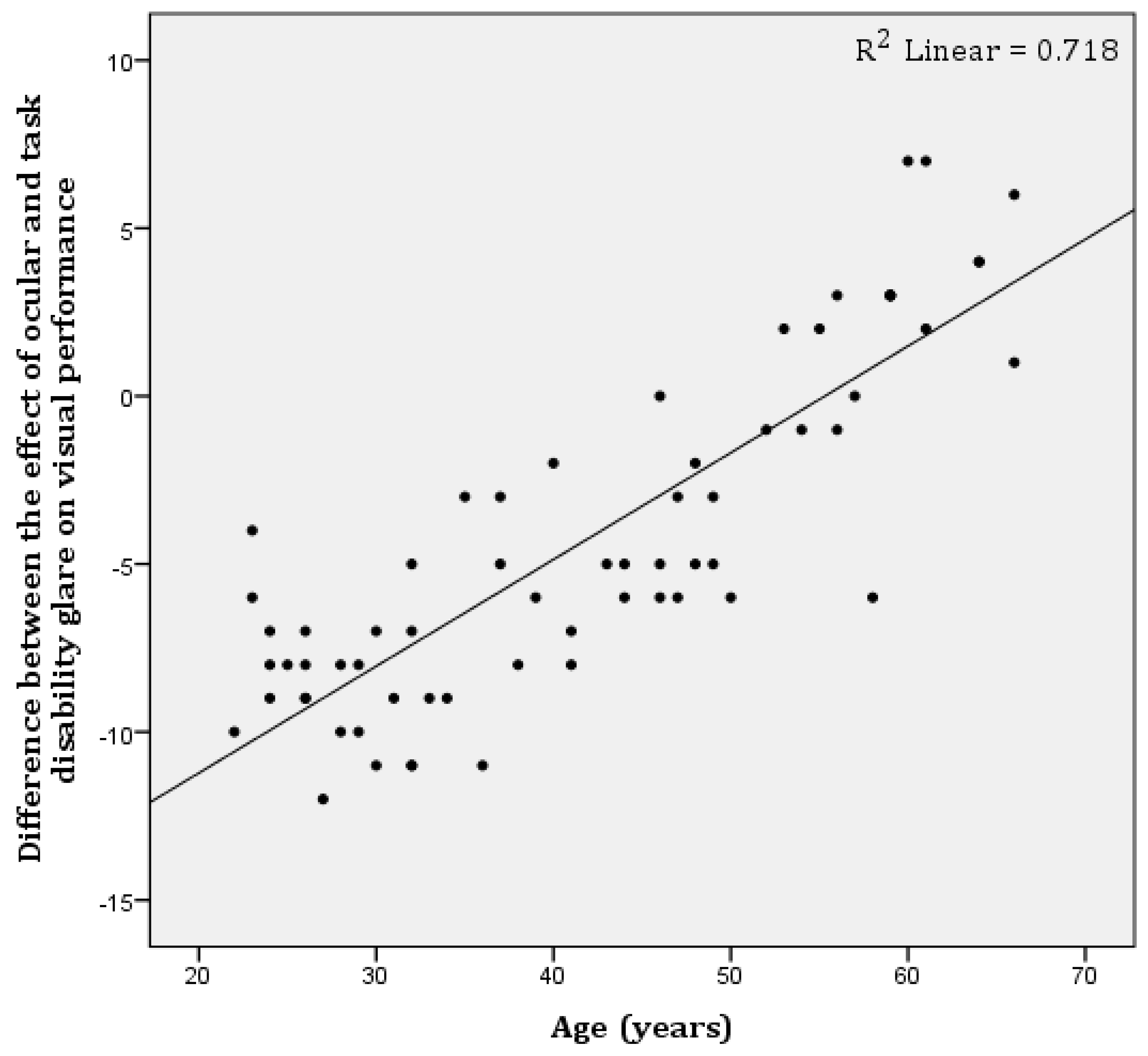

The Classification of Disability Glare and the Effect of Age


Abstract
1. Introduction
2. Methods
2.1. Procedure
2.2. Measurements Taken
2.3. Test Conditions
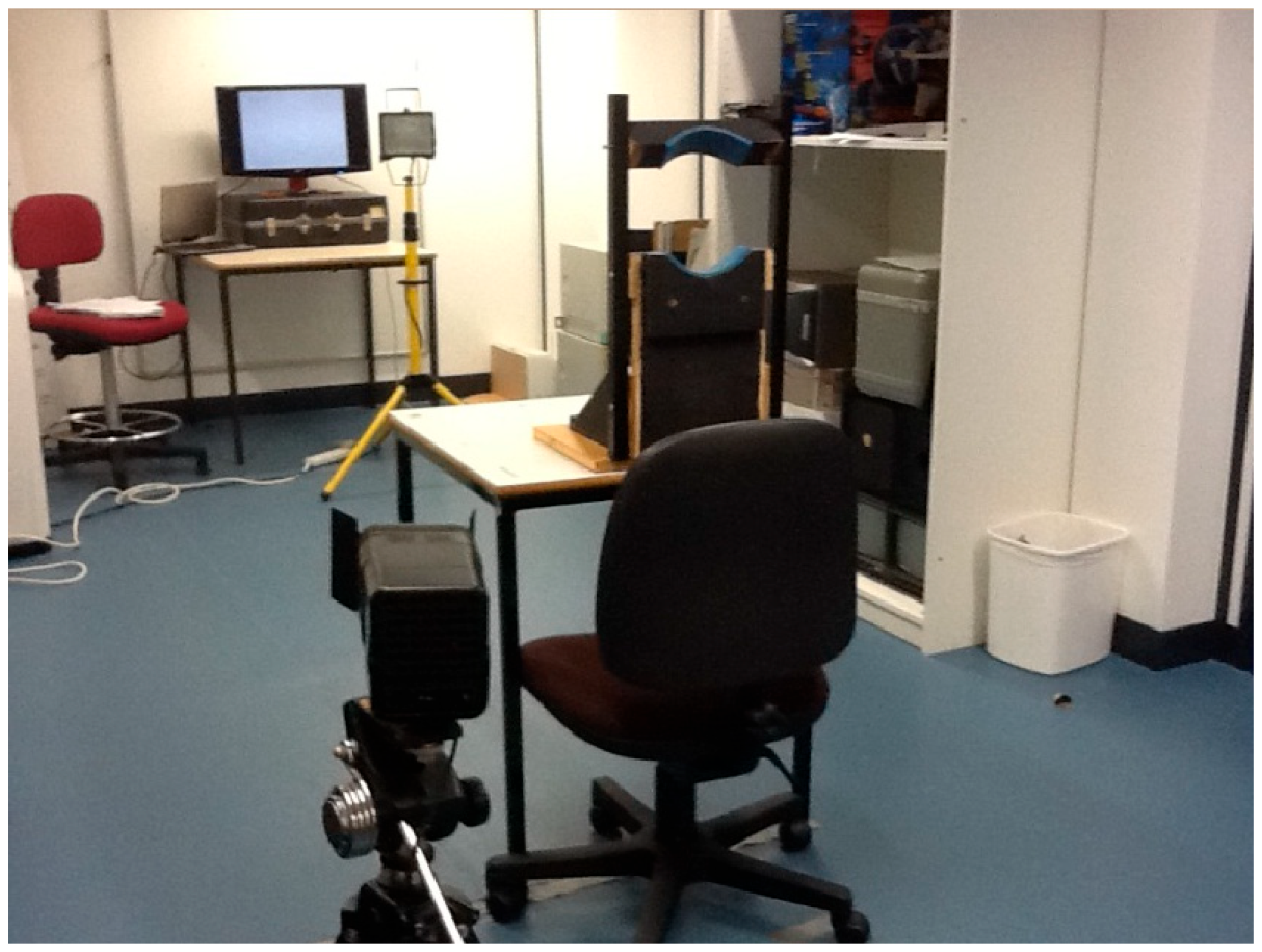
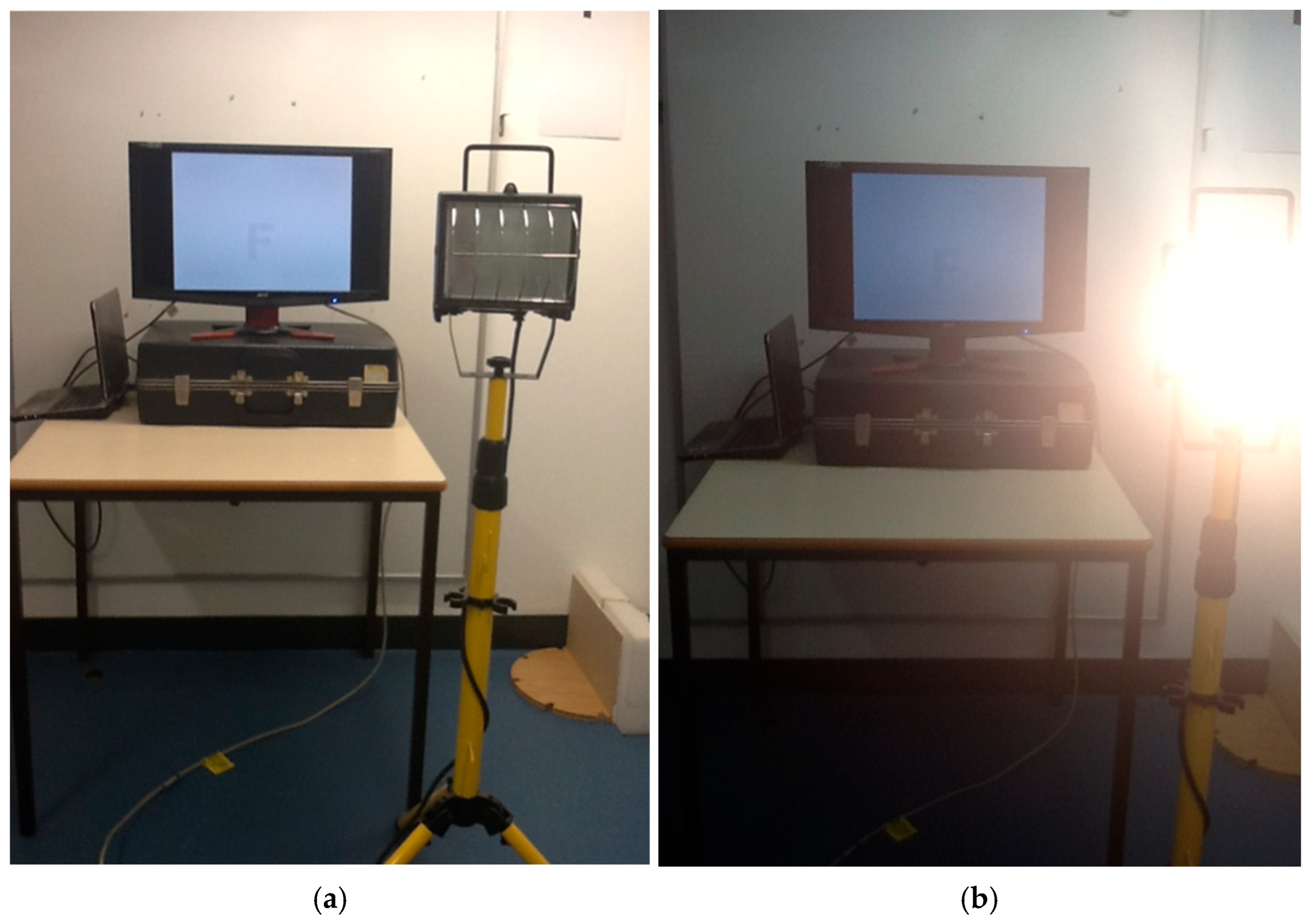
- No glare: this is the control for each participant. The screen was viewed under normal laboratory lighting, which provided illuminance of 700 lux in the plane of the eye and 700 lux in the plane of the screen (Figure 2a).
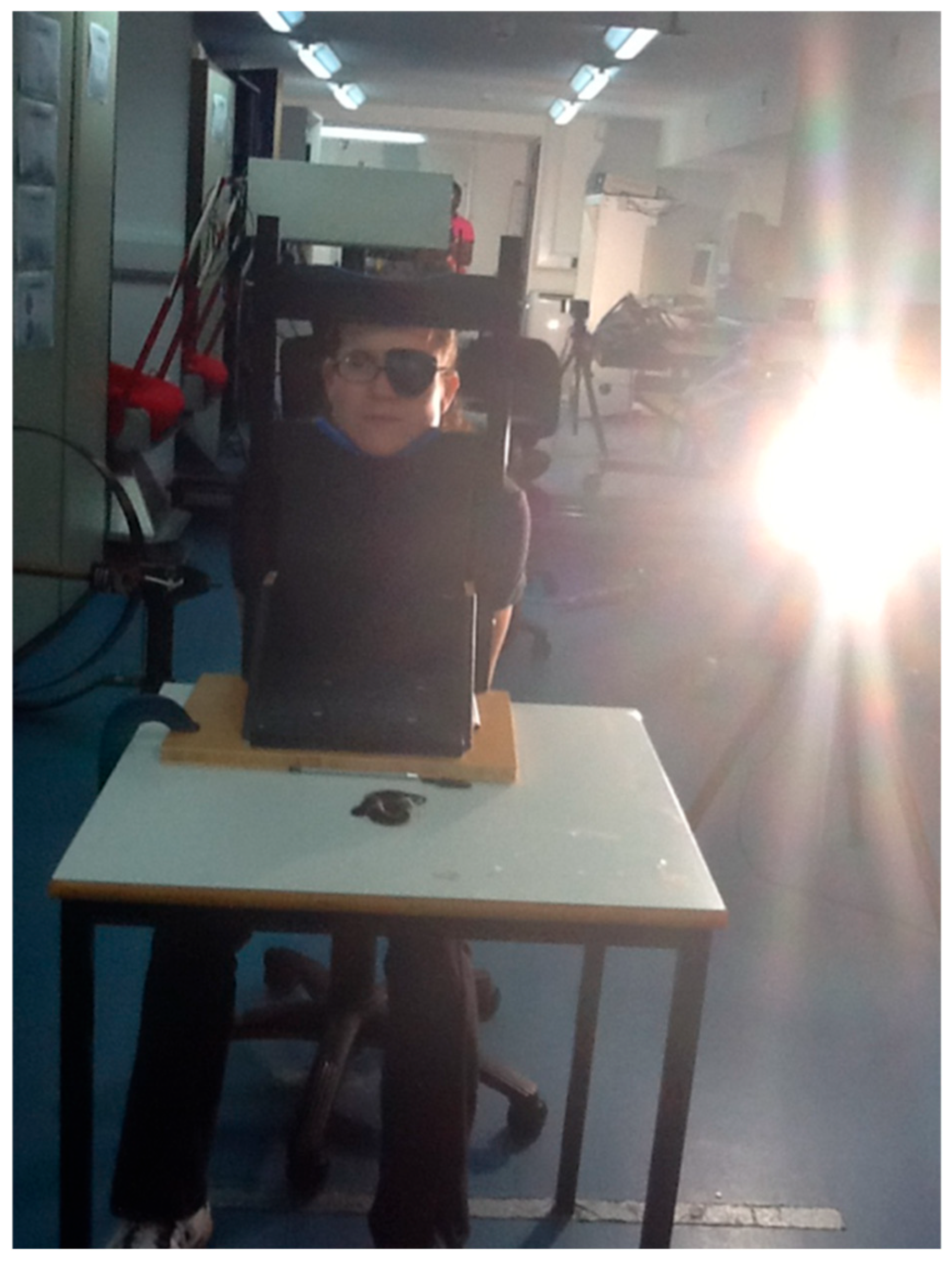
- Task disability glare condition: a 240 V 1000 W Kaiser 3007 SFK photoflood lamp (Kaiser Fototechnik, Buchen, Germany) was positioned 5 m from the screen, to the left of the participant at an angle 60° to the midline of the screen. The positioning was in such a way that uniform illumination was provided by the lamp over the task and background. The lamp produced a luminance of 158,000 cd/m2 and an illuminance of 780 lux (in the vertical plane) on the screen (Figure 3).
- Ocular disability glare condition: a 240 V 500 W MAX, linear tungsten halogen lamp was positioned 2.9 m from the participant. The glare source was positioned at 4° from the line of sight of the participant’s eye. The lamp produced luminance of 158,000 cd/m2 and illuminance of 780 lux (in the vertical plane) at the line of sight of the eye of the participant (Figure 2b).
2.4. Participants
2.5. Data Analysis
3. Results
3.1. Visual Performance and Age
3.2. Age and Visual Performance Under Glare Conditions
4. Discussion
Funding
Institutional Review Board Statement
Informed Consent Statement
Data Availability Statement
Conflicts of Interest
References
- Howarth, P.A. Towards a better understanding of glare: Classification on the basis of its effect. Theor. Appl. Ergon. 2026. [Google Scholar]
- Commission Internationale de I’Eclairage. CIE Equations for Disability Glare; CIE Report 146; CIE: Vienna, Austria, 2002. [Google Scholar]
- Garciai, K.D.; Wierwille, W.W. Effect of Glare on Performance of a VDT Reading-Comprehension Task. Hum. Factors J. Hum. Factors Ergon. Soc. April. 1985, 27, 163–173. [Google Scholar] [CrossRef] [Scilit] [PubMed]
- Bailey, I.L.; Bullimore, M. A new test for the evaluation of disability glare. Optom. Vis. Sci. 1991, 68, 911. [Google Scholar] [CrossRef] [Scilit] [PubMed]
- De Waard, P.; IJspeert, J.; Van Den Berg, T.; De Jong, P. Intraocular light scattering in age-related cataracts. Investig. Ophthalmol. Vis. Sci. 1992, 33, 618–625. [Google Scholar]
- Hemenger, R.P. Intraocular light scatter in normal vision loss with age. Appl. Opt. 1984, 23, 1972–1974. [Google Scholar] [CrossRef] [Scilit] [PubMed]
- Hennelly, M.; Barbur, J.; Edgar, D.; Woodward, E. The effect of age on the light scattering characteristics of the eye. Ophthalmic Physiol. Opt. 1998, 18, 197–203. [Google Scholar] [CrossRef] [Scilit]
- Herrero-Gracia, A.; Hernández-Andrés, R.; Luque, M.J.; Díez-Ajenjo, M.A. Age-related changes in contrast sensitivity function under different illumination conditions. Clin. Exp. Optom. 2025, 108, 880–885. [Google Scholar] [CrossRef] [Scilit] [PubMed]
- Holladay, L. The fundamentals of glare and visibility. J. Optom. Soc. 1926, 12, 271–319. [Google Scholar] [CrossRef] [Scilit]
- Holladay, L. Action of a light-source in the field of view in lowering visibility. J. Optom. Soc. 1927, 14, 1–15. [Google Scholar] [CrossRef] [Scilit]
- Kuroda, T.; Fujikado, T.; Ninomiya, S.; Maeda, N.; Hirohara, Y.; Mihashi, T. Effect of aging on ocular light scatter and higher order aberrations. J. Refract. Surg. 2002, 18, S598–S602. [Google Scholar] [CrossRef] [Scilit] [PubMed]
- Spieringhs, R.M.; Smet, K.; Cuijpers, R.; Heynderickx, I.; Hanselaer, P. Road Marking Contrast Threshold for the Elderly and the Impact of Glare. LEUKOS 2024, 21, 109–124. [Google Scholar] [CrossRef] [Scilit]
- Stiles, W. The nature and effects of glare. Illum. Eng. 1929, 22, 304–312. [Google Scholar]
- Wolf, E. Glare and Age. Arch. Ophthalmol. 1960, 64, 502–514. [Google Scholar] [CrossRef] [Scilit] [PubMed]
- Van den Berg, T. Analysis of intraocular straylight, especially in relation to age. Optom. Vis. Sci. Off. Publ. Am. Acad. Optom. 1995, 72, 52. [Google Scholar] [CrossRef] [Scilit] [PubMed]
- Vos, J.J. Disability glare-a state of the art report. CIE J. 1984, 3, 39–53. [Google Scholar]
- Vos, J.J. Age dependence of glare effects and their significance in terms of visual ergonomics. Light. Aging Vis. Health 1995, 11, 25. [Google Scholar]
- Vos, J.J. Reflections on glare. Light Res. Technol. 2003, 35, 163–175. [Google Scholar] [CrossRef] [Scilit]
- Vos, J.J. On the cause of disability glare and its dependence on glare angle, age and ocular pigmentation. Clin. Exp. Optom. 2003, 86, 363–370. [Google Scholar] [CrossRef] [Scilit] [PubMed]
- Yuan, R.; Yager, D.; Guethlein, M.; Oliver, G.; Kapoor, N.; Zhong, R. Controlling unwanted sources of threshold change in disability glare studies: A prototype apparatus and procedure. Optom. Vis. Sci. 1993, 70, 976. [Google Scholar] [PubMed]
- Charness, N.; Boot, W.R. Aging and Information Technology Use: Potential and Barriers. Curr. Dir. Psychol. Sci. 2009, 18, 253–258. [Google Scholar]
- Fozard, J.L.; Kearns, W.D. Impacts of technology interventions on communication in aging and aged persons. In Gerontechnology: Growing Old in a Technological Society; Lesnoff-Caravaglia, G., Ed.; Charles Thomas: Springfield, IL, USA, 2007; pp. 271–291. [Google Scholar]
- Owsley, C. Aging and Vision. Vis. Res. 2011, 51, 1610–1622. [Google Scholar] [CrossRef] [Scilit] [PubMed]
- Haegerstrom-Portnoy, G.; Schneck, M.E.; Brabyn, J.A. Seeing into old age: Vision function beyond acuity. Optom. Vis. Sci. 1999, 76, 141–158. [Google Scholar] [CrossRef] [Scilit] [PubMed]
- Boyce, P. Lighting for Driving: Roads, Vehicles, Signs, and Signals: Roads, Vehicles, Signs, and Signals; CRC Press: Boca Raton, FL, USA, 2024. [Google Scholar]
- Carlson, P.J. 2015 Can traffic signs be too bright on low-volume roads? Transp. Res. Rec. 2015, 2472, 101–108. [Google Scholar] [CrossRef] [Scilit]
- Dixon, K.; Park, E.S.; Brewer, M.; Wu, L.; Geedipally, S.; Srinivasan, R.; Rista, E. Guidelines for Treatments to Mitigate Opposite Direction Crashes; Transportation Research Board: Washington, DC, USA, 2022. [Google Scholar]
- Ni, R.; Bian, Z.; Guindon, A.; Andersen, G.J. 2012 Aging and the detection of imminent collisions under simulated fog conditions. Accid. Anal. Prev. 2012, 49, 525–531. [Google Scholar] [CrossRef] [Scilit] [PubMed]
- Ungewiss, J.; Schiefer, U.; Eichinger, P.; Wörner, M.; Crabb, D.P.; Jones, P.R. Does intraocular straylight predict night driving visual performance? Correlations between straylight levels and contrast sensitivity, halo size, and hazard recognition distance with and without glare. Front. Hum. Neurosci. 2022, 16, 910620. [Google Scholar] [CrossRef] [Scilit] [PubMed]
- Bailey, I.L.; Lovie, J. New design principles for visual acuity letter charts. Am. J. Optom. Physiol. Opt. 1976, 53, 740. [Google Scholar] [CrossRef] [Scilit]
- McMonnies, C.W.; Ho, A. Analysis of errors in letter acuity measurements. Clin. Exp. Optom. 1996, 79, 144–151. [Google Scholar] [CrossRef] [Scilit]
- BS 4274-1; Visual Acuity Test Types. Specification for Test Charts for Clinically Determining Distance Visual Acuity. British Standard Institution: London, UK, 1968.
- Elliott, D.B.; Bullimore, M.A. Assessing the reliability, discriminative ability, and validity of disability glare tests. Investig. Ophthalmol. Vis. Sci. 1993, 34, 108–119. [Google Scholar]
- Fisher, A.; Christie, A. A note on disability glare. Vis. Res. 1965, 5, 565–571. [Google Scholar] [CrossRef] [Scilit] [PubMed]
- IJspeert, J.; De Waard, P.; Van den Berg, T.; De Jong, P. The intraocular straylight function in 129 healthy volunteers; dependence on angle, age and pigmentation. Vis. Res. 1990, 30, 699–707. [Google Scholar] [CrossRef] [Scilit] [PubMed]
- LeClaire, J.; Nadler, M.; Weiss, S.; Miller, D. A new glare tester for clinical testing: Results comparing normal subjects and variously corrected aphakic patients. Arch. Ophthalmol. 1982, 100, 153. [Google Scholar] [PubMed]
- Longobardi, G. On the variability of the disability glare factor. Atti Fond. Giorgio Ronchi 1973, 28, 653. [Google Scholar]
- Norton, T.T.; Corlis, D.A.; Bailey, J.E. The Psychophysical Measurement of Visual Function; Richmond Products: Albuquerque, NM, USA, 2002. [Google Scholar]
- Regan, D.; Neima, D. Low-contrast letter charts as a test of visual function. Ophthalmology 1983, 90, 1192–1200. [Google Scholar] [CrossRef] [Scilit] [PubMed]
- Frazor, R.A.; Wilson, S.; Geisler, W.S. Local luminance and contrast in natural images. Vis. Res. 2006, 46, 1585–1598. [Google Scholar] [CrossRef] [Scilit] [PubMed]
- Aslam, T.M.; Haider, D.; Murray, I.J. Principles of disability glare measurement: An ophthalmological perspective. Acta Ophthalmol. Scand. 2007, 85, 354–360. [Google Scholar] [CrossRef] [Scilit] [PubMed]
- Howarth, P.A. Vision visual work. In Evaluation of Human Work, 3rd ed.; Wilson John, R., Wilson Nigel Corlett, E., Eds.; CRC Press: London, UK, 2005; pp. 664–692. [Google Scholar]





| p-Value | R2 Value | Confidence Interval | Regression Equation | |
|---|---|---|---|---|
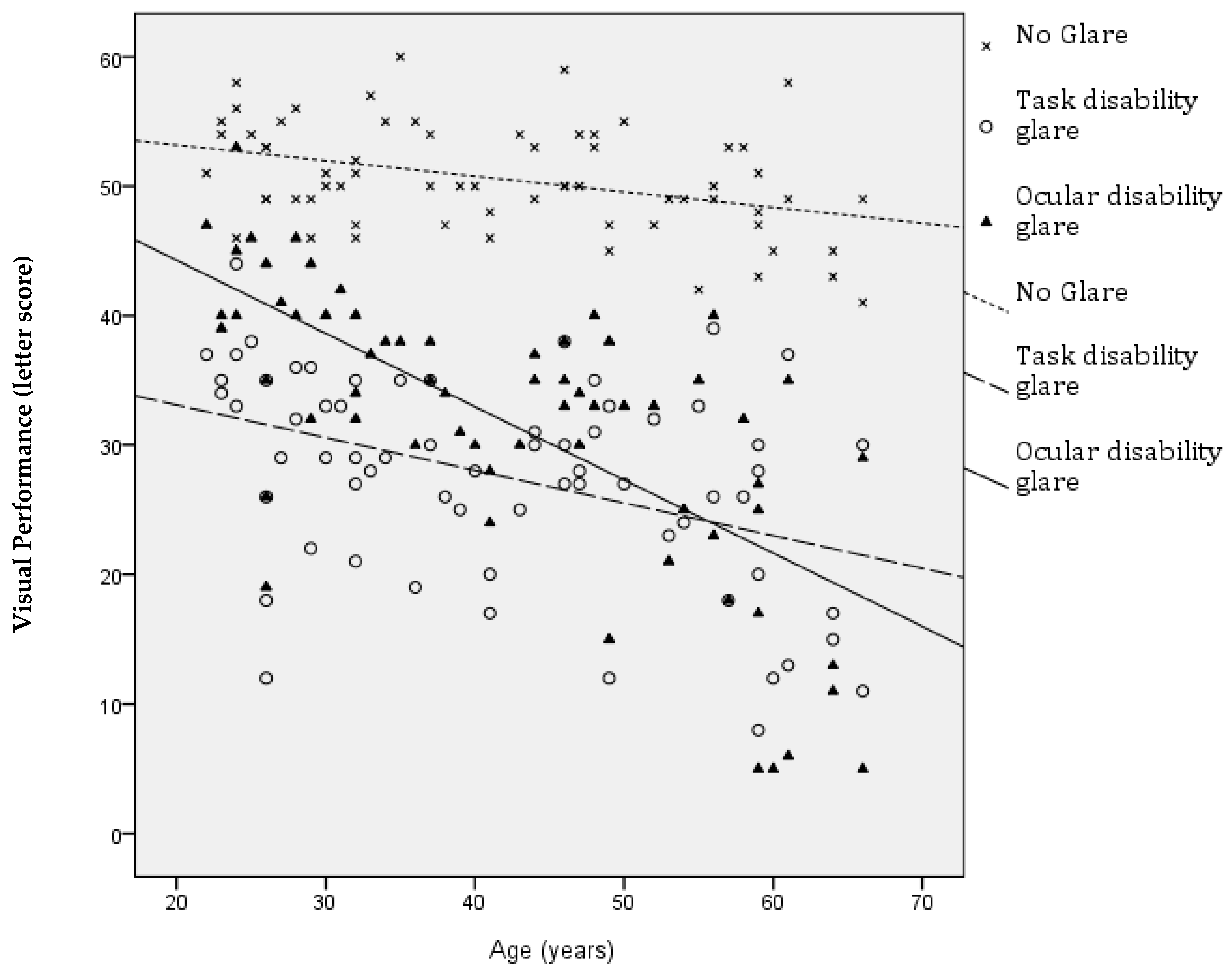
| Visual performance without glare (a) | 0.001 | 0.148 | −0.193 to −0.048 | Y = 55.598 + (−0.121Age) |
| Visual performance under ocular disability glare (b) | <0.001 | 0.485 | −0.712 to −0.420 | Y = 55.591 + (−0.566Age) |
| Visual performance under task disability glare (c) | <0.001 | 0.178 | −0.388 to −0.117 | Y = 38.142 + (−0.252Age) |
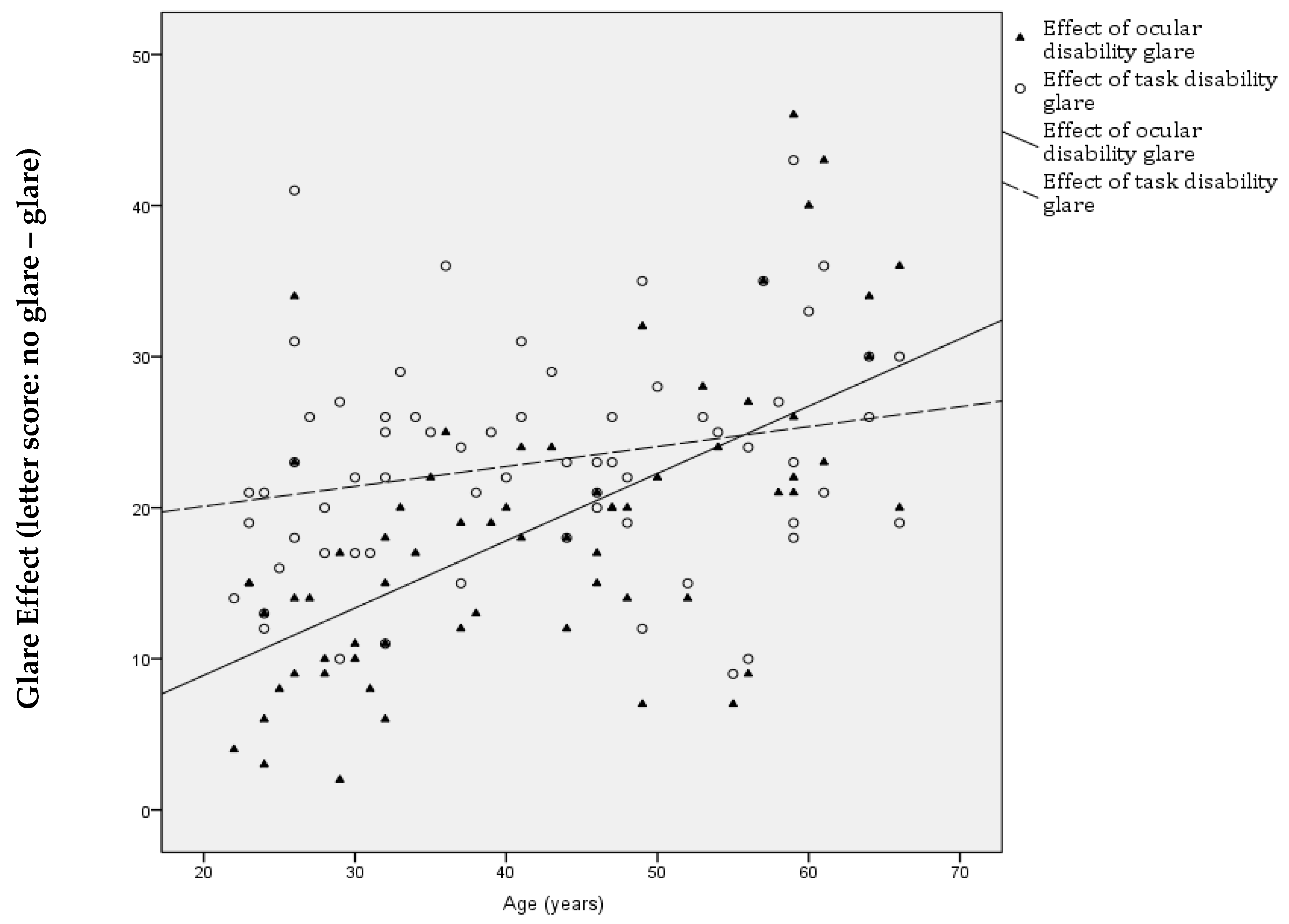
| Effect of ocular disability glare on visual performance (b-a) | <0.001 | 0.383 | 0.304 to 0.586 | Y = 0.008 + (0.445Age) |
| Effect of task disability glare on visual performance (c-a) | 0.051 | 0.058 | −0.001 to 0.264 | Y = 17.456 + (0.132Age) |
| Difference between the effect of ocular and task disability glare (b-c) | <0.001 | 0.718 | 0.268 to 0.368 | Y = −17.578 + (0.318Age) |
Disclaimer/Publisher’s Note: The statements, opinions and data contained in all publications are solely those of the individual author(s) and contributor(s) and not of MDPI and/or the editor(s). MDPI and/or the editor(s) disclaim responsibility for any injury to people or property resulting from any ideas, methods, instructions or products referred to in the content. |
© 2026 by the author. Licensee MDPI, Basel, Switzerland. This article is an open access article distributed under the terms and conditions of the Creative Commons Attribution (CC BY) license.
Share and Cite
Howarth, P.A. The Classification of Disability Glare and the Effect of Age. Theor. Appl. Ergon. 2026, 2, 20. https://doi.org/10.3390/tae2030020
Howarth PA. The Classification of Disability Glare and the Effect of Age. Theoretical and Applied Ergonomics. 2026; 2(3):20. https://doi.org/10.3390/tae2030020
Chicago/Turabian StyleHowarth, Peter Alan. 2026. "The Classification of Disability Glare and the Effect of Age" Theoretical and Applied Ergonomics 2, no. 3: 20. https://doi.org/10.3390/tae2030020
APA StyleHowarth, P. A. (2026). The Classification of Disability Glare and the Effect of Age. Theoretical and Applied Ergonomics, 2(3), 20. https://doi.org/10.3390/tae2030020