


Abstract
Background: In recent years, aesthetic medicine has progressively prioritized conservative treatment volumes, subtle enhancements, and skin quality improvement over volumization. This study evaluates patient-reported psychosocial outcomes, satisfaction, and regret rates following minimally invasive aesthetic procedures using validated instruments. Methods: A review was conducted in accordance with PRISMA guidelines. PubMed, Scopus, and Cochrane Library were searched for studies reporting outcomes using validated PROMs (FACE-Q, GAIS, Decision Regret Scale, BDDQ, DCQ and COPS) with a minimum follow-up of 6 months. Studies evaluating facial botulinum neurotoxins, hyaluronic acid fillers, and biostimulation treatments were included. Given the heterogeneity in study design and outcome reporting, findings were synthesized narratively with descriptive comparisons across treatment modalities. Results: Increased treatment intensity was not consistently associated with greater satisfaction, and higher dose or volume often corresponded to more dissatisfaction and regret. The evidence for this pattern was stronger for botulinum toxin and hyaluronic acid fillers; weaker for biostimulators and preliminary for post-GLP-1 facial changes. Conservative approaches were associated with favorable PROMs, and unrealistic expectations, body dysmorphic disorder, and insufficient pre-treatment counseling were the principal predictors of poor outcomes. Conclusions: Patient satisfaction was not proportional to treatment intensity, particularly when results were perceived as unnatural or overcorrected. This relationship appears associative rather than causal, as patients receiving more intense treatment may differ in expectations, history, and psychological profile. A PROM-driven, patient-tailored approach seems more likely to produce durable satisfaction and minimize regret.
1. Introduction
Minimally invasive aesthetic procedures are among the fastest-growing segments of medical practice worldwide. According to the International Society of Aesthetic Plastic Surgery (ISAPS), over 7.8 million neurotoxin injections and 6.3 million soft tissue filler procedures were performed in 2023 [1]. Over the past decade, patient preferences have shifted toward subtler outcomes: less volume, more attention to skin quality, and more individualized approaches [2,3,4].
This shift likely reflects broader changes in patient expectations and aesthetic standards, influenced by greater social media transparency, high-profile celebrity procedure disclosures, and a growing rejection of the overtreated aesthetic that dominated the early 2000s [5,6,7,8].
In the daily routine of an aesthetic practitioner, patient satisfaction represents the primary success metric [9]. Unlike reconstructive procedures, where objective endpoints define success (e.g., complication rates, functional outcomes), aesthetic treatments must deliver measurable subjective benefit to justify their cost and risk. Patient-Reported Outcome Measures (PROMs) provide validated, standardized tools for quantifying these benefits and enable comparison across modalities, treatment volumes, and populations [10].
Three instruments have established a strong track record in this field.
The FACE-Q, originally developed for facial aesthetic surgery, has been validated for neurotoxin and filler applications across more than thirty languages; it evaluates satisfaction with facial appearance, psychological function, social function, and age appraisal through psychometrically validated subscales [11,12,13].
The Global Aesthetic Improvement Scale (GAIS), a validated 5-point ordinal scale assessing overall aesthetic change from “very much improved” to “worse,” provides a simple and widely used single-item measure of treatment outcome [7,8].
The Decision Regret Scale, a validated instrument widely used in elective medicine, quantifies post-treatment regret, which may represent a more relevant metric than satisfaction alone when evaluating aesthetic procedures, as it captures whether the treatment ultimately aligned with the patient’s expectations and values [14].
The interpretation of these outcomes must be contextualized within patient psychological profiles [15].
Body dysmorphic disorder (BDD), for example, affects 1.7–2.4% of the general population but is present in 7–15% of patients seeking aesthetic treatment [16]. When unrecognized, BDD is associated with poor outcomes, including markedly reduced satisfaction (35–45%) and high regret rates (60–75%), despite technically successful procedures [17]. The development of validated screening tools (Body Dysmorphic Disorder Questionnaire [BDDQ], Dysmorphic Concern Questionnaire [DCQ] and Cosmetic Procedure Screening Scale [COPS]) offers a practical opportunity to identify at-risk patients and optimize treatment selection [18,19,20].
In parallel, the patient population itself is evolving. The widespread adoption of GLP-1 receptor agonists (semaglutide, tirzepatide) for weight management has produced a new cohort of patients presenting with rapid volume loss, skin laxity, and contour irregularities [21,22]. These patients carry different psychosocial expectations and treatment priorities compared with traditional aesthetic populations, further emphasizing the need for outcome-driven evaluation [23,24].
Against this background, this review evaluates evidence from studies using validated PROMs to assess psychosocial outcomes after facial minimally invasive aesthetic procedures. Specifically, we examine satisfaction and regret across neurotoxin, hyaluronic acid filler, and biostimulatory facial treatments; assess how conservative versus aggressive treatment strategies affect outcomes; identify predictors of regret; and describe the emerging evidence on post-GLP-1 patients.
To our knowledge, no previous review has specifically examined the relationship between treatment intensity and patient-reported outcomes in minimally invasive aesthetic medicine.
2. Materials and Methods
2.1. Search Strategy
This study represents a narrative review with a structured and transparent approach in accordance with the PRISMA guidelines [25]. A comprehensive literature search was performed in PubMed/MEDLINE, Scopus, and the Cochrane Library to identify relevant studies published between 1 January 2015, and 1 May 2026.
The search strategy combined controlled vocabulary and free-text terms related to patient-reported outcomes and aesthetic procedures, including: (FACE-Q OR “patient satisfaction” OR “patient-reported outcome” OR “quality of life” OR “psychosocial outcome” OR “treatment regret” OR “GAIS” OR “global aesthetic improvement” OR “BDD”) AND (neurotoxin OR “botulinum toxin” OR Botox OR “hyaluronic acid” OR “dermal filler” OR biostimulator OR poly-L-lactic acid OR calcium hydroxylapatite OR “polycaprolactone-based fillers” OR “aesthetic medicine” OR “cosmetic dermatology”). Reference lists of included studies were also screened to identify additional relevant publications. Study selection and data extraction were performed independently by the authors, with disagreements resolved through discussion until consensus was reached.
2.2. Eligibility Criteria
For primary studies, inclusion required the use of at least one validated PROM (FACE-Q, GAIS, Decision Regret Scale, BDDQ, DCQ, or COPS). For secondary evidence sources (systematic reviews, meta-analyses, narrative reviews, and expert consensus documents), this requirement was waived, as these studies synthesize or contextualize PROM-based evidence rather than applying instruments directly. Additionally, for body dysmorphic disorder outcome prediction and GLP-1-associated facial aging, studies reporting structured clinical outcome data were included to provide a descriptive overview.
Eligible interventions were facial minimally invasive procedures: botulinum neurotoxins, hyaluronic acid fillers, and biostimulatory agents (poly-L-lactic acid, calcium hydroxylapatite, polycaprolactone-based fillers). Primary studies required a minimum of 50 patients and 6 months of follow-up. Studies below these thresholds were retained only when they addressed clinical questions not covered by larger studies, or where inclusion was justified by aggregated secondary evidence in the same domain [9,12,26,27,28,29].
For the GLP-1 domain, where validated PROM data remain scarce, studies reporting clinical outcomes and expert observations were included to describe this emerging population. Studies reporting dose–response or complication outcome data were included where directly informative of the treatment intensity–satisfaction relationship.
Studies were excluded if they used no validated outcome measures, focused exclusively on reconstructive or therapeutic indications, reported complications without psychosocial outcomes, or were available only as conference abstracts. Non-English publications were excluded.
2.3. Study Selection and Data Extraction
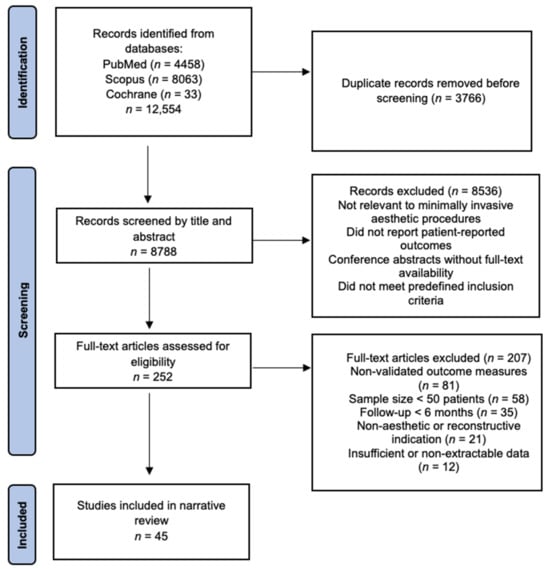
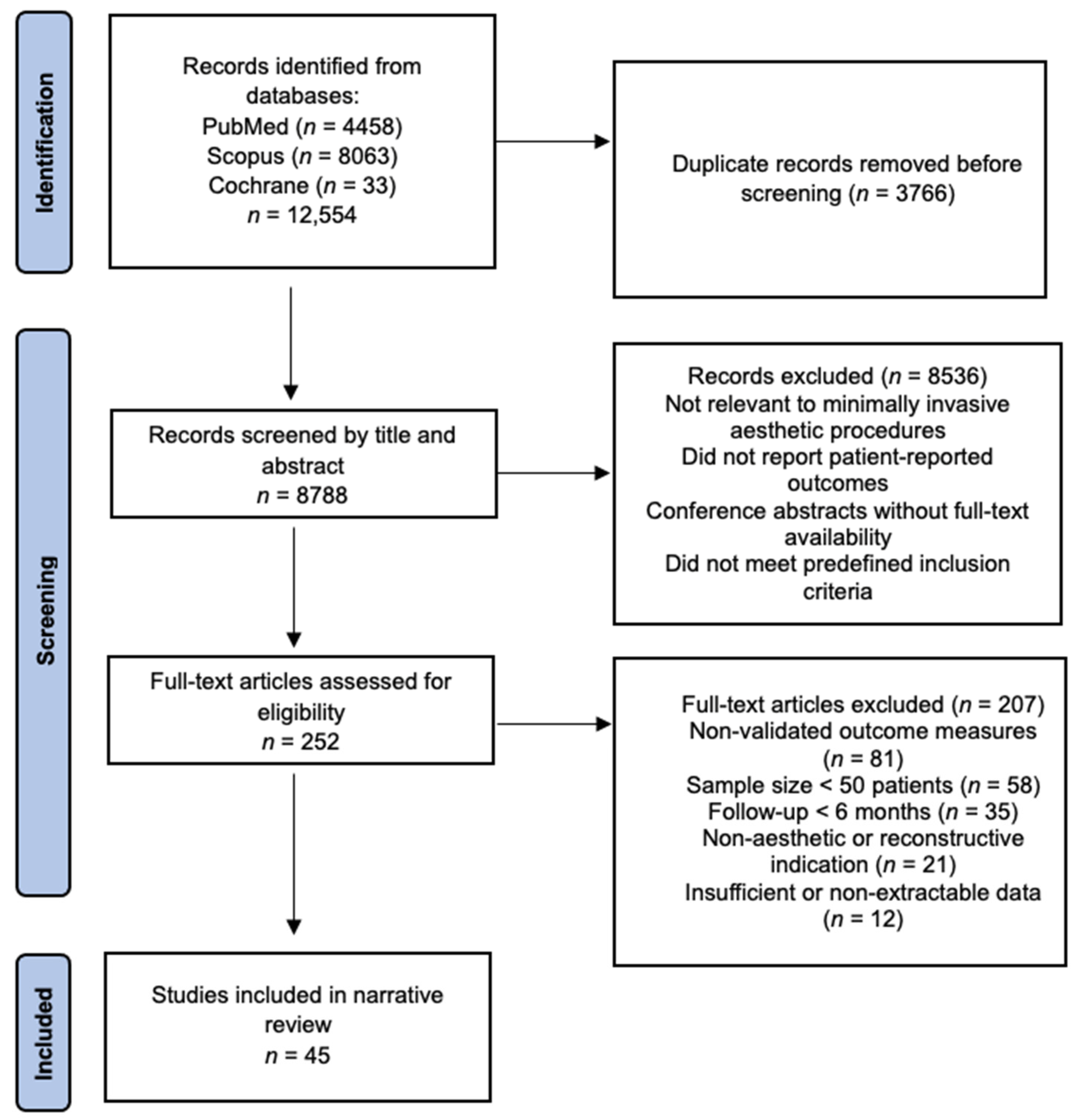
Initial database searches yielded 12,554 records (PubMed n = 4458, Scopus n = 8063, Cochrane n = 33). After removal of duplicates (n = 3766), 8788 unique records remained and were screened by title and abstract.
At this stage, 8536 records were excluded because they were not relevant to minimally invasive aesthetic procedures, did not report patient-reported outcomes, were conference abstracts without full-text availability, or clearly did not meet predefined inclusion criteria.
A total of 252 articles were retrieved for full-text assessment. Of these, 207 were excluded for the following reasons: use of non-validated outcome measures (n = 81), insufficient sample size below the 50-patient threshold (n = 58), follow-up shorter than 6 months (n = 35), non-aesthetic or primarily reconstructive indication (n = 21), and insufficient or non-extractable outcome data (e.g., studies not reporting a quantifiable PROM results, studies reporting results only graphically or pooling modalities without separable outcomes; n = 12).
Forty-five studies met all inclusion criteria (Figure 1): 27 primary studies (prospective cohort studies, randomized controlled trials, and retrospective analyses) and 18 secondary evidence sources (systematic reviews, meta-analyses, expert consensus documents, and evidence-based reviews). Where both types of evidence addressed the same clinical question, primary studies were used for quantitative data extraction, while systematic reviews and reviews were used to contextualize findings.
Figure 1.
Flow diagram of Records Identification, Screening and Inclusion phases according to the PRISMA 2020 guidelines.
Data extraction included study design, number of patients, type of intervention, PROM instruments used, reported outcomes and follow-up.
2.4. Risk of Bias Assessment and Evidence Synthesis
Primary studies were assessed for risk of bias using the Newcastle-Ottawa Scale for cohort and retrospective studies, the Cochrane Risk of Bias 2 tool for randomized controlled trials, and the NIH Quality Assessment Tool for Observational Cohort and Cross-Sectional Studies for cross-sectional designs. Systematic reviews and meta-analyses were appraised using AMSTAR-2 [30]. Narrative reviews and expert consensus documents were evaluated using SANRA, the Scale for the Assessment of Narrative Review Articles [31]. The psychometric validation study was assessed following COSMIN principles [32]. Overall, the methodological quality of included studies was variable. Randomized controlled trials and large prospective studies using validated PROMs demonstrated low risk of bias; smaller observational studies and those relying on non-validated instruments showed moderate to high risk. Systematic reviews and meta-analyses were of higher methodological quality, while narrative reviews and expert consensus documents, by their nature, do not meet the same formal standards. Ratings are reported in Supplementary Table S1. For each study was further assigned a qualitative evidence-strength rating, which does not constitute a formal GRADE assessment, intended as grading the certainty of evidence per outcome rather than per individual study. Rather, it reflects a transparent synthesis of two dimensions: study design, classified according to the Oxford Centre for Evidence-Based Medicine Levels of Evidence [33], and the validation status of the outcome instrument employed, whereby validated PROMs (FACE-Q, GAIS) were weighted above non-validated satisfaction questionnaires and clinical or complication-based outcomes. Accordingly, randomized controlled trials and meta-analyses employing validated PROMs were rated as strong; prospective cohorts and systematic reviews with validated PROMs as moderate; studies with small samples, non-validated questionnaires, or narrative and consensus sources as weak; and case series, complication-only data, or expert observations without a validated PROM as preliminary. Moreover, heterogeneity in study design, treatment protocols, and outcome reporting precluded formal meta-analysis for most endpoints: studies differed substantially in PROM instruments, anatomical areas treated, products used, dosing strategies, follow-up intervals, and definitions of satisfaction or regret. Therefore, findings were synthesized using a structured narrative approach. Quantitative results were reported descriptively where outcome measures were sufficiently comparable across studies. In cases where multiple studies reported similar endpoints, trends were interpreted qualitatively rather than through statistical pooling.
3. Results
3.1. Overview of Included Studies
The included 45 studies covered four clinical domains: botulinum neurotoxin treatments, hyaluronic acid fillers, biostimulatory agents, and psychosocial predictors of outcome including body dysmorphic disorder. Evidence strength varied substantially across domains.
For botulinum neurotoxin and hyaluronic acid filler treatments, several large-scale prospective studies and phase 3 clinical trials using validated PROMs were identified, providing a relatively robust evidence base [34,35,36,37,38,39,40].
For biostimulatory agents, the evidence consisted primarily of smaller prospective cohorts and observational studies, supplemented by systematic reviews [7,41,42,43,44]. For GLP-1-associated aesthetic outcomes, available data derived almost entirely from expert opinion articles, retrospective analyses, and early observational reports [7,21,22,28,41,42,43,44,45]. Follow-up duration across primary studies ranged from 6 to 48 months. An overview of the outcome instruments and screening tools employed, classified by category, is provided in Table 1 study characteristics are detailed in Table 2.
Table 1.
Validated Patient-Reported Outcome Measures in Aesthetic Medicine. FACE-Q and GAIS measure treatment outcome; the Decision Regret Scale measures decisional regret; BDDQ, DCQ and COPS are screening instruments that predict risk of poor outcome rather than measuring it.
Table 2.
Characteristics of Included Studies.
3.2. Psychosocial Outcomes Following Botulinum Toxin Treatment
Botulinum neurotoxin treatment was associated with significant improvements in patient-reported satisfaction, facial appearance, and psychological well-being across the included studies [60,61,64]. Chang et al. reported a 28% increase in FACE-Q satisfaction with overall facial appearance after glabellar neuromodulation in 57 female patients (p < 0.01), with no clinically meaningful differences between onabotulinumtoxinA, abobotulinumtoxinA, and incobotulinumtoxinA formulations [12].
Long-term data from a retrospective analysis of 4402 glabellar treatments over a mean of 9.1 years confirmed durable satisfaction: 92.3% of patients were mostly or very satisfied, and among those who reported looking younger (89.7%), the mean perceived age reduction was 6.9 years [34]. Phase 3 evidence from the BLESS trials (letibotulinumtoxinA, N = 1272) confirmed improvements in quality of life, perceived age, and FACE-Q satisfaction with treatment outcome compared with placebo [35]. Similarly, the READY-1 trial (relabotulinumtoxinA, N = 307) reported GAIS responder rates of 74.3–98.1% and higher FACE-Q psychological function scores versus placebo over 6 months [35,39,40].
The dose–satisfaction relationship does not appear to be linear. In a dose-escalation study with onabotulinumtoxinA, subject satisfaction at Week 24 increased from 20 U (24% satisfied) to 40 U (60%), but then declined with further escalation to 60 U (51%) and 80 U (39%); a similar pattern was observed for satisfaction with natural appearance.
In contrast, abobotulinumtoxinA maintained patient satisfaction and natural-looking results at doses 2–2.5 times the on-label dose, with the added benefit of extended duration (median 9 months) [46].
Drivers of regret included reduced facial expressivity and a perceived “unnatural” or “overcorrected” appearance [47,69,70]. Age also plays a role: a prospective observational study of 150 patients found higher satisfaction scores in patients under 40 [26].
These findings likely reflect the interaction between dosing, technique, and patient expectations rather than a direct pharmacologic effect. The available data suggest a threshold-dependent pattern: increasing treatment intensity beyond a moderate dose does not confer additional psychosocial benefit and could increase dissatisfaction [62].
3.3. Psychosocial Outcomes Following Hyaluronic Acid Filler Treatment
Hyaluronic acid filler treatment was associated with high levels of patient satisfaction and durable aesthetic improvement across the included studies [36,37,38,48,49,50,51,52,53,54,63].
A 2025 systematic review and meta-analysis of midface augmentation reported pooled GAIS responder rates strongly favoring HA over placebo (RR = 3.27, 95% CI: 2.26–4.75), though no significant difference emerged when HA was compared to other active fillers such as calcium hydroxylapatite or poly-L-lactic acid (RR = 1.12, 95% CI: 0.84–1.50) [36]. These findings are supported by long-term observational data. An 18-month multicenter study of full-facial volumization reported that 95% of patients achieved improved GAIS scores, with more than 60% of the initial volumetric effect maintained over time [37].
However, the relationship between filler volume and satisfaction is not linear. In the VYC-20L midface trial (N = 235, mean total volume 6.65 mL), satisfaction with facial appearance declined from 89.8% at 6 months to 75.8% at 2 years despite persistence of volumetric correction [31]. A multicenter RCT of HA filler for infraorbital hollows (N = 333) reported GAIS responder rates of 87.5–97.7% over 12 months and FACE-Q scores of 64.3–73.5 compared to 14.1–16.2 in the control group [52]. A separate retrospective study using lower volumes of a typical of daily practice (mean 1.6 mL) found that 84% of patients remained satisfied at 12 months [61], suggesting that moderate, conservative volumes produce more durable patient-reported benefit per mL injected [38].
At the opposite end, overfilling leads to facial disproportion and a rigid, unnatural appearance—the so-called “Pillow Face” syndrome—which drives dissatisfaction and can paradoxically make patients look older [64].
Complication patterns reinforce this picture. In a large series of hyaluronidase treatments (157 periorbital applications, 90 patients), 52% of dissolution treatments were indicated for swelling and 20% for lumpiness, with 18% of patients developing a posthyaluronidase syndrome characterized by facial hollowing, a complication significantly correlated with duration of filler in situ (p = 0.00019) and volume of filler (p = 0.00001) [49].
Hyaluronic acid fillers nonetheless maintain a favorable safety profile overall. Non-surgical rhinoplasty using HA filler demonstrated very high satisfaction rates (FACE-Q up to 99.2%), with infrequent and typically mild or reversible adverse events [50,51].
These outcomes, however, depend greatly on the operator. The nasal region carries the highest vascular risk of any injection zone, accounting for 56.3% of filler-related occlusions with ocular involvement [64,71]. A serious complication of this kind is likely to be among the most powerful drivers of decisional regret in an elective aesthetic context, reinforcing the role of exhaustive informed consent as an integral part of outcome-focused consultation.
HA filler in patients with retrognathic profiles was associated with high FACE-Q satisfaction scores and improvement across psychosocial outcome domains [54,62].
Combined neurotoxin and HA filler treatment showed additive psychosocial benefit: a systematic review of 31 studies using the FACE-Q found that absolute changes in psychological wellbeing and age appraisal were greatest with combined treatments compared to single-modality approaches [54,63].
3.4. Psychosocial Outcomes Following Biostimulation Treatments
Evidence on biostimulatory treatments, including poly-L-lactic acid (PLLA) and calcium hydroxylapatite (CaHA), derives primarily from smaller prospective cohorts and observational studies, and should be interpreted with more caution than the evidence available for neurotoxins and HA fillers. Across these studies, biostimulatory approaches were associated with high patient-reported satisfaction and sustained aesthetic improvement, though direct PROMs-based comparisons with HA fillers remain scarce.
A prospective study of 52 patients treated with PLLA reported high GAIS satisfaction scores at day 90 and day 150 post-injection [7]. A multicenter prospective study of PLLA (N = 36) reported GAIS ratings of “much better” or “better” in 66.7% of patients at month 1, remaining stable at 65.6% at month 6 [42]. For CaHA, systematic reviews of controlled clinical trials demonstrate improvements in GAIS scores in facial and hand applications, with high patient satisfaction across study populations [43,44].
Unlike hyaluronic acid fillers, which provide immediate volumetric correction, these agents work through neocollagenesis, with gradual and progressive changes in facial appearance [4,41,72]. This gradual mechanism produces aesthetic results perceived as more natural, with expectations more likely to be met over time.
Notably, most of the biostimulator evidence included in this study relied on the GAIS, which reflects global aesthetic improvement but does not directly capture skin texture, elasticity, or dermal thickness. Where improvements in skin quality were reported, particularly the long-term gains persisting beyond 12–24 months, these rest predominantly on GAIS and clinician assessment rather than on instruments specifically validated for skin-quality endpoints [27]. Dedicated tools for these dimensions are available—including the Facial Laxity Rating Scale for laxity [73], ultrasound for objective dermal thickness [74], and the FACE-Q Satisfaction with Skin scale for the patient-perceived dimension—and their wider adoption would allow these claims to be tested more directly in future studies. Within this limitation, the available evidence remains consistent with a satisfaction profile distinct from HA fillers, defined by progressive, durable change rather than immediate volumization [4]. Treatment selection and expectation management differ meaningfully between the two approaches and should be addressed explicitly in pre-treatment counseling [41].
3.5. Body Dysmorphic Disorder: Screening and Outcome Predictors
Body dysmorphic disorder (BDD) is a recognized psychiatric comorbidity in aesthetic populations, with reported prevalence rates ranging from approximately 7% to 15%, higher than in the general population (1.7–2.4%) [55,75]. In a cross-sectional study of 597 patients attending facial plastic and oculoplastic surgery clinics, BDD prevalence reached 14.7%, with most cases going unrecognized during routine consultation [55]. BDD predicts poor outcomes reliably: lower satisfaction and higher regret rates even after technically successful procedures, across surgical and minimally invasive contexts alike [65,66].
Validated screening tools for clinical use include the Body Dysmorphic Disorder Questionnaire (BDDQ), its dermatology-adapted version (BDDQ-DV), the Dysmorphic Concern Questionnaire (DCQ), and the Cosmetic Procedure Screening Questionnaire (COPS), all of which have demonstrated utility in aesthetic settings [15,16]. Unlike outcome measures such as the FACE-Q or GAIS, these instruments are designed to identify at-risk patients before treatment rather than to quantify post-treatment benefit. Among these, the BDDQ and DCQ are the most widely studied and require minimal chair time [67,68].
Interestingly, high daily social media use is associated with a greater likelihood of positive BDD screening [56]. These findings suggest that unrecognized BDD as a largely preventable predictor of poor patient-reported outcomes in aesthetic practice.
3.6. Outcomes in Post-GLP-1 Receptor Agonist Treatment Patients
Aesthetic outcomes in patients treated with glucagon-like peptide-1 (GLP-1) receptor agonists have only recently begun to be characterized, and the evidence remains less developed than for the other modalities evaluated. Rapid weight loss in this population is frequently associated with facial fat depletion, skin laxity, and loss of structural support, often described as “Ozempic face” [21,22,28].
Unlike age-related volume loss, these changes appear to be driven not only by fat reduction but also by insufficient time for dermal remodeling, producing a clinical picture where skin quality and laxity predominate over volumetric deficiency [28].
Early clinical observations indicate that outcomes are most favorable when treatment addresses the patient’s predominant concerns directly [45]. Biostimulatory agents and energy-based devices targeting skin quality and tissue remodeling are increasingly favored in this population, while purely volumizing strategies may not adequately address the underlying changes [4,21].
Timing is also a key aspect. Some authors indicate that aesthetic treatments performed after weight stabilization yield more predictable outcomes than interventions during active weight loss [28,45]; others suggest that the timing may depend on the products used [76]. However, the most consistent finding across the current literature is that timing should be individualized and determined through shared decision-making between clinician and patient, taking into account patient motivation and expectations [77].
Outcome measurement in this population is also beginning to mature: a short-form FACE-Q scale specific to facial appearance after GLP-1 medication use has recently been validated [57], and the first prospective treatment studies have appeared [58].
Given their recent introduction in widespread clinical use, however, these findings should be interpreted with caution, and further prospective studies are needed to better define treatment strategies and long-term outcomes.
4. Discussion
Minimally invasive aesthetic treatments were associated with improved patient-reported outcomes across the included studies; however, increasing treatment intensity did not enhance satisfaction proportionally. This finding should be interpreted as an association rather than a demonstrated causal relationship, as patients undergoing more cumulative treatment may differ systematically in baseline expectations, prior treatment history, age, anatomy, and psychological profile, any of which may independently influence the observed outcomes.
Across neurotoxins, HA fillers, and biostimulatory agents, the relationship appears non-linear: beyond a moderate threshold, additional dose or volume failed to improve patient-reported satisfaction. This pattern is best supported for botulinum neurotoxin and HA filler treatments, where large-scale prospective data and phase 3 trials are available [34,35,36,37,38,39,40]. For biostimulatory agents, the same trend appeared in smaller and more heterogeneous studies [7,41,42,43,44], and conclusions warrant proportional caution. The correlation between clinician-assessed improvement and patient satisfaction is moderate: the available data suggest that objective change alone does not fully account for patient wellbeing, and that subjective factors play a substantial role [12,13,59,61]. Key predictors of dissatisfaction and regret across the included studies are summarized in Table 3. Validated PROMs remain the most reliable instrument for capturing what matters to the patient rather than to the clinician [10,11,78].
Table 3.
Key Predictors of Treatment Dissatisfaction and Regret in Aesthetic Medicine.
4.1. Treatment Intensity and the Limits of Aesthetic Improvement
Across the modalities reviewed, higher treatment intensity did not consistently correspond to better patient-reported outcomes. The strength of this evidence, however, varies across treatment categories. It is well supported for botulinum toxin and hyaluronic acid fillers, for which prospective trials and validated PROMs are available [34,35,36,37,38,39,40] for biostimulatory agents it derives from smaller and more heterogeneous studies [7,41,42,43,44]; while for post-GLP-1 facial changes the evidence is still maturing. Most of those data come from expert opinion, retrospective analyses, and early observational reports, although a specific FACE-Q scale for facial appearance after GLP-1 receptor agonists has very recently been validated [57] and the first prospective treatment studies are beginning to appear [58].
However, a recurring difficulty is that “treatment intensity” can not be reduced to a single quantity: units of toxin, injected filler volume, and biostimulator dilution and number of sessions are not directly comparable, and each study operationalizes the concept in its own terms. Table 4 sets out how intensity is defined for each modality, following the dosing conventions used in the studies reviewed [4,39,41,46,50].
Table 4.
Operational definitions of treatment intensity by modality, based on the dosing parameters reported in the reviewed studies.
A further caution is that the relationship between treatment intensity and PROMs does not demonstrate causation itself. Patients receiving greater cumulative treatment exposure may differ in baseline expectations, aesthetic preferences, prior treatment history, or psychological profile, any of which may independently influence patient-reported outcomes. The notion of a “natural” outcome is poorly standardized: what reads as overtreatment in one cultural context could be the intended result in another, and perceptions vary across age groups, social media exposure, and aesthetic trends, which limits how far conclusions about optimal intensity can be generalized.
For neurotoxins, dose-escalation data show that while increasing dosage initially improves outcomes, further escalation compromises perceived naturalness and facial expressivity. This is consistent with the broader observation that clinician-assessed improvement correlates only moderately with patient-reported outcomes, reinforcing the importance of validated PROMs such as the FACE-Q in capturing clinically relevant treatment effects [11]. The same pattern holds for filler-based treatments. Long-term studies demonstrate that high early satisfaction declines over time despite persistence of volumetric correction, indicating that structural change alone does not fully account for how patients perceive the result [36,37]. In contrast, biostimulatory agents such as poly-L-lactic acid and calcium hydroxylapatite act through neocollagenesis, producing gradual improvements in skin quality and structural support [72], a profile that appears to be aligned with contemporary preferences for subtle results.
In all treatment categories, dissatisfaction is more frequently linked to overtreatment than to undertreatment. Beyond the loss of expressivity already noted for neurotoxins, excessive filler use can result in facial disproportion and the well-described “pillow face” phenomenon, which paradoxically accentuates perceived aging.
High patient satisfaction should not, however, be read as synonymous with appropriate treatment. In aesthetic medicine, reinforcement mechanisms, evolving treatment dependency, and social validation can drive repeated treatment-seeking behavior even when correction is excessive from a clinical aesthetic standpoint. This issue is especially important in patients undergoing frequent aesthetic treatments, where continued procedural escalation does not always correspond to improved psychosocial wellbeing.
At the same time, aesthetic preferences remain highly individual, and some patients seek more visible or transformative outcomes. In selected cases, greater treatment intensity may therefore remain aligned with patient expectations and satisfaction.
4.2. Body Dysmorphic Disorder: A Cross-Cutting Predictor of Poor Outcome
Patient selection determines outcome as much as technique does. Body dysmorphic disorder is significantly more prevalent in aesthetic populations than in the general population, with rates reported between 7% and 15%. Importantly, patients with BDD report lower satisfaction and higher rates of dissatisfaction even when objective aesthetic results are favorable [71,72]. Higher daily social media use is associated with a greater likelihood of positive BDD screening: adding one question about social media habits to the intake—how many hours per day, which platforms—takes thirty seconds and can identify patients who need more careful evaluation with validated instruments before treatment [73,75].
As demonstrated by Pereira et al., structured instruments such as the BDDQ and DCQ provide practical and evidence-based methods for identifying at-risk patients in routine practice. These findings support the integration of psychological screening into routine pre-treatment consultation, particularly in patients with complex expectations or a history of unsatisfactory procedures [16,55,75].
Future research should examine whether treating patients with mild-to-moderate BDD symptoms following psychological intervention improves outcomes compared to treatment refusal, since current guidelines are based largely on case reports of severe BDD rather than stratified outcome data.
4.3. Post-GLP-1 Patients: An Emerging Clinical Population
The expanding use of GLP-1 receptor agonists has produced a new and clinically relevant aesthetic population [21,22,23].
As detailed in Section 3.6, the facial changes in these patients are dominated by laxity and loss of dermal support rather than by true volume loss, and analyses including those by Ridha et al. indicate that volumizing strategies alone do not adequately address them [28]. The implication for practice is that treatment calibrated to proportional, natural-appearing results, with explicit attention to tissue quality rather than volume, appears better aligned with patient priorities; modalities targeting tissue remodeling and skin laxity, such as energy-based devices, are increasingly applied on this rationale [29].
In this specific population, however, the evidence base remains limited and prospective data are needed to confirm whether this approach translates into improved PROMs compared with traditional volumizing strategies.
4.4. PROMs Implementation in Clinical Practice
Consistent improvements in FACE-Q scores across different treatments and patient populations support its role as a validated and responsive tool in aesthetic practice [11,12,13]. A systematic review of patient-reported outcomes for cosmetic botulinum toxin indications confirmed FACE-Q adoption has accelerated across phase 3 trials, with reliable correlation to clinician-assessed outcomes [59,61]. Developed specifically for facial aesthetics, the FACE-Q allows structured evaluation of satisfaction, quality of life, and psychosocial impact, capturing aspects that are often missed by clinician-based assessment alone [12].
PROMs also should guide treatment decisions. Monitoring patient-reported outcomes over time can indicate when additional treatment no longer yields clinically relevant improvement. Accordingly, PROMs provide a concrete framework to support more conservative and individualized treatment strategies.
From a practical perspective, PROMs can be integrated into clinical workflow without significant burden. Digital administration through patient portals facilitates data collection, and brief tools such as the GAIS can be used for routine follow-up, while more detailed instruments like the FACE-Q should be reserved for selected cases, such as patients with complex concerns or higher expectations.
However, patient-reported outcomes in aesthetic medicine remain intrinsically subjective and should be interpreted within a broader psychosocial and cultural context. Improvements in PROM scores can partially reflect evolving patient expectations, social reinforcement, or short-term emotional responses rather than stable long-term wellbeing. Satisfaction scores are also susceptible to ceiling effects and social desirability bias, particularly in elective aesthetic settings where patients feel psychologically invested in perceiving benefit from treatment. These limitations are most relevant for simplified instruments such as the GAIS, which, despite widespread adoption, relies on a single global assessment and does not fully capture the multidimensional nature of psychosocial outcomes. More comprehensive instruments such as the FACE-Q provide a more nuanced evaluation of psychological function, social confidence, and appearance-related quality of life over time.
4.5. Limitations
This review has several limitations. The included studies were highly heterogeneous in treatment protocols, injected volumes, patient populations, follow-up duration, and PROM instruments, limiting direct comparability. Most available evidence was observational and frequently derived from non-randomized or industry-sponsored studies, which increases the risk of selection and reporting bias.
Patient satisfaction in aesthetic medicine is inherently subjective and shaped by cultural standards, social media exposure, evolving beauty trends, and baseline psychological characteristics that cannot be standardized across populations. The GAIS, though widely used, may not adequately capture the multidimensional nature of psychosocial outcomes. This limitation is most evident for biostimulatory agents, where claims regarding skin texture, elasticity, and dermal thickness rest largely on GAIS-based and clinician-assessed data, as most available studies did not employ instruments specifically validated for these skin-quality endpoints.
There is no standardized definition of “natural” versus “overcorrected” outcomes, which remain partly culturally and temporally dependent. For GLP-1-associated facial aging, the evidence base still rests mainly on observational data rather than comparative prospective studies, although the recent validation of a specific FACE-Q scale mark the first steps toward closing this gap.
5. Conclusions
Minimally invasive aesthetic procedures were associated with substantial psychosocial benefits across the included studies. The relationship between treatment intensity and patient-reported satisfaction was not linear: increasing dose or volume beyond moderate thresholds did not reliably improve outcomes and, in several cases, correlated with higher rates of dissatisfaction. This pattern is most clearly documented for botulinum neurotoxin and HA filler treatments, where large-scale prospective data are available; for biostimulatory agents, the same trend appeared in smaller and more heterogeneous studies. Unrecognized body dysmorphic disorder was a notable and preventable predictor of poor outcomes across modalities, supporting routine integration of validated screening tools into pre-treatment consultation. Aesthetic outcomes depend on the interaction between technique, treatment strategy, and patient psychology. A conservative, patient-centered approach appears more likely to produce favorable patient-reported outcomes, although this remains an association, and prospective comparative studies are needed to establish whether it is causal. Aesthetic preferences remain highly individual: in selected cases, greater treatment intensity could still remain aligned with patient expectations and produce genuine satisfaction.
Supplementary Materials
The following supporting information can be downloaded at: https://www.mdpi.com/article/10.3390/jaestheticmed2030015/s1, Table S1: Risk of Bias Assessment of the included studies.
Author Contributions
Conceptualization, M.A. and E.V.; methodology, E.V.; software, D.B.; validation, P.A.R., B.A.-L. and I.H.-A.; formal analysis, D.B.; investigation, P.A.R., B.A.-L. and I.H.-A.; resources, A.S.-G. and E.Z.; data curation, D.B. and E.Z.; writing—original draft preparation, E.V.; writing—review and editing, M.A., M.M. and A.S.-G.; visualization, A.S.-G.; supervision, M.M.; project administration, M.A. All authors have read and agreed to the published version of the manuscript.
Funding
This research received no external funding.
Institutional Review Board Statement
Not applicable.
Informed Consent Statement
Not applicable.
Data Availability Statement
The original contributions presented in this study are included in the article/Supplementary Materials. Further inquiries can be directed to the corresponding author.
Acknowledgments
During the preparation of this manuscript, the authors used Claude Sonnet 4.5 for the purposes of final syntactic and orthographic polishing. The authors have reviewed and edited the output and take full responsibility for the content of this publication.
Conflicts of Interest
The authors declare no conflicts of interest.
Abbreviations
The following abbreviations are used in this manuscript:
| AMSTAR-2 | A Measurement Tool to Assess Systematic Reviews, version 2 |
| PROMs | Patient-Reported Outcome Measures |
| FACE-Q | Facial Aesthetic Patient-Reported Outcome Instrument |
| GAIS | Global Aesthetic Improvement Scale |
| BDD | Body Dysmorphic Disorder |
| BDDQ | Body Dysmorphic Disorder Questionnaire |
| BDDQ-DV | Body Dysmorphic Disorder Questionnaire (Dermatology Version) |
| DCQ | Dysmorphic Concern Questionnaire |
| COPS | Cosmetic Procedure Screening Questionnaire |
| COSMIN | Cosensus-based Standards for the selection of health Measurement Instruments |
| HA | Hyaluronic Acid |
| NIH | National Institutes of Health Quality Assessment Tool |
| NOS | Newcastle-Ottawa Scale |
| PLLA | Poly-L-lactic Acid |
| CaHA | Calcium Hydroxylapatite |
| GLP-1 | Glucagon-Like Peptide-1 |
| BoNT-A | Botulinum Toxin Type A |
| RCT | Randomized Controlled Trial |
| RoB 2 | Cochrane Risk of Bias tool, version 2 |
| SANRA | Scale for the Assessment of Narrative Review Articles |
| WSRS | Wrinkle Severity Rating Scale |
References
- International Society of Aesthetic Plastic Surgery. ISAPS Global Survey on Aesthetic/Cosmetic Procedures 2023. 2023. Available online: https://www.isaps.org/discover/about-isaps/global-statistics/ (accessed on 1 June 2026).
- De Boulle, K.; Heydenrych, I. Patient factors influencing dermal filler complications: Prevention, assessment, and treatment. Clin. Cosmet. Investig. Dermatol. 2015, 8, 205–214. [Google Scholar] [CrossRef] [Scilit] [PubMed]
- Ibrahim, O.; Keller, E.; Arndt, K. Update on botulinum neurotoxin use in aesthetic dermatology. Semin. Cutan. Med. Surg. 2014, 33, 152–156. [Google Scholar] [CrossRef] [Scilit] [PubMed]
- Goldie, K.; Peeters, W.; Alghoul, M.; Butterwick, K.; Casabona, G.; Chao, Y.Y.Y.; Costa, J.; Eviatar, J.; Fabi, S.G.; Lupo, M.; et al. Global Consensus Guidelines for the Injection of Diluted and Hyperdiluted Calcium Hydroxylapatite for Skin Tightening. Dermatol. Surg. 2018, 44, S32–S41. [Google Scholar] [CrossRef] [Scilit] [PubMed]
- American Society of Plastic Surgeons. 2024 Plastic Surgery Statistics Report; ASPS: Arlington Heights, IL, USA, 2024; Available online: https://www.plasticsurgery.org/news/plastic-surgery-statistics (accessed on 2 June 2026).
- Wen, Y.E.; Rivera, L.R.P.; Wyatt, H.P.; Lee, W.-Y.; Oh, C.; Boyd, C.J.; Karp, N.S. Efficacy and Safety of Hyaluronic Acid Lip Fillers: A Systematic Review and Meta-Analysis of Randomized Controlled Trials. Aesthet. Surg. J. 2026, 46, NP24–NP32. [Google Scholar] [CrossRef] [Scilit] [PubMed]
- Bravo, B.S.F.; Calvacante, T.; Nobre, C.S.; Bravo, L.G.; Zafra, M.C.; Elias, M.C. Exploring the Safety and Satisfaction of Patients Injected With Collagen Biostimulators—A Prospective Investigation Into Injectable Poly-l-Lactic Acid (PLLA). J. Cosmet. Dermatol. 2025, 24, e16723. [Google Scholar] [CrossRef] [Scilit] [PubMed]
- Salem, S.A.; Seoudy, W.M.; Abd El-Rahman, N.S.; Afify, A.A. Different Dilutions of Mesobotox in Facial Rejuvenation: Which is Better? Aesthet. Plast. Surg. 2024, 48, 3669–3680. [Google Scholar] [CrossRef] [Scilit] [PubMed]
- McKeown, D.J. Impact of Minimally Invasive Aesthetic Procedures on the Psychological and Social Dimensions of Health. Plast. Reconstr. Surg. Glob. Open 2021, 9, e3578. [Google Scholar] [CrossRef] [Scilit] [PubMed]
- Black, N. Patient reported outcome measures could help transform healthcare. BMJ 2013, 346, f167. [Google Scholar] [CrossRef] [Scilit] [PubMed]
- Klassen, A.F.; Cano, S.J.; Schwitzer, J.A.; Scott, A.M.; Pusic, A.L. FACE-Q Scales for Health-Related Quality of Life, Early Life Impact, Satisfaction with Outcomes, and Decision to Have Treatment. Plast. Reconstr. Surg. 2015, 135, 375–386. [Google Scholar] [CrossRef] [Scilit] [PubMed]
- Chang, B.L.; Wilson, A.J.; Taglienti, A.J.; Chang, C.S.; Folsom, N.; Percec, I. Patient Perceived Benefit in Facial Aesthetic Procedures: FACE-Q as a Tool to Study Botulinum Toxin Injection Outcomes. Aesthet. Surg. J. 2016, 36, 810–820. [Google Scholar] [CrossRef] [Scilit] [PubMed]
- Gallo, L.; Churchill, I.; Kim, P.; Rae, C.; Voineskos, S.H.; Thoma, A.; Pusic, A.L.; Cano, S.J.; Klassen, A.F. Patient Factors That Impact FACE-Q Aesthetics Outcomes: An Exploratory Cross-sectional Regression Analysis. Aesthet. Surg. J. 2025, 45, 543–551. [Google Scholar] [CrossRef] [Scilit] [PubMed]
- Brehaut, J.C.; O’Connor, A.M.; Wood, T.J.; Hack, T.F.; Siminoff, L.; Gordon, E.; Feldman-Stewart, D. Validation of a Decision Regret Scale. Med. Decis. Mak. 2003, 23, 281–292. [Google Scholar] [CrossRef] [Scilit] [PubMed]
- Picavet, V.; Gabriëls, L.; Jorissen, M.; Hellings, P.W. Screening tools for body dysmorphic disorder in a cosmetic surgery setting. Laryngoscope 2011, 121, 2535–2541. [Google Scholar] [CrossRef] [Scilit] [PubMed]
- Pereira, I.N.; Chattopadhyay, R.; Fitzpatrick, S.; Nguyen, S.; Hassan, H. Evidence-based review: Screening body dysmorphic disorder in aesthetic clinical settings. J. Cosmet. Dermatol. 2023, 22, 1951–1966. [Google Scholar] [CrossRef] [Scilit] [PubMed]
- Barrera, P.; Felice, F.; Orlovska, M.; Harris, S. Body Dysmorphic Disorder in Aesthetic Practitioners: A Cross-Sectional Study of Prevalence, Awareness, and Psychological Implications. Aesthet. Surg. J. Open Forum 2025, 7, ojaf070. [Google Scholar] [CrossRef] [Scilit] [PubMed]
- Declau, F.; Pingnet, L.; Smolders, Y.; Fransen, E.; Verkest, V. The Body Dysmorphic Disorder Questionnaire—Aesthetic Surgery: Are We Screening the Troublesome Patients? Facial Plast. Surg. 2024, 40, 571–580. [Google Scholar] [CrossRef] [Scilit] [PubMed]
- Rozzell, K.N.; Carter, C.; Convertino, A.D.; Gonzales, M.; Blashill, A.J. The Dysmorphic Concern Questionnaire: Measurement invariance by gender and race/ethnicity among sexual minority adults. Body Image 2020, 35, 201–206. [Google Scholar] [CrossRef] [Scilit] [PubMed]
- Veale, D.; Ellison, N.; Werner, T.G.; Dodhia, R.; Serfaty, M.A.; Clarke, A. Development of a Cosmetic Procedure Screening Questionnaire (COPS) for Body Dysmorphic Disorder. J. Plast. Reconstr. Aesthet. Surg. 2012, 65, 530–532. [Google Scholar] [CrossRef] [Scilit] [PubMed]
- Haykal, D.; Hersant, B.; Cartier, H.; Meningaud, J. The Role of GLP-1 Agonists in Esthetic Medicine: Exploring the Impact of Semaglutide on Body Contouring and Skin Health. J. Cosmet. Dermatol. 2025, 24, e16716. [Google Scholar] [CrossRef] [Scilit] [PubMed]
- Mansour, M.R.; Hannawa, O.M.; Yaldo, M.M.; Nageeb, E.M.; Chaiyasate, K. The rise of ‘Ozempic Face’: Analyzing trends and treatment challenges associated with rapid facial weight loss induced by GLP-1 agonists. J. Plast. Reconstr. Aesthet. Surg. 2024, 96, 225–227. [Google Scholar] [CrossRef] [Scilit] [PubMed]
- Daneshgaran, G.; Shauly, O.; Gould, D.J. ‘Ozempic Face’ in Plastic Surgery: A Systematic Review of the Literature on GLP-1 Receptor Agonist Mediated Weight Loss and Analysis of Public Perceptions. Aesthet. Surg. J. Open Forum 2025, 7, ojaf056. [Google Scholar] [CrossRef] [Scilit] [PubMed]
- Persson, C.; Eaton, A.; Mayrovitz, H.N. A Closer Look at the Dermatological Profile of GLP-1 Agonists. Diseases 2025, 13, 127. [Google Scholar] [CrossRef] [Scilit] [PubMed]
- Page, M.J.; McKenzie, J.E.; Bossuyt, P.M.; Boutron, I.; Hoffmann, T.C.; Mulrow, C.D.; Shamseer, L.; Tetzlaff, J.M.; Akl, E.A.; Brennan, S.E.; et al. The PRISMA 2020 statement: An updated guideline for reporting systematic reviews. Int. J. Surg. 2021, 88, 105906. [Google Scholar] [CrossRef] [PubMed]
- Farashi, F.; Ghoncheh, M.; Ghasemian Moghaddam, M.R.; Soroosh, Z. Evaluation of people’s satisfaction with botulinum toxin injection for facial rejuvenation based on age. J. Cosmet. Dermatol. 2024, 23, 2380–2385. [Google Scholar] [CrossRef] [Scilit] [PubMed]
- Sadick, N.S. A 52-week study of safety and efficacy of calcium hydroxylapatite for rejuvenation of the aging hand. J. Drugs Dermatol. 2011, 10, 47–51. [Google Scholar] [PubMed]
- Ridha, Z.; Fabi, S.G.; Zubair, R.; Dayan, S.H. Decoding the Implications of Glucagon-like Peptide-1 Receptor Agonists on Accelerated Facial and Skin Aging. Aesthet. Surg. J. 2024, 44, NP809–NP818. [Google Scholar] [CrossRef] [Scilit] [PubMed]
- Catalfamo, L.; De Ponte, F.S.; De Rinaldis, D. ‘Ozempic Face’: An Emerging Drug-Related Aesthetic Concern and Its Treatment with Endotissutal Bipolar Radiofrequency (RF)—Our Experience. J. Clin. Med. 2025, 14, 5269. [Google Scholar] [CrossRef] [Scilit] [PubMed]
- Lu, C.; Lu, T.; Ge, L.; Yang, N.; Yan, P.; Yang, K. Use of AMSTAR-2 in the methodological assessment of systematic reviews: Protocol for a methodological study. Ann. Transl. Med. 2020, 8, 652. [Google Scholar] [CrossRef] [Scilit] [PubMed]
- Baethge, C.; Goldbeck-Wood, S.; Mertens, S. SANRA—A scale for the quality assessment of narrative review articles. Res. Integr. Peer Rev. 2019, 4, 5. [Google Scholar] [CrossRef] [Scilit] [PubMed]
- Terwee, C.B.; Prinsen, C.A.C.; Chiarotto, A.; Westerman, M.J.; Patrick, D.L.; Alonso, J.; Bouter, L.M.; de Vet, H.C.W.; Mokkink, L.B. COSMIN methodology for evaluating the content validity of patient-reported outcome measures: A Delphi study. Qual. Life Res. 2018, 27, 1159–1170. [Google Scholar] [CrossRef] [Scilit] [PubMed]
- Durieux, N.; Vandenput, S.; Pasleau, F. Médecine factuelle: La hiérarchisation des preuves par le Centre for Evidence-Based Medicine d’oOford. Rev. Med. Liege 2013, 68, 644–649. [Google Scholar] [PubMed]
- Trindade de Almeida, A.; Carruthers, J.; Cox, S.E.; Goldman, M.P.; Wheeler, S.; Gallagher, C.J. Patient Satisfaction and Safety With Aesthetic OnabotulinumtoxinA After At Least 5 Years. Dermatol. Surg. 2015, 41, S19–S28. [Google Scholar] [CrossRef] [Scilit] [PubMed]
- Cox, S.E.; Kaufman-Janette, J.; Cohen, J.L.; Gold, M.; Joseph, J.; Nestor, M.S.; Rzany, B.M.; Taylor, S.; Zhou, J.; Cecerle, M.D.; et al. LetibotulinumtoxinA Attenuates the Psychological Burden of Glabellar Lines and Is Associated With High Subject Satisfaction in Phase 3 Clinical Trials. Dermatol. Surg. 2024, 50, 535–541. [Google Scholar] [CrossRef] [Scilit] [PubMed]
- Safia, A.; Abd Elhadi, U.; Merchavy, S.; Batheesh, R.; Bathish, N. Efficacy and Safety of Hyaluronic Acid Fillers for Midface Augmentation: A Systematic Review and Meta-Analysis. Medicina 2025, 61, 1823. [Google Scholar] [CrossRef] [Scilit] [PubMed]
- Talarico, S.; Meski, A.P.; Buratini, L.; Manela-Azulay, M.; Simpson, H.; Sidou, F.; Kerrouche, N. High Patient Satisfaction of a Hyaluronic Acid Filler Producing Enduring Full-Facial Volume Restoration. Dermatol. Surg. 2015, 41, 1361–1369. [Google Scholar] [CrossRef] [Scilit] [PubMed]
- Few, J.; Cox, S.E.; Paradkar-Mitragotri, D.; Murphy, D.K. A Multicenter, Single-Blind Randomized, Controlled Study of a Volumizing Hyaluronic Acid Filler for Midface Volume Deficit: Patient-Reported Outcomes at 2 Years. Aesthet. Surg. J. 2015, 35, 589–599. [Google Scholar] [CrossRef] [Scilit] [PubMed]
- Gold, M.H.; Donofrio, L.; Shridharani, S.; Moradi, A.; Biesman, B.; Chiang, M.; George, R.; Polder, K.; Solish, N.; Schwarcz, R.; et al. Patient-Reported Outcomes for Glabellar Line Improvement and Satisfaction With the RelabotulinumtoxinA Ready-to-Use Liquid Formulation: Data From the Phase 3 READY-1 Trial. Aesthet. Surg. J. 2025, 45, 828–835. [Google Scholar] [CrossRef] [Scilit] [PubMed]
- Shridharani, S.M.; Moradi, A.; Donofrio, L.; Gold, M.H.; Biesman, B.; Chiang, M.; George, R.; Polder, K.; Solish, N.; Schwarcz; et al. Efficacy and Safety of RelabotulinumtoxinA, a New Ready-to-Use Liquid Formulation Botulinum Toxin: Results From the READY-1 Double-Blind, Randomized, Placebo-Controlled Phase 3 Trial in Glabellar Lines. Aesthet. Surg. J. 2024, 44, 1330–1340. [Google Scholar] [CrossRef] [Scilit] [PubMed]
- Christen, M.-O. Collagen Stimulators in Body Applications: A Review Focused on Poly-L-Lactic Acid (PLLA). Clin. Cosmet. Investig. Dermatol. 2022, 15, 997–1019. [Google Scholar] [CrossRef] [Scilit] [PubMed]
- Urdiales-Gálvez, F.; Benítez, P.A.; Díaz, I. Clinical Outcomes of an Innovative Poly-L-Lactic Acid (LASYNPRO) in Facial Rejuvenation: Prospective, Multicenter Spanish Study. J. Cosmet. Dermatol. 2026, 25, e70753. [Google Scholar] [CrossRef] [Scilit] [PubMed]
- Zago Sá Fortes, R.; Spanemberg, J.C.; Cherubini, K.; Salum, F.G. Adverse Events and Satisfaction Outcomes with Calcium Hydroxylapatite and Polycaprolactone Fillers in Facial Aesthetics: A Systematic Review. Cosmetics 2024, 11, 165. [Google Scholar] [CrossRef] [Scilit]
- Amiri, M.; Meçani, R.; Llanaj, E.; Niehot, C.D.; Phillips, T.L.; Goldie, K.; Kolb, J.; Muka, T.; Daughtry, H. Calcium Hydroxylapatite (CaHA) and Aesthetic Outcomes: A Systematic Review of Controlled Clinical Trials. J. Clin. Med. 2024, 13, 1686. [Google Scholar] [CrossRef] [Scilit] [PubMed]
- Humphrey, C.D.; Lawrence, A.C. Implications of Ozempic and Other GLP-1 Receptor Agonists for Facial Plastic Surgeons. Facial Plast. Surg. 2023, 39, 719–721. [Google Scholar] [CrossRef] [Scilit] [PubMed]
- Kaufman-Janette, J.; Cox, S.E.; Dayan, S.; Joseph, J. Botulinum Toxin Type A for Glabellar Frown Lines: What Impact of Higher Doses on Outcomes? Toxins 2021, 13, 494. [Google Scholar] [CrossRef] [Scilit] [PubMed]
- Molina, B.; David, M.; Jain, R.; Amselem, M.; Ruiz-Rodriguez, R.; Ma, M.Y.; Kerrouche, N.; Georgantopoulos, S.P.; Radeau, T.; Boineau, D. Patient Satisfaction and Efficacy of Full-Facial Rejuvenation Using a Combination of Botulinum Toxin Type A and Hyaluronic Acid Filler. Dermatol. Surg. 2015, 41, S325–S332. [Google Scholar] [CrossRef] [Scilit] [PubMed]
- Wilson, M.V.; Fabi, S.G.; Greene, R. Correction of Age-Related Midface Volume Loss With Low-Volume Hyaluronic Acid Filler. JAMA Facial Plast. Surg. 2017, 19, 88–93. [Google Scholar] [CrossRef] [Scilit] [PubMed]
- Wilde, C.L.; Jiang, K.; Lee, S.; Ezra, D.G. The Posthyaluronidase Syndrome: Dosing Strategies for Hyaluronidase in the Dissolving of Facial Filler and Independent Predictors of Poor Outcomes. Plast. Reconstr. Surg. Glob. Open 2024, 12, e5765. [Google Scholar] [CrossRef] [Scilit] [PubMed]
- Jalali, A. Nonsurgical rhinoplasty using the hyaluronic acid filler VYC-25L: Safety and patient satisfaction in a retrospective analysis of 492 patients. J. Cosmet. Dermatol. 2024, 23, 426–433. [Google Scholar] [CrossRef] [Scilit] [PubMed]
- Lombardo, G.A.G.; Melita, D.; Stivala, A.; Cuomo, R.; Tamburino, S. Assessing the Long-Term Impact of Non-Surgical Rhinoplasty on Patient Satisfaction and Quality of Life: A Prospective Study Using FACE-Q. Aesthet. Plast. Surg. 2025, 49, 3629–3637. [Google Scholar] [CrossRef] [Scilit] [PubMed]
- Rzany, B.; Cartier, H.; Kestemont, P.; Trevidic, P.; Sattler, G.; Kerrouche, N.; Dhuin, J.-C.; Ma, M.Y. Full-Face Rejuvenation Using a Range of Hyaluronic Acid Fillers: Efficacy, Safety, and Patient Satisfaction over 6 Months. Dermatol. Surg. 2012, 38, 1153–1161. [Google Scholar] [CrossRef] [Scilit] [PubMed]
- Biesman, B.S.; Green, J.B.; George, R.; Jacob, C.; Palm, M.; Jones, D.H.; Grunebaum, L.; Beer, K.; Cho, Y.; Joseph, J.H.; et al. A Multicenter, Randomized, Evaluator-Blinded Study to Examine the Safety and Effectiveness of Hyaluronic Acid Filler in the Correction of Infraorbital Hollows. Aesthet. Surg. J. 2024, 44, 1001–1013. [Google Scholar] [CrossRef] [Scilit]
- de Almeida Silva, L.; de Almeida, K.R.; Ortolani, C.L.F. Aesthetic and Psychosocial Impacts of Hyaluronic Acid Fillers in Patients with Retrognathic Profiles. Aesthet. Plast. Surg. 2026, 50, 762–773. [Google Scholar] [CrossRef] [Scilit] [PubMed]
- Joseph, A.W.; Ishii, L.; Joseph, S.S.; Smith, J.I.; Su, P.; Bater, K.; Byrne, P.; Boahene, K.; Papel, I.; Kontis, T.; et al. Prevalence of Body Dysmorphic Disorder and Surgeon Diagnostic Accuracy in Facial Plastic and Oculoplastic Surgery Clinics. JAMA Facial Plast. Surg. 2017, 19, 269–274. [Google Scholar] [CrossRef] [Scilit] [PubMed]
- Alenezi, A.M.; AlQahtani, B.A.M.; Thirunavukkarasu, A.; Alrashed, H.; Alsardi, B.A.H.; Aldaham, T.A.B.; Alsabilah, R.M.D.; Alazmi, K.N.N. Prevalence and Predictors of Positive Screening of Body Dysmorphic Disorder in Eastern Saudi Women Seeking Cosmetic Procedures: Implications for Clinical Practice in the Social Media Era. Healthcare 2025, 13, 3232. [Google Scholar] [CrossRef] [Scilit] [PubMed]
- Klassen, A.F.; Gallo, L.; Dayan, S.; Poulsen, L.; Kaur, M.; Pusic, A.; Cano, S.; Rae, C. Measuring Facial Appearance in GLP-1 Agonist Use with the FACE-Q Aesthetics Item Library. Aesthet. Surg. J. 2026, sjag095. [Google Scholar] [CrossRef] [Scilit] [PubMed]
- Nguyen, N.; Aguilar, A.; Afzal, N.; Lee, A.; Akram, W.; Duong, M.N.; Sivamani, R.K. Topical Volumizing Cream Improves Facial Volume and Skin Health in Adults With Rapid Weight Loss From Pharmacologic (GLP-1/GIP Agonists), Surgical, or Behavioral Interventions. J. Cosmet. Dermatol. 2026, 25, e70681. [Google Scholar] [CrossRef] [Scilit] [PubMed]
- Wang, J.; Rieder, E.A. A Systematic Review of Patient-Reported Outcomes for Cosmetic Indications of Botulinum Toxin Treatment. Dermatol. Surg. 2019, 45, 668–688. [Google Scholar] [CrossRef] [Scilit] [PubMed]
- Pereira, I.N.; Hassan, H. Impact of botulinum toxin for facial aesthetics on psychological well-being and quality of life: Evidence-based review. J. Plast. Reconstr. Aesthet. Surg. 2022, 75, 4450–4463. [Google Scholar] [CrossRef] [Scilit] [PubMed]
- Dayan, S.; Rivkin, A.Z.; Ogilvie, P.; Carruthers, J.D.A.; Wu, Y.; Lee, E.; Patel, V.; Musumeci, M. Revealing the Patient Perspective: Evolution of Patient-Reported Outcome Measures in Botulinum Toxin Studies in Aesthetic Medicine. J. Cosmet. Dermatol. 2025, 24, e70311. [Google Scholar] [CrossRef] [Scilit] [PubMed]
- Philipp-Dormston, W.; De Boulle, K.; Gronovich, Y.; Lowe, N.; Sayed, K.; Sykianakis, D.; Tuncer, S. The Patient Journey in Facial Aesthetics: Findings from a European Consensus Meeting on Improving the Quality of Life for Patients Receiving Botulinum Toxin Injections. Clin. Cosmet. Investig. Dermatol. 2024, 17, 329–337. [Google Scholar] [CrossRef] [Scilit] [PubMed]
- Lauren Hoffman, S.F. Look Better, Feel Better, Live Better? The Impact of Minimally Invasive Aesthetic Procedures on Satisfaction with Appearance and Psychosocial Wellbeing. J. Clin. Aesthet. Dermatol. 2022, 15, 47. [Google Scholar] [CrossRef] [Scilit]
- Peng, C.-X.; Xv, W.; Ao, Y.-J. A Review: Causes, Consequences, and Management Strategies of Facial Overfilling. Clin. Cosmet. Investig. Dermatol. 2025, 18, 1857–1864. [Google Scholar] [CrossRef] [Scilit] [PubMed]
- Phillips, K.A. Body dysmorphic disorder: Recognizing and treating imagined ugliness. World Psychiatry 2004, 3, 12–17. [Google Scholar] [CrossRef] [Scilit] [PubMed]
- Crerand, C.E.; Franklin, M.E.; Sarwer, D.B. Body Dysmorphic Disorder and Cosmetic Surgery. Plast. Reconstr. Surg. 2006, 118, 167e–180e. [Google Scholar] [CrossRef] [Scilit] [PubMed]
- Higgins, S.; Wysong, A. Cosmetic Surgery and Body Dysmorphic Disorder—An Update. Int. J. Womens Dermatol. 2018, 4, 43–48. [Google Scholar] [CrossRef] [Scilit] [PubMed]
- Türk, C.B.; Maymone, M.B.C.; Kroumpouzos, G. Body dysmorphic disorder: A critical appraisal of diagnostic, screening, and assessment tools. Clin. Dermatol. 2023, 41, 16–27. [Google Scholar] [CrossRef] [Scilit] [PubMed]
- Hopf, A.G.M.; Buchheim, A.; Hopf, M.; Cajkovský, M.; Eilert, D.W. A Psychological Guide to Upper Face Botulinum Toxin Injections: Baseline Emotional Functions of Facial Expressions. J. Cosmet. Dermatol. 2025, 24, e70508. [Google Scholar] [CrossRef] [Scilit] [PubMed]
- Goodman, G.J.; Cuvelier, P.; Lin, F.; McDonald, C.; Boxley, S.; Vandeputte, J.; Van Heijningen, I.; Baharlou, S.; Baker, T.; Chawla, S.; et al. Improved Periorbital Satisfaction After Combined Mid and Upper Facial Treatment With Hyaluronic Acid Fillers and OnabotulinumtoxinA: Effectiveness and Safety Results From a Post-Marketing Study. J. Cosmet. Dermatol. 2025, 24, e70487. [Google Scholar] [CrossRef] [Scilit] [PubMed]
- Beleznay, K.; Carruthers, J.D.A.; Humphrey, S.; Jones, D. Avoiding and Treating Blindness From Fillers. Dermatol. Surg. 2015, 41, 1097–1117. [Google Scholar] [CrossRef] [Scilit] [PubMed]
- Fabi, S.G.; Goldman, M.P. The Safety and Efficacy of Combining Poly-L-Lactic Acid with Intense Pulsed Light in Facial Rejuvenation: A Retrospective Study of 90 Patients. Dermatol. Surg. 2012, 38, 1208–1216. [Google Scholar] [CrossRef] [Scilit] [PubMed]
- Leal Silva, H.G. Facial Laxity Rating Scale Validation Study. Dermatol. Surg. 2016, 42, 1370–1379. [Google Scholar] [CrossRef] [Scilit] [PubMed]
- Petrone, G.; Leão, C.; Morais, D.; Ducati, E.; Kasai, M.; Viana, R. Clinical Evaluation of an Innovative CaHA Bio-Stimulator in Facial Rejuvenation: 1 Year Follow-Up. J. Cosmet. Dermatol. 2025, 24, e70210. [Google Scholar] [CrossRef] [Scilit] [PubMed]
- Veale, D.; Bewley, A. Body dysmorphic disorder. BMJ 2015, 350, h2278. [Google Scholar] [CrossRef] [Scilit] [PubMed]
- Fabi, S.; Yoo, J.; Kaufman-Janette, J.; Dayan, S.; Boyd, C.; Sangha, S.; Ashourian, N. Aesthetic Concerns and Nonsurgical Treatment Trends in Patients With GLP-1 Agonist–Associated Weight Loss. Dermatol. Surg. 2026, 52, S23–S28. [Google Scholar] [CrossRef] [Scilit] [PubMed]
- Moradi, A.; Denkova, R.; Holcomb, K.; Rossi, A.; Ashourian, N. Nonsurgical Aesthetic Treatment of the Face and Neck in GLP-1 Receptor Agonist Weight Loss Patients: Experience-Based Considerations. Aesthet. Surg. J. Open Forum 2026, 8, ojag011. [Google Scholar] [CrossRef] [Scilit] [PubMed]
- Cano, S.J.; Klassen, A.; Pusic, A.L. The Science behind Quality-of-Life Measurement: A Primer for Plastic Surgeons. Plast. Reconstr. Surg. 2009, 123, 98e–106e. [Google Scholar] [CrossRef] [Scilit] [PubMed]

Disclaimer/Publisher’s Note: The statements, opinions and data contained in all publications are solely those of the individual author(s) and contributor(s) and not of MDPI and/or the editor(s). MDPI and/or the editor(s) disclaim responsibility for any injury to people or property resulting from any ideas, methods, instructions or products referred to in the content. |
© 2026 by the authors. Licensee MDPI, Basel, Switzerland. This article is an open access article distributed under the terms and conditions of the Creative Commons Attribution (CC BY) license.