


Abstract
This study provides a critical examination of Nike’s sustainability reporting by comparing disclosures across six major frameworks: the Higg Index, the Global Reporting Initiative (GRI), the Sustainability Accounting Standards Board (SASB), the Sustainable Development Goals (SDGs), the Triple Bottom Line (TBL), and Double Materiality. Drawing on a directed content analysis of Nike’s 2022–2023 sustainability documents, the research codes and compares how these frameworks are applied to environmental, social, and governance topics. The analysis shows that Nike’s environmental reporting is the most consistent and well-developed across the six frameworks. In contrast, significant gaps and inconsistencies remain in areas such as labor rights, living wages, and supply chain transparency. These findings reveal both the advantages and the tensions that come with using multiple frameworks, illustrating where they reinforce one another and where they diverge. Overall, the study highlights the essential need for harmonized reporting practices across the global apparel sector. It also reflects both the strengths and the limitations of using multiple frameworks to produce sustainability reports that are transparent and comprehensive.
1. Introduction
The environmental footprint, labor conditions, and broader contributions to sustainable development of the global apparel sector continue to capture the interest of academics and sustainability researchers [1,2]. In a sustainable, circular economy, fashion companies are incentivized to prolong the life cycles of their garments, minimize the use of scarce natural resources, reduce greenhouse gas emissions, mitigate waste and pollution, and treat the environment and workers responsibly and ethically. Sustainability reporting enhances circularity by providing the data-driven transparency needed to track, measure, and optimize resource use, waste reduction, and product lifecycles. It enables companies to identify inefficiencies, set circular targets (e.g., % recycled content), reduce reliance on virgin materials, and improve investor trust. Over the past decade, apparel brands have increasingly adopted a range of sustainability reporting frameworks, including GRI, SASB, the Higg Index, the SDGs, TBL, and double materiality. The concurrent use of these frameworks has broadened the scope and depth of circularity targets and sustainability disclosures. It has also led to redundancies and inconsistencies in reporting practices [3,4]. These overlapping and occasionally conflicting expectations complicate the assessment and comparability of sustainability performance, particularly within the social and governance dimensions [5,6].
Most existing studies focus on a single sustainability reporting framework or engage in conceptual comparisons across frameworks [7]. Few investigate how individual firms operationalize multiple frameworks simultaneously, or how these choices influence the representation and prioritization of environmental, social, and governance issues [3,4,7]. As a result, the practical integration of multiple frameworks within real reporting systems—and the tensions that emerge from this integration—remains insufficiently examined in the literature [3,5].
Nike offers a particularly relevant case for this study. As a globally influential brand, it has been widely criticized for its circularity efforts, labor rights, and supply chain transparency. Also being recognized for leadership in sustainability innovation and reporting [2,8,9]. The company reports against several major sustainability frameworks, including GRI, SASB, the Higg Index, the SDGs, TBL, and materiality assessment, providing broad disclosures that reflect both industry best practices and evolving stakeholder expectations. Nike’s scale, visibility, and complex global supply chain [10], therefore, make it a strong context for examining how multiple reporting frameworks are integrated into practice. Additionally, how this integration generates both opportunities and tensions in environmental, social, and governance disclosure [11,12].
This article addresses this gap by conducting a directed content analysis of Nike’s 2022–2023 sustainability reports, which apply six major frameworks. The study (1) systematically compares Nike’s disclosures across these frameworks, (2) identifies synergies and contradictions in environmental, social, and governance reporting, and (3) assesses the implications for stakeholder coverage, transparency, and double materiality. By focusing on a single, influential brand that employs multiple frameworks in parallel, the article provides empirical insight into how framework integration functions in practice. It also reveals where the current sustainability reporting architecture continues to fall short. By focusing on a single, influential brand that employs multiple frameworks in parallel, the article provides empirical insight into how framework integration functions in practice. It also reveals where current sustainability reporting architectures continue to fall short.
2. Literature Review
Sustainability reporting in the apparel sector has expanded rapidly as brands adopt multiple frameworks to showcase their circular-economy targets and demonstrate external accountability. For example, apparel companies should report on how they contribute to a circular economy by designing improved products in accordance with circular principles. This involves, among other requirements and expectations, reporting how their key products are designed to last longer, including information on repairability and the use of sustainably sourced materials, as well as non-virgin, reused, or recycled materials. The sustainability disclosure should also describe the company’s waste management strategy, including the total amount of waste generated, the type and method of waste recovery and treatment, the amount and percentage of non-recycled waste, the waste composition, and the methodologies used to calculate the data. Most companies disclose environmental, social, and governance performance through annual reports or dedicated, voluntary, and increasingly regulated reports. These reports, often produced by internal CSR or sustainability teams, outline goals, progress, and metrics (e.g., carbon emissions, labor practices) using established frameworks to build trust with stakeholders. The growth of sustainability reporting frameworks, however, has generated a reporting landscape that is increasingly complex and, at times, inconsistent [4,13]. Existing studies examining GRI, SASB, the Higg Index, and related systems suggest that these standards can enhance the structure and comparability of disclosures [3,14]. Their contributions are particularly evident in environmental performance. At the same time, prior research identifies duplication, selective reporting, and persistent gaps in labor and governance coverage [15]. Overall, this body of evidence indicates that the widespread adoption of a reporting framework does not ensure balanced or comprehensive sustainability disclosure [16].
A growing body of empirical research in the apparel and related industries reveals a systematic imbalance between environmental reporting and social or governance disclosures [17,18,19]. Numerous studies identify detailed indicators and relatively standardized metrics for carbon, water, and waste, whereas information concerning wages, working conditions, and supply chain governance remains fragmented [2,4]. Research further indicates that labor rights and equitable value distribution are frequently overshadowed by issues that are easier to quantify or more visible to investors and regulators [8,16]. These patterns align with stakeholder and legitimacy theory, which suggests that firms may strategically emphasize less politically sensitive topics that enhance external perceptions [3,5]. As a result, high-risk social domains often remain underreported [7,20].
Table 1 summarizes how prior studies emphasize environmental, social, and governance dimensions across key frameworks, reinforcing these imbalances and gaps.
Table 1.
Summary of Key Sustainability Frameworks and Thematic Emphasis Across Reviewed Studies.
A smaller but expanding body of research examines multi-framework reporting and its implications for comparability [5,22]. These studies demonstrate that combining GRI and SASB can broaden the overall scope of disclosure. However, they also reveal overlapping indicators, divergent materiality principles, and inconsistencies in how individual metrics are interpreted and applied [16], Scholarship on Higg Index reporting similarly identifies robust operational measures for environmental performance. Although it also notes that transparency in social and governance domains remains limited [7]. Research incorporating the SDGs or TBL suggests that these frameworks promote a more holistic sustainability narrative [1,24]. However, they often exhibit selective alignment with specific goals and provide only superficial engagement with underlying trade-offs [5,22]. Overall, this literature indicates that while multi-framework reporting can expand the breadth of disclosure, it may also prevent comparability and weaken attention to issues that are already underrepresented [28,30].
Debates on materiality have intensified with the emergence of double materiality and evolving regulatory requirements. Conceptual contributions show that impact-oriented approaches, such as those associated with GRI, tend to expand the range of relevant sustainability topics [20]. Empirical studies likewise demonstrate that investor-oriented standards, such as SASB, narrow the scope of disclosure to issues considered financially material [8,16]. Case studies further indicate that firms often adopt the language of double materiality without fully operationalizing it in practice [7]. This gap is particularly evident in the social and governance impacts of global supply chains. Taken together, these findings raise important questions about how companies reconcile differing materiality logics when applying multiple frameworks simultaneously.
Despite these advances, two critical gaps remain. First, most studies concentrate on individual frameworks or high-level comparisons. As a result, they offer limited insight into how multiple frameworks function together within a single firm’s reporting architecture. Second, there is a lack of detailed evidence on how framework integration shapes the relative visibility of environmental, social, and governance topics for a globally influential apparel brand. The present study addresses these gaps by conducting a directed content analysis of Nike’s sustainability reports across six major frameworks. It examines not only the substance of disclosure but also the synergies, contradictions, and materiality patterns that emerge when these frameworks are combined in practice.
3. Sustainability Reporting Frameworks
Major apparel brands increasingly rely on a combination of sustainability reporting frameworks rather than a single standard [8]. These systems share a focus on environmental, social, and governance (ESG) [9], issues, but they differ in purpose, stakeholder orientation, and materiality logic [28,31,32]. Understanding these differences is essential for interpreting how Nike’s disclosures vary across frameworks and for identifying synergies or contradictions.
3.1. GRI, SASB, SDGs
The Global Reporting Initiative (GRI) provides a comprehensive, impact-oriented standard for reporting an organization’s economic [3,4], environmental, and social impacts to a broad set of stakeholders, including communities, NGOs, regulators, and investors [9]. GRI includes circular economy principles primarily through the updated GRI 306: Waste 2020 standard, which shifts focus from mere waste disposal to managing waste as a resource throughout its lifecycle. Key standards such as GRI 301 (Materials) and GRI 302 (Energy) mandate disclosures on circularity, including recycled input materials, waste diversion rates, and product design for longevity. In contrast, the Sustainability Accounting Standards Board (SASB) focuses on sustainability issues that are financially material [4,20]. For example, these standards provide data that directly impacts the long-term financial performance of the company, and therefore, the communication of these data-driven reports is aimed primarily at investors and financial analysts [4,33]. Additionally, these standards contextualize the necessity to transition from a linear “take-make-dispose” model to a circular, regenerative system that keeps products and materials in use for longer, aiming to minimize environmental impact. When it comes to sustainability reporting practices, reporting on the Sustainable Development Goals (SDGs) has significantly deepened mainstream corporate reporting. The United Nations Sustainable Development Goals (SDGs) function as a global policy framework rather than a technical reporting standard [5]. However, companies increasingly map their disclosures to the SDGs to signal alignment with circularity targets (e.g., waste, water, energy) and international development priorities [13]. Table 2 illustrates a Comparative Summary of GRI, SASB, and SDGs.
Table 2.
Comparative Summary of GRI, SASB, and SDGs Using Key Abbreviated Indicators.
3.2. Higg Index, TBL
The Higg Index is an industry-specific toolset for the apparel and footwear sector that provides quantitative metrics on environmental and selected social impacts at the product, facility, and brand levels [2,19,22]. It provides detailed operational information and enhances comparability across suppliers. However, prior research indicates that its social and governance dimensions are less developed than its circularity and environmental indicators [8]. The Triple Bottom Line (TBL) is not a formal reporting standard but rather a conceptual framework that evaluates performance across people, planets, and profit [29]. When applied alongside systems such as GRI or SASB, TBL encourages a more holistic assessment of trade-offs among circularity targets and economic, social, and environmental outcomes [26]. Its integrative perspective can complement more technical reporting standards [20,29]. Table 3 presents a comparative overview of these frameworks and their main analytical dimensions.
Table 3.
Comparative Overview of Major Sustainability Reporting Frameworks.
3.3. Materiality Assessment and Double Materiality Principle
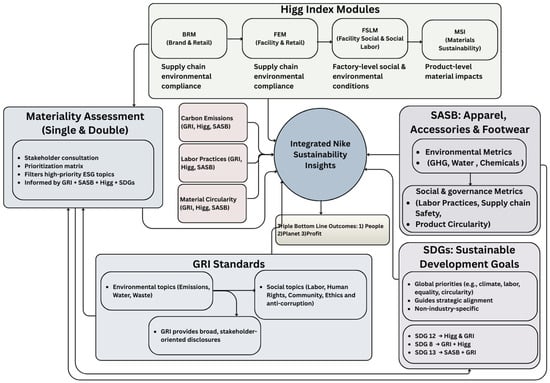
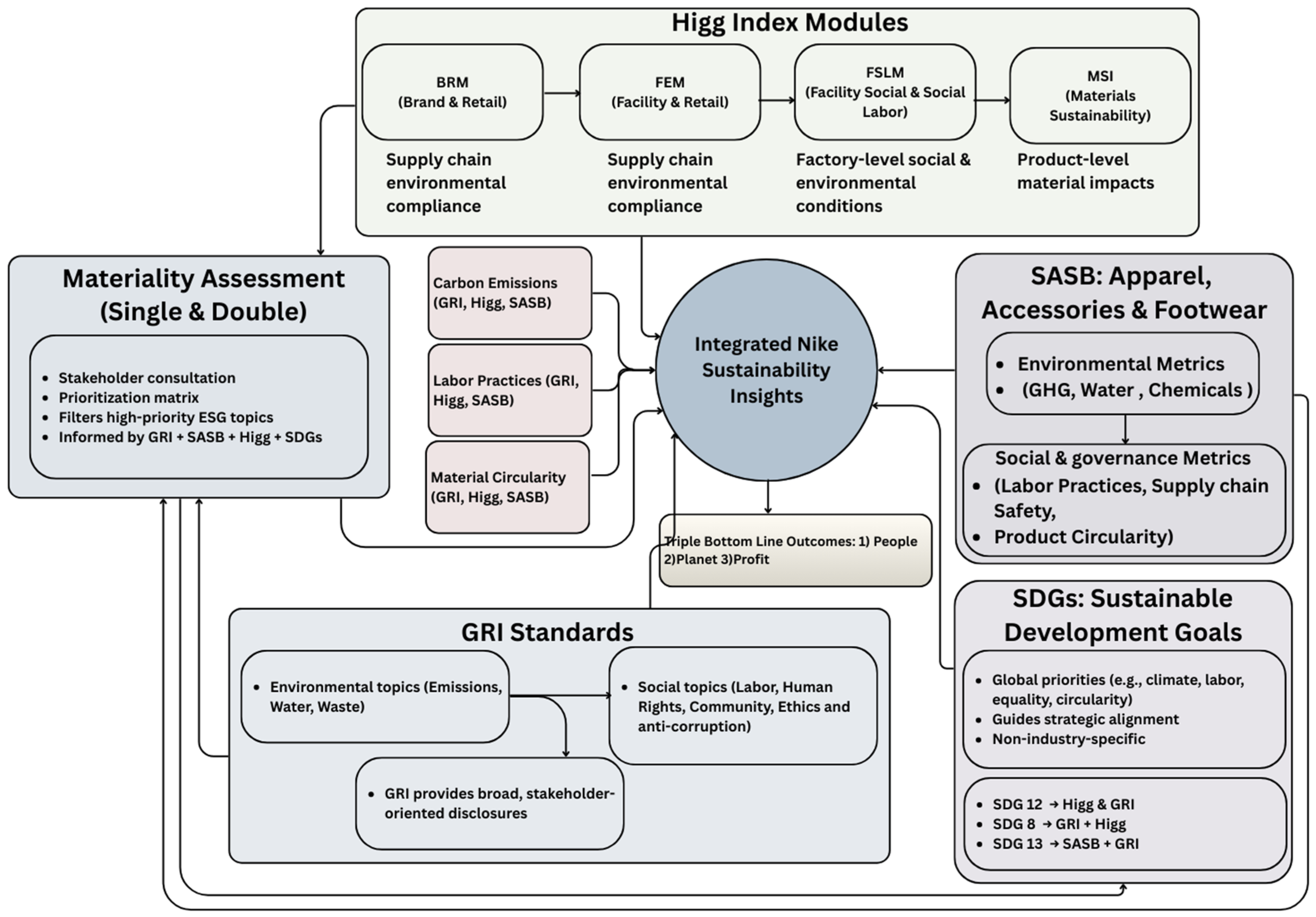
Materiality assessment is a cross-cutting process used to identify and prioritize ESG topics for reporting [6]. Recent regulatory developments—particularly within the European Union—promote a double materiality perspective that incorporates both impact materiality (effects on society and the environment) [4], and financial materiality (effects on enterprise value) [3]. Double materiality tackles circularity by requiring companies to assess both their impact on resource depletion/waste generation (impact materiality) and how circular economy transitions affect their financial performance (financial materiality). Frameworks such as GRI and SASB operationalize these logics differently: GRI emphasizes impact materiality, whereas SASB focuses on financial materiality [7,20]. In practice, companies often use materiality assessments to filter and align topics across multiple frameworks, yet studies indicate that double materiality is not consistently implemented, especially with respect to social and governance issues in global supply chains [3,16,26,33]. Details are shown in Figure 1.
Figure 1.
Integration of Nike’s sustainability reporting frameworks and insights. Note: Arrows from Higg, GRI, SASB, SDGs, and the materiality assessment into the central node indicate how Nike integrates operational, stakeholder, investor, and global-goal perspectives into a unified sustainability insight. Arrows from each framework to the materiality assessment show that all four systems inform topic prioritization. At the same time, the central links to carbon, labor, and circularity illustrate shared focal areas across frameworks.
3.4. Framework Integration: Comparative Analysis
Using several frameworks together can generate both synergies and complexity [5]. When thoughtfully combined, GRI and SASB can provide complementary perspectives on impact and financial materiality, while the Higg Index can deepen operational insights [5,27,28]. Moreover, the SDGs and TBL help frame corporate performance in relation to broader societal goals. Materiality assessment helps direct attention to the key focus areas across these systems, potentially reducing duplication and clarifying priorities [3,20]. At the same time, differences in materiality definitions, stakeholder orientations, and indicator designs can produce overlaps, gaps, and inconsistencies that complicate comparability and stakeholder interpretation, and where they offer unique value (e.g., the Higg Index’s operational depth or the SDGs’ global alignment) [13]. Table 4 summarizes the key synergies that may arise when the six frameworks considered in this study are combined.
Table 4.
Synergies Among Six Sustainability Reporting Frameworks.
3.5. Reporting Synergies
Using several sustainability reporting frameworks together can create valuable synergies. They can strengthen the relevance and overall quality of ESG disclosures [5,34]. GRI and SASB can work together to cover both impact and financial considerations [7,23,35]. Table 4 outlines how the six frameworks in this study can complement one another and reinforce different elements of reporting when applied together. For instance, the Higg Index adds apparel-specific operational metrics [22,28,36]. The SDGs and TBL help place a company’s performance in a broader social context [4,6]. Materiality assessments help highlight the most important topics and can reduce repetition while clarifying priorities [3,20]. However, differences in definitions, stakeholder expectations, and data needs can create overlaps, gaps, and tensions that make reports harder to compare and interpret [13,24,29].
4. Method
4.1. Case Selection and Rationale
Nike was selected as the case company because it has a long-standing record of sustainability reporting and discloses circularity targets against several globally recognized frameworks, including GRI, SASB, the Higg Index, the SDGs, TBL, and materiality assessment. This combination of breadth and depth makes Nike an appropriate context for observing how multiple reporting architectures interact with company strategies, stakeholder demands, and system-level impacts in the apparel sector [13].
4.2. Data and Time Frame
The analysis focuses on Nike’s 2022–2023 reporting cycle. This period represents the most recent, complete set of disclosures in which Nike reports systematically against all six focal frameworks and expands Scope 3 emissions coverage and supply chain information. It also coincides with growing regulatory attention to double materiality and climate-related disclosure in the United States. New California requirements mandate reporting on greenhouse gas emissions and climate risks. These developments raise expectations for more comprehensive ESG transparency.
The empirical material consists of 1056 pages of Nike’s publicly available sustainability and ESG documents for 2022–2023. These include the full FY22 NIKE, Inc. Impact Report (executive summary, geographic spotlights, coaching diaries, athlete addresses, SASB summary, circularity targets and data supplement), Nike’s SDG mapping resources, the GRI index and glossary, framework-specific materials linked to the Higg Index, TBL, and Nike’s materiality assessment. Documents were included if Nike or its corporate parent issued them (a), (b) contained explicit sustainability, ESG, or impact-related content, and (c) formed part of, or directly supported, the FY22 reporting cycle. Materials such as general marketing brochures without sustainability content, duplicate versions of the same report, and documents unrelated to FY22 data were excluded. This helped maintain relevance and prevent double-counting (Table 5).
Table 5.
Inclusion and Exclusion Criteria for Document Selection.
4.3. Codebook Development and Coding Procedure
The study uses a directed content analysis approach. The unit of analysis was a coded text segment, typically a single sentence or a short cluster of sentences, addressing one sustainability topic, circularity target or indicator and mapped to at least one of the six focal frameworks (Higg Index, GRI, SASB, SDGs, TBL, and Materiality Assessment).
The initial codebook was developed deductively from two sources: (1) the main domains and indicators of the six frameworks (environmental, social, governance, supply chain, and materiality-related topics) and (2) the key constructs of stakeholder, legitimacy, and systems theory as summarized in the literature review. This preliminary structure produced a set of first-order codes for environmental reporting, social standards, supply chain disclosure, and governance and legitimacy. It also generated tags for framework types and stakeholder groups.
The codebook was then refined inductively through pilot coding of a subset of Nike’s disclosures. Both researchers independently coded an initial sample of documents, identified recurring themes not captured by the deductive scheme (e.g., cross-framework references or narrative justifications for selective disclosure), and added or merged code accordingly. The final codebook comprised four main analytical categories—Environmental Reporting, Social Standards, Supply Chain Disclosure, and Governance & Legitimacy—each with several sub-codes, alongside attributes for the primary framework(s) referenced, the dominant framing of the disclosure (e.g., risk-oriented vs. opportunity-oriented), and the stakeholder group(s) addressed. Table 6 summarizes these categories and provides operational definitions, and Table 7 offers anonymized examples illustrating how codes were applied across frameworks.
Table 6.
Analysis Categories and Definitions.
Table 7.
Example Coded Excerpts by Framework.
Two researchers then independently coded all eligible documents. Each coded segment captured four elements: (1) the fundamental topic (e.g., circularity targets, emissions, labor standards, supply chain transparency, governance), (2) the primary framework(s) referenced or implied, (3) the framing of the disclosure, and (4) the stakeholder group(s) addressed. Intercoder reliability was assessed using Cohen’s kappa across [37], the four main thematic categories. Agreement levels were strong for Environmental Reporting (κ = 0.84) and Governance & Legitimacy (κ = 0.81), and moderate, almost strong for Social Standards (κ = 0.73) and Supply Chain Disclosure (κ = 0.79), all above conventional benchmarks for qualitative content analysis (Table 8). Discrepancies were reviewed in joint sessions and resolved through consensus, with minor adjustments to code definitions where recurring ambiguities were identified. The resulting coded dataset forms the basis for the cross-framework analysis presented in the Results section.
Table 8.
Intercoder Reliability for Key Categories.
4.4. Evolution of Nike’s Sustainability Reporting (2015–2023)
To situate the 2022–2023 cycle within a broader trajectory, a brief review of Nike’s reporting evolution from 2015 to 2023 was conducted using publicly available information [13]. Over this period, Nike shifted from biennial to annual sustainability reports, adopted GRI and SASB to improve comparability, and launched initiatives such as Flyknit and the Move to Zero campaign to signal long-term commitments to material circularity, carbon and waste reduction. At the same time, the company continued to face criticism regarding supply chain transparency, fair wages, and labor rights, especially around Scope 3 emissions and raw-material sourcing, which account for most of its environmental impact [1,13]. New climate-related rules in the United States—particularly California’s disclosure requirements—have also increased pressure on companies to report greenhouse gas emissions and climate risks in a more detailed and consistent way [38]. Table 9 provides a short timeline of major reporting milestones and key U.S. regulatory developments from 2015 to 2023 to help frame the 2022–2023 analysis.
Table 9.
Nike’s Reporting Milestones and US Regulatory Changes, 2015–2023.
5. Results
This section presents the key findings from Nike’s sustainability disclosures, organized according to the six major frameworks: Higg Index, GRI, SASB, SDGs, TBL, and Double Materiality. Each subsection provides targeted analysis, highlighting where reporting is most robust, where gaps persist, and how integration shapes the overall transparency and strategic narrative. A cross-framework summary at the end synthesizes these patterns and indicates the relative weight of the analyzed categories.
5.1. Disclosure According to the Higg Index
Nike’s Higgs-based disclosures show strong coverage of environmental circularity, showcasing how creative and innovative design solutions eliminate waste by keeping materials, products, and resources in use for as long as possible. Circularity targets are particularly tied to material sourcing, energy use, water management, and waste reduction. Environmental reporting accounted for a large majority of coded Higg segments, while social topics such as labor standards and workplace safety appeared less frequently and with less detail. This pattern reflects the operational design of the Higg Index, which prioritizes quantitative environmental metrics at facility and product levels, and leaves social and governance aspects comparatively underrepresented.
5.2. Disclosures According to the GRI Standards
Under GRI, Nike reports across a broad spectrum of ESG topics, with relatively detailed information on environmental performance and high-level governance structures. In the coded sample, circularity targets aligned with GRI 301 materials and GRI 302 energy are thoroughly described. Nevertheless, issues of particular concern to workers and communities—such as wage practices, supplier-level labor conditions, and local biodiversity impacts—were less extensively covered. These gaps indicate that, even within a comprehensive framework such as GRI, social and supply chain issues do not reach the same level of depth and consistency as environmental topics.
5.3. Disclosures According to the SASB Standards
SASB-based disclosures provide clear, investor-oriented information on financially material topics and circularity targets. This includes, in particular, greenhouse gas emissions, energy consumption, and selected supply chain risks. In the SASB-coded material, environmental and governance segments dominated, and supply chain disclosure focused mainly on risk and compliance indicators. By contrast, broader social issues—such as living wages, community impacts, and non-financial aspects of worker well-being—were coded far less often. This pattern highlighted the selective emphasis built into a financial-material framework.
5.4. Disclosures According to the SDGs
Nike’s SDG-related reporting focuses on a subset of sustainability and circularity goals, particularly those related to climate action (e.g., reductions in greenhouse gas emissions), and responsible consumption and production (e.g., Nike’s program “Reuse a shoe”, Nike’s Grind). Additionally, the brand identified the areas where they believe they have the biggest potential to contribute to gender equality. These specific environmental targets and social equity goals are referenced repeatedly and were associated with a comparatively high number of coded segments, often linked to existing environmental and diversity initiatives. Other SDG themes—such as poverty reduction, inequality, and community-level equity—appeared far less often. They were also supported by fewer concrete indicators, showing a more selective alignment with the SDG agenda.
5.5. Disclosures According to the Triple Bottom Line (TBL)
When viewed through a TBL lens, Nike reports progress across economic, environmental, and social dimensions. However, the coding shows that financial and ecological outcomes remain more visible than social performance. Segments on circularity through waste diversion, renewable energy, and profitability targets appeared more frequently than those on labor conditions or community impacts. This is notable because labor and community issues are central to the “people” dimension. Evidence of improvement in areas such as gender diversity in leadership is present, but social disclosures overall are less detailed than environmental ones.
5.6. Disclosures According to Materiality Assessment Processes and Double Materiality
Nike’s materiality assessment identifies high-priority topics through stakeholder engagement and internal impact analysis. These priorities are reflected in the distribution of coded segments. Circularity targets cover areas including climate risk, greenhouse gas emissions, and water use. Supply chain labor conditions are often addressed across frameworks and treated as both environmental and financial priorities. In contrast, topics such as living wages and community health are less frequent and less detailed, suggesting that issues of lower financial relevance receive less attention even when they carry significant social impacts. Overall, this pattern shows that Nike’s materiality practice still leans toward financial materiality, despite its reporting referencing double materiality.
5.7. Reconstructed Materiality Matrix Table Based on Disclosure Patterns
To assess how disclosed topics align with different dimensions of materiality and risk, a reconstructed materiality matrix was developed based on the depth, frequency, and cross-framework consistency of reporting. Topics that received extensive, detailed, and multi-framework coverage were classified as high in both impact and financial materiality (for example, GHG targets). Those with limited or inconsistent disclosure were positioned lower on one or both dimensions. For example, climate risk and greenhouse gas emissions are high on both types of materiality and have established risk-management practices. In contrast, supply chain labor and traceability score high or medium on impact but only medium on financial materiality, and their risk management is still developing. Table 10 summarizes the reconstructed materiality matrix.
Table 10.
Cross-Dimensional Evaluation of Sustainability Topics: Materiality and Risk Maturity.
5.8. Cross Framework Comparative Summary
Table 11 provides a comparative overview of Nike’s disclosures across the six frameworks, using the four principal thematic categories from the codebook. Filled circles indicate categories where coded segments were frequent and detailed, while half circles indicate more partial or uneven coverage. Overall, environmental and circularity reporting is consistently strong across all frameworks. This table illustrates high coverage scores in Higg, GRI, SASB, SDGs, TBL, and materiality assessment. Social standards, supply chain disclosure, and governance topics appear across the frameworks, but their coverage varies in depth and consistency. Several frameworks address these areas only partially. These cross-framework patterns show that Nike’s reporting system strengthens environmental transparency. At the same time, it leaves key social and supply chain topics less fully developed. This sets up the interpretive discussion in the next section.
Table 11.
Cross-Framework Comparative Summary.
6. Discussion
An analysis of Nike’s sustainability reporting across six frameworks shows that its reporting system strongly supports environmental transparency. However, it pays less consistent attention to key social and supply chain issues. This section interprets these patterns, considering framework integration, materiality debates, and the three theoretical lenses introduced earlier, and relates them explicitly to previous literature.
6.1. Synergies from Framework Integration
Nike’s simultaneous use of GRI and SASB illustrates how combining impact-oriented and investor-oriented standards can broaden stakeholder coverage. GRI-aligned disclosures cover a wide range of stakeholders and topics. SASB, in contrast, provides more detailed information on financial material issues, such as climate and energy risks. This pattern echoes prior studies that show GRI and SASB can be complementary when applied together. Although in practice, investor-focused metrics often receive more attention than broader social indicators.
The Higg Index adds industry-specific, facility-level metrics that enhance the precision and comparability of circular targets that are critical for environmental reporting. This finding is consistent with research showing that the Higg Index can strengthen environmental benchmarking in apparel but offers limited coverage of social and governance dimensions. Nike’s use of SDG references and a TBL narrative helps present its sustainability work in a broader, more holistic way. These elements link the company’s visible initiatives to global goals and to the “people–planet–profit” theme. Similar patterns of selective SDG alignment and high-level TBL references have been noted in other studies of apparel and corporate sustainability reporting. This suggests that these frameworks often strengthen the overall narrative rather than meaningfully shifting the balance of what companies choose to disclose.
6.2. Persistent Tensions and Contradictions
Despite these synergies, the results show that those circularity topics with clear financial and environmental relevance—such as climate risk, Scope 1–2 emissions, and renewable energy—receive more consistent and detailed disclosure. In contrast, labor rights, living wages, and community impacts appear less frequently and with substantially less depth. This imbalance reflects earlier research showing that social and governance issues are often underreported compared with environmental metrics. The pattern is powerful when investor-focused standards shape reporting priorities. In Nike’s case, references to double materiality appear alongside a pattern in which financial materiality still acts as the dominant filter. This suggests that the principle is applied more fully to environmental circularity targets than to social ones.
The analysis also highlights fragmentation in social and supply chain data across frameworks. Environmental information seems to come from centralized systems that make reporting under GRI, SASB, and Higg more consistent. In contrast, social and labor data come from more dispersed sources, which makes it harder to coordinate and standardize. This finding aligns with studies showing that social disclosure in global supply chains is often uneven. Researchers link this pattern to measurement challenges, context-specific metrics, and weaker institutional pressure compared with climate reporting. Overlapping requirements for emissions and other indicators across GRI, SASB, Higg, SDGs, and TBL add to the reporting burden and can create confusion for stakeholders. This pattern echoes broader concerns about the growing number of frameworks and supports calls for greater convergence, including through initiatives such as the International Sustainability Standards Board (ISSB).
6.3. Insights from Stakeholder, Legitimacy, and Systems Perspectives
Stakeholder theory helps explain why investor-oriented frameworks are more fully implemented. Stakeholders with greater influence over capital allocation and regulatory risk shape which topics receive the most attention and detail in Nike’s disclosures. Legitimacy theory helps explain why Nike adopts multiple frameworks and highlights its alignment with the SDGs and its environmental performance. These visible signals help build credibility with influential audiences, even when longstanding social concerns are only partly addressed. Systems theory suggests that many of the tensions we observe—such as fragmented social data, overlapping requirements, and uneven use of double materiality—stem from the structure of global supply chains and the complexity of reporting systems. These issues reflect broader systemic conditions rather than only company-specific choices. Together, these perspectives show how organizational priorities, stakeholder pressure, and structural constraints interact. This helps explain why environmental reporting is strong while social and supply chain disclosure remains weaker.
6.4. Theoretical and Practical Contributions
The study contributes to sustainability reporting research in three main ways. First, the study provides one of the few detailed, cross-framework analyses of a single apparel brand. It shows how six major reporting systems function together in practice rather than in isolation. Second, the study adds materiality debates by showing how double materiality language can appear alongside disclosure patterns still driven mainly by financial and environmental concerns. This is especially evident for social and supply chain topics. Third, by combining stakeholders, legitimacy, and systems theory, the study shows how multi-framework reporting can broaden accountability. At the same time, it can also reinforce existing power dynamics and data gaps. For practitioners, the findings suggest that fully realizing the benefits of multi-framework reporting will require better integration of social and supply chain data and a more precise explanation of how double materiality is applied in practice. Companies also need to be more transparent about how their choice of frameworks shapes what is reported and what receives less attention.
7. Conclusions
This study examined Nike’s sustainability disclosures across six major reporting frameworks, offering a comparative view of how overlapping standards shape transparency and accountability in the apparel sector. The analysis shows consistently strong environmental reporting, especially in areas where the frameworks overlap and reinforce each other. Comparative assessments confirm that circularity is central to Nike’s “Move to Zero” initiative, aiming for a zero-carbon and zero-waste future to protect the planet and the future of sport. By embracing circular design principles—sourcing, making, using, returning, and reimagining products—Nike reduces environmental impact, drives innovation, and creates durable, recyclable products that minimize waste. In contrast to environmental circularity targets, which are most commonly shared and measured, disclosure of social and supply chain targets—such as living wages, labor conditions, and traceability—is more uneven and selective. By comparing the priorities built into GRI, SASB, the Higg Index, the SDGs, the TBL, and Nike’s materiality assessment, the study shows how these systems interact in practice. Together, they can create beneficial synergies, but they also carry forward existing reporting imbalances. Environmental circularity indicators benefit from more quantifiable, precise metrics and more substantial alignment across different standards. In contrast, social equity, labor rights, and community well-being receive less consistent and less detailed coverage. This pattern reflects both the financial-materiality emphasis of investor-oriented standards and the operational focus of industry-specific tools.
Theoretically, the findings show that reporting frameworks are not neutral instruments but are shaped by stakeholder power, legitimacy concerns, and structural constraints in global supply chains. Methodologically, the study illustrates how directed content analysis and a cross-framework coding scheme can be used to reconstruct practical materiality priorities from corporate disclosures. In practice, the results suggest that companies aiming for more balanced reporting could strengthen their social and supply chain data systems. They can also apply double materiality more clearly when selecting topics and explain how their choice of frameworks shapes what is reported and what receives less attention.
The analysis is limited to a single company and reporting cycle and relies on publicly available documents, which may not fully capture internal deliberations or unpublished information. Future research could extend this approach to multiple brands and time periods, compare different harmonization initiatives, or explore how various stakeholder groups interpret and use integrated disclosures in practice.
Author Contributions
Conceptualization, M.S. and I.J.; methodology, M.S. and I.J.; investigation, M.S.; software, M.S.; validation, M.S. and I.J.; formal analysis, M.S. and I.J.; data curation, M.S.; writing—original draft preparation, M.S.; writing—review and editing, M.S. and I.J.; visualization, M.S.; supervision, I.J.; project administration, M.S. All authors have read and agreed to the published version of the manuscript.
Funding
This research received no external funding.
Institutional Review Board Statement
Not applicable.
Informed Consent Statement
Not applicable.
Data Availability Statement
The data used in this study are publicly available in Nike’s annual reports, published on the company’s official website.
Acknowledgments
The authors acknowledge the publicly available Nike annual sustainability and financial reports used in this research. The manuscript relies exclusively on publicly available documents, including Nike’s publicly disclosed sustainability reports. No informed consent was required.
Conflicts of Interest
The authors declare no conflicts of interest. The funders had no role in the design of the study, the collection, analysis, or interpretation of data, the writing of the manuscript, or the decision to publish the results.
References
- Garcia-Torres, S.; Rey-Garcia, M.; Albareda-Vivo, L. Effective disclosure in the fast-fashion industry: From sustainability reporting to action. Sustainability 2017, 9, 2256. [Google Scholar] [CrossRef] [Scilit]
- Niskanen, H. Sustainability in the Sporting Goods Industry: How Nike, Adidas and Puma Have Developed Company Sustainability. Bachelor’s Thesis, Metropolia University of Applied Sciences, Metropolia, Finland, 2019. [Google Scholar]
- Jørgensen, S.; Mjøs, A.; Pedersen, L.J.T. Sustainability reporting and approaches to materiality: Tensions and potential resolutions. Sustain. Account. Manag. Policy J. 2022, 13, 341–361. [Google Scholar] [CrossRef] [Scilit]
- Ballester, P. The New Complementarity Matrix of 7 Responsibilities of a Company: Toward a CSR-Oriented Marketing. 2022. Available online: https://hal.science/hal-03834109/ (accessed on 5 May 2023).
- Pesci, C.; Vola, P.; Gelmini, L. Flattening or addressing complexity? The future role of GRI in light of the sustainability accounting (r)evolution. Sustain. Account. Manag. Policy J. 2023, 14, 792–814. [Google Scholar] [CrossRef] [Scilit]
- Wych, M. Materiality Assessment: Tools and Building Blocks for ESG Reporting; AuditBoard: Cerritos, CA, USA, 2024. [Google Scholar]
- Moussa, A.S.; Elmarzouky, M. Sustainability reporting and market uncertainty: The moderating effect of carbon disclosure. Sustainability 2024, 16, 5290. [Google Scholar] [CrossRef] [Scilit]
- Caniato, F.; Caridi, M.; Crippa, L.; Moretto, A. Environmental sustainability in fashion supply chains: An exploratory case based research. Int. J. Prod. Econ. 2012, 135, 659–670. [Google Scholar] [CrossRef] [Scilit]
- Climefy. ESG Reporting Frameworks: GRI vs SASB vs TCFD; Climefy: Riyadh, Saudi Arabia, 2024. [Google Scholar]
- Covington, S.M.; Soltanisehat, M. Enhancing transparency and traceability in fast fashion: The role of blockchain technology. Int. J. Sustain. Fash. Text. 2025, 4, 257–280. [Google Scholar] [CrossRef] [Scilit]
- Broussard-Goldsmith, A. Brand Assessment of the Adaptation of Nike to New Consumer Trends. Open J. Bus. Manag. 2024, 12, 4020–4035. [Google Scholar] [CrossRef]
- Saha, S.K.; Rhaman, M.; Paul, A.; Mobin, A.; Soltanisehat, M. Environmental Impact Perspective Sustainable Online Textile Retailing: Harnessing Augmented Reality-Based Digital Twins in Bangladesh. J. Waste Manag. Xenobiotics (OAJWX) 2025, 8, 1–13. [Google Scholar] [CrossRef] [Scilit]
- Cai, Y.-J.; Choi, T.-M. A United Nations’ Sustainable Development Goals perspective for sustainable textile and apparel supply chain management. Transp. Res. Part E Logist. Transp. Rev. 2020, 141, 102010. [Google Scholar] [CrossRef] [Scilit]
- Soltanisehat, M.; Covington, S. The scalability of Aura Blockchain Consortium to advance fast fashion sustainability through collaborative innovation. In Proceedings of the Fabricating the Future: AATCC and SEAMS 2025 Annual Conference, Savannah, Georgia, 5–7 October 2025. [Google Scholar]
- Nørgaard, N. Environmental sustainability and social (in) justice in Nike’s Space Hippie campaign video–a multimodal approach. RASK-Int. J. Lang. Commun. 2022, 55, 75–94. [Google Scholar]
- Ranjan, W. The Financial Performance Analysis of Nike Inc: With Special Reference Year 2015 Annual Report. Eur. J. Bus. Manag. 2016, 8, 30–37. [Google Scholar]
- Hernandez, N. Evaluation of Sustainability & Materials Among Major Footwear Brands; California State University: Long Beach, CA, USA, 2022. [Google Scholar]
- Öndoğan, E.N.; Öndoğan, Z.; Topuzoğlu, B. A study on the investigation of sustainability practices of global brands in the fashion market. Ege Acad. Rev. 2022, 22, 393–412. [Google Scholar] [CrossRef] [Scilit]
- Nike, I. FY22 Nike Impact Report; Nike, Inc.: Beaverton, OR, USA, 2022. [Google Scholar]
- Vigneau, L.; Adams, C.A. The failure of transparency as self-regulation. Sustain. Account. Manag. Policy J. 2023, 14, 852–876. [Google Scholar] [CrossRef] [Scilit]
- Calub, M.E. Proactive Environmental Strategies: Managing a Corporate Culture Shift Toward Sustainability. Master’s Thesis, University of San Francisco, San Francisco, CA, USA, 2015. [Google Scholar]
- Fulton, K.; Lee, S. An overview of sustainability in the fashion industry. Int. J. Environ. Cult. Econ. Soc. Sustain. 2010, 6, 1–14. [Google Scholar] [CrossRef] [Scilit]
- Holloway Cripps, K.G. Best Practices in Sustainability Reporting: The Results of an Exercise by Charlton College of Business Project Team Management Students. Available online: https://www.semanticscholar.org/paper/Best-Practices-in-Sustainability-Reporting%3A-The-of-Cripps-Kaisa/0edbd5c9056f4796ddd7ce126a6a43ea087cd3d6 (accessed on 27 January 2026).
- Bakarich, K.M.; Baranek, D.; O’Brien, P.E. The current state and future implications of environmental, social, and governance assurance. Curr. Issues Audit. 2023, 17, A1–A21. [Google Scholar] [CrossRef] [Scilit]
- Whittingham, K.L.; Earle, A.G.; Leyva-de la Hiz, D.I.; Argiolas, A. The impact of the United Nations Sustainable Development Goals on corporate sustainability reporting. BRQ Bus. Res. Q. 2023, 26, 45–61. [Google Scholar] [CrossRef] [Scilit]
- Sherman, W.R. The global reporting initiative: What value is added? Int. Bus. Econ. Res. J. 2009, 8, 5. [Google Scholar] [CrossRef] [Scilit]
- Wong, C.W.; Wong, C.Y.; Boon-Itt, S.; Tang, A.K. Strategies for building environmental transparency and accountability. Sustainability 2021, 13, 9116. [Google Scholar] [CrossRef] [Scilit]
- Radhakrishnan, S. The sustainable apparel coalition and the higg index. In Roadmap to Sustainable Textiles and Clothing: Regulatory Aspects and Sustainability Standards of Textiles and the Clothing Supply Chain; Springer: Berlin/Heidelberg, Germany, 2014; pp. 23–57. [Google Scholar]
- Edgeman, R.; Neely, A.; Eskildsen, J.; Kozlowski, A.; Searcy, C.; Bardecki, M. Corporate sustainability reporting in the apparel industry. Int. J. Product. Perform. Manag. 2015, 64, 377–397. [Google Scholar]
- Islam, M.M.; Khan, M.M.R. Environmental Sustainability Evaluation of Apparel Product: A Case Study on Knitted T-Shirt. J. Text. 2014, 2014, 643080. [Google Scholar] [CrossRef] [Scilit]
- Foundation, I. Sustainability Accounting Standards Board; SASB Standards: London, UK, 2023. [Google Scholar]
- Vola, P.; Cantino, G.; Gransinigh, S. Stakeholder theory and sustainability disclosure: A comparative analysis of different approaches. Corp. Ownersh. Control 2025, 22, 63–74. [Google Scholar] [CrossRef] [Scilit]
- Asab, G. Global Reporting Initiative, & Sustainability Accounting Standards Board. GRI and SASB Reporting “Complement Each Other”. 2021. Available online: https://www.globalreporting.org/news/news-center/gri-and-sasb-reporting-complement-each-other (accessed on 8 April 2021).
- Plana.earth. Materiality Assessment: A Guide to a Better ESG Performance. 2023. Available online: https://plana.earth/academy/materiality-assessment-sustainability-strategy (accessed on 27 January 2026).
- Coalition, S.A. The Higg Index; Cascale: San Francisco, CA, USA, 2021. [Google Scholar]
- Convene, A. Materiality Matrix: Key Components for ESG Reporting. 2024. Available online: https://www.azeusconvene.com/esg/articles/what-is-a-materiality-matrix (accessed on 27 January 2026).
- McHugh, M.L. Interrater reliability: The kappa statistic. Biochem. Medica 2012, 22, 276–282. [Google Scholar] [CrossRef] [Scilit]
- European Union. Directive (EU) 2022/2464 on Corporate Sustainability Reporting (CSRD); European Union: Brussels, Belgium, 2022; pp. 15–80. [Google Scholar]

Disclaimer/Publisher’s Note: The statements, opinions and data contained in all publications are solely those of the individual author(s) and contributor(s) and not of MDPI and/or the editor(s). MDPI and/or the editor(s) disclaim responsibility for any injury to people or property resulting from any ideas, methods, instructions or products referred to in the content. |
© 2026 by the authors. Licensee MDPI, Basel, Switzerland. This article is an open access article distributed under the terms and conditions of the Creative Commons Attribution (CC BY) license.