
Cities Do Not Emerge from the Bottom Up

Abstract
1. Introduction
2. Schrödinger’s What Is Life?—A Forerunner of Complexity Theory
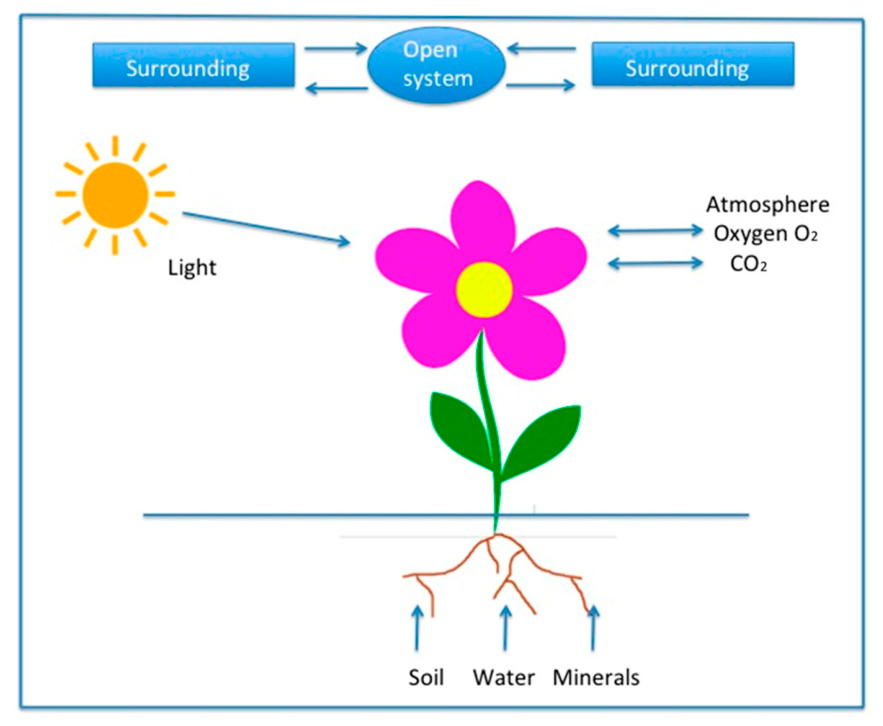
it delays the decay into thermodynamical equilibrium (death) … by means of the process of metabolism, a living organism. … feeds upon negative entropy, attracting … a stream of negative entropy upon itself, to compensate the entropy increase it produces by living and thus to maintain itself on a stationary and fairly low entropy level. [4] (The notion of negative entropy was later termed negentropy by Brillouin [7])
The orderliness encountered in the unfolding of life springs from a different source. It appears that there are two different ‘mechanisms’ by which orderly events can be produced: the ‘statistical mechanism’ which produces order from disorder and the new one, producing order from order.
… we cannot expect that the ‘laws of physics’ derived from it suffice straightaway to explain the behaviour of living matter, whose most striking features are visibly based to a large extent on the ‘order-from-order’ principle.
Watson and I were once discussing how we came to enter the field of molecular biology, and we discovered that we had both been influenced by your little book ‘What is Life?’ … We thought you might be interested—you will see that it looks as though your term ‘aperiodic crystal’ is going to be a very apt one.(Quoted in [9], Chapter 4)
3. The Emergence of a Common View
Are most types of ‘organizations’ around us of this nature?, [that is, characterized by thermodynamic equilibrium?]. […] the answer is negative. Obviously in a town, in a living system, we have a quite different type of functional order. To obtain a thermodynamic theory for this type of structure we have to show that non-equilibrium may be a source of order.(Source: [10])
4. The View from Synergetics
5. Synergetic Cities and the Emergence of an Alternative View
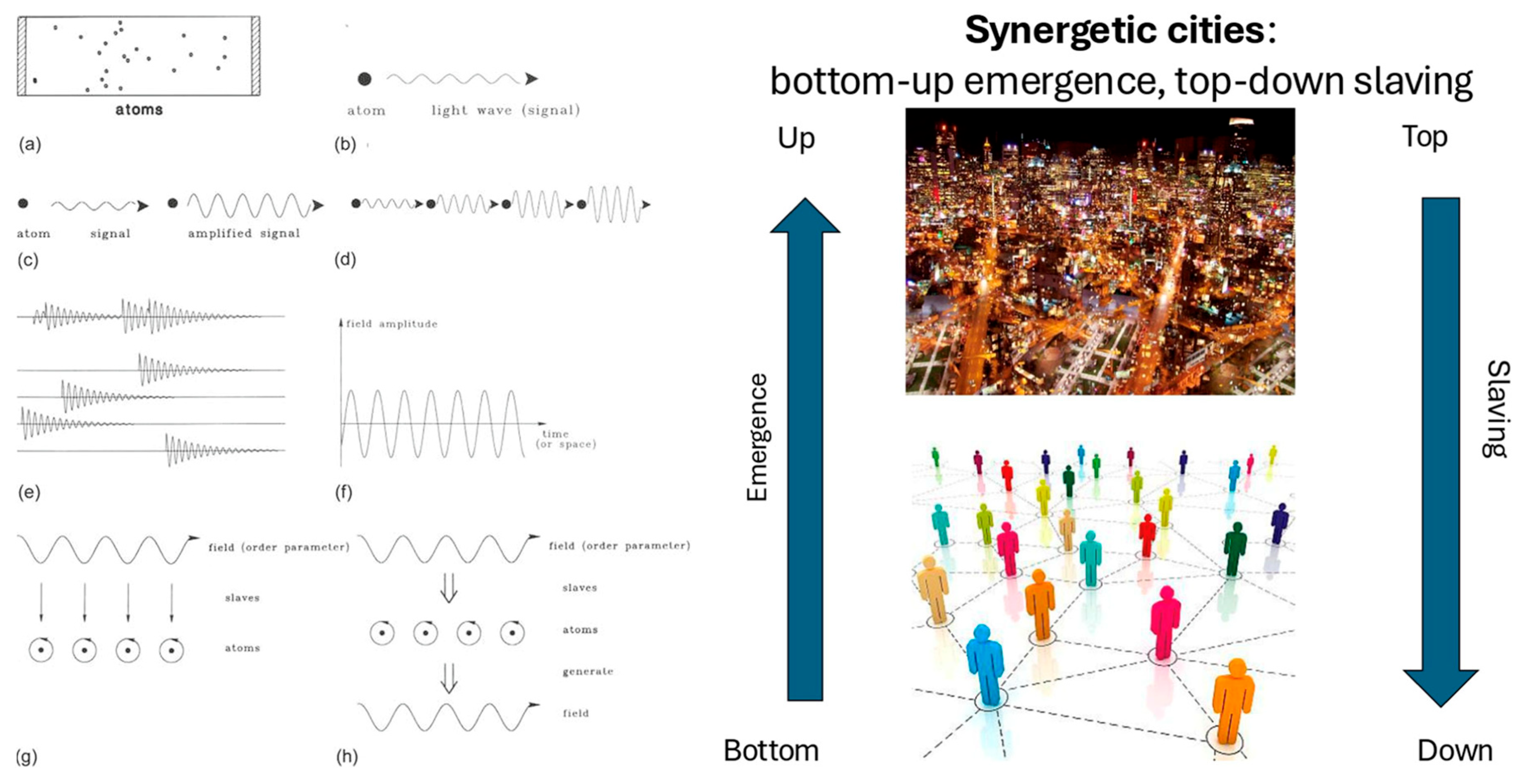
… on the one hand, the regional system serves as the environment and the boundary condition under which each local urban microstructure evolves. On the other hand, the … regional macrostructure is … the global resultant of many local structures.[31]
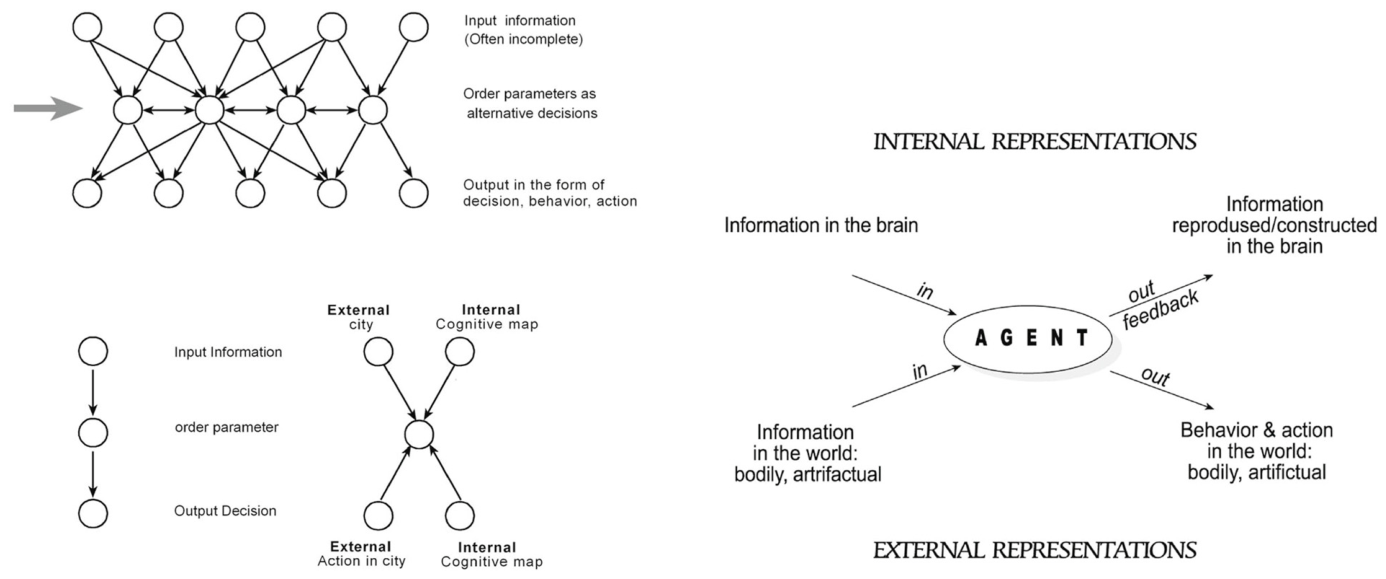
- Cognitive mapping. Introduced by Tolman’s [35] seminal paper—“Cognitive maps in rats and men”—the notion of a cognitive map is due to empirical studies indicating that animals (humans included) navigate in space according to cognitive maps constructed in their brain while moving in the environment. Subsequent studies further revealed fascinating brain properties associated with cognitive maps: O’Keefe and Dostrovsky [36] revealed the existence of the brain’s “place cells”—neurons in the hippocampus activated when an animal encounters a particular place in the environment; O’Keefe and Nadel [37] published their The Hippocampus as a Cognitive Map, while O’Keefe, May-Britt and Edvard Moser received the 2014 Nobel Prize in physiology or medicine for discovering the brain’s Grid Cells that function as “… a positioning system, an “inner GPS” in the brain that makes it possible to orient ourselves in space, demonstrating a cellular basis for higher cognitive function” (From the announcement. see: https://www.nobelprize.org/prizes/medicine/2014/press-release/, accessed on 3 November 2015) (see also [38]). In the domain of cities, studies demonstrated that urban agents move and behave in the city not according to its exact geographical structure, but rather according to the agents’ cognitive maps of the cities which are not exact representations of the urban landscape but are systematically distorted; not because of representation errors but as a consequence of the way the mind–brain processes information ([39] and [1], Chap. 6).
- Chronesthesia or mental time travel. Recent studies indicate that human memory is chronesthetic, typified by mental time travel (MTT) tendencies to the past but also to the future [40,41]. The implications are as follows: first, urban agents’ action and behavior in the here and now urban present, are determined, on the one hand, by their past experience, and on the other, by their future expectations [6,42]. Second, not only do urban agents have the capability of MTT, but they cannot not travel in time to the past and to the future. This latter property is associated with two forms of chronesthesia: One is prospective memory (PM), referring to human action determined by “a remembered future… in contrast to retrospective memory that refers to a remembered past”, that is, to “the realization of delayed intentions or plans” involving “the future use of memory—one ‘remembers to remember’ ([6] Chap. 15). The second form of chronesthesia is cognitive planning that is discussed next.
- Cognitive planning. As a corollary from the above and as implied from studies in the research domain of cognitive planning, planning is a basic cognitive capability of humans [43,44]—every human being and thus every urban agent is a planner at a certain scale with the implication that inter-agent interaction in a city is an interaction between a huge number of agents/cognitive planners of which the official city planning team is but one agent. As a consequence, due to the non-linearity that typifies complex systems, the plan of a single urban agent is often more influential in determining the structure of the city, than that of an official urban planning team (for specific case studies see [1], Chap. 15; [42]; and [6] Chap. 10).
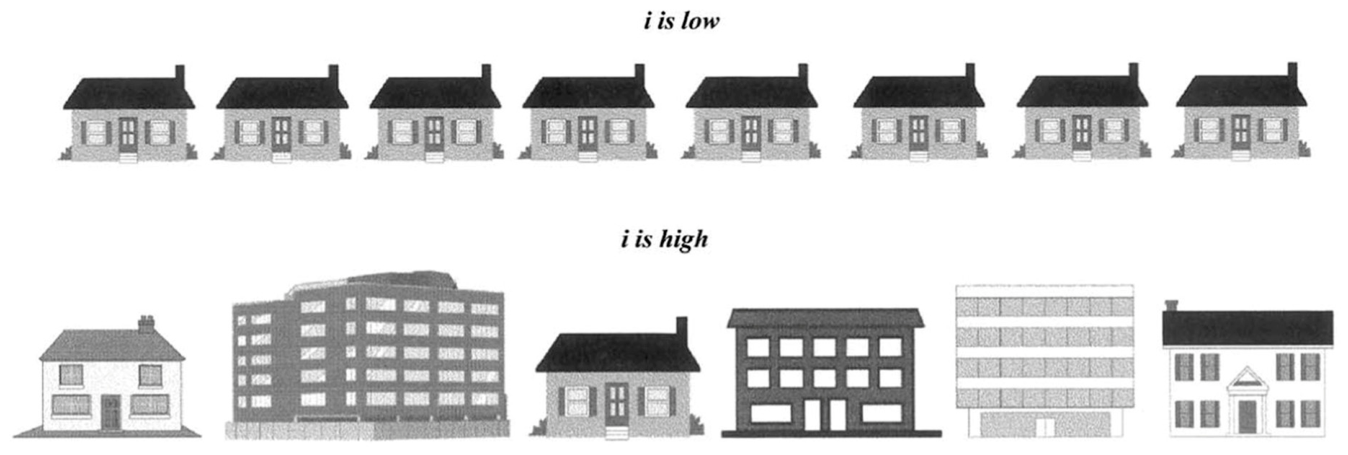
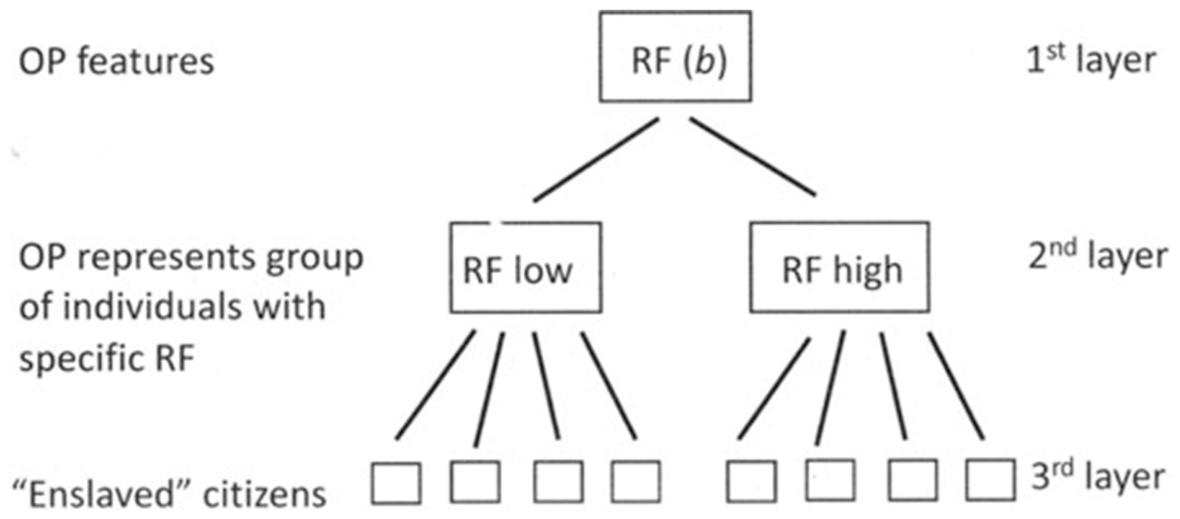
- Urban regulatory focus. As just noted, urban allometry studies established the existence of the phenomenon but did not explain how and why it occurs. Such an explanation was provided by Ross and Portugali’s ([6], Chap. 13) notion of urban regulatory focus (URF), that extends and applies psychologist Higgins’ [45,46] regulatory focus theory (RFT) to the domain of cities. Higgins’ theory posits that a person’s motivational system, that is, his or her goal-directed behavior, is regulated by two behavioral tendencies termed promotion and prevention, so that some persons are prevention oriented while others are promotion oriented. He further developed a way to quantify each person’s promotion–prevention characteristic mix termed chronic regulatory focus [47]. While Higgins refers to individuals only, Faddegon et al. [48] demonstrated empirically that a person’s chronic regulatory focus tends to be affected by the group to which one belongs—such as working place, thus giving rise to a collective regulatory focus. Ross and Portugali’s ([6] Chap. 13) URF ‘have taken the phenomenon to the city’, demonstrating empirically that cities differing in their size and thus in their ‘pace of life’ affect their citizens’ chronic regulatory focus. In a follow-up study Haken and Portugali [6] have complemented ‘the way to the city’ by demonstrating the various ways URF is affecting the dynamics of cities—cf. Section 7.1 below.
6. Cities Are Hybrid Complex Systems
7. Internal Negations and the City
7.1. Hierarchy of Order Parameters
7.2. Complementarity and Metastability
7.3. Implicate, Explicate and Generative Orders
…these two theories have never been unified in a consistent way. Rather, it seems most likely that such a unification is not actually possible. What is very probably needed instead is a qualitatively new theory, from which both relativity and quantum theory are to be derived as abstractions, approximations and limiting cases. The basic notions of this new theory evidently cannot be found by beginning with those features in which relativity and quantum theory stand in direct contradiction. The best place to begin is with what they have basically in common. This is undivided wholeness. Though each comes to such wholeness in a different way, it is clear that it is this to which they are both fundamentally pointing.
In a dialogue, … nobody is trying to win. Everybody wins if anybody wins. … there is no attempt to gain points, or to make your particular view prevail. … a dialogue is something more of a common participation, in which we are not playing a game against each other, but with each other. In a dialogue, everybody wins.
8. Concluding Notes
Funding
Institutional Review Board Statement
Informed Consent Statement
Data Availability Statement
Conflicts of Interest
References
- Portugali, J. Complexity, Cognition and the City; Springer: Berlin/Heidelberg, Germany, 2011. [Google Scholar]
- Bénard, H. Les tourbillons cellulaires dans une nappe liquide. Rev. Gén. Sci. Pures Appl. 1900, 11, 1261–1271, 1309–1328. [Google Scholar]
- Hudson, J.L.; Mankin, J.C. Chaos in the Belousov–Zhabotinskii reaction. J. Chem. Phys. 1981, 74, 6171–6177. [Google Scholar] [CrossRef] [Scilit]
- Schrödinger, E. What Is Life? The Physical Aspects of the Living Cell; Cambridge University Press: Cambridge, UK, 1944. [Google Scholar]
- Prigogine, I.; Stengers, I. Order Out of Chaos; Verso Books: Victoria, Australia, 1984. [Google Scholar]
- Haken, H.; Portugali, J. Synergetic Cities. Information, Steady State and Phase Transition: Implications to Urban Scaling, Smart Cities and Planning; Springer: Berlin/Heidelberg, Germany, 2021. [Google Scholar]
- Brillouin, L. The Negentropy Principle of Information. J. Appl. Phys. 1953, 24, 1152–1163. [Google Scholar] [CrossRef] [Scilit]
- Portugali, J. Schrödinger’s What is Life?—Complexity, Cognition and the City. Entropy 2023, 25, 872. [Google Scholar] [CrossRef] [Scilit] [PubMed]
- Greene, B. Until the End of Time; Penguin Books: Singapore, 2020. [Google Scholar]
- Prigogine, I. Time, structure and fluctuations. In Nobel Lectures, Chemistry; Frängsmyr, T., Forn, S., Eds.; World Scientific Publishing: Singapore, 1993; pp. 1971–1980. [Google Scholar]
- Jacobs, J. The Death and Life of Great American Cities; Penguin Books: London, UK, 1961. [Google Scholar]
- Hillier, B. Space Is the Machine: A Configurational Theory of Architecture; Cambridge University Press: Cambridge, UK, 1996. [Google Scholar]
- Gell-Mann, M. The Quark and the Jaguar: Adventures in the Simple and the Complex; Freeman: New York, NY, USA, 1994. [Google Scholar]
- Holland, J.H. Hidden Order: How Adaptation Builds Complexity; Addison-Wesley: New York, NY, USA, 1995. [Google Scholar]
- Bettencourt, L.M. Introduction to Urban Science: Evidence and Theory of Cities as Complex Systems; MIT Press: Cambridge MA, USA, 2021. [Google Scholar]
- de Roo, G. Adaptive Planning-Acting in moments of uncertainty. In Beyond the Future–Planning in Uncertainty to Design Unpredictability; Moccia, F.D., Sepe, M., Eds.; INU Edizione: Rome, Italy, 2024; pp. 67–86. [Google Scholar]
- Haken, H. Advanced Synergetics: Instability Hierarchies of Self-Organizing Systems and Devices; Springer: Berlin/Heidelberg, Germany, 1983. [Google Scholar]
- Haken, H. Advanced Synergetics: An Introduction, 2nd ed.; Springer: Berlin/Heidelberg, Germany, 1987. [Google Scholar]
- Haken, H. Pattern formation and pattern recognition—An attempt at a synthesis. In Pattern Formation by Dynamical Systems and Pattern Recognition; Haken, H., Ed.; Springer: Berlin/Heidelberg, Germany, 1979; pp. 2–13. [Google Scholar]
- Haken, H.; Kelso, J.A.S.; Bunz, H. A theoretical model of phase transitions in human hand movements. Biol. Cybern. 1985, 51, 347–356. [Google Scholar] [CrossRef] [Scilit] [PubMed]
- Kelso, J.A.S. Phase transitions and critical behavior in human bimanual coordination. Am. J. Physiol. 1984, 246, R1000–R1004. [Google Scholar] [CrossRef] [Scilit] [PubMed]
- Portugali, J. Complexity, Coordination Dynamics and the Urban Landscape. Buildings 2024, 14, 1327. [Google Scholar] [CrossRef] [Scilit]
- Haken, H.; Schiepek, G. Synergetik in der Psychologie. Selbst-Organisation Verstehen und Gestalten; Hogrefe: Göttingen, Germany, 2005. [Google Scholar]
- Haken, H. Synergetic Computers and Cognition; Springer: Berlin/Heidelberg, Germany, 2013. [Google Scholar]
- Haken, H. Principles of Brain Functioning: A Synergetic Approach to Brain Activity, Behavior and Cognition; Springer: Berlin/Heidelberg, Germany, 1996. [Google Scholar]
- Gibson, J.J. The Ecological Approach to Visual Perception; Houghton-Mifflin: Boston, MA, USA, 1979. [Google Scholar]
- Friston, K. The free-energy principle: A unified brain theory? Nat. Rev. Neurosci. 2010, 11, 127–138. [Google Scholar] [CrossRef] [Scilit] [PubMed]
- Haken, H. Information and Self-Organization: A Macroscopic Approach to Complex Systems, 3rd ed.; Springer: Berlin/Heidelberg, Germany, 1988. [Google Scholar]
- Shannon, C.E. A Mathematical Theory of Communication. Bell Syst. Tech. J. 1948, 27, 379–423. [Google Scholar] [CrossRef] [Scilit]
- Shannon, C.E.; Weaver, W. The Mathematical Theory of Communication; University of Illinois Press: Champaign, IL, USA, 1949. [Google Scholar]
- Weidlich, W. From fast to slow processes in the evolution of urban and regional settlement structures: The role of population pressure. Discret. Dyn. Nat. Soc. 1999, 3, 137–147. [Google Scholar]
- Weidlich, W. Sociodynamics: A Systematic Approach to Mathematical Modelling in the Social Sciences; Taylor & Francis: London, UK, 2002. [Google Scholar]
- Tanyildiz, G.S. Social reproduction, infrastructure, and the everyday. Dialogues Hum. Geogr. 2023, 15, 126–129. [Google Scholar] [CrossRef] [Scilit]
- Bettencourt, L.M.A.; Lobo, J.; Helbing, D.; Kühnert, C.; West, G.B. Growth, Innovation, Scaling, and the Pace of Life in Cities. Proc. Natl. Acad. Sci. USA 2007, 104, 7301–7306. [Google Scholar] [CrossRef] [Scilit] [PubMed]
- Tolman, E.C. Cognitive Maps in Rats and Men. Psychol. Rev. 1948, 56, 144–155. [Google Scholar] [CrossRef] [Scilit] [PubMed]
- O’keefe, J.; Dostrovsky, J. The hippocampus as a spatial map. Preliminary evidence from unit activity in the freely-moving rat. Brain Res. 1971, 34, 171–175. [Google Scholar] [CrossRef] [Scilit] [PubMed]
- O’Keefe, J.; Nadel, L. The Hippocampus as a Cognitive Map; Oxford University Press: Oxford, UK, 1978. [Google Scholar]
- Bonnevie, T.; Dunn, B.; Fyhn, M.; Hafting, T.; Derdikman, D.; Kubie, J.L.; Roudi, Y.; Moser, E.I.; Moser, M.B. Grid cells require excitatory drive from the hippocampus. Nat. Neurosci. 2013, 16, 309–317. [Google Scholar] [CrossRef] [Scilit] [PubMed]
- Tversky, B. Distortions in Cognitive Maps. Geoforum 1992, 23, 131–138. [Google Scholar] [CrossRef] [Scilit]
- Tulving, E. Elements of Episodic Memory; Clarendon Press: Oxford, UK, 1983. [Google Scholar]
- Nyberg, L.; Alice, S.N.; Habib, K.R.; Levine, B.; Tulving, E. Consciousness of Subjective Time in the Brain. Proc. Natl. Acad. Sci. USA 2010, 107, 22356–22359. [Google Scholar] [CrossRef] [Scilit] [PubMed]
- Portugali, J. What Makes Cities Complex? In Complexity, Cognition Urban Planning and Design; Portugali, J., Stolk, E., Eds.; Springer: Berlin/Heidelberg, Germany, 2016; pp. 3–20. [Google Scholar]
- Miller, G.A.; Galanter, E.H.; Pribram, K.H. Plans and the Structure of Behavior; Holt Rinehart & Winston: New York, NY, USA, 1960. [Google Scholar]
- Ormerod, T.C. Planning and ill-defined problems. In The Cognitive Psychology of Planning; Morris, R., Ward, G., Eds.; Psychology Press: Hove, UK, 2005; pp. 53–70. [Google Scholar]
- Higgins, E.T. Beyond pleasure and pain. Am. Psychol. 1997, 52, 1280–1300. [Google Scholar] [CrossRef] [Scilit] [PubMed]
- Higgins, E.T. Promotion and prevention: Regulatory focus as a motivational principle. Adv. Exp. Soc. Psychol. 1998, 30, 1–46. [Google Scholar] [CrossRef] [Scilit]
- Higgins, E.T.; Friedman, R.S.; Harlow, R.E.; Idson, L.C.; Ayduk, O.N.; Taylor, A. Achievement orientations from subjective histories of success: Promotion pride versus prevention pride. Eur. J. Soc. Psychol. 2001, 31, 3–23. [Google Scholar] [CrossRef] [Scilit]
- Faddegon, K.; Scheepers, D.; Ellemers, N. If we have the will, there will be a way: Regulatory focus as a group identity. Eur. J. Soc. Psychol. 2008, 38, 880–895. [Google Scholar] [CrossRef] [Scilit]
- Norman, D.A.; Berkrot, P. The Design of Everyday Things; The MIT Press: Cambridge, MA, USA; London, UK, 2013; ISBN 978-0-262-52567-1. [Google Scholar]
- Portugali, J. The Second Urban Revolution: Complexity, Cognition and the View from the Israeli-Palestinian Periphery; Edward Elgar Publishing: Cheltenham, UK, 2025. [Google Scholar]
- Dawkins, R. The Selfish Gene; Granada Publisher: London, UK, 1986. [Google Scholar]
- Hilpinen, R. Artifacts and Works of Art. Theoria 1992, 58, 58–82. [Google Scholar] [CrossRef] [Scilit]
- Hilpinen, R. Artifact. In The Stanford Encyclopedia of Philosophy; Winter 2011 Edition; Zalta, E.N., Ed.; Stanford University: Stanford, CA, USA, 2011. [Google Scholar]
- Cameli, S.A. Natural or artificial? A reflection on a complex ontology. Plan. Theory 2021, 20, 191–210. [Google Scholar] [CrossRef] [Scilit]
- De Franco, A. Revisiting the distinction between the natural and the artificial. Towards a properly urban ontology. Plan. Theory 2023, 22, 224–229. [Google Scholar] [CrossRef] [Scilit]
- Moroni, S.; De-Franco, A. On the multiplicity of artifacts: A typology including regulatory artifacts. Des. Stud. 2025, 101, 101356. [Google Scholar] [CrossRef] [Scilit]
- Portugali, J. Inter-Representation Networks and Cognitive Maps. In The Construction of Cognitive Maps; Portugali, J., Ed.; Kluwer Academic: Dordrecht, The Netherlands, 1996; pp. 11–43. [Google Scholar]
- Portugali, J. Information adaptation as the link between cognitive planning and professional planning. In Handbook on Planning and Complexity; de Roo, G., Yamu, C., Zuidema, C., Eds.; Elgar Publishing: Cheltenham, UK, 2020; pp. 203–219. [Google Scholar]
- Bohm, D. Wholeness and the Implicate Order; Routledge & Kegan Paul: London, UK, 1980. [Google Scholar]
- Haken, H. What Can Synergetics Contribute to Embodied Aesthetics? Behav. Sci. 2017, 7, 61. [Google Scholar] [CrossRef] [Scilit] [PubMed]
- Kelso, J.A.S.; Engstrøm, D.A. The Complementary Nature; MIT Press: Cambridge, MA, USA, 2006. [Google Scholar]
- Kelso, J.A.S.; Engstrøm, D.A. The Squiggle Sense: Sixth Sense of the Complementary Nature and the Metastable Brain~Mind; Springer: Berlin/Heidelberg, Germany, 2024. [Google Scholar]
- Portugali, J. Bohm’s theory of orders as a basis for a unified urban theory. Dialogues Urban Res. 2024, 2, 267–289. [Google Scholar] [CrossRef] [Scilit]
- Auerbach, F. Das Gesetz der Bevölkerungskonzentration. Petermanns Geogr. Mitteilungen 1913, 59, 74–76. [Google Scholar]
- Christaller, W. Central Places in Southern Germany; Prentice Hall: Englewood Cliffs, NJ, USA, 1933. [Google Scholar]
- Lösch, A. The Economics of Location; Yale Univ Press: New Haven, CT, USA, 1954. [Google Scholar]
- Kelso, S.J.A.; Stolk, E.; Portugali, J. Self-organization and Design as a Complementary Pair. In Complexity, Cognition Urban Planning and Design; Portugali, J., Stolk, E., Eds.; Springer: Berlin/Heidelberg, Germany, 2016; pp. 3–20, 43–54. [Google Scholar]
- Snow, C.P. The Two Cultures and a Second Look; Cambridge University Press: Cambridge, UK, 1964. [Google Scholar]
- Bohm, D. On Dialogue; Nichol, L., Ed.; Routledge: London, UK; New York, NY, USA, 2013. [Google Scholar]
- Stolk, E. Portugali’s creative folds. Dialogues Urban Res. 2024, 2, 305–310. [Google Scholar] [CrossRef] [Scilit]
- Bohm, D.; Peat, F.D. Science, Order and Creativity; Bantam: New York, NY, USA, 1987. [Google Scholar]


Disclaimer/Publisher’s Note: The statements, opinions and data contained in all publications are solely those of the individual author(s) and contributor(s) and not of MDPI and/or the editor(s). MDPI and/or the editor(s) disclaim responsibility for any injury to people or property resulting from any ideas, methods, instructions or products referred to in the content. |
© 2026 by the author. Licensee MDPI, Basel, Switzerland. This article is an open access article distributed under the terms and conditions of the Creative Commons Attribution (CC BY) license.
Share and Cite
Portugali, J. Cities Do Not Emerge from the Bottom Up. Complexities 2026, 2, 18. https://doi.org/10.3390/complexities2030018
Portugali J. Cities Do Not Emerge from the Bottom Up. Complexities. 2026; 2(3):18. https://doi.org/10.3390/complexities2030018
Chicago/Turabian StylePortugali, Juval. 2026. "Cities Do Not Emerge from the Bottom Up" Complexities 2, no. 3: 18. https://doi.org/10.3390/complexities2030018
APA StylePortugali, J. (2026). Cities Do Not Emerge from the Bottom Up. Complexities, 2(3), 18. https://doi.org/10.3390/complexities2030018